EP0447250B1 - Verfahren und Vorrichtung zur Dampfreinigung von laminierten Gegenständen - Google Patents
Verfahren und Vorrichtung zur Dampfreinigung von laminierten Gegenständen Download PDFInfo
- Publication number
- EP0447250B1 EP0447250B1 EP91302202A EP91302202A EP0447250B1 EP 0447250 B1 EP0447250 B1 EP 0447250B1 EP 91302202 A EP91302202 A EP 91302202A EP 91302202 A EP91302202 A EP 91302202A EP 0447250 B1 EP0447250 B1 EP 0447250B1
- Authority
- EP
- European Patent Office
- Prior art keywords
- workpiece
- coating
- cleaning
- particles
- travel path
- Prior art date
- Legal status (The legal status is an assumption and is not a legal conclusion. Google has not performed a legal analysis and makes no representation as to the accuracy of the status listed.)
- Expired - Lifetime
Links
Images


Classifications
-
- B—PERFORMING OPERATIONS; TRANSPORTING
- B08—CLEANING
- B08B—CLEANING IN GENERAL; PREVENTION OF FOULING IN GENERAL
- B08B3/00—Cleaning by methods involving the use or presence of liquid or steam
-
- H—ELECTRICITY
- H02—GENERATION; CONVERSION OR DISTRIBUTION OF ELECTRIC POWER
- H02K—DYNAMO-ELECTRIC MACHINES
- H02K15/00—Processes or apparatus specially adapted for manufacturing, assembling, maintaining or repairing of dynamo-electric machines
-
- B—PERFORMING OPERATIONS; TRANSPORTING
- B05—SPRAYING OR ATOMISING IN GENERAL; APPLYING FLUENT MATERIALS TO SURFACES, IN GENERAL
- B05C—APPARATUS FOR APPLYING FLUENT MATERIALS TO SURFACES, IN GENERAL
- B05C19/00—Apparatus specially adapted for applying particulate materials to surfaces
- B05C19/02—Apparatus specially adapted for applying particulate materials to surfaces using fluidised-bed techniques
- B05C19/025—Combined with electrostatic means
-
- B—PERFORMING OPERATIONS; TRANSPORTING
- B05—SPRAYING OR ATOMISING IN GENERAL; APPLYING FLUENT MATERIALS TO SURFACES, IN GENERAL
- B05C—APPARATUS FOR APPLYING FLUENT MATERIALS TO SURFACES, IN GENERAL
- B05C9/00—Apparatus or plant for applying liquid or other fluent material to surfaces by means not covered by any preceding group, or in which the means of applying the liquid or other fluent material is not important
- B05C9/08—Apparatus or plant for applying liquid or other fluent material to surfaces by means not covered by any preceding group, or in which the means of applying the liquid or other fluent material is not important for applying liquid or other fluent material and performing an auxiliary operation
- B05C9/10—Apparatus or plant for applying liquid or other fluent material to surfaces by means not covered by any preceding group, or in which the means of applying the liquid or other fluent material is not important for applying liquid or other fluent material and performing an auxiliary operation the auxiliary operation being performed before the application
-
- B—PERFORMING OPERATIONS; TRANSPORTING
- B08—CLEANING
- B08B—CLEANING IN GENERAL; PREVENTION OF FOULING IN GENERAL
- B08B3/00—Cleaning by methods involving the use or presence of liquid or steam
- B08B3/02—Cleaning by the force of jets or sprays
- B08B3/022—Cleaning travelling work
-
- H—ELECTRICITY
- H02—GENERATION; CONVERSION OR DISTRIBUTION OF ELECTRIC POWER
- H02K—DYNAMO-ELECTRIC MACHINES
- H02K15/00—Processes or apparatus specially adapted for manufacturing, assembling, maintaining or repairing of dynamo-electric machines
- H02K15/12—Impregnating, moulding insulation, heating or drying of windings, stators, rotors or machines
-
- Y—GENERAL TAGGING OF NEW TECHNOLOGICAL DEVELOPMENTS; GENERAL TAGGING OF CROSS-SECTIONAL TECHNOLOGIES SPANNING OVER SEVERAL SECTIONS OF THE IPC; TECHNICAL SUBJECTS COVERED BY FORMER USPC CROSS-REFERENCE ART COLLECTIONS [XRACs] AND DIGESTS
- Y10—TECHNICAL SUBJECTS COVERED BY FORMER USPC
- Y10S—TECHNICAL SUBJECTS COVERED BY FORMER USPC CROSS-REFERENCE ART COLLECTIONS [XRACs] AND DIGESTS
- Y10S118/00—Coating apparatus
- Y10S118/05—Fluidized bed
Definitions
- Armature cores are conventionally manufactured in the form of stacked laminae, punched or otherwise formed from metal plate.
- Lubricating substances are of course utilized in such metal cutting and forming operations, and as a practical matter some residual lubricant is almost invariably retained on the surface of the metal element, despite efforts made to remove it. The presence of such substances will interfere with the production of satisfactory insulating layers, and therefore a degreasing step is normally employed preliminarily to powder coating of the component, carried out in-line with the subsequent deposition and fusion steps.
- degreasing does not effectively remove matter trapped between the laminae.
- residual lubricants and the like will volatilize during the heating that is carried out to effect fusion of the powder deposit, with the consequential off-gassing tending to produce pores and other electrical and physical defects and discontinuities.
- Kawamura et al US-A-4 391 016 discloses apparatus for degreasing elongated members, such as rod stock, which includes degreasing and predrying chambers; in the latter, steam is utilized to effect predrying.
- FR-A-2 559 509 discloses a method and an apparatus for cleaning and drying workpieces, such as mechanical components for automobiles, in which a cleaning solution is sprayed on the workpieces which are subsequently dried. Air for effecting the drying exchanges heat with vaporised cleaning solution, without the two streams coming into contact.
- Chlorinated and fluorinated hydrocarbon solvents such as trichloroethylene and Freon products
- trichloroethylene and Freon products are widely employed for metal degreasing, but such solvents are of course ecologically and environmentally undesirable; their use is therefore subject to serious constraints, imposed to maintain safe and pleasant working conditions and to ensure proper disposal.
- the vapors of such substances must not be permitted to escape into the atmosphere, and consequently they are normally used at relatively low temperatures, to avoid excessively active fuming, and are contained in tanks fitted with condensing coils for confining the vapors.
- a relatively complex conveyor system must be employed to permit introduction of the workpieces at a level above the condensing coils, and passage therebelow for degreasing.
- a more specific object of the invention is to provide such a system and method in which lubricants, and other such substances, can be volatilized and thereby expelled from between adjacent laminae of a workpiece during the cleaning phase of operation.
- Another more specific object is to provide such a system in which is included a conveyor, operating on a single level, for transporting the parts through the cleaning and coating zones.
- a system for cleaning and coating a workpiece contaminated with a liquid lubricant, or the like comprising:
- Said coating means may comprise an electrostatic fluidized bed unit, and said means for effecting fusion may comprise a heating unit, said fluidized bed unit having a porous plate defining a plenum therebelow and a coating chamber thereabove, said travel path extending through said coating chamber.
- Said means for transporting may comprise a conveyor extending along said travel path and having spaced members adapted to rotatably and drivingly engage the ends of oppositely extending shaft portions of a transported workpiece; and said spray means may comprise a plurality of nozzles arranged in a bank extending along said travel path between and above said spaced members of said conveyor, said apparatus thereby being adapted for the cleaning and coating of armatures having a cylindrical core with shaft portions extending axially from the opposite ends thereof.
- Cooling means may additionally be disposed along said travel path between said cleaning apparatus and said fluidized bed unit, said cooling means being operative to lower the temperature of said workpiece.
- a method for cleaning and coating a workpiece contaminated with a liquid lubricant or the like comprising the steps:
- said workpiece is contaminated with a volatilizable liquid substance; said cleaning substance is steam, and discharge upon said workpiece elevates the temperature thereof; said workpiece is exposed to a cloud of electrostatically charged particles, said workpiece being at an electrical potential effective to attract particles of said cloud thereto, to form a coating thereupon; said workpiece is cooled between said discharging and coating steps as necessary to prevent fusion of said particles of said coating during said coating step; and fusion of said particles on said workpiece is effected subsequent to said coating step.
- Said workpiece may include a portion that is of laminated metal construction, wherein the contamination resides at least partially between the laminae thereof, said contamination comprising a substance that exists in the gaseous state at the temperature to which said object is elevated in said discharging step, said steam thereby being effective to volatilize and expel said substance from between the laminae.
- Said workpiece may be the armature of an electric machine, said armature having a cylindrical core, providing said workpiece portion, with shaft portions extending from the opposite ends of said core, the surfaces at said opposite ends of said core being coated in said workpiece exposure step.
- the steam may be superheated.
- Said particles may be of a thermoplastic material, and said fusion step may be effected by heating of said workpiece.
- Said travel path may lie substantially entirely on a single horizontal plane.
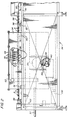
- FIG. 1 of the appended drawings therein illustrated schematically is a cleaning and coating system embodying the present invention. It includes a degreasing unit, generally designated by the numeral 10, followed sequentially by a cooling unit 12, an electrostatic fluidized bed coating unit 14, a heating unit 16, and a second cooling unit 18.
- An electrically grounded conveyor mechanism generally designated by the numeral 20 and having loading and unloading stations 22, 24 at its opposite ends, passes on a single level horizontally through each of the units 10, 12, 14, 16, and 18, to transport individual parts in the direction illustrated by the arrow in Figure 1.
- a powder supply arrangement 28 is operatively connected to the coating unit 14, in which is disposed a porous support member 30, as is conventional.
- the enclosure of the degreasing unit 10 consists of a pair of generally L-shaped end walls 32, a front wall 34, upper and lower rear walls 36 and 38, respectively, and an inclined bottom wall 40.
- the several walls cooperatively define an internal chamber 42, which includes a forward cleaning compartment and a collecting compartment rearwardly offset therefrom at a level generally therebelow.
- the forward compartment is closed by a cover 44, which is bolted in place, and the top of the collecting compartment is closed by a plate 46 that is set into an opening in the overlying upper wall 49.
- a depending partition 48 Disposed near the rear of the collecting compartment is a depending partition 48, which is attached to the overlying wall 49 and extends to a point short of the bottom wall 40.
- Elongated baffle elements 50 arranged in two transversely spaced columns, span the sidewalls 32 in front of the partition 48, and a spray tube 52 extends through one of the end walls 32 into the space therebetween, cooperatively creating a condenser section within the collecting compartment.
- a relatively large opening 54 is formed through the upper portion of the rear wall 38, to provide communication with an electrice exhaust fan 56 mounted by flange assembly 57, and an outlet port 58 is formed at the lower end of the rear wall 38, adjacent the bottom wall 40, to communicate with the drain pipe 60.
- a steam manifold 62 which is connected to the superheater 26 by conduit 66; a thermocouple (not shown) enables monitoring of the temperature therewithin.
- Inlet conduit 68 supplies saturated steam to the superheater 26, and two parallel pipes 70, each carrying a set of five downwardly directed nozzles 72, extend longitudinally within the chamber 42 from the manifold 62.
- Screen 74 spans the enclosure in a horizontal plane below the nozzles 72, and serves of course to prevent parts from dropping into the collecting compartment.
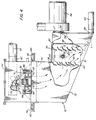
- brackets 76 atached to the enclosure provide flange portions that extend forwardly and rearwardly from the walls 34 and 36, respectively, to support the unit 10 upon the upper beams 82 of the machine frame, generally designated by the numeral 84; heat-insulating pads 80 are interposed therebetween.
- Two transversely spaced upstanding rails 90 extend parallel to one another along the top of the frame 84, passing through the aligned inlet and outlet openings 91 in the end walls 32 (only the outlet opening is visible). They rest upon the plates 92 and 94, which also support pairs of brackets 96, transversely aligned to opposite sides of the rails 90.
- the brackets 96 rotatably support parallel conveyor screws 98, which also extend through the openings 91 and cooperate with the rails to provide a length of the conveyor mechanism 20 depicted in Figure 1, and an electric motor 100 is mounted within the lower portion of the frame 84; the motor is operatively connected to the screws 98 through a belt 102, as well as to other mechanisms of the system (by means not shown).
- Panel 104 (and other similar panels, not shown) is suitably attached to enclose the illustrated section of the frame.
- armatures A the objects to be cleaned and coated, depicted herein as armatures A, are initially loaded at station 22 onto the upstanding rails 90 with the opposite ends of their shafts engaged within the threads of the screws 98; they are grounded through the conveyor mechanism 20.
- the motor 100 serves of course to rotate the screws, causing them to carry the armatures forwardly through the enclosure of the cleaning unit 10, supported by the rails 90 and rotated by coaction therewith.
- the armatures A will be subjected to high-pressure sprays of superheated steam, discharged from the nozzles 72.
- the steam will not only remove lubricant and other contamination (including dirt and metal fragments) from the exposed surfaces, but it will also heat the armatures to an elevated temperature, typically on the order of 370°C (700°F). At such temperatures the lubricants and other normally liquid contaminants will exist in the gaseous state; consequently, the steam will effect volatilization, expelling and flashing-off any liquids that may be present between the lamina of the cores.
- the cleaned armatures A After exiting the degreasing enclosure, the cleaned armatures A will pass in sequence through the cooling, coating, heating and cooling units, 12, 14, 16, and 18, respectively. In the course of doing so they will be electrostatically coated in a conventional manner, ultimately being off-loaded at location 24.
- the contaminated steam from the upper portion of the forward chamber compartment will be drawn by exhaust fan 56 through the screen 74 and into the space between the columns of baffle elements 50.
- a spray of water injected through the pipe 52 will effect condensation of any condensible fractions (e.g., of the steam, and of any contaminating substances) that may be present in the gaseous stream, with the resultant condensate liquid L passing under the internal partition 48, through the port 58, and into the drain pipe 60, to be discharged directly or conducted to a water treatment facility, as appropriate.
- any contaminating substance that is gaseous at the temperature to which the armatures are subjected to effect fusion of the coating powder deposited in the unit 14, will of course volatilize under those conditions.
- the resultant off-gassing will cause pore formation and other defects in the coating ultimately produced, leading to electrical and physical discontinuity and therefore to rejection of the part.
- the present invention obviates such problems.
- the use of steam in the cleaning operation is highly beneficial from ecological and environmental standpoints; and by avoiding any need for dipping of the workpiece into a solvent vapor tank, the process enables the use of a relatively simple conveyor system, operating horizontally and in a single plane.
- the present invention provides a novel system, method and apparatus by and with which workpieces, and especially electrical components of laminated construction, can be cleaned and coated in a continuous, in-line operation so as to enable the production of high quality, pore-free coatings thereupon.
- Metal-forming lubricants, and other substances that volatilize at elevated temperatures, will inherently be expelled from between adjacent laminae of a workpiece during the cleaning phase of operation, and the conveyor used for transporting the parts through the cleaning and coating zones can operate on a single level.
Landscapes
- Engineering & Computer Science (AREA)
- Manufacturing & Machinery (AREA)
- Power Engineering (AREA)
- Cleaning By Liquid Or Steam (AREA)
- Cleaning And De-Greasing Of Metallic Materials By Chemical Methods (AREA)
- Application Of Or Painting With Fluid Materials (AREA)
- Processing And Handling Of Plastics And Other Materials For Molding In General (AREA)
- Separation, Recovery Or Treatment Of Waste Materials Containing Plastics (AREA)
- Coating Apparatus (AREA)
- Laminated Bodies (AREA)
- Electrostatic Spraying Apparatus (AREA)
- Manufacture Of Motors, Generators (AREA)
Claims (10)
- Ein System zum Reinigen und Beschichten eines durch einen flüssigen Schmierstoff o. dgl. verunreinigten Werkstücks (A), gekennzeichnet durch:a. eine Reinigungsanlage (10) mit einer Kammer (42) und einem Sprühmittel (72) zur Abgabe von Dampf auf ein durch die besagte Kammer (42) hindurch befördertes Werkstück (A);b. ein Beschichtungsmittel (14) zum Erzeugen einer Wolke von elektrostatisch aufgeladenen Feststoffteilchen;c. ein Mittel (16) zum Bewirken der Verschmelzung eines teilchenförmigen, durch das besagte Beschichtungsmittel (14) auf dem Werkstück (A) erzeugten Niederschlags; undd. ein Mittel (20) zum Befördern eines Werkstücks (A) entlang einer Förderbahn, die sich der Reihe nach durch die besagte Kammer (42), um das Werkstück (A) zu reinigen, in Nähe des besagten Beschichtungsmittels (14), so daß das beförderte Werkstück (A) der besagten Wolke zwecks Abscheidung solcher Teilchen darauf ausgesetzt werden kann, und in Nähe des besagten Mittels (16) zum Bewirken der Verschmelzung solcher Teilchen erstreckt.
- Ein System nach Anspruch 1, dadurch gekennzeichnet, daß das besagte Beschichtungsmittel (14) eine elektrostatische Wirbelschichteinheit umfaßt, sowie dadurch, daß das besagte Mittel (16) zum Bewirken der Verschmelzung eine Erhitzungseinheit umfaßt, wobei die besagte Wirbelschichteinheit eine poröse Platte enthält, die eine darunter befindliche Plenumkammer und eine darüber befindliche Beschichtungskammer abgrenzt, während sich die besagte Förderbahn durch die besagte Beschichtungskammer hindurch erstreckt.
- Ein System nach Anspruch 1 oder 2, dadurch gekennzeichnet, daß das besagte Fördermittel (20) einen Förderer umfaßt, der sich entlang der besagten Förderbahn erstreckt und mit Abstand angeordnete Glieder (98) aufweist, die so beschaffen sind, daß sie in die Enden von sich in entgegengesetzten Richtungen erstreckenden Wellenteilen eines beförderten Werkstücks (A) drehbar und antreibend eingreifen; sowie dadurch, daß das besagte Sprühmittel (72) eine Mehrzahl von Düsen umfaßt, die in einer sich entlang der besagten Förderbahn zwischen den besagten mit Abstand angeordneten Gliedern (98) des besagten Förderers und oberhalb der besagten Glieder erstreckenden Reihe angeordnet sind, so daß die besagte Anlage zum Reinigen und Beschichten von Ankern geeignet ist, die einen zylindrischen Kern mit sich axial von den entgegengesetzten Enden davon erstreckenden Wellenteilen umfassen.
- Ein System nach den Ansprüchen 1, 2 oder 3, das zusätzlich entlang der besagten Förderbahn zwischen der besagten Reinigungsanlage (10) und dem besagten Beshichtungsmittel (14) ein Kühlmittel (12) angeordnet ist, wobei die Funktion des besagten Kühlmittels darin besteht, die Temperatur des besagten Werkstücks (A) zu senken.
- Ein Verfahren zum Reinigen und Beschichten eines Werkstücks (A), das mit einem flüssigen Schmierstoff o. dgl. verunreinigt ist, umfassend die Schritte:
des Beförderns eines verunreinigten Werkstücks entlang einer Förderbahn und des Abgebens einer Reinigungssubstanz auf das besagte Werkstück, um die Verunreinigung davon zu entfernen, wobei im Zuge einer solchen Beförderung die vor- und nachstehend angeführten Schritte durchgeführt werden; dadurch gekennzeichnet, daß:
das besagte Werkstück mit einer verflüchtigungsfähigen flüssigen Substanz verunreinigt wird;
die besagte Reinigungssubstanz Dampf ist, und die Abgabe davon auf das besagte Werkstück dessen Temperatur erhöht;
das besagte Werkstück einer Wolke elektrostatisch aufgeladener Teilchen ausgesetzt wird, wobei sich das besagte Werkstück unter einem elektrischen Potential befindet, das geeignet ist, Teilchen der besagten Wolke daran anzuziehen, um eine Beschichtung darauf zu bilden;
das besagte Werkstück zwischen den besagten Abgabe- und Beschichtungsschritten im erforderlichen Maße gekühlt wird, um Verschmelzung der besagten Teilchen der besagten Beschichtung während des besagten Beschichtungsschrittes zu verhindern; und
die Verschmelzung der besagten Teilchen an dem besagten Werkstück nach dem besagten Beschichtungsschritt bewirkt wird. - Ein Verfahren nach Anspruch 5, dadurch gekennzeichnet, daR das besagte Werkstück einen in Schichtbauweise aus Metall gefertigten Teil umfaßt, sowie dadurch, daß die Verunreinigung zumindest teilweise zwischen dessen Lamellen sitzt, wobei die besagte Verunreinigung einen Stoff umfaßt, der bei der Temperatur, auf die das besagte Objekt in dem besagten Abgabeschritt erhöht wird, im gasförmigen Zustand ist, so daß der besagte Dampf in der Lage ist, den besagten Stoff zu verflüchtigen und aus den Zwischenräumen zwischen den Lamellen auszutreiben.
- Ein Verfahren nach Anspruch 5 oder 6, dadurch gekennzeichnet, daß das besagte Werkstück der Anker einer elektrischen Maschine ist, wobei der besagte Anker einen den besagten Werkstückteil bildenden zylindrischen Kern umfaßt, mit Wellenteilen, die sich von den entgegengesetzten Enden des besagten Kerns aus erstrecken, und zwar werden die Oberflächen an den besagten entgegengesetzten Enden des besagten Kerns in dem besagten Schritt der Werkstückaussetzung beschichtet.
- Ein Verfahren nach einem der Ansprüche 5 bis 7, dadurch gekennzeichnet, daß der Dampf überhitzt ist.
- Ein Verfahren nach einem der Ansprüche 5 bis 8, dadurch gekennzeichnet, daß die besagten Teilchen aus einem thermoplastischen Material bestehen, sowie dadurch, daß der besagte Verschmelzungsschritt durch Erhitzen des besagten Werkstücks bewirkt wird.
- Ein Verfahren nach einem der Ansprüche 5 bis 9, dadurch gekennzeichnet, daß die besagte Förderbahn im wesentlichen ganz in einer einzigen waagerechten Ebene liegt.
Priority Applications (1)
| Application Number | Priority Date | Filing Date | Title |
|---|---|---|---|
| EP95103587A EP0665065B1 (de) | 1990-03-15 | 1991-03-14 | Vorrichtung zur Dampfreinigung eines Werkstücks |
Applications Claiming Priority (2)
| Application Number | Priority Date | Filing Date | Title |
|---|---|---|---|
| US493791 | 1990-03-15 | ||
| US07493791 US5052332B1 (en) | 1990-03-15 | 1990-03-15 | Apparatus and system for steam cleaning and coating of laminated articles |
Related Child Applications (2)
| Application Number | Title | Priority Date | Filing Date |
|---|---|---|---|
| EP95103587A Division EP0665065B1 (de) | 1990-03-15 | 1991-03-14 | Vorrichtung zur Dampfreinigung eines Werkstücks |
| EP95103587.2 Division-Into | 1991-03-14 |
Publications (3)
| Publication Number | Publication Date |
|---|---|
| EP0447250A2 EP0447250A2 (de) | 1991-09-18 |
| EP0447250A3 EP0447250A3 (en) | 1992-08-19 |
| EP0447250B1 true EP0447250B1 (de) | 1996-06-12 |
Family
ID=23961725
Family Applications (2)
| Application Number | Title | Priority Date | Filing Date |
|---|---|---|---|
| EP95103587A Expired - Lifetime EP0665065B1 (de) | 1990-03-15 | 1991-03-14 | Vorrichtung zur Dampfreinigung eines Werkstücks |
| EP91302202A Expired - Lifetime EP0447250B1 (de) | 1990-03-15 | 1991-03-14 | Verfahren und Vorrichtung zur Dampfreinigung von laminierten Gegenständen |
Family Applications Before (1)
| Application Number | Title | Priority Date | Filing Date |
|---|---|---|---|
| EP95103587A Expired - Lifetime EP0665065B1 (de) | 1990-03-15 | 1991-03-14 | Vorrichtung zur Dampfreinigung eines Werkstücks |
Country Status (10)
| Country | Link |
|---|---|
| US (1) | US5052332B1 (de) |
| EP (2) | EP0665065B1 (de) |
| JP (1) | JPH04222676A (de) |
| KR (1) | KR910016391A (de) |
| AT (2) | ATE139150T1 (de) |
| AU (1) | AU7287691A (de) |
| CA (1) | CA2037302A1 (de) |
| DE (2) | DE69120115T2 (de) |
| IL (1) | IL97358A0 (de) |
| NO (1) | NO911018L (de) |
Families Citing this family (13)
| Publication number | Priority date | Publication date | Assignee | Title |
|---|---|---|---|---|
| DE4122699C2 (de) * | 1991-04-19 | 1996-01-18 | Edwards Kniese & Co Hochvakuum | Arbeitsplatz für die Behandlung schadstoffbelasteter Teile |
| US5446942A (en) * | 1993-07-01 | 1995-09-05 | Whitehorn; Sydney | Steam cleaning assembly for cleaning pallets |
| US5580394A (en) * | 1993-07-12 | 1996-12-03 | Airtronic, Inc. | Method for cleaning industrial parts including sequential direct spray and immersion of the part |
| FR2717092B1 (fr) * | 1994-03-11 | 1996-04-19 | Skid Sa | Machine pour traiter les semelles de ski, notamment par ponçage. |
| WO1996001157A1 (en) * | 1994-07-01 | 1996-01-18 | R. Just Pty. Ltd. | Washing and cleaning unit |
| US6129099A (en) * | 1997-09-17 | 2000-10-10 | Foster; James B. | Pallet washing apparatus and method |
| US6328797B1 (en) * | 2000-02-29 | 2001-12-11 | Jeffrey G. Parzych | Cleaning and epoxy application table for laminate strips |
| US7946302B2 (en) * | 2006-02-03 | 2011-05-24 | George Koch Sons Llc | Parts immersion apparatus and method |
| US20080057210A1 (en) * | 2006-08-29 | 2008-03-06 | Snow Gerald F | Apparatus and method for coating fasteners |
| US7981465B2 (en) * | 2007-01-16 | 2011-07-19 | Globe Motors, Inc. | Method and apparatus for powder coating stator stacks |
| US8795439B2 (en) * | 2009-07-21 | 2014-08-05 | Beasley Ip Holdings, Llc | Method and apparatus for washing temporary road mats |
| JP6632055B2 (ja) * | 2015-12-07 | 2020-01-15 | 吉川工業株式会社 | 固定子積層鉄心の製造方法 |
| CN106787491B (zh) * | 2016-12-23 | 2019-02-12 | 江苏未来智慧信息科技有限公司 | 一种配电站电动机定子铁芯智能清理机器人 |
Family Cites Families (23)
| Publication number | Priority date | Publication date | Assignee | Title |
|---|---|---|---|---|
| US1949438A (en) * | 1930-12-02 | 1934-03-06 | Colt S Mfg Co | Cleaning and annealing machine |
| DK108983C (da) * | 1963-02-01 | 1968-03-04 | Danfoss As | Fremgangsmåde og apparat til påføring af et isolationslag i området af noterne for statoren eller rotoren af en elektrisk maskine. |
| JPS582705B2 (ja) * | 1975-07-01 | 1983-01-18 | 三菱電機株式会社 | ヒコウブツタイ |
| US3904346A (en) * | 1971-12-23 | 1975-09-09 | Leslie Earl Shaw | Electrostatic powder coating process |
| US3865610A (en) * | 1972-05-24 | 1975-02-11 | Electrostatic Equip Corp | Coating method with precure and apparatus therefor |
| US3889015A (en) * | 1972-05-24 | 1975-06-10 | Electrostatic Equip Corp | Coating method with cleaning |
| US3901185A (en) * | 1972-05-24 | 1975-08-26 | Electrostatic Equip Corp | Coating method with precure and apparatus therefor |
| US3921574A (en) * | 1972-05-24 | 1975-11-25 | Electrostatic Equip Corp | Coating method with cleaning and apparatus therefor |
| CH602202A5 (en) * | 1976-01-20 | 1978-07-31 | Sic Ag | Rinsing and disinfecting installation for hospital |
| JPS548455A (en) * | 1977-06-22 | 1979-01-22 | Hitachi Ltd | Cleansing/drying device for products |
| JPS5413455A (en) * | 1977-07-01 | 1979-01-31 | Hitachi Ltd | Uniformly expanding device for tube |
| US4141373A (en) * | 1977-09-28 | 1979-02-27 | Rjr Archer, Inc. | Method for deoiling metal scrap |
| DE2847988A1 (de) * | 1978-11-04 | 1980-05-14 | Bbc Brown Boveri & Cie | Verfahren zum verkleben von blechpaketen im elektromaschinen- und transformatorenbau |
| US4208221A (en) * | 1978-12-04 | 1980-06-17 | Copeland Corporation | Stator core stripping |
| US4400891A (en) * | 1980-03-28 | 1983-08-30 | Norsk Hydro A.S. | Steam cleaning system for process equipment and compressors |
| US4391016A (en) * | 1980-10-14 | 1983-07-05 | Kabushiki Kaisha Kobe Seiko Sho | Degreasing apparatus for elongated materials |
| DE3202920A1 (de) * | 1982-01-29 | 1983-08-11 | Rhein-Nadel Maschinennadel GmbH, 5100 Aachen | Vorrichtung zum transport stabfoermiger werkstuecke, insbesondere naehmaschinennadel-rohlinge |
| FR2559509B1 (fr) * | 1984-02-15 | 1986-07-04 | Stic Hafroy | Procede et installation pour le nettoyage et le sechage de pieces diverses, notamment de pieces mecaniques pour automobile |
| JPS6220217A (ja) * | 1985-07-18 | 1987-01-28 | Mitsubishi Electric Corp | 陰極線管パネルスカ−ト部のグラフアイト膜のトリミング方法 |
| DE3620503A1 (de) * | 1986-06-19 | 1987-12-23 | Wacker Chemie Gmbh | Stabilisierte organopolysiloxanoele |
| JPS63264182A (ja) * | 1987-04-17 | 1988-11-01 | ホソカワミクロン株式会社 | 超音波洗滌装置 |
| FR2649913B1 (fr) * | 1989-07-18 | 1991-11-08 | Stic Hafroy | Procede et installation pour le nettoyage et le sechage de pieces mecaniques notamment pour l'industrie automobile |
| JPH0555198A (ja) * | 1991-08-22 | 1993-03-05 | Nec Corp | 半導体装置の製造方法 |
-
1990
- 1990-03-15 US US07493791 patent/US5052332B1/en not_active Expired - Lifetime
-
1991
- 1991-02-26 IL IL97358A patent/IL97358A0/xx unknown
- 1991-02-28 CA CA002037302A patent/CA2037302A1/en not_active Abandoned
- 1991-03-14 AT AT91302202T patent/ATE139150T1/de not_active IP Right Cessation
- 1991-03-14 DE DE69120115T patent/DE69120115T2/de not_active Expired - Fee Related
- 1991-03-14 DE DE69128973T patent/DE69128973T2/de not_active Expired - Fee Related
- 1991-03-14 EP EP95103587A patent/EP0665065B1/de not_active Expired - Lifetime
- 1991-03-14 AT AT95103587T patent/ATE163368T1/de not_active IP Right Cessation
- 1991-03-14 AU AU72876/91A patent/AU7287691A/en not_active Abandoned
- 1991-03-14 JP JP3073643A patent/JPH04222676A/ja active Pending
- 1991-03-14 EP EP91302202A patent/EP0447250B1/de not_active Expired - Lifetime
- 1991-03-14 NO NO91911018A patent/NO911018L/no unknown
- 1991-03-15 KR KR1019910004100A patent/KR910016391A/ko not_active Ceased
Also Published As
| Publication number | Publication date |
|---|---|
| EP0665065A3 (de) | 1995-09-27 |
| EP0447250A2 (de) | 1991-09-18 |
| EP0665065A2 (de) | 1995-08-02 |
| IL97358A0 (en) | 1992-05-25 |
| EP0665065B1 (de) | 1998-02-25 |
| JPH04222676A (ja) | 1992-08-12 |
| DE69128973T2 (de) | 1998-07-30 |
| CA2037302A1 (en) | 1991-09-16 |
| NO911018L (no) | 1991-09-16 |
| ATE163368T1 (de) | 1998-03-15 |
| KR910016391A (ko) | 1991-11-05 |
| NO911018D0 (no) | 1991-03-14 |
| AU7287691A (en) | 1991-09-19 |
| US5052332A (en) | 1991-10-01 |
| EP0447250A3 (en) | 1992-08-19 |
| US5052332B1 (en) | 1997-02-18 |
| DE69120115D1 (de) | 1996-07-18 |
| DE69128973D1 (de) | 1998-04-02 |
| DE69120115T2 (de) | 1997-01-23 |
| ATE139150T1 (de) | 1996-06-15 |
Similar Documents
| Publication | Publication Date | Title |
|---|---|---|
| EP0447250B1 (de) | Verfahren und Vorrichtung zur Dampfreinigung von laminierten Gegenständen | |
| US5116636A (en) | Method for steam cleaning and electrostatic coating of laminated articles | |
| EP3096915B1 (de) | Flussverwaltungssystem und verfahren zur schadstoffbeseitigung für eine wellenlötmaschine | |
| EP3744444B1 (de) | Behandlungs- und pulverentfernungsverfahren und -systeme für generativ geformte komponenten | |
| US5653820A (en) | Method for cleaning metal articles and removing water from metal articles | |
| JP2019503284A (ja) | アディティブマニュファクチュアリング容器/プレート組立体の運搬方法 | |
| US4244078A (en) | Method and apparatus for cleaning film | |
| EP0191615B1 (de) | Verfahren und Vorrichtung zum Entfetten von dünnen Bändern | |
| US3120853A (en) | Apparatus for detergent-solvent degreasing | |
| DE69002298T2 (de) | Vakuumtrocknungsverfahren für Stückgüter und Vorrichtung zur Durchführung des Verfahrens. | |
| USRE35879E (en) | Cleaning method using both wet and dry steam, and apparatus adapted therefor | |
| JPS62500182A (ja) | 噴霧装置による冷却用設備 | |
| US5205303A (en) | Liquid cleaning process and apparatus for circuit boards and the like | |
| EP0286880B1 (de) | Trockeneinrichtung für schüttfähiges Gut | |
| US3718147A (en) | Installation for degreasing metal articles | |
| EP0405164B1 (de) | Anlage und Verfahren zur Herstellung von pulverbeschicheten, flachen Teilen, insbesondere flachen Blechteilen | |
| US3123083A (en) | Metal degreasing apparatus | |
| JPH0655114A (ja) | 洗浄装置および洗浄方法 | |
| US3924569A (en) | Apparatus for treating tire cord fabric | |
| WO2002043876A1 (en) | Workpiece coating apparatus | |
| WO1991007234A1 (en) | Improved finish spray apparatus and method | |
| DE4017361A1 (de) | Anlage und verfahren zur herstellung von pulverbeschichteten, flachen teilen, insbesondere flachen blechteilen | |
| DE2541613A1 (de) | Verfahren und vorrichtung zur entfettung und/oder reinigung von metallspaenen, schuettguetern, kleinteilen o.dgl. | |
| JPH05239678A (ja) | 洗浄方法および洗浄装置 | |
| JPH0853787A (ja) | 金属帯材の洗浄方法 |
Legal Events
| Date | Code | Title | Description |
|---|---|---|---|
| PUAI | Public reference made under article 153(3) epc to a published international application that has entered the european phase |
Free format text: ORIGINAL CODE: 0009012 |
|
| AK | Designated contracting states |
Kind code of ref document: A2 Designated state(s): AT BE CH DE DK FR GB IT LI LU NL SE |
|
| PUAL | Search report despatched |
Free format text: ORIGINAL CODE: 0009013 |
|
| AK | Designated contracting states |
Kind code of ref document: A3 Designated state(s): AT BE CH DE DK FR GB IT LI LU NL SE |
|
| 17P | Request for examination filed |
Effective date: 19930121 |
|
| RAP1 | Party data changed (applicant data changed or rights of an application transferred) |
Owner name: ELECTROSTATIC TECHNOLOGY, INC. |
|
| 17Q | First examination report despatched |
Effective date: 19940322 |
|
| GRAA | (expected) grant |
Free format text: ORIGINAL CODE: 0009210 |
|
| AK | Designated contracting states |
Kind code of ref document: B1 Designated state(s): AT BE CH DE DK FR GB IT LI LU NL SE |
|
| PG25 | Lapsed in a contracting state [announced via postgrant information from national office to epo] |
Ref country code: NL Free format text: LAPSE BECAUSE OF FAILURE TO SUBMIT A TRANSLATION OF THE DESCRIPTION OR TO PAY THE FEE WITHIN THE PRESCRIBED TIME-LIMIT Effective date: 19960612 Ref country code: LI Effective date: 19960612 Ref country code: DK Effective date: 19960612 Ref country code: CH Effective date: 19960612 Ref country code: BE Effective date: 19960612 Ref country code: AT Effective date: 19960612 |
|
| REF | Corresponds to: |
Ref document number: 139150 Country of ref document: AT Date of ref document: 19960615 Kind code of ref document: T |
|
| XX | Miscellaneous (additional remarks) |
Free format text: TEILANMELDUNG 95103587.2 EINGEREICHT AM 14/03/91. |
|
| ITF | It: translation for a ep patent filed | ||
| REF | Corresponds to: |
Ref document number: 69120115 Country of ref document: DE Date of ref document: 19960718 |
|
| GRAH | Despatch of communication of intention to grant a patent |
Free format text: ORIGINAL CODE: EPIDOS IGRA |
|
| ET | Fr: translation filed | ||
| PG25 | Lapsed in a contracting state [announced via postgrant information from national office to epo] |
Ref country code: SE Effective date: 19960912 |
|
| NLV1 | Nl: lapsed or annulled due to failure to fulfill the requirements of art. 29p and 29m of the patents act | ||
| REG | Reference to a national code |
Ref country code: CH Ref legal event code: PL |
|
| PG25 | Lapsed in a contracting state [announced via postgrant information from national office to epo] |
Ref country code: LU Free format text: LAPSE BECAUSE OF NON-PAYMENT OF DUE FEES Effective date: 19970331 |
|
| PLBE | No opposition filed within time limit |
Free format text: ORIGINAL CODE: 0009261 |
|
| STAA | Information on the status of an ep patent application or granted ep patent |
Free format text: STATUS: NO OPPOSITION FILED WITHIN TIME LIMIT |
|
| 26N | No opposition filed | ||
| PGFP | Annual fee paid to national office [announced via postgrant information from national office to epo] |
Ref country code: FR Payment date: 19990208 Year of fee payment: 9 |
|
| PGFP | Annual fee paid to national office [announced via postgrant information from national office to epo] |
Ref country code: GB Payment date: 19990216 Year of fee payment: 9 |
|
| PGFP | Annual fee paid to national office [announced via postgrant information from national office to epo] |
Ref country code: DE Payment date: 19990226 Year of fee payment: 9 |
|
| PG25 | Lapsed in a contracting state [announced via postgrant information from national office to epo] |
Ref country code: GB Free format text: LAPSE BECAUSE OF NON-PAYMENT OF DUE FEES Effective date: 20000314 |
|
| GBPC | Gb: european patent ceased through non-payment of renewal fee |
Effective date: 20000314 |
|
| PG25 | Lapsed in a contracting state [announced via postgrant information from national office to epo] |
Ref country code: FR Free format text: LAPSE BECAUSE OF NON-PAYMENT OF DUE FEES Effective date: 20001130 |
|
| REG | Reference to a national code |
Ref country code: FR Ref legal event code: ST |
|
| PG25 | Lapsed in a contracting state [announced via postgrant information from national office to epo] |
Ref country code: DE Free format text: LAPSE BECAUSE OF NON-PAYMENT OF DUE FEES Effective date: 20010103 |
|
| PG25 | Lapsed in a contracting state [announced via postgrant information from national office to epo] |
Ref country code: IT Free format text: LAPSE BECAUSE OF NON-PAYMENT OF DUE FEES;WARNING: LAPSES OF ITALIAN PATENTS WITH EFFECTIVE DATE BEFORE 2007 MAY HAVE OCCURRED AT ANY TIME BEFORE 2007. THE CORRECT EFFECTIVE DATE MAY BE DIFFERENT FROM THE ONE RECORDED. Effective date: 20050314 |