EP0447360B1 - Glycidylester von Tricarbonsäureaddukten - Google Patents
Glycidylester von Tricarbonsäureaddukten Download PDFInfo
- Publication number
- EP0447360B1 EP0447360B1 EP91810151A EP91810151A EP0447360B1 EP 0447360 B1 EP0447360 B1 EP 0447360B1 EP 91810151 A EP91810151 A EP 91810151A EP 91810151 A EP91810151 A EP 91810151A EP 0447360 B1 EP0447360 B1 EP 0447360B1
- Authority
- EP
- European Patent Office
- Prior art keywords
- composition according
- weight
- parts
- crosslinking agent
- formula
- Prior art date
- Legal status (The legal status is an assumption and is not a legal conclusion. Google has not performed a legal analysis and makes no representation as to the accuracy of the status listed.)
- Expired - Lifetime
Links
- 0 C*C(*)OC(C(CCCC1)C1C(OCC(C)(COC(C(CCCC1)C1C(OCC(C)OC)=O)=O)C(OC(*)CCOC)=O)=O)=O Chemical compound C*C(*)OC(C(CCCC1)C1C(OCC(C)(COC(C(CCCC1)C1C(OCC(C)OC)=O)=O)C(OC(*)CCOC)=O)=O)=O 0.000 description 1
- YAQFLLSHVGISIJ-UHFFFAOYSA-N CCCOC(C(C)(COC(C(CCCC1)C1C(OCC(C)CC)=C1CC1)=O)COC(C(CCCC1)C1C(OCC(C)OC)=O)=O)=O Chemical compound CCCOC(C(C)(COC(C(CCCC1)C1C(OCC(C)CC)=C1CC1)=O)COC(C(CCCC1)C1C(OCC(C)OC)=O)=O)=O YAQFLLSHVGISIJ-UHFFFAOYSA-N 0.000 description 1
- LBPTZFQSXZXJJQ-UHFFFAOYSA-N CCCOC(C(C)(COC(C(CCCC1)C1C(OCC(C)OC)=O)=O)COC(C1C(C(OCC(C)OC)=O)=C=CCC1)=O)=O Chemical compound CCCOC(C(C)(COC(C(CCCC1)C1C(OCC(C)OC)=O)=O)COC(C1C(C(OCC(C)OC)=O)=C=CCC1)=O)=O LBPTZFQSXZXJJQ-UHFFFAOYSA-N 0.000 description 1
Classifications
-
- C—CHEMISTRY; METALLURGY
- C07—ORGANIC CHEMISTRY
- C07D—HETEROCYCLIC COMPOUNDS
- C07D303/00—Compounds containing three-membered rings having one oxygen atom as the only ring hetero atom
- C07D303/02—Compounds containing oxirane rings
- C07D303/12—Compounds containing oxirane rings with hydrocarbon radicals, substituted by singly or doubly bound oxygen atoms
- C07D303/16—Compounds containing oxirane rings with hydrocarbon radicals, substituted by singly or doubly bound oxygen atoms by esterified hydroxyl radicals
-
- C—CHEMISTRY; METALLURGY
- C08—ORGANIC MACROMOLECULAR COMPOUNDS; THEIR PREPARATION OR CHEMICAL WORKING-UP; COMPOSITIONS BASED THEREON
- C08G—MACROMOLECULAR COMPOUNDS OBTAINED OTHERWISE THAN BY REACTIONS ONLY INVOLVING UNSATURATED CARBON-TO-CARBON BONDS
- C08G59/00—Polycondensates containing more than one epoxy group per molecule; Macromolecules obtained by polymerising compounds containing more than one epoxy group per molecule using curing agents or catalysts which react with the epoxy groups
- C08G59/18—Macromolecules obtained by polymerising compounds containing more than one epoxy group per molecule using curing agents or catalysts which react with the epoxy groups ; e.g. general methods of curing
- C08G59/20—Macromolecules obtained by polymerising compounds containing more than one epoxy group per molecule using curing agents or catalysts which react with the epoxy groups ; e.g. general methods of curing characterised by the epoxy compounds used
- C08G59/32—Epoxy compounds containing three or more epoxy groups
-
- C—CHEMISTRY; METALLURGY
- C08—ORGANIC MACROMOLECULAR COMPOUNDS; THEIR PREPARATION OR CHEMICAL WORKING-UP; COMPOSITIONS BASED THEREON
- C08G—MACROMOLECULAR COMPOUNDS OBTAINED OTHERWISE THAN BY REACTIONS ONLY INVOLVING UNSATURATED CARBON-TO-CARBON BONDS
- C08G59/00—Polycondensates containing more than one epoxy group per molecule; Macromolecules obtained by polymerising compounds containing more than one epoxy group per molecule using curing agents or catalysts which react with the epoxy groups
- C08G59/18—Macromolecules obtained by polymerising compounds containing more than one epoxy group per molecule using curing agents or catalysts which react with the epoxy groups ; e.g. general methods of curing
- C08G59/20—Macromolecules obtained by polymerising compounds containing more than one epoxy group per molecule using curing agents or catalysts which react with the epoxy groups ; e.g. general methods of curing characterised by the epoxy compounds used
- C08G59/32—Epoxy compounds containing three or more epoxy groups
- C08G59/3218—Carbocyclic compounds
Definitions
- the present invention relates to glycidyl esters of certain tricarboxylic acid adducts and compositions containing such esters.
- adducts from 2,2-dimethylolalkanoic acids with anhydrides leads to intermediates which can be required for the preparation of the glycidyl esters according to the invention.
- DMPA 2,2-dimethylolpropionic acid
- phthalic anhydride leads to a tricarboxylic acid adduct of the following structure:
- US Pat. No. 3,404,018 describes reaction products of hydroxycarboxylic acids with liquid epoxy resins (commercially available bisphenol A diglycidyl ethers).
- 2,2-Dimethylolpropionic acid and adducts of polyols with dicarboxylic acid anhydrides are used as hydroxycarboxylic acids, with ethylene glycol, propylene glycol, butanediol, polyethylene glycols and glycerol as polyols, and maleic acid, succinic acid, dodecenyl succinic acid, phthalic acid, phthalic acid, phthalic acid, as phthalates -, Dichloromaleic and hexachloro-endomethylene tetrahydrophthalic anhydride can be used.
- the polyols are reacted with the anhydrides in a 1: 1 mole ratio, the anhydride ring opening, resulting in the formation of an ester group between a carboxyl group of the anhydride and a hydroxyl group of the polyol, and the remaining carboxyl and hydroxyl groups remain unesterified.
- the present invention relates to new crosslinking agents for various systems.
- the present invention further provides compositions for weather-resistant coatings and cast resin parts.
- the present invention accordingly relates to polyglycidyl esters of the following formula (I) wherein R is -H or C1-C5-alkyl, and R1 is an o-phenylene or a saturated or unsaturated 1,2-cyclohexylene radical or a 2,3-bicyclo [2.2.1] -hept-5-enylene radical
- Formula (II) means, or R1 is an unsubstituted or saturated or unsaturated aliphatic group having 2 to 20 C atoms or substituted by one or more chlorine or bromine atoms, where the o-phenylene radical can be unsubstituted or substituted by one or two C1-C4 alkyl groups, and the 1,2-cyclohexylene radical and the bicyclo radical of the formula II may be unsubstituted or substituted by one or two C1-C4 alkyl groups and / or by one to six chlorine or bromine atoms.
- Preferred o-phenylene radicals are unsubstituted or methyl-substituted o-phenylene.
- Preferred 1,2-cyclohexylene radicals have the following structures which are unsubstituted or substituted by methyl, in particular in the 3,4,5 and 6-positions.
- Preferred radicals of the formula II have the formulas Preferred aliphatic radicals as R1 have from 2 to 14 carbon atoms and are, for example, -CH2CH2-, -CH2 (CH2) 2CH2-, CH2 (CH2) 12CH2- and -CH ⁇ CH-.
- R is preferably -H, -CH3 or -C2H5, but especially -CH3.
- the polyglycidyl esters according to the invention can be obtained by glycidylating the tricarboxylic acid adducts which are obtained from two moles of a dicarboxylic acid anhydride and one mole of 2,2-dimethylolalkanoic acid.
- Suitable tricarboxylic acid adducts which can be glycidylated with epichlorohydrin are adducts of 2,2-dimethylolalkanoic acids and tetrahydrophthalic acid, hexahydrophthalic acid, succinic acid, maleic acid, dodecenylsuccinic acid, hexachlorodomethylene tetrahydrophthalic acid or tachydrophthalic acid.
- Epoxidation of the trifunctional carboxylic acid adducts thus obtained can be carried out using an excess of epichlorohydrin in the presence of a phase transfer agent, e.g. Tetramethylammonium chloride, and subsequent dehydrohalogenation with sodium hydroxide with azeotropic removal of the water from the reaction mixture to reduce to a minimum a possible saponification of the ester groups by the alkaline agent.
- a phase transfer agent e.g. Tetramethylammonium chloride
- the 2,2-dimethylolalkanoic acids used according to the invention have 4 to 9 carbon atoms and have the following formula (III): wherein R is -H or C1-C5-alkyl.
- Examples include 2,2-dimethylolbutyric acid, 2,2-dimethylolvaleric acid and 2,2-dimethylolcaproic acid, and in particular 2,2-dimethylolpropionic acid (2,2-bis-hydroxymethylpropionic acid, hereinafter abbreviated as DMPA).
- DMPA 2,2-dimethylolpropionic acid
- the effective amount of the crosslinking agent is 2 to 15 parts by weight for 85 to 98 parts by weight of polyglycidyl ester a).
- the effective amount of the crosslinking agent is 70 to 90 parts by weight for 10 to 30 parts by weight of the polyglycidyl ester a).
- crosslinking agent is an aliphatic or aromatic amine, e.g. Diaminodiphenylmethane or 4,4'-diaminodiphenylsulfone, 10 to 20 parts by weight of crosslinking agent for 80 to 90 parts by weight of polyglycidyl ester a) are effective amounts.
- aliphatic or aromatic amine e.g. Diaminodiphenylmethane or 4,4'-diaminodiphenylsulfone
- the effective amount of the crosslinking agent is 35 to 45 parts by weight for 55 to 65 parts by weight of polyglycidyl ester a).
- the coating compositions according to the invention can also contain solvents, pigments, fillers, flow regulators and other conventional additives for epoxy resins used in coating compositions.
- Example 1 Preparation of the adduct from DMPA and hexahydrophthalic anhydride.
- a 5.0 liter flask with stirrer, reflux condenser, nitrogen supply and thermometer is loaded with 1850 g of hexahydrophthalic anhydride under nitrogen and heated to 80 ° C. Then 800 g of methyl isobutyl ketone (MIBK) and then 805 g of dimethylolpropionic acid (DMPA) and 800 g of MIBK are added. The reaction mixture is heated to 100 ° C. and held at this temperature for 5.5 hours.
- MIBK methyl isobutyl ketone
- DMPA dimethylolpropionic acid
- MIBK is then distilled off at 60 ° C under a pressure of 6666.1 Pa (50 mm Hg) and then at 90 ° C under less than 1333.22 Pa (10 mm Hg).
- the residue is discharged liquid (as a melt) and allowed to cool.
- the received The product is a white powder with a melting point of 81 ° C and an acid number of 376 mg KOH / g.
- Example 2 Glycidylation of the Adduct Obtained According to Example 1
- a 5-liter flask equipped with stirrer, an azeotropic separation device for epichlorohydrin / water, and a thermometer-thermoregulator is 1100 g of the adduct obtained according to Example 1, 5 g of Irganox ® 1010 (antioxidant from Ciba-Geigy Corp.) and 49.3 g of a 50% aqueous tetramethylammonium chloride solution (TMAC) filled. 250 g of epichlorohydrin are then added dropwise at 60 ° C., and the mixture is stirred for a further 30 minutes, the temperature being kept at 60-65 ° C. by cooling, if necessary.
- Irganox ® 1010 antioxidant from Ciba-Geigy Corp.
- TMAC 50% aqueous tetramethylammonium chloride solution
- the product obtained has the following properties: Percent epoxidation: 77; Epoxy content: 0.414 Aeq / 100 g; Acid number: ⁇ 1; Viscosity at 25 ° C: 16800 cP; Chlorine content (total): 1.50%; Hydrolyzable chlorine: 1.00%.
Landscapes
- Chemical & Material Sciences (AREA)
- Organic Chemistry (AREA)
- Health & Medical Sciences (AREA)
- Chemical Kinetics & Catalysis (AREA)
- Medicinal Chemistry (AREA)
- Polymers & Plastics (AREA)
- Epoxy Resins (AREA)
- Epoxy Compounds (AREA)
- Paints Or Removers (AREA)
- Heterocyclic Carbon Compounds Containing A Hetero Ring Having Oxygen Or Sulfur (AREA)
Description
- Die vorliegende Erfindung betrifft Glycidylester bestimmter Tricarbonsäureaddukte sowie Zusammensetzungen enthaltend derartige Ester.
- Die Bildung von Addukten aus 2,2-Dimethylolalkansäuren mit Anhydriden führt zu Zwischenprodukten, die zur Herstellung der erfindungsgemässen Glycidylester benötigt werden können. So führt z.B. die Umsetzung von einem Mol 2,2-Dimethylolpropionsäure (DMPA) mit Phthalsäureanhydrid zu einem Tricarbonsäureaddukt folgender Struktur:

Im US-Patent Nr. 3,404,018 sind Reaktionsprodukte von Hydroxycarbonsäuren mit flüssigen Epoxidharzen (handelsüblichen Bisphenol-A-diglycidylethern) beschrieben. Als Hydroxycarbonsäuren werden 2,2-Dimethylolpropionsäure sowie Addukte von Polyolen mit Dicarbonsäureanhydriden verwendet, wobei als Polyole Ethylenglykol, Propylenglykol, Butandiol, Polyethylenglykole und Glycerin, und als Anhydride Maleinsäure-, Bernsteinsäure-, Dodecenyl-bernsteinsäure-, Phthalsäure-, Tetrahydrophthalsäure-, Hexahydrophthalsäure-, Dichlormaleinsäure- und Hexachlor-endomethylen-tetrahydrophthalsäure-anhydrid eingesetzt werden. - Die Polyole werden mit den Anhydriden in einem 1:1-Mol-Verhältnis umgesetzt, wobei sich der Anhydridring öffnet, was zur Bildung einer Estergruppe zwischen einer Carboxylgruppe des Anhydrids und einer Hydroxylgruppe des Polyols führt, und die restlichen Carboxyl- und Hydroxylgruppen bleiben unverestert.
- Die Reaktion der erhaltenen Hydroxymonocarbonsäuren mit der Epoxidgruppe eines handelsüblichen flüssigen Harzes liefert einen Hydroxyester ohne oder mit geringer Veresterung der Carboxylgruppe mit den sich im gleichen Molekül befindenden Hydroxylgruppen, wie nachstehend dargestellt:

wobei R¹ einen aliphatischen, cycloaliphatischen oder aromatischen Rest, der sich von einem Monohydroxycarbonsäure- oder Polyolanhydrid-Addukt ableitet, bedeutet, und das Addukt durch Reaktion eines Polyols und eines Anhydrids gebildet wird. - Ein Gegenstand der vorliegenden Erfindung sind neue Vernetzungsmittel für verschiedene Systeme.
- Ein weiterer Gegenstand vorliegender Erfindung sind Zusammensetzungen für wetterbeständige Beschichtungen und Giessharzteile.
- Die vorliegende Erfindung betrifft demnach Polyglycidylester der folgenden Formel (I)

worin R -H oder C₁-C₅-Alkyl ist, und R¹ einen o-Phenylen- oder einen gesättigten oder ungesättigten 1,2-Cyclohexylen-Rest oder einen 2,3-Bicyclo[2.2.1]-hept-5-enylenrest der Formel (II)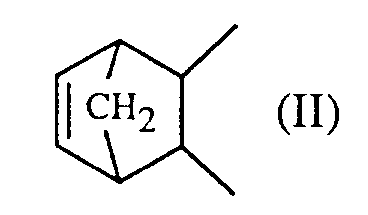
bedeutet, oder R¹ eine unsubstituierte oder durch ein oder mehrere Chlor- oder Bromatome substituierte gesättigte oder ungesättigte aliphatische Gruppe mit 2 bis 20 C-Atomen bedeutet, wobei der o-Phenylenrest unsubstituiert oder durch eine oder zwei C₁-C₄-Alkylgruppen substituiert sein kann, und der 1,2-Cyclohexylenrest und der Bicyclorest der Formel II unsubstituiert oder durch eine oder zwei C₁-C₄-Alkylgruppen und/oder durch ein bis sechs Chlor- oder Bromatome substituiert sein können. - Bevorzugte o-Phenylenreste sind unsubstituiertes oder durch Methyl substituiertes o-Phenylen.
- Bevorzugte 1,2-Cyclohexylenreste weisen die folgenden Strukturen

auf, welche unsubstituiert oder durch Methyl, insbesondere in 3,4,5 und 6-Stellung, substituiert sind. - Bevorzugte Reste der Formel II haben die Formeln

Bevorzugte aliphatische Reste als R¹ weisen von 2 bis 14 C-Atomen auf und sind z.B. -CH₂CH₂-, -CH₂(CH₂)₂CH₂-, CH₂(CH₂)₁₂CH₂- und -CH≡CH-. - R ist bevorzugt -H, -CH₃ oder -C₂H₅, insbesondere aber -CH₃.
- Die erfindungsgemässen Polyglycidylester können durch Glycidylierung der Tricarbonsäureaddukte, die aus zwei Mol eines Dicarbonsäureanhydrids und einem Mol 2,2-Dimethylolalkansäure gewonnen werden. Geeignete Tricarbonsäureaddukte, die mit Epichlorhydrin glycidyliert werden können, sind Addukte aus 2,2-Dimethylolalkansäuren und Tetrahydrophthalsäure-, Hexahydrophthalsäure-, Bernsteinsäure-, Maleinsäure-, Dodecenylbernsteinsäure-, Hexachlorendomethylentetrahydrophthalsäure- oder Tetrachlorphthalsäure-anhydrid.
- Epoxidierung der so erhaltenen trifunktionellen Carbonsäureaddukte kann unter Verwendung eines Ueberschusses an Epichlorhydrin in Gegenwart eines Phasentransfermittels, z.B. Tetramethylammoniumchlorid, und anschliessende Dehydrohalogenierung mit Natriumhydroxid unter azeotroper Entfernung des Wassers aus dem Reaktionsgemisch zur Reduzierung auf das Minimum einer möglichen Verseifung der Estergruppen durch das alkalische Mittel durchgeführt werden.
- Die erfindungsgemäss verwendeten 2,2-Dimethylolalkansäuren weisen 4 bis 9 C-Atome auf und haben die folgende Formel (III):

worin R -H oder C₁-C₅-Alkyl bedeutet. - Beispiele hierfür sind 2,2-Dimethylolbuttersäure, 2,2-Dimethylolvaleriansäure und 2,2-Dimethylolcapronsäure, und insbesondere 2,2-Dimethylolpropionsäure (2,2-Bis-hydroxymethylpropionsäure, nachstehend als DMPA abgekürzt).
- Ein besonders bevorzugtes DMPA-Addukt mit Hexahydrophthalsäureanhydrid weist die folgende Formel (IV) auf:

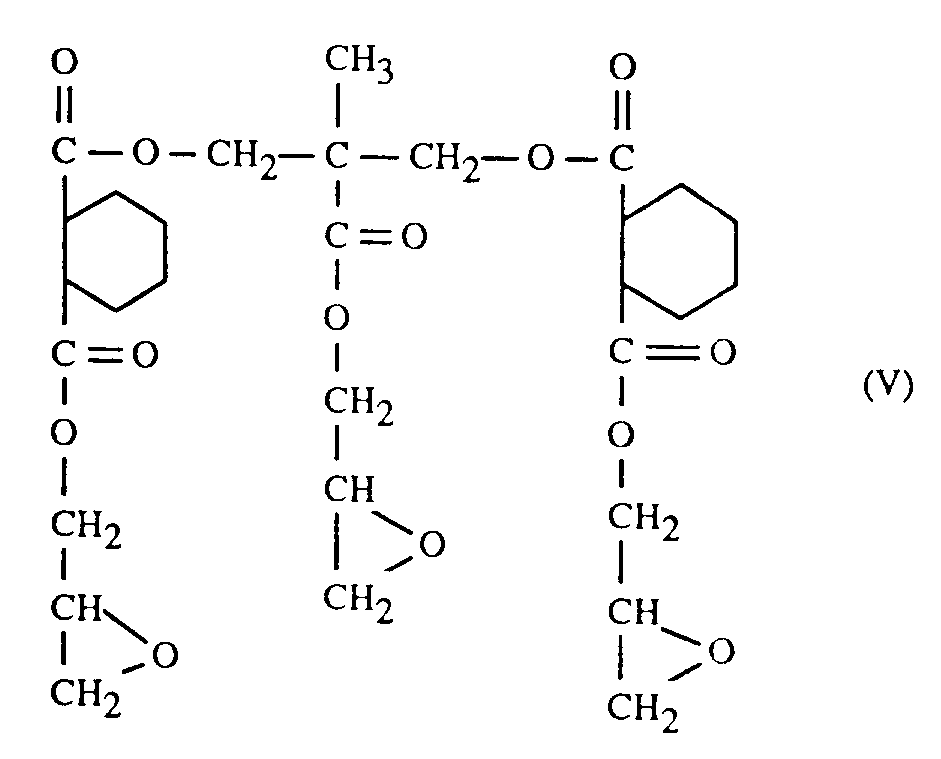
Dieses Addukt ist ein weisses Pulver mit einer Säurezahl von 376 mg KOH/g, und der Glycidylester davon (nachstehende Formel) ist eine viskose klare Flüssigkeit mit einem Epoxidgehalt von 0,35 bis 0,45 Aeq./100 g:
Ein weiterer Gegenstand der vorliegenden Erfindung betrifft eine hitzehärtbare Beschichtungs- und Giessharzzusammensetzung enthaltend - a) einen Polyglycidylester der obigen Formel I und
- b) eine effektive Menge eines Vernetzungsmittels aus der Reihe Dicyandiamid, der hitzehärtbaren Polyester enthaltend funktionelle Carboxylgruppe(n), der Polyhydroxyether mit phenolischen Endgruppen, der Amine und der Anhydride.
- Wird Dicyandiamid verwendet, so beträgt die effektive Menge des Vernetzungsmittels 2 bis 15 Gewichtsteile für 85 bis 98 Gewichtsteile Polyglycidylester a).
- Ist das Vernetzungsmittel ein Polyester mit funktionellen Carboxylgruppen, so beträgt die effektive Menge des Vernetzungsmittels 70 bis 90 Gewichtsteile für 10 bis 30 Gewichtsteile des Polyglycidylesters a).
- Beim Einsatz eines Polyhydroxyethers mit phenolischen Endgruppen als Vernetzungsmittel beträgt dessen effektive Menge 10 bis 30 Gewichtsprozente für 70 bis 90 Gewichtsteile des Polyglycidylesters a).
- Ist das Vernetzungsmittel ein aliphatisches oder aromatisches Amin, wie z.B. Diaminodiphenylmethan oder 4,4'-Diaminodiphenylsulfon, so werden als effektive Mengen 10 bis 20 Gewichtsteile Vernetzungsmittel für 80 bis 90 Gewichtsteile Polyglycidylester a).
- Beim Einsatz eines Anhydrids, wie z.B. Hexahydrophthalsäureanhydrid, so beträgt die effektive Menge des Vernetzungsmittels 35 bis 45 Gewichtsteile für 55 bis 65 Gewichtsteile Polyglycidylester a).
- Die erfindungsgemässen Beschichtungszusammensetzungen können auch Lösungsmittel, Pigmente, Füllmittel, das Fliessverhalten regulierende Mittel sowie andere herkömmliche Zusätze für in Beschichtungszusammensetzungen eingesetzte Epoxidharze enthalten.
- Die folgenden Beispiele illustrieren den vorliegenden Erfindungsgegenstand.
- Ein 5,0 Liter Kolben mit Rührer, Rückflusskühler, Stickstoffzufuhr und Thermometer wird mit 1850 g Hexahydrophthalsäureanhydrid unter Stickstoff beladen und auf 80°C erwärmt. Dann werden 800 g Methylisobutylketon (MIBK) und anschliessend 805 g Dimethylolpropionsäure (DMPA) und 800 g MIBK zugegeben. Das Reaktionsgemisch wird auf 100°C erwärmt und bei dieser Temperatur während 5,5 Stunden gehalten.
- MIBK wird dann bei 60°C unter einem Druck von 6666,1 Pa (50 mm Hg) und anschliessend bei 90°C unter weniger als 1333,22 Pa (10 mm Hg) abdestilliert.
- Der Rückstand wird flüssig (als Schmelze) ausgeladen und erkalten lassen. Das erhaltene Produkt ist ein weisses Pulver mit einem Schmelzpunkt von 81°C und einer Säurezahl von 376 mg KOH/g.
- Ein 5 Liter Kolben mit Rührer, einer azeotropischen Abscheidungseinrichtung für Epichlorhydrin/Wasser und einem Thermometer-Thermoregulator wird mit 1100 g des gemäss Beispiel 1 erhaltenen Adduktes, 5 g Irganox® 1010 (Antioxidanz der Ciba-Geigy Corp.) und 49,3 g einer 50%igen wässrigen Tetramethylammoniumchloridlösung (TMAC) gefüllt. Danach werden 250 g Epichlorhydrin bei 60°C zugetropft, und das Gemisch wird während 30 Minuten weitergerührt, wobei die Temperatur durch Kühlung, falls nötig, auf 60-65°C gehalten wird.
- Dann werden 49,3 g einer 50%igen TMAC-Lösung zugegeben, und Teilvakuum von ca. 6666,1 Pa (ca. 50 mm Hg) wird zur Einstellung des Rückflusses (ca 65°C) angelegt.
- Anschliessend werden 540 g einer 50%igen NaOH-Lösung innerhalb von 4 bis 5 Stunden zugegeben, wobei gleichzeitig Wasser durch azeotropische Destillation entfernt wird. Nach der Zugabe der NaOH-Lösung wird das restliche Wasser während 7 Stunden entfernt, das Vakuum wird ausgeschaltet und der Kolben wird auf Raumtemperatur abgekühlt. Der Rückstand wird vom Salz durch Filtration befreit, das Filtrat wird zweimal mit 750 ml einer 10%igen warmen wässrigen Natriumzitratlösung während 5 Minuten extrahiert, das erhaltene Gemisch wird 10 Minuten stehen gelassen, die obere wässrige Schicht wird entfernt und die organische Schicht wird filtriert.
- Die Aufarbeitung wird wie folgt durchgeführt:
- 1. Die organische Schicht mehrerer Ansätze wird gesammelt und in einem 12,0 Liter Drei-Halsrundkolben mit Vakuumdestillationseinrichtung abgefüllt.
- 2. 262 g einer 50%igen wässrigen NaOH-Lösung und 105 g einer 50%igen wässrigen TMAC-Lösung werden zugegeben, und die erhaltene Mischung wird auf 70°C erwärmt und während 30 Min. bei dieser Temperatur gehalten.
- 3. 2000 ml deionisiertes Wasser werden zugegeben, und das Gemisch wird auf 70°C erwärmt, so dass sich der gebildete Niederschlag wieder löst.
- 4. Die organische (obere) Schicht wird abdekantiert und mit 2000 ml deionisiertem Wasser und 20 g trockenem Eis gewaschen. Das gesamte Gemisch wird auf 70°C zur vollständigen Lösung eines allfälligen Niederschlages erwärmt.
- 5. Der pH-Wert der wässrigen Phase (obere Schicht) des zweiten Waschgangs muss unter 7 sein.
- 6. Die organische (untere) Schicht wird gesammelt, mit 100 g Supergel Hyflo, dann mit 3000 ml MIBK behandelt, und anschliessend vom Supergel abfiltriert.
- 7. MIBK wird dann bei 60°C unter Druck (10 mm Hg) abdestilliert.
- Ausbeute: 68 % der Theorie [2-Methyl-2-ketoglycidyloxy-1,3-ketoxy-bis(β-ketoglycidyloxy-α-cyclohexyl)propan].
- Das erhaltene Produkt weist folgende Eigenschaften auf:
Prozentige Epoxidierung: 77;
Epoxidgehalt: 0,414 Aeq/100 g;
Säurezahl: <1;
Viskosität bei 25°C: 16800 cP;
Chlorgehalt (total): 1,50 %;
Hydrolysierbares Chlor: 1,00 %.
Claims (20)
- Hitzehärtbare Beschichtungszusammensetzungen enthaltenda) einen Polyglycidylester der nachstehenden Formel (I) undb) eine effektive Menge eines Vernetzungsmittels aus der Reihe Dicyandiamid, der hitzehärtbaren Polyester enthaltend polyfunktionelle Carbonsäure(n), der Polyhydroxyether mit phenolischen Endgruppen, der Amine und der Anhydride


- Zusammensetzungen gemäss Anspruch 1, worin der Polyglycidylester die Formel (V)
- Zusammensetzungen gemäss Anspruch 1, worin das Vernetzungsmittel Dicyandiamid ist.
- Zusammensetzungen gemäss Anspruch 1, worin die effektive Menge des Vernetzungsmittels 2 bis 15 Gewichtsteile für 85 bis 98 Gewichtsteile Polyglycidylester beträgt.
- Zusammensetzungen gemäss Anspruch 1, worin das Vernetzungsmittel ein hitzehärtbarer Polyester mit funktionellen Carboxylgruppen ist.
- Zusammensetzungen gemäss Anspruch 5, worin die effektive Menge des Vernetzungsmittels 70 bis 90 Gewichtsteile für 10 bis 30 Gewichtsteile Polyglycidylester beträgt.
- Zusammensetzungen gemäss Anspruch 1, worin das Vernetzungsmittel ein Polyhydroxyether mit phenolischen Endgruppen ist.
- Zusammensetzungen gemäss Anspruch 7, worin die effektive Menge des Polyhydroxyethers 10 bis 30 Gewichtsteile für 70 bis 90 Gewichtsteile des Polyglycidylesters beträgt.
- Zusammensetzungen gemäss Anspruch 1, worin das Vernetzungsmittel ein aromatisches oder aliphatisches Amin ist.
- Zusammensetzungen gemäss Anspruch 9, worin die effektive Menge des Amins 10 bis 20 Gewichtsteile für 80 bis 90 Gewichtsteile Polyglycidylester beträgt.
- Zusammensetzungen gemäss Anspruch 1, worin in der Formel I R Methyl bedeutet.
- Zusammensetzungen gemäss Anspruch 1, worin in der Formel I R¹ 1,2-Cyclohexen bedeutet.
Applications Claiming Priority (2)
| Application Number | Priority Date | Filing Date | Title |
|---|---|---|---|
| US494194 | 1983-05-13 | ||
| US49419490A | 1990-03-15 | 1990-03-15 |
Publications (3)
| Publication Number | Publication Date |
|---|---|
| EP0447360A2 EP0447360A2 (de) | 1991-09-18 |
| EP0447360A3 EP0447360A3 (en) | 1992-12-09 |
| EP0447360B1 true EP0447360B1 (de) | 1995-02-08 |
Family
ID=23963446
Family Applications (1)
| Application Number | Title | Priority Date | Filing Date |
|---|---|---|---|
| EP91810151A Expired - Lifetime EP0447360B1 (de) | 1990-03-15 | 1991-03-06 | Glycidylester von Tricarbonsäureaddukten |
Country Status (6)
| Country | Link |
|---|---|
| US (1) | US5138078A (de) |
| EP (1) | EP0447360B1 (de) |
| JP (1) | JP3038511B2 (de) |
| CA (1) | CA2038204A1 (de) |
| DE (1) | DE59104522D1 (de) |
| ES (1) | ES2068555T3 (de) |
Cited By (2)
| Publication number | Priority date | Publication date | Assignee | Title |
|---|---|---|---|---|
| DE10054504A1 (de) * | 2000-11-03 | 2002-05-16 | Alfred Krueger | Verfahren zur Herstellung von Dicarbonsäuren und ihre Verwendung |
| US6756452B2 (en) * | 1999-10-29 | 2004-06-29 | Resolution Performance Products Llc | Glycidyl ester of cooh polyester and curing agent |
Families Citing this family (18)
| Publication number | Priority date | Publication date | Assignee | Title |
|---|---|---|---|---|
| JP3432278B2 (ja) * | 1993-07-15 | 2003-08-04 | ジャパンエポキシレジン株式会社 | 酸官能性ポリエステル樹脂およびそれから誘導されるポリグリシジルエステル樹脂の製造法 |
| US5536855A (en) * | 1994-03-04 | 1996-07-16 | National Starch And Chemical Investment Holding Corporation | Process for preparing glycidyl esters for use in electronics adhesives |
| EP0720997B1 (de) * | 1995-01-06 | 2001-10-17 | Resolution Research Nederland B.V. | Lineare, epoxyfunktionelle Polyesterharze |
| JPH08253566A (ja) * | 1995-01-06 | 1996-10-01 | Yuka Shell Epoxy Kk | 酸官能性及びエポキシ官能性ポリエステル樹脂 |
| NZ334764A (en) * | 1996-11-25 | 2000-01-28 | Shell Int Research | Acid functional and epoxy functional polyester resins |
| US6201073B1 (en) | 1996-12-02 | 2001-03-13 | Shell Oil Company | Tertiary carboxyl-functional polyester derived from cyclohexane dicarboxylic acid and dihydroxymono carboxylic acid |
| US6107442A (en) * | 1997-02-21 | 2000-08-22 | Shell Oil Company | Outdoor durable coating compositions and acid functional polyester resins and polyglycidyl esters thereof usable therefor |
| US6187875B1 (en) | 1997-03-25 | 2001-02-13 | Shell Oil Company | Acid functional polyester resins and lower temperature curable powder coating compositions comprising them |
| US6143838A (en) * | 1997-03-25 | 2000-11-07 | Shell Oil Company | Acid functional and epoxy functional polyester resins |
| EP0971968A2 (de) * | 1997-03-25 | 2000-01-19 | Shell Internationale Researchmaatschappij B.V. | Säurefunktionelle und epoxyfunktionelle polyester-harze |
| MY133123A (en) * | 1998-04-07 | 2007-10-31 | Shell Int Research | Glycidation of carboxyl-functional polyester and 3 c-containing monocarboxylic acid or its glycidyl ester |
| US6103835A (en) * | 1998-11-11 | 2000-08-15 | Shell Oil Company | Epoxy-functional polyester advanced with carboxyl-functional polyester or dicarboxylic acid (anhydride) |
| US6388024B1 (en) | 1999-10-29 | 2002-05-14 | Ronald Petrus Clemens Van Gaalen | Acid functional and epoxy functional polyester resins |
| US6423774B1 (en) | 2000-03-21 | 2002-07-23 | Ppg Industries Ohio, Inc. | Cationic aliphatic polyester resins and their electrodeposition |
| JP4788330B2 (ja) * | 2004-12-22 | 2011-10-05 | 住友化学株式会社 | 化学増幅型ポジ型レジスト組成物及び超分子とその製法 |
| WO2014075288A1 (en) * | 2012-11-16 | 2014-05-22 | Dow Global Technologies Llc | Epoxy resin compositions |
| KR102589546B1 (ko) * | 2021-04-05 | 2023-10-16 | 한국화학연구원 | 산 무수물기반 에폭시 화합물, 이를 포함하는 에폭시 수지 조성물 및 이로부터 제조된 경화물 |
| KR102566321B1 (ko) * | 2021-07-26 | 2023-08-14 | 한국화학연구원 | 산 무수물기반 에폭시 화합물, 이를 포함하는 에폭시 수지 이액형 조성물 및 이로부터 제조된 경화물 |
Family Cites Families (6)
| Publication number | Priority date | Publication date | Assignee | Title |
|---|---|---|---|---|
| US3404018A (en) * | 1965-09-27 | 1968-10-01 | Celanese Coatings Co | Esters of polyepoxides and hydroxycarboxylic acids |
| CH473798A (de) * | 1966-07-29 | 1969-06-15 | Ciba Geigy | Verfahren zur Herstellung von neuen Polyglycidylestern und deren Anwendung |
| US3631150A (en) * | 1970-05-20 | 1971-12-28 | Dexter Corp | Synergistic composition for curing polyepoxides comprising an imidazole compound and dicyandiamide |
| JPS501917B1 (de) * | 1970-08-28 | 1975-01-22 | ||
| DE2133039A1 (de) * | 1971-07-02 | 1973-01-18 | Ciba Geigy Ag | Harze aus epoxyden und dimethylolpropionsaeure |
| US4090936A (en) * | 1976-10-28 | 1978-05-23 | Minnesota Mining And Manufacturing Company | Photohardenable compositions |
-
1990
- 1990-12-10 US US07/625,787 patent/US5138078A/en not_active Expired - Fee Related
-
1991
- 1991-03-06 ES ES91810151T patent/ES2068555T3/es not_active Expired - Lifetime
- 1991-03-06 EP EP91810151A patent/EP0447360B1/de not_active Expired - Lifetime
- 1991-03-06 DE DE59104522T patent/DE59104522D1/de not_active Expired - Fee Related
- 1991-03-13 CA CA002038204A patent/CA2038204A1/en not_active Abandoned
- 1991-03-15 JP JP3174260A patent/JP3038511B2/ja not_active Expired - Lifetime
Cited By (2)
| Publication number | Priority date | Publication date | Assignee | Title |
|---|---|---|---|---|
| US6756452B2 (en) * | 1999-10-29 | 2004-06-29 | Resolution Performance Products Llc | Glycidyl ester of cooh polyester and curing agent |
| DE10054504A1 (de) * | 2000-11-03 | 2002-05-16 | Alfred Krueger | Verfahren zur Herstellung von Dicarbonsäuren und ihre Verwendung |
Also Published As
| Publication number | Publication date |
|---|---|
| DE59104522D1 (de) | 1995-03-23 |
| EP0447360A2 (de) | 1991-09-18 |
| JPH04234868A (ja) | 1992-08-24 |
| CA2038204A1 (en) | 1991-09-16 |
| EP0447360A3 (en) | 1992-12-09 |
| ES2068555T3 (es) | 1995-04-16 |
| JP3038511B2 (ja) | 2000-05-08 |
| US5138078A (en) | 1992-08-11 |
Similar Documents
| Publication | Publication Date | Title |
|---|---|---|
| EP0447360B1 (de) | Glycidylester von Tricarbonsäureaddukten | |
| EP0475023B1 (de) | Härtbare Mischungen zur Herstellung von Epoxidnetzwerken, Verfahren zu deren Herstellung und Verwendung | |
| WO1989000565A1 (fr) | Composes de cyclocarbonate | |
| EP0155238A2 (de) | Verfahren zur Herstellung bestimmter Glycidylverbindungen | |
| DE1643777C3 (de) | Verfahren zur Herstellung von C arbonsäureglycidy lestern | |
| DE2522044C2 (de) | Verwendung eines flüssigen,lösemittelarmen bzw.lösemittelfreien Überzugsmittels zur Herstellung von Überzügen. | |
| DE2126280B2 (de) | Diglycidylester von verzweigtkettigen alkan-omega, omega'-dicarbonsaeuren, deren herstellung und deren verwendung | |
| EP0243318B1 (de) | Epoxidgruppenhaltige Phenolether | |
| DE2263492C2 (de) | Epoxidharzmischungen heterocyclischer N,N'-Diglycidylverbindungen, Verfahren zu deren Herstellung und ihre Verwendung | |
| EP0366205B1 (de) | Polyglycidylester, deren Herstellung und Verwendung in durch Wärme aushärtenden Kunstharzen | |
| CH619218A5 (en) | Process for the preparation of polyglycidyl polycarboxylates | |
| EP0108720A1 (de) | Neue cycloaliphatische Diallyläther | |
| US3884944A (en) | Cyclic acetals containing epoxide groups | |
| US3978087A (en) | Cyclic acetals containing epoxide groups | |
| DE2056789A1 (de) | Neue Diglycidyldenvate von zwei N heterocyclische Ringe enthaltenden Ver bindungen. Verfahren zu ihrer Herstellung und Anwendung | |
| DE1954503C3 (de) | Diglycidylaether von N-heterocyclischen Verbindungen,Verfahren zu ihrer Herstellung und ihre Verwendung | |
| DE2205104A1 (de) | Neue N-heterocyclische Polyglycidylverbindungen, Verfahren zu ihrer Herstellung und ihrer Anwendung | |
| US3219670A (en) | Glycidyl ethers of poly(hydroxyphenoxy) aromatic compounds | |
| US3978088A (en) | Cyclic acetals containing epoxide groups | |
| EP0137176B1 (de) | N,N'-Bis-(2,3-epoxypropyl)-derivate cyclischer Dicarbonsäurehydrazide und ein Verfahren zu ihrer Herstellung | |
| EP0008111B1 (de) | Verfahren zur Herstellung von Glycidylestern cycloaliphatischer Polycarbonsäuren | |
| DE2125355A1 (de) | Neue, zweikernige N-heterocyclische N,N-Diglycidylverbindungen, Verfahren zu ihrer Herstellung und ihrer Anwendung | |
| EP0445401A2 (de) | Polymere Epoxidnetzwerke mit Überstruktur | |
| EP0009089A1 (de) | Carbonsäuredianhydride auf der Basis von Trimellitsäureanhydrid, Verfahren zu ihrer Herstellung und ihre Verwendung als Härtungsmittel | |
| DE2220549C3 (de) | Diglycidylester, Verfahren zu ihrer Herstellung und ihre Verwendung |
Legal Events
| Date | Code | Title | Description |
|---|---|---|---|
| PUAI | Public reference made under article 153(3) epc to a published international application that has entered the european phase |
Free format text: ORIGINAL CODE: 0009012 |
|
| 17P | Request for examination filed |
Effective date: 19910308 |
|
| AK | Designated contracting states |
Kind code of ref document: A2 Designated state(s): CH DE ES FR GB IT LI |
|
| PUAL | Search report despatched |
Free format text: ORIGINAL CODE: 0009013 |
|
| AK | Designated contracting states |
Kind code of ref document: A3 Designated state(s): CH DE ES FR GB IT LI |
|
| 17Q | First examination report despatched |
Effective date: 19930930 |
|
| GRAA | (expected) grant |
Free format text: ORIGINAL CODE: 0009210 |
|
| AK | Designated contracting states |
Kind code of ref document: B1 Designated state(s): CH DE ES FR GB IT LI |
|
| REF | Corresponds to: |
Ref document number: 59104522 Country of ref document: DE Date of ref document: 19950323 |
|
| ITF | It: translation for a ep patent filed | ||
| REG | Reference to a national code |
Ref country code: ES Ref legal event code: FG2A Ref document number: 2068555 Country of ref document: ES Kind code of ref document: T3 |
|
| GBT | Gb: translation of ep patent filed (gb section 77(6)(a)/1977) |
Effective date: 19950322 |
|
| ET | Fr: translation filed | ||
| PLBE | No opposition filed within time limit |
Free format text: ORIGINAL CODE: 0009261 |
|
| 26N | No opposition filed | ||
| REG | Reference to a national code |
Ref country code: CH Ref legal event code: PUE Owner name: CIBA-GEIGY AG TRANSFER- CIBA SC HOLDING AG |
|
| REG | Reference to a national code |
Ref country code: CH Ref legal event code: PFA Free format text: CIBA SC HOLDING AG TRANSFER- CIBA SPECIALTY CHEMICALS HOLDING INC. |
|
| REG | Reference to a national code |
Ref country code: GB Ref legal event code: 732E |
|
| REG | Reference to a national code |
Ref country code: FR Ref legal event code: TP |
|
| REG | Reference to a national code |
Ref country code: ES Ref legal event code: PC2A |
|
| REG | Reference to a national code |
Ref country code: CH Ref legal event code: PUE Owner name: CIBA SPECIALTY CHEMICALS HOLDING INC. TRANSFER- VA |
|
| REG | Reference to a national code |
Ref country code: GB Ref legal event code: 732E |
|
| PGFP | Annual fee paid to national office [announced via postgrant information from national office to epo] |
Ref country code: FR Payment date: 20010130 Year of fee payment: 11 Ref country code: CH Payment date: 20010130 Year of fee payment: 11 |
|
| PGFP | Annual fee paid to national office [announced via postgrant information from national office to epo] |
Ref country code: DE Payment date: 20010209 Year of fee payment: 11 |
|
| PGFP | Annual fee paid to national office [announced via postgrant information from national office to epo] |
Ref country code: GB Payment date: 20010226 Year of fee payment: 11 |
|
| PGFP | Annual fee paid to national office [announced via postgrant information from national office to epo] |
Ref country code: ES Payment date: 20010308 Year of fee payment: 11 |
|
| REG | Reference to a national code |
Ref country code: GB Ref legal event code: IF02 |
|
| PG25 | Lapsed in a contracting state [announced via postgrant information from national office to epo] |
Ref country code: GB Free format text: LAPSE BECAUSE OF NON-PAYMENT OF DUE FEES Effective date: 20020306 |
|
| PG25 | Lapsed in a contracting state [announced via postgrant information from national office to epo] |
Ref country code: ES Free format text: LAPSE BECAUSE OF NON-PAYMENT OF DUE FEES Effective date: 20020307 |
|
| PG25 | Lapsed in a contracting state [announced via postgrant information from national office to epo] |
Ref country code: LI Free format text: LAPSE BECAUSE OF NON-PAYMENT OF DUE FEES Effective date: 20020331 Ref country code: CH Free format text: LAPSE BECAUSE OF NON-PAYMENT OF DUE FEES Effective date: 20020331 |
|
| PG25 | Lapsed in a contracting state [announced via postgrant information from national office to epo] |
Ref country code: DE Free format text: LAPSE BECAUSE OF NON-PAYMENT OF DUE FEES Effective date: 20021001 |
|
| GBPC | Gb: european patent ceased through non-payment of renewal fee |
Effective date: 20020306 |
|
| REG | Reference to a national code |
Ref country code: CH Ref legal event code: PL |
|
| PG25 | Lapsed in a contracting state [announced via postgrant information from national office to epo] |
Ref country code: FR Free format text: LAPSE BECAUSE OF NON-PAYMENT OF DUE FEES Effective date: 20021129 |
|
| REG | Reference to a national code |
Ref country code: FR Ref legal event code: ST |
|
| REG | Reference to a national code |
Ref country code: ES Ref legal event code: FD2A Effective date: 20030410 |
|
| PG25 | Lapsed in a contracting state [announced via postgrant information from national office to epo] |
Ref country code: IT Free format text: LAPSE BECAUSE OF NON-PAYMENT OF DUE FEES;WARNING: LAPSES OF ITALIAN PATENTS WITH EFFECTIVE DATE BEFORE 2007 MAY HAVE OCCURRED AT ANY TIME BEFORE 2007. THE CORRECT EFFECTIVE DATE MAY BE DIFFERENT FROM THE ONE RECORDED. Effective date: 20050306 |