EP0447579A1 - Process for filling a regulated pressurised dispenser - Google Patents
Process for filling a regulated pressurised dispenser Download PDFInfo
- Publication number
- EP0447579A1 EP0447579A1 EP90105133A EP90105133A EP0447579A1 EP 0447579 A1 EP0447579 A1 EP 0447579A1 EP 90105133 A EP90105133 A EP 90105133A EP 90105133 A EP90105133 A EP 90105133A EP 0447579 A1 EP0447579 A1 EP 0447579A1
- Authority
- EP
- European Patent Office
- Prior art keywords
- members
- pouch
- component
- predetermined
- Prior art date
- Legal status (The legal status is an assumption and is not a legal conclusion. Google has not performed a legal analysis and makes no representation as to the accuracy of the status listed.)
- Granted
Links
- 230000001105 regulatory effect Effects 0.000 title claims description 3
- 238000000034 method Methods 0.000 title description 9
- 230000008569 process Effects 0.000 title description 3
- 229920003023 plastic Polymers 0.000 claims abstract description 12
- 239000004033 plastic Substances 0.000 claims abstract description 11
- 238000000926 separation method Methods 0.000 claims abstract description 7
- KRKNYBCHXYNGOX-UHFFFAOYSA-N citric acid Chemical compound OC(=O)CC(O)(C(O)=O)CC(O)=O KRKNYBCHXYNGOX-UHFFFAOYSA-N 0.000 claims description 102
- CURLTUGMZLYLDI-UHFFFAOYSA-N Carbon dioxide Chemical compound O=C=O CURLTUGMZLYLDI-UHFFFAOYSA-N 0.000 claims description 34
- UIIMBOGNXHQVGW-UHFFFAOYSA-M Sodium bicarbonate Chemical compound [Na+].OC([O-])=O UIIMBOGNXHQVGW-UHFFFAOYSA-M 0.000 claims description 34
- 239000001569 carbon dioxide Substances 0.000 claims description 17
- 229910002092 carbon dioxide Inorganic materials 0.000 claims description 17
- 229910000030 sodium bicarbonate Inorganic materials 0.000 claims description 17
- 235000017557 sodium bicarbonate Nutrition 0.000 claims description 17
- XLYOFNOQVPJJNP-UHFFFAOYSA-N water Substances O XLYOFNOQVPJJNP-UHFFFAOYSA-N 0.000 claims description 13
- 239000002609 medium Substances 0.000 claims description 11
- 230000004888 barrier function Effects 0.000 claims description 8
- 239000012530 fluid Substances 0.000 claims description 8
- -1 polyethylene Polymers 0.000 claims description 8
- 229920001684 low density polyethylene Polymers 0.000 claims description 7
- 239000004702 low-density polyethylene Substances 0.000 claims description 7
- 229920002799 BoPET Polymers 0.000 claims description 5
- 239000005041 Mylar™ Substances 0.000 claims description 5
- 239000000443 aerosol Substances 0.000 claims description 5
- 239000007788 liquid Substances 0.000 claims description 5
- VTYYLEPIZMXCLO-UHFFFAOYSA-L Calcium carbonate Chemical compound [Ca+2].[O-]C([O-])=O VTYYLEPIZMXCLO-UHFFFAOYSA-L 0.000 claims description 4
- 239000012736 aqueous medium Substances 0.000 claims description 4
- 230000009969 flowable effect Effects 0.000 claims description 4
- 239000004743 Polypropylene Substances 0.000 claims description 3
- 239000007903 gelatin capsule Substances 0.000 claims description 3
- 239000004615 ingredient Substances 0.000 claims description 3
- 229920001155 polypropylene Polymers 0.000 claims description 3
- 239000004698 Polyethylene Substances 0.000 claims description 2
- 229910000019 calcium carbonate Inorganic materials 0.000 claims description 2
- 229920000573 polyethylene Polymers 0.000 claims description 2
- 150000001875 compounds Chemical class 0.000 claims 2
- 238000003475 lamination Methods 0.000 claims 2
- 229920000728 polyester Polymers 0.000 claims 2
- 230000000063 preceeding effect Effects 0.000 claims 2
- JLGADZLAECENGR-UHFFFAOYSA-N 1,1-dibromo-1,2,2,2-tetrafluoroethane Chemical compound FC(F)(F)C(F)(Br)Br JLGADZLAECENGR-UHFFFAOYSA-N 0.000 claims 1
- RFCAUADVODFSLZ-UHFFFAOYSA-N 1-Chloro-1,1,2,2,2-pentafluoroethane Chemical compound FC(F)(F)C(F)(F)Cl RFCAUADVODFSLZ-UHFFFAOYSA-N 0.000 claims 1
- 239000002253 acid Substances 0.000 claims 1
- AYJRCSIUFZENHW-DEQYMQKBSA-L barium(2+);oxomethanediolate Chemical compound [Ba+2].[O-][14C]([O-])=O AYJRCSIUFZENHW-DEQYMQKBSA-L 0.000 claims 1
- MEXUFEQDCXZEON-UHFFFAOYSA-N bromochlorodifluoromethane Chemical compound FC(F)(Cl)Br MEXUFEQDCXZEON-UHFFFAOYSA-N 0.000 claims 1
- 150000001732 carboxylic acid derivatives Chemical class 0.000 claims 1
- AFYPFACVUDMOHA-UHFFFAOYSA-N chlorotrifluoromethane Chemical compound FC(F)(F)Cl AFYPFACVUDMOHA-UHFFFAOYSA-N 0.000 claims 1
- 229910052500 inorganic mineral Inorganic materials 0.000 claims 1
- 239000002651 laminated plastic film Substances 0.000 claims 1
- 239000011707 mineral Substances 0.000 claims 1
- 235000010755 mineral Nutrition 0.000 claims 1
- 238000005507 spraying Methods 0.000 claims 1
- 239000000047 product Substances 0.000 description 30
- 239000000463 material Substances 0.000 description 18
- 239000002775 capsule Substances 0.000 description 17
- 238000004519 manufacturing process Methods 0.000 description 7
- 230000000694 effects Effects 0.000 description 4
- 239000000203 mixture Substances 0.000 description 4
- 239000002904 solvent Substances 0.000 description 4
- 238000007599 discharging Methods 0.000 description 3
- 230000007246 mechanism Effects 0.000 description 3
- 229910052751 metal Inorganic materials 0.000 description 3
- 238000007789 sealing Methods 0.000 description 3
- 239000007921 spray Substances 0.000 description 3
- 238000006243 chemical reaction Methods 0.000 description 2
- 230000007812 deficiency Effects 0.000 description 2
- 238000006073 displacement reaction Methods 0.000 description 2
- 239000004744 fabric Substances 0.000 description 2
- 239000011888 foil Substances 0.000 description 2
- 239000002184 metal Substances 0.000 description 2
- 239000000843 powder Substances 0.000 description 2
- 239000003380 propellant Substances 0.000 description 2
- 239000000126 substance Substances 0.000 description 2
- 108010010803 Gelatin Proteins 0.000 description 1
- VEXZGXHMUGYJMC-UHFFFAOYSA-N Hydrochloric acid Chemical compound Cl VEXZGXHMUGYJMC-UHFFFAOYSA-N 0.000 description 1
- 229920001800 Shellac Polymers 0.000 description 1
- UIIMBOGNXHQVGW-DEQYMQKBSA-M Sodium bicarbonate-14C Chemical compound [Na+].O[14C]([O-])=O UIIMBOGNXHQVGW-DEQYMQKBSA-M 0.000 description 1
- 229910052782 aluminium Inorganic materials 0.000 description 1
- XAGFODPZIPBFFR-UHFFFAOYSA-N aluminium Chemical compound [Al] XAGFODPZIPBFFR-UHFFFAOYSA-N 0.000 description 1
- 230000000903 blocking effect Effects 0.000 description 1
- 239000006227 byproduct Substances 0.000 description 1
- 239000011248 coating agent Substances 0.000 description 1
- 238000000576 coating method Methods 0.000 description 1
- 238000011109 contamination Methods 0.000 description 1
- 238000013461 design Methods 0.000 description 1
- 230000007613 environmental effect Effects 0.000 description 1
- 229920002457 flexible plastic Polymers 0.000 description 1
- 229920000159 gelatin Polymers 0.000 description 1
- 239000008273 gelatin Substances 0.000 description 1
- 235000019322 gelatine Nutrition 0.000 description 1
- 235000011852 gelatine desserts Nutrition 0.000 description 1
- 239000011521 glass Substances 0.000 description 1
- 238000010438 heat treatment Methods 0.000 description 1
- 238000003780 insertion Methods 0.000 description 1
- 230000037431 insertion Effects 0.000 description 1
- 239000002650 laminated plastic Substances 0.000 description 1
- XGZVUEUWXADBQD-UHFFFAOYSA-L lithium carbonate Chemical compound [Li+].[Li+].[O-]C([O-])=O XGZVUEUWXADBQD-UHFFFAOYSA-L 0.000 description 1
- 229910052808 lithium carbonate Inorganic materials 0.000 description 1
- 238000005259 measurement Methods 0.000 description 1
- 239000000155 melt Substances 0.000 description 1
- 239000007769 metal material Substances 0.000 description 1
- 238000002156 mixing Methods 0.000 description 1
- 238000012986 modification Methods 0.000 description 1
- 230000004048 modification Effects 0.000 description 1
- 231100000252 nontoxic Toxicity 0.000 description 1
- 230000003000 nontoxic effect Effects 0.000 description 1
- 230000002028 premature Effects 0.000 description 1
- 230000035945 sensitivity Effects 0.000 description 1
- ZLGIYFNHBLSMPS-ATJNOEHPSA-N shellac Chemical compound OCCCCCC(O)C(O)CCCCCCCC(O)=O.C1C23[C@H](C(O)=O)CCC2[C@](C)(CO)[C@@H]1C(C(O)=O)=C[C@@H]3O ZLGIYFNHBLSMPS-ATJNOEHPSA-N 0.000 description 1
- 229940113147 shellac Drugs 0.000 description 1
- 235000013874 shellac Nutrition 0.000 description 1
- 239000004208 shellac Substances 0.000 description 1
- 231100000419 toxicity Toxicity 0.000 description 1
- 230000001988 toxicity Effects 0.000 description 1
- 239000012780 transparent material Substances 0.000 description 1
- 239000011800 void material Substances 0.000 description 1
Images


Classifications
-
- B—PERFORMING OPERATIONS; TRANSPORTING
- B65—CONVEYING; PACKING; STORING; HANDLING THIN OR FILAMENTARY MATERIAL
- B65D—CONTAINERS FOR STORAGE OR TRANSPORT OF ARTICLES OR MATERIALS, e.g. BAGS, BARRELS, BOTTLES, BOXES, CANS, CARTONS, CRATES, DRUMS, JARS, TANKS, HOPPERS, FORWARDING CONTAINERS; ACCESSORIES, CLOSURES, OR FITTINGS THEREFOR; PACKAGING ELEMENTS; PACKAGES
- B65D83/00—Containers or packages with special means for dispensing contents
- B65D83/14—Containers for dispensing liquid or semi-liquid contents by internal gaseous pressure, i.e. aerosol containers comprising propellant
- B65D83/60—Containers for dispensing liquid or semi-liquid contents by internal gaseous pressure, i.e. aerosol containers comprising propellant with contents and propellant separated
- B65D83/62—Containers for dispensing liquid or semi-liquid contents by internal gaseous pressure, i.e. aerosol containers comprising propellant with contents and propellant separated by membranes, bags or the like
- B65D83/625—Containers for dispensing liquid or semi-liquid contents by internal gaseous pressure, i.e. aerosol containers comprising propellant with contents and propellant separated by membranes, bags or the like the propellant being generated by a chemical or electrochemical reaction
Definitions
- Dispensers pressurized with propellants have other deficiencies such as incompatibilities, non-uniform dispensing pressure, temperature sensitivity, leakage and unreliability and solubility problems.
- the present invention provides a dispensing mechanism which overcomes the above-mentioned deficiencies of the prior art devices and provides additional novel features and advantages, and a wider range of uses, than were possible with devices used heretofore.
- Expulsion means for developing and substantially maintaining within predetermined maximum and minimum range gaseous dispensing pressure in a container from which a product is to be dispensed, comprising an enclosed fluid impermeable flexible pouch disposed within the container and having a pair of facing wall members.
- a plurality of pocket members in spaced relation to one another each contains a predetermined quantity of first component of a two component gas generation mixture, and a closure member releasably closes each of said pocket members.
- This plurality of closed pocket members is disposed within the pouch, and each has a pocket extension member and a closure extension member affixed by weld portions to a predetermined spot on the interior of one of the facing wall members of the pouch.
- the first component of the two-component gas generation mixture is e.g.
- the second component of said two-component gas generation mixture is e.g. sodium bicarbonate and water is disposed within the pouch and externally of said closed pocket members. When these two components are mixed, they react and generate carbon dioxide gas.
- Starting delay means e.g., a rupturable or dissolvable capsule containing a predetermined quantity of the first component, e.g. citric acid, is disposed within the pouch in contact with the second component for causing the initial generation of carbon dioxide gas after a prescribed period of time.
- the pouch inflates and gradually expands in increments and displaces the product evacuated from the container.
- Each pocket member sequentially separates from its respective closure member as the pouch expands within the container to thereby open and empty its content into admixture with the second component to react and generate an additional predetermined quantity of pressurizing carbon dioxide gas within the pouch.
- One object of the present invention is to provide a dispensing mechanism to fill in the need of providing consumer products pressurized under maximum and minimum pressure levels.
- Another object of this invention is to provide dispensing mechanism to fill the void where there is no suitable propellant for specific products required to be dispensed under specific pressure levels.
- Another object of this invention is to provide a safe and efficient pressurized system which conforms with the laws and regulations of various government agencies.
- Container 10 has a cylindrical body or side wall 11, inwardly dished bottom 12 and bell-shaped top 13 in which is mounted a conventional spring valve assembly 14.
- Container 10 and its component parts just described can be fabricated from any suitable material such as thin gauge aluminum or other metal, or even plastics, depending on the product to be dispensed and any governing safety specifications that might be involved.
- Valve assembly 14 is also of conventional design having plunger and spray head 15 carrying spray orifice 16, suitable constructed of plastic material, and internal parts (not shown) such as a spring, ball valve and mounting ring 17 and bottom intake member 18 which may be of metal and/or plastic consistent with the previously mentioned requirements.
- flowable product 19 and expulsion assembly 20 which is the subject of the present invention and as will be seen , generates and maintains gas pressure therein to enable product 19 to be dispensed on demand, substantially under a range of predetermined maximum and minimum pressure levels.
- barrier member 22 At the upper end 21 of the interior of cylindrical body 11 is a perforated or foraminous barrier member 22 having a plurality of holes 23 distributed throughout its surface. Also located along inner surface 24 of sidewall 11 and extending longitudinally there along is a perforate tube member 25 having a plurality of holes 26 at spaced positions around and along said tube member 25.
- the function of barrier member 22 and tube member 25 is to insure trouble-free operation of the dispenser and prevent expulsion assembly 20, as it expands in the manner to be described, from blocking off or plugging the interior of the container either laterally/circumferentially or plugging off valve bottom intake member 18.
- Expulsion assembly as shown is disposed within container 10 without being attached or anchored to container 10, although it may, if desired be so connected.
- Assembly 20 is comprised of generally regular envelope, bag or pouch 27 which is constructed of a flexible, fluid impermeable plastic material, such as, for example, polyethylene or polypropylene and may be fabricated from a sheet of plastic by folding it into overlaid halves 27a, 27b which are then sealed or adhered by suitable means along their respective contacting side, bottom and top edges 28, 29, 30 respectively to form sealed enclosure as shown in Fig. 1 to 3 inclusive.
- a flexible, fluid impermeable plastic material such as, for example, polyethylene or polypropylene
- fluid impermeable flexible plastic sandwich or enfoldment 31 having a pair of facing wall members 32 and 33 releasably adhered to one another - see also Figs. 2 through 6 - and permanently attached on their exterior surfaces by suitable means, such as heat sealed portions 35 to respective interior sides 27c and 27d respectively.
- Portions of one wall member 33 have plurality of cup-shaped depressions, cavities or pocket members 34 disposed inwardly from one surface thereof at spaced positions, and other portions of wall member 33 each forms an extension member (a) as in Fig. 15, to each pocket member.
- Each extension member extends from the edge of the opening of its respective pocket member to the edge of wall member 33.
- Each extension ends at a predetermined distance from the edge of the opening of its pocket member.
- Each extension is affixed permanently at its end by one of weld portions 35 to predetermined locations or spots on the interior wall 27d. These spots on interior wall 27d are located on the same locations as weld portions 35 shown in the drawing and are superimposed and concealed by them. They may be referred to in the drawings by the same numeral 35.
- the other wall member 32 is substantially flat and has lidding area members or closure members which close each of the respective facing member of pockets 34 and releasably adhered to it. Pocket members 34 are superimposed on these closure members in the drawings, see Fig. 17.
- Other areas of wall member 32 each forms an extension member b as in Fig. 15, to each closure member.
- Each closure extension member extends from the edge of each of closure member to the edge of wall member 32.
- Each extension ends at a predetermined distance from the edge of its closure member.
- Each extension is affixed permanently at its end by one of weld portions 35 to a predetermined location or spot on interior wall 27c. These spots on interior wall 27c are on the same locations and are superimposed by weld portions 35 in the drawings. They may be referred to in the drawing by the same numeral 35.
- Each of pocket members 34 is releasably closed by wall member 32 to encapsulate within each of pocket members 34 a predetermined quantity of aliquot of component 36, which may be either in the form of powder or a solution.
- component 37 Disposed within pouch 27 is component 37 including a solvent.
- starting delay means or device 38 which as shown is in the form of dissolvable capsule and contains an inital charge of component 36. Pouch 27 is then closed by sealing its open end. After the elapse of a predetermined period of time after assembling expulsion assembly 20 and disposing it within container 10, filling product 19 therein, and placing tubing 25 and barrier 22 in place and capping container 10 with top 13 and its associated parts, capsule 38 dissolves and causes component 36 contained therein to be exposed and to mix and react with component 37 and generate the initial quantity of pressuirzing gas, thereby inflating and expanding bag or pouch 27 and providing dispensing pressure within container 10.
- the solvent portion of component 37 which is in a liquid state during the useful life of the dispenser may be added in a liquid state or in a frozen state during manufacturing.
- cavities or pocket members 34 and capsule 38 may carry component 36, e.g. citric acid in powder form or in solution, and component 37 may be sodium bicarbonate and water, or the two carbon dioxide gas generating components can be switched the other way around.
- component 36 e.g. citric acid in powder form or in solution
- component 37 may be sodium bicarbonate and water, or the two carbon dioxide gas generating components can be switched the other way around.
- Pouch 27 in one preferred embodiment, is constructed of a three layer laminated film having a middle layer of saran, an external layer of Mylar about 0.5 mils thick, and the inside layer (the interior of the pouch) being low density polyethylene of about 1.5 mils thick, and the saran layer is only deposited from spray.
- the characteristics required or desired in said pouch is that it be non-toxic, has sufficient mechanical strength and chemical stability, and flexible but not appreciably stretchable, and the interior facing surfaces of the pouch be heat sealable.
- Pouch 27 can also be constructed from other films such as impervious or non-impervious, non-laminated or laminated with plastics, foil or treated fabrics or other suitable material which may be available.
- Wall member 32 is fabricated from the same material which contacts the interior of pouch 27 and is of compatible plastic material, e.g. low density polyethylene. In one preferred embodiment, it has an overall thickness of about 4.5 mils and is a three layer sandwich of about 0.5 mils mylar in the middle and about 2.0 mils of low density polyethylene on either sides. Wall member 32 may also be constructed from other films such as impervious or non-impervious, coated or non-coated, laminated with plastics, foil or treated fabrics or any other suitable material which may be available.
- compatible plastic material e.g. low density polyethylene.
- Wall member 32 may also be constructed from other films such as impervious or non-impervious, coated or non-coated, laminated with plastics, foil or treated fabrics or any other suitable material which may be available.
- Wall member 33 carrying the cup-shaped depressions or pocket members 34, adapted for deep drawing and is in one preferred embodiment a laminated plastic sheet having an exterior layer - (the layer in contact with the interior of pouch 27)- of low density polyethylene of about 0.5 mils to about 20 mils thick and an interior layer (the other side) of polypropylene of from about 0.1 mils to about 3.75 mils thick or higher.
- Wall member 33 may also be constructed from any other suitable material.
- components 36 and 37 as citric acid and sodium bicarbonate mixed with water respectively are normally preferred, it is possible that under particular circumstances other materials may be suitable such as, for example, dilute hydrochloric acid (e.g. 10 to 30%) may replace citric acid, and lithium carbonate or calcium carbonate my replace the sodium bicarbonate.
- component 36 may be selected from any suitable material which can react with component 37 and generate a pressurizing gas, and the contents of each of pocket members 34 and capsule 38 may be the same material or different from each other.
- the radio-activity at the surface of the dispenser and its component parts and accessories as well as that of the product discharged therefrom is within human tolerence, an does not exceed 0.1 milliroentgen per hour at the time of manufacturing. This requirement may be obtained by blending materials of lower level radio-activity than the level required with materials of higher level radio-activity than the level required in order to produce blended materials of the required low level radio-activity.
- Capsule 38 which functions as the starting delay means or device, may be constructed from any suitable material, such as gelatin, or coating such as shellac, or any breachable or breakable barrier enclosure.
- the method of assembly requires the following data to be determined:
- capsule 38 disintegrates, its content of component 36 is released and reacts with second component 37 within pouch 27, and generates the initial predetermined quantity of pressure generating gas which raises the internal pressure therein to the predetermined maximum pressure level, and pouch 27 inflates and expands within container 10.
- each quantity of component 36 encapsulated in each of closed pocket members 34 is released sequentially and reacts with component 37 within pouch 27 and generates sequentially additonal predetermined quantities of pressurizing gas therein each time the internal pressure within pouch 27 drops from predetermined maximum pressure level to predetermined minimum pressure level.
- These additional quantities of pressurizing gas raise the internal pressure within pouch 27 from predetermined minimum pressure levels to predetermined maximum pressure levels.
- the increases in the size of pouch 27 cause its facing walls to push outwardly, and thereby the distance between interior wall members 27c and 27d as well as the distances between identifiable spots on these two walls increase.
- each of closed pocket members 34 separate from their respective closure members and said closed pocket members open sequentially and discharge their contents, which react with component 37 and generate sequentially additional predetermined quantities of pressurizing gas, which raise the pressure therein to predetermined maximum levels.
- the internal pressure within pouch 27 alternates between predetermined maximum and minimum pressure levels, until dispensing product 19 is completed.
- the method of assembly is depicted schematically in Figs. 4 to 8 and 9 to 11.
- cavities or pockets are formed on portions of sheet 33, and extension members to each of pockets 34 are formed on other portions of sheet 33.
- Each of these extensions extends from the edge of the opening of each member of pockets 34 and ends at the edge of sheet 33.
- Each extension ends at a predetermined distance from the edge of the opening of its pocket member.
- Predetermined quantities of component 36 e.g. citric acid are deposited in each member of pockets 34.
- Each of these quantities and the length of the extension of each pocket member are predetermined according to the order of the sequential opening of each closed pocket member in the manner to be described.
- sheet 32 is overlayed on sheet 33 and they are releasably sealed together (Fig. 5) to close each of pockets 34, and thereby form enfoldment 31.
- Portions of sheet 32 become liddings or closures to each member of pockets 34.
- Other portions of sheet 32 become extensions to each of these closure members.
- Each extension member extends from the edge of each closure member to the edge of wall member 32.
- Each extension ends at a predetermined distance from the edge of its closure member. The length of the extension of each closure is predetermined according to the order of the sequential opening in the manner to be described.
- Enfoldment 31 is inserted into the open end 30 of pouch 27.
- each extension member of pocket members 34 is affixed permanently to predetermined identified location or spot on interior wall 27d by one of weld portions 35
- the end of each extension member of the closure members is affixed permanently to predetermined identified location or spot on interior wall 27c by one of weld portions 35, (Fig. 8.).
- Capsule 38 and a predetermined quantity of component 37 which includes water which may be in a frozen state are deposited within pouch 27, and then upper edge 30 is closed and heat sealed permanently to completely enclose the contents in pouch 27 and thereby complete the assembly of expulsion means 20.
- This expulsion means assembly 20 is then inserted into container 10 and product 19 is added therein around it, barrier 22 and perforated tubing 25 are put into place, and top 13 is affixed to container (10 Fig.) 10.
- the frozen ingredient in component 37 melts, and capsule 38 has dissolved and generates a predetermined quantity of pressurizing gas, e.g. carbon dioxide gas, which inflates, pressurizes and causes pouch 27 to expand, and the dispenser is now ready for use (Fig. 11.) Figs.
- pressurizing gas e.g. carbon dioxide gas
- FIG. 3 12, and 13 show schematically how interior walls 27c and 27d of pouch 27 are permanently affixed and welded at weld portions 35 to the exterior of wall members 32 and 33, and how the expansion of pouch 27 causes the closure members to separate from their respective pocket members and open and expose their content of first component 36 to admix and react with the second component 37 and water within pouch 27 and thereby generate additional predetermined quantities of the pressurizing gas.
- Enfoldment 31 may also be sliced in suitable patterns to form smaller units of enfoldment 31, each comprised of a single closed pocket member 34 encapsulating a predetermined quantity of component 36.
- Each pocket and its closure has an extension extending to the edges of sheet 33 and 32 respectively as described above.
- Each of single closed pocket members 34 may be disposed within pouch 27 unattached to the other closed pocket members.
- Each extension of pocket members 34 ends at a predetermined distance from the edge of the opening of its respective pocket member, and each extension of the closure members ends at a predetermined distance from the edge of its respective closure member. Each of these ends defines a free end of their respective extensions.
- the delay device may be constructed from gelatinous material in the form of a gelatinous capsule or a pouch which disintegrates in its sourrounding within the expulsion assembly, and it may also be a container or an enclosure constructed from glass or any other suitable material, which is broken open within the expulsion assembly at any time before or after assembling the dispenser, whichever situation is suitable in the manufacturing process.
- the second component of the two-component gas generation system 37 may include an ingredient in a frozen state at the time when it is deposited within pouch 27 and subsequently it liquifies.
- expulsion assembly 20 comprising a bag or pouch 27 enclosing: a gelatin capsule 38 encapsulating a predetermined quantity of citric acid, and a predetermined quantity of sodium bicarbonate and 5 cc of water, and an insignificant quantity of atmospheric air, and having displacement capacity of 12 cc, is disposed within container 10 having displacement capacity of 140 cc.
- a gelatin capsule 38 encapsulating a predetermined quantity of citric acid, and a predetermined quantity of sodium bicarbonate and 5 cc of water, and an insignificant quantity of atmospheric air, and having displacement capacity of 12 cc, is disposed within container 10 having displacement capacity of 140 cc.
- One hundred (100) cc of flowable product 19 is introduced into container 10 around expulsion means 20, and barrier member 22 and perforated tubing 25 are put in place, and top 13 is affixed on container 10 to close it.
- the aggregate head space above the liquid in container 10 and in expulsion assembly 20 is 28 cc, occupied by atmospheric air.
- citric acid is required to completely react with enough quantity of sodium bicarbonate in aqueous medium in order to generate 1 cc of carbon dioxide gas compressed under 144 psig. (pound per square inch gauge), and 0.03458 gms. of sodium bicarbonate is required to completely react with enough quantity of citric acid in aqueous medium in order to generate 1 cc of carbon dioxide gas compressed under 144 psig.
- the internal pressure within the 28 cc of head space in container 10 should measure one atmospheric pressure or 14.4 psig.
- An additional quantity of pressurizing gas is required to provide another 25.2cc of pressurizing gas compressed under 144 psig. for raising the pressure in the total head space of 28cc within container 10 to 144 psig.
- This 25.2cc is the difference between 28 cc and 2.8 cc.
- This quantity of citric acid is encapsulated in capsule 38, which is deposited within pouch 27 together with the sodium bicarbonate and water, which may be in a frozen state. After a predetermined period of time, this capsule disintegrates or dissolves and releases its content within pouch 27. Its 0.665 gms. content of citric acid reacts with the sodium bicarbonate within pouch 27 and generates the required quantity of additional pressurizing gas which raises the pressure within this space of 28 cc to 144 psig.
- This quantity of 0.325 gms of citric acid is encapsulated in one of closed pocket members 34 which is disposed within pouch 27 and is scheduled to open first among the plurality of closed pocket members 34 which are scheduled to open within pouch 27.
- any quantity of citric acid ranging between 0.2 gms. and 0.97 gms. encapsulated within this closed pocket member which is disposed within pouch 27 and is scheduled to open fourth in sequence, will provide pressure within the range between 100 psig. and 144 psig. at the time when discharging product 19 from this dispenser is completed, and thus conform with the requirements specified for this dispenser.
- the four (4) closed pocket members mentioned above are required to be disposed within pouch 27 according to the order of their sequential opening.
- Item d mentioned above may be determined as follows:
- the length of the extension of the pocket member and the length of the extension of its respective closure memer of each of closed pocket members (34) may be determined as follows:
- the internal pressure within pouch 27 is dealt with as synonymous to that of expulsion assembly means 20 and is equivalent to the internal pressure within container 10.
- step XVI is duplicated, and the dispenser is assembled and completed on the production line.
- dispenser of other specifications can be processed as well.
- the pouch will line the interior of the container.
Landscapes
- Chemical & Material Sciences (AREA)
- Chemical Kinetics & Catalysis (AREA)
- Electrochemistry (AREA)
- General Chemical & Material Sciences (AREA)
- Dispersion Chemistry (AREA)
- Engineering & Computer Science (AREA)
- Mechanical Engineering (AREA)
- Containers And Packaging Bodies Having A Special Means To Remove Contents (AREA)
Abstract
Description
- For a long time there has been a need for a self regulated pressure generating system for use in a container dispensing a product that is isolated from, and is not dispensed with, the product. Environmental considerations and safety precautions, as well as physical or chemical incompatabilities, toxicity, and contamination are some of the factors which emphasized this need.
- Most other aerosol type dispensers generally were operable only in an upright position, otherwise premature exhaustion of the dispensing medium would result with a substantial loss of usable product which would remain indispensable in the container due to loss of dispensing pressure.
- Dispensers pressurized with propellants have other deficiencies such as incompatibilities, non-uniform dispensing pressure, temperature sensitivity, leakage and unreliability and solubility problems.
- The present invention provides a dispensing mechanism which overcomes the above-mentioned deficiencies of the prior art devices and provides additional novel features and advantages, and a wider range of uses, than were possible with devices used heretofore.
- Expulsion means for developing and substantially maintaining within predetermined maximum and minimum range gaseous dispensing pressure in a container from which a product is to be dispensed, comprising an enclosed fluid impermeable flexible pouch disposed within the container and having a pair of facing wall members. A plurality of pocket members in spaced relation to one another, each contains a predetermined quantity of first component of a two component gas generation mixture, and a closure member releasably closes each of said pocket members. This plurality of closed pocket members is disposed within the pouch, and each has a pocket extension member and a closure extension member affixed by weld portions to a predetermined spot on the interior of one of the facing wall members of the pouch. The first component of the two-component gas generation mixture is e.g. citric acid. The second component of said two-component gas generation mixture is e.g. sodium bicarbonate and water is disposed within the pouch and externally of said closed pocket members. When these two components are mixed, they react and generate carbon dioxide gas. Starting delay means, e.g., a rupturable or dissolvable capsule containing a predetermined quantity of the first component, e.g. citric acid, is disposed within the pouch in contact with the second component for causing the initial generation of carbon dioxide gas after a prescribed period of time. As the product is discharged intermittantly from the container, the pouch inflates and gradually expands in increments and displaces the product evacuated from the container. Each pocket member sequentially separates from its respective closure member as the pouch expands within the container to thereby open and empty its content into admixture with the second component to react and generate an additional predetermined quantity of pressurizing carbon dioxide gas within the pouch.
- One object of the present invention is to provide a dispensing mechanism to fill in the need of providing consumer products pressurized under maximum and minimum pressure levels.
- Another object of this invention is to provide dispensing mechanism to fill the void where there is no suitable propellant for specific products required to be dispensed under specific pressure levels.
- Another object of this invention is to provide a safe and efficient pressurized system which conforms with the laws and regulations of various government agencies.
- Other objects of the precise nature of the present invention will become evident from the following description and accompanying drawings in which each of the various components has the same reference numeral in their different views.
-
- Fig. 1 is an elevation sectional view of an aerosol dispensing container including an expulsion means embodiment of the present invention shown in a fragmentary cutaway view;
- Fig. 2 is a sectional plan view of the structure shown in Fig. 1 showing the expulsion means in initial collapsed condition.
- Fig. 3 is a sectional plan view of the structure shown in Fig. 1, showing the expulsion means in intermediate expanded condition;
- Fig. 4 is an enlarged isometric view of the two envelope sheets of an embodiment of the invention prior to assembly;
- Fig. 5 is an enlarged isometric view of the two envelope sheets of Fig. 4 in assembled condition;
- Fig. 6 is a sectional view taken along lines 6-6 of Fig. 5;
- Fig. 7 is an enlarged schematic respresentation showing, the method of insertion of the envelope into the pouch;
- Fig. 8 is an enlarged schematic representation, showing heat sealing of the envelope sides to the inner walls of the pouch;
- Fig. 9 through 11 are reduced sectional elevations showing assembly of the pouch containing the envelope inside an aerosol type dispenser;
- Figs. 12 and 13 are enlarged fragmentary schematic views showing separation of the envelope sides during expansion of the pouch to open the pocket members;
- Fig. 14 is another cross section view of the structure shown in Fig. 1, showing the expulsion means in initial collapsed condition.
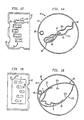
- Fig. 15 is another sectional plan view of the device shown in Fig. 1, showing the expulsion means in intermediate expanded condition. Also shown are the exterior surfaces of the extensions of the pocket and closure members attached to the interior of the facing walls of the pouch.
- Fig. 16 is a schematic respresentation of an arrangement of the closure members and the pattern of attachment of the exterior sides of their extensions to the interior of the facing wall of the pouch.
- Fig. 17 is a schematic respresentation of the arrangement of a plurality of envelopes, independent from each other disposed within the pouch and each having a single pocket member.
- Referring to the drawings, in which each of the various components has the same reference numeral in the different views, and in particular Figs. 1-3, a fluid impermeable dispensing container is shown and designated generally by
reference 10.Container 10 has a cylindrical body orside wall 11, inwardly dishedbottom 12 and bell-shaped top 13 in which is mounted a conventionalspring valve assembly 14.Container 10 and its component parts just described can be fabricated from any suitable material such as thin gauge aluminum or other metal, or even plastics, depending on the product to be dispensed and any governing safety specifications that might be involved.Valve assembly 14 is also of conventional design having plunger andspray head 15 carryingspray orifice 16, suitable constructed of plastic material, and internal parts (not shown) such as a spring, ball valve and mounting ring 17 andbottom intake member 18 which may be of metal and/or plastic consistent with the previously mentioned requirements. - Within
container 10 isflowable product 19 andexpulsion assembly 20 which is the subject of the present invention and as will be seen , generates and maintains gas pressure therein to enableproduct 19 to be dispensed on demand, substantially under a range of predetermined maximum and minimum pressure levels. - At the
upper end 21 of the interior ofcylindrical body 11 is a perforated orforaminous barrier member 22 having a plurality of holes 23 distributed throughout its surface. Also located alonginner surface 24 ofsidewall 11 and extending longitudinally there along is aperforate tube member 25 having a plurality ofholes 26 at spaced positions around and along saidtube member 25. The function ofbarrier member 22 andtube member 25 is to insure trouble-free operation of the dispenser and preventexpulsion assembly 20, as it expands in the manner to be described, from blocking off or plugging the interior of the container either laterally/circumferentially or plugging off valvebottom intake member 18. - Expulsion assembly as shown is disposed within
container 10 without being attached or anchored tocontainer 10, although it may, if desired be so connected.Assembly 20 is comprised of generally regular envelope, bag orpouch 27 which is constructed of a flexible, fluid impermeable plastic material, such as, for example, polyethylene or polypropylene and may be fabricated from a sheet of plastic by folding it into overlaidhalves top edges - Disposed within
pouch 27 is fluid impermeable flexible plastic sandwich or enfoldment 31, having a pair of facingwall members portions 35 to respectiveinterior sides 27c and 27d respectively. Portions of onewall member 33 have plurality of cup-shaped depressions, cavities orpocket members 34 disposed inwardly from one surface thereof at spaced positions, and other portions ofwall member 33 each forms an extension member (a) as in Fig. 15, to each pocket member. Each extension member extends from the edge of the opening of its respective pocket member to the edge ofwall member 33. Each extension ends at a predetermined distance from the edge of the opening of its pocket member. Each extension is affixed permanently at its end by one ofweld portions 35 to predetermined locations or spots on the interior wall 27d. These spots on interior wall 27d are located on the same locations asweld portions 35 shown in the drawing and are superimposed and concealed by them. They may be referred to in the drawings by thesame numeral 35. Theother wall member 32 is substantially flat and has lidding area members or closure members which close each of the respective facing member ofpockets 34 and releasably adhered to it.Pocket members 34 are superimposed on these closure members in the drawings, see Fig. 17. Other areas ofwall member 32, each forms an extension member b as in Fig. 15, to each closure member. Each closure extension member extends from the edge of each of closure member to the edge ofwall member 32. Each extension ends at a predetermined distance from the edge of its closure member. Each extension is affixed permanently at its end by one ofweld portions 35 to a predetermined location or spot oninterior wall 27c. These spots oninterior wall 27c are on the same locations and are superimposed byweld portions 35 in the drawings. They may be referred to in the drawing by thesame numeral 35. Each ofpocket members 34 is releasably closed bywall member 32 to encapsulate within each of pocket members 34 a predetermined quantity of aliquot ofcomponent 36, which may be either in the form of powder or a solution. Disposed withinpouch 27 iscomponent 37 including a solvent. Also disposed withinpouch 27 and mixed withcomponent 37 is starting delay means ordevice 38, which as shown is in the form of dissolvable capsule and contains an inital charge ofcomponent 36.Pouch 27 is then closed by sealing its open end. After the elapse of a predetermined period of time after assemblingexpulsion assembly 20 and disposing it withincontainer 10, fillingproduct 19 therein, and placingtubing 25 andbarrier 22 in place and cappingcontainer 10 with top 13 and its associated parts,capsule 38 dissolves and causescomponent 36 contained therein to be exposed and to mix and react withcomponent 37 and generate the initial quantity of pressuirzing gas, thereby inflating and expanding bag orpouch 27 and providing dispensing pressure withincontainer 10. The solvent portion ofcomponent 37 which is in a liquid state during the useful life of the dispenser may be added in a liquid state or in a frozen state during manufacturing. - It is to be understood that cavities or
pocket members 34 andcapsule 38 may carrycomponent 36, e.g. citric acid in powder form or in solution, andcomponent 37 may be sodium bicarbonate and water, or the two carbon dioxide gas generating components can be switched the other way around. -
Pouch 27, in one preferred embodiment, is constructed of a three layer laminated film having a middle layer of saran, an external layer of Mylar about 0.5 mils thick, and the inside layer (the interior of the pouch) being low density polyethylene of about 1.5 mils thick, and the saran layer is only deposited from spray. The characteristics required or desired in said pouch is that it be non-toxic, has sufficient mechanical strength and chemical stability, and flexible but not appreciably stretchable, and the interior facing surfaces of the pouch be heat sealable.Pouch 27 can also be constructed from other films such as impervious or non-impervious, non-laminated or laminated with plastics, foil or treated fabrics or other suitable material which may be available. -
Wall member 32 is fabricated from the same material which contacts the interior ofpouch 27 and is of compatible plastic material, e.g. low density polyethylene. In one preferred embodiment, it has an overall thickness of about 4.5 mils and is a three layer sandwich of about 0.5 mils mylar in the middle and about 2.0 mils of low density polyethylene on either sides.Wall member 32 may also be constructed from other films such as impervious or non-impervious, coated or non-coated, laminated with plastics, foil or treated fabrics or any other suitable material which may be available. -
Wall member 33, carrying the cup-shaped depressions orpocket members 34, adapted for deep drawing and is in one preferred embodiment a laminated plastic sheet having an exterior layer - (the layer in contact with the interior of pouch 27)- of low density polyethylene of about 0.5 mils to about 20 mils thick and an interior layer (the other side) of polypropylene of from about 0.1 mils to about 3.75 mils thick or higher.Wall member 33 may also be constructed from any other suitable material. - While for most practical applications of the invention,
components component 36 may be selected from any suitable material which can react withcomponent 37 and generate a pressurizing gas, and the contents of each ofpocket members 34 andcapsule 38 may be the same material or different from each other. - The radio-activity at the surface of the dispenser and its component parts and accessories as well as that of the product discharged therefrom is within human tolerence, an does not exceed 0.1 milliroentgen per hour at the time of manufacturing. This requirement may be obtained by blending materials of lower level radio-activity than the level required with materials of higher level radio-activity than the level required in order to produce blended materials of the required low level radio-activity.
-
Capsule 38, which functions as the starting delay means or device, may be constructed from any suitable material, such as gelatin, or coating such as shellac, or any breachable or breakable barrier enclosure. - The method of assembly requires the following data to be determined:
- 1. The Maximum and minimum pressure levels under which
product 19 is to be discharged out ofcontainer 10. - 2. The increases in the size of
pouch 27 withincontainer 10 at the time when its internal pressure drops sequentially from predetermined maximum to predetermined minimum pressure levels. - 3. The number of the releasably closed
pocket members 34 required to be disposed withinpouch 27 and the order of their sequential opening withinpouch 27 as the product is dispensed fromcontainer 10, the quantities ofcomponent 36 to be enclosed in each of these releasablyclosed pocket members 34 as well as incapsule 38, the quantity ofcomponent 37 including the solvent e.g., water in this case, to be deposited withinpouch 27, and the lengths of each of the pocket and closure extension members of each of said closed pocket members according to the order of their sequential opening. - For all practical purposes, the internal pressure within
pouch 27 or expulsion means 20 is presumed to be equivalent to the internal pressure ofcontainer 10. - As
capsule 38 disintegrates, its content ofcomponent 36 is released and reacts withsecond component 37 withinpouch 27, and generates the initial predetermined quantity of pressure generating gas which raises the internal pressure therein to the predetermined maximum pressure level, andpouch 27 inflates and expands withincontainer 10. - As
product 19 is dispensed, and therebypouch 27 expands and increases in size further and displaces the space vacated byproduct 19 withincontainer 10, each quantity ofcomponent 36 encapsulated in each ofclosed pocket members 34 is released sequentially and reacts withcomponent 37 withinpouch 27 and generates sequentially additonal predetermined quantities of pressurizing gas therein each time the internal pressure withinpouch 27 drops from predetermined maximum pressure level to predetermined minimum pressure level. These additional quantities of pressurizing gas raise the internal pressure withinpouch 27 from predetermined minimum pressure levels to predetermined maximum pressure levels. The increases in the size ofpouch 27 cause its facing walls to push outwardly, and thereby the distance betweeninterior wall members 27c and 27d as well as the distances between identifiable spots on these two walls increase. Eventually the pocket members of each ofclosed pocket members 34 separate from their respective closure members and said closed pocket members open sequentially and discharge their contents, which react withcomponent 37 and generate sequentially additional predetermined quantities of pressurizing gas, which raise the pressure therein to predetermined maximum levels. The internal pressure withinpouch 27 alternates between predetermined maximum and minimum pressure levels, until dispensingproduct 19 is completed. - The method of assembly is depicted schematically in Figs. 4 to 8 and 9 to 11. By heating and drawing portions of
sheet 33 in a mold, cavities or pockets are formed on portions ofsheet 33, and extension members to each ofpockets 34 are formed on other portions ofsheet 33. Each of these extensions extends from the edge of the opening of each member ofpockets 34 and ends at the edge ofsheet 33. Each extension ends at a predetermined distance from the edge of the opening of its pocket member. Predetermined quantities ofcomponent 36 e.g. citric acid are deposited in each member ofpockets 34. Each of these quantities and the length of the extension of each pocket member are predetermined according to the order of the sequential opening of each closed pocket member in the manner to be described. Thensheet 32 is overlayed onsheet 33 and they are releasably sealed together (Fig. 5) to close each ofpockets 34, and thereby formenfoldment 31. Portions ofsheet 32 become liddings or closures to each member ofpockets 34. Other portions ofsheet 32 become extensions to each of these closure members. Each extension member extends from the edge of each closure member to the edge ofwall member 32. Each extension ends at a predetermined distance from the edge of its closure member. The length of the extension of each closure is predetermined according to the order of the sequential opening in the manner to be described.Enfoldment 31 is inserted into theopen end 30 ofpouch 27. The exterior walls ofenfoldment 31 are heat sealed together permanently byweld portions 35 as follows: The end of each extension member ofpocket members 34 is affixed permanently to predetermined identified location or spot on interior wall 27d by one ofweld portions 35, and the end of each extension member of the closure members is affixed permanently to predetermined identified location or spot oninterior wall 27c by one ofweld portions 35, (Fig. 8.).Capsule 38 and a predetermined quantity ofcomponent 37, which includes water which may be in a frozen state are deposited withinpouch 27, and thenupper edge 30 is closed and heat sealed permanently to completely enclose the contents inpouch 27 and thereby complete the assembly of expulsion means 20. This expulsion meansassembly 20 is then inserted intocontainer 10 andproduct 19 is added therein around it,barrier 22 andperforated tubing 25 are put into place, and top 13 is affixed to container (10 Fig.) 10. After elapse of a prescribed period of time, the frozen ingredient incomponent 37 melts, andcapsule 38 has dissolved and generates a predetermined quantity of pressurizing gas, e.g. carbon dioxide gas, which inflates, pressurizes and causespouch 27 to expand, and the dispenser is now ready for use (Fig. 11.) Figs. 3, 12, and 13 show schematically howinterior walls 27c and 27d ofpouch 27 are permanently affixed and welded atweld portions 35 to the exterior ofwall members pouch 27 causes the closure members to sepaarate from their respective pocket members and open and expose their content offirst component 36 to admix and react with thesecond component 37 and water withinpouch 27 and thereby generate additional predetermined quantities of the pressurizing gas. -
Enfoldment 31 may also be sliced in suitable patterns to form smaller units ofenfoldment 31, each comprised of a singleclosed pocket member 34 encapsulating a predetermined quantity ofcomponent 36. Each pocket and its closure has an extension extending to the edges ofsheet closed pocket members 34 may be disposed withinpouch 27 unattached to the other closed pocket members. Each extension ofpocket members 34 ends at a predetermined distance from the edge of the opening of its respective pocket member, and each extension of the closure members ends at a predetermined distance from the edge of its respective closure member. Each of these ends defines a free end of their respective extensions. - The delay device may be constructed from gelatinous material in the form of a gelatinous capsule or a pouch which disintegrates in its sourrounding within the expulsion assembly, and it may also be a container or an enclosure constructed from glass or any other suitable material, which is broken open within the expulsion assembly at any time before or after assembling the dispenser, whichever situation is suitable in the manufacturing process.
- The second component of the two-component
gas generation system 37 may include an ingredient in a frozen state at the time when it is deposited withinpouch 27 and subsequently it liquifies. - In a dispesner of the following description, the method of determination of,
- a. The increases in the pouch size each time the pressure therein drops from the predetermined maximum to the predetermined minimum pressure levels,
- b. the number of
closed pocket members 34 to be disposed withinpouch 27. - c. the quantity of
first component 36 e.g. citric acid to be encapsulated in each ofclosed pocket members 34 andcapsule 38, - d. the length of each extension of the pocket and the closure members of each of
closed pockets 34, - e. the quantity of
second component 37 e.g. sodium bicarbonate and solvent, e.g. water, to be introduced intopouch 27, - The above mentioned items may be determined as follows:
It is assumed thatexpulsion assembly 20 comprising a bag orpouch 27 enclosing: agelatin capsule 38 encapsulating a predetermined quantity of citric acid, and a predetermined quantity of sodium bicarbonate and 5 cc of water, and an insignificant quantity of atmospheric air, and having displacement capacity of 12 cc, is disposed withincontainer 10 having displacement capacity of 140 cc. One hundred (100) cc offlowable product 19 is introduced intocontainer 10 around expulsion means 20, andbarrier member 22 andperforated tubing 25 are put in place, and top 13 is affixed oncontainer 10 to close it. The aggregate head space above the liquid incontainer 10 and inexpulsion assembly 20 is 28 cc, occupied by atmospheric air. The pressure under whichproduct 19 is to be discharged fromcontainer 10 should be within the range of maximum pressure level of 144 psig. and minimum pressure level of 100 psig. - It is assumed that one atmospheric pressure at normal temperature measures 14.4 psig., and 144 psig. is equivalent to ten (10) atmospheric pressures.
- It is assumed that the complete reaction of 1.45 gms. of citric acid with 1.9 gms. of sodium bicarbonate in aqueous medium generates 1 gm. of carbon dioxide gas, and that 1000 cc of carbon dioxide gas weigh 1,82 gms., and that 1 gm of carbon dioxide gas measures 549.45 cc at normal temperature and pressure.
- It is assumed that 0.02639 gms. of citric acid is required to completely react with enough quantity of sodium bicarbonate in aqueous medium in order to generate 1 cc of carbon dioxide gas compressed under 144 psig. (pound per square inch gauge), and 0.03458 gms. of sodium bicarbonate is required to completely react with enough quantity of citric acid in aqueous medium in order to generate 1 cc of carbon dioxide gas compressed under 144 psig.
- The air in the 28 cc of head space in this dispenser pressurized under 14.4 psig., that is the number of molecules contained therein, provides a quantity of pressurized gas under 144 psig. for only 2,8 cc.
- After the completion of discharging its contents of
product 19, this dispenser will be capable of holding gas pressurized under 144 psig., the volume of which is calculated as follows:

- The quantity of sodium bicarbonate required to react with enough quantity of citric acid to generate carbon dioxide gas compressed under 144 psig. in a space of 125.2 cc is calculated according to the above mentioned mathematical formula as follows:
125.2 x 0.03458 = 4.32 gms., rounded to 4.4 gms. of sodium bicarbonate. (It is permitted to exceed the calculated quantity ofcomponent 37, which may help the chemical reaction). - Following are the stages of the internal pressure in
pouch 27 and the incremental expansion in the size ofpouch 27 in the course of dischargingproduct 19 out ofcontainer 10 from beginning to end:
Under normal conditions, immediately after the dispenser is assembled and before the generation of the pressurizing gas begins therein, the internal pressure within the 28 cc of head space incontainer 10 should measure one atmospheric pressure or 14.4 psig. An additional quantity of pressurizing gas is required to provide another 25.2cc of pressurizing gas compressed under 144 psig. for raising the pressure in the total head space of 28cc withincontainer 10 to 144 psig. This 25.2cc is the difference between 28 cc and 2.8 cc.This additional quantity of pressurizing gas is generated by reacting an additional quantity of citric acid with the sodium bicarbonate withpouch 27, which is calculated according to the above mentioned mathematical formula as follows:
25.2 x 0.02639 = 0.665 gms. citric acid. - This quantity of citric acid is encapsulated in
capsule 38, which is deposited withinpouch 27 together with the sodium bicarbonate and water, which may be in a frozen state. After a predetermined period of time, this capsule disintegrates or dissolves and releases its content withinpouch 27. Its 0.665 gms. content of citric acid reacts with the sodium bicarbonate withinpouch 27 and generates the required quantity of additional pressurizing gas which raises the pressure within this space of 28 cc to 144 psig. -
Product 19 is discharged fromcontainer 10 at staggered intervals in small increments.Pouch 27 gradually expands therein and increases in size. When its internal pressure drops from 144 psig. to 100 psig. for the first time, the size ofpouch 27 should expand to the size which is calculated as follows:
(28 x 144) divided by 100 = 40.32 cc., that is an increase of 12.32 cc. - This additional 12.32 cc requires an additonal quantity of pressurizing gas which can be generated by reacting the following quantity of citric acid with the sodium bicarbonate within
pouch 27 in order to raise the internal pressure within this dispenser to 144 psig. from 100 psig., which is calculated as follows:
12.32 x 0.02639 = 0.325 gms. citric acid. - This quantity of 0.325 gms of citric acid is encapsulated in one of
closed pocket members 34 which is disposed withinpouch 27 and is scheduled to open first among the plurality ofclosed pocket members 34 which are scheduled to open withinpouch 27. - By the same method of the calculation mentioned above, after the internal pressure within
pouch 27 drops from 144 psig. to 100 psig. twice, its size increases further as follows:
40.32 x 1.44 = 58.06 cc, that is an increase of 17.74 cc. - The closed pocket member disposed within
pouch 27 and scheduled to open second in sequence, should encapsulate the following quantity of citric acid in order to raise the pressure within this dispenser to 144 psig. from 100 psig., which is calculated as follows:
17.74 x 0.02639 = 0.468 gms. citric acid. - After the internal pressure within this dispenser drops from 144 psig. to 100 psig. three (3) times, the size of
pouch 27 increases as follows:
58.,06 x 1.44 = 83.6 cc, that is an increase of 25.546 cc. - The closed pocket member disposed within
pouch 27 and scheduled to open third in sequence should encapsulate the following quantity of citric acid in order to raise the internal pressure within this dispenser to 144 psig. from 100 psig., which is calculated as follows:
25.546 x 0.02639 = 0.674 gms. - After the internal pressure within this dispenser drops from 144 psig. to 100 psig. four (4 ) times, the size of
pouch 27 increases as follows:
83.6 x 1.44 = 120.384 cc, that is an increase of 36.784cc. - The closed pocket member disposed within
pouch 27 and scheduled to open fourth in sequence, should encapsulate the following quantity of citric acid in order to raise the pressure within this dispenser to 144 psig. from 100 psig., which is calculated as follows:
36.784 x 0.02639 = 0.97 gms of citric acid. - However, there is only 128 cc of space available within
container 10, andpouch 27 can expand additionally only another 7.616 cc, which is the difference between 128 and 120.384 cc. Consequently, the internal pressure within this dispenser cannot drop to 100 psig. when dispensingproduct 19 from this dispenser is completed. On the other hand, in order to have the internal pressure within this dispenser drops to a minimum of 100 psig. at the time when dispensingproduct 19 from this dispenser is completed, this closed pocket member which is scheduled to open fourth in sequence must encapsulate the following minimum quantity of citric acid, which is calculated as follows:
7.616 x 0.02639 = 0.2 gms. citric acid. - Accordingly, any quantity of citric acid ranging between 0.2 gms. and 0.97 gms. encapsulated within this closed pocket member which is disposed within
pouch 27 and is scheduled to open fourth in sequence, will provide pressure within the range between 100 psig. and 144 psig. at the time when dischargingproduct 19 from this dispenser is completed, and thus conform with the requirements specified for this dispenser. - The four (4) closed pocket members mentioned above are required to be disposed within
pouch 27 according to the order of their sequential opening. - Items a), b), c), and e) mentioned above have been determined as mentioned above. Item d mentioned above may be determined as follows:
The length of the extension of the pocket member and the length of the extension of its respective closure memer of each of closed pocket members (34) may be determined as follows: - I. An
experimental pouch 27 made of transparent plastic material having two (2) facingwalls Walls interior walls 27c and 27d respectively. Each ofinterior walls 27c and 27d is marked at random with four identifiable markings or spots at suitably accessible locations forming four identifiable pairs of spots,each comprisin two (2) member spots, one member spot of which is suitably located oninterior wall 27c and the other member spot is suitably located on interior wall 27d. - II. An
experimental container 10 having the shape and dimensions of the container intended to be utilized in the mass production of the dispenser, and is constructed from any suitable metal or transparent material. - III. An
experimental expulsion assembly 20 comprisingpouch 27 described in step I, in which are depositedcapsule 38 encapsulating 0.665 gms. ofcomponent 36 e.g., citric acid, and 4.4 gms. ofcomponent 37 e.g., sodium bicarbonate including 5 cc of water, in contact with each other. Thenpouch 27 is closed by sealing its open end,top side 30. - IV. An experimental apparatus is assembled by disposing
experimental expulsion assembly 20 of step III withinexperimental container 10 of step II and adding therein aroundexpulsion assembly 20 100 cc ofproduct 19.Perforate tubing 25 andbarrier 22 are put in place, and top 13 is affixed tocontainer 10.Container 10 is immersed in water heated to about 60 degrees Centigrade. After elapse of a period of time of about four (4) minutes,capsule 38 has disintegrated andcomponents pouch 27 to 144 psig., and this pressurized apparatus is ready to be sprayed. -
V. Product 19 is discharged fromcontainer 10 at intervals in small increments, and the internal pressure withincontainer 10 is measured after eachtime product 19 is discharged.Container 10 is shaken periodically. Simultaneously when the internal pressure within this apparatus drops to 100 psig. for the first time,pouch 27 expands an additional 1232 cc withincontainer 10 and the distances between the member spots of the identifiable pairs of spots also increase. - VI. The image of the interior of
experimental container 10 and that of theexperimental expulsion assembly 20 and their component parts are reproduced by an imagery process or by photography or by any other suitable process at the time when the internal pressure incontainer 10 drops to 100 psig. for the first time. The distance between two members of an identifiable pair of spots which are suitably located on each ofinterior walls 27c and 27d, is measured. - VII. Step IV is repeated using
experimental container 10,experimental expulsion assembly 20 containing 4.4 gms. of sodium bicarbonate, 5 cc of water,capsule 38 encapsulating 0.665 gms. of citric acid, and adding the first closed pocket member encapsulating 0.325 gms. of citric acid disposed withinpouch 27 as follows: the total length of its pocket extension member a plus the length of its closure extension member b is made equal to the distance between the two members of the pair of the identifiable spots measured in step VI, and the end of its pocket extension member a and the end of its closure extension member b are affixed byweld portions 35 to each member of the identifiable pair of spots oninterior walls 27c and 27d identified in step VI. - VIII. Step V is repeated, allowing the internal pressure in
container 10 to drop twice to 100 psig., and therebypouch 27 has expanded an additional 17.68 cc. - IX. Step VI is repeated, and the distance between the two members of another identifiable pair of spots, one member spot on each of
walls 27c and 27d, is measured. - X. Step VII is repeated, and in addition the second closed pocket member encapsulating 0.47 gms. of citric acid is disposed within
pouch 27 as follows: The total length of its pocket extension member a plus the length of its closure extension member b is made equal to the distance between the two members of the pair of the identifiable spots measured in step IX, and the end of its pocket extension member a and the end of its closure extension member b are affixed byweld portions 35 to each member of the identifiable pair of spots oninterior walls 27c and 27d identified in step IX. - XI. Step VIII is repeated, allowing the internal pressure in
container 10 to drop three times to 100 psig., and therebypouch 27 has expanded an additional 25.52 cc. - XII. Step IX is repeated and the distance between members of the third pair of identifiable spots, one member spot on each of
walls 27c and 27d, is measured. - XIII. Step X is repeated, and in addition, the third closed pocket member encapsulating 0.674 gms. of citric acid is disposed within
pouch 27 as follows: the total length of its pocket extension member a plus the length of its closure extension member b is made equal to the distance between the two members of the pair of the identifiable spots measured in step XII, and the end of its pocket extension member a and the end of its closure extension member b are affixed byweld portions 35 to each member of the identifiable pair of spots oninterior walls 27c and 27d identified in step XII. - XIV. Step XI is repeated, allowing the internal pressure within
container 10 to drop four times to 100 psig., and therebypouch 27 has expanded an additional 36.75 cc. - XV. Step XII is repeated and the distance between members of the fourth pair of identifiable spots, one member spot on each of
walls 27c and 27d, is measured. - XVI. Step XIII is repeated and in addition the fourth pocket member encapsulating 0.97 gms. of citric acid is disposed within
pouch 27 as follows: the total length of its pocket extension member a plus the length of its closure extension member b is made equal to the distance between the two members of the pair of the identifiable spots measured in step XV, and the end of its pocket extension member a and the end of its closure extension member b are affixed byweld portions 35 to each member of the identifiable pair of spots oninterior walls 27c and 27d identified in step XV. - For practical purposes, the internal pressure within
pouch 27 is dealt with as synonymous to that of expulsion assembly means 20 and is equivalent to the internal pressure withincontainer 10. - All quantities, pressures, volumes and measurements given above are in approximate numbers and are presumed to be substantially accurate.
- The above is the data required to manufacture and assemble the aove mentioned dispenser. In mass production,
expulsion assembly 20 in step XVI is duplicated, and the dispenser is assembled and completed on the production line. By following the above mentioned method, dispenser of other specifications can be processed as well. - After dispensing the product from the container is completed, the pouch will line the interior of the container.
- While certain illustrative embodiments of the invention have been described with particularity, it will be understood that various other modifications will be readily apparent to those skilled in the art without departing from the scope and spirit of the invention. Accordingly, it is not intended that the scope of the claims appended hereto be limited to the description set forth herein, but rather that the claims be construed as encompassing all equivalents of the present invention which are apparent to those skilled in the art to which the invention pertains.
Claims (17)
- In an aerosol type dispenser, internal expulsion means for developing and maintaining gaseous dispensing pressure ranging substantially between predetermined maximum and minimum pressure levels for a product within a container of the dispenser said expulsion means comprising an enclosed fluid impermeable, flexible closed pouch disposed within said dispenser and having a pair of facing wall members, a plurality of pocket members disposed within said pouch in spaced relation to one another and affixed to the interior of a first of said pair of facing wall members of said pouch, a predetermined quantity of a first component of a two-component gas generation system disposed within each of said pocket members, closure members associated with the interior of the second of said pair of said facing wall members of said pouch closing each of said pocket members and releasably adhering to their contacting surfaces, thereby forming a plurality of closed pocket members each containing a predetermined quantity of said first component of said two-component gas generation system, a predetermined quantity of a second component of said two-component gas generation system disposed within said pouch and externally of said closed pocket members, starting delay device carrying a predetermined quantity of said first component disposed within said pouch in contact with said predetermined quantity of said second component of said two-component gas generation system for causing the initial generation of gas after a prescribed period of time, said closed pocket members being sequentially separable from their respective closure members to empty their contents into admixture with said second component and to react and generate more gas as said pouch expands due to dispensing said product, said product being dispensed disposed externally of said pouch within said container,
a plurality of identifiable pairs of spots, each comprising two identifiable member spots, and one member spot is located on said first and the other member spot is located on said second of said facing wall members of said pouch,
each of said plurality of closed pocket members having a first extension of a predetermined length extending from the edge of its pocket member and is affixed at its end to said first facing wall member of said pouch at one identifiable member spot of an identifiable pair of spots of said plurality of identifiable pairs of spots, and a second extension member of a predetermined length extending from the edge of each closure member closing a respective pocket member of said plurality of closed pocket members is affixed at its end to said second facing wall member of said pouch at the other identifiable member spot of said identifiable pair of spots,
as the product is dispensed, the pouch expands and its said first and second facing wall members move away from each other under pressure, thus causing the distance between said ends of said first and second extension members of each of said closed pocket members affixed to said first and second facing wall members of said pouch to exceed the total predetermined lengths of said first and second extension members of said closed pocket members, thereby, causing sequential separation of each of said pocket members from their respective closure members according to a predetermined sequence and serial opening of each of said closed pocket members, which discharge their contents sequentially and generate additional predetermined quantities of pressurizing gas each time the internal pressure within said dispenser drops to a predetermined minimum pressure level,
said pouch increases in size to a predetermined capacity each time the internal pressure within said dispenser drops from predetermined maximum to predetermined minimum pressure levels,
whereby dispensing said product from said dispenser causes the internal pressure therein to alternate continuously between said predetermined minimum and maximum pressure levels,
the coordination of said range of predetermined maximum and minimum pressure levels with, the lengths of the extension members of each of said pocket and closure members of said plurality of closed pocket member, the quantity of said first component enclosed within each of said pocket members and in the starting delay device, the order of sequence of the opening of each of said closed pocket members, and the quantity of said second component deposited within said pouch is necessary for dispensing said product within the range of predetermined maximum and minimum pressure levels. - In an aerosol type dispenser, internal expulsion means for developing and maintaining gaseous dispensing pressure ranging substantially between predetermined maximum and minimum pressure levels for a product within a container of the dispenser said expulsion means comprising an enclosed fluid impermeable, flexible closed pouch disposed within said dispenser and having a pair of facing wall members, a plurality of interconnected pocket members disposed within said pouch in spaced relation to one another and affixed to the interior of a first of said pair of facing wall members of said pouch, a predetermined quantity of a first component of a two-component gas generation system disposed within each of said pocket members, a common closure members associated with the interior of the second of said pair of said facing wall members of said pouch closing each of said pocket members and releasably adhering to their contacting surfaces, thereby forming a plurality of closed pocket members each containing a predetermined quantity of said first component of said two-component gas generation system, a predetermined quantity of a second component of said two-component gas generation system disposed within said pouch and externally of said closed pocket members, starting delay device carrying a predetermined quantity of said first component disposed within said pouch in contact with said predetermined quantity of said second component of said two-component gas generation system for causing the initial generation of gas after a prescribed period of time, said closed pocket members being sequentially separable from their respective closure members to empty their contents into admixture with said second component and to react and generate more gas as said pouch expands due to dispensing said product, said product being dispensed disposed externally of said pouch within said container,
a plurality of identifiable pairs of spots, each comprising two identifiable member spots, and one member spot is located on said first and the other member spot is located on said second of said facing wall members of said pouch,
each of said plurality of closed pocket membes ahving a first extension of a predetermined length extending from the edge of its pocket member and is affixed at its end to said first facing wall member of said pouch at one identifiable member spot of an identifiable pair of spots of said plurality of identifiable pairs of spots, and a second extension member of a predetermined length extending from the edge of each closure member closing a respective pocket member of said plurality of closed pocket members is affixed at its end to said second facing wall member of said pouch at the other identifiable member spot of said identifiable pair of spots,
as the product is dispensed, the pouch expands and its said first and second facing wall members move away from each other under pressure, thus causing the distance between said ends of said first and second extension members of each of said closed pocket members affixed to said first and second facing wall members of said pouch to exceed the total predetermined length of said first and second extension membes of said closed pocket members, thereby, causing sequential separation of each of said pocket members from their respective closure members according to a predetermined sequence and serial opening of each of said closed pocket members, which discharge their contents sequentially and generate additional predetermined quantities of pressurizing gas each time the internal pressure within said dispenser drops to a predetermined minimum pressure level,
said pouch increases in size to a predetermined capacity each time the internal pressure witin said dispenser drops from predetermined maximum to predetermined minimum pressure levels
whereby dispensing said product from said dispenser causes the internal pressure therein to alternate continuously between said predetermined minimum and maximum pressure levels,
the coordination of said range of predetermined maximum and minimum pressure levels with, the lengths of the extension members of each of said pocket and closure members of said plurality of claosed pocket members, the quantity of said first component enclosed within each of said pocket members and in the starting delay device, the order of sequence of the opening of each of said closed pocket members, and the quantity of said second component deposited within said pouch is necessary for dispensing said product within the range of predetermined maximum and minimum pressure levels. - In a regualted self-pressurizing dispensing apparatus for developing and maintaining gaseous dispensing pressure ranging substantially between predetermined maximum and minimum pressure levels for a product being dispensed, an outer container, a dispensable flowable medium within said container to be dispensed, a manually actuable atomizing and dispensing valve on said container, and expulsion means within said container for providing and dispensing pressure for said dispensable medium comprising, a liquid impermeable expansible flexible closed pouch having a pair of facing wall members disposed within said container, said dispensable medium disposed externally of said pouch within said container, a pair of sheets permanently attached on their outer surfaces to the inner surfaces of said facing wall members of said pouch and releasably adhered to one another over substantially their entire contacting surfaces, at least one of said sheets having a plurality of pocket members in its surface in spaced positions to one another and each carrying a predetermined quantity of an aliquot of first component of a two-component gas generation system, the other sheet enclosing and encapsulating said first component within each of said pocket members, thereby forming a plurality of closed pocket members each containing a predetermined quantity of said first component of said two-component gas generation system, a predetermined quantity of a second component of said two-component gas generation system disposed within said pouch and externally of said pocket members, starting delay device carrying a predetermined quantity of said first component disposed within said pouch in contact with said second component for causing the initial generation of pressurizing gas after a predetermined period of time, upon outward expansion of said pouch due to the pressure of said gas generated therein and the evacuation of said dispenser by dispensing said dispensable medium through said valve, said closed pocket members being adapted to gradually separate from their respective closures and open sequentially, thereby permitting said aliquots of said first component to contact and react with said second component and generate additional quantities of pressurizing gas within said pouch,
a plurality of identifiable pairs of spots, each comprising two identifiable member spots. and one member spot is located on said first and the other member spot is located on said second of said facing wall members of said pouch,
each of said plurality of closed pocket members having a first extension of a predetermined length extending from the edge of its pocket member and is affixed at its end to said first facing wall member of said pouch at one identifable member spot of an identifable pair of spots of said plurality of identifiable pairs of spots, and a second extension member of a predetermined length extending from the edge of each closure member closing a respective pocket member of said plurality of closed pocket members is affixed at its end to said second facing wall member of said pouch at the other identifiable member spot of said identifiable pair of spots,
as the product is dispensed, the pouch expands and its said first and second facing wall members move away from each other under pressure, thus causing the distance between said ends of said first and second extension members of each of said closed pocket members affixed to said first and second facing wall members of said pouch to exceed the total predetermined lengths of said first and second extension members of said closed pocket members, thereby, causing sequential separtion of each of said pocket members from their respective closure members according to a predetermined sequence and serial opening of each of said closed pocket members, which discharge their contents sequentially and generate additional predetermined quantities of pressurizing gas each time the internal pressure within said dispenser drops to a predetermined minimum pressure level,
said pouch increases in size to a predetermined capacity each time the internal pressure within said dispenser drops from predetermined maximum to predetermined minimum pressure levels,
whereby dispensing said product from said dispenser causes the internal pressure therein to alternate continuously between said predetermined minimum and maximum pressure levels,
the coordination of said range of predetermined maximum and minimum pressure levels with, the lengths of the extension members of each of said pocket and closure members of said plurality of closed pocket members, the quantity of said first component enclosed within each of said pocket members and in the starting delay device, the order of sequence of the opening of each of said closed pocket members, and the quantity of said second component deposited within said pouch is necessary for dispensing said product within the range of predetermined maximum and minimum pressure levels. - In a regulated self-pressurizing dispensing apparatus for developing and maintaining gaseous dispensing pressure ranging substantially between predetermined maximum and minimum pressure levels for a product being dispensed, an outer container, a dispensable flowable medium within said container to be dispensed, a manually actuable atomizing and dispensing valve on said container, and expulsion means within said container for providing and dispensing pressure for said dispensable medium comprising, a liquid impermeable expansible flexible closed pouch having a pair of facing wall members disposed within said container, said dispensable medium disposed externally of said pouch within said container, two generally congruent sheets permanently attached on their outer surfaces to the inner surfaces of said facing wall members of said pouch and releasably adhered to one another along at least portions of their contacting surfaces, at least one of said sheets having a plurality of pocket members in its surface in spaced positions to one another and each carrying a predetermined quantity of an aliquot of first component of a two-component carbon dioxide gas generation system, the other sheet enclosing and encapsulating said first component within each of said pocket members, thereby forming a plurality of closed pocket members each containing a predetermined quantity of said first component of said two-component gas generation system, a predetermined quantity of a second component of said two-component carbon dioxide gas generation system disposed within said pouch and externally of said pocket members, starting delay device carrying a predetermined quantity of said first component disposed within said pouch in contact with said second component for causing the initial generation of pressurizing gas after a predetermined period of time, upon outward expansion of said pouch due to the pressure of said carbon dioxide gas generated therein and the evacuation of said dispenser by dispensing said medium through said valve, said closed pocket members being adapted to gradually separate from their respective closures and open sequentially, thereby permitting said aliquots of said first component to contact and react with said second component and generate additional quantities of said carbon dioxide pressurizing gas within said pouch,
a plurality of identifiable pairs of spots, each comprising two identifiable member spots, and one member spot is located on said first and the other member spot is located on said second of said facing wall members of said pouch,
each of said plurality of closed pocket members having a first extension of a predetermined length extending from the edge of its pocket member and is affixed at its end to said first facing wall member of said pouch at one identifiable member spot of an identifiable pair of spots of said plurality of identifiable pairs of spots, and a second extension member of a predetermined length extending from the edge of each closure member closing a respective pocket member of said plurality of closed pocket member is affixed at its end to said second facing wall member of said pouch at the other identifiable member spot of said identifiable pair of spots,
as the product is dispensed, the pouch expands and its said first and second facing wall members move away from each other under pressure, thus causing the distance beetween said ends of said first and second extension members of each of said closed pocket members affixed to said first and second facing wall members of said pouch to exceed the total predetermined lengths of said first and second extension members of said closed pocket members, thereby, causing sequential separation of each of said pocket members from their respective closure members according to a predetermined sequence and serial opening of each of said closed pocket members, which discharge their contents sequentially and generate additional predetermined quantities of pressurizing gas each time the internal pressure within said dispenser drops to a predetermined minimum pressure level,
said pouch increases in size to a predetermined capacity each time the internal pressure within said dispenser drops from predetermined maximum to predetermined minimum pressure levels,
whereby dispensing said product from said dispenser causes the internal pressure therein to alternate continuously between said predetermined minimum and maximum pressure levels,
the coordination of said range of predetermined maximum and minimum pressure levels with, the lengths of the extension members of each of said pocket and closure members of said plurality of closed members, the quantity of said first component enclosed within each of said pocket members and in the starting delay device, the order of sequence of the opening of each of said closed pocket members, and the quantity of said second component deposited within said pouch is necessary for dispensing said product within the range of predetermined maximum and minimum pressure levels. - Expulsion means for developing and maintaining gaseous dispensing pressure in a container for a dispensable product being dispensed from said container, said means comprising a fluid impermeable expansible flexible closed pouch adpated to be disposed within said container and having a pair a facing wall members, a plurality of pocket members disposed within said pouch in spaced relations to one another and each is affixed to the interior of a first of said facing wall members of said pouch, a predetermined quantity of a first of a two-component gas generation system disposed within each of said pocket members, a closure member for each pocket member associated with the interior of the other member of said pair of facing wall members of said pouch and closing each of said pocket members and releasably adhering to its contacting surfaces, thereby forming a plurality of closed pocket members each containing a predetermined quantity of said first component of said two-component gas generation system, a predetermined quantity of a second component of said two-component gas generation system disposed within said pouch and externally of said pocket members, starting delay device carrying a predetermined quantity of said first component disposed within said pouch in contact with said second component of said two-component gas generation system for causing the initial generation of pressurizing gas after a predetermined period of time, upon outward expansion of said pouch due to the pressure of said gas generated therein and the evacuation of said dispenser by dispensing said dispensable medium, each of said closed pocket members being adapted to gradually separate from its respective closure member and open sequentially, thereby permitting their contents of said aliquots of said first component to contact and react with said second component and generate additional quantities of pressurizing gas within said pouch,
a plurality of identifiable pairs of spots, each comprising two identifiable member spots, and one member spot is located on said first and the other member spot is located on said second of said facing wall members of said pouch,
each of said plurality of closed pocket members having a first extension of a predetermined length extending from the edge of its pocket member and is affixed at its end to said first facing wall member of said pouch at one identifiable member spot of an identifiable pair of spots of said plurality of identifiable pairs of spots, and a second extension member of a predetermined length extending from the edge of each closure member closing a respective pocket member of said plurality of closed pocket members is affixed at its end to said second facing wall member of said pouch at the other identifiable member spot of said identifiable pair of spots,
as the product is dispensed, the pouch expands and its said first and second facing wall members move away from each other under pressure, thus causing the distance beetween said ends of said first and second extension members of each of said closed pocket members affixed to said first and second facing wall members of said pouch to exceed the total predetermined lengths of said first and second extension members of said closed pocket members, thereby, causing sequential separation of each of said pocket members from their respective closure members according to a predetermined sequence and serial opening of each of said closed pocket members, which discharge their contents sequentially and generate additonal predetermined quantities of pressurizing gas each time the internal pressure within said dispenser drops to a predetermined minimum pressure level,
said pouch increases in size to a predetermined capacity each time the internal pressure within said dispenser drops from predetermined maximum to predetermined minimum pressure levels,
whereby dispensing said product from said dispenser causes the internal pressure therein to alternate continuously between said predetermined minimum and maximum pressure levels,
the coordination of said range of predetermined maximum and minimum pressure levels with, the lengths of the extension members of each of said pocket and closure members of said plurality of closed pocket members, the quantity of said first component enclosed within each of said pocket members and in the starting delay device, the order of sequence of the opening of each of said closed pocket members, and the quantity of said second component deposited within said pouch is necessary for dispensing said product within the range of predetermined maximum and minimum pressure levels. - Expulsion means for developing and maintaining gaseous dispensing pressure in a container for a dispensable product being dispensed from said container, said means comprising a fluid impermeable expansible flexible closed pouch adapted to be disposed within said container and having a pair of facing wall members, a plurality of pocket members disposed within said pouch in spaced realtions to one another affixed to the interior of a first of said facing wall members of said pouch, a predetermined quantity of a first of a two-component gas generation system disposed within each of said pocket members, a common closure member associated with the interior of the other member of said pair of facing wall members of said pouch and closing each of said pocket members and releasably adhering to its contacting surfaces, thereby forming a plurality of closed pocket members each containing a predetermiend quantity of said first component of said two-component gas generation system, a predetermined quantity of a second component of said two-component gas generation system disposed within said pouch and externally of said pocket members, starting delay device carrying a predetermined quantity of said first component disposed within said pouch in contact with said second component of said two-component gas generation system for causing the initial gneration of pressurizing gas after a predetermined period of time, upon outward expansion of said pouch due to the pressure of said gas generated therein and the evacuation of said dispenser by dispensing said dispensable medium, said closed pocket members being adapted to gradually separate from their respective closure members and open sequentially, thereby permitting their contents of said aliquots of said first component of said two-component gas generation system to contact and react with said second component and generate additional quantities of pressurizing gas within said pouch,
a plurality of identifiable pairs of spots, each comprising two identifiable member spots, and one member spot is located on said first and the other member spot is located on said second of said facing wall members of said pouch,
each of said plurality of closed pocket members having a first extension of a predetermined length extending from the edge of its pocket member and is affixed at its end to said first facing wall member of said pouch at one identifiable member spot of an identifiable pair of spots of said plurality of identifiable pairs of spots, and a second extension member of a predetermined length extending from the edge of each closure member closing a respective pocket member of said plurality of closed pocket members is affixed at its end to said second facing wall member of said pouch at the other identifiable member spot of said identifiable pair of spots,
as the product is dispensed, the pouch expands and its said first and second facing wall members move away from each other under pressure, thus causing the distance between said ends of said first and second extension members of each of said closed pocket members affixed to said first and second facing wall members of said pouch to exceed the total predetermined lengths of said first and second extension members of said closed pocket members, thereby, causing sequential separation of each of said pocket members from their respective closure members according to a predetermined sequence and serial opening of each of said closed pocket members, which discharge their contents sequentially and generate additional predetermined quantities of pressurizing gas each time the internal pressure within said dispenser drops to a predetermined minimum pressure level,
said pouch increases in size to a predetermined capacity each time the internal pressure within said dispenser drops from predetermined maximum to predetermined minimum pressure levels,
whereby dispensing said product from said dispenser causes the internal pressure therein to alternate continuously between said predetermined minimum and maximum pressure levels,
the coordination of said range of predetermined maximum and minimum pressure levels with, the lengths of the extension members of each of said pocket and closure members of said plurality of closed pocket members, the quantity of said first component enclosed within each of said pocket members and in the starting delay device, the order of sequence of the opening of each of said closed pocket members, and the quantity of said second component deposited within said pouch is necessary for dispensing said product within the range of predetermined maximum and minimum pressure levels. - In the dispenser defined in anyone of the preceeding claims wherein, said pouch is comprised of three-layer laminated plastic film, the external layer being Mylar polyester 0.5 to 3 mils thick, the inner layer being low density polyethylene 0.5 to 20 mils thick, and the middle layer being saran deposited by spraying at least one of the inner surfaces of said Mylar and polyethylene layers.
- In the dispenser defined in claim 7 wherein, said sheet carrying said pocket members is comprised of two-layer plastic lamination having an outer layer of low density polyethylene 0.5 to 20 mils thick, and an inner layer of polypropylene 0.1 to 10 mils thick, said closure members comprised of three-layer plastic sandwich lamination having an inner Mylar polyester layer of 0.3 to 3 mils in thickness, the outer layers of the sandwich being of low density polyethylene of 0.3 to 20 mils thick.
- In the dispenser defined in claim 8 wherein, each of said pocket members and said starting delay device encapsulating said predetermined quantity of said first component of said two-component gas generation system comprising at least one compound selected from the class consisting of a water soluble mineral acid, carboxylic acid and citric acid, and said second component is comprised of at least one compound selected from the class consisting of barium carbonate, calcium carbonate and sodium bicarbonate in an aqueous medium and said generated pressurizing gas being carbon dioxide gas.
- In the dispenser defined in claim 9 wherein, each of said plurality of pocket members is individually separated and independent from the others.
- In the dispenser defined in claim 10 wherein, said delay device comprising at least one device selected from the class consisting of a gelatin capsule, disintegrating pouch and breakable enclosure which break open within said expulsion assembly prior to assembling the dispenser.
- In the dispenser defined in claim 10 wherein, said delay device comprising at least one device selected from the class consisting of a gelatin capsule, disintegrating pouch and breakable enclosure which break open within said expulsion assembly after assembling the dispenser.
- In the dispenser defined in claim 11 or 12 wherein, a foraminous barrier is located under a valve intake and a perforated tubing located alongside and internally of the container to facilitate the flow of the contents in said container to said valve intake.
- In the dispenser defined in claim 13 wherein, the end of each of said extension members of each of said closed pocket members of said plurality of pocket members is affixed by proportionately short heat sealed weld portions to one of two facing walls of said pouch at a predetermined spot, and each of said extension member of each of said closure members respective to said pocket members is affixed by proportionately short heat sealed portion to the other of the two facing walls of said pouch at a predetermined spot, said spots constitute two member identifiable spots of an identifiable pair of spots, one of which is located on each of said facing walls of said pouch.
- In the dispenser defined in claim 14 wherein, said product to be dispensed is comprised of at least one component selected from the class consisting of bromo-chloro-difluoro-methane,
chlor-penta-fluoro-ethane, chloro-trifluro-methane, and
dibromo-tetra-fluoro-ethane. - In the dispenser defined in anyone of the preceeding claims whereby, the radioactivity at the surface of said dispenser and its component parts and accessories as well as that of the product dispensed therefrom does not exceed 0.1 milliroengten per hour.
- In the dispenser defined in claim 16 wherein, said second component of said two-component gas generation system 37 including an ingredient in a frozen state when deposited within said pouch and subsequently liquifies.
Priority Applications (3)
| Application Number | Priority Date | Filing Date | Title |
|---|---|---|---|
| DE1990105133 DE447579T1 (en) | 1990-03-19 | 1990-03-19 | REGULATED PRESSURE DISPENSER AND METHOD. |
| AT90105133T ATE118437T1 (en) | 1990-03-19 | 1990-03-19 | FILLING METHOD OF A REGULATED PRESSURIZED DISPENSER. |
| DE1990617003 DE69017003T2 (en) | 1990-03-19 | 1990-03-19 | Filling process of a regulated pressurized donor. |
Applications Claiming Priority (2)
| Application Number | Priority Date | Filing Date | Title |
|---|---|---|---|
| US41349882A | 1982-09-02 | 1982-09-02 | |
| US06/671,048 US4646946A (en) | 1982-09-02 | 1984-11-13 | Pressure generating apparatus and method |
Publications (2)
| Publication Number | Publication Date |
|---|---|
| EP0447579A1 true EP0447579A1 (en) | 1991-09-25 |
| EP0447579B1 EP0447579B1 (en) | 1995-02-15 |
Family
ID=27022200
Family Applications (1)
| Application Number | Title | Priority Date | Filing Date |
|---|---|---|---|
| EP90105133A Expired - Lifetime EP0447579B1 (en) | 1982-09-02 | 1990-03-19 | Process for filling a regulated pressurised dispenser |
Country Status (2)
| Country | Link |
|---|---|
| US (1) | US4646946A (en) |
| EP (1) | EP0447579B1 (en) |
Cited By (1)
| Publication number | Priority date | Publication date | Assignee | Title |
|---|---|---|---|---|
| DE10310079A1 (en) * | 2003-03-07 | 2004-09-23 | GMG Beratungs-und Beteiligungs GmbH & Co.KG, | Fluid dispenser for delivery of cosmetics or medicines has stretch of inner elastic container adjustable by force action from outside container or through enlargement of component inside container |
Families Citing this family (27)
| Publication number | Priority date | Publication date | Assignee | Title |
|---|---|---|---|---|
| US4646946A (en) * | 1982-09-02 | 1987-03-03 | Reyner Ellis M | Pressure generating apparatus and method |
| US4909420A (en) * | 1982-09-02 | 1990-03-20 | Reyner Ellis M | Regulated pressurized dispenser and method |
| AU607257B2 (en) * | 1987-09-11 | 1991-02-28 | Ccl Industries Inc. | Method for prepressurizing dispensing container and for filling pressurized container with flowable product |
| US4896794A (en) * | 1987-09-11 | 1990-01-30 | Enviro-Spray Systems, Inc. | Method for prepressurizing dispensing container and for filling pressurized container with flowable product |
| FR2630090B1 (en) * | 1988-04-18 | 1990-10-12 | Carnaud Sa | METHOD FOR MANUFACTURING A PACKAGE FOR A PRESSURIZED PRODUCT, FOR EXAMPLE A SPRAY PRODUCT AND PACKAGE THUS OBTAINED |
| US5060823A (en) * | 1988-09-15 | 1991-10-29 | Brandeis University | Sterile transfer system |
| US4919310A (en) * | 1989-03-02 | 1990-04-24 | Adolph Coors Company | Pressure generation system for a container |
| DE3914517A1 (en) * | 1989-03-10 | 1990-09-13 | Coster Tecnologie Speciali Spa | TWO CHAMBER PACK |
| US5137186A (en) * | 1990-01-26 | 1992-08-11 | Ccl Industries Inc. | Method and apparatus for dispensing product from a product bag |
| US5040704A (en) * | 1990-01-26 | 1991-08-20 | Ccl Industries, Inc. | Method and apparatus for dispensing product from a product bag |
| RU2016820C1 (en) * | 1991-06-29 | 1994-07-30 | Анатолий Яковлевич Столяревский | Method for producing excess pressure of gaseous carbon dioxide inside working volume of package |
| US5571261A (en) * | 1993-08-06 | 1996-11-05 | River Medical, Inc | Liquid delivery device |
| US5578005A (en) * | 1993-08-06 | 1996-11-26 | River Medical, Inc. | Apparatus and methods for multiple fluid infusion |
| US5397303A (en) * | 1993-08-06 | 1995-03-14 | River Medical, Inc. | Liquid delivery device having a vial attachment or adapter incorporated therein |
| US5398850A (en) * | 1993-08-06 | 1995-03-21 | River Medical, Inc. | Gas delivery apparatus for infusion |
| US5398851A (en) * | 1993-08-06 | 1995-03-21 | River Medical, Inc. | Liquid delivery device |
| IT1272761B (en) * | 1993-10-29 | 1997-06-26 | Claudio Bna | TOOTHPASTE DISPENSER FROM A PRESSURE CONTAINER, WITH RECTANGULAR MOUTH DISPENSER |
| US5766147A (en) * | 1995-06-07 | 1998-06-16 | Winfield Medical | Vial adaptor for a liquid delivery device |
| US5700245A (en) * | 1995-07-13 | 1997-12-23 | Winfield Medical | Apparatus for the generation of gas pressure for controlled fluid delivery |
| US5915595A (en) * | 1996-08-21 | 1999-06-29 | U.S. Can Company | Aerosol dispensing container and method for assembling same |
| US5992700A (en) * | 1997-05-28 | 1999-11-30 | Apex Medical Technologies, Inc. | Controlled gas generation for gas-driven infusion devices |
| FR2783513B1 (en) * | 1998-09-23 | 2000-12-08 | Techniplast | SPRAYER WITH INTEGRATED PROPELLANT GAS GENERATION |
| EP1026220A1 (en) * | 1999-02-02 | 2000-08-09 | GOLDWELL GmbH | Process for the production of an aerosol composition |
| AUPS023702A0 (en) * | 2002-01-31 | 2002-02-21 | Fraser-Easton, Gilbert | Pressure regulating device for a pressurised dispensing vessel |
| EP1871689A4 (en) * | 2005-04-08 | 2008-10-15 | Multi Vet Ltd | Venturi effect aerosol dispenser using reactant-based propellant |
| DE102006009262B4 (en) * | 2006-02-28 | 2008-01-24 | Rolf Vaitl | Self-inflating umbrella |
| EP2803631A1 (en) * | 2013-05-16 | 2014-11-19 | Carlsberg Breweries A/S | A beverage dispensing system and a method of dispensing beverage |
Citations (2)
| Publication number | Priority date | Publication date | Assignee | Title |
|---|---|---|---|---|
| US4646946A (en) * | 1982-09-02 | 1987-03-03 | Reyner Ellis M | Pressure generating apparatus and method |
| US4909420A (en) * | 1982-09-02 | 1990-03-20 | Reyner Ellis M | Regulated pressurized dispenser and method |
Family Cites Families (4)
| Publication number | Priority date | Publication date | Assignee | Title |
|---|---|---|---|---|
| FR1205297A (en) * | 1957-04-02 | 1960-02-02 | Bradley Container Corp | Process for filling containers with deformable walls |
| US4360131A (en) * | 1979-12-19 | 1982-11-23 | Enviro-Spray Systems, Inc. | Pressure generating apparatus |
| US4376500A (en) * | 1980-07-25 | 1983-03-15 | Enviro-Spray Systems, Inc. | Expandable bag |
| US4373341A (en) * | 1980-12-18 | 1983-02-15 | Mahaffy & Harder Engineering Co. | Expandible package for dispensing containers |
-
1984
- 1984-11-13 US US06/671,048 patent/US4646946A/en not_active Expired - Fee Related
-
1990
- 1990-03-19 EP EP90105133A patent/EP0447579B1/en not_active Expired - Lifetime
Patent Citations (2)
| Publication number | Priority date | Publication date | Assignee | Title |
|---|---|---|---|---|
| US4646946A (en) * | 1982-09-02 | 1987-03-03 | Reyner Ellis M | Pressure generating apparatus and method |
| US4909420A (en) * | 1982-09-02 | 1990-03-20 | Reyner Ellis M | Regulated pressurized dispenser and method |
Cited By (1)
| Publication number | Priority date | Publication date | Assignee | Title |
|---|---|---|---|---|
| DE10310079A1 (en) * | 2003-03-07 | 2004-09-23 | GMG Beratungs-und Beteiligungs GmbH & Co.KG, | Fluid dispenser for delivery of cosmetics or medicines has stretch of inner elastic container adjustable by force action from outside container or through enlargement of component inside container |
Also Published As
| Publication number | Publication date |
|---|---|
| US4646946A (en) | 1987-03-03 |
| EP0447579B1 (en) | 1995-02-15 |
Similar Documents
| Publication | Publication Date | Title |
|---|---|---|
| EP0447579A1 (en) | Process for filling a regulated pressurised dispenser | |
| US4360131A (en) | Pressure generating apparatus | |
| US4376500A (en) | Expandable bag | |
| US5022564A (en) | Regulated pressurized dispenser and method | |
| US3718236A (en) | Pressurized container with non-rigid follower | |
| US3178075A (en) | Pressurized container | |
| US4491250A (en) | Pressurized dispensing pouch | |
| US4909420A (en) | Regulated pressurized dispenser and method | |
| EP0171556B1 (en) | Inflatable pouch | |
| EP0033377B1 (en) | Self-pressurizing dispensing container | |
| EP0091306B1 (en) | Dispensing system and a refill pouch | |
| US4510734A (en) | Expandable bag and method of manufacture | |
| US3705667A (en) | Proportioning valve for a pressurized dispenser | |
| US3255924A (en) | Pressurized dispensing device | |
| US4896794A (en) | Method for prepressurizing dispensing container and for filling pressurized container with flowable product | |
| GB2240077A (en) | Inflatable enclosure and means to inflate the same. | |
| US5263519A (en) | Ready to fill pressurized dispenser and method | |
| US5040704A (en) | Method and apparatus for dispensing product from a product bag | |
| US3834589A (en) | Pressure-responsive safety device for aerosol dispenser and containers equipped therewith | |
| US4553685A (en) | Dispensing system and a refill pouch | |
| US3738540A (en) | Container for corrosive products to be stored under pressure | |
| US4621483A (en) | Inflatable pouch and method of manufacture | |
| CA2012366C (en) | Regulated pressurized dispenser and method | |
| JPH03275480A (en) | Adjustably pressurizable dispenser and its method | |
| AU616877B2 (en) | Self-generating pressure applying means for a disposable container |
Legal Events
| Date | Code | Title | Description |
|---|---|---|---|
| PUAI | Public reference made under article 153(3) epc to a published international application that has entered the european phase |
Free format text: ORIGINAL CODE: 0009012 |
|
| AK | Designated contracting states |
Kind code of ref document: A1 Designated state(s): AT BE CH DE DK ES FR GB GR IT LI LU NL SE |
|
| TCAT | At: translation of patent claims filed | ||
| EL | Fr: translation of claims filed | ||
| DET | De: translation of patent claims | ||
| 17P | Request for examination filed |
Effective date: 19920227 |
|
| 17Q | First examination report despatched |
Effective date: 19920519 |
|
| GRAA | (expected) grant |
Free format text: ORIGINAL CODE: 0009210 |
|
| AK | Designated contracting states |
Kind code of ref document: B1 Designated state(s): AT BE CH DE DK ES FR GB GR IT LI LU NL SE |
|
| PG25 | Lapsed in a contracting state [announced via postgrant information from national office to epo] |
Ref country code: IT Free format text: LAPSE BECAUSE OF FAILURE TO SUBMIT A TRANSLATION OF THE DESCRIPTION OR TO PAY THE FEE WITHIN THE PRE;WARNING: LAPSES OF ITALIAN PATENTS WITH EFFECTIVE DATE BEFORE 2007 MAY HAVE OCCURRED AT ANY TIME BEFORE 2007. THE CORRECT EFFECTIVE DATE MAY BE DIFFERENT FROM THE ONE RECORDED.SCRIBED TIME-LIMIT Effective date: 19950215 Ref country code: AT Effective date: 19950215 Ref country code: ES Free format text: THE PATENT HAS BEEN ANNULLED BY A DECISION OF A NATIONAL AUTHORITY Effective date: 19950215 Ref country code: DK Effective date: 19950215 Ref country code: GR Free format text: LAPSE BECAUSE OF FAILURE TO SUBMIT A TRANSLATION OF THE DESCRIPTION OR TO PAY THE FEE WITHIN THE PRESCRIBED TIME-LIMIT Effective date: 19950215 Ref country code: NL Effective date: 19950215 |
|
| REF | Corresponds to: |
Ref document number: 118437 Country of ref document: AT Date of ref document: 19950315 Kind code of ref document: T |
|
| REF | Corresponds to: |
Ref document number: 69017003 Country of ref document: DE Date of ref document: 19950323 |
|
| ET | Fr: translation filed | ||
| PGFP | Annual fee paid to national office [announced via postgrant information from national office to epo] |
Ref country code: CH Payment date: 19950418 Year of fee payment: 6 |
|
| PG25 | Lapsed in a contracting state [announced via postgrant information from national office to epo] |
Ref country code: SE Effective date: 19950515 |
|
| NLV1 | Nl: lapsed or annulled due to failure to fulfill the requirements of art. 29p and 29m of the patents act | ||
| PLBE | No opposition filed within time limit |
Free format text: ORIGINAL CODE: 0009261 |
|
| STAA | Information on the status of an ep patent application or granted ep patent |
Free format text: STATUS: NO OPPOSITION FILED WITHIN TIME LIMIT |
|
| 26N | No opposition filed | ||
| PG25 | Lapsed in a contracting state [announced via postgrant information from national office to epo] |
Ref country code: LI Effective date: 19960331 Ref country code: CH Effective date: 19960331 |
|
| REG | Reference to a national code |
Ref country code: CH Ref legal event code: PL |
|
| PGFP | Annual fee paid to national office [announced via postgrant information from national office to epo] |
Ref country code: LU Payment date: 20000404 Year of fee payment: 11 |
|
| PG25 | Lapsed in a contracting state [announced via postgrant information from national office to epo] |
Ref country code: LU Free format text: LAPSE BECAUSE OF NON-PAYMENT OF DUE FEES Effective date: 20010319 |
|
| PGFP | Annual fee paid to national office [announced via postgrant information from national office to epo] |
Ref country code: GB Payment date: 20010627 Year of fee payment: 12 Ref country code: FR Payment date: 20010627 Year of fee payment: 12 |
|
| PGFP | Annual fee paid to national office [announced via postgrant information from national office to epo] |
Ref country code: DE Payment date: 20010702 Year of fee payment: 12 |
|
| PGFP | Annual fee paid to national office [announced via postgrant information from national office to epo] |
Ref country code: BE Payment date: 20010716 Year of fee payment: 12 |
|
| REG | Reference to a national code |
Ref country code: GB Ref legal event code: IF02 |
|
| PG25 | Lapsed in a contracting state [announced via postgrant information from national office to epo] |
Ref country code: GB Free format text: LAPSE BECAUSE OF NON-PAYMENT OF DUE FEES Effective date: 20020319 |
|
| PG25 | Lapsed in a contracting state [announced via postgrant information from national office to epo] |
Ref country code: BE Free format text: LAPSE BECAUSE OF NON-PAYMENT OF DUE FEES Effective date: 20020331 |
|
| BERE | Be: lapsed |
Owner name: *JOY RESEARCH INC. Effective date: 20020331 |
|
| PG25 | Lapsed in a contracting state [announced via postgrant information from national office to epo] |
Ref country code: DE Free format text: LAPSE BECAUSE OF NON-PAYMENT OF DUE FEES Effective date: 20021001 |
|
| GBPC | Gb: european patent ceased through non-payment of renewal fee |
Effective date: 20020319 |
|
| PG25 | Lapsed in a contracting state [announced via postgrant information from national office to epo] |
Ref country code: FR Free format text: LAPSE BECAUSE OF NON-PAYMENT OF DUE FEES Effective date: 20021129 |
|
| REG | Reference to a national code |
Ref country code: FR Ref legal event code: ST |