EP0447599A1 - Entraînement électrique pour portes relevables pliantes à deux panneaux - Google Patents
Entraînement électrique pour portes relevables pliantes à deux panneaux Download PDFInfo
- Publication number
- EP0447599A1 EP0447599A1 EP90105599A EP90105599A EP0447599A1 EP 0447599 A1 EP0447599 A1 EP 0447599A1 EP 90105599 A EP90105599 A EP 90105599A EP 90105599 A EP90105599 A EP 90105599A EP 0447599 A1 EP0447599 A1 EP 0447599A1
- Authority
- EP
- European Patent Office
- Prior art keywords
- drive unit
- drive according
- rotation
- socket
- gate
- Prior art date
- Legal status (The legal status is an assumption and is not a legal conclusion. Google has not performed a legal analysis and makes no representation as to the accuracy of the status listed.)
- Granted
Links
- 210000002105 tongue Anatomy 0.000 claims description 8
- 125000006850 spacer group Chemical group 0.000 claims description 4
- 229920003023 plastic Polymers 0.000 claims description 3
- 230000005540 biological transmission Effects 0.000 description 4
- 238000011109 contamination Methods 0.000 description 2
- 230000007547 defect Effects 0.000 description 2
- 238000006073 displacement reaction Methods 0.000 description 2
- 230000007257 malfunction Effects 0.000 description 2
- 238000000034 method Methods 0.000 description 2
- 229910000746 Structural steel Inorganic materials 0.000 description 1
- 230000006835 compression Effects 0.000 description 1
- 238000007906 compression Methods 0.000 description 1
- 238000010276 construction Methods 0.000 description 1
- 230000008878 coupling Effects 0.000 description 1
- 238000010168 coupling process Methods 0.000 description 1
- 238000005859 coupling reaction Methods 0.000 description 1
- 238000009434 installation Methods 0.000 description 1
- 238000004519 manufacturing process Methods 0.000 description 1
- 239000002184 metal Substances 0.000 description 1
- 229910052751 metal Inorganic materials 0.000 description 1
- 230000001681 protective effect Effects 0.000 description 1
Images


Classifications
-
- E—FIXED CONSTRUCTIONS
- E05—LOCKS; KEYS; WINDOW OR DOOR FITTINGS; SAFES
- E05D—HINGES OR SUSPENSION DEVICES FOR DOORS, WINDOWS OR WINGS
- E05D15/00—Suspension arrangements for wings
- E05D15/26—Suspension arrangements for wings for folding wings
- E05D15/262—Suspension arrangements for wings for folding wings folding vertically
-
- E—FIXED CONSTRUCTIONS
- E05—LOCKS; KEYS; WINDOW OR DOOR FITTINGS; SAFES
- E05F—DEVICES FOR MOVING WINGS INTO OPEN OR CLOSED POSITION; CHECKS FOR WINGS; WING FITTINGS NOT OTHERWISE PROVIDED FOR, CONCERNED WITH THE FUNCTIONING OF THE WING
- E05F15/00—Power-operated mechanisms for wings
- E05F15/60—Power-operated mechanisms for wings using electrical actuators
- E05F15/603—Power-operated mechanisms for wings using electrical actuators using rotary electromotors
- E05F15/605—Power-operated mechanisms for wings using electrical actuators using rotary electromotors for folding wings
-
- E—FIXED CONSTRUCTIONS
- E05—LOCKS; KEYS; WINDOW OR DOOR FITTINGS; SAFES
- E05F—DEVICES FOR MOVING WINGS INTO OPEN OR CLOSED POSITION; CHECKS FOR WINGS; WING FITTINGS NOT OTHERWISE PROVIDED FOR, CONCERNED WITH THE FUNCTIONING OF THE WING
- E05F15/00—Power-operated mechanisms for wings
- E05F15/60—Power-operated mechanisms for wings using electrical actuators
- E05F15/603—Power-operated mechanisms for wings using electrical actuators using rotary electromotors
- E05F15/665—Power-operated mechanisms for wings using electrical actuators using rotary electromotors for vertically-sliding wings
- E05F15/668—Power-operated mechanisms for wings using electrical actuators using rotary electromotors for vertically-sliding wings for overhead wings
- E05F15/678—Power-operated mechanisms for wings using electrical actuators using rotary electromotors for vertically-sliding wings for overhead wings operated by swinging lever arms
-
- E—FIXED CONSTRUCTIONS
- E05—LOCKS; KEYS; WINDOW OR DOOR FITTINGS; SAFES
- E05F—DEVICES FOR MOVING WINGS INTO OPEN OR CLOSED POSITION; CHECKS FOR WINGS; WING FITTINGS NOT OTHERWISE PROVIDED FOR, CONCERNED WITH THE FUNCTIONING OF THE WING
- E05F15/00—Power-operated mechanisms for wings
- E05F15/60—Power-operated mechanisms for wings using electrical actuators
- E05F15/603—Power-operated mechanisms for wings using electrical actuators using rotary electromotors
- E05F15/611—Power-operated mechanisms for wings using electrical actuators using rotary electromotors for swinging wings
- E05F15/63—Power-operated mechanisms for wings using electrical actuators using rotary electromotors for swinging wings operated by swinging arms
-
- E—FIXED CONSTRUCTIONS
- E05—LOCKS; KEYS; WINDOW OR DOOR FITTINGS; SAFES
- E05Y—INDEXING SCHEME ASSOCIATED WITH SUBCLASSES E05D AND E05F, RELATING TO CONSTRUCTION ELEMENTS, ELECTRIC CONTROL, POWER SUPPLY, POWER SIGNAL OR TRANSMISSION, USER INTERFACES, MOUNTING OR COUPLING, DETAILS, ACCESSORIES, AUXILIARY OPERATIONS NOT OTHERWISE PROVIDED FOR, APPLICATION THEREOF
- E05Y2201/00—Constructional elements; Accessories therefor
- E05Y2201/40—Motors; Magnets; Springs; Weights; Accessories therefor
- E05Y2201/47—Springs
- E05Y2201/474—Compression springs
-
- E—FIXED CONSTRUCTIONS
- E05—LOCKS; KEYS; WINDOW OR DOOR FITTINGS; SAFES
- E05Y—INDEXING SCHEME ASSOCIATED WITH SUBCLASSES E05D AND E05F, RELATING TO CONSTRUCTION ELEMENTS, ELECTRIC CONTROL, POWER SUPPLY, POWER SIGNAL OR TRANSMISSION, USER INTERFACES, MOUNTING OR COUPLING, DETAILS, ACCESSORIES, AUXILIARY OPERATIONS NOT OTHERWISE PROVIDED FOR, APPLICATION THEREOF
- E05Y2900/00—Application of doors, windows, wings or fittings thereof
-
- E—FIXED CONSTRUCTIONS
- E05—LOCKS; KEYS; WINDOW OR DOOR FITTINGS; SAFES
- E05Y—INDEXING SCHEME ASSOCIATED WITH SUBCLASSES E05D AND E05F, RELATING TO CONSTRUCTION ELEMENTS, ELECTRIC CONTROL, POWER SUPPLY, POWER SIGNAL OR TRANSMISSION, USER INTERFACES, MOUNTING OR COUPLING, DETAILS, ACCESSORIES, AUXILIARY OPERATIONS NOT OTHERWISE PROVIDED FOR, APPLICATION THEREOF
- E05Y2900/00—Application of doors, windows, wings or fittings thereof
- E05Y2900/10—Application of doors, windows, wings or fittings thereof for buildings or parts thereof
- E05Y2900/106—Application of doors, windows, wings or fittings thereof for buildings or parts thereof for garages
Definitions
- Folding doors that open upwards are widely used as garage doors in Northern Europe, for example.
- Such a folding door consists, for example, of two segments which are connected to one another in an articulated manner and the upper segment is pivotally mounted laterally in the door wall in the vicinity of the upper edge.
- the lower segment is guided in a lateral guide rail by means of a roller which is located in the vicinity of the lower edge of the lower segment.
- the lower segment is raised, whereby the articulated connection between the door segments moves into the interior of the building and the role of the lower segment in the side guide rail slides up until the two segments lie parallel to each other, approximately horizontally at the level of the upper edge of the door lie.
- This opening process is generally supported by a gas pressure damper, which is arranged, for example, between the upper door segment and a point fixed to the building.
- the invention now relates to an electrical, retrofittable drive for such gates.
- a pulling element such as a chain or a toothed element is used for the purpose of an electric drive on the ceiling of the garage, which is connected to the door leaf by means of a connecting element and pulls it backwards and thus into the open position.
- a drive would, however, be unsuitable for a segment gate opening afterwards, since its segments essentially move upwards during the opening process and much less into the interior of the building than one-piece swing gates.
- Sensitive parts of the drive such as the control in the form of an electrical circuit, electromechanical limit switches and exposed gear parts, are housed inside a closed drive unit, thereby protecting them from damage during installation and from contamination and the resulting malfunctions during operation. Since this drive unit must be connected to the building in a rotationally fixed manner according to the present invention, the drive unit must be built very flat at least in one dimension, since there is often little space available to the side of the door opening or above the door opening in the direction of the lintel.
- This drive unit comprises a motor-gear unit, the transformer required for this, a circuit board with the appropriate control for the entire unit and the necessary additional translation of the motor output shaft to a dimension that is necessary for the output of the entire drive unit.
- the output of the drive unit is a bushing, which runs through the drive unit in its smallest dimension, i.e. parallel to the narrow sides, and has an out-of-round or polygonal contour on one of its end faces, to which a transmission element can be connected in a form-fitting manner to decrease the rotational movement emitted.
- this socket is installed parallel to the narrow sides of the drive unit, this offers the advantage that when the drive box is fastened in addition to the cavity for the gate, only a space requirement between the cavity and the outer wall or cavity and ceiling corresponding to the narrow side of the box is required, and yet the rotating bush runs parallel to the axis of rotation of the upper gate.
- a lever is preferably used, which is connected at one end to the socket in a rotationally fixed manner and extends essentially parallel to the upper door segment.
- the other end of the lever is connected to the lower edge of the upper gate segment by a pin attached to the inside of the upper gate segment running in an elongated hole of the lever.
- the lever on the inside of the door which runs parallel and downwards, can be pivoted about the horizontal axis of the socket by approx. 90 ° necessary to move the upper segment of the door into the open, horizontal position.
- this connecting element lies in its low susceptibility to malfunction and the low costs, and in the fact that such a lever can be very easily adapted to the different dimensions of the upper door segment depending on the door size, door manufacturer, etc.
- the drive unit can be retrofitted practically at any time, since only an angle iron or the like has to be screwed to the pin parallel to the door and horizontally on the back of the door, while the drive unit is fastened to the building near the upper edge of the door to the side of the door cavity got to.
- the drive unit directly to the articulation angle, which is also attached to the building on one or both sides of the door cavity and projects into the building interior, since at its protruding end the gas pressure damper is attached, which is supported at its other end on the door leaf to open and hold it to facilitate in the open position. If this articulation angle is in a suitable position, the drive unit can be screwed directly to it. Of course, in addition to the drive unit, switches or the like must also be attached to the outside and inside of the building, which are to be connected to the drive unit via electrical lines. This can be dispensed with if the drive unit contains a receiver which can be controlled by means of a hand transmitter.
- the lever described will be arranged approximately in the middle of the door width, in order not to do so due to the one-sided loading, particularly in the case of wide doors To allow the gate to jam in the guide rails.
- the socket to be connected to the lever must be extended to the center of the door, which can also be done by means of an extension rod that extends over the entire door width and is supported on both sides.
- an extension rod that extends over the entire door width and is supported on both sides.
- not only one but several levers can be arranged at different points on the door, for example on both side edges, with the extension rod, which is recommended with increasing width and weight of the door.
- a rotation of the socket serving as the output of the drive unit is therefore only required of approximately 90 °.
- the electric motor Since the electric motor has a larger dimension along its longitudinal axis than is desired in the drive unit between the lower part and cover, that is to say the narrow side, the electric motor can only be accommodated lying on the lower part. Since the axis of the bushing used as the output is perpendicular or skewed, a one-time deflection of 90 ° is required for the rotary movement.
- a planetary gear is therefore additionally installed on the output shaft of the motor-gear unit for further reduction, which meshes with a comparatively large gearwheel, which is connected coaxially and non-rotatably to the bushing. Because of this rotationally fixed coupling, this large gear wheel also rotates by only 90 ° between the open and the closed position.
- the axis of the planetary gear is parallel to the axis of the socket and thus parallel to the narrow sides of the drive unit and perpendicular to the lower part and cover of the housing of the drive unit.
- the planetary gear consists of two levels - viewed from the output shaft emerging from the front of the gear unit: In the first level, the motor output shaft rotates several planet gears via an attached pinion, which roll on the outside in an internally toothed ring. In the center of the planet gears, axles are rotatably supported, which extend into the second plane of the planetary gear, which consists of a central gear, so that this central gear is connected to the centers of the planet gears in a rotationally fixed manner.
- the central wheel is hollow and in this center hole by means of plain bearings on the outer diameter of a flange stored, which is screwed onto the outside of the cover and protrudes into the inside of the housing. This central wheel is provided on the outside with a toothing which meshes with the toothing on the circumference of the large gearwheel lying in the same plane, which represents the last reduction stage.
- the large gear runs on an outer circumference of the socket described, with which it is rotatably connected via dowel pins.
- the socket itself is slidably supported at its ends on the outer diameter relative to the inner diameter of a respective bearing flange, which is screwed onto the cover or the lower housing part of the drive unit from the outside and projects into the interior of the housing through a corresponding recess.
- Lower part of housing and cover consist of metal plates with preferably bent edges, which are screwed together using spacers. Inside the bent edges, side walls, for example made of transparent plastic, can be inserted before screwing, so that the function of the drive unit can be observed and checked without opening it after attaching a lighting source within the drive unit.
- the dowel pins connecting the socket and the large gearwheel are held axially fixed in one of the two parts by means of a press fit or screw connection, but axially displaceable in the other part.
- the bush has a shoulder, between which and the outer wall of the housing opposite the large gear, a compression spring is arranged so that the bush is held in contact with the gear.
- This fork for disengaging the socket from the gear serves as an emergency actuation in the event of a power failure or a defect in the motor, so that after loosening the socket and thus the entire gate to be moved by the motor-gear unit, the gate can still be opened by hand. In this way, an extremely easy to implement emergency switching of the entire drive is guaranteed.
- Limit switches are still required for the motorized operation of the gate.
- the limit switches which are supposed to achieve the open or closed position and thus switch off the motor, can be arranged directly on the gate, so that the open and closed positions are reached immediately Position of the gate is displayed In the present case, however, these limit switches are accommodated within the housing of the drive unit, since the limit switches within the protective housing, which are very sensitive to contamination and damage, have a considerably longer, trouble-free service life.
- the two limit switches for displaying the open and closed position are arranged in the effective range of the large gear, so that their switching elements are offset by about 180 ° with respect to the axis of rotation of the large gear.
- the trigger elements firmly connected to the large gearwheel, on the other hand, are only offset by 90 °, so that one of the trigger elements in the closed position on the a limit switch and the other trigger element acts on the other limit switch in the open position.
- any lever that projects radially away from the large gearwheel in the direction of the actuating element of the associated limit switch can serve as the trigger element.
- a small angle element is preferably attached to the large gearwheel, through the leg of which protrudes from the gearwheel there is a threaded hole through which a threaded bolt can be screwed and fixed by means of a nut.
- the protrusion of the threaded bolt over the front edge of the profile is infinitely adjustable, which is used to fine-tune the triggering of the limit switches.
- Purchased parts with the protruding tongue are used as the actuating element as limit switches, which are screwed onto the housing so that the tongue protrudes into the area of the threaded bolt on the large gear.
- the final shutdown is accomplished by simple purchased parts, which has the desired consequence of low production costs for the entire drive unit.
- the building can first be partially recognized, consisting of the ceiling 1 and the lintel 2, and the door cavity 46 in which the door is arranged.
- the gate consists of the upper gate segment 5 and the lower gate segment 6, which are rotatably connected to one another via a joint 4. In the illustration in FIG. 1, the gate is in the fully open position, while a position that is only partially open is shown in broken lines.
- the upper door segment is mounted near its upper edge along an axis of rotation 3 at two bearing points, that is to say on each side of the gate, in the wall of the building, while the lower segment is perpendicular to the side of the door cavity via a roller 14 which is attached to the side in each case extending guide rail 13 is guided.
- the opening and holding of the door in the open position is supported by gas pressure dampers 8, which are connected on the one hand to the upper door segment 5 and on the other hand to a hinge bracket 7 fixed to the building next to the door cavity.
- Fig. 1 also shows the arrangement of the drive unit 11 inside the building next to the door cavity.
- the drive unit 11 is mounted at a height such that the square 44 of the socket of the drive unit shown above the upper gate segment 5 which is in the open, ie horizontal position. Because of this position, the socket can be connected in a rotationally fixed manner via the square 44 or another non-positive or positive connection to the socket with a coaxial extension rod which extends above the gate over the entire width of the gate, so that several of this extension rod Make a connection to the upper gate segment is possible. This is preferably done on both sides of the Gates are made when the gates are large, wide and therefore heavy.
- a single connection between the square 44 and the upper gate segment 5 is sufficient, which can be arranged, for example, approximately in the middle of the width of the gate.
- connection consists of a lever arm 9 which is rotatably connected on one side to the square 44 and then to the socket and runs parallel to the rear of the upper door segment 5.
- This lever 9 is machined in the longitudinal direction of the lever 9 near its other end.
- a pin 47 protrudes into this elongated hole, which runs horizontally and parallel to the rear of the upper door segment 5 and is firmly connected to the latter via an angle 48. If the lever 9 is now pivoted from its horizontal position around the square 44 by approximately 90 ° into a downwardly projecting, vertical position, this also brings the upper gate segment 5 and thus the entire gate into its vertical, closed position.
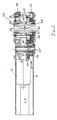
- Fig. 2 shows a plan view of an open drive unit 11, that is, with the cover 16 removed, so that it can be seen how the individual units are arranged on the lower part l5.
- Fig. 3 shows a top view of the lower part 15 of the drive unit, in which some elements are only shown symbolically, e.g. the circuit board 18, on which the control for the entire electric drive unit is accommodated and which can be controlled by means of electrical lines from a manually operated switch or also by means of a wireless hand transmitter, provided that it contains a corresponding receiver.
- the transformer 19 takes up a further large space on the lower part 15 and converts the usually only available high-voltage alternating current into direct current for the motor-transmission unit 20.
- the motor-transmission unit 20 is arranged on the lower part 15 such that the longitudinal axis of the motor runs parallel to the lower part 15 and the axis of the output of the unit is perpendicular thereto, that is to say parallel to the narrow side walls 50 shown in FIG. 2 only on two sides
- the axial direction of the output of the motor-gear unit is already parallel to the axial direction of the socket 30 serving as the output of the entire drive unit 11 with the inner square 44.
- This bushing 30 is not driven directly by the output shaft of the motor-gear unit 20, the gear part of which advantageously has a worm gear that is already strongly reducing, but via a further reduction 21, as can best be seen in FIG. 3.
- the output shaft of the motor-gear unit 20, which is screwed onto the lower part 15, is extended to such an extent that it extends through the opposite cover 16 and is additionally supported there via a slide bearing bush in a bearing bush 27 which is on the outside of the cover 16 is screwed on and extends somewhat through a corresponding recess in the cover into the interior of the housing in order to offer a sufficient axial bearing length on its inside diameter and on the outside diameter.
- the protruding motor output shaft is toothed on the outside and serves as the central pinion 22 of a planetary gear stage, and meshes with a plurality of planet gears 23 which roll outside in a comprehensive, internally toothed outer ring 24.
- These planet gears 23 each have dowel pins 25 as coaxial axes, which extend in the axial direction away from the motor gear unit out of these planet gears and, in the next axial stage - projecting from the motor gear unit 20 - protrude into corresponding recesses in a central gear 26.
- This central wheel which is mounted coaxially on the outer circumference of the bearing bush 27 and thus coaxially with the motor output shaft, is thus located between the planetary gear stage and the cover 16, as a result of which the gap between the motor gear unit 20 and the cover 16 in the axial direction is almost completely complete is filled.
- This externally toothed central gear 26 is rotated via the connection with the planet gears 23 with their rotation and meshes with its external toothing with the large gear 28 running in the same plane, which is normally connected in a rotationally fixed manner to the socket 30 serving as the output of the drive unit 11 is.
- This large gear 28, like the central gear 26, is parallel and immediately adjacent to the cover 16 and is already held in this axial position in that an axial offset in the direction opposite the cover is limited by the planetary gear stage, which is a larger one Has outer diameter than the underlying central gear 26 which meshes with the large gear 28 and thus partially projects beyond the large gear 28.
- the dowel pins 25 between the planetary gear stage and the central gear 26 running coaxially in the next stage must therefore either have a press fit in the central gear 26 and be slide-mounted in the planet gears 23 or vice versa.
- the planetary gear stage is held between the large gear 28 and the tarpaulin end surface of the motor gear unit 20 from which the output shaft protrudes.
- the large gear 28 is not directly supported, but sits coaxially on an outer circumference of the bush 30, and is connected to it in a rotationally fixed manner via two pairs of pins 29. Since this connection is designed to be detachable, the dowel pins 29 are press-fit either in the socket 30 or in the large gearwheel 28, while they have a clearance fit in the other part and are therefore axially displaceable.
- the socket 30 itself is slidingly supported on both sides, that is to say with the lower part 15 and with the cover 16, in a bearing flange 34, which is screwed onto the outside of the lower part 15 and the cover, and extends somewhat into the interior of the housing through a corresponding recess Extends the housing so that there is a sufficient axial bearing width for the bush 30.
- Plain bearing bushes 42 are arranged between the bushing 30 and the bearing flange 34.
- the drive unit 11 is approximately as flat as the distance between the lower part 15 and the cover 16, since beyond this distance only screw heads protrude, by means of which, for example, the motor-gear unit 20 is screwed to the lower part 15 or through the lower part 15 and cover 16 are screwed through with a spacer 41 for their connection.
- the bearing flanges 34 and the bearing bush 27 do not protrude further beyond the outer edges of the lower part 15 and cover 16 than the heads of these screws.
- the bushing 30 closes on the lower part with the outer surface of the bearing flange 34, while on the side of the cover 16 it projects a few millimeters beyond the outer surface of the bearing flange 34.
- the bush 30 by means of a spring 33 loaded under pressure in the form of a spiral spring which is arranged between the flange 34 of the lower part 15 and a corresponding shoulder of the bush 30, normally against the large gear 28 and thus the Lid 16 is pressed.
- the bushing 30 can be axially displaced against the force of this spring to such an extent that the hardened dowel pins no longer hold a positive connection either with the bushing 30 or with the large gearwheel 28.
- the door to be driven which is generally connected to the socket 30 and its inner square 44 in a form-fitting manner, is separated from the motor-gear unit 20, so that the door can move freely when it fails and can be opened by hand.
- Such an axial displacement of the bush 30 against the force of the spring 33 can be accomplished in that a fork, not shown in FIG. 3, engages in a circumferential, radial groove 31 of the bush 30, which is located between the shoulder 32 and the large gear 28.
- a fork 43 is pivotable about an axis which is perpendicular or skewed to the longitudinal axis of the bush 30, so that by pivoting the fork about its axis, which can be done by an operator, for example by means of a cable, the bush 30 is axially displaced and so that it can be disengaged from the large gear 28 to open the gate by hand.
- the bushing 30 in the normal position must protrude somewhat beyond the edge of this bearing flange.
- the socket 30 is hollow, so that the inner square 44 extends through the entire length of the socket. This has the advantage that - depending on the possibility of mounting the drive unit 11 - a corresponding outer square can optionally be inserted in both sides of the inner square 44, which is also positively and thus non-rotatably connected to one end of the lever 9 of FIG. 1.
- the mounting options of the drive unit 11 on a gate to be driven are thereby made considerably easier.
- Fig. 3 also shows the bent edges 17 of the lower part 15 and the lid 16, which are kept at a distance from each other by the spacer 41, in whose end faces the fastening screws reaching through the lower part 15 or lid are screwed.
- the side surfaces 49 of the housing between the lower part 15 and the cover 16 are closed by interposed side walls 15, which - depending on the mounting position of the drive unit - can be transparent plastic, at least on the underside. In this way, a function check is possible at any time without dismantling the drive unit by arranging a light source within the housing.
- Fig. 2 shows in addition to the assignment of the large gear 28 to the motor-gear unit 20 and the downstream planetary gear stage, the arrangement of the limit switches 35, which serve to automatically switch off the drive when the gate is in the fully closed or fully open position has reached.
- the limit switches 35 are arranged outside the circumference of the large gear 28 so that their tongues 40 to be released extend into the circumferential area of the large gear 28, but axially offset from this.
- actuation elements are in turn firmly connected to the large gear 28, which trigger them when a rotational position is reached in accordance with the position of the tongue.
- the large gearwheel 28 would turn several turns during operation of the gate would have passed through, the arrangement of the limit switches would be much more complicated, since they should only be operated at a certain number of revolutions.
- an angle 36 is fastened on the surface of the gear 28 facing the lower part at a distance of approximately 90 °, the leg of the gear 28 which struts from the gear has a continuous threaded bore through which a screw 37 is screwed and in a certain rotational position by means of a mother 38 is set.
- the free end face of the screw 37 confirms one of the tongues 40 of the limit switches 38, which are offset by approximately 180 °.
- the fine adjustment of the limit switches takes place in that the screw 37 is screwed into the threaded bore until the screw protrudes by the desired amount over the leg of the angle.
- the drive according to the invention creates an automatic drive that can be retrofitted at any time for the described gate type, which additionally contains many individual parts that are available at any time as purchased parts and, furthermore, is prone to failure and easy to maintain due to the simple construction of the components and can be repaired in the event of a defect .
Landscapes
- Engineering & Computer Science (AREA)
- Mechanical Engineering (AREA)
- Power-Operated Mechanisms For Wings (AREA)
Priority Applications (3)
| Application Number | Priority Date | Filing Date | Title |
|---|---|---|---|
| DE59006063T DE59006063D1 (de) | 1990-03-23 | 1990-03-23 | Elektrischer Antrieb für nach oben zu öffnende Falttore. |
| EP90105599A EP0447599B1 (fr) | 1990-03-23 | 1990-03-23 | Entraînement électrique pour portes relevables pliantes à deux panneaux |
| AT90105599T ATE106981T1 (de) | 1990-03-23 | 1990-03-23 | Elektrischer antrieb für nach oben zu öffnende falttore. |
Applications Claiming Priority (1)
| Application Number | Priority Date | Filing Date | Title |
|---|---|---|---|
| EP90105599A EP0447599B1 (fr) | 1990-03-23 | 1990-03-23 | Entraînement électrique pour portes relevables pliantes à deux panneaux |
Publications (2)
| Publication Number | Publication Date |
|---|---|
| EP0447599A1 true EP0447599A1 (fr) | 1991-09-25 |
| EP0447599B1 EP0447599B1 (fr) | 1994-06-08 |
Family
ID=8203805
Family Applications (1)
| Application Number | Title | Priority Date | Filing Date |
|---|---|---|---|
| EP90105599A Expired - Lifetime EP0447599B1 (fr) | 1990-03-23 | 1990-03-23 | Entraînement électrique pour portes relevables pliantes à deux panneaux |
Country Status (3)
| Country | Link |
|---|---|
| EP (1) | EP0447599B1 (fr) |
| AT (1) | ATE106981T1 (fr) |
| DE (1) | DE59006063D1 (fr) |
Citations (7)
| Publication number | Priority date | Publication date | Assignee | Title |
|---|---|---|---|---|
| US1335750A (en) * | 1916-09-28 | 1920-04-06 | Fred N Pearson | Controlling mechanism for doors and the like |
| US1872177A (en) * | 1931-12-03 | 1932-08-16 | Peelle Co The | Operator for canopy type doors |
| US3389740A (en) * | 1966-02-07 | 1968-06-25 | Allan Moyer Buehler | Door operators |
| DE2752348A1 (de) * | 1977-10-31 | 1979-05-03 | Schwab Klaus Bueren A A | Betaetigungsvorrichtung fuer ein garagen-kipptor |
| FR2529250A1 (fr) * | 1982-06-29 | 1983-12-30 | Almatic Sa | Porte basculante motorisee |
| US4496942A (en) * | 1981-03-10 | 1985-01-29 | Hitachi, Ltd. | Method and apparatus for door operation remote control |
| DE8807592U1 (de) * | 1987-07-20 | 1988-08-11 | Somfy, Cluses | Hilfsvorrichtung für einen Motor zum Antrieb einer Garagentür |
-
1990
- 1990-03-23 DE DE59006063T patent/DE59006063D1/de not_active Expired - Lifetime
- 1990-03-23 AT AT90105599T patent/ATE106981T1/de not_active IP Right Cessation
- 1990-03-23 EP EP90105599A patent/EP0447599B1/fr not_active Expired - Lifetime
Patent Citations (7)
| Publication number | Priority date | Publication date | Assignee | Title |
|---|---|---|---|---|
| US1335750A (en) * | 1916-09-28 | 1920-04-06 | Fred N Pearson | Controlling mechanism for doors and the like |
| US1872177A (en) * | 1931-12-03 | 1932-08-16 | Peelle Co The | Operator for canopy type doors |
| US3389740A (en) * | 1966-02-07 | 1968-06-25 | Allan Moyer Buehler | Door operators |
| DE2752348A1 (de) * | 1977-10-31 | 1979-05-03 | Schwab Klaus Bueren A A | Betaetigungsvorrichtung fuer ein garagen-kipptor |
| US4496942A (en) * | 1981-03-10 | 1985-01-29 | Hitachi, Ltd. | Method and apparatus for door operation remote control |
| FR2529250A1 (fr) * | 1982-06-29 | 1983-12-30 | Almatic Sa | Porte basculante motorisee |
| DE8807592U1 (de) * | 1987-07-20 | 1988-08-11 | Somfy, Cluses | Hilfsvorrichtung für einen Motor zum Antrieb einer Garagentür |
Also Published As
| Publication number | Publication date |
|---|---|
| DE59006063D1 (de) | 1994-07-14 |
| EP0447599B1 (fr) | 1994-06-08 |
| ATE106981T1 (de) | 1994-06-15 |
Similar Documents
| Publication | Publication Date | Title |
|---|---|---|
| DE102007002650B4 (de) | Drehflügelantrieb | |
| AT500017B1 (de) | Schwenkschiebetür für fahrzeuge | |
| EP1818492A2 (fr) | Dispositif d'entraînement destiné à l'actionnement motorisé d'un élément de fonctionnement dans un véhicule automobile | |
| EP2682304B1 (fr) | Dispositif de réglage pour un phare de véhicule automobile | |
| DE69300308T2 (de) | Schwenkbetätigungsvorrichtung einer Trittstufenanordnung für Fahrzeuge. | |
| DE3834643C2 (de) | Antriebseinheit | |
| DE3121136A1 (de) | "antrieb insbesondere fuer schwenktore und dgl." | |
| DE9418079U1 (de) | Freitragendes Schiebetor | |
| EP3656960B1 (fr) | Cinématique pour volet de véhicule | |
| DE3608988A1 (de) | Vorrichtung zur handbetaetigung einer elektromotorisch antreibbaren wickelwelle z.b. eines rolladens | |
| EP0447599B1 (fr) | Entraînement électrique pour portes relevables pliantes à deux panneaux | |
| DE19742512C2 (de) | Schubstangenverschluß für eine an einem Schaltschrank-Korpus angelenkte Schranktüre | |
| DE3503816C2 (fr) | ||
| DE3400778C2 (fr) | ||
| EP1437475B1 (fr) | Fenêtre ou porte avec dispositif d'entraînement | |
| EP1836368A1 (fr) | Dispositif d'entrainement pour une porte ou une fenetre | |
| DE3513666A1 (de) | Industrietor | |
| EP0374271B1 (fr) | Dispositif de commande d'une porte coulissant horizontalement sur des poulies le long d'un rail de guidage | |
| EP0938619B1 (fr) | Volets pivotants pour ouvertures de fenetres et de portes | |
| EP3018280A1 (fr) | Entraînement de porte | |
| AT401082B (de) | Ein- oder zweiflügelige schiebe-, schwenkschiebe- oder taschentür | |
| DE2739151A1 (de) | Endschaltervorrichtung, insbesondere fuer rolladen und jalousien | |
| DE4327230C1 (de) | Rolladen für Dachfenster | |
| DE9200754U1 (de) | Vorrichtung zum Aus- und Einfahren einer Dichtleiste an einem beweglichen Trennwandelement | |
| DE102007006313B4 (de) | Modellfahrzeug |
Legal Events
| Date | Code | Title | Description |
|---|---|---|---|
| PUAI | Public reference made under article 153(3) epc to a published international application that has entered the european phase |
Free format text: ORIGINAL CODE: 0009012 |
|
| AK | Designated contracting states |
Kind code of ref document: A1 Designated state(s): AT BE CH DE DK ES FR GB GR IT LI LU NL SE |
|
| RBV | Designated contracting states (corrected) |
Designated state(s): AT CH DE FR IT LI |
|
| 17P | Request for examination filed |
Effective date: 19920227 |
|
| 17Q | First examination report despatched |
Effective date: 19920622 |
|
| GRAA | (expected) grant |
Free format text: ORIGINAL CODE: 0009210 |
|
| AK | Designated contracting states |
Kind code of ref document: B1 Designated state(s): AT CH DE FR IT LI |
|
| PG25 | Lapsed in a contracting state [announced via postgrant information from national office to epo] |
Ref country code: FR Free format text: THE PATENT HAS BEEN ANNULLED BY A DECISION OF A NATIONAL AUTHORITY Effective date: 19940608 |
|
| REF | Corresponds to: |
Ref document number: 106981 Country of ref document: AT Date of ref document: 19940615 Kind code of ref document: T |
|
| REF | Corresponds to: |
Ref document number: 59006063 Country of ref document: DE Date of ref document: 19940714 |
|
| ITF | It: translation for a ep patent filed | ||
| PG25 | Lapsed in a contracting state [announced via postgrant information from national office to epo] |
Ref country code: DE Effective date: 19940929 |
|
| ET | Fr: translation filed | ||
| PG25 | Lapsed in a contracting state [announced via postgrant information from national office to epo] |
Ref country code: AT Effective date: 19950323 |
|
| PG25 | Lapsed in a contracting state [announced via postgrant information from national office to epo] |
Ref country code: LI Effective date: 19950331 Ref country code: CH Effective date: 19950331 |
|
| PLBE | No opposition filed within time limit |
Free format text: ORIGINAL CODE: 0009261 |
|
| STAA | Information on the status of an ep patent application or granted ep patent |
Free format text: STATUS: NO OPPOSITION FILED WITHIN TIME LIMIT |
|
| 26N | No opposition filed | ||
| REG | Reference to a national code |
Ref country code: CH Ref legal event code: PL |
|
| REG | Reference to a national code |
Ref country code: FR Ref legal event code: ST |
|
| PG25 | Lapsed in a contracting state [announced via postgrant information from national office to epo] |
Ref country code: IT Free format text: LAPSE BECAUSE OF NON-PAYMENT OF DUE FEES;WARNING: LAPSES OF ITALIAN PATENTS WITH EFFECTIVE DATE BEFORE 2007 MAY HAVE OCCURRED AT ANY TIME BEFORE 2007. THE CORRECT EFFECTIVE DATE MAY BE DIFFERENT FROM THE ONE RECORDED. Effective date: 20050323 |