EP0447768B1 - Lasermodul - Google Patents
Lasermodul Download PDFInfo
- Publication number
- EP0447768B1 EP0447768B1 EP91101251A EP91101251A EP0447768B1 EP 0447768 B1 EP0447768 B1 EP 0447768B1 EP 91101251 A EP91101251 A EP 91101251A EP 91101251 A EP91101251 A EP 91101251A EP 0447768 B1 EP0447768 B1 EP 0447768B1
- Authority
- EP
- European Patent Office
- Prior art keywords
- laser
- casing
- module
- flange
- optical waveguide
- Prior art date
- Legal status (The legal status is an assumption and is not a legal conclusion. Google has not performed a legal analysis and makes no representation as to the accuracy of the status listed.)
- Expired - Lifetime
Links
- 230000003287 optical effect Effects 0.000 claims abstract description 25
- 125000006850 spacer group Chemical group 0.000 claims description 2
- 230000008878 coupling Effects 0.000 abstract description 5
- 238000010168 coupling process Methods 0.000 abstract description 5
- 238000005859 coupling reaction Methods 0.000 abstract description 5
- 230000005540 biological transmission Effects 0.000 abstract description 2
- 230000005284 excitation Effects 0.000 abstract description 2
- 239000013307 optical fiber Substances 0.000 description 18
- 238000003384 imaging method Methods 0.000 description 17
- 230000005855 radiation Effects 0.000 description 13
- 239000004065 semiconductor Substances 0.000 description 11
- 239000000835 fiber Substances 0.000 description 8
- 239000002184 metal Substances 0.000 description 3
- 238000005476 soldering Methods 0.000 description 3
- 238000003466 welding Methods 0.000 description 3
- 208000004350 Strabismus Diseases 0.000 description 2
- 238000004026 adhesive bonding Methods 0.000 description 2
- 238000005457 optimization Methods 0.000 description 2
- 229910000679 solder Inorganic materials 0.000 description 2
- XUIMIQQOPSSXEZ-UHFFFAOYSA-N Silicon Chemical compound [Si] XUIMIQQOPSSXEZ-UHFFFAOYSA-N 0.000 description 1
- 239000000853 adhesive Substances 0.000 description 1
- 230000001070 adhesive effect Effects 0.000 description 1
- 238000010586 diagram Methods 0.000 description 1
- 239000006185 dispersion Substances 0.000 description 1
- 230000000694 effects Effects 0.000 description 1
- 238000010438 heat treatment Methods 0.000 description 1
- 238000004519 manufacturing process Methods 0.000 description 1
- 238000000034 method Methods 0.000 description 1
- 230000000284 resting effect Effects 0.000 description 1
- 229910052710 silicon Inorganic materials 0.000 description 1
- 239000010703 silicon Substances 0.000 description 1
- 239000007787 solid Substances 0.000 description 1
- 239000000126 substance Substances 0.000 description 1
Images

Classifications
-
- G—PHYSICS
- G02—OPTICS
- G02B—OPTICAL ELEMENTS, SYSTEMS OR APPARATUS
- G02B6/00—Light guides; Structural details of arrangements comprising light guides and other optical elements, e.g. couplings
- G02B6/24—Coupling light guides
- G02B6/42—Coupling light guides with opto-electronic elements
- G02B6/4201—Packages, e.g. shape, construction, internal or external details
- G02B6/4219—Mechanical fixtures for holding or positioning the elements relative to each other in the couplings; Alignment methods for the elements, e.g. measuring or observing methods especially used therefor
- G02B6/422—Active alignment, i.e. moving the elements in response to the detected degree of coupling or position of the elements
- G02B6/4226—Positioning means for moving the elements into alignment, e.g. alignment screws, deformation of the mount
-
- G—PHYSICS
- G02—OPTICS
- G02B—OPTICAL ELEMENTS, SYSTEMS OR APPARATUS
- G02B6/00—Light guides; Structural details of arrangements comprising light guides and other optical elements, e.g. couplings
- G02B6/24—Coupling light guides
- G02B6/42—Coupling light guides with opto-electronic elements
- G02B6/4201—Packages, e.g. shape, construction, internal or external details
- G02B6/4204—Packages, e.g. shape, construction, internal or external details the coupling comprising intermediate optical elements, e.g. lenses, holograms
-
- G—PHYSICS
- G02—OPTICS
- G02B—OPTICAL ELEMENTS, SYSTEMS OR APPARATUS
- G02B6/00—Light guides; Structural details of arrangements comprising light guides and other optical elements, e.g. couplings
- G02B6/24—Coupling light guides
- G02B6/42—Coupling light guides with opto-electronic elements
- G02B6/4201—Packages, e.g. shape, construction, internal or external details
- G02B6/4219—Mechanical fixtures for holding or positioning the elements relative to each other in the couplings; Alignment methods for the elements, e.g. measuring or observing methods especially used therefor
- G02B6/4234—Passive alignment along the optical axis and active alignment perpendicular to the optical axis
Definitions
- the invention is based on a laser module according to the preamble of claim 1.
- a laser module in which the rotationally symmetrical housing consists of two parts.
- a semiconductor laser located in a housing is fixedly arranged in one part.
- the imaging optics and the connecting optical waveguide are fixed.
- the position of the semiconductor laser is determined via the fit of the laser housing in a recess in the one housing part.
- the laser chip is usually not exactly in the target position, but is offset in relation to this in the range of a few tens of nanometers in space.
- this means that the optical axis of the laser does not exactly match the longitudinal axis of the associated module housing part, on the other hand, the laser position varies in the longitudinal axis direction around the target position.
- the division of the module housing into two is unfavorable, since temperature changes acting on one side cannot spread quickly and evenly enough over the metallic welding or soldering bridges or the adhesive connection to both housing parts. However, this is of grave importance since partial temperature-related deformations of the laser housing influence the adjustment. In addition, a further optimization possibility is dispensed with due to the fixed assignment of the imaging optics to the connecting optical waveguide. In addition, the division of the laser housing in two is uneconomical due to higher manufacturing costs.
- a laser module according to the preamble of claim 1 is known from the document "PATENT ABSTRACTS OF JAPAN, Volume 6, No. 176 (E-30), September 10, 1982 to JP-A-57093590 (NEC) June 10, 1982".
- the module housing an inner wall piece of a recess for receiving the housing of a semiconductor element is lined with a substance that cannot be wetted by solder.
- the semiconductor element is aligned in the recess with the center axis of the module housing and its housing is connected by a solder bridge to the non-wetted outer wall piece of the module housing in such a way that the housing flange of the semiconductor element is located outside the module housing.
- the object of the invention is to provide a laser module with which such an optimal coupling of a laser to an optical waveguide is possible that stable single-mode operation is possible even with a semiconductor laser operating below the cut-off wavelength of a single-mode fiber.
- the advantages achieved by the invention consist in particular in the fact that the module housing is in one piece and made of metal and thus on the one hand is economically producible and on the other hand temperature changes due to the unimpeded higher conductivity of the housing have no effect that the optical axis by adjusting the laser relative to the module housing can be made to coincide with the mechanical axis of the module housing, so that the radiation of the laser is coupled concentrically into the imaging optics, that due to the enlarging imaging ratio of the optics, the axial radiation into the core of the optical waveguide takes place at an angle that optimally couples the Luminous power enables, and that the connecting optical fiber in the concentric bore of the module housing to an optimal image of the laser light spot on the end face of the optical fiber is adjustable before attachment.
- a monomode optical waveguide also referred to as optical fiber
- optical fiber has established itself as the optical transmission medium, which has the lowest attenuation and dispersion above the cutoff wavelength in the range from 1300 to 1600 nm. This for long-distance traffic currently. optimal fiber optic type is already produced in considerable quantities at corresponding prices.
- this single-mode optical fiber is also a suitable optical fiber type for the optical subscriber line.
- the object of the present invention is to enable stable single-mode operation with a laser operating below the cut-off wavelength of a single-mode optical fiber. This can only be achieved under optimal conditions, which essentially consist in the geometric assignment of laser and fiber optic and depend on the coupling of the laser radiation into the optical waveguide.
- the laser radiation is highly divergent.
- the radiation power of the laser 6 can be optimally used, for example over an angle ⁇ 1 of ⁇ 30 °.
- the angle ⁇ 2 at which the laser radiation is coupled into the fiber optic cable 10 may only be as large as the acceptance angle of the fiber.
- FIG. 3 shows a laser module in section III-III of FIG. 4, in which a laser 6 with an operating wavelength of 780 nm and a single-mode fiber 10 is used as the connection optical fiber 10.
- the mode housing 1 is a rotationally symmetrical body made of a metal with good thermal conductivity.
- the three-stage housing 1 has a central central bore 4 with the diameter of a magnifying imaging optic 9.
- the housing 1 has a round recess 3 which is concentric with the central bore 4 and which is stepped outward in a step-like manner to a larger diameter.
- the resulting annular stop surface 3a serves as an abutment for the flange 6a of the laser 6 in the inserted state.
- the recess 3 has a slightly larger diameter than the housing of the laser 6 or its rear flange 6a.
- the outer part of the stepped recess 3 has an internal thread for receiving a ring nut 8.
- the module housing 1 has a cylindrical bore 5 which is concentric with the central bore 4.
- the front end of the connecting optical fiber 10 is surrounded concentrically by a cylindrical sleeve 11, the end face 11a of which, except for the optical fiber 10, is ground flat at right angles to the central axis.
- the sleeve 11 fits without play into the cylinder bore 5.
- the middle step of the module housing 1 is provided with a thread 2, via which the module can be fastened, for example, in a holder.
- the laser flange 6a resting on the abutment surface 3a is the reference plane of the laser 6.
- the position of the laser chip 7 in space varies by up to ⁇ 80 »m. If these deviations from the target position are not compensated, then the laser light would not be coupled into the core of the optical fiber 10 in a rotationally symmetrical manner due to the lateral offset to the central axis. Even an off-center offset of more than 2 »m leads to disturbing excitation of the LP11 mode.
- the adjusting screws 12 are provided for aligning the laser 6 or the chip 7 on the central axis.
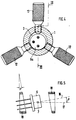
- FIG. 4 shows in section IV-IV of FIG. 3 the arrangement of the three set screws 12 which act on the flange 6a of the laser 6.
- the laser 6 can be moved in the clearance of the recess 3 in the module housing 1.
- the setting is made in the unmodulated operating state of the laser 6 to the maximum intensity of the radiation emerging at the end of the optical fiber 10.
- the setting is fixed by tightening the ring nut 8, which was previously only slightly tightened.
- the axial tolerance range between in extreme cases, the laser chip 7 and the imaging optics 9 can be compensated for by spacers. In general, an adjustment is not necessary here, since this error only affects the laser light radiation detected by the imaging optics 9 and is relatively small.
- the cylinder sleeve 11 is then positioned and fixed in the bore 5 in such a way that the imaging of the laser light area, enlarged by the imaging optics 9, takes place exactly on the end face 11a of the sleeve 11 or the core cross-sectional area of the optical fiber 10.
- the laser light spot is imaged on the core cross-sectional area in a rotationally symmetrical manner. This creates the prerequisite that the LWL 10 is only excited in the basic mode.
- the optimization of the setting is also recognized here via the intensity of the radiation emerging at the end of the connecting optical fiber 10.
- the imaging optics 9 is a gradient index lens with an enlarging imaging ratio of 1: 3. The latter can vary depending on the imaging system.
- the optical axis of the laser 6 is aligned with the central axis of the module housing 1.
- the mechanical axis 16 of the laser u. the optical axis 17 of the laser chip 7 diverge relatively strongly.
- the deviation referred to as the squint angle can be compensated for by the fact that the laser 6 (shown disproportionately in FIG. 5) has flattened compensation rings 18 in the recess 3 of the module housing 1 are enclosed.
- the optical axis 17 is brought into a position parallel to the central axis and then brought into congruence with the latter by the adjustment process described.
- a one-piece metal body as a module housing guarantees permanent shape and temperature-resistant assignment of the laser 6 via the imaging optics 9 to the connection optical fiber 10.
- the module housing according to the invention can of course also be used for lasers whose emission wavelength is above the limit wavelength of the connecting or line fiber.
- the centered laser-fiber coupling provides excellent temperature stability.
Landscapes
- Physics & Mathematics (AREA)
- General Physics & Mathematics (AREA)
- Optics & Photonics (AREA)
- Optical Couplings Of Light Guides (AREA)
- Semiconductor Lasers (AREA)
- Laser Surgery Devices (AREA)
- Lasers (AREA)
Description
- Die Erfindung geht von einem Lasermodul gemäß dem Oberbegriff des Anspruchs 1 aus.
- Durch die DE 34 13 749 A1 ist ein Lasermodul bekannt, bei dem das rotationssymmetrische Gehäuse aus zwei Teilen besteht. In dem einen Teil ist ein in einem Gehäuse befindlicher Halbleiterlaser fest angeordnet. Im anderen Teil sind die Abbildungsoptik und der Anschluß-Lichtwellenleiter fest angeordnet. Die Position des Halbleiterlasers wird über die Paßform des Lasergehäuses in einer Ausnehmung in dem einen Gehäuseteil bestimmt. Das Laserchip befindet sich in der Regel nicht exakt in der Sollage, sondern ist gegenüber dieser im Bereich von einigen zig Nanometern im Raum versetzt. Damit stimmt aber einerseits die optische Achse des Lasers mit der Längsachse des zugehörigen Modulgehäuseteils nicht exakt überein, andererseits variiert die Laserposition in Achsenlängsrichtung um die Sollage. Diese Abweichungen werden durch Justieren der beiden Gehäuseteile des Moduls zueinander auf maximale Intensität des am Ende des Anschluß-Lichtwellenleiters austretenden Lichtes ausgeglichen. In dieser Zuordnung werden die beiden Gehäuseteile durch Schweißen, Löten oder Kleben fest miteinander verbunden. Die beim Schweißen und Löten partiell auftretende Wärmebehandlung der beiden Gehäuseteile kann Formveränderungen zur Folge haben, die eine Dejustierung bewirken. Auch das Kleben ist im Hinblick auf die mechanische und thermische Stabilität der Verbindung kritisch. Ein Ausgleich der mit Schielwinkel bezeichneten Abweichung zwischen der optischen Achse des Laserchips und der mechanischen Achse des Lasergehäuses erfolgt nicht. Darüber hinaus ist die Zweiteilung des Modulgehäuses ungünstig, da sich einseitig einwirkende Temperaturänderungen nicht schnell und gleichmäßig genug über die metallischen Schweiß- oder Lötbrücken oder die Kleberverbindung auf beide Gehäuseteile verteilen können. Dies ist jedoch von gravierender Bedeutung, da partielle temperaturbedingte Verformungen des Lasergehäuses Einfluß auf die Justage nehmen. Im übrigen wird durch die feste Zuordnung der Abbildungsoptik zum Anschluß-Lichtwellenleiter auf eine weitere Optimierungsmöglichkeit verzichtet. Im übrigen ist die Zweiteilung des Lasergehäuses aufgrund höherer Herstellungskosten unwirtschaftlich.
- Ein Lasermodul nach dem Oberbegriff des Anspruchs 1 ist aus dem Dokument "PATENT ABSTRACTS OF JAPAN, Band 6, Nr. 176 (E-30), 10. September 1982 zu JP-A-57093590 (NEC) 10.06.1982" bekannt. Bei dem Modulgehäuse ist ein inneres Wandstück einer Ausnehmung für die Aufnahme des Gehäuses eines Halbleiterelementes mit einer von Lötzinn nicht benetzbaren Substanz ausgekleidet. Das Halbleiterelement ist in der Ausnehmung auf die Mittelachse des Modulgehäuses ausgerichtet und sein Gehäuse durch eine Lötbrücke so mit dem unbenetzten äußeren Wandstück des Modulgehäuses verbunden, daß der Gehäuseflansch des Halbleiterelementes sich außerhalb des Modulgehäuses befindet.
- Die Aufgabe der Erfindung besteht darin, ein Lasermodul zu schaffen, mit dem eine so optimale Kopplung eines Lasers an einen Lichtwellenleiter möglich ist, daß sogar mit einem unterhalb der Grenzwellenlänge einer Einmodenfaser arbeitender Halbleiterlaser ein stabiler Einmodenbetrieb möglich ist.
- Diese Aufgabe wird durch die im Anspruch 1 angegebenen Merkmale gelöst. Die Unteransprüche zeigen vorteilhafte Ausgestaltungen des Erfindungsgegenstandes auf.
- Die durch die Erfindung erzielten Vorteile bestehen insbesondere darin, daß das Modulgehäuse einteilig und aus Metall ist und damit einerseits wirtschaftlich herstellbar ist und andererseits Temperaturänderungen durch die ungehinderte höhere Leitfähigkeit des Gehäuses ohne Auswirkung bleiben, daß durch das Einstellen des Lasers gegenüber dem Modulgehäuse die optische Achse mit der mechanischen Achse des Modulgehäuses zur Deckung gebracht werden kann, so daß die Abstrahlung des Lasers konzentrisch in die Abbildungsoptik eingekoppelt wird, daß durch das vergrößernde Abbildungsverhältnis der Optik die axiale Einstrahlung in den Kern des Lichtwellenleiters unter einem Winkel erfolgt, der eine optimale Einkopplung der Lichtleistung ermöglicht, und daß der Anschluß-Lichtwellenleiter in der konzentrischen Bohrung des Modulgehäuses auf eine optimale Abbildung des Laserlichtflecks auf der Stirnfläche des Lichtwellenleiters vor der Befestigung einstellbar ist.
- Anhand eines Ausführungsbeispiels wird die Erfindung in Verbindung mit den Zeichnungen nachfolgend näher erläutert. Es zeigen:
- Fig. 1
- das Strahlungsdiagramm einer handelsüblichen Halbleiter-Laserdiode,
- Fig. 2
- die Fokussierung einer Laserstrahlung gemäß Fig. 1 auf den Kernbereich eines Lichtwellenleiters durch eine Abbildungsoptik mit vergrößerndem Abbildungsverhältnis,
- Fig. 3
- ein Lasermodul gemäß der Erfindung im Schnitt III-III der Fig. 4,
- Fig. 4
- das Lasermodul im Schnitt IV-IV der Fig. 3,
- Fig. 5
- in schematischer Darstellung Maßnahmen zum Ausgleich bei divergierender mechanischer und optischer Achse des Lasers.
- In der DE 36 37 097 A1 ist im einzelnen dargelegt, daß Monomode-Lichtwellenleiter nur für Wellenlängen oberhalb einer Grenzwellenlänge monomodig sind, d.h., oberhalb der Grenzwellenlänge ist nur der Grundmode ausbreitungsfähig. Dagegen sind bei Wellenlängen unterhalb der Grenzwellenlänge mehrere Moden ausbreitungsfähig.
- Im Weitverkehr hat sich als optisches Übertragungsmedium ein Monomode-Lichtwellenleiter, weiterhin mit LWL bezeichnet, durchgesetzt, der oberhalb der Grenzwellenlänge im Bereich von 1300 bis 1600 nm die niedrigste Dämpfung und Dispersion hat. Dieser für den Weitverkehr z.Zt. optimale LWL-Typ wird bereits in erheblichen Mengen zu entsprechenden Preisen hergestellt.
- Es wurde bereits erkannt, daß dieser Monomode-LWL auch für den optischen Teilnehmeranschluß ein geeigneter LWL-Typ ist. Die hohen Kosten der bisher als notwendig erachteten elektro-optischen bzw. opto-elektrischen Wandler standen jedoch der Einführung von optischen Breitband-Teilnehmeranschlüssen im Wege.
- Unter Inkaufnahme einer erhöhten Dämpfung, die jedoch bei der Anwendung im Teilnehmeranschlußbereich (ca. 6-12 km) ohne weiteres hingenommen werden kann, ist es durch die vorgenannte Patentanmeldung bekannt, mit einem weit unter der Grenzwellenlänge des LWLs arbeitenden Halbleiter-Laser einen stabilen Monomode-Betrieb zu erreichen. Es handelt sich um einen Laser-Typ mit einer Betriebswellenlänge von 780 nm, wie er in CD-Plattenspielern üblich ist und in sehr hohen Stückzahlen hergestellt wird und daher sehr preiswert ist. Als entsprechend preiswerte Empfänger bieten sich Fotodioden auf Siliziumbasis an.
- Wie beim vorgenannten Anmeldungsgegenstand besteht auch bei der vorliegenden Erfindung die Aufgabe, mit einem unterhalb der Grenzwellenlänge eines einmodigen LWLs arbeitenden Laser einen stabilen Monomode-Betrieb zu ermöglichen. Dieses läßt sich nur unter optimalen Gegebenheiten erreichen, die im wesentlichen in der geometrischen Zuordnung von Laser und LWL bestehen und von der Einkopplung der Laserstrahlung in den Lichtwellenleiter abhängen.
- Fig. 1 zeigt den typischen Intensitätsverlauf der abgestrahlten Lichtleistung eines Halbleiter-Lasers in Prozent über den Abstrahlwinkel α 1.
- Fig. 2 zeigt die Fokussierung und Einkopplung der abgestrahlten Lichtleistung 14 eines Halbleiter-Lasers 6 im Bereich des Abstrahlwinkels α 1 über eine Abbildungsoptik 9 auf die Kernquerschnittsfläche eines LWLs 10. Die Laserabstrahlung ist stark divergent. Im Hinblick auf die eingangs erwähnte höhere Streckendämpfung ist die Strahlungsleistung des Lasers 6 optimal auszunutzen, z.B. über einen Winkel α 1 von ± 30°. Der Winkel α 2, unter dem die Laserstrahlung in den LWL 10 eingekoppelt wird, darf jedoch nur so groß wie der Akzeptanzwinkel der Faser sein. Da die lichtabstrahlende Fläche eines Laserchips 7 klein ist gegenüber der Kernquerschnittsfläche des LWLs 10, kann über eine vergrößernde Abbildungsoptik 9 der Raumwinkel α 2 der einzukoppelnden Strahlung gemäß der Beziehung

reduziert werden, wobei der Vergrößerungsfaktor durch das Verhältnis von Kernquerschnittsfläche zu Strahlfläche des Lasers begrenzt ist. - Fig. 3 zeigt ein Lasermodul im Schnitt III-III der Fig. 4, bei dem ein Laser 6 mit einer Betriebswellenlänge von 780 nm und als Anschluß-LWL 10 eine Einmodenfaser verwendet ist.
- Das Modengehäuse 1 ist ein rotationssymmetrischer Körper aus einem Metall mit guter Wärmeleitfähigkeit. Das dreigestufte Gehäuse 1 hat eine zentrale Mittelbohrung 4 vom Durchmesser einer vergrößernden Abbildungsoptik 9. An einem Ende hat das Gehäuse 1 eine zur Mittelbohrung 4 konzentrische runde Ausnehmung 3, die nach außen stufenförmig auf einen größeren Durchmesser abgesetzt ist. Die dadurch gegebene ringförmige Anschlagfläche 3a dient als Anlage für den Flansch 6a des Lasers 6 im eingesetzten Zustand. Die Ausnehmung 3 hat einen etwas größeren Durchmesser als das Gehäuse des Lasers 6 bzw. seines rückwärtigen Flansches 6a. Der äußere Teil der stufenförmig abgesetzten Ausnehmung 3 hat ein Innengewinde zur Aufnahme einer Ringmutter 8. Im Bereich des Flansches 6a sind im Modulgehäuse 1 drei im Dreieck auf die Mittelachse gerichtete Stellglieder angeordnet (Fig. 4). Beim vorliegenden Beispiel sind es Stellschrauben 12, die manuell betätigt werden. Es sind aber auch durch Stellmotore betriebene Stellstifte denkbar, deren Bewegung rechnergestützt koordiniert werden. Am anderen Ende hat das Modulgehäuse 1 eine zur Mittelbohrung 4 konzentrische Zylinderbohrung 5. Das vordere Ende des Anschluß-LWLs 10 ist konzentrisch von einer Zylinderhülse 11 umgeben, deren Stirnfläche 11a bis auf den LWL 10 rechtwinklig zur Mittelachse plangeschliffen ist. Die Hülse 11 paßt spielfrei in die Zylinderbohrung 5. Die mittlere Stufe des Modulgehäuses 1 ist mit einem Gewinde 2 versehen, über das das Modul z.B. in einer Halterung befestigt werden kann.
- Der an der Anschlagfläche 3a anliegende Laserflansch 6a ist die Bezugsebene des Lasers 6. Gegenüber dieser und der Mittelachse variiert die Lage des Laserchips 7 im Raum um bis zu ± 80 »m. Werden diese Abweichungen von der Sollage nicht ausgeglichen, dann würde durch den seitlichen Versatz zur Mittelachse das Laserlicht nicht rotationssymmetrisch in den Kern des LWLs 10 eingekoppelt. Schon ein außermittiger Versatz von mehr als 2 »m führt zu störender Anregung des LP₁₁-Modes. Zum Ausrichten des Lasers 6 bzw. des Chips 7 auf die Mittelachse sind die Stellschrauben 12 vorgesehen.
- Fig. 4 zeigt im Schnitt IV-IV der Fig. 3 die Anordnung der drei Stellschrauben 12, die auf den Flansch 6a des Lasers 6 einwirken. Durch gleichzeitiges Verstellen von jeweils zwei Stellschrauben 12 läßt sich der Laser 6 im Spielraum der Ausnehmung 3 im Modulgehäuse 1 bewegen. Die Einstellung erfolgt im unmodulierten Betriebszustand des Lasers 6 auf maximale Intensität der am Ende des Anschluß-LWLs 10 austretenden Strahlung. Durch Festziehen der zuvor nur leicht angezogenen Ringmutter 8 wird die Einstellung fixiert. Der axiale Toleranzbereich zwischen dem Laserchip 7 und der Abbildungsoptik 9 kann im Extremfall durch Distanzscheiben ausgeglichen werden. Im allgemeinen ist eine Justage hier nicht erforderlich, da sich dieser Fehler nur auf die von der Abbildungsoptik 9 erfaßten Laserlichtabstrahlung auswirkt und relativ gering ist. Anschließend wird die Zylinderhülse 11 in der Bohrung 5 so positioniert und fixiert, daß die durch die Abbildungsoptik 9 vergrößerte Abbildung der Laserlichtfläche genau auf der Stirnfläche 11a der Hülse 11 bzw. der Kernquerschnittsfläche des LWLs 10 erfolgt. Durch die zuvor erfolgte Ausrichtung der optischen Achse des Lasers 6 auf die Mittelachse des Modulgehäuses 1 wird der Laserlichtfleck rotationssymmetrisch auf der Kernquerschnittsfläche abgebildet. Damit ist die Voraussetzung geschaffen, daß der LWL 10 nur im Grundmode angeregt wird. Die Optimierung der Einstellung wird auch hier über die Intensität der am Ende des Anschluß-LWLs 10 austretenden Strahlung erkannt.
- Die Abbildungsoptik 9 ist im vorliegenden Beispiel eine Gradienten-Index-Linse mit einem vergrößernden Abbildungs-Verhältnis von 1:3. Letzteres kann je nach Abbildungs-System variieren.
- Wie vorbeschrieben, ist es von entscheidender Bedeutung, daß die optische Achse des Lasers 6 auf die Mittelachse des Modulgehäuses 1 ausgerichtet ist. Unter der Masse der im vorliegenden Fall verwendeten Halbleiterlaser gibt es gemäß Fig. 5 Exemplare, bei der die mechanische Achse 16 des Lasers u. die optische Achse 17 des Laserchips 7 relativ stark divergieren. Die als Schielwinkel bezeichnete Abweichung kann dadurch kompensiert werden, daß dem Laser 6 (in Fig. 5 überproportional dargestellt) keilförmig abgeflachte Ausgleichsringe 18 in die Ausnehmung 3 des Modulgehäuses 1 beigelegt werden. Dadurch wird die optische Achse 17 in eine zur Mittelachse parallele Lage gebracht und durch den beschriebenen Justiervorgang sodann mit letzterer zur Deckung gebracht.
- Die Verwendung eines einteiligen Metallkörpers als Modulgehäuse garantiert eine dauerhafte form- und temperaturbeständige Zuordnung des Lasers 6 über die Abbildungsoptik 9 zum Anschluß-LWL 10.
- Das erfindungsgemäße Modulgehäuse ist natürlich auch für Laser zu benutzen, deren Emissionswellenlänge oberhalb der Grenzwellenlänge der Anschluß- bzw. Streckenfaser liegt. Hier bringt die zentrierte Laser-Faser-Kopplung eine hervorragende Temperaturstabilität.
Claims (5)
- Lasermodul mit einem rotationssymmetrischen Modulgehäuse (1), das eine konzentrische Mittelbohrung (4) hat, in die an einem Ende eine achssymmetrische Ausnehmung (3) zur Aufnahme eines in einem Gehäuse (6) mit Flansch (6a) gekapselten Lasers (7) eingelassen ist, wobei die Ausnehmung (3) zur seitlichen Ausrichtung einen größeren Querschnitt als das Lasergehäuse (6) aufweist, und die Mittelbohrung (4) am anderen Ende eine konzentrische Zylinderbohrung (5) mit einer darin fixierten, einen Anschluß-Lichtwellenleiter (10) enthaltenden Zylinderhülse (11) hat, zwischen der und dem Laser (7) in der Mittelbohrung (4) eine Abbildungsoptik (9) angeordnet ist,
dadurch gekennzeichnet,
daß die Ausnehmung (3) nach außen stufenförmig auf einen größeren als den Flanschdurchmesser des Lasergehäuses (6) abgesetzt ist und eine ringförmige Anschlagfläche (3a) für den Flansch (6a) bildet, daß im Modulgehäuse (1) drei im Dreieck auf den Flansch (6a) des Lasergehäuses (6) einwirkende Stellglieder angeordnet sind, und daß der äußere Teil der abgesetzten Ausnehmung (3) ein Innengewinde zur Aufnahme einer Ringmutter (8) hat, zwischen der und der Anschlagfläche (3a) des Modulgehäuses (1) der Flansch (6a) des Lasergehäuses (6) fixiert ist. - Lasermodul nach Anspruch 1, dadurch gekennzeichnet, daß die Stellglieder zum Positionieren des Lasers (7) aus auf die Mittelachse der Bohrung (4) des Modulgehäuses (1) gerichteten Stellschrauben (12) bestehen.
- Lasermodul nach Anspruch 1 oder 2, dadurch gekennzeichnet, daß der axiale Toleranzbereich zwischen Laserchip (7) und Abbildungsoptik (9) im Modulgehäuse (1) durch Distanzscheiben ausgleichbar ist.
- Lasermodul nach Anspruch 1 oder 2, dadurch gekennzeichnet, daß Abweichungen der optischen Achse (17) des Laserchips (7) von der mechanischen Achse (16) des Lasergehäuses (6) im Modulgehäuse (1) durch Beilegen von keilförmig abgeflachten Ausgleichsringen (18) kompensierbar sind.
- Lasermodul nach einem der Ansprüche 1 bis 4, dadurch gekennzeichnet, daß das Modulgehäuse (1) eine mit Gewinde (2) versehene Stufe zur Befestigung des Lasermoduls hat.
Applications Claiming Priority (2)
| Application Number | Priority Date | Filing Date | Title |
|---|---|---|---|
| DE4009380 | 1990-03-23 | ||
| DE4009380A DE4009380A1 (de) | 1990-03-23 | 1990-03-23 | Lasermodul |
Publications (2)
| Publication Number | Publication Date |
|---|---|
| EP0447768A1 EP0447768A1 (de) | 1991-09-25 |
| EP0447768B1 true EP0447768B1 (de) | 1995-04-26 |
Family
ID=6402914
Family Applications (1)
| Application Number | Title | Priority Date | Filing Date |
|---|---|---|---|
| EP91101251A Expired - Lifetime EP0447768B1 (de) | 1990-03-23 | 1991-01-31 | Lasermodul |
Country Status (6)
| Country | Link |
|---|---|
| US (1) | US5191629A (de) |
| EP (1) | EP0447768B1 (de) |
| JP (1) | JPH04223388A (de) |
| AT (1) | ATE121850T1 (de) |
| DE (2) | DE4009380A1 (de) |
| ES (1) | ES2074176T3 (de) |
Families Citing this family (19)
| Publication number | Priority date | Publication date | Assignee | Title |
|---|---|---|---|---|
| JPH0595169A (ja) * | 1991-10-02 | 1993-04-16 | Nec Corp | 半導体レーザ装置および半導体レーザモジユール |
| JP2954788B2 (ja) * | 1992-07-06 | 1999-09-27 | アルプス電気株式会社 | 光電変換接続装置およびその製造方法 |
| DE4311980C1 (de) * | 1993-04-07 | 1994-06-30 | Siemens Ag | Kopplungsteil |
| JP3087561B2 (ja) * | 1993-12-28 | 2000-09-11 | 三菱電機株式会社 | 光半導体モジュールおよびその製造方法 |
| US5504828A (en) * | 1994-06-29 | 1996-04-02 | International Business Machines Corporation | Apparatus for extending bandwidth of large core fiber optic transmission links |
| EP0708347A1 (de) * | 1994-10-21 | 1996-04-24 | Hewlett-Packard GmbH | Vorrichtung zum Justieren, Abschwächungsvorrichtung, Kopplungsvorrichtung und Filtervorrichtung |
| US5495545A (en) * | 1994-10-24 | 1996-02-27 | International Business Machines Corporation | Method for extending bandwidth of large core fiber optic transmission links |
| GB2298055B (en) * | 1995-02-14 | 1999-09-15 | Eurotec Fibre Optics Ltd | Improvements relating to light transmission means |
| US5778127A (en) * | 1995-06-07 | 1998-07-07 | Gilliland; Patrick | Optical transceiver and filler composition |
| DE19633293A1 (de) * | 1996-08-19 | 1998-02-26 | Deutsche Telekom Ag | Verfahren und Vorrichtung zum Justieren von wenigstens zwei zu koppelnden optischen Mikrokomponenten |
| JP3854359B2 (ja) * | 1997-03-05 | 2006-12-06 | アルプス電気株式会社 | 半導体レーザモジュール |
| US6454469B1 (en) | 1999-06-29 | 2002-09-24 | International Business Machines Corporation | Actively aligned optical coupling assembly |
| ATE375527T1 (de) * | 2004-12-06 | 2007-10-15 | Toptica Photonics Ag | Optischer faserkoppler |
| DE102005009576B4 (de) * | 2005-02-28 | 2006-12-21 | Molex Incorporated, Lisle | Optische Verbinderanordnung |
| US7114861B1 (en) * | 2005-05-09 | 2006-10-03 | Lecc Technology Co., Ltd. | Laser module with trimming capacity |
| DE102006041959A1 (de) * | 2006-08-30 | 2008-03-06 | Karl Storz Gmbh & Co. Kg | Beleuchtungssystem zum Erzeugen von Licht und zum Einkoppeln des Lichts in ein proximales Ende eines Lichtleitkabels einer Beobachtungsvorrichtung für die Endoskopie oder Mikroskopie |
| US8515228B2 (en) * | 2009-06-23 | 2013-08-20 | Raytheon Canada Limited | Method and apparatus for accurately positioning an optical fiber end |
| CN104062724B (zh) * | 2014-05-29 | 2016-01-20 | 奉化市宇达高科光电器件有限公司 | 光接收器件 |
| CN110625255A (zh) * | 2019-10-15 | 2019-12-31 | 大族激光科技产业集团股份有限公司 | 焊接夹具及焊接装置 |
Family Cites Families (14)
| Publication number | Priority date | Publication date | Assignee | Title |
|---|---|---|---|---|
| NL7802231A (nl) * | 1978-03-01 | 1979-09-04 | Tekade Felten & Guilleaume | Contrastekker met een lichtdetektor voor een losneemba- re stekkerverbinding voor het koppelen van een lichtge- leidende vezel aan een halfgeleiderlichtbron. |
| JPS579359A (en) * | 1980-06-17 | 1982-01-18 | Toshiba Corp | Shaft sealing apparatus |
| FR2492542A1 (fr) * | 1980-09-23 | 1982-04-23 | Thomson Csf | Procede d'alignement d'une fibre de verre faisant partie d'un cable de transmission optique avec un composant opto-electronique, adaptateur, et tete de couplage comportant l'utilisation du procede |
| US4435037A (en) * | 1981-11-06 | 1984-03-06 | E. I. Du Pont De Nemours And Company | Fiber optic connector with deformable mounting post |
| EP0155528B1 (de) * | 1984-02-22 | 1989-02-01 | Siemens Aktiengesellschaft | Optoelektronisches Modulgehäuse |
| DE3413749A1 (de) * | 1984-04-12 | 1985-10-17 | Telefunken electronic GmbH, 7100 Heilbronn | Optisches system |
| EP0207352B1 (de) * | 1985-06-17 | 1991-12-11 | Hitachi, Ltd. | Sondenkontrollverfahren und -gerät für einen Apparat mit mehreren Freiheitsgraden |
| JPS6279213U (de) * | 1985-11-01 | 1987-05-21 | ||
| AU596451B2 (en) * | 1986-10-31 | 1990-05-03 | Alcatel N.V. | Optical communication system |
| DE3705408C1 (en) * | 1987-02-20 | 1988-08-11 | Ant Nachrichtentech | Device for optically coupling an element which emits light to an element which receives light |
| US4840450A (en) * | 1988-02-03 | 1989-06-20 | General Electric Company | Apparatus and method for optical fiber end positioning for laser injection |
| US4868361A (en) * | 1988-04-01 | 1989-09-19 | General Electric Company | Coupling device for high power laser beam transmitting optical fibers |
| NL8801443A (nl) * | 1988-06-06 | 1990-01-02 | Koninkl Philips Electronics Nv | Opto-elektrische inrichting met een koppeling tussen een optische transmissievezel en een halfgeleiderlaserdiode. |
| US5029965A (en) * | 1989-11-21 | 1991-07-09 | Tan Yoke T | Method for aligning an optical fiber to an active device |
-
1990
- 1990-03-23 DE DE4009380A patent/DE4009380A1/de not_active Withdrawn
-
1991
- 1991-01-31 AT AT91101251T patent/ATE121850T1/de not_active IP Right Cessation
- 1991-01-31 ES ES91101251T patent/ES2074176T3/es not_active Expired - Lifetime
- 1991-01-31 EP EP91101251A patent/EP0447768B1/de not_active Expired - Lifetime
- 1991-01-31 DE DE59105288T patent/DE59105288D1/de not_active Expired - Fee Related
- 1991-03-21 US US07/672,891 patent/US5191629A/en not_active Expired - Fee Related
- 1991-03-25 JP JP3082971A patent/JPH04223388A/ja active Pending
Also Published As
| Publication number | Publication date |
|---|---|
| US5191629A (en) | 1993-03-02 |
| EP0447768A1 (de) | 1991-09-25 |
| ES2074176T3 (es) | 1995-09-01 |
| DE59105288D1 (de) | 1995-06-01 |
| JPH04223388A (ja) | 1992-08-13 |
| ATE121850T1 (de) | 1995-05-15 |
| DE4009380A1 (de) | 1991-09-26 |
Similar Documents
| Publication | Publication Date | Title |
|---|---|---|
| EP0447768B1 (de) | Lasermodul | |
| DE68919327T2 (de) | Halbleiterlasermodul und methode zu seiner justierung. | |
| DE69109317T2 (de) | Verfahren zur Herstellung eines optischen Kopplers. | |
| DE69011078T2 (de) | Optoelektronische Anordnung mit einer eine Linse enthaltenden Kopplung zwischen einer optischen Übertragungsfaser und einer Halbleiterlaserdiode. | |
| DE69807972T2 (de) | Optisches Modul | |
| DE112011102811T5 (de) | Faseroptikarrayverfahren und -vorrichtung | |
| DE60313113T2 (de) | Optische Kopplungsvorrichtung und ihr Herstellungsverfahren | |
| DE3831839A1 (de) | Optischer sende- und/oder empfangsbaustein | |
| DE19844701C1 (de) | Verfahren zur Justage eines optoelektronischen Bauelements sowie Bauelement | |
| EP0012189A1 (de) | Koppelelement zum Auskoppeln eines Lichtanteils aus einem einen Kern und einen Mantel aufweisenden Glasfaser-Lichtwellenleiter | |
| EP0986847A1 (de) | Festkörperlaser mit einer oder mehreren pumplichtquellen | |
| EP1358516A2 (de) | Optik zur einkopplung von licht aus einer lichtquelle in ein medium | |
| DE102021104213A1 (de) | Lichtquellenvorrichtung und direktes Diodenlasersystem | |
| EP0590393A1 (de) | Halbleiter-Lasermodul | |
| DE69412925T2 (de) | Optisches Modul | |
| DE3615727A1 (de) | Koppelstelle fuer monomode-faser | |
| EP0400161B1 (de) | Anordnung zum optischen Koppeln eines elektrooptischen Wandlermoduls mit einem Lichtwellenleiter mittels zweier Linsen | |
| EP2056144B1 (de) | Endstück für Lichtleitfaser | |
| DE69315936T2 (de) | Optische Koppelvorrichtung für einen optischen Halbleiter und eine Glasfaser | |
| DE10201127C2 (de) | Anordnung zum Ein- und/oder Auskoppeln optischer Signale mindestens eines optischen Datenkanals in bzw. aus einem Lichtwellenleiter | |
| DE68905005T2 (de) | Kopplung zwischen einer laserdiode und einer faser durch reflexion. | |
| DE69626559T2 (de) | Laserlichtquelle und Herstellungsverfahren | |
| DE19703607A1 (de) | Strahlungsübertragungseinheit mit mindestens einem Lichtwellenleiter | |
| EP0275068B1 (de) | Rückwirkungsfreie optische Anordnung zum Umwandeln der von einem Halbleiterlaser divergent abgestrahlten polarisierten Laserstrahlung in eine konvergente Strahlung | |
| DE10033785C2 (de) | Vorrichtung zum Einkoppeln von Laserstrahlen in eine Lichtleitfaser |
Legal Events
| Date | Code | Title | Description |
|---|---|---|---|
| PUAI | Public reference made under article 153(3) epc to a published international application that has entered the european phase |
Free format text: ORIGINAL CODE: 0009012 |
|
| AK | Designated contracting states |
Kind code of ref document: A1 Designated state(s): AT BE CH DE ES FR GB IT LI NL SE |
|
| 17P | Request for examination filed |
Effective date: 19920212 |
|
| RAP3 | Party data changed (applicant data changed or rights of an application transferred) |
Owner name: ALCATEL N.V. Owner name: ALCATEL SEL AKTIENGESELLSCHAFT |
|
| 17Q | First examination report despatched |
Effective date: 19931025 |
|
| GRAA | (expected) grant |
Free format text: ORIGINAL CODE: 0009210 |
|
| AK | Designated contracting states |
Kind code of ref document: B1 Designated state(s): AT BE CH DE ES FR GB IT LI NL SE |
|
| REF | Corresponds to: |
Ref document number: 121850 Country of ref document: AT Date of ref document: 19950515 Kind code of ref document: T |
|
| REF | Corresponds to: |
Ref document number: 59105288 Country of ref document: DE Date of ref document: 19950601 |
|
| GBT | Gb: translation of ep patent filed (gb section 77(6)(a)/1977) |
Effective date: 19950515 |
|
| ITF | It: translation for a ep patent filed | ||
| ET | Fr: translation filed | ||
| REG | Reference to a national code |
Ref country code: ES Ref legal event code: FG2A Ref document number: 2074176 Country of ref document: ES Kind code of ref document: T3 |
|
| PLBE | No opposition filed within time limit |
Free format text: ORIGINAL CODE: 0009261 |
|
| STAA | Information on the status of an ep patent application or granted ep patent |
Free format text: STATUS: NO OPPOSITION FILED WITHIN TIME LIMIT |
|
| 26N | No opposition filed | ||
| PGFP | Annual fee paid to national office [announced via postgrant information from national office to epo] |
Ref country code: GB Payment date: 20001212 Year of fee payment: 11 |
|
| PGFP | Annual fee paid to national office [announced via postgrant information from national office to epo] |
Ref country code: CH Payment date: 20001214 Year of fee payment: 11 |
|
| PGFP | Annual fee paid to national office [announced via postgrant information from national office to epo] |
Ref country code: AT Payment date: 20001221 Year of fee payment: 11 |
|
| PGFP | Annual fee paid to national office [announced via postgrant information from national office to epo] |
Ref country code: NL Payment date: 20001222 Year of fee payment: 11 |
|
| PGFP | Annual fee paid to national office [announced via postgrant information from national office to epo] |
Ref country code: SE Payment date: 20001227 Year of fee payment: 11 |
|
| PGFP | Annual fee paid to national office [announced via postgrant information from national office to epo] |
Ref country code: DE Payment date: 20010102 Year of fee payment: 11 |
|
| PGFP | Annual fee paid to national office [announced via postgrant information from national office to epo] |
Ref country code: FR Payment date: 20010103 Year of fee payment: 11 |
|
| PGFP | Annual fee paid to national office [announced via postgrant information from national office to epo] |
Ref country code: BE Payment date: 20010118 Year of fee payment: 11 |
|
| PGFP | Annual fee paid to national office [announced via postgrant information from national office to epo] |
Ref country code: ES Payment date: 20010122 Year of fee payment: 11 |
|
| REG | Reference to a national code |
Ref country code: GB Ref legal event code: IF02 |
|
| PG25 | Lapsed in a contracting state [announced via postgrant information from national office to epo] |
Ref country code: LI Free format text: LAPSE BECAUSE OF NON-PAYMENT OF DUE FEES Effective date: 20020131 Ref country code: GB Free format text: LAPSE BECAUSE OF NON-PAYMENT OF DUE FEES Effective date: 20020131 Ref country code: CH Free format text: LAPSE BECAUSE OF NON-PAYMENT OF DUE FEES Effective date: 20020131 Ref country code: BE Free format text: LAPSE BECAUSE OF NON-PAYMENT OF DUE FEES Effective date: 20020131 Ref country code: AT Free format text: LAPSE BECAUSE OF NON-PAYMENT OF DUE FEES Effective date: 20020131 |
|
| PG25 | Lapsed in a contracting state [announced via postgrant information from national office to epo] |
Ref country code: SE Free format text: LAPSE BECAUSE OF NON-PAYMENT OF DUE FEES Effective date: 20020201 Ref country code: ES Free format text: LAPSE BECAUSE OF NON-PAYMENT OF DUE FEES Effective date: 20020201 |
|
| BERE | Be: lapsed |
Owner name: ALCATEL N.V. Effective date: 20020131 |
|
| PG25 | Lapsed in a contracting state [announced via postgrant information from national office to epo] |
Ref country code: NL Free format text: LAPSE BECAUSE OF NON-PAYMENT OF DUE FEES Effective date: 20020801 Ref country code: DE Free format text: LAPSE BECAUSE OF NON-PAYMENT OF DUE FEES Effective date: 20020801 |
|
| REG | Reference to a national code |
Ref country code: CH Ref legal event code: PL |
|
| GBPC | Gb: european patent ceased through non-payment of renewal fee |
Effective date: 20020131 |
|
| EUG | Se: european patent has lapsed |
Ref document number: 91101251.6 |
|
| PG25 | Lapsed in a contracting state [announced via postgrant information from national office to epo] |
Ref country code: FR Free format text: LAPSE BECAUSE OF NON-PAYMENT OF DUE FEES Effective date: 20020930 |
|
| NLV4 | Nl: lapsed or anulled due to non-payment of the annual fee |
Effective date: 20020801 |
|
| REG | Reference to a national code |
Ref country code: FR Ref legal event code: ST |
|
| PG25 | Lapsed in a contracting state [announced via postgrant information from national office to epo] |
Ref country code: IT Free format text: LAPSE BECAUSE OF NON-PAYMENT OF DUE FEES;WARNING: LAPSES OF ITALIAN PATENTS WITH EFFECTIVE DATE BEFORE 2007 MAY HAVE OCCURRED AT ANY TIME BEFORE 2007. THE CORRECT EFFECTIVE DATE MAY BE DIFFERENT FROM THE ONE RECORDED. Effective date: 20050131 |