EP0447846A2 - Meuble d'angle de cuisine - Google Patents
Meuble d'angle de cuisine Download PDFInfo
- Publication number
- EP0447846A2 EP0447846A2 EP91102932A EP91102932A EP0447846A2 EP 0447846 A2 EP0447846 A2 EP 0447846A2 EP 91102932 A EP91102932 A EP 91102932A EP 91102932 A EP91102932 A EP 91102932A EP 0447846 A2 EP0447846 A2 EP 0447846A2
- Authority
- EP
- European Patent Office
- Prior art keywords
- diagonal
- carousel
- corner
- cabinet housing
- rotating column
- Prior art date
- Legal status (The legal status is an assumption and is not a legal conclusion. Google has not performed a legal analysis and makes no representation as to the accuracy of the status listed.)
- Withdrawn
Links
Images




Classifications
-
- A—HUMAN NECESSITIES
- A47—FURNITURE; DOMESTIC ARTICLES OR APPLIANCES; COFFEE MILLS; SPICE MILLS; SUCTION CLEANERS IN GENERAL
- A47B—TABLES; DESKS; OFFICE FURNITURE; CABINETS; DRAWERS; GENERAL DETAILS OF FURNITURE
- A47B49/00—Revolving cabinets or racks; Cabinets or racks with revolving parts
- A47B49/004—Cabinets with compartments provided with trays revolving on a vertical axis
- A47B49/006—Corner cabinets
Definitions
- the invention relates to a corner cupboard, in particular a kitchen corner cupboard according to the preamble of patent claim 1.
- a known kitchen corner cabinet of this type (DE-PS 27 22 629) is provided to avoid a collision of the vertical edges with the side walls, that the vertical edges in the closed state of the cabinet extend to the lateral boundaries and the rotary column to ensure that the side edges remain within the lateral limits when twisting from the closed position along the corner diagonals can be moved inwards.
- the rotating column is hollow and penetrated by a synchronous shaft, which engages both above and below with guides extending along the corner diagonals and fastened to the floor or the cover plate in the manner of a rack and pinion connection.
- the aim of the present invention is to provide a corner cupboard, in particular a kitchen corner cupboard of the type mentioned, in which the rotary column does not need to be supported or guided at all above, so that it does not have to extend above the top support plate and up there Accommodation space not disturbed by the rotating column is created, and in which the diagonal displacement required to clear the vertical edges of the front panels of the front element is possible independently of a rotary movement of the carousel.
- both the rotary and the diagonal displacement mounting of the rotating column is carried out exclusively at its lower end.
- the rotating column thus ends at its upper end at the level of the uppermost support plate, so that a free accommodation space not interrupted by the rotating column is available between this and the cover plate of the corner cabinet housing located above it. Since the diagonal displacement body can be displaced linearly diagonally regardless of a rotary movement of the rotating column, and even preferably in a manner locked against rotation, the gap between the vertical edges of the front panels of the front element and the front panels of the adjacent cabinets can be kept extremely small. It should only be provided that the side walls of the corner cabinet housing each have a bevel at their front end, which runs parallel to the diagonal and allows the vertical edges to move diagonally along the bevels.
- the essence of the invention is therefore that a special component is provided for the linear diagonal displacement in the lower region of the corner cabinet housing, on which the vertical rotating column is then rotatably mounted in a suitable manner. In this way, all diagonal displacement movements and rotary movements can be controlled largely independently of one another in the manner required for the optimal use of space.
- a locking pin arranged fixedly on the base body of the corner cabinet housing, preferably on the side of the rotating column facing the front element, engages in a suitable transverse bore in the rotating column and secures it against rotation when the carousel is not in the ready to turn position or in a rotated position. From the ready-to-turn position, when the carousel is moved into the closed position immediately or after only a slight displacement, the cross hole is increasingly pushed over the locking pin, which prevents the carousel from rotating in all corresponding intermediate positions and in the closed position, and otherwise when the cross hole is completely removed from the Locking pin is removed, is possible.
- a latching device is provided according to claim 2. This preferably consists of a pointer attached to the rotating column and thus rotating with it, with a recess or groove into which the ball of a ball catch attached to the diagonal displacement body engages in the closed rotary position of the carousel and thereby fixes this position.
- the diagonal displacement of the carousel can be extended so far that the vertical edges collide with the uncut side walls during the subsequent rotation the corner cabinet housing is avoided.
- the inward displacement of the carousel on the displacement body is preferably limited to a value by a stop where, during the subsequent rotary movement, the vertical edges of the front element do not collide with the side walls of the corner cabinet housing.
- a forced rotation guide could be provided for the carousel, in such a way that it is then positively guided on a circular path until a 360 ° rotation has taken place, whereupon the carousel is then again moved diagonally outward into the closed position can.
- the vertical edges of the front element should protrude radially somewhat further, preferably by about 10 to 15% further radially from the axis of rotation than the support plates, so that in the event that during the diagonal displacement the support plates come into the area of the rear plate of the corner cabinet housing , when the carousel is rotated by approx. 90 °, the vertical edges of the front element could collide with the rear wall of the corner cabinet housing, especially if the diagonal displacement area of the diagonal displacement body, which is limited by the diameter of the support plates, is fully exhausted.
- a further essential aspect of the invention is that the diagonal displacement path of the displacement body, which is limited by the circular support plates, is fully exploited in such a way that the circumference of the support plates comes as close as possible to the preferably correspondingly curved rear wall of the corner cabinet housing.
- the carousel can be rotated easily and smoothly.
- the sliding body with the rotating column is then displaced again in the opposite direction to the front by a corresponding cam-link guide, and just so far that a collision of the vertical edges with the rear wall is avoided.
- the carousel is shifted slightly forward again, this forward shift is limited by the diameter of the support plates, which may only approach the side walls of the corner cabinet housing to such an extent that there is still an informal, frictionless rotation availability is given.
- the diameter of the support plates may only be so large that they do not yet touch the side walls of the corner cabinet housing when the rotating column is in the closed position, after a rotation of, for example, 90 ° to one side or the other, the rotating column can practically return to its front Starting position can be moved back.
- This not only has the advantage that the radially protruding vertical edges can be moved past the curved rear wall of the corner cabinet housing without collision, but also that the support plates now also assume their most forward-protruding position, so that they are most convenient for the user are best accessible.
- the preferred embodiment of the invention thus consists in that the position of the carousel which is moved diagonally to the rear is maintained only as long as the vertical edges on the side walls of the corner cabinet housing require it to pass, while in all other angular positions of the carousel the rotary column is largely in the position furthest forward diagonal position.
- the further movement of the carousel in the closed rotational position to the front and preferably also to the rear is determined by stops.
- the entire displacement mechanism is hidden under the base plate and thus secured against contamination. From the top you can only see the elongated hole with the rotating column protruding upwards. A risk of injury to the operator by the sliding mechanism is also reliably eliminated in this way.
- the front end and preferably also the rear end of the elongated hole form the stops.
- the diagonal guides can preferably consist of linear displacement bearings arranged at the four corners of a rectangle or square, in which diagonally displaceable displacement rods are accommodated, to which in turn the diagonal displacement plate is fastened, e.g. B. is welded.
- a support pin is provided as a further measure according to claim 3.
- the cam body is particularly advantageous for the structural implementation of these positive guides.
- the kitchen corner cabinet consists of a corner cabinet housing 12 with two side walls 21, 22 arranged at an angle of 90 ° with an opening 45 between the front edges thereof and a curved rear wall 26, a cover plate 11, one at a distance from the floor 27 arranged base plate 16 and a carousel 13 rotatable about a vertical axis 17, the structure of which is described in detail below.
- the carousel 13 comprises a corner front 18 which takes up the opening 45 in the closed rotational position and which has two front panels 19, 20 which are at an angle ⁇ of 90 ° to one another, one of which (19) parallel to the side wall 22 and the other (20) parallel to the Side wall 21 runs.
- the corner 43 of the corner front 18 lies in the closed rotational position on the diagonal 37, which arises when the side walls 21, 22 of the corner cabinet housing 12, which run at right angles to one another, are supplemented to form a rectangle.
- the corner 43 coincides with the cutting line of the imaginary extension of the front elements 41, 42 of adjacent cabinet housings and, like this cutting line, lies at a clear distance from the axis of rotation 17.
- the corner front 18 forming the front end of the kitchen corner cupboard according to the invention is fastened by means of suitable fittings 46 in corresponding rectangular recesses in horizontal support plates 14a, 14b which, apart from the right-angled cutout for receiving the corner front 18, are circular and are vertically spaced from a vertically extending rotating column 15 are attached.
- the vertical rotary column 15 extends from the uppermost horizontal support plate 14b only downward and not upward, so that above the uppermost support plate 14b there is a continuous accommodation space 47 which is not interrupted by the rotary column 15.
- the rotating column 15 is rotatable about a vertical axis 17 on a vertical support pin 30, which is fastened to a horizontal diagonal displacement plate 25 arranged below the base plate 16 and extends upwards through a diagonal oblong hole 28 in the base plate 16 to a little above the lower support plate 14a.
- the rotating column 15 in turn extends radially outside the trunnion 30 through the diagonal elongated hole 28 to a point somewhat above the diagonal sliding plate 25, where the rotating column 15 is also expediently supported directly on the diagonal sliding plate 25 via an axial support rotary bearing 48.
- the diagonal displacement plate 25 has a rectangular shape with short sides running parallel to the diagonal 37.
- support and guide rods are attached to the diagonal sliding plate, e.g. B. welded, which extends on both sides of the diagonal displacement plate 25 significantly beyond its long sides.
- the two end regions of each rod 49, which extend beyond the long sides of the diagonal displacement plate 25, can be displaced diagonally in diagonal guide bearing blocks 29 stored. The displacement movement is limited by the ends of the diagonal slot 28.
- Relatively weak return springs 31 can be provided between the rear bearing blocks 29 and the diagonal displacement plate 25, which prestress the rotary column 15 onto the front edge of the elongated hole 28.
- the bearing blocks 29 are fastened to the base plate 16 from below by means of suitable fittings 50.
- the carousel 13 with the components attached to it can be moved diagonally within the diagonal elongated hole 28, as a result of which the vertical edges 23, 24 of the front panels 19, 20 of the corner front 18 from the closed rotational position shown in FIG. 1 along corresponding bevels 44 of the front edges of the side walls 21, 22 can be moved inwards into the position 1 indicated by dashed lines.
- the vertical edges 23 and 24, respectively reach the closest approach to the side walls 21, 22 at 4 and 5, respectively, without a collision with the side walls 21, 22. because before the rotary movement in the direction of arrows 2 and 3, the diagonal displacement of the rotary column 15 up to the rear end of the diagonal elongated hole 28 had taken place.
- the carousel 13 could now be rotated up to an angle of 360 ° from the closed rotational position if the rear wall 26 had a sufficiently large distance from the carousel 13.
- the rear wall 26 is only so far away from the axis of rotation 17 that when the carousel continues to rotate, the vertical edges 23, 24 have finally reached the positions illustrated with 6 and 7 respectively, where a collision of the vertical edge 23 (FIG. 6) with the rear wall 26 is imminent, shortly before this position is reached the rotary column 15 is shifted forwards within the diagonal elongated hole 28, so that the positions 6 ′ and 7 ′ of the vertical edges 23, 24 to be taken.
- a cam plate is on the rotating column below the base plate 16 but above the diagonal displacement plate 25 32 attached, which essentially has the triangular shape shown in FIG. 1.
- the cam plate 32 has an upwardly extending main cam 34 which, in the closed rotational position, is located within a diagonal positive guideway 35 which is formed in a guide plate 52 which is fastened to the base plate 16 from below.
- the carousel 13 starting from the closed position shown in FIG. 1, can initially only be moved in the direction of the diagonal 37 until the main cam 34 at 34 'in FIG. 1 reaches the ready-to-turn position, in which the rotary column 15 reaches the rear end of the Diagonal slot 28 has reached.
- the main cam 34 is now located within a circular guideway 36 provided in the plate 52, which now permits only a rotational movement of the rotary column about the vertical axis 17 which has been displaced to the rear on both sides up to an angle of approximately 90 °.
- this circular positive guideway 36 could extend through an angle of 360 °, as indicated by dash-dotted lines at 51 ', in order to force a corresponding rotary movement of the carousel 13 until it returns to the ready-to-turn position.
- the front and rear halves of the circular positive guideway 36 are interrupted by straight-line guide sections 38 which run parallel to the diagonal 37 and enable the rotary column 15 to be moved back during those angular ranges during which the vertical edges 23, 24 are located in the area of the rear wall 26.
- auxiliary positive guideways 33, 33 'are located in front of or behind the ends of the diagonal elongated hole.
- auxiliary cams 40, 40 'of the cam plate 32 which are angularly offset by 90 ° with respect to the vertical axis 17.
- the cams 34, 40, 40 'are all in different planes.
- the positive guide tracks 35, 36 lie in the same plane, while the tracks 33, 33 'are located relative to one another and also to the tracks 35, 36 in different planes.
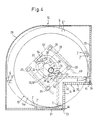
- the main cam 34 enters the lower half of the circular positive guideway 36, as a result of which the rotary column 15 is pivoted in its now reached front position by an angle of approximately 130 to 140 °, whereupon either the Auxiliary cam 40 or the auxiliary cam 40 'enters the associated auxiliary auxiliary guideway 33 or 33' and initiates the return movement of the rotary column 15 to the rear position, the main cam 34 again being in a straight section 38 with sufficient play.
- the lower cam 40 ′′ interacts with the auxiliary positive guideways 39, which are just the reverse of the tracks 33 'according to FIG Fig. 1 by 180 ° offset arrangement of the second auxiliary cam 40 '' the same type of positive guidance as in FIG. 1 is achieved.
- the auxiliary positive guideways 33, 39 are located in different vertically offset planes corresponding to the planes of the auxiliary cams 40, 40 ′′.
- the boundary line, on both sides of which the different auxiliary positive guideways 33, 39 are formed, is denoted by 54 in FIG. 4.
- the front panels 19, 20 of the corner front 18 are aligned with the front panels 41 and 42 of adjacent cabinet elements.
- the gap 55 between the vertical edges 23, 24 of the front panels 19, 20 and the opposite vertical edges of the front panels 41, 42 can be chosen to be extremely small.
- the bevels 44 of the side walls 21, 22 at the front end are chosen so that when the corner front 18 is moved in the direction of the diagonal 37 to the rear, the vertical edges 23, 24 can move along the front edges of the side walls 21, 22 without collision.
- the diagonal maximum displacement of the rotary column 15 is approximately 60 mm.
- the base plate 16 is cut out in accordance with the corner front or generally the front element 18, while there is also an underneath the shape of the corner front 18 corresponding, here rectangular base.
- This right-angled base is located approximately where the corner front 18 is in the position displaced to the rear in the diagonal elongated hole 28 (position 1 indicated by dashed lines in FIG. 1).
- FIG. 5 A particularly preferred embodiment of an auxiliary positive guide track arrangement 57 is shown in FIG. 5.
- the tracks 33 correspond to those in FIG. 1.
- 17 '' the position of the turning axis 17 in the rearmost position is designated, with 17 'the position where the turning axis 17 is located when the vertical column 23 or 24 approaches the rear wall 26, the rotary column 15 has been moved forward again . This shift therefore does not need to be completely in the foremost position (17).
- a straight guideway 59 branches off from the left circular region 57, which runs parallel to the diagonal 37 and guides the auxiliary cam 40 in a straight line in the position according to FIG. 1. In this way, the desired sequence of movements takes place during displacement and rotation in the direction of the arrow. When rotating in the opposite direction, the angular displacement is a little later, which can be taken into account by suitable selection of the diameter of the carousel 13. To do this, an auxiliary cam 40 and a closed guideway 57 are sufficient.
- FIG. 6 schematically shows the relation of the guide track 57 to the tracks 35, 36, 38 and to the cams 34, 40.
- the front panels 19, 20 can also enclose an angle ⁇ of 180 ° and thus form a flat front element 18, as a result of which a particularly large usable area of the support plates 14a and 14b is achieved. This is then at an obtuse angle, which in the example shown is approximately 135 ° each, to the front panels 41 and 42 of adjacent cabinet elements.
- the vertical connecting center line 43 of the front panels 19, 20 thus lies in one plane with their vertical edges 23 and 24.
- the front panels can be made in one piece from a plate. In the closed position of the carousel 13, the vertical edges 23 and 24 are also each in the plane of one of the front panels 41 and 42 of the adjacent cabinet elements, i.e. they adjoin it, expediently having a small distance for sufficient freedom of movement.
- the front element 8 can also be curved and form a curved front element 18, which merges into the planes of the front panels 41 and 42 of adjacent cabinet elements, so that the vertical edges 23 and 24 of the front panels 19 and 20 of the corner cabinet with one each Front panels 41 and 42 are aligned.
- the front element 18 thus has a concave, cylindrical, curved shape which matches some furniture styles.
- the front panels 18, 19 meet on the vertical connecting center line 43 at an angle ⁇ of 180 °.
- the turnstile consists of a fixedly arranged on the base body 16, in the diagonal direction 37 locking pin 60. This is positioned so that it in a transverse bore 61 in the rotating column 15 engages when the latter is not in or near the ready to turn position or any rotational position.
- the transverse bore 61 is pushed the most over the locking pin 60.
- a locking device 63 is provided.
- the pointer 64 has a groove 66 on its underside in the longitudinal direction, into which, when the carousel 13 is in the closed rotational position, the ball 67 of a ball catch 65 is engaged, which represents a button and is positioned on the diagonal displacement plate 25 accordingly.
- the carousel 13 If the carousel 13 is in any rotational position and is to be brought into the ready-to-turn position, it only has to be rotated until the ball 67 of the ball catch 65 engages in the groove 66 of the pointer 64.
- the rotary column 15 is then in the closed rotational position or the ready-to-turn position and the carousel 13 can be moved into the closed position, the simultaneously aligned transverse bore 61 being easily pushed over the locking pin 60 and the carousel 13 being rotated during the displacement into the closed position and in this prevents itself.
- the groove 66 in the pointer 64 is particularly simple to manufacture and allows a certain compensation of manufacturing tolerances.
- a differently shaped depression e.g. a dent can be provided in which the ball 67 can snap.
- rubber buffers 72 and 73 are provided at the ends 70 and 71 of the diagonal elongated hole 28 as stops in order to limit the diagonal displacement path of the rotary column 15. This can also be achieved by additional or alternative stops directly for the diagonal displacement plate 25.
Landscapes
- Automatic Disk Changers (AREA)
Applications Claiming Priority (4)
| Application Number | Priority Date | Filing Date | Title |
|---|---|---|---|
| DE4009150 | 1990-03-21 | ||
| DE19904009150 DE4009150C1 (en) | 1990-03-21 | 1990-03-21 | Corner section for kitchen cupboard - has carousel with vertical rotary column carrying horizontal plate |
| DE4014375 | 1990-05-04 | ||
| DE4014375A DE4014375A1 (de) | 1990-03-21 | 1990-05-04 | Kuecheneckschrank |
Publications (2)
| Publication Number | Publication Date |
|---|---|
| EP0447846A2 true EP0447846A2 (fr) | 1991-09-25 |
| EP0447846A3 EP0447846A3 (en) | 1992-11-19 |
Family
ID=25891417
Family Applications (1)
| Application Number | Title | Priority Date | Filing Date |
|---|---|---|---|
| EP19910102932 Withdrawn EP0447846A3 (en) | 1990-03-21 | 1991-02-27 | Kitchen corner cupboard |
Country Status (3)
| Country | Link |
|---|---|
| US (1) | US5249856A (fr) |
| EP (1) | EP0447846A3 (fr) |
| DE (1) | DE4014375A1 (fr) |
Cited By (6)
| Publication number | Priority date | Publication date | Assignee | Title |
|---|---|---|---|---|
| EP0601296A1 (fr) * | 1992-12-10 | 1994-06-15 | Hetal-Werke Franz Hettich GmbH & Co. | Montage pour armoire de coin |
| EP0920821A1 (fr) * | 1997-12-05 | 1999-06-09 | Hettich-Heinze GmbH & Co. KG | Support pour un ensemble rotatif d'étagères d'un placard de coin |
| EP0867134A3 (fr) * | 1997-03-26 | 1999-07-07 | Joh. Stiegelmeyer GmbH & Co. KG | Table de nuit |
| CH693697A5 (de) * | 1999-02-01 | 2003-12-31 | Peka Metall Ag | Drehkarussell eines Eckschrankes. |
| WO2010130565A3 (fr) * | 2009-05-11 | 2012-04-05 | Hettich Holding Gmbh & Co. Ohg | Meuble |
| WO2020007525A1 (fr) * | 2018-07-04 | 2020-01-09 | Paul Hettich Gmbh & Co. Kg | Tablette pour un meuble ou un appareil ménager |
Families Citing this family (10)
| Publication number | Priority date | Publication date | Assignee | Title |
|---|---|---|---|---|
| EP0577551A1 (fr) * | 1992-06-11 | 1994-01-05 | Thierry Zesiger | Dispositif de rayonnage pour le rangement d'articles, notamment dans un meuble |
| EP1372916A2 (fr) * | 2001-03-21 | 2004-01-02 | Vitrox APS | Procedes de realisation d'operations, compartiment destine a ces procedes et accessoires pour ce compartiment |
| US6471076B1 (en) * | 2001-08-24 | 2002-10-29 | Shin Tai Spurt Water Of The Garden Tools Co., Ltd. | Revolving rack for holding or displaying pistol nozzles |
| AT6717U1 (de) * | 2003-03-19 | 2004-03-25 | Blum Gmbh Julius | Schublade |
| RU2231046C1 (ru) * | 2003-05-30 | 2004-06-20 | Деревягин Александр Михайлович | Способ измерения точки росы и устройство для его осуществления |
| DE202004011748U1 (de) * | 2004-07-27 | 2004-10-14 | Julius Blum Gmbh | Schublade |
| US8074812B1 (en) | 2009-05-18 | 2011-12-13 | Michael Sean Bradbury | Rotary track mechanism for corner cabinets |
| EP2333530A4 (fr) * | 2009-05-22 | 2013-02-13 | Derevyagin Alexandr Mikhailovich | Procédé de mesure de la température du point de rosée d'hydrocarbures et dispositif correspondant |
| US9022237B2 (en) | 2013-05-22 | 2015-05-05 | Glideware, Llc. | Extendable storage device |
| US11129473B2 (en) * | 2017-04-18 | 2021-09-28 | Wolfgang Held | Rack |
Family Cites Families (9)
| Publication number | Priority date | Publication date | Assignee | Title |
|---|---|---|---|---|
| US2629643A (en) * | 1948-12-03 | 1953-02-24 | Rudolph Werberger | Cabinet with rotatable shelves |
| US2570747A (en) * | 1949-06-21 | 1951-10-09 | Gen Electric | Rotary shelf cabinet |
| GB977734A (en) * | 1961-04-27 | 1964-12-09 | Oscar Alfredo Kraft | Improvements in or relating to rotary files for card indexes and the like |
| US3160453A (en) * | 1961-10-19 | 1964-12-08 | Tassell Hardward Company | Rotating dor and shelf for corner cabinets and the like |
| US3260560A (en) * | 1965-06-28 | 1966-07-12 | Orrie L Hofstetter | Lock for rotating shelf |
| DE2722629B1 (de) * | 1977-05-18 | 1978-09-21 | Horst Dreier | Kuecheneckschrank |
| US4433885A (en) * | 1981-05-22 | 1984-02-28 | Leslie Metal Arts Company | Lazy susan assembly having a rotational and vertical adjustment mechanism |
| FR2528295A3 (fr) * | 1982-06-10 | 1983-12-16 | Daimez Claude | Armoire de rangement |
| US4587908A (en) * | 1985-03-12 | 1986-05-13 | Amerock Corporation | Rotary shelf assembly with bearing assembly and detent mechanism |
-
1990
- 1990-05-04 DE DE4014375A patent/DE4014375A1/de not_active Withdrawn
-
1991
- 1991-02-27 EP EP19910102932 patent/EP0447846A3/de not_active Withdrawn
- 1991-03-20 US US07/672,263 patent/US5249856A/en not_active Expired - Fee Related
Cited By (8)
| Publication number | Priority date | Publication date | Assignee | Title |
|---|---|---|---|---|
| EP0601296A1 (fr) * | 1992-12-10 | 1994-06-15 | Hetal-Werke Franz Hettich GmbH & Co. | Montage pour armoire de coin |
| EP0867134A3 (fr) * | 1997-03-26 | 1999-07-07 | Joh. Stiegelmeyer GmbH & Co. KG | Table de nuit |
| EP0920821A1 (fr) * | 1997-12-05 | 1999-06-09 | Hettich-Heinze GmbH & Co. KG | Support pour un ensemble rotatif d'étagères d'un placard de coin |
| CH693697A5 (de) * | 1999-02-01 | 2003-12-31 | Peka Metall Ag | Drehkarussell eines Eckschrankes. |
| WO2010130565A3 (fr) * | 2009-05-11 | 2012-04-05 | Hettich Holding Gmbh & Co. Ohg | Meuble |
| RU2532718C2 (ru) * | 2009-05-11 | 2014-11-10 | Хеттих Холдинг Гмбх Унд Ко. Охг | Предмет мебели |
| WO2020007525A1 (fr) * | 2018-07-04 | 2020-01-09 | Paul Hettich Gmbh & Co. Kg | Tablette pour un meuble ou un appareil ménager |
| US11350745B2 (en) | 2018-07-04 | 2022-06-07 | Paul Hettich Gmbh & Co. Kg | Storage shelf base for a piece of furniture or household appliance |
Also Published As
| Publication number | Publication date |
|---|---|
| US5249856A (en) | 1993-10-05 |
| EP0447846A3 (en) | 1992-11-19 |
| DE4014375A1 (de) | 1991-11-14 |
Similar Documents
| Publication | Publication Date | Title |
|---|---|---|
| EP0433726B1 (fr) | Système de porte repliable coulissante vers l'intérieur d'une armoire | |
| EP0447846A2 (fr) | Meuble d'angle de cuisine | |
| DE8690010U1 (de) | Vorrichtung zum Eindrehen von Schrauben mit Unterlegscheiben | |
| WO2010129971A1 (fr) | Dispositif d'extraction pour partie de meuble mobile | |
| EP0422678B1 (fr) | Coffre à bagages | |
| DE3875819T2 (de) | Biegepresse fuer bleche. | |
| DE69127909T2 (de) | Schiebe-Hebe-Dach-Vorrichtung für Kraftfahrzeug | |
| DE29513851U1 (de) | Verstelleinrichtung zur Ausrichtung eines auf Laufschienen gelagerten Schubkastens, Auszuges o.dgl. | |
| DE2319775A1 (de) | Vorrichtung zum einstellen der neigung und lage eines gegenstandes gegenueber einer bezugsrichtung | |
| DE3207177C2 (de) | Tisch mit einer in der Höhe und in der Neigung verstellbaren Tischplatte | |
| DE4418556A1 (de) | Beschlag für einen Eckschrank | |
| DE4009150C1 (en) | Corner section for kitchen cupboard - has carousel with vertical rotary column carrying horizontal plate | |
| DE29516477U1 (de) | Futtergitter | |
| DE9007322U1 (de) | Kücheneckschrank | |
| DE1198026B (de) | Abstellplatte, insbesondere fuer Kuehlschraenke | |
| DE3008626A1 (de) | Wagenheber | |
| DE19860241A1 (de) | Karussellvorrichtung zum Halten mindestens eines Fachbodens in einem Eckschrank und einer zweiflügeligen Türe | |
| DE2722629B1 (de) | Kuecheneckschrank | |
| DE10105847A1 (de) | Mitnahmevorrichtung für ausziehbaren Möbelboden | |
| EP4335322B1 (fr) | Dispositif d'extraction pour une armoire, en particulier une armoire d'angle | |
| DE9014366U1 (de) | Kücheneckschrank | |
| EP0363864B1 (fr) | Grignoteuse guidée par la main | |
| DE2710560A1 (de) | Schrank mit zwei oder mehreren schubladen | |
| DE2532400A1 (de) | Bewegbare begrenzungswand fuer ein fahrzeug | |
| EP0683996A2 (fr) | Fixation pour une armoire de coin |
Legal Events
| Date | Code | Title | Description |
|---|---|---|---|
| PUAI | Public reference made under article 153(3) epc to a published international application that has entered the european phase |
Free format text: ORIGINAL CODE: 0009012 |
|
| AK | Designated contracting states |
Kind code of ref document: A2 Designated state(s): AT DE ES FR GB IT SE |
|
| PUAL | Search report despatched |
Free format text: ORIGINAL CODE: 0009013 |
|
| AK | Designated contracting states |
Kind code of ref document: A3 Designated state(s): AT DE ES FR GB IT SE |
|
| 17P | Request for examination filed |
Effective date: 19930514 |
|
| 17Q | First examination report despatched |
Effective date: 19941109 |
|
| STAA | Information on the status of an ep patent application or granted ep patent |
Free format text: STATUS: THE APPLICATION IS DEEMED TO BE WITHDRAWN |
|
| 18D | Application deemed to be withdrawn |
Effective date: 19950321 |