EP0447857B1 - Polycyclische Verbindung, Verfahren zu ihrer Herstellung und diese enthaltende Arzneimittel - Google Patents
Polycyclische Verbindung, Verfahren zu ihrer Herstellung und diese enthaltende Arzneimittel Download PDFInfo
- Publication number
- EP0447857B1 EP0447857B1 EP91103059A EP91103059A EP0447857B1 EP 0447857 B1 EP0447857 B1 EP 0447857B1 EP 91103059 A EP91103059 A EP 91103059A EP 91103059 A EP91103059 A EP 91103059A EP 0447857 B1 EP0447857 B1 EP 0447857B1
- Authority
- EP
- European Patent Office
- Prior art keywords
- azepin
- ethyl
- pyrazino
- hexahydrodibenzo
- following formula
- Prior art date
- Legal status (The legal status is an assumption and is not a legal conclusion. Google has not performed a legal analysis and makes no representation as to the accuracy of the status listed.)
- Expired - Lifetime
Links
- 0 CN(CC1)CCN1C1=Nc2ccccc2*c2ccc(*)cc12 Chemical compound CN(CC1)CCN1C1=Nc2ccccc2*c2ccc(*)cc12 0.000 description 1
Classifications
-
- C—CHEMISTRY; METALLURGY
- C07—ORGANIC CHEMISTRY
- C07D—HETEROCYCLIC COMPOUNDS
- C07D487/00—Heterocyclic compounds containing nitrogen atoms as the only ring hetero atoms in the condensed system, not provided for by groups C07D451/00 - C07D477/00
- C07D487/02—Heterocyclic compounds containing nitrogen atoms as the only ring hetero atoms in the condensed system, not provided for by groups C07D451/00 - C07D477/00 in which the condensed system contains two hetero rings
- C07D487/04—Ortho-condensed systems
-
- A—HUMAN NECESSITIES
- A61—MEDICAL OR VETERINARY SCIENCE; HYGIENE
- A61P—SPECIFIC THERAPEUTIC ACTIVITY OF CHEMICAL COMPOUNDS OR MEDICINAL PREPARATIONS
- A61P1/00—Drugs for disorders of the alimentary tract or the digestive system
-
- A—HUMAN NECESSITIES
- A61—MEDICAL OR VETERINARY SCIENCE; HYGIENE
- A61P—SPECIFIC THERAPEUTIC ACTIVITY OF CHEMICAL COMPOUNDS OR MEDICINAL PREPARATIONS
- A61P1/00—Drugs for disorders of the alimentary tract or the digestive system
- A61P1/08—Drugs for disorders of the alimentary tract or the digestive system for nausea, cinetosis or vertigo; Antiemetics
-
- A—HUMAN NECESSITIES
- A61—MEDICAL OR VETERINARY SCIENCE; HYGIENE
- A61P—SPECIFIC THERAPEUTIC ACTIVITY OF CHEMICAL COMPOUNDS OR MEDICINAL PREPARATIONS
- A61P25/00—Drugs for disorders of the nervous system
-
- A—HUMAN NECESSITIES
- A61—MEDICAL OR VETERINARY SCIENCE; HYGIENE
- A61P—SPECIFIC THERAPEUTIC ACTIVITY OF CHEMICAL COMPOUNDS OR MEDICINAL PREPARATIONS
- A61P25/00—Drugs for disorders of the nervous system
- A61P25/04—Centrally acting analgesics, e.g. opioids
-
- A—HUMAN NECESSITIES
- A61—MEDICAL OR VETERINARY SCIENCE; HYGIENE
- A61P—SPECIFIC THERAPEUTIC ACTIVITY OF CHEMICAL COMPOUNDS OR MEDICINAL PREPARATIONS
- A61P37/00—Drugs for immunological or allergic disorders
- A61P37/08—Antiallergic agents
-
- A—HUMAN NECESSITIES
- A61—MEDICAL OR VETERINARY SCIENCE; HYGIENE
- A61P—SPECIFIC THERAPEUTIC ACTIVITY OF CHEMICAL COMPOUNDS OR MEDICINAL PREPARATIONS
- A61P43/00—Drugs for specific purposes, not provided for in groups A61P1/00-A61P41/00
-
- A—HUMAN NECESSITIES
- A61—MEDICAL OR VETERINARY SCIENCE; HYGIENE
- A61P—SPECIFIC THERAPEUTIC ACTIVITY OF CHEMICAL COMPOUNDS OR MEDICINAL PREPARATIONS
- A61P9/00—Drugs for disorders of the cardiovascular system
- A61P9/06—Antiarrhythmics
-
- A—HUMAN NECESSITIES
- A61—MEDICAL OR VETERINARY SCIENCE; HYGIENE
- A61P—SPECIFIC THERAPEUTIC ACTIVITY OF CHEMICAL COMPOUNDS OR MEDICINAL PREPARATIONS
- A61P9/00—Drugs for disorders of the cardiovascular system
- A61P9/12—Antihypertensives
-
- C—CHEMISTRY; METALLURGY
- C07—ORGANIC CHEMISTRY
- C07D—HETEROCYCLIC COMPOUNDS
- C07D223/00—Heterocyclic compounds containing seven-membered rings having one nitrogen atom as the only ring hetero atom
- C07D223/14—Heterocyclic compounds containing seven-membered rings having one nitrogen atom as the only ring hetero atom condensed with carbocyclic rings or ring systems
- C07D223/18—Dibenzazepines; Hydrogenated dibenzazepines
- C07D223/20—Dibenz [b, e] azepines; Hydrogenated dibenz [b, e] azepines
-
- C—CHEMISTRY; METALLURGY
- C07—ORGANIC CHEMISTRY
- C07D—HETEROCYCLIC COMPOUNDS
- C07D267/00—Heterocyclic compounds containing rings of more than six members having one nitrogen atom and one oxygen atom as the only ring hetero atoms
- C07D267/02—Seven-membered rings
- C07D267/08—Seven-membered rings having the hetero atoms in positions 1 and 4
- C07D267/12—Seven-membered rings having the hetero atoms in positions 1 and 4 condensed with carbocyclic rings or ring systems
- C07D267/16—Seven-membered rings having the hetero atoms in positions 1 and 4 condensed with carbocyclic rings or ring systems condensed with two six-membered rings
- C07D267/20—[b, f]-condensed
-
- C—CHEMISTRY; METALLURGY
- C07—ORGANIC CHEMISTRY
- C07D—HETEROCYCLIC COMPOUNDS
- C07D281/00—Heterocyclic compounds containing rings of more than six members having one nitrogen atom and one sulfur atom as the only ring hetero atoms
- C07D281/02—Seven-membered rings
- C07D281/04—Seven-membered rings having the hetero atoms in positions 1 and 4
- C07D281/08—Seven-membered rings having the hetero atoms in positions 1 and 4 condensed with carbocyclic rings or ring systems
- C07D281/12—Seven-membered rings having the hetero atoms in positions 1 and 4 condensed with carbocyclic rings or ring systems condensed with two six-membered rings
- C07D281/16—[b, f]-condensed
Definitions
- the present invention relates to novel polycyclic compounds useful as antihistaminic agents, antiallergic agents, hypo-sedatives, psychoneurotic agents, analgetics, antiemetics, gastrointestinal tract hyperkinetics, antiarrhythmics, and antihypertensive agents.
- the present invention relates to compounds represented by the following formula (I): A -(CH2) n - COOR1 (I) wherein R1 represents a hydrogen atom or a C1-C4 alkyl group; n represents an integer of from 0 to 5; and A is a group represented by the following formula: wherein X represents a hydrogen atom or a halogen atom; and Y represents a methylene group, an oxygen atom, or a sulfur atom, or A is a group represented by the following formula: and pharmacologically acceptable salts except the compounds Ethyl(1,2,3,4,10,14b-hexahydrodibenzo[c,f]pyrazino[1,2-a]azepin-2-yl) acetate; Ethyl(S)-(1,2,3,4,10,14b-hexahydrodibenzo[c,f]pyrazino[1,2-a] azepin-2-yl)carboxylate; Ethyl(
- the Merck Index discloses drugs having a polycyclic nucleus similar to that of the compound of the present invention.
- examples of such drugs include, for example, Amoxapine represented by the following formula (II): as a antidepressant (11th edition, 609); Clothiapine represented by the following formula (III): as an antischizophrenic agent (11th edition, 2410): Perlapine represented by the following formula (IV): as a hypo-sedative (11th edition, 7131), and Mianserin represented by the following formula (V): as a antidepressant (11th edition, 6097).
- any documents do not disclose the polycyclic compound of the present invention having a polycyclic nucleus substituted with a carboxyalkyl or alkoxycarbonylalkyl group.
- the major defects of these drugs are adverse reactions caused by various kinds of pharmacological actions of the drugs.
- Examples of the adverse reactions those frequently observed clinically are, for example, psychoneurotic symptoms such as, tremor, hallucinosis, delirium, cerebaria, malaise, vertigo, or anticholinergic symptoms such as hydrodipsia, dysuria, or cycloplegia.
- EP-A-0 421 823 and EP-A-0 505 014 which are cited according to Art. 54(3) EPC disclose the compounds Ethyl(S)-(1,2,3,4, 10,14b-hexahydrodibenzo[c,f]pyrazino[1,2-a]azepin-2-yl)-carboxylate and Ethyl(R) (1,2,3,4,10,14b-hexahydrodibenzo-[c,f]pyrazino[1,2-a]azepin-2-yl)carboxylate and the compound Ethyl-((1,2,3,4,10,14b-hexahydrodibenzo[c,f]pyrazino-[1,2-a]azepin-2-yl)acetate.
- the document also mentiones the anti-allergic and anti-asthmatic activities of these compounds.
- WO-A-88/07997 discloses condensed piperazines for example desmethylmianserins, N-substituted by a carboxamido or a carboxamidoalkyl group, exhibiting antihistaminic properties.
- DE-A-1 801 523 describes new tricyclic enamines and process for the preparation of tricyclic enamines.
- An object of the present invention is to provide novel compounds having a selective pharmacological activity.
- Another object of the present invention is to provide novel compounds which extensively eliminate undesired adverse reactions.
- a further object of the present invention is to provide a method for preparing said compounds.
- Yet another object is to provide a pharmaceutical composition comprising said compounds.
- polycyclic compounds of the present invention have selective pharmacological activity and reduced adverse reactions and are useful as antihistaminic agents, antiallergic agents, hypo-sedatives, psychoneurotic agents, analgetics, antiemetics, gastrointestinal tract hyperkinetics, antiarrhythmics, or antihypertensive agents.
- the present invention provides a compound represented by the following formula (I): A -(CH2) n - COOR1 (I) wherein R1 represents a hydrogen atom or a lower alkyl group; n represents an integer of from 0 to 5; and A is a group represented by the following formula: wherein X represents a hydrogen atom or a halogen atom; and Y represents a methylene group, an oxygen atom, or a sulfur atom, or A is a group represented by the following formula: or a pharmacologically acceptable salt of the compound.
- R1 represents a hydrogen atom or a lower alkyl group
- n represents an integer of from 0 to 5
- A is a group represented by the following formula: wherein X represents a hydrogen atom or a halogen atom; and Y represents a methylene group, an oxygen atom, or a sulfur atom, or A is a group represented by the following formula: or a pharmacologically acceptable salt of the compound
- the present invention provides a method for preparing the compound represented by formula (I).
- the present invention provides a pharmaceutical composition comprising an effective amount of the compound represented by formula (I) together with a pharmaceutically acceptable carrier or coating.
- the present invention provides a method for treating an allergic disease or bronchial asthma comprising the step of administering an effective amount of the compound represented by formula (I) to an mammal.
- the present invention also provides an antiallergic agent, antihistaminic agent, and an agent for bronchial asthma comprising the compound represented by formula (I).
- the lower alkyl group represented by R1 may be, for example, methyl, ethyl, n-propyl, isopropyl, n-butyl, or isobutyl group
- the halogen atom represented by X may be, for example, a fluorine atom, a chlorine atom, a bromine atom, or a iodine atom.
- Prefered examples of the present invention include: ethyl 4-(2-chlorodibenz[b,f][1,4]oxazepin-11-yl)-1-piperazinecarboxylate; ethyl 4-(2-chlorodibenz[b,f][1,4]oxazepin-11-yl)1-piperazinepropionate; ethyl 4-(2-chlorodibenz[b,f][1,4]oxazepin-11-yl)-1-piperazineacetate; ethyl 4-(2-chlorodibenz[b,f][1,4]oxazepin-11-yl)-1-piperazinebutyrate; ethyl 4-(2-chlorodibenz[b,f][1,4]oxazepin-11-yl)-1-piperazinevalerate; ethyl 4-(2-chlorodibenz[b,f][1,4]oxazepin-11-yl)-1
- the compounds of the present invention represented by the above formula (I) may be converted to pharmacologically acceptable salts, if desired, and may then reconverted to produce the free compound from the obtained salts.
- the pharmacologically acceptable salts of the compounds of the present invention represented by formula (I) may be acid addition salts or alkali addition salts.
- the acid addition salts include mineral acid addition salts such as, for example, hydrochloride, hydrobromide, sulfate, nitrate, phosphate, and organic acid addition salts such as, for example, acetate, maleate, fumarate, malate, citrate, oxalate, lactate, and tartarate.
- alkali addition salts include metal salts such as, for example, sodium, potassium, carcium salt, and organic alkali salts such as, for example, ammonium salts, methylamine, ethylamine, dimethylamine, triethylamine, ethanolamine, piperidine, and piperazine salts.
- metal salts such as, for example, sodium, potassium, carcium salt
- organic alkali salts such as, for example, ammonium salts, methylamine, ethylamine, dimethylamine, triethylamine, ethanolamine, piperidine, and piperazine salts.
- any inert solvent may be used in the alkylation process of the present invention.
- the inert solvent include benzene, toluene, tetrahydrofuran, dioxane, acetone, acetonitrile, methanol, ethanol, isopropanol, n-butanol, dimethyl sulfoxide, and N,N-dimethylformamide.
- Examples of the base used in the process of the present invention include potassium carbonate, sodium carbonate, pyridine, and triethylamine.
- the reaction may be carried out at from 0 to 200 °C.
- an acid such as, for example, hydrochloric acid or sulfuric acid
- a base such as, for example, sodium hydroxide, potassium hydroxide, potassium carbonate, sodium carbonate, or sodium bicarbonate
- a solvent used in the hydrolysis may be, for example, water, methanol, ethanol, acetone, or tetrahydrofuran, and the hydrolysis may be carried out at from 0 to 100 °C.
- the novel polycyclic compounds of the present invention represented by formula (I) wherein n is 0, can be prepared by the method comprising the steps of reacting a compound represented by the following formula (VIII): A - CH3 (VIII) wherein A is the same as that defined above, with a compound represented by the following formula (IX): Z - COOR1 (IX) wherein R1 and Z are the same as those defined above, in a solvent in the presence or absence of a base as dehydrohalogenating agent.
- any inert solvent may be used in the alkylation process of the present invention.
- the inert solvent include benzene, toluene, tetrahydrofuran, dioxane, acetone, acetonitrile, methanol, ethanol, isopropanol, n-butanol, dimethyl sulfoxide, and N,N-dimethylformamide.
- Examples of the base used in the process of the present invention include potassium carbonate, sodium carbonate, pyridine, and triethylamine.
- the reaction may be carried out at from 0 to 200 °C.
- novel polycyclic compounds of the present invention represented by the above formula (I) and pharmacologically acceptable salts of the compounds are useful as antihistaminic agents, antiallergic agents, hypo-sedatives, psychoneurotic agents, analgetics, antiemetics, gastrointestinal tract hyperkinetics, antiarrhythmics, or antihypertensive agents.
- novel polycyclic compounds of the present invention and their pharmacologically acceptable salts may be administered orally or parenterally to a patient as a pharmaceutical composition which comprises an effective amount of said compound or the salt thereof together with a pharmacologically acceptable carrier or coating.
- the pharmaceutical composition suitable for oral administration may be, for example, tablet, capsule, powder, subtilized granule, granule, solution, or syrup.
- the pharmaceutical composition suitable for parenteral administration may be injection, suppository, inhalant, eye drop, nasal drop, ointment, or cataplasm.
- the pharmaceutically acceptable carrier or coating used for the preparation of the pharmaceutical composition may be excipient, disintegrant or agent for accelerating disintegration, binder, lubricant, coating agent, pigment, diluent, base, solubilizing agent, solubilizer, isotonicity, pH adjusting agent, stabilizer, propellant, and adhesive.
- the coating or carrier may comprise the following: an excipient such as, for example, glucose, lactose, D-mannitol, starch, or crystalline cellulose; a disintegrant or an agent for accelerating disintegration such as, for example, carboxymethylcellulose, starch, or calcium carboxymethylcellulose; a binder such as, for example, hydroxypropylcellulose, hydroxypropylmethylcellulose, polyvinylpyrrolidone, or gelatin; a lubricant such as, for example, magnesium stearate or talc; a coating agent such as, for example, hydroxypropylmethylcellulose, sucrose, polyethylene glycol, or titanium oxide; a base such as, for example, petrolatum, liquid paraffin, polyethyleneglycol, gelatin, kaolin, glycerin, purified water, or hard fat; a propellant such as, for example, fron, diethyl ether,
- an excipient such as, for example, glucose, lactose, D-mann
- the pharmaceutical composition suitable for injection may comprise the following: a solubilizing agent or a solubilizer, e.g., distilled water for injection, saline, or propylene glycol which is useful for an aqueous composition or a composition for preparing aqueous solution before use; an isotonicity agent such as, for example, glucose, sodium chloride, D-mannitol, or glycerin; and a pH adjusting agent such as, for example, an inorganic or organic acid or an inorganic or organic base.
- a solubilizing agent or a solubilizer e.g., distilled water for injection, saline, or propylene glycol which is useful for an aqueous composition or a composition for preparing aqueous solution before use
- an isotonicity agent such as, for example, glucose, sodium chloride, D-mannitol, or glycerin
- a pH adjusting agent such as, for example, an inorganic or organic acid
- the dose of the pharmaceutical composition of the present invention for an adult patient may genarally be from about 1 to 500 mg per day for oral administration, which may be increased or decreased depending on the conditions of the patient to be treated.
- the reference compounds used were Amoxapine (II) Clothiapine (III), Perlapine (IV) and Mianserin (V).
- the concentration-contractile response curve to histamine was constructed before and after 30 min contact with test compounds.
- the dissociation constant K B (M) of test compounds was calculated according to the method of Furchgott ("Catecholamines” Edited by Blaschko, H. and Muscholl, E., 283-335, Springer, Berlin, Heidelberg and New York, 1972).
- the compounds of the present invention exhibited excellent activities, though the activities were somewhat less potent than those of the reference compounds.
- test compounds Male Wistar rats, 6 weeks of age, were passively sensitized by intracutaneous injection in the back of a volume of 0.1 ml of anti-DNP-As rat serum. Forty-eight hours later, the animals were administered an intravenous injection of 0.5 ml saline solution containing 1 mg of DNP-As and 5 mg of Evans blue. The animals were sacrificed 30 min after the injection and the extravasated dye was extracted with 1N KOH and acetone, neutralized with 1N H3PO4 and the absorbance at 620 nm was determined. The test compounds were administered orally in a dose of 1 mg/Kg 1 hr before antigen challenge. The inhibitory activity of a test compound was expressed as percent inhibition of PCA as compared with the control group.
- the compounds of the present invention exhibited more potent antiallergic activity than the reference compounds.
- the inhibitory activity of noradrenaline and 5-hydroxytryptamine uptake and anticholinergic activity were also examined.
- the compounds of the present invention showed little activity, while the reference compounds showed considerable activity.
- the compounds of the present invention hardly have the above activity, these compounds, and because they cause no side effects such as, for example, psychogenesis, dipsia and dysuria derived from these activities, are expected to be excellent, selective antihistaminic and antiallergic agents.
- Example 4 to 6 were prepared in the same manner as described in Example 3.
- Example 15 to 17 were prepared in the same manner as described in Example 14.
- Example 20 to 22 were prepared in the same manner as described in Example 19.
- Example 26 to 28 were prepared in the same manner as described in Example 25.
- Example 30 to 33 were prepared in the same manner as described in Example 29.
- Example 37 to 39 were prepared in the same manner as described in Example 36.
- Example 41 to 44 were prepared in the same manner as described in Example 40.
- Tablets of a pharmaceutical preparation according to the present invention are prepared in the usual manner using the following constituents: Compound of the present invention 10 mg Lactose q.s. Corn starch 34 mg Magnesium stearate 2 mg Hydroxypropylmethylcellulose 8 mg polyethyleneglycol 6000 0.5 mg Titanium oxide 0.5 mg
- Capsules of a pharmaceutical preparation according to the present invention are prepared in the usual manner using the following constituents: Compound of the present invention 10 mg Lactose q.s. Calcium carboxymethylcellulose 15 mg Hydroxypropylcellulose 2 mg Magnesium stearate 2 mg 100 mg
- Powders of a pharmaceutical preparation according to the present invention are prepared in the usual manner using the following constituents: Compound of the present invention 20 mg Lactose q.s. D-Mannitol 500 mg Hydroxypropylcellulose 5 mg Talc 2 mg 1000 mg
- Injections of a pharmaceutical preparation according to the present invention are prepared in the usual manner using the following constituents: Compound of the present invention 1 mg Glucose 50 mg Hydrochloric acid q.s. Distilled water for injection q.s. 2 ml
- Suppositories of a pharmaceutical preparation according to the present invention are prepared in the usual manner using the following constituents: Compound of the present invention 5 mg Hard fat 1295 mg 1300 mg
- Plasters of a pharmaceutical preparation according to the present invention are prepared in the usual manner using the following constituents: Compound of the present invention 10 mg Gelatin 1100 mg Polyvinylalcohol 250 mg Methylcellulose 100 mg Glycerin 1500 mg Kaolin 850 mg Sodium polyacrylate 50 mg Polybutene 150 mg Purified water 990 mg 5000 mg
Landscapes
- Chemical & Material Sciences (AREA)
- Organic Chemistry (AREA)
- Health & Medical Sciences (AREA)
- General Health & Medical Sciences (AREA)
- Veterinary Medicine (AREA)
- Public Health (AREA)
- Chemical Kinetics & Catalysis (AREA)
- General Chemical & Material Sciences (AREA)
- Medicinal Chemistry (AREA)
- Nuclear Medicine, Radiotherapy & Molecular Imaging (AREA)
- Bioinformatics & Cheminformatics (AREA)
- Pharmacology & Pharmacy (AREA)
- Life Sciences & Earth Sciences (AREA)
- Animal Behavior & Ethology (AREA)
- Engineering & Computer Science (AREA)
- Neurology (AREA)
- Heart & Thoracic Surgery (AREA)
- Cardiology (AREA)
- Neurosurgery (AREA)
- Biomedical Technology (AREA)
- Hospice & Palliative Care (AREA)
- Immunology (AREA)
- Pain & Pain Management (AREA)
- Pulmonology (AREA)
- Otolaryngology (AREA)
- Pharmaceuticals Containing Other Organic And Inorganic Compounds (AREA)
- Acyclic And Carbocyclic Compounds In Medicinal Compositions (AREA)
- Other In-Based Heterocyclic Compounds (AREA)
- Nitrogen- Or Sulfur-Containing Heterocyclic Ring Compounds With Rings Of Six Or More Members (AREA)
- Nitrogen Condensed Heterocyclic Rings (AREA)
- Heterocyclic Carbon Compounds Containing A Hetero Ring Having Nitrogen And Oxygen As The Only Ring Hetero Atoms (AREA)
Claims (18)
- Polycyclische Verbindung, die durch die folgende Formel (I)
A―(CH₂)nCOOR¹ (I)
repräsentiert wird, in derR¹ ein Wasserstoff-Atom oder eine C₁-C₄-Alkyl-Gruppe darstellt,n eine ganze Zahl von 0 bis 5 darstellt, undA eine Gruppe der folgenden Formel X ein Wasserstoff-Atom oder ein Halogen-Atom darstellt undY eine Methylen-Gruppe, ein Sauerstoff-Atom oder ein Schwefel-Atom darstellt, oderA eine Gruppe der folgenden Formeloder ein pharmakologisch annehmbares Salz derselben, mit Ausnahme der Verbindungen
Ethyl-(1,2,3,4,10,14b-hexahydrodibenzo[c,f]pyrazino[1,2-a]azepin-2-yl)acetat;
Ethyl(S)-(1,2,3,4,10,14b-hexahydrodibenzo[c,f]pyrazino[1,2-a]azepin-2-yl)carboxylat;
Ethyl(R)-(1,2,3,4,10,14b-hexahydrodibenzo[c,f]pyrazino[1,2-a]azepin-2-yl)carboxylat; und des Racemats von
Ethyl-(1,2,3,4,10,14b-hexahydrodibenzo[c,f]pyrazino[1,2-a]azepin-2-yl)carboxylat. - 4-(2-Chlordibenzo[b,f][1,4]oxazepin-11-yl)-1-piperazinpropionsäure und ein pharmakologisch annehmbares Salz derselben.
- 4-(2-Chlordibenzo[b,f][1,4]oxazepin-11-yl)-1-piperazinbuttersäure und ein pharmakologisch annehmbares Salz derselben.
- 4-(2-Chlordibenzo[b,f][1,4]thiazepin-11-yl)-1-piperazinpropionsäure und ein pharmakologisch annehmbares Salz derselben.
- 4-(2-Chlordibenzo[b,f][1,4]thiazepin-11-yl)-1-piperazinbuttersäure und ein pharmakologisch annehmbares Salz derselben.
- 4-(11H-Dibenz[b,e]azepin-6-yl)-1-piperazinpropionsäure und ein pharmakologisch annehmbares Salz derselben.
- 4-(11H-Dibenz[b,e]azepin-6-yl)-1-piperazinbuttersäure und ein pharmakologisch annehmbares Salz derselben.
- 3-(1,2,3,4,10,14b-hexahydrodibenzo[c,f]pyrazino-[1,2a]azepin-2-yl)propionsäure und ein pharmakologisch annehmbares Salz derselben.
- 4-(1,2,3,4,10,14b-hexahydrodibenzo[c,f]pyrazino[1,2-a]azepin-2-yl)buttersäure und ein pharmakologisch annehmbares Salz derselben.
- Verfahren zur Herstellung einer Verbindung die durch die folgende Formel (I), wie sie in Anspruch 1 definiert ist,
A―(CH₂)nCOOR¹ (I)
repräsentiert wird, in derR¹ ein Wasserstoff-Atom oder eine C₁-C₄-Alkyl-Gruppe darstellt,n eine ganze Zahl von 0 bis 5 darstellt, undA eine Gruppe der folgenden Formel X ein Wasserstoff-Atom oder ein Halogen-Atom darstellt undY eine Methylen-Gruppe, ein Sauerstoff-Atom oder ein Schwefel-Atom darstellt, oderA eine Gruppe der folgenden Formelund eines pharmakologisch annehmbaren Salzes derselben, mit Ausnahme der Verbindungen
Ethyl-(1,2,3,4,10,14b-hexahydrodibenzo[c,f]pyrazino[1,2-a]azepin-2-yl)acetat;
Ethyl(S)-(1,2,3,4,10,14b-hexahydrodibenzo[c,f]pyrazino[1,2-a]azepin-2-yl)carboxylat;
Ethyl(R)-(1,2,3,4,10,14b-hexahydrodibenzo[c,f]pyrazino[1,2-a]azepin-2-yl)carboxylat; und des Racemats von
Ethyl-(1,2,3,4,10,14b-hexahydrodibenzo[c,f]pyrazino[1,2-a]azepin-2-yl)carboxylat,
umfassend die Schritte der Umsetzung einer Verbindung, die durch die folgende Formel
A―R²
repräsentiert wird, in derA das gleiche wie das oben definierte ist undR² ein Wasserstoff-Atom oder eine Methyl-Gruppe darstellt,mit einer Verbindung, die durch die folgende Formel
Z―(CH₂)n―COOR¹ oder CH₂=CH―COOR¹
repräsentiert wird, in derR¹ und n die gleichen wie die oben definierten sind undZ ein Halogen-Atom darstellt,worauf, wenn nötig, Hydrolyse erfolgt. - Pharmazeutische Zusammensetzung, umfassend eine wirksame Menge einer polycyclischen Verbindung, die durch die folgende Formel (I), wie sie in Anspruch 1 definiert ist,
A―(CH₂)nCOOR¹ (I)
repräsentiert wird, in derR¹ ein Wasserstoff-Atom oder eine C₁-C₄-Alkyl-Gruppe darstellt,n eine ganze Zahl von 0 bis 5 darstellt, undA eine Gruppe der folgenden Formel X ein Wasserstoff-Atom oder ein Halogen-Atom darstellt undY eine Methylen-Gruppe, ein Sauerstoff-Atom oder ein Schwefel-Atom darstellt, oderA eine Gruppe der folgenden Formeloder ein pharmakologisch annehmbares Salz derselben, mit Ausnahme der Verbindungen
Ethyl-(1,2,3,4,10,14b-hexahydrodibenzo[c,f]pyrazino[1,2-a]azepin-2-yl)acetat;
Ethyl(S)-(1,2,3,4,10,14b-hexahydrodibenzo[c,f]pyrazino[1,2-a]azepin-2-yl)carboxylat;
Ethyl(R)-(1,2,3,4,10,14b-hexahydrodibenzo[c,f]pyrazino[1,2-a]azepin-2-yl)carboxylat; und des Racemats von
Ethyl-(1,2,3,4,10,14b-hexahydrodibenzo[c,f]pyrazino[1,2-a]azepin-2-yl)carboxylat,
zusammen mit einem pharmazeutisch annehmbaren Träger oder Überzug. - Antihistaminisches Mittel, umfassend eine wirksame Menge einer polycyclischen Verbindung, die durch die folgende Formel (I), wie sie in Anspruch 1 definiert ist,
A―(CH₂)nCOOR¹ (I)
repräsentiert wird, in derR¹ ein Wasserstoff-Atom oder eine C₁-C₄-Alkyl-Gruppe darstellt,n eine ganze Zahl von 0 bis 5 darstellt, undA eine Gruppe der folgenden Formel X ein Wasserstoff-Atom oder ein Halogen-Atom darstellt undY eine Methylen-Gruppe, ein Sauerstoff-Atom oder ein Schwefel-Atom darstellt, oderA eine Gruppe der folgenden Formeloder ein pharmakologisch annehmbares Salz derselben, mit Ausnahme der Verbindungen
Ethyl-(1,2,3,4,10,14b-hexahydrodibenzo[c,f]pyrazino[1,2-a]azepin-2-yl)acetat;
Ethyl(S)-(1,2,3,4,10,14b-hexahydrodibenzo[c,f]pyrazino[1,2-a]azepin-2-yl)carboxylat;
Ethyl(R)-(1,2,3,4,10,14b-hexahydrodibenzo[c,f]pyrazino[1,2-a]azepin-2-yl)carboxylat; und des Racemats von
Ethyl-(1,2,3,4,10,14b-hexahydrodibenzo[c,f]pyrazino[1,2-a]azepin-2-yl)carboxylat. - Antiallergisches Mittel, umfassend eine wirksame Menge einer polycyclischen Verbindung, die durch die folgende Formel (I), wie sie in Anspruch 1 definiert ist,
A―(CH₂)nCOOR¹ (I)
repräsentiert wird, in derR¹ ein Wasserstoff-Atom oder eine C₁-C₄-Alkyl-Gruppe darstellt,n eine ganze Zahl von 0 bis 5 darstellt, undA eine Gruppe der folgenden Formel X ein Wasserstoff-Atom oder ein Halogen-Atom darstellt undY eine Methylen-Gruppe, ein Sauerstoff-Atom oder ein Schwefel-Atom darstellt, oderA eine Gruppe der folgenden Formeloder ein pharmakologisch annehmbares Salz derselben, mit Ausnahme der Verbindungen
Ethyl-(1,2,3,4,10,14b-hexahydrodibenzo[c,f]pyrazino-[1,2-a]azepin-2-yl)acetat;
Ethyl(S)-(1,2,3,4,10,14b-hexahydrodibenzo[c,f]pyrazino-[1,2-a]azepin-2-yl)carboxylat;
Ethyl(R)-(1,2,3,4,10,14b-hexahydrodibenzo[c,f]pyrazino-[1,2-a]azepin-2-yl)carboxylat; und des Racemats von
Ethyl-(1,2,3,4,10,14b-hexahydrodibenzo[c,f]pyrazino-[1,2-a]azepin-2-yl)carboxylat. - Mittel für Bronchialasthma, umfassend eine wirksame Menge einer polycyclischen Verbindung, die durch die folgende Formel (I), wie sie in Anspruch 1 definiert ist,
A―(CH₂)nCOOR¹ (I)
repräsentiert wird, in derR¹ ein Wasserstoff-Atom oder eine C₁-C₄-Alkyl-Gruppe darstellt,n eine ganze Zahl von 0 bis 5 darstellt, undA eine Gruppe der folgenden Formel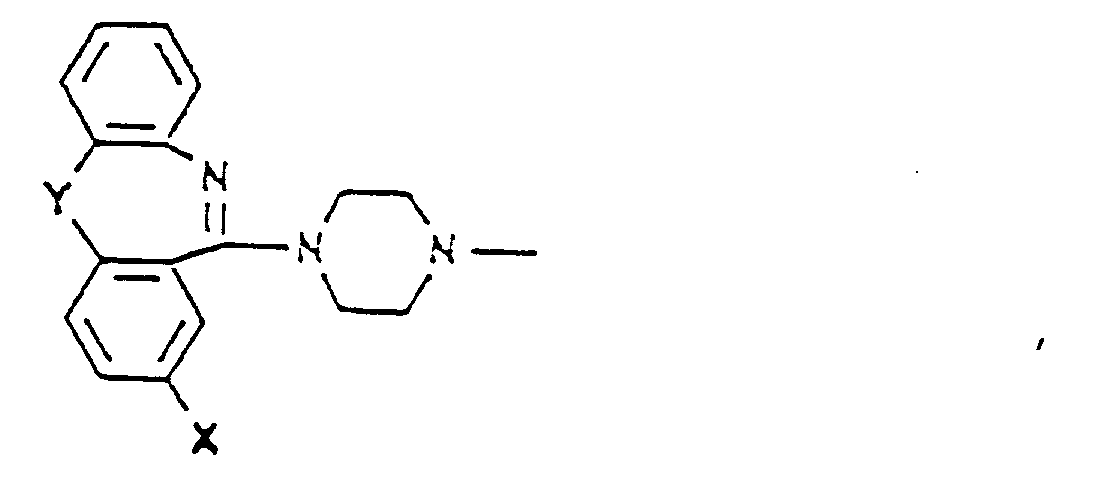 X ein Wasserstoff -Atom oder ein Halogen-Atom darstellt undY eine Methylen-Gruppe, ein Sauerstoff-Atom oder ein Schwefel-Atom darstellt, oderA eine Gruppe der folgenden Formeloder ein pharmakologisch annehmbares Salz derselben, mit Ausnahme der Verbindungen
Ethyl-(1,2,3,4,10,14b-hexahydrodibenzo[c,f]pyrazino[1,2-a]azepin-2-yl)acetat;
Ethyl(S)-(1,2,3,4,10,14b-hexahydrodibenzo[c,f]pyrazino[1,2-a]azepin-2-yl)carboxylat;
Ethyl(R)-(1,2,3,4,10,14b-hexahydrodibenzo[c,f]pyrazino[1,2-a]azepin-2-yl)carboxylat; und des Racemats von
Ethyl-(1,2,3,4,10,14b-hexahydrodibenzo[c,f]pyrazino[1,2-a]azepin-2-yl)carboxylat. - Verwendung einer Substanz, die aus der Gruppe ausgewählt ist, die im wesentlichen besteht aus(a) einer polycyclischen Verbindung, die durch die folgende Formel (I), wie sie in Anspruch 1 definiert ist,
A―(CH₂)nCOOR¹ (I)
repräsentiert wird, in derR¹ ein Wasserstoff-Atom oder eine C₁-C₄-Alkyl-Gruppe darstellt,n eine ganze Zahl von 0 bis 5 darstellt, undA eine Gruppe der folgenden Formel X ein Wasserstoff-Atom oder ein Halogen-Atom darstellt undY eine Methylen-Gruppe, ein Sauerstoff-Atom oder ein Schwefel-Atom darstellt, oderA eine Gruppe der folgenden Formeloder einem pharmakologisch annehmbaren Salz der Verbindung der Formel (I),
 (b) einem die Verbindungen der Formel (I) umfassenden antiallergischen Mittel und(c) pharmazeutischen Zusammensetzung, die die Verbindungen der Formel (I) umfaßt,mit Ausnahme der Verbindungen
Ethyl-(1,2,3,4,10,14b-hexahydrodibenzo[c,f]pyrazino[1,2-a]azepin-2-yl)acetat;
Ethyl(S)-(1,2,3,4,10,14b-hexahydrodibenzo[c,f]pyrazino[1,2-a]azepin-2-yl)carboxylat;
Ethyl(R)-(1,2,3,4,10,14b-hexahydrodibenzo[c,f]pyrazino[1,2-a]azepin-2-yl)carboxylat; und des Racemats von
Ethyl-(1,2,3,4,10,14b-hexahydrodibenzo[c,f]pyrazino[1,2-a]azepin-2-yl)carboxylat,
zur Herstellung eines Medikaments zur Behandlung einer allergischen Erkrankung. - Verwendung nach Anspruch 15, worin die Behandlung am Menschen durchgeführt wird.
- Verwendung einer Substanz, die aus der Gruppe ausgewählt ist, die im wesentlichen besteht aus(a) einer polycyclischen Verbindung, die durch die folgende Formel (I), wie sie in Anspruch 1 definiert ist,
A―(CH₂)nCOOR¹ (I)
repräsentiert wird, in derR¹ ein Wasserstoff-Atom oder eine C₁-C₄-Alkyl-Gruppe darstellt,n eine ganze Zahl von 0 bis 5 darstellt, undA eine Gruppe der folgenden Formel X ein Wasserstoff-Atom oder ein Halogen-Atom darstellt undY eine Methylen-Gruppe, ein Sauerstoff-Atom oder ein Schwefel-Atom darstellt, oderA eine Gruppe der folgenden Formeloder einem pharmakologisch annehmbaren Salz der Verbindung der Formel (I),
 (b) einem die Verbindungen der Formel (I) umfassenden Mittel für Bronchialasthma und(c) pharmazeutischen Zusammensetzung, die die Verbindungen der Formel (I) umfaßt,mit Ausnahme der Verbindungen
Ethyl-(1,2,3,4,10,14b-hexahydrodibenzo[c,f]pyrazino[1,2-a]azepin-2-yl)acetat;
Ethyl(S)-(1,2,3,4,10,14b-hexahydrodibenzo[c,f]pyrazino[1,2-a]azepin-2-yl)carboxylat;
Ethyl(R)-(1,2,3,4,10,14b-hexahydrodibenzo[c,f]pyrazino[1,2-a]azepin-2-yl)carboxylat; und des Racemats von
Ethyl-(1,2,3,4,10,14b-hexahydrodibenzo[c,f]pyrazino[1,2-a]azepin-2-yl)carboxylat,
zur Herstellung eines Medikaments zur Behandlung von Bronchialasthma. - Verwendung nach Anspruch 17, worin die Behandlung am Menschen durchgeführt wird.
Applications Claiming Priority (6)
| Application Number | Priority Date | Filing Date | Title |
|---|---|---|---|
| JP5189790 | 1990-03-05 | ||
| JP51897/90 | 1990-03-05 | ||
| JP51898/90 | 1990-03-05 | ||
| JP5189890 | 1990-03-05 | ||
| JP225256/90 | 1990-08-29 | ||
| JP22525690 | 1990-08-29 |
Publications (2)
| Publication Number | Publication Date |
|---|---|
| EP0447857A1 EP0447857A1 (de) | 1991-09-25 |
| EP0447857B1 true EP0447857B1 (de) | 1994-12-14 |
Family
ID=27294479
Family Applications (1)
| Application Number | Title | Priority Date | Filing Date |
|---|---|---|---|
| EP91103059A Expired - Lifetime EP0447857B1 (de) | 1990-03-05 | 1991-03-01 | Polycyclische Verbindung, Verfahren zu ihrer Herstellung und diese enthaltende Arzneimittel |
Country Status (4)
| Country | Link |
|---|---|
| US (1) | US5344828A (de) |
| EP (1) | EP0447857B1 (de) |
| JP (1) | JPH04211071A (de) |
| DE (1) | DE69105787T2 (de) |
Families Citing this family (31)
| Publication number | Priority date | Publication date | Assignee | Title |
|---|---|---|---|---|
| US5476848A (en) * | 1989-10-05 | 1995-12-19 | Sankyo Company, Limited | 14B(R) isomers of novel tetracyclic compounds having anti-allergic and anti-asthmatic activities, and their use |
| US5470851A (en) * | 1990-06-27 | 1995-11-28 | Sankyo Company, Limited | Thiazolidinecarboxylic acid amide derivatives and their therapeutic uses |
| AU666318B2 (en) * | 1991-06-28 | 1996-02-08 | Smithkline Beecham Corporation | Bicyclic fibrinogen antagonists |
| US5939412A (en) * | 1992-06-26 | 1999-08-17 | Smithkline Beecham Corporation | Bicyclic fibrinogen antagonists |
| GB9120640D0 (en) * | 1991-09-27 | 1991-11-06 | Ici Plc | Tricyclic heterocycles |
| EP0539164A1 (de) * | 1991-10-23 | 1993-04-28 | Sankyo Company Limited | Stickstoff enthaltende tetracyclische Verbindungen mit antiallergischen und antiasthmatischen Wirkungen, ihre Herstellung und Verwendung |
| SG63579A1 (en) * | 1992-12-21 | 1999-03-30 | Smithkline Beecham Corp | Bicyclic fibrinogen antagonists |
| US6403578B1 (en) | 1993-12-21 | 2002-06-11 | Smithkline Beecham Corporation | Bicyclic fibrinogen antagonists |
| MA23420A1 (fr) * | 1994-01-07 | 1995-10-01 | Smithkline Beecham Corp | Antagonistes bicycliques de fibrinogene. |
| US6458784B1 (en) | 1994-06-29 | 2002-10-01 | Smithkline Beecham Corporation | Vitronectin receptor antagonists |
| US5977101A (en) * | 1995-06-29 | 1999-11-02 | Smithkline Beecham Corporation | Benzimidazoles/Imidazoles Linked to a Fibrinogen Receptor Antagonist Template Having Vitronectin Receptor Antagonist Activity |
| WO1997011061A1 (en) * | 1995-09-21 | 1997-03-27 | Nikken Chemicals Co., Ltd. | Compounds potentiating retinoid |
| US7355042B2 (en) * | 2001-10-16 | 2008-04-08 | Hypnion, Inc. | Treatment of CNS disorders using CNS target modulators |
| US20050250767A1 (en) * | 2003-01-23 | 2005-11-10 | Weiner David M | Use of N-desmethylclozapine to treat human neuropsychiatric disease |
| US20050085463A1 (en) * | 2003-01-23 | 2005-04-21 | Weiner David M. | Use of N-desmethylclozapine to treat human neuropsychiatric disease |
| AU2004206931A1 (en) * | 2003-01-23 | 2004-08-05 | Acadia Pharmaceuticals Inc. | Use of N-desmethylclozapine to treat human neuropsychiatric disease |
| CA2550735A1 (en) | 2003-12-22 | 2005-07-14 | Acadia Pharmaceuticals Inc. | Amino substituted diaryl[a,d]cycloheptene analogs as muscarinic agonists and methods of treatment of neuropsychiatric disorders |
| CN1950346A (zh) * | 2004-04-01 | 2007-04-18 | 阿卡蒂亚药品公司 | N-去甲基氯氮平的晶形 |
| DK1804804T3 (da) * | 2004-09-21 | 2012-02-20 | Hypnion Inc | 3-[4-(dibenzo[b,f][1,4]oxazepin-11-yl)-piperazin-1-yl]-2,2-dimethylpropansyre til anvendelse ved behandlingen af søvnforstyrrelser |
| US20060063754A1 (en) * | 2004-09-21 | 2006-03-23 | Edgar Dale M | Methods of treating a sleep disorder |
| WO2006049734A2 (en) * | 2004-10-29 | 2006-05-11 | Hypnion, Inc. | Quetiapine analogs and methods of use thereof |
| TW200640467A (en) * | 2005-02-14 | 2006-12-01 | Combinatorx Inc | Compounds and uses thereof |
| US7807828B2 (en) * | 2005-08-11 | 2010-10-05 | Hypnion, Inc. | Olanzapine analogs and methods of use thereof |
| WO2007053618A1 (en) * | 2005-10-31 | 2007-05-10 | Acadia Pharmaceuticals Inc. | Prodrugs of muscarinic agonists and methods of treatment of neuropsychiatric disorders |
| WO2009151393A1 (en) * | 2008-06-14 | 2009-12-17 | Astrazeneca Ab | Novel derivatives of 11-piperazin-l-yldibenzo [b,f] [l,4] thiazepine for treating at least one syndrome or condition associated with schizophrenia and other psychotic disorders |
| WO2008079839A1 (en) * | 2006-12-20 | 2008-07-03 | Astrazeneca Ab | Compounds and uses thereof |
| WO2009151392A1 (en) * | 2008-06-14 | 2009-12-17 | Astrazeneca Ab | Novel derivatives of 11-piperazin-l-yldibenzo [b,f] [1,4] thiazepine for treating at least one syndrome or condition associated with schizophrenia and other psychotic disorders |
| US8389510B2 (en) | 2005-11-18 | 2013-03-05 | Astrazeneca Ab | Crystalline forms |
| ME01516B (me) * | 2008-06-20 | 2014-04-20 | Astrazeneca Ab | DERIVAT DIBENZOTIAZEPINA l NJEGOVA UPOTREBA |
| WO2010021681A2 (en) * | 2008-08-18 | 2010-02-25 | Combinatorx (Singapore) Pte. Ltd. | Compositions and methods for treatment of viral diseases |
| US11046651B2 (en) | 2019-10-21 | 2021-06-29 | Alairion, Inc. | Piperazine substituted azapine derivatives and uses thereof |
Citations (1)
| Publication number | Priority date | Publication date | Assignee | Title |
|---|---|---|---|---|
| EP0421823A2 (de) * | 1989-10-05 | 1991-04-10 | Sankyo Company Limited | Tetracyclische Verbindungen mit antiallergischen und antiasthmatischen Wirkungen, ihre Herstellung und Verwendung |
Family Cites Families (6)
| Publication number | Priority date | Publication date | Assignee | Title |
|---|---|---|---|---|
| NL140242B (nl) * | 1963-03-01 | 1973-11-15 | Wander Ag Dr A | Werkwijze voor het bereiden van op de 11-plaats door een basische groep gesubstitueerde dibenz (b.f.)(1.4) oxazepinen. |
| US3389139A (en) * | 1963-06-14 | 1968-06-18 | Wander Ag Dr A | 6-homopiperazino and piperazinomorphanthridines |
| CH539044A (de) * | 1967-10-06 | 1973-08-31 | Gnii Orch Poluproduktov I Kras | Verfahren zur Herstellung quaternärer Ammoniumsalze von 1,3-Bis-(aminomethyl)-imidazolidonen |
| US3928356A (en) * | 1967-10-06 | 1975-12-23 | Fujisawa Pharmaceutical Co | 10-{8 4-({107 -Hydroxy alkyl)-1-piperazimyl{9 -dibenzo (h,f) oxofins and thiepins and acetyl esters thereof |
| US3845074A (en) * | 1969-06-20 | 1974-10-29 | En Nom Collectif Science Union | Dibenzo(b,f)thiazepin(1,4)-11-yl amino alkanoic acids |
| US5049637A (en) * | 1987-04-10 | 1991-09-17 | Monash University | 1,2,3,4,10,14b-hexahydrodibenzo[c,f]pyrazino-[1,2-a]azepino derivatives and 10-aza, 10-oxa and 10-thia analogues |
-
1991
- 1991-02-01 JP JP3031305A patent/JPH04211071A/ja active Pending
- 1991-03-01 DE DE69105787T patent/DE69105787T2/de not_active Expired - Fee Related
- 1991-03-01 US US07/663,154 patent/US5344828A/en not_active Expired - Fee Related
- 1991-03-01 EP EP91103059A patent/EP0447857B1/de not_active Expired - Lifetime
Patent Citations (2)
| Publication number | Priority date | Publication date | Assignee | Title |
|---|---|---|---|---|
| EP0421823A2 (de) * | 1989-10-05 | 1991-04-10 | Sankyo Company Limited | Tetracyclische Verbindungen mit antiallergischen und antiasthmatischen Wirkungen, ihre Herstellung und Verwendung |
| EP0505014A2 (de) * | 1989-10-05 | 1992-09-23 | Sankyo Company Limited | Tetracyclische Verbindungen mit antiallergischen und antiasthmatischen Wirkungen, ihre Herstellung und Verwendung |
Also Published As
| Publication number | Publication date |
|---|---|
| JPH04211071A (ja) | 1992-08-03 |
| DE69105787D1 (de) | 1995-01-26 |
| US5344828A (en) | 1994-09-06 |
| DE69105787T2 (de) | 1995-05-24 |
| EP0447857A1 (de) | 1991-09-25 |
Similar Documents
| Publication | Publication Date | Title |
|---|---|---|
| US5344828A (en) | Piperazinealkanoic acid and a pharmaceutical composition comprising the same | |
| US4579854A (en) | Bronchodilating 8-hydroxy-5-{(1R)-1-hydroxy-2-[N-((1R)-2-(p-methoxyphenyl)-1-methylethyl)-amino]ethyl} carbostyril | |
| JPH08506576A (ja) | 低脂血症化合物 | |
| JPH01199971A (ja) | 芳香族化合物を有効成分とする抗ムスカリン剤 | |
| US5095022A (en) | Piperidine derivatives and pharmaceutical compositions comprising the same | |
| EP0399414B1 (de) | Piperidinderivat, Verfahren zur Herstellung davon und dieses enthaltende pharmazeutische Zusammensetzung | |
| JPH0578292A (ja) | 三環系化合物 | |
| US6319916B1 (en) | Heterocyclic compounds, their production and use | |
| US4749703A (en) | Calcium antagonist piperazine derivatives, and compositions therefor | |
| EP0846109B1 (de) | Quinoneverbindung, seine herstellung und anwendung. | |
| US4871739A (en) | Substituted 6H-7,8-dihydrothiapyrano(3,2-D)-pyrimidines as hyopglycemic agents | |
| AU1783792A (en) | Novel heterocyclic carboxylic acids | |
| KR920005827B1 (ko) | 벤조티아디아제핀 유도체 | |
| US3679662A (en) | Tetrahydrocyclopropadibenzazepine derivatives | |
| GB2171997A (en) | 4-Amino-6,7-dimethoxy-2-Piperazin-1-ylquinazoline derivatives | |
| DE60214719T2 (de) | 11-Piperazinyldibenzo(B,F)(1,4)-Oxazepine und - Thiazepine als atypische antipschotische Wirkstoffe mit geringer Affinität für den D2-Rezeptor | |
| US5571807A (en) | 1,5 benzothiazepinone dervatives their preparation and pharmaceutical use | |
| US4337260A (en) | Imidazopyridine-spiro-piperidine compounds | |
| JPH02164882A (ja) | スピロ化合物及びその中間体 | |
| CA1088068A (en) | Piperidino-quinazolines | |
| US6528504B2 (en) | Oxazepine derivatives and medicine containing the same | |
| JPH0565257A (ja) | 多環式化合物及びその用途 | |
| EP0451772A1 (de) | Piperidinverbindungen, Verfahren zu ihrer Herstellung und diese Verbindungen enthaltende pharmazeutische Zusammensetzungen | |
| US3635983A (en) | 11h-dibenzo(1,2,5)triaz 2 nes and their salts | |
| HK1040399A1 (zh) | N-取代的氮雜二環庚烷衍生物及其製備方法和用途 |
Legal Events
| Date | Code | Title | Description |
|---|---|---|---|
| PUAI | Public reference made under article 153(3) epc to a published international application that has entered the european phase |
Free format text: ORIGINAL CODE: 0009012 |
|
| AK | Designated contracting states |
Kind code of ref document: A1 Designated state(s): DE FR GB IT |
|
| 17P | Request for examination filed |
Effective date: 19920117 |
|
| 17Q | First examination report despatched |
Effective date: 19930211 |
|
| GRAA | (expected) grant |
Free format text: ORIGINAL CODE: 0009210 |
|
| AK | Designated contracting states |
Kind code of ref document: B1 Designated state(s): DE FR GB IT |
|
| ITF | It: translation for a ep patent filed | ||
| PGFP | Annual fee paid to national office [announced via postgrant information from national office to epo] |
Ref country code: GB Payment date: 19950124 Year of fee payment: 5 Ref country code: FR Payment date: 19950124 Year of fee payment: 5 |
|
| REF | Corresponds to: |
Ref document number: 69105787 Country of ref document: DE Date of ref document: 19950126 |
|
| ET | Fr: translation filed | ||
| PGFP | Annual fee paid to national office [announced via postgrant information from national office to epo] |
Ref country code: DE Payment date: 19950412 Year of fee payment: 5 |
|
| PLBE | No opposition filed within time limit |
Free format text: ORIGINAL CODE: 0009261 |
|
| STAA | Information on the status of an ep patent application or granted ep patent |
Free format text: STATUS: NO OPPOSITION FILED WITHIN TIME LIMIT |
|
| 26N | No opposition filed | ||
| PG25 | Lapsed in a contracting state [announced via postgrant information from national office to epo] |
Ref country code: GB Effective date: 19960301 |
|
| GBPC | Gb: european patent ceased through non-payment of renewal fee |
Effective date: 19960301 |
|
| PG25 | Lapsed in a contracting state [announced via postgrant information from national office to epo] |
Ref country code: FR Effective date: 19961129 |
|
| PG25 | Lapsed in a contracting state [announced via postgrant information from national office to epo] |
Ref country code: DE Effective date: 19961203 |
|
| REG | Reference to a national code |
Ref country code: FR Ref legal event code: ST |
|
| PG25 | Lapsed in a contracting state [announced via postgrant information from national office to epo] |
Ref country code: IT Free format text: LAPSE BECAUSE OF NON-PAYMENT OF DUE FEES Effective date: 20050301 |