EP0447862B1 - Méthode pour la purification biologique de gaz contaminés par des éthènes halogénés et/ou par des butadiènes halogénés - Google Patents
Méthode pour la purification biologique de gaz contaminés par des éthènes halogénés et/ou par des butadiènes halogénés Download PDFInfo
- Publication number
- EP0447862B1 EP0447862B1 EP91103147A EP91103147A EP0447862B1 EP 0447862 B1 EP0447862 B1 EP 0447862B1 EP 91103147 A EP91103147 A EP 91103147A EP 91103147 A EP91103147 A EP 91103147A EP 0447862 B1 EP0447862 B1 EP 0447862B1
- Authority
- EP
- European Patent Office
- Prior art keywords
- halogenated
- bacteria
- butadienes
- isoprene
- purified
- Prior art date
- Legal status (The legal status is an assumption and is not a legal conclusion. Google has not performed a legal analysis and makes no representation as to the accuracy of the status listed.)
- Expired - Lifetime
Links
Images

Classifications
-
- B—PERFORMING OPERATIONS; TRANSPORTING
- B01—PHYSICAL OR CHEMICAL PROCESSES OR APPARATUS IN GENERAL
- B01D—SEPARATION
- B01D53/00—Separation of gases or vapours; Recovering vapours of volatile solvents from gases; Chemical or biological purification of waste gases, e.g. engine exhaust gases, smoke, fumes, flue gases, aerosols
- B01D53/34—Chemical or biological purification of waste gases
- B01D53/74—General processes for purification of waste gases; Apparatus or devices specially adapted therefor
- B01D53/84—Biological processes
- B01D53/85—Biological processes with gas-solid contact
-
- C—CHEMISTRY; METALLURGY
- C12—BIOCHEMISTRY; BEER; SPIRITS; WINE; VINEGAR; MICROBIOLOGY; ENZYMOLOGY; MUTATION OR GENETIC ENGINEERING
- C12N—MICROORGANISMS OR ENZYMES; COMPOSITIONS THEREOF; PROPAGATING, PRESERVING, OR MAINTAINING MICROORGANISMS; MUTATION OR GENETIC ENGINEERING; CULTURE MEDIA
- C12N1/00—Microorganisms; Compositions thereof; Processes of propagating, maintaining or preserving microorganisms or compositions thereof; Processes of preparing or isolating a composition containing a microorganism; Culture media therefor
- C12N1/20—Bacteria; Culture media therefor
- C12N1/205—Bacterial isolates
-
- C—CHEMISTRY; METALLURGY
- C12—BIOCHEMISTRY; BEER; SPIRITS; WINE; VINEGAR; MICROBIOLOGY; ENZYMOLOGY; MUTATION OR GENETIC ENGINEERING
- C12N—MICROORGANISMS OR ENZYMES; COMPOSITIONS THEREOF; PROPAGATING, PRESERVING, OR MAINTAINING MICROORGANISMS; MUTATION OR GENETIC ENGINEERING; CULTURE MEDIA
- C12N1/00—Microorganisms; Compositions thereof; Processes of propagating, maintaining or preserving microorganisms or compositions thereof; Processes of preparing or isolating a composition containing a microorganism; Culture media therefor
- C12N1/36—Adaptation or attenuation of cells
-
- C—CHEMISTRY; METALLURGY
- C12—BIOCHEMISTRY; BEER; SPIRITS; WINE; VINEGAR; MICROBIOLOGY; ENZYMOLOGY; MUTATION OR GENETIC ENGINEERING
- C12R—INDEXING SCHEME ASSOCIATED WITH SUBCLASSES C12C - C12Q, RELATING TO MICROORGANISMS
- C12R2001/00—Microorganisms ; Processes using microorganisms
- C12R2001/01—Bacteria or Actinomycetales ; using bacteria or Actinomycetales
-
- C—CHEMISTRY; METALLURGY
- C12—BIOCHEMISTRY; BEER; SPIRITS; WINE; VINEGAR; MICROBIOLOGY; ENZYMOLOGY; MUTATION OR GENETIC ENGINEERING
- C12R—INDEXING SCHEME ASSOCIATED WITH SUBCLASSES C12C - C12Q, RELATING TO MICROORGANISMS
- C12R2001/00—Microorganisms ; Processes using microorganisms
- C12R2001/01—Bacteria or Actinomycetales ; using bacteria or Actinomycetales
- C12R2001/05—Alcaligenes
-
- Y—GENERAL TAGGING OF NEW TECHNOLOGICAL DEVELOPMENTS; GENERAL TAGGING OF CROSS-SECTIONAL TECHNOLOGIES SPANNING OVER SEVERAL SECTIONS OF THE IPC; TECHNICAL SUBJECTS COVERED BY FORMER USPC CROSS-REFERENCE ART COLLECTIONS [XRACs] AND DIGESTS
- Y02—TECHNOLOGIES OR APPLICATIONS FOR MITIGATION OR ADAPTATION AGAINST CLIMATE CHANGE
- Y02A—TECHNOLOGIES FOR ADAPTATION TO CLIMATE CHANGE
- Y02A50/00—TECHNOLOGIES FOR ADAPTATION TO CLIMATE CHANGE in human health protection, e.g. against extreme weather
- Y02A50/20—Air quality improvement or preservation, e.g. vehicle emission control or emission reduction by using catalytic converters
Definitions
- the invention relates to a method for the microbiological purification of gas streams contaminated with halogenated ethenes and / or with halogenated butadienes.
- Halogenated ethenes and halogenated butadienes have a wide range of applications.
- chlorinated ethenes are used in various areas as solvents and / or as cleaning agents. Contamination of soil, water and exhaust air with these mostly volatile substances therefore occur very frequently and lead to considerable environmental pollution.
- Contaminated sites are mainly remedied by means of soil-air extraction.
- the volatile components for example chlorinated ethenes
- pass into the exhaust air stream which is then passed through activated carbon filters, so that the contaminants, for example the chlorinated ethenes, are removed from the exhaust air stream by adsorption.
- the activated carbon is then regenerated and used again to clean the exhaust air streams. If regeneration of the activated carbon is not economical, it is burned together with the adsorbate.
- the microbiological degradation of chlorinated ethenes, e.g. B. trichlorethylene, by methane and aromatics-utilizing bacteria occurs through the initial attack of an oxygenase on the chlorinated ethene and leads to a very reactive epoxide. This epoxy alkylates proteins and thus damages or deactivates the cells.
- a Pseudomonas putida F1 strain is used as the microorganism, its activity for the breakdown of trichlorethylene is reduced by 98% after 20 minutes.
- EP-A-0 336 718 describes a process with which trichlorethylene is degraded microbiologically by means of genetically manipulated microorganisms. Since these are genetically manipulated microorganisms, extensive and lengthy approval procedures are necessary before they can be used. Furthermore, genetic manipulation of microorganisms is technically very complex, therefore very expensive and therefore uneconomical in many cases. Naturally occurring, TCE-degrading bacterial strains are also described for comparison purposes. A pre-adaptation of alkene users with isoprene and / or butadienes is not described.
- DE-A-3227678 describes a method for the biological purification of exhaust air. This is generally a biofilter, and the biology used is also not able halogenated Alk e ne to mineralize.
- the invention is therefore based on the object of providing a method by means of which gas flows halogenated ethenes and / or contaminated with halogenated butadienes, can be cleaned economically, quickly and easily. These contaminations should not only be removed from the gas streams, they should also be destroyed in a simple and economical manner. The process should also be able to economically clean and dispose of gas streams whose concentrations of halogenated ethenes and / or halogenated butadienes are very low and are, for example, below the limits of TA Heil.
- Suitable bacterial strains which grow with isoprene and / or with butadienes as a source of carbon and energy and which degrade halogenated ethenes and / or halogenated butadienes by using them in a bioreactor with isoprene and / or with butadienes as a carbon and energy source for the new formation or for the regeneration that the gas stream to be cleaned is passed into a bioreactor which contains the pre-adapted bacteria, and that in this bioreactor the halogenated ethenes and the halogenated butadienes from the gas stream by biological Degradation can be removed using the pre-adapted bacteria.
- Suitable butadienes for carrying out the process according to the invention are e.g. 1,2-butadiene and / or 1,3-butadiene.
- This contaminated waste water is cleaned in a first process step by so-called "stripping" of the waste water. Air is blown into the wastewater to be cleaned, the volatile contaminants enter the exhaust air stream, and the contaminated exhaust air stream is cleaned according to the method of the invention, as described above.
- the contaminated floors can be cleaned in three different ways.
- air is blown into the floor to be cleaned, the volatile contaminants enter the exhaust air stream and, as described above, the contaminated exhaust air stream is cleaned by the method according to the invention.
- the soil air is drawn off together with the volatile contaminants and, as described above, cleaned by the methods according to the invention. It depends on the permeability of the floor whether the first or the second embodiment is more appropriate.
- the contaminated floor is subjected to a floor wash, the contaminants go into the wash water, and the contaminated wash water is further treated according to the method according to the invention, as described above for waste water.
- bacteria with isoprene and / or with butadiene as carbon and Grow energy source can tolerate very high concentrations of halogenated ethenes and / or halogenated butadienes, such as trichlorethylene.
- An epoxy detoxifying enzyme system prevents cell damage to the bacteria pre-adapted in this way by the resulting epoxy.
- This enzyme system is induced with isoprene and / or with butadienes as a source of carbon and energy.
- the bacteria can grow through z.
- B. isoprene as structural analogues for the degradation of the halogenated ethenes and / or the halogenated butadienes can be pre-adapted.
- halogenated ethenes and / or halogenated butadienes to be removed are chlorinated or brominated ethenes, such as e.g. trichlorethylene, cis- or trans-1,2-dichloroethene or vinyl chloride.
- chlorinated or brominated ethenes such as e.g. trichlorethylene, cis- or trans-1,2-dichloroethene or vinyl chloride.
- Suitable bacteria for carrying out the process according to the invention are obtained by isolating those bacteria from soil or water samples by known methods using isoprene and / or using butadienes as the only sources of carbon and energy which are able to break down isoprene and / or butadienes. With the help of a rapid test, those bacteria are identified from these bacteria that can break down halogenated ethenes and / or halogenated butadienes. The bacteria thus determined and isolated are then used to carry out the method according to the invention.
- the pre-adapted bacteria can be grown with isoprene and / or with butadienes in any fermenter.
- the enzyme system for the detoxification of the intermediate products is induced by the isoprene and / or by the butadienes as a source of carbon and energy.
- Suitable bacteria for performing the method according to the invention are e.g. to be found among the alkene recyclers. Without restricting generality, suitable bacteria for carrying out the method according to the invention are e.g. Alcaligenes denitrificans ssp. xylosoxidans strains or Rhodococcus erythropolis strains.
- the bacteria can be supplied with isoprene and / or with butadienes as a carbon and energy source via the gas phase, or by adding the appropriate liquids to the bacterial suspensions. If the bacteria to be supplied are in a bioreactor, the isoprene and / or the butadienes are expediently added via the gas phase. If the bacteria to be supplied are in a closed system, for example in a shake flask, they are added by adding the appropriate liquids to the flask. Preferred embodiments of the method according to the invention use isoprene or 1,3-butadiene as the carbon and energy source.
- the bacteria are supplied with isoprene or with 1,3-butadiene via the gas phase, in that gaseous isoprene or gaseous 1,3-butadiene is mixed into the air stream for the gassing of the bioreactor.
- the proportion of 1,3-butadiene for example The gas flow depends on the volume flow, the flow rate in the bioreactor, the biomass concentration in the bioreactor, the nutrient requirements of the bacteria and the type of bioreactor, and depends on the requirements of the individual case.
- the proportion of 1,3-butadiene in the gas stream can be, for example, 10,000 ppm, but it can also be higher or lower.
- the nutrient salts required for the growth or regeneration of the bacteria are added in a known manner in a buffered system.
- the gas stream is cleaned by introducing the gas stream into the bioreactor, which contains the pre-adapted bacteria for degradation.
- Preferred embodiments of the process according to the invention work with bubble column reactors, with fixed bed reactors or with membrane reactors. If a bubble column reactor is used to carry out the process according to the invention, the exhaust air stream to be cleaned is passed from below through the aqueous biosuspension containing the pre-adapted bacteria. If a fixed bed reactor is used to carry out the process according to the invention, it contains the pre-adapted bacteria immobilized on packing, for example on Siran R rings from Schott. The gas stream to be cleaned is passed through the substrate together with the aqueous phase for the supply of the pre-adapted bacteria.
- the gas stream to be cleaned is passed through hollow fiber membranes which lead through the aqueous biosuspension containing the pre-adapted bacteria.
- the halogenated ethenes and / or the halogenated butadienes permeate through the membranes into the aqueous biosuspension and are broken down there.
- an emulsion is used. Because of the higher distribution coefficient as an adsorbent, an oil is added to the aqueous phase, which contains the pre-adapted bacteria, which preferably absorbs the halogenated ethenes to be broken down and / or the halogenated butadienes.
- oils can be, for example, rapeseed oil or silicone oils.
- rapeseed oil has the advantage that rapeseed oil is a relatively cheap oil and that it is biodegradable.
- an emulsifier is added in a further embodiment of the process according to the invention for stabilizing the emulsion.
- These can be biological or synthetic emulsifiers. Suitable biological emulsifiers are, for example, lecithins.
- a commercially available product for this is, for example, the Connoxol R cutting oil from Leutze in Metzingen, which consists of rapeseed oil and an emulsifier.
- the pre-adapted bacteria are alternately supplied with isoprene and / or with butadienes for new formation or for regeneration and induction in a bioreactor and alternately with the halogenated ethenes and / or the halogenated butadienes to be broken down.
- This variant enables a quasi-continuous process, which e.g. can be carried out in a fixed bed, in a bubble column or in a membrane reactor.
- the time required to regenerate the bacteria and to induce the enzyme system depends on the requirements of the individual case. E.g.
- Bacteria regenerated with isoprene after a trichlorethylene degradation phase and if these bacteria are in a fixed bed reactor which is saturated with isoprene, the regeneration time is approximately 10-20% of the operating time with trichlorethylene.
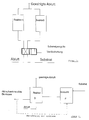
- FIG 1 shows schematically the inventive method according to variant I.
- the bioreactors (1) and (2) are used alternately for the degradation of, for example, trichlorethylene.
- the gas stream loaded with trichlorethylene is passed into reactor (2).
- the co-oxidative degradation of trichlorethylene takes place through the induced enzyme system of the pre-adapted bacteria. Due to the onset of a lack of NADH2, the breakdown rate of the bacteria for trichlorethylene drops.
- the reaction equation on page 6 for the regeneration of the bacteria and for the new induction of the necessary enzyme system Gas flow switched to reactor (1), and the reactor (2) is supplied with the growth and regeneration substrate, for example with isoprene.
- the bacteria are pre-adapted and grown in a chemostat and then passed into a separate bioreactor in which the degradation of the halogenated ethenes and / or the halogenated butadienes takes place.
- This variant enables a continuous process, which e.g. can be carried out in a bubble column or in a membrane reactor.
- the spent biomass is returned to the chemostats, regenerated there with isoprene and / or with butadienes, and fed back into the bioreactor to break down the halogenated ethenes and / or the halogenated butadienes.
- This variant of the method enables a much more economical use of the growth or regeneration substrate in continuous operation, since it is no longer required as a carbon source for the new formation of biomass, but only as an inductor for the necessary enzyme system and as an energy source for supplying the cells with NADH2.
- FIG. 2 shows schematically the process according to the invention in accordance with variant II.
- a reactor (A) operated as a chemostat continuously supplies active biomass grown or reactivated with isoprene or with butadiene.
- a downstream bioreactor (B) co-oxidative degradation of, for example, trichlorethylene takes place.
- the dwell time of the cells in this bioreactor is set so that there are always active cells for breaking down the trichlorethylene. If the degradation activity of the cells decreases due to a lack of energy, these can be used for regeneration and induction of the required enzyme system in the chemostats (A) are returned.
- Example 1 (Extraction, isolation and purification of suitable, pre-adapted bacteria)
- Alcaligenes denitrificans ssp. xylosoxidans JE 75 and Rhodococcus erythropolis JE 77 were isolated from a water sample with isoprene (2-methyl-1,3-butadiene) as the only source of carbon and energy. The two strains were identified by the German Collection for Microorganisms (DSM, Braunschweig).
- a mineral medium containing the following components was used for growth in liquid culture: KH2PO4: 3.4 g / l; Na2HPO4 x 2 H2O: 4.4 g / l; (NH4) 2SO4: 1 g / l; Fe- (III) -NH4-citrate: 10 mg / l; MgSO4 x 7 H2O: 200 mg / l; Ca (NO3) 2 x 4 H2O: 50 mg / l; Trace element solution according to Pfennig and Lippert (N.Pfenning, KDLippert, "About the vitamin B12 need of phototrophic sulfur bacteria", Arch.Mikrobiol. 55 , pp.
- the degradation activity for chlorinated ethenes was determined by determining the amount of chloride.
- the Weightman et al. Chloride test (AJWeightman, ALWeightman, JHSlater, Appl. Environ. Microbiol. 49 , pp. 1494-1501 (1985)) was transferred to cells grown in liquid culture. The mixed cultures grown in 100 ml baffle flasks were centrifuged (6000 ⁇ g 15 min), washed twice with 100 mM Tris sulfate buffer (pH 8.0) and adjusted to an optical density of 15-20.
- TCE trichlorethylene
- a measure of the tolerance of the bacteria is their doubling time. This was determined by using scattered light measurements to determine the optical density of the bacterial suspension as a function of time. The inhibition of the Growth on isoprene due to different trichlorethylene concentrations.
- Figure 3 shows that the doubling time increases drastically only at TCE concentrations ⁇ 600 mg / l.
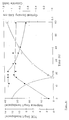
- FIG. 4 shows the growth of Rhodococcus erythropolis JE77 on isoprene in the presence of 15 ml of trichlorethylene. The cultivation was carried out in a 1000 ml baffle flask, from which gas samples were taken with a gas-tight syringe and examined for isoprene ( ⁇ ) and trichlorethylene ( ⁇ ).
- GC injector, detector and furnace temperature were 200 °, 300 ° and 200 ° C, FID, Pora PLOT Q-column (25mx0.32) with He (70 kPa column pressure) as carrier gas).
- the release of chloride ( ⁇ ) was determined by means of ion chromatography.
- the optical density ( ⁇ ) was measured at 546 nm. The dehalogenation of trichlorethylene took place during the stationary phase and was observed over a period of 60 hours.
Landscapes
- Engineering & Computer Science (AREA)
- Life Sciences & Earth Sciences (AREA)
- Health & Medical Sciences (AREA)
- Chemical & Material Sciences (AREA)
- Biotechnology (AREA)
- Biomedical Technology (AREA)
- Organic Chemistry (AREA)
- Zoology (AREA)
- Wood Science & Technology (AREA)
- Genetics & Genomics (AREA)
- Bioinformatics & Cheminformatics (AREA)
- General Engineering & Computer Science (AREA)
- Biochemistry (AREA)
- Tropical Medicine & Parasitology (AREA)
- Virology (AREA)
- General Health & Medical Sciences (AREA)
- Medicinal Chemistry (AREA)
- Microbiology (AREA)
- Environmental & Geological Engineering (AREA)
- Oil, Petroleum & Natural Gas (AREA)
- Analytical Chemistry (AREA)
- General Chemical & Material Sciences (AREA)
- Chemical Kinetics & Catalysis (AREA)
- Molecular Biology (AREA)
- Cell Biology (AREA)
- Processing Of Solid Wastes (AREA)
- Treating Waste Gases (AREA)
- Apparatus Associated With Microorganisms And Enzymes (AREA)
- Micro-Organisms Or Cultivation Processes Thereof (AREA)
Claims (16)
- Procédé d'épuration microbiologique de courants de gaz contaminés par des éthylènes halogénés et/ou des butadiènes halogénés, caractérisé en ce que des sous-règnes de bactéria qui croissent en combinaison avec l'isoprène et/ou les butadiènes comme source de carbone et d'énergie et qui décomposent des éthylènes halogénés et/ou des butadiènes halogénés sont pré-adaptés en combinaison avec l'isoprène et/ou les butadiènes comme source de carbone et d'énergie pour la nouvelle formation ou la régénération, et sont contactés avec le courant de gaz à épurer dans un bioréacteur.
- Procédé selon la revendication 1, caractérisé en ce que des courants de gaz contaminés sont épurés, qui sont produits en soufflant de l'air dans des sols ou des liquides contaminés par des éthylènes halogénés et/ou des butadiènes halogénés.
- Procédé selon la revendication 1, caractérisé en ce que des courants de gaz contaminés sont épurés, qui sont produits en aspirant de l'air des sols contaminés par des éthylènes halogénés et/ou des butadiènes halogénés.
- Procédé selon une quelconque des revendications 1 à 3, caractérisé en ce que, dans un bioréacteur, lesdits bacteria sont alimentés, à tour de rôle, en isoprène et/ou les butadiènes, et sont contactés avec le courant de gaz à épurer.
- Procédé selon une quelconque des revendications 1 à 3, caractérisé en ce que lesdits bactéria sont cultivés et pré-adaptés dans un système chimiostatique, et sont contactés, dans un bioréacteur séparé, avec le courant de gaz à épurer. .
- Procédé selon la revendication 5, caractérisé en ce que lesdits bactéria, après leur contact avec le courant de gaz à épurer, sont retournés dans ledit système chimiostatique.
- Procédé selon une ou plusieurs des revendications 1 à 6, caractérisé en ce que lesdits bactéria sont alimentés en isoprène et/ou les butadiènes par la phase gazeuse, et en ce que ledit isoprène gazeux et/ou les butadiènes gazeux sont mélangé avec le courant d'air pour l'introduction de gaz dans ledit bioréacteur.
- Procédé selon une ou plusieurs des revendications 1 à 7, caractérisé en ce que lesdits bactéria pré-adaptés sont contactés avec le courant de gaz à épurer dans une émulsion d'une phase aqueuse qui contient lesdits bactéria et une huile qui absorbe lesdits éthylènes halogénés et/ou lesdits butadiènes halogénés.
- Procédé selon une ou plusieurs des revendications 1 à 7, caractérisé en ce que le courant de gaz à épurer est passé dans un réacteur à lit fixe en s'écoulant sur lesdits bactéria pré-adaptés et immobilisés sur des corps de remplissage.
- Procédé selon une ou plusieurs des revendications 1 à 7, caractérisé en ce que le courant de gaz à épurer est passé dans un réacteur à colonne à bulles par ladite bio-suspension aqueuse desdits bactéria pré-adaptés.
- Procédé selon une ou plusieurs des revendications 1 à 7, caractérisé en ce que le courant de gaz à épurer est passé dans un réacteur à membrane par des membranes à fibres creuses qui sont traversées par les substances nocives à décomposer, dans ladite bio-suspension qui contient lesdits bactéria pré-adaptés.
- Procédé selon une ou plusieurs des revendications 1 à 11, caractérisé en ce que, de préférence, l'isoprène ou le 1,3-butadiène est utilisé comme source de carbone pour la nouvelle formation et/ou la régénération desdits bactéria.
- Procédé selon une ou plusieurs des revendications 1 à 12, caracterisé en ce que, de préférence, des courants de gaz sont épurés qui contiennent des éthylènes chlorés.
- Procédé selon la revendication 13, caractérisé en ce que des courants de gaz sont épurés qui présentent des concentrations des éthylènes chlorés à moins de 100 mg/m³.
- Procédé selon une ou plusieurs des revendications 1 à 14, caractérisé en ce que des bactéria sont pré-adaptés, qu'on avait obtenu en isolant des bactéria capable de décomposer l'isoprène et/ou le butadiène, des spécimens de sol ou de l'eau moyennant l'isoprène et/ou moyennant des butadiènes comme la seule source de carbone et d'énergie, et en ce que des bactéria capable de décomposer des éthylènes halogénés et/ou des butadiènes halogénés sont détectés et isolés par un essai accéléré selon des procédés connus en soi.
- Procédé selon une ou plusieurs des revendications 1 à 15, caractérisé en ce que des sous-règnes de bactéria de l'espèce Alcaligenes denitrificans ssp. xylosoxidans ou Rhodococcus ery thropolis sont pré-adaptés.
Priority Applications (1)
| Application Number | Priority Date | Filing Date | Title |
|---|---|---|---|
| AT91103147T ATE99980T1 (de) | 1990-03-21 | 1991-03-02 | Verfahren zur mikrobiologischen reinigung von mit halogenierten ethenen und/oder mit halogenierten butadienen kontaminierten gasstroemen. |
Applications Claiming Priority (2)
| Application Number | Priority Date | Filing Date | Title |
|---|---|---|---|
| DE4009109 | 1990-03-21 | ||
| DE4009109A DE4009109A1 (de) | 1990-03-21 | 1990-03-21 | Verfahren zur mikrobiologischen reinigung von mit halogenierten ethenen und/oder mit halogenierten butadienen kontaminierten abluftstroemen |
Publications (2)
| Publication Number | Publication Date |
|---|---|
| EP0447862A1 EP0447862A1 (fr) | 1991-09-25 |
| EP0447862B1 true EP0447862B1 (fr) | 1994-01-12 |
Family
ID=6402760
Family Applications (1)
| Application Number | Title | Priority Date | Filing Date |
|---|---|---|---|
| EP91103147A Expired - Lifetime EP0447862B1 (fr) | 1990-03-21 | 1991-03-02 | Méthode pour la purification biologique de gaz contaminés par des éthènes halogénés et/ou par des butadiènes halogénés |
Country Status (3)
| Country | Link |
|---|---|
| EP (1) | EP0447862B1 (fr) |
| AT (1) | ATE99980T1 (fr) |
| DE (2) | DE4009109A1 (fr) |
Cited By (1)
| Publication number | Priority date | Publication date | Assignee | Title |
|---|---|---|---|---|
| WO1998015338A1 (fr) * | 1996-10-07 | 1998-04-16 | Fraunhofer-Gesellschaft zur Förderung der angewandten Forschung e.V. | Procede microbiologique d'elimination d'ethylenes halogene |
Families Citing this family (8)
| Publication number | Priority date | Publication date | Assignee | Title |
|---|---|---|---|---|
| DE4345195C2 (de) * | 1993-06-26 | 1996-08-22 | Zueblin Ag | Verfahren zur Eliminierung von schwerabsorbierbaren chlorierten Kohlenwasserstoffen |
| DE4321349C2 (de) * | 1993-06-26 | 1999-03-18 | Zueblin Ag | Kontinuierliches Verfahren zum Abbau von Monochlorethen |
| DE4405435C2 (de) * | 1994-02-21 | 1998-08-13 | Zueblin Ag | Verfahren zur Abluftreinigung |
| DE19709453C2 (de) * | 1996-10-07 | 2000-07-13 | Fraunhofer Ges Forschung | Verwendung von Bakterienstämmen die aus Proben angereichert wurden, die sowohl Ethen als auch Chlorethen ausgesetzt waren zum Abbau von halogeniertem Ethen |
| DE19730653A1 (de) * | 1997-07-17 | 1999-01-21 | Forschungszentrum Fuer Medizin | Verfahren zum mikrobiologischen Abbau halogenierter aliphatischer und aromatischer Kohlenwasserstoffe in kontaminierten Medien |
| US6864074B2 (en) * | 1998-10-30 | 2005-03-08 | Canon Kabushiki Kaisha | Dna fragment carrying toluene monooxygenase gene, recombinant plasmid, transformed microorganism, method for degrading chlorinated aliphatic hydrocarbon compounds and aromatic compounds, and method for environmental remediation |
| CN110559840A (zh) * | 2019-09-19 | 2019-12-13 | 清远市益源环保科技有限公司 | 一种通过微生物对恶臭及VOCs进行治理的方法及设备 |
| CN116179411B (zh) * | 2022-11-24 | 2025-05-06 | 中国科学院沈阳应用生态研究所 | 一株厌氧降解1,3-丁二烯的醋酸杆菌及其应用 |
Family Cites Families (6)
| Publication number | Priority date | Publication date | Assignee | Title |
|---|---|---|---|---|
| DE3000705C2 (de) * | 1980-01-10 | 1982-07-22 | Daimler-Benz Ag, 7000 Stuttgart | Verfahren zum Aufrechterhalten der biologischen Aktivität und Adaptation der Biozönose einer biologischen Abluftnaßreinigungsanlage in Stillstandszeiten |
| DE3227678A1 (de) * | 1982-07-24 | 1984-01-26 | Bayer Ag, 5090 Leverkusen | Verfahren zur biologischen reinigung von abluft |
| DE3322688A1 (de) * | 1983-06-23 | 1985-01-10 | Gebrüder Weiss KG, 6340 Dillenburg | Verfahren zum abscheiden gasfoermiger, fluechtiger und/oder fluessiger verunreinigungen aus abgasen |
| DE3326057A1 (de) * | 1983-07-20 | 1985-01-31 | Bayer Ag, 5090 Leverkusen | Verfahren zur biologischen abluftreinigung |
| DE3641442C2 (de) * | 1986-12-04 | 1994-04-21 | Gewerk Keramchemie | Verfahren zur Reinigung von Abluft |
| US5079166A (en) * | 1988-04-05 | 1992-01-07 | Amgen Inc. | Microbial degradation of trichloroethylene |
-
1990
- 1990-03-21 DE DE4009109A patent/DE4009109A1/de not_active Ceased
-
1991
- 1991-03-02 DE DE91103147T patent/DE59100827D1/de not_active Expired - Fee Related
- 1991-03-02 EP EP91103147A patent/EP0447862B1/fr not_active Expired - Lifetime
- 1991-03-02 AT AT91103147T patent/ATE99980T1/de active
Cited By (2)
| Publication number | Priority date | Publication date | Assignee | Title |
|---|---|---|---|---|
| WO1998015338A1 (fr) * | 1996-10-07 | 1998-04-16 | Fraunhofer-Gesellschaft zur Förderung der angewandten Forschung e.V. | Procede microbiologique d'elimination d'ethylenes halogene |
| US6218172B1 (en) * | 1996-10-07 | 2001-04-17 | Fraunhofer-Gesellschaft Zur Forderung Der Angewandten Forschung E.V. | Microbiological method for eliminating halogenated ethenes |
Also Published As
| Publication number | Publication date |
|---|---|
| DE59100827D1 (de) | 1994-02-24 |
| DE4009109A1 (de) | 1991-09-26 |
| ATE99980T1 (de) | 1994-01-15 |
| EP0447862A1 (fr) | 1991-09-25 |
Similar Documents
| Publication | Publication Date | Title |
|---|---|---|
| DE69937330T2 (de) | DNS-Fragment das ein Toluenmonooxygenasegen enthält, ein rekombinantes Plasmid, transformierter Mikroorganismus, Verfahren zum Abbau von chlorierten aliphatischen Kohlenwasserstoffen und aromatischen Verbindungen, und Verfahren zur Engifung der Umwelt | |
| Kleinheinz et al. | Characterization of alpha-pinene-degrading microorganisms and application to a bench-scale biofiltration system for VOC degradation | |
| Xue et al. | Odorous composting gas abatement and microbial community diversity in a biotrickling filter | |
| EP0449957A1 (fr) | Procede de stimulation de la biodegradation d'hydrocarbures aliphatiques halogenes | |
| DE69320938T2 (de) | Verfahren zum biologischen Abbau von Trichloroethylen und Dichloroethylen und zur Bodensanierung durch Mikroorganismen Pseudomonas cepacia KKO1 (FERM BP-4235) | |
| DE69703059T2 (de) | Bioabbau einer organischen Verbindung und Verfahren zur Umweltverbesserung durch das Entfernen dieser Verbindung | |
| KR100285035B1 (ko) | 할로겐화 탄화수소 분해균 및 이의 용도 | |
| EP0447862A1 (fr) | Méthode pour la purification biologique de gaz contaminés par des éthènes halogénés et/ou par des butadiènes halogénés | |
| Song et al. | Effect of directional switching frequency on toluene degradation in a vapor-phase bioreactor | |
| Nwankwoala et al. | Enhanced biodegradation of methylhydrazine and hydrazine contaminated NASA wastewater in fixed-film bioreactor | |
| EP0881923B1 (fr) | SOUCHE BACTERIENNE COMAMONAS ACIDOVORANS P4a ET PROCEDE DE DECONTAMINATION MICROBIENNE DE MATERIAUX POLLUES PAR DES HERBICIDES A BASE D'ACIDE PHENOXYACETIQUE | |
| EP0885032A1 (fr) | Procede de decomposition microbienne de substances nuisibles contenues dans des milieux, et micro-organismes appropries a ce procede | |
| EP0930929B1 (fr) | Procede microbiologique d'elimination d'ethylenes halogenes | |
| KR100888273B1 (ko) | 바이오필터시스템에서 톨루엔의 생물학적 분해를 위한랄스토니아 속 균주 mg1 | |
| Diaz et al. | Stabilization of hazardous wastes through biotreatment | |
| KR100607031B1 (ko) | 다이옥신을 분해하는 신규한 미생물 슈도모나스속 균주 피에이치-03 | |
| DE19709453C2 (de) | Verwendung von Bakterienstämmen die aus Proben angereichert wurden, die sowohl Ethen als auch Chlorethen ausgesetzt waren zum Abbau von halogeniertem Ethen | |
| Oliveira et al. | Performance of an internal-loop airlift bioreactor for treatment of hexane-contaminated air | |
| JP2001179234A (ja) | 環境浄化方法およびそれに用いる微生物群を得る方法 | |
| JP3444959B2 (ja) | 微生物分解活性確認方法、それを用いた微生物スクリーニング方法および環境浄化方法 | |
| Fox | Status and trends in bioremediation treatment technology | |
| KR100566473B1 (ko) | 다이옥신을 분해하는 신규한 미생물 트라메테스속 균주 프로바이오-58 | |
| JP3436654B2 (ja) | ハロゲン化炭化水素分解菌及びその使用 | |
| Kohler et al. | Mikrobielle Umwandlungen polychlorierter Biphenyle (PCBs) | |
| AT392461B (de) | Verfahren zur biologischen beseitigung von diethanolamin |
Legal Events
| Date | Code | Title | Description |
|---|---|---|---|
| PUAI | Public reference made under article 153(3) epc to a published international application that has entered the european phase |
Free format text: ORIGINAL CODE: 0009012 |
|
| 17P | Request for examination filed |
Effective date: 19910314 |
|
| AK | Designated contracting states |
Kind code of ref document: A1 Designated state(s): AT CH DE LI |
|
| 17Q | First examination report despatched |
Effective date: 19930617 |
|
| GRAA | (expected) grant |
Free format text: ORIGINAL CODE: 0009210 |
|
| AK | Designated contracting states |
Kind code of ref document: B1 Designated state(s): AT CH DE LI |
|
| REF | Corresponds to: |
Ref document number: 99980 Country of ref document: AT Date of ref document: 19940115 Kind code of ref document: T |
|
| REF | Corresponds to: |
Ref document number: 59100827 Country of ref document: DE Date of ref document: 19940224 |
|
| PLBE | No opposition filed within time limit |
Free format text: ORIGINAL CODE: 0009261 |
|
| STAA | Information on the status of an ep patent application or granted ep patent |
Free format text: STATUS: NO OPPOSITION FILED WITHIN TIME LIMIT |
|
| 26N | No opposition filed | ||
| PGFP | Annual fee paid to national office [announced via postgrant information from national office to epo] |
Ref country code: AT Payment date: 20000322 Year of fee payment: 10 |
|
| PGFP | Annual fee paid to national office [announced via postgrant information from national office to epo] |
Ref country code: CH Payment date: 20000323 Year of fee payment: 10 |
|
| PGFP | Annual fee paid to national office [announced via postgrant information from national office to epo] |
Ref country code: DE Payment date: 20000522 Year of fee payment: 10 |
|
| PG25 | Lapsed in a contracting state [announced via postgrant information from national office to epo] |
Ref country code: AT Free format text: LAPSE BECAUSE OF NON-PAYMENT OF DUE FEES Effective date: 20010302 |
|
| PG25 | Lapsed in a contracting state [announced via postgrant information from national office to epo] |
Ref country code: LI Free format text: LAPSE BECAUSE OF NON-PAYMENT OF DUE FEES Effective date: 20010331 Ref country code: CH Free format text: LAPSE BECAUSE OF NON-PAYMENT OF DUE FEES Effective date: 20010331 |
|
| REG | Reference to a national code |
Ref country code: CH Ref legal event code: PL |
|
| PG25 | Lapsed in a contracting state [announced via postgrant information from national office to epo] |
Ref country code: DE Free format text: LAPSE BECAUSE OF NON-PAYMENT OF DUE FEES Effective date: 20020101 |