EP0930929B1 - Procede microbiologique d'elimination d'ethylenes halogenes - Google Patents
Procede microbiologique d'elimination d'ethylenes halogenes Download PDFInfo
- Publication number
- EP0930929B1 EP0930929B1 EP97947005A EP97947005A EP0930929B1 EP 0930929 B1 EP0930929 B1 EP 0930929B1 EP 97947005 A EP97947005 A EP 97947005A EP 97947005 A EP97947005 A EP 97947005A EP 0930929 B1 EP0930929 B1 EP 0930929B1
- Authority
- EP
- European Patent Office
- Prior art keywords
- ethene
- process according
- ethenes
- halogenated
- halogenated ethenes
- Prior art date
- Legal status (The legal status is an assumption and is not a legal conclusion. Google has not performed a legal analysis and makes no representation as to the accuracy of the status listed.)
- Expired - Lifetime
Links
Images
Classifications
-
- C—CHEMISTRY; METALLURGY
- C02—TREATMENT OF WATER, WASTE WATER, SEWAGE, OR SLUDGE
- C02F—TREATMENT OF WATER, WASTE WATER, SEWAGE, OR SLUDGE
- C02F3/00—Biological treatment of water, waste water, or sewage
- C02F3/34—Biological treatment of water, waste water, or sewage characterised by the microorganisms used
- C02F3/348—Biological treatment of water, waste water, or sewage characterised by the microorganisms used characterised by the way or the form in which the microorganisms are added or dosed
-
- A—HUMAN NECESSITIES
- A62—LIFE-SAVING; FIRE-FIGHTING
- A62D—CHEMICAL MEANS FOR EXTINGUISHING FIRES OR FOR COMBATING OR PROTECTING AGAINST HARMFUL CHEMICAL AGENTS; CHEMICAL MATERIALS FOR USE IN BREATHING APPARATUS
- A62D3/00—Processes for making harmful chemical substances harmless or less harmful, by effecting a chemical change in the substances
- A62D3/02—Processes for making harmful chemical substances harmless or less harmful, by effecting a chemical change in the substances by biological methods, i.e. processes using enzymes or microorganisms
-
- B—PERFORMING OPERATIONS; TRANSPORTING
- B01—PHYSICAL OR CHEMICAL PROCESSES OR APPARATUS IN GENERAL
- B01D—SEPARATION
- B01D53/00—Separation of gases or vapours; Recovering vapours of volatile solvents from gases; Chemical or biological purification of waste gases, e.g. engine exhaust gases, smoke, fumes, flue gases, aerosols
- B01D53/34—Chemical or biological purification of waste gases
- B01D53/46—Removing components of defined structure
- B01D53/68—Halogens or halogen compounds
- B01D53/70—Organic halogen compounds
-
- B—PERFORMING OPERATIONS; TRANSPORTING
- B01—PHYSICAL OR CHEMICAL PROCESSES OR APPARATUS IN GENERAL
- B01D—SEPARATION
- B01D53/00—Separation of gases or vapours; Recovering vapours of volatile solvents from gases; Chemical or biological purification of waste gases, e.g. engine exhaust gases, smoke, fumes, flue gases, aerosols
- B01D53/34—Chemical or biological purification of waste gases
- B01D53/74—General processes for purification of waste gases; Apparatus or devices specially adapted therefor
- B01D53/84—Biological processes
-
- B—PERFORMING OPERATIONS; TRANSPORTING
- B09—DISPOSAL OF SOLID WASTE; RECLAMATION OF CONTAMINATED SOIL
- B09C—RECLAMATION OF CONTAMINATED SOIL
- B09C1/00—Reclamation of contaminated soil
- B09C1/10—Reclamation of contaminated soil microbiologically, biologically or by using enzymes
-
- C—CHEMISTRY; METALLURGY
- C02—TREATMENT OF WATER, WASTE WATER, SEWAGE, OR SLUDGE
- C02F—TREATMENT OF WATER, WASTE WATER, SEWAGE, OR SLUDGE
- C02F3/00—Biological treatment of water, waste water, or sewage
- C02F3/34—Biological treatment of water, waste water, or sewage characterised by the microorganisms used
- C02F3/341—Consortia of bacteria
-
- C—CHEMISTRY; METALLURGY
- C12—BIOCHEMISTRY; BEER; SPIRITS; WINE; VINEGAR; MICROBIOLOGY; ENZYMOLOGY; MUTATION OR GENETIC ENGINEERING
- C12N—MICROORGANISMS OR ENZYMES; COMPOSITIONS THEREOF; PROPAGATING, PRESERVING, OR MAINTAINING MICROORGANISMS; MUTATION OR GENETIC ENGINEERING; CULTURE MEDIA
- C12N1/00—Microorganisms; Compositions thereof; Processes of propagating, maintaining or preserving microorganisms or compositions thereof; Processes of preparing or isolating a composition containing a microorganism; Culture media therefor
- C12N1/20—Bacteria; Culture media therefor
- C12N1/205—Bacterial isolates
-
- C—CHEMISTRY; METALLURGY
- C12—BIOCHEMISTRY; BEER; SPIRITS; WINE; VINEGAR; MICROBIOLOGY; ENZYMOLOGY; MUTATION OR GENETIC ENGINEERING
- C12P—FERMENTATION OR ENZYME-USING PROCESSES TO SYNTHESISE A DESIRED CHEMICAL COMPOUND OR COMPOSITION OR TO SEPARATE OPTICAL ISOMERS FROM A RACEMIC MIXTURE
- C12P1/00—Preparation of compounds or compositions, not provided for in groups C12P3/00 - C12P39/00, by using microorganisms or enzymes
- C12P1/04—Preparation of compounds or compositions, not provided for in groups C12P3/00 - C12P39/00, by using microorganisms or enzymes by using bacteria
-
- A—HUMAN NECESSITIES
- A62—LIFE-SAVING; FIRE-FIGHTING
- A62D—CHEMICAL MEANS FOR EXTINGUISHING FIRES OR FOR COMBATING OR PROTECTING AGAINST HARMFUL CHEMICAL AGENTS; CHEMICAL MATERIALS FOR USE IN BREATHING APPARATUS
- A62D2101/00—Harmful chemical substances made harmless, or less harmful, by effecting chemical change
- A62D2101/20—Organic substances
- A62D2101/22—Organic substances containing halogen
-
- B—PERFORMING OPERATIONS; TRANSPORTING
- B01—PHYSICAL OR CHEMICAL PROCESSES OR APPARATUS IN GENERAL
- B01D—SEPARATION
- B01D2251/00—Reactants
- B01D2251/95—Specific microorganisms
-
- B—PERFORMING OPERATIONS; TRANSPORTING
- B01—PHYSICAL OR CHEMICAL PROCESSES OR APPARATUS IN GENERAL
- B01D—SEPARATION
- B01D2257/00—Components to be removed
- B01D2257/20—Halogens or halogen compounds
- B01D2257/206—Organic halogen compounds
- B01D2257/2064—Chlorine
-
- C—CHEMISTRY; METALLURGY
- C02—TREATMENT OF WATER, WASTE WATER, SEWAGE, OR SLUDGE
- C02F—TREATMENT OF WATER, WASTE WATER, SEWAGE, OR SLUDGE
- C02F2101/00—Nature of the contaminant
- C02F2101/30—Organic compounds
- C02F2101/36—Organic compounds containing halogen
-
- C—CHEMISTRY; METALLURGY
- C02—TREATMENT OF WATER, WASTE WATER, SEWAGE, OR SLUDGE
- C02F—TREATMENT OF WATER, WASTE WATER, SEWAGE, OR SLUDGE
- C02F2103/00—Nature of the water, waste water, sewage or sludge to be treated
- C02F2103/06—Contaminated groundwater or leachate
-
- C—CHEMISTRY; METALLURGY
- C12—BIOCHEMISTRY; BEER; SPIRITS; WINE; VINEGAR; MICROBIOLOGY; ENZYMOLOGY; MUTATION OR GENETIC ENGINEERING
- C12R—INDEXING SCHEME ASSOCIATED WITH SUBCLASSES C12C - C12Q, RELATING TO MICROORGANISMS
- C12R2001/00—Microorganisms ; Processes using microorganisms
- C12R2001/01—Bacteria or Actinomycetales ; using bacteria or Actinomycetales
-
- Y—GENERAL TAGGING OF NEW TECHNOLOGICAL DEVELOPMENTS; GENERAL TAGGING OF CROSS-SECTIONAL TECHNOLOGIES SPANNING OVER SEVERAL SECTIONS OF THE IPC; TECHNICAL SUBJECTS COVERED BY FORMER USPC CROSS-REFERENCE ART COLLECTIONS [XRACs] AND DIGESTS
- Y02—TECHNOLOGIES OR APPLICATIONS FOR MITIGATION OR ADAPTATION AGAINST CLIMATE CHANGE
- Y02A—TECHNOLOGIES FOR ADAPTATION TO CLIMATE CHANGE
- Y02A50/00—TECHNOLOGIES FOR ADAPTATION TO CLIMATE CHANGE in human health protection, e.g. against extreme weather
- Y02A50/20—Air quality improvement or preservation, e.g. vehicle emission control or emission reduction by using catalytic converters
-
- Y—GENERAL TAGGING OF NEW TECHNOLOGICAL DEVELOPMENTS; GENERAL TAGGING OF CROSS-SECTIONAL TECHNOLOGIES SPANNING OVER SEVERAL SECTIONS OF THE IPC; TECHNICAL SUBJECTS COVERED BY FORMER USPC CROSS-REFERENCE ART COLLECTIONS [XRACs] AND DIGESTS
- Y02—TECHNOLOGIES OR APPLICATIONS FOR MITIGATION OR ADAPTATION AGAINST CLIMATE CHANGE
- Y02P—CLIMATE CHANGE MITIGATION TECHNOLOGIES IN THE PRODUCTION OR PROCESSING OF GOODS
- Y02P20/00—Technologies relating to chemical industry
- Y02P20/151—Reduction of greenhouse gas [GHG] emissions, e.g. CO2
Definitions
- the invention relates to a method for the microbiological removal of halogenated ethenes.
- Halogenated ethenes have been found in the past other than degreasing agent in the metalworking Industry and widely used in textile cleaning Application. In the meantime, these are hazardous to health Substances in groundwater in many places and soil detectable.
- Claims are mainly dealt with by soil air intake or by stripping the Aquifer with air.
- the one with volatile components loaded exhaust air is then activated carbon filter headed.
- the pollutants by adsorption on the activated carbon from the exhaust air flow away.
- the loaded activated carbon can be regenerated and used again to clean the exhaust air flows become. Is a regeneration of activated carbon not economical, as in the case of cleaning low-laden exhaust air flows, the activated carbon burned together with the adsorbed pollutants.
- the combustion of CHC-loaded activated carbon can produce polychlorinated dioxins.
- the "17th Ordinance to the Federal Immission Control Act” therefore prescribes a dioxin limit value of 0.1 ng / m 3 exhaust air for thermal waste treatment.
- the regeneration of activated carbon is uneconomical if only small concentrations of the pollutants to be removed are present in the exhaust air stream to be cleaned and the activated carbon is therefore only slightly loaded due to the adsorption heat. With low pollutant concentrations in the exhaust air to be cleaned, large amounts of activated carbon are required due to the low loading latitude. In the case of soil and groundwater remediation, the thermal disposal of this activated carbon significantly influences the economic viability of the process.
- Soil and, above all, groundwater are valuable assets.
- the cleaning of low-loaded exhaust air flows Soil air extraction is very expensive, because large amounts of low-loaded activated carbon are produced, that are not regenerated economically can be disposed of thermally and at high costs have to.
- methane to inject into the earth to oxidize methane there (Methylotrophic) bacteria to enrich and to activate.
- the biodegradation rate depends on the number the chlorine substituents and the presence or absence of oxygen. Highly chlorinated CHCs, especially PCE, are used only under anaerobic conditions, however, low chlorinated CHCs predominantly below aerobic conditions biodegraded. Methane oxidizing (methylotrophic) and aromatic-degrading bacteria are able, for example, to mineralize TCE, So to carbon dioxide, water and chloride convert.
- the initial attack is carried out by a Oxygenase. Due to the oxygenase reaction, however a highly reactive epoxy is formed that the cell damages and deactivates. The damage occurs by alkylation of cell proteins.
- the Pseudomonas strain For example, Putida F1 becomes very fast deactivated by TCE sales. The oxygenase activity decreases to within 20 minutes 2% of the initial activity.
- EP-B1-0 447 862 describes a method for biological Purification of with halogenated ethenes and / or halogenated butadienes contaminated gas streams, described in particular from the soil air.
- This process uses expensive growth substrates (Auxiliary substrates) such as isoprene and / or butadiene used.
- growth substrates such as isoprene and / or butadiene used.
- this procedure turned out to be as expensive because the bacteria used supplied with larger amounts of isoprene for regeneration Need to become. Since isoprene is a relative easily degradable connection is the risk foreign contamination by non-dehalogenating Bacteria are very high and can only be produced by complex Sterile measures to be avoided have a significant impact on operating costs.
- EP-A-0 336 718 describes a further process for microbiological breakdown of trichlorethylene with the help described genetically modified microorganisms. Before using such a renovation process damage cases are special security measures to meet and lengthy approval process required. There are also problems with acceptance cannot be ruled out by the population.
- EP-A-3 326 057 discloses the microbiological Degradation of trichloroethene, among other things with natural occurring microorganisms.
- the degrading cells are initially using different connections pre-adapted, inducing toluene monooxygenase genes become.
- a supply of ethene for pre-adaptation, New formation and energy supply are not described or excited.
- the task is characterized by the characteristics of claim 1 solved.
- the subclaims show advantageous further training.
- ethene as a carbon and energy source and which are at the same time able to mineralize halogenated ethenes as carbon, for example c DCE.
- these bacteria are supplied with ethene as a carbon and energy source.
- the halogenated ethenes to be broken down are fed into the bioreactor with the pre-adapted microorganisms.
- the chloroethenes are completely mineralized there.
- the auxiliary substrate ethene and the halogenated ethene are degraded simultaneously and / or consecutively.
- the process is particularly suitable for cis -1,2-dichloroethene and / or vinyl chloride, which can be purified in concentrations of up to 100 mg / l.
- the process according to the invention is preferably carried out in such a way that it is used in combination with an anaerobic stage.
- anaerobic bacteria and mixed cultures are able to reductively dehalogenate chloroethenes.
- PCE is gradually converted to TCE, cis-dichloroethene ( c DCE), VC and ethene with the release of chloride. Since the first two dehalogenation steps take place very efficiently and quickly, but the dehalogenation of cDCE and in particular of VC takes place in technically irrelevant rates, the anaerobic reductive dehalogenation described above is combined with the method according to the invention.
- the groundwater is pumped out and, for example, over the top edge of the railing treated in bioreactors.
- the one in the soil air Chlorethenes found dissolve in the filtered Groundwater. Remaining chlorinated hydrocarbon residues can be broken down by the Soil air is used to aerate the aerobic bioreactor becomes.
- the bacterial cultures on which the process according to the invention is based break down ethene in rates of up to 60 nmol / min ⁇ mg protein and are able to completely mineralize halogenated ethenes, such as cDCE, and to tolerate extremely high concentrations of these toxic compounds.
- halogenated ethenes such as cDCE
- the high resistance to halogenated ethenes is due to the fact that the epoxides primarily formed during oxidative degradation are very effectively detoxified by the bacterial strains utilizing ethene.
- Ethene is used by the microorganisms for recycling of this substrate are capable in the first Step of the degradation sequence by an oxygenase reaction oxidized to ethylene oxide.
- an oxygenase reaction oxidized to ethylene oxide.
- Epoxy-splitting enzyme system instructed the ethylene oxide detoxifies.
- This enzyme system is also in the Location resulting from the primary oxidation step from chloroethenes to split the epoxides.
- pre-adapted microorganisms themselves can Tolerate high concentrations of halogenated ethenes and dehalogenate.
- halogenated ethenes e.g. cDCE as the only source of energy and carbon.
- Another advantage of the method according to the invention is that ethene is a comparative one inexpensive auxiliary substrate.
- Activated sludge was used to enrich suitable bacteria from the operational sewage treatment plant of an ethene and CHC producing industrial company as an inoculum used. As the only source of carbon and energy ethene was used. For growing liquid cultures was developed by Dorn et al. (1974) Dorn, Hellwig, Reineke, Knackmuss (1974): Isolation and Characterization of a 3-Chlorobenzoate Degrading pseudomonad. Arch. Microbiol. 99: 62-70 Mineral salt solution used. Ethen was born in the Concentrations between 3% and 20% (each v / v in the gas phase) added.
- the incubation took place in Shake flasks with baffles and a nominal volume of 100 ml or 500 ml, in which there is 10% of the nominal volume of mineral medium at 30 ° C a rotary shaker at 135 rpm.
- the bacterial Growth was contributed by measuring the optical density a wavelength of 546 nm in a photometer (DU 50, Beckmann Instruments Inc., UK).
- the insulation the bacteria took place on agar plates (agar No. 1 Oxoid Ltd., London, UK) with mineral medium. Ethen was metered in via the gas phase (1.9% v / v).
- the dehalogenation activity of the enriched bacteria was determined via the amount of chloride formed.
- the chloride test by Weightman et al. (1985) Weightman, Weightman, Slater (1985): Toxic effects of Chlorinated and Brominated Alkanoic Acids on Pseudomonas putida PP3: Selection at High Frequencies of Mutations in Genes Encoding Dehalogenases. Appl. Environ. Microbiol.
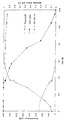
- FIG. 1 shows the growth of a mixed culture on 250 ⁇ M ethene in the presence of 800 ⁇ M cis -1,2-dichloroethene in a batch culture.
- the concentrations refer to the liquid phase.
- the cultivation was carried out in a shake flask with baffles and a nominal volume of 500 ml.
- the samples to be examined were removed from the flask's gas space through a septum using a gas-tight syringe.
- Ethene and cDCE were detected using a gas chromatograph (injector, detector and oven temperature 250 ° C, 200 ° C and 170 ° C, FID, Plora PLOT U column (25 mx 0.53 mm) with He (30 kPa column pressure) as carrier gas). The optical density was determined at 546 nm. Cis -1,2-dichloroethene is broken down at the end of the exponential phase and during the stationary phase.
Landscapes
- Life Sciences & Earth Sciences (AREA)
- Engineering & Computer Science (AREA)
- Chemical & Material Sciences (AREA)
- Health & Medical Sciences (AREA)
- Microbiology (AREA)
- Environmental & Geological Engineering (AREA)
- Organic Chemistry (AREA)
- Biomedical Technology (AREA)
- Chemical Kinetics & Catalysis (AREA)
- General Chemical & Material Sciences (AREA)
- General Health & Medical Sciences (AREA)
- Molecular Biology (AREA)
- Biotechnology (AREA)
- Zoology (AREA)
- Wood Science & Technology (AREA)
- Biochemistry (AREA)
- Mycology (AREA)
- Hydrology & Water Resources (AREA)
- Bioinformatics & Cheminformatics (AREA)
- Analytical Chemistry (AREA)
- Water Supply & Treatment (AREA)
- Oil, Petroleum & Natural Gas (AREA)
- Genetics & Genomics (AREA)
- Biodiversity & Conservation Biology (AREA)
- General Engineering & Computer Science (AREA)
- Toxicology (AREA)
- Business, Economics & Management (AREA)
- Emergency Management (AREA)
- Soil Sciences (AREA)
- Medicinal Chemistry (AREA)
- Tropical Medicine & Parasitology (AREA)
- Virology (AREA)
- Processing Of Solid Wastes (AREA)
- Micro-Organisms Or Cultivation Processes Thereof (AREA)
- Organic Low-Molecular-Weight Compounds And Preparation Thereof (AREA)
- Treating Waste Gases (AREA)
- Purification Treatments By Anaerobic Or Anaerobic And Aerobic Bacteria Or Animals (AREA)
- Carbon And Carbon Compounds (AREA)
Claims (9)
- Procédé microbiologique pour l'élimination d'éthènes halogénés, caractérisé en ce qu'on préadapte des souches bactériennes croissant avec de l'éthène en tant que source de carbone et d'énergie et dégradant les éthènes halogénés, avec de l'éthène en tant que source de carbone et d'énergie pour la néoformation et pour l'apport d'énergie, et on met ensuite les bactéries en contact, dans un bioréacteur aérobie, simultanément et/ou consécutivement avec de l'éthène et les éthènes halogénés à éliminer.
- Procédé selon la revendication 1, caractérisé en ce que l'éthène, en tant que source de carbone et/ou d'énergie, est introduit dans le bioréacteur par l'intermédiaire de la phase gazeuse avec l'air d'arrivée, à une concentration de moins de 2,3 % (v/v).
- Procédé selon la revendication 1 ou 2, caractérisé en ce que les souches bactériennes dans le bioréacteur sont mises en contact avec une eau à épurer contenant des éthènes halogénés.
- Procédé selon la revendication 3, caractérisé en ce que de l'eau souterraine contaminée est épurée.
- Procédé selon au moins l'une des revendications 1 et 2, caractérisé en ce qu'on utilise pour l'aération du bioréacteur de l'air contaminé par des éthènes halogénés.
- Procédé selon la revendication 5, caractérisé en ce qu'on utilise de l'air au sol contaminé par des éthènes halogénés.
- Procédé selon au moins l'une des revendications 1 à 6, caractérisé en ce qu'avant l'étape d'épuration dans le bioréacteur aérobie, on effectue une étape anaérobie pour la déshalogénation réductrice des éthènes halogénés.
- Procédé selon au moins l'une des revendications 1 à 7, caractérisé en ce qu'on épure de l'eau et/ou de l'air contenant du cis-1,2-dichloréthène et/ou du chlorure de vinyle.
- Procédé selon la revendication 8, caractérisé en ce qu'on purifie des concentrations de cis-1,2-dichoréthène et/ou de chlorure de vinyle allant jusqu'à 100 mg/l.
Applications Claiming Priority (5)
| Application Number | Priority Date | Filing Date | Title |
|---|---|---|---|
| DE19641268 | 1996-10-07 | ||
| DE19641268 | 1996-10-07 | ||
| DE19709453 | 1997-03-07 | ||
| DE19709453A DE19709453C2 (de) | 1996-10-07 | 1997-03-07 | Verwendung von Bakterienstämmen die aus Proben angereichert wurden, die sowohl Ethen als auch Chlorethen ausgesetzt waren zum Abbau von halogeniertem Ethen |
| PCT/DE1997/002313 WO1998015338A1 (fr) | 1996-10-07 | 1997-10-07 | Procede microbiologique d'elimination d'ethylenes halogene |
Publications (2)
| Publication Number | Publication Date |
|---|---|
| EP0930929A1 EP0930929A1 (fr) | 1999-07-28 |
| EP0930929B1 true EP0930929B1 (fr) | 2001-08-22 |
Family
ID=26030134
Family Applications (1)
| Application Number | Title | Priority Date | Filing Date |
|---|---|---|---|
| EP97947005A Expired - Lifetime EP0930929B1 (fr) | 1996-10-07 | 1997-10-07 | Procede microbiologique d'elimination d'ethylenes halogenes |
Country Status (8)
| Country | Link |
|---|---|
| US (1) | US6218172B1 (fr) |
| EP (1) | EP0930929B1 (fr) |
| JP (1) | JP2001501865A (fr) |
| AT (1) | ATE204508T1 (fr) |
| CA (1) | CA2266495A1 (fr) |
| DK (1) | DK0930929T3 (fr) |
| ES (1) | ES2162332T3 (fr) |
| WO (1) | WO1998015338A1 (fr) |
Families Citing this family (1)
| Publication number | Priority date | Publication date | Assignee | Title |
|---|---|---|---|---|
| US6916446B1 (en) | 2002-09-18 | 2005-07-12 | The United States Of America As Represented By The Secretary Of The Navy | Bioreactor method, apparatus and product thereby |
Citations (2)
| Publication number | Priority date | Publication date | Assignee | Title |
|---|---|---|---|---|
| DE3326057A1 (de) * | 1983-07-20 | 1985-01-31 | Bayer Ag, 5090 Leverkusen | Verfahren zur biologischen abluftreinigung |
| EP0336718A2 (fr) * | 1988-04-05 | 1989-10-11 | Amgen Inc. | Dégradation microbienne de trichloréthylène |
Family Cites Families (2)
| Publication number | Priority date | Publication date | Assignee | Title |
|---|---|---|---|---|
| DE4009109A1 (de) * | 1990-03-21 | 1991-09-26 | Fraunhofer Ges Forschung | Verfahren zur mikrobiologischen reinigung von mit halogenierten ethenen und/oder mit halogenierten butadienen kontaminierten abluftstroemen |
| DE4142063A1 (de) | 1991-12-19 | 1993-06-24 | Wisstrans Umwelt Gmbh | Mittel gegen tce-kontaminationen, bakterien und verfahren dafuer sowie verwendung der bakterien |
-
1997
- 1997-10-07 EP EP97947005A patent/EP0930929B1/fr not_active Expired - Lifetime
- 1997-10-07 JP JP10517081A patent/JP2001501865A/ja not_active Ceased
- 1997-10-07 WO PCT/DE1997/002313 patent/WO1998015338A1/fr not_active Ceased
- 1997-10-07 AT AT97947005T patent/ATE204508T1/de not_active IP Right Cessation
- 1997-10-07 CA CA2266495A patent/CA2266495A1/fr not_active Abandoned
- 1997-10-07 ES ES97947005T patent/ES2162332T3/es not_active Expired - Lifetime
- 1997-10-07 US US09/284,027 patent/US6218172B1/en not_active Expired - Fee Related
- 1997-10-07 DK DK97947005T patent/DK0930929T3/da active
Patent Citations (2)
| Publication number | Priority date | Publication date | Assignee | Title |
|---|---|---|---|---|
| DE3326057A1 (de) * | 1983-07-20 | 1985-01-31 | Bayer Ag, 5090 Leverkusen | Verfahren zur biologischen abluftreinigung |
| EP0336718A2 (fr) * | 1988-04-05 | 1989-10-11 | Amgen Inc. | Dégradation microbienne de trichloréthylène |
Non-Patent Citations (1)
| Title |
|---|
| "Untersuchungen zum mikrobiellen Abbau chlorsubstituierter Ethene", Dissertation Jens Ewers, 1991, Universität Stuttgart * |
Also Published As
| Publication number | Publication date |
|---|---|
| DK0930929T3 (da) | 2001-10-08 |
| ES2162332T3 (es) | 2001-12-16 |
| EP0930929A1 (fr) | 1999-07-28 |
| US6218172B1 (en) | 2001-04-17 |
| CA2266495A1 (fr) | 1998-04-16 |
| ATE204508T1 (de) | 2001-09-15 |
| JP2001501865A (ja) | 2001-02-13 |
| WO1998015338A1 (fr) | 1998-04-16 |
Similar Documents
| Publication | Publication Date | Title |
|---|---|---|
| Semple et al. | Impact of composting strategies on the treatment of soils contaminated with organic pollutants | |
| DE69514871T2 (de) | Corynebacterium sp. J1, Verfahren zum biologischen Abbau von aromatischen Verbindungen und/oder chlorierten organischen Verbindungen, und Verfahren zur Entgiftung der Umwelt damit | |
| DE69727340T2 (de) | Mikrobielle Stamme, Verfahren zum Abbau von organischen Verbindungen und Verfahren zur Entgiftung der Umwelt | |
| Samudro et al. | Mixed plant operations for phytoremediation in polluted environments–a critical review | |
| EP0447862B1 (fr) | Méthode pour la purification biologique de gaz contaminés par des éthènes halogénés et/ou par des butadiènes halogénés | |
| Kaszycki et al. | Bioremediation of a spent metalworking fluid with auto-and allochthonous bacterial consortia | |
| DE102008008029A1 (de) | Verfahren und Vorrichtung zur Reinigung von wässrigen Medien mit toxischen und/oder schwer abbaubaren organischen Inhaltsstoffen | |
| DE19709453C2 (de) | Verwendung von Bakterienstämmen die aus Proben angereichert wurden, die sowohl Ethen als auch Chlorethen ausgesetzt waren zum Abbau von halogeniertem Ethen | |
| WO1998015338A1 (fr) | Procede microbiologique d'elimination d'ethylenes halogene | |
| DE19708181A1 (de) | Verfahren zum mikrobiellen Abbau von Schadstoffen in schadstoffbefrachteten Medien und dazu geeignete Mikroorganismen | |
| US5994121A (en) | Method for degrading recalcitrant organic contaminants | |
| KR102671162B1 (ko) | 난분해성 유기탄소물질 제거 기능이 우수한 미생물 혼합 균주 및 폐수 처리 방법 | |
| KR100607031B1 (ko) | 다이옥신을 분해하는 신규한 미생물 슈도모나스속 균주 피에이치-03 | |
| DE102008008031A1 (de) | Verfahren und Vorrichtung zur kombinierten in situ und on site Reinigung schadstoffhaltiger Wässer | |
| Fox | Status and trends in bioremediation treatment technology | |
| DE3917595C2 (de) | Verfahren zum mikrobiellen Abbau von leichtflüchtigen Chlorkohlenwasserstoffen aus kontaminierten Grund- und Oberflächenwässern | |
| JP3436654B2 (ja) | ハロゲン化炭化水素分解菌及びその使用 | |
| Payne et al. | Petroleum and chlorinated hydrocarbon analysis in support of in vitro studies of natural anaerobic and aerobic microbial degradation of xenobiotics in contaminated groundwater and soil | |
| Bécaert et al. | Development of a microbial consortium from a contaminated soil that degrades pentachlorophenol and wood-preserving oil | |
| Ebulue | Ecosystem Biology of Soil Polluted with Spent Engine Oil | |
| DE4311981A1 (de) | Mikrobielle Mischkultur zum Abbau von polycyclischen aromatischen Kohlenwasserstoffen, insbesondere aus Teerölen | |
| Demnerová et al. | Biodegradation of alkanes and PCBs: Experience in the Czech Republic | |
| JP2003250529A (ja) | 分解方法、浄化方法および分解菌 | |
| JP2003010833A (ja) | 土壌・砂利又は汚泥に含有される有機塩素化合物の分解処理法 | |
| DE4345195C2 (de) | Verfahren zur Eliminierung von schwerabsorbierbaren chlorierten Kohlenwasserstoffen |
Legal Events
| Date | Code | Title | Description |
|---|---|---|---|
| PUAI | Public reference made under article 153(3) epc to a published international application that has entered the european phase |
Free format text: ORIGINAL CODE: 0009012 |
|
| 17P | Request for examination filed |
Effective date: 19990308 |
|
| AK | Designated contracting states |
Kind code of ref document: A1 Designated state(s): AT BE CH DE DK ES FI FR GB IE IT LI NL SE |
|
| 17Q | First examination report despatched |
Effective date: 19991223 |
|
| GRAG | Despatch of communication of intention to grant |
Free format text: ORIGINAL CODE: EPIDOS AGRA |
|
| GRAG | Despatch of communication of intention to grant |
Free format text: ORIGINAL CODE: EPIDOS AGRA |
|
| GRAG | Despatch of communication of intention to grant |
Free format text: ORIGINAL CODE: EPIDOS AGRA |
|
| GRAH | Despatch of communication of intention to grant a patent |
Free format text: ORIGINAL CODE: EPIDOS IGRA |
|
| GRAH | Despatch of communication of intention to grant a patent |
Free format text: ORIGINAL CODE: EPIDOS IGRA |
|
| GRAA | (expected) grant |
Free format text: ORIGINAL CODE: 0009210 |
|
| AK | Designated contracting states |
Kind code of ref document: B1 Designated state(s): AT BE CH DE DK ES FI FR GB IE IT LI NL SE |
|
| REF | Corresponds to: |
Ref document number: 204508 Country of ref document: AT Date of ref document: 20010915 Kind code of ref document: T |
|
| REG | Reference to a national code |
Ref country code: CH Ref legal event code: NV Representative=s name: TROESCH SCHEIDEGGER WERNER AG Ref country code: CH Ref legal event code: EP |
|
| REF | Corresponds to: |
Ref document number: 59704393 Country of ref document: DE Date of ref document: 20010927 |
|
| REG | Reference to a national code |
Ref country code: IE Ref legal event code: FG4D Free format text: GERMAN |
|
| REG | Reference to a national code |
Ref country code: DK Ref legal event code: T3 |
|
| ET | Fr: translation filed | ||
| GBT | Gb: translation of ep patent filed (gb section 77(6)(a)/1977) |
Effective date: 20011117 |
|
| REG | Reference to a national code |
Ref country code: ES Ref legal event code: FG2A Ref document number: 2162332 Country of ref document: ES Kind code of ref document: T3 |
|
| REG | Reference to a national code |
Ref country code: GB Ref legal event code: IF02 |
|
| PLBE | No opposition filed within time limit |
Free format text: ORIGINAL CODE: 0009261 |
|
| STAA | Information on the status of an ep patent application or granted ep patent |
Free format text: STATUS: NO OPPOSITION FILED WITHIN TIME LIMIT |
|
| 26N | No opposition filed | ||
| PGFP | Annual fee paid to national office [announced via postgrant information from national office to epo] |
Ref country code: GB Payment date: 20030930 Year of fee payment: 7 |
|
| PGFP | Annual fee paid to national office [announced via postgrant information from national office to epo] |
Ref country code: DK Payment date: 20031021 Year of fee payment: 7 Ref country code: AT Payment date: 20031021 Year of fee payment: 7 |
|
| PGFP | Annual fee paid to national office [announced via postgrant information from national office to epo] |
Ref country code: SE Payment date: 20031022 Year of fee payment: 7 Ref country code: FI Payment date: 20031022 Year of fee payment: 7 |
|
| PGFP | Annual fee paid to national office [announced via postgrant information from national office to epo] |
Ref country code: FR Payment date: 20031024 Year of fee payment: 7 |
|
| PGFP | Annual fee paid to national office [announced via postgrant information from national office to epo] |
Ref country code: IE Payment date: 20031029 Year of fee payment: 7 |
|
| REG | Reference to a national code |
Ref country code: CH Ref legal event code: PFA Owner name: FRAUNHOFER-GESELLSCHAFT ZUR FOERDERUNG DER ANGEWA Free format text: FRAUNHOFER-GESELLSCHAFT ZUR FOERDERUNG DER ANGEWANDTEN FORSCHUNG E.V.#LEONRODSTRASSE 54#80636 MUENCHEN (DE) -TRANSFER TO- FRAUNHOFER-GESELLSCHAFT ZUR FOERDERUNG DER ANGEWANDTEN FORSCHUNG E.V.#HANSASTRASSE 27 C#80686 MUENCHEN (DE) |
|
| PG25 | Lapsed in a contracting state [announced via postgrant information from national office to epo] |
Ref country code: IE Free format text: LAPSE BECAUSE OF NON-PAYMENT OF DUE FEES Effective date: 20041007 Ref country code: GB Free format text: LAPSE BECAUSE OF NON-PAYMENT OF DUE FEES Effective date: 20041007 Ref country code: FI Free format text: LAPSE BECAUSE OF NON-PAYMENT OF DUE FEES Effective date: 20041007 Ref country code: AT Free format text: LAPSE BECAUSE OF NON-PAYMENT OF DUE FEES Effective date: 20041007 |
|
| PG25 | Lapsed in a contracting state [announced via postgrant information from national office to epo] |
Ref country code: SE Free format text: LAPSE BECAUSE OF NON-PAYMENT OF DUE FEES Effective date: 20041008 |
|
| PG25 | Lapsed in a contracting state [announced via postgrant information from national office to epo] |
Ref country code: DK Free format text: LAPSE BECAUSE OF NON-PAYMENT OF DUE FEES Effective date: 20041101 |
|
| GBPC | Gb: european patent ceased through non-payment of renewal fee |
Effective date: 20041007 |
|
| EUG | Se: european patent has lapsed | ||
| REG | Reference to a national code |
Ref country code: DK Ref legal event code: EBP |
|
| PG25 | Lapsed in a contracting state [announced via postgrant information from national office to epo] |
Ref country code: FR Free format text: LAPSE BECAUSE OF NON-PAYMENT OF DUE FEES Effective date: 20050630 |
|
| REG | Reference to a national code |
Ref country code: IE Ref legal event code: MM4A |
|
| REG | Reference to a national code |
Ref country code: FR Ref legal event code: ST |
|
| PG25 | Lapsed in a contracting state [announced via postgrant information from national office to epo] |
Ref country code: IT Free format text: LAPSE BECAUSE OF NON-PAYMENT OF DUE FEES;WARNING: LAPSES OF ITALIAN PATENTS WITH EFFECTIVE DATE BEFORE 2007 MAY HAVE OCCURRED AT ANY TIME BEFORE 2007. THE CORRECT EFFECTIVE DATE MAY BE DIFFERENT FROM THE ONE RECORDED. Effective date: 20051007 |
|
| PGFP | Annual fee paid to national office [announced via postgrant information from national office to epo] |
Ref country code: NL Payment date: 20071016 Year of fee payment: 11 Ref country code: ES Payment date: 20071026 Year of fee payment: 11 |
|
| PGFP | Annual fee paid to national office [announced via postgrant information from national office to epo] |
Ref country code: CH Payment date: 20071023 Year of fee payment: 11 |
|
| PGFP | Annual fee paid to national office [announced via postgrant information from national office to epo] |
Ref country code: BE Payment date: 20071022 Year of fee payment: 11 |
|
| PGFP | Annual fee paid to national office [announced via postgrant information from national office to epo] |
Ref country code: DE Payment date: 20071217 Year of fee payment: 11 |
|
| BERE | Be: lapsed |
Owner name: *FRAUNHOFER-GESELLSCHAFT ZUR FORDERUNG DER ANGEWAN Effective date: 20081031 |
|
| REG | Reference to a national code |
Ref country code: CH Ref legal event code: PL |
|
| NLV4 | Nl: lapsed or anulled due to non-payment of the annual fee |
Effective date: 20090501 |
|
| PG25 | Lapsed in a contracting state [announced via postgrant information from national office to epo] |
Ref country code: NL Free format text: LAPSE BECAUSE OF NON-PAYMENT OF DUE FEES Effective date: 20090501 |
|
| PG25 | Lapsed in a contracting state [announced via postgrant information from national office to epo] |
Ref country code: DE Free format text: LAPSE BECAUSE OF NON-PAYMENT OF DUE FEES Effective date: 20090501 |
|
| PG25 | Lapsed in a contracting state [announced via postgrant information from national office to epo] |
Ref country code: BE Free format text: LAPSE BECAUSE OF NON-PAYMENT OF DUE FEES Effective date: 20081031 |
|
| PG25 | Lapsed in a contracting state [announced via postgrant information from national office to epo] |
Ref country code: LI Free format text: LAPSE BECAUSE OF NON-PAYMENT OF DUE FEES Effective date: 20081031 Ref country code: CH Free format text: LAPSE BECAUSE OF NON-PAYMENT OF DUE FEES Effective date: 20081031 |
|
| REG | Reference to a national code |
Ref country code: ES Ref legal event code: FD2A Effective date: 20081008 |
|
| PG25 | Lapsed in a contracting state [announced via postgrant information from national office to epo] |
Ref country code: ES Free format text: LAPSE BECAUSE OF NON-PAYMENT OF DUE FEES Effective date: 20081008 |