EP0448224B2 - Polymere - Google Patents
Polymere Download PDFInfo
- Publication number
- EP0448224B2 EP0448224B2 EP91301279A EP91301279A EP0448224B2 EP 0448224 B2 EP0448224 B2 EP 0448224B2 EP 91301279 A EP91301279 A EP 91301279A EP 91301279 A EP91301279 A EP 91301279A EP 0448224 B2 EP0448224 B2 EP 0448224B2
- Authority
- EP
- European Patent Office
- Prior art keywords
- polymer
- functional
- coating composition
- groups
- group
- Prior art date
- Legal status (The legal status is an assumption and is not a legal conclusion. Google has not performed a legal analysis and makes no representation as to the accuracy of the status listed.)
- Expired - Lifetime
Links
Classifications
-
- C—CHEMISTRY; METALLURGY
- C08—ORGANIC MACROMOLECULAR COMPOUNDS; THEIR PREPARATION OR CHEMICAL WORKING-UP; COMPOSITIONS BASED THEREON
- C08F—MACROMOLECULAR COMPOUNDS OBTAINED BY REACTIONS ONLY INVOLVING CARBON-TO-CARBON UNSATURATED BONDS
- C08F220/00—Copolymers of compounds having one or more unsaturated aliphatic radicals, each having only one carbon-to-carbon double bond, and only one being terminated by only one carboxyl radical or a salt, anhydride ester, amide, imide or nitrile thereof
-
- C—CHEMISTRY; METALLURGY
- C08—ORGANIC MACROMOLECULAR COMPOUNDS; THEIR PREPARATION OR CHEMICAL WORKING-UP; COMPOSITIONS BASED THEREON
- C08F—MACROMOLECULAR COMPOUNDS OBTAINED BY REACTIONS ONLY INVOLVING CARBON-TO-CARBON UNSATURATED BONDS
- C08F2/00—Processes of polymerisation
- C08F2/38—Polymerisation using regulators, e.g. chain terminating agents, e.g. telomerisation
Definitions
- This invention relates to certain novel star co-polymers, their preparation and use in coating compositions.
- the co-polymers of the present invention have an idealised structure that can be regarded as consisting of a number of arm that radiate from a central point. Polymers having such geometry are referred to colloquially as star polymers or polymers with star geometry.
- DE-A-2944092 discloses polymers formed from acrylic and thioether-containing mercapto monomers that are for use in the production of a photographic silver halide emulsion.
- the polymers are not of star configuration.
- EP-A-31305 discloses polymer compositions formed by actinic radiation-induced or free-radical polymerization of acryloyloxy and aromatic ally-containing compounds including at least three double bonds and a polymercaptan.
- the polymer compositions are not of star configuration and are for use in the production of surface coatings for printing plates and printing circuits, adhesive bonds, and of reinforced composites.
- a star co-polymer having a weight average molecular weight of from 3 000 to 30 000 inclusive and having a hub portion from which radiate from 3 to 8 arms where the hub portion is the residue of a tri-functional to octa-functional thiol ester, formed from a tri-functional to octa-functional alcohol and thio C 2-6 alkanoic acid, and each arm is an addition polymer comprising structural units and functional units where the functional units, but not the structural units, include crosslinking substituents and are mutually compatable in that the crosslinking substituents are capable of undergoing a crosslinking reaction with a crosslinking agent or the same or a complementary substituent in functional units in another molecule of the same polymer, and optionally compatable auxilliary functional units that contain wetting groups.
- compositions based on them have improved pot lives and gel times compared with compositions based on corresponding linear polymers.
- a primer composition based on such a star polymer has improved sandability as compared to one based upon a commercial standard.
- a star polymer composition is, as compared with a commercial standard based on a linear polymer, relatively stable to ultra violet degradation.
- Further waterborne compositions based on allyl functional and hydroxy functional star polymers display viscosities much lower than would be expected from their molecular weights whilst showing relatively improve film performance.
- the co-polymers of this invention have a total weight average molecular weight of at least 3,000.
- the molecular weight will not be more than 150,000.
- the molecular weight can be 3,000 to 30,000, particularly 3,000 to 15,000 the molecular weight is 5,000 to 10,000.
- the term 'molecular weight' here means the apparent total weight average molecular weight. Apparent molecular weight is measured by the gel permeation chromatography method described in Gel Chromatography: Theory, Methodology and Application, T Kremmer and L Boross, Wiley Interscience 1979.
- the co-polymers of the invention have a hub portion that is the residue of a trifunctional to octafunctional thiol.
- an addition polymer arm extends from each thio moiety in the hub, hence the three to eight arms.
- the hub is the residue of a trifunctional, tetrafunctional or hexafunctional thiol especially a tetra or hexafunctional thiol.
- the trifunctional to octafunctional thiol can be aromatic or aliphatic.
- aromatic thiols are benzene-1,3,5-trithiol, 3,4,8,9-tetramercaptotetrathiafulvalene and 7-methyltrithiouric acid.
- the thiol residue is the residue of an ester formed from a trifunctional to octafunctional alcohol and a thio-C 2-6 alkanoic acid.
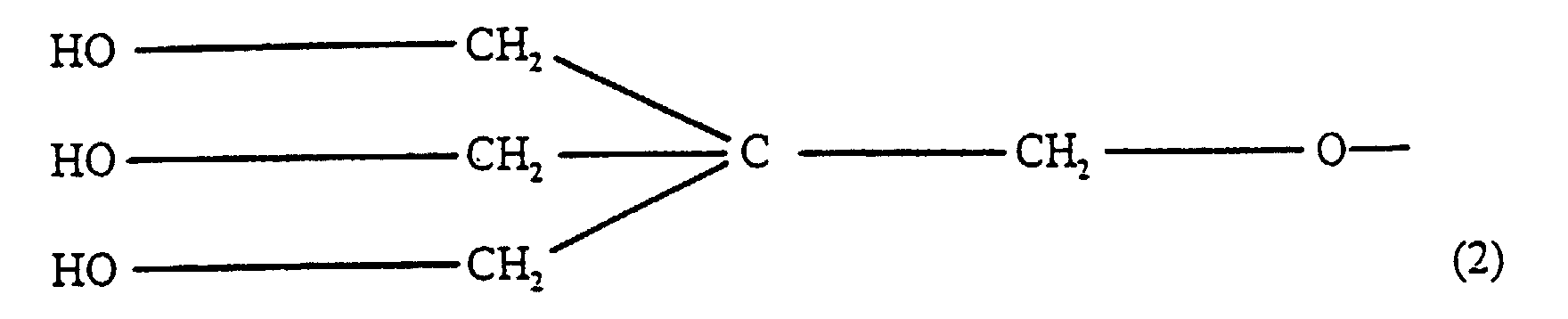
- Suitable alcohols are glycerol, sorbitol and especially alcohols having the general formula (1):- where R 1 is hydrogen, C 1-4 alkyl or hydroxy-C 1-4 alkyl, (especially methyl, ethyl, hydroxymethyl or hydroxyethyl) or a group of formula (2):-
- Examples of mercapto-C 2-6 -alkanoic acids are 2-mercaptoacetic acid , 2-mercaptopropionic acid, 3-mercaptopropionic acid, 4-mercaptobutyric acid, 5-mercaptopentanoic acid and 6-mercaptohexanoic acid.
- the mercaptoalkanoic acid is 2-mercaptoacetic or 3-mercaptopropionic acid.
- Each arm of the star co-polymer is made up of structural units, functional units that are mutually compatible and include crosslinking substituents capable of undergoing a crosslinking reaction with a crosslinking agent or with the same or a complementary substituent in functional units in another molecule of the same polymer and optionally compatible auxiliary functional units containing wetting groups. As in conventional acrylic polymers, the distribution of such units is random.
- the total average mole percentage of functional units and auxiliary functional units in the arms is from 10% to 70%, for example 25% to 50% or 60% to 70% particularly 30% to 40% of the arm.
- the average mole percentage of functional units in each arm is calculated from the mole percentage of total monomers making up the arms that is represented by the monomers that will provide the functional units.
- the functional units that are selected for any particular polymer are chosen so as to be mutually compatible. This means that the substituents tend to undergo inter- molecular crosslinking reactions with a crosslinking agent or with the same or complementary substituents in functional units in another molecule in preference to intra-molecular reactions with crosslinking substituents in functional units in the same molecule.
- crosslinking substituents are hydroxyl, carboxyl, isocyanate, blocked isocyanate, epoxy, allyloxyester and 2-hydroxy-3-allyloxy propyl ester groups.
- the functional units contain the same crosslinking group, it is selected such that the crosslinking reaction requires a crosslinking agent or where self crosslinking takes place between different molecules in the same polymer, that the crosslinking reaction requires triggering for example by a catalyst.
- hydroxyl group-containing polymers require for example an isocyanate-containing cross-linking agent.
- 2-Hydroxy-3-allyloxypropyl ester groups generally require a cobalt catalyst for cross-linking with each other.
- the different crosslinking groups or the crosslinking groups and the wetting groups are chosen so that crosslinking is inter-molecular rather than intra-molecular.
- one type can contain hydroxy groups and the other carboxy groups, or hydroxy groups and blocked isocyanate groups, or hydroxy groups and epoxy groups, or carboxyl groups or salts thereof and allyl or 2-hydroxy-3-allyoxy propyl ester groups.
- wetting groups for auxiliary functional units are 4-nitrobenzoyloxy and 4-aminobenzoyloxy and its acid addition salt derivatives.
- acid addition salts are hydrohalide salts especially hydrochloride or organic acid salts for example an acetic acid salt.
- the functional units can be derived from hydroxy, carboxy, isocyanate, blocked isocyanate or epoxy group-containing ethylenic monomers, or from the reaction of a carboxyl group-containing unit with allyl alcohol or 1-allyoxy-2,3-epoxy propane.
- the molar ratio of free acid or salt group to ester group is from 1 to 3 to 1 to 9 in particular 1 to 5.6 to 1 to 7.33.
- the ratio 1 to 3 means that 75 mole % of the carboxyl groups are esterified.
- the ratio 1 to 5.6 means 85% of the carboxyl groups are esterified, the ratio 1 to 7.33 means that 88% of the carboxyl groups are esterified and a ratio of 1 to 9 means that 90% of the carboxyl groups are esterified.
- the carboxyl groups can form salts for example alkali metal, alkaline earth metal and ammonium salts especially lithium and sodium salts.
- the unit present in the largest amount will not usually exceed 97 mole % of the total of the functional units. Usually it will not exceed 90 mole % of the total.
- the auxiliary functional unit will not be less than 0.5 or 1.3 mole % of the total functional units. Typically it will be 0.5 to 5 mole % especially 1 to 2 mole %.
- carboxy group-containing monomers examples include acrylic, methacrylic and maleic acid and maleic anhydride.
- Examples of blocked isocyanate group-containing monomers of formula (4) are monomers where the isocyanate group has been blocked with an alkanol, especially a C 1-10 alkanol, an alkoxyalkanol especially a C 1-3 alkoxy C 1-3 alkanol, an hydroxy ester, a keto ester, an oxime, a ketoxime, an optionally substituted phenol, a lactam (including cyclic lactams) and N-hydroxy imides especially cyclic N-hydroxy imides.
- Blocking groups of this type are described in Preparation, Polymerisation and Evaluation of Blocked Isocyanato-ethyl Methacrylate H.G Fravel Jr et al Ind. Eng. Chem. Prod. Res. Dev. 1984 23 586.
- epoxy group-containing monomers examples include glycidyl acrylate and glycidyl methacrylate.
- Examples of structural units are units derived from ethylenically unsaturated monomers in particular C 1-8 alkyl esters of acrylic and methacrylic acids, vinyl C 2-6 alkanoates and styrene and its C 1-4 alkyl analogues.
- C 1-8 alkyl esters of acrylic and methacrylic acids are methyl methacrylate, ethyl methacrylate, propyl methacrylate, pentyl methacrylate, hexyl methacrylate, octyl methacrylate, ethyl acrylate, propyl acrylate, butyl acrylate, pentyl acrylate, hexyl acrylate, octyl acrylate and 2-ethylhexyl acrylate.
- vinyl C 2-6 alkanoate esters are vinyl acetate, vinyl propionate and vinyl butanoate.
- styrene and its C 1-4 alkyl analogues are 4-methylstyrene and 4-ethylstyrene.
- the structural units are derived from methyl methacrylate, ethyl methacrylate butyl methacrylate and butyl acrylate.
- Tg glass transition temperature
- Co-polymers of the invention can have a wide range of Tg's for example -5 to +100°C.
- Co-polymers having a Tg in the range of -5 to 55°C are particularly useful in paints for respraying motor vehicles.
- Co-polymers having a Tg in the range +45 to 100°C are particularly useful in the preparation of paints for painting motor vehicles especially in a vehicle manufacturing line.
- the co-polymers of the present invention can be prepared by a process which comprises reacting together at moderate to elevated temperatures, a tri- to octa-functional thiol chain transfer agent with ethylenically unsaturated monomers that polymerise to form structural units, ethylenically unsaturated monomers that polymerise to form functional units and optionally ethylenically unsaturated monomers that polymerise to form auxiliary functional units thereby forming a co-polymer and optionally thereafter, where a salt or ester is required, salifying or co-reacting a polymer so formed containing functional units having carboxyl groups with allylalcohol or 1-allyloxy-2,3- epoxypropane or optionally reacting a co-polymer so formed containing functional units having epoxy groups with 4-nitrobenzoic acid or 4-aminobenzoic acid and optionally converting the product so obtained into an acid addition salt.
- the reaction is carried out in the presence of an initiator for the free radical reaction for example, a per ester for example t-butyl perbenzoate, t-butyl per-2-ethyl hexanoate or azobisisobutyronitrile.
- an initiator for the free radical reaction for example, a per ester for example t-butyl perbenzoate, t-butyl per-2-ethyl hexanoate or azobisisobutyronitrile.
- the reaction is carried out in such a way that the molecular weight distribution of the polymer product is small.
- This can be achieved by producing a high radical flux at the beginning of reaction.
- This is achieved either by using a fast initiator, that is one that produces a large number of free radicals very quickly, or a relatively slow initiator, and adding monomer to an excess of the initiator.
- the polymerisation reaction is carried out at moderate to elevated temperature.
- the precise temperature depends upon the specific initiator employed and the monomers to be polymerised. Usually the reaction is carried out at from 70 to 170°C especially from 100 to 140°C.
- the post-esterification and epoxide ring opening can be carried out at moderate temperatures for example ambient temperature optionally in the presence of a catalyst.
- the polymerisation reaction and the post esterification reaction are carried out in the presence of a non-interfering solvent or diluant for example a high boiling aromatic hydrocarbon, particularly xylene or a high boiling hydrocarbon solvent blend. for example 'Solvesso*'.
- a non-interfering solvent or diluant for example a high boiling aromatic hydrocarbon, particularly xylene or a high boiling hydrocarbon solvent blend. for example 'Solvesso*'.
- the salification steps can be carried out by standard procedures for example by contacting the polymer containing free acid groups with a base, or the polymer containing free amino with an acid in a liquid medium in which the base or acid is soluble and the polymer is at least partially soluble.
- aromatic thiols specifically referred to above, the alcohols of formula (1), vinyl monomers of formula (3), acrylates and methacrylates of formula (4) are known, or can be made by analogy with known processes.
- the polymers of this invention are formulated with a volatile liquid diluant or carrier into coating compositions.
- a coating composition comprising a star co-polymer and a liquid diluent or carrier characterised in that the star co-polymer has a hub portion from which radiate from 3 to 8 arms where the hub portion is the residue of a tri-functional to octa-functional thiol ester, formed from a tri-functional to octa-functional alcohol and thio C 2-6 alkanoic acid, and each arm is an addition polymer comprising structural units and functional units where the functional units, but not the structural units, include crosslinking substituents and are mutually compatable in that the crosslinking substituents are capable of undergoing a crosslinking reaction, with either a crosslinking agent, in which case the composition also comprises a crosslinking agent, or the same or a complementary substituent in functional units in another molecule of the same polymer, and optionally compatable auxilliary functional units that contain wetting groups.
- liquid carriers examples include aliphatic hydrocarbons, aromatic hydrocarbons, halogenated hydrocarbons, alcohols, ketones, esters, ethers alcohols and water.
- the amount of the liquid carrier can be varied depending on the molecular weight or composition of the polymer so that the resulting composition is of an appropriate viscosity for the method of application chosen.
- compositions also comprise crosslinking agents.
- the crosslinking agent chosen in any particular case depends upon the functional units in the polymer.
- the crosslinking agent can be a di- or multifunctional isocyanate, a melamine formaldehyde resin or a glycoluril. Glycolurils are also effective as cross-linking agents for polymers where the functional unit contains carboxyl groups.
- alkane diisocyanates of formula (5):- OCN(CH 2 ) n NCO where n is from 2 to 8. In particular n is 4 to 6 especially 6.
- An example of a simple cycloalkanediisocyanate is isophoronediisocyanate.
- Examples of simple aromatic di-isocyanates are toluene-2,4-diisocyanate and 4,4-diphenylmethane diisocyanate.
- Complex multi-functional oligomeric isocyanates are reaction products of di- and polyols with the difunctional isocyanates described above.
- diols and polyols examples are ethylene glycol, propyleneglycol, trimethylolpropane and pentaerythritol.
- the composition also comprises a catalyst for the crosslinking reaction.
- the catalyst can be an organotin compound for example dibutyltin dilaurate.
- isocyanate crosslinkers are known or can be made by analogy with known methods. Many are available under the brand name 'Desmodur'.
- Melamine formaldehyde resins are commercially available under the trade name 'Cymel'.
- the crosslinker can be a di- or multifunctional alcohol.
- Examples of simple di- and multi-functional alcohols are ethylene glycol, propylene glycol, trimethylol propane and pentaerythritol.
- compositions can also comprise a catalyst for the cross linking reaction.
- the catalyst can be an organotin compound for example dibutyltin dilaurate.
- Glycolurils also called acetylene ureas
- They preparation is described in US Patent No. 4064191. They are prepared by reacting two moles of urea with one mole of glyoxal.
- the glycoluril so obtained can optionally bear a C 1-6 alkyl substituent (this is introduced by selection of appropriate starting materials) or can be methylolated partially or fully by reaction with from 1 to 4 moles of formaldehyde.
- glycolurils disclosed in US Patent No. 4064191 are tetramethylol glycoluril, tetrabutoxymethyl glycoluril, partially methylolated glycoluril, tetramethoxylmethyl glycoluril, and dimethyoxydiethoxy glycoluril.
- a particular group of glycoluril derivatives consists of mono- and dimethylether of dimethylol glycoluril, the trimethylether of tetramethylol glycoluril, the tetramethylether of tetramethylol glycoluril, tetrakisethoxymethyl glycoluril tetrakispropoxymethyl glycoluril, tetrakisbutoxymethyl glycoluril, tetrakisamyloxymethyl glycoluril and tetrakishexoxymethyl glycoluril.
- Another glycoluril is dimethylol dihydroxyl ethylene urea. Its chemical structure is thought to be as shown in formula (6).
- the cross-linking reaction between the hydroxy polymer and the glycoluril can be catalysed by an acid catalyst for example toluene sulphonic acid.
- Glycolurils are particularly useful as cross-linkers for water-borne coating compositions.
- the crosslinking agent is a simple mono-primary amine or a simple di- or multi-functional amine.
- Examples of simple mono primary amines are C 2-8 alkyl amines, in particular ethylamine, propylamine, butylamine and hexylamine.
- Examples of simple di-amines are amines of formula (7):- NH 2 (CH 2 ) m NH 2 where m is from 2 to 8, especially 4 to 6.
- a particular diamine is 1,6-diaminohexane.
- complex diamines are amine-terminated polypropylene glycols of formula (8):- where a is from 2 to 6.
- complex triamines are of general formula (9):- where R is hydrogen or C 1-6 alkyl, for example methyl ethyl or propyl, and b , c and d are integers such that their sum is from 3 to 30.
- Amines of formula (8) and (9) are commercially available under the trade mark 'Jeffamine'.
- compositions can contain a free radical initiator.
- suitable free radical initiators are peroxides especially benzoyl peroxide.
- crosslinking takes place by autoxidation in air in the presence of a cobalt catalyst for example cobalt octoate or cobalt naphthenate.
- a cobalt catalyst for example cobalt octoate or cobalt naphthenate.
- the crosslinking agent can be a di- or multifunctional epoxide.
- polyepoxides examples include polyglycidylethers of polyphenols, especially those having an epoxide equivalent in the range 150 to 2500, and more especially in the range 400 to 1000. Particular examples of such polyepoxides are those derived from epichlorhydrin and bis(4-hydroxyphenyl)- 2,2-propane. These polyepoxides can be regarded as having the idealised structural formula (10):- where p is an integer such that the polyepoxide has an epoxide equivalent within the above range.
- Polyepoxides of this type are available under the Trade Mark 'Epikote', in particular Epikote 1001, 1004 and 1007.
- composition can also comprise optional additives, for example UV absorbers and water scavengers or flow aids commonly used in paint formulations to modify application or final film properties.
- optional additives for example UV absorbers and water scavengers or flow aids commonly used in paint formulations to modify application or final film properties.
- compositions of the invention can be prepared by mixing a co-polymer of the invention with a liquid carrier and any other optional additive.
- compositions of this invention can be used to coat an object by applying a film to the surface of the object by standard techniques for example by dipping, brushing, roller coating or spraying, allowing the solvent to evaporate and the film to cure.
- Examples 1 to 17 are examples of hydroxyl functional polymers.
- An initiator 'spike' comprising a mixture of tertiary butylperbenzoate (15.0g), butyl acetate (7.5g) and C 10 aromatic hydrocarbon solvent commercially available from Exxon as 'Solvesso' 100 (7.5g), ('Solvesso' is a trade mark) was added over 10 minutes with stirring to butyl acetate (592.5g) and 'Solvesso' 100 (592.5g) in an inert atmosphere heated at reflux.
- the temperature was held at reflux for a further three hours.
- Polymer 1 as a dispersion having a theoretical non volatile content of 60.0% which was diluted with butyl acetate (449.0g) and filtered under pressure 10.3 x 10 4 Pa (15psi) through a filter bed of 'Celite 560', diatomaceous Silica, commercially available from Manville Corporation (Celite is a trade mark).
- the molecular weight of the polymer was determined using the Gel Permeation Chromatography technique as described in Gel Chromatography; Theory, Methodology & Application, T Kremmer: L Boross, Wiley Interscience 1979.
- a Clearcoat was prepared by mixing together the following components to give an activation ratio of 1:1 hydroxyl groups to isocyanate groups: 1.
- Butyl acetate. 34.61g 4.
- a slip aid 50% solution in xylene, commercially available from Bayer as 'Baysilone*' OL17 . 0.15g 5.
- An anticrater agent 50% solution in C 9-10 hydrocarbon, commercially available from BYK Chemie as 'BYK'358. 0.60g 6.
- the resulting composition had a theoretical non volatile content of 40.0%.
- the temperature was held at reflux for a further three hours.
- the temperature was held at reflux for a further three hours.
- the temperature was held at reflux for a further three hours.
- An initiator'spike' comprising a mixture of tertiary butylperbenzoate (15.0g), butyl acetate (7.5g) and C 10 aromatic hydrocarbon solvent 'Solvesso' 100 (7.5g) was added over 10 minutes with stirring to butyl acetate (592.5g) and 'Solvesso' 100 (592.5g) in an inert atmosphere heated at reflux.
- the temperature was held at reflux for a further three hours.
- An initiator 'spike' comprising a mixture of tertiary butylperbenzoate (15.0g), butyl acetate (7.5g) and C 10 aromatic hydrocarbon solvent 'Solvesso' 100 (7.5g) was added over 5 minutes with stirring to butyl acetate (592.5g) and 'Solvesso' 100 (592.5g) in an inert atmosphere heated at reflux.
- the temperature was held at reflux for a further three hours.
- the temperature was held at reflux for a further three hours.
- An initiator 'spike' comprising a mixture of tertiary butylperbenzoate (15.1g) and methyl propoxol acetate (15.1g) was added over 5 minutes with stirring to methyl propoxol acetate (1184.9g) in an inert atmosphere heated at reflux.
- a second mixture of hydroxyethyl methacrylate (936.1g), methyl methacrylate (182.2g), butyl acrylate (681.7g), tertiary butylperbenzoate (90.2g) and pentaerythritol tetramercaptopropionate (36.1g) was added over three hours to the solvent mixture heated at reflux. The temperature was held at reflux for a further three hours.
- the product so obtained was filtered under pressure 10.3 x 10 4 Pa (15psi) through a filter bed of 'Celite' 560.
- Clearcoat Compositions 8a and 8b were prepared by mixing together the amounts of components as shown in Table 1 to give an activation ratio of hydroxyl groups to isocyanate groups of 1:1. ( Figures are weight in grams).
- Formulations for Clearcoat Compositions 8b and 8c COMPONENTS COMPOSITION 8b 8c 1.
- Polymer Dispersion 8. 47.54 52.54 2.
- Lumiflonresin 926Z commercially available from Imperial Chemical Industries PLC, (5.0g). 5.00 0.00 3.
- a slip aid 50% solution in xylene commercially available from Bayer as 'Baysilon'OL17. 0.10 0.10 6.
- An anticrater agent 50% solution in C 9-10 hydrocarbon, commercially available from BYK Chemie as 'BYK'358. 0.70 0.70 7. Methyl ethyl ketone. 16.44 16.44 8. Butyl ethoxol acetate. 5.59 5.59 9. Butyl acetate. 2.04 2.04 10. Methyl propoxol acetate. 37.09 37.09 11.
- the temperature was held at reflux for a further three hours.
- An initiator 'spike' comprising a mixture of tertiary butylperbenzoate (15.23g) and methyl propoxol acetate (15.23g) was added over 5 minutes with stirring to methyl propoxol acetate (1185.05g) in an inert atmosphere heated at reflux.
- a second mixture of hydroxyethyl methacrylate (836.0g), glycidyl methacrylate (90.1g), methyl methacrylate (195.4g), butyl acrylate (678.3g), tertiary butylperbenzoate (90.1g) and pentaerythritol tetramercaptopropionate (35.85g) was added over three hours to the solvent mixture heated at reflux. The temperature was held at reflux for a further one hour.
- the temperature was held at reflux for a further three hours.
- the temperature was held at reflux for a further three hours.
- the temperature was held at reflux for a further three hours.
- An initiator 'spike' comprising a mixture of tertiary butylperbenzoate (15.0g), butyl acetate (7.5g) and C 10 aromatic hydrocarbon solvent 'Solvesso' 100 (7.5g) was added over 10 minutes with stirring to butyl acetate (592.5g) and 'Solvesso' 100 (592.5g) in an inert atmosphere heated at reflux.
- the temperature was held at reflux for a further three hours.
- An initiator 'spike' comprising a mixture of tertiary butylperbenzoate (15.0g), butyl acetate (7.5g) and C 10 aromatic hydrocarbon solvent 'Solvesso' 100 (7.5g) was added over 10 minutes with stirring to butyl acetate (592.5g) and 'Solvesso' 100 (592.5g) in an inert atmosphere heated at reflux.
- the temperature was held at reflux for a further three hours.
- An initiator 'spike' comprising a mixture of tertiary butylperbenzoate (15.0g), butyl acetate (7.5g) and C 10 aromatic hydrocarbon solvent 'Solvesso' 100 (7.5g) was added over 10 minutes with stirring to butyl acetate (592.59) and 'Solvesso' 100 (592.5g) in an inert atmosphere heated at reflux.
- the temperature was held at reflux for a further three hours.
- the temperature was held at reflux for a further three hours.
- tertiary butyl-per-2-ethyl hexanoate (1.69g) was added to the mixture. A similar addition was made after 10 minutes. A further four additions at intervals of 10 minutes were made to the mixture heated at reflux.
- the temperature was held at reflux for a further 15 minutes.
- the temperature was held at reflux for three hours.
- tertiary butyl per-2-ethylhexanoate (1.69g) was added to the mixture. A similar addition was made after 10 minutes. A further four additions at intervals of 10 minutes were made to the mixture heated at reflux.
- the temperature was held at reflux for a further 15 minutes then reduced to 70°C.
- the temperature was held at reflux for a further 15 minutes then reduced to 70°C.
- the final product had a viscosity of 33 seconds as measured using a bubble tube at a temperature of 25°C and a non volatile content of 65.0%.
- the temperature was maintained at reflux for a further 1 hour then reduced to 112°C.
- the final product had a viscosity of 28 seconds as measured using a bubble tube at a temperature of 25°C and a non volatile content of 65.6%.
- a mixture of hydroxy ethyl acrylate (445.4g) and ethyl acrylate (190.9g) was fed over a period of three hours concurrently with a mixture of tertiary butyl per-2-ethylhexanoate (10.09g), pentaerythritol tetra mercaptopropionate (12.72g) and 1-methoxy-2-hydroxy propane (1.1g) with stirring to a mixture of 1-methoxy-2-hydroxy propane (197.2g) and demineralised water (131.9g) heated at reflux.
- tertiary butyl perbenzoate (6.4g) was added over a period of 50 minutes to the mixture heated at reflux.
- the temperature was maintained for a further 20 minutes.
- the resulting product had a viscosity of 9.0 seconds as measured using a bubble tube at a temperature of 25°C and a non volatile content of 60.0%.
- a clearcoat was prepared by blending together the following components. The composition was then acidified to a pH of 1.0 using toluene sulphonic acid solution (25% in water). 1. Polymer Dispersion 23 30.00g 2. Tetramethylol glycoluril solution (45% in water) (Commercially available from Dyno-Cyanamid as 'Cymel'1172 ) 12.51g 3. Water 12.54g
- tertiary butyl perbenzoate (6.36g) was added over a period of 50 minutes to the mixture heated at reflux.
- the temperature was maintained for a further 15 minutes.
- the final product had a viscosity of 8.0 seconds as measured using a bubble tube at a temperature of 25°C and a non volatile content of 60.0%.
- a clearcoat was prepared by blending together the following components. The composition was then acidified to a pH of 1.0 using toluene sulphonic acid solution (25% in water).
- the composition was then acidified to a pH of 1.0 using toluene sulphonic acid solution (25% in water).
- Polymer Dispersion 24 30.04g 2. Tetramethylol glycoluril solution (45% in water) (Commercially available from Dyno-Cyanamid as 'Cymel' 1172) 12.16g 3. Water 13.96g
- Table 2 shows the quantities of each component, required to prepare Clearcoat compositions 1 to 7, 8a, 9 and 11 to 17.
- Formulations for Clearcoat Compositions 1 to 7, 8a, 9 and 11 to 17 CLEARCOAT COMPOSITION POL. No. DISP'N (g) STARTING MATERIALS: 2. 3. 4. 5. 6.
- Polymer Dispersions 1 to 24 are shown in Table 3 below: Properties of Polymer Dispersions 1 to 24 POLYMER DISP'N FUNCTIONAL GROUP FUNCTIONALITY (%) NON VOL (%) Tg (°C) MOLECULAR WEIGHT (Mw) 1 Hydroxyl 35.80 52.50 41 7,092 2 " 35.80 62.64 41 6,774 3 " 35.80 65.00 41 14,061 4 " 35.80 59.00 41 3,770 5 " 22.46 61.50 40 9,006 6 " 21.93 52.30 60 8,641 7 " 37.86 58.00 5 8,366 8 " 50.18 62.80 5 7,446 9 " 37.86 34.35 5 13,807 10 " WG 42.94 1.36 61.10 5 9,921 11 " 37.85 46.60 5 15,285 12 " 37.85 61.40 5 8,013 13 " 37.85 61.40 5 9,705 14 " 10.93 59.10 40 9,089 15 " 16.62 49.50 40
- FUNCTIONALITY is expressed as the mole percentage of functional group-containing monomers as a percentage of total monomers (excluding thiol hub portion) making up the total polymer.
- MOLECULAR WEIGHT is expressed as the apparent weight average molecular weight of the polymer.
- Polymer 6 (1146.9g) was charged to a premix vessel containing butyl acetate (540.9g) and xylene (545.6g).
- a mixture of Bentone 34 (25.0g; commercially available from Steetley-Berk Ltd.), synthetic barium sulphate (681.0g), aluminium/magnesium silicates (428.5g), yellow iron oxide (77.5g), zinc/aluminium phosphate (428.5g), titanium dioxide (474.5g) and magnesium silicate (599.0g) was added to the premix vessel.
- the mixture was stirred and passed through an EIGERbead mill running at 3000rpm until a fineness of 25 micrometers was achieved.
- Example 26 is a comparative Example based upon a commercially available 2 component primer coating based on linear polymers.
- the composition is called '2K ExtrafillerP565-761' and is available from Imperial Chemical Industries PLC. It has a viscosity of 19.7 seconds in a British standard B4 viscosity cup at 23°C and a pot life of 60 minutes. Pot life means the time for the viscosity to double.
- Polymer 10 (115.68g) was charged to a premix vessel containing methyl propoxol acetate (58.48g). A mixture of hostaperm violet RL (4.8g), heliogen blue L7101F (3.84g), carbon black (3.2g), titanium dioxide (14.64g) and monastral green GNC (0.96g) was added to the premix vessel and mixed at 3500rpm for 20 minutes.
- the mixture was passed through a NETZSCH bead mill until a fineness of 5 micrometers (microns) was achieved.
- a slip aid 50% solution in xylene commercially available from Bayer as 'Baysilone'OL17. 0.1g 8.
- An anticrater agent 50% solution in C 9-10 hydrocarbon, commercially available from BYK Chemie as 'BYK'358 . 0.3g 9.
- An anticrater agent 50% solution in C 9-10 hydrocarbon, commercially available from BYK Chemie as 'BYK'358. 0.3g 8. Methyl isobutyl ketone. 17.0g 9. An isocyanurate trimer of hexamethylene diisocyanate, 90% solution in butyl acetate, commercially available from Bayer as 'Desmodur'N3390 . 26.2g 10. An biuret of hexamethylene diisocyanate, 75% solution in methyl propoxol acetate and xylene (1:1), commercially available from Bayer as 'Desmodur'N75 . 13.1g
- composition is prepared by mixing together F407-701 (2 parts by volume) with F210-731 (1 part by volume) and methyl isobutyl ketone (1 part by volume) to give a product having a viscosity of 29 seconds in a British Standard B3 viscosity cup at 25°C and a pot life of 360 minutes. Pot life means the time for the viscosity to double.
- the pot life of Clearcoat Compositions 1 to 7, 8a and 9 was measured in minutes and means the time for the viscosity of the clearcoat (as measured using a BSB4 viscosity cup) when first prepared (activated with isocyanate) to double.
- the gel time of Clearcoat Compositions 1 to 7, 8a and 9 was measured in minutes and means the time for the clearcoat to become immobile.
- Table 4 shows the initial viscosity (when first activated) as measured in a British Standard B4 viscosity cup at 22°C of each clearcoat composition, the time in minutes for it to double (Pot Life) and the time in minutes for the clearcoat to become immobile (Gel Time). Pot Life and Gel Time of Clearcoat Compositions 1 to 9 CLEARCOAT COMPOSITION POLYMER TYPE VISCOSITY BSB4 (22°C) (SECS) POT LIFE (MINS) GEL TIME (MINS) 1 4 arm Star / Med M. WtJ Med OH Func./ Med Tg 17.3 225 270 2 Linear / Med M.
- Clearcoat Composition 1 containing a star polyer exhibits a lower viscosity and longer pot life than the equivalent composition containing a linear polymer (Clearcoat Composition 2).
- Clearcoat Compositions 23 and 24 were tested for their resistance to water using the following method:
- a coating 50 to 60 micrometers thick was applied at 20°C and 50% relative humidity to a dry coat of conventional liquid gloss alkyd paint (such as "Dulux” brilliant white liquid gloss) after the coat had been allowed to dry at 20°C and 50% relative humidity for at least 7 days.
- the coating was allowed to dry for 24 hours at 20°C and 50% relative humidity.
- a 1 ml drop of water was deposited onto it and covered with a watch glass and allowed to stand at 20°C for two hours. The glass was removed and the sample immediately wiped dry and examined for disfiguration at 24 hours and one week after spreading.
- Table 5 below shows the water resistance of Clearcoat Compositions 23 and 24.
- Water Resistance of Clearcoat Compositions 23 and 24 CLEARCOAT COMPOSITION WATER RESISTANCE 24 HOURS 1 WEEK 23 Clear Clear 24 Blisters Present Clear
- Primer Compositions 25 and 26 are suitable for use as an undercoat for re-spraying motor vehicles. The compositions were sprayed over bare steel substrates to a dry film thickness of 75-100 micrometers. Coating Compositions 27 and 29 are suitable for use as coatings for aircraft. The compositions were sprayed over aluminium 20 SWG substrate coated with a standard chromate-containing epoxy primer, (commercially available from Imperial Chemical Industries PLC as F580-2080) to a dry film thickness of 15 micrometers.
- a standard chromate-containing epoxy primer commercially available from Imperial Chemical Industries PLC as F580-2080
- Primer Composition 25 which is based on a star polymer has a longer pot life and earlier cure as seen by its early sanding ability.
- Tables 7 and 8 show the results for Coating Compositions 27 and 29.
- Results of Scratch Tests for Coating Compositions 27 and 29 Coating Composition 'Skydrol' & Scratch Water & Scratch 27 Pass 1500g, Fail 2000g Pass 2000g 29 Pass 1500g, Pass 2000g Pass 2000g Results of UV Resistance for Coating Compositions 27 and 29 Coating Composition U V Resistance (gloss reading) 0h 91h 168h 220h 384h 465h 552h 27 80.9 - 82.9 - 81.5 - 80.4 29 80.5 72.3 - 74.8 - 60.0 - where 'h' is hours of exposure.
- Coating Composition 27 which is based on a star polymer has an excellent resistance to U V exposure and an acceptable resistance to 'Skydrol'.
Landscapes
- Chemical & Material Sciences (AREA)
- Chemical Kinetics & Catalysis (AREA)
- Medicinal Chemistry (AREA)
- Polymers & Plastics (AREA)
- Organic Chemistry (AREA)
- Health & Medical Sciences (AREA)
- Paints Or Removers (AREA)
- Graft Or Block Polymers (AREA)
- Addition Polymer Or Copolymer, Post-Treatments, Or Chemical Modifications (AREA)
- Polyethers (AREA)
- Coating Of Shaped Articles Made Of Macromolecular Substances (AREA)
- Polymerisation Methods In General (AREA)
- Supporting Of Heads In Record-Carrier Devices (AREA)
Claims (32)
- Eine vernetzbare Beschichtungszusammensetzung, die ein Stern-Copolymer und einen flüssigen Verdünner oder Träger umfaßt, dadurch gekennzeichnet, daß das Stern-Copolymer ein Zentrum aufweist, von dem 3 bis 8 Arme strahlenförmig ausgehen, bei dem das Zentrum der Rest eines trifunktionellen bis oktafunktionellen Thiolesters ist, der aus einem trifunktionellen bis oktafunktionellen Alkohol und einer Thio-C2-6-alkansäure gebildet wird, und bei dem jeder Arm ein Additionspolymer ist, das strukturelle Einheiten und funktionelle Einheiten aufweist, wobei die funktionellen Einheiten, nicht aber die strukturellen Einheiten, Vernetzungssubstituenten aufweisen und gegenseitig verträglich sind, so daß die Vernetzungssubstituenten eine Vernetzungsreaktion mit entweder einem Vernetzungsmittel, wobei in diesem Fall die Zusammensetzung auch ein Vernetzungsmittel umfaßt, oder mit dem gleichen oder einem komplementären Substituenten in funktionellen Einheiten in einem anderen Molekül des gleichen Polymers eingehen können, und gegebenenfalls verträgliche funktionelle Hilfseinheiten, die Benetzungsgruppen enthalten.
- Beschichtungszusammensetzung nach Anspruch 1, wobei das Copolymer ein gewichtsmittleres Gesamtmolekulargewicht von 3 000 bis einschließlich 30 000 hat.
- Beschichtungszusammensetzung nach Anspruch 1 oder 2, wobei das Copolymer 3, 4 oder 6 Arme hat.
- Beschichtungszusammensetzung nach Anspruch 3, wobei das Copolymer 4 oder 6 Arme hat.
- Beschichtungszusammensetzung nach irgendeinem der Ansprüche 1 bis 4, wobei der Alkohol, aus dem der Thiolester gebildet wird, die Formel (1) hat;in der R1 für Wasserstoff, C1-4 Alkyl, Hydroxy-C1-4-alkyl oder eine Gruppe mit Formel (2) steht;


- Beschichtungszusammensetzung nach irgendeinem der Ansprüche 1 bis 5, wobei die Thio-C2-6-alkansäure 2-Mercaptoessig- oder 3-Mercaptopropionsäure ist.
- Beschichtungszusammensetzung nach irgendeinem der Ansprüche 1 bis 6, wobei sämtliche funktionelle Einheiten den gleichen Vernetzungsubstituenten enthalten und der Substituent eine Hydroxyl-Gruppe, eine Isocyanat-Gruppe, eine Epoxy-Gruppe, eine Carboxy-Gruppe oder ein Salz davon oder ein Allyl- oder 2-Hydroxy-3-allyloxypropylester-Derivat davon ist.
- Beschichtungszusammensetzung nach irgendeinem der Ansprüche 1 bis 6 mit zwei verschiedenen Typen funktioneller Gruppen, wobei ein Typ der funktionellen Gruppen Hydroxyl-Gruppen enthält und der andere Carboxyl-Gruppen oder Hydroxyl- und blockierte Isocyanat-Gruppen, Hydroxyl- und Epoxy-Gruppen oder Carboxyl-Gruppen oder Salze davon und Allyl- oder 2-Hydroxy-3-allyloxypropylester-Gruppen enthält.
- Beschichtungszusammensetzung nach irgendeinem der Ansprüche 1 bis 8, die eine funktionelle Hilfseinheit aufweist, die eine Benetzungsgruppe enthält.
- Beschichtungszusammensetzung nach Anspruch 9, wobei der Substituent in der funktionellen Gruppe ein anderer als Isocyanat ist und die Benetzungsgruppe 4-Nitro- oder 4-Aminobenzoylester ist.
- Beschichtungszusammensetzung nach irgendeinem der Ansprüche 1 bis 10, wobei der mittlere Mol-Gesamtprozentsatz an funktionellen Einheiten und funktionellen Hilfseinheiten in jedem Arm 0,5 bis 5 Mol-% beträgt.
- Beschichtungszusammensetzung nach irgendeinem der Ansprüche 1 bis 7, wobei die funktionellen Einheiten von Allylalkohol oder Glycidylmethacrylat oder Acrylat- und Methacrylatestern mit der Formel (3) stammen;R1 für Wasserstoff oder Methyl steht undR2 für C2-6-Alkandiyl steht.
- Beschichtungszusammensetzung nach Anspruch 12, wobei R2 für Butan-1,4-diyl und R1 für Wasserstoff steht oder R1 für Methyl und R2 für Ethan -1,2-diyl steht.
- Beschichtungszusammensetzung nach irgendeinem der Ansprüche 1 bis 13, wobei die strukturellen Einheiten Einheiten sind, die von C1-8-Alkylestern von Acryl- oder Methacrylsäure, Vinyl-C2-6-alkanoaten und Styrol und seinen C1-4-Alkyl-Analogen stammen.
- Beschichtungszusammensetzung nach Anspruch 14, wobei die strukturellen Einheiten von Methylmethacrylat, Ethylmethacrylat, Butylmethacrylat und Butylacrylat stammen.
- Verfahren zum Beschichten eines Gegenstandes, daß das Auftragen eines Films einer Beschichtungszusammensetzung nach irgendeinem der Ansprüche 1 bis 15 auf die Oberfläche des Gegenstandes umfaßt und dem Polymerfilm ermöglicht, sich zu vernetzen.
- Stern-Copolymer mit einem gewichtsmittleren Gesamtmolekulargewicht von 3 000 bis einschließlich 30 000, das ein Zentrum aufweist, von dem 3 bis 8 Arme strahlenförmig ausgehen, bei dem das Zentrum der Rest eines trifunktionellen bis oktafunktionellen Thiolesters ist, der aus einem trifunktionellen bis oktafunktionellen Alkohol und einer Thio-C2-6-alkansäure gebildet wird, und bei dem jeder Arm ein Additionspolymer ist, das strukturelle Einheiten und funktionelle Einheiten umfaßt, wobei die funktionellen Einheiten, nicht aber die strukturellen Einheiten, Vernetzungssubstituenten aufweisen und gegenseitig verträglich sind, so daß die Vernetzungssubstituenten eine Vernetzungsreaktion mit einem Vernetzungsmittel oder mit dem gleichen oder einem komplementären Substituenten in funktionellen Einheiten in einem anderen Molekül des gleichen Polymers eingehen können, und gegebenenfalls verträgliche funktionelle Hilfseinheiten, die Benetzungsgruppen enthalten.
- Copolymer nach Anspruch 17, wobei das Copolymer 3, 4 oder 6 Arme hat.
- Copolymer nach Anspruch 18, wobei das Copolymer 4 oder 6 Arme hat.
- Copolymer nach irgendeinem der Ansprüche 17 bis 19, wobei der Alkohol, aus dem der Thioester gebildet wird, die Formel (1) hat;in der R1 für Wasserstoff, C1-4-Alkyl, Hydroxy-C1-4-alkyl oder eine Gruppe mit der Formel (2) steht;

- Copolymer nach irgendeinem der Ansprüche 17 bis 20, wobei die Thio-C2-6-alkansäure 2-Mercaptoessig- oder 3-Mercaptopropionsäure ist.
- Copolymer nach irgendeinem der Ansprüche 17 bis 21, wobei sämtliche funktionelle Einheiten den gleichen Vernetzungssubstituent enthalten und der Substituent eine Hydroxylgruppe, eine Isocyanat-Gruppe, eine Epoxy-Gruppe, eine Carboxyl-Gruppe oder ein Salz davon oder ein Allyl- oder 2-Hydroxy-3-allyloxypropylester-Derivat davon ist.
- Copolymer nach irgendeinem der Ansprüche 17 bis 21 mit zwei verschiedenen Typen funktioneller Gruppen, wobei ein Typ der funktionellen Gruppen Hydroxyl-Gruppen enthält und der andere Carboxyl-Gruppen oder Hydroxyl- und blockierte Isocyanat-Gruppen, Hydroxyl- und Epoxy-Gruppen oder Carboxyl-Gruppen oder Salze davon und Allyl- oder 2-Hydroxy-3-allyloxypropylester-Gruppen enthält.
- Copolymer nach irgendeinem der Ansprüche 17 bis 23, das eine funktionelle Hilfseinheit umfaßt, die eine Benetzungsgruppe enthält.
- Copolymer nach Anspruch 24, wobei der Substituent der funktionellen Gruppe ein anderer als Isocyanat ist und die Benetzungsgruppe 4-Nitro- oder 4-Aminobenzoylester ist.
- Copolymer nach irgendeinem der Ansprüche 17 bis 25, wobei der mittlere Mol-Gesamtprozentsatz an funktionellen Einheiten und funktionellen Hilfseinheiten in jedem Arm 0,5 bis 5 Mol-% beträgt.
- Copolymer nach irgendeinem der Ansprüche 17 bis 22, wobei die funktionellen Einheiten von Allylalkohol oder Glycidyl-Methacrylat oder Acrylat- und Methacrylatestern mit der Formel (3) stammen;
- Copolymer nach Anspruch 27, wobei R2 für Butan-1,4-diyl und R1 für Wasserstoff steht oder R1 für Methyl und R2 für Ethan-1,2-diyl steht.
- Copolymer nach irgendeinem der Ansprüche 17 bis 28, wobei die strukturellen Einheiten Einheiten sind, die von C1-8-Alkylestern von Acryl- oder Methacrylsäure, Vinyl-C2-6-alkanoaten und Styrol und seinen C1-4-Alkyl-Analogen stammen.
- Copolymer nach Anspruch 29, wobei die strukturellen Einheiten von Methylmethacrylat, Ethylmethacrylat, Butylmethacrylat und Butylacrylat stammen.
- Beschichtungszusammensetzung, die ein Copolymer nach irgendeinem der Ansprüche 17 bis 30 und einen flüssigen Verdünner oder Träger umfaßt.
- Verfahren zum Beschichten eines Gegenstandes, daß das Auftragen eines Films eines Copolymers nach irgendeinem der Ansprüche 17 bis 30 auf die Oberfläche des Gegenstands umfaßt und den Polymerfilm ermöglicht, sich zu vernetzen.
Applications Claiming Priority (2)
| Application Number | Priority Date | Filing Date | Title |
|---|---|---|---|
| GB9006557 | 1990-03-23 | ||
| GB909006557A GB9006557D0 (en) | 1990-03-23 | 1990-03-23 | Polymers |
Publications (3)
| Publication Number | Publication Date |
|---|---|
| EP0448224A1 EP0448224A1 (de) | 1991-09-25 |
| EP0448224B1 EP0448224B1 (de) | 1995-12-20 |
| EP0448224B2 true EP0448224B2 (de) | 1999-07-28 |
Family
ID=10673141
Family Applications (1)
| Application Number | Title | Priority Date | Filing Date |
|---|---|---|---|
| EP91301279A Expired - Lifetime EP0448224B2 (de) | 1990-03-23 | 1991-02-18 | Polymere |
Country Status (13)
| Country | Link |
|---|---|
| US (1) | US5473048A (de) |
| EP (1) | EP0448224B2 (de) |
| JP (1) | JPH0687908A (de) |
| AT (1) | ATE131833T1 (de) |
| AU (1) | AU647090B2 (de) |
| CA (1) | CA2037364C (de) |
| DE (1) | DE69115529T3 (de) |
| ES (1) | ES2080887T3 (de) |
| GB (2) | GB9006557D0 (de) |
| IE (1) | IE910588A1 (de) |
| PT (1) | PT97112A (de) |
| ZA (1) | ZA911362B (de) |
| ZW (1) | ZW1491A1 (de) |
Cited By (2)
| Publication number | Priority date | Publication date | Assignee | Title |
|---|---|---|---|---|
| US6639046B1 (en) | 1999-04-26 | 2003-10-28 | Akzo Nobel N.V. | Composition comprising mercapto-functional compounds |
| US7045579B2 (en) | 2002-03-07 | 2006-05-16 | Akzo Nobel N.V. | Coating composition comprising an acetal-functional binder |
Families Citing this family (38)
| Publication number | Priority date | Publication date | Assignee | Title |
|---|---|---|---|---|
| EP0449413B1 (de) * | 1990-03-23 | 1995-12-20 | Imperial Chemical Industries Plc | Polymere |
| GB9007267D0 (en) * | 1990-03-30 | 1990-05-30 | Shell Int Research | Process for preparing a dispersant/vi improver |
| US5225472A (en) * | 1992-05-19 | 1993-07-06 | Courtaulds Aerospace, Inc. | Low viscosity polythiol and method therefor |
| US5820925A (en) * | 1994-04-15 | 1998-10-13 | Imperial Chemical Industries Plc. | Coating process |
| TW320784B (de) * | 1994-05-13 | 1997-11-21 | Gould Electronics Inc | |
| GB9415239D0 (en) * | 1994-07-28 | 1994-09-21 | Courtaulds Coatings Holdings | Coating compositions |
| GB9510653D0 (en) * | 1995-05-25 | 1995-07-19 | Ici Plc | Solutions containing increased amounts of acrylic polymers |
| US5936055A (en) * | 1997-02-19 | 1999-08-10 | The Dow Chemical Company | Acid functionalized polyurethane adducts |
| US6165563A (en) * | 1998-11-12 | 2000-12-26 | National Starch And Chemical Investment Holding Corporation | Radiation curable free radically polymerized star-branched polymers |
| US6201099B1 (en) | 1998-11-12 | 2001-03-13 | National Starch & Chemical Investment Holding Corporation | Multireactivity polymercaptans, star polymers and methods of preparation |
| US6177540B1 (en) | 1998-11-12 | 2001-01-23 | National Starch And Chemical Investment Holding Corporation | Use of star-branched polymers in pressure sensitive adhesives |
| US6150468A (en) * | 1998-11-12 | 2000-11-21 | National Starch And Chemical Investment Holding Corporation | Water soluble amphiphilic heteratom star polymers and their use as emulsion stabilizers in emulsion polymerization |
| US6054248A (en) * | 1999-03-12 | 2000-04-25 | Arch Specialty Chemicals, Inc. | Hydroxy-diisocyanate thermally cured undercoat for 193 nm lithography |
| ATE266697T1 (de) * | 1999-09-21 | 2004-05-15 | Nat Starch Chem Invest | Verwendung einer polymerbeschichtung für gummigegenstände |
| DE60114160D1 (de) | 2000-03-13 | 2006-03-02 | Akzo Nobel Coatings Int Bv | Zusammensetzung enthaltend eine isocyanat-funktionelle verbindung, eine isocyanat-reaktive verbindung und einen cokatalysator |
| CN1187388C (zh) | 2000-05-26 | 2005-02-02 | 阿克佐诺贝尔股份有限公司 | 光敏涂料组合物 |
| AU2000251762A1 (en) * | 2000-06-02 | 2001-12-24 | National Starch And Chemical Investment Holding Corporation | Water soluble ampiphilic heteratom star polymers and their use as emulsion stabilizers in emulsion polymerization |
| WO2001094491A1 (en) * | 2000-06-02 | 2001-12-13 | National Starch And Chemical Investment Holding Corporation | Radiation curable free radically polymerized star-branched polymers |
| AU2000254565A1 (en) * | 2000-06-02 | 2001-12-24 | National Starch And Chemical Investment Holding Corporation | Multireactivity polymercaptans, star polymers and methods of preparation |
| WO2001094490A1 (en) * | 2000-06-02 | 2001-12-13 | National Starch And Chemical Investment Holding Corporation | The use of star-branched polymers in pressure sensitive adhesives |
| US6420479B1 (en) | 2000-12-29 | 2002-07-16 | National Starch And Chemical Investment Holding Corporation | Star polymer colloidal stabilizers |
| KR100477938B1 (ko) * | 2002-01-04 | 2005-03-18 | 주식회사 엘지화학 | 아크릴계 점착제 수지 조성물 |
| BRPI0413526A (pt) | 2003-08-14 | 2006-10-10 | Akzo Nobel Coatings Int Bv | tinta compreendendo uma fase lìquida e uma fase em pó de ativação |
| CN101044179B (zh) | 2004-09-17 | 2011-07-06 | 阿克佐诺贝尔国际涂料股份有限公司 | 基于硫醇-nco固化的涂料组合物 |
| US8686103B2 (en) | 2004-12-15 | 2014-04-01 | Akzo Nobel Coatings International B.V. | Water borne coating composition containing thiol functional compounds |
| CN101243114B (zh) | 2005-08-17 | 2012-05-23 | 阿克佐诺贝尔国际涂料股份有限公司 | 包含多异氰酸酯和多元醇的涂料组合物 |
| DE602006008350D1 (de) | 2005-12-15 | 2009-09-17 | Akzo Nobel Coatings Int Bv | Mehrlagiges beschichtungssystem |
| EP2414416A1 (de) | 2009-03-31 | 2012-02-08 | Akzo Nobel Coatings International B.V. | Strahlungshärtung von beschichtungen |
| EP2514778B1 (de) | 2009-09-28 | 2013-10-16 | Coatings Foreign IP Co. LLC | Flüssige Zweikomponenten-Beschichtungszusammensetzungen |
| WO2012044509A1 (en) | 2010-10-01 | 2012-04-05 | E. I. Du Pont De Nemours And Company | Two-component coating compositions |
| JP5205505B2 (ja) | 2010-12-28 | 2013-06-05 | 富士フイルム株式会社 | 平版印刷版原版及びその平版印刷方法 |
| US9458351B2 (en) | 2011-05-03 | 2016-10-04 | Axalta Coating Systems Ip Co., Llc | Two-component coating compositions |
| EP2705066B1 (de) | 2011-05-03 | 2019-10-16 | Coatings Foreign IP Co. LLC | Katalysatorverbindung zur zweikomponenten-beschichtungszusammensetzungen |
| WO2013113642A1 (en) | 2012-01-30 | 2013-08-08 | Akzo Nobel Coatings International B.V. | Repair process and primer composition |
| CN104136474B (zh) | 2012-03-07 | 2016-06-22 | 阿克佐诺贝尔国际涂料股份有限公司 | 非水性液体涂料组合物 |
| AU2013357500B2 (en) * | 2012-12-11 | 2017-09-14 | Akzo Nobel Coatings International B.V. | Thiol-functional compound |
| SI25663A (sl) * | 2018-06-23 | 2019-12-31 | HELIOS Tovarna barv, lakov in umetnih smol KoliÄŤevo, d.o.o | Umetna smola za pripravo zaščitnega premaza in postopek priprave tovrstnega premaza |
| JP2020196806A (ja) * | 2019-06-03 | 2020-12-10 | ナトコ株式会社 | 膜形成用樹脂組成物、樹脂膜および樹脂膜を備える物品 |
Family Cites Families (20)
| Publication number | Priority date | Publication date | Assignee | Title |
|---|---|---|---|---|
| US3923748A (en) * | 1973-11-12 | 1975-12-02 | Prod Res & Chem Corp | Mercaptan terminated polymers and method therefor |
| US4035273A (en) * | 1976-05-24 | 1977-07-12 | Scm Corporation | Cathodic electrocoating process |
| DE2944092A1 (de) * | 1979-10-31 | 1981-05-14 | Agfa-Gevaert Ag, 5090 Leverkusen | Schwefelhaltige polymere, verfahren zur herstellung, verwendung zur herstellung von dispersionen sowie dispersionen |
| DE2945549A1 (de) * | 1979-11-10 | 1981-05-21 | Röhm GmbH, 6100 Darmstadt | Fluesiges, durch uv-strahlung haertbares ueberzugs- und bindemittel |
| DE3071155D1 (en) * | 1979-12-22 | 1985-11-07 | Ciba Geigy Ag | Compositions containing acrylate and their polymerisation |
| US4429099A (en) * | 1982-11-22 | 1984-01-31 | The University Of Akron | Phenol terminated polymers and epoxies therefrom |
| US4568737A (en) * | 1983-01-07 | 1986-02-04 | The Dow Chemical Company | Dense star polymers and dendrimers |
| US4558120A (en) * | 1983-01-07 | 1985-12-10 | The Dow Chemical Company | Dense star polymer |
| US4737550A (en) * | 1983-01-07 | 1988-04-12 | The Dow Chemical Company | Bridged dense star polymers |
| US4565854A (en) * | 1983-04-07 | 1986-01-21 | Kuraray Co., Ltd. | Polymer having thiol end group |
| JPS6053552A (ja) * | 1983-09-02 | 1985-03-27 | Dainippon Ink & Chem Inc | 感圧接着剤用合成樹脂水分散液 |
| DE3410235A1 (de) * | 1984-03-21 | 1985-10-03 | Hoechst Ag, 6230 Frankfurt | Verfahren zur einbrennbeschichtung von oberflaechen fester stoffe |
| DE3574260D1 (en) * | 1984-07-05 | 1989-12-21 | Du Pont | Acrylic star polymers |
| US4587329A (en) * | 1984-08-17 | 1986-05-06 | The Dow Chemical Company | Dense star polymers having two dimensional molecular diameter |
| JPS61126104A (ja) * | 1984-11-22 | 1986-06-13 | Dai Ichi Kogyo Seiyaku Co Ltd | 低分子量水溶性重合体の製造方法 |
| EP0293871B1 (de) * | 1987-06-04 | 1993-03-17 | Ciba-Geigy Ag | Lichtstabilisierte, sternförmig polymerisierte Mikropartikel |
| US4857599A (en) * | 1988-02-08 | 1989-08-15 | The Dow Chemical Company | Modified dense star polymers |
| US5041516A (en) * | 1989-06-21 | 1991-08-20 | Cornell Research Foundation, Inc. | Dendritic molecules and method of production |
| US5032647A (en) * | 1989-09-29 | 1991-07-16 | E. I. Du Pont De Nemours And Company | Process for making hybrid acrylic star polymers with polysiloxane cores |
| EP0449413B1 (de) * | 1990-03-23 | 1995-12-20 | Imperial Chemical Industries Plc | Polymere |
-
1990
- 1990-03-23 GB GB909006557A patent/GB9006557D0/en active Pending
-
1991
- 1991-02-18 AT AT91301279T patent/ATE131833T1/de not_active IP Right Cessation
- 1991-02-18 ES ES91301279T patent/ES2080887T3/es not_active Expired - Lifetime
- 1991-02-18 DE DE69115529T patent/DE69115529T3/de not_active Expired - Fee Related
- 1991-02-18 EP EP91301279A patent/EP0448224B2/de not_active Expired - Lifetime
- 1991-02-20 IE IE058891A patent/IE910588A1/en unknown
- 1991-02-20 GB GB919103533A patent/GB9103533D0/en active Pending
- 1991-02-25 ZW ZW14/91A patent/ZW1491A1/xx unknown
- 1991-02-25 ZA ZA911362A patent/ZA911362B/xx unknown
- 1991-02-28 CA CA002037364A patent/CA2037364C/en not_active Expired - Lifetime
- 1991-02-28 US US07/662,029 patent/US5473048A/en not_active Expired - Lifetime
- 1991-03-20 AU AU73555/91A patent/AU647090B2/en not_active Ceased
- 1991-03-20 JP JP3056661A patent/JPH0687908A/ja active Pending
- 1991-03-22 PT PT97112A patent/PT97112A/pt not_active Application Discontinuation
Cited By (2)
| Publication number | Priority date | Publication date | Assignee | Title |
|---|---|---|---|---|
| US6639046B1 (en) | 1999-04-26 | 2003-10-28 | Akzo Nobel N.V. | Composition comprising mercapto-functional compounds |
| US7045579B2 (en) | 2002-03-07 | 2006-05-16 | Akzo Nobel N.V. | Coating composition comprising an acetal-functional binder |
Also Published As
| Publication number | Publication date |
|---|---|
| ES2080887T3 (es) | 1996-02-16 |
| CA2037364A1 (en) | 1991-09-24 |
| PT97112A (pt) | 1991-12-31 |
| US5473048A (en) | 1995-12-05 |
| AU647090B2 (en) | 1994-03-17 |
| GB9103533D0 (en) | 1991-04-10 |
| ZW1491A1 (en) | 1991-10-30 |
| DE69115529T2 (de) | 1996-06-13 |
| DE69115529T3 (de) | 1999-11-25 |
| CA2037364C (en) | 2002-05-07 |
| ATE131833T1 (de) | 1996-01-15 |
| AU7355591A (en) | 1991-10-03 |
| DE69115529D1 (de) | 1996-02-01 |
| ZA911362B (en) | 1992-03-25 |
| IE910588A1 (en) | 1991-09-25 |
| EP0448224A1 (de) | 1991-09-25 |
| GB9006557D0 (en) | 1990-05-23 |
| EP0448224B1 (de) | 1995-12-20 |
| JPH0687908A (ja) | 1994-03-29 |
Similar Documents
| Publication | Publication Date | Title |
|---|---|---|
| EP0448224B1 (de) | Polymere | |
| CA2482898C (en) | Highly crosslinked polymer particles and coating compositions containing the same | |
| AU647089B2 (en) | Star polymer of tri to octafunctional thiol with addition polymers having hydrolysable group-bearing silicon atoms | |
| KR100358470B1 (ko) | 측쇄카르바메이트기를갖는폴리우레탄의제조방법,이로써얻은중합체및이를포함하는코팅조성물 | |
| CA1097445A (en) | Copolymer solution consisting of acrylic resin, process for its manufacture and the use thereof in reactive lacquers | |
| US5430089A (en) | Dispersant polymers | |
| EP1470201A1 (de) | Wässrige beschichtungszusammensetzungen mit dispergierten materialien wit wasserlöslichen carbamatmaterialien | |
| CA2147723C (en) | Copolymers containing hydroxyl and carboxyl groups, their preparation, and their use in high-solids coating compositions | |
| EP0626948B1 (de) | Neue härter und beschleuniger für epoxidharze und härtbare zusammensetzungen und verfahren | |
| JPH0637602B2 (ja) | 塗料用流動性制御剤 | |
| JPH10502700A (ja) | ポリ尿素樹脂ベースの室温硬化性水性塗料組成物 | |
| EP0644905A1 (de) | Harz für pulverbeschichtung, verwendung als decklack in der automobilindustrie und deckbeschichtete kraftfahrzeugsubstrate | |
| EP2089436B1 (de) | Polymerisation von acrylpolymeren in reaktiven verdünnungsmitteln | |
| KR960014552B1 (ko) | 알파,베타-에틸렌형 불포화 산과 에폭시 화합물을 중합하여 히드록실기 함유 중합체를 제조하는 방법 | |
| EP0103118B1 (de) | Grundier- und Zwischenschichtmasse mit hohem Feststoffgehalt auf Basis von t-Butylacrylat und Styrol | |
| US5770667A (en) | Functional copolymers of low molar mass, processes for their preparation, and their use | |
| US7008673B2 (en) | Hardenable mixture of substances, production method and use thereof | |
| WO2002066527A2 (en) | High solids acrylic resin | |
| GB2039498A (en) | Preparation of copolymers containing hydroxyl groups by simultaneous esterification and copolymerisation. | |
| EP0862591A1 (de) | Wasserdispergierbare polymerisate und deren anwendung in wässrigen systemen | |
| EP0661361A1 (de) | Reaktive Harnstoff-Urethan Verbindungen enthaltende Beschichtungszusammensetzungen für Grundbeschichtungen von Kraftwagen | |
| EP0661359A1 (de) | Reaktive Harnstoff-Urethan Verbindungen enthaltende Lackzusammensetzungen | |
| US20240084160A1 (en) | 3-Wet Coating Method For Preparing Multilayer Coating Systems | |
| GB2037301A (en) | Process for the manufacture of copolymers which carry hydroxyl groups and are soluble in organic solvents, using an esterification catalyst | |
| MXPA98004918A (es) | Composiciones de revestimiento de poliurea acuosas de un solo componente |
Legal Events
| Date | Code | Title | Description |
|---|---|---|---|
| PUAI | Public reference made under article 153(3) epc to a published international application that has entered the european phase |
Free format text: ORIGINAL CODE: 0009012 |
|
| AK | Designated contracting states |
Kind code of ref document: A1 Designated state(s): AT BE CH DE DK ES FR GB GR IT LI LU NL SE |
|
| 17P | Request for examination filed |
Effective date: 19920123 |
|
| 17Q | First examination report despatched |
Effective date: 19940805 |
|
| GRAA | (expected) grant |
Free format text: ORIGINAL CODE: 0009210 |
|
| AK | Designated contracting states |
Kind code of ref document: B1 Designated state(s): AT BE CH DE DK ES FR GB GR IT LI LU NL SE |
|
| PG25 | Lapsed in a contracting state [announced via postgrant information from national office to epo] |
Ref country code: GR Free format text: LAPSE BECAUSE OF FAILURE TO SUBMIT A TRANSLATION OF THE DESCRIPTION OR TO PAY THE FEE WITHIN THE PRESCRIBED TIME-LIMIT Effective date: 19951220 Ref country code: AT Effective date: 19951220 Ref country code: DK Effective date: 19951220 |
|
| REF | Corresponds to: |
Ref document number: 131833 Country of ref document: AT Date of ref document: 19960115 Kind code of ref document: T |
|
| ITF | It: translation for a ep patent filed | ||
| PGFP | Annual fee paid to national office [announced via postgrant information from national office to epo] |
Ref country code: BE Payment date: 19960116 Year of fee payment: 6 |
|
| REF | Corresponds to: |
Ref document number: 69115529 Country of ref document: DE Date of ref document: 19960201 |
|
| PGFP | Annual fee paid to national office [announced via postgrant information from national office to epo] |
Ref country code: ES Payment date: 19960213 Year of fee payment: 6 |
|
| REG | Reference to a national code |
Ref country code: ES Ref legal event code: FG2A Ref document number: 2080887 Country of ref document: ES Kind code of ref document: T3 |
|
| PGFP | Annual fee paid to national office [announced via postgrant information from national office to epo] |
Ref country code: CH Payment date: 19960226 Year of fee payment: 6 |
|
| PG25 | Lapsed in a contracting state [announced via postgrant information from national office to epo] |
Ref country code: LU Free format text: LAPSE BECAUSE OF NON-PAYMENT OF DUE FEES Effective date: 19960229 |
|
| REG | Reference to a national code |
Ref country code: CH Ref legal event code: NV Representative=s name: A. BRAUN, BRAUN, HERITIER, ESCHMANN AG PATENTANWAE |
|
| ET | Fr: translation filed | ||
| PG25 | Lapsed in a contracting state [announced via postgrant information from national office to epo] |
Ref country code: SE Effective date: 19960320 |
|
| PLBI | Opposition filed |
Free format text: ORIGINAL CODE: 0009260 |
|
| PLBF | Reply of patent proprietor to notice(s) of opposition |
Free format text: ORIGINAL CODE: EPIDOS OBSO |
|
| 26 | Opposition filed |
Opponent name: ROEHM GMBH Effective date: 19960919 |
|
| NLR1 | Nl: opposition has been filed with the epo |
Opponent name: ROEHM GMBH |
|
| PLBF | Reply of patent proprietor to notice(s) of opposition |
Free format text: ORIGINAL CODE: EPIDOS OBSO |
|
| PG25 | Lapsed in a contracting state [announced via postgrant information from national office to epo] |
Ref country code: ES Free format text: LAPSE BECAUSE OF NON-PAYMENT OF DUE FEES Effective date: 19970219 |
|
| PG25 | Lapsed in a contracting state [announced via postgrant information from national office to epo] |
Ref country code: BE Effective date: 19970228 Ref country code: CH Effective date: 19970228 Ref country code: LI Effective date: 19970228 |
|
| BERE | Be: lapsed |
Owner name: IMPERIAL CHEMICAL INDUSTRIES P.L.C. Effective date: 19970228 |
|
| REG | Reference to a national code |
Ref country code: CH Ref legal event code: PL |
|
| PLAW | Interlocutory decision in opposition |
Free format text: ORIGINAL CODE: EPIDOS IDOP |
|
| PLAW | Interlocutory decision in opposition |
Free format text: ORIGINAL CODE: EPIDOS IDOP |
|
| REG | Reference to a national code |
Ref country code: ES Ref legal event code: FD2A Effective date: 19990405 |
|
| PUAH | Patent maintained in amended form |
Free format text: ORIGINAL CODE: 0009272 |
|
| STAA | Information on the status of an ep patent application or granted ep patent |
Free format text: STATUS: PATENT MAINTAINED AS AMENDED |
|
| 27A | Patent maintained in amended form |
Effective date: 19990728 |
|
| AK | Designated contracting states |
Kind code of ref document: B2 Designated state(s): AT BE CH DE DK ES FR GB GR IT LI LU NL SE |
|
| ET3 | Fr: translation filed ** decision concerning opposition | ||
| REG | Reference to a national code |
Ref country code: ES Ref legal event code: FD2A Effective date: 19991102 |
|
| NLR3 | Nl: receipt of modified translations in the netherlands language after an opposition procedure | ||
| NLS | Nl: assignments of ep-patents |
Owner name: PPG INDUSTRIES OHIO, INC. |
|
| REG | Reference to a national code |
Ref country code: FR Ref legal event code: TP |
|
| REG | Reference to a national code |
Ref country code: GB Ref legal event code: 732E |
|
| REG | Reference to a national code |
Ref country code: GB Ref legal event code: IF02 |
|
| PG25 | Lapsed in a contracting state [announced via postgrant information from national office to epo] |
Ref country code: IT Free format text: LAPSE BECAUSE OF NON-PAYMENT OF DUE FEES;WARNING: LAPSES OF ITALIAN PATENTS WITH EFFECTIVE DATE BEFORE 2007 MAY HAVE OCCURRED AT ANY TIME BEFORE 2007. THE CORRECT EFFECTIVE DATE MAY BE DIFFERENT FROM THE ONE RECORDED. Effective date: 20050218 |
|
| PGFP | Annual fee paid to national office [announced via postgrant information from national office to epo] |
Ref country code: FR Payment date: 20050718 Year of fee payment: 15 |
|
| REG | Reference to a national code |
Ref country code: FR Ref legal event code: ST Effective date: 20061031 |
|
| PG25 | Lapsed in a contracting state [announced via postgrant information from national office to epo] |
Ref country code: FR Free format text: LAPSE BECAUSE OF NON-PAYMENT OF DUE FEES Effective date: 20060228 |
|
| PGFP | Annual fee paid to national office [announced via postgrant information from national office to epo] |
Ref country code: NL Payment date: 20090224 Year of fee payment: 19 |
|
| PGFP | Annual fee paid to national office [announced via postgrant information from national office to epo] |
Ref country code: GB Payment date: 20090227 Year of fee payment: 19 |
|
| PGFP | Annual fee paid to national office [announced via postgrant information from national office to epo] |
Ref country code: DE Payment date: 20090331 Year of fee payment: 19 |
|
| REG | Reference to a national code |
Ref country code: NL Ref legal event code: V1 Effective date: 20100901 |
|
| GBPC | Gb: european patent ceased through non-payment of renewal fee |
Effective date: 20100218 |
|
| PG25 | Lapsed in a contracting state [announced via postgrant information from national office to epo] |
Ref country code: NL Free format text: LAPSE BECAUSE OF NON-PAYMENT OF DUE FEES Effective date: 20100901 |
|
| PG25 | Lapsed in a contracting state [announced via postgrant information from national office to epo] |
Ref country code: DE Free format text: LAPSE BECAUSE OF NON-PAYMENT OF DUE FEES Effective date: 20100901 |
|
| PG25 | Lapsed in a contracting state [announced via postgrant information from national office to epo] |
Ref country code: GB Free format text: LAPSE BECAUSE OF NON-PAYMENT OF DUE FEES Effective date: 20100218 |