EP0448819A1 - Procédé et dispositif pour former des piles de sacs retenues par des agrafes - Google Patents
Procédé et dispositif pour former des piles de sacs retenues par des agrafes Download PDFInfo
- Publication number
- EP0448819A1 EP0448819A1 EP90124787A EP90124787A EP0448819A1 EP 0448819 A1 EP0448819 A1 EP 0448819A1 EP 90124787 A EP90124787 A EP 90124787A EP 90124787 A EP90124787 A EP 90124787A EP 0448819 A1 EP0448819 A1 EP 0448819A1
- Authority
- EP
- European Patent Office
- Prior art keywords
- stacking
- pin
- bags
- stack
- stacking pin
- Prior art date
- Legal status (The legal status is an assumption and is not a legal conclusion. Google has not performed a legal analysis and makes no representation as to the accuracy of the status listed.)
- Ceased
Links
- 238000000034 method Methods 0.000 title claims description 14
- 230000015572 biosynthetic process Effects 0.000 claims abstract description 16
- 238000003780 insertion Methods 0.000 claims description 5
- 230000037431 insertion Effects 0.000 claims description 5
- 238000002347 injection Methods 0.000 claims description 3
- 239000007924 injection Substances 0.000 claims description 3
- 239000002991 molded plastic Substances 0.000 claims description 3
- 239000004033 plastic Substances 0.000 claims 1
- 238000003466 welding Methods 0.000 abstract description 3
- 230000005484 gravity Effects 0.000 description 2
- 238000013459 approach Methods 0.000 description 1
- 239000011324 bead Substances 0.000 description 1
- 238000013461 design Methods 0.000 description 1
- 238000011161 development Methods 0.000 description 1
- 238000006073 displacement reaction Methods 0.000 description 1
- 210000003746 feather Anatomy 0.000 description 1
- 238000003801 milling Methods 0.000 description 1
- 230000002093 peripheral effect Effects 0.000 description 1
- 230000000284 resting effect Effects 0.000 description 1
- 238000000926 separation method Methods 0.000 description 1
- 239000012815 thermoplastic material Substances 0.000 description 1
Images



Classifications
-
- B—PERFORMING OPERATIONS; TRANSPORTING
- B31—MAKING ARTICLES OF PAPER, CARDBOARD OR MATERIAL WORKED IN A MANNER ANALOGOUS TO PAPER; WORKING PAPER, CARDBOARD OR MATERIAL WORKED IN A MANNER ANALOGOUS TO PAPER
- B31B—MAKING CONTAINERS OF PAPER, CARDBOARD OR MATERIAL WORKED IN A MANNER ANALOGOUS TO PAPER
- B31B70/00—Making flexible containers, e.g. envelopes or bags
-
- B—PERFORMING OPERATIONS; TRANSPORTING
- B31—MAKING ARTICLES OF PAPER, CARDBOARD OR MATERIAL WORKED IN A MANNER ANALOGOUS TO PAPER; WORKING PAPER, CARDBOARD OR MATERIAL WORKED IN A MANNER ANALOGOUS TO PAPER
- B31B—MAKING CONTAINERS OF PAPER, CARDBOARD OR MATERIAL WORKED IN A MANNER ANALOGOUS TO PAPER
- B31B70/00—Making flexible containers, e.g. envelopes or bags
- B31B70/74—Auxiliary operations
- B31B70/92—Delivering
- B31B70/98—Delivering in stacks or bundles
-
- B—PERFORMING OPERATIONS; TRANSPORTING
- B31—MAKING ARTICLES OF PAPER, CARDBOARD OR MATERIAL WORKED IN A MANNER ANALOGOUS TO PAPER; WORKING PAPER, CARDBOARD OR MATERIAL WORKED IN A MANNER ANALOGOUS TO PAPER
- B31B—MAKING CONTAINERS OF PAPER, CARDBOARD OR MATERIAL WORKED IN A MANNER ANALOGOUS TO PAPER
- B31B2160/00—Shape of flexible containers
- B31B2160/10—Shape of flexible containers rectangular and flat, i.e. without structural provision for thickness of contents
-
- B—PERFORMING OPERATIONS; TRANSPORTING
- B31—MAKING ARTICLES OF PAPER, CARDBOARD OR MATERIAL WORKED IN A MANNER ANALOGOUS TO PAPER; WORKING PAPER, CARDBOARD OR MATERIAL WORKED IN A MANNER ANALOGOUS TO PAPER
- B31B—MAKING CONTAINERS OF PAPER, CARDBOARD OR MATERIAL WORKED IN A MANNER ANALOGOUS TO PAPER
- B31B2160/00—Shape of flexible containers
- B31B2160/10—Shape of flexible containers rectangular and flat, i.e. without structural provision for thickness of contents
- B31B2160/102—Shape of flexible containers rectangular and flat, i.e. without structural provision for thickness of contents obtained from essentially rectangular sheets
Definitions
- the invention relates to a method for forming stacks of bags from successively fed flat-lying bags with at least one hole serving for stacking, which are pushed onto at least one stacking pin for stacking, and a device for carrying out this method.
- the object of the invention is to propose a method and a device according to which stacks of bags can be produced which do not have to be blocked together by welding devices or heated cutting knives.
- this object is achieved in a method of Generic type solved in that at least one stacking pin having a lower widened head is intermittently inserted and held in a stacking station with the stack formation and onto which a racket or pusher-like pusher pushes the bags brought up by a transport device, and that into the pestle in front of the Sliding the last bag of each stack on the stacking pin, a counter head part is inserted, which is pressed onto the stacking pin by the plunger in such a way that it is positively and / or non-positively held on the stacking pin and the stack on the stacking pin between the end head parts is supported.
- the stack is thus formed on at least one stacking pin, which then remains in the stack formed and forms a clamp with the head part pressed onto it, which holds the stack together.
- it is therefore not necessary to block the stack of bags made of thermoplastic material with one another by welding or heated separation devices.
- the stack formation can also be simplified overall by the method according to the invention in that the stacks do not have to be fixed only after their stack formation, but instead, after each stack formation, finished and no longer falling apart stacks are ejected from the stack formation station.
- a stack After a stack has been formed, it is expediently pushed out of the stacking station and at the same time a new stacking pin is pushed into the stack formation position.
- the ejection of a stack from the stack forming station and the provision of a new stacking pin in it can take place in the time between the feeding of two bags, so that the clocks for producing and feeding the bags do not have to be interrupted or changed in length due to the stack formation.
- Two stacking pins are expediently provided for stacking, onto which the bags to be stacked are pushed.
- a device for carrying out the method according to the invention with a conveyor which successively conveys the bags to be stacked into a stacking station is characterized in accordance with the invention in that the stacking station has at least one support which has holders for the widened head part of a stacking pin and a guide device for feeding stacking pins in the holders are provided, and that at least one racket or pestle cooperating with the support is provided, which pushes the bags onto the stacking pin and which is provided with guides and holders for a counter-head part to be fixed to the stacking pin.
- the device according to the invention is provided with feed devices and holders for the stacking pins in the support of the stacking station and with a plunger or the like.
- provided in the counter head parts can also be inserted via guides and holding means before pushing the last bag of the stack onto the stacking pin in such a way that they are pushed in alignment to fix the stack on the stacking pins and fixed thereon.
- the support is expediently provided with a cross-sectionally T-shaped guide groove for the stacking pins, which, with their pin-shaped shaft parts, penetrate the central gap of the guide groove and the head parts of which are held between the flanks of the groove parts which laterally adjoin the gap.
- This magazine section can consist of a base plate, which carries the lower head parts of the stacking pins and is arranged above that of guide rails, the distance from which corresponds to the diameter of the shaft parts of the holding pins and the distance from the base plate to the thickness of the head parts.
- a slide is guided in a guide adjoining the T-shaped guide groove, which carries a spring-loaded latch part which carries the T-shaped guide groove and which pushes the stacking pin forward during its advancing movement and presses it down during its retracting movement the head part of the stacking pin can be pulled away.
- the T-shaped groove in the stacking position of the stacking pins expediently has an opening corresponding to the cross section of the head part and resilient latching means which serve to hold the stacking pins releasably under pressure.
- This configuration ensures that the stacking pins are each held in their stacking position and, after the formation of stacks, can be easily pushed out of their stacking position to eject the finished stack.
- the latching means for the stacking pins or their head parts can consist of spring-loaded balls which engage at a distance from one another on the circular disc-shaped edges of the head parts and thereby fix them.
- the pawl-carrying slide is provided with a step-shaped recess forming an abutting edge, which in each case advances the front stacking pin fed from the magazine section in the T-shaped groove.
- the slide thus has two edges for advancing two stacking pins, namely the edge formed by the front spring-loaded pawl, which engages the peripheral edge of the head part of the stacking pin and ejects the last stack formed via this and the rear abutting edge, which at a feed stroke of the slide promotes a new stacking pin in the stacking station.
- the pawl-shaped feed member can be easily pulled away under the stacking pin conveyed into the stacking position when the slide is retracted in that it can be pressed down against spring force.
- the plunger is provided with a cross-sectionally T-shaped insertion channel which opens into a recess corresponding to the cross section of the counter head part and which is provided with resilient latching or holding means for holding a counter head part.
- a guide is provided for this, which opens into the T-shaped insertion channel in the retracted position of the plunger.
- a counter head part is then inserted into the plunger via this guide before the last bag of a stack is pushed on.
- a slide can be arranged in the guide, which pushes the counter head part into the plunger before the cycle that pushes on the last bag of a stack.
- a further embodiment of the invention includes one in the Guide-opening magazine section is provided, which is provided with a device which releases the counter head pieces individually.
- This device which releases the counter head pieces individually, expediently consists of a rocker-like lever, the two lever arms of which are provided at the end with locking lugs. This rocker-like lever can thus be controlled in such a way that a counter head piece is released while the following one is locked.
- the supports and holding parts for the stacking pins and the pusher pushing up the bag or the like provided twice and in mirror image to the vertical center plane of the conveyor feeding the bags.
- the conveyor feeding the bags expediently consists of a suction belt conveyor conveying with its lower run.
- the support parts supporting the plungers and the tappets can be actuated by jointly actuated spindle drives or the like. be adjustable towards and away from each other in order to be able to easily set the device to different formats.
- the stacking pins suitably consist of injection molded plastic parts with a hollow shaft.
- the counter-head parts can consist of injection-molded plastic parts with circular disc-shaped head parts and medium short shaft parts, which are also sleeve-shaped.
- the short shaft part of the counter head part can then be pressed into the sleeve-shaped shaft of the stacking pin.
- the inner wall of the shaft part of the stacking pin can be provided with a circumferential annular groove and the shaft part of the counter head part with an outer circumferential bead.
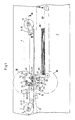
- the shafts 3, 4 are mounted in the side walls 1, 2 of a frame. Deflection rollers 5, 6, which are wrapped by a conveyor belt 7, are placed on the shafts 3, 4. As can be seen from FIG. 9, the shaft 4 has an axially extending groove 8 into which a feather key 9 engages, which is connected to the deflection roller 6.
- the shaft 5 is designed in the same way as the shaft 4.
- the conveyor belt 7 is driven via a chain wheel 10 which is firmly attached to the part of the shaft 4 which projects outwards from the wall 2.
- the deflection roller 6 has two hub-shaped lugs 11, 12, via which it is supported on the fork-shaped arms 14, 15 by the bearings 13.
- the deflection roller 5 is also mounted on the arms 16, 17.
- a suction box 18 is connected to these arms and takes over the individual bags 20 brought up by the intermediate conveyor 19. Suction openings or a suction gap of the suction box 18 is covered by the conveyor belt 7, which is provided with corresponding perforations.
- the bags 20 have stacking holes 21 at their rear ends in the transport direction, so that the individual bags 20 can be stacked downward by means of the plungers 22 and 23 assigned to the suction boxes 18 onto stacking pins 24 provided with collars.
- a hold-down 25 ensures that the individual bags 20 actually remain on the stacking pins.
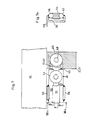
- FIGS. 2, 4, 5 and 6 how the actual lower stacking point is constructed in detail.
- a console 29 can be seen from FIG. 4, which, as shown in FIG. 2, is present in duplicate.
- the latter like the lower bracket 29, is placed on a guide rod 30 which is fixedly mounted in the two side walls 1 and 2. Via a threaded spindle 31, which has opposite threads, the two brackets 29 can then be adjusted relative to one another in accordance with the bag format to be stacked by rotating this threaded spindle 31.
- the console 29 itself has a guide 32 in which a slide 33 can be moved back and forth via a piston-cylinder unit 34.
- the slider 33 has a step 35, into which the individual stacking pins 24 are inserted one after the other from the side.
- a stacking pin 24 ' is in the front stacking position, while the rear stacking pin 24 is in the waiting position. If a desired amount of bags has now been combined into a stack 36, cones are pressed onto the two stacking pins 24 'from above. The slide is then operated in the direction of arrow A. The pawl 37 lies against the collar of the stacking pin 24 'and the step edge 38 against the corresponding collar of the stacking pin 24. Both stacking pins 24, 24' are consequently likewise in the direction of arrow A in accordance with the stroke of the piston-cylinder unit 34 postponed.
- the pawl 37 is pivotally mounted in a recess 39 of the bracket 29 and is held by a spring 41 against the stop 42.
- the stack 36 pushed down by the console 29 then falls downward in the direction of the arrow B onto the conveyor belt 28 arranged below it.
- the stacking pin 24 in the stacking position is held in position by two spring-loaded pressure balls 43 and 44, these balls 43 and 44 resting against the collar 40 of the stacking pin in the stacking position. This ensures that the stacking pin in the stacking position is not taken along by the pawl 37 during the return stroke movement of the piston-cylinder unit 34.
- a further stacking pin is inserted into the guide 32 of the console 29 from the side.
- a guide plate 45 is firmly connected to the side of the console, to which two rods 46 and 47, which are spaced apart, are assigned. These rods 46 and 47 have such a vertical distance from the guide plate 45 that the collars 40 of the individual stacking pins can slide easily between the guide plate 45 and the rods 46 and 47. The distance between the rods 46 and 47 corresponds approximately to the diameter of the stacking pins 24.
- the guide plate 45 and the rods 46 and 47 protrude laterally through an opening 48 in the rear wall 2, so that the stacking pin magazine can be of any size. Be inclined stack magazine, the individual stacking pins 4 slide into the guide of the slide due to their gravity, but of course, here too, like this horizontally arranged magazine is required, sliding springs are provided.
- a bracket 50 is firmly screwed via an angle 49, in which a piston-cylinder unit 51 is firmly held and a rod 52 is slidably guided.
- One end of the rod 52 and the end of the piston rod 53 projecting downward from the piston-cylinder unit are fixedly connected to the plunger 22, 23.
- a bag 20 can thus be pressed downward from the suction box 18 onto the stacking pins 24 'provided. This takes place in cycles until a sufficient number of bags 20 are combined in a stack.
- a cap is pressed onto the stacking pin 24 from above with the last bag 20 to be pressed off by the plunger 22, 23.
- the individual cones 26 are fed to the plungers 22, 23 by a slide 55 actuated by a piston-cylinder unit 54 in time with the stack formation.
- the slider 55 is held by guide rods 56 and 57 which engage from the side in semicircular recesses in the slider 55.
- the rods 56 and 57 themselves are welded to the free legs of a U-profile 58, the U-profile being connected to the suction box 18 via a connecting piece 59.
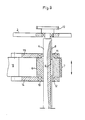
- FIGS. 7 and 8. show that the plungers 22 and 23 each have a cutout 60 so that the cones 26 can be pushed into the plunger by the slide.
- the milling 60 is designed so that the plungers 22 and 23 have in the insertion area of the support surfaces 61 and 62 for the collar 63 of a cap.
- These support balls are designed in their spring force so that they can no longer pull a hat up again as soon as it has been pressed onto a stacking pin 24 '.
- the individual cones 26 are stored in a magazine 64, from which they are fed individually to the slide 55.
- the magazine 65 itself consists in a simple manner of two rods 66 and 67 arranged parallel to one another, the spacing of which from one another is such that it is larger than the extension 68 of each cone.
- the collars 69 of the cones thus rest on the rods 66 and 67, whereas the lugs 68 are guided between the rods. Since these rods are arranged obliquely, the individual cones fall due to their gravity between the two rods 56 and 57, which guide the slide 55. This means that the distance between the rods 56 and 57 must be chosen so large that the lugs 68 of the cones 26 can be guided between these rods.
- the rocker arm 73 is pivoted counterclockwise, with the locking pin 75 laying against the collar of a second cap, while the locking pin 74 releases the first cap, so that this with its approach 68 between the rods 56 and 57 and so that falls in front of the slider 55.
- the carrier 50 is slidably mounted on a guide rod 76.
- the displacement takes place via a threaded spindle 77 which, like the guide rod 76, is mounted in the two side walls 1 and 2.
- both a sprocket 78 and a handwheel 79 are placed on the end of the threaded spindle 77 projecting outwards from the side wall 2.
- the threaded spindle 77 can be rotated by this handwheel 79.
- This rotary movement is transmitted via chain wheel 78, chain 80 and a further chain wheel 81 to threaded spindle 31, so that carrier 50 and bracket 29 are laterally displaced by the same amount.
- the threaded spindle 77 like the threaded spindle 31, has opposite threads, because, as mentioned at the beginning, the devices shown in FIG. 1 are duplicated and are each assigned to one side of the bag.
Landscapes
- Making Paper Articles (AREA)
Applications Claiming Priority (2)
| Application Number | Priority Date | Filing Date | Title |
|---|---|---|---|
| DE4009655A DE4009655A1 (de) | 1990-03-26 | 1990-03-26 | Verfahren und vorrichtung zur bildung von durch klammern zusammengehaltenen beutelstapeln |
| DE4009655 | 1990-03-26 |
Publications (1)
| Publication Number | Publication Date |
|---|---|
| EP0448819A1 true EP0448819A1 (fr) | 1991-10-02 |
Family
ID=6403071
Family Applications (1)
| Application Number | Title | Priority Date | Filing Date |
|---|---|---|---|
| EP90124787A Ceased EP0448819A1 (fr) | 1990-03-26 | 1990-12-19 | Procédé et dispositif pour former des piles de sacs retenues par des agrafes |
Country Status (3)
| Country | Link |
|---|---|
| EP (1) | EP0448819A1 (fr) |
| CA (1) | CA2037554A1 (fr) |
| DE (1) | DE4009655A1 (fr) |
Families Citing this family (1)
| Publication number | Priority date | Publication date | Assignee | Title |
|---|---|---|---|---|
| DE10134508A1 (de) * | 2001-06-28 | 2003-01-23 | Windmoeller & Hoelscher | Verfahren zum Zusammenfassen von Beuteln, Vorrichtung zur Durchführung des Verfahrens und Beutelkette, sowie Beutelstapelkette |
Citations (1)
| Publication number | Priority date | Publication date | Assignee | Title |
|---|---|---|---|---|
| EP0084880A2 (fr) * | 1982-01-25 | 1983-08-03 | Windmöller & Hölscher | Dispositif pour le découpage transversal de bandes |
-
1990
- 1990-03-26 DE DE4009655A patent/DE4009655A1/de not_active Withdrawn
- 1990-12-19 EP EP90124787A patent/EP0448819A1/fr not_active Ceased
-
1991
- 1991-03-05 CA CA002037554A patent/CA2037554A1/fr not_active Abandoned
Patent Citations (1)
| Publication number | Priority date | Publication date | Assignee | Title |
|---|---|---|---|---|
| EP0084880A2 (fr) * | 1982-01-25 | 1983-08-03 | Windmöller & Hölscher | Dispositif pour le découpage transversal de bandes |
Also Published As
| Publication number | Publication date |
|---|---|
| CA2037554A1 (fr) | 1991-09-27 |
| DE4009655A1 (de) | 1991-10-02 |
Similar Documents
| Publication | Publication Date | Title |
|---|---|---|
| DE69419603T2 (de) | Herstellung von taschenfederaufbauten | |
| DE3521942C2 (de) | Vorrichtung zur Herstellung von Zigarettengruppen, in denen Lücken vorhanden sind | |
| DE1756814C3 (de) | Vorrichtung zur Fortschaltung eines Dornförderers | |
| EP0910248B1 (fr) | Procede, dispositif et outil de decoupage pour la production de morceaux de pate individuels a partir d'une bande de pate continue | |
| DE2645095A1 (de) | Maschine zur herstellung von schachteln aus halbgeformten zuschnitten | |
| EP2498983B1 (fr) | Dispositif et procédé pour la formation de piles de sachets | |
| DE1945427B2 (de) | Vorrichtung zum herstellen von tampons | |
| EP0143930A2 (fr) | Procédé de fabrication de brosses et machine pour la mise en oeuvre du procédé | |
| DE3221620A1 (de) | Vorrichtung zum anbringen von komponenten | |
| CH652674A5 (de) | Vorrichtung zum aufteilen von in einer reihe zulaufenden gegenstaenden und verfahren zum betrieb der vorrichtung. | |
| DE2210983A1 (de) | Verfahren und Vorrichtung zur Montage von Einfach- und Mehrfach-Antriebsrollenketten | |
| DE4435981C2 (de) | Einrichtung zum Zuführen von zu verpackenden Produkten zu einer Verpackungsmaschine | |
| DE1629514B1 (de) | Automatische schallplattenpresse | |
| WO2000048932A2 (fr) | Procede pour decouper des feuilles de tole en bandes de tole, et dispositif de coupe permettant la mise en oeuvre de ce procede | |
| WO2002024556A1 (fr) | Procede et dispositif d'apport d'objets reguliers a une station de travail | |
| DE2226979B2 (de) | Maschine zum anbringen von kontaktstuecken aus draht an plattenartigen kontakttraegern | |
| DE1290031B (de) | Mehrstationen-Bearbeitungsmaschine zum automatischen Herstellen von Gewindestiften | |
| EP0448819A1 (fr) | Procédé et dispositif pour former des piles de sacs retenues par des agrafes | |
| DE1153234B (de) | Vorrichtung zur Herstellung von Faltschachteln | |
| DE4232963C1 (de) | Vorrichtung zum Aufbringen eines bedruckten Labels auf den Seitenwänden eines Kunststoffbehälters | |
| DE2142321A1 (de) | Verfahren und vorrichtung zum herstellen von gitterrostmatten | |
| DE2626017C2 (de) | Vorrichtung zum Zuführen eines Kartons auf die Unterseite eines tafelförmigen Gegenstandes, insbesondere einer Schokoladetafel | |
| DE3238698A1 (de) | Vorrichtung zum zusammenfuegen von becherartigen behaeltern und diese erfassenden verpackungstraegern | |
| AT404439B (de) | Vorrichtung zum verteilen von stabförmigen elementen | |
| DE10006484A1 (de) | Verfahren und Vorrichtung zum Umreifen zylindrischer Körper |
Legal Events
| Date | Code | Title | Description |
|---|---|---|---|
| PUAI | Public reference made under article 153(3) epc to a published international application that has entered the european phase |
Free format text: ORIGINAL CODE: 0009012 |
|
| AK | Designated contracting states |
Kind code of ref document: A1 Designated state(s): BE DE ES GB IT |
|
| 17P | Request for examination filed |
Effective date: 19920120 |
|
| 17Q | First examination report despatched |
Effective date: 19930811 |
|
| STAA | Information on the status of an ep patent application or granted ep patent |
Free format text: STATUS: THE APPLICATION HAS BEEN REFUSED |
|
| 18R | Application refused |
Effective date: 19940131 |