EP0448861A1 - Semiconductor integrated circuit device - Google Patents
Semiconductor integrated circuit device Download PDFInfo
- Publication number
- EP0448861A1 EP0448861A1 EP90309030A EP90309030A EP0448861A1 EP 0448861 A1 EP0448861 A1 EP 0448861A1 EP 90309030 A EP90309030 A EP 90309030A EP 90309030 A EP90309030 A EP 90309030A EP 0448861 A1 EP0448861 A1 EP 0448861A1
- Authority
- EP
- European Patent Office
- Prior art keywords
- integrated circuit
- semiconductor integrated
- circuit device
- electromagnetic coil
- circuit substrate
- Prior art date
- Legal status (The legal status is an assumption and is not a legal conclusion. Google has not performed a legal analysis and makes no representation as to the accuracy of the status listed.)
- Granted
Links
- 239000004065 semiconductor Substances 0.000 title claims abstract description 114
- 239000000758 substrate Substances 0.000 claims abstract description 68
- 239000004020 conductor Substances 0.000 claims abstract description 16
- 238000005259 measurement Methods 0.000 claims abstract description 16
- 230000003287 optical effect Effects 0.000 claims description 60
- 238000006073 displacement reaction Methods 0.000 claims description 24
- 230000005389 magnetism Effects 0.000 claims description 3
- 238000005530 etching Methods 0.000 description 12
- 229910052710 silicon Inorganic materials 0.000 description 8
- 239000010703 silicon Substances 0.000 description 8
- XUIMIQQOPSSXEZ-UHFFFAOYSA-N Silicon Chemical compound [Si] XUIMIQQOPSSXEZ-UHFFFAOYSA-N 0.000 description 7
- 239000012530 fluid Substances 0.000 description 7
- 238000005516 engineering process Methods 0.000 description 6
- 230000007246 mechanism Effects 0.000 description 5
- 238000000034 method Methods 0.000 description 5
- VYPSYNLAJGMNEJ-UHFFFAOYSA-N Silicium dioxide Chemical compound O=[Si]=O VYPSYNLAJGMNEJ-UHFFFAOYSA-N 0.000 description 4
- 229910052814 silicon oxide Inorganic materials 0.000 description 4
- ZOXJGFHDIHLPTG-UHFFFAOYSA-N Boron Chemical compound [B] ZOXJGFHDIHLPTG-UHFFFAOYSA-N 0.000 description 2
- 230000015572 biosynthetic process Effects 0.000 description 2
- 229910052796 boron Inorganic materials 0.000 description 2
- 230000004907 flux Effects 0.000 description 2
- 230000001939 inductive effect Effects 0.000 description 2
- 230000000149 penetrating effect Effects 0.000 description 2
- 230000001133 acceleration Effects 0.000 description 1
- 229910052782 aluminium Inorganic materials 0.000 description 1
- XAGFODPZIPBFFR-UHFFFAOYSA-N aluminium Chemical compound [Al] XAGFODPZIPBFFR-UHFFFAOYSA-N 0.000 description 1
- 238000013459 approach Methods 0.000 description 1
- 238000005452 bending Methods 0.000 description 1
- 239000013078 crystal Substances 0.000 description 1
- 238000011161 development Methods 0.000 description 1
- 230000005674 electromagnetic induction Effects 0.000 description 1
- 238000003780 insertion Methods 0.000 description 1
- 230000037431 insertion Effects 0.000 description 1
- 238000004519 manufacturing process Methods 0.000 description 1
- 239000000463 material Substances 0.000 description 1
- 239000011159 matrix material Substances 0.000 description 1
- 229910052751 metal Inorganic materials 0.000 description 1
- 239000002184 metal Substances 0.000 description 1
- 238000009877 rendering Methods 0.000 description 1
Images



Classifications
-
- G—PHYSICS
- G01—MEASURING; TESTING
- G01B—MEASURING LENGTH, THICKNESS OR SIMILAR LINEAR DIMENSIONS; MEASURING ANGLES; MEASURING AREAS; MEASURING IRREGULARITIES OF SURFACES OR CONTOURS
- G01B7/00—Measuring arrangements characterised by the use of electric or magnetic techniques
- G01B7/02—Measuring arrangements characterised by the use of electric or magnetic techniques for measuring length, width or thickness
- G01B7/023—Measuring arrangements characterised by the use of electric or magnetic techniques for measuring length, width or thickness for measuring distance between sensor and object
-
- B—PERFORMING OPERATIONS; TRANSPORTING
- B82—NANOTECHNOLOGY
- B82Y—SPECIFIC USES OR APPLICATIONS OF NANOSTRUCTURES; MEASUREMENT OR ANALYSIS OF NANOSTRUCTURES; MANUFACTURE OR TREATMENT OF NANOSTRUCTURES
- B82Y15/00—Nanotechnology for interacting, sensing or actuating, e.g. quantum dots as markers in protein assays or molecular motors
-
- G—PHYSICS
- G01—MEASURING; TESTING
- G01D—MEASURING NOT SPECIALLY ADAPTED FOR A SPECIFIC VARIABLE; ARRANGEMENTS FOR MEASURING TWO OR MORE VARIABLES NOT COVERED IN A SINGLE OTHER SUBCLASS; TARIFF METERING APPARATUS; MEASURING OR TESTING NOT OTHERWISE PROVIDED FOR
- G01D5/00—Mechanical means for transferring the output of a sensing member; Means for converting the output of a sensing member to another variable where the form or nature of the sensing member does not constrain the means for converting; Transducers not specially adapted for a specific variable
- G01D5/12—Mechanical means for transferring the output of a sensing member; Means for converting the output of a sensing member to another variable where the form or nature of the sensing member does not constrain the means for converting; Transducers not specially adapted for a specific variable using electric or magnetic means
- G01D5/14—Mechanical means for transferring the output of a sensing member; Means for converting the output of a sensing member to another variable where the form or nature of the sensing member does not constrain the means for converting; Transducers not specially adapted for a specific variable using electric or magnetic means influencing the magnitude of a current or voltage
-
- G—PHYSICS
- G01—MEASURING; TESTING
- G01D—MEASURING NOT SPECIALLY ADAPTED FOR A SPECIFIC VARIABLE; ARRANGEMENTS FOR MEASURING TWO OR MORE VARIABLES NOT COVERED IN A SINGLE OTHER SUBCLASS; TARIFF METERING APPARATUS; MEASURING OR TESTING NOT OTHERWISE PROVIDED FOR
- G01D5/00—Mechanical means for transferring the output of a sensing member; Means for converting the output of a sensing member to another variable where the form or nature of the sensing member does not constrain the means for converting; Transducers not specially adapted for a specific variable
- G01D5/12—Mechanical means for transferring the output of a sensing member; Means for converting the output of a sensing member to another variable where the form or nature of the sensing member does not constrain the means for converting; Transducers not specially adapted for a specific variable using electric or magnetic means
- G01D5/14—Mechanical means for transferring the output of a sensing member; Means for converting the output of a sensing member to another variable where the form or nature of the sensing member does not constrain the means for converting; Transducers not specially adapted for a specific variable using electric or magnetic means influencing the magnitude of a current or voltage
- G01D5/20—Mechanical means for transferring the output of a sensing member; Means for converting the output of a sensing member to another variable where the form or nature of the sensing member does not constrain the means for converting; Transducers not specially adapted for a specific variable using electric or magnetic means influencing the magnitude of a current or voltage by varying inductance, e.g. by a movable armature
- G01D5/2006—Mechanical means for transferring the output of a sensing member; Means for converting the output of a sensing member to another variable where the form or nature of the sensing member does not constrain the means for converting; Transducers not specially adapted for a specific variable using electric or magnetic means influencing the magnitude of a current or voltage by varying inductance, e.g. by a movable armature by influencing the self-induction of one or more coils
- G01D5/2033—Mechanical means for transferring the output of a sensing member; Means for converting the output of a sensing member to another variable where the form or nature of the sensing member does not constrain the means for converting; Transducers not specially adapted for a specific variable using electric or magnetic means influencing the magnitude of a current or voltage by varying inductance, e.g. by a movable armature by influencing the self-induction of one or more coils controlling the saturation of a magnetic circuit by means of a movable element, e.g. a magnet
-
- H—ELECTRICITY
- H01—ELECTRIC ELEMENTS
- H01F—MAGNETS; INDUCTANCES; TRANSFORMERS; SELECTION OF MATERIALS FOR THEIR MAGNETIC PROPERTIES
- H01F7/00—Magnets
- H01F7/06—Electromagnets; Actuators including electromagnets
- H01F7/066—Electromagnets with movable winding
Definitions
- This invention relates to a semiconductor integrated circuit device, and more particularly to a semiconductor actuator utilizing an electromagnetic force, or a semiconductor sensor utilizing an electromagnetic induction.
- optical head of a structure which will be described below will be provided.
- This optical head is composed of, e.g., a cylindrical magnet, a cylindrical bobbin, and a semiconductor chip on which an optical integrated circuit-type pickup is formed.
- the cylindrical bobbin is of a hollow structure in which the diameter of the hollow portion is larger than that of the cylindrical magnet. This cylindrical bobbin is mounted on the cylindrical magnet so that it is seated thereon.
- One end surface of the cylindrical bobbin is closed and the semiconductor chip is affixed on that end surface.
- an electromagnetic coil is provided on the cylindrical side surface of the cylindrical bobbin so as to surround it.
- a magnetic field is formed by magnetic lines of force directed from one end surface of the cylindrical magnet toward the other end surface thereof. These magnetic lines of force penetrate through the end surface of the bobbin and the semiconductor chip surface.
- An object of this invention is to provide a semiconductor integrated circuit device which can be utilized as a small-sized and lightweight actuator or a small-sized sensor.
- an electromagnetic coil is provided on a semiconductor integrated circuit substrate.
- a pair of conductors are drawn out from the magnetic coil.
- the semiconductor integrated circuit substrate is movably arranged within a magnetic field.
- a right-handed magnetic field is produced toward the direction in which the current flows in accordance with "Ampere's right-handed screw rule".
- an attractive force or a repulsive force in a direction of the magnetic lines of force is exerted on the electromagnetic coil.
- the semiconductor integrated circuit substrate also moves in the positive or negative direction of the magnetic lines of force in the direction of the magnetic field. This permits the semiconductor integrated circuit device to operate as a subminiature actuator.
- an optical head for recording/playback of an optical disk which is smaller and lighter than the conventional optical head, can be advantageously provided.
- such a device in the case of moving this semiconductor integrated circuit substrate within a magnetic field, or changing that magnetic field, by measuring an induced current produced in the coil, such a device can be advantageously used as a semiconductor integrated circuit device having a subminiature sensor function for measuring changes in a physical quantity such as displacement, pressure, magnetism, or the like.
- the conventional optical head is constituted as shown in FIGS. 1 and 2.
- a semiconductor chip 101 on which an optical integrated circuit type pickup is formed is mounted or affixed on a cylindrical bobbin 112.
- An electromagnetic coil 110 is provided on the cylindrical surface of the bobbin 112.
- the bobbin 112 is mounted, in an insertion hole 118, on a cylindrical portion 117 of a lower yoke 116 of a magnet 114 so that it is seated thereon, and is movable in the axial direction of the cylindrical portion 117 (A-A direction).
- a magnetic field exists by the magnet 114.
- a current is caused to flow in the electromagnetic coil 110 through lead wires 111, an electromagnetic force is exerted on the electromagnetic coil 110, so it moves in the A-A direction.
- the electromagnetic coil 110 and the magnet 114 form a focusing actuator.
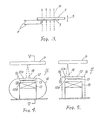
- the basic embodiment of this invention is constituted as shown in FIG. 3.
- this semiconductor integrated circuit device 1 is such that an electromagnetic coil 3 is provided on a semiconductor integrated circuit substrate 2. A pair of conductors 4 are drawn out from the electromagnetic coil 3. Further, the semiconductor integraged circuit substrate 2 is movably disposed within a magnetic field M.
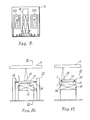
- FIGS. 4 and 5 An optical head which is a first embodiment of a semiconductor integrated circuit device according to this invention is shown in FIGS. 4 and 5.
- This optical head 11 comprises a semiconductor integrated circuit substrate 12, a magnet 15 for producing a magnetic field and a flexible printed wiring board 16 as support means serving as conductors.
- An optical integrated circuit type pickup 18 is formed on the front side 12A of the semiconductor integrated circuit substrate 12, and an electromagnetic coil 13 is formed on the back side 12B thereof.
- the front side 12A opposite to the optical disk D of the semiconductor integrated circuit substrate 12 and the side 12B corresponding to the back side thereof and opposite to the magnet 15 are shown in FIGS. 6 and 7, respectively.
- the optical integrated circuit type pickup 18 comprises a laser diode 18L, a focusing grating coupler 18C, a grating beam splitter 18S, and photo detectors 18D.
- the laser diode 18L generates a laser beam.
- This laser beam is conducted to the focusing grating coupler 18c through an optical waveguide layer (not shown) of the semiconductor integrated circuit substrate 12.
- the focusing grating coupler 18C changes the laser beam so as to take a form of spots by the object lens action to focus it onto information pits on the recording surface of the optical disk D.
- the laser beam is reflected on the surface of the information pits.
- the reflected light is incident back to the focusing grating coupler 18C for a second time, and is then conducted to the grating beam splitter 18S.
- the grating beam splitter 18S splits the reflected light into those in two light paths. These two split light rays are incident to four photo detectors 18D. These photo detectors 18D output electric signals corresponding to a quantity of incident light rays. From these electric signals, information signals and signals for servo control control are provided.
- the electromagnetic coil 13 is provided on the side 12B. Lines of magnetic force based on a magnetic field produced by the magnet 15 penetrate through the electromagnetic coil 13 on the semiconductor integrated circuit substrate 12.
- the flexible printed wiring board 16 is constituted, as shown in FIG. 8, by assembling an elastic member 16S like a metal film for rendering suitable rigidity and elasticity and lead wires 16L of conductors for wiring into a film like matrix 16M having elastic and insulating properties like a plastic material.
- the electrical connection between the lead wires 16L and the optical integrated circuit type pickup 18 or the electromagnetic coil 13 is carried out through land terminals 16T.
- This flexible printed wiring board 16 is constituted, as shown in FIGS. 4 and 5, by bending the both end portions of a belt-shaped flexible printed wiring board to cover the surface of the magnet 15 in a manner to take a form of cylinder or leaf spring. Further, the semiconductor integrated circuit substrate 12 is mounted or affixed on the surface of this flexible printed wiring board 16 just above the magnet 15. Accordingly, the semiconductor integrated circuit substrate 12 is resiliently supported by the flexible printed wiring plate 16. Thus, this substrate can move in the direction of the optical disk D (B-B direction). In this case, the portion of the flexible printed wiring board 16 immediately above the focusing grating coupler 18C of the optical integrated circuit type pickup 18 is cut out in the form of a window as indicated by reference symbol 16W of FIG. 8. Thus, an arrangement such that irradiation of a laser beam is not prevented is provided.
- the method of forming the electromagnetic coil provided on the semiconductor integrated circuit substrate and the configuration of the electromagnetic coil will now be described.
- the electromagnetic coil 13 is formed by using the multilayer interconnection formation technology which is one of integrated circuit technologies to etch a spiral coil pattern on the surface of a silicon substrate to vacuum-deposit aluminum, etc. thereon.
- the pattern of the electromagnetic coil is not limited to a square spiral shown in FIG. 7. Further, patterns of circle, ellipse, or other curves may be used. This coil pattern may be constructed not only in a planar spiral form but also in a three-dimensional spiral or helical form in layer direction in the same manner as in an ordinary electromagnetic coil by the application of the multilayer interconnection technology. In addition, the number of coil patterns on a single semiconductor integrated circuit substrate is not limited to one as in the pattern shown in FIG. 7. Two coil patterns or more may be adopted. For example, as shown in FIG. 9, there may be employed an arrangement to provide two electromagnetic coils 13A and 13B so that the optical integrated circuit type pickup 18 is put therebetween.
- the electromagnetic coil may be provided on either side of the semiconductor integrated circuit substrate 12.
- FIGS. 10 and 11 An optical head which is a second embodiment of a semiconductor integrated circuit device according to this invention is shown in FIGS. 10 and 11.
- This optical head 21 differs from the optical head 11 in the first embodiment in that four elastic supporters 26 are affixed on the semiconductor integrated circuit substrate 12 as support means in place of the flexible printed wiring board 16 of the optical head 11 in the first embodiment shown in FIGS. 4 to 9.
- These supporters 26 may be not only in the form of coil, rod and plate, etc., but also in other forms.
- the number of supporters is not limited to four as in the embodiment.
- the electromagnetic coil is provided on the semiconductor integrated circuit substrate provided with the optical integrated circuit type pickup, thus to allow the semiconductor integrated circuit device to have a function as the optical head.
- this invention is not limited to the optical integrated circuit type pickup, but can be utilized as a semiconductor integrated circuit device where another integrated circuit is mounted on a semiconductor integrated circuit substrate and the semiconductor integrated circuit substrate itself can be moved.
- the device of this invention may be used as a miniaturized actuator including no integrated circuit and directed to only drive.
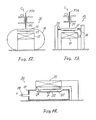
- a displacement sensor which is a third embodiment of a semiconductor integrated circuit device according to this invention is shown in FIG. 12.
- This displacement sensor 31 is constituted of a structure such that the optical integrated circuit type pickup is removed from the optical head 11 of the first embodiment shown in FIGS. 4 to 9, and that a rod 37 for allowing the semiconductor integrated circuit substrate to interlock with a measurement object is instead provided so that it comes in contact with that substrate.
- the semiconductor integrated circuit substrate 12 indicates a quantity of displacement equal to a quantity of displacement in the C-C direction of the end point 37A of the rod 37.
- an induced current corresponding to a displacement velocity of the semiconductor integrated circuit substrate 12 flows in the electromagnetic coil 13. Accordingly, by measuring such an induced current by a galvanometer, etc. through conductors (not shown), velocity, position, and acceleration, etc. can be calculated.
- the mechanism for allowing the substrate to interlock with a measurement object is not limited to the rod, but may be other mechanisms.
- a displacement sensor of a structure such that the optical integrated circuit type pickup is removed from the second embodiment of FIGS. 10 and 11, and a rod 37 of the interlocking means is instead provided so that it comes in contact with the semiconductor integrated circuit substrate is also effective as a fourth embodiment of this invention.
- FIG. 14 The cross section of a pressure sensor which is a fifth embodiment of a semiconductor integrated circuit device according to this invention is shown in FIG. 14.
- This pressure sensor 50 comprises a pressure vessel 51 for containing fluid for measuring pressure, and a semiconductor integrated circuit substrate 52.
- the semiconductor integrated circuit substrate 52 is affixed, on the pressure vessel 51, on a diaphragm 57 serving as the support means and for allowing the substrate to interlock with a measurement object, and the semiconductor integrated circuit substrate 52 includes an electromagnetic coil 53. Further, a magnet 55 for producing a magnetic field is provided immediately above the semiconductor integrated circuit substrate 52.
- the fluid L is conducted into the pressure vessel 51 through a pouring tube 58.
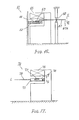
- a displacement sensor which is a sixth embodiment of a semiconductor integrated circuit device according to this invention is shown in FIG. 15.
- This displacement sensor 61 comprises a semiconductor integrated circuit substrate 62, a magnet 65 for producing a magnetic field, a rod 67 for allowing the substrate 62 to interlock with a measurement object, and a support 68.
- the magnet 65 is provided immediately above the semiconductor integrated circuit substrate 62. Further, a cantilever member 66 is formed on the semiconductor integrated circuit substrate 62. An electromagnetic coil 63 is provided on the cantilever member 66. In this embodiment, the cantilever member 66 constitutes the support means.
- the rod 67 is in contact with the cantilever member 66 to transmit a displacement in the E-E direction of an end point 67A to the cantilever member 66 by the support 68.
- this displacement sensor 61 has, in the same manner as in the displacement sensor shown in FIGS. 12 and 13, a sensor function to respond to a displacement given to the terminal point 67A of the rod 67 to convert a quantity of that displacement to an electric output to output it.
- the support means is incorporated as the cantilever member into the semiconductor integrated circuit substrate.
- the displacement sensor of this embodiment can be advantageously smaller than the displacement sensors of the third and fourth embodiments shown in FIGS. 12 and 13. It is to be noted that the mechanism for allowing the substrate to interlock with a measurement object is not limited to the rod, but may be other mechanisms.
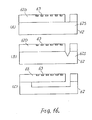
- FIG. 16 A method of forming the cantilever member 66 of the semiconductor integrated circuit substrate 62 is shown in FIG. 16.
- a silicon oxide film 62D is formed on a silicon substrate 62S.
- An electromagnetic coil 63 is then formed by the multilayer interconnection formation technology.
- the silicon oxide film 62D is etched (FIG. 16(A)).
- the exposed silicon surface is etched by the anisotropy etching of which the each rate varies in dependence upon the direction of the crystal. In the beginning, etching proceeds so that a V-shaped groove is formed (FIG. 16(B)).
- cantilever member 66 including electromagnetic coil 63 on the surface thereof can be formed (FIG. 16 (C)).
- a pressure sensor which is a seventh embodiment of a semiconductor integrated circuit device according to this invention is shown in FIG. 17.
- This pressure sensor 70 comprises a semiconductor pressure vessel 71, and a magnet 75 for producing a magnetic field provided immediately above the semiconductor pressure vessel 71.
- a diaphragm 76 is provided in the semiconductor pressure vessel 71.
- An electromagnetic coil 73 is provided on the diaphragm 76.
- fluid L for measuring a pressure is conducted into the semiconductor pressure vessel 71 through a pouring tube 78 communicating with the semiconductor pressure vessel 71.
- the diaphragm 76 allows the semiconductor integrated circuit substrate to interlock with a measurement object.
- FIG. 18 A method of forming this semiconductor pressure vessel 71 is shown in FIG. 18.
- an etching stop portion 72B for stopping etching is formed.
- electromagnetic coil 73 is formed by the multilayer interconnection technology within the portion surrounded by the etching stop portion 72B (FIG. 18(A)).
- etching is applied to the bellows portion of the diaphragm around the electromagnetic coil 73 on the surface of the silicon substrate 72S (FIG. 18(B)).
- etching stop layer 76B (FIG. 18(C)).
- semiconductor pressure vessel 71 can be formed (FIG. 18(E)).
- the configurations and the numbers of the coil patterns in the above-described third to seventh embodiments are not limited to those mentioned therein, but may be other configurations and numbers.
- sensors in the above-described third to seventh embodiments can measure not only so called mechanical changes in the physical quantity such as displacement, velocity and the like, but also changes in the magnetism. Namely, when an external magnetic field changes, for example, when an object producing a magnetic filed comes into contact with the sensor and is away from therefrom, or the like, it is also possible to measure changes in a magnetic filed by measuring an inductive current which is caued to flow by the mutual inductive action of the electromagnetic coil.
- the magnet for producing a magnetic field may be a permanent magnet or an electromagnet.
- the semiconductor integrated circuit device of this invention can be applied not only as a semiconductor integrated circuit device having an actuator function and a semiconductor integrated circuit device having a sensor function, but also as a semiconductor integrated circuit device having an actuator function and a sensor function combined with each other.
- an approach may be also employed to further provide a velocity coil for detecting a velocity of the optical head on the semiconductor integrated circuit substrate 12 to constitute a miniaturized optical head having a function to detect a velocity at the time of track jump motion.
Landscapes
- Physics & Mathematics (AREA)
- General Physics & Mathematics (AREA)
- Electromagnetism (AREA)
- Engineering & Computer Science (AREA)
- Chemical & Material Sciences (AREA)
- Nanotechnology (AREA)
- Health & Medical Sciences (AREA)
- Life Sciences & Earth Sciences (AREA)
- General Health & Medical Sciences (AREA)
- Molecular Biology (AREA)
- Power Engineering (AREA)
- Crystallography & Structural Chemistry (AREA)
- Optical Recording Or Reproduction (AREA)
- Micromachines (AREA)
- Optical Head (AREA)
Abstract
Description
- This invention relates to a semiconductor integrated circuit device, and more particularly to a semiconductor actuator utilizing an electromagnetic force, or a semiconductor sensor utilizing an electromagnetic induction.
- Recently, with development of Compact Disks (CDs) of digital audio disks, Laservision Disks (LVDs) of video and acoustic information media, write once Read Many-type optical disks, and rewritable photomagnetic disks, etc., it has been strongly required for an optical pickup to be small-sized and light in weight. To meet such a requirement, in place of an optical pickup of a structure such that optical parts such as lens or mirror, etc. are combined with each other, an optical integrated circuit type pickup to which the integrated circuit technology established in the manufacturing field of LSI is applied has been proposed. For example, see Toshiaki Suhara, Shogo Ura, and Hiroshi Nishihara (Department of Electronics, Osaka University), 'Optical Integrated Disk Pickup Head', "Optronics" monthly published, No. 2, pp. 149-154 (1989), or the publication of the Japanese Patent Laid Open Publication No. 296540/86.
- However, in case that the above-mentioned optical integrated type pickup is used in an actual playback equipment such as a CD player or an LVD player, etc., it is required to affix or mount an actuator for control. In this case, following the conventional form, an optical head of a structure which will be described below will be provided. This optical head is composed of, e.g., a cylindrical magnet, a cylindrical bobbin, and a semiconductor chip on which an optical integrated circuit-type pickup is formed. The cylindrical bobbin is of a hollow structure in which the diameter of the hollow portion is larger than that of the cylindrical magnet. This cylindrical bobbin is mounted on the cylindrical magnet so that it is seated thereon. One end surface of the cylindrical bobbin is closed and the semiconductor chip is affixed on that end surface. Further, an electromagnetic coil is provided on the cylindrical side surface of the cylindrical bobbin so as to surround it. In this case, a magnetic field is formed by magnetic lines of force directed from one end surface of the cylindrical magnet toward the other end surface thereof. These magnetic lines of force penetrate through the end surface of the bobbin and the semiconductor chip surface. When a current is caused to flow in the electromagnetic coil on the side surface of the bobbin, an electromagnetic force attempting to move the electromagnetic coil, i.e., the bobbin toward either a positive or a negative direction of the longitudinal axis of the cylindrical magnet is produced by "Fleming's left-hand rule". Accordingly, since a quantity of movement of the semiconductor chip in the axial direction of the magnet can be adjusted by the direction of a current caused to flow and the intensity of that current, this mechanism will form a focusing actuator.
- However, since the sizes of these electromagnetic coil and magnet are considerably larger than that of the semiconductor chip, there was the problem that the merit that the semiconductor chip is small is not exhibited. In addition, because the number of parts is large, there was left a room for improvement from viewpoints of assembling steps and cost as well.
- An object of this invention is to provide a semiconductor integrated circuit device which can be utilized as a small-sized and lightweight actuator or a small-sized sensor.
- To solve the above-mentioned problems, in accordance with this invention, an electromagnetic coil is provided on a semiconductor integrated circuit substrate. A pair of conductors are drawn out from the magnetic coil. Further, the semiconductor integrated circuit substrate is movably arranged within a magnetic field.
- In accordance with a preferred embodiment of this invention, when a current is caused to flow in the magnetic coil through the conductors, a right-handed magnetic field is produced toward the direction in which the current flows in accordance with "Ampere's right-handed screw rule". In this case, since the magnetic lines of force penetrate through the electromagnetic coil, an attractive force or a repulsive force in a direction of the magnetic lines of force is exerted on the electromagnetic coil. As a result, the semiconductor integrated circuit substrate also moves in the positive or negative direction of the magnetic lines of force in the direction of the magnetic field. This permits the semiconductor integrated circuit device to operate as a subminiature actuator. Accordingly, since it is possible to move a semiconductor intergrated circuit substrate having a predetermined function and to carry out a positioning control thereof, such a semiconductor integrated circuit device can be applied to various uses. As a preferred example, an optical head for recording/playback of an optical disk, which is smaller and lighter than the conventional optical head, can be advantageously provided.
- Further, in the above-mentioned semiconductor integrated circuit device, when an arrangement is employed such that a semiconductor integrated circuit substrate can interlock with an object to be measured to move the semiconductor integrated circuit substrate, an induced electromotive force to prevent changes in magnetic flux penetrating through the electromagnetic coil is produced in the electromagnetic coil in accordance with Lenz's law. As a result, an induced current flows. By taking out this induced current through the conductors to measure it by a galvanometer, it is possible to know a quantity in changes of the measurement object. This permits the semiconductor integrated circuit device to operate as a subminiature sensor. Accordingly, in the case of moving this semiconductor integrated circuit substrate within a magnetic field, or changing that magnetic field, by measuring an induced current produced in the coil, such a device can be advantageously used as a semiconductor integrated circuit device having a subminiature sensor function for measuring changes in a physical quantity such as displacement, pressure, magnetism, or the like.
- In the accompanying drawings:-
- FIG. 1 is a perspective view showing an example of a conventional optical head;
- FIG. 2 is a cross sectional view of the optical head shown in FIG. 1;
- FIG. 3 is a conceptual view for explaining an embodiment of a semiconductor integrated circuit device according to this invention;
- FIG. 4 is a view showing the structure of an optical head which is a first embodiment according to this invention;
- FIG. 5 is a cross sectional view of the optical head, taken along the line V-V in FIG. 4;
- FIG. 6 is a view showing the front side of a semiconductor integrated circuit substrate in the optical head shown in FIG. 4;
- FIG. 7 is a view showing the back side of the semiconductor integrated circuit substrate shown in FIG. 6;
- FIG. 8 is a view showing a flexible printed wiring board in the optical head shown in FIG. 4;
- FIG. 9 is a top view showing a modified example of the front side of the semiconductor integrated circuit substrate in the optical head shown in FIG. 4;
- FIG. 10 is a view showing the structure of an optical head which is a second embodiment of this invention.
- FIG. 11 is a cross sectional view of the optical head, taken along the line XI-XI in FIG. 10;
- FIG. 12 is a view showing the structure of a displacement sensor which is a third embodiment of this invention;
- FIG. 13 is a view showing the structure of a displacement sensor which is a fourth embodiment of this invention;
- FIG. 14 is a view showing the cross section of a pressure sensor which is a fifth embodiment of this invention;
- FIG. 15 is a view showing the cross section of a displacement sensor which is a sixth embodiment of this invention;
- FIGS. 16A to 16C are views showing a method of forming the displacement sensor shown in FIG. 15, respectively;
- FIG. 17 is a views showing the cross sections of a pressure sensor which is a seventh embodiment of this invention; and
- FIG. 18A to 18E are views showing a method of forming the pressure sensor showing in FIG. 17, respectively.
- Prior to description of embodiments of this invention, a conventional optical head will be described for helping the understanding of this invention.
- The conventional optical head is constituted as shown in FIGS. 1 and 2.
- In FIGS. 1 and 2, a
semiconductor chip 101 on which an optical integrated circuit type pickup is formed is mounted or affixed on acylindrical bobbin 112. Anelectromagnetic coil 110 is provided on the cylindrical surface of thebobbin 112. Thebobbin 112 is mounted, in aninsertion hole 118, on acylindrical portion 117 of alower yoke 116 of amagnet 114 so that it is seated thereon, and is movable in the axial direction of the cylindrical portion 117 (A-A direction). - In this case, a magnetic field exists by the
magnet 114. When a current is caused to flow in theelectromagnetic coil 110 throughlead wires 111, an electromagnetic force is exerted on theelectromagnetic coil 110, so it moves in the A-A direction. By this operation, it is possible to carry out, e.g., a focusing servo of thesemiconductor chip 101. In this example, theelectromagnetic coil 110 and themagnet 114 form a focusing actuator. - The concept of the structure and the operation of this invention will now be described.
- The basic embodiment of this invention is constituted as shown in FIG. 3.
- In FIG. 1, this semiconductor integrated
circuit device 1 is such that an electromagnetic coil 3 is provided on a semiconductor integratedcircuit substrate 2. A pair ofconductors 4 are drawn out from the electromagnetic coil 3. Further, the semiconductorintegraged circuit substrate 2 is movably disposed within a magnetic field M. - In FIG. 3, when a current is caused to flow in the electromagnetic coil 3 through the
conductors 4, a right-handed magnetic field is produced toward the direction in which that current flows in accordance with "Ampere's right-handed screw rule". In this case, since lines of magnetic force based on the magnetic field M are penetrated through the electromagnetic coil 3, an attractive force or a repulsive force in the direction 5 of the magnetic field M is exerted on the electromagnetic coil 3. As a result, the semiconductor integratedcircuit substrate 2 also moves in the positive or negative direction 5 of the magnetic field M. This permits the semiconductor integratedcircuit device 1 to operate as an actuator. - In the above-mentioned semiconductor integrated
circuit device 1, when an arrangement is employed such that the semiconductor integratedcircuit substrate 2 is interlocked with a measurement object to be moved therewith, an induced electromotive force to prevent changes in the magnetic flux penetrating through the electromagnetic coil is produced in accordance with "Lenz's law". As a result, an induced current flows. By taking out this induced current throughconductors 4 to measure it by a galvanometer (not shown), it is possible to know a quantity of changes of the measurement object by an inverse operation. This permits the semiconductor integratedcircuit device 1 to operate as a sensor. - Preferred embodiments of this invention will now be described with reference to the attached drawings.
- An optical head which is a first embodiment of a semiconductor integrated circuit device according to this invention is shown in FIGS. 4 and 5.
- This
optical head 11 comprises a semiconductor integratedcircuit substrate 12, amagnet 15 for producing a magnetic field and a flexible printedwiring board 16 as support means serving as conductors. - An optical integrated
circuit type pickup 18 is formed on thefront side 12A of the semiconductor integratedcircuit substrate 12, and anelectromagnetic coil 13 is formed on theback side 12B thereof. Thefront side 12A opposite to the optical disk D of the semiconductor integratedcircuit substrate 12 and theside 12B corresponding to the back side thereof and opposite to themagnet 15 are shown in FIGS. 6 and 7, respectively. - The optical integrated
circuit type pickup 18 comprises a laser diode 18L, a focusinggrating coupler 18C, a grating beam splitter 18S, and photo detectors 18D. - The laser diode 18L generates a laser beam. This laser beam is conducted to the focusing grating coupler 18c through an optical waveguide layer (not shown) of the semiconductor integrated
circuit substrate 12. The focusinggrating coupler 18C changes the laser beam so as to take a form of spots by the object lens action to focus it onto information pits on the recording surface of the optical disk D. The laser beam is reflected on the surface of the information pits. The reflected light is incident back to the focusinggrating coupler 18C for a second time, and is then conducted to the grating beam splitter 18S. The grating beam splitter 18S splits the reflected light into those in two light paths. These two split light rays are incident to four photo detectors 18D. These photo detectors 18D output electric signals corresponding to a quantity of incident light rays. From these electric signals, information signals and signals for servo control control are provided. - Further, the
electromagnetic coil 13 is provided on theside 12B. Lines of magnetic force based on a magnetic field produced by themagnet 15 penetrate through theelectromagnetic coil 13 on the semiconductor integratedcircuit substrate 12. - The flexible printed
wiring board 16 is constituted, as shown in FIG. 8, by assembling an elastic member 16S like a metal film for rendering suitable rigidity and elasticity andlead wires 16L of conductors for wiring into a film likematrix 16M having elastic and insulating properties like a plastic material. - The electrical connection between the
lead wires 16L and the optical integratedcircuit type pickup 18 or theelectromagnetic coil 13 is carried out throughland terminals 16T. - This flexible printed
wiring board 16 is constituted, as shown in FIGS. 4 and 5, by bending the both end portions of a belt-shaped flexible printed wiring board to cover the surface of themagnet 15 in a manner to take a form of cylinder or leaf spring. Further, the semiconductor integratedcircuit substrate 12 is mounted or affixed on the surface of this flexible printedwiring board 16 just above themagnet 15. Accordingly, the semiconductor integratedcircuit substrate 12 is resiliently supported by the flexible printedwiring plate 16. Thus, this substrate can move in the direction of the optical disk D (B-B direction). In this case, the portion of the flexible printedwiring board 16 immediately above the focusinggrating coupler 18C of the optical integratedcircuit type pickup 18 is cut out in the form of a window as indicated by reference symbol 16W of FIG. 8. Thus, an arrangement such that irradiation of a laser beam is not prevented is provided. - The operation of the
optical head 11 will now be described. - When a control current is caused to flow in the
electromagnetic coil 13 through thelead wires 16L by a power supply (not shown), a new right-handed magnetic field with respect to the control current direction is produced in theelectromagnetic coil 13. Accordingly, an electromagnetic force in the B-B direction is exerted on theelectromagnetic coil 13. As a result, since the force in the B-B direction is also exerted on the semiconductor integratedcircuit substrate 12, it is possible to move theoptical head 11 in the positive or negative direction of the optical disk D. Thus, focusing servo of theoptical head 11 can be carried out. - The method of forming the electromagnetic coil provided on the semiconductor integrated circuit substrate and the configuration of the electromagnetic coil will now be described. The
electromagnetic coil 13 is formed by using the multilayer interconnection formation technology which is one of integrated circuit technologies to etch a spiral coil pattern on the surface of a silicon substrate to vacuum-deposit aluminum, etc. thereon. - The pattern of the electromagnetic coil is not limited to a square spiral shown in FIG. 7. Further, patterns of circle, ellipse, or other curves may be used. This coil pattern may be constructed not only in a planar spiral form but also in a three-dimensional spiral or helical form in layer direction in the same manner as in an ordinary electromagnetic coil by the application of the multilayer interconnection technology. In addition, the number of coil patterns on a single semiconductor integrated circuit substrate is not limited to one as in the pattern shown in FIG. 7. Two coil patterns or more may be adopted. For example, as shown in FIG. 9, there may be employed an arrangement to provide two
electromagnetic coils circuit type pickup 18 is put therebetween. In this case, by adjusting control currents caused to flow in individual electromagnetic coils, it is possible to alter the directional angle of a laser beam with respect to the optical disk D. By making use of this, tracking servo of the optical head can be also carried out. In addition, the electromagnetic coil may be provided on either side of the semiconductor integratedcircuit substrate 12. - An optical head which is a second embodiment of a semiconductor integrated circuit device according to this invention is shown in FIGS. 10 and 11.
- This
optical head 21 differs from theoptical head 11 in the first embodiment in that fourelastic supporters 26 are affixed on the semiconductor integratedcircuit substrate 12 as support means in place of the flexible printedwiring board 16 of theoptical head 11 in the first embodiment shown in FIGS. 4 to 9. Thesesupporters 26 may be not only in the form of coil, rod and plate, etc., but also in other forms. In addition, the number of supporters is not limited to four as in the embodiment. - Also in the second embodiment, by causing a control current to flow in the
electromagnetic coil 13 through conductors (not shown) by a power supply (not shown), it is possible to carry out focusing servo. Further, in the same manner as in the modified embodiment shown in FIG. 9, an arrangement may be employed to provide two electromagnetic coils to carry out tracking servo. In addition, similarly to the first embodiment, there is not limitation also in connection with the number of coil patterns, etc. - In the above-mentioned first and second embodiments, the electromagnetic coil is provided on the semiconductor integrated circuit substrate provided with the optical integrated circuit type pickup, thus to allow the semiconductor integrated circuit device to have a function as the optical head. However, this invention is not limited to the optical integrated circuit type pickup, but can be utilized as a semiconductor integrated circuit device where another integrated circuit is mounted on a semiconductor integrated circuit substrate and the semiconductor integrated circuit substrate itself can be moved.
- Alternatively, the device of this invention may be used as a miniaturized actuator including no integrated circuit and directed to only drive.
- A displacement sensor which is a third embodiment of a semiconductor integrated circuit device according to this invention is shown in FIG. 12.
- This
displacement sensor 31 is constituted of a structure such that the optical integrated circuit type pickup is removed from theoptical head 11 of the first embodiment shown in FIGS. 4 to 9, and that arod 37 for allowing the semiconductor integrated circuit substrate to interlock with a measurement object is instead provided so that it comes in contact with that substrate. - In such an arrangement, when a displacement in the C-C direction is applied to an
end point 37A of therod 37, a quantity of that displacement is transmitted to the semiconductor integrated circuit substrate through therod 37. Namely, the semiconductor integratedcircuit substrate 12 indicates a quantity of displacement equal to a quantity of displacement in the C-C direction of theend point 37A of therod 37. In this case, an induced current corresponding to a displacement velocity of the semiconductor integratedcircuit substrate 12 flows in theelectromagnetic coil 13. Accordingly, by measuring such an induced current by a galvanometer, etc. through conductors (not shown), velocity, position, and acceleration, etc. can be calculated. - It is to be noted that the mechanism for allowing the substrate to interlock with a measurement object is not limited to the rod, but may be other mechanisms.
- Further, as shown in FIG. 13, a displacement sensor of a structure such that the optical integrated circuit type pickup is removed from the second embodiment of FIGS. 10 and 11, and a
rod 37 of the interlocking means is instead provided so that it comes in contact with the semiconductor integrated circuit substrate is also effective as a fourth embodiment of this invention. - The cross section of a pressure sensor which is a fifth embodiment of a semiconductor integrated circuit device according to this invention is shown in FIG. 14.
- This
pressure sensor 50 comprises apressure vessel 51 for containing fluid for measuring pressure, and a semiconductor integrated circuit substrate 52. The semiconductor integrated circuit substrate 52 is affixed, on thepressure vessel 51, on adiaphragm 57 serving as the support means and for allowing the substrate to interlock with a measurement object, and the semiconductor integrated circuit substrate 52 includes anelectromagnetic coil 53. Further, amagnet 55 for producing a magnetic field is provided immediately above the semiconductor integrated circuit substrate 52. The fluid L is conducted into thepressure vessel 51 through a pouringtube 58. - By employing the above-mentioned arrangement, when the pressure P of the fluid L poured into the
pressure vessel 51 changes, the diaphragm changes in the D-D direction. As a result, the semiconductor integrated circuit substrate 52 moves in the D-D direction. Thus, an induced current flows in theelectromagnetic coil 53. By employing this induced current by using a galvanometer, etc. through conductors (not shown), it is possible to calculate the pressure P of the fluid L. - A displacement sensor which is a sixth embodiment of a semiconductor integrated circuit device according to this invention is shown in FIG. 15.
- This
displacement sensor 61 comprises a semiconductor integratedcircuit substrate 62, amagnet 65 for producing a magnetic field, arod 67 for allowing thesubstrate 62 to interlock with a measurement object, and asupport 68. - The
magnet 65 is provided immediately above the semiconductor integratedcircuit substrate 62. Further, acantilever member 66 is formed on the semiconductor integratedcircuit substrate 62. Anelectromagnetic coil 63 is provided on thecantilever member 66. In this embodiment, thecantilever member 66 constitutes the support means. - The
rod 67 is in contact with thecantilever member 66 to transmit a displacement in the E-E direction of anend point 67A to thecantilever member 66 by thesupport 68. - By employing such a configuration, this
displacement sensor 61 has, in the same manner as in the displacement sensor shown in FIGS. 12 and 13, a sensor function to respond to a displacement given to theterminal point 67A of therod 67 to convert a quantity of that displacement to an electric output to output it. - In this embodiment, the support means is incorporated as the cantilever member into the semiconductor integrated circuit substrate. The displacement sensor of this embodiment can be advantageously smaller than the displacement sensors of the third and fourth embodiments shown in FIGS. 12 and 13. It is to be noted that the mechanism for allowing the substrate to interlock with a measurement object is not limited to the rod, but may be other mechanisms.
- A method of forming the
cantilever member 66 of the semiconductor integratedcircuit substrate 62 is shown in FIG. 16. - Initially, a
silicon oxide film 62D is formed on a silicon substrate 62S. - An
electromagnetic coil 63 is then formed by the multilayer interconnection formation technology. - Subsequently, the
silicon oxide film 62D is etched (FIG. 16(A)). - Then, the exposed silicon surface is etched by the anisotropy etching of which the each rate varies in dependence upon the direction of the crystal. In the beginning, etching proceeds so that a V-shaped groove is formed (FIG. 16(B)).
- Then, etching is further caused to proceed to etch the lower portion of the silicon oxide film so that a portion of the silicon oxide film portion is left. Thus,
cantilever member 66 includingelectromagnetic coil 63 on the surface thereof can be formed (FIG. 16 (C)). - A pressure sensor which is a seventh embodiment of a semiconductor integrated circuit device according to this invention is shown in FIG. 17.
- This
pressure sensor 70 comprises asemiconductor pressure vessel 71, and amagnet 75 for producing a magnetic field provided immediately above thesemiconductor pressure vessel 71. Adiaphragm 76 is provided in thesemiconductor pressure vessel 71. Anelectromagnetic coil 73 is provided on thediaphragm 76. Further, fluid L for measuring a pressure is conducted into thesemiconductor pressure vessel 71 through a pouringtube 78 communicating with thesemiconductor pressure vessel 71. In this case, thediaphragm 76 allows the semiconductor integrated circuit substrate to interlock with a measurement object. - By employing the above-described configuration, when the pressure of the fluid L poured into the
semiconductor pressure vessel 71 changes, thediaphragm 76 and theelectromagnetic coil 73 moves in the F-F direction. Accordingly, since an induced current flows in theelectromagnetic coil 73, it is possible to calculate the pressure of the fluid L by measuring that induced current by using a galvanometer, etc. through conductors (not shown). - A method of forming this
semiconductor pressure vessel 71 is shown in FIG. 18. - By diffusing in advance boron, etc. into an area on the side of the surface of the silicon substrate 72S, an
etching stop portion 72B for stopping etching is formed. - Then,
electromagnetic coil 73 is formed by the multilayer interconnection technology within the portion surrounded by theetching stop portion 72B (FIG. 18(A)). - Then, etching is applied to the bellows portion of the diaphragm around the
electromagnetic coil 73 on the surface of the silicon substrate 72S (FIG. 18(B)). - Then, boron, etc. is diffused from the surface to form an
etching stop layer 76B (FIG. 18(C)). - Then, when etching is applied from the back side of the silicon substrate 72S, etching is stopped at the
etching stop portion 72B and theetching stop layer 76B. As a result, adiaphragm 76 including theelectromagnetic coil 73 on the surface thereof and including the bellows portion is left (FIG. 18 (D)). - Finally, the
diaphragm 76 and the silicon member 71S which will serve as the bottom portion of thesemiconductor pressure vessel 71 are bonded by silicon-to-silicon bonding. Thus,semiconductor pressure vessel 71 can be formed (FIG. 18(E)). - The configurations and the numbers of the coil patterns in the above-described third to seventh embodiments are not limited to those mentioned therein, but may be other configurations and numbers.
- Further, sensors in the above-described third to seventh embodiments can measure not only so called mechanical changes in the physical quantity such as displacement, velocity and the like, but also changes in the magnetism. Namely, when an external magnetic field changes, for example, when an object producing a magnetic filed comes into contact with the sensor and is away from therefrom, or the like, it is also possible to measure changes in a magnetic filed by measuring an inductive current which is caued to flow by the mutual inductive action of the electromagnetic coil.
- In the above-described first to seventh embodiments, the magnet for producing a magnetic field may be a permanent magnet or an electromagnet.
- In addition, the semiconductor integrated circuit device of this invention can be applied not only as a semiconductor integrated circuit device having an actuator function and a semiconductor integrated circuit device having a sensor function, but also as a semiconductor integrated circuit device having an actuator function and a sensor function combined with each other. For example, in the first and second embodiemnts, an approach may be also employed to further provide a velocity coil for detecting a velocity of the optical head on the semiconductor integrated
circuit substrate 12 to constitute a miniaturized optical head having a function to detect a velocity at the time of track jump motion.
Claims (11)
- A semiconductor integrated circuit device comprising a semiconductor integrated circuit substrate (2) having an electromagnetic coil (3) from which a pair of conductors (4)
lead, said substrate being movably arranged within a magnetic field (M). - A semiconductor integrated circuit device as set forth in claim 1, wherein said semiconductor integrated circuit substrate (2, 12) is supported by support means (16) having elasticity.
- A semiconductor integrated circuit device as set forth in claim 2, wherein said support means is constituted by using a bent flexible printed wiring board (16).
- A semiconductor integrated circuit device as set forth in claim 1, wherein said semiconductor integrated circuit device is constructed to deliver a drive power to said electromagnetic coil (3, 13) through said conductors (4, 16L) so that it is operable as an actuator.
- A semiconductor integrated circuit device as set forth in claim 1, wherein said semiconductor integrated circuit substrate is provided with an optical integrated circuit type pickup (18) comprising a laser diode (18L), a beam splitter (18S), and a photo detector (18D).
- A semiconductor integrated circuit device as set forth in claim 1, wherein said semiconductor integrated circuit device is constructed to arrange said semiconductor integrated circuit substrate (2, 12) so that it interlocks with a measurement object to take out, from said conductors (4, 16L), an induced current produced in said electromagnetic coil (3, 13) when said semiconductor integrated circuit substrate (2, 12) interlocks with said measurement object, whereby said semiconductor integrated circuit device is operable as a sensor.
- A semiconductor integrated circuit device as set forth in claim 5, wherein the direction in which said semiconductor integrated circuit substrate (2, 12) is movable is the direction of an optical axis of a laser beam emitted from said optical integrated circuit type pickup (18).
- A semiconductor integrated circuit device as set forth in claim 5, wherein the direction in which said semiconductor integrated circuit substrate (2, 12) is movable is the direction perpendicular to an optical axis of a laser beam emitted from said optical integrated circuit type pickup (18).
- A semiconductor integrated circuit device as set forth in claim 6, wherein said sensor is a sensor for measurement of displacement.
- A semiconductor integrated circuit device as set forth in claim 6, wherein said sensor is a sensor for measurement of pressure.
- A semiconductor integrated circuit device as set forth in claim 6, wherein said sensor is a sensor for measurement of magnetism.
Applications Claiming Priority (2)
| Application Number | Priority Date | Filing Date | Title |
|---|---|---|---|
| JP2067885A JP2768792B2 (en) | 1990-03-16 | 1990-03-16 | Semiconductor integrated circuit device |
| JP67885/90 | 1990-03-16 |
Publications (2)
| Publication Number | Publication Date |
|---|---|
| EP0448861A1 true EP0448861A1 (en) | 1991-10-02 |
| EP0448861B1 EP0448861B1 (en) | 1994-10-19 |
Family
ID=13357803
Family Applications (1)
| Application Number | Title | Priority Date | Filing Date |
|---|---|---|---|
| EP90309030A Expired - Lifetime EP0448861B1 (en) | 1990-03-16 | 1990-08-17 | Semiconductor integrated circuit device |
Country Status (4)
| Country | Link |
|---|---|
| US (1) | US5631488A (en) |
| EP (1) | EP0448861B1 (en) |
| JP (1) | JP2768792B2 (en) |
| DE (1) | DE69013491T2 (en) |
Cited By (1)
| Publication number | Priority date | Publication date | Assignee | Title |
|---|---|---|---|---|
| EP0816861A3 (en) * | 1996-06-25 | 2000-03-29 | Siemens Aktiengesellschaft | Apparatus for measuring magnetic fields |
Families Citing this family (4)
| Publication number | Priority date | Publication date | Assignee | Title |
|---|---|---|---|---|
| JP3318486B2 (en) * | 1996-06-14 | 2002-08-26 | アルプス電気株式会社 | Thermal transfer printer |
| LV12835B (en) | 2000-11-24 | 2002-07-20 | Leon�ds BE�ERS | Micromovement measuring device and a method of displacement-to-signal conversion embodied in said device |
| DE102004047188B4 (en) | 2004-09-29 | 2022-10-27 | Robert Bosch Gmbh | Device for locating metallic objects |
| DE102010041214A1 (en) * | 2010-09-22 | 2012-03-22 | Siemens Aktiengesellschaft | Switching device and method for controlling a switching device |
Citations (4)
| Publication number | Priority date | Publication date | Assignee | Title |
|---|---|---|---|---|
| US3699249A (en) * | 1962-02-28 | 1972-10-17 | Magnavox Co | Facsimile systems, transceivers, and marking transducers therefor |
| DE2701296B1 (en) * | 1977-01-14 | 1978-04-20 | Philips Patentverwaltung | Thin-film magnetic field sensor |
| GB2200461A (en) * | 1987-01-27 | 1988-08-03 | Ford Motor Co | Noncontacting position and pick-up sensor |
| US4779259A (en) * | 1985-04-25 | 1988-10-18 | Mitsubishi Denki Kabushiki Kaisha | Optical head assembly with efficient light source coupling surface and method of construction |
Family Cites Families (8)
| Publication number | Priority date | Publication date | Assignee | Title |
|---|---|---|---|---|
| US3258723A (en) * | 1962-01-30 | 1966-06-28 | Osafune ia | |
| US3533022A (en) * | 1967-08-11 | 1970-10-06 | Gen Electric | Magnetically driven electromechanical filter with cantilevered resonator and variable q |
| US3671793A (en) * | 1969-09-16 | 1972-06-20 | Itt | High frequency transistor structure having an impedance transforming network incorporated on the semiconductor chip |
| FR2582136B1 (en) * | 1985-05-14 | 1987-06-26 | Labo Electronique Physique | LOAD TRANSFER DEVICE HAVING SEELFIED ORGANS |
| JPS635307A (en) * | 1986-06-25 | 1988-01-11 | Matsushita Electric Ind Co Ltd | optical waveguide device |
| JPH0675294B2 (en) * | 1987-08-25 | 1994-09-21 | 東京電気株式会社 | Objective lens drive |
| JP2614455B2 (en) * | 1987-08-31 | 1997-05-28 | 日本電気ホームエレクトロニクス株式会社 | Objective lens actuator for optical head |
| JPH01154522U (en) * | 1988-04-14 | 1989-10-24 |
-
1990
- 1990-03-16 JP JP2067885A patent/JP2768792B2/en not_active Expired - Fee Related
- 1990-08-17 EP EP90309030A patent/EP0448861B1/en not_active Expired - Lifetime
- 1990-08-17 DE DE69013491T patent/DE69013491T2/en not_active Expired - Fee Related
-
1992
- 1992-03-23 US US07/855,496 patent/US5631488A/en not_active Expired - Fee Related
Patent Citations (4)
| Publication number | Priority date | Publication date | Assignee | Title |
|---|---|---|---|---|
| US3699249A (en) * | 1962-02-28 | 1972-10-17 | Magnavox Co | Facsimile systems, transceivers, and marking transducers therefor |
| DE2701296B1 (en) * | 1977-01-14 | 1978-04-20 | Philips Patentverwaltung | Thin-film magnetic field sensor |
| US4779259A (en) * | 1985-04-25 | 1988-10-18 | Mitsubishi Denki Kabushiki Kaisha | Optical head assembly with efficient light source coupling surface and method of construction |
| GB2200461A (en) * | 1987-01-27 | 1988-08-03 | Ford Motor Co | Noncontacting position and pick-up sensor |
Non-Patent Citations (1)
| Title |
|---|
| PATENT ABSTRACTS OF JAPAN vol. 133, no. 8 (P-281) 20 June 1984, & JP-A-59 034127 (YOKOGAWA HOKUSHIN DENKI KK) 24 February 1984, * |
Cited By (1)
| Publication number | Priority date | Publication date | Assignee | Title |
|---|---|---|---|---|
| EP0816861A3 (en) * | 1996-06-25 | 2000-03-29 | Siemens Aktiengesellschaft | Apparatus for measuring magnetic fields |
Also Published As
| Publication number | Publication date |
|---|---|
| JP2768792B2 (en) | 1998-06-25 |
| JPH03268235A (en) | 1991-11-28 |
| EP0448861B1 (en) | 1994-10-19 |
| DE69013491D1 (en) | 1994-11-24 |
| US5631488A (en) | 1997-05-20 |
| DE69013491T2 (en) | 1995-05-18 |
Similar Documents
| Publication | Publication Date | Title |
|---|---|---|
| JPH01125734A (en) | Transfer apparatus of optical reading head | |
| GB2052829A (en) | Apparatus for driving objective lens in tracking direction | |
| JP3411603B2 (en) | Objective lens electromagnetic drive for optical information recording / reproducing device | |
| JPH03156711A (en) | Magnetic head and method for writing information in magnetic medium | |
| EP0121857B1 (en) | Mounting arrangement and driving apparatus suitable for optical disc player or recorder and player or recorder including such an arrangement or such apparatus | |
| US6947228B2 (en) | Objective lens driving device, optical pickup device, and optical information recording and/or reproduction device | |
| JPS6339980B2 (en) | ||
| JPS6118261B2 (en) | ||
| JPH0696458A (en) | Electromagnetic drive device for objective lens of optical information recording / reproducing device | |
| US5631488A (en) | Semiconductor integrated circuit device | |
| US5867468A (en) | Optical pickup with a vertically movable aperture means | |
| JP2000011408A (en) | Pickup device of disk player | |
| JPS6098531A (en) | Optical information processor | |
| JP3570838B2 (en) | Objective lens drive | |
| JP2001273656A (en) | Objective lens driving device for optical pickup | |
| JPH03217806A (en) | Lens position detector | |
| JPH05250708A (en) | Optical information recorder/reproducer | |
| JP2007317259A (en) | Hard disk drive | |
| JPS60254425A (en) | Objective lens driving device used for optical information reader | |
| JPH01220235A (en) | optical pickup | |
| KR20040108266A (en) | Micro actuator for controlling the focal length | |
| JP5801582B2 (en) | Head gimbal assembly, head gimbal assembly manufacturing method, and head gimbal assembly manufacturing apparatus | |
| KR200235189Y1 (en) | Bobbin assembly device in optical pickup actuator | |
| JPS6182337A (en) | Pickup device | |
| JPH0969231A (en) | Optical pickup device |
Legal Events
| Date | Code | Title | Description |
|---|---|---|---|
| PUAI | Public reference made under article 153(3) epc to a published international application that has entered the european phase |
Free format text: ORIGINAL CODE: 0009012 |
|
| AK | Designated contracting states |
Kind code of ref document: A1 Designated state(s): DE FR GB |
|
| 17P | Request for examination filed |
Effective date: 19911223 |
|
| 17Q | First examination report despatched |
Effective date: 19930413 |
|
| GRAA | (expected) grant |
Free format text: ORIGINAL CODE: 0009210 |
|
| AK | Designated contracting states |
Kind code of ref document: B1 Designated state(s): DE FR GB |
|
| REF | Corresponds to: |
Ref document number: 69013491 Country of ref document: DE Date of ref document: 19941124 |
|
| ET | Fr: translation filed | ||
| REG | Reference to a national code |
Ref country code: GB Ref legal event code: 746 Effective date: 19950421 |
|
| PLBE | No opposition filed within time limit |
Free format text: ORIGINAL CODE: 0009261 |
|
| STAA | Information on the status of an ep patent application or granted ep patent |
Free format text: STATUS: NO OPPOSITION FILED WITHIN TIME LIMIT |
|
| REG | Reference to a national code |
Ref country code: FR Ref legal event code: D6 |
|
| 26N | No opposition filed | ||
| REG | Reference to a national code |
Ref country code: GB Ref legal event code: IF02 |
|
| PGFP | Annual fee paid to national office [announced via postgrant information from national office to epo] |
Ref country code: FR Payment date: 20060808 Year of fee payment: 17 |
|
| PGFP | Annual fee paid to national office [announced via postgrant information from national office to epo] |
Ref country code: DE Payment date: 20060810 Year of fee payment: 17 |
|
| PGFP | Annual fee paid to national office [announced via postgrant information from national office to epo] |
Ref country code: GB Payment date: 20060816 Year of fee payment: 17 |
|
| GBPC | Gb: european patent ceased through non-payment of renewal fee |
Effective date: 20070817 |
|
| REG | Reference to a national code |
Ref country code: FR Ref legal event code: ST Effective date: 20080430 |
|
| PG25 | Lapsed in a contracting state [announced via postgrant information from national office to epo] |
Ref country code: DE Free format text: LAPSE BECAUSE OF NON-PAYMENT OF DUE FEES Effective date: 20080301 |
|
| PG25 | Lapsed in a contracting state [announced via postgrant information from national office to epo] |
Ref country code: FR Free format text: LAPSE BECAUSE OF NON-PAYMENT OF DUE FEES Effective date: 20070831 |
|
| PG25 | Lapsed in a contracting state [announced via postgrant information from national office to epo] |
Ref country code: GB Free format text: LAPSE BECAUSE OF NON-PAYMENT OF DUE FEES Effective date: 20070817 |