EP0449225B1 - Planetary roller type flow control valve - Google Patents
Planetary roller type flow control valve Download PDFInfo
- Publication number
- EP0449225B1 EP0449225B1 EP19910104800 EP91104800A EP0449225B1 EP 0449225 B1 EP0449225 B1 EP 0449225B1 EP 19910104800 EP19910104800 EP 19910104800 EP 91104800 A EP91104800 A EP 91104800A EP 0449225 B1 EP0449225 B1 EP 0449225B1
- Authority
- EP
- European Patent Office
- Prior art keywords
- flow control
- control valve
- roller type
- ring
- type flow
- Prior art date
- Legal status (The legal status is an assumption and is not a legal conclusion. Google has not performed a legal analysis and makes no representation as to the accuracy of the status listed.)
- Expired - Lifetime
Links
- 239000012530 fluid Substances 0.000 claims description 59
- 238000010276 construction Methods 0.000 description 8
- 239000000446 fuel Substances 0.000 description 8
- 230000009467 reduction Effects 0.000 description 8
- 230000008878 coupling Effects 0.000 description 7
- 238000010168 coupling process Methods 0.000 description 7
- 238000005859 coupling reaction Methods 0.000 description 7
- 230000008901 benefit Effects 0.000 description 6
- 238000010586 diagram Methods 0.000 description 4
- 230000033001 locomotion Effects 0.000 description 4
- 239000002699 waste material Substances 0.000 description 3
- 230000008859 change Effects 0.000 description 2
- 230000004044 response Effects 0.000 description 2
- 230000000903 blocking effect Effects 0.000 description 1
- 230000003247 decreasing effect Effects 0.000 description 1
- 230000012447 hatching Effects 0.000 description 1
- 238000003754 machining Methods 0.000 description 1
- 238000007789 sealing Methods 0.000 description 1
Images




Classifications
-
- F—MECHANICAL ENGINEERING; LIGHTING; HEATING; WEAPONS; BLASTING
- F02—COMBUSTION ENGINES; HOT-GAS OR COMBUSTION-PRODUCT ENGINE PLANTS
- F02C—GAS-TURBINE PLANTS; AIR INTAKES FOR JET-PROPULSION PLANTS; CONTROLLING FUEL SUPPLY IN AIR-BREATHING JET-PROPULSION PLANTS
- F02C7/00—Features, components parts, details or accessories, not provided for in, or of interest apart form groups F02C1/00 - F02C6/00; Air intakes for jet-propulsion plants
- F02C7/22—Fuel supply systems
- F02C7/232—Fuel valves; Draining valves or systems
-
- F—MECHANICAL ENGINEERING; LIGHTING; HEATING; WEAPONS; BLASTING
- F16—ENGINEERING ELEMENTS AND UNITS; GENERAL MEASURES FOR PRODUCING AND MAINTAINING EFFECTIVE FUNCTIONING OF MACHINES OR INSTALLATIONS; THERMAL INSULATION IN GENERAL
- F16K—VALVES; TAPS; COCKS; ACTUATING-FLOATS; DEVICES FOR VENTING OR AERATING
- F16K7/00—Diaphragm valves or cut-off apparatus, e.g. with a member deformed, but not moved bodily, to close the passage ; Pinch valves
- F16K7/02—Diaphragm valves or cut-off apparatus, e.g. with a member deformed, but not moved bodily, to close the passage ; Pinch valves with tubular diaphragm
-
- Y—GENERAL TAGGING OF NEW TECHNOLOGICAL DEVELOPMENTS; GENERAL TAGGING OF CROSS-SECTIONAL TECHNOLOGIES SPANNING OVER SEVERAL SECTIONS OF THE IPC; TECHNICAL SUBJECTS COVERED BY FORMER USPC CROSS-REFERENCE ART COLLECTIONS [XRACs] AND DIGESTS
- Y10—TECHNICAL SUBJECTS COVERED BY FORMER USPC
- Y10S—TECHNICAL SUBJECTS COVERED BY FORMER USPC CROSS-REFERENCE ART COLLECTIONS [XRACs] AND DIGESTS
- Y10S251/00—Valves and valve actuation
- Y10S251/901—Curtain type valves
-
- Y—GENERAL TAGGING OF NEW TECHNOLOGICAL DEVELOPMENTS; GENERAL TAGGING OF CROSS-SECTIONAL TECHNOLOGIES SPANNING OVER SEVERAL SECTIONS OF THE IPC; TECHNICAL SUBJECTS COVERED BY FORMER USPC CROSS-REFERENCE ART COLLECTIONS [XRACs] AND DIGESTS
- Y10—TECHNICAL SUBJECTS COVERED BY FORMER USPC
- Y10T—TECHNICAL SUBJECTS COVERED BY FORMER US CLASSIFICATION
- Y10T137/00—Fluid handling
- Y10T137/8593—Systems
- Y10T137/86493—Multi-way valve unit
- Y10T137/86574—Supply and exhaust
- Y10T137/86622—Motor-operated
Definitions
- the present invention relates to a planetary roller type flow control valve, which is available in an apparatus requiring extremely precise control for a minute flow rate such as control for a fuel flow rate and the like.
- a needle valve type flow control valve as shown in Fig. 12 As representative flow control valves in the prior art, a needle valve type flow control valve as shown in Fig. 12, a slitted cylinder type flow control valve as shown in Fig. 13, and a slitted disc type flow control valve as shown in Fig. 14 are known.
- the needle valve type flow control valve an opening area of a fluid outlet 51 is varied by a needle valve 52 entering and coming out in the axial direction with respect to the fluid outlet 51 as shown in Fig. 12 and thereby a flow rate is controlled, and the entering and coming out of the needle valve 52 is effected by rotationally driving the needle valve 52 with a stepping motor 57.
- a more specific object of the present invention is to provide a planetary roller type flow control valve which can precisely control a minute flow rate of fluid without necessitating a large driving torque nor an additional speed reducing device having a large reduction ratio.
- a planetary roller type flow control valve comprising a plurality of planetary rollers having different diameters from one another and being externally contiguous to a roller serving also as an input shaft, a ring being internally contiguous to the planetary rollers and having a predetermined width in its axial direction, a housing fitting around the ring with its inner circumference partly kept in contact with the outer circumference of the ring and held coaxial and liquid-tight with respect to the roller serving also as an input shaft, a fluid inlet provided at one angular position of the inner circumference of the housing so as to be interceptable by the predetermined width of the ring, and a fluid outlet provided at another angular position of the inner circumference of the housing so as to be interceptable by the predetermined width of the ring.
- the subject planetary roller type flow control valve operates in the following manner.
- the gap clearance between the ring and the housing produced in the case of giving a difference in diameter to the planetary rollers would have a distribution along the circumferential direction, and flow rate control is effected in the range where the gap clearance varies from the minimum to the maximum.
- flow rate control is effected in the range where the gap clearance varies from the minimum to the maximum.
- a valve according to the preamble of claim 1 is known from FR-A-1 448 737.
- the input shaft of the first-featured planetary roller type flow control valve can serve also as a rotary shaft of a driving device, and also the planetary rollers can be also used as bearings, in addition to the advantages of the above, there are additional advantages that a number and a weight of the component parts can be reduced.
- Fig. 1 two pairs of four planetary rollers 2 having different diameters from one another are externally contiguous to an input shaft 1 of roller shape and internally contiguous to a ring 3 having a predetermined width in its axial direction, and are accommodated within a housing 4 jointly with the ring 3, and this housing 4 is fitted around the outer circumference of the ring 3 with its inner circumference partly kept in contact with the outer circumference of the ring 3.
- One end of the input shaft 1 is connected via a coupling member 8 with a stepping motor 9 fixed to the housing 4, hence if the stepping motor 9 rotates, then the input shaft 1 also rotates, the planetary rollers 2 revolve around the input shaft 1 while rotating about their own axes, and consequently the ring 3 also rotates within the housing 4.
- a fluid inlet 5 extends therethrough in the radial direction, while at another angular position a fluid outlet 6 extends therethrough.
- Fig. 2 is a diagram showing this change while taking the magnitude of this gap clearance X or the degree of the press contact along the ordinate and the revolving angle of the planetary rollers 2 along the abscissa.
- Fig. 4 is a diagram corresponding to that shown in Fig. 2 depicted for this particular embodiment, in which ⁇ 1 represents an angle of the sum of ⁇ 3 in Fig. 3 plus 180°, and ⁇ 2 represents an angle corresponding to ⁇ 2 in Fig. 3.
- the valve could be utilized in such manner that the fluid outlet 6a may be used as a fine nozzle having an extremely small bore diameter for feeding fuel for ignition purpose, the fluid outlet 6b may be used as a small flow rate nozzle having a small bore diameter for feeding fuel for idling operation purpose, and the fluid outlet 6c may be used as a large flow rate nozzle for feeding fuel for normal operation purpose.
- the number of the fluid outlets should not be limited to three, but it could be increased or decreased, if desired.
- the planetary rollers 2 and the stepping motor 9 employed the construction that the planetary rollers 2 and the stepping motor 9 are formed separately, and in order to absorb misalignment between the axes of the respective components a coupling member 8 is used, the planetary rollers 2 inherently possess a capability of a bearing, and so, they can also serve as a bearing on one side of the stepping motor 9.
- the third preferred embodiment is a flow control valve constructed from the above-mentioned view point, in which reference numeral 1a designates a rotary shaft serving also as a drive shaft of a stepping motor 9a which will be described later, and planetary rollers 2 perform revolution around this rotary shaft 1a as well as rotation about its own axis.
- the stepping motor 9a consists of a motor rotor 10, motor coil 11, motor housing 12 and a bearing 13 for supporting one end of the rotary shaft 1a as shown in the figure, and a role of another bearing at the other end corresponding to the bearing 13 is played by the afore-mentioned planetary rollers 2.
- this embodiment is basically similar to the first and second preferred embodiments.
- FIGs. 7 to 9 are diagrammatic views in which the planetary roller type servo valve shown in Fig. 6 is connected to an actuator consisting of a cylinder 19 and a piston 20, they are shown by figures corresponding to a cross-section view taken along line A-A in Fig. 6 as viewed in the direction of arrows, and the feed port 15a leading to the actuator and the return port 16b extending from the actuator shown on the cross-section view taken along line B-B in Fig. 6 as viewed in the direction of arrows are depicted by dash lines. It is to be noted that in these figures, for the purpose of facilitating to understand, only essential parts are shown, and the pressurized fluid inlet 14 and the other components are omitted.
- the fluid on the upper side of the piston 20 becomes return fluid, and is exhausted as waste oil 17 via the return port 16a extending from the actuator where the gap clearance X has arrived at and through the gap clearance X.
- rotation of the stepping motor 9a is precisely controlled by easily controllable electric signals, and reciprocating motions of the actuator can be controlled precisely.
- the pistons 24 are respectively accommodated pistons 24 so as to be able to reciprocate in the axial direction, and the respective tip portions of the pistons 24 are universally coupled to the swash plate 21 via universal couplings.
- the universal couplings 25 are slidable along the coupling surface to the swash plate 21, and even if the output shaft 22 rotates about its own axis, they do not displace in the directions perpendicular to the axis but they displace only in the axial direction according to the degree of inclination of the swash plate 21. Accordingly, the pistons 24 universally coupled to the swash plate 21 would displace within the respective cylinders in the axial direction of the cylinders.
Landscapes
- Engineering & Computer Science (AREA)
- General Engineering & Computer Science (AREA)
- Chemical & Material Sciences (AREA)
- Combustion & Propulsion (AREA)
- Mechanical Engineering (AREA)
- Electrically Driven Valve-Operating Means (AREA)
- Friction Gearing (AREA)
Description
- The present invention relates to a planetary roller type flow control valve, which is available in an apparatus requiring extremely precise control for a minute flow rate such as control for a fuel flow rate and the like.
- As representative flow control valves in the prior art, a needle valve type flow control valve as shown in Fig. 12, a slitted cylinder type flow control valve as shown in Fig. 13, and a slitted disc type flow control valve as shown in Fig. 14 are known. In the needle valve type flow control valve, an opening area of a
fluid outlet 51 is varied by aneedle valve 52 entering and coming out in the axial direction with respect to thefluid outlet 51 as shown in Fig. 12 and thereby a flow rate is controlled, and the entering and coming out of theneedle valve 52 is effected by rotationally driving theneedle valve 52 with astepping motor 57. Theneedle valve 52 has its outer circumference tightly sealed by aseal ring 54 so that fluid entering through a fluid inlet 53 may not leak out in the opposite direction. It is to be noted thatreference numeral 56 denotes a coupling member between theneedle valve 52 and thestepping motor 57. - In the slitted cylinder type flow control valve, a flow rate is controlled by a notch or
hole 34 formed in a shaft of a steppingmotor 36 opening and closing aslit 33 drilled on the side of afluid inlet 32 according to rotation of the shaft as shown in Fig. 13. It is to be noted that in thisfigure reference numeral 31 denotes a fluid outlet andnumeral 35 denotes a seal member. - In the slitted disc type flow control valve, a flow rate is controlled by a notch or
hole 44 in a disc 49, which is rotatably held in contact with a wall provided in perpendicular to afluid outlet 41 within a chamber between afluid inlet 42 and thefluid outlet 41, opening and closing aslit 43 in the same wall according to rotation of the disc 49 as shown in Fig. 14. In this figure,reference numeral 47 denotes reduction gears for transmitting rotation of astepping motor 46 to the disc 49 while appropriately reducing the rotational speed,numeral 48 denotes a preloading spring for making a pressing force of the disc 49 against the wall sufficient, andnumeral 45 denotes a seal member. - The above-described flow control valves (hereinafter called simply "valve") in the prior art involved the following problems to be resolved.
- That is, in order to precisely control a minute flow rate, it is necessary to exactly regulate a throttle area of 0.1 mm² or less. However, in the flow control valve of needle valve type in the prior art, despite of the fact that a needle valve having a diameter and a stroke of 0.4 mm or less and a driving device (a combination of a ball screw and a stepping motor) were necessitated, there was a problem that due to machining errors a sufficient precision could not be obtained, and also there was a problem that upon full closure a valve seat for a needle would wear and hence its durability was poor. In the slitted type valve and slitted disc type valves in the prior art, a slit of about 0.02 mm x 5 mm was necessary, hence there was a problem that a possibility of foreign matters in fluid such as fuel or the like blocking the slit was large, also despite of the fact that in order to realize full closure it is necessary to make a gap clearance between slide surfaces zero, in the slitted cylinder type valve it was impossible to be realized, in the slitted disc type valve it was necessary to hold slide surfaces in press contact by means of a spring or the like, and there was a problem that friction upon driving would become large.
- Furthermore, in the case where the needle valve or the slitted cylinder type and slitted disc type valves in the prior art are driven by a stepping motor controlled by a digital controller, it is necessary to enlarge a driving force and also enhance a control resolution by making use of a speed reducing device (a ball screw, a gear-box or the like). However, since a driving torque of a stepping motor used for control purpose is normally as small as several kg·cm, in order to fulfil this requirement it is necessary to use a speed reducing device having a sufficiently large reduction ratio so as to overcome a frictional force of a needle valve or a slit valve. But, if large speed reduction is effected, a response characteristic is degraded, and so, there is a problem that an aimed control function cannot be achieved.
- It is therefore one object of the present invention to provide an improved planetary roller type flow control valve, which is free from the above-mentioned shortcomings of the flow control valves in the prior art.
- A more specific object of the present invention is to provide a planetary roller type flow control valve which can precisely control a minute flow rate of fluid without necessitating a large driving torque nor an additional speed reducing device having a large reduction ratio.
- In the present invention, there is provided a planetary roller type flow control valve comprising a plurality of planetary rollers having different diameters from one another and being externally contiguous to a roller serving also as an input shaft, a ring being internally contiguous to the planetary rollers and having a predetermined width in its axial direction, a housing fitting around the ring with its inner circumference partly kept in contact with the outer circumference of the ring and held coaxial and liquid-tight with respect to the roller serving also as an input shaft, a fluid inlet provided at one angular position of the inner circumference of the housing so as to be interceptable by the predetermined width of the ring, and a fluid outlet provided at another angular position of the inner circumference of the housing so as to be interceptable by the predetermined width of the ring.
- According to the present invention, owing to the above-described structural features, the subject planetary roller type flow control valve operates in the following manner.
- That is, the gap clearance between the ring and the housing produced in the case of giving a difference in diameter to the planetary rollers would have a distribution along the circumferential direction, and flow rate control is effected in the range where the gap clearance varies from the minimum to the maximum. For instance, in the case where a difference in diameter is given to two pairs of planetary rollers disposed at diametrically opposed positions and a speed reduction ratio of the planetary rollers is 6, 1

A valve according to the preamble ofclaim 1 is known from FR-A-1 448 737. - When it is necessitated to perfectly shut out a flow rate, it is only necessary to tighten the fitting between the ring and the housing and to enhance a contact surface pressure. Also, if the planetary rollers are made hollow to weaken a rigidity, then a stable contact surface pressure can be obtained.
- In addition, since the input shaft of the first-featured planetary roller type flow control valve can serve also as a rotary shaft of a driving device, and also the planetary rollers can be also used as bearings, in addition to the advantages of the above, there are additional advantages that a number and a weight of the component parts can be reduced.
- The above-mentioned and other objects, features and advantages of the present invention will become more apparent by reference to the following description of preferred embodiments of the invention taken in conjunction with the accompanying drawings.
- In the accompanying drawings:
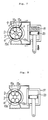
- Fig. 1 shows a first preferred embodiment of the present invention, Fig. 1(a) being a front view, and Fig. 1(b) being a cross-section side view;
- Fig. 2 is a diagram showing the relation between a revolution angle of a planetary roller and a gap clearance between a housing and a ring, through which fluid passes;
- Fig. 3 is a front view of a second preferred embodiment of the present invention;
- Fig. 4 is a diagram similar to that shown in Fig. 2 for the first preferred embodiment but relevant to the second preferred embodiment;
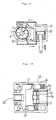
- Fig. 5 is a cross-section side view of a third preferred embodiment of the present invention;
- Fig. 6 is a cross-section side view of a fourth preferred embodiment of the present invention;
- Fig. 7 is a diagrammatic view showing reciprocating operations when a reciprocating type actuator is hydraulically controlled by making use of the fourth preferred embodiment, which shows the state where a piston is urged downwardly;
- Fig. 8 is a diagrammatic view similar to Fig. 7, but showing the state where a piston is stopped (the actuator being fixed);
- Fig. 9 is a diagrammatic view similar to Fig. 7, but showing the state where a piston is urged upwardly;
- Fig. 10 is a cross-section side view of a fifth preferred embodiment of the present invention;
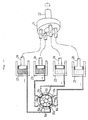
- Fig. 11 is a diagrammatic view showing operations of the fifth preferred embodiment in a disintegrated form;
- Fig. 12 is a cross-section side view of one example of the flow control valve in the prior art;
- Fig. 13 is a cross-section side view of another example of the flow control valve in the prior art; and
- Fig. 14 is a cross-section side view of still another example of the flow control valve in the prior art.
- Now a fuel flow control valve of a gas turbine engine according to a first preferred embodiment of the present invention will be described with reference to Figs. 1 and 2. Fig. 1 shows a construction of a fuel flow control valve according to this preferred embodiment, Fig. 1(a) being a front view partly cut away, and Fig. 1(b) is a cross-section side view of the construction shown in Fig. 1(a), that is, a cross-section view taken along line B-B in Fig. 1(a) as viewed in the direction of arrows.
- In Fig. 1, two pairs of four
planetary rollers 2 having different diameters from one another are externally contiguous to aninput shaft 1 of roller shape and internally contiguous to aring 3 having a predetermined width in its axial direction, and are accommodated within ahousing 4 jointly with thering 3, and thishousing 4 is fitted around the outer circumference of thering 3 with its inner circumference partly kept in contact with the outer circumference of thering 3. One end of theinput shaft 1 is connected via a coupling member 8 with a steppingmotor 9 fixed to thehousing 4, hence if the steppingmotor 9 rotates, then theinput shaft 1 also rotates, theplanetary rollers 2 revolve around theinput shaft 1 while rotating about their own axes, and consequently thering 3 also rotates within thehousing 4. Between thehousing 4 and the outer circumference of thering 3 are fittedseal rings 7, and at one angular position of the inner circumference of thehousing 4, afluid inlet 5 extends therethrough in the radial direction, while at another angular position a fluid outlet 6 extends therethrough. - Next, with respect to the operation of the flow control valve having the above-mentioned construction, description will be made with reference to Fig. 2. When the
planetary rollers 2 having a difference in their diameters revolve around the outer circumference of theinput shaft 1, the distance corresponding to a radius between the outer circumference of thering 3 and the axis of theinput shaft 1 would differ depending upon the angular position about the axis, accordingly between the inner circumference of thehousing 4 and thering 3 coexist a region where they are held in press contact with each other and another region where, on the contrary, a gap clearance is formed therebetween, and the angular positions of these regions about the axis would change every moment according to the revolution. Symbol X in Fig. 1(a) denotes this gap clearance, and Fig. 2 is a diagram showing this change while taking the magnitude of this gap clearance X or the degree of the press contact along the ordinate and the revolving angle of theplanetary rollers 2 along the abscissa. As will be apparent from these figures, by controlling the difference in diameter of theplanetary rollers 2, a desired gap clearance X is formed, and so, a flow rate can be arbitrarily controlled. - Next, description will be made on a second preferred embodiment of the present invention with reference to Figs. 3 and 4.
- While the first preferred embodiment was an embodiment in which the fluid outlet 6 was provided at one location of the
housing 4, the second preferred embodiment is an embodiment in which fluid outlets are provided at three locations along the circumferential direction, and with reference to Fig. 3, along the circumference of thehousing 4,fluid outlets fluid inlet 5, so that flow rate characteristics are controlled according to a preset flow rate schedule by rotation of aninput shaft 1. It is to be noted that the construction other than the illustrated section is similar to that shown in Fig. 1. - Fig. 4 is a diagram corresponding to that shown in Fig. 2 depicted for this particular embodiment, in which ϑ₁ represents an angle of the sum of ϑ₃ in Fig. 3 plus 180°, and ϑ₂ represents an angle corresponding to ϑ₂ in Fig. 3.
- Principal parameters, required for a plurality of flow controls as is the case with this preferred embodiment, are timing of switching from an intercepted condition to an opened condition and a flow rate variation ratio. With regard to the timing, it can be adjusted by the phases (ϑ₂ and ϑ₃ in Fig. 4) of the
respective fluid outlets fluid outlets fluid outlet 6a may be used as a fine nozzle having an extremely small bore diameter for feeding fuel for ignition purpose, thefluid outlet 6b may be used as a small flow rate nozzle having a small bore diameter for feeding fuel for idling operation purpose, and thefluid outlet 6c may be used as a large flow rate nozzle for feeding fuel for normal operation purpose. It is to be noted that the number of the fluid outlets should not be limited to three, but it could be increased or decreased, if desired. - Next, a third preferred embodiment of the present invention will be described with reference to Fig. 5.
- While both the above-described first and second preferred embodiments employed the construction that the
planetary rollers 2 and the steppingmotor 9 are formed separately, and in order to absorb misalignment between the axes of the respective components a coupling member 8 is used, theplanetary rollers 2 inherently possess a capability of a bearing, and so, they can also serve as a bearing on one side of the steppingmotor 9. - The third preferred embodiment is a flow control valve constructed from the above-mentioned view point, in which reference numeral 1a designates a rotary shaft serving also as a drive shaft of a stepping
motor 9a which will be described later, andplanetary rollers 2 perform revolution around thisrotary shaft 1a as well as rotation about its own axis. The steppingmotor 9a consists of amotor rotor 10, motor coil 11,motor housing 12 and abearing 13 for supporting one end of therotary shaft 1a as shown in the figure, and a role of another bearing at the other end corresponding to thebearing 13 is played by the afore-mentionedplanetary rollers 2. With regard to the other construction, this embodiment is basically similar to the first and second preferred embodiments. - In the case of this preferred embodiment, in addition to the fact that advantages similar to those of the first and second preferred embodiments are provided, since the
rotary shaft 1a of the steppingmotor 9a also serves directly as an input shaft of theplanetary rollers 2 and the planetary rollers also serve as a bearing, there is no need to separately prepare an input shaft nor a coupling member as is the case with the first and second preferred embodiments and also only one bearing can suffice, hence there is an advantage that a number of parts, a weight and a cost are all reduced and the valve can be small-sized. - Next, a fourth preferred embodiment of the present invention will be described with reference to Figs. 6 to 9.
- This preferred embodiment is an embodiment forming a planetary roller type servo valve for feeding fluid to an actuator consisting of a
cylinder 19 and apiston 20 illustrated in Figs. 7 to 9 while precisely controlling a flow rate, in which component parts similar to those of the first to third preferred embodiments are given like reference numerals and further explanation thereof will be omitted. - In Fig. 6, reference numeral 1b denotes a sun roller serving also as an input shaft, which is rotated by a
motor rotor 10 and causesplanetary rollers 2 on its outer circumference to rotate about their own axes and to revolve around the sun roller 1b. Reference numeral 14 denotes a pressurized fluid inlet, numeral 15a denotes a feed port leading to an actuator, numeral 16b denotes a return port extending from the actuator, numeral 17 denotes a waste oil exhausted through a gap clearance between thering 3 and thehousing 4, numeral 18 denotes a groove formed along the inner circumference of thehousing 4 for the purpose of holdingseal rings 7a and 7b and receiving inflow of pressurized fluid by communicating with the pressurized fluid inlet 14. Besides, for instance, as shown in Fig. 7 anotherfeed port 15b leading to the actuator is provided symmetrically with respect to the axis of the sun roller 1b, that is, on the lower side as viewed in Fig. 6, in opposition to thefeed port 15a leading to the actuator, and also on the same circumferential surface delimited in the axial direction byseal rings 7a and 7b as thefeed port 15a leading to the actuator, and anotherreturn port 16a extending from the actuator is provided on the upper side as viewed in Fig. 7 in opposition to thereturn port 16b extending from the actuator, and also on the same circumferential surface delimited on the left side of theseal ring 7a as thereturn port 16b. - Next, one example of reciprocating operation of an actuator by making use of a planetary roller type servo valve having the above-described construction, will be explained with reference to Figs. 7 to 9. Figs. 7 to 9 are diagrammatic views in which the planetary roller type servo valve shown in Fig. 6 is connected to an actuator consisting of a
cylinder 19 and apiston 20, they are shown by figures corresponding to a cross-section view taken along line A-A in Fig. 6 as viewed in the direction of arrows, and thefeed port 15a leading to the actuator and thereturn port 16b extending from the actuator shown on the cross-section view taken along line B-B in Fig. 6 as viewed in the direction of arrows are depicted by dash lines. It is to be noted that in these figures, for the purpose of facilitating to understand, only essential parts are shown, and the pressurized fluid inlet 14 and the other components are omitted. - Fig. 7 is a figure showing the state where pressurized fluid (represented by hatching) is fed to the upper side of the
piston 20 and thepiston 20 is moving in the direction of a hatched arrow (the downward direction), Fig. 8 is a figure showing the state where movement of fluid is not present and thepiston 20 is held stopped (the actuator being fixed), and Fig. 9 is a figure showing the state where pressurized fluid is fed to the lower side of thepiston 20 on the contrary to Fig. 7 and the piston is moving in the direction of a hatched arrow (the upward direction). Symbol ø denotes a rotated angle caused by the stepping motor, and symbol X denotes gap clearances produced at two diametrically opposed positions along the circumference between thering 3 and thehousing 4 due to the fact that thering 3 has its inner side not pressed by theplanetary rollers 2. It is to be noted that return fluid coming from the actuator is represented by dotting. - At first, in Fig. 6, pressurized fluid flows into the valve through the pressurized fluid inlet 14 and fills the
groove 18. Then it flows into thefeed port 15a leading to the actuator where the gap clearance X has arrived at, through the gap clearance X, subsequently it flows into the actuator, and the state shown in Fig. 7 is created. That is, the pressurized fluid strongly urges thepiston 20 downwards and causes an object not shown to displace. The fluid on the lower side of thepiston 20 becomes return fluid and is exhausted aswaste oil 17 via thereturn port 16b from the actuator where a gap clearance X on the opposite side to the above-mentioned gap clearance X has arrived at, and through the gap clearance X. Under this condition, thefeed port 15b leading to the actuator and thereturn port 16a from the actuator are at the positions where the gap clearance X is zero due to the fact that thering 3 has its inner side pressed by theplanetary rollers 2, and so, they are respectively blocked. - It is to be noted that while the gap clearance X is illustrated in an enlarged scale in Fig. 7 for convenience of explanation, in a practical machine, a gap clearance of such size that pressurized fluid can pass therethrough, for instance, a very small gap clearance of about 0.5 mm or less can suffice. In other words, the gap clearance X between the
ring 3 and thehousing 4 in Fig. 6 is extremely small as compared to the diameters of the seal rings 7a and 7b, and so, a sealing property of the seal rings 7a and 7b would not be deteriorated by the gap clearance X. Accordingly, the pressurized fluid entered through the pressurized fluid inlet 14 would not leak out to the side of thereturn ports seal ring 7a, nor would not leak out to the side of the steppingmotor 9a over the seal ring 7b. - When the sun roller 1b is rotated by the stepping
motor 9a, theplanetary rollers 2 rotate about their own axes and revolve around the sun roller 1b and the state shown in Fig. 8 has been established, the gap clearances X at all the locations of thefeed ports return ports piston 20 cannot move, and hence thepiston 20 is fixed. In other words, the object not shown is fixed. - When the sun roller 1b is rotated by the stepping
motor 9a, theplanetary rollers 2 rotate about their own axes and revolve around the sun roller 1b and the state shown in Fig. 9 has been established, the respective gap clearances X would arrive at the locations of thefeed port 15b leading to the actuator and thereturn port 16a extending from the actuator, hence on the contrary to the case shown in Fig. 7, the pressurized fluid flows into thefeed port 15b leading to the actuator through the gap clearance X, subsequently it flows into the actuator and enters the chamber on the lower side of thepiston 20, and it strongly pushes up thepiston 20. And the object not shown is made to displace in the opposite direction to the case of Fig. 7. The fluid on the upper side of thepiston 20 becomes return fluid, and is exhausted aswaste oil 17 via thereturn port 16a extending from the actuator where the gap clearance X has arrived at and through the gap clearance X. In this way, rotation of the steppingmotor 9a is precisely controlled by easily controllable electric signals, and reciprocating motions of the actuator can be controlled precisely. - Next, description will be made on a fifth preferred embodiment of the present invention with reference to Figs. 10 and 11. This preferred embodiment is an example of a rotary actuator, in which the planetary roller type servo valve shown in Fig. 6 and the so-called swash plate type hydraulic rotary machine are integrally combined and reciprocating motions of pistons controlled by the planetary roller type servo valve are converted into a rotary motion and then taken out. Fig. 10 is a cross-section side view of this preferred embodiment, and Fig. 11 is a diagrammatic view for explaining the operation of this preferred embodiment by disintegrated illustration. Component members similar to those shown in Fig. 6 are given like reference numeral, and further explanation thereof will be omitted.
- In Fig. 10, generally the portion in the proximity of the center of the right-hand section forms a planetary roller type servo valve, and the other portion forms a swash plate type hydraulic rotary machine.
Reference numeral 4a denotes a housing of a planetary roller type servo valve, one end of which is continuous tocylinders 23 to be described later.Reference numeral 21 designates a swash plate, numeral 22 denotes an output shaft which is continuous to theswash plate 21, and fourcylinders 23 are disposed at equal angular intervals about the axis of theoutput shaft 22 with their axes held in parallel to one another. In thecylinders 23 are respectively accommodatedpistons 24 so as to be able to reciprocate in the axial direction, and the respective tip portions of thepistons 24 are universally coupled to theswash plate 21 via universal couplings. Theuniversal couplings 25 are slidable along the coupling surface to theswash plate 21, and even if theoutput shaft 22 rotates about its own axis, they do not displace in the directions perpendicular to the axis but they displace only in the axial direction according to the degree of inclination of theswash plate 21. Accordingly, thepistons 24 universally coupled to theswash plate 21 would displace within the respective cylinders in the axial direction of the cylinders. - Next, the operation of the hydraulic rotary machine having the above-described construction will be explained with reference to Fig. 11. The left-hand portion of this figure illustrates a planetary roller type servo valve, which is similar, in principle, to the case of the fourth preferred embodiment shown in Fig. 7. However, in the case of this preferred embodiment, only difference resides in that as shown in Fig. 11, feed
ports ports feed ports return ports planetary rollers 2 rotate about their own axes and revolve around the sun roller 1b, and for instance, pressurized fluid is fed to the tip end side of thepiston 24 by an operation similar to the case of Fig. 7 to push and move thepiston 24. Then theswash plate 21 rotates about the axis of theoutput shaft 22. Since thepiston 24 on the opposite side of the axis of theoutput shaft 22 is pushed back in the opposite direction by theswash plate 21, the fluid on the tip end side of thepiston 24 becomes return fluid and returns to the planetary roller type servo valve to be exhausted. This operation is sequentially repeated around the axis of theoutput shaft 22, and the output shaft transmits a strong torque and precise rotation to the object not shown. It is to be noted that while this preferred embodiment has been described in connection to an example provided with fourpistons 24, so long as the number is such number that theswash plate 21 may not produce a rotational dead point, that is, so long as there are three pistons in the case where pistons are disposed so as to nearly equally divide the circumference of theswash plate 21 into three about the axis of theoutput shaft 22, or more pistons, any number of pistons could be employed within the scope where the gap clearance between thering 3 and thehousing 4a and the positional relationship where it is blocked. - As will be apparent from the above description of the preferred embodiments, owing to the above-described structural features, the present invention offers the following advantages:
- (1) Since a gap clearance formed by a difference in diameter of planetary rollers is utilized, a flow rate can be controlled precisely.
- (2) As a location where small areas push against each other or slide along each other is not present, the valve is excellent in abrasion-resistance.
- (3) There is no fear of interception by foreign matters, because the valve does not include a slit.
- (4) A frictional loss is small, because a location where members slide at a high speed as urged by a spring or the like does not exist.
- (5) Since revolution of planetary rollers is utilized, a large torque as well as precise timing can be realized.
Claims (8)
- A planetary roller type flow control valve comprising a plurality of planetary rollers (2), an input shaft (1), a ring (3) being internally contiguous to said planetary rollers (2) and having a predetermined width in its axial direction, a housing (4, 4a) fitting around said ring (3) with its inner circumference partly kept in contact with the outer circumference of said ring (3) and held coaxial and liquid-tight with respect to said input shaft (1), a fluid inlet (5, 14) provided at one angular position of the inner circumference of said housing (4, 4a) and at least a fluid outlet (6; 6a, 6b, 6c; 15a, 15b, 15c, 15d) provided at another angular position of the inner circumference of said housing (4, 4a) so as to be interceptable by the predetermined width of said ring (3), characterized in that said rollers (2) have different diameters from one another and are externally contiguous to a roller (1, 1a, 1b) serving also as an input shaft.
- A planetary roller type flow control valve as claimed in Claim 1, wherein said input shaft (1a) serves also as a rotary shaft (10) of a driving device (9a).
- A planetary roller type flow control valve as claimed in claim 2, wherein said planetary rollers (2) serve also as bearings for the rotary shaft (1a) of the driving device (9a).
- A planetary roller type flow control valve as claimed in Claim 1, wherein said fluid outlet (6a, 6b, 6c; 15a, 15b, 15c, 15d) is provided in multiple on the inner circumference of said housing (4,4a).
- A planetary roller type flow control valve as claimed in any one of Claims 1 to 4, wherein the fluid issued from the fluid outlet (15a, 15b) is adapted to be fed as working fluid of an actuator (19, 20).
- A planetary roller type flow control valve as claimed in any one of Claims 1 to 4, wherein the fluid issued from the fluid outlet (15a, 15b, 15c, 15d) is adapted to be fed as working fluid of a swash plate type rotary machine.
- A planetary roller type flow control valve as claimed in any one of Claims 1 to 4, which further comprises a circumferential groove (18) formed in the housing (4) along the circumference of the ring (3) and opening at the contact surface between the housing (4) and the ring (3), and a seal ring (7b) provided within said circumferential groove (18).
- A planetary roller type flow control valve as claimed in Claim 2, wherein said driving device (9) is a stepping motor.
Applications Claiming Priority (4)
| Application Number | Priority Date | Filing Date | Title |
|---|---|---|---|
| JP76804/90 | 1990-03-28 | ||
| JP7680490 | 1990-03-28 | ||
| JP642191A JP2607754B2 (en) | 1990-03-28 | 1991-01-23 | Planetary roller type flow control valve |
| JP6421/91 | 1991-01-23 |
Publications (2)
| Publication Number | Publication Date |
|---|---|
| EP0449225A1 EP0449225A1 (en) | 1991-10-02 |
| EP0449225B1 true EP0449225B1 (en) | 1993-11-10 |
Family
ID=26340556
Family Applications (1)
| Application Number | Title | Priority Date | Filing Date |
|---|---|---|---|
| EP19910104800 Expired - Lifetime EP0449225B1 (en) | 1990-03-28 | 1991-03-26 | Planetary roller type flow control valve |
Country Status (4)
| Country | Link |
|---|---|
| US (1) | US5096157A (en) |
| EP (1) | EP0449225B1 (en) |
| JP (1) | JP2607754B2 (en) |
| DE (1) | DE69100608T2 (en) |
Families Citing this family (6)
| Publication number | Priority date | Publication date | Assignee | Title |
|---|---|---|---|---|
| FR2685384A1 (en) * | 1991-12-18 | 1993-06-25 | Snecma | FUEL SUPPLY SYSTEM FOR INJECTORS OF A TURBOMACHINE. |
| US6962320B2 (en) * | 2002-12-12 | 2005-11-08 | Sankyo Seiki Mfg. Co., Ltd. | Flow control device |
| EP1477873B1 (en) | 2003-05-12 | 2013-09-11 | WIKA Alexander Wiegand GmbH & Co.KG | Pressure control sysytem |
| JP4817671B2 (en) * | 2005-02-16 | 2011-11-16 | 株式会社不二工機 | Motorized valve with speed reducer |
| JP5693211B2 (en) * | 2010-12-27 | 2015-04-01 | 株式会社マキタ | Work tools |
| WO2021222778A1 (en) * | 2020-04-30 | 2021-11-04 | Vanderbilt University | Vertical-via rotary valves, microbioreactors and applications of same |
Family Cites Families (6)
| Publication number | Priority date | Publication date | Assignee | Title |
|---|---|---|---|---|
| DE929406C (en) * | 1954-04-24 | 1955-06-27 | Victor Donald Grant | Stopcock with a tubular sealing element made of rubber and fastened in the valve housing, and a cock plug rotatably arranged in the sealing element |
| GB912831A (en) * | 1958-02-26 | 1962-12-12 | United Shoe Machinery Corp | Improvements in or relating to valve devices |
| DE1833069U (en) * | 1961-04-11 | 1961-06-15 | Birut Waechtersbacher Kunststo | FUEL TAP. |
| FR1448737A (en) * | 1964-03-21 | 1966-03-18 | Pinch valve | |
| US4056292A (en) * | 1976-08-02 | 1977-11-01 | Traut Earl W | Linear rolling contact devices |
| US4718453A (en) * | 1987-02-06 | 1988-01-12 | Bergstrom Manufacturing Co. | Rotary valve |
-
1991
- 1991-01-23 JP JP642191A patent/JP2607754B2/en not_active Expired - Lifetime
- 1991-03-26 DE DE91104800T patent/DE69100608T2/en not_active Expired - Fee Related
- 1991-03-26 EP EP19910104800 patent/EP0449225B1/en not_active Expired - Lifetime
- 1991-03-27 US US07/675,257 patent/US5096157A/en not_active Expired - Lifetime
Also Published As
| Publication number | Publication date |
|---|---|
| JPH04211774A (en) | 1992-08-03 |
| JP2607754B2 (en) | 1997-05-07 |
| US5096157A (en) | 1992-03-17 |
| DE69100608T2 (en) | 1994-05-11 |
| DE69100608D1 (en) | 1993-12-16 |
| EP0449225A1 (en) | 1991-10-02 |
Similar Documents
| Publication | Publication Date | Title |
|---|---|---|
| EP0147209B1 (en) | Phasing device for machinery applications | |
| CA2219062C (en) | Infinitely variable ring gear pump | |
| US6199377B1 (en) | Compact hydraulic motor | |
| CN1266473A (en) | Device for changing the relative rotational position of a shaft to the drive wheel | |
| EP0015127B1 (en) | Fluid motor-pump assembly | |
| EP3260745A1 (en) | Flow control valve | |
| EP0449225B1 (en) | Planetary roller type flow control valve | |
| JP4212065B2 (en) | Continuously variable hydraulic transmission with 1: 1 ratio lock-up clutch | |
| KR100398846B1 (en) | Continuously Variable Hydrostatic Transmission | |
| EP1634131A1 (en) | Liquid flow regulating device and dynamometer testing device | |
| US5083473A (en) | Ratio control system for toroidal continuously variable transmission | |
| CN111828694B (en) | Axial piston machine with valve core integrated into connecting plate | |
| JPH09507902A (en) | Hydraulic variable speed drive | |
| SE470426B (en) | Device for torque transmission between two rotatable shafts | |
| DE19740553B4 (en) | Differential hydraulic motor | |
| US5394698A (en) | Hydraulic transmission apparatus | |
| US4891944A (en) | Hydraulically operated continuously variable transmission | |
| DE69104324T2 (en) | Removable axial bearing unit with flexible membrane for a rotating machine. | |
| EP2013475A1 (en) | Hydraulic motor having radial cylinders and continuous variable displacement | |
| WO1987000590A1 (en) | Rotary actuator | |
| US6092455A (en) | Hydraulic pressure transformer | |
| US20020078686A1 (en) | Hydraulic pressure transformer | |
| US4352319A (en) | Positive control for hydrostatic motors, especially radial piston motors | |
| WO1991019902A1 (en) | Hydraulic rotary radial piston pumps | |
| JPH061070B2 (en) | Rotary fluid energy converter |
Legal Events
| Date | Code | Title | Description |
|---|---|---|---|
| PUAI | Public reference made under article 153(3) epc to a published international application that has entered the european phase |
Free format text: ORIGINAL CODE: 0009012 |
|
| 17P | Request for examination filed |
Effective date: 19910423 |
|
| AK | Designated contracting states |
Kind code of ref document: A1 Designated state(s): DE GB |
|
| 17Q | First examination report despatched |
Effective date: 19921222 |
|
| GRAA | (expected) grant |
Free format text: ORIGINAL CODE: 0009210 |
|
| AK | Designated contracting states |
Kind code of ref document: B1 Designated state(s): DE GB |
|
| REF | Corresponds to: |
Ref document number: 69100608 Country of ref document: DE Date of ref document: 19931216 |
|
| PLBE | No opposition filed within time limit |
Free format text: ORIGINAL CODE: 0009261 |
|
| STAA | Information on the status of an ep patent application or granted ep patent |
Free format text: STATUS: NO OPPOSITION FILED WITHIN TIME LIMIT |
|
| 26N | No opposition filed | ||
| REG | Reference to a national code |
Ref country code: GB Ref legal event code: IF02 |
|
| PGFP | Annual fee paid to national office [announced via postgrant information from national office to epo] |
Ref country code: DE Payment date: 20050324 Year of fee payment: 15 |
|
| PG25 | Lapsed in a contracting state [announced via postgrant information from national office to epo] |
Ref country code: DE Free format text: LAPSE BECAUSE OF NON-PAYMENT OF DUE FEES Effective date: 20061003 |
|
| PGFP | Annual fee paid to national office [announced via postgrant information from national office to epo] |
Ref country code: GB Payment date: 20100322 Year of fee payment: 20 |
|
| REG | Reference to a national code |
Ref country code: GB Ref legal event code: PE20 Expiry date: 20110325 |
|
| PG25 | Lapsed in a contracting state [announced via postgrant information from national office to epo] |
Ref country code: GB Free format text: LAPSE BECAUSE OF EXPIRATION OF PROTECTION Effective date: 20110325 |