EP0449357B1 - Folie aus einem Ethylen-Vinylacetatcopolymer mit zumindest einer aufgerauhten Fläche und Verfahren zu ihrer Herstellung - Google Patents
Folie aus einem Ethylen-Vinylacetatcopolymer mit zumindest einer aufgerauhten Fläche und Verfahren zu ihrer Herstellung Download PDFInfo
- Publication number
- EP0449357B1 EP0449357B1 EP91200603A EP91200603A EP0449357B1 EP 0449357 B1 EP0449357 B1 EP 0449357B1 EP 91200603 A EP91200603 A EP 91200603A EP 91200603 A EP91200603 A EP 91200603A EP 0449357 B1 EP0449357 B1 EP 0449357B1
- Authority
- EP
- European Patent Office
- Prior art keywords
- copolymer
- die
- film
- equal
- extrusion
- Prior art date
- Legal status (The legal status is an assumption and is not a legal conclusion. Google has not performed a legal analysis and makes no representation as to the accuracy of the status listed.)
- Expired - Lifetime
Links
Images
Classifications
-
- B—PERFORMING OPERATIONS; TRANSPORTING
- B29—WORKING OF PLASTICS; WORKING OF SUBSTANCES IN A PLASTIC STATE IN GENERAL
- B29C—SHAPING OR JOINING OF PLASTICS; SHAPING OF MATERIAL IN A PLASTIC STATE, NOT OTHERWISE PROVIDED FOR; AFTER-TREATMENT OF THE SHAPED PRODUCTS, e.g. REPAIRING
- B29C48/00—Extrusion moulding, i.e. expressing the moulding material through a die or nozzle which imparts the desired form; Apparatus therefor
- B29C48/25—Component parts, details or accessories; Auxiliary operations
- B29C48/78—Thermal treatment of the extrusion moulding material or of preformed parts or layers, e.g. by heating or cooling
- B29C48/86—Thermal treatment of the extrusion moulding material or of preformed parts or layers, e.g. by heating or cooling at the nozzle zone
- B29C48/87—Cooling
-
- B—PERFORMING OPERATIONS; TRANSPORTING
- B29—WORKING OF PLASTICS; WORKING OF SUBSTANCES IN A PLASTIC STATE IN GENERAL
- B29C—SHAPING OR JOINING OF PLASTICS; SHAPING OF MATERIAL IN A PLASTIC STATE, NOT OTHERWISE PROVIDED FOR; AFTER-TREATMENT OF THE SHAPED PRODUCTS, e.g. REPAIRING
- B29C48/00—Extrusion moulding, i.e. expressing the moulding material through a die or nozzle which imparts the desired form; Apparatus therefor
- B29C48/03—Extrusion moulding, i.e. expressing the moulding material through a die or nozzle which imparts the desired form; Apparatus therefor characterised by the shape of the extruded material at extrusion
- B29C48/06—Rod-shaped
-
- B—PERFORMING OPERATIONS; TRANSPORTING
- B29—WORKING OF PLASTICS; WORKING OF SUBSTANCES IN A PLASTIC STATE IN GENERAL
- B29C—SHAPING OR JOINING OF PLASTICS; SHAPING OF MATERIAL IN A PLASTIC STATE, NOT OTHERWISE PROVIDED FOR; AFTER-TREATMENT OF THE SHAPED PRODUCTS, e.g. REPAIRING
- B29C48/00—Extrusion moulding, i.e. expressing the moulding material through a die or nozzle which imparts the desired form; Apparatus therefor
- B29C48/03—Extrusion moulding, i.e. expressing the moulding material through a die or nozzle which imparts the desired form; Apparatus therefor characterised by the shape of the extruded material at extrusion
- B29C48/09—Articles with cross-sections having partially or fully enclosed cavities, e.g. pipes or channels
-
- B—PERFORMING OPERATIONS; TRANSPORTING
- B29—WORKING OF PLASTICS; WORKING OF SUBSTANCES IN A PLASTIC STATE IN GENERAL
- B29C—SHAPING OR JOINING OF PLASTICS; SHAPING OF MATERIAL IN A PLASTIC STATE, NOT OTHERWISE PROVIDED FOR; AFTER-TREATMENT OF THE SHAPED PRODUCTS, e.g. REPAIRING
- B29C48/00—Extrusion moulding, i.e. expressing the moulding material through a die or nozzle which imparts the desired form; Apparatus therefor
- B29C48/25—Component parts, details or accessories; Auxiliary operations
- B29C48/78—Thermal treatment of the extrusion moulding material or of preformed parts or layers, e.g. by heating or cooling
- B29C48/86—Thermal treatment of the extrusion moulding material or of preformed parts or layers, e.g. by heating or cooling at the nozzle zone
Definitions
- the present invention relates to a resin film based on a copolymer of ethylene and vinyl acetate, at least one of the faces of which has a rough appearance and which is therefore particularly suitable for producing packaging bags which can be sterilized by gamma radiation and a method for making such films.
- This type of sheath is certainly suitable for producing packaging bags but has the disadvantage of requiring the use of resins containing plasticizers which can eventually migrate into the packaged products.
- the Applicant has therefore considered replacing the polychloride-based resin vinyl with a resin based on a copolymer of ethylene and vinyl acetate. It appears, in fact, that bags produced from such a resin are particularly suitable in particular for the packaging of products for medical use such as solutions of amino acids, dextrose or emulsions of lipids, fatty vitamins, etc.
- the Applicant has nevertheless managed to produce such a resin film based on a copolymer of ethylene and vinyl acetate.
- the present invention therefore relates mainly to a film based on a copolymer of ethylene and vinyl acetate, at least one of the faces of which has a rough appearance making it suitable for use without encountering problems of adhesion.
- the invention therefore relates to a resin film based on a copolymer of ethylene and vinyl acetate, at least one of the faces of which has a rough appearance which is characterized in that the ratio between the average degree of roughness of the faces of rough appearance, expressed in microns and measured according to ISO standard R468-1966, and the percentage by weight of units derived from vinyl acetate of the copolymer constituting the film is greater than 0.019.
- the film according to the invention can be either a single-layer film consisting exclusively of a copolymer of ethylene and vinyl acetate, or else a composite film produced, for example, by coextrusion and consisting of a plurality of layers of plastics different, the film having, in this case, at least one external face made from a copolymer of ethylene and vinyl acetate.
- the degree of roughness of the film produced should be directly proportional to the percentage by weight of units derived from vinyl acetate of its constituent copolymer.
- the Applicant has moreover found that when the film does not satisfy the above-mentioned characteristic, not only the production and the use (welding of bags from rolled sheaths, placement of inserts, filling of bags, separation bags, etc.) of bags are made difficult, but still the bags produced are sticky to the touch, sensitive to scratches and are easily loaded with dust.
- the Applicant also prefers that the ratio specified above is greater than 0.02.
- copolymers based on a copolymer of ethylene and vinyl acetate the applicant prefers to use copolymers containing from 10 to 30 percent by weight of units derived from vinyl acetate.
- the average degree of roughness of the films in accordance with the invention is determined according to ISO standard R468-1966 using a device of the Perth-O-Meter type which is based on an averaged measurement of the amplitude of the displacements d '' a needle perpendicular to the surface to be characterized.
- the present invention also relates, on a secondary basis, to a process allowing the production of such films.
- H, L, and Lf are expressed in millimeters and is expressed in cm / sec.
- the surface cooling of one or both sides of the extruded sheath is obtained by a circulation of a cooling fluid, generally oil or a glycol, in the end of the die and / or of the core of the device. extrusion.
- a cooling fluid generally oil or a glycol
- This refrigeration is preferably carried out by a thin annular film of refrigerant (thickness of the order of a millimeter) circulating axially, that is to say along the direction of the extrusion axis, so as to ensure symmetrical cooling of the sheath leading to a product of uniform roughness.
- the length of the refrigerated zone can vary between 3 and 30 mm and the distance between the end of the refrigerated zone and the end of the extrusion die can vary between 0 and 60 mm.
- the distance between the start of the refrigerated zone and the die outlet should not exceed 70 mm in order not to generate an unacceptable back pressure in the extrusion device upstream of the refrigerated area.
- the average temperature Tm of the copolymer at its exit from the die is easily determined in particular by means of thermometric probes, this temperature generally being between 160 and 200 ° C and, preferably between 170 and 190 ° C.
- drawing speed exerted on the sheath at the exit from the extrusion die positively influences the appearance of roughness. It is therefore preferred that this drawing speed is preferably between 120 and 600% of the average speed of the resin at the outlet of the die.
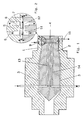
- the extrusion head shown in FIGS. 1 and 2 has an annular die 1 and an internal core 2 held by means of core-carrying fins 3.
- the core has a central channel 4, which makes it possible to inject a fluid under pressure, generally of air, in the extruded sheath as is usual in any blown extrusion installation.
- the end of the core 2 and the end of the die 1 are equipped with an annular refrigeration system 5 comprising two axially spaced chambers 6 and 7, connected together by an annular channel 8.
- an annular refrigeration system 5 comprising two axially spaced chambers 6 and 7, connected together by an annular channel 8.
- one of the chambers is connected to a pipe 9 for supplying a refrigerant, in this case oil, and the other to a pipe 10 for discharging this fluid.
- the two chambers (11,12) of the core refrigeration system are also and respectively connected to supply lines 13 and discharge lines 14 of a coolant which pass through the core 2 and one of the core-carrying fins 3.
- the supply lines (9,13) and evacuation (10,14) of the refrigerant are equipped with a thermal insulation lining, not shown, as are the refrigeration systems except on their face opposite with the flow channel of the extruded copolymer.
- Fig. 2 we have also shown the length L of the refrigeration zone, the height H of the air gap of the die in the refrigerated area and the distance Lf between the outlet of the die and the downstream end of the refrigerated area.
- Table 1 shows the data and the results of the tests carried out, tests 1R to 6R not respecting the conditions imposed by the process according to the invention and being given for comparison.
- the different contents expressed as percentages by weight of units derived from vinyl acetate of the different copolymers tested are shown, the different values assigned to the parameters L, Lf, H, , and Tm (mean temperature), the calculated values of aG n and A (Lf / L) 2 + B (Lf / L) , the maximum calculated temperatures (Tmax) authorized, for the refrigerant, for each test, according to the process in accordance with the invention, the temperatures T tested for the refrigerant, the degrees of roughness observed during each test and the value of the ratio between these degrees of roughness and the percentage by weight of units derived from the vinyl acetate of the copolymer used.
- tests 7 to 16 carried out within the framework of the method according to the invention lead to films forming part of the framework of the invention and which are particularly suitable for the production of packaging bags.
Landscapes
- Engineering & Computer Science (AREA)
- Mechanical Engineering (AREA)
- Physics & Mathematics (AREA)
- Thermal Sciences (AREA)
- Extrusion Moulding Of Plastics Or The Like (AREA)
- Manufacture Of Macromolecular Shaped Articles (AREA)
- Treatments Of Macromolecular Shaped Articles (AREA)
- Laminated Bodies (AREA)
Claims (8)
- Folie aus einem Hart auf Ethylen-Vinylacetat-Copolymer-Basis mit wenigstens einer aufgerauhten Fläche, dadurch gekennzeichnet, daß das Verhältnis zwischen dem mittleren Rauhigkeitsgrad der rauhen Flächen, ausgedrückt in Mikrometern und gemessen gemäß der Norm ISO R468-1966, und den Gewichtsprozenten der vom Vinylacetat des Copolymeren, das die Folie bildet, abgeleiteten Einheiten größer als 0,019 ist.
- Folie gemäß Anspruch 1, dadurch gekennzeichnet, daß das Verhältnis größer als 0,02 ist.
- Folie gemäß Anspruch 1 oder 2, dadurch gekennzeichnet, daß das Copolymere 10 bis 30 Gewichtsprozent vom Vinylacetat abgeleitete Einheiten enthält.
- Verfahren zur Herstellung einer Folie gemäß irgendeinem der Ansprüche 1 bis 3, dadurch gekennzeichnet, daß die Folie in Form eines Schlauchs durch Extrusionsblasen hergestellt wird, und dadurch, daß wenigstens eine der Flächen der Düse und der erzeugten Folie oberhalb der Austrittsöffnung der Extrusionsdüse (1) durch Zirkulation einer Kühlflüssigkeit oberflächlich gekühlt wird, deren Temperatur T so gewählt wird, daß die Beziehung:
 Tc die Temperatur ist, für die der natürliche Logarithmus des Verhältnisses zwischen der Länge beim Bruch und der Anfangslänge einer Copolymerprobe 87% seines Wertes bei 180 °C beträgt, wobei die Dehnung beim Bruch mittels eines Elongations-Viskosimeters mit einem konstanten Gradienten der Zuggeschwindigkeit von 5 s⁻¹ gemessen wird,Tm die mittlere Temperatur des Copolymeren bei seinem Austritt aus der Düse ist,a gleich 0,24 ist,G durch die Beziehungin der:
 ρ die Dichte des Copolymeren ist,Cp die spezifische Wärmekapazität des Copolymeren ist,V die mittlere Fließgeschwindigkeit des Copolymeren in der Extrusionsdüse ist,H die Höhe des Spalts zwischen dem Kern und der Extrusionsdüse ist,λ die thermische Leitfähigkeit des Copolymeren ist,L die Länge der Kühlzone ist,n gleich 0,1688 ist,A gleich -0,0148 ist,Lf der Abstand zwischen dem Ende der Kühlzone und dem Ende der Düse ist,B gleich 0,2175 ist.
- Verfahren gemäß Anspruch 4, dadurch gekennzeichnet, daß die Kühlung durch einen dünnen ringförmigen Film der Kühlflüssigkeit (5) bewirkt wird, die entsprechend der Richtung der Extrusionsachse zirkuliert.
- Verfahren gemäß Anspruch 4, dadurch gekennzeichnet, daß der extrudierte Schlauch mit einer Geschwindigkeit zwischen 120 und 600% der mittleren Geschwindigkeit des Hartes beim Austritt aus der Düse gestreckt wird.
- Verfahren gemäß Anspruch 4, dadurch gekennzeichnet, daß die Länge L der gekühlten Zone zwischen 3 und 30 mm variiert, und dadurch, daß der Abstand Lf zwischen dem Ende der gekühlten Zone und dem Ende der Extrusionsdüse (1) zwischen 0 und 60 mm variiert.
- Verfahren gemäß Anspruch 4, dadurch gekennzeichnet, daß das extrudierte Copolymere am Ende der Düse einen plötzlich verringerten Durchgangsquerschnitt passiert.
Applications Claiming Priority (2)
| Application Number | Priority Date | Filing Date | Title |
|---|---|---|---|
| BE9000360 | 1990-03-30 | ||
| BE9000360A BE1004000A4 (fr) | 1990-03-30 | 1990-03-30 | Pellicule en resine a base de copolymere d'ethylene et d'acetate de vinyle dont au moins une des faces presente un aspect rugueux et procede pour sa realisation. |
Publications (2)
| Publication Number | Publication Date |
|---|---|
| EP0449357A1 EP0449357A1 (de) | 1991-10-02 |
| EP0449357B1 true EP0449357B1 (de) | 1995-02-22 |
Family
ID=3884740
Family Applications (1)
| Application Number | Title | Priority Date | Filing Date |
|---|---|---|---|
| EP91200603A Expired - Lifetime EP0449357B1 (de) | 1990-03-30 | 1991-03-19 | Folie aus einem Ethylen-Vinylacetatcopolymer mit zumindest einer aufgerauhten Fläche und Verfahren zu ihrer Herstellung |
Country Status (7)
| Country | Link |
|---|---|
| EP (1) | EP0449357B1 (de) |
| AT (1) | ATE118726T1 (de) |
| BE (1) | BE1004000A4 (de) |
| BR (1) | BR9101234A (de) |
| CA (1) | CA2039325C (de) |
| DE (1) | DE69107489T2 (de) |
| ES (1) | ES2069189T3 (de) |
Families Citing this family (1)
| Publication number | Priority date | Publication date | Assignee | Title |
|---|---|---|---|---|
| DE102007059721A1 (de) * | 2007-12-12 | 2009-06-18 | Böck, Klaus | Abdeckfolie für Silo |
Family Cites Families (4)
| Publication number | Priority date | Publication date | Assignee | Title |
|---|---|---|---|---|
| JPS5563228A (en) * | 1978-11-07 | 1980-05-13 | Mitsui Toatsu Chem Inc | Polyolefin self-viscous film |
| US4465487A (en) * | 1981-06-16 | 1984-08-14 | Terumo Kabushiki Kaisha | Container for medical use |
| JPS6219431A (ja) * | 1985-07-19 | 1987-01-28 | Terumo Corp | 内面を粗面とした環状の熱可塑性樹脂フイルムの製造方法およびその装置 |
| FR2637533B1 (fr) * | 1988-10-10 | 1990-12-07 | Solvay | Procede pour realiser, par extrusion soufflee, une gaine en resine a base de chlorure de vinyle dont au moins une face presente un aspect mat |
-
1990
- 1990-03-30 BE BE9000360A patent/BE1004000A4/fr not_active IP Right Cessation
-
1991
- 1991-03-19 AT AT91200603T patent/ATE118726T1/de not_active IP Right Cessation
- 1991-03-19 ES ES91200603T patent/ES2069189T3/es not_active Expired - Lifetime
- 1991-03-19 DE DE69107489T patent/DE69107489T2/de not_active Expired - Fee Related
- 1991-03-19 EP EP91200603A patent/EP0449357B1/de not_active Expired - Lifetime
- 1991-03-27 BR BR919101234A patent/BR9101234A/pt not_active IP Right Cessation
- 1991-03-28 CA CA002039325A patent/CA2039325C/fr not_active Expired - Lifetime
Also Published As
| Publication number | Publication date |
|---|---|
| EP0449357A1 (de) | 1991-10-02 |
| DE69107489D1 (de) | 1995-03-30 |
| ES2069189T3 (es) | 1995-05-01 |
| BE1004000A4 (fr) | 1992-09-08 |
| DE69107489T2 (de) | 1995-06-29 |
| ATE118726T1 (de) | 1995-03-15 |
| CA2039325C (fr) | 2002-02-12 |
| CA2039325A1 (fr) | 1991-10-01 |
| BR9101234A (pt) | 1991-11-05 |
Similar Documents
| Publication | Publication Date | Title |
|---|---|---|
| EP0019564B1 (de) | Verfahren und Vorrichtung zum Extrudieren von Mehrschichtschläuchen aus Kunststoff | |
| EP0712714B1 (de) | Wärmeschrumpfbare, biaxial orientierte, ultradünne Folie und Verfahren zu ihrer Herstellung | |
| US4760116A (en) | Monolayer polyethylene shrink film | |
| JP5041958B2 (ja) | 防曇性多層フィルム | |
| CA1336035C (fr) | Procede pour realiser, par extrusion soufflee, une gaine en resine a base de chlorure de vinyle dont au moins une face presente un aspect mat | |
| BE1004000A4 (fr) | Pellicule en resine a base de copolymere d'ethylene et d'acetate de vinyle dont au moins une des faces presente un aspect rugueux et procede pour sa realisation. | |
| AU600406B2 (en) | Dusting treatment agent, dusting-treated thermoplastic film, and method of dusting treatment for the film | |
| JPS63194947A (ja) | 延伸成形用多層構造パイプおよびそれを用いた多層容器の製造法 | |
| FR2609663A1 (fr) | Procede de fabrication de films a partir de polymeres fluides semi-cristallins, par coextrusion et soufflage de gaine | |
| JPS6410339B2 (de) | ||
| US5601778A (en) | Process for producing a resin film based on a copolymer of ethylene and vinyl acetate | |
| FR2580542A1 (fr) | Procede d'extrusion de matieres plastiques expansibles | |
| BE1006667A3 (fr) | Procede pour realiser, par coextrusion, un tuyau allege et filiere pour sa realisation. | |
| Intawong et al. | Experimental studies on radial extrudate swell and velocity profiles of flowing PS melt in an electro‐magnetized die of an extrusion rheometer | |
| EP0627295B1 (de) | Verfahren zur kontinuierlichen Extrusion von biorientierten Rohrstrukturen aus kristallisierbaren Polymeren | |
| CA2405111A1 (fr) | Materiaux composites polymere/polymere a haute teneur en phase dispersee amorphe et procede pour leur preparation | |
| EP1606095A2 (de) | Verfahren und extrusionsdüse zur beseitigung von oberflächenschmelzbruch bei der extrusion von thermoplastischen polymeren | |
| CS268663B2 (en) | Method of liquid alloy's surface break limitation | |
| EP0137120B1 (de) | Verfahren zum Vermindern des Oberflächen-Schmelzbruches während des Strangpressens von Äthylenpolymeren | |
| JP2526432B2 (ja) | 耐圧強度に優れたポリブテン管とその製造方法 | |
| JPH0536223B2 (de) | ||
| BR102024003517A2 (pt) | Filme multicamadas orientado na direção de máquina, processo para produzir um filme multicamadas e uso de um filme multicamadas | |
| JPS58201625A (ja) | ポリオレフイン押出方法及び装置 | |
| JPS6048321A (ja) | エチレン重合体の押出中表面溶融破壊を軽減する方法 | |
| FI76955B (fi) | Foerfarande foer att minska ytans smaeltfraktur vid straengsprutning av etylenpolymerer. |
Legal Events
| Date | Code | Title | Description |
|---|---|---|---|
| PUAI | Public reference made under article 153(3) epc to a published international application that has entered the european phase |
Free format text: ORIGINAL CODE: 0009012 |
|
| AK | Designated contracting states |
Kind code of ref document: A1 Designated state(s): AT CH DE DK ES FR GB GR IT LI LU NL SE |
|
| RAP1 | Party data changed (applicant data changed or rights of an application transferred) |
Owner name: SOLVAY |
|
| 17P | Request for examination filed |
Effective date: 19920321 |
|
| RAP1 | Party data changed (applicant data changed or rights of an application transferred) |
Owner name: SOLVAY (SOCIETE ANONYME) |
|
| 17Q | First examination report despatched |
Effective date: 19930816 |
|
| GRAA | (expected) grant |
Free format text: ORIGINAL CODE: 0009210 |
|
| AK | Designated contracting states |
Kind code of ref document: B1 Designated state(s): AT CH DE DK ES FR GB GR IT LI LU NL SE |
|
| PG25 | Lapsed in a contracting state [announced via postgrant information from national office to epo] |
Ref country code: AT Effective date: 19950222 Ref country code: NL Free format text: LAPSE BECAUSE OF NON-PAYMENT OF DUE FEES Effective date: 19950222 Ref country code: GR Free format text: LAPSE BECAUSE OF FAILURE TO SUBMIT A TRANSLATION OF THE DESCRIPTION OR TO PAY THE FEE WITHIN THE PRESCRIBED TIME-LIMIT Effective date: 19950222 Ref country code: DK Effective date: 19950222 |
|
| REF | Corresponds to: |
Ref document number: 118726 Country of ref document: AT Date of ref document: 19950315 Kind code of ref document: T |
|
| REF | Corresponds to: |
Ref document number: 69107489 Country of ref document: DE Date of ref document: 19950330 |
|
| ITF | It: translation for a ep patent filed | ||
| PG25 | Lapsed in a contracting state [announced via postgrant information from national office to epo] |
Ref country code: LU Free format text: LAPSE BECAUSE OF NON-PAYMENT OF DUE FEES Effective date: 19950331 Ref country code: LI Effective date: 19950331 Ref country code: CH Effective date: 19950331 |
|
| REG | Reference to a national code |
Ref country code: ES Ref legal event code: FG2A Ref document number: 2069189 Country of ref document: ES Kind code of ref document: T3 |
|
| GBT | Gb: translation of ep patent filed (gb section 77(6)(a)/1977) |
Effective date: 19950412 |
|
| PG25 | Lapsed in a contracting state [announced via postgrant information from national office to epo] |
Ref country code: SE Effective date: 19950522 |
|
| NLV1 | Nl: lapsed or annulled due to failure to fulfill the requirements of art. 29p and 29m of the patents act | ||
| REG | Reference to a national code |
Ref country code: CH Ref legal event code: PL |
|
| PLBE | No opposition filed within time limit |
Free format text: ORIGINAL CODE: 0009261 |
|
| STAA | Information on the status of an ep patent application or granted ep patent |
Free format text: STATUS: NO OPPOSITION FILED WITHIN TIME LIMIT |
|
| 26N | No opposition filed | ||
| REG | Reference to a national code |
Ref country code: GB Ref legal event code: IF02 |
|
| PGFP | Annual fee paid to national office [announced via postgrant information from national office to epo] |
Ref country code: GB Payment date: 20030319 Year of fee payment: 13 |
|
| PG25 | Lapsed in a contracting state [announced via postgrant information from national office to epo] |
Ref country code: GB Free format text: LAPSE BECAUSE OF NON-PAYMENT OF DUE FEES Effective date: 20040319 |
|
| GBPC | Gb: european patent ceased through non-payment of renewal fee |
Effective date: 20040319 |
|
| REG | Reference to a national code |
Ref country code: FR Ref legal event code: TP |
|
| PGFP | Annual fee paid to national office [announced via postgrant information from national office to epo] |
Ref country code: ES Payment date: 20090325 Year of fee payment: 19 |
|
| PGFP | Annual fee paid to national office [announced via postgrant information from national office to epo] |
Ref country code: IT Payment date: 20090325 Year of fee payment: 19 Ref country code: DE Payment date: 20090525 Year of fee payment: 19 |
|
| PGFP | Annual fee paid to national office [announced via postgrant information from national office to epo] |
Ref country code: FR Payment date: 20090318 Year of fee payment: 19 |
|
| REG | Reference to a national code |
Ref country code: FR Ref legal event code: ST Effective date: 20101130 |
|
| PG25 | Lapsed in a contracting state [announced via postgrant information from national office to epo] |
Ref country code: FR Free format text: LAPSE BECAUSE OF NON-PAYMENT OF DUE FEES Effective date: 20100331 |
|
| PG25 | Lapsed in a contracting state [announced via postgrant information from national office to epo] |
Ref country code: DE Free format text: LAPSE BECAUSE OF NON-PAYMENT OF DUE FEES Effective date: 20101001 |
|
| PG25 | Lapsed in a contracting state [announced via postgrant information from national office to epo] |
Ref country code: IT Free format text: LAPSE BECAUSE OF NON-PAYMENT OF DUE FEES Effective date: 20100319 |
|
| REG | Reference to a national code |
Ref country code: ES Ref legal event code: FD2A Effective date: 20111118 |
|
| PG25 | Lapsed in a contracting state [announced via postgrant information from national office to epo] |
Ref country code: ES Free format text: LAPSE BECAUSE OF NON-PAYMENT OF DUE FEES Effective date: 20100320 |