EP0449535A2 - Core slider for rigid magnetic disc drive, and method of producing the same - Google Patents
Core slider for rigid magnetic disc drive, and method of producing the same Download PDFInfo
- Publication number
- EP0449535A2 EP0449535A2 EP91302548A EP91302548A EP0449535A2 EP 0449535 A2 EP0449535 A2 EP 0449535A2 EP 91302548 A EP91302548 A EP 91302548A EP 91302548 A EP91302548 A EP 91302548A EP 0449535 A2 EP0449535 A2 EP 0449535A2
- Authority
- EP
- European Patent Office
- Prior art keywords
- core
- slider body
- chip
- slider
- glass
- Prior art date
- Legal status (The legal status is an assumption and is not a legal conclusion. Google has not performed a legal analysis and makes no representation as to the accuracy of the status listed.)
- Granted
Links
Images



Classifications
-
- G—PHYSICS
- G11—INFORMATION STORAGE
- G11B—INFORMATION STORAGE BASED ON RELATIVE MOVEMENT BETWEEN RECORD CARRIER AND TRANSDUCER
- G11B5/00—Recording by magnetisation or demagnetisation of a record carrier; Reproducing by magnetic means; Record carriers therefor
- G11B5/48—Disposition or mounting of heads or head supports relative to record carriers ; arrangements of heads, e.g. for scanning the record carrier to increase the relative speed
- G11B5/58—Disposition or mounting of heads or head supports relative to record carriers ; arrangements of heads, e.g. for scanning the record carrier to increase the relative speed with provision for moving the head for the purpose of maintaining alignment of the head relative to the record carrier during transducing operation, e.g. to compensate for surface irregularities of the latter or for track following
- G11B5/60—Fluid-dynamic spacing of heads from record-carriers
- G11B5/6005—Specially adapted for spacing from a rotating disc using a fluid cushion
-
- G—PHYSICS
- G11—INFORMATION STORAGE
- G11B—INFORMATION STORAGE BASED ON RELATIVE MOVEMENT BETWEEN RECORD CARRIER AND TRANSDUCER
- G11B5/00—Recording by magnetisation or demagnetisation of a record carrier; Reproducing by magnetic means; Record carriers therefor
- G11B5/10—Structure or manufacture of housings or shields for heads
-
- G—PHYSICS
- G11—INFORMATION STORAGE
- G11B—INFORMATION STORAGE BASED ON RELATIVE MOVEMENT BETWEEN RECORD CARRIER AND TRANSDUCER
- G11B5/00—Recording by magnetisation or demagnetisation of a record carrier; Reproducing by magnetic means; Record carriers therefor
- G11B5/10—Structure or manufacture of housings or shields for heads
- G11B5/105—Mounting of head within housing or assembling of head and housing
-
- G—PHYSICS
- G11—INFORMATION STORAGE
- G11B—INFORMATION STORAGE BASED ON RELATIVE MOVEMENT BETWEEN RECORD CARRIER AND TRANSDUCER
- G11B5/00—Recording by magnetisation or demagnetisation of a record carrier; Reproducing by magnetic means; Record carriers therefor
- G11B5/127—Structure or manufacture of heads, e.g. inductive
- G11B5/187—Structure or manufacture of the surface of the head in physical contact with, or immediately adjacent to the recording medium; Pole pieces; Gap features
- G11B5/193—Structure or manufacture of the surface of the head in physical contact with, or immediately adjacent to the recording medium; Pole pieces; Gap features the pole pieces being ferrite or other magnetic particles
-
- Y—GENERAL TAGGING OF NEW TECHNOLOGICAL DEVELOPMENTS; GENERAL TAGGING OF CROSS-SECTIONAL TECHNOLOGIES SPANNING OVER SEVERAL SECTIONS OF THE IPC; TECHNICAL SUBJECTS COVERED BY FORMER USPC CROSS-REFERENCE ART COLLECTIONS [XRACs] AND DIGESTS
- Y10—TECHNICAL SUBJECTS COVERED BY FORMER USPC
- Y10T—TECHNICAL SUBJECTS COVERED BY FORMER US CLASSIFICATION
- Y10T29/00—Metal working
- Y10T29/49—Method of mechanical manufacture
- Y10T29/49002—Electrical device making
- Y10T29/4902—Electromagnet, transformer or inductor
- Y10T29/49021—Magnetic recording reproducing transducer [e.g., tape head, core, etc.]
- Y10T29/49032—Fabricating head structure or component thereof
- Y10T29/49036—Fabricating head structure or component thereof including measuring or testing
- Y10T29/49041—Fabricating head structure or component thereof including measuring or testing with significant slider/housing shaping or treating
-
- Y—GENERAL TAGGING OF NEW TECHNOLOGICAL DEVELOPMENTS; GENERAL TAGGING OF CROSS-SECTIONAL TECHNOLOGIES SPANNING OVER SEVERAL SECTIONS OF THE IPC; TECHNICAL SUBJECTS COVERED BY FORMER USPC CROSS-REFERENCE ART COLLECTIONS [XRACs] AND DIGESTS
- Y10—TECHNICAL SUBJECTS COVERED BY FORMER USPC
- Y10T—TECHNICAL SUBJECTS COVERED BY FORMER US CLASSIFICATION
- Y10T29/00—Metal working
- Y10T29/49—Method of mechanical manufacture
- Y10T29/49002—Electrical device making
- Y10T29/4902—Electromagnet, transformer or inductor
- Y10T29/49021—Magnetic recording reproducing transducer [e.g., tape head, core, etc.]
- Y10T29/49032—Fabricating head structure or component thereof
- Y10T29/49048—Machining magnetic material [e.g., grinding, etching, polishing]
- Y10T29/49052—Machining magnetic material [e.g., grinding, etching, polishing] by etching
Definitions
- the present invention relates to a core slider for a rigid magnetic disk drive consisting of a slider body having air bearing portions, and a core chip which has an information writing/reading magnetic gap and which is integrally bonded to the slider body.
- the invention also relates to a method of producing such a core slider.
- a so-called composite type core slider is known as one of core sliders of air-bearing or flying type for a rigid disk drive.
- the composite type core slider consists of a slider body having air bearing portions, and a core chip having a magnetic gap for writing or reading information on or from a magnetic memory disk. These slider body and the core chip are prepared as separate members, and are integrally bonded together.
- this composite type core slider has a smaller thickness of the core and accordingly lower inductance, and exhibits better high-frequency operating characteristics.
- the composite type core slider has an additional advantage that the crosstalk can be reduced by forming the track portion such that the side faces of the track portion is substantially perpendicular or normal to the sliding surface on which a magnetic disk slides in operation.
- the composite type core slider suffers from easy cracking of the bonding glass and easy distortion, if the slider body and the core chip have a difference in the coefficient of thermal expansion. In this respect, it is necessary to minimize the difference in the thermal expansion coefficient of the slider body and core chip. If the slider body and the core chip are formed of a same material, however, there is an undesirable tendency that a magnetic flux leaks from the core chip toward the slider body, causing the inferior information writing/reading efficiency.
- the slider body is generally formed principally of a non-magnetic ceramic material such as CaTiO3, whose coefficient of thermal expansion is almost equal to that of the ferrite of the core chip.
- the conventional core slider whose slider body is formed of a non-magnetic ceramic material, particularly, the widely used core slider whose major component is CaTiO3 has a high coefficient of friction with respect to the magnetic disk, and therefore has a high tendency of damaging the magnetic disk due to the frictional contact, whereby the slider body is likely to be damaged.
- a second object of the invention is to provide a method suitable for producing such a composite type core slider.
- a core slider for a rigid magnetic disk drive including a slider body having air bearing portions, and a core chip which has a magnetic gap for writing and reading information and which is integrally secured to said slider body, wherein the slider body consists of a ferrite section which includes at least the air bearing portions and which is formed of Mn-Zn ferrite, and a non-magnetic ceramic section formed of a non-magnetic ceramic material.
- the slider body has a chip-accommodating groove, and the core chip is accommodated in the chip-accommodating groove and glass-bonded to the slider body.
- the air bearing portions of the slider body are formed of Mn-Zn ferrite having a relatively small friction coefficient, whereby a magnetic disk can smoothly slide on the air bearing portions during operation of the core slider.
- the present core slider may be adapted such that the Mn-Zn ferrite section consists of only those air bearing portions, or is limited to a part of the slider body which includes the air bearing portions and the neighboring portions on the side of the magnetic disk. This arrangement assures the smooth sliding of the magnetic disk on the Mn-Zn air bearing portions, without significantly sacrificing the magnetic efficiency of the core slider.
- the non-magnetic ceramic section which cooperates with the Mn-Zn ferrite section to constitute the slider body may preferably include CaTiO3 as a major component thereof.
- a method of producing a core slider for a rigid magnetic disk drive the core slider including a slider body having air bearing portions, and a core chip which has a magnetic gap for writing and reading information and which is integrally secured to the slider body, the method comprising the steps of: (a) preparing a slider body blank by glass-bonding together a Mn-Zn ferrite sheet and a non-magnetic ceramic sheet, so as to give the slider body; (b) preparing the core chip having the magnetic gap; (c) forming a chip-accommodating groove for accommodating the core chip; (d) inserting the core chip in the chip-accommodating groove and glass-bonding the core chip to the slider body blank; and (e) forming the air bearing portions on the slider body blank such that the air bearing portions are provided by the Mn-Zn ferrite sheet, to thereby provide the slider body.
- the air bearing portions may be formed by etching the Mn-Zn ferrite sheet of the slider body blank, or by machining the Mn-Zn ferrite sheet of the slider body blank.
- the core chip may be inserted in the chip-accommodating groove and glass-bonded to the slider body blank, after the air bearing portions are formed on the slider body blank.
- the air bearing portions and a surface of the core chip in which the magnetic gap is open are ground, after the core chip is glass-bonded to the slider body blank.
- the core chip may be inserted in the chip-accommodating groove and glass-bonded to the slider body blank, before the air bearing portions are formed on the slider body blank.
- the Mn-Zn ferrite sheet and a surface of the core chip in which the magnetic gap is open are ground, after the core chip is glass-bonded to the slider body blank and before the air-bearing portions are formed.
- the core chip may be glass-bonded to the slider body blank by filling a clearance between the core chip and the chip-accommodating groove, with a bonding glass.
- a glass-filler groove is first formed in the slider body blank and filling the glass-filler groove with a mass of bonding glass, before the chip-accommodating groove is formed by removing a portion of the mass of bonding glass.
- the core chip is then glass-bonded to the slider body with the remaining portion of the mass of bonding glass.
- Figs. 1-12 illustrate the process steps for producing a core slider according to one embodiment of this invention.
- the core slider to be produced is indicated generally at 13 in Fig. 13.
- a generally elongate rectangular ferrite sheet 10 which consists of a single crystal of Mn-Zn ferrite, as shown in Fig. 1(a).
- a ceramic sheet 12 which has the same surface area and shape as the Mn-Zn ferrite sheet 10 and which is formed of a non-magnetic ceramic material.
- One of the opposite major surfaces of each of these ferrite and ceramic sheets 10, 12 is mirror-polished in a suitable known manner.
- the ferrite and ceramic sheets 10, 12 have a width slightly larger than two times the length of the core slider 13 (Fig. 13) in the direction parallel to air bearing portions 18 (which will be described), so that there are obtained two slider body blanks 16 (Fig. 3) each having a width slightly larger than the length of the core slider 13.
- the width of the ferrite and ceramic sheets 10, 12 may be slightly larger than the length of the core slider 13.
- the thicknesses of the ferrite and ceramic sheets 10, 12 are larger by suitable amounts than the respective thicknesses of ferrite and ceramic layers (ferrite and ceramic sections) 30, 32 of a slider body 14 (Fig. 13) of the core slider 13.
- the air bearing portions 18 are constituted by the ferrite layers 30, as is apparent from the following description.
- the non-magnetic ceramic material of the ceramic sheet 12 is a ceramic material whose coefficient of thermal expansion is close to that of a ferrite material.
- the ceramic sheet 12 consists principally of CaTiO3, or CaTiO3 and a small amount of additives.
- the air bearing portions 18 are formed by etching the ferrite sheet 10, it is preferred to orient the ferrite sheet 10 such that one of the crystal planes (100), (110), (311), (332), (611), (331) and (211) of the Mn-Zn single crystal is selected for the surface to be etched to provide the air bearing portions 18.
- a glass layer 20 having a thickness of about 0.05-20 ⁇ m is formed, as shown in Fig. 1(b), on at least one of the mirror-polished surfaces of these ferrite and ceramic sheets 10, 12, by applying a glass material having a high melting point by a suitable method such as sputtering or other film-forming process, or coating process using a glass paste.
- the ferrite and ceramic sheets 10, 12 are then butted together at the mirror-polished surfaces with the glass layer 20 interposed therebetween, and bonded together under pressure and heat.
- a clad plate 22 consisting of the ferrite and ceramic sheets 10, 12 bonded together with the glass layer 20 is prepared as shown in Fig. 2.
- the glass material for the glass layer 20 has generally a softening point of about 600°C or higher.
- the glass layer 20 has a glass composition which has a softening point of 670°C and which consists of 50% by weight of SiO2, 7% by weight of B2O3, 7% by weight of Al2O3, 5% by weight of K2O, 12% by weight of ZnO, 12% by weight of Na2O, 5% by weight of CaO and 2% by weight of BaO.
- the glass layer 20 is heated to a temperature higher than its softening temperature, for example, about 720°C.
- the clad plate 22 consisting of the ferrite and ceramic sheets 10, 12 bonded together with the interposed glass layer 20 is cut along a widthwise centerline thereof, to provide two slider body blanks 16 as shown in Fig. 3.
- Each slider body blank 16 has a width slightly larger than the length of the core slider 13 (Fig. 13) to be eventually produced.
- chip-accommodating grooves 26 are formed in one of the opposite side faces of the slider body blank 16, which side faces define the width of the blank 16, as illustrated in Fig. 4. These grooves 26 are provided to accommodate core chips 24 as shown in Figs. 8(a) and 8(b).
- the grooves 26 are spaced apart from each other in the direction of length of the blank 16, with a spacing distance slightly larger than the width of the core slider 13 (which has one groove 26 and one core chip 24 as indicated in Fig. 13).
- a coil-winding groove 28 is formed in the same side face of the slider body blank 16, more precisely, in the ceramic sheet 12, such that the groove 28 extends in the longitudinal direction of the blank 16, while intersecting the chip-accommodating grooves 24, as shown in Fig. 5.
- This groove 28 permits a coil to be wound on the core chip 24 which is fixed in the corresponding groove 26, as described below.
- the exposed opposite major surfaces of the ferrite and ceramic sheets 10, 12 of the blank 16 are ground such that the thickness of the ferrite sheet 10 is slightly larger than that of the ferrite layers 30 on the slider body 14 of the core slider 13, while the thickness of the ceramic sheet 12 is equal to that of the ceramic layer 32 of the slider body 14.
- the slider body blank 16 as ground is shown in Fig. 6.
- the separately prepared core chips 24 as shown in Figs. 8(a) and 8(b) are inserted in the respective chip-accommodating grooves 26 in the blank 16, and are integrally bonded to the blank 16 with a mass of a bonding glass 34 which has a relatively low melting point.
- Each core chip 24 is a generally rectangular body having a center cavity, as shown in Figs. 8(a) and 8(b).
- the core chip has a narrow portion 38 which defines a top one of the four sides of the rectangular body and which provides a track portion of the core slider 13.
- the narrow portion 38 includes an inclined rear part 36, and has a magnetic gap 40 formed in an intermediate part.
- the magnetic gap 40 is adapted to write and read information on or from a magnetic disk.
- the core chip 24 is positioned together with a non-magnetic spacer 42, within the appropriate chip-accommodating groove 26 in the slider body blank 16, such that the inclined rear part 36 is located on the inner side of the groove 26 and such that the narrow portion 38 is exposed in the ground surface of the ferrite sheet 10.
- a clearance between the narrow portion 38 of the core chip 24 and the inner surface of the groove 16 is filled with a molten mass of the bonding glass mass 34, whereby the core chip 24 is integrally bonded to the slider body blank 16.
- the bonding glass 34 has o low softening point than the high-melting-point glass of the glass layer 20, permitting the bonding of the core chip 24 to the blank 16 at a temperature lower than that at which the ferrite and ceramic sheets 10, 12 are bonded together by the glass layer 20.
- the softening point of the bonding glass 34 is generally not higher than about 450°.
- the bonding glass 34 has a glass composition which has a solfening point of 425°C and which consists of 18.5% by weight of SiO2, 4.0% by weight of Al2O3, 62.0% by weight of PbO, 10.0% by weight of Bi2O3, 3.5% by weight of Na2O, and 2.0% by weight of B2O3.
- the major surface of the ferrite sheet 10 in which the magnetic gap 40 is open is ground to adjust the depth of the magnetic gap 40 as measured in the direction of thickness of the blank 16, as indicated in Fig. 9.
- the blank 16 is machined to provide a leading ramp 44 at the rear end portion of each air bearing portion 18, which is subsequently formed on the blank 16.
- a pair of generally elongate rectangular etching masks 46 are formed, as shown in Fig. 10, so as to cover respective areas of the ground surface of the ferrite sheet 10, which correspond to the air bearing portions 18 of each slider body 14 (Fig. 13) obtained by cutting the blank 16 as described below.
- the exposed areas of the ground surface of the ferrite sheet 10 are etched by a suitable depth, whereby there are formed the two spaced-apart parallel air bearing portions 18 for each slider body 14 (for each core slider 13), as shown in Fig. 11.
- the thickness of each air bearing portion 18 corresponds to the depth of etching of the ferrite sheet 10 of the blank 16.
- photolithography and chemical etching operations are used for forming the etching masks 46 and etching the ferrite sheet 10, respectively, to provide the air bearing portions 18.
- the etching depth is almost the same as the thickness of the ferrite sheet 10 so that the ceramic sheet 12 is exposed at its areas corresponding to the areas of the ferrite sheet 10 which are not covered by the etching masks 46.
- the ferrite layers 30 are left only as the air bearing portions 18, as indicated in Fig. 11.
- a small thickness of the ferrite sheet 10 (ferrite layers 30) may be left in the areas not covered by the masks 46, provided that the ferrite material at those areas will cause substantially no magnetic flux leakage during operation of the core slider 13.
- the thickness of the ferrite material left in the non-covered areas is preferably not more than about 150 ⁇ m, more preferably not more than about 100 ⁇ m.
- the slider body blank 16 is trimmed along a cutting line 48 indicated in Fig. 11, to remove the edge portion remote from the core chips 24, so that the width of the trimmed blank 16 is equal to the length of the core slider 13 to be obtained.
- the trailing end of each air bearing portion 18 and the corresponding end of the core chip 24 are chamferred to provide a trailing chamfer 50, as shown in Figs. 12(a) and 12 (b).
- the blank 16 is cut along straight lines parallel to the direction of width of the blank, so that each core slider 13 thus obtained has the two adjacent air bearing portions 18 as provided on the blank 16, such that the two air bearing portions 18 are disposed at the opposite ends of the core slider 13 as viewed in the direction of width thereof, as indicated in Fig. 13.
- a coil is wound on the trailing end side portion of the rectangular core chip 24, by utilizing the coil-winding groove 28 which communicates with the center cavity of the core chip 24.
- the core slider 13 consisting of the slider body 14 and the core chip 24 is provided with a magnetic head which has the coil and the magnetic gap 40.
- the core chips 24 are prepared independently of the slider body blank 16 (slider body 14), and the magnetic head for writing and reading information can be considerably small-sized and compact, which is a typical feature of the so-called "composite type" core slider.
- the air bearing portions 18 are constituted by the ferrite layers 30 made of Mn-Zn ferrite having a sufficiently low friction resistance, the core slider 13 permits smooth sliding of the magnetic disk on the air bearing portions 18, and assures minimum scratch of not only the magnetic disk but also the air bearing portions 18.
- the air bearing portions 18 have considerably improved durability. Namely, the present core slider 13 has accordingly increased life expectancy.
- the core slider 13 produced as described above is substantially free of magnetic flux leakage from the core chip 24, since the ferrite material exists on the slider body 14 only at the air bearing portions 18 as the ferrite layers 30, or only a small thickness of the ferrite material covers the portion of the ceramic sheet 12 between the air bearing portions 18.
- the magnetic flux leakage is avoided also by the bonding glass mass 34 which fills the clearance between the core chip 24 and the ferrite material.
- the instant core slider 13 does not suffer from the conventionally experienced deterioration of the magnetic efficiency due to the magnetic flux leakage from the core chip to the ferrite material as the air bearing portions.
- the present method permits simultaneous etching of the ferrite sheet 10, for efficient formation of the air bearing portions 18 for a plurality of core sliders 13. Further, the present method permits easy grinding of the ferrite sheet 10 to simultaneously adjust the desired depth of the magnetic gap 40 for each of the two or more core sliders 13. Thus, the method assures improved production efficiency.
- the slider body blank 16 prepared in the same manner as described above with respect to the first embodiment is used. That is, the slider body blank 16 as shown in Fig. 14 is ground at the top and bottom surfaces (exposed major surfaces of the ferrite and ceramic sheets 10, 12), so that the thickness of the ferrite sheet 10 is slightly larger than the thickness of the ferrite layers 30 (air bearing portions 18) of the core slider 13 to be produced, while the thickness of the ceramic sheet 12 is equal to that of the ceramic layer 32.
- the blank 16 is subjected to an etching operation to form the air bearing portions 18, as shown in Fig. 15, in substantially the same manner as described above.
- the chip-accommodating grooves 26 and the coil-winding groove 28 are formed in the slider body blank 16, as also shown in Fig. 15.
- the ferrite material exists only as the air bearing portions 18.
- the slider body blank 16 is trimmed, along the edge portion, as described above, so as to establish the desired length of each core slider 13 to be produced. Subsequently, the slider body blank 16 is cut to provide two or more slider bodies 14 (one of which is shown in Fig. 16) each having the width corresponding to the width of the core slider 13.
- the separately prepared core chip 24 is inserted in the chip-accommodating groove 26 and bonded to the slider body 14, with the low-melting-point bonding glass mass 34, as shown in Fig. 17, in the same manner as described above with respect to the first embodiment.
- the surface of the core slider 13 on the side of the air bearing portions 18 (ferrite sheet 10) is ground, so as to establish the desired depth of the magnetic gap 40 in the core chip 24. Then, the slider body 14 is machined and chamferred to provide the leading ramp and the trailing chamfer, whereby the core slider 13 is eventually produced, as shown in Fig. 17.
- the core slider 13 thus produced enjoys the same advantages as the core slider produced according to the preceding embodiment.
- the magnetic gap 40 may have a more accurately controlled depth, since the grinding operation to determine the depth of the gap 40 is effected for each core slider 13, independently of the grinding operation for another core slider.
- this second embodiment permits the grinding depth to be adjusted to an optimum value, so as to absorb or accommodate a variation in the position of the core chip 24 relative to the surfaces of the air bearing portions 18.
- FIGs. 18-28 there is illustrated a further embodiment of the present invention.
- the process steps of this embodiment are shown in Figs. 18 through 27, while the core slider to be produced is indicated at 78 in Fig. 28.
- a generally elongate rectangular ferrite block 60 consisting of a single crystal of Mn-Zn ferrite, as indicated in Fig. 18.
- This ferrite block 60 has a thickness which is several times that of the ferrite sheet 10 used in the preceding embodiments.
- a plurality of glass-filler grooves 62 are formed in the ferrite block 60, as indicated in Fig. 19, such that the grooves 62 are spaced apart from each other by a spacing distance equal to that of the chip-accommodating grooves 26 in the preceding embodiments.
- the formed glass-filler grooves 62 are filled with the low-melting-point bonding glass mass 34 as used in the preceding embodiments.
- the ferrite block 60 is sliced into a plurality of ferrite sheets 66 each having the same thickness as the ferrite sheet 10.
- One of these ferrite sheets 66 is shown in Fig. 20(a).
- the opposite major surfaces of each ferrite sheet 66 are ground, and one of the ground surfaces is mirror-polished.
- a ceramic sheet 68 which is made of the same non-magnetic material and has the same thickness and cross sectional area as the ceramic sheet 12 used in the preceding embodiments.
- This ceramic sheet 68 which is shown in Fig. 20(b), is ground at the opposite major surfaces, and is mirror-polished at one of the ground surfaces, like the ferrite sheet 66.
- a slider body blank 70 is prepared as indicated in Fig. 21.
- chip-accommodating grooves 72 and a coil-winding groove 74 are formed in the thus prepared slider body blank 70.
- Each chip-accommodating groove 72 is formed through the bonding glass mass 34 filling the glass-filler groove 62. More specifically, a portion of the bonding glass mass 34 is left on the opposite surfaces of the groove 62 such that the remaining portion of the glass mass 34 defines the chip-accommodating groove 72 aligned with the centerline of the groove 62, as indicated in Fig. 22. Namely, the width of the chip-accommodating groove 72 is smaller than that of the glass-filler groove 62.
- a core chip 76 having a magnetic gap 40 is inserted into the appropriate chip-accommodating groove 72.
- the slider body blank 70 is heated to soften the remaining bonding glass mass 34, to thereby bond the chip 76 to the blank 70, as shown in Fig. 23.
- the core chip 76 used in this third embodiment is more or less similar to the core chip 24 of the preceding embodiments, but is different from the core chip 24 in that the narrow portion 38 is formed in the middle of the thickness of the chip 76. Further, the masses of the bonding glass 34 are deposited on the chip 76 such that the narrow portion 36 is embedded in the bonding glass 34.
- the core chip 76 is first positioned in the chip-accommodating groove 72, and the bonding glass 34 is then softened at an elevated temperature, so that the core chip 76 is integrally bonded to the blank 70 with the glass 34, as shown in Fig. 23, like the core chip 24 in the preceding embodiments.
- the surface of the blank 70 in which the magnetic gap 40 of the core chip 76 is open is ground, so as to establish the desired depth of the magnetic gap 40, and the blank 76 is machined to provide the leading ramp 44 at the leading end portion of each air bearing portion 80 on a core slider 78 to be produced (Fig. 28), as shown in Fig. 25.
- the ferrite sheet 66 of the blank 70 is etched to form the air bearing portions 80, as shown in Fig. 26, in the same manner as in the preceding embodiments.
- the blank 70 is trimmed to determine the length of the core slider 78, and chamferred to provide the trailing chamfer, as indicated in Fig. 27.
- the blank 70 is cut to provide the core slider 78 which consists of the core chip 76, and a slider body 82 having the desired width.
- the thickness of the ferrite layers 30 constituting the air bearing portions 80 is preferably not more than 150 ⁇ m, and more preferably not more than 100 ⁇ m, in order to effectively avoid the magnetic flux leakage from the core chip 76.
- the core slider 78 produced by the instant third embodiment assures smooth sliding of a magnetic disk (as a data storage medium) on the air bearing portions 80, which are constituted by the Mn-Zn ferrite layers 30 having a low sliding resistance.
- the core slider 78 and the magnetic head including this core slider 78 have considerably increased life expectancy.
- the ferrite layers 30 have an extremely small thickness, and are isolated by the bonding glass 34 from the core chip 76, the instant core slider 78 is substantially free of the deterioration of the magnetic efficiency due to the magnetic flux leakage from the core chip 76.
- the present embodiment is advantageous over the preceding embodiments, since the spacer 42 is not necessary for bonding the core chip 76 to the slider body blank 70.
- the air bearing portions 18, 80 may be formed by machining the slider body blank 16, 70, rather than by etching the blank 16, 70 as in the illustrated embodiments.
- the ferrite sheet 10, 66 may consist of a poly-crystalline Mn-Zn ferrite, and the air bearing portions 18, 80 may be formed by machining either before the blank 16, 70 is ground to define the depth of the magnetic gap 40, or after the blank 16, 70 is ground for the same purpose.
- the core slider 13, 78 has the core chip 24, 76 which is aligned with the centerline of one of the two air bearing portions 18, 80.
- the core chip 24, 76 may be bonded to the slider body 14, 82, at a position intermediate between the two air bearing portions 18, 80 as seen in the direction perpendicular to the direction of extension of the air bearing portions.
Landscapes
- Engineering & Computer Science (AREA)
- Manufacturing & Machinery (AREA)
- Adjustment Of The Magnetic Head Position Track Following On Tapes (AREA)
Abstract
Description
- The present invention relates to a core slider for a rigid magnetic disk drive consisting of a slider body having air bearing portions, and a core chip which has an information writing/reading magnetic gap and which is integrally bonded to the slider body. The invention also relates to a method of producing such a core slider.
- A so-called composite type core slider is known as one of core sliders of air-bearing or flying type for a rigid disk drive. The composite type core slider consists of a slider body having air bearing portions, and a core chip having a magnetic gap for writing or reading information on or from a magnetic memory disk. These slider body and the core chip are prepared as separate members, and are integrally bonded together. As compared with a monolithic type core slider, this composite type core slider has a smaller thickness of the core and accordingly lower inductance, and exhibits better high-frequency operating characteristics. The composite type core slider has an additional advantage that the crosstalk can be reduced by forming the track portion such that the side faces of the track portion is substantially perpendicular or normal to the sliding surface on which a magnetic disk slides in operation.
- On the other hand, the composite type core slider suffers from easy cracking of the bonding glass and easy distortion, if the slider body and the core chip have a difference in the coefficient of thermal expansion. In this respect, it is necessary to minimize the difference in the thermal expansion coefficient of the slider body and core chip. If the slider body and the core chip are formed of a same material, however, there is an undesirable tendency that a magnetic flux leaks from the core chip toward the slider body, causing the inferior information writing/reading efficiency.
- To avoid deterioration of the magnetic properties of the known composite type core slider due to the magnetic flux leakage, the slider body is generally formed principally of a non-magnetic ceramic material such as CaTiO₃, whose coefficient of thermal expansion is almost equal to that of the ferrite of the core chip.
- The conventional core slider whose slider body is formed of a non-magnetic ceramic material, particularly, the widely used core slider whose major component is CaTiO₃ has a high coefficient of friction with respect to the magnetic disk, and therefore has a high tendency of damaging the magnetic disk due to the frictional contact, whereby the slider body is likely to be damaged.
- It is therefore a first object of the present invention to provide a composite type core slider for a rigid magnetic disk drive, which core slider has considerably improved durability, being adapted to effectively reduce the sliding friction with a magnetic disk while preventing deterioration of its magnetic efficiency.
- A second object of the invention is to provide a method suitable for producing such a composite type core slider.
- There is provided according to one aspect of the present invention, a core slider for a rigid magnetic disk drive, including a slider body having air bearing portions, and a core chip which has a magnetic gap for writing and reading information and which is integrally secured to said slider body, wherein the slider body consists of a ferrite section which includes at least the air bearing portions and which is formed of Mn-Zn ferrite, and a non-magnetic ceramic section formed of a non-magnetic ceramic material. The slider body has a chip-accommodating groove, and the core chip is accommodated in the chip-accommodating groove and glass-bonded to the slider body.
- In the core slider of the present invention constructed as described above, the air bearing portions of the slider body are formed of Mn-Zn ferrite having a relatively small friction coefficient, whereby a magnetic disk can smoothly slide on the air bearing portions during operation of the core slider. Further, the present core slider may be adapted such that the Mn-Zn ferrite section consists of only those air bearing portions, or is limited to a part of the slider body which includes the air bearing portions and the neighboring portions on the side of the magnetic disk. This arrangement assures the smooth sliding of the magnetic disk on the Mn-Zn air bearing portions, without significantly sacrificing the magnetic efficiency of the core slider.
- The non-magnetic ceramic section which cooperates with the Mn-Zn ferrite section to constitute the slider body may preferably include CaTiO₃ as a major component thereof.
- There is provided according to another aspect of the present invention
a method of producing a core slider for a rigid magnetic disk drive, the core slider including a slider body having air bearing portions, and a core chip which has a magnetic gap for writing and reading information and which is integrally secured to the slider body, the method comprising the steps of: (a) preparing a slider body blank by glass-bonding together a Mn-Zn ferrite sheet and a non-magnetic ceramic sheet, so as to give the slider body; (b) preparing the core chip having the magnetic gap; (c) forming a chip-accommodating groove for accommodating the core chip; (d) inserting the core chip in the chip-accommodating groove and glass-bonding the core chip to the slider body blank; and (e) forming the air bearing portions on the slider body blank such that the air bearing portions are provided by the Mn-Zn ferrite sheet, to thereby provide the slider body. - The air bearing portions may be formed by etching the Mn-Zn ferrite sheet of the slider body blank, or by machining the Mn-Zn ferrite sheet of the slider body blank.
- The core chip may be inserted in the chip-accommodating groove and glass-bonded to the slider body blank, after the air bearing portions are formed on the slider body blank. In this case, the air bearing portions and a surface of the core chip in which the magnetic gap is open are ground, after the core chip is glass-bonded to the slider body blank.
- Alternatively, the core chip may be inserted in the chip-accommodating groove and glass-bonded to the slider body blank, before the air bearing portions are formed on the slider body blank. The Mn-Zn ferrite sheet and a surface of the core chip in which the magnetic gap is open are ground, after the core chip is glass-bonded to the slider body blank and before the air-bearing portions are formed.
- It is usually desirable to form a coil-winding groove in the slider body blank which permits a coil to be wound on the core chip accommodated in the chip-accommodating groove.
- The core chip may be glass-bonded to the slider body blank by filling a clearance between the core chip and the chip-accommodating groove, with a bonding glass. Alternatively, a glass-filler groove is first formed in the slider body blank and filling the glass-filler groove with a mass of bonding glass, before the chip-accommodating groove is formed by removing a portion of the mass of bonding glass. The core chip is then glass-bonded to the slider body with the remaining portion of the mass of bonding glass.
- The above and optional objects, features and advantages of the present invention will become more apparent by reading the following detailed description of some presently preferred embodiments of the present invention, when considered in connection with the accompanying drawings, in which:
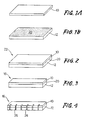
- Figs. 1(a) and 1(b) are perspective views respectively showing ferrite and ceramic sheets used to produce a core slider by a method according to one embodiment of this invention;
- Fig. 2 is a perspective view of a clad plate prepared by bonding together the ferrite and ceramic sheets of Figs. 1(a) and 1(b) with a high-melting-point glass;
- Fig. 3 is a perspective view of a slider body blank obtained by cutting the clad plate of Fig. 2;
- Fig. 4 is a perspective view showing the slider body blank after chip-accommodating grooves are formed therein;
- Fig. 5 is a perspective view of the slider body blank after coil-winding grooves are further formed therein;
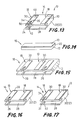
- Fig. 6 is a perspective view of the slider body blank after the opposite major surfaces are ground;
- Fig. 7 is a fragmentary perspective view of the slider body blank after core chips are secured in the chip-accommodating grooves;
- Fig. 8(a) is a perspective view of one of the core chips;
- Fig. 8(b) is a left-hand side elevational view of the core chip of Fig. 8(a);
- Fig. 9 is a fragmentary perspective view of the slider body blank with the core chips, after a leading ramp is formed thereon;
- Fig. 10 is a fragmentary perspective view showing etching masks formed on the slider body blank for forming air bearing portions thereon;
- Fig. 11 is a fragmentary perspective view showing the air bearing portions formed by etching on the slider body blank;
- Fig. 12 (a) is a fragmentary perspective view of the slider body blank after a trailing chamfer is cut;
- Fig. 12(b) is a fragmentary enlarged perspective view of the trailing chamfer;
- Fig. 13 is a perspective view of a core slider produced by the method illustrated in Figs. 1 through 12;
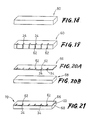
- Fig. 14 is a perspective view of a slider body blank similar to that of Fig. 3, whose opposite major surfaces have been ground, and which is used to produce a core slider by a method according to another embodiment of the invention;
- Fig. 15 is a fragmentary perspective view of the slider body blank after air bearing portions are formed by etching;
- Fig. 16 is a perspective view showing a slider body obtained by cutting the slider body blank of Fig. 15;
- Fig. 17 is a perspective view showing core chips secured in the slider body of Fig. 16;
- Fig. 18 is a perspective view of a ferrite block to provide ferrite sheets each used for producing a core slider according to a further embodiment of the present invention;
- Fig. 19 is a perspective view showing the ferrite block with glass-filler grooves filled with a low-melting-point glass;
- Fig. 20(a) is a perspective view of a ferrite sheet obtained by slicing the ferrite block of Fig. 19;
- Fig. 20(b) is a perspective view of a ceramic sheet prepared independently of the ferrite sheet;
- Fig. 21 is a perspective view of a slider body blank prepared by bonding together the ferrite and ceramic sheets of Figs. 20(a) and 20(b) by a high-melting-point glass;
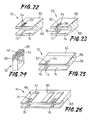
- Fig. 22 is a fragmentary perspective view showing the slider body blank having a chip-accommodating groove and a coil-winding groove formed therein;
- Fig. 23 is a fragmentary perspective view showing a core chip secured in the slider body blank of Fig. 22;
- Fig. 24 is a perspective view of the core chip of Fig. 23;
- Fig. 25 is a fragmentary perspective view of the slider body blank after a leading ramp is formed thereon;
- Fig. 26 is a fragmentary perspective view showing air bearing portions formed on the slider body blank of Fig. 25;
- Fig. 27 is a fragmentary perspective view showing the slider body blank after it is machined to a desired width and chamferred to provide a trailing chamfer; and
- Fig. 28 is a perspective view of a core slider produced by the method illustrated in Figs. 18 through 27.
- Reference is first made to Figs. 1-12 which illustrate the process steps for producing a core slider according to one embodiment of this invention. The core slider to be produced is indicated generally at 13 in Fig. 13. For producing the core slider of Fig. 13, there is prepared a generally elongate
rectangular ferrite sheet 10 which consists of a single crystal of Mn-Zn ferrite, as shown in Fig. 1(a). There is also prepared aceramic sheet 12 which has the same surface area and shape as the Mn-Zn ferrite sheet 10 and which is formed of a non-magnetic ceramic material. One of the opposite major surfaces of each of these ferrite andceramic sheets - In the present embodiment, the ferrite and
ceramic sheets ceramic sheets - The thicknesses of the ferrite and
ceramic sheets air bearing portions 18 are constituted by the ferrite layers 30, as is apparent from the following description. - The non-magnetic ceramic material of the
ceramic sheet 12 is a ceramic material whose coefficient of thermal expansion is close to that of a ferrite material. In particular, it is desirable that theceramic sheet 12 consists principally of CaTiO₃, or CaTiO₃ and a small amount of additives. While theair bearing portions 18 are formed by etching theferrite sheet 10, it is preferred to orient theferrite sheet 10 such that one of the crystal planes (100), (110), (311), (332), (611), (331) and (211) of the Mn-Zn single crystal is selected for the surface to be etched to provide theair bearing portions 18. - Subsequently, a
glass layer 20 having a thickness of about 0.05-20µm is formed, as shown in Fig. 1(b), on at least one of the mirror-polished surfaces of these ferrite andceramic sheets ceramic sheets glass layer 20 interposed therebetween, and bonded together under pressure and heat. Thus, aclad plate 22 consisting of the ferrite andceramic sheets glass layer 20 is prepared as shown in Fig. 2. - The glass material for the
glass layer 20 has generally a softening point of about 600°C or higher. For instance, theglass layer 20 has a glass composition which has a softening point of 670°C and which consists of 50% by weight of SiO₂, 7% by weight of B₂O₃, 7% by weight of Al₂O₃, 5% by weight of K₂O, 12% by weight of ZnO, 12% by weight of Na₂O, 5% by weight of CaO and 2% by weight of BaO. In bonding the twosheets glass layer 20 is heated to a temperature higher than its softening temperature, for example, about 720°C. - The
clad plate 22 consisting of the ferrite andceramic sheets glass layer 20 is cut along a widthwise centerline thereof, to provide twoslider body blanks 16 as shown in Fig. 3. Each slider body blank 16 has a width slightly larger than the length of the core slider 13 (Fig. 13) to be eventually produced. In the next step, chip-accommodatinggrooves 26 are formed in one of the opposite side faces of the slider body blank 16, which side faces define the width of the blank 16, as illustrated in Fig. 4. Thesegrooves 26 are provided to accommodatecore chips 24 as shown in Figs. 8(a) and 8(b). Thegrooves 26 are spaced apart from each other in the direction of length of the blank 16, with a spacing distance slightly larger than the width of the core slider 13 (which has onegroove 26 and onecore chip 24 as indicated in Fig. 13). Successively, a coil-windinggroove 28 is formed in the same side face of the slider body blank 16, more precisely, in theceramic sheet 12, such that thegroove 28 extends in the longitudinal direction of the blank 16, while intersecting the chip-accommodatinggrooves 24, as shown in Fig. 5. Thisgroove 28 permits a coil to be wound on thecore chip 24 which is fixed in the correspondinggroove 26, as described below. - After the
grooves ceramic sheets ferrite sheet 10 is slightly larger than that of the ferrite layers 30 on theslider body 14 of the core slider 13, while the thickness of theceramic sheet 12 is equal to that of theceramic layer 32 of theslider body 14. The slider body blank 16 as ground is shown in Fig. 6. After the slider body blank 16 is ground, the separately prepared core chips 24 as shown in Figs. 8(a) and 8(b) are inserted in the respective chip-accommodatinggrooves 26 in the blank 16, and are integrally bonded to the blank 16 with a mass of abonding glass 34 which has a relatively low melting point. - Each
core chip 24 is a generally rectangular body having a center cavity, as shown in Figs. 8(a) and 8(b). The core chip has anarrow portion 38 which defines a top one of the four sides of the rectangular body and which provides a track portion of the core slider 13. Thenarrow portion 38 includes an inclinedrear part 36, and has amagnetic gap 40 formed in an intermediate part. Themagnetic gap 40 is adapted to write and read information on or from a magnetic disk. As shown in Fig. 7, thecore chip 24 is positioned together with anon-magnetic spacer 42, within the appropriate chip-accommodatinggroove 26 in the slider body blank 16, such that the inclinedrear part 36 is located on the inner side of thegroove 26 and such that thenarrow portion 38 is exposed in the ground surface of theferrite sheet 10. A clearance between thenarrow portion 38 of thecore chip 24 and the inner surface of thegroove 16 is filled with a molten mass of thebonding glass mass 34, whereby thecore chip 24 is integrally bonded to theslider body blank 16. - The
bonding glass 34 has o low softening point than the high-melting-point glass of theglass layer 20, permitting the bonding of thecore chip 24 to the blank 16 at a temperature lower than that at which the ferrite andceramic sheets glass layer 20. The softening point of thebonding glass 34 is generally not higher than about 450°. For example, thebonding glass 34 has a glass composition which has a solfening point of 425°C and which consists of 18.5% by weight of SiO₂, 4.0% by weight of Al₂O₃, 62.0% by weight of PbO, 10.0% by weight of Bi₂O₃, 3.5% by weight of Na₂O, and 2.0% by weight of B₂O₃. - After the core chips 24 are fixedly accommodaded in the respective chip-accommodating
grooves 26 in the slider body blank 16, the major surface of theferrite sheet 10 in which themagnetic gap 40 is open is ground to adjust the depth of themagnetic gap 40 as measured in the direction of thickness of the blank 16, as indicated in Fig. 9. At the same time, the blank 16 is machined to provide a leadingramp 44 at the rear end portion of eachair bearing portion 18, which is subsequently formed on the blank 16. - After the slider body blank 16 is ground and machined, a pair of generally elongate rectangular etching masks 46 are formed, as shown in Fig. 10, so as to cover respective areas of the ground surface of the
ferrite sheet 10, which correspond to theair bearing portions 18 of each slider body 14 (Fig. 13) obtained by cutting the blank 16 as described below. In this condition, the exposed areas of the ground surface of theferrite sheet 10 are etched by a suitable depth, whereby there are formed the two spaced-apart parallelair bearing portions 18 for each slider body 14 (for each core slider 13), as shown in Fig. 11. The thickness of eachair bearing portion 18 corresponds to the depth of etching of theferrite sheet 10 of the blank 16. - Preferably, photolithography and chemical etching operations are used for forming the etching masks 46 and etching the
ferrite sheet 10, respectively, to provide theair bearing portions 18. - Usually, the etching depth is almost the same as the thickness of the
ferrite sheet 10 so that theceramic sheet 12 is exposed at its areas corresponding to the areas of theferrite sheet 10 which are not covered by the etching masks 46. In this case, the ferrite layers 30 are left only as theair bearing portions 18, as indicated in Fig. 11. However, a small thickness of the ferrite sheet 10 (ferrite layers 30) may be left in the areas not covered by themasks 46, provided that the ferrite material at those areas will cause substantially no magnetic flux leakage during operation of the core slider 13. To avoid a significant magnetic flux leakage, the thickness of the ferrite material left in the non-covered areas is preferably not more than about 150µm, more preferably not more than about 100µm. - It is noted that only one of the two air bearing portions 18 (ferrite layers 30) for each core slider 13 is aligned with the
core chip 24, and the otherair bearing portion 18 is disposed between the above oneair bearing portion 18 of the relevant core slider 13, and one of theair bearing portions 18 for the adjacent core slider 13. Please refer to Figs. 11 and 13. - After the
air bearing portions 18 are formed by etching, the slider body blank 16 is trimmed along a cuttingline 48 indicated in Fig. 11, to remove the edge portion remote from the core chips 24, so that the width of the trimmed blank 16 is equal to the length of the core slider 13 to be obtained. After or before this trimming operation, the trailing end of eachair bearing portion 18 and the corresponding end of thecore chip 24 are chamferred to provide a trailingchamfer 50, as shown in Figs. 12(a) and 12 (b). - After the slider body blank 16 is trimmed and chamferred, the blank 16 is cut along straight lines parallel to the direction of width of the blank, so that each core slider 13 thus obtained has the two adjacent
air bearing portions 18 as provided on the blank 16, such that the twoair bearing portions 18 are disposed at the opposite ends of the core slider 13 as viewed in the direction of width thereof, as indicated in Fig. 13. Then, a coil is wound on the trailing end side portion of therectangular core chip 24, by utilizing the coil-windinggroove 28 which communicates with the center cavity of thecore chip 24. Thus, the core slider 13 consisting of theslider body 14 and thecore chip 24 is provided with a magnetic head which has the coil and themagnetic gap 40. - According to the instant method of producing the core slider 13 for a rigid magnetic disk drive, the core chips 24 are prepared independently of the slider body blank 16 (slider body 14), and the magnetic head for writing and reading information can be considerably small-sized and compact, which is a typical feature of the so-called "composite type" core slider. In addition, since the
air bearing portions 18 are constituted by the ferrite layers 30 made of Mn-Zn ferrite having a sufficiently low friction resistance, the core slider 13 permits smooth sliding of the magnetic disk on theair bearing portions 18, and assures minimum scratch of not only the magnetic disk but also theair bearing portions 18. Thus, theair bearing portions 18 have considerably improved durability. Namely, the present core slider 13 has accordingly increased life expectancy. - Further, the core slider 13 produced as described above is substantially free of magnetic flux leakage from the
core chip 24, since the ferrite material exists on theslider body 14 only at theair bearing portions 18 as the ferrite layers 30, or only a small thickness of the ferrite material covers the portion of theceramic sheet 12 between theair bearing portions 18. The magnetic flux leakage is avoided also by thebonding glass mass 34 which fills the clearance between thecore chip 24 and the ferrite material. Thus, the instant core slider 13 does not suffer from the conventionally experienced deterioration of the magnetic efficiency due to the magnetic flux leakage from the core chip to the ferrite material as the air bearing portions. - The present method permits simultaneous etching of the
ferrite sheet 10, for efficient formation of theair bearing portions 18 for a plurality of core sliders 13. Further, the present method permits easy grinding of theferrite sheet 10 to simultaneously adjust the desired depth of themagnetic gap 40 for each of the two or more core sliders 13. Thus, the method assures improved production efficiency. - Referring next to Figs. 14-17, there will be described another embodiment of the method of the present invention, for producing the core slider 13 which has the same construction as described above. In the present modified embodiment, the slider body blank 16 prepared in the same manner as described above with respect to the first embodiment is used. That is, the slider body blank 16 as shown in Fig. 14 is ground at the top and bottom surfaces (exposed major surfaces of the ferrite and
ceramic sheets 10, 12), so that the thickness of theferrite sheet 10 is slightly larger than the thickness of the ferrite layers 30 (air bearing portions 18) of the core slider 13 to be produced, while the thickness of theceramic sheet 12 is equal to that of theceramic layer 32. Subsequently, the blank 16 is subjected to an etching operation to form theair bearing portions 18, as shown in Fig. 15, in substantially the same manner as described above. Before or after this etching operation, the chip-accommodatinggrooves 26 and the coil-windinggroove 28 are formed in the slider body blank 16, as also shown in Fig. 15. In the present embodiment, the ferrite material exists only as theair bearing portions 18. - After the
air bearing portions 18 and the chip-accommodating and coil-windinggrooves - In the next step, the separately
prepared core chip 24 is inserted in the chip-accommodatinggroove 26 and bonded to theslider body 14, with the low-melting-pointbonding glass mass 34, as shown in Fig. 17, in the same manner as described above with respect to the first embodiment. - After the
core chip 24 is fixedly accommodated in thegroove 26 in theslider body 14, the surface of the core slider 13 on the side of the air bearing portions 18 (ferrite sheet 10) is ground, so as to establish the desired depth of themagnetic gap 40 in thecore chip 24. Then, theslider body 14 is machined and chamferred to provide the leading ramp and the trailing chamfer, whereby the core slider 13 is eventually produced, as shown in Fig. 17. - The core slider 13 thus produced enjoys the same advantages as the core slider produced according to the preceding embodiment. Further, the
magnetic gap 40 may have a more accurately controlled depth, since the grinding operation to determine the depth of thegap 40 is effected for each core slider 13, independently of the grinding operation for another core slider. Unlike the production method according to the first embodiment, this second embodiment permits the grinding depth to be adjusted to an optimum value, so as to absorb or accommodate a variation in the position of thecore chip 24 relative to the surfaces of theair bearing portions 18. - Referring further to Figs. 18-28, there is illustrated a further embodiment of the present invention. The process steps of this embodiment are shown in Figs. 18 through 27, while the core slider to be produced is indicated at 78 in Fig. 28.
- In the present embodiment, there is prepared a generally elongate
rectangular ferrite block 60 consisting of a single crystal of Mn-Zn ferrite, as indicated in Fig. 18. Thisferrite block 60 has a thickness which is several times that of theferrite sheet 10 used in the preceding embodiments. Then, a plurality of glass-filler grooves 62 are formed in theferrite block 60, as indicated in Fig. 19, such that thegrooves 62 are spaced apart from each other by a spacing distance equal to that of the chip-accommodatinggrooves 26 in the preceding embodiments. The formed glass-filler grooves 62 are filled with the low-melting-pointbonding glass mass 34 as used in the preceding embodiments. - After the
grooves 62 are filled with theglass mass 34, theferrite block 60 is sliced into a plurality offerrite sheets 66 each having the same thickness as theferrite sheet 10. One of theseferrite sheets 66 is shown in Fig. 20(a). The opposite major surfaces of eachferrite sheet 66 are ground, and one of the ground surfaces is mirror-polished. - In the meantime, there is prepared a
ceramic sheet 68 which is made of the same non-magnetic material and has the same thickness and cross sectional area as theceramic sheet 12 used in the preceding embodiments. Thisceramic sheet 68, which is shown in Fig. 20(b), is ground at the opposite major surfaces, and is mirror-polished at one of the ground surfaces, like theferrite sheet 66. - The thus
prepared ferrite sheet 66 and theceramic sheet 68 are bonded together at the mirror-polished surfaces, with thebonding glass layer 20, whereby a slider body blank 70 is prepared as indicated in Fig. 21. In the thus prepared slider body blank 70, there are formed chip-accommodatinggrooves 72 and a coil-windinggroove 74, as shown in Fig. 22. - Each chip-accommodating
groove 72 is formed through thebonding glass mass 34 filling the glass-filler groove 62. More specifically, a portion of thebonding glass mass 34 is left on the opposite surfaces of thegroove 62 such that the remaining portion of theglass mass 34 defines the chip-accommodatinggroove 72 aligned with the centerline of thegroove 62, as indicated in Fig. 22. Namely, the width of the chip-accommodatinggroove 72 is smaller than that of the glass-filler groove 62. - After the
grooves core chip 76 having amagnetic gap 40 is inserted into the appropriate chip-accommodatinggroove 72. In this condition, the slider body blank 70 is heated to soften the remainingbonding glass mass 34, to thereby bond thechip 76 to the blank 70, as shown in Fig. 23. - As shown in Fig. 24, the
core chip 76 used in this third embodiment is more or less similar to thecore chip 24 of the preceding embodiments, but is different from thecore chip 24 in that thenarrow portion 38 is formed in the middle of the thickness of thechip 76. Further, the masses of thebonding glass 34 are deposited on thechip 76 such that thenarrow portion 36 is embedded in thebonding glass 34. - For bonding the
core chip 76 to the slider body blank 70, thecore chip 76 is first positioned in the chip-accommodatinggroove 72, and thebonding glass 34 is then softened at an elevated temperature, so that thecore chip 76 is integrally bonded to the blank 70 with theglass 34, as shown in Fig. 23, like thecore chip 24 in the preceding embodiments. - As in the preceding embodiments, the surface of the blank 70 in which the
magnetic gap 40 of thecore chip 76 is open is ground, so as to establish the desired depth of themagnetic gap 40, and the blank 76 is machined to provide the leadingramp 44 at the leading end portion of eachair bearing portion 80 on acore slider 78 to be produced (Fig. 28), as shown in Fig. 25. Then, theferrite sheet 66 of the blank 70 is etched to form theair bearing portions 80, as shown in Fig. 26, in the same manner as in the preceding embodiments. Subsequently, the blank 70 is trimmed to determine the length of thecore slider 78, and chamferred to provide the trailing chamfer, as indicated in Fig. 27. Then, the blank 70 is cut to provide thecore slider 78 which consists of thecore chip 76, and aslider body 82 having the desired width. - In the present embodiment, too, the thickness of the ferrite layers 30 constituting the
air bearing portions 80 is preferably not more than 150µm, and more preferably not more than 100µm, in order to effectively avoid the magnetic flux leakage from thecore chip 76. - Like the core slider 13 produced according to the first and second embodiments, the
core slider 78 produced by the instant third embodiment assures smooth sliding of a magnetic disk (as a data storage medium) on theair bearing portions 80, which are constituted by the Mn-Zn ferrite layers 30 having a low sliding resistance. Thus, thecore slider 78 and the magnetic head including thiscore slider 78 have considerably increased life expectancy. Further, since the ferrite layers 30 have an extremely small thickness, and are isolated by thebonding glass 34 from thecore chip 76, theinstant core slider 78 is substantially free of the deterioration of the magnetic efficiency due to the magnetic flux leakage from thecore chip 76. - The present embodiment is advantageous over the preceding embodiments, since the
spacer 42 is not necessary for bonding thecore chip 76 to theslider body blank 70. - While the present invention has been described in its presently preferred embodiments, it is to be understood that the invention is not limited to the details of the illustrated embodiments, but may be embodied with various changes, modifications and improvements, which may occur to those skilled in the art, without departing from the spirit of the invention which is understood from the foregoing description.
- For instance, the
air bearing portions ferrite sheet air bearing portions magnetic gap 40, or after the blank 16, 70 is ground for the same purpose. - In the illustrated embodiments, the
core slider 13, 78 has thecore chip air bearing portions core chip slider body air bearing portions
Claims (16)
- A core slider for a rigid magnetic disk drive, including a slider body having air bearing portions, and a core chip which has a magnetic gap (40) for writing and reading information and which is integrally secured to said slider body, characterized in that:
said slider body (14, 82)has one or more ferrite sections (30) which include at least said air bearing portions (18, 80) and which are formed of Mn-Zn ferrite, and a non-magnetic ceramic section (32) formed of a non-magnetic ceramic material;
said slider body has a chip-accommodating groove (26, 72); and
said core chip ( 24, 76 ) is accommodated in said chip-accommodating groove and glass-bonded to said slider body. - A core slider according to claim 1, wherein said ferrite section (30) consists of a single crystal of Mn-Zn ferrite.
- A core slider according to claim 1 or 2, wherein said non-magnetic ceramic material of said non-magnetic ceramic section (32) includes CaTiO₃ as a major component thereof.
- A core slider according to any one of claims 1-3, wherein said ferrite section (30) has a thickness of not more than 150µm.
- A core slider according to any one of claims 1-4, wherein said core chip (24, 76) has a narrow portion (38) which extends in a direction of extension of said air bearing portions (18, 80) and which has said magnetic gap (40), a dimension of said narrow portion in a direction perpendicular to said direction of extension of said air bearing portions being smaller than a dimension of said chip-accommodating groove (26, 72) in said direction of extension.
- A core slider according to claim 5, wherein said core chip (24, 76) is bonded to said slider body (14, 82) by a glass material which fills a space around said narrow portion (38) of said core chip in said chip-accommodating groove (26, 72).
- A method of producing a core slider for a rigid magnetic disk drive, the core sliding including a slider body having air bearing portions, and a core chip which has a magnetic gap (40) for writing and reading information and which is integrally secured to said slider body, said method comprising the steps of:
preparing a slider body blank (16, 70) by glass-bonding together a Mn-Zn ferrite sheet (10) and a non-magnetic ceramic sheet (12), said slider body blank giving said slider body (14, 82);
preparing said core chip (24, 76) having said magnetic gap (40);
forming a chip-accommodating groove (26, 72) for accommodating said core chip;
inserting said core chip in said chip-accommodating groove and glass-bonding said core chip to said slider body blank; and
forming said air bearing portions (18, 80) on said slider body blank such that said air bearing portions are provided by said Mn-Zn ferrite sheet, to thereby provide said slider body. - A method according to claim 7, wherein said step of forming said air bearing portions ( 18, 80 ) comprises etching said Mn-Zn ferrite sheet ( 10 ) of said slider body blank.
- A method according to claim 7, wherein said step of forming said air bearing portions (18, 80) comprises machining said Mn-Zn ferrite sheet (10) of said slider body blank.
- A method according to any one of claims 7-9, wherein said core chip (24) is inserted in said chip-accommodating groove (26) and glass-bonded to said slider body blank (16), after said air bearing portions (18) are formed on said slider body blank.
- A method according to claim 10, further comprising a step of grinding said air bearing portions (18) and a surface of said core chip (24) in which said magnetic gap (40) is open, after said core chip is glass-bonded to said slider body blank.
- A method according to any one of claims 7-9, wherein said core chip (24, 76) is inserted in said chip-accommodating groove (26, 72) and glass-bonded to said slider body blank (16, 70), before said air bearing portions (18, 80) are formed on said slider body blank.
- A method according to claim 12, further comprising a step of grinding said Mn-Zn ferrite sheet (10) and a surface of said core chip (24, 76) in which said magnetic gap (40) is open, after said core chip is glass-bonded to said slider body blank and before said air-bearing portions (18, 80) are formed.
- A method according to any one of claims 7-13, further comprising a step of forming a coil-winding groove (28, 74) in said slider body blank (16, 70) which permits a coil to be wound on said core chip (24, 76) accommodated in said chip-accommodating groove ( 26, 72 ).
- A method according to any one of claims 7-14, wherein said step of glass-bonding said core chip (24) to said slider body blank (16) comprises filling a clearance between said core chip and said chip-accommodating groove (26), with a bonding glass (34).
- A method according to any one of claims 7-14, further comprising a step of forming a glass-filler groove (62) in said slider body blank (70) and filling said glass-filler groove with a mass of bonding glass (34), before said chip-accommodating groove (72) is formed by removing a portion of said mass of bonding glass, said core chip being glass-bonded to said slider body by a remaining portion of said mass of bonding glass.
Applications Claiming Priority (2)
| Application Number | Priority Date | Filing Date | Title |
|---|---|---|---|
| JP2074371A JPH0782629B2 (en) | 1990-03-23 | 1990-03-23 | Core slider for fixed magnetic disk device and manufacturing method thereof |
| JP74371/90 | 1990-03-23 |
Publications (3)
| Publication Number | Publication Date |
|---|---|
| EP0449535A2 true EP0449535A2 (en) | 1991-10-02 |
| EP0449535A3 EP0449535A3 (en) | 1992-11-25 |
| EP0449535B1 EP0449535B1 (en) | 1995-06-28 |
Family
ID=13545242
Family Applications (1)
| Application Number | Title | Priority Date | Filing Date |
|---|---|---|---|
| EP91302548A Expired - Lifetime EP0449535B1 (en) | 1990-03-23 | 1991-03-22 | Core slider for rigid magnetic disc drive, and method of producing the same |
Country Status (4)
| Country | Link |
|---|---|
| US (2) | US5177654A (en) |
| EP (1) | EP0449535B1 (en) |
| JP (1) | JPH0782629B2 (en) |
| DE (1) | DE69110720T2 (en) |
Cited By (1)
| Publication number | Priority date | Publication date | Assignee | Title |
|---|---|---|---|---|
| US6445542B1 (en) | 2000-03-06 | 2002-09-03 | Read-Rite Corporation | Air bearing slider |
Families Citing this family (5)
| Publication number | Priority date | Publication date | Assignee | Title |
|---|---|---|---|---|
| EP0602486B1 (en) * | 1992-12-14 | 1999-02-10 | Minebea Co.,Ltd. | Floating magnetic head |
| US5522126A (en) * | 1993-03-26 | 1996-06-04 | Ngk Insulators, Ltd. | Method of manufacturing a composite magnetic head |
| US6404591B1 (en) | 1996-02-06 | 2002-06-11 | Mitsumi Electric Co., Ltd. | Magnetic head having cut-out portions for different recording density head cores |
| JP3300970B2 (en) * | 1996-04-12 | 2002-07-08 | ミネベア株式会社 | Manufacturing method of floating magnetic head |
| US7477486B1 (en) | 2005-12-07 | 2009-01-13 | Western Digital (Fremont), Llc | Air bearing slider with a side pad having a shallow recess depth |
Family Cites Families (13)
| Publication number | Priority date | Publication date | Assignee | Title |
|---|---|---|---|---|
| JPS5292710A (en) * | 1976-01-30 | 1977-08-04 | Hitachi Ltd | Magnetic head |
| JPS5487516A (en) * | 1977-12-23 | 1979-07-12 | Fujitsu Ltd | Magnetic head |
| FR2447072A1 (en) * | 1979-01-17 | 1980-08-14 | Cii Honeywell Bull | BODY CONTAINING AT LEAST ONE TRANSDUCER FOR READING AND / OR RECORDING INFORMATION CONTAINED ON A MEDIUM |
| JPS5622217A (en) * | 1979-08-01 | 1981-03-02 | Hitachi Ltd | Manufacture of magnetic head |
| JPS5625261A (en) * | 1979-08-08 | 1981-03-11 | Fujitsu Ltd | Magnetic head |
| JPS60136004A (en) * | 1983-12-22 | 1985-07-19 | Fujitsu Ltd | Manufacture of vertical magnetic recording head |
| JPS61184708A (en) * | 1985-02-12 | 1986-08-18 | Hitachi Metals Ltd | Composite magnetic head |
| JPS61278005A (en) * | 1985-06-04 | 1986-12-08 | Alps Electric Co Ltd | Floating magnetic head |
| JPS62124684A (en) * | 1985-11-25 | 1987-06-05 | Yokogawa Electric Corp | Head slider |
| JPS6334714A (en) * | 1986-07-29 | 1988-02-15 | Seiko Epson Corp | Production of floating type magnetic head |
| JPH01189020A (en) * | 1988-01-22 | 1989-07-28 | Hitachi Metals Ltd | Floating type composite magnetic head |
| JPH01276419A (en) * | 1988-04-27 | 1989-11-07 | Seiko Epson Corp | Production of composite type magnetic head |
| US4870521A (en) * | 1988-06-23 | 1989-09-26 | Kyocera Corporation | Floating magnetic head |
-
1990
- 1990-03-23 JP JP2074371A patent/JPH0782629B2/en not_active Expired - Lifetime
-
1991
- 1991-03-19 US US07/672,111 patent/US5177654A/en not_active Expired - Fee Related
- 1991-03-22 EP EP91302548A patent/EP0449535B1/en not_active Expired - Lifetime
- 1991-03-22 DE DE69110720T patent/DE69110720T2/en not_active Expired - Fee Related
-
1992
- 1992-08-21 US US07/933,301 patent/US5297330A/en not_active Expired - Fee Related
Cited By (1)
| Publication number | Priority date | Publication date | Assignee | Title |
|---|---|---|---|---|
| US6445542B1 (en) | 2000-03-06 | 2002-09-03 | Read-Rite Corporation | Air bearing slider |
Also Published As
| Publication number | Publication date |
|---|---|
| US5177654A (en) | 1993-01-05 |
| JPH0782629B2 (en) | 1995-09-06 |
| DE69110720D1 (en) | 1995-08-03 |
| DE69110720T2 (en) | 1996-02-08 |
| EP0449535A3 (en) | 1992-11-25 |
| US5297330A (en) | 1994-03-29 |
| JPH03273520A (en) | 1991-12-04 |
| EP0449535B1 (en) | 1995-06-28 |
Similar Documents
| Publication | Publication Date | Title |
|---|---|---|
| US5020213A (en) | Method of producing a head core slider | |
| US5107382A (en) | Head core slider having an air bearing surface of a particular configuration | |
| US5008767A (en) | Flying-type composite magnetic head having magnetic core with improved flatness of air-bearing surface | |
| US5157569A (en) | Thin film magnetic head | |
| EP0140977B1 (en) | Magnetic head and method of manufacture thereof | |
| JPH02156411A (en) | Monolithic reading/writing recording head used for disc drive system and manufacture thereof | |
| EP0449535B1 (en) | Core slider for rigid magnetic disc drive, and method of producing the same | |
| EP0488539A2 (en) | Method of manufacturing flying magnetic head | |
| JPH0554167B2 (en) | ||
| US4821131A (en) | Core assembly for a flying magnetic head with magnetic gap on air-bearing surface | |
| US5010431A (en) | Flying-type composite magnetic head | |
| JP3083675B2 (en) | Manufacturing method of magnetic head | |
| US5267107A (en) | Laminated magnetic transducer | |
| US5708543A (en) | Magnetic head with glass used to bond together two core halves having a coefficient of thermal expansion less than that of the ferromagnetic oxide used to make the core halves | |
| JP3057861B2 (en) | Manufacturing method of magnetic head | |
| US5522126A (en) | Method of manufacturing a composite magnetic head | |
| JP3311790B2 (en) | Method for manufacturing core for composite magnetic head | |
| JP2545304B2 (en) | Flying magnetic head | |
| JPH08508360A (en) | Hybrid metallic and thin film read / write head | |
| JPH0654528B2 (en) | Magnetic head | |
| JPH03288306A (en) | Multichannel magnetic head and manufacture of the same | |
| JPH08153308A (en) | Method of manufacturing magnetic head | |
| JPS618710A (en) | Manufacture of magnetic head | |
| JPH01260609A (en) | Composite magnetic head and its manufacture | |
| JPS63112813A (en) | Composite magnetic head and its manufacture |
Legal Events
| Date | Code | Title | Description |
|---|---|---|---|
| PUAI | Public reference made under article 153(3) epc to a published international application that has entered the european phase |
Free format text: ORIGINAL CODE: 0009012 |
|
| 17P | Request for examination filed |
Effective date: 19910507 |
|
| AK | Designated contracting states |
Kind code of ref document: A2 Designated state(s): BE DE FR GB IT LU NL |
|
| PUAL | Search report despatched |
Free format text: ORIGINAL CODE: 0009013 |
|
| AK | Designated contracting states |
Kind code of ref document: A3 Designated state(s): BE DE FR GB IT LU NL |
|
| 17Q | First examination report despatched |
Effective date: 19940818 |
|
| GRAA | (expected) grant |
Free format text: ORIGINAL CODE: 0009210 |
|
| AK | Designated contracting states |
Kind code of ref document: B1 Designated state(s): BE DE FR GB IT LU NL |
|
| REF | Corresponds to: |
Ref document number: 69110720 Country of ref document: DE Date of ref document: 19950803 |
|
| ITF | It: translation for a ep patent filed | ||
| ET | Fr: translation filed | ||
| PG25 | Lapsed in a contracting state [announced via postgrant information from national office to epo] |
Ref country code: LU Free format text: LAPSE BECAUSE OF NON-PAYMENT OF DUE FEES Effective date: 19960331 Ref country code: BE Effective date: 19960331 |
|
| PLBE | No opposition filed within time limit |
Free format text: ORIGINAL CODE: 0009261 |
|
| STAA | Information on the status of an ep patent application or granted ep patent |
Free format text: STATUS: NO OPPOSITION FILED WITHIN TIME LIMIT |
|
| 26N | No opposition filed | ||
| BERE | Be: lapsed |
Owner name: NGK INSULATORS LTD Effective date: 19960331 |
|
| PGFP | Annual fee paid to national office [announced via postgrant information from national office to epo] |
Ref country code: FR Payment date: 19990305 Year of fee payment: 9 |
|
| PGFP | Annual fee paid to national office [announced via postgrant information from national office to epo] |
Ref country code: DE Payment date: 19990308 Year of fee payment: 9 |
|
| PGFP | Annual fee paid to national office [announced via postgrant information from national office to epo] |
Ref country code: NL Payment date: 19990310 Year of fee payment: 9 |
|
| PGFP | Annual fee paid to national office [announced via postgrant information from national office to epo] |
Ref country code: GB Payment date: 19990312 Year of fee payment: 9 |
|
| PG25 | Lapsed in a contracting state [announced via postgrant information from national office to epo] |
Ref country code: GB Free format text: LAPSE BECAUSE OF NON-PAYMENT OF DUE FEES Effective date: 20000322 |
|
| PG25 | Lapsed in a contracting state [announced via postgrant information from national office to epo] |
Ref country code: NL Free format text: LAPSE BECAUSE OF NON-PAYMENT OF DUE FEES Effective date: 20001001 |
|
| GBPC | Gb: european patent ceased through non-payment of renewal fee |
Effective date: 20000322 |
|
| PG25 | Lapsed in a contracting state [announced via postgrant information from national office to epo] |
Ref country code: FR Free format text: LAPSE BECAUSE OF NON-PAYMENT OF DUE FEES Effective date: 20001130 |
|
| NLV4 | Nl: lapsed or anulled due to non-payment of the annual fee |
Effective date: 20001001 |
|
| REG | Reference to a national code |
Ref country code: FR Ref legal event code: ST |
|
| PG25 | Lapsed in a contracting state [announced via postgrant information from national office to epo] |
Ref country code: DE Free format text: LAPSE BECAUSE OF NON-PAYMENT OF DUE FEES Effective date: 20010103 |
|
| PG25 | Lapsed in a contracting state [announced via postgrant information from national office to epo] |
Ref country code: IT Free format text: LAPSE BECAUSE OF NON-PAYMENT OF DUE FEES;WARNING: LAPSES OF ITALIAN PATENTS WITH EFFECTIVE DATE BEFORE 2007 MAY HAVE OCCURRED AT ANY TIME BEFORE 2007. THE CORRECT EFFECTIVE DATE MAY BE DIFFERENT FROM THE ONE RECORDED. Effective date: 20050322 |