EP0449579A2 - Machine de simulation logique - Google Patents
Machine de simulation logique Download PDFInfo
- Publication number
- EP0449579A2 EP0449579A2 EP91302632A EP91302632A EP0449579A2 EP 0449579 A2 EP0449579 A2 EP 0449579A2 EP 91302632 A EP91302632 A EP 91302632A EP 91302632 A EP91302632 A EP 91302632A EP 0449579 A2 EP0449579 A2 EP 0449579A2
- Authority
- EP
- European Patent Office
- Prior art keywords
- simulation
- data
- machine
- memory
- host
- Prior art date
- Legal status (The legal status is an assumption and is not a legal conclusion. Google has not performed a legal analysis and makes no representation as to the accuracy of the status listed.)
- Withdrawn
Links
Images






Classifications
-
- G—PHYSICS
- G06—COMPUTING OR CALCULATING; COUNTING
- G06F—ELECTRIC DIGITAL DATA PROCESSING
- G06F30/00—Computer-aided design [CAD]
- G06F30/30—Circuit design
- G06F30/32—Circuit design at the digital level
- G06F30/33—Design verification, e.g. functional simulation or model checking
Definitions
- the present invention relates generally to a logic simulation machine of the type adapted to simulate digital logic by exchanging data with a host computer, and particularly to the transmission of data between a logic simulation machine and a host computer.
- One technique for providing design verification is logic simulation by a general purpose computer.
- Another technique is to use a special purpose computer that is optimized for logic simulation.
- the special purpose computer usually uses a multiple processor architecture by which a number of processors, called simulation processors, may be interconnected to improve simulation performance.
- the special purpose computer may operate in combination with a host computer which is used to provide several services, loading functions, analysis on the results of the simulation, user interface, etc.
- Such a special purpose computer is called a logic simulation machine.
- the host computer needs to access data in the logic simulation machine during a simulation in which the host computer participates for example, when performing memory modeling or device behavioral tasks, which the simulation processors of the logic simulation machine cannot perform.
- a logic of the type adapted to simulate digital logic by exchanging data with a host computer, characterised by first memory for storing instructions to specify operation of the machine, second memory for storing data defining a logic model for simulation by the machine, a simulation bus for connecting the machine to the host computer, as further characterised in that said second memory is responsive to instructions from said first memory to fetch selected data and to apply such data to said simulation bus.
- the command called as a Broadcast command, includes a field to specify communication operation performed by the machine and plural fields to specify addresses in the second memory unit.
- the Broadcast command is stored in the first memory unit with the instructions to specify operation of the machine at a place where it is necessary for the machine to send the data to the host for host tasks, e.g., memory modeling, tracing, etc., during the simulation.
- the address fields in the Broadcast command can specify any addresses in the second memory unit to collect the data from the machine.
- the Broadcast command fetches the plural data designated by the address fields from the second memory unit at a time and puts on the data on the simulation bus means in parallel. If size of the simulation bus means is broad enough to send the data fetched by more than one Broadcast command at a time, several Broadcast commands are executed by the machine simultaneously or sequentially to put data on the bus means to form a packet of information to be sent to the host.
- the data on the simulation bus means can be received by the host computer or by the auxiliary processor which performs host tasks in place of the host through the simulation bus means.
- Fig. 1 is an entire schematic block diagram of a logic simulation machine in which a method according to a preferred embodiment of the invention is used.
- Fig. 2 is a schematic block diagram of the simulation processor plugged into the slot 0 in Fig. 1.
- Fig. 3 is a schematic diagram showing contents of a block description array of the simulation processor of Fig. 2.
- Fig. 4 is a schematic diagram showing the op-code field of the instructions stored in the block description array of Fig. 3.
- Fig. 5 is a schematic block diagram of a simplified logic circuit model used in explaining a block description instruction and operation of the simulation processor shown in Fig. 2.
- Fig. 6 is a schematic block diagram of a current state array of the simulation processor of Fig 2.
- Fig. 7 is a detailed schematic block diagram of a part of the simulation processor of Fig. 2.
- Fig. 8 is a schematic block diagram of an outputting means of the simulation processor of Fig. 2 for putting a result from a logic function table on allocated data lines of the simulation bus.
- Fig. 9 is an instruction list to explain a method of compiling a model to be simulated by the machine of Fig. 1.
- Fig. 10 is a simplified illustration of the block description arrays of the simulation processors in the machine of Fig. 1 to explain operation of the machine.
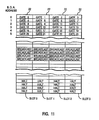
- Fig. 11 is a simplified illustration of the block description arrays of the logic simulation machine of another configuration.
- Fig. 12 is a schematic diagram to explain a Broadcast command to be used by the method according to a preferred embodiment of the invention.
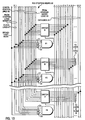
- Fig. 13 is a schematic block diagram of a bus steering means which is used by the Broadcast command to put data from the simulation processors on a simulation bus means to send the data to a host computer.
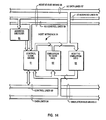
- Fig. 14 is a schematic block diagram of a host interface of the simulation processor of Fig. 2.
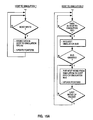
- Figs. 15A and 15B are flow charts to explain operation of the host interface of Fig. 14.
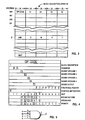
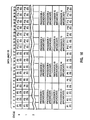
- Fig. 16 is a schematic diagram to explain how the logic simulation machine of Fig. 1 puts data on the simulation bus means during gate evaluation and Broadcast operation.
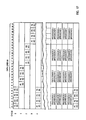
- Fig. 17 is a schematic diagram to explain how the logic simuation machine of another configuration puts data on the simulation bus means during gate evaluation and Broadcast operation.
- the logic simulation machine 1 is the subject of the co-pending application US Serial No. filed and having internal docket No. AT9-89-099.
- the machine 1 includes plural simulation processors 2 connected to each other in parallel through a simulation bus means 3. Although four simulation processors 2 are shown in Fig. 1, the number of the simulation processors 2 connected to the simulation bus means 3 is sixteen and sixteen processors are a maximum configuration in this example for explanation purpose. However, any number of simulation processors selected from a group consisting of 1, 2, 4, 8, and 16 is able to be used in the machine 1.
- the simulation bus means 3 comprises three parts: data lines 3A through which each simulation processor 2 transfers a simulated result and each simulation processor 2 receives the results from all the simulation processors 2 to update its own copy of current states when evaluating gates, through which a host computer 5 transfers packet data to the simulation processors 2 when not evaluating gates, and through which the simulation processors 2 transfer any packet data to the host 5 by Broadcast commands; control lines 3B through which current contents on the data lines 3A are indicated and arbitration for the bus 3 is done; and configuration lines 3C through which a unique code is transferred to each of the simulation processors 2 to inform the configuration of the simulation processors.
- the simulation bus means 3 further comprises slot means 0, 1, 2,..., 15 and n.
- Each simulation processor 2 is plugged into the slot means 0, 1, 2,..., or 15 for connection with the simulation bus means 3.
- Each slot means 0, 1, 2,..., or 15 of the simulation bus means 3 has a hard wired means 3D associated with the configuration lines 3C.
- the number of the configuration lines 3C depends on how many simulation processors 2 the logic simulation machine 1 can contain. In this embodiment, the number of the lines 3C is four to convey a different 4-bit binary data to each of the sixteen simulation processors.
- the hard wired means 3D of the slot means 0 sets all the lines of the configuration lines 3C OFF so that the configuration lines 3C input 4-bit binary zero data 0000 into the simulation processor 2 plugged into the slot means 0.
- the hard wired means 3D of the slot means 1 sets the least significant bit line ON and the other three lines OFF so that the configuration lines 3C input binary data 0001 into the simulation processor 2 plugged into that slot means.
- the hard wired means 3D of the slot means 2 sets the second least significant bit line ON and the other three lines OFF so that the configuration lines 3C input binary data 0010 into the simulation processor 2 plugged into that slot means and so on.
- the hard wired means 3D of the slot means 15 sets all the lines ON so that the configuration lines 3C input binary data 1111 into the simulation processor 2 plugged into that slot means.
- An auxiliary processor 4 which executes some tasks, for example, memory modeling or trace collection which is the subject of the co-pending application US Serial No. filed and having internal docket No. AT9-89-096, instead of the host computer 5 may be plugged into the slot means n of the bus means 3 for connection with the simulation bus means 3 in parallel with the simulation processors 2.
- the number of the data lines 3A depends on how many simulation processors 2 the logic simulation machine 1 can contain and how many bits each simulation processor 2 needs to represent a calculated result.
- Each of the simulation processors 2 is allocated two data lines 3A to transfer a result calculated by that processor to all of the simulation processors 2, depending upon which slot means that processor 2 occupies as explained later.
- the data lines 3A can be used by the host computer 5 to load data and instructions into each of the simulation processors 2 and the auxiliary processor 4 before simulation anti also be used by the machine 1 to send the data stored in the simulation processors 2 to the host 5 and the auxiliary processor 4 during the simulation as explained later.
- the host computer 5 may be a conventional engineering workstation.
- the host computer 5 includes a central processing unit 51, a main memory 52, a disk file (direct access storage device) 53, a keyboard 54, a display 55, and a host I/O bus means 56.
- Each of the simulation processors 2 and the auxiliary processor 4 are connected to the host computer 5 through the I/O bus means 56 by being plugged into slot means (not shown) of the I/O bus means 56. If the number of the simulation processors 2 exceeds the number of the I/O slot means provided within the host computer 5, an extension housing may be used to connect the additional simulation processors to the host computer 5.
- the simulation processors 2 and the auxiliary processor 4 are provided on rectangular cards. Connector (not shown) for the slot (not shown) of the host I/O bus means 56 is provided at one end of the card on which the simulation processor 2 or the auxiliary processor 4 is mounted. Connector (not shown) for the slot means 0, 1, ..., 15 or n of the simulation bus means 3 is provided at the opposite end of the card.
- the simulation processors 2 and the auxiliary processor 4 are installed in the host 5 by directly plugging the connector (not shown) at the one end of the card into the slot (not shown) of the host I/O bus 56.
- the simulation bus means 3 connects the simulation processors 2 and the auxiliary processor 4 by plugging the slot means 0 thru n into the connectors (not shown) at the opposite end of the cards.
- Each simulation processor 2 has seven primary elements: a first memory unit, such as a block description array 22; a second memory unit, such as a current state array 23; a logical function table 24; an outputting means 25; a bus steering means 80; a program counter 26; and a control logic means 27.
- the block description array 22 is an instruction memory for the simulation processor 2 which contains all of the information necessary to specify operations of that processor.
- Fig 3 shows contents of the block description array 22.
- An instruction stored at one address in the array 22 contains an op-code field (16 bits), A1, A2, A3, and A4 fields (each 24 bits in this embodiment).
- one instruction word corresponds to each logical block or gate in a model to be simulated.
- the instruction word's address represents a block or gate identifier.
- the instruction contains the op-code field, to specify a logical function of the gate, such as AND, OR, etc., and four fields A1, A2, A3 and A4, to specify input connections or input operands of the gate.
- a block description instruction corresponds to a single 1-output, 4-input gate.
- the logical function of the gate is determined by an 8-bit function pointer FFFFFF in the op-code which is an index to the logical function table 24.
- Input/output inversion can be done independent of the logical function table 24 by inversion bits I1, I2, I3, I4, and I0 in the op-code.
- the fields A1, A2, A3, and A4 represent addresses in the current state array 23 where the four input operands are stored.
- the block description instruction's address in the block description array 22 implies its output address in the current state array 23 where the calculated result is to be stored.
- the size of the block description array 22 depends on a desired capacity of the machine 1. In this example, the array 22 can store up to 512 K block description instructions.
- Fig. 5 shows an example of a gate to be simulated by the simulation processor 2 in order to illustrate the block description instruction shown at an address Z in Fig. 3.
- An AND gates is identified by a numeral Z which corresponds to an address in the block description array 22 where the block description instruction of the gate is stored.
- the AND function pointer and the inversion functions of the gate are stored in the op-code field of the instruction.
- Input connections V, W, X, and Y of this gate are stored in the fields A1, A2, A3 and A4 of the instruction.
- the current state array 23 stores input operands of the gate Z at addresses V, W, X, and Y designated by the fields A1, A2, A3, and A4.
- the op-code field specifies a control function executed by the simulation processors.
- Halt means to stop the simulation to wait for host interaction.
- Branch means to go to an instruction stored in the address designated by the fields A2 and A3.
- Broadcast means to send any packet of data to the simulation bus means 3 for use by the host 5 and/or the auxiliary processor 4.
- Broadcast commands There are two kinds of Broadcast commands, one of which indicates Broadcast and the other of which indicates Broadcast End.
- Fig. 12 shows the Broadcast command in detail.
- the Broadcast command contains inversion bits I1, I2, I3, and I4 in the op-code field to invert operands fetched from the current state array 23 before sending to the host 5.
- the fields A1 thru A4 contain addresses of the operands to be fetched from the current state array 23.
- the current state array 23 is a memory which stores a complete copy of current states of a whole model being simulated.
- the state of each block or gate is specified by 2 bits.
- the possible states are logical 0 (00), logical 1 (01), Undefined (10) and High Impedance (11).
- the current state array 23 stores such current states of all blocks or gates of the machine being simulated.
- the current state array 23 must have 1 M bit capacity at least. In this example, however, the current state array 23 is larger to achieve maximum performance.
- the contents of the current state array 23 are simultaneously addressed by the four fields A1, A2, A3 and A4. It is preferred to read the current states of four different blocks or gates simultaneously. Therefore, the array 23 is replicated 4 times. When reading the array 23, four different addresses can be read simultaneously. When writing the array 23, the same addresses in all four arrays are always written. That is, when the current state array 23 is read, the multiplexors 62 are controlled through an address selection by the control logic means 27 to output addresses A1, A2, A3, and A4 to each array. Then, each array outputs a 2-bit operand to an operand invert logic means 63.
- Each of the outputted operands may be inverted by the inversion bit of the op-code in the means 63 before calculation in the logical function table 24 or being sent to the host 5.
- the multiplexors 62 are controlled through the address selection by the control logic means 27 to output one address A0. Then, the same data is written into the four arrays at the same address A0.
- this could been done using a single array and time-slicing, but at the expense of roughly 4 times performance.
- another 4 arrays are added in the example shown in Fig. 6. For unit delay simulation, the states of the machine being simulated need to be saved in a "master-slave" arrangement.
- next state of the machine needs to be computed before this becomes the current state of the machine.
- the simplest way to implement this is with two memory (A and B) operating in a ping-pong arrangement.
- A contains the current state
- B will be used to save the next state.
- A is used to save the next state.
- the logical function table 24 is a programmable logic block whose main element is a memory 65, a 64K x 2bit static RAM, indexed by the 8-bit function pointer in the op-code field plus the four 2-bit input operands form the operand invert logic 63.
- the logical function table 24 generates a 2-bit output, which is the next state of the gate being evaluated.
- the RAM 65 is also accessible to the host computer 5 through a multiplexor 67, which needs to load it with a set of logical functions prior to beginning of the simulation.
- the logical function table 24 is in essence a look up table which generates a 2-bit output with respect to a given gate function and four input operands.
- the output of the logic function table 24 is supplied to the outputting means 25 through an output invert logic means 66.
- the output from the table 24 may be inverted in the output invert logic means 66 by the inversion bit of the op-code before being put on the allocated lines of the data lines 3A through the outputting means 25.
- the outputs from the operand invert logics 63 are also supplied to the bus steering means 80.
- the bus steering means 80 receives four current states designated by A1 thru A4 fields of the command from the current state array 23 through the operand invert logics 63 and puts the data on the data lines 0 thru 7, 8 thru 15, 16 thru 23, or 24 thru 31 under the control of the control logic 27 as explained in detail later in order to send the data from the current state array 23 to the host 5.
- the outputting means 25 comprises 16 AND gates E0, E1,..., and E15, 16 gates L0, L1,..., and L15 whose outputs are connected to the even number lines 0, 2,..., and 30 of the data lines 3A, respectively, and 16 gates H0, H1,..., and H15 whose outputs are connected to the odd number lines 1, 3,..., and 31 of the data lines 3A, respectively.
- Configuration lines 3C which are connected to the hard wired means 3D and the control logic 27 are connected to inputs of the AND gates E0, E1,..., and E15. All the inputs from the lines 3C to the gate E0 are inverted so that only the 4-bit binary data 0000 on the lines 3C can activate the gate E0.
- An input from the least significant bit line of the lines 3C is directly connected to the gate E1 and the other three inputs from the lines 3C to the gate E1 are inverted so that only the 4-bit binary data 0001 can activate the gate E1 and so on. All the inputs from the lines 3C are directly connected to the gate E15 so that only the 4-bit binary data 1111 on the lines 3C can activate the gate E15.
- a running mode signal from the control logic 27 is also connected to an input of each of the AND gates E0, E1,..., and E15 to activate the AND gates during running mode of the simulation processors 2. Outputs of the AND gates E0, E1,..., and E15 are connected to enable terminals of the gates L0 and H0, L1 and H1,..., and L15 and H15, respectively.
- the low bit line of the output from the output invert logic means 66 is connected to inputs of the gates L0, L1,..., and L15.
- the high bit line of the output from the output invert logic means 66 is connected to inputs of the gates H0, H1,..., and H15.
- the bus steering means 80 is explained.
- the bus steering means 80 is used by the Broadcast commands to put data on the data lines 3A from the current state array 23 to send the data to the host 5.
- the means 80 includes four switches A, B, C(not shown), and D for putting an 8-bit data from the four operand invert logics 63 on the data lines 0 thru 7, 8 thru 15, 16 thru 23, and 24 thru 31 in parallel, respectively.
- AND gates F1, F2, F3(not shown), and F4 output logical one signal to enable terminals of the switches A, B, C, and D, the switches put the 8-bit data from the four logics 63 on the allocated data lines 0 thru 7, 8 thru 15, 16 thru 23, and 24 thru 31 in parallel.
- the gates F1, F2, F3, and F4 receive inputs from the least and the second least significant bit lines of the configuration lines 3C which are connected to the hard wired means 3D and the control logic means 27.
- the inputs to the gate F1 from the lines 3C are all inverted.
- the least significant bit line of the lines 3C is directly connected to the gate F2 and the second significant bit line of the lines 3C is inverted before inputting into the gate F2.
- Input of the least significant bit line of the lines 3C is inverted before inputted into the gate F3 (not shown) and the second least significant bit line of the lines 3C is directly connected to the input of the gate F3 (not shown).
- the inputs of the lines 3C are directly connected to the gate F4.
- the gates F1, F2, F3 and F4 also receive inputs from comparators C1 and C2.
- the comparator C1 outputs logical one signal when the second most significant line of the configuration lines 3C and a low line L of clock lines 81 from the control logic means 27 have the same binary signal thereon.
- the comparator C2 outputs logical one signal when the most significant bit line of the lines 3C and a high clock line H of the clock lines 81 have the same binary signal thereon.
- the control logic means 27 sends clock signals (0,0), (0,1), (1,0) and (1,1) through the clock lines 81 in this order during Broadcast operation when there are sixteen processors 2 connected to the simulation bus means 3.
- the control logic means 27 sends clock signals (0,0) and (0,1) through the clock lines 81 alternately during the Broadcast operation when there are eight processors 2 connected to the bus 3.
- the control logic means 27 keeps the clock signal (0,0) on the clock lines 81 during the Broadcast operation when four, two or one processor 2 is connected to the bus 3.
- the gates F1, F2, F3, and F4 also receive an input indicating Broadcast mode during the Broadcast operation from the control logic means 27.
- control logic means 27 controls a clock means 68 so that all the simulation processors 2 connected with the simulation bus means 3 synchronously execute their operations.
- the control logic means 27 controls the program counter 26 so that the program counter 26 generates addresses to output instructions from the block description array 22 and addresses to write the calculated results from all of the simulation processors 2 into the current state arrays 23.
- the control logic means 27 control the control instructions, such as Branch, Broadcast, and Halt.
- the control logic means 27 also controls the simulation processor 2 to load the block description array 22 with instructions and the current state array 23 with initial states from the host computer 5 before simulation.
- the simulation processor 2 occupying the slot 0 contains the host interface 21 to transfer data and instructions between the host 5 and the simulation processors 2.
- the host interface 21 contains First-In First-Out buffers to buffer data between the simulation bus means 3 and the host I/O bus means 56.
- each of the simulation processors 2 takes its data off the simulation bus means 3.
- control logic in the host interface 21 determines, by the contents of the control lines 3B, that the data on the data lines 3A is intended for the host and transfers the data to the host 5.
- the host interface means 21 allows the user to initialize the block description array 22 and the current state arrays 23 at the beginning of the simulation and tests results at the end of the simulation.
- the host interface is the subject of the co-pending application US Serial No. filed and having internal docket No. AT9-89-097.
- the host interface 21 includes a control logic means 91, a simulation to host FIFO register 92, a host to simulation FIFO register 93, and an address decoder 94.
- the simulation to host FIFO 92 receives and stores data from the data lines 3A of the simulation bus means 3 to send the data to the I/O data lines 57.
- the host to simulation FIFO receives and stores data from the I/O data lines 57 to send the data to the data lines 3A of the simulation bus 3.
- the address decoder 94 receives an address from the I/O address lines 58.
- the control logic means 91 receives control signal from the control lines 3B of the simulation bus means 3 and the I/O control lines 59 of the I/O bus 56 and also receives header of packet to be sent from the simulation processors 2 to the host 5.
- the control means 91 also sends status information to the host 5 through the data lines 57.
- Fig. 15A shows flow charts which explain operation of the host interface 21 to send data from the host 5 to the simulation bus means 3. This operation is executed by the host interface 21 when the host 5 loads the simulation processors 2 with instructions and data before the simulation or modifies data in the simulation processors 2 during the simulation.
- Fig. 15B shows flow charts which explain operation of the host interface 21 to send data from the simulation processors 2 to the host 5. This operation is executed by the host interface 21 when the Broadcast commands send data from the simulation processors 2 to the host 5 during the Broadcast operation.
- the method comprises assigning the instructions of a model to be simulated to each of the simulation processors in "round-robin" fashion in an instruction list to be loaded into the simulation processors 2 from the host computer 5 before a simulation.
- the instruction list the block instructions begin at the first simulation processor, proceed to the 16th processor, and then back to the first processor to repeat the above sequence.
- the method further comprises inserting a set of 16 identical control instructions for the precessors into the instruction list in the same sequence as the block description instructions at a location beginning at k x 16 (k is an integer).
- Each of the sixteen Broadcast commands has different addresses in the fields A1 thru A4 to fetch different data from the current state array 23 and the last four Broadcast commands are Broadcast End commands.
- 16 is the maximum number in the group (1, 2, 4, 8, 16) from which a user can select the number of the simulation processors to be installed in the logic simulation machine 1 to get a desired performance.
- the block description instructions for each of the simulation processors are arranged by turns, beginning at the first processor, proceeding to the 16th processor, and then backing to the first processor to repeat the above sequence. Sets of the same sixteen control instructions are put at locations from 0FF0 (Broadcast), and from FFF0 (Halt). All sixteen instructions in one cycle are to be operated simultaneously by the simulation processors 2 in the largest configuration.
- Block description instructions that begin a new logic rank must begin at a location p x 16 (p is an integer) and dead cycles are inserted before the first block of the new rank in order to absorb delay between when an instruction is fetched and when its output is ready due to pipeline operation if the pipeline operation is used. If delayed writeback of computed results is used, that is, if the computed results are written back to the current state array every jth cycle, the new logic rank must begin at a location j x q x 16 (j and q are integers).
- the host computer 5 is used to personalize the simulation processors 2 on power-on operation, to load the simulation processors 2 with instructions and data before the simulation, to evaluate or modify the results during and/or after the simulation, and to interface with user.
- the host computer 5 personalizes each of the simulation processors 2 directly through the I/O bus means 56.
- the host counts the number of the simulation processors 2 plugged into the I/O slots and tells the simulation processors 2 the number. After the personalization, however, the host does not need to take care of the configuration of the simulation processors 2 as explained later.
- the host computer 5 communicates with the simulation processors 2 only through the host interface 21 provided in the simulation processor 2 plugged into the slot 0 of the simulation bus means 3 except power supply through the I/O slot.
- the host computer 5 When loading the instructions into the block description array 22 of each of the simulation processors 2, the host computer 5 sends instructions in the instruction list of Fig. 9 from the top to the bottom to the simulation bus means 3 through the I/O bus 56 and the host interface 21.
- Each simulation processor 2 takes by turns the instructions and stores them into the block description array 22.
- the simulation processors 2 plugged into the slot means 0, 1,..., and 15 store consecutively the block description instructions for gates 0, 16, 32,..., gates 1, 17, 33,..., and gates 15, 31, 47,..., in their block description arrays 22, respectively, and store the same control instructions at the same addresses in the block description arrays 22.
- the host computer 5 loads the same initial states of a whole model to be simulated by the machine 1 into the current state array 23 in each of the simulation processors 2.
- the current state array 23 in each simulation processor 2 maintains a complete copy of current states of the whole model being simulated during the simulation as explained later.
- the host computer also loads the same functional data into the logical functional tables 24.
- the host interface 21 receives data or instructions from the host 5 through the I/O bus 56, stores them into the host to simulation FIFO 93 and puts these data or instructions on the simulation bus means as explained by the flow charts in Fig. 15A.
- the control logic 91 examines if the host 5 writes data into the machine 1. If so, the logic 91 stores data into the FIFO 93 and updates pointers. The logic 91 also examines if data is in the FIFO 93. If so, the logic 91 requests simulation bus grant. If granted, the FIFO 93 puts data on the simulation bus means 3 and updates pointers until the last data in the FIFO 93 is put on the bus 3.
- each simulation processor 2 continuously steps through its block description array 22, evaluating each gate's next state, until it receives a command to stop that can be either imbedded in the block description array 22 or come from the host computer 5.
- the stopped mode no simulation is occurring, and the entire state of the logic simulation machine 1 including the current state array 23 and the block description array 22 is available for inspection and modification by the host computer 5.
- this logic simulation machine 1 allows the sixteen simulation processors 2 to work on one simulation model to speed up simulation.
- each simulation processor 2 evaluates one gate per cycle. At the end of the cycle each simulation processor 2 puts its result on the allocated lines of the data lines 3A in parallel and all the simulation processors 2 update their current state arrays 23 with the results from the data lines 3A.
- each simulation processor 2 which is plugged into the simulation bus means 3 until a Halt command is found from the block description array 22 or the host computer 5 stops the simulation.
- the control logic means 27 sequentially increments the program counter 26 from a start address to sequentially output instructions from the block description array 22.
- the block description array 22 When the block description array 22 is addressed by the program counter 26, it outputs an instruction stored in the corresponding address.
- the op-code field of the instruction is latched by a latch 61.
- the op-code field indicates whether it is a block description instruction or a control instruction. If it is a block description instruction, the op-code field describes the function of the gate being evaluated.
- the fields A1 thru A4 specify four input connections of the gate being evaluated and correspond to addresses in the current state array 23 where the current states of the input connections are stored.
- the addresses A1 thru A4 are passed to the array 23 through the multiplexors 62.
- Four 2-bit current states that are input operands to the gate being evaluated are simultaneously fetched from the addresses designated by the fields A1 thru A4. These input operands are sent to the operand invert logic means 63 so that the operands are inverted if the op-code indicates before the calculation in the logical function table 24.
- the input operands to the gate being evaluated are sent to the logical function table 24.
- This information along with the function pointer of the op-code field describing the gate's function from the latch 61, serves as a pointer into the logical function table 24.
- the logical function table 24 is in essence a look up table, and generates a proper 2-bit output value for the gate given its present inputs.
- the output of the logical function table 24 is sent to the output invert logic 66 so that the output is inverted if the op-code indicates.
- the result from the output invert logic means 66 is supplied to the outputting means 25 to be put on the allocated lines of the data lines 3A in order to update all the current state arrays 23 in the machine 1 with the result.
- the AND gate shown in Fig. 5 is evaluated as follows:
- the program counter 26 of the simulation processor plugged into the slot 0 generates an address Z to fetch the block description instruction of the gate from the block description array 22.
- Four operands H(0,1), H(0,1), L(0,0), and L(0,0) are fetched from the addresses V, W, X, and Y in the current state array 23 as designated by the fields A1 thru A4 of the block description instruction.
- the first and the second input operands H(0,1) and H(0,1) are inverted to L(0,0) and L(0,0) in the operand invert logic 63 by the op-code.
- All four L(0,0) input openrands and an function pointer specifying AND function are inputted to the table 24.
- the table 24 outputs a result, L(0,0). This result is inverted to H(0,1) in the output invert logic means 66 by the op-code.
- the output H(0,1) is supplied to the outputting means to transfer through the allocated data lines to all the simulation processors 2 to update their current state arrays 23.
- the processors 2 in the slot 0, 1, 2,..., and 15 put their 2-bit results on the allocated lines 0 and 1, 2 and 3, 4 and 5,..., and 30 and 31 of the data lines 3A, respectively. In this way, all results calculated in this cycle appear on the data lines 3A in parallel.
- the results on the data lines 3A are received by the control logic means 27 and are written back to 16 adjacent addresses beginning at an address designated by the product of the simulation cycle number and the number of the simulation processors in the configuration (16 in this embodiment), in the current state array 23 in each of the processors 2 at the end of each simulation cycle. For example, at the end of the first simulation cycle, addresses 0 thru 15 in the current state arrays 23 of all the simulation processors are updated with the results on the data lines 3A.
- addresses 16 thru 31 in the current state array 23 are updated with the results on the lines 3A.
- addresses 32 thru 47 and so on are updated.
- the current state array 23 in each simulation processor 2 is updated with the results calculated at each simulation cycle by all of the processors 2 and keeps a complete copy of current states of the model being evaluated in the machine 1.
- the host computer 5 can receive the results through the data lines 3A and the host interface 21 during the simulation by the Broadcast command as explained later.
- the identical sixteen control instructions are executed simultaneously in all of the simulation processors 2 for proper synchronization of the simulation. For, example, Branches are resolved identically across all simulation processors 2 at a time.
- the sixteen Broadcast commands executed by the processors 2 in the machine 1 take four simulation cycles to put the data on the data lines 3A since only four Broadcast commands can put data on the data lines in parallel at a time.
- the Broadcast commands are fetched from the block description array 22 and executed in each of the simulation processors 2.
- Each of the Broadcast commands fetches four 2-bit data from the current state array 23 indicated by the addresses in the fields A1 thru A4 in the same way as the block description instruction.
- the four operands from the array 23 may be inverted by the inversion bit in the op-code field before being sent to the host 5 in the operand invert logics 63.
- the control logic 27 in all the simulation processors 2 sends clock signal (0,0) through the clock lines 81 to its bus steering means 80 (Fig. 13) so that the Broadcast commands executed by the simulation processors 2 plugged into the slot means 0, 1, 2, and 3 put the 8-bit data from the current state array 23 on the data lines 0 thru 7, 8 thru 15, 16 thru 23, and 24 thru 31, respectively.
- the control logic 27 sends clock signal (0,1) to the bus steering means 80 so that the Broadcast commands executed by the processors 2 in the slot means 4, 5, 6, and 7 put the 8-bit data on the data lines 0 thru 7, 8 thru 15, 16 thru 23, and 24 thru 31, respectively.
- the control logic 27 sends clock signal (1,0) to the bus steering means 80 so that the Broadcast command executed in the processors 2 plugged into the slot means 8, 9, 10, and 11 put the 8-bit data on the data lines 0 thru 7, 8 thru 15, 16 thru 23, and 24 thru 31, respectively.
- the control logic sends clock signal (1,1) to the bus steering means 80 so that the Broadcast commands which are Broadcast End commands and which are executed by the processors plugged into the slot means 12, 13, 14 and 15 put the 8-bit data on the data lines 0 thru 7, 8 thru 15, 16 thru 23, and 24 thru 31, respectively.
- the Broadcast commands send data from the current state arrays 23 to the host 5.
- the two bits from the nodes in the current state array 23 are concatenated into an eight bit byte in each of the simulation processors 2.
- the Broadcast commands always exist in sets of four, generating a 32 bit word that is sent to the host 5.
- Multiple sets of four Broadcast commands residing in the block description arrays 22 can generate any packet of information desired. Any node in the current state array 23 can be incorporated into the packet by pointing to it with the address. In this way any combination of current state array data can be combined in a packet and sent to the host.
- the invert bits in the Broadcast commands are valid so that node data can be pre-inverted before it is incorporated into the packet.
- the host interface 21 receives the packet on the data lines 3A, stores the packet in the simulation to host FIFO 92 and updates pointers to send the packet to the host if the header of the packet indicates the host destination.
- the host interface 21 sends the data from the FIFO 92 to the host 5 through the I/O bus 56 and updates pointers when the host 5 reads the data from the machine 1.
- the host interface 21 also sends status data indicating whether the simulation machine 1 is running or not through the I/O bus to the host when the host requests the status.
- the first is RAM array packet.
- the host 5 performs the RAM array processing in the simulation.
- the other is trace data. In order to minimize the host interaction during simulation, the data the user wants to trace is sent to the host in packets at the end of each cycle.
- the Broadcast command has two advantages over the host getting the data directly. Nodes from disparate addresses in the current state array 23 can be collected efficiently. In direct access mode, the host can only get adjacent nodes efficiently. If a facility has its nodes scattered (a requirement if they are generated on different ranks), the host could take several cycles to accumulate the required data. With the Broadcast command there is no penalty for collecting any arbitrary pattern of nodes. In addition, waiting for the host is minimized. While the machine 1 will have to wait for the host if the FIFO buffer is full, it can start simulating again as soon as the last data is put in the FIFO.
- the Broadcast command has been presented as if the host were the only place the data is sent to. In reality, the Broadcast command only puts data on the simulation bus means 3. Its final destination is determined by the hardware configuration. For example, if an auxiliary processor performing an array management function were present, the RAM array packets would go to the auxiliary processor instead of the host. The simulation processor 2 does not care. It just builds the packets on the bus. Their final destination is handled by hardware of the bus means 3 which builds the header of the packets indicating destination of the packet, the host 5 or the auxiliary processor 4. If the header of the packet indicates the auxiliary processor destination, the host interface 21 does not receive the packet. The auxiliary processor receives the packet instead.
- the configuration of the simulation processors 2 is kept transparent from the host computer 5 and the same model built for the largest configuration can be used irrespective of the changes in the configuration because the control logic 27 and the configuration lines 3C inform the simulation processors of the configuration to take care of the configuration change by themselves.
- the host computer 5 communicates with the logic simulation machine 1 through the host interface 21 of the processor 2 plugged into the slot 0 of the simulation bus means 3. Then, the group of the simulation processors 2 appear to the host computer 5 as a single entity with respect to a number of tasks; building the simulation model, loading it into the simulator, running the simulation, and fetching the results for analysis.
- each simulation processor 2 receives by turns and stores the instructions in the block description arrays 22 as shown in Fig. 11.
- each block description array 22 has four identical control instructions in four adjacent addresses.
- Each control logic means 27 in the processors 2 executes the first Branch or Halt control instruction of the four identical control instructions and neglects the other three redundant identical control instructions since the four Branch or Halt commands have the same contents.
- each Broadcast command contains different addresses in the fields A1 thru A4 to transfer data from the array 23 to the host 5. It takes four cycles to send the data.
- the control logic 27 sends clock signal (0,0) during the four cycles to the bus steering means 80 through the clock lines 81 (Fig. 13) so that the processors 2 plugged into the slot means 0 thru 3 put data on the lines 0 thru 31 at the end of each of the four cycles.
- processors 2 If there are eight processors 2 connected to the bus 3, it also takes four cycles to execute sixteen Broadcast commands and the control logic 27 sends alternately clock signal (0,0) and (0,1) during the four cycles to the bus steering means 80 so that the processors plugged into slot 0 thru 3 and 4 thru 7 put alternately data on the lines 3A.
- the machine 1 makes the number of simulation processors transparent to software. This means that architecturally 16 block description instructions are always executed simultaneously. In fact, this may take 1, 2, 4, 8, or 16 cycles, depending on the number of the simulation processors, but the software does not see a difference.
- the host computer accesses the block description arrays in the simulation processors for loading or other purposes, it sees simply one set of instructions. Physically, the hardware of the simulation processors may direct the host's accesses to different arrays on multiple cards, bit the host does not see this. If a logic model to be simulated is built for the largest configuration of the logic simulation machine the model will run on any smaller configuration without any modification. This concept allows the same model to be used across many hardware configurations. The host does not need to know the configuration but just sends all host data to the I/0 bus regardless of the configuration. This is important particularly because the architecture of this embodiment allows the user to reconfigure the logic simulation machine at any time in order to get a desired performance.
- the simulation processors 2 will normally be used to simulate only gate logic, functions such as memory or array modelling and device behavioral will be performed by the host computer 5.
- all data to and from the host computer 5 goes on the simulation bus means 3, the host becomes just another device on the bus 3.
- Obvious candidates for the hardware accelerator or the auxiliary processor is trace collection, memory or array simulation, and device behavioral, where the host may be slowing down the simulation throughput.
- all functions except user interface could be migrated to an auxiliary processor to relieve such a host work.
- the auxiliary processor 4 is such an auxiliary processor and may receive data put on the simulation bus 3 by the Broadcast command to perform such host function.
- the method of the invention is able to be used in a logic simulation machine which contains any number of the simulation processors.
Landscapes
- Engineering & Computer Science (AREA)
- Computer Hardware Design (AREA)
- Physics & Mathematics (AREA)
- Theoretical Computer Science (AREA)
- Evolutionary Computation (AREA)
- Geometry (AREA)
- General Engineering & Computer Science (AREA)
- General Physics & Mathematics (AREA)
- Information Transfer Between Computers (AREA)
- Computer And Data Communications (AREA)
- Test And Diagnosis Of Digital Computers (AREA)
Applications Claiming Priority (2)
| Application Number | Priority Date | Filing Date | Title |
|---|---|---|---|
| US50208890A | 1990-03-30 | 1990-03-30 | |
| US502088 | 1990-03-30 |
Publications (2)
| Publication Number | Publication Date |
|---|---|
| EP0449579A2 true EP0449579A2 (fr) | 1991-10-02 |
| EP0449579A3 EP0449579A3 (en) | 1993-02-24 |
Family
ID=23996287
Family Applications (1)
| Application Number | Title | Priority Date | Filing Date |
|---|---|---|---|
| EP19910302632 Withdrawn EP0449579A3 (en) | 1990-03-30 | 1991-03-26 | A logic simulation machine |
Country Status (2)
| Country | Link |
|---|---|
| EP (1) | EP0449579A3 (fr) |
| JP (1) | JPH0731645B2 (fr) |
Family Cites Families (6)
| Publication number | Priority date | Publication date | Assignee | Title |
|---|---|---|---|---|
| JP2508620B2 (ja) * | 1984-02-20 | 1996-06-19 | 株式会社日立製作所 | 論理回路シミュレ―ション装置 |
| JPS61161553A (ja) * | 1985-01-11 | 1986-07-22 | Nec Corp | ハ−ドウエア シミユレ−タ |
| EP0258650B1 (fr) * | 1986-08-01 | 1995-04-12 | Hitachi, Ltd. | Système ordinateur parallèle apte à la transmission asynchrone de données |
| JPS63292337A (ja) * | 1987-05-26 | 1988-11-29 | Nec Corp | 論理シミュレ−ションシステム |
| US4914612A (en) * | 1988-03-31 | 1990-04-03 | International Business Machines Corporation | Massively distributed simulation engine |
| JPH01305444A (ja) * | 1988-06-02 | 1989-12-08 | Nec Corp | 論理シミュレーションシステム |
-
1991
- 1991-02-22 JP JP3048822A patent/JPH0731645B2/ja not_active Expired - Lifetime
- 1991-03-26 EP EP19910302632 patent/EP0449579A3/en not_active Withdrawn
Also Published As
| Publication number | Publication date |
|---|---|
| JPH0731645B2 (ja) | 1995-04-10 |
| EP0449579A3 (en) | 1993-02-24 |
| JPH04227556A (ja) | 1992-08-17 |
Similar Documents
| Publication | Publication Date | Title |
|---|---|---|
| US5327361A (en) | Events trace gatherer for a logic simulation machine | |
| US5721953A (en) | Interface for logic simulation using parallel bus for concurrent transfers and having FIFO buffers for sending data to receiving units when ready | |
| EP0021404B1 (fr) | Système de traitement de données pour la simulation d'opérations logiques | |
| JP2989518B2 (ja) | 多重プロセッサ・エミュレーション・システム | |
| EP0096176B1 (fr) | Méthode de simulation logique et appareil de simulation logique | |
| EP0217922B1 (fr) | Reseau de simulation des fonctions informatiques de vastes systemes d'ordinateurs | |
| US7865346B2 (en) | Instruction encoding in a hardware simulation accelerator | |
| JPS60218138A (ja) | 事象駆動形アルゴリズムを実行するコンピユータ装置 | |
| US20070129926A1 (en) | Hardware acceleration system for simulation of logic and memory | |
| Jones et al. | The Cm* multiprocessor project: A research review | |
| US4584642A (en) | Logic simulation apparatus | |
| EP0755016B1 (fr) | Système d'émulation avec des cycles d'horloge multiples émulés par cycle d'horloge d'émulation et acheminement de signaux | |
| JP2004519041A (ja) | 効率的なデータロード及びアンロードのために統合されるパケット基準のプロトコル論理を用いるハードウェア支援設計検証システム | |
| JP2001249824A (ja) | 論理エミュレーションプロセッサおよびそのモジュールユニット | |
| US20070129924A1 (en) | Partitioning of tasks for execution by a VLIW hardware acceleration system | |
| US7228513B2 (en) | Circuit operation verification device and method | |
| Agrawal et al. | Architecture and design of the MARS hardware accelerator | |
| EP0449579A2 (fr) | Machine de simulation logique | |
| JP3212709B2 (ja) | ロジックシミュレーション装置 | |
| EP0450837A2 (fr) | Simulation logique | |
| EP0483965A2 (fr) | Simulation logique | |
| Kean et al. | The use of FPGAs in a novel computing subsystem | |
| Denneau et al. | Design and implementation of a software simulation engine | |
| Cooper | Micromodules: Microprogrammable building blocks for hardware development | |
| US20080270748A1 (en) | Hardware simulation accelerator design and method that exploits a parallel structure of user models to support a larger user model size |
Legal Events
| Date | Code | Title | Description |
|---|---|---|---|
| PUAI | Public reference made under article 153(3) epc to a published international application that has entered the european phase |
Free format text: ORIGINAL CODE: 0009012 |
|
| AK | Designated contracting states |
Kind code of ref document: A2 Designated state(s): DE FR GB |
|
| 17P | Request for examination filed |
Effective date: 19911219 |
|
| PUAL | Search report despatched |
Free format text: ORIGINAL CODE: 0009013 |
|
| AK | Designated contracting states |
Kind code of ref document: A3 Designated state(s): DE FR GB |
|
| STAA | Information on the status of an ep patent application or granted ep patent |
Free format text: STATUS: THE APPLICATION HAS BEEN WITHDRAWN |
|
| 18W | Application withdrawn |
Withdrawal date: 19960423 |