EP0451015B1 - Entfernbares Gerüst für das Einschreiten innerhalb einer Hülle, wie ein Druckausgleichgefäss eines Druckwasserkernreaktors - Google Patents
Entfernbares Gerüst für das Einschreiten innerhalb einer Hülle, wie ein Druckausgleichgefäss eines Druckwasserkernreaktors Download PDFInfo
- Publication number
- EP0451015B1 EP0451015B1 EP91400797A EP91400797A EP0451015B1 EP 0451015 B1 EP0451015 B1 EP 0451015B1 EP 91400797 A EP91400797 A EP 91400797A EP 91400797 A EP91400797 A EP 91400797A EP 0451015 B1 EP0451015 B1 EP 0451015B1
- Authority
- EP
- European Patent Office
- Prior art keywords
- casing
- arms
- pressurizer
- axis
- supporting
- Prior art date
- Legal status (The legal status is an assumption and is not a legal conclusion. Google has not performed a legal analysis and makes no representation as to the accuracy of the status listed.)
- Expired - Lifetime
Links
- XLYOFNOQVPJJNP-UHFFFAOYSA-N water Substances O XLYOFNOQVPJJNP-UHFFFAOYSA-N 0.000 claims description 11
- 238000007689 inspection Methods 0.000 claims description 5
- 230000002093 peripheral effect Effects 0.000 claims description 4
- 238000010438 heat treatment Methods 0.000 description 5
- 238000005507 spraying Methods 0.000 description 5
- 230000005855 radiation Effects 0.000 description 4
- 238000009434 installation Methods 0.000 description 3
- 238000005485 electric heating Methods 0.000 description 2
- 239000012530 fluid Substances 0.000 description 2
- 238000012423 maintenance Methods 0.000 description 2
- 238000010079 rubber tapping Methods 0.000 description 2
- 238000004891 communication Methods 0.000 description 1
- 230000000295 complement effect Effects 0.000 description 1
- 239000000470 constituent Substances 0.000 description 1
- 239000000498 cooling water Substances 0.000 description 1
- 230000002950 deficient Effects 0.000 description 1
- 238000006073 displacement reaction Methods 0.000 description 1
- 230000005865 ionizing radiation Effects 0.000 description 1
- 238000005272 metallurgy Methods 0.000 description 1
- 230000000149 penetrating effect Effects 0.000 description 1
- 239000003208 petroleum Substances 0.000 description 1
- 239000000126 substance Substances 0.000 description 1
Images


Classifications
-
- G—PHYSICS
- G21—NUCLEAR PHYSICS; NUCLEAR ENGINEERING
- G21C—NUCLEAR REACTORS
- G21C1/00—Reactor types
- G21C1/04—Thermal reactors ; Epithermal reactors
- G21C1/06—Heterogeneous reactors, i.e. in which fuel and moderator are separated
- G21C1/08—Heterogeneous reactors, i.e. in which fuel and moderator are separated moderator being highly pressurised, e.g. boiling water reactor, integral super-heat reactor, pressurised water reactor
- G21C1/09—Pressure regulating arrangements, i.e. pressurisers
-
- G—PHYSICS
- G21—NUCLEAR PHYSICS; NUCLEAR ENGINEERING
- G21C—NUCLEAR REACTORS
- G21C19/00—Arrangements for treating, for handling, or for facilitating the handling of, fuel or other materials which are used within the reactor, e.g. within its pressure vessel
-
- E—FIXED CONSTRUCTIONS
- E04—BUILDING
- E04G—SCAFFOLDING; FORMS; SHUTTERING; BUILDING IMPLEMENTS OR AIDS, OR THEIR USE; HANDLING BUILDING MATERIALS ON THE SITE; REPAIRING, BREAKING-UP OR OTHER WORK ON EXISTING BUILDINGS
- E04G1/00—Scaffolds primarily resting on the ground
- E04G1/36—Scaffolds for particular parts of buildings or buildings of particular shape, e.g. for stairs, cupolas, domes
- E04G1/362—Scaffolds for particular parts of buildings or buildings of particular shape, e.g. for stairs, cupolas, domes specially adapted for tanks, silos or similar vessels
-
- G—PHYSICS
- G21—NUCLEAR PHYSICS; NUCLEAR ENGINEERING
- G21C—NUCLEAR REACTORS
- G21C17/00—Monitoring; Testing ; Maintaining
-
- Y—GENERAL TAGGING OF NEW TECHNOLOGICAL DEVELOPMENTS; GENERAL TAGGING OF CROSS-SECTIONAL TECHNOLOGIES SPANNING OVER SEVERAL SECTIONS OF THE IPC; TECHNICAL SUBJECTS COVERED BY FORMER USPC CROSS-REFERENCE ART COLLECTIONS [XRACs] AND DIGESTS
- Y02—TECHNOLOGIES OR APPLICATIONS FOR MITIGATION OR ADAPTATION AGAINST CLIMATE CHANGE
- Y02E—REDUCTION OF GREENHOUSE GAS [GHG] EMISSIONS, RELATED TO ENERGY GENERATION, TRANSMISSION OR DISTRIBUTION
- Y02E30/00—Energy generation of nuclear origin
- Y02E30/30—Nuclear fission reactors
Definitions
- the invention relates to a removable floor for intervention inside an envelope (see FR-A-2 395 461 concerning a removable floor for intervention inside a steam generator envelope of a nuclear water reactor under pressure), such as the casing of a pressurizer for a pressurized water nuclear reactor.
- Pressurized water nuclear reactors have a primary circuit in which the reactor cooling water is maintained at a high pressure of the order of 155 bars, thanks to a pressurizer placed on one of the branches of the primary circuit.
- the pressurizer makes it possible to maintain the pressure in the primary circuit between certain determined limits, either by spraying when the pressure tends to exceed the upper accepted limit, or by electric heating of the primary fluid, when the pressure tends to drop below the lower value allowed.
- These operations are carried out inside the pressurizer which in particular comprises a casing of generally cylindrical shape arranged with its vertical axis and closed at its lower part and at its upper part by domed bottoms.
- the lower curved bottom is crossed by cuffs into which are inserted electric heating rods penetrating inside the pressurizer.
- the upper convex bottom is traversed in particular by a connection connection for the pressurizer's spraying piping, by connections for the passage of instrumentation devices and by at least one inspection opening which can be closed off by a sealed closure means.
- the pressurizer jacket of nuclear reactors currently built has a diameter of around 2.40 m and a height of around 13 m.
- the heating rods are checked and the defective rods entering the pressurizer are replaced by its lower bottom. These operations can be carried out from outside the pressurizer and using at least partially automated devices.
- the scaffolding necessary to work in the upper part of the casing of the pressurizer has a height of approximately 10 m and is made up by elementary parts which can be assembled together, for example by snap-fastening.
- the scaffolding consists of loose parts which can be snapped together, some of these parts may accidentally fall to the bottom of the pressurizer during assembly and damage the end parts of the heating rods projecting inside. the casing of the pressurizer.
- the object of the invention is therefore to propose a removable floor for intervention inside an envelope such as the envelope of a pressurizer of a pressurized water nuclear reactor, of generally cylindrical shape, arranged with its vertical axis closed at its upper end by a curved bottom crossed by at least one inspection opening, the intervention floor being able to be put in place in the envelope and dismantled and extracted by operations carried out from outside the envelope, so as to avoid the presence, for an extended period of time, of operators inside the envelope and the fall of constituent elements of the floor into the lower part of the enclosure, during the assembly or disassembly of this removable floor.
- an envelope such as the envelope of a pressurizer of a pressurized water nuclear reactor, of generally cylindrical shape, arranged with its vertical axis closed at its upper end by a curved bottom crossed by at least one inspection opening, the intervention floor being able to be put in place in the envelope and dismantled and extracted by operations carried out from outside the envelope, so as to avoid the presence, for an extended period of time, of operators inside
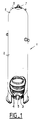
- Figure 1 is a perspective view with cutaway of a pressurizer of a pressurized water nuclear reactor.
- Figure 2 is a sectional view through a vertical plane of the upper part of the pressurizer shown in Figure 1, in which has been put in place a removable floor according to the invention.
- FIG. 2A is a side elevation view of one of the support arms of the removable floor shown in FIG. 2.
- Figure 2B is a side elevational view of a support arm different from the arm shown in Figure 2A in its engagement position on the support shaft.
- Figure 3 is a top view along 3-3 of Figure 2, the removable floor placed inside the casing of the pressurizer.
- FIG. 1 we see a pressurizer of a pressurized water nuclear reactor generally designated by the reference 1.
- the pressurizer 1 comprises a casing 2 of cylindrical shape arranged with its vertical axis in the operating position of the pressurizer.
- the envelope 2 comprises, in the vicinity of its lower end, a first convex bottom 3 crossed by a large number of sleeves in each of which is engaged a heating rod 4.
- the heating rods are placed in a vertical arrangement in the lower part of the casing 2 of the pressurizer in which they are projecting.
- a tap 5 passing through the bottom 3 makes it possible to put the interior volume of the pressurizer into communication with the primary circuit of the reactor, by means of a conduit of large section.
- the casing 2 of the pressurizer is closed at its upper part by a convex bottom 6 which is crossed, at the central part, by a tapping 7 to which the spraying pipes of the pressurizer are connected.
- the curved bottom 6 is also crossed by a visit opening 8 or manhole which is closed in leaktight manner, during the operation of the pressurizer.
- the lower part of its casing, above the bottom 3, in which the heating rods 4 are arranged contains water under pressure.
- the upper part of the interior volume of the casing 2 into which the nozzle 7 of the spraying nozzle opens contains steam in pressure equilibrium with the water contained in the lower part of the casing.
- the manhole 8 is formed in the internal bore of a tube 10 formed in the wall of the convex bottom 6.
- the watertight closing tape of the manhole 8 is fixed on the external end of the tubing 10, to ensure the watertight closing of the pressurizer, during its operation.
- the tubing 10 and the manhole are also used to implement and fix the removable floor according to the invention, during the periods of shutdown of the nuclear reactor, the pressurizer having been drained and cooled beforehand.
- the removable floor according to the invention generally designated by the reference 12 is constituted by a chute 14 ensuring the handling and fixing of the floor for its installation in the casing of the pressurizer, a support shaft 16 mounted articulated to the 'one end of the chute 14, a set of support arms such as the arm 15 pivotally mounted on the shaft 16, and a plurality of planar elements 17 intended to constitute a work floor, substantially throughout the cross section of the cylindrical casing 2 of the pressurizer.
- the chute 14 comprises, at one of its ends, a handling and fixing assembly comprising the end part 14a of the chute having the shape of a cylindrical ferrule, a flange 19 integral with the ferrule 14a at its end and a hooking element 18 of angled shape fixed on the flange 19.
- the chute has a support part 14b fixed to the end of the ferrule 14a opposite the flange 19 and in the extension of this ferrule.
- the axis 21 of the manhole is directed along a radius of the spherical curved bottom and cuts the vertical axis 20 of symmetry of the casing of the pressurizer at a point O which constitutes the geometric center of the spherical curved bottom.
- the support part 14b of the chute makes a certain angle with the axis 21 of the manhole and of the ferrule 14a and its end opposite to its handling and fixing part on which the support shaft 16 is articulated. located near the axis 20 of the casing of the pressurizer, below the center O of the convex bottom, when the chute is placed in the pressurizer, as shown in FIG. 2.
- the horizontal articulation axis 22 of the support shaft 16 on the end of the chute 14 is concurrent with the axis 20 of the casing of the pressurizer.
- the hooking element 18 of the chute is made in bent and ribbed form and comprises, at its end opposite to the flange 19 on which it is fixed, a hooking opening 23 in which the hook 24 can be engaged.
- handling and lifting means ensuring the installation of the chute 14 and the structure of the support floor, inside the casing of the pressurizer.
- the means of handling and lifting the removable floor can be constituted for example by the polar bridge of the nuclear reactor or by an auxiliary hoist installed in the casemate of the pressurizer.
- the flange 19 has openings which are placed in coincidence with the tapped holes such as the hole 25 'machined in the pipe 10 delimiting the manhole 8.
- the fixing screws such as the screw 25 are engaged in the openings of the flange 19 and in the corresponding tapped holes 25 ′ to ensure the clamping of the flange 19 against the outer end of the tube 10.
- the flange 19 and the pipe 10 generally have three openings arranged at 120 ° relative to each other around the axis 21 common to the pipe 10 and the ferrule 14a.
- the support part 14b of the chute 14 is constituted by a cylinder portion having a lateral opening of longitudinal direction delimited by flanges formed by a cut 26 slightly inclined relative to the longitudinal direction of the chute.
- the part 14b of the chute carries, at its end opposite to the fitting and fixing ring 14a, a bearing 28 in which the articulation axis 22 of the support shaft 16 is rotatably mounted.
- the position of the bearing 28 at the end of the chute 14 is such that when the chute 14 is in place in the pressurizer, the articulation axis 22 is concurrent with the axis of symmetry 20 of the pressurizer casing.
- the support shaft 16 is pivotally mounted via the axis 22 in the bearing 28 integral with the chute 14, so as to be able to move between a service position of the removable floor shown in Figure 2 where the axis 29 of the tree of support 16 coincides with the axis 20 of the envelope and a folded-back position where the axis 29 of the support shaft 16 is in a position 29 ′ substantially perpendicular to the longitudinal direction of the trough 14.
- the support shaft 16 carries a set of support arms 15 which are pivotally mounted on the shaft 16, around the geometric axis 29.
- Each of the support arms 15, as will be described in more detail in the following description, is movable between a folded position and a deployed position allowing the establishment of a work floor in a cross section of the pressurizer casing.
- the removable floor comprises a support structure constituted by six arms 15a, 15b, 15c, 15d, 15e, 15f pivotally mounted on the support shaft 16.
- the arms 15a to 15f are substantially parallel to one another and joined together to form a compact assembly which can be moved as a whole, between a transport and handling position 30 shown in phantom in Figure 2, l axis of the support shaft 16 then being in its position 29 ′, and a commissioning position 30 ′ shown in FIG. 3, the axis 29 of the support shaft 16 then being coincident with the axis 20 of the casing of the pressurizer and the arms 15a to 15f being substantially horizontal.
- a traction and pushing device such as a Teleflex type ball cable connected to a appropriate gear mounted on the support shaft 16, either by an operating pole which can be connected to all of the arms 15.
- the arms 15 are constituted by braced structures of generally triangular shape having a substantially horizontal upper support bar 32 on which rest the planar elements 17 constituting the floor of job.
- Each of the arms has two bearings 33 allowing its articulated and stable mounting on the support shaft 16.
- the arms 15 are all different with regard to their shape and the height position of the bearings 33 allowing their pivoting mounting on the support shaft 16.
- the connecting part between the bearings 33 and the straight part of the support arm comprising the support bar 32 has an angled shape, the connecting parts of the different arms 15 having different shapes.
- the six arms 15a, 15b, ... 15f can be pivotally mounted on the support shaft 16, so that their bearings 33 are placed in adjacent and successive positions, in the axial direction 29 of the support shaft 16.
- FIG. 2A the shaft 15a is shown, the bearings of which are located at the second level below the shaft 15c.
- the shaft 15e is shown, the bearings 33e of which are located at the fourth level below the bearings 33c of the shaft 15c located the highest.
- the bent connecting parts between the bearings 33 and the rectilinear parts of the arms 15 are placed one above the other in the folded position of the arms, so that the rectilinear parts of the arms and in particular the support bars 32 are in a parallel arrangement and joined.
- the arms 15 have also been shown in a deployed position, below the work floor formed by the planar elements 17, their rectilinear parts being placed in radial directions relative to a straight section of the envelope. 2 of pressurizer 1 making between them angles of 60 °.
- This deployed arrangement of the arms 15 is obtained from the position in which these arms are put into service, shown in dashed lines in FIG. 3, the axis 29 of the support shaft 16 being vertical and coinciding with the axis 20 of the pressurizer.
- This position is obtained by rotating each of the arms 15 by a desired angle around the axis 29 of the support arm 16.
- the deployed position of the arm 15c is obtained by a rotation of approximately 30 °, the deployed position of the arm 15b by a rotation of approximately 90 ° and the position of the arm 15c by a rotation of approximately 120 °.
- the deployed positions of the arms 15d, 15e and 15f are obtained by rotations of these arms by approximately 30, 90 and 120 °, in a pivoting direction, opposite to the pivoting direction of the arms 15a, 15b and 15c.
- the support structure formed by these arms is ready to receive the work floor constituted by planar elements 17 juxtaposed and connected by connecting elements 34.
- the positioning in the deployed position of the arms 15 can be controlled remotely, from outside the casing of the pressurizer, for example by using a control of the Teleflex type or by using an operating stick.
- planar elements 17 constituting the work floor can then be placed and assembled on the support bars 32 of the arms 15, by an operator working inside the casing of the pressurizer.
- the floor can also be constituted by a light structure introduced in the folded state into the casing of the pressurizer and maneuvered after its introduction into the casing to be put in an unfolded or deployed state where this structure covers the support bars 32 arms 15, so as to occupy a substantial part or all of the cross section of the casing 2 of the pressurizer 1.
- This maneuver of a light structure to achieve its deployment inside the casing of the pressurizer can be remotely controlled from outside the pressurizer or performed by an operator working inside the pressurizer.
- the elements located at the central part of the floor are generally in the form of trapezoids and are connected at their external part to complementary elements 35 in in the form of circular sectors whose outer edge in the form of a portion of a circle is intended to come into contact with or in the vicinity of the internal surface of the cylindrical casing 2 of the pressurizer 1.
- adjustable elements 36 in the form of circular sectors connected to the elements 35 by pins engaged in the slots 37 in the radial direction formed in the elements 35.
- FIG 3 there is shown an element 36 whose radial displacement relative to the corresponding element 35 allows to adjust the position of the outer edge 38 of circular shape, so that this edge comes into contact with the inner surface of a pressurizer casing 2.
- the elements 36 make it possible to produce a continuous floor with its peripheral part coming into contact with the internal surface of the casing of the pressurizer.
- the floor obtained thus occupies the entire cross section of the casing 2 and makes it possible to avoid any fall of object or tool in the lower part of the pressurizer, during the interventions carried out using the working floor.
- the arms 15 comprise, at their outer end part opposite their articulation bearing 33, a rod 40 slidingly mounted in the structure of the arm and pierced with openings capable of coming to coincide with the openings of the corresponding arm 15 for engaging pins 42 for fixing the radial extension of the arm made in telescopic form.
- the end of the rod 40 is integral with a head 41 which comes into contact with the internal wall of the casing 2 of the pressurizer when the arms are put into service in their deployed position.
- the telescopic mounting of the end of the arm and the elements 36 adjustable in the radial direction make it possible to adapt the work floor to the inside diameter of the casing of the pressurizer, within an adjustment interval of a certain amplitude.
- the chute 14 in which the set of arms 15 is placed in its folded-back position 30 is brought, by handling and lifting means, into a position allowing its introduction into a manhole 8 passing through the domed upper bottom of the pressurizer.
- the hooking element 18 is provided so that the inclination of the chute in the free state at the end of the hook of the lifting means corresponds substantially to the inclination of the axis 21 of the manhole.
- Fixing is then carried out by screwing the flange 19 onto the tube 10 and then placing the arms 15 in the service position by tilting the support shaft 16, so that its axis 29 comes in a vertical position coincident with the axis of the pressurizer casing.
- the arms 15 are then placed in their deployed position, at 60 ° from each other.
- the adjustment of the peripheral planar elements of the working floor makes it possible to obtain a continuous floor having no discontinuity or openings through which objects such as tools could fall into the lower part of the pressurizer, during the intervention carried out using the removable floor according to the invention.
- the device has good rigidity and, in the case of a pressurizer of a common type nuclear reactor, this floor could be made so that it supports loads greater than 400 kg.
- the chute may have a shape different from that which has been described, from the moment when this chute has sufficient rigidity to support the removable floor and the loads coming to rest on this floor during the intervention inside the pressurizer.
- the work floor can be made in a different way from that which has been described, either from attached planar elements, or from a light structure which can be unfolded, deployed or unrolled. inside the pressurizer.
- control means ensuring the placing in the service position of the support arms can be of any type, these means being preferably controlled remotely.
- support structures having a number of arms other than six, these arms being placed in the service position in angular positions which can be regularly distributed around the axis of the envelope.
- the removable intervention floor according to the invention can be used not only for carrying out interventions inside the casing of a pressurizer of a pressurized water nuclear reactor and in its upper part, but also at the inside a vertical axis cylindrical casing used in any part of a nuclear reactor or even inside vertical axis cylindrical casings used in any industry such as the chemical industry, petroleum industry or metallurgy .
Landscapes
- Engineering & Computer Science (AREA)
- Physics & Mathematics (AREA)
- Architecture (AREA)
- Plasma & Fusion (AREA)
- General Engineering & Computer Science (AREA)
- High Energy & Nuclear Physics (AREA)
- Mechanical Engineering (AREA)
- Civil Engineering (AREA)
- Structural Engineering (AREA)
- Manipulator (AREA)
- Monitoring And Testing Of Nuclear Reactors (AREA)
- Pressure Vessels And Lids Thereof (AREA)
- Structures Of Non-Positive Displacement Pumps (AREA)
Claims (8)
- Entfernbares Gerüst zum Zugang in das Innere einer Hülle, wie der im wesentlichen zylindrischen Hülle (2) eines Druckbehälters (1) eines Druckwasserkernreaktors, die mit ihrer Achse vertikal angeordnet und an ihrem oberen Ende durch eine gewölbte Decke (6) geschlossen ist, durch die sich wenigstens eine Einstiegsöffnung (8) erstreckt, wobei das Zugangsgerüst (12) durch Operationen von außerhalb der Hülle (2) in der Hülle (2) angeordnet, demontiert und herausgezogen werden kann, dadurch gekennzeicnnet, daß das Gerüst aufweist:- eine Rutsche (14), an deren einem Ende eine Wartungs- und Befestigungseinheit vorgesehen ist, die durch ein Element (18) zum Verbinden mit einer Hebeeinrichtung (24), einen zylindrischen Ring (14a) und einen Flansch (19) zu seinem Eingreifen in die Einstiegsöffnung (18) der Hülle und zur Befestigung durch Verschrauben des Flanschs (19) an einem Außenteil (10) der Hülle (2) sowie durch ein Stützteil (14b) in Form eines seitlich offenen und den Ring im wesentlichen in dessen Achsrichtung verlängernden Zylinders gebildet ist,- eine Stützwelle (16), die gelenkig an dem dem die Wartungs- und Befestigungseinheit aufweisenden Ende gegenüberliegenden Ende der Rutsche (14) montiert ist, wobei dieses Ende sich in der Nähe der Achse (20) der Hülle (2) befindet, wenn die Rutsche (14) in der Hülle (2) plaziert ist, wobei sich die Schwenkachse (22) der Stützwelle (16) dann derart in einer horizontalen Position befindet, daß diese Welle (16) zwischen einer zur Längsrichtung der Rutsche (14) im wesentlichen senkrechten Klapposition und einer Gebrauchsposition, in der die Welle (16) im wesentlichen koaxial zu der Hülle (2) verläuft, schwenkbar ist,- eine Gruppe von Stützarmen (15), die an der Stützwelle (16) zwischen einer Klapposition, in der die Stützarme im wesentlichen zueinander parallel verlaufen und fest sind, wodurch die Arme (15) entlang der Achsrichtung in der Rutsche (14) angeordnet und gehalten werden können, während sich die Stützwelle (16) in ihrer Klapposition befindet, und einer ausgefahrenen Position verschwenkbar sind, in der die Arme (15) durch Schwenken um die Achse (29) der Stützwelle (16) in die vertikale Position in im wesentlichen regelmäßig um die Achse (20) der Hülle (2) verteilte Winkelpositionen (15a, 15b, ..., 15f) schwenkbar sind,- und mehrere ebene Elemente (17, 35), die in der ausgefahrenen Position zum Aufliegen auf den Stützarmen (15) vorgesehen sind, um im wesentlichen über den gesamten Querschnitt der Hülle (2) ein Arbeitsgerüst zu bilden.
- Entfernbares Gerüst nach Anspruch 1, dadurch gekennzeichnet, daß die Arme (15) eine Strebenstruktur aus einer oberen Auflagestrebe (32), auf der die ebenen Elemente (17) des Gerüsts liegen, und wenigstens einem Schwenklager (33) bilden, das durch ein abgewinkeltes Verbindungselement mit der Strebenstruktur verbunden ist, wobei jeder Arm der Gruppe von Armen (15), hinsichtlich der Position des Schwenklagers (33) in Achsrichtung der Stützwelle (16) in bezug auf die Auflagestrebe (32), eine von den anderen Armen verschiedene Form aufweist, derart, daß die Arme (15a, 15b, ..., 15f) mit in Achsrichtung (29) der Stützwelle übereinanderliegenden Lagern (33) gelenkig an der Stützwelle (16) montierbar sind, wobei sämtliche Auflageflächen der Auflagestreben (32) derart in der selben Ebene liegen, daß sich die Auflageflächen der Streben (32) in der ausgefahrenen Position der Arme (15) in der selben horizontalen Querschnittsebene der Hülle (2) befinden.
- Entfernbares Gerüst nach Anspruch 2, dadurch gekennzeichnet, daß jeder der Arme (15) zwei in Richtung der Achse (29) der Stützwelle (16) übereinanderliegende Schwenklager (33) aufweist.
- Entfernbares Gerüst nach einem der Ansprüche 1 bis 3, dadurch gekennzeichnet, daß jeder der Arme (15) ein teleskopierbares Ende (40, 41, 42) zum Einstellen der Länge der Stützarme (15) in Abhängigkeit vom Durchmesser der Hülle (2) aufweist.
- Entfernbares Gerüst nach einem der Ansprüche 1 bis 4, dadurch gekennzeichnet, daß die ebenen Elemente (17) trapezförmige mittlere Elemente und sektorförmige Umfangselemente aufweisen, deren kreisbogenförmiger Außenrand dazu vorgesehen ist, in Anlage an oder in die Nähe der Innenfläche der Hülle (2) zu gelangen.
- Entfernbares Gerüst nach Anspruch 5, dadurch gekennzeichnet, daß die Umfangselemente (35) sektorförmige Elemente (36) tragen, deren Position in Radialrichtung der Hülle (2) einstellbar ist, um die Abmessung des entfernbaren Gerüsts der Abmessung des Querschnitts der Hülle (2) anzupassen und um das Vorhandensein von Öffnungen oder Abständen am Umfang des Gerüsts zwischen dem Außenrand des Gerüsts und der Innenwand der Hülle (2) zu vermeiden.
- Entfernbares Gerüst nach einem der Ansprüche 1 bis 6, dadurch gekennzeichnet, daß es sechs Stützarme (15a, 15b, 15c, 15d, 15e, 15f) aufweist, die in der ausgefahrenen Position in Winkelabständen von 60° voneinander um die Achse (20) der Hülle (2) angeordnet sind.
- Entfernbares Gerüst nach Anspruch 1, dadurch gekennzeichnet, daß die ebenen Elemente (17, 35) eine vormontierte Einheit bilden, die im zusammengeklappten Zustand in die Hülle (2) eingeführt und im Inneren der Hülle auf die durch die in der ausgefahrenen Position befindlichen Arme (15) gebildete Stützstruktur aufgeklappt oder ausgefahren werden kann.
Applications Claiming Priority (2)
| Application Number | Priority Date | Filing Date | Title |
|---|---|---|---|
| FR9004190A FR2660478B1 (fr) | 1990-04-02 | 1990-04-02 | Plancher amovible pour intervention a l'interieur d'une enveloppe telle qu'un pressuriseur de reacteur nucleaire a eau sous pression. |
| FR9004190 | 1990-04-02 |
Publications (2)
| Publication Number | Publication Date |
|---|---|
| EP0451015A1 EP0451015A1 (de) | 1991-10-09 |
| EP0451015B1 true EP0451015B1 (de) | 1994-06-01 |
Family
ID=9395354
Family Applications (1)
| Application Number | Title | Priority Date | Filing Date |
|---|---|---|---|
| EP91400797A Expired - Lifetime EP0451015B1 (de) | 1990-04-02 | 1991-03-25 | Entfernbares Gerüst für das Einschreiten innerhalb einer Hülle, wie ein Druckausgleichgefäss eines Druckwasserkernreaktors |
Country Status (9)
| Country | Link |
|---|---|
| US (1) | US5183625A (de) |
| EP (1) | EP0451015B1 (de) |
| JP (1) | JPH05273386A (de) |
| KR (1) | KR910019065A (de) |
| CN (1) | CN1055441A (de) |
| CA (1) | CA2039313A1 (de) |
| DE (1) | DE69102187D1 (de) |
| FR (1) | FR2660478B1 (de) |
| ZA (1) | ZA912424B (de) |
Families Citing this family (11)
| Publication number | Priority date | Publication date | Assignee | Title |
|---|---|---|---|---|
| FR2682803B1 (fr) * | 1991-10-21 | 1993-12-03 | Framatome | Procede et dispositif pour prelever une eprouvette dans la cuve d'un reacteur nucleaire en arret definitif. |
| NL1002196C2 (nl) * | 1996-01-29 | 1997-07-30 | Safety Floor Bvio | Verstelbare werkvloerconstructie. |
| US5898115A (en) * | 1998-03-31 | 1999-04-27 | General Electric Company | Pole installed X-Y scanner |
| US6856663B2 (en) * | 2002-02-20 | 2005-02-15 | General Electric Company | Reactor servicing platform |
| JP3592313B2 (ja) * | 2002-05-10 | 2004-11-24 | 大王製紙株式会社 | 塔槽体の内壁面作業装置 |
| DE10348447B4 (de) * | 2003-10-17 | 2014-04-03 | Siemens Aktiengesellschaft | Montage- und Wartungshilfsmittel für eine Gasturbine |
| DE102005053048B4 (de) * | 2005-11-04 | 2007-10-04 | Hitachi Power Europe Gmbh | Sicherheitsabschottung einer Brennkammer eines Dampferzeugers |
| JP2011525576A (ja) * | 2008-06-23 | 2011-09-22 | インテリジェント タワー ソリューションズ アンパーツゼルスカブ | プラットフォーム、特に筒状の塔についての内部プラットフォーム |
| US8681922B2 (en) * | 2010-01-13 | 2014-03-25 | Westinghouse Electric Company Llc | Pressurizer with a mechanically attached surge nozzle thermal sleeve |
| CN104057242B (zh) * | 2014-04-17 | 2016-02-03 | 上海锅炉厂有限公司 | 一种可装卸筒体十字定位装置 |
| GB2543059A (en) * | 2015-10-06 | 2017-04-12 | Waters Philip | Temporary access platform |
Family Cites Families (7)
| Publication number | Priority date | Publication date | Assignee | Title |
|---|---|---|---|---|
| US3166154A (en) * | 1962-02-02 | 1965-01-19 | Titzel Engineering Inc | Portable scaffolds and work towers |
| US3910379A (en) * | 1973-11-30 | 1975-10-07 | Robert E Miller | System for construction of monolithic concrete tanks and silos |
| US4173060A (en) * | 1977-06-24 | 1979-11-06 | Westinghouse Electric Corp. | System and method for retubing a steam generator |
| FR2444996A1 (fr) * | 1978-12-18 | 1980-07-18 | Commissariat Energie Atomique | Ensemble d'installation pour le dechargement-rechargement d'un reacteur nucleaire |
| US4672741A (en) * | 1985-06-27 | 1987-06-16 | Westinghouse Electric Corp. | End effector apparatus for positioning a steam generator heat exchanger tube plugging tool |
| US4801422A (en) * | 1986-12-23 | 1989-01-31 | Electric Power Research Institute, Inc. | Apparatus for installing and removing a control rod drive in a nuclear reactor |
| US4842807A (en) * | 1987-03-31 | 1989-06-27 | Westinghouse Electric Corp. | Support stand for top access reactor cavity dosimetry |
-
1990
- 1990-04-02 FR FR9004190A patent/FR2660478B1/fr not_active Expired - Lifetime
-
1991
- 1991-03-25 EP EP91400797A patent/EP0451015B1/de not_active Expired - Lifetime
- 1991-03-25 DE DE69102187T patent/DE69102187D1/de not_active Expired - Lifetime
- 1991-03-28 CA CA002039313A patent/CA2039313A1/fr not_active Abandoned
- 1991-04-01 JP JP3068138A patent/JPH05273386A/ja active Pending
- 1991-04-01 KR KR1019910005171A patent/KR910019065A/ko not_active Withdrawn
- 1991-04-01 CN CN91102038A patent/CN1055441A/zh active Pending
- 1991-04-02 US US07/679,228 patent/US5183625A/en not_active Expired - Fee Related
- 1991-04-02 ZA ZA912424A patent/ZA912424B/xx unknown
Also Published As
| Publication number | Publication date |
|---|---|
| CN1055441A (zh) | 1991-10-16 |
| EP0451015A1 (de) | 1991-10-09 |
| DE69102187D1 (de) | 1994-07-07 |
| FR2660478B1 (fr) | 1992-07-24 |
| FR2660478A1 (fr) | 1991-10-04 |
| US5183625A (en) | 1993-02-02 |
| CA2039313A1 (fr) | 1991-10-03 |
| JPH05273386A (ja) | 1993-10-22 |
| ZA912424B (en) | 1992-11-25 |
| KR910019065A (ko) | 1991-11-30 |
Similar Documents
| Publication | Publication Date | Title |
|---|---|---|
| EP0360629B1 (de) | Instrumentierungsvorrichtung für die Spaltzone eines Druckwasserkernreaktors und Verfahren und Vorrichtung zum Aus- und Einbau dieser Instrumentierungsvorrichtung | |
| EP0451015A1 (de) | Entfernbares Gerüst für das Einschreiten innerhalb einer Hülle, wie ein Druckausgleichgefäss eines Druckwasserkernreaktors | |
| FR2531563A1 (fr) | Procede de remplacement des broches de guidage d'un tube-guide faisant partie des equipements internes superieurs d'un reacteur nucleaire a eau sous pression et dispositif correspondant | |
| EP1803996B1 (de) | Interventionsverfahren und Vorrichtung in einem Wasserkasten eines Wärmetauschers | |
| EP0185561B1 (de) | Reinigungsvorrichtung der Führungsrohre von Neutronenflussmesseinrichtungen in einem Druckwasserkernreaktor | |
| EP0681302B1 (de) | Maschine zum Beladen von Brennstabbündeln der Spaltzone eines Kernreaktors mit abnehmbaren Leitträgern | |
| FR2848717A1 (fr) | Procede et dispositif de manutention d'un tube-guide des equipements internes superieurs d'un reacteur nucleaire | |
| FR2848328A1 (fr) | Procede et dispositif de chargement d'un assemblage de combustible dans le coeur d'un reacteur nucleaire. | |
| EP0533547A1 (de) | Verstellbarer Handhabungsgreifer für ein Kernbrennelement | |
| BE1008997A3 (fr) | Coeur d'un reacteur nucleaire a eau sous pression et embout superieur d'un assemblage de combustible du coeur. | |
| FR2788628A1 (fr) | Dispositif et procede de chargement du coeur d'un reacteur nucleaire | |
| BE1007689A3 (fr) | Dispositif d'extraction de pieces ou particules etrangeres dans des assemblages combustibles d'un reacteur nucleaire. | |
| FR2656458A1 (fr) | Dispositif de support et de positionnement d'un moyen d'intervention dans une zone determinee du cloisonnement du cóoeur d'un reacteur nucleaire a eau sous pression. | |
| EP0098781A1 (de) | Einrichtung zur Nachprüfung des Ausschaltens der Steuerbündel eines Kernreaktors | |
| WO2008132362A2 (fr) | Dispositif de manutention des équipements d'un réacteur nucléaire | |
| FR2684481A1 (fr) | Dispositif de support et de positionnement d'un moyen d'intervention sur le cloisonnement du cóoeur d'un reacteur nucleaire a eau sous pression. | |
| EP4156207B1 (de) | Zerlegungssystem für kerntechnische anlage und verfahren zur verlängerung und verkürzung des mastes eines solchen zerlegungssystems | |
| FR2666679A1 (fr) | Procede et dispositif d'extraction d'une canne chauffante presentant des deformations, d'une enveloppe de pressuriseur d'un reacteur nucleaire a eau sous pression. | |
| FR2679370A1 (fr) | Dispositif d'inspection et d'intervention dans la partie secondaire d'un generateur de vapeur d'un reacteur nucleaire refroidi a l'eau. | |
| EP0769786B1 (de) | Stange zum ferngesteuerten Eingreifen, insbesondere in einem Zerfallagerbecken eines Kernreaktors | |
| FR2671023A1 (fr) | Procede et dispositif de reparation d'une grille-entretoise d'un assemblage combustible pour reacteur nucleaire. | |
| EP0589792A1 (de) | Handhabungseinrichtung für Rohrbündel von Wärmetauschern | |
| FR2846466A1 (fr) | Procede et dispositif de manutention et de separation de la plaque superieure de coeur d'un reacteur nucleaire a eau sous pression, d'un assemblage de combustible | |
| EP0391778A1 (de) | Vorrichtung zum Zentrieren eines Interventionsgerät in einem Dampferzeugerrohr | |
| EP1256118B1 (de) | Werkzeug zum ergreifen und zur handhabung einer auf einem oberen endstück eines kernbrennstabbündels befestigten feder und austauschverfahren für eine feder |
Legal Events
| Date | Code | Title | Description |
|---|---|---|---|
| PUAI | Public reference made under article 153(3) epc to a published international application that has entered the european phase |
Free format text: ORIGINAL CODE: 0009012 |
|
| AK | Designated contracting states |
Kind code of ref document: A1 Designated state(s): BE CH DE ES LI SE |
|
| 17P | Request for examination filed |
Effective date: 19910906 |
|
| 17Q | First examination report despatched |
Effective date: 19930928 |
|
| GRAA | (expected) grant |
Free format text: ORIGINAL CODE: 0009210 |
|
| AK | Designated contracting states |
Kind code of ref document: B1 Designated state(s): BE CH DE ES LI SE |
|
| PG25 | Lapsed in a contracting state [announced via postgrant information from national office to epo] |
Ref country code: ES Free format text: THE PATENT HAS BEEN ANNULLED BY A DECISION OF A NATIONAL AUTHORITY Effective date: 19940601 |
|
| REF | Corresponds to: |
Ref document number: 69102187 Country of ref document: DE Date of ref document: 19940707 |
|
| PG25 | Lapsed in a contracting state [announced via postgrant information from national office to epo] |
Ref country code: SE Effective date: 19940901 |
|
| PG25 | Lapsed in a contracting state [announced via postgrant information from national office to epo] |
Ref country code: DE Effective date: 19940902 |
|
| PG25 | Lapsed in a contracting state [announced via postgrant information from national office to epo] |
Ref country code: LI Effective date: 19950331 Ref country code: CH Effective date: 19950331 Ref country code: BE Effective date: 19950331 |
|
| PLBE | No opposition filed within time limit |
Free format text: ORIGINAL CODE: 0009261 |
|
| STAA | Information on the status of an ep patent application or granted ep patent |
Free format text: STATUS: NO OPPOSITION FILED WITHIN TIME LIMIT |
|
| 26N | No opposition filed | ||
| BERE | Be: lapsed |
Owner name: FRAMATOME Effective date: 19950331 |
|
| REG | Reference to a national code |
Ref country code: CH Ref legal event code: PL |