EP0451049A1 - Verfahren und Speicher- und Abrufsystem von chemischen Formeln in einer Datenbank - Google Patents
Verfahren und Speicher- und Abrufsystem von chemischen Formeln in einer Datenbank Download PDFInfo
- Publication number
- EP0451049A1 EP0451049A1 EP91400897A EP91400897A EP0451049A1 EP 0451049 A1 EP0451049 A1 EP 0451049A1 EP 91400897 A EP91400897 A EP 91400897A EP 91400897 A EP91400897 A EP 91400897A EP 0451049 A1 EP0451049 A1 EP 0451049A1
- Authority
- EP
- European Patent Office
- Prior art keywords
- formula
- formulas
- list
- fragment
- markush
- Prior art date
- Legal status (The legal status is an assumption and is not a legal conclusion. Google has not performed a legal analysis and makes no representation as to the accuracy of the status listed.)
- Granted
Links
- 238000000034 method Methods 0.000 title claims abstract description 36
- 239000000126 substance Substances 0.000 title claims description 25
- 239000012634 fragment Substances 0.000 claims abstract description 277
- 239000000284 extract Substances 0.000 claims description 14
- 230000015654 memory Effects 0.000 claims description 10
- 238000004364 calculation method Methods 0.000 claims description 7
- SNDPXSYFESPGGJ-UHFFFAOYSA-N L-norVal-OH Natural products CCCC(N)C(O)=O SNDPXSYFESPGGJ-UHFFFAOYSA-N 0.000 claims description 6
- 238000000605 extraction Methods 0.000 claims description 3
- 230000001131 transforming effect Effects 0.000 claims description 2
- 125000004429 atom Chemical group 0.000 description 78
- 238000011160 research Methods 0.000 description 11
- 230000002093 peripheral effect Effects 0.000 description 6
- 238000010586 diagram Methods 0.000 description 5
- 238000013479 data entry Methods 0.000 description 4
- 125000000217 alkyl group Chemical group 0.000 description 3
- GDTBXPJZTBHREO-UHFFFAOYSA-N bromine Chemical compound BrBr GDTBXPJZTBHREO-UHFFFAOYSA-N 0.000 description 3
- 238000012545 processing Methods 0.000 description 3
- 230000000717 retained effect Effects 0.000 description 3
- ZCYVEMRRCGMTRW-UHFFFAOYSA-N 7553-56-2 Chemical group [I] ZCYVEMRRCGMTRW-UHFFFAOYSA-N 0.000 description 2
- 229910052794 bromium Inorganic materials 0.000 description 2
- 125000003178 carboxy group Chemical group [H]OC(*)=O 0.000 description 2
- 229910052801 chlorine Inorganic materials 0.000 description 2
- 239000000460 chlorine Substances 0.000 description 2
- 229910052740 iodine Inorganic materials 0.000 description 2
- 102100028080 ATPase family AAA domain-containing protein 5 Human genes 0.000 description 1
- WKBOTKDWSSQWDR-UHFFFAOYSA-N Bromine atom Chemical compound [Br] WKBOTKDWSSQWDR-UHFFFAOYSA-N 0.000 description 1
- KZBUYRJDOAKODT-UHFFFAOYSA-N Chlorine Chemical compound ClCl KZBUYRJDOAKODT-UHFFFAOYSA-N 0.000 description 1
- ZAMOUSCENKQFHK-UHFFFAOYSA-N Chlorine atom Chemical compound [Cl] ZAMOUSCENKQFHK-UHFFFAOYSA-N 0.000 description 1
- 101100536354 Drosophila melanogaster tant gene Proteins 0.000 description 1
- 101000789829 Homo sapiens ATPase family AAA domain-containing protein 5 Proteins 0.000 description 1
- 101001126591 Homo sapiens Post-GPI attachment to proteins factor 2 Proteins 0.000 description 1
- UFHFLCQGNIYNRP-UHFFFAOYSA-N Hydrogen Chemical compound [H][H] UFHFLCQGNIYNRP-UHFFFAOYSA-N 0.000 description 1
- 241000861223 Issus Species 0.000 description 1
- 241000699666 Mus <mouse, genus> Species 0.000 description 1
- 241000699670 Mus sp. Species 0.000 description 1
- 241001080024 Telles Species 0.000 description 1
- 241000897276 Termes Species 0.000 description 1
- 239000003814 drug Substances 0.000 description 1
- 229940079593 drug Drugs 0.000 description 1
- 230000000694 effects Effects 0.000 description 1
- 230000008030 elimination Effects 0.000 description 1
- 238000003379 elimination reaction Methods 0.000 description 1
- 229910052739 hydrogen Inorganic materials 0.000 description 1
- 239000001257 hydrogen Substances 0.000 description 1
- 125000004435 hydrogen atom Chemical group [H]* 0.000 description 1
- 239000003317 industrial substance Substances 0.000 description 1
- 239000011630 iodine Substances 0.000 description 1
- 238000012986 modification Methods 0.000 description 1
- 230000004048 modification Effects 0.000 description 1
- 238000005457 optimization Methods 0.000 description 1
- 230000004044 response Effects 0.000 description 1
- 125000001424 substituent group Chemical group 0.000 description 1
- 238000006467 substitution reaction Methods 0.000 description 1
- 238000012800 visualization Methods 0.000 description 1
- 230000003936 working memory Effects 0.000 description 1
Images






Classifications
-
- G—PHYSICS
- G16—INFORMATION AND COMMUNICATION TECHNOLOGY [ICT] SPECIALLY ADAPTED FOR SPECIFIC APPLICATION FIELDS
- G16C—COMPUTATIONAL CHEMISTRY; CHEMOINFORMATICS; COMPUTATIONAL MATERIALS SCIENCE
- G16C20/00—Chemoinformatics, i.e. ICT specially adapted for the handling of physicochemical or structural data of chemical particles, elements, compounds or mixtures
- G16C20/90—Programming languages; Computing architectures; Database systems; Data warehousing
Definitions
- the present invention relates to a method and a system for storing and searching in a database of Markush formulas, and of information associated with said formulas.
- a Markush formula is a structural representation of a component or family of chemical components with common structural characteristics. Such a formula is represented by a diagram comprising a part common to the family of components, or basic group, and one or more parts of different characteristics, or "substituent" groups, usually represented by symbols such as R, R1, etc. ...
- the invention finds a particularly important although not exclusive application in the fields of pharmaceutical research and industrial chemistry. It allows the storage, research and identification of information on Markush formulas mentioned in the literature and in particular in patent claims.
- the invention can thus be used in the study of the properties of a molecule, or of a family of molecules, intended for example for a drug or an industrial chemical.
- US Patent 4,642,762 describes a method of storing and searching for Markush formulas comprising a preselection step of this type. To do this, we first rewrite the Markush formulas in the form of a specific multiple representation, then in the form of a corresponding generic multiple representation, representing all the individual generic representations of said Markush formulas.
- the present invention aims to provide a method and a system for storing and searching for chemical formulas which meet the requirements of practice better than those known in the past, in particular in that they make it possible to search in a file of Markush formulas previously constituted, a formula determined with a high degree of reliability and great speed.
- the invention makes it possible to directly obtain the images of the chemical formulas close to, or corresponding to, the chemical formula sought for automatically or semi-automatically and in a modified and improved form. An easy comparison by the user, of the image of the formula sought, with that of the formulas obtained by the research, will, moreover, be possible.
- the invention which poses and solves the complex technical problem which consists in finding, among an extremely large quantity of chemical formulas appearing in the literature in multiple different forms and representations, elements and information relating to a specific formula, makes it possible to carry out this research interactively with the operator. It thus makes it possible, as we will see, to operate the computer system implemented with the invention, with optimum efficiency, in particular in time of use of its computer, which allows, at equal power, greater number of concurrent users.
- the optimization of the search thanks to the invention, thus saves a significant time of connection between the user and the computer system, and therefore makes it possible to reduce the costs.
- the method and system of the invention are, moreover, implemented in a simple and easy manner by the user of the system ".
- the invention also provides a computer system or device for implementing the method for storing and searching for Markush formulas defined above, comprising a central unit, working and storage memories, input means for Markush formulas in graphic and / or alpha-numeric form and means for restoring information, characterized in that it comprises means for generating a basic file of chemical formulas, from said Markush formulas, in the form of connectivity tables, each formula comprising a reference number and a "preselection" number describing typical characters of said formula defined according to a definition table previously stored in a system memory, means for generating, for each stored or sought formula, the list of all the nodes, or focal atoms, comprising at least two immediate neighboring atoms, means of calculation, for each node of this list by formula, of all the possible parts, called fragments, of said formula, resulting from this node, a fragment being defined as a part of structure of formula constituted by a hearth, its atoms immediate neighbors (environment 1) and if there exist the immediate neighbor atom (
- Figure 1 is a simple example of a Markush formula.
- a Markush formula is a structural representation of a chemical component or family of components. It is generally presented in the form of a graph or diagram comprising a common part, or basic group, (represented by R0 in FIG. 1), and one or more parts of different characteristics, or "substituting group". ", represented in FIG. 1 by the symbols R1 and R2 and which can signify any of the atoms or groups of atoms mentioned by way of example in FIG. 1.
- FIG. 2 shows a Markush formula as used in the graphical representations of data entry or output of the present invention.
- the formula on the example represented in figure 2, is constituted by a basic graph, or basic group, G0. This graph is often called the "father" graph.
- G1 It is connected in two of these nodes to two graphs or "son" groups G1 and G2.
- the values of G1 are shown in the figure as being able to be a hydrogen, bromine, chlorine or iodine atom; the values taken by G2 can be, bromine, chlorine, iodine or two sub-graphs or groups G3, G4, which can in turn take several different values as shown in Figure 2.
- each node usually represents an atom, whose identity can then be saved, we have seen that a node could also represent a generic term, such as alkyl, carboxyl, etc.
- connections between nodes of a Markush formula, which represent the bonds must also be defined, to allow a sufficiently complete representation of the molecules to be stored or to be sought.
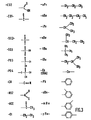
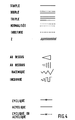
- the information concerning these connections like the orientation or the relative arrangement in space of the various nodes with respect to each other (stereochemistry) are mentioned in FIG. 4 which also gives a type of graphic representation of these connections, such advantageously used in the present invention.
- an advantageous embodiment of storing the formulas according to the invention provides for storing the different nodes of the graphs representing the Markush formula by assigning to each node a label or "attribute" for reporting this information.
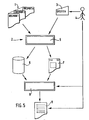
- Figure 5 is a block diagram of the storage and retrieval system of the Markush formula according to the embodiment of the invention more particularly described here.
- This embodiment is advantageously implemented by means of a computer which comprises, in a manner known per se, a central unit (CPU) connected to ancillary devices comprising external storage units and means of input-output interfaces, such as as display screens and printers, said peripherals being connected to the central unit in a manner known per se by the usual means of telecommunication.
- a computer which comprises, in a manner known per se, a central unit (CPU) connected to ancillary devices comprising external storage units and means of input-output interfaces, such as as display screens and printers, said peripherals being connected to the central unit in a manner known per se by the usual means of telecommunication.
- the central unit is for example constituted by one or more IBM computers (INTERNATIONAL BUSINESS MACHINE) of large capacity, for example of the IBM 3090 type.
- IBM computers INTERNATIONAL BUSINESS MACHINE
- the peripherals, or terminals, of input-output interfaces can themselves be microcomputers of the IBM PC type, or of other terminals of the Hewlett Packard 2647A type, to allow data entry in graphical and / or alpha-numeric form.
- Figure 5 there is shown a series 1 of documents, (Document 1, Document 2 ..) each comprising a Markush formula.
- the Markush formulas of these documents are entered into system 2 via an application program, known in itself, allowing the graphical and / or alpha-numerical representation of the formulas, for example a program of the PLOT type. 10 from TEKTRONIX., Or another type available on the market.
- This program stores the data formed by the formulas of the documents entered in the system, in a database file 6, in the form of tables of connectivity each comprising a reference number of the formula and a preselection number, as will be described later.
- the Markush formula of question 3 is formulated by the input program 5 in the form of a connectivity table 7 with a reference number and a preset number.
- the sought-after formula 7 is then compared with the file 6 of the database by a search program 8, in the course of which the operator 4 can intervene interactively.
- the program generates a list 9 after processing, a list which is extracted visually, and / or in a printed form, the references and / or representation of the possible Markush formula (s), taken from file 6 of the database, and which correspond to the sought Markush formula 7.
- the operator introduces into the system in graphical or alpha-numeric form, the Markush formulas from the database and / or from the formula to be searched for in said database (data entry block 10).
- a table VII representing the table of preselection numbers used in the rest of the program has also been created (reference 11 in FIG. 6a).
- Table VII An example of Table VII is given below in simplified form to better understand the invention.
- the example given is, of course, not limiting, in particular as to the number and type of standard characters retained.
- the number of characters can for example be of the order of 100 to 400.
- a connectivity table is made up of several tables.
- An exemplary embodiment of a connectivity table used in the method and the system according to the invention is given below (table VIII).
- the table notably advantageously includes 5 first tables (DEG, ADR, TABGR, TABLI and TABST) precisely defining each node of the graph of the Markush formula it represents, and 4 second tables (LIRAT, IFR, IAT and NVAL) defining the relations between the different groups as will be seen more precisely in the rest of the text.
- each Markush formula is assigned an identification number (NOFMi) and a preset number (Npsi) describing synthetically predetermined standard characters of the formula, with reference to the table previously made up of said standard characters (table VII ).
- the preset number is advantageously calculated automatically. This calculation is represented schematically by the functional block 13 in FIG. 6a.
- the preselection number is calculated to be in the form of a chain of n bits for example of 200 bits, each bit of which corresponds to a fixed selection criteria.
- the value 1 corresponds to the presence of this criterion, the value 0 not necessarily corresponding to the absence of this criterion.
- the calculation is carried out from the connectivity tables introduced, by means of an algorithm (GENBIT) of which an example of representation in pseudo-code, understandable for those skilled in the art, is provided below (table IX ).
- the basic file 14 of chemical formulas obtained after this first treatment is presented as a series of files by formula, referenced NOFM1, NOFM2, ... NOFM n , each comprising a corresponding connectivity table TC1, TC2 .... TC n and a preset number Nps1, Nps2 ... Nps n .
- a fragment file 18 is formed (block 17) comprising, for each calculated fragment, formulas from the base file 14, the list of reference numbers of the formulas comprising this fragment (FRAG1, FRAG2 ......).
- Figure 7a shows a structure 20a. It comprises three fragments with two environments 21a, 22a and 23a, the foci of which are marked with an asterisk.
- Figure 7b shows another structure 20b. It comprises two fragments with two environments 21b and 22b, with a presentation different from that of the Figure 7a, the foci being always marked with asterisks.
- a fragment with two environments can also be defined as a substructure built concentrically around a focal point, the focal point being the top of said substructure and comprising at least two determined neighboring atoms, each neighbor being connected to the focal point by a determined bond. (these two conditions defining the environment 1 of the focus), said substructure extending to all the vertices or neighboring atoms of the neighboring atoms of environment 1, that is to say having a distance of "2" relative to the focus of the fragment. This second row of atoms forms the environment 2.
- FIG. 7b We will also refer to the broken lines in FIG. 7b.
- FRAG 1 is the "subfragment" file. It contains the description of "subfragments” to an environment (1) of the database. Each sub-fragment 1 is associated with a list of possible positions 2. This list is described in FRAG 2.
- One or more director blocks, located at the head of the file, make it possible to limit the search on the lists 2 associated with a sub-fragment 1.
- FRAG 2 is the file of lists 2. It contains the description of the lists of positions 2 associated with each sub-fragment 1. Each set of positions 2 corresponds to a list of structure numbers described in FRAG N.
- FRAG N is the file for lists of structure or formula numbers. It contains the description of the structure number lists associated with a Fragment with two environments.
- the link between these three files is by direct addressing.
- Table XIbis gives, by way of example, details on the procedures in pseudocode, implemented in advantageous embodiments of the invention. They allow, in particular, thanks to the use of drawer connectivity tables and their LIRAT or NVAL tables, significant time savings in data processing. Instead of recalculating all the necessary elements, each time, the existence of such tables makes it possible to seek there directly, as in a "drawer", the information sought for the continuation of the operations of calculation.
- the program After sorting all the fragments generated for all the foci of all the formulas in the table, the program, described in table XIII, detects the redundancy between the "fragments" and eliminates the identical fragments from the same focus.
- the program (table XIV) detects the inter-fragment redundancy and calculates the occurrence of each fragment within each formula entered (updated).
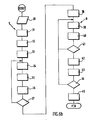
- FIG. 6b is a simplified flowchart of the search program for a Markush formula according to the embodiment of the invention more particularly described here.
- fragment advantageously chosen to be the fragment common to the formula sought and to a minimum number of formulas in the file of fragments 18 with which it is compared (block 34), we extract ( block 35) of said file 18 a first list of the formula reference number.
- This first list is then compared (block 36) with the list obtained for the preceding fragment, if necessary.
- the operation can be repeated (decision block 37) for the next fragment, and so on.
- the search on the "preselection" number constitutes a screen, which will make it possible to further minimize the number of candidates, thus delaying the decompacting of the connectivity tables of the candidates and the node-to-node comparisons, very heavy in terms of time of use of the central unit (CPU), of these formulas with the formula sought.
- CPU central unit
- the preset number is, as we have seen, in the form of a chain of n bits, each bit of which corresponds to a fixed selection criterion.
- the value 1 corresponds for example to the presence of the character, the value 0 not corresponding, at least at the level of the search for the Markush formula sought, to the absence of character.
- step 38 of reading the list "derived from fragments of optimized length" are essentially: reading the preset number of the desired formula (39), comparing the preset numbers (40) of the desired formula with those from the list of fragments of optimized length and, once the comparison is complete (decision block 41), continuation of the program.
- a node-to-node comparison of the formulas in the final list is also carried out with the Markush formula sought (block 43). This comparison is for example carried out using an algorithm such as that appearing in Table XV below.
- the example chosen is that of a simple formula advantageously entered, displayed or edited in graphic form as shown in FIGS. 8 to 10.
- Figure 8 shows the formula identified by a CN number: 87010122-01; It shows the existence of a first group G1.
- Figure 9 shows the detail of the possible values for this group G1, the initial general formula remains visible in a window at the top left of the screen.
- Figure 9 shows the existence of a second group G2.
- FIG. 10 gives the different values that the group G2 can take, the group G1 being this time visible at the top left of the screen. This "drawers" or window display mode makes it easier for the operator to find it.
- FIGS. 11a and 11b now give an example of a connectivity table as described in Table VIII, above.
- the upper line 50a essentially comprises an internal number assigned by the software (NOFM), an external number assigned by the user (UID1) and an internal number assigned by the software based on information provided by the user or operator (UID2).
- NOFM internal number assigned by the software
- UID1 an external number assigned by the user
- UID2 an internal number assigned by the software based on information provided by the user or operator
- Line 51a gives the largest number of the defined group (NBGM) and the number of defined groups (NBGR).
- Table 52a shows the group information.
- Table VIII the tables LIRAT and NVAL mentioned above (see table VIII), as well as, for example and in particular a table concerning the number of links of attachment of the groups (NBLP)
- IDEB (I + 1) -1 being the number of the last atom in fragment I.
- Table 54a gives the information relating to value beginnings. For each group (NBGG: group number), are indicated in particular, the length of IAT in words of length 2 (LGIAT), the address table by IAT group (IFR), and the table of group values (IAT). We will refer to the definition of these tables above (see Table VIII).
- FIG. 11b illustrates the continuation of the tables appearing in the embodiment of the connectivity table of the invention more particularly described here.
- the top row of the table shown in Figure 11b contains an indication 50b of the number of atoms (NAT) in the formula, and the value 51b of the length of the table (LG).
- the first column 52b gives the number (NOAT) assigned (arbitrarily) to each node of the formula.
- the second column 53b gives an address table (ADR) to TABGR, TABLI and TABST (see table VII above).
- the third column 54b is the table giving, for each of the N nodes (here 32) of the graph of the formula, the number of neighbors of this node.
- FIG. 12 represents the table of the attributes of each of the nodes of the formula n ° CN: 87010122-01 taken as an example, as it is advantageously used in an embodiment of the invention.
- FIG 13 there is shown a computer system according to one embodiment of the invention, implementing the method according to the invention.
- the system includes a computer 80 of the type defined above, which itself essentially comprises three elements, a central unit 81, memory circuits (RAM, ROM) 82 and an input-output interface circuit 83.
- a computer 80 of the type defined above, which itself essentially comprises three elements, a central unit 81, memory circuits (RAM, ROM) 82 and an input-output interface circuit 83.
- the computer 80 is connected, via the circuit 83, either to peripherals constituted by keyboards 84, "mice” 85 and display screens 86 and / or printers, either on one or more microcomputers 87.
- Two types of entry and search in the database can therefore be envisaged, one directly, one via a microcomputer.
- the computer 80 further comprises means 89 for generating files and for calculation, belonging or not to the central unit 81, and comprising one or more microprocessors of known type, for example 80386 from the company INTEL, programmed to generate said files.
- These means 89 are programmed as described above to generate a basic file (14) of chemical formulas from the Markush formulas introduced into the system via the peripherals 84, 85 or 87, and to store said basic file in the memory 88 , in the form of a connectivity table with a reference number and a "preselection" number defined according to table VII, previously stored in memory 82 or 88.
- the means 89 are also programmed to generate for each stored formula, the list of all the nodes, and to calculate for each node of this list, all the fragments of said formula, originating from this node.
- the means 89 are finally also programmed to generate a file of fragments (18) comprising for each fragment the list of formulas including said fragment.
- This list is stored in memory means 82 or 88 of known type.
- the central unit 81 also programmed accordingly, also includes the various extraction and comparison means as defined above and making it possible to carry out searches by fragment, by selection number, node to node, by cross-checking of attributes etc ... to obtain on the screen 86 or the microcomputer 87, the results of the research carried out on a given Markush formula introduced into the system via the peripherals 84, 85 and / or 87.
- the means 89 for generating the base file 14, include one or more electronic circuits programmed to constitute a preselection number in the form of a chain of n bits, each bit of which corresponds to a typical character of the definition table (table VII ).
- the operator connects via the peripherals 84, 85 and 86, or 87, to the central computer 80 connected to the memory 88 containing the database 14.
- the operator may complete his question by specifying the attributes, or even other parameters like for example the period over which the research must be carried out. In the latter case, the operator then limits his question to the formulas appearing in the literature over a given period (from 1980 for example), etc.
- the system then automatically calculates the fragments of the formula sought, then performs the first search on fragments by showing on the screen the number of candidates found having a fragment common with the formula sought, a number which may moreover be zero.
- the operator orders the comparison of the preselection numbers, and the rest of the search in order to obtain, ultimately and possibly, a list of candidate formulas, or the candidate sought, after having chosen or not to perform a node by node search.
Landscapes
- Engineering & Computer Science (AREA)
- Computing Systems (AREA)
- Theoretical Computer Science (AREA)
- Databases & Information Systems (AREA)
- Software Systems (AREA)
- Chemical & Material Sciences (AREA)
- Crystallography & Structural Chemistry (AREA)
- Life Sciences & Earth Sciences (AREA)
- Bioinformatics & Cheminformatics (AREA)
- Bioinformatics & Computational Biology (AREA)
- Information Retrieval, Db Structures And Fs Structures Therefor (AREA)
- Nitrogen And Oxygen Or Sulfur-Condensed Heterocyclic Ring Systems (AREA)
Applications Claiming Priority (2)
| Application Number | Priority Date | Filing Date | Title |
|---|---|---|---|
| FR9004134A FR2660458B1 (fr) | 1990-03-30 | 1990-03-30 | Procede et systeme de stockage et de recherche de formules chimiques dans une base de donnees. |
| FR9004134 | 1990-03-30 |
Publications (2)
| Publication Number | Publication Date |
|---|---|
| EP0451049A1 true EP0451049A1 (de) | 1991-10-09 |
| EP0451049B1 EP0451049B1 (de) | 1998-10-21 |
Family
ID=9395314
Family Applications (1)
| Application Number | Title | Priority Date | Filing Date |
|---|---|---|---|
| EP91400897A Expired - Lifetime EP0451049B1 (de) | 1990-03-30 | 1991-04-02 | Verfahren und Speicher- und Abrufsystem von chemischen Formeln in einer Datenbank |
Country Status (5)
| Country | Link |
|---|---|
| EP (1) | EP0451049B1 (de) |
| JP (1) | JPH04227573A (de) |
| AT (1) | ATE172560T1 (de) |
| DE (1) | DE69130373T2 (de) |
| FR (1) | FR2660458B1 (de) |
Cited By (1)
| Publication number | Priority date | Publication date | Assignee | Title |
|---|---|---|---|---|
| CN1307595C (zh) * | 2001-07-19 | 2007-03-28 | 精工爱普生株式会社 | 管理信息数据库结构定义文件链接的方法及管理设备 |
Citations (2)
| Publication number | Priority date | Publication date | Assignee | Title |
|---|---|---|---|---|
| EP0196237A2 (de) * | 1985-03-29 | 1986-10-01 | Japan Association for International Chemical Information | Aufzeichnungs- und Wiederauffindungsverfahren für chemische Strukturdaten |
| US4642762A (en) * | 1984-05-25 | 1987-02-10 | American Chemical Society | Storage and retrieval of generic chemical structure representations |
-
1990
- 1990-03-30 FR FR9004134A patent/FR2660458B1/fr not_active Expired - Lifetime
-
1991
- 1991-03-29 JP JP3133818A patent/JPH04227573A/ja active Pending
- 1991-04-02 DE DE69130373T patent/DE69130373T2/de not_active Expired - Fee Related
- 1991-04-02 EP EP91400897A patent/EP0451049B1/de not_active Expired - Lifetime
- 1991-04-02 AT AT91400897T patent/ATE172560T1/de not_active IP Right Cessation
Patent Citations (2)
| Publication number | Priority date | Publication date | Assignee | Title |
|---|---|---|---|---|
| US4642762A (en) * | 1984-05-25 | 1987-02-10 | American Chemical Society | Storage and retrieval of generic chemical structure representations |
| EP0196237A2 (de) * | 1985-03-29 | 1986-10-01 | Japan Association for International Chemical Information | Aufzeichnungs- und Wiederauffindungsverfahren für chemische Strukturdaten |
Non-Patent Citations (3)
| Title |
|---|
| J. CHEM. INF. COMPUT. SCI., vol. 21, 1981, pages 148-150, ACS, Washington, US; M. LYNCH et al.: "Computer storage and retrieval of generic chemical structures in patents. 1. Introduction and general strategy" * |
| J. CHEM. INF. COMPUT. SCI., vol. 24, 1984, pages 57-66, ACS, Washington, US; S. WELFORD et al.: "Computer storage and retrieval of generic chemical structures in patents. 5. Algorithmic generation of fragment descriptors for generic structure screening" * |
| J. OF CHEM. DOCUMENTATION, vol. 13, no. 1, 1973, pages 8-13, ACS, Washington, US; J. DUBOIS: "French national policy for chemical information and the DARC system as a potential tool of this policy" * |
Cited By (1)
| Publication number | Priority date | Publication date | Assignee | Title |
|---|---|---|---|---|
| CN1307595C (zh) * | 2001-07-19 | 2007-03-28 | 精工爱普生株式会社 | 管理信息数据库结构定义文件链接的方法及管理设备 |
Also Published As
| Publication number | Publication date |
|---|---|
| JPH04227573A (ja) | 1992-08-17 |
| ATE172560T1 (de) | 1998-11-15 |
| FR2660458A1 (fr) | 1991-10-04 |
| DE69130373D1 (de) | 1998-11-26 |
| FR2660458B1 (fr) | 1992-07-17 |
| EP0451049B1 (de) | 1998-10-21 |
| DE69130373T2 (de) | 1999-05-20 |
Similar Documents
| Publication | Publication Date | Title |
|---|---|---|
| US9996566B2 (en) | Visual design system for generating a visual data structure associated with a semantic composition based on a hierarchy of components | |
| CN100530185C (zh) | 基于网络行为的个性化推荐方法和系统 | |
| US20160364770A1 (en) | System for high volume data analytic integration and channel-independent advertisement generation | |
| US20110289094A1 (en) | Integrating media content databases | |
| EP1515239A1 (de) | Verfahren und System zur Verarbeitung von Daten aus mehrdimensionalen Datenbanken mit einem Tabellenkalkulationprogramm | |
| CN1841381A (zh) | 带有文本概述的实时图形预览 | |
| WO2011087756A1 (en) | Multi-stage lookup for rolling audio recognition | |
| FR2824160A1 (fr) | Conteneur generique configurable de facon dynamique | |
| AU2021258035B2 (en) | System and method for the creation and use of visually- diverse high-quality dynamic visual data structures | |
| WO2015023304A1 (en) | Refining search query results | |
| CN1126042C (zh) | 输出树结构间差分的方法及其装置 | |
| RU2568276C2 (ru) | Способ извлечения полезного контента из установочных файлов мобильных приложений для дальнейшей машинной обработки данных, в частности поиска | |
| WO1998057272A1 (fr) | Dispositif d'analyse et d'organisation de donnees | |
| US8996542B2 (en) | Navigation of hierarchical data sets | |
| JPWO2010061535A1 (ja) | 情報検索装置、情報検索方法、及びプログラム | |
| EP0451049A1 (de) | Verfahren und Speicher- und Abrufsystem von chemischen Formeln in einer Datenbank | |
| WO1995008154A1 (fr) | Procede de demonstration automatique | |
| WO2002041174A1 (fr) | Procede de recherche, de selection et de representation cartographique de pages web | |
| JP4973503B2 (ja) | ファイル検索プログラム、方法及び装置 | |
| EP1774441B1 (de) | Verfahren zur Datenverarbeitung und assoziiertes Softwareprogramm | |
| WO2009004231A2 (fr) | Procede de tri d'informations | |
| CN115691702A (zh) | 一种化合物可视化分类方法及系统 | |
| EP1085447B1 (de) | Verfahren und Vorrichtung zur Modellzerlegung und Benutzung davon zur Detektierung der Angriffe gegen die Informatiksysteme | |
| JP6361472B2 (ja) | 対応情報生成プログラム、対応情報生成装置及び対応情報生成方法 | |
| Elliot et al. | Extraction of Sequential Patterns Using PREFIXSPAN |
Legal Events
| Date | Code | Title | Description |
|---|---|---|---|
| PUAI | Public reference made under article 153(3) epc to a published international application that has entered the european phase |
Free format text: ORIGINAL CODE: 0009012 |
|
| AK | Designated contracting states |
Kind code of ref document: A1 Designated state(s): AT BE CH DE DK ES FR GB GR IT LI LU NL SE |
|
| 17P | Request for examination filed |
Effective date: 19911022 |
|
| 17Q | First examination report despatched |
Effective date: 19970131 |
|
| GRAG | Despatch of communication of intention to grant |
Free format text: ORIGINAL CODE: EPIDOS AGRA |
|
| GRAG | Despatch of communication of intention to grant |
Free format text: ORIGINAL CODE: EPIDOS AGRA |
|
| GRAH | Despatch of communication of intention to grant a patent |
Free format text: ORIGINAL CODE: EPIDOS IGRA |
|
| GRAH | Despatch of communication of intention to grant a patent |
Free format text: ORIGINAL CODE: EPIDOS IGRA |
|
| GRAA | (expected) grant |
Free format text: ORIGINAL CODE: 0009210 |
|
| AK | Designated contracting states |
Kind code of ref document: B1 Designated state(s): AT BE CH DE DK ES FR GB GR IT LI LU NL SE |
|
| PG25 | Lapsed in a contracting state [announced via postgrant information from national office to epo] |
Ref country code: IT Free format text: LAPSE BECAUSE OF FAILURE TO SUBMIT A TRANSLATION OF THE DESCRIPTION OR TO PAY THE FEE WITHIN THE PRE;WARNING: LAPSES OF ITALIAN PATENTS WITH EFFECTIVE DATE BEFORE 2007 MAY HAVE OCCURRED AT ANY TIME BEFORE 2007. THE CORRECT EFFECTIVE DATE MAY BE DIFFERENT FROM THE ONE RECORDED.SCRIBED TIME-LIMIT Effective date: 19981021 Ref country code: ES Free format text: THE PATENT HAS BEEN ANNULLED BY A DECISION OF A NATIONAL AUTHORITY Effective date: 19981021 Ref country code: AT Free format text: LAPSE BECAUSE OF FAILURE TO SUBMIT A TRANSLATION OF THE DESCRIPTION OR TO PAY THE FEE WITHIN THE PRESCRIBED TIME-LIMIT Effective date: 19981021 Ref country code: GR Free format text: LAPSE BECAUSE OF NON-PAYMENT OF DUE FEES Effective date: 19981021 |
|
| REF | Corresponds to: |
Ref document number: 172560 Country of ref document: AT Date of ref document: 19981115 Kind code of ref document: T |
|
| REG | Reference to a national code |
Ref country code: CH Ref legal event code: EP |
|
| REF | Corresponds to: |
Ref document number: 69130373 Country of ref document: DE Date of ref document: 19981126 |
|
| PG25 | Lapsed in a contracting state [announced via postgrant information from national office to epo] |
Ref country code: SE Free format text: LAPSE BECAUSE OF FAILURE TO SUBMIT A TRANSLATION OF THE DESCRIPTION OR TO PAY THE FEE WITHIN THE PRESCRIBED TIME-LIMIT Effective date: 19990121 Ref country code: DK Free format text: LAPSE BECAUSE OF FAILURE TO SUBMIT A TRANSLATION OF THE DESCRIPTION OR TO PAY THE FEE WITHIN THE PRESCRIBED TIME-LIMIT Effective date: 19990121 |
|
| GBT | Gb: translation of ep patent filed (gb section 77(6)(a)/1977) |
Effective date: 19990105 |
|
| REG | Reference to a national code |
Ref country code: CH Ref legal event code: NV Representative=s name: PATENTANWAELTE SCHAAD, BALASS, MENZL & PARTNER AG |
|
| PG25 | Lapsed in a contracting state [announced via postgrant information from national office to epo] |
Ref country code: LU Free format text: LAPSE BECAUSE OF NON-PAYMENT OF DUE FEES Effective date: 19990402 |
|
| PLBE | No opposition filed within time limit |
Free format text: ORIGINAL CODE: 0009261 |
|
| STAA | Information on the status of an ep patent application or granted ep patent |
Free format text: STATUS: NO OPPOSITION FILED WITHIN TIME LIMIT |
|
| 26N | No opposition filed | ||
| PG25 | Lapsed in a contracting state [announced via postgrant information from national office to epo] |
Ref country code: FR Free format text: LAPSE BECAUSE OF NON-PAYMENT OF DUE FEES Effective date: 19991231 |
|
| REG | Reference to a national code |
Ref country code: FR Ref legal event code: ST |
|
| REG | Reference to a national code |
Ref country code: GB Ref legal event code: IF02 |
|
| PGFP | Annual fee paid to national office [announced via postgrant information from national office to epo] |
Ref country code: DE Payment date: 20080411 Year of fee payment: 18 Ref country code: CH Payment date: 20080415 Year of fee payment: 18 |
|
| PGFP | Annual fee paid to national office [announced via postgrant information from national office to epo] |
Ref country code: BE Payment date: 20080513 Year of fee payment: 18 |
|
| PGFP | Annual fee paid to national office [announced via postgrant information from national office to epo] |
Ref country code: NL Payment date: 20080319 Year of fee payment: 18 |
|
| PGFP | Annual fee paid to national office [announced via postgrant information from national office to epo] |
Ref country code: GB Payment date: 20080408 Year of fee payment: 18 |
|
| BERE | Be: lapsed |
Owner name: *QUESTEL Effective date: 20090430 |
|
| REG | Reference to a national code |
Ref country code: CH Ref legal event code: PL |
|
| GBPC | Gb: european patent ceased through non-payment of renewal fee |
Effective date: 20090402 |
|
| NLV4 | Nl: lapsed or anulled due to non-payment of the annual fee |
Effective date: 20091101 |
|
| PG25 | Lapsed in a contracting state [announced via postgrant information from national office to epo] |
Ref country code: LI Free format text: LAPSE BECAUSE OF NON-PAYMENT OF DUE FEES Effective date: 20090430 Ref country code: DE Free format text: LAPSE BECAUSE OF NON-PAYMENT OF DUE FEES Effective date: 20091103 Ref country code: CH Free format text: LAPSE BECAUSE OF NON-PAYMENT OF DUE FEES Effective date: 20090430 |
|
| PG25 | Lapsed in a contracting state [announced via postgrant information from national office to epo] |
Ref country code: NL Free format text: LAPSE BECAUSE OF NON-PAYMENT OF DUE FEES Effective date: 20091101 |
|
| PG25 | Lapsed in a contracting state [announced via postgrant information from national office to epo] |
Ref country code: GB Free format text: LAPSE BECAUSE OF NON-PAYMENT OF DUE FEES Effective date: 20090402 |
|
| PG25 | Lapsed in a contracting state [announced via postgrant information from national office to epo] |
Ref country code: BE Free format text: LAPSE BECAUSE OF NON-PAYMENT OF DUE FEES Effective date: 20090430 |