EP0196237A2 - Aufzeichnungs- und Wiederauffindungsverfahren für chemische Strukturdaten - Google Patents
Aufzeichnungs- und Wiederauffindungsverfahren für chemische Strukturdaten Download PDFInfo
- Publication number
- EP0196237A2 EP0196237A2 EP86302323A EP86302323A EP0196237A2 EP 0196237 A2 EP0196237 A2 EP 0196237A2 EP 86302323 A EP86302323 A EP 86302323A EP 86302323 A EP86302323 A EP 86302323A EP 0196237 A2 EP0196237 A2 EP 0196237A2
- Authority
- EP
- European Patent Office
- Prior art keywords
- chemical
- query
- node
- attribute
- stored
- Prior art date
- Legal status (The legal status is an assumption and is not a legal conclusion. Google has not performed a legal analysis and makes no representation as to the accuracy of the status listed.)
- Granted
Links
Images




Classifications
-
- G—PHYSICS
- G16—INFORMATION AND COMMUNICATION TECHNOLOGY [ICT] SPECIALLY ADAPTED FOR SPECIFIC APPLICATION FIELDS
- G16C—COMPUTATIONAL CHEMISTRY; CHEMOINFORMATICS; COMPUTATIONAL MATERIALS SCIENCE
- G16C20/00—Chemoinformatics, i.e. ICT specially adapted for the handling of physicochemical or structural data of chemical particles, elements, compounds or mixtures
- G16C20/90—Programming languages; Computing architectures; Database systems; Data warehousing
-
- G—PHYSICS
- G16—INFORMATION AND COMMUNICATION TECHNOLOGY [ICT] SPECIALLY ADAPTED FOR SPECIFIC APPLICATION FIELDS
- G16C—COMPUTATIONAL CHEMISTRY; CHEMOINFORMATICS; COMPUTATIONAL MATERIALS SCIENCE
- G16C20/00—Chemoinformatics, i.e. ICT specially adapted for the handling of physicochemical or structural data of chemical particles, elements, compounds or mixtures
- G16C20/40—Searching chemical structures or physicochemical data
-
- Y—GENERAL TAGGING OF NEW TECHNOLOGICAL DEVELOPMENTS; GENERAL TAGGING OF CROSS-SECTIONAL TECHNOLOGIES SPANNING OVER SEVERAL SECTIONS OF THE IPC; TECHNICAL SUBJECTS COVERED BY FORMER USPC CROSS-REFERENCE ART COLLECTIONS [XRACs] AND DIGESTS
- Y10—TECHNICAL SUBJECTS COVERED BY FORMER USPC
- Y10S—TECHNICAL SUBJECTS COVERED BY FORMER USPC CROSS-REFERENCE ART COLLECTIONS [XRACs] AND DIGESTS
- Y10S707/00—Data processing: database and file management or data structures
- Y10S707/99931—Database or file accessing
- Y10S707/99933—Query processing, i.e. searching
Definitions
- This invention relates to a method of storing chemical structure data in a storage device and searching said chemical structure data using a query chemical structure by examining the match or analogy between the said query structure with the structure data stored.
- Textual data which consist-of alphabets and numerals, such as patent claim information or technical information are now stored as a database and specific pieces of information is easily retrieved by searching the database.
- keywords are picked up from each piece of information, generally called a record, and those keywords are sorted alphabetically in the database as an inverted file.
- a search is conducted by combining record list of eack keyword using the Boolean operation with AND, OR, or NOT logical operators. The basic idea of this method was introduced early in 1960's. The first computer system using this method was introduced in 1970's in the United States. Most of the current online information retrieval systems use this type of textual data retrieval method.
- connection tables for all query and file structures. Since this comparison requires tracking atom connections one by one, it is usually called an iterative search.
- the iterative search consumes much computer time and affects overall search time considerably, it is a necessity to minimize the number of candidate file structures to which iterative searches are to be conducted by screen out most of "unwanted" structures.
- the screening is achieved by checking-the presence or absence of particular chemical characteristics called screens requested by the query structure. For example, if the query structure contains a nitrogen atom, any file structures which do not have nitrogens will be screened out.
- screens are created automatically by a computer, when a query structure was created through interactive session on a remote graphic terminal.
- Heterocyclic (i. e., rings containing one or more non-carbon atoms) groups with ring size of 5 or 6.
- the other approach is to define codes fro various chemically significant units, such as rings, chains and functional groups, and search the structure via those codes like keywords of textual detabases.
- the examples are the World Patent Index of Derwent or Comprehensive Database of IFI-
- the expression C4-C5 alkyl group may be coded into two keywords, C4 and C5.
- a searcher has to know the coding rule and use the necessary codes explicitly. For example, in searching for a propyl group, one has to specify keywords both RPOPYL and C3 ALKYL. But bigger problem is that the coding system cannot express the connection between the chemical units successfully.
- the claimed invention is intended to solve the above problems in developing the generic structure search system and provide it for practical use.
- a method of storing chemical structure data in a storage device and searching said chemical structure data using a query chemical structure by examining the match or analogy between the said query structure with the structure data stored which comprises
- the stored structure (Structure 1) is represented by the connection table (Table 1) and the attribute table (Table 2)
- the query structure (Structure 2) is represented by the connection table (Table 3) and the attribute table (Table 4).
- XX is an oxygen-containing ring system consisting of one or two component rings with the ring size of five or six.
- nodes correspond to the chemical unit described earlier.
- a table is created with each rows representing each nodes of the structure and the first colomn representing the node number.
- the second colomn shows the element type of-the node
- -the third colomn shows the attribute code of the node
- the fourth colomn shows the number of a node to which the current node is connected
- the fifth colomn shows the bond value of the connection above.
- the bond value is coded such that a single bond is represented by 1, double bond, 2, triple bond, 3, aromatic bond, 4.
- a single bond is represented by a straight line and an aromatic bond by a broken line. It is important that the colomn 4 and 5 form a pair to describe connection information.
- the pairs of colomn 6 and 7, 8 and 9, and 10 and 11 each describe connections of the current node to the other nodes. Although there are only four pairs of the connection information in Table 1 and 3, one may add more colomns if more than four connections are expected.
- pre-defined chemical characteristics of each chemical unit, or node in this example are assigned a position in the bit-map vector, which is widely used in computer programming. If a particular chemical characteristics exists in the node, the position of the bit-map is filled by number 1, otherwise it is filled by number 0. Although there is no limitation in the length of the bit-map, or the number of positions in it, the range may be between 4 to 4096, preferably 8 to 512, to make best use of computer resources. These bit-map is easily handled by the ordinary electronic computer systems.
- the generic node expression in the node 7 of Table 1 is expressed as follows. First a dummy element code XX is put in the row 7, column 2 of Table 1, showing that the node 7 is a generic node.
- each colomn (bit-map position) of row 7 of Table 2 is filled with either 1 or 0 depending on the presence or the absence of the corresponding chemical characteristics.
- two sets of colomns are usually prepared to represent both the maximum and minimum values.
- a minimum value simply means the actual value may not be lower than it, and a maximum value means the actual value may not be larger than it.
- the colomn of minimum value of 1 is filled with 1, and the colomns of maximum value of 1, 2 and 3 are filled with 1.
- the colomns corresponding to the minimum value of 1 and 2, and the maximum value of 1, 2 and 3 are filled with 1.
- the latter case may be interpreted by combining the bit-maps corresponding to number of rings, 1 and 2, by logical operator OR.
- the node 8 does not have any attribute here. The important point is that this attribute bit-map is generated for all nodes of the structure regardless they are generic or not. It is convenient to define separate attributes for rings and chains. Although it is very easy to distinguish if a generic node is a ring or chain in most cases, it may be necessary to devide a structure into two, namely the one with the ring node and the one with a chain node when the distinction is not very clear.
- Search is conducted by comparing one by one the nodes of the query structure (Structure 2) with the nodes of the stored structure.
- YY is a nitrogen-containing heterocycle. The number of component rings is unlimited.
- the nodes of the query structure are assigned alphabet values rather than numerals.
- the generic node A of the query structure is assigned a dummy element value of YY.
- YY dummy element value
- the matches of attributes are most important. Although the examination steps described in Table 5 shows that the element matches precede the attribute match, this order is not critical. It is also possible to eliminate the element matches at all.
- the attributes of the query structure is shown in Table 4. Since the number of rings of the node A is undefined (more than one), only the colomn of the minimum value of 1 is assigned the number 1. Also no attribute is assigned for the size of the ring.
- a match is determined when the every colomn of the attribute bit-map of a stored structure node fulfill the corresponding colomn of the bit-map of a query structure node, i. e., if a colomn of the query node is one, then the corresponding colomn of the stored structure node MUST be one. On the other hand, if the colomn is zero, the corresponding colomn of the stored structure node can be either one or zero. It is possible to exchange the value one and zero, depending on the system architechture. It is also possible to define values other than 1 and 0.
- bit-map 1 of Table 2 (0010 0010 100 111) is 1101 1101 011 000.
- Fig. 5 An apparatus which would operate in accordance with our search process is illustrated in Fig. 5.
- First the query structure is input by the graphic structure input device 1, and converted into a connection table.
- the connection table data are set to each component register of the connection table register 8.
- the search controller 3 reads a connection table and set data to each component register of the connection table register 9.
- the count of the file connection table is incremented whenever a new connection table is read.
- Comparison of a query structure and a file structure is controlled by the node comparison status controller register.
- nodes of the query structure are numbered by i.
- i nodes of the query structure
- j nodes of a candidate structure in the file
- n the count of the file nodes.
- a vector P(i) is defined to store the number of a file node which matches the query node i.
- Another vector M(j) is defined to mark if the file node j is already matched with a query node. If it is, its value is 1. Otherwise it is 0.
- a generic file node may be matched with multiple query nodes, the M(j) value of a generic file node is kept 0.
- connection data from the component register 10 to 16 of the query connection table register 8 for a particular query node, and the component registers 17 to 23 of the file connection table register 9 for a particular file node. If the query node A has a connection with a query node B already matched with a file node Y, then the file node X, which is now compared with the query node A, must have a connection with the file node Y. In addition, the bond type between X and Y must be the same with that of A and B.
- the file node X is generic, i.e., can be matched with multiple query nodes, there is a chance both A and B matches X. Then the connection between A and B need not be examined as long as both A and B belong to the same ring or chain. If a connecting query node B is generic, a connecting file node need not be necessarily Y, which was matched with B. If a connecting file node of X, which is Z, is found to be in the same ring or chain, it is determined that the connection is matched.
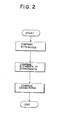
- Attributes of a query structure and a stored structure mentioned in Figure 2 may be compared by the step as illustrated in Figure 4. A series of logical operations are applied as described earlier.
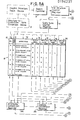
- a step-by-step illustration is given in Table 5, using the example Structures 1 and 2, and Tables 1, 2, 3 and 4. As described in Table 5, this method develops a vector with the node numbers of the query structure as components, and assign the nodes of the stored structure one by one, comparing the connection with other nodes.
- the node 1 of the stored structure matches with the node A of the query structure by their attributes.
- the element value is not examined since the node A is generic. No connection is examined for the first node.
- the node 2 and node B one finds that their attributes do not match (the node B has a 5-membered ring while the node 2 has a 6-membered ring), although the element is the same.
- no matches are found at last at the step 8. Then one concludes that the initial assignment of the node 1 and the node A is irrelevant. Thus one begins comparing the node 2 with the node A instead.
- the successful match is found when the node 6 is assigned to the node A, and the node 7 is compared with the node B. Since the node 7 is generic, only the attribute is examined. The attribute of the node 7 tells it has a 5- or 6-membered ring with oxygen atoms, which fulfills the condition of the node B. Since the node B is connected with the node A, it is required that the node 7 is connected to the corresponding node 6. This requirement is also fulfilled notably. Since the bond value of those two connections are the same, the single bond, the match of the node 7 and B are confirmed.
- the node C, D, and E of the query structure all match with the node 7.
- the match is confirmed by the fact that node C, D, and E are in the same ring system, .because the generic node 7 must be a single ring system. Duplicate matches are possible, since the generic node 7 is considered to be consisted of multiple nodes.
- the node 8 matches with the node G in every respect, it is concluded that the stored structure 1 matches the query structure 2.
- the matches of specifically defined nodes and generic nodes are easily examined, and thus the matches of the query and stored structures containing both specific and generic nodes are determined.
- the ordinary electronic computers are easily programmed and conduct the search.
- Chains are often expressed generically as C3-C5.
- attributes of each nodes are expressed as in Table 6.
- the attribute bit-map is the result of logical OR operation of the attribute of C3, C4, and C5.
- the attribute of the query node is the result of AND combination of the attribute of C4, C5, C6, and C7.
- the node of the stored structure fulfill the attribute requirement of the query node, and the match is found.
- this invention uses the extended connection table and the attribute table, the representation is compact. It requires much less computer storage than the method using whole set of structures derived from a generic structure as described in the method A. Since this invention is based on traditional connection tables, the search system can be developed based on structure graphics. Thus a searcher can build a query chemical structure image familiar to chemists on a graphic terminal and conduct a search using it. There is no need to learn complex coding rules as described in the method B.
- This invention breaks a generic expression down to chemically-significant units and represents them by a finit number of attribute position on a bit-map. This allows one to find a match between non-identical expression such as a C3-C5 alkyl, and a C4-C7 alkyl, or a nitrogen-containing ring and a six-membered heterocycle. Since these attributes are generated for both the specifically-defined nodes and generic nodes, the comparison between those two types of nodes is easy.
- the invented method Since it is usually easy to generate the attributes algorithmically from the normal generic expression as well as the specific expression, the invented method is easily implemented on a computer. It is important, too, that the invented method is compatible with the currently available specific structure search system using the connection tables so that the mixed handling of both generic structure and specific structure data is possible.
- this invention is particularlly useful in storing and retrieving complex chemical structures using a computer.
- This invention is intended to be used in the information storage and retrieval system, specifically in the chemical and chemical structure information storage and retrieval system.
- This invention is specifically intended to provide effective way to store and search complex chemical structure data especially those chemical structure expression widely known as "generic" chemical structures on a computer.
Landscapes
- Chemical & Material Sciences (AREA)
- Computing Systems (AREA)
- Engineering & Computer Science (AREA)
- Crystallography & Structural Chemistry (AREA)
- Theoretical Computer Science (AREA)
- Bioinformatics & Computational Biology (AREA)
- Life Sciences & Earth Sciences (AREA)
- Bioinformatics & Cheminformatics (AREA)
- Software Systems (AREA)
- Databases & Information Systems (AREA)
- Information Retrieval, Db Structures And Fs Structures Therefor (AREA)
- ing And Chemical Polishing (AREA)
- Medical Treatment And Welfare Office Work (AREA)
Priority Applications (1)
| Application Number | Priority Date | Filing Date | Title |
|---|---|---|---|
| AT86302323T ATE77499T1 (de) | 1985-03-29 | 1986-03-27 | Aufzeichnungs- und wiederauffindungsverfahren fuer chemische strukturdaten. |
Applications Claiming Priority (2)
| Application Number | Priority Date | Filing Date | Title |
|---|---|---|---|
| JP63283/85 | 1985-03-29 | ||
| JP60063283A JPS61223941A (ja) | 1985-03-29 | 1985-03-29 | 化学構造の検索方法 |
Publications (3)
| Publication Number | Publication Date |
|---|---|
| EP0196237A2 true EP0196237A2 (de) | 1986-10-01 |
| EP0196237A3 EP0196237A3 (en) | 1988-09-14 |
| EP0196237B1 EP0196237B1 (de) | 1992-06-17 |
Family
ID=13224840
Family Applications (1)
| Application Number | Title | Priority Date | Filing Date |
|---|---|---|---|
| EP86302323A Expired - Lifetime EP0196237B1 (de) | 1985-03-29 | 1986-03-27 | Aufzeichnungs- und Wiederauffindungsverfahren für chemische Strukturdaten |
Country Status (5)
| Country | Link |
|---|---|
| US (1) | US4811217A (de) |
| EP (1) | EP0196237B1 (de) |
| JP (1) | JPS61223941A (de) |
| AT (1) | ATE77499T1 (de) |
| DE (1) | DE3685671T2 (de) |
Cited By (1)
| Publication number | Priority date | Publication date | Assignee | Title |
|---|---|---|---|---|
| FR2660458A1 (fr) * | 1990-03-30 | 1991-10-04 | Questel | Procede et systeme de stockage et de recherche de formules chimiques dans une base de donnees. |
Families Citing this family (65)
| Publication number | Priority date | Publication date | Assignee | Title |
|---|---|---|---|---|
| US5161230A (en) * | 1987-06-05 | 1992-11-03 | Trw Inc. | Multifield identification circuit and related method of operation |
| US5241671C1 (en) * | 1989-10-26 | 2002-07-02 | Encyclopaedia Britannica Educa | Multimedia search system using a plurality of entry path means which indicate interrelatedness of information |
| US6978277B2 (en) * | 1989-10-26 | 2005-12-20 | Encyclopaedia Britannica, Inc. | Multimedia search system |
| US5224206A (en) * | 1989-12-01 | 1993-06-29 | Digital Equipment Corporation | System and method for retrieving justifiably relevant cases from a case library |
| US5175814A (en) * | 1990-01-30 | 1992-12-29 | Digital Equipment Corporation | Direct manipulation interface for boolean information retrieval |
| DE69131941T2 (de) * | 1990-10-05 | 2000-06-08 | Microsoft Corp | System und verfahren für informationsauffindung |
| EP0496902A1 (de) * | 1991-01-26 | 1992-08-05 | International Business Machines Corporation | Wissensbasiertes System und Verfahren zur Wiederauffindung von Moleküldaten |
| US5345516A (en) * | 1991-04-19 | 1994-09-06 | International Business Machines Corporation | Apparatus and method for parsing a chemical string |
| US5157736A (en) * | 1991-04-19 | 1992-10-20 | International Business Machines Corporation | Apparatus and method for optical recognition of chemical graphics |
| EP0633534B1 (de) * | 1992-03-27 | 2001-02-07 | ITAI, Akiko | Verfahren zur analyse der struktur von stabilen zusammengesetzten biopolymerligandmolekuelen |
| US5434796A (en) * | 1993-06-30 | 1995-07-18 | Daylight Chemical Information Systems, Inc. | Method and apparatus for designing molecules with desired properties by evolving successive populations |
| US5692176A (en) * | 1993-11-22 | 1997-11-25 | Reed Elsevier Inc. | Associative text search and retrieval system |
| US5664172A (en) * | 1994-07-19 | 1997-09-02 | Oracle Corporation | Range-based query optimizer |
| US5577239A (en) * | 1994-08-10 | 1996-11-19 | Moore; Jeffrey | Chemical structure storage, searching and retrieval system |
| US5463564A (en) | 1994-09-16 | 1995-10-31 | 3-Dimensional Pharmaceuticals, Inc. | System and method of automatically generating chemical compounds with desired properties |
| US5752019A (en) * | 1995-12-22 | 1998-05-12 | International Business Machines Corporation | System and method for confirmationally-flexible molecular identification |
| US6185506B1 (en) * | 1996-01-26 | 2001-02-06 | Tripos, Inc. | Method for selecting an optimally diverse library of small molecules based on validated molecular structural descriptors |
| WO1997027559A1 (en) | 1996-01-26 | 1997-07-31 | Patterson David E | Method of creating and searching a molecular virtual library using validated molecular structure descriptors |
| US5913208A (en) * | 1996-07-09 | 1999-06-15 | International Business Machines Corporation | Identifying duplicate documents from search results without comparing document content |
| WO1998020437A2 (en) | 1996-11-04 | 1998-05-14 | 3-Dimensional Pharmaceuticals, Inc. | System, method and computer program product for identifying chemical compounds having desired properties |
| US6453246B1 (en) | 1996-11-04 | 2002-09-17 | 3-Dimensional Pharmaceuticals, Inc. | System, method, and computer program product for representing proximity data in a multi-dimensional space |
| US6571227B1 (en) * | 1996-11-04 | 2003-05-27 | 3-Dimensional Pharmaceuticals, Inc. | Method, system and computer program product for non-linear mapping of multi-dimensional data |
| US6654736B1 (en) * | 1998-11-09 | 2003-11-25 | The United States Of America As Represented By The Secretary Of The Army | Chemical information systems |
| US6323852B1 (en) * | 1999-01-04 | 2001-11-27 | Leadscope, Inc. | Method of analyzing organizing and visualizing chemical data with feature hierarchy |
| US7912689B1 (en) * | 1999-02-11 | 2011-03-22 | Cambridgesoft Corporation | Enhancing structure diagram generation through use of symmetry |
| US7295931B1 (en) | 1999-02-18 | 2007-11-13 | Cambridgesoft Corporation | Deriving fixed bond information |
| US6584412B1 (en) * | 1999-08-04 | 2003-06-24 | Cambridgesoft Corporation | Applying interpretations of chemical names |
| US7416524B1 (en) | 2000-02-18 | 2008-08-26 | Johnson & Johnson Pharmaceutical Research & Development, L.L.C. | System, method and computer program product for fast and efficient searching of large chemical libraries |
| WO2001065462A2 (en) | 2000-02-29 | 2001-09-07 | 3-Dimensional Pharmaceuticals, Inc. | Method and computer program product for designing combinatorial arrays |
| US6907350B2 (en) * | 2000-03-13 | 2005-06-14 | Chugai Seiyaku Kabushiki Kaisha | Method, system and apparatus for handling information on chemical substances |
| US7039621B2 (en) | 2000-03-22 | 2006-05-02 | Johnson & Johnson Pharmaceutical Research & Development, L.L.C. | System, method, and computer program product for representing object relationships in a multidimensional space |
| WO2001075790A2 (en) | 2000-04-03 | 2001-10-11 | 3-Dimensional Pharmaceuticals, Inc. | Method, system, and computer program product for representing object relationships in a multidimensional space |
| US7272509B1 (en) * | 2000-05-05 | 2007-09-18 | Cambridgesoft Corporation | Managing product information |
| US7356419B1 (en) | 2000-05-05 | 2008-04-08 | Cambridgesoft Corporation | Deriving product information |
| AU2001286601A1 (en) * | 2000-08-22 | 2002-03-04 | Dimitris K. Agrafiotis | Method, system, and computer program product for determining properties of combinatorial library products from features of library building blocks |
| DE10043853A1 (de) * | 2000-09-06 | 2002-03-14 | Merck Patent Gmbh | Verfahren zur Erstellung von Synthesepfaden |
| US6678619B2 (en) * | 2000-09-20 | 2004-01-13 | Victor S. Lobanov | Method, system, and computer program product for encoding and building products of a virtual combinatorial library |
| US7054757B2 (en) * | 2001-01-29 | 2006-05-30 | Johnson & Johnson Pharmaceutical Research & Development, L.L.C. | Method, system, and computer program product for analyzing combinatorial libraries |
| US20020169755A1 (en) * | 2001-05-09 | 2002-11-14 | Framroze Bomi Patel | System and method for the storage, searching, and retrieval of chemical names in a relational database |
| US6694330B2 (en) * | 2001-05-09 | 2004-02-17 | Row 2 Technologies, Inc. | System and method for identifying the raw materials consumed in the manufacture of a chemical product |
| KR20030005461A (ko) * | 2001-07-09 | 2003-01-23 | 인포켐스(주) | 화학 물질의 데이터베이스구조 및 그 구축방법 |
| AUPR981002A0 (en) * | 2002-01-02 | 2002-01-31 | Proteome Systems Ltd | 2 Dimensional structure queries |
| KR20030066095A (ko) * | 2002-02-04 | 2003-08-09 | 주식회사 넥스트테크 | 신물질 개발을 위한 검색 엔진 기반의 화학 정보 제공시스템 |
| US7447786B2 (en) * | 2003-05-09 | 2008-11-04 | Oracle International Corporation | Efficient locking of shared data that is accessed for reads in a cluster database |
| US20060053173A1 (en) * | 2004-09-03 | 2006-03-09 | Biowisdom Limited | System and method for support of chemical data within multi-relational ontologies |
| US7496593B2 (en) | 2004-09-03 | 2009-02-24 | Biowisdom Limited | Creating a multi-relational ontology having a predetermined structure |
| US20060053172A1 (en) * | 2004-09-03 | 2006-03-09 | Biowisdom Limited | System and method for creating, editing, and using multi-relational ontologies |
| US20060053175A1 (en) * | 2004-09-03 | 2006-03-09 | Biowisdom Limited | System and method for creating, editing, and utilizing one or more rules for multi-relational ontology creation and maintenance |
| US20060053171A1 (en) * | 2004-09-03 | 2006-03-09 | Biowisdom Limited | System and method for curating one or more multi-relational ontologies |
| US7505989B2 (en) | 2004-09-03 | 2009-03-17 | Biowisdom Limited | System and method for creating customized ontologies |
| US20060053382A1 (en) * | 2004-09-03 | 2006-03-09 | Biowisdom Limited | System and method for facilitating user interaction with multi-relational ontologies |
| US20060074836A1 (en) * | 2004-09-03 | 2006-04-06 | Biowisdom Limited | System and method for graphically displaying ontology data |
| US20060053174A1 (en) * | 2004-09-03 | 2006-03-09 | Bio Wisdom Limited | System and method for data extraction and management in multi-relational ontology creation |
| US7493333B2 (en) * | 2004-09-03 | 2009-02-17 | Biowisdom Limited | System and method for parsing and/or exporting data from one or more multi-relational ontologies |
| US20060074833A1 (en) * | 2004-09-03 | 2006-04-06 | Biowisdom Limited | System and method for notifying users of changes in multi-relational ontologies |
| WO2007008987A1 (en) * | 2005-07-11 | 2007-01-18 | Emolecules, Inc. | Molecular keyword indexing for chemical structure database storage, searching and retrieval |
| US8140267B2 (en) * | 2006-06-30 | 2012-03-20 | International Business Machines Corporation | System and method for identifying similar molecules |
| CN101196963B (zh) * | 2007-12-26 | 2010-06-02 | 北京时代楷模科技有限公司 | 族性化学结构标引的纠错系统 |
| US20090228445A1 (en) * | 2008-03-04 | 2009-09-10 | Systems Biology (1) Pvt. Ltd. | Automated molecular mining and activity prediction using xml schema, xml queries, rule inference and rule engines |
| US8996568B2 (en) * | 2009-07-14 | 2015-03-31 | Qualcomm Incorporated | Methods and apparatus for efficiently processing multiple keyword queries on a distributed network |
| WO2011060285A1 (en) * | 2009-11-13 | 2011-05-19 | Chemsil Silicones, Inc. | Search engine identifying chemical products |
| US9171044B2 (en) * | 2010-02-16 | 2015-10-27 | Oracle International Corporation | Method and system for parallelizing database requests |
| US10318526B2 (en) * | 2016-07-05 | 2019-06-11 | Zymergen Inc. | Complex chemical substructure search query building and execution |
| US10459810B2 (en) | 2017-07-06 | 2019-10-29 | Oracle International Corporation | Technique for higher availability in a multi-node system using replicated lock information to determine a set of data blocks for recovery |
| US12020781B1 (en) * | 2023-08-14 | 2024-06-25 | Benchling, Inc. | Searching of chemical structures |
Family Cites Families (3)
| Publication number | Priority date | Publication date | Assignee | Title |
|---|---|---|---|---|
| FR2286443A1 (fr) * | 1974-09-16 | 1976-04-23 | Anvar | Appareil pour le codage et la visualisation simultanes d'un graphe |
| JPS58175077A (ja) * | 1982-04-07 | 1983-10-14 | Nippon Kagaku Gijutsu Joho Center | 化合物の立体化学情報記憶方法及び装置 |
| US4642762A (en) * | 1984-05-25 | 1987-02-10 | American Chemical Society | Storage and retrieval of generic chemical structure representations |
-
1985
- 1985-03-29 JP JP60063283A patent/JPS61223941A/ja active Granted
-
1986
- 1986-03-25 US US06/844,016 patent/US4811217A/en not_active Expired - Fee Related
- 1986-03-27 EP EP86302323A patent/EP0196237B1/de not_active Expired - Lifetime
- 1986-03-27 AT AT86302323T patent/ATE77499T1/de not_active IP Right Cessation
- 1986-03-27 DE DE8686302323T patent/DE3685671T2/de not_active Expired - Fee Related
Cited By (2)
| Publication number | Priority date | Publication date | Assignee | Title |
|---|---|---|---|---|
| FR2660458A1 (fr) * | 1990-03-30 | 1991-10-04 | Questel | Procede et systeme de stockage et de recherche de formules chimiques dans une base de donnees. |
| EP0451049A1 (de) * | 1990-03-30 | 1991-10-09 | Questel | Verfahren und Speicher- und Abrufsystem von chemischen Formeln in einer Datenbank |
Also Published As
| Publication number | Publication date |
|---|---|
| DE3685671D1 (de) | 1992-07-23 |
| US4811217A (en) | 1989-03-07 |
| JPS61223941A (ja) | 1986-10-04 |
| EP0196237B1 (de) | 1992-06-17 |
| EP0196237A3 (en) | 1988-09-14 |
| ATE77499T1 (de) | 1992-07-15 |
| JPH0542705B2 (de) | 1993-06-29 |
| DE3685671T2 (de) | 1993-01-14 |
Similar Documents
| Publication | Publication Date | Title |
|---|---|---|
| EP0196237B1 (de) | Aufzeichnungs- und Wiederauffindungsverfahren für chemische Strukturdaten | |
| US5953006A (en) | Methods and apparatus for detecting and displaying similarities in large data sets | |
| US7523095B2 (en) | System and method for generating refinement categories for a set of search results | |
| US4554631A (en) | Keyword search automatic limiting method | |
| US5473732A (en) | Relational artificial intelligence system | |
| EP1585073B1 (de) | Verfahren zur Determinierung und Unterdrückung von Duplikaten | |
| US20070016612A1 (en) | Molecular keyword indexing for chemical structure database storage, searching, and retrieval | |
| US6430557B1 (en) | Identifying a group of words using modified query words obtained from successive suffix relationships | |
| US6112204A (en) | Method and apparatus using run length encoding to evaluate a database | |
| CA2206155A1 (en) | Knowledge-based information retrieval system | |
| US20070150469A1 (en) | Multi-segment string search | |
| CN100419746C (zh) | 信息检索方法 | |
| JP2693914B2 (ja) | 検索システム | |
| Van Rijsbergen | An algorithm for information structuring and retrieval | |
| Chang | oriented reciprocal hashing scheme | |
| Schlaf et al. | Learning Categories and their Instances by Contextual Features. | |
| JPS63311432A (ja) | 連想語検索システム | |
| Lin et al. | Smart Semantic Query of Design Information in a Case Library | |
| KR100434718B1 (ko) | 문서 색인 시스템 및 그 방법 | |
| TWI911775B (zh) | 數據探索裝置、串聯式數據探索方法及其電腦程式產品 | |
| Parker-Rhodes et al. | A reduction method for non-arithmetic data, and its application to thesauric translation. | |
| Hartzman et al. | A relational approach to querying data streams | |
| Bersohn | Learning rules for graph transformations by induction from examples | |
| De Bonis et al. | Efficient algorithms for chemical threshold testing problems | |
| Drewes | Retrieval of abstracts by analogy |
Legal Events
| Date | Code | Title | Description |
|---|---|---|---|
| PUAI | Public reference made under article 153(3) epc to a published international application that has entered the european phase |
Free format text: ORIGINAL CODE: 0009012 |
|
| AK | Designated contracting states |
Kind code of ref document: A2 Designated state(s): AT CH DE FR GB IT LI NL |
|
| PUAL | Search report despatched |
Free format text: ORIGINAL CODE: 0009013 |
|
| AK | Designated contracting states |
Kind code of ref document: A3 Designated state(s): AT CH DE FR GB IT LI NL |
|
| 17P | Request for examination filed |
Effective date: 19890228 |
|
| 17Q | First examination report despatched |
Effective date: 19901017 |
|
| GRAA | (expected) grant |
Free format text: ORIGINAL CODE: 0009210 |
|
| AK | Designated contracting states |
Kind code of ref document: B1 Designated state(s): AT CH DE FR GB IT LI NL |
|
| REF | Corresponds to: |
Ref document number: 77499 Country of ref document: AT Date of ref document: 19920715 Kind code of ref document: T |
|
| REF | Corresponds to: |
Ref document number: 3685671 Country of ref document: DE Date of ref document: 19920723 |
|
| ET | Fr: translation filed | ||
| ITF | It: translation for a ep patent filed | ||
| PLBE | No opposition filed within time limit |
Free format text: ORIGINAL CODE: 0009261 |
|
| STAA | Information on the status of an ep patent application or granted ep patent |
Free format text: STATUS: NO OPPOSITION FILED WITHIN TIME LIMIT |
|
| 26N | No opposition filed | ||
| PGFP | Annual fee paid to national office [announced via postgrant information from national office to epo] |
Ref country code: FR Payment date: 19940310 Year of fee payment: 9 |
|
| PGFP | Annual fee paid to national office [announced via postgrant information from national office to epo] |
Ref country code: AT Payment date: 19940314 Year of fee payment: 9 |
|
| PGFP | Annual fee paid to national office [announced via postgrant information from national office to epo] |
Ref country code: GB Payment date: 19940317 Year of fee payment: 9 |
|
| PGFP | Annual fee paid to national office [announced via postgrant information from national office to epo] |
Ref country code: DE Payment date: 19940323 Year of fee payment: 9 Ref country code: CH Payment date: 19940323 Year of fee payment: 9 |
|
| PGFP | Annual fee paid to national office [announced via postgrant information from national office to epo] |
Ref country code: NL Payment date: 19940331 Year of fee payment: 9 |
|
| PG25 | Lapsed in a contracting state [announced via postgrant information from national office to epo] |
Ref country code: GB Effective date: 19950327 Ref country code: AT Effective date: 19950327 |
|
| PG25 | Lapsed in a contracting state [announced via postgrant information from national office to epo] |
Ref country code: LI Effective date: 19950331 Ref country code: CH Effective date: 19950331 |
|
| PG25 | Lapsed in a contracting state [announced via postgrant information from national office to epo] |
Ref country code: NL Effective date: 19951001 |
|
| GBPC | Gb: european patent ceased through non-payment of renewal fee |
Effective date: 19950327 |
|
| PG25 | Lapsed in a contracting state [announced via postgrant information from national office to epo] |
Ref country code: FR Free format text: LAPSE BECAUSE OF NON-PAYMENT OF DUE FEES Effective date: 19951130 |
|
| REG | Reference to a national code |
Ref country code: CH Ref legal event code: PL |
|
| NLV4 | Nl: lapsed or anulled due to non-payment of the annual fee |
Effective date: 19951001 |
|
| PG25 | Lapsed in a contracting state [announced via postgrant information from national office to epo] |
Ref country code: DE Effective date: 19951201 |
|
| REG | Reference to a national code |
Ref country code: FR Ref legal event code: ST |
|
| PG25 | Lapsed in a contracting state [announced via postgrant information from national office to epo] |
Ref country code: IT Free format text: LAPSE BECAUSE OF NON-PAYMENT OF DUE FEES Effective date: 20050327 |