EP0451092A2 - Konzentrierte Farbstofflösungen - Google Patents
Konzentrierte Farbstofflösungen Download PDFInfo
- Publication number
- EP0451092A2 EP0451092A2 EP91810177A EP91810177A EP0451092A2 EP 0451092 A2 EP0451092 A2 EP 0451092A2 EP 91810177 A EP91810177 A EP 91810177A EP 91810177 A EP91810177 A EP 91810177A EP 0451092 A2 EP0451092 A2 EP 0451092A2
- Authority
- EP
- European Patent Office
- Prior art keywords
- dye
- formula
- concentrated aqueous
- solution according
- mol
- Prior art date
- Legal status (The legal status is an assumption and is not a legal conclusion. Google has not performed a legal analysis and makes no representation as to the accuracy of the status listed.)
- Granted
Links
Classifications
-
- C—CHEMISTRY; METALLURGY
- C09—DYES; PAINTS; POLISHES; NATURAL RESINS; ADHESIVES; COMPOSITIONS NOT OTHERWISE PROVIDED FOR; APPLICATIONS OF MATERIALS NOT OTHERWISE PROVIDED FOR
- C09B—ORGANIC DYES OR CLOSELY-RELATED COMPOUNDS FOR PRODUCING DYES, e.g. PIGMENTS; MORDANTS; LAKES
- C09B67/00—Influencing the physical, e.g. the dyeing or printing properties of dyestuffs without chemical reactions, e.g. by treating with solvents grinding or grinding assistants, coating of pigments or dyes; Process features in the making of dyestuff preparations; Dyestuff preparations of a special physical nature, e.g. tablets, films
- C09B67/0033—Blends of pigments; Mixtured crystals; Solid solutions
-
- C—CHEMISTRY; METALLURGY
- C09—DYES; PAINTS; POLISHES; NATURAL RESINS; ADHESIVES; COMPOSITIONS NOT OTHERWISE PROVIDED FOR; APPLICATIONS OF MATERIALS NOT OTHERWISE PROVIDED FOR
- C09B—ORGANIC DYES OR CLOSELY-RELATED COMPOUNDS FOR PRODUCING DYES, e.g. PIGMENTS; MORDANTS; LAKES
- C09B67/00—Influencing the physical, e.g. the dyeing or printing properties of dyestuffs without chemical reactions, e.g. by treating with solvents grinding or grinding assistants, coating of pigments or dyes; Process features in the making of dyestuff preparations; Dyestuff preparations of a special physical nature, e.g. tablets, films
- C09B67/0071—Process features in the making of dyestuff preparations; Dehydrating agents; Dispersing agents; Dustfree compositions
- C09B67/0072—Preparations with anionic dyes or reactive dyes
- C09B67/0073—Preparations of acid or reactive dyes in liquid form
-
- Y—GENERAL TAGGING OF NEW TECHNOLOGICAL DEVELOPMENTS; GENERAL TAGGING OF CROSS-SECTIONAL TECHNOLOGIES SPANNING OVER SEVERAL SECTIONS OF THE IPC; TECHNICAL SUBJECTS COVERED BY FORMER USPC CROSS-REFERENCE ART COLLECTIONS [XRACs] AND DIGESTS
- Y10—TECHNICAL SUBJECTS COVERED BY FORMER USPC
- Y10S—TECHNICAL SUBJECTS COVERED BY FORMER USPC CROSS-REFERENCE ART COLLECTIONS [XRACs] AND DIGESTS
- Y10S8/00—Bleaching and dyeing; fluid treatment and chemical modification of textiles and fibers
- Y10S8/916—Natural fiber dyeing
- Y10S8/918—Cellulose textile
-
- Y—GENERAL TAGGING OF NEW TECHNOLOGICAL DEVELOPMENTS; GENERAL TAGGING OF CROSS-SECTIONAL TECHNOLOGIES SPANNING OVER SEVERAL SECTIONS OF THE IPC; TECHNICAL SUBJECTS COVERED BY FORMER USPC CROSS-REFERENCE ART COLLECTIONS [XRACs] AND DIGESTS
- Y10—TECHNICAL SUBJECTS COVERED BY FORMER USPC
- Y10S—TECHNICAL SUBJECTS COVERED BY FORMER USPC CROSS-REFERENCE ART COLLECTIONS [XRACs] AND DIGESTS
- Y10S8/00—Bleaching and dyeing; fluid treatment and chemical modification of textiles and fibers
- Y10S8/916—Natural fiber dyeing
- Y10S8/919—Paper
Definitions
- Preferred dye solutions according to the invention contain 0.1 to 0.9, especially 0.2 to 0.6 mol of 3-diethylamino-1-propylamine per mole of dye of the formula (1) and 2 to 4, especially 2.5 to 4 moles of hydroxyalkylamine .
- the dye solutions according to the invention preferably contain 10 to 25% by weight of a dye of the formula (1).
- K represents a coupling component of the acetoacetanilide, pyridone, pyrazolone or pyrimidine series. Above all, these are the coupling components customary for azo dyes, in particular for paper dyes.
- K is preferably a coupling component of the formula wherein
- Y3 O
- R is hydrogen or C1-C4-alkyl
- R1 and R 2 each independently represent hydrogen, optionally substituted alkyl or optionally substituted phenyl.
- R1 and / or R2 represents an optionally substituted alkyl group, e.g. a methyl, ethyl, n- or iso-propyl, n-, sec.- or tert.-butyl, a straight-chain or branched pentyl or hexyl or a cyclohexyl radical which is to be understood as one or more e.g. can be substituted by -OH, C1-C4-alkoxy or C1-C4-hydroxyalkoxy.
- Suitable substituted alkyl radicals are: methoxymethyl, ethoxymethyl, ethoxyethyl, ethoxypropyl, n-propoxymethyl, iso-propoxymethyl, butoxymethyl, butoxyethyl, butoxypropyl, methoxybutyl, ethoxypentyl and 2-hydroxyethoxypentyl.
- R1 and / or R2 are optionally substituted phenyl, it can be unsubstituted or monosubstituted or polysubstituted by the same or different radicals.
- Such residues include e.g. in question: C1-C4-alkyl, which is generally to be understood in this application as methyl, ethyl, n- or iso-propyl or n-, sec- or tert-butyl, C1-C4-alkoxy, which is used in this application generally includes methoxy, ethoxy, n- or iso-propoxy or n-, sec- or tert-butoxy, halogen such as fluorine, chlorine or bromine or nitro.
- C1-C4-alkyl which is generally to be understood in this application as methyl, ethyl, n- or iso-propyl or n-, sec- or tert-butyl
- C1-C4-alkoxy which is used in this application generally includes methoxy, ethoxy, n- or iso-propoxy or n-, sec- or tert-butoxy, halogen such as fluorine, chlorine or bro
- R1 and / or R2 as phenyl is preferably phenyl which is unsubstituted or substituted by 1 to 3 C1-C4-alkyl, chlorine or methoxy groups, unsubstituted phenyl being particularly preferred.
- R1 and R2 are preferably hydrogen or C1-C4 alkyl and particularly preferably hydrogen or methyl.
- the dyes of the formula (1) are known or are obtained in a known manner.
- the aqueous dye solutions according to the invention contain at least 0.1 but less than 1 mole of 3-diethylamino-1-propylamine per mole of dye of the formula (1) and a hydroxyalkylamine, such as, for example, ethanolamine, diethanolamine, triethanolamine, 2-dimethylaminoethanol, 2-methylaminoethanol, N. , N-bis (2-hydroxyethyl) -1,3-diaminopropane, N- (2-hydroxyethyl) ethylenediamine or 2-hydroxypropylamine. Mixtures containing 2 or more of these hydroxyalkylamines can also be used.
- a hydroxyalkylamine such as, for example, ethanolamine, diethanolamine, triethanolamine, 2-dimethylaminoethanol, 2-methylaminoethanol, N. , N-bis (2-hydroxyethyl) -1,3-diaminopropane, N- (2-hydroxyethyl) ethylenediamine or 2-hydroxyprop
- the dye solutions according to the invention can contain water-soluble organic solubilizers.
- water-soluble organic solubilizers include: urea, formamide, ⁇ -caprolactam, dimethylformamide, 1,2-diaminopropane, polyhydric alcohols, e.g. Ethylene glycol, propylene glycol or glycerin.
- the amount of organic solubilizer depends, among other things. depends on how much 3-diethylamino-1-propylamine and hydroxyalkylamine is contained in the dye solutions. If the content of the amines mentioned is about 2 to 4 moles per mole of dye, no organic solubilizer or only about 5 to 10% by weight, based on the total weight of the dye solution, is generally required. On the other hand, it is often advantageous for economic reasons to adjust the content of the amines mentioned to about 1.5 to 2.5 moles per mole of dye and additionally to use about 10 to 25% by weight of organic solubilizer.
- the concentrated aqueous dye solutions according to the invention are generally prepared by stirring the free dye acids with a mixture of water, 3-diethylamino-1-propylamine, hydroxyalkylamine and optionally an organic solubilizer until a homogeneous solution is obtained. If necessary, the mixture can be heated, eg to 40 to 80 ° C, and if necessary filtered.
- the concentrated aqueous dye solutions obtained are notable in particular for good storage stability.
- the concentrated dye solutions according to the invention are used, if appropriate after dilution with water, in particular for dyeing and printing paper, including semi-cardboard boxes and cardboard boxes, these materials being e.g. stain in bulk, by brushing or by dipping.
- a liquid formulation can also be used for a continuous or discontinuous dyeing process for textile materials, in particular cellulosic or cellulose-containing textile materials.
- Example 1 1522 parts of the aqueous press cake, containing 456.5 parts of the dye of the formula as free dye acid, 41.3 parts of 3-diethylamino-1-propylamine, 42 parts of diethanolamine and 246 parts of 2-methylaminoethanol are added and the mixture is made up to a total weight of 4348 parts with water.
- the suspension obtained is heated to 50 ° C. with stirring and stirred at this temperature until the dye has completely dissolved.
- the dye solution is then clarified.
- a liquid commercial form of dye is obtained which shows no residue even after storage for one month at 3-5 ° C.
- Example 2 920 parts of the aqueous press cake containing 260 parts of the dye of the formula listed in Example 1 are mixed with 23.5 parts of 3-diethylamino-1-propylamine and 167 parts of 2-methylaminoethanol and made up to a total weight of 2600 parts with water . The suspension obtained is heated to 50 ° C. warmed and stirred at this temperature until the dye has completely dissolved. The dye solution is then clarified.
- a liquid storage-stable commercial form of dye is obtained.
- Example 3 920 parts of the same aqueous press cake as in Example 2 are mixed with 14.8 parts of 3-diethylamino-1-propylamine and 193 parts of dimethylaminoethanol, made up to a total weight of 2600 parts with water and otherwise carried out as in Example 2 a liquid, storage-stable commercial form.
- Example 4 920 parts of the same aqueous press cake as in Example 2 are mixed with 11.7 parts of 3-diethylamino-1-propylamine, 12.6 parts of diethanolamine and 165.5 parts of 2-methylaminoethanol, with water to a total weight of 2600 parts provided and otherwise processed as described in Example 2 into a liquid commercial form.
- Example 5 920 parts of the same aqueous press cake as in Example 2 are mixed with 18.5 parts of 3-diethylamino-1-propylamine, 15 parts of diethanolamine and 107 parts of 2-methylaminoethanol, made up to a total weight of 2600 parts with water and the rest processed as described in Example 2 into a liquid commercial form.
- Example 6-10 The procedure is as described in Example 1, but instead of the dye used there are used equivalent amounts of the dyes which are obtained by diazotization of dehydrothiotoluidine-7-sulfonic acid and coupling with the coupling components listed in the table below.
- Example 11 In a Dutch company, 70 parts of chemically bleached sulfite cellulose from softwood and 30 parts of chemically bleached sulfite cellulose from birch wood are ground in 2000 parts of water. 0.3 part of the commercial dye form described in Example 1 is added to this mass. After 20 minutes of mixing, paper is made from this mass. The absorbent paper obtained in this way is colored yellow. The wastewater is practically colorless.
Landscapes
- Chemical & Material Sciences (AREA)
- Chemical Kinetics & Catalysis (AREA)
- Organic Chemistry (AREA)
- Coloring (AREA)
- Paper (AREA)
Abstract
Description
- Gegenstand der vorliegenden Erfindung sind konzentrierte wässrige Farbstofflösungen, enthaltend
- a) 7 bis 30 Gew.-% eines Farbstoffes der Formel

- b) mindestens 0,1 aber weniger als 1 Mol 3-Diethylamino-1-propylamin, pro Mol Farbstoff der Formel (1),
- c) soviel eines Hydroxyalkylamins,
dass insgesamt 1,5 bis 5 Mol der Komponenten b) und c) pro Mol Farbstoff vorhanden sind, und - d) gegebenenfalls weitere Zusätze.
- Bervorzugte erfindungsgemässe Farbstofflösungen enthalten 0,1 bis 0,9, vor allem 0,2 bis 0,6 Mol 3-Diethylamino-1-propylamin pro Mol Farbstoff der Formel (1) und 2 bis 4 vor allem 2,5 bis 4 Mol Hydroxyalkylamin.
- Vorzugsweise enthalten die erfindungsgemässen Farbstofflösungen 10 bis 25 Gew.-% eines Farbstoffes der Formel (1).
- In der obigen Formel (1) bedeutet K eine Kupplungskomponente der Acetoacetanilid-, Pyridon-, Pyrazolon- oder Pyrimidinreihe. Es handelt sich vor allem um die bei Azofarbstoffen, insbesondere bei Papierfarbstoffen, gebräuchlichen Kupplungskomponenten.
- Vorzugsweise ist K eine Kupplungskomponente der Formel

worin - Y₁ und Y₂ unabhängig voneinander =O, =NH oder =N-C₁-C₄-Alkyl, Y₃ =O, =S, =NR oder =N-CN, wobei R Wasserstoff oder C₁-C₄-Alkyl ist, und R₁ und R2 unabhängig voneinander je Wasserstoff, gegebenenfalls substituiertes Alkyl oder gegebenenfalls substituiertes Phenyl bedeuten.
- In der obigen Formel (2) ist für die Kupplungskomponente nur eine tautomere Form angegeben, auch die anderen tautomeren Formen sollen jedoch durch diese Formel mit umfasst sein.
- Stellen R₁ und/oder R₂ eine gegebenenfalls substituierte Alkylgruppe dar, so ist darunter z.B. ein Methyl-, Ethyl-, n- oder iso-Propyl-, n-, sec.- oder tert.-Butyl-, ein geradkettiger oder verzweigter Pentyl- oder Hexyl- oder ein Cyclohexylrest zu verstehen, der einfach oder mehrfach z.B. durch -OH, C₁-C₄-Alkoxy oder C₁-C₄-Hydroxyalkoxy substituiert sein kann.
- Beispiele für geeignete substituierte Alkylreste sind: Methoxymethyl, Ethoxymethyl, Ethoxyethyl, Ethoxypropyl, n-Propoxymethyl, iso-Propoxymethyl, Butoxymethyl, Butoxyethyl, Butoxypropyl, Methoxybutyl, Ethoxypentyl und 2-Hydroxyethoxypentyl.
- Bedeuten R₁ und/oder R₂ gegebenenfalls substituiertes Phenyl, so kann es sich um unsubstituiertes oder einfach oder mehrfach mit gleichen oder verschiedenen Resten substituiertes Phenyl handeln.
- Als derartige Reste kommen z.B. in Frage: C₁-C₄-Alkyl, worunter generell in dieser Anmeldung Methyl, Ethyl, n- oder iso-Propyl oder n-, sec.- oder tert.-Butyl zu verstehen ist, C₁-C₄-Alkoxy, welches in dieser Anmeldung generell Methoxy, Ethoxy, n- oder iso-Propoxy oder n-, sec.- oder tert.-Butoxy umfasst, Halogen wie Fluor, Chlor oder Brom oder Nitro.
- Vorzugsweise handelt es sich bei R₁ und/oder R₂ als Phenyl um unsubstituiertes oder mit 1 bis 3 C₁-C₄-Alkyl, Chlor oder Methoxygruppen substituiertes Phenyl, wobei insbesondere die Bedeutung unsubstituiertes Phenyl bevorzugt ist.
- R₁ und R₂ stehen bevorzugt für Wasserstoff oder C₁-C₄-Alkyl und besonders bevorzugt für Wasserstoff oder Methyl.
- Y₁ und/oder Y₂ stehen vorzugsweise für die funktionelle Gruppe =O oder =NH, wobei es ausserdem bevorzugt ist, dass Y₁ und Y₂ gleich sind. Y₁ und Y₂ sind besonders bevorzugt gleich und bedeuten jeweils =NH.
- Y₃ stellt bevorzugt die Gruppe =O, =S, =NH oder =N-CN und insbesondere bevorzugt die Gruppe =NH dar.
- In einer besonders bevorzugten Ausführungsform enthalten die erfindungsgemässen Farbstofflösungen Azofarbstoffe der Formel (1), worin R₁ und R₂ unabhängig voneinander je Wasserstoff oder C₁-C₄-Alkyl, Y₁ und Y₂ unabhängig voneinander je =O oder =NH und Y₃ =O, =S, =NH oder =N-CN bedeutet.
- Die Farbstoffe der Formel (1) sind bekannt oder werden auf bekannte Art und Weise erhalten.
- Die erfindungsgemässen wässrigen Farbstofflösungen enthalten mindestens 0,1 aber weniger als 1 Mol 3-Diethylamino-1-propylamin pro Mol Farbstoff der Formel (1) und ein Hydroxyalkylamin, wie z.B. Ethanolamin, Diethanolamin, Triethanolamin, 2-Dimethylaminoethanol, 2-Methylaminoethanol, N,N-Bis-(2-hydroxyethyl)-1,3-diaminopropan, N-(2-Hydroxyethyl)-ethylendiamin oder 2-Hydroxypropylamin. Es können auch Gemische, enthaltend 2 oder mehrere dieser Hydroxyalkylamine eingesetzt werden.
- Zusätzlich können die erfindungsgemässen Farbstofflösungen wasserlösliche organische Lösungsvermittler enthalten. In Frage kommen z.B.: Harnstoff, Formamid, ε-Caprolactam, Dimethylformamid, 1,2-Diaminopropan, mehrwertige Alkohole, wie z.B. Ethylenglykol, Propylenglykol oder Glycerin.
- Die Menge an organischem Lösungsvermittler hängt u.a. davon ab, wieviel 3-Diethylamino-1-propylamin und Hydroxyalkylamin in den Farbstofflösungen enthalten ist. Liegt der Gehalt an den genannten Aminen bei ca. 2 bis 4 Mol pro Mol Farbstoff, so ist im allgemeinen kein organischer Lösungsvermittler oder nur ca. 5 bis 10 Gew.-% davon, bezogen auf das Gesamtgewicht der Farbstofflösung, erforderlich. Andererseits ist es aus ökonomischen Gründen oft vorteilhaft, den Gehalt an den genannten Aminen bei ca. 1,5 bis 2,5 Mol pro Mol Farbstoff einzustellen und zusätzlich ca. 10 bis 25 Gew.-% an organischem Lösungsvermittler einzusetzen.
- Bevorzugte erfindungsgemässe wässrige Farbstofflösungen enthalten
- a) 10 bis 30 Gew.-% eines Farbstoffes der Formel (1),
- b) 0,1 bis 0,9 Mol 3-Diethylamino-1-propylamin pro Mol Farbstoff der Formel (1),
- c) 2-4 Mol Hydroxyalkylamin pro Mol Farbstoff der Formel (1) sowie
- d) 0 bis 25 Gew.-% eines organischen Lösungsvermittlers.
- Unter diesen sind diejenigen besonders bevorzugt, welche
- a) 10 bis 30 Gew.-% eines Farbstoffes der Formel (1),
- b) 0,2 bis 0,6 Mol 3-Diethylamino-1-propylamin pro Mol Farbstoff der Formel (1),
- c) 2,5 bis 4 Mol Hydroxyalkylamin pro Mol Farbstoff der Formel (1) sowie
- d) 0 bis 25 Gew.-% eines organischen Lösungsvermittlers enthalten.
- Die Herstellung der erfindungsgemässen konzentrierten wässrigen Farbstofflösungen erfolgt im allgemeinen in der Weise, dass die freien Farbstoffsäuren mit einer Mischung aus Wasser, 3-Diethylamino-1-propylamin, Hydroxyalkylamin sowie gegebenenfalls einem organischen Lösungsvermittler verrührt werden, bis eine homogene Lösung entsteht. Falls erforderlich kann die Mischung erwärmt werden, z.B. auf 40 bis 80°C, und evtl. filtriert werden.
- Die erhaltenen konzentrierten wässrigen Farbstofflösungen zeichnen sich vor allem durch eine gute Lagerstabilität aus.
- Verwendung finden die erfindungsgemässen konzentrierten Farbstofflösungen, gegebenenfalls nach dem Verdünnen mit Wasser, insbesondere zum Färben und Bedrucken von Papier, einschliesslich Halbkartons und Kartons, wobei man diese Materialien z.B. in der Masse, durch Streichen oder durch Tauchen färben kann. Im übrigen kann eine derartige Flüssigformulierung auch für ein kontinuierliches oder diskontinuierliches Färbeverfahren für Textilmaterialien, insbesondere cellulosischen oder Cellulose enthaltenden Textilmaterialien, eingesetzt werden.
- Die nachfolgenden Beispiele veranschaulichen die Erfindung. Darin bedeuten Teile Gewichtsteile.
- Beispiel 1: 1522 Teile des wässrigen Presskuchens, enthaltend 456,5 Teile des Farbstoffes der Formel
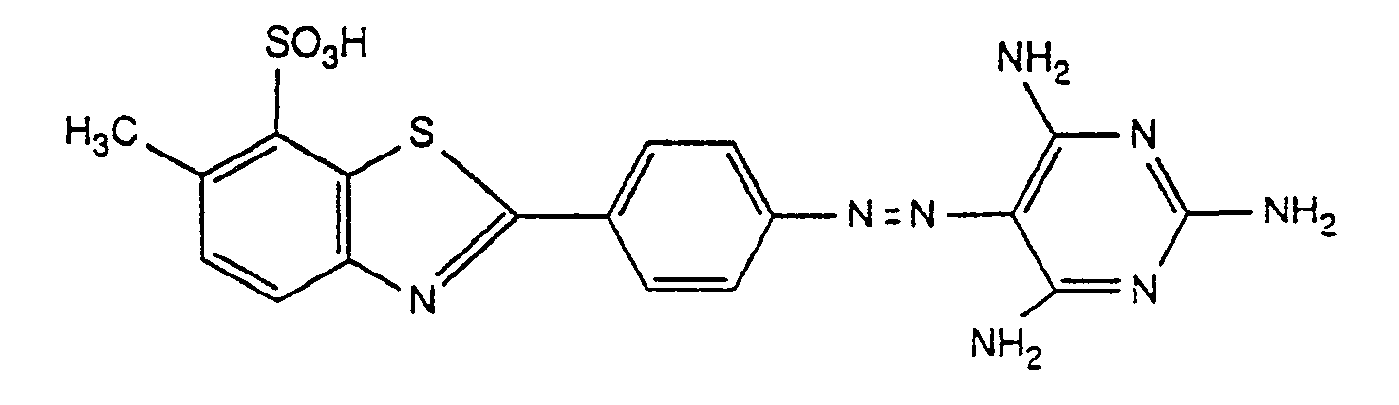
als freie Farbstoffsäure, werden mit 41,3 Teilen 3-Diethylamino-1-propylamin, 42 Teilen Diethanolamin und 246 Teilen 2-Methylaminoethanol versetzt und mit Wasser auf ein Gesamtgewicht von 4348 Teile gestellt. Die erhaltene Suspension wird unter Rühren auf 50°C erwärmt und bei dieser Temperatur so lange gerührt, bis der Farbstoff vollständig in Lösung gegangen ist. Die Farbstofflösung wird dann noch klärfiltriert. - Man erhält eine flüssige Farbstoff-Handelsform, welche auch nach einmonatiger Lagerung bei 3-5°C keinerlei Rückstand zeigt.
- Beispiel 2: 920 Teile des wässrigen Presskuchens, enthaltend 260 Teile des Farbstoffes der im Beispiel 1 aufgeführten Formel werden mit 23,5 Teilen 3-Diethylamino-1-propylamin und 167 Teilen 2-Methylaminoethanol versetzt und mit Wasser auf ein Gesamtgewicht von 2600 Teile gestellt. Die erhaltene Suspension wird unter Rühren auf 50°C erwärmt und bei dieser Temperatur so lange gerührt, bis der Farbstoff vollständig in Lösung gegangen ist. Die Farbstofflösung wird dann noch klärfiltriert.
- Man erhält eine flüssige lagerstabile Farbstoff-Handelsform.
- Beispiel 3: 920 Teile des gleichen wässrigen Presskuchens wie im Beispiel 2 werden mit 14,8 Teilen 3-Diethylamino-1-propylamin und 193 Teilen Dimethylaminoethanol versetzt, mit Wasser auf ein Gesamtgewicht von 2600 Teile gestellt und im übrigen wie im Beispiel 2 ausgeführt zu einer flüssigen lagerstabilen Handelsform weiterverarbeitet.
- Beispiel 4: 920 Teile des gleichen wässrigen Presskuchens wie im Beispiel 2 werden mit 11,7 Teilen 3-Diethylamino-1-propylamin, 12,6 Teilen Diethanolamin und 165,5 Teilen 2-Methylaminoethanol versetzt, mit Wasser auf ein Gesamtgewicht von 2600 Teile gestellt und im übrigen wie im Beispiel 2 ausgeführt zu einer flüssigen Handelsform weiterverarbeitet.
- Beispiel 5: 920 Teile des gleichen wässrigen Presskuchens wie im Beispiel 2 werden mit 18,5 Teilen 3-Diethylamino-1-propylamin, 15 Teilen Diethanolamin und 107 Teilen 2-Methylaminoethanol versetzt, mit Wasser auf ein Gesamtgewicht von 2600 Teile gestellt und im übrigen wie im Beispiel 2 ausgeführt zu einer flüssigen Handelsform weiterverarbeitet.
- Beispiel 6-10: Man arbeitet wie im Beispiel 1 beschrieben, verwendet jedoch anstelle des dort eingesetzten Farbstoffes äquivalente Mengen der Farbstoffe, die man durch Diazotierung von Dehydrothiotoluidin-7-sulfonsäure und Kuppeln mit den in der folgenden Tabelle aufgeführten Kupplungskomponenten erhält.
- Man erhält auf diese Weise konzentrierte Lösungen der Farbstoffe, welche sich durch gute Lagerstabilität auszeichnen.

- Beispiel 11: In einem Holländer werden 70 Teile chemisch gebleichte Sulfitzellulose aus Nadelholz und 30 Teile chemisch gebleichte Sulfitzellulose aus Birkenholz in 2000 Teilen Wasser gemahlen. Zu dieser Masse gibt man 0,3 Teile der im Beispiel 1 beschriebenen Farbstoff-Handelsform. Nach 20 Minuten Mischzeit wird aus dieser Masse Papier hergestellt. Das auf diese Weise erhaltene saugfähige Papier ist gelb gefärbt. Das Abwasser ist praktisch farblos.
Claims (15)
- Konzentrierte wässrige Farbstofflösungen, enthaltenda) 7 bis 30 Gew.-% eines Farbstoffes der Formel
 b) mindestens 0,1 aber weniger als 1 Mol 3-Diethylamino-1-propylamin, pro Mol Farbstoff der Formel (1),c) soviel eines Hydroxyalkylamins,
dass insgesamt 1,5 bis 5 Mol der Komponenten b) und c) pro Mol Farbstoff vorhanden sind, undd) gegebenenfalls weitere Zusätze. - Konzentrierte wässrige Farbstofflösung gemäss Anspruch 1, enthaltend 10 bis 25 Gew.-% eines Farbstoffes der Formel (1).
- Konzentrierte wässrige Farbstofflösung gemäss einem der Ansprüche 1 oder 2, enthaltend einen Farbstoff der Formel (1), worin
K eine Kupplungskomponente der Formel
- Konzentrierte wässrige Farbstofflösung gemäss Anspruch 3, worin R₁ und R₂ unabhängig voneinander je Wasserstoff oder C₁-C₄-Alkyl bedeuten.
- Konzentrierte wässrige Farbstofflösung gemäss einem der Ansprüche 3 oder 4, worin Y₁ und Y₂ unabhängig voneinander je =O oder =NH bedeuten.
- Konzentrierte wässrige Farbstofflösung gemäss einem der Ansprüche 3 bis 5, worin Y₃ =O, =S, =NH oder =N-CN, insbesondere =NH bedeutet.
- Konzentrierte wässrige Farbstofflösung gemäss einem der Ansprüche 4 bis 6, worin R₁ und R₂ unabhängig voneinander je Wasserstoff oder C₁-C₄-Alkyl, Y₁ und Y₂ unabhängig voneinder je =O oder =NH und Y₃ =O, =S, =NH oder =N-CN bedeutet.
- Konzentrierte wässrige Farbstofflösung gemäss einem der Ansprüche 1 bis 7, dadurch gekennzeichnet, dass sie 0,1 bis 0,9 Mol 3-Diethylamino-1-propylamin und 2 bis 4 Mol Hydroxyalkylamin pro Mol Farbstoff enthalten.
- Konzentrierte wässrige Fabstofflösung gemäss einem der Ansprüche 1 bis 8, dadurch gekennzeichnet, dass sie 0,2 bis 0,6 Mol 3-Diethylamino-1-propylamin und 2,5 bis 4 Mol Hydroxyalkylamin enthalten.
- Konzentrierte wässrige Farbstofflösung gemäss einem der Ansprüche 1 bis 9, dadurch gekennzeichnet, dass sie als Hydroxyalkylamin Diethanolamin, 2-Methylaminoethanol oder Dimethylaminoethanol enthalten.
- Konzentrierte wässrige Farbstofflösung gemäss einem der Ansprüche 1 bis 10, dadurch gekennzeichnet, dass sie als organischen Lösungsvermittler Harnstoff, ε-Caprolactam oder einen mehrwertigen Alkohol enthalten.
- Konzentrierte wässrige Farbstofflösung gemäss einem der Ansprüche 1 bis 11, enthaltenda) 10 bis 30 Gew.-% eines Farbstoffes der Formel (l),b) 0,1 bis 0,9 Mol 3-Diethylamino-1-propylamin pro Mol Farbstoff der Formel (1),c) 2-4 Mol Hydroxyalkylamin pro Mol Farbstoff der Formel (1) sowied) 0 bis 25 Gew.-% eines organischen Lösungsvermittlers.
- Konzentrierte Farbstofflösung gemäss Anspruch 12, enthaltenda) 10 bis 30 Gew.-% eines Farbstoffes der Formel (1),b) 0,2 bis 0,6 Mol 3-Diethylamino-1-propylamin pro Mol Farbstoff der Formel (1),c) 2,5 bis 4 Mol Hydroxyalkylamin pro Mol Farbstoff der Formel (1) sowied) 0 bis 25 Gew.-% eines organischen Lösungsvermittlers enthalten.
- Verfahren zur Herstellung von konzentrierten wässrigen Farbstofflösungen, dadurch gekennzeichnet, dass man einen Farbstoff der Formel

- Verwendung der Farbstofflösungen gemäss einem der Ansprüche 1 bis 13 zum Färben von Textilmaterial aus Cellulose und insbesondere von Papier.
Applications Claiming Priority (2)
| Application Number | Priority Date | Filing Date | Title |
|---|---|---|---|
| CH110290 | 1990-04-03 | ||
| CH1102/90 | 1990-04-03 |
Publications (3)
| Publication Number | Publication Date |
|---|---|
| EP0451092A2 true EP0451092A2 (de) | 1991-10-09 |
| EP0451092A3 EP0451092A3 (en) | 1992-10-28 |
| EP0451092B1 EP0451092B1 (de) | 1996-05-08 |
Family
ID=4202521
Family Applications (1)
| Application Number | Title | Priority Date | Filing Date |
|---|---|---|---|
| EP91810177A Expired - Lifetime EP0451092B1 (de) | 1990-04-03 | 1991-03-19 | Konzentrierte Farbstofflösungen |
Country Status (8)
| Country | Link |
|---|---|
| US (1) | US5143519A (de) |
| EP (1) | EP0451092B1 (de) |
| JP (1) | JP3124571B2 (de) |
| KR (1) | KR0159518B1 (de) |
| AU (1) | AU637553B2 (de) |
| CA (1) | CA2039469C (de) |
| DE (1) | DE59107782D1 (de) |
| ES (1) | ES2087273T3 (de) |
Cited By (5)
| Publication number | Priority date | Publication date | Assignee | Title |
|---|---|---|---|---|
| WO2005040286A1 (en) * | 2003-10-27 | 2005-05-06 | Clariant International Ltd | Storagestable concentrated aqueous solutions of anionic dis- or tetrazo dyestuffs |
| WO2005087872A1 (en) * | 2004-03-12 | 2005-09-22 | Clariant International Ltd. | Concentrated dye solutions |
| WO2006122891A3 (en) * | 2005-05-18 | 2007-03-15 | Ciba Sc Holding Ag | Aqueous solutions of direct dyes |
| WO2010089255A3 (en) * | 2009-02-04 | 2011-01-06 | Basf Se | Aqueous dye dispersions |
| US7976586B2 (en) | 2005-05-18 | 2011-07-12 | Basf Se | 1-phenoxy-2-propanol as a formulating aid for dyes |
Families Citing this family (2)
| Publication number | Priority date | Publication date | Assignee | Title |
|---|---|---|---|---|
| US20020065296A1 (en) | 1999-01-13 | 2002-05-30 | Bayer Corporation | Heteroaryl ureas containing nitrogen hetero-atoms as p38 kinase inhibitors |
| WO2003064539A1 (en) * | 2002-01-28 | 2003-08-07 | Ciba Specialty Chemicals Holding Inc. | Aqueous dye solutions |
Family Cites Families (6)
| Publication number | Priority date | Publication date | Assignee | Title |
|---|---|---|---|---|
| CH554397A (de) * | 1971-02-16 | 1974-09-30 | Sandoz Ag | Verfahren zur herstellung von azofarbstoffen. |
| CA919659A (en) * | 1971-05-03 | 1973-01-23 | American Cyanamid Company | Azo dyes |
| US3862116A (en) * | 1972-01-03 | 1975-01-21 | Du Pont | Dehydrothio-p-toluidinesulfonic acid azo-hexahydro-4,6-dioxopyrimidineurea or cyanamide direct dyes for paper |
| JPS55164252A (en) * | 1979-05-18 | 1980-12-20 | Toyo Ink Mfg Co Ltd | Preparation of azo pigment |
| DE3434921A1 (de) * | 1984-09-22 | 1986-05-07 | Sandoz-Patent-GmbH, 7850 Lörrach | Heterocyclische monoazoverbindungen |
| EP0369940B1 (de) * | 1988-11-15 | 1995-05-31 | Ciba-Geigy Ag | Konzentrierte Farbstofflösungen |
-
1991
- 1991-03-19 ES ES91810177T patent/ES2087273T3/es not_active Expired - Lifetime
- 1991-03-19 DE DE59107782T patent/DE59107782D1/de not_active Expired - Lifetime
- 1991-03-19 EP EP91810177A patent/EP0451092B1/de not_active Expired - Lifetime
- 1991-03-28 CA CA002039469A patent/CA2039469C/en not_active Expired - Fee Related
- 1991-03-29 US US07/677,721 patent/US5143519A/en not_active Expired - Lifetime
- 1991-04-02 KR KR1019910005251A patent/KR0159518B1/ko not_active Expired - Lifetime
- 1991-04-02 AU AU74031/91A patent/AU637553B2/en not_active Expired
- 1991-04-03 JP JP03070220A patent/JP3124571B2/ja not_active Expired - Lifetime
Cited By (7)
| Publication number | Priority date | Publication date | Assignee | Title |
|---|---|---|---|---|
| WO2005040286A1 (en) * | 2003-10-27 | 2005-05-06 | Clariant International Ltd | Storagestable concentrated aqueous solutions of anionic dis- or tetrazo dyestuffs |
| WO2005087872A1 (en) * | 2004-03-12 | 2005-09-22 | Clariant International Ltd. | Concentrated dye solutions |
| US7686851B2 (en) | 2004-03-12 | 2010-03-30 | Clariant Finance (Bvi) Limited | Concentrated dye solutions |
| WO2006122891A3 (en) * | 2005-05-18 | 2007-03-15 | Ciba Sc Holding Ag | Aqueous solutions of direct dyes |
| US7976586B2 (en) | 2005-05-18 | 2011-07-12 | Basf Se | 1-phenoxy-2-propanol as a formulating aid for dyes |
| US8034129B2 (en) | 2005-05-18 | 2011-10-11 | Basf Se | Aqueous solutions of direct dyes |
| WO2010089255A3 (en) * | 2009-02-04 | 2011-01-06 | Basf Se | Aqueous dye dispersions |
Also Published As
| Publication number | Publication date |
|---|---|
| JP3124571B2 (ja) | 2001-01-15 |
| KR910018496A (ko) | 1991-11-30 |
| EP0451092A3 (en) | 1992-10-28 |
| ES2087273T3 (es) | 1996-07-16 |
| AU637553B2 (en) | 1993-05-27 |
| EP0451092B1 (de) | 1996-05-08 |
| JPH04225067A (ja) | 1992-08-14 |
| CA2039469C (en) | 2002-10-08 |
| KR0159518B1 (ko) | 1998-12-15 |
| AU7403191A (en) | 1991-10-10 |
| DE59107782D1 (de) | 1996-06-13 |
| CA2039469A1 (en) | 1991-10-04 |
| US5143519A (en) | 1992-09-01 |
Similar Documents
| Publication | Publication Date | Title |
|---|---|---|
| DE2915323A1 (de) | Basische bzw. kationische, sulfonsaeuregruppenhaltige monoazo- oder disazoverbindungen | |
| EP0369940B1 (de) | Konzentrierte Farbstofflösungen | |
| CH678529A5 (de) | ||
| DE3434921A1 (de) | Heterocyclische monoazoverbindungen | |
| DE60300537T2 (de) | Wässrige farbstofflösungen | |
| EP0451092B1 (de) | Konzentrierte Farbstofflösungen | |
| EP0212345B1 (de) | Wässrige Farbstoffzubereitung, ihre Herstellung und Verwendung | |
| DE3434920A1 (de) | Salze anionischer farbstoffe und konzentrierte loesungen davon | |
| DE4406950A1 (de) | Disazofarbstoffe | |
| DE2555533A1 (de) | Organische verbindungen | |
| EP0591103A1 (de) | Disazofarbstoffe zum Färben von Papier | |
| EP0696619B1 (de) | Verfahren zum Färben von Papier | |
| DE2152523B2 (de) | Stabile konzentrierte Lösungen von wasserlöslichen tertiären Ammonsalzen von Direktfarbstoffen, Verfahren zu deren Herstellung und ihre Verwendung zum Färben von Cellulosematerial, insbesondere Papier | |
| EP0479726A1 (de) | Konzentrierte wässrige Lösungen anionischer Disazofarbstoffe | |
| EP0290384B1 (de) | Anionische Disazofarbstoffe | |
| DE3030196A1 (de) | Organische verbindungen, verfahren zur herstellung und verwendung | |
| EP0062824A2 (de) | Sulfonsäuregruppenhaltige kationische Azofarbstoffe, ihre Herstellung und ihre Verwendung | |
| CH667663A5 (de) | Anionische disazoverbindungen. | |
| EP0183151A1 (de) | Monoazofarbstoffe | |
| DE19615260A1 (de) | Verfahren zur Herstellung salzarmer, flüssiger Farbstoffpräparationen | |
| EP0601401A1 (de) | Verdoppelte Azofarbstoffe | |
| EP0679691B1 (de) | Kationische oder basische Aminobenzthiazol-Farbstoffe | |
| EP0623704A1 (de) | Verfahren zum Färben von Papier mit Disazofarbstoffen | |
| EP0289458B1 (de) | Anionische Disazofarbstoffe | |
| EP0263073A2 (de) | Kationische Disazofarbstoffe |
Legal Events
| Date | Code | Title | Description |
|---|---|---|---|
| PUAI | Public reference made under article 153(3) epc to a published international application that has entered the european phase |
Free format text: ORIGINAL CODE: 0009012 |
|
| 17P | Request for examination filed |
Effective date: 19910322 |
|
| AK | Designated contracting states |
Kind code of ref document: A2 Designated state(s): BE CH DE ES FR GB IT LI |
|
| PUAL | Search report despatched |
Free format text: ORIGINAL CODE: 0009013 |
|
| AK | Designated contracting states |
Kind code of ref document: A3 Designated state(s): BE CH DE ES FR GB IT LI |
|
| 17Q | First examination report despatched |
Effective date: 19950630 |
|
| GRAH | Despatch of communication of intention to grant a patent |
Free format text: ORIGINAL CODE: EPIDOS IGRA |
|
| GRAA | (expected) grant |
Free format text: ORIGINAL CODE: 0009210 |
|
| AK | Designated contracting states |
Kind code of ref document: B1 Designated state(s): BE CH DE ES FR GB IT LI |
|
| ET | Fr: translation filed | ||
| REG | Reference to a national code |
Ref country code: ES Ref legal event code: BA2A Ref document number: 2087273 Country of ref document: ES Kind code of ref document: T3 |
|
| REF | Corresponds to: |
Ref document number: 59107782 Country of ref document: DE Date of ref document: 19960613 |
|
| REG | Reference to a national code |
Ref country code: ES Ref legal event code: FG2A Ref document number: 2087273 Country of ref document: ES Kind code of ref document: T3 |
|
| GBT | Gb: translation of ep patent filed (gb section 77(6)(a)/1977) |
Effective date: 19960614 |
|
| ITF | It: translation for a ep patent filed | ||
| REG | Reference to a national code |
Ref country code: CH Ref legal event code: PUE Owner name: CIBA-GEIGY AG TRANSFER- CIBA SC HOLDING AG |
|
| BECN | Be: change of holder's name |
Effective date: 19961129 |
|
| PLBE | No opposition filed within time limit |
Free format text: ORIGINAL CODE: 0009261 |
|
| REG | Reference to a national code |
Ref country code: FR Ref legal event code: TP |
|
| 26N | No opposition filed | ||
| REG | Reference to a national code |
Ref country code: CH Ref legal event code: PFA Free format text: CIBA SC HOLDING AG TRANSFER- CIBA SPECIALTY CHEMICALS HOLDING INC. |
|
| REG | Reference to a national code |
Ref country code: GB Ref legal event code: 732E |
|
| REG | Reference to a national code |
Ref country code: FR Ref legal event code: CD |
|
| REG | Reference to a national code |
Ref country code: ES Ref legal event code: PC2A |
|
| REG | Reference to a national code |
Ref country code: GB Ref legal event code: IF02 |
|
| PGFP | Annual fee paid to national office [announced via postgrant information from national office to epo] |
Ref country code: BE Payment date: 20050429 Year of fee payment: 15 |
|
| PG25 | Lapsed in a contracting state [announced via postgrant information from national office to epo] |
Ref country code: BE Free format text: LAPSE BECAUSE OF NON-PAYMENT OF DUE FEES Effective date: 20060331 |
|
| BERE | Be: lapsed |
Owner name: *CIBA SPECIALTY CHEMICALS HOLDING INC. Effective date: 20060331 |
|
| REG | Reference to a national code |
Ref country code: CH Ref legal event code: PFA Owner name: CIBA HOLDING INC. Free format text: CIBA SPECIALTY CHEMICALS HOLDING INC.#KLYBECKSTRASSE 141#4057 BASEL (CH) -TRANSFER TO- CIBA HOLDING INC.#KLYBECKSTRASSE 141#4057 BASEL (CH) |
|
| PGFP | Annual fee paid to national office [announced via postgrant information from national office to epo] |
Ref country code: CH Payment date: 20100331 Year of fee payment: 20 |
|
| PGFP | Annual fee paid to national office [announced via postgrant information from national office to epo] |
Ref country code: GB Payment date: 20100330 Year of fee payment: 20 |
|
| PGFP | Annual fee paid to national office [announced via postgrant information from national office to epo] |
Ref country code: ES Payment date: 20100409 Year of fee payment: 20 Ref country code: FR Payment date: 20100419 Year of fee payment: 20 |
|
| PGFP | Annual fee paid to national office [announced via postgrant information from national office to epo] |
Ref country code: IT Payment date: 20100330 Year of fee payment: 20 Ref country code: DE Payment date: 20100531 Year of fee payment: 20 |
|
| REG | Reference to a national code |
Ref country code: DE Ref legal event code: R071 Ref document number: 59107782 Country of ref document: DE |
|
| REG | Reference to a national code |
Ref country code: CH Ref legal event code: PL |
|
| REG | Reference to a national code |
Ref country code: GB Ref legal event code: PE20 Expiry date: 20110318 |
|
| PG25 | Lapsed in a contracting state [announced via postgrant information from national office to epo] |
Ref country code: GB Free format text: LAPSE BECAUSE OF EXPIRATION OF PROTECTION Effective date: 20110318 |
|
| PG25 | Lapsed in a contracting state [announced via postgrant information from national office to epo] |
Ref country code: DE Free format text: LAPSE BECAUSE OF EXPIRATION OF PROTECTION Effective date: 20110319 |
|
| REG | Reference to a national code |
Ref country code: ES Ref legal event code: FD2A Effective date: 20140826 |
|
| PG25 | Lapsed in a contracting state [announced via postgrant information from national office to epo] |
Ref country code: ES Free format text: LAPSE BECAUSE OF EXPIRATION OF PROTECTION Effective date: 20110320 |