EP0451110A2 - Device for disconnection of loads powered by an uninterruptible power supply when a short-circuit occurs - Google Patents
Device for disconnection of loads powered by an uninterruptible power supply when a short-circuit occurs Download PDFInfo
- Publication number
- EP0451110A2 EP0451110A2 EP91810237A EP91810237A EP0451110A2 EP 0451110 A2 EP0451110 A2 EP 0451110A2 EP 91810237 A EP91810237 A EP 91810237A EP 91810237 A EP91810237 A EP 91810237A EP 0451110 A2 EP0451110 A2 EP 0451110A2
- Authority
- EP
- European Patent Office
- Prior art keywords
- consumer
- circuit
- current
- transformer
- power supply
- Prior art date
- Legal status (The legal status is an assumption and is not a legal conclusion. Google has not performed a legal analysis and makes no representation as to the accuracy of the status listed.)
- Granted
Links
Images

Classifications
-
- H—ELECTRICITY
- H02—GENERATION; CONVERSION OR DISTRIBUTION OF ELECTRIC POWER
- H02J—ELECTRIC POWER NETWORKS; CIRCUIT ARRANGEMENTS OR SYSTEMS FOR SUPPLYING OR DISTRIBUTING ELECTRIC POWER; SYSTEMS FOR STORING ELECTRIC ENERGY
- H02J9/00—Circuit arrangements for emergency or stand-by power supply, e.g. for emergency lighting
- H02J9/04—Circuit arrangements for emergency or stand-by power supply, e.g. for emergency lighting in which the distribution system is disconnected from the normal source and connected to a standby source
- H02J9/06—Circuit arrangements for emergency or stand-by power supply, e.g. for emergency lighting in which the distribution system is disconnected from the normal source and connected to a standby source with automatic change-over, e.g. UPS systems
- H02J9/062—Circuit arrangements for emergency or stand-by power supply, e.g. for emergency lighting in which the distribution system is disconnected from the normal source and connected to a standby source with automatic change-over, e.g. UPS systems for AC powered loads
-
- H—ELECTRICITY
- H02—GENERATION; CONVERSION OR DISTRIBUTION OF ELECTRIC POWER
- H02H—EMERGENCY PROTECTIVE CIRCUIT ARRANGEMENTS
- H02H3/00—Emergency protective circuit arrangements for automatic disconnection directly responsive to an undesired change from normal electric working condition with or without subsequent reconnection ; integrated protection
- H02H3/08—Emergency protective circuit arrangements for automatic disconnection directly responsive to an undesired change from normal electric working condition with or without subsequent reconnection ; integrated protection responsive to excess current
Definitions
- the invention relates to a device for switching off electrical consumers in emergency power mode when a short circuit occurs.
- An uninterruptible power supply is required for special electrical consumers. Such consumers could be: lighting systems for comfort and security in commercial buildings, banks, public buildings, hotels, hospitals, old people's homes and nursing homes, underground garages, shopping centers etc., and delivery or metering pumps in devices for life-supporting measures in the medical field.
- special precautions are taken for the most uninterruptible power supply possible in the event of a failure of the public power grid or in the event of a consumer failure due to a short circuit.
- the known systems are equipped with at least one emergency power unit, which can consist, for example, of a drive motor with a generator or batteries charged by rectifiers with an inverter for supplying the consumers, for example via an emergency power supply.
- the known emergency power units work well, but have the disadvantage that in the event of a short circuit, which occurs during the emergency power supply occurs in one of the consumers, the supply for all consumers can fail due to overload, so that the emergency power operation breaks down altogether, which can cause serious problems in the security area and in life-support measures.
- the object of the invention is to eliminate this disadvantage and to provide increased operational safety, particularly in the case of lighting systems and devices in the medical field.
- FIG. 1 shows the electrical circuit of a system with a large number of consumers which are connected to form groups.
- the system has a power supply 1, usually from the public network, and an emergency power unit, which consists of a rectifier 2, several batteries 3 and an inverter 4. These batteries are charged during normal power supply and kept in the charged state.
- the inverter 4 takes over the power supply without interruption in the event of a voltage drop or in the event of a failure of the public grid 1.
- FIG. 1 shows this state of the emergency power supply for the consumer groups 8, 9, 10, 11 by the inverter 4 via the transformer 5 and contacts 61 and 71 electromagnetic relays 6 and 7.
- At the input of each consumer group are a fuse 81, 91, 101, 111 and Monitoring logic 82, 92, 102, 112 provided.
- the monitoring logic gives a control signal to the controller 13 when a voltage drop or a failure of the public network occurs, which causes the relay 7 to be energized, so that the working switch 71 is moved into the position shown.
- the consumer groups 8, 9, 10, 11 are connected to the emergency power supply of the inverter 4 via the normally closed contact 61 (drawn position) of the non-excited relay 6 and via the transformer 5.
- the current monitor 12 which is in the primary circuit, detects the increased current and excites the relay 6, which brings its normally closed contact 61 into the other position (not shown), so that a center tap 53 of the transformer is switched on, as a result of which the secondary voltage is reduced.
- the secondary current increases 10 to 100 times and only via the fuse in the position switch 71 in the position shown (relay 7 is still energized) flows with a short-circuited consumer group.
- This fuse or isolating device responds through this greatly increased current and switches off the relevant consumer group from the emergency power supply. In this way, the emergency power supply for the other consumer groups is maintained.
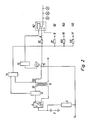
- FIG. 2 shows an alternative which is used to generate an increased current for switching off the consumer group in which a short circuit has occurred during emergency operation.
- the circuit of each monitoring logic 82, 92, 102, 112 and the normally closed contact 71 controlled by the relay 7 are in the position shown.
- a current monitor 12 and an overcurrent generator 14 are arranged in the primary circuit 51 of the transformer 5, the output of which is connected to the isolating elements or fuses 81, 91, 101, 111 of the consumer groups 8, 9, 100, 110.
- the consumer groups are supplied by the emergency power unit 2, 3, 4. If a short circuit occurs in any consumer (e.g.
- the current in the secondary circuit 52 of the transformer 5 increases, which produces a voltage increase in the primary circuit 51.
- the current monitor 12 responds to this voltage increase and outputs a current 10 to 100 times higher to the fuses 81, 91, 101, 111, which disconnects the fuse that belongs to the consumer group 8 with the short circuit, so that this consumer group is switched off and the inverter 4 can continue to supply the other consumer groups with electricity.
- relays 6 and 7 in FIGS. 1 and 2 are electronic Switches such as thyristors can be replaced.
- Such thyrister circuits are known.
- the transformer 5 can be used, which is already available for charging the batteries 3 by the rectifier, since this is only used during the normal power supply by the public network.
- FIGS. 1 and 2 only require simple components, which results in low manufacturing costs.
Landscapes
- Business, Economics & Management (AREA)
- Emergency Management (AREA)
- Engineering & Computer Science (AREA)
- Power Engineering (AREA)
- Stand-By Power Supply Arrangements (AREA)
- Emergency Protection Circuit Devices (AREA)
- Protection Of Static Devices (AREA)
- Direct Current Feeding And Distribution (AREA)
Abstract
Die Vorrichtung reagiert auf einen Kurzschluss eines elektrischen Verbrauchers innerhalb einer grossen Anzahl von alektrischen Verbrauchern, welche bereits im Notstrombetrieb gefahren werden, in der jWeise, dass eine im Primärkreis (51) eines Transformators (5) angeordnete Stromüberwachung (12) über ein Relais (6) eine Spannungserniedrigung im Sekundärkreis (52) des Transformators (5) bewirkt, welche Spannungserniedrigung einen um ein Mehrfaches erhöhten Strom im Sekundärkreis erzeugt. Der um ein Mehrfaches erhöhte Strom trennt dasjenige Trennorgan (81, 91, 101, 111) auf, welches der Verbrauchergruppe (8, 9, 10, 11) angehört. Diese Verbrauchergruppe ist von der Notstromversorgung abgeschaltet, so dass das Notstromagregat (2, 3, 4) vor Kurzschluss geschützt und die Notstromversorgung für die anderen Verbraucher aufrechterhalten wird.
Description
Die Erfindung betrifft eine Vorrichtung zum Abschalten von im Notstrombetrieb befindlichen elektrischen Verbrauchern bei Auftreten eines Kurzschlusses.The invention relates to a device for switching off electrical consumers in emergency power mode when a short circuit occurs.
Für spezielle elektrische Verbraucher wird eine möglichst unterbrechungslose Stromversorgung verlangt. Solche Verbraucher könnten sein: Beleuchtungsanlagen für Komfort und Sicherheit in Geschäftshäusern, Banken, öffentlichen Gebäuden, Hotels, Spitäler, Alters- und Pflegeheimen, Tiefgaragen, Einkaufszentren usw., und Förder- bzw. Dosierpumpen in Geräten für lebenserhaltende Massnahmen im medizinischen Bereich. In den bekannten Anlagen werden besondere Vorkehrungen getroffen zur möglichst unterbrechungslosen Stromversorgung bei Ausfall des öffentlichen Stromnetzes oder bei Ausfall eines Verbrauchers durch Kurzschluss. Zu diesem Zweck sind die bekannten Anlagen mit mindestens einem Notstromagregat ausgerüstet, das zum Beispiel aus einem Antriebsmotor mit Generator oder durch Gleichrichter aufgeladene Batterien mit Wechselrichter für die Versorgung der Verbraucher beispielsweise über ein Notstromnetz bestehen kann. Die bekannten Notstromagregate funktionieren gut, haben aber den Nachteil, dass bei einem Kurzschluss, der während der Notstromversorgung in einem der Verbraucher auftritt, die Versorgung für sämtliche Verbraucher infolge Ueberbelastung ausfallen kann, sodass der Notstrombetrieb gesamthaft zusammenbricht, wodurch gravierende Probleme im Sicherheitsbereich und bei den lebenserhaltenden Massnahmen entstehen können.An uninterruptible power supply is required for special electrical consumers. Such consumers could be: lighting systems for comfort and security in commercial buildings, banks, public buildings, hotels, hospitals, old people's homes and nursing homes, underground garages, shopping centers etc., and delivery or metering pumps in devices for life-supporting measures in the medical field. In the known systems, special precautions are taken for the most uninterruptible power supply possible in the event of a failure of the public power grid or in the event of a consumer failure due to a short circuit. For this purpose, the known systems are equipped with at least one emergency power unit, which can consist, for example, of a drive motor with a generator or batteries charged by rectifiers with an inverter for supplying the consumers, for example via an emergency power supply. The known emergency power units work well, but have the disadvantage that in the event of a short circuit, which occurs during the emergency power supply occurs in one of the consumers, the supply for all consumers can fail due to overload, so that the emergency power operation breaks down altogether, which can cause serious problems in the security area and in life-support measures.
Die Erfindung hat die Aufgabe, diesen Nachteil zu beseitigen sowie eine erweiterte Betriebssicherheit namentlich bei Beleuchtungsanlagen und Geräten im medizinischen Bereich zu schaffen.The object of the invention is to eliminate this disadvantage and to provide increased operational safety, particularly in the case of lighting systems and devices in the medical field.
Diese Aufgabe wird durch die Merkmale des kennzeichnenden Teils des Patentanspruches 1 gelöst.This object is achieved by the features of the characterizing part of patent claim 1.
Es zeigen:
- Fig. 1 ein erstes Ausführungsbeispiel der Erfindung
- Fig. 2 ein zweites Ausführungsbeispiel der Erfindung
- Fig. 1 shows a first embodiment of the invention
- Fig. 2 shows a second embodiment of the invention
Die Figur 1 zeigt die elektrische Schaltung einer Anlage mit einer Vielzahl von Verbrauchern, welche zu Gruppen zusammengeschaltet sind. Die Anlage hat eine Stromversorgung 1, normalerweise aus dem öffentlichen Netz, und ein Notstromagregat, das aus einem Gleichrichter 2, mehreren Batterien 3 und einem Wechselrichter 4 besteht. Diese Batterien werden während der normalen Stromversorgung aufgeladen und im aufgeladenen Zustand gehalten. Der Wechselrichter 4 übernimmt die Stromversorgung unterbrechungslos bei einer Spannungsabsenkung oder bei einem Ausfall des öffentlichen Netzes 1. Die Figur 1 zeigt diesen Zustand der Notstromversorgung der Verbrauchergruppen 8, 9, 10, 11 durch den Wechselrichter 4 über den Transformator 5 und Kontakte 61 und 71 der elektromagnetischen Relais 6 und 7. Am Eingang einer jeden Verbrauchergruppe sind eine Sicherung 81, 91, 101, 111 und eine Ueberwachungslogik 82, 92, 102, 112 vorgesehen. Die Ueberwachungslogik gibt bei Auftreten einer Spannungsabsenkung oder eines Ausfalls des öffentlichen Netzes ein Steuersignal auf die Steuerung 13, welche bewirkt, dass das Relais 7 erregt wird, sodass der Arbeitsschalter 71 in die gezeichnete Stellung bewegt wird. Hierdurch werden die Verbrauchergruppen 8, 9, 10, 11 über den Ruhekontakt 61 (gezeichnete Stellung) des nichterregten Relais 6 und über den Transformator 5 an die Notstromversorgung des Wechselrichters 4 gelegt. Wenn nun während des Notstrombetriebes bei irgend einem Verbraucher in einer der Verbrauchergruppen 8-11 ein Kurzschluss entsteht, erhöht sich der Strom in dieser Gruppe, der aber besonders bei Verbrauchern mit kleinem Anschlusswert nicht genügt, die Sicherung der betreffenden Verbrauchergruppe plötzlich aufzutrennen und diese Verbrauchergruppe von der Notstromversorgung sofort abzuschalten, um das Notstromagregat (Wechselrichter 4) zu schonen und vor dem Ausschalten für sämtliche Verbrauchergruppen zu schützen. Die Schwierigkeit des sofortigen Abschaltens vergrössert sich noch dadurch, dass die Trennorgane, welche normalerweise als Sicherungen ausgebildet sind, Ansprechwerte haben, welche in einem grösseren Toleranzbereich variieren können. Die Erfindung eliminiert dieses Problem dadurch, dass der Kurzschlussstrom, der im Sekundärkreis 52 des Transformators 5 liegt, seinen Primärkreis 51 beeinflusst. Die Stromüberwachung 12, welche im Primärkreis liegt, erkennt den erhöhten Strom und erregt das Relais 6, welches seinen Ruhekontakt 61 in die andere (nicht gezeichnete) Stellung bringt, so dass ein Mittenabgriff 53 des Transformators eingeschaltet wird, wodurch die Sekundärspannung sich erniedrigt. Dies hat zur Folge, dass der Sekundärstrom auf das 10 bis 100-fache ansteigt und über den in der gezeichneten Stellung liegenden Arbeitsschalter 71 (Relais 7 ist noch immer erregt) nur durch die Sicherung der mit einem Kurzschluss behafteten Verbrauchergruppe fliesst. Diese Sicherung bzw. dieses Trennorgan spricht durch diesen stark erhöhten Strom an und schaltet die betreffende Verbrauchergruppe von der Notstromversorgung ab. Auf diese Weise wird die Notstromversorgung für die anderen Verbrauchergruppen aufrechterhalten.FIG. 1 shows the electrical circuit of a system with a large number of consumers which are connected to form groups. The system has a power supply 1, usually from the public network, and an emergency power unit, which consists of a
Die Figur 2 zeigt eine Alternative, welche der Erzeugung eines erhöhten Stromes dient zum Abschalten derjenigen Verbrauchergruppe, in der während des Notbetriebes ein Kurzschluss entstanden ist. Die Schaltung jeder Ueberwachungslogik 82, 92, 102, 112 und des vom Relais 7 gesteuerten Ruhekontaktes 71 befinden sich in der gezeichneten Stellung. Bei diesem Ausführungsbeispiel ist im Primärkreis 51 des Transformators 5 eine Stromüberwachung 12 und ein Ueberstromgenerator 14 angeordnet, dessen Ausgang an die Trennorgane bzw. Sicherungen 81, 91, 101, 111 der Verbrauchergruppen 8, 9, 100, 110 angeschlossen ist. Auch hier sei angenommen, dass die Verbrauchergruppen vom Notstromagregat 2, 3, 4 gespiesen werden. Tritt während des Notstrombetriebes ein Kurzschluss in irgend einem Verbraucher auf (z.B. in der Verbrauchergruppe 8), erhöht sich der Strom im Sekundärkreis 52 des Transformators 5, was eine Spannungserhöhung im Primärkreis 51 erzeugt. Die Stromüberwachung 12 spricht auf diese Spannungserhöhung an und gibt einen um das 10 bis 100-fache erhöhten Strom auf die Sicherungen 81, 91, 101, 111 ab, welcher diejenige Sicherung auftrennt, die der Verbrauchergruppe 8 mit dem Kurzschluss angehört, so dass diese Verbrauchergruppe abgeschaltet wird und der Wechselrichter 4 die übrigen Verbrauchergruppen weiterhin mit Strom versorgen kann.FIG. 2 shows an alternative which is used to generate an increased current for switching off the consumer group in which a short circuit has occurred during emergency operation. The circuit of each
Der Vollständigkeit halber sei noch erwähnt, dass die Relais 6 und 7 in den Figuren 1 und 2 durch elektronische Schalter, z.B. Thyristoren ersetzt werden kann. Solche Thyristerschaltungen sind bekannt.For the sake of completeness, it should also be mentioned that the
Bei beiden Ausführungsbeispielen kann der Transformator 5 verwendet werden, der schon für die Aufladung der Batterien 3 durch den Gleichrichter vorhanden ist, da dieser nur während der normalen Stromversorgung durch das öffentliche Netz im Einsatz ist.In both embodiments, the
Die in den Figuren 1 und 2 gezeigten Ausführungsbeispiele benötigen lediglich einfache Bauelemente, was niedrige Herstellungskosten ergibt.The exemplary embodiments shown in FIGS. 1 and 2 only require simple components, which results in low manufacturing costs.
Claims (5)
Applications Claiming Priority (2)
| Application Number | Priority Date | Filing Date | Title |
|---|---|---|---|
| CH1157/90A CH680320A5 (en) | 1990-04-05 | 1990-04-05 | |
| CH1157/90 | 1990-04-05 |
Publications (3)
| Publication Number | Publication Date |
|---|---|
| EP0451110A2 true EP0451110A2 (en) | 1991-10-09 |
| EP0451110A3 EP0451110A3 (en) | 1994-03-02 |
| EP0451110B1 EP0451110B1 (en) | 1995-05-17 |
Family
ID=4203814
Family Applications (1)
| Application Number | Title | Priority Date | Filing Date |
|---|---|---|---|
| EP91810237A Expired - Lifetime EP0451110B1 (en) | 1990-04-05 | 1991-04-03 | Device for disconnection of loads powered by an uninterruptible power supply when a short-circuit occurs |
Country Status (5)
| Country | Link |
|---|---|
| EP (1) | EP0451110B1 (en) |
| AT (1) | ATE122828T1 (en) |
| CH (1) | CH680320A5 (en) |
| DE (1) | DE59105487D1 (en) |
| ES (1) | ES2072589T3 (en) |
Cited By (2)
| Publication number | Priority date | Publication date | Assignee | Title |
|---|---|---|---|---|
| US8530765B2 (en) | 2010-11-19 | 2013-09-10 | Bae Systems Controls Inc. | Hybrid vehicle high voltage multiple battery disconnect |
| RU2625564C1 (en) * | 2016-07-07 | 2017-07-17 | Открытое Акционерное Общество "Научно-Исследовательский И Проектно-Конструкторский Институт Информатизации, Автоматизации И Связи На Железнодорожном Транспорте" | Method of disconnecting sources of power supply from user loading and device for its implementation |
Family Cites Families (3)
| Publication number | Priority date | Publication date | Assignee | Title |
|---|---|---|---|---|
| DE3127460C2 (en) * | 1981-07-11 | 1985-09-19 | Industrie Automation Halbleitergerätebau GmbH & Co, 7801 March | Circuit arrangement for a power-limited inverter |
| JPS61262026A (en) * | 1985-05-15 | 1986-11-20 | 三菱電機株式会社 | Short circuit protection method of uninterruptible power supply |
| DE3519151C1 (en) * | 1985-05-29 | 1987-01-02 | Piller Gmbh Co Kg Anton | Static inverter with a circuit for increasing the current in the event of a short circuit |
-
1990
- 1990-04-05 CH CH1157/90A patent/CH680320A5/de not_active IP Right Cessation
-
1991
- 1991-04-03 AT AT91810237T patent/ATE122828T1/en not_active IP Right Cessation
- 1991-04-03 ES ES91810237T patent/ES2072589T3/en not_active Expired - Lifetime
- 1991-04-03 EP EP91810237A patent/EP0451110B1/en not_active Expired - Lifetime
- 1991-04-03 DE DE59105487T patent/DE59105487D1/en not_active Expired - Fee Related
Cited By (2)
| Publication number | Priority date | Publication date | Assignee | Title |
|---|---|---|---|---|
| US8530765B2 (en) | 2010-11-19 | 2013-09-10 | Bae Systems Controls Inc. | Hybrid vehicle high voltage multiple battery disconnect |
| RU2625564C1 (en) * | 2016-07-07 | 2017-07-17 | Открытое Акционерное Общество "Научно-Исследовательский И Проектно-Конструкторский Институт Информатизации, Автоматизации И Связи На Железнодорожном Транспорте" | Method of disconnecting sources of power supply from user loading and device for its implementation |
Also Published As
| Publication number | Publication date |
|---|---|
| EP0451110B1 (en) | 1995-05-17 |
| ATE122828T1 (en) | 1995-06-15 |
| ES2072589T3 (en) | 1995-07-16 |
| CH680320A5 (en) | 1992-07-31 |
| EP0451110A3 (en) | 1994-03-02 |
| DE59105487D1 (en) | 1995-06-22 |
Similar Documents
| Publication | Publication Date | Title |
|---|---|---|
| DE2657167C3 (en) | Circuit for automatically switching the power supply of a load from a primary current source to a secondary current source | |
| WO2021144103A1 (en) | Changeover device, retrofit kit and method for supplying electrical power to a load | |
| EP0451110B1 (en) | Device for disconnection of loads powered by an uninterruptible power supply when a short-circuit occurs | |
| DE102020210554A1 (en) | inverter | |
| DE102022125440A1 (en) | Device and method for powering devices in medical facilities | |
| DE3738493A1 (en) | TROUBLESHOOTING DEVICE | |
| EP2498300A1 (en) | Photovoltaic assembly, control device and switching device | |
| DE2541598A1 (en) | ELECTRIC POWER SUPPLY CIRCUIT WITH TWO ENERGY SOURCES | |
| EP2608343B1 (en) | Power supply | |
| DE1538448C3 (en) | Consumer network | |
| DE102017124567B4 (en) | Battery system, local power supply and disconnector | |
| DE102021109645A1 (en) | Energy supply device with safety-related disconnection and method for disconnecting an energy supply device | |
| DE102024113544B4 (en) | Switching device, emergency power system and procedure for operating the emergency power system | |
| DE2611674C2 (en) | ||
| CH658837A5 (en) | Circuit arrangement for driving a current load in a failsafe fashion in terms of signalling technology | |
| DE2150948A1 (en) | DEVICE FOR LIMITING THE CURRENT DRAWN FROM AN ELECTRICAL SUPPLY NETWORK | |
| AT61448B (en) | Circuit device for the automatic shutdown of a defective generator in electrical centers. | |
| DE3111400C2 (en) | Device for phase difference protection of electric motors | |
| DE3613630C2 (en) | ||
| DE3342113A1 (en) | TRANSFORMER AS A CONTINUOUS, CONTINUOUS POWER SOURCE WITH AC VOLTAGE | |
| DE918582C (en) | Emergency power device, in particular for operating fluorescent tubes | |
| DE202023104012U1 (en) | Inverter with switching device for control supply | |
| DE932318C (en) | Arrangement for actuation of cell switches for accumulator batteries | |
| DE269160C (en) | ||
| DE3333820C2 (en) |
Legal Events
| Date | Code | Title | Description |
|---|---|---|---|
| PUAI | Public reference made under article 153(3) epc to a published international application that has entered the european phase |
Free format text: ORIGINAL CODE: 0009012 |
|
| AK | Designated contracting states |
Kind code of ref document: A2 Designated state(s): AT BE CH DE ES FR GB IT LI LU NL SE |
|
| PUAL | Search report despatched |
Free format text: ORIGINAL CODE: 0009013 |
|
| AK | Designated contracting states |
Kind code of ref document: A3 Designated state(s): AT BE CH DE ES FR GB IT LI LU NL SE |
|
| 17P | Request for examination filed |
Effective date: 19940707 |
|
| 17Q | First examination report despatched |
Effective date: 19941014 |
|
| GRAA | (expected) grant |
Free format text: ORIGINAL CODE: 0009210 |
|
| AK | Designated contracting states |
Kind code of ref document: B1 Designated state(s): AT BE CH DE ES FR GB IT LI LU NL SE |
|
| REF | Corresponds to: |
Ref document number: 122828 Country of ref document: AT Date of ref document: 19950615 Kind code of ref document: T |
|
| REF | Corresponds to: |
Ref document number: 59105487 Country of ref document: DE Date of ref document: 19950622 |
|
| GBT | Gb: translation of ep patent filed (gb section 77(6)(a)/1977) |
Effective date: 19950612 |
|
| REG | Reference to a national code |
Ref country code: ES Ref legal event code: FG2A Ref document number: 2072589 Country of ref document: ES Kind code of ref document: T3 |
|
| ITF | It: translation for a ep patent filed | ||
| ET | Fr: translation filed | ||
| PLBE | No opposition filed within time limit |
Free format text: ORIGINAL CODE: 0009261 |
|
| 26N | No opposition filed | ||
| REG | Reference to a national code |
Ref country code: GB Ref legal event code: IF02 |
|
| PGFP | Annual fee paid to national office [announced via postgrant information from national office to epo] |
Ref country code: SE Payment date: 20070319 Year of fee payment: 17 |
|
| PGFP | Annual fee paid to national office [announced via postgrant information from national office to epo] |
Ref country code: DE Payment date: 20070320 Year of fee payment: 17 |
|
| PGFP | Annual fee paid to national office [announced via postgrant information from national office to epo] |
Ref country code: AT Payment date: 20070413 Year of fee payment: 17 |
|
| PGFP | Annual fee paid to national office [announced via postgrant information from national office to epo] |
Ref country code: NL Payment date: 20070417 Year of fee payment: 17 |
|
| PGFP | Annual fee paid to national office [announced via postgrant information from national office to epo] |
Ref country code: ES Payment date: 20070425 Year of fee payment: 17 |
|
| PGFP | Annual fee paid to national office [announced via postgrant information from national office to epo] |
Ref country code: LU Payment date: 20070426 Year of fee payment: 17 |
|
| PGFP | Annual fee paid to national office [announced via postgrant information from national office to epo] |
Ref country code: CH Payment date: 20070719 Year of fee payment: 17 |
|
| PGFP | Annual fee paid to national office [announced via postgrant information from national office to epo] |
Ref country code: BE Payment date: 20070419 Year of fee payment: 17 Ref country code: IT Payment date: 20070607 Year of fee payment: 17 |
|
| PGFP | Annual fee paid to national office [announced via postgrant information from national office to epo] |
Ref country code: FR Payment date: 20070418 Year of fee payment: 17 |
|
| BERE | Be: lapsed |
Owner name: *ALMAT BRUNO KESSLER Effective date: 20080430 |
|
| REG | Reference to a national code |
Ref country code: CH Ref legal event code: PL |
|
| EUG | Se: european patent has lapsed | ||
| PGFP | Annual fee paid to national office [announced via postgrant information from national office to epo] |
Ref country code: GB Payment date: 20080402 Year of fee payment: 18 |
|
| NLV4 | Nl: lapsed or anulled due to non-payment of the annual fee |
Effective date: 20081101 |
|
| PG25 | Lapsed in a contracting state [announced via postgrant information from national office to epo] |
Ref country code: LI Free format text: LAPSE BECAUSE OF NON-PAYMENT OF DUE FEES Effective date: 20080430 Ref country code: NL Free format text: LAPSE BECAUSE OF NON-PAYMENT OF DUE FEES Effective date: 20081101 Ref country code: DE Free format text: LAPSE BECAUSE OF NON-PAYMENT OF DUE FEES Effective date: 20081101 Ref country code: CH Free format text: LAPSE BECAUSE OF NON-PAYMENT OF DUE FEES Effective date: 20080430 |
|
| REG | Reference to a national code |
Ref country code: FR Ref legal event code: ST Effective date: 20081231 |
|
| PG25 | Lapsed in a contracting state [announced via postgrant information from national office to epo] |
Ref country code: AT Free format text: LAPSE BECAUSE OF NON-PAYMENT OF DUE FEES Effective date: 20080403 |
|
| PG25 | Lapsed in a contracting state [announced via postgrant information from national office to epo] |
Ref country code: BE Free format text: LAPSE BECAUSE OF NON-PAYMENT OF DUE FEES Effective date: 20080430 |
|
| PG25 | Lapsed in a contracting state [announced via postgrant information from national office to epo] |
Ref country code: FR Free format text: LAPSE BECAUSE OF NON-PAYMENT OF DUE FEES Effective date: 20080430 |
|
| REG | Reference to a national code |
Ref country code: ES Ref legal event code: FD2A Effective date: 20080404 |
|
| PG25 | Lapsed in a contracting state [announced via postgrant information from national office to epo] |
Ref country code: ES Free format text: LAPSE BECAUSE OF NON-PAYMENT OF DUE FEES Effective date: 20080404 |
|
| PG25 | Lapsed in a contracting state [announced via postgrant information from national office to epo] |
Ref country code: IT Free format text: LAPSE BECAUSE OF NON-PAYMENT OF DUE FEES Effective date: 20080403 |
|
| GBPC | Gb: european patent ceased through non-payment of renewal fee |
Effective date: 20090403 |
|
| PG25 | Lapsed in a contracting state [announced via postgrant information from national office to epo] |
Ref country code: GB Free format text: LAPSE BECAUSE OF NON-PAYMENT OF DUE FEES Effective date: 20090403 |
|
| PG25 | Lapsed in a contracting state [announced via postgrant information from national office to epo] |
Ref country code: LU Free format text: LAPSE BECAUSE OF NON-PAYMENT OF DUE FEES Effective date: 20080403 |
|
| PG25 | Lapsed in a contracting state [announced via postgrant information from national office to epo] |
Ref country code: SE Free format text: LAPSE BECAUSE OF NON-PAYMENT OF DUE FEES Effective date: 20080404 |