EP0451228B1 - Aufheller- und lichtstabilisator-salze - Google Patents
Aufheller- und lichtstabilisator-salze Download PDFInfo
- Publication number
- EP0451228B1 EP0451228B1 EP90914065A EP90914065A EP0451228B1 EP 0451228 B1 EP0451228 B1 EP 0451228B1 EP 90914065 A EP90914065 A EP 90914065A EP 90914065 A EP90914065 A EP 90914065A EP 0451228 B1 EP0451228 B1 EP 0451228B1
- Authority
- EP
- European Patent Office
- Prior art keywords
- group
- formula
- radical
- amino
- light
- Prior art date
- Legal status (The legal status is an assumption and is not a legal conclusion. Google has not performed a legal analysis and makes no representation as to the accuracy of the status listed.)
- Expired - Lifetime
Links
- 0 CC1*2C(*)=C*(*C(*)CC(CC=CC)=NC(*)=I)=CC12 Chemical compound CC1*2C(*)=C*(*C(*)CC(CC=CC)=NC(*)=I)=CC12 0.000 description 2
Classifications
-
- C—CHEMISTRY; METALLURGY
- C07—ORGANIC CHEMISTRY
- C07D—HETEROCYCLIC COMPOUNDS
- C07D401/00—Heterocyclic compounds containing two or more hetero rings, having nitrogen atoms as the only ring hetero atoms, at least one ring being a six-membered ring with only one nitrogen atom
- C07D401/02—Heterocyclic compounds containing two or more hetero rings, having nitrogen atoms as the only ring hetero atoms, at least one ring being a six-membered ring with only one nitrogen atom containing two hetero rings
- C07D401/12—Heterocyclic compounds containing two or more hetero rings, having nitrogen atoms as the only ring hetero atoms, at least one ring being a six-membered ring with only one nitrogen atom containing two hetero rings linked by a chain containing hetero atoms as chain links
-
- C—CHEMISTRY; METALLURGY
- C07—ORGANIC CHEMISTRY
- C07D—HETEROCYCLIC COMPOUNDS
- C07D211/00—Heterocyclic compounds containing hydrogenated pyridine rings, not condensed with other rings
- C07D211/04—Heterocyclic compounds containing hydrogenated pyridine rings, not condensed with other rings with only hydrogen or carbon atoms directly attached to the ring nitrogen atom
- C07D211/06—Heterocyclic compounds containing hydrogenated pyridine rings, not condensed with other rings with only hydrogen or carbon atoms directly attached to the ring nitrogen atom having no double bonds between ring members or between ring members and non-ring members
- C07D211/36—Heterocyclic compounds containing hydrogenated pyridine rings, not condensed with other rings with only hydrogen or carbon atoms directly attached to the ring nitrogen atom having no double bonds between ring members or between ring members and non-ring members with hetero atoms or with carbon atoms having three bonds to hetero atoms with at the most one bond to halogen, e.g. ester or nitrile radicals, directly attached to ring carbon atoms
- C07D211/56—Nitrogen atoms
- C07D211/58—Nitrogen atoms attached in position 4
-
- C—CHEMISTRY; METALLURGY
- C07—ORGANIC CHEMISTRY
- C07D—HETEROCYCLIC COMPOUNDS
- C07D251/00—Heterocyclic compounds containing 1,3,5-triazine rings
- C07D251/02—Heterocyclic compounds containing 1,3,5-triazine rings not condensed with other rings
- C07D251/12—Heterocyclic compounds containing 1,3,5-triazine rings not condensed with other rings having three double bonds between ring members or between ring members and non-ring members
- C07D251/26—Heterocyclic compounds containing 1,3,5-triazine rings not condensed with other rings having three double bonds between ring members or between ring members and non-ring members with only hetero atoms directly attached to ring carbon atoms
- C07D251/40—Nitrogen atoms
- C07D251/48—Two nitrogen atoms
- C07D251/52—Two nitrogen atoms with an oxygen or sulfur atom attached to the third ring carbon atom
-
- C—CHEMISTRY; METALLURGY
- C08—ORGANIC MACROMOLECULAR COMPOUNDS; THEIR PREPARATION OR CHEMICAL WORKING-UP; COMPOSITIONS BASED THEREON
- C08K—Use of inorganic or non-macromolecular organic substances as compounding ingredients
- C08K5/00—Use of organic ingredients
- C08K5/0008—Organic ingredients according to more than one of the "one dot" groups of C08K5/01 - C08K5/59
- C08K5/0041—Optical brightening agents, organic pigments
-
- C—CHEMISTRY; METALLURGY
- C08—ORGANIC MACROMOLECULAR COMPOUNDS; THEIR PREPARATION OR CHEMICAL WORKING-UP; COMPOSITIONS BASED THEREON
- C08K—Use of inorganic or non-macromolecular organic substances as compounding ingredients
- C08K5/00—Use of organic ingredients
- C08K5/0008—Organic ingredients according to more than one of the "one dot" groups of C08K5/01 - C08K5/59
- C08K5/005—Stabilisers against oxidation, heat, light, ozone
-
- C—CHEMISTRY; METALLURGY
- C08—ORGANIC MACROMOLECULAR COMPOUNDS; THEIR PREPARATION OR CHEMICAL WORKING-UP; COMPOSITIONS BASED THEREON
- C08K—Use of inorganic or non-macromolecular organic substances as compounding ingredients
- C08K5/00—Use of organic ingredients
- C08K5/36—Sulfur-, selenium-, or tellurium-containing compounds
- C08K5/41—Compounds containing sulfur bound to oxygen
- C08K5/42—Sulfonic acids; Derivatives thereof
Definitions
- the brightening or stabilizing effects with these compounds are very striking, they are very much more fast to wet, in particular more fast to washing than with the corresponding compounds which are not bound to radicals B in a salt-like manner.
- the compounds according to the invention are also outstandingly suitable for the
- Brightening or light stabilization of soluble plastics e.g. Nitrocellulose varnishes.
- the brightener and light stabilizer residues A can have anionic or also cationic character. Residues A of anionic brighteners are generally preferred. Likewise preferred are the radicals B which are to be understood as meaning up to four, preferably one or two ammonium or immonium groups (including cyclically bound ammonium, in particular 2,2,6,6-tetramethylpiperidine or ammonium nitrogen bound in piperazine radicals) is) and a C1 ⁇ 12 alkyl, cyclohexane, piperazine, triazine, pyrimidine, quinazoline, quinoxaline, phthalazine, phthalimide or benzene bridge member, preferably contain a bridge member of the benzene or triazine series.
- the compounds of the formula I in which one n is 1 and the other n is 1 or 2, in particular 1, are also preferred.
- residues of brightener A are those of the formula as well as the acidic groups (-SO3H groups) or basic groups (for example ammonium, oxazolium, thiazolium, etc.) described in the book by K. Venkataraman "The Chemistry of Synthetic Dyes” Vol.V, 1971 on pages 550-674. Compounds containing pyridinium or piperidinium groups) are preferred.
- the light stabilizers especially UV stabilizers, there are especially those from Kirk-Othmer "Encyclopedia of Chemical Technology" 3rd Edition, Vol. 23, pp. 615-625 or the compounds known from "Ullmanns Encyklopadie der Technische Chemie", 4th edition, vol. 15, pages 253-267, ib 257-260, to be understood, in particular in sulfonated form.
- Component B the amino and / or imino compounds, are prepared according to processes which are well known to the person skilled in the art [amide formation from the acid chloride (for example trimesic acid trichloride, example 1) and an amine (for example 2,2,6,6-tetramethyl) -4-amino-piperidine), condensation of amines with halotriazinyl, etc.].
- the compounds (salts) of the formula I are likewise prepared in any manner familiar to the person skilled in the art; the anionic compounds can, in general, as they occur during production (for example as sodium salts) in the presence of adequate amounts of a mineral acid (for example HCl ) implemented with the basic components B with salt formation will. If the free acids are used, it is not necessary to add acid.
- the cationic compounds are preferably reacted with the acid-containing components B in a slightly alkaline medium.
- the mixing in the mass and the use in dissolved plastics are carried out analogously to known methods in the field of mass coloring or the field of solvent dyes.
- Synthetic polyamides are understood to mean all known plastics of this type, in particular the polycondensates or polymers made from dicarboxylic acids and diamines, e.g. from adipic acid and hexamethylenediamine, from lactams, e.g. ⁇ -caprolactam, or from aminocarboxylic acids, e.g. ⁇ -aminoundecanoic acid. The rest, e.g.
- Example 3 The procedure described in Example 3 is followed, but 161.2 parts of compound 21 (top, pyromellitic acid tetramide) are used instead of the 88.4 parts of terephthalic acid diamide.
- the salt thus obtained like those of Examples 3 and 4, has excellent light-stabilizing properties and does not migrate out of the plastic stabilized with it, even under extreme conditions.
- Example 5 The procedure is as given in Example 5, but only 61 parts of the light stabilizer (benzotriazole compound) are used. The properties of the product obtained are very similar to those of Examples 3 to 5.
- Example 7 The procedure is as described in Example 7, but instead of the 84.7 parts of the triazine compound, 88.4 parts of the compound of the formula 5 (Example 3) are used, and a brightener having properties which improve light fastness is obtained.
- the compounds of the formulas 1 to 34 with brighteners containing acidic groups (formulas a1 to a31), or the compounds of the formulas 35 to 55 with basic brighteners (of the formulas b1 to b) to the brightener salts according to the invention are implemented.
- a comparative wash fastness test showed that the lightening effect of the fibers treated according to the invention after washing (1% detergent, 1 hour at 70 °) was more than 12 times as great as that of fibers which had not been (according to the invention) salted brighteners were mixed in the mass.
- a nitrocellulose lacquer made from 18.8% nitrocellulose A15 moistened with 35% isopropanol (in the form of white flakes), 6.3% butyl acrylate polymers, plasticizer resin (Acronal 4F, BASF), 3.3% diphenyl octyl phosphate, plasticizer (Santicizer 141, Monsanto), 10.0% methoxypropanol (Dowanol PM, Dow Chemical), 41.6% ethanol 10.0% ethoxypropanol and 10.0% ethyl acetate, 5 parts of the dye salt according to Example 2 were stirred in with the dissolver and dissolved on the trestle overnight. The solubility is perfect.
Landscapes
- Chemical & Material Sciences (AREA)
- Organic Chemistry (AREA)
- Health & Medical Sciences (AREA)
- Chemical Kinetics & Catalysis (AREA)
- Medicinal Chemistry (AREA)
- Polymers & Plastics (AREA)
- Compositions Of Macromolecular Compounds (AREA)
- Plural Heterocyclic Compounds (AREA)
- Treatments For Attaching Organic Compounds To Fibrous Goods (AREA)
- Heterocyclic Carbon Compounds Containing A Hetero Ring Having Nitrogen And Oxygen As The Only Ring Hetero Atoms (AREA)
- Paints Or Removers (AREA)
- Artificial Filaments (AREA)
Abstract
Description
- Es hat sich gezeigt, dass in der Masse Aufheller, bzw. Lichtstabilisatoren enthaltendes Fasermaterial aus synthetischen Polyamiden schlechte Nassechtheiten, insbesondere eine schlechte Waschechtheit, besitzt, die Aufheller und Lichtstabilisatoren diffundieren in die Waschflotte unverhältnismässig stark aus, was zu Protesten der Verbraucher geführt hat.
- Im Zuge der Arbeiten zur Beseitigung dieses Mangels wurde gefunden, dass die Aufheller und Lichtstabilisatoren der allgemeinen Formel I
An .(B)n (I),
worin - A
- den Rest eines a) anionischen oder b) kationischen Aufhellers oder Lichtstabilisators,
- B
- im Fall a) einen mindestens eine Ammonium-, Cyclosmmonium- oder Immonium-Gruppe und mindestens eine aliphatische, cycloaliphatische, an mindestens eine (bis zu vier) Carbonylgruppe gebundene aromatische oder eine heteroaromatische Gruppe aus der Reihe der Triazin-, Pyrimidin-, Chinazolin-, Chinoxalin-, Piperazin-, Phthalimid oder Phthalazinverbindungen enthaltender Rest, wobei die eine aliphatische oder cycloaliphatische Gruppe enthaltenden Reste auch mindestens eine cyclisch gebundene Ammoniumgruppe enthalten, und im Fall b) einen mindestens einen Carbonsäure- oder Sulfonsäurerest und eine aliphatische, cycloaliphatische, aromatische oder heteroaromatische Gruppe aufweisenden Rest oder einen C₂₋₁₄-Dicarbonsäure- oder Amino-C₂₋₁₂-alkylcarbonsäurerest und die beiden n unabhängig voneinander 1, 2, 3 oder 4 bedeuten, wobei A und B salzartig aneinander gebunden sind, sich zum Aufhellen, bzw. Stabilisieren von Kunststoffen, vor allem synthetischen Polyamiden, insbesondere zu Fasermaterial zu verarbeitenden synthetischen Polyamiden, ausgezeichnet eignen. Die Erfindung betrifft also diese Verbindungen, ihre Herstellung und die genannte Verwendung.
- Die Aufhellungs- bzw. Stabilisierungseffekte mit diesen Verbindungen sind sehr markant, sie sind ganz wesentlich nassechter, insbesondere waschechter als mit den entsprechenden, nicht salzartig an Reste B gebundenen Verbindungen. Die erfindungsgemässen Verbindungen eignen sich auch hervorragend für das
- Aufhellen oder Lichtstabilisieren löslicher Kunststoffe, z.B. Nitrocellulose-Lacken.
- Die Aufheller- und Lichtstabilisator-Reste A können anionischen oder auch kationischen Charakter besitzen. Reste A von anionischen Aufhellern sind im allgemeinen bevorzugt. Gleichermassen bevorzugt sind auch die Reste B, die bis zu vier, vorzugsweise eine oder zwei Ammonium- oder Immoniumgruppen, (worunter auch cyclisch gebundenes Ammonium, insbesondere in 2,2,6,6-Tetramethylpiperidin- oder in Piperazinresten gebundener Ammonium-Stickstoff zu verstehen ist) und ein C₁₋₁₂-Alkyl-, Cyclohexan-, Piperazin-, Triazin-, Pyrimidin-, Chinazolin-, Chinoxalin-, Phthalazin-, Phthalimid- oder Benzol-Brückenglied, vorzugsweise ein Brückenglied der Benzol- oder Triazinreihe enthalten. Bevorzugt sind damit auch die Verbindungen der Formel I, worin ein n 1 und das andere n 1 oder 2, insbesondere 1 ist.
- Unter den Resten von Aufhellern A sind vor allem diejenigen der Formel

sowie die im Buch von K. Venkataraman "The Chemistry of Synthetic Dyes" Vol.V, 1971 auf den Seiten 550-674 beschriebenen, saure Gruppen (-SO₃H-Gruppen) oder basische Gruppen (z.B. Ammonium-, Oxazolium-, Thiazolium-, Pyridinium- oder Piperidiniumgruppen) enthaltenenden Verbindungen bevorzugt.
Unter den Lichtstabilisatoren, vor allem UV-Stabilisatoren, sind insbesondere die aus Kirk-Othmer "Encyclopedia of Chemical Technology" 3rd Edition, Vol. 23, pp. 615-625 bzw. die aus "Ullmanns Encyklopädie der technischen Chemie", 4. Auflage, Bd. 15, Seiten 253-267, i.b. 257-260, bekannten Verbindungen, insbesondere in sulfonierter Form, zu verstehen. - Bevorzugt als Verbindungen B (freie Amine, bzw. Imine, noch nicht salzförmig gebunden) sind solche, die eine oder mehrere gleichzeitig als Lichtstabilisator wirkende Reste mit sterisch gehindertem Aminostickstoff enthalten, insbesondere Gruppen der Formeln a bis e enthalten
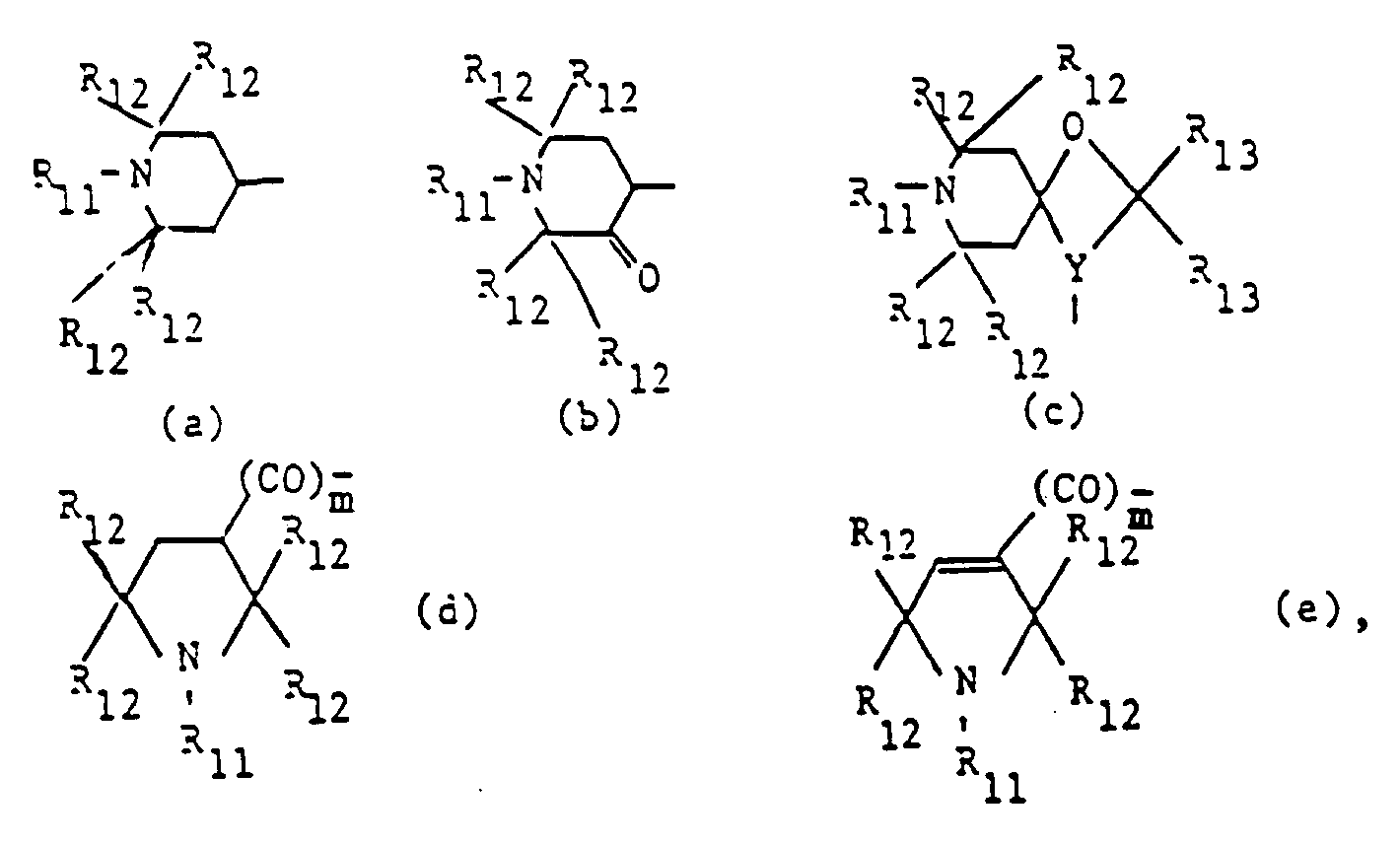
worin - R₁₁
- Wasserstoff oder C₁₋₄-Alkyl, vorzugsweise Wasserstoff oder C₁₋₂-Alkyl,
- R₁₂
- unabhängig voneinander C₁₋₅-Alkyl, vorzugsweise Methyl,
- Y-
- eine Gruppe der Formel -CO-N< oder >N-CO-
- R₁₃
- Phenyl, das andere Wasserstoff oder C₁₋₂-Alkyl oder beide
- R₁₃
- zusammen eine Gruppe der Formel -(CH₂))₁₁-
- m
- 0 oder 1 bedeuten,
- Besonders bevorzugt sind auch die Verbindungen der Formel I, worin B mit einer, zwei oder drei Gruppen der Formel f und einer über eine -CO-Brücke gebundenen Gruppe der Formel g

(R₁ = -O- oder -NR₂- und R₂ = H oder C₁₋₂-Alkyl)
substituiertes Benzol, oder Triazin, das in 2-Stellung eine Gruppe der Formel g, in 4-Stellung eine Gruppe der Formel f und in 6-Stellung ein Chlor oder ebenfalls eine Gruppe der Formel f als Substituenten trägt, oder eine Verbindung der Formel
worin R₂ Wasserstoff oder C₁₋₃-Alkyl, vorzugsweise Wasserstoff und n 1 bedeuten. - Weitere Beispiele für bevorzugte Komponenten B (als freie Amino- bzw. -cyclische Aminoverbindungen) sind:
- 1. 1,3,5-Tri-(2',2',6',6'-tetramethylpiperidyl-4')-trimesinsäuretriamid,
- 2. 2,4-Bis-(2',2',6',6'-tetramethylpiperidyl-4'amino)-6-chlortriazin,
- 3. 2,4,6-Tri-(2',2',6',6'-tetramethylpiperidyl-4'amino)-triazin,
- 4. Bis-(2 ,2 ,6 ,6 -tetramethylpiperidyl-4'aminocarbonyl -paraphenylen)-terephthalsäurediamid,
- 5. Bis-(2 ,2 ,6 ,6 -tetramethylpiperidyl-4')-terephthalsäurediamid,
- 6. 2,4-Bis-(2',2',6',6'-tetramethylpiperidyl-4'amino)-chinazolin,
- 7. 2,3-Bis-(2',2',6',6',-tetramethylpiperidyl-4'amino)-chinoxalin,
- 8. 1,4-Bis-(2',2',6',6',-tetramethylpiperidyl-4'amino)-phthalazin,
- 9. 2-Chlor-4,6-Bis-(2',2',6',6',-tetramethylpiperidyl-4'-amino)-pyrimidin,
- 10. 2,5-Dichlor-4,6-Bis-(2',2',6',6',-tetraethylpiperidyl-4'-amino)-pyrimidin,
- 11. 2-Fluor-5-chlor-4,6-Bis-(2',2',6',6',-tetraethylpiperidyl-4'-amino)-pyrimidin,
- 12. 2,4,6,Tri-(2',2',6',6',-tetriethylpiperidyl-4'-amino)-pyrimidin,
- 13. 2,4,6,Tri-(2',2',6',6',-tetramethylpiperidyl-4'-amino)-5-chlor-pyrimidin, sowie die Verbindungen der Formeln
- 14.
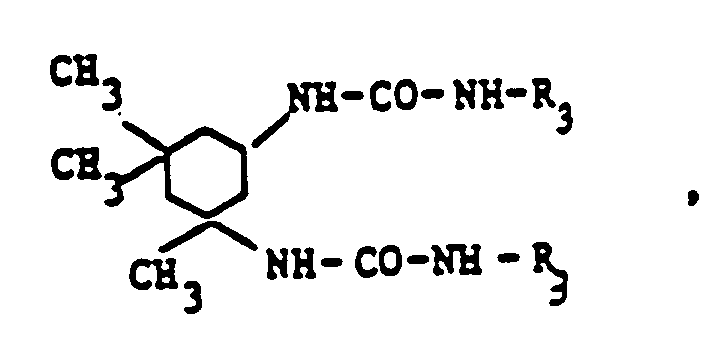
- 15.

- 16.

- 17.

- 18.

- 19.

- 20.
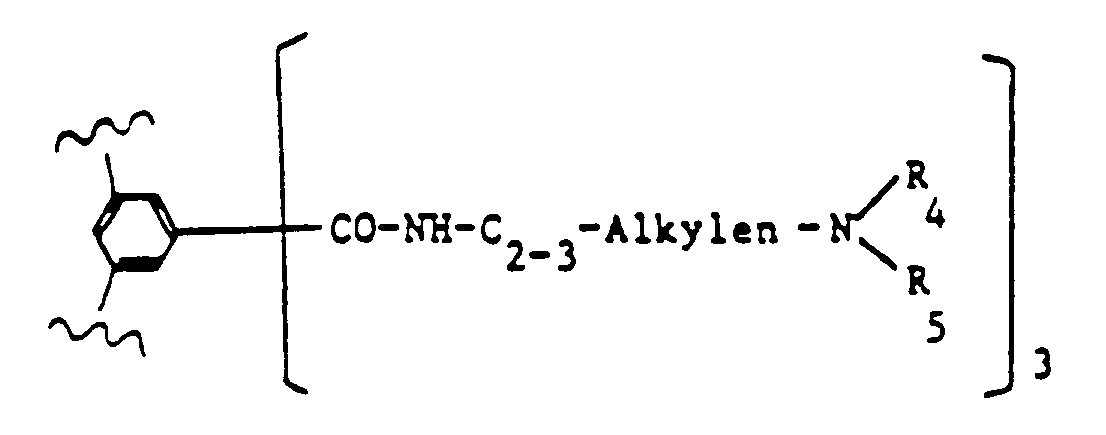
- R₄ und R₅
- bedeuten in Formel 19 und 20 unabhängig voneinander Wasserstoff oder C₁₋₃ -Alkyl,
- 21.

- 22.

- 23.

- 24.

- 25.
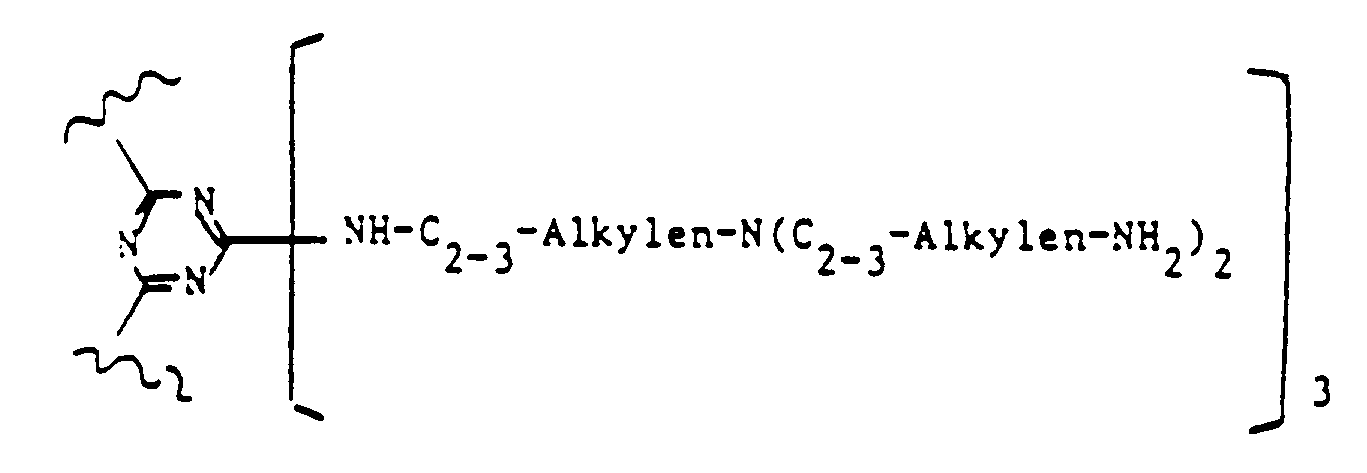
- 26.

- 27.

- 28.

- 29.

- 30.

- 31.

- 32.

- 33. R₆(-CO NH - R₃)p
- 34. H₂N-C₂₋₁₂-Alkylen CONH-R₃, worin p 1, 2, 3 oder 4, vorzugsweise 1 oder 2, R₃ 2,2,6,6-Tetramethylpiperidyl-4- und R₆ einen p-wertigen aliphatischen Rest mit bis zu 12, vorzugsweise einen Alkylrest mit bis zu 6, insbesondere 1, 2, 3, oder 4 Kohlenstoffatomen bedeuten, wobei R₃ in den obigen Formeln immer eine 2,2,6,6,-Tetramethylpiperidyl-4-gruppe ist und an Stelle der daran gebundenen -NH-Brücke auch eine Sauerstoff-Brücke oder ein Brückenglied der Formel -N(C₁₋₂-Alkyl)- stehen kann.
Bevorzugte Komponenten B, freie Säuren zur Salzbildung mit basischen Aufhellern sind z.B. - 35. H₂N-C₂₋₁₂-Alkylen-COOH,
- 36.

- 37. 4-Benzoylamino-benzoesäure,
- 38. HOOC-Alkylen

- 39.

- 40.

- 41.

- 42.
- 43.

- 44.

- 45.

- 46.

- 47. 2,4,-Bis-(4'-carboxyphenylamino)-6-chlortriazin,
- 48.

- 49. 1,4-Bis-(4'-carboxyphenylaminocarbonyl)-benzol,
- 50. 1,3-BiS-(4'-carboxyphenylaminocarbonyl)-benzol,
- 51. 1,2-Bis-(4'-carboxyphenylaminocarbonyl)-benzol,
- 52. Carboxy-C₁₋₃-alkylen-phenyl und
- 53. HOCO-R₇-COOH, worin R₇ die direkte Bindung oder ein C₁₋₁₂-Alkylenrest ist, wobei die genannten Alkyl-und Alkylenreste geradkettig oder verzweigt sein können und vorzugsweise (falls nichts anderes 1, 2, 3 oder 4, insbesondere 1 oder 2 Kohlenstoffatome enthalten.
- Als Aufheller, die mit den obengenannten, bzw. mit den im Patentanspruch 1 definierten, als freie Basen oder Säuren vorliegenden Verbindungen unter Salzbildung die erfindungsgemässen Aufheller ergeben, kommen z.B. die Verbindungen der Formeln a₁ bis a₂₃ (saure Gruppen enthaltend) und b₁ bis b₅ in Betracht:


Die Herstellung der Komponenten B, der Amino-, bzw. Imino-Verbindungen, erfolgt gemäss dem Fachmann durchaus geläufigen Verfahren [Amidbildung aus dem Säurechlorid (z.B. Trimesinsäuretrichlorid, Bsp. 1) und einem Amin (z.B. 2,2,6,6-Tetramethyl-4-amino-piperidin), Kondensation von Aminen mit Halogentriazinyl etc.]. - Die Herstellung der Verbindungen (Salze) der Formel I erfolgt ebenfalls auf eine beliebige, dem Fachmann geläufige Weise, die anionischen Verbindungen können im allgemeinen, so wie sie bei der Produktion anfallen (z.B. als Natriumsalze), in Gegenwart adäquater Mengen einer Mineralsäure (z.B. HCl) mit den basischen Komponenten B unter Salzbildung umgesetzt werden. Verden die freien Säuren eingesetzt, ist es nicht nötig Säure zuzusetzen. Die kationischen Verbindungen werden vorzugsweise in leicht alkalischem Milieu mit den saure Gruppen enthaltenden Komponenten B umgesetzt. Das Vermischen in der Masse und der Einsatz in gelösten Kunststoffen erfolgen analog zu bekannten Methoden auf dem Gebiet der Massefärbung, bzw. dem Gebiet der Lösungsmittelfarbstoffe.
- Unter synthetischen Polyamiden sind sämtliche bekannten Kunststoffe dieser Art zu verstehen, insbesondere die Polykondensate oder Polymerisate aus Dicarbonsäuren und Diaminen, z.B. aus Adipinsäure und Hexamethylendiamin, aus Lactamen, z.B. ε-Caprolactam, oder aus Aminocarbonsäuren, z.B. ω-Aminoundecansäure. Auch die übrigen,z.B. im Buch "Synthesefasern", Verlag Chemie, Weinheim; Deerfield Beach Florida; Basel, 1981, (herausgegeben von Béla von Falkai), Abschnitt 6 "Charakterisierung synthetischer Fasern", beschriebenen, im allgemeinen schwer färbbaren synth. Polyamide lassen sich mit den Verbindungen der Formel I gut veredeln. Die mit den Verbindungen der Formel I vermischte Polyamidschmelze wird in üblicher Weise verformt, z.B. in Schmelzspinn-, Spritzguss-, Strangspritz- oder Folienblasmaschinen.
- Falls nicht anders präzisiert, bedeuten in den folgenden Beispielen die Teile Gewichtsteile und die Prozente Gewichtsprozente. Die Temperaturen sind in Celsiusgraden angegeben.
-
- a) Auf bekannte Weise werden 184,5g 2,4,6-Trichlortriazin mit 314 g 2,2,6,6-Tetramethyl-4-aminopiperidin kondensiert.
- b) 45,5 g einer Handelsform (85 % Aktivsubstanz) des Aufhellers der Formel

- Auf analoge Weise wie im Beispiel 1 beschrieben, wird 1 Moläquivalent des Aufhellers der Formel b 2 (oben) mit 1 Moläquivalent der Verbindung der Formel

unter Salzbildung zur Reaktion gebracht, das unlösliche Salz abfiltriert, salzfrei gewaschen und getrocknet. - 122 Teile des Lichtstabilisators der Formel

werden mit 88,4 Teilen Bis-(2,2,6,6-tetramethylpiperidyl-4)-terephthalsäurediamid (Verbindung 5, oben) in 500 Teilen Wasser verteilt und unter Rühren 5 Stunden auf 50° erwärmt. Das unlösliche Reaktionsprodukt wird abfiltriert, mit kaltem Wasser ausgewaschen und im Vakuum getrocknet. Man erhält so ein 2:1-Salz mit hervorragenden stabilisierenden Eigenschaften für synthetische Kunststoffe, insbesondere Polyamid. - Man verfährt wie im Beispiel 3 angegeben, setzt aber nur 61 Teile Lichtstabilisator (wie oben) mit 84,7 Teilen der Verbindung 2 [=2,4-Bis-(2ʼ,2ʼ,6',6-tetramethylpiperidyl-4-amino)-6-chlortriazin] zu einem 1:1 Salz um und erhält so eine Verbindung mit ähnlichen Eigenschaften.
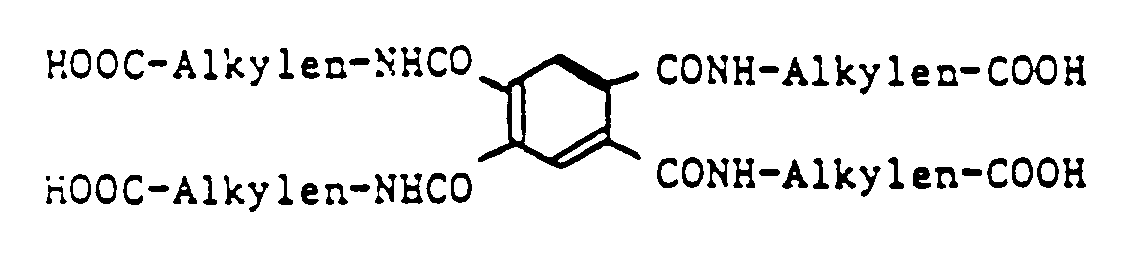
- Man verfährt wie im Beispiel 3 angegeben, setzt aber an Stelle der 88,4 Teile des Terephthalsäurediamids 161,2 Teile der Verbindung 21 (oben, Pyromellitsäuretetramid) ein. Das so erhaltene Salz hat wie diejenigen der Beispiele 3 und 4 ausgezeichnete lichtstabilisierende Eigenschaften und migriert auch unter extremen Bedingungen nicht aus dem mit ihm stabilisierten Kunststoff heraus.
- Man verfährt wie im Beispiel 5 angegeben, verwendet aber nur 61 Teile des Lichtstabilisators (Benztriazolverbindung). Das erhaltene Produkt ist in seinen Eigenschaften dem der Beispiele 3 bis 5 sehr ähnlich.
- Analog zur Arbeitsweise des Beispiels 3 setzt man 67,3 Teile der Verbindung der Formel
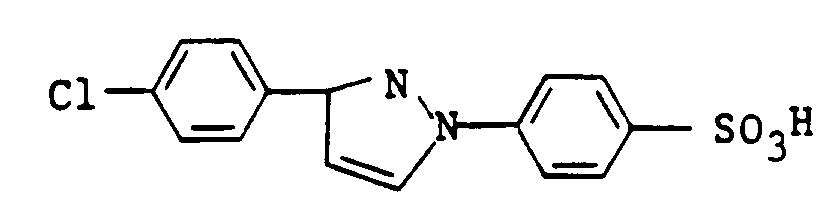
und 84,7 Teile 2,4-bis-(2',2',6',6',-tetramethylpiperidyl-4-amino)-6-chlortriazin (=Verbindung 2, oben) zu einem Salz um. Man erhält so einen sehr waschechten Aufheller, der auch die Lichtstabilität der mit ihm versetzten Polymere sehr positiv beeinflusst. - Man verfährt wie im Beispiel 7 angegeben, setzt jedoch 134,6 Teile der Pyrazolinverbindung ein. Es resultiert ein sehr wirksamer Aufheller, der auch die Lichtstabilität der mit ihm versetzten Polymere sehr verbessert.
- Man verfährt wie im Beispiel 7 angegeben, setzt aber an Stelle der 84,7 Teile der Triazinverbindung 88,4 Teile der Verbindung der Formel 5 (Beispiel 3) ein und erhält so einen Aufheller mit Lichtechtheit-verbessernden Eigenschaften.
- Nach der Vorschrift des Beispiels 9, jedoch mit 134,6 Teilen (an Stelle von 67,3 Teilen) der Pyrazolinverbindung erhält man einen Aufheller, der, in Polyamidmassen eingebracht, sehr licht- und waschecht ist.
- Gemäss den Angaben im Beispiel 7, jedoch mit 161,2 Teilen der Verbindung 21 (Pyromellitsäuretetramid) erhält man ebenfalls einen Aufheller mit verbesserter Licht- und Waschechtheit.
- Nach den Angaben im Beispiel 8, aber mit 161,2 Teilen der Verbindung 21 (Pyromellitsäuretetramid) an Stelle der 84,7 Teile Triazinverbindung, erhält man einen Aufheller mit sehr ähnlichen Eigenschaften.
- Analog zu den Angaben in den vorhergehenden Beispielen können auch die Verbindungen der Formeln 1 bis 34 mit saure Gruppen enthaltenden Aufhellern (Formeln a₁ bis a₃₁), bzw. die Verbindugnen der Formeln 35 bis 55 mit basischen Aufhellern (der Formeln b₁ bis b) zu den erfindungsgemässen Aufhellersalzen umgesetzt werden.
- 100 Teile Poly-ε-caprolactam in Form eines Pulvers werden mit 1 Teil des Aufhellersalzes gemäss Beispiel 1 in einem Trommelmischer vermischt. Das Pulver verteilt sich nach kurzer Zeit sehr gleichmässig. Nach ca. 10 Minuten wird das Gemisch 16 Stunden bei 120°C getrocknet, in eine Schmelzspinnmaschine eingebracht und nach 8-minütiger Verweilzeit bei 275-280°C unter Stickstoffatmosphäre zu Fasern versponnen. Der erhaltene Aufhelleffekt ist ausserordentlich licht- und waschecht. Bei einem vergleichenden Waschechtheits-Test hat sich gezeigt, dass der Aufhellungseffekt der erfindungsgemäss behandelten Fasern nach dem Waschen (1% Waschmittel, 1 Stunde bei 70°) mehr als 12 mal so stark war wie der von Fasern, die mit dem nicht (erfindungsgemäss) versalzten Aufheller in der Masse vermischt wurden.
- In 95 Teile eines Nitrocellulose-Lacks, hergestellt aus 18,8 % mit 35 % Isopropanol angefeuchtete Nitrocellulose A15 (in Form weisser Flocken),
6,3 % Acrylsäurebutylester-Polymere, Weichmacherharz (Acronal 4F, BASF),
3,3 % Diphenyloctylphosphat, Weichmacher (Santicizer 141, Monsanto),
10,0 % Methoxypropanol (Dowanol PM, Dow Chemical),
41,6 % Aethanol
10,0 % Aethoxypropanol und
10,0 % Aethylacetat,
wurden 5 Teile des Farbstoffsalzes gemäss Beispiel 2 mit dem Dissolver eingerührt und über Nacht auf dem Rollbock gelöst. Die Löslichkeit ist perfekt. - Auf a) unlackierte und b) mit farblosem Nitrocelluloselack lackierte Aluminiumfolie wurden mit dem 25 µm-Ziehstab Nassfilme mit der obigen Lackkomposition hergestellt, diese 5 Stunden bei 130°C getrocknet und die Transparenz als Maßstab der Verträglichkeit des Farbstoffsalzes mit dem lösungsmittelfreien Film, und die Haftfestigkeit nach dem Scotch-tape-Test auf der unlackierten und der vorher lackierten Aluminumfolie bestimmt. Beide Eigenschaften wurden als perfekt beurteilt.
Claims (6)
- Optische Aufheller und/oder Lichtstabilisatoren der allgemeinen Formel I
An . Bn (I)
worinA der Rest eines a) anionischen oder kationischen Aufhellers oder Lichtstabilisators,B im Fall einen mindestens eine Ammonium-, Cycloammonium- oder Immoniumgruppe und mindestens eine aliphatische, cycloaliphatische, an mindestens eine Carbonylgruppe gebundene aromatische oder eine heteroaromatische Gruppe aus der Reihe der Triazin-, Pyrimidin-, Chinazolin-, Chinoxalin-, Piperazin-, Phthalimid- oder Phthalazinverbindungen enthaltenden Rest, wobei die eine aliphatische oder cycloaliphatische Gruppe enthaltenden Reste auch mindestens eine cyclisch gebundene Ammoniumgruppe enthaltenund die beiden n unabhängig voneinander 1, 2, 3 oder 4 bedeuten, wobei A und B salzartig aneinander gebunden sind.
und im Fall b) einen mindestens einen Carbonsäure- oder Sulfonsäurerest und eine aliphatische, cycloaliphatische, aromatische oder hetero-aromatische Gruppe aufweisenden Rest oder einen C₂₋₁₄-Di-carbonsäure- oder Amino-C₂₋₁₂-alkyl-carbonsäurerest, - Die Verbindungen der Formel I gemäss Anspruch 1, worinA der Rest eines anionischen Aufhellers oder Lichtstabilisators,B eine oder zwei Ammonium- oder Immoniumgruppen und ein C₁₋₁₂-Alkyl-, Cyclohexan-, Piperazin-, Triazin-, Pyrimidin-, Chinazolin-, Chinoxalin-, Phthalazin-, Phthalimid- oder Benzol-Brückenglied enthaltender Rest, vorzugsweise ein solcher der Benzol- oder Triazinreihe und die beidenein n=1 und das andere n 1 oder 2, vorzugsweise 1 bedeuten.
- Die Aufheller und Lichtstabilisatoen der Formel I, gemäss Anspruch 1 oder 2,
worinA ein Rest der Formel
- Die Aufheller und Lichtstabilisatoren der Formel I, gemäss einem der vorhergehenden Ansprüche, worin A der Rest eines anionischen Aufhellers und B ein Rest ist, der eine oder zwei 2,2,6,6-Tetramethylpiperidinium- und gegebenenfalls eine, zwei oder drei 2,2,6,6-Tetramethylpiperidylgruppen, immer in 4-Stellung gebunden, trägt.
- Die Aufheller und Lichtstabilisatoren der Formel I, gemäss einem der vorhergehenden Ansprüche, worinA den Rest eines anionischen Aufhellers oder LichtstabilisatorsB mit einer, zwei oder drei 2,2,6,6-Tetramethylpiperidyl-4-oxycarbonyl- oder -amino-carbonylgruppen (f) und einer über eine -CO-Brücke gebundenen Gruppe der Formel g


- Die Verwendung der Verbindungen der Formel I gemäss einem der vorhergehenden Ansprüche zum Aufhellen und Lichtstabilisieren von synthetischen Polyamiden oder Lösungsmittel enthaltenden Lacksystemen.
Applications Claiming Priority (3)
| Application Number | Priority Date | Filing Date | Title |
|---|---|---|---|
| DE3932914A DE3932914A1 (de) | 1989-10-03 | 1989-10-03 | Aufhellersalze |
| DE3932914 | 1989-10-03 | ||
| PCT/CH1990/000230 WO1991004987A1 (de) | 1989-10-03 | 1990-09-28 | Aufheller- und lichtstabilisator-salze |
Publications (2)
| Publication Number | Publication Date |
|---|---|
| EP0451228A1 EP0451228A1 (de) | 1991-10-16 |
| EP0451228B1 true EP0451228B1 (de) | 1994-12-28 |
Family
ID=6390707
Family Applications (1)
| Application Number | Title | Priority Date | Filing Date |
|---|---|---|---|
| EP90914065A Expired - Lifetime EP0451228B1 (de) | 1989-10-03 | 1990-09-28 | Aufheller- und lichtstabilisator-salze |
Country Status (4)
| Country | Link |
|---|---|
| EP (1) | EP0451228B1 (de) |
| JP (1) | JPH04502034A (de) |
| DE (2) | DE3932914A1 (de) |
| WO (1) | WO1991004987A1 (de) |
Families Citing this family (3)
| Publication number | Priority date | Publication date | Assignee | Title |
|---|---|---|---|---|
| EP0618205A1 (de) * | 1993-04-02 | 1994-10-05 | Ciba-Geigy Ag | Wasserlösliche Triazinderivate zur photochemischen und thermischen Stabilisierung von Polyamidfasermaterialien |
| US6998272B2 (en) | 1999-12-10 | 2006-02-14 | Prometic Biosciences, Ltd. | Macrocyclic compounds and their use |
| GB9929318D0 (en) * | 1999-12-10 | 2000-02-02 | Prometic Biosciences Limited | Macrocyclic compounds and their use |
Family Cites Families (3)
| Publication number | Priority date | Publication date | Assignee | Title |
|---|---|---|---|---|
| US4462805A (en) * | 1982-05-17 | 1984-07-31 | Ciba-Geigy Corporation | Mixture of cationic compounds for dyeing and printing textiles, leather and paper |
| IT1193659B (it) * | 1983-02-04 | 1988-07-21 | Chimosa Chimica Organica Spa | Composti piperidinil-triazinici utili come stabilizzanti per polimeri sintetici |
| US4950304A (en) * | 1987-10-02 | 1990-08-21 | Ciba-Geigy Corporation | Process for quenching or suppressing the fluorescence of substrates treated with fluorescent whitening agents |
-
1989
- 1989-10-03 DE DE3932914A patent/DE3932914A1/de not_active Withdrawn
-
1990
- 1990-09-28 JP JP2513113A patent/JPH04502034A/ja active Pending
- 1990-09-28 WO PCT/CH1990/000230 patent/WO1991004987A1/de not_active Ceased
- 1990-09-28 EP EP90914065A patent/EP0451228B1/de not_active Expired - Lifetime
- 1990-09-28 DE DE59008147T patent/DE59008147D1/de not_active Expired - Fee Related
Non-Patent Citations (1)
| Title |
|---|
| Journal of Applied Polymer Science, Band 32, Nr. 4, September 1986 John Wiley & Sons, Inc.,G.N. Sheth:"Studies in interaction between polyvinyl pyrrolidone and stilbene fluorescent compounds II. Interaction with mixture of compounds", pages 4333-4349, see page 4334, coumpound 32 * |
Also Published As
| Publication number | Publication date |
|---|---|
| DE3932914A1 (de) | 1991-04-11 |
| WO1991004987A1 (de) | 1991-04-18 |
| EP0451228A1 (de) | 1991-10-16 |
| DE59008147D1 (de) | 1995-02-09 |
| JPH04502034A (ja) | 1992-04-09 |
Similar Documents
| Publication | Publication Date | Title |
|---|---|---|
| DE3920029C2 (de) | Farbstoffe zum Färben von Kunststoffen | |
| EP0045721B1 (de) | Piperidylderivate von Triazincopolymeren, Verfahren zu deren Herstellung und solche Derivate enthaltende stabilisierte Zusammensetzung | |
| EP0284828B1 (de) | Gegen Einwirkung von Licht stabilisierte Polymere sowie neue Imidazol-2-carbonsäure-anilide | |
| DE2930397C2 (de) | ||
| EP0029522A1 (de) | s-Triazinderivate, ihre Herstellung aus Halogentriazinylaminen und Polyaminen, und ihre Verwendung als Stabilisatoren | |
| DE3304266A1 (de) | Piperidin derivate und ihre anwendung als stabilisatoren fuer polymere | |
| EP0002261A1 (de) | Alkylierte 2,2'-Biphenylen-phosphonite und mit deren Hilfe stabilisierte Gemische | |
| US5493022A (en) | Brightener and light stabilizer salts | |
| WO1991004987A1 (de) | Aufheller- und lichtstabilisator-salze | |
| EP0349862B1 (de) | 2,6-Polyalkyl-piperidin-4-amide, deren Verwendung als Stabilisatoren, insbesondere für Kunststoffe, sowie diese Amide enthaltendes organisches Material | |
| EP0272589B1 (de) | Polyalkylpiperidinderivate mit Alkylenbrücken und ihre Verwendung als Stabilisator | |
| EP0072009A2 (de) | Polytriazinylalkohole, -ester und -urethane, ein Verfahren zu ihrer Herstellung und ihre Verwendung als Stabilisatoren | |
| DE3233353A1 (de) | Stabilisierte synthetische harzmasse | |
| DE102015000124A1 (de) | Verfahren zur Stabilisierung von Polyamiden | |
| DD144411A5 (de) | Verfahren zur herstellung von 1,3,5-triazacycloheptan-2,4-dionderivaten | |
| DE19745099B4 (de) | Verwendung eines Additivs mit kettenregelnden und stabilisierenden Eigenschaften bei der Herstellung von Polycaprolactam | |
| DE1695122A1 (de) | Verfahren zur Herstellung von v-oexriazolyl-cumarinen | |
| DE3737398A1 (de) | Heterocyclisch oder aromatisch substituierte oxalsaeurediamide und ihre verwendung als uv-stabilisatoren | |
| EP0103193A1 (de) | Quadratsäureamidderivate, ihre Verwendung als Stabilisierungsmittel sowie die mit diesen behandelten Kunststoffe | |
| CH687283B5 (de) | Verfahren zum Nachbehandeln von mit anionischen Farbstoffen gefaerbten Substraten. | |
| DE2321530A1 (de) | 4,6-bis-(alkaryl)-s-triazine und verfahren zu deren herstellung | |
| DE4125440A1 (de) | Mono-, bi- oder tri-carbocyclische phosphin- oder phosphonsaeureverbindungen | |
| EP0481300A2 (de) | Polyalkylpiperidinderivate und deren Verwendung als Lichtschutzmittel | |
| EP0044424A1 (de) | Flammfeste Polyamidformmassen und entsprechende Formkörper | |
| DE3930089A1 (de) | Modifizierte synthetische polyamide |
Legal Events
| Date | Code | Title | Description |
|---|---|---|---|
| PUAI | Public reference made under article 153(3) epc to a published international application that has entered the european phase |
Free format text: ORIGINAL CODE: 0009012 |
|
| 17P | Request for examination filed |
Effective date: 19910409 |
|
| AK | Designated contracting states |
Kind code of ref document: A1 Designated state(s): CH DE FR GB IT LI |
|
| 17Q | First examination report despatched |
Effective date: 19940304 |
|
| GRAA | (expected) grant |
Free format text: ORIGINAL CODE: 0009210 |
|
| AK | Designated contracting states |
Kind code of ref document: B1 Designated state(s): CH DE FR GB IT LI |
|
| REF | Corresponds to: |
Ref document number: 59008147 Country of ref document: DE Date of ref document: 19950209 |
|
| ITF | It: translation for a ep patent filed | ||
| ET | Fr: translation filed | ||
| GBT | Gb: translation of ep patent filed (gb section 77(6)(a)/1977) |
Effective date: 19950321 |
|
| PGFP | Annual fee paid to national office [announced via postgrant information from national office to epo] |
Ref country code: GB Payment date: 19950821 Year of fee payment: 6 |
|
| PGFP | Annual fee paid to national office [announced via postgrant information from national office to epo] |
Ref country code: FR Payment date: 19950828 Year of fee payment: 6 |
|
| PGFP | Annual fee paid to national office [announced via postgrant information from national office to epo] |
Ref country code: DE Payment date: 19950911 Year of fee payment: 6 |
|
| PLBE | No opposition filed within time limit |
Free format text: ORIGINAL CODE: 0009261 |
|
| STAA | Information on the status of an ep patent application or granted ep patent |
Free format text: STATUS: NO OPPOSITION FILED WITHIN TIME LIMIT |
|
| PGFP | Annual fee paid to national office [announced via postgrant information from national office to epo] |
Ref country code: CH Payment date: 19951213 Year of fee payment: 6 |
|
| 26N | No opposition filed | ||
| PG25 | Lapsed in a contracting state [announced via postgrant information from national office to epo] |
Ref country code: GB Effective date: 19960928 |
|
| PG25 | Lapsed in a contracting state [announced via postgrant information from national office to epo] |
Ref country code: LI Effective date: 19960930 Ref country code: FR Effective date: 19960930 Ref country code: CH Effective date: 19960930 |
|
| REG | Reference to a national code |
Ref country code: CH Ref legal event code: PL |
|
| GBPC | Gb: european patent ceased through non-payment of renewal fee |
Effective date: 19960928 |
|
| PG25 | Lapsed in a contracting state [announced via postgrant information from national office to epo] |
Ref country code: DE Effective date: 19970603 |
|
| REG | Reference to a national code |
Ref country code: FR Ref legal event code: ST |
|
| REG | Reference to a national code |
Ref country code: FR Ref legal event code: ST |
|
| PG25 | Lapsed in a contracting state [announced via postgrant information from national office to epo] |
Ref country code: IT Free format text: LAPSE BECAUSE OF NON-PAYMENT OF DUE FEES;WARNING: LAPSES OF ITALIAN PATENTS WITH EFFECTIVE DATE BEFORE 2007 MAY HAVE OCCURRED AT ANY TIME BEFORE 2007. THE CORRECT EFFECTIVE DATE MAY BE DIFFERENT FROM THE ONE RECORDED. Effective date: 20050928 |