EP0451653A2 - Naphthalinderivate - Google Patents
Naphthalinderivate Download PDFInfo
- Publication number
- EP0451653A2 EP0451653A2 EP91105114A EP91105114A EP0451653A2 EP 0451653 A2 EP0451653 A2 EP 0451653A2 EP 91105114 A EP91105114 A EP 91105114A EP 91105114 A EP91105114 A EP 91105114A EP 0451653 A2 EP0451653 A2 EP 0451653A2
- Authority
- EP
- European Patent Office
- Prior art keywords
- carbonyl
- alkoxy
- alkyl
- halogen
- methyl
- Prior art date
- Legal status (The legal status is an assumption and is not a legal conclusion. Google has not performed a legal analysis and makes no representation as to the accuracy of the status listed.)
- Withdrawn
Links
- 0 *C1N=C(*)C(*)=C(*)N*1 Chemical compound *C1N=C(*)C(*)=C(*)N*1 0.000 description 2
Classifications
-
- A—HUMAN NECESSITIES
- A01—AGRICULTURE; FORESTRY; ANIMAL HUSBANDRY; HUNTING; TRAPPING; FISHING
- A01N—PRESERVATION OF BODIES OF HUMANS OR ANIMALS OR PLANTS OR PARTS THEREOF; BIOCIDES, e.g. AS DISINFECTANTS, AS PESTICIDES OR AS HERBICIDES; PEST REPELLANTS OR ATTRACTANTS; PLANT GROWTH REGULATORS
- A01N51/00—Biocides, pest repellants or attractants, or plant growth regulators containing organic compounds having the sequences of atoms O—N—S, X—O—S, N—N—S, O—N—N or O-halogen, regardless of the number of bonds each atom has and with no atom of these sequences forming part of a heterocyclic ring
-
- C—CHEMISTRY; METALLURGY
- C07—ORGANIC CHEMISTRY
- C07D—HETEROCYCLIC COMPOUNDS
- C07D239/00—Heterocyclic compounds containing 1,3-diazine or hydrogenated 1,3-diazine rings
- C07D239/02—Heterocyclic compounds containing 1,3-diazine or hydrogenated 1,3-diazine rings not condensed with other rings
- C07D239/24—Heterocyclic compounds containing 1,3-diazine or hydrogenated 1,3-diazine rings not condensed with other rings having three or more double bonds between ring members or between ring members and non-ring members
- C07D239/28—Heterocyclic compounds containing 1,3-diazine or hydrogenated 1,3-diazine rings not condensed with other rings having three or more double bonds between ring members or between ring members and non-ring members with hetero atoms or with carbon atoms having three bonds to hetero atoms with at the most one bond to halogen, directly attached to ring carbon atoms
- C07D239/32—One oxygen, sulfur or nitrogen atom
-
- A—HUMAN NECESSITIES
- A01—AGRICULTURE; FORESTRY; ANIMAL HUSBANDRY; HUNTING; TRAPPING; FISHING
- A01N—PRESERVATION OF BODIES OF HUMANS OR ANIMALS OR PLANTS OR PARTS THEREOF; BIOCIDES, e.g. AS DISINFECTANTS, AS PESTICIDES OR AS HERBICIDES; PEST REPELLANTS OR ATTRACTANTS; PLANT GROWTH REGULATORS
- A01N43/00—Biocides, pest repellants or attractants, or plant growth regulators containing heterocyclic compounds
- A01N43/48—Biocides, pest repellants or attractants, or plant growth regulators containing heterocyclic compounds having rings with two nitrogen atoms as the only ring hetero atoms
- A01N43/54—1,3-Diazines; Hydrogenated 1,3-diazines
-
- C—CHEMISTRY; METALLURGY
- C07—ORGANIC CHEMISTRY
- C07D—HETEROCYCLIC COMPOUNDS
- C07D239/00—Heterocyclic compounds containing 1,3-diazine or hydrogenated 1,3-diazine rings
- C07D239/02—Heterocyclic compounds containing 1,3-diazine or hydrogenated 1,3-diazine rings not condensed with other rings
- C07D239/24—Heterocyclic compounds containing 1,3-diazine or hydrogenated 1,3-diazine rings not condensed with other rings having three or more double bonds between ring members or between ring members and non-ring members
- C07D239/28—Heterocyclic compounds containing 1,3-diazine or hydrogenated 1,3-diazine rings not condensed with other rings having three or more double bonds between ring members or between ring members and non-ring members with hetero atoms or with carbon atoms having three bonds to hetero atoms with at the most one bond to halogen, directly attached to ring carbon atoms
- C07D239/46—Two or more oxygen, sulphur or nitrogen atoms
- C07D239/60—Three or more oxygen or sulfur atoms
-
- C—CHEMISTRY; METALLURGY
- C07—ORGANIC CHEMISTRY
- C07D—HETEROCYCLIC COMPOUNDS
- C07D401/00—Heterocyclic compounds containing two or more hetero rings, having nitrogen atoms as the only ring hetero atoms, at least one ring being a six-membered ring with only one nitrogen atom
- C07D401/02—Heterocyclic compounds containing two or more hetero rings, having nitrogen atoms as the only ring hetero atoms, at least one ring being a six-membered ring with only one nitrogen atom containing two hetero rings
- C07D401/12—Heterocyclic compounds containing two or more hetero rings, having nitrogen atoms as the only ring hetero atoms, at least one ring being a six-membered ring with only one nitrogen atom containing two hetero rings linked by a chain containing hetero atoms as chain links
-
- C—CHEMISTRY; METALLURGY
- C07—ORGANIC CHEMISTRY
- C07D—HETEROCYCLIC COMPOUNDS
- C07D405/00—Heterocyclic compounds containing both one or more hetero rings having oxygen atoms as the only ring hetero atoms, and one or more rings having nitrogen as the only ring hetero atom
- C07D405/02—Heterocyclic compounds containing both one or more hetero rings having oxygen atoms as the only ring hetero atoms, and one or more rings having nitrogen as the only ring hetero atom containing two hetero rings
- C07D405/12—Heterocyclic compounds containing both one or more hetero rings having oxygen atoms as the only ring hetero atoms, and one or more rings having nitrogen as the only ring hetero atom containing two hetero rings linked by a chain containing hetero atoms as chain links
Definitions
- the invention relates to new naphthalene derivatives, processes for their preparation and their use as herbicides.
- naphthalene derivatives e.g. 2- (4,6-Dimethoxy-pyrimidin-2-yl-oxy) -1-naphthaldehyde
- herbicidal properties cf. EP-A 360 163; JP-A 2 056 469.
- the new naphthalene derivatives of the general formula (I) are notable for a strong herbicidal action.
- the naphthalene derivatives of the formula (I) according to the invention have a considerably stronger action against weeds than the known compound 2- (4,6-dimethoxy-pyrimidin-2-yl-oxy) -1-naphthaldehyde, which is structurally a similar previously known active ingredient with the same direction of action.
- Aliphatic hydrocarbon radicals listed for example alkyl, alkenyl, alkynyl
- heteroatoms for example in alkoxy, alkylthio, alkylamino
- compositions such as for example haloalkyl, haloalkoxy are each straight-chain or branched.
- Halogen generally represents fluorine, chlorine, bromine or iodine, preferably fluorine, chlorine or bromine, in particular fluorine or chlorine.
- Formula (II) provides a general definition of the carbonyl compounds to be used as starting materials in process (a) according to the invention for the preparation of compounds of the formula (I).
- R1, R2, R3, R4, R5, R6 and R7 preferably or in particular have those meanings which are preferred or particularly preferred in connection with the description of the compounds of the formula (1) according to the invention for Q, R1, R2, R3, R4, R5, R6 and R7 were specified.
- Examples of the starting materials of the formula (II) are: 2- (4,6-dimethoxy-pyrimidin-2-yl-oxy) -, 2- (4-methoxy-6-methyl-pyrimidin-2-yl-oxy ) -, 2- (4,6-Dimethyl-pyrimidin-2-yl-oxy) -, 2- (4-methoxy-6-trifluoromethyl-pyrimidin-2-yl-oxy) -, 2- (4-ethyl- 6-methoxy-pyrimidin-2-yl-oxy) -, 2- (4-ethoxy-6-methyl-pyrimidin-2-yl-oxy) - and 2- (4,6-diethoxypyrimidin-2-yl- oxy) -1-naphthaldehyde.
- Formula (III) provides a general definition of the amino or methylene compounds to be used as starting materials in process (a) according to the invention for the preparation of compounds of formula (I).
- the starting materials of the formula (III) are known synthetic chemicals.
- Process (a) according to the invention for the preparation of the new naphthalene derivatives of the formula (I) is preferably carried out using diluents.
- diluents Practically all inert organic solvents can be used as diluents. These preferably include aliphatic and aromatic, optionally halogenated hydrocarbons such as pentane, hexane, heptane, cyclohexane, petroleum ether, gasoline, ligroin, benzene, toluene, xylene, methylene chloride, ethylene chloride, chloroform, carbon tetrachloride, chlorobenzene and o-dichlorobenzene, ethers such as diethyl and Dibutyl ether, glycol dimethyl ether and diglycol dimethyl ether, tetrahydrofuran and dioxane, ketones such as acetone, methyl ethyl, methyl isopropy
- reaction auxiliaries are substances which are usually used to control and / or accelerate condensation reactions between carbonyl compounds and Amino or methylene compounds can be used. These include in particular nitrogen compounds, such as ammonium acetate, ⁇ -alanine, pyridine and piperidine.
- reaction temperatures in process (a) according to the invention can be varied within a substantial range. In general, temperatures between 0 ° C and 150 ° C, preferably at temperatures between 10 ° C and 120 ° C.
- the starting materials in process (b) according to the invention for the preparation of compounds of the formula (I) Formula (IV) generally defines nucleophilic naphthalene derivatives using.
- R1, R2, R3, R4 and Z preferably or in particular have those meanings which have already been mentioned above in connection with the description of the compounds of the formula (I) according to the invention preferably or as being particularly preferred for Q, R1 , R2, R3, R4 and Z were specified.
- the starting materials of the formula (IV) are known and / or can be prepared by processes known per se (cf. Synthesis 1985, 201-202; US Pat. No. 4,277,500; Tetrahedron Lett. 1975, 785-788; Chem. Pharm. Bull. 24 (1976), 3065-3074; U.S. Patent 4,334,015; Preparation Examples).
- Formula (V) provides a general definition of the pyrimidine derivatives to be used as starting materials in process (b) according to the invention for the preparation of compounds of the formula (I).
- Examples of the starting materials of the formula (V) are: 2-chloro and 2-methylsulfonyl-4,6-dimethyl-pyrimidine, -4-methyl-6-methoxy-pyrimidine, -4,6-dimethoxy-pyrimidine, -4-methyl-6-ethoxy-pyrimidine, -4 -chloro-6-methoxy-pyrimidine, -4-methyl-pyrimidine, -4-chloro-6-methyl-pyrimidine, -4-trifluoromethyl-6-methoxy-pyrimidine, -4-methoxy-6-difluoromethoxy-pyrimidine, 4-methyl-6-difluoromethoxypyrimidine, -4,6-bis-difluoromethoxypyrimidine, -4-chloro-6-ethoxypyrimidine, -4,6-diethoxypyrimidine, -4,5-dichloro-6- methyl-pyrimidine, -4-methyl-5-chloro-6-methoxy-pyrimidine,
- inert organic solvents can be used as diluents.
- These preferably include aliphatic and aromatic, optionally halogenated hydrocarbons such as pentane, hexane, heptane, cyclohexane, petroleum ether, gasoline, ligroin, benzene, toluene, xylene, methylene chloride, ethylene chloride, chloroform, carbon tetrachloride, chlorobenzene and o-dichlorobenzene, ethers such as diethyl and Dibutyl ether, glycol dimethyl ether and diglycol dimethyl ether, tetrahydrofuran and dioxane, ketones such as acetone, methyl ethyl, methyl isopropyl and methyl isobutyl ketone, esters such as methyl acetate and ethyl acetate, nitriles such as, for.
- Acid acceptors which can be used in process (b) according to the invention are all acid binders which can customarily be used for such reactions.
- Alkali metal hydroxides such as, for. B. sodium and potassium hydroxide, alkaline earth metal hydroxides such. B.
- reaction temperatures can be varied within a substantial range in process (b) according to the invention. In general, temperatures between 0 ° C and 150 ° C, preferably at temperatures between 10 ° C and 100 ° C.
- Process (b) according to the invention is generally carried out under normal pressure. However, it is also possible to work under increased or reduced pressure.
- process (b) the starting materials required in each case are generally used in approximately equimolar amounts. However, it is also possible to use one of the two components used in each case in a larger excess.
- the reactions are generally carried out in a suitable diluent in the presence of an acid acceptor, and the reaction mixture is stirred for several hours at the temperature required in each case.
- Working up in process (b) according to the invention is carried out in each case by customary methods (cf. the preparation examples).
- the active compounds according to the invention can e.g. can be used in the following plants:
- the compounds of the formula (I) according to the invention are particularly suitable for the selective control of monocotyledon and dicotyledon weeds in monocotyledon and dicotyledon crops both in the pre-emergence and in the post-emergence process.
- the active ingredients can be converted into the customary formulations, such as solutions, emulsions, wettable powders, suspensions, powders, dusts, pastes, soluble powders, granules, suspension emulsion concentrates, active ingredient-impregnated natural and synthetic substances, and very fine encapsulations in polymeric substances.
- formulations are prepared in a known manner, e.g. B. by mixing the active ingredients with Extenders, that is to say liquid solvents and / or solid carriers, optionally using surface-active agents, that is to say emulsifiers and / or dispersants and / or foam-generating agents.
- Extenders that is to say liquid solvents and / or solid carriers
- surface-active agents that is to say emulsifiers and / or dispersants and / or foam-generating agents.
- organic solvents can, for example, also be used as auxiliary solvents.
- auxiliary solvents include aromatics, such as xylene, toluene, or alkylnaphthalenes, chlorinated aromatics and chlorinated aliphatic hydrocarbons, such as chlorobenzenes, chlorethylenes or methylene chloride, aliphatic hydrocarbons, such as cyclohexane or paraffins, for example petroleum fractions, mineral and vegetable oils, alcohols, such as butanol or glycol and their ethers and esters, ketones such as acetone, methyl ethyl ketone, methyl isobutyl ketone or cyclohexanone, strongly polar solvents such as dimethylformamide and dimethyl sulfoxide, and water.
- aromatics such as xylene, toluene, or alkylnaphthalenes
- chlorinated aromatics and chlorinated aliphatic hydrocarbons such as chlorobenzene
- solid carriers e.g. ammonium salts and natural rock powders, such as kaolins, clays, talc, chalk, quartz, attapulgite, montmorillonite or diatomaceous earth and synthetic rock powders, such as highly disperse silica, aluminum oxide and silicates, as solid carriers for granulates are possible: e.g.
- Adhesives such as carboxymethyl cellulose, natural and synthetic powdery, granular or latex-shaped polymers, such as gum arabic, polyvinyl alcohol, polyvinyl acetate, and natural phospholipids such as cephalins and lecithins and synthetic phospholipids can be used in the formulations.
- Other additives can be mineral and vegetable oils.
- Dyes such as inorganic pigments, e.g. Iron oxide, titanium oxide, ferrocyan blue and organic dyes such as alizarin, azo and metal phthalocyanine dyes and trace nutrients such as salts of iron, manganese, boron, copper, cobalt, molybdenum and zinc can be used.
- the formulations generally contain between 0.1 and 95 percent by weight of active compound, preferably between 0.5 and 90%.
- the active compounds can be used as such, in the form of their formulations or in the use forms prepared therefrom by further dilution, such as ready-to-use solutions, suspensions, emulsions, powders, pastes and granules. They are used in the usual way, e.g. by pouring, spraying, spraying, sprinkling.
- Phenylhydrazine (5.4 g, 50 mmol) is added to 2-hydroxy-1-naphthaldehyde (8.6 g, 50 mmol) in toluene (70 ml) and the mixture is stirred at 20 ° C. for 1 h. The crystalline product is isolated by suction.
- active compound 1 part by weight of active compound is mixed with the stated amount of solvent, the stated amount of emulsifier is added and the concentrate is diluted with water to the desired concentration.
- active compound 1 part by weight of active compound is mixed with the stated amount of solvent, the stated amount of emulsifier is added and the concentrate is diluted with water to the desired concentration.
Landscapes
- Chemical & Material Sciences (AREA)
- Organic Chemistry (AREA)
- Life Sciences & Earth Sciences (AREA)
- Agronomy & Crop Science (AREA)
- Pest Control & Pesticides (AREA)
- Plant Pathology (AREA)
- Health & Medical Sciences (AREA)
- Engineering & Computer Science (AREA)
- Dentistry (AREA)
- General Health & Medical Sciences (AREA)
- Wood Science & Technology (AREA)
- Zoology (AREA)
- Environmental Sciences (AREA)
- Plural Heterocyclic Compounds (AREA)
- Agricultural Chemicals And Associated Chemicals (AREA)
Abstract
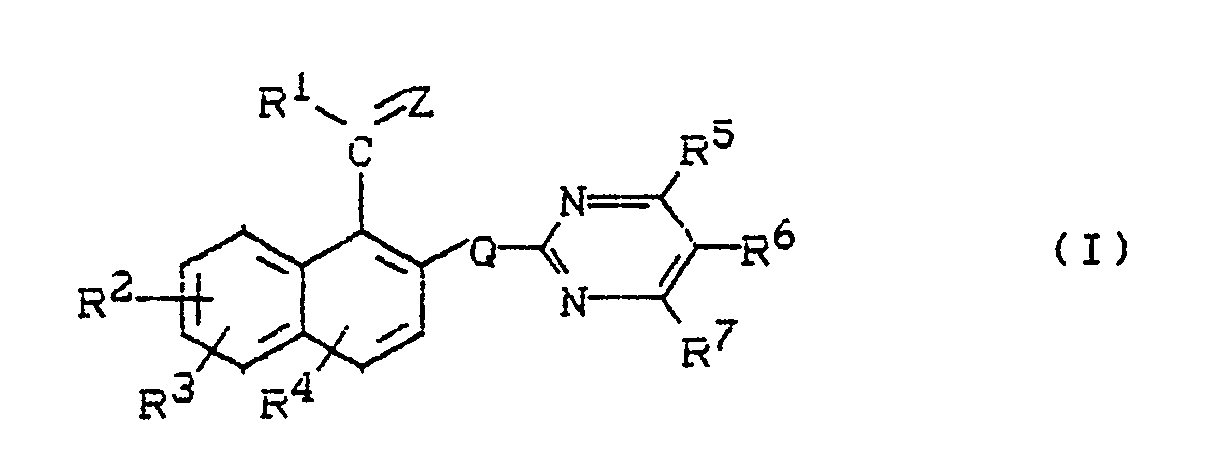
Die Erfindung betrifft neue Naphthalinderivate der allgemeinen Formel (I),
in welcher
in welcher
- Q
- für Sauerstoff, Schwefel oder die Gruppierung NR steht, wobei R für Wasserstoff oder Alkyl steht,
- R¹
- für Wasserstoff oder Alkyl steht und
- Z
- für eine der nachstehenden Gruppierungen steht: N-R⁸ oder
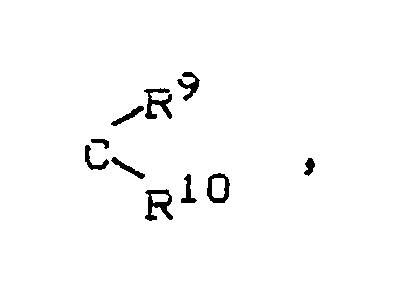
(wobei die Reste R² - R¹⁰ die in der Beschreibung angegebenen Bedeutungen haben), Verfahren zu ihrer Herstellung und ihre Verwendung als Herbizide.
Description
- Die Erfindung betrifft neue Naphthalinderivate, Verfahren zu ihrer Herstellung und ihre Verwendung als Herbizide.
- Es ist bereits bekannt, daß bestimmte Naphthalinderivate, wie z.B. 2-(4,6-Dimethoxy-pyrimidin-2-yl-oxy)-1-naphthaldehyd, herbizide Eigenschaften aufweisen (vgl. EP-A 360 163; JP-A 2 056 469).
- Die herbizide Wirksamkeit der bekannten Naphthalinderivate und ihre Verträglichkeit gegenüber Nutzpflanzen ist jedoch nicht immer ganz zufriedenstellend.
- Es wurden nun die neuen Naphthalinderivate der allgemeinen Formel (I) gefunden,

in welcher - Q
- für Sauerstoff, Schwefel oder die Gruppierung NR steht, wobei R für Wasserstoff oder Alkyl steht,
- R¹
- für Wasserstoff oder Alkyl steht,
- R² R³ und R⁴
- gleich oder verschieden sind und jeweils für Wasserstoff, Hydroxy, Amino, Cyano, Nitro, Halogen oder für jeweils gegebenenfalls substituiertes Alkyl, Alkoxy, Alkylthio, Alkylsulfinyl oder Alkylsulfonyl stehen,
- R⁵
- für Wasserstoff, Halogen oder für jeweils gegebenenfalls substituiertes Alkyl, Alkoxy, Alkylthio, Alkylamino oder Dialkylamino steht,
- R⁶
- für Wasserstoff, Halogen oder für jeweils gegebenenfalls substituiertes Alkyl oder Alkoxy steht und
- R⁷
- für Wasserstoff, Halogen oder für jeweils gegebenenfalls substituiertes Alkyl, Alkoxy, Alkylthio, Alkylamino oder Dialkylamino steht, und
- Z
- für eine der nachstehenden Gruppierungen steht: N-R⁸ oder

- R⁸
- für Wasserstoff, Hydroxy, Amino, Carbamoylamino oder für jeweils gegebenenfalls substituiertes Alkyl, Alkenyl, Alkinyl, Alkoxy, Alkenyloxy, Alkoxycarbonylalkoxy, Alkylamino, Dialkylamino, Alkylcarbonylamino, Alkoxycarbonylamino, Alkylsulfonylamino, Aryl, Aralkyl, Aryloxy, Aralkyloxy, Arylamino, Diarylamino, Aralkylamino, N-Alkyl-N-arylamino, Hetarylamino, Hetarylcarbonylamino, Arylcarbonylamino oder Arylsulfonylamino steht,
- R⁹
- für Wasserstoff, Halogen, Cyano, Carboxy, Alkoxycarbonyl, Alkylcarbonylamino oder Dialkoxyphosphoryl steht und
- R¹⁰
- für Formyl, Cyano, Carboxy, Hydroxymethyl, Carbamoyl oder für jeweils gegebenenfalls substituiertes Alkoxycarbonyl, Cycloalkoxycarbonyl, Alkylthiocarbonyl, Alkylaminocarbonyl, Cycloalkylaminocarbonyl, Dialkylaminocarbonyl, Alkylaminocarbonylalkoxycarbonyl, Dialkylaminocarbonylalkoxycarbonyl, Arylaminocarbonylalkoxycarbonyl, N-Alkyl-N-arylaminocarbonylalkoxycarbonyl, Pyrrolidinylcarbonyl, Piperidinylcarbonyl, Morpholinylcarbonyl, Piperazinylcarbonyl, Aryloxycarbonyl, Aralkyloxycarbonyl, Heterocyclylalkoxycarbonyl, Arylthiocarbonyl, Aralkylthiocarbonyl, Arylaminocarbonyl, Aralkylaminocarbonyl, N-Alkyl-N-arylaminocarbonyl, Arylhydrazinocarbonyl, Alkylhydrazinocarbonyl oder Phthalimidoxycarbonyl steht oder R¹⁰ zusammen mit R⁹ für die Gruppierung -CO-O-(CH₂)n- steht, wobei n für die Zahlen 1 bis 4 steht.
- Man erhält die neuen Naphthalinderivate der allgemeinen Formel (I), wenn man
- (a) entsprechende Carbonylverbindungen der allgemeinen Formel (II)

- Q, R¹, R², R³, R⁴, R⁵, R⁶ und R⁷
- die oben angegebene Bedeutung haben,
H₂Z (III)
in welcher- Z
- die oben angegebene Bedeutung hat,
- (b) nucleophile Naphthalinderivate der allgemeinen Formel (IV)

- Q, R¹, R², R³, R⁴ und Z
- die oben angegebene Bedeutung haben,

- R⁵, R⁶ und R⁷
- die oben angegebene Bedeutung haben und
- X
- für eine nucleofuge Abgangsgruppe steht,
- Die neuen Naphthalinderivate der allgemeinen Formel (I) zeichnen sich durch starke Herbizidwirkung aus.
- Überraschenderweise zeigen die erfindungsgemäßen Naphthalinderivate der Formel (I) bei guter Verträglichkeit gegenüber wichtigen Kulturpflanzen wesentlich stärkere Wirkung gegen Unkräuter als die bekannte Verbindung 2-(4,6-Dimethoxy-pyrimidin-2-yl-oxy)-1-naphthaldehyd, welches ein strukturell ähnlicher vorbekannter Wirkstoff gleicher Wirkungsrichtung ist.
- Die Erfindung betrifft vorzugsweise Verbindungen der Formel (I), in welcher
- Q
- für Sauerstoff, Schwefel oder die Gruppierung NR steht, wobei R für Wasserstoff oder C₁-C₄-Alkyl steht,
- R¹
- für Wasserstoff oder C₁-C₄-Alkyl steht,
- R², R³ und R⁴
- gleich oder verschieden sind und jeweils für Wasserstoff, Hydroxy, Amino, Cyano, Nitro, Halogen oder für jeweils gegebenenfalls durch Halogen substituiertes C₁-C₄-Alkyl, C₁-C₄-Alkoxy, C₁-C₄-Alkylthio, C₁-C₄-Alkylsulfinyl oder C₁-C₄-Alkylsulfonyl stehen,
- R⁵
- für Wasserstoff, Halogen oder für jeweils gegebenenfalls durch Halogen oder C₁-C₄- Alkoxy substituiertes C₁-C₄-Alkyl, C₁-C₄-Alkoxy, C₁-C₄-Alkylthio, C₁-C₄-Alkylamino oder Di-(C₁-C₄-alkyl)-amino steht,
- R⁶
- für Wasserstoff, Halogen oder für jeweils gegebenenfalls durch Halogen substituiertes C₁-C₄-Alkyl oder C₁-C₄-Alkoxy steht,
- R⁷
- für Wasserstoff, Halogen oder für jeweils gegebenenfalls durch Halogen substituiertes C₁-C₄-Alkyl, C₁-C₄-Alkoxy, C₁-C₄-Alkylthio, C₁-C₄-Alkylamino oder Di-(C₁-C₄-alkyl)-amino steht,
- Z
- für eine der nachstehenden Gruppierungen steht: N-R⁸ oder

- R⁸
- für Wasserstoff, Hydroxy, Amino, Carbamoylamino oder für jeweils gegebenenfalls durch Halogen substituiertes C₁-C₆-Alkyl, C₃-C₆-Alkenyl, C₃-C₆-Alkinyl, C₁-C₆-Alkoxy, C₃-C₆-Alkenyloxy, C₁-C₄-Alkoxy-carbonyl-C₁-C₂-alkoxy, C₁-C₆-Alkylamino, Di-(C₁-C₂-alkyl)-amino, C₁-C₆-Alkylcarbonylamino, C₁-C₆-Alkoxy-carbonylamino, C₁-C₆-Alkyl-sulfonylamino, oder für jeweils gegebenenfalls durch Nitro, Hydroxy, Amino, Cyano, Carboxy, Halogen, C₁-C₄-Alkyl, C₁-C₂-Halogenalkyl, C₁-C₄-Alkoxy, C₁-C₂-Halogenalkoxy, C₁-C₄-Alkylthio, C₁-C₂-Halogenalkylthio, C₁-C₄-Alkoxy-carbonyl und/oder Di-(C₁-C₂-alkyl)-amino substituiertes Phenyl, Phenyl-C₁-C₄-alkyl, Phenoxy, Phenyl-C₁-C₄-alkoxy, Phenylamino, Diphenylamino, Phenyl-C₁-C₄-alkylamino, N-(C₁-C₄-alkyl)-N-phenylamino, Pyridylamino, Pyrimidylamino, Chinolylamino, Pyridylcarbonylamino, Phenylcarbonylamino, Furylcarbonylamino, Thienylcarbonylamino oder Phenylsulfonylamino steht,
- R⁹
- für Wasserstoff, Halogen, Cyano, Carboxy, C₁-C₆-Alkoxy-carbonyl, C₁-C₆-Alkylcarbonylamino oder Di-(C₁-C₄-alkoxy)-phosphoryl steht und
- R¹⁰
- für Formyl, Cyano, Carboxy, Hydroxymethyl, Carbamoyl oder für jeweils gegebenenfalls durch Halogen, Carboxy oder C₁-C₄-Alkoxy-carbonyl substituiertes C₁-C₆-Alkoxy-carbonyl, C₅-C₆-Cycloalkyloxy-carbonyl, C₁-C₆-Alkylthiocarbonyl, C₁-C₆-Alkylamino-carbonyl oder C₅-C₆-Cycloalkylamino-carbonyl, für Di-(C₁-C₂-alkyl)-amino-carbonyl, für C₁-C₄-Alkylamino-carbonyl-C₁-C₄-alkoxy-carbonyl, für Di-(C₁-C₂-alkyl)-amino-carbonyl-C₁-C₄-alkoxy-carbonyl, für Phenylaminocarbonyl-C₁-C₄-alkoxy-carbonyl, für N-Methyl-N-phenylaminocarbonyl-C₁-C₄-alkoxycarbonyl, für jeweils gegebenenfalls durch Methyl und/oder Ethyl substituiertes Pyrrolidinylcarbonyl, Piperidinyl-carbonyl, Morpholinylcarbonyl oder Piperazinylcarbonyl, für jeweils gegebenenfalls durch Nitro, Amino, Cyano, Carboxy, Halogen, C₁-C₄-Alkyl, C₁-C₂-Halogenalkyl, C₁-C₄-Alkoxy, C₁-C₂-Halogenalkoxy, C₁-C₄-Alkylthio, C₁-C₂-Halogenalkylthio, C₁-C₄-Alkoxy-carbonyl und/oder Di-(C₁-C₂-alkyl)amino substituiertes Phenoxycarbonyl, Phenyl-C₁-C₄-alkoxycarbonyl, Furylmethoxycarbonyl, Thienylmethoxycarbonyl, Phenylthiocarbonyl, Phenyl-C₁-C₄-alkylthio-carbonyl, Phenylaminocarbonyl, Phenyl-C₁-C₄-alkylamino-carbonyl, N-(C₁-C₄-Alkyl)-N-phenylamino-carbonyl oder Phenylhydrazinocarbonyl, für C₁-C₄-Alkylhydrazinocarbonyl oder für Phthalimidoxycarbonyl steht oder R¹⁰ zusammen mit R⁹ für die Gruppierung -CO-O-(CH₂)n-steht, wobei
- n
- für die Zahlen 1 bis 4, insbesondere 2 oder 3 steht.
- Die in der Definition der erfindungsgemäßen Verbindungen aufgeführten aliphatischen Kohlenwasserstoffreste (z.B. Alkyl, Alkenyl, Alkinyl), auch in Kombination mit Heteroatomen (z.B. in Alkoxy, Alkylthio, Alkylamino) oder in Zusammensetzungen wie z.B. Halogenalkyl, Halogenalkoxy, sind jeweils geradkettig oder verzweigt.
- Halogen steht im allgemeinen für Fluor, Chlor, Brom oder Jod, vorzugsweise für Fluor, Chlor oder Brom, insbesondere für Fluor oder Chlor.
- Die Erfindung betrifft insbesondere Verbindungen der Formel (1), in welcher
- Q
- für Sauerstoff steht,
- R¹
- für Wasserstoff steht,
- R², R³ und R⁴
- für Wasserstoff stehen,
- R⁵
- für Wasserstoff, Chlor, Methyl, Ethyl, Trifluormethyl, Methoxymethyl, Methoxy, Ethoxy, Difluormethoxy, Methylthio, Methylamino, Ethylamino oder Dimethylamino - insbesondere für Methoxy - steht,
- R⁶
- für Wasserstoff, Chlor, Methyl oder Methoxy - insbesondere für Wasserstoff - steht, und
- R⁷
- für Wasserstoff, Chlor, Methyl, Ethyl, Trifluormethyl, Methoxy, Ethoxy, Difluormethoxy, Methylthio, Methylamino, Ethylamino oder Dimethylamino - insbesondere für Methoxy - steht, und
- Z
- für eine der nachstehenden Gruppierungen steht:
N-R⁸ oder
- R⁸
- für Wasserstoff, Hydroxy, Amino, Carbamoylamino, für Methyl, Ethyl, n-Propyl, Isopropyl, n-Butyl, Isobutyl, sec-Butyl, tert-Butyl, Allyl, Propargyl, Methoxy, Ethoxy, n-Propoxy, Isopropoxy, n-Butoxy, Isobutoxy, sec-Butoxy, Allyloxy, Methoxycarbonylmethoxy, Ethoxycarbonylmethoxy, Methoxycarbonylethoxy, Ethoxycarbonylethoxy, Methylamino, Ethylamino, n-Propylamino, Isopropylamino, n-Butylamino, Isobutylamino, sec-Butylamino, tert-Butylamino, Dimethylamino, Acetylamino, Propionylamino, Methoxycarbonylamino, Ethoxycarbonylamino, Methylsulfonylamino, Ethylsulfonylamino, für jeweils gegebenenfalls durch Nitro, Hydroxy, Cyano, Carboxy, Fluor, Chlor, Brom, Methyl, Trifluormethyl, Methoxy, Trifluormethoxy, Methylthio oder Trifluormethylthio substituiertes Phenyl, Benzyl, Phenoxy, Benzyloxy, Phenylamino, Diphenylamino, Benzylamino, N-Methyl-N-phenylamino, Pyridylamino, Pyrimidylamino, Chinolylamino, Pyridylcarbonylamino, Phenylcarbonylamino, Furylcarbonylamino, Thienylcarbonylamino oder Phenylsulfonylamino steht,
- R⁹
- für Wasserstoff, Fluor, Chlor, Cyano, Carboxy, C₁-C₄-Alkoxy-carbonyl, C₁-C₄-Alkyl-carbonylamino, Dimethoxyphosphoryl oder Diethoxyphosphoryl steht und
- R¹⁰
- für Formyl, Cyano, Carboxy, Hydroxymethyl, Carbamoyl, für jeweils gegebenenfalls durch Fluor, Chlor, Carboxy oder C₁-C₄-Alkoxy-carbonyl substituiertes C₁-C₄-Alkoxy-carbonyl, C₅-C₆-Cycloalkyloxy-carbonyl, C₁-C₄-Alkylthiocarbonyl, C₁-C₄-Alkylamino-carbonyl oder C₅-C₆-Cycloalkylamino-carbonyl, für Dimethylaminocarbonyl, für C₁-C₄-Alkylaminocarbonyl-C₁-C₄-alkoxy-carbonyl, für Dimethylaminocarbonyl-C₁-C₄-alkoxy-carbonyl, für N-Methyl-N-phenylaminocarbonyl-C₁-C₄-alkoxy-carbonyl, für jeweils gegebenenfalls durch Methyl und/oder Ethyl substituiertes Pyrrolidinyl-carbonyl, Piperidinyl-carbonyl, Morpholinyl-carbonyl oder Piperazinyl-carbonyl, für jeweils gegebenenfalls durch Nitro, Cyano, Fluor, Chlor, Brom, Methyl, Trifluormethyl, Methoxy, Trifluormethoxy, Methylthio oder Trifluormethylthio substituiertes Phenoxycarbonyl, Benzyloxycarbonyl, Phenylthiocarbonyl, Benzylthiocarbonyl, Phenylaminocarbonyl, Benzylaminocarbonyl, N-Methyl-N-phenylaminocarbonyl, Phenylhydrazinocarbonyl oder für Phthalimidoxycarbonyl steht oder R¹⁰ zusammen mit R⁹ für die Gruppierung -CO-O-CH₂CH₂- steht.
- Verwendet man für das erfindungsgemäße Verfahren (a) beispielsweise 2-(4,6-Dimethoxy-pyrimidin-2-yl-oxy)-1-naphthaldehyd und Acethydrazid als Ausgangsstoffe, so kann der Reaktionsablauf durch das folgende Formelschema wiedergegeben werden:

- Verwendet man für das erfindungsgemäße Verfahren (b) beispielsweise 1-Methoximinomethyl-2-naphthol und 2-Chlor-4,6-dimethoxy-pyrimidin als Ausgangsstoffe, so kann der Reaktionsablauf durch das folgende Formelschema wiedergegeben werden:

- Die beim erfindungsgemäßen Verfahren (a) zur Herstellung von Verbindungen der Formel (I) als Ausgangsstoffe zu verwendenden Carbonylverbindungen sind durch die Formel (II) allgemein definiert.
- In Formel (II) haben Q, R¹, R², R³, R⁴, R⁵, R⁶ und R⁷ vorzugsweise bzw. insbesondere diejenigen Bedeutungen, die bereits oben im Zusammenhang mit der Beschreibung der erfindungsgemäßen Verbindungen der Formel (1) vorzugsweise bzw. als insbesondere bevorzugt für Q, R¹, R², R³, R⁴, R⁵, R⁶ und R⁷ angegeben wurden.
- Als Beispiele für die Ausgangsstoffe der Formel (II) seien genannt: 2-(4,6-Dimethoxy-pyrimidin-2-yl-oxy)-, 2-(4-Methoxy-6-methyl-pyrimidin-2-yl-oxy)-, 2-(4,6-Dimethyl-pyrimidin-2-yl-oxy)-, 2-(4-Methoxy-6-trifluormethyl-pyrimidin-2-yl-oxy)-, 2-(4-Ethyl-6-methoxy-pyrimidin-2-yl-oxy)-, 2-(4-Ethoxy-6-methyl-pyrimidin-2-yl-oxy)- und 2-(4,6-Diethoxy-pyrimidin-2-yl-oxy)-1-naphthaldehyd.
- Die Carbonylverbindungen der Formel (II) sind bekannt und/oder können nach an sich bekannten Verfahren hergestellt werden (vgl. EP-A 360 163; JP-A 2 056 469 - zitiert in Chem. Abstracts 113 (1990), 54345m; Herstellungsbeispiele).
- Die beim erfindungsgemäßen Verfahren (a) zur Herstellung von Verbindungen der Formel (I) weiter als Ausgangsstoffe zu verwendenden Amino- oder Methylen-Verbindungen sind durch die Formel (III) allgemein definiert.
- In Formel (III) hat Z vorzugsweise bzw. insbesondere diejenige Bedeutung, die bereits oben im Zusammenhang mit der Beschreibung der erfindungsgemäßen Verbindungen der Formel (I) vorzugsweise bzw. als insbesondere bevorzugt für Z angegeben wurde.
- Als Beispiele für die Ausgangsstoffe der Formel (III) seien genannt:
Ammoniak, Hydroxylamin, Hydrazin, Methylamin, Ethylamin, Propylamin, Isopropylamin, Butylamin, Isobutylamin, sec-Butylamin, tert-Butylamin, Allylamin, Propargylamin, O-Methyl-, O-Ethyl-, O-Propyl-, O-Isopropyl-, O-Butyl-, O-Isobutyl- und O-sec-Butyl-hydroxylamin, O-Allyl-hydroxylamin, Aminooxyessigsäure-methylester und -ethylester, α-Aminooxy-propionsäure-methylester und -ethylester, Methylhydrazin, Ethylhydrazin, Propylhydrazin, Isopropylhydrazin, Butylhydrazin, Isobutylhydrazin, sec-Butyl-hydrazin, tert-Butylhydrazin, N,N-Dimethylhydrazin, Acethydrazid, Propionylhydrazid, Methoxycarbonylhydrazin, Ethoxycarbonylhydrazin, Methylsulfonylhydrazin, Ethylsulfonylhydrazin, Phenylhydrazin, Benzoylhydrazin, Benzolsulfonsäurehydrazid, p-Toluolsulfonsäurehydrazid, Malonsäure, Cyanessigsäure, Malonsäuredinitril, Cyanessigsäure-methylester und -ethylester, Malonsäure-dimethylester und -diethylester, γ-Butyrolacton. - Die Ausgangsstoffe der Formel (III) sind bekannte Synthesechemikalien.
- Das erfindungsgemäße Verfahren (a) zur Herstellung der neuen Naphthalinderivate der Formel (I) wird vorzugsweise unter Verwendung von Verdünnungsmitteln durchgeführt. Als Verdünnungsmittel kommen dabei praktisch alle inerten organischen Lösungsmittel infrage. Hierzu gehören vorzugsweise aliphatische und aromatische, gegebenenfalls halogenierte Kohlenwasserstoffe wie Pentan, Hexan, Heptan, Cyclohexan, Petrolether, Benzin, Ligroin, Benzol, Toluol, Xylol, Methylenchlorid, Ethylenchlorid, Chloroform, Tetrachlorkohlenstoff, Chlorbenzol und o-Dichlorbenzol, Ether wie Diethyl- und Dibutylether, Glykoldimethylether und Diglykoldimethylether, Tetrahydrofuran und Dioxan, Ketone wie Aceton, Methyl-ethyl-, Methyl-isopropyl- und Methyl-isobutyl-keton, Ester wie Essigsäuremethylester und -ethylester, Nitrile wie z. B. Acetonitril und Propionitril, Amide wie z. B. Dimethylformamid, Dimethylacetamid und N-Methyl-pyrrolidon sowie Dimethylsulfoxid, Tetramethylensulfon und Hexamethylphosphorsäuretriamid.
- Das erfindungsgemäße Verfahren (a) wird gegebenenfalls in Gegenwart eines Reaktionshilfsmittels durchgeführt. Geeignete Reaktionshilfsmittel sind Stoffe, die üblicherweise zur Steuerung und/oder Beschleunigung von Kondensationsreaktionen zwischen Carbonylverbindungen und Amino- oder Methylen-Verbindungen verwendet werden. Hierzu gehören insbesondere Stickstoffverbindungen, wie z.B. Ammoniumacetat, β-Alanin, Pyridin und Piperidin.
- Die Reaktionstemperaturen können bei dem erfindungsgemäßen Verfahren (a) in einem größeren Bereich variiert werden. Im allgemeinen arbeitet man bei Temperaturen zwischen 0 °C und 150 °C, vorzugsweise bei Temperaturen zwischen 10 °C und 120 °C.
- Das erfindungsgemäße Verfahren (a) wird im allgemeinen unter Normaldruck durchgeführt. Es ist jedoch auch möglich, unter erhöhtem oder vermindertem Druck zu arbeiten.
- Zur Durchführung des erfindungsgemäßen Verfahrens (a) werden die jeweils benötigten Ausgangsstoffe im allgemeinen in angenähert äquimolaren Mengen eingesetzt. Es ist jedoch auch möglich, eine der beiden jeweils eingesetzten Komponenten in einem größeren Überschuß zu verwenden. Die Reaktionen werden im allgemeinen in einem geeigneten Verdünnungsmittel, gegebenenfalls in Gegenwart eines Reaktionshilfsmittels durchgeführt, und das Reaktionsgemisch wird mehrere Stunden bei der jeweils erforderlichen Temperatur gerührt. Die Aufarbeitung erfolgt bei dem erfindungsgemäßen Verfahren jeweils nach üblichen Methoden (vergleiche die Herstellungsbeispiele).
- Die beim erfindungsgemäßen Verfahren (b) zur Herstellung von Verbindungen der Formel (I) als Ausgangsstoffe zu verwendenden nucleophilen Naphthalinderivate sind durch die Formel (IV) allgemein definiert.
- In Formel (IV) haben Q, R¹, R², R³, R⁴ und Z vorzugsweise bzw. insbesondere diejenigen Bedeutungen, die bereits oben im Zusammenhang mit der Beschreibung der erfindungsgemäßen Verbindungen der Formel (I) vorzugsweise bzw. als insbesondere bevorzugt für Q, R¹, R², R³, R⁴ und Z angegeben wurden.
- Beispiele für die Ausgangsstoffe der Formel (IV) sind in der nachstehenden Tabelle 1 aufgeführt.
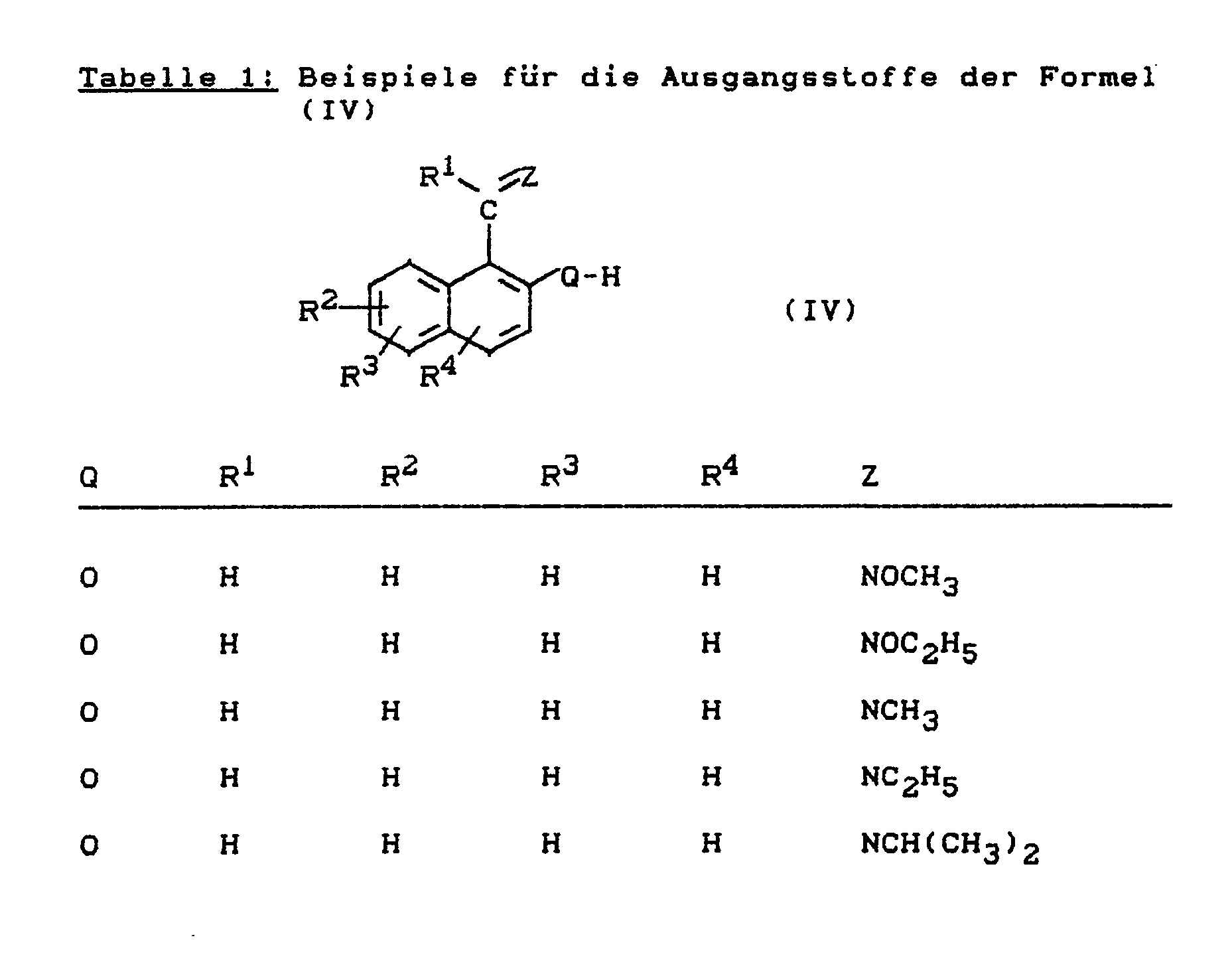


- Die Ausgangsstoffe der Formel (IV) sind bekannt und/oder können nach an sich bekannten Verfahren hergestellt werden (vgl. Synthesis 1985, 201-202; US-P 4 277 500; Tetrahedron Lett. 1975, 785-788; Chem. Pharm. Bull. 24 (1976), 3065-3074; US-P 4 334 015; Herstellungsbeispiele).
- Die beim erfindungsgemäßen Verfahren (b) zur Herstellung von Verbindungen der Formel (I) weiter als Ausgangsstoffe zu verwendenden Pyrimidinderivate sind durch die Formel (V) allgemein definiert.
- In Formel (V) haben R⁵, R⁶ und R⁷ vorzugsweise bzw. insbesondere diejenigen Bedeutungen, die bereits oben im Zusammenhang mit der Beschreibung der erfindungsgemäßen Verbindungen der Formel (I) vorzugsweise bzw. als insbesondere bevorzugt für R⁵, R⁶ und R⁷ angegeben wurden und
- X
- steht vorzugsweise für Fluor, Chlor, Brom oder C₁-C₄-Alkylsulfonyl, insbesondere für Chlor oder Methylsulfonyl.
- Als Beispiele für die Ausgangsstoffe der Formel (V) seien genannt:
2-Chlor- und 2-Methylsulfonyl-4,6-dimethyl-pyrimidin, -4-methyl-6-methoxy-pyrimidin, -4,6-dimethoxy-pyrimidin, -4-methyl-6-ethoxy-pyrimidin, -4-chlor-6-methoxy-pyrimidin, -4-methyl-pyrimidin, -4-chlor-6-methyl-pyrimidin, -4-trifluormethyl-6-methoxy-pyrimidin, -4-methoxy-6-difluormethoxy-pyrimidin, -4-methyl-6-difluormethoxy-pyrimidin, -4,6-bis-difluormethoxy-pyrimidin, -4-chlor-6-ethoxy-pyrimidin, -4,6-diethoxy-pyrimidin, -4,5-dichlor-6-methyl-pyrimidin, -4-methyl-5-chlor-6-methoxy-pyrimidin, -4,6-dichlor-pyrimidin, -4-ethyl-6-methoxy-pyrimidin, -5-chlor-4,6-dimethoxy-pyrimidin, -4-methoxy-6-methylamino-pyrimidin sowie -4,6-bis-trifluormethyl-pyrimidin. - Die Pyrimidinderivate der Formel (V) sind bekannt und/oder können nach an sich bekannten Verfahren hergestellt werden (vgl. J. Chem. Soc. 1957, 1830, 1833; J. Org. Chem. 26 (1961), 792; US-P 3 308 119 und US-P 4 711 959).
- Das erfindungsgemäße Verfahren (b) zur Herstellung der neuen Naphthalinderivate der Formel (I) wird vorzugsweise unter Verwendung von Verdünnungsmitteln durchgeführt.
- Als Verdünnungsmittel kommen dabei praktisch alle inerten organischen Lösungsmittel in Frage. Hierzu gehören vorzugsweise aliphatische und aromatische, gegebenenfalls halogenierte Kohlenwasserstoffe wie Pentan, Hexan, Heptan, Cyclohexan, Petrolether, Benzin, Ligroin, Benzol, Toluol, Xylol, Methylenchlorid, Ethylenchlorid, Chloroform, Tetrachlorkohlenstoff, Chlorbenzol und o-Dichlorbenzol, Ether wie Diethyl- und Dibutylether, Glykoldimethylether und Diglykoldimethylether, Tetrahydrofuran und Dioxan, Ketone wie Aceton, Methyl-ethyl-, Methyl-isopropyl- und Methyl-isobutyl-keton, Ester wie Essigsäuremethylester und -ethylester, Nitrile wie z. B. Acetonitril und Propionitril, Amide wie z. B. Dimethylformamid, Dimethylacetamid und N-Methyl-pyrrolidon sowie Dimethylsulfoxid, Tetramethylensulfon und Hexamethylphosphorsäuretriamid.
- Als Säureakzeptoren können bei dem erfindungsgemäßen Verfahren (b) alle üblicherweise für derartige Umsetzungen verwendbaren Säurebindemittel eingesetzt werden. Vorzugsweise in Frage kommen Alkalimetallhydroxide wie z. B. Natrium- und Kaliumhydroxid, Erdalkalihydroxide wie z. B. Calciumhydroxid, Alkalicarbonate und -alkoholate wie Natrium- und Kaliumcarbonat, Natrium- und Kalium-tert-butylat, ferner aliphatische, aromatische oder heterocyclische Amine, beispielsweise Triethylamin, Trimethylamin, Dimethylanilin, Dimethylbenzylamin, Pyridin, 1,5-Diazabicyclo-[4,3,0]-non-5-en (DBN), 1,8-Diazabicyclo-[5,4,0]-undec-7-en (DBU) und 1,4-Diazabicyclo-[2,2,2]-octan (DABCO).
- Die Reaktionstemperaturen können bei dem erfindungsgemäßen Verfahren (b) in einem größeren Bereich variiert werden. Im allgemeinen arbeitet man bei Temperaturen zwischen 0 °C und 150 °C, vorzugsweise bei Temperaturen zwischen 10 °C und 100 °C.
- Das erfindungsgemäße Verfahren (b) wird im allgemeinen unter Normaldruck durchgeführt. Es ist jedoch auch möglich, unter erhöhtem oder vermindertem Druck zu arbeiten.
- Zur Durchführung des erfindungsgemäßen Verfahrens (b) werden die jeweils benötigten Ausgangsstoffe im allgemeinen in angenähert äquimolaren Mengen eingesetzt. Es ist jedoch auch möglich, eine der beiden jeweils eingesetzten Komponenten in einem größeren Überschuß zu verwenden. Die Reaktionen werden im allgemeinen in einem geeigneten Verdünnungsmittel in Gegenwart eines Säureakzeptors durchgeführt, und das Reaktionsgemisch wird mehrere Stunden bei der jeweils erforderlichen Temperatur gerührt. Die Aufarbeitung erfolgt bei dem erfindungsgemäßen Verfahren (b) jeweils nach üblichen Methoden (vgl. die Herstellungsbeispiele).
- Die erfindungsgemäßen Wirkstoffe können als Defoliants, Desiccants, Krautabtötungsmittel und insbesondere als Unkrautvernichtungsmittel verwendet werden. Unter Unkraut im weitesten Sinne sind alle Pflanzen zu verstehen, die an Orten aufwachsen, wo sie unerwünscht sind. Ob die erfindungsgemäßen Stoffe als totale oder selektive Herbizide wirken, hängt im wesentlichen von der angewendeten Menge ab.
- Die erfindungsgemäßen Wirkstoffe können z.B. bei den folgenden Pflanzen verwendet werden:
- Dikotyle Unkräuter der Gattungen: Sinapis, Lepidium, Galium, Stellaria, Matricaria, Anthemis, Galinsoga, Chenopodium, Urtica, Senecio, Amaranthus, Portulaca, Xanthium, Convolvulus, Ipomoea, Polygonum, Sesbania, Ambrosia, Cirsium, Carduus, Sonchus, Solanum, Rorippa, Rotala, Lindernia, Lamium, Veronica, Abutilon, Emex, Datura, Viola, Galeopsis, Papaver, Centaurea, Trifolium, Ranunculus, Taraxacum.
- Dikotyle Kulturen der Gattungen: Gossypium, Glycine, Beta, Daucus, Phaseolus, Pisum, Solanum, Linum, Ipomoea, Vicia, Nicotiana, Lycopersicon, Arachis, Brassica, Lactuca, Cucumis, Cucurbita.
- Monokotyle Unkräuter der Gattungen: Echinochloa, Setaria, Panicum, Digitaria, Phleum, Poa, Festuca, Eleusine, Brachiaria, Lolium, Bromus, Avena, Cyperus, Sorghum, Agropyron, Cynodon, Monochoria, Fimbristylis, Sagittaria, Eleocharis, Scirpus, Paspalum, Ischaemum, Sphenoclea, Dactyloctenium, Agrostis, Alopecurus, Apera.
- Monokotyle Kulturen der Gattungen: Oryza, Zea, Triticum, Hordeum, Avena, Secale, Sorghum, Panicum, Saccharum, Ananas, Asparagus, Allium.
- Die Verwendung der erfindungsgemäßen Wirkstoffe ist jedoch keineswegs auf diese Gattungen beschränkt, sondern erstreckt sich in gleicher Weise auch auf andere Pflanzen.
- Die Verbindungen eignen sich in Abhängigkeit von der Konzentration zur Totalunkrautbekämpfung z.B. auf Industrie- und Gleisanlagen und auf Wegen und Plätzen mit und ohne Baumbewuchs. Ebenso können die Verbindungen zur Unkrautbekämpfung in Dauerkulturen, z.B. Forst, Ziergehölz-, Obst-, Wein-, Citrus-, Nuß-, Bananen-, Kaffee-, Tee-, Gummi-, Ölpalm-, Kakao-, Beerenfrucht- und Hopfenanlagen, auf Zier- und Sportrasen und Weideflächen und zur selektiven Unkrautbekämpfung in einjährigen Kulturen eingesetzt werden.
- Die erfindungsgemäßen Verbindungen der Formel (I) eignen sich insbesondere zur selektiven Bekämpfung von monokotylen und dikotylen Unkräutern in monokotylen und dikotylen Kulturen sowohl im Vorauflauf- als auch im Nachauflauf-Verfahren.
- Die Wirkstoffe können in die üblichen Formulierungen überführt werden, wie Lösungen, Emulsionen, Spritzpulver, Suspensionen, Pulver, Stäubemittel, Pasten, lösliche Pulver, Granulate, Suspensions-Emulsions-Konzentrate, Wirkstoff-imprägnierte Natur- und synthetische Stoffe sowie Feinstverkapselungen in polymeren Stoffen.
- Diese Formulierungen werden in bekannter Weise hergestellt, z. B. durch Vermischen der Wirkstoffe mit Streckmitteln, also flüssigen Lösungsmitteln und/oder festen Trägerstoffen, gegebenenfalls unter Verwendung von oberflächenaktiven Mitteln, also Emulgiermitteln und/oder Dispergiermitteln und/oder schaumerzeugenden Mitteln.
- Im Falle der Benutzung von Wasser als Streckmittel können z.B. auch organische Lösungsmittel als Hilfslösungsmittel verwendet werden. Als flüssige Lösungsmittel kommen im wesentlichen infrage: Aromaten, wie Xylol, Toluol, oder Alkylnaphthaline, chlorierte Aromaten und chlorierte aliphatische Kohlenwasserstoffe, wie Chlorbenzole, Chlorethylene oder Methylenchlorid, aliphatische Kohlenwasserstoffe, wie Cyclohexan oder Paraffine, z.B. Erdölfraktionen, mineralische und pflanzliche Öle, Alkohole, wie Butanol oder Glykol sowie deren Ether und Ester, Ketone wie Aceton, Methylethylketon, Methylisobutylketon oder Cyclohexanon, stark polare Lösungsmittel, wie Dimethylformamid und Dimethylsulfoxid, sowie Wasser.
Als feste Trägerstoffe kommen infrage:
z.B. Ammoniumsalze und natürliche Gesteinsmehle, wie Kaoline, Tonerden, Talkum, Kreide, Quarz, Attapulgit, Montmorillonit oder Diatomeenerde und synthetische Gesteinsmehle, wie hochdisperse Kieselsäure, Aluminiumoxid und Silikate, als feste Trägerstoffe für Granulate kommen in Frage: z.B. gebrochene und fraktionierte natürliche Gesteine wie Calcit, Marmor, Bims, Sepiolith, Dolomit sowie synthetische Granulate aus anorganischen und organischen Mehlen sowie Granulate aus organischem Material wie Sägemehl, Kokosnußschalen, Maiskolben und Tabakstengeln; als Emulgier- und/oder schaumerzeugende Mittel kommen infrage: z.B. nichtionogene und anionische Emulgatoren, wie Polyoxyethylen-Fettsäure-Ester, Polyoxyethylen-Fettalkohol-Ether, z.B. Alkylaryl-polyglykolether, Alkylsulfonate, Alkylsulfate, Arylsulfonate sowie Eiweißhydrolysate; als Dispergiermittel kommen infrage: z.B. Lignin-Sulfitablaugen und Methylcellulose. - Es können in den Formulierungen Haftmittel wie Carboxymethylcellulose, natürliche und synthetische pulvrige, körnige oder latexförmige Polymere verwendet werden, wie Gummiarabicum, Polyvinylalkohol, Polyvinylacetat, sowie natürliche Phospholipide, wie Kephaline und Lecithine und synthetische Phospholipide. Weitere Additive können mineralische und vegetabile Öle sein.
- Es können Farbstoffe wie anorganische Pigmente, z.B. Eisenoxid, Titanoxid, Ferrocyanblau und organische Farbstoffe, wie Alizarin-, Azo- und Metallphthalocyaninfarbstoffe und Spurennährstoffe wie Salze von Eisen, Mangan, Bor, Kupfer, Kobalt, Molybdän und Zink verwendet werden.
- Die Formulierungen enthalten im allgemeinen zwischen 0,1 und 95 Gewichtsprozent Wirkstoff, vorzugsweise zwischen 0,5 und 90 %.
- Die erfindungsgemäßen Wirkstoffe können als solche oder in ihren Formulierungen auch in Mischung mit bekannten Herbiziden zur Unkrautbekämpfung Verwendung finden, wobei Fertigformulierungen oder Tankmischungen möglich sind.
- Für die Mischungen kommen bekannte Herbizide wie z.B. 1-Amino-6-ethylthio-3-(2,2-dimethylpropyl)-1,3,5-triazin-2,4(1H,3H)-dion (AMETHYDIONE) oder N-(2-Benzthiazolyl)-N,N'-dimethyl-harnstoff (METABENZTHIAZURON) zur Unkrautbekämpfung in Getreide; 4-Amino-3-methyl-6-phenyl-1,2,4-triazin-5(4H)-on (METAMITRON) zur Unkrautbekämpfung in Zuckerrüben und 4-Amino-6-(1,1-dimethylethyl)-3-methylthio-1,2,4-triazin-5(4H)-on (METRIBUZIN) zur Unkrautbekämpfung in Sojabohnen, infrage. Ferner auch 2,4-Dichlorphenoxyessigsäure (2,4-D); 4-(2,4-Dichlorphenoxy)-buttersäure (2,4-DB); 2,4-Dichlorphenoxypropionsäure (2,4-DP); Chloressigsäure-N-(methoxymethyl)-2,6-diethylanilid (ALACHLOR); Methyl-6,6-dimethyl-2,4-dioxo-3-[1-(2-propenyloxyamino)-butyliden]-cyclohexancarbonsäure (ALLOXYDIM); 2-Chlor-4-ethylamino-6-isopropylamino-1,3,5-triazin (ATRAZIN); 3-Isopropyl-2,1,3-benzothiadiazin-4-on-2,2-dioxid (BENTAZON); 3,5-Dibrom-4-hydroxybenzonitril (BROMOXYNIL); N-(3-Chlorphenyl)-isopropylcarbamat (CHLORPROPHAM); 2-Chlor-N-{[(4-methoxy-6-methyl-1,3,5-triazin-2-yl)-amino]-carbonyl}-benzolsulfonamid (CHLORSULFURON); N,N-Dimethyl-N'-(3-chlor-4-methylphenyl)-harnstoff (CHLORTOLURON); exo-1-Methyl-4-(1-methylethyl)-2-(2-methylphenyl-methoxy)-7-oxabicyclo-(2,2,1)-heptan (CINMETHYLIN); 3,6-Dichlor-2-pyridincarbonsäure (CLOPYRALID); 2-Chlor-4-ethylamino-6-(3-cyanopropylamino)-1,3,5-triazin (CYANAZIN); 2-[1-(Ethoximino)-butyl]-3-hydroxy-5-[tetrahydro-(2H)-thiopyran-3-yl]-2-cyclohexen-1-on (CYCLOXYDIM); 2-[4-(2,4-Dichlorphenoxy)-phenoxy]-propionsäure, deren Methyl-oder deren Ethylester (DICLOFOP); 2-[(2-Chlorphenyl)-methyl]-4,4-dimethylisoxazolidin-3-on (DIMETHAZONE); N,N-Di-n-propyl-thiocarbamidsäure-S-ethylester (EPTAME); 4-Amino-6-t-butyl-3-ethylthio-1,2,4-triazin-5(4H)-on (ETHIOZIN); 2-{4-[(6-Chlor-2-benzoxazolyl)-oxyl-phenoxy}-propansäure, deren Methyl- oder deren Ethylester (FENOXAPROP); 2-[4-(5-Trifluormethyl-2-pyridyloxy)-phenoxy]-propansäure oder deren Butylester (FLUAZIFOP); [(4-Amino-3,5-dichlor-6-fluor-2-pyridinyl)-oxy]-essigsäure bzw. deren 1-Methylheptylester (FLUROXYPYR); 2-{4-[(3-Chlor-5-(trifluormethyl)-2-pyridinyl)-oxy]-phenoxy}-propansäure bzw. deren Ethylester (HALOXYFOP); 3-Cyclohexyl-6-dimethylamino-1-methyl-1,3,5-triazin-2,4-dion (HEXAZINONE); Methyl-2-[4,5-dihydro-4-methyl-4-(1-methylethyl)-5-oxo-1H-imidazol-2-yl]-4(5)-methylbenzoat (IMAZAMETHABENZ); 3,5-Diiod-4-hydroxybenzonitril (IOXYNIL); N,N-Dimethyl-N'-(4-isopropylphenyl)-harnstoff (ISOPROTURON); (2-Methyl-4-chlorphenoxy)-essigsäure (MCPA); (4-Chlor-2-methylphenoxy)-propionsäure (MCPP); N-Methyl-2-(1,3-benzthiazol-2-yloxy)-acetanilid (MEFENACET); 2-Chlor-N-(2,6-dimethylphenyl)-N-[(1H)-pyrazol-1-yl-methyl]-acetamid (METAZACHLOR); 2-Ethyl-6-methyl-N-(1-methyl-2-methoxyethyl)-chloracetanilid (METOLACHLOR); 2-{[[((4-Methoxy-6-methyl-1,3,5-triazin-2-yl)-amino)-carbonyl]-amino]-sulfonyl}-benzoesäure oder deren Methylester (METSULFURON); N-(1-Ethylpropyl)-3,4-dimethyl-2,6-dinitroanilin (PENDIMETHALIN); Isopropyl-N-phenyl-carbamat (PROPHAM); O-(6-Chlor-3-phenyl-pyridazin-4-yl)-S-octyl-thiocarbonat (PYRIDATE); 2-[4-(6-Chlor-chinoxalin-2-yl-oxy)-phenoxy]-propionsäure-ethylester (QUIZALOFOPETHYL); 2-[1-(Ethoxamino)-butyliden]-5-(2-ethylthiopropyl)-1,3-cyclohexadion (SETHOXYDIM); 2-Chlor-4,6-bis-(ethylamino)-1,3,5-triazin (SIMAZIN); 2,4-Bis-[N-ethylamino]-6-methylthio-1,3,5-triazin (SIMETRYNE); 4-Ethylamino-2-t-butylamino-6-methylthio-s-triazin (TERBUTRYNE); 3-[[[[(4-Methoxy-6-methyl-1,3,5-triazin-2-yl)-amino]-carbonyl]-amino]-sulfonyl]-thiophen-2-carbonsäure-methylester (THIAMETURON); S-[(4-Chlorphenyl)-methyl]-N,N-diethyl-thiocarbamat (THIOBENCARB); N,N-Diisopropyl-S-(2,3,3-trichlorallyl)-thiolcarbamat (TRIALLATE); 2,6-Dinitro-4-trifluormethyl-N,N-dipropylanilin (TRIFLURALIN). Einige Mischungen zeigen überraschenderweise auch synergistische Wirkung.
- Auch eine Mischung mit anderen bekannten Wirkstoffen, wie Fungiziden, Insektiziden, Akariziden, Nematiziden, Schutzstoffen gegen Vogelfraß, Pflanzennährstoffen und Bodenstrukturverbesserungsmitteln ist möglich.
- Die Wirkstoffe können als solche, in Form ihrer Formulierungen oder den daraus durch weiteres Verdünnen bereiteten Anwendungsformen, wie gebrauchsfertige Lösungen, Suspensionen, Emulsionen, Pulver, Pasten und Granulate angewandt werden. Die Anwendung geschieht in üblicher Weise, z.B. durch Gießen, Spritzen, Sprühen, Streuen.
- Die erfindungsgemäßen Wirkstoffe können sowohl vor als auch nach dem Auflaufen der Pflanzen appliziert werden. Sie können auch vor der Saat in den Boden eingearbeitet werden.
- Die angewandte Wirkstoffmenge kann in einem größeren Bereich schwanken. Sie hängt im wesentlichen von der Art des gewünschten Effektes ab. Im allgemeinen liegen die Aufwandmengen zwischen 1 g und 10 kg Wirkstoff pro Hektar Bodenfläche, vorzugsweise zwischen 5 g und 5 kg pro ha.
- Die Herstellung und die Verwendung der erfindungsgemäßen Wirkstoffe geht aus den nachfolgenden Beispielen hervor.
-
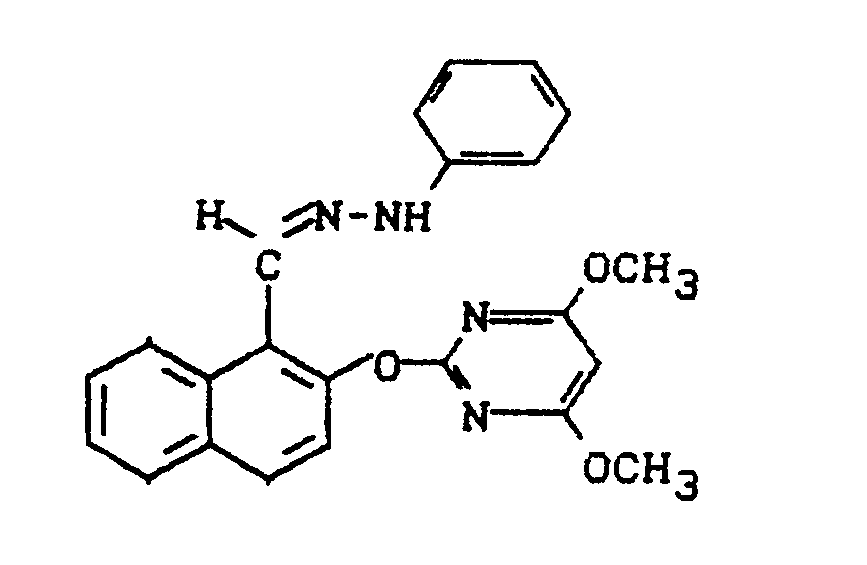
- Eine Mischung aus 3,1 g (10 mmol) 2-(4,6-Dimethoxy-pyrimidin-2-yl-oxy)-1-naphthaldehyd, 1,2 g (10 mmol) Phenylhydrazin und 40 ml Toluol wird bei 20°C gerührt und anschließend eingeengt. Der Rückstand wird mit Ethanol zur Kristallisation gebracht und das kristalline Produkt durch Absaugen isoliert.
- Man erhält 2,2 g (55% der Theorie) 2-(4,6-Dimethoxypyrimidin-2-yl-oxy)-1-naphthaldehyd-phenylhydrazon vom Schmelzpunkt 148°C.
-
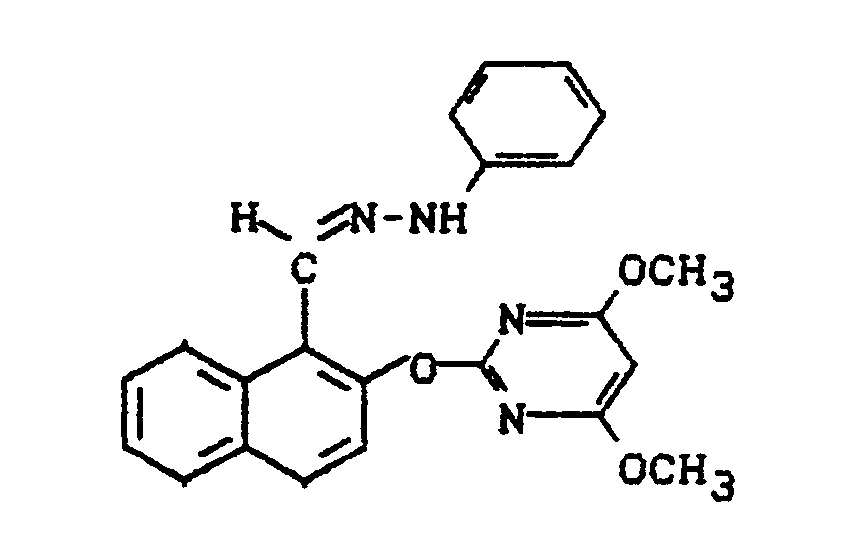
- Zu 4,6-Dimethoxy-2-methylsulfonylpyrimidin (2,2 g, 10 mmol) in Acetonitril (50 ml) gibt man 2-Hydroxy-1-naphthaldedyd-phenylhydrazon (2,6 g, 10 mmol) sowie Kaliumcarbonat (1,4 g). Es wird 7 h unter Rückfluß zum Sieden erhitzt, in Eiswasser gegossen und mit Diethylether extrahiert. Nach dem Trocknen über Natriumsulfat wird eingeengt.
- Man erhält 3,1 g (76% der Theorie) 2-(4,6-Dimethoxypyrimidin-2-yl-oxy)-1-naphthaldehyd-phenylhydrazon vom Schmelzpunkt 148°C.
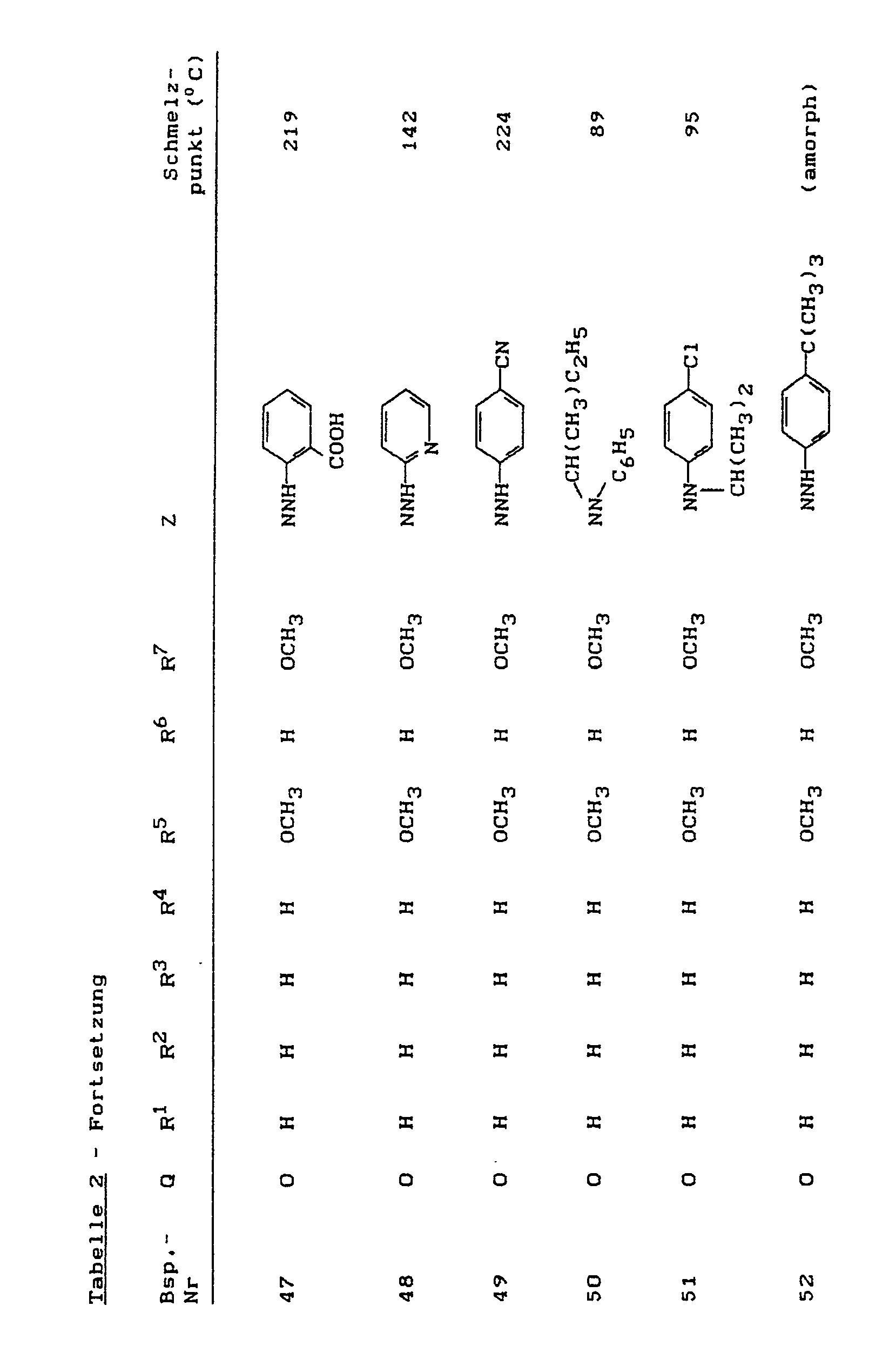
- Analog zu den Beispielen 1 und 2 sowie entsprechend der allgemeinen Beschreibung der erfindungsgemäßen Herstellungsverfahren können beispielsweise auch die in der nachstehenden Tabelle 2 aufgeführten Verbindungen der Formel (I) hergestellt werden.


-

- Zu 4,6-Dimethoxy-2-methylsulfonylpyrimidin (6,5 g, 90 mmol) in Acetonitril (100 ml) gibt man 2-Hydroxy-1-naphthaldehyd (5,1 g, 90 mmol) sowie Kaliumcarbonat (8,3 g). Es wird 18 Stunden unter Rückfluß zum Sieden erhitzt, in Eiswasser gegossen und mit Diethylether extrahiert. Nach dem Trocknen über Natriumsulfat wird eingeengt. Die zurückbleibende Substanz wird durch Chromatographie an Silica-Gel gereinigt.
- Man erhält 4,7 g (50% der Theorie) 2-(4,6-Dimethoxy-pyrimidin-2-yl-oxy)-1-naphthaldehyd vom Schmelzpunkt 135°C.
-

- Zu 2-Hydroxy-1-naphthaldehyd (8,6 g, 50 mmol) in Toluol (70 ml) gibt man Phenylhydrazin (5,4 g, 50 mmol) und rührt 1 h bei 20°C nach. Das kristalline Produkt wird durch Absaugen isoliert.
- Man erhält 2-Hydroxy-1-naphthaldehyd-phenylhydrazon (9,6 g, 73 % der Theorie) vom Schmelzpunkt 210°C (Zers.).
- In den Anwendungsbeispielen wird die nachstehend skizzierte Verbindung (A) als Vergleichssubstanz herangezogen:

2-(4,6-Dimethoxy-pyrimidin-2-yl-oxy)-1-naphthaldehyd (bekannt aus EP-A 360 163 und JP-A 2 056 469). -
- Lösungsmittel:
- 5 Gewichtsteile Aceton
- Emulgator:
- 1 Gewichtsteil Alkylarylpolyglykolether
- Zur Herstellung einer zweckmäßigen Wirkstoffzubereitung vermischt man 1 Gewichtsteil Wirkstoff mit der angegebenen Menge Lösungsmittel, gibt die angegebene Menge Emulgator zu und verdünnt das Konzentrat mit Wasser auf die gewünschte Konzentration.
- Mit der Wirkstoffzubereitung spritzt man Testpflanzen, welche eine Höhe von 5 - 15 cm haben, so, daß die jeweils gewünschten Wirkstoffmengen pro Flächeneinheit ausgebracht werden. Die Konzentration der Spritzbrühe wird so gewählt, daß in 1000 l Wasser/ha die jeweils gewünschten Wirkstoffmengen ausgebracht werden. Nach drei Wochen wird der Schädigungsgrad der Pflanzen bonitiert in % Schädigung im Vergleich zur Entwicklung der unbehandelten Kontrolle.
Es bedeuten: - 0 % =
- keine Wirkung (wie unbehandelte Kontrolle)
- 100 % =
- totale Vernichtung
-
- Lösungsmittel:
- 5 Gewichtsteile Aceton
- Emulgator:
- 1 Gewichtsteil Alkylarylpolyglykolether
- Zur Herstellung einer zweckmäßigen Wirkstoffzubereitung vermischt man 1 Gewichtsteil Wirkstoff mit der angegebenen Menge Lösungsmittel, gibt die angegebene Menge Emulgator zu und verdünnt das Konzentrat mit Wasser auf die gewünschte Konzentration.
- Samen der Testpflanzen werden in normalen Boden ausgesät und nach 24 Stunden mit der Wirkstoffzubereitung begossen. Dabei hält man die Wassermenge pro Flächeneinheit zweckmäßigerweise konstant. Die Wirkstoffkonzentration in der Zubereitung spielt keine Rolle, entscheidend ist nur die Aufwandmenge des Wirkstoffs pro Flächeneinheit. Nach drei Wochen wird der Schädigungsgrad der Pflanzen bonitiert in % Schädigung im Vergleich zur Entwicklung der unbehandelten Kontrolle. Es bedeuten:
- 0 % =
- keine Wirkung (wie unbehandelte Kontrolle)
- 100 % =
- totale Vernichtung
Eine deutliche Überlegenheit in der Wirksamkeit ebenso wie in der Nutzpflanzenselektivität gegenüber dem Stand der Technik zeigen in diesem Test z.B. die Verbindungen gemäß folgender Herstellungsbeispiele: 1, 8, 9, 10, 11, 12, 13, 14, 15, 16, 19, 21, 27, 28, 31 und 33.
Eine deutliche Überlegenheit in der Wirksamkeit ebenso wie in der Nutzpflanzenselektivität gegenüber dem Stand der Technik zeigen in diesem Test z.B. die Verbindungen gemäß folgender Herstellungsbeispiele: 1, 7, 8, 9, 10, 12, 13, 14, 15, 16, 19, 20, 21, 22, 24, 25, 26, 27, 29, 30, 31 und 33.
Claims (8)
- Naphthalinderivate der allgemeinen Formel (I)
 Q für Sauerstoff, Schwefel oder die Gruppierung NR steht, wobei R für Wasserstoff oder Alkyl steht,R¹ für Wasserstoff oder Alkyl steht,R², R³ und R⁴ gleich oder verschieden sind und jeweils für Wasserstoff, Hydroxy, Amino, Cyano, Nitro, Halogen oder für jeweils gegebenenfalls substituiertes Alkyl, Alkoxy, Alkylthio, Alkylsulfinyl oder Alkylsulfonyl stehen,R⁵ für Wasserstoff, Halogen oder für jeweils gegebenenfalls substituiertes Alkyl, Alkoxy, Alkylthio, Alkylamino oder Dialkylamino steht,R ⁶ für Wasserstoff, Halogen oder für jeweils gegebenenfalls substituiertes Alkyl oder Alkoxy steht undR⁷ für Wasserstoff, Halogen oder für jeweils gegebenenfalls substituiertes Alkyl, Alkoxy, Alkylthio, Alkylamino oder Dialkylamino steht, undZ für eine der nachstehenden Gruppierungen steht: N-R⁸ oder
 R⁸ für Wasserstoff, Hydroxy, Amino, Carbamoylamino oder für jeweils gegebenenfalls substituiertes Alkyl, Alkenyl, Alkinyl, Alkoxy, Alkenyloxy, Alkoxycarbonylalkoxy, Alkylamino, Dialkylamino, Alkylcarbonylamino, Alkoxycarbonylamino, Alkylsulfonylamino, Aryl, Aralkyl, Aryloxy, Aralkyloxy, Arylamino, Diarylamino, Aralkylamino, N-Alkyl-N-arylamino, Hetarylamino, Hetarylcarbonylamino, Arylcarbonylamino oder Arylsulfonylamino steht,R⁹ für Wasserstoff, Halogen, Cyano, Carboxy, Alkoxycarbonyl, Alkylcarbonylamino oder Dialkoxyphosphoryl steht undR¹⁰ für Formyl, Cyano, Carboxy, Hydroxymethyl, Carbamoyl oder für jeweils gegebenenfalls substituiertes Alkoxycarbonyl, Cycloalkoxycarbonyl, Alkylthiocarbonyl, Alkylaminocarbonyl, Cycloalkylaminocarbonyl, Dialkylaminocarbonyl, Alkylaminocarbonylalkoxycarbonyl, Dialkylaminocarbonylalkoxycarbonyl, Arylaminocarbonylalkoxycarbonyl, N-Alkyl-N-arylaminocarbonylalkoxycarbonyl, Pyrrolidinylcarbonyl, Piperidinylcarbonyl, Morpholinylcarbonyl, Piperazinylcarbonyl, Aryloxycarbonyl, Aralkyloxycarbonyl, Heterocyclylalkoxycarbonyl, Arylthiocarbonyl, Aralkylthiocarbonyl, Arylaminocarbonyl, Aralkylaminocarbonyl, N-Alkyl-N-arylaminocarbonyl, Arylhydrazinocarbonyl, Alkylhydrazinocarbonyl oder Phthalimidoxycarbonyl steht oder R¹⁰ zusammen mit R⁹ für die Gruppierung -CO-O(CH₂)n-steht, wobei n für die Zahlen 1 bis 4 steht.
 - Naphthalinderivate der allgemeinen Formel (I) gemäß Anspruch 1, dadurch gekennzeichnet, daß darinQ für Sauerstoff, Schwefel oder die Gruppierung NR steht, wobei R für Wasserstoff oder C₁-C₄-Alkyl steht,R¹ für Wasserstoff oder C₁-C₄-Alkyl steht,R², R³ und R⁴ gleich oder verschieden sind und jeweils für Wasserstoff, Hydroxy, Amino, Cyano, Nitro, Halogen oder für jeweils gegebenenfalls durch Halogen substituiertes C₁-C₄-Alkyl, C₁-C₄-Alkoxy, C₁-C₄-Alkylthio, C₁-C₄-Alkylsulfinyl oder C₁-C₄-Alkylsulfonyl stehen,R⁵ für Wasserstoff, Halogen oder für jeweils gegebenenfalls durch Halogen oder C₁-C₄-Alkoxy substituiertes C₁-C₄-Alkyl, C₁-C₄-Alkoxy, C₁-C₄-Alkylthio, C₁-C₄-Alkylamino oder Di-(C₁-C₄-alkyl)-amino steht,R⁶ für Wasserstoff, Halogen oder für jeweils gegebenenfalls durch Halogen substituiertes C₁-C₄-Alkyl oder C₁-C₄-Alkoxy steht,R⁷ für Wasserstoff, Halogen oder für jeweils gegebenenfalls durch Halogen substituiertes C₁-C₄-Alkyl, C₁-C₄-Alkoxy, C₁-C₄-Alkylthio, C₁-C₄-Alkylamino oder Di-(C₁-C₄-alkyl)-amino steht,Z für eine der nachstehenden Gruppierungen steht: N-R⁸ oder
 R⁸ für Wasserstoff, Hydroxy, Amino, Carbamoylamino oder für jeweils gegebenenfalls durch Halogen substituiertes C₁-C₆-Alkyl, C₃-C₆-Alkenyl, C₃-C₆-Alkinyl, C₁-C₆-Alkoxy, C₃-C₆-Alkenyloxy, C₁-C₄-Alkoxy-carbonyl-C₁-C₂-alkoxy, C₁-C₆-Alkylamino, Di-(C₁-C₂-alkyl)-amino, C₁-C₆-Alkyl-carbonylamino, C₁-C₆-Alkoxy-carbonylamino, C₁-C₆-Alkyl-sulfonylamino, oder für jeweils gegebenenfalls durch Nitro, Hydroxy, Amino, Cyano, Carboxy, Halogen, C₁-C₄-Alkyl, C₁-C₂-Halogenalkyl, C₁-C₄-Alkoxy, C₁-C₂-Halogenalkoxy, C₁-C₄-Alkylthio, C₁-C₂-Halogenalkylthio, C₁-C₄-Alkoxy-carbonyl und/oder Di-(C₁-C₂-alkyl)-amino substituiertes Phenyl, Phenyl-C₁-C₄-alkyl, Phenoxy, Phenyl-C₁-C₄-alkoxy, Phenylamino, Diphenylamino, Phenyl-C₁-C₄-alkylamino, N-(C₁-C₄-alkyl)-N-phenylamino, Pyridylamino, Pyrimidylamino, Chinolylamino, Pyridylcarbonylamino, Phenylcarbonylamino, Furylcarbonylamino, Thienylcarbonylamino oder Phenylsulfonylamino steht,R⁹ für Wasserstoff, Halogen, Cyano, Carboxy, C₁-C₆-Alkoxy-carbonyl, C₁-C₆-Alkylcarbonylamino oder Di-(C₁-C₄-alkoxy)-phosphoryl steht undR¹⁰ für Formyl, Cyano, Carboxy, Hydroxymethyl, Carbamoyl oder für jeweils gegebenenfalls durch Halogen, Carboxy oder C₁-C₄-Alkoxy-carbonyl substituiertes C₁-C₆-Alkoxy-carbonyl, C₅-C₆-Cycloalkyloxy-carbonyl, C₁-C₆-Alkylthio-carbonyl, C₁-C₆-Alkylamino-carbonyl oder C₅-C₆-Cycloalkylamino-carbonyl, für Di-(C₁-C₂-alkyl)-amino-carbonyl, für C₁-C₄-Alkylamino-carbonyl-C₁-C₄-alkoxy-carbonyl, für Di-(C₁-C₂-alkyl)-amino-carbonyl-C₁-C₄-alkoxy-carbonyl, für Phenylaminocarbonyl-C₁-C₄-alkoxy-carbonyl, für N-Methyl-N-phenylaminocarbonyl-C₁-C₄-alkoxy-carbonyl, für jeweils gegebenenfalls durch Methyl und/oder Ethyl substituiertes Pyrrolidinylcarbonyl, Piperidinyl-carbonyl, Morpholinylcarbonyl oder Piperazinylcarbonyl, für jeweils gegebenenfalls durch Nitro, Amino, Cyano, Carboxy, Halogen, C₁-C₄-Alkyl, C₁-C₂-Halogenalkyl, C₁-C₄-Alkoxy, C₁-C₂-Halogenalkoxy, C₁-C₄-Alkylthio, C₁-C₂-Halogenalkylthio, C₁-C₄-Alkoxy-carbonyl und/oder Di-(C₁-C₂-alkyl)-amino substituiertes Phenoxycarbonyl, Phenyl-C₁-C₄-alkoxycarbonyl, Furylmethoxycarbonyl, Thienylmethoxycarbonyl, Phenylthiocarbonyl, Phenyl-C₁-C₄-alkylthio-carbonyl, Phenylaminocarbonyl, Phenyl-C₁-C₄-alkylamino-carbonyl, N-(C₁-C₄-Alkyl)-N-phenylamino-carbonyl oder Phenylhydrazinocarbonyl, für C₁-C₄-Alkylhydrazinocarbonyl oder für Phthalimidoxycarbonyl steht oder R¹⁰ zusammen mit R⁹ für die Gruppierung -CO-O-(CH₂)n- steht, wobein für die Zahlen 1 bis 4, insbesondere 2 oder 3 steht.
 - Naphthalinderivate der allgemeinen Formel (I) gemäß Anspruch 1, dadurch gekennzeichnet, daß darinQ für Sauerstoff steht,R¹ für Wasserstoff steht,R², R³ und R⁴ für Wasserstoff stehen,R⁵ für Wasserstoff, Chlor, Methyl, Ethyl, Trifluormethyl, Methoxymethyl, Methoxy, Ethoxy, Difluormethoxy, Methylthio, Methylamino, Ethylamino oder Dimethylamino - insbesondere für Methoxy - steht,R⁶ für Wasserstoff, Chlor, Methyl oder Methoxy - insbesondere für Wasserstoff - steht, undR⁷ für Wasserstoff, Chlor, Methyl, Ethyl, Trifluormethyl, Methoxy, Ethoxy, Difluormethoxy, Methylthio, Methylamino, Ethylamino oder Dimethylamino - insbesondere für Methoxy - steht, undZ für eine der nachstehenden Gruppierungen steht: N-R⁸ oder
 R⁸ für Wasserstoff, Hydroxy, Amino, Carbamoylamino, für Methyl, Ethyl, n-Propyl, Isopropyl, n-Butyl, Isobutyl, sec-Butyl, tert-Butyl, Allyl, Propargyl, Methoxy, Ethoxy, n-Propoxy, Isopropoxy, n-Butoxy, Isobutoxy, sec-Butoxy, Allyloxy, Methoxycarbonylmethoxy, Ethoxycarbonylmethoxy, Methoxycarbonylethoxy, Ethoxycarbonylethoxy, Methylamino, Ethylamino, n-Propylamino, Isopropylamino, n-Butylamino, Isobutylamino, sec-Butylamino, tert-Butylamino, Dimethylamino, Acetylamino, Propionylamino, Methoxycarbonylamino, Ethoxycarbonylamino, Methylsulfonylamino, Ethylsulfonylamino, für jeweils gegebenenfalls durch Nitro, Hydroxy, Cyano, Carboxy, Fluor, Chlor, Brom, Methyl, Trifluormethyl, Methoxy, Trifluormethoxy, Methylthio oder Trifluormethylthio substituiertes Phenyl, Benzyl, Phenoxy, Benzyloxy, Phenylamino, Diphenylamino, Benzylamino, N-Methyl-N-phenylamino, Pyridylamino, Pyrimidylamino, Chinolylamino, Pyridylcarbonylamino, Phenylcarbonylamino, Furylcarbonylamino, Thienylcarbonylamino oder Phenylsulfonylamino steht,R⁹ für Wasserstoff, Fluor, Chlor, Cyano, Carboxy, C₁-C₄-Alkoxy-carbonyl, C₁-C₄-Alkyl-carbonylamino, Dimethoxyphosphoryl oder Diethoxyphosphoryl steht undR¹⁰ für Formyl, Cyano, Carboxy, Hydroxymethyl, Carbamoyl, für jeweils gegebenenfalls durch Fluor, Chlor, Carboxy oder C₁-C₄-Alkoxy-carbonyl substituiertes C₁-C₄-Alkoxy-carbonyl, C₅-C₆-Cycloalkyloxy-carbonyl, C₁-C₄-Alkylthiocarbonyl, C₁-C₄-Alkylamino-carbonyl oder C₅-C₆-Cycloalkylamino-carbonyl, für Dimethylaminocarbonyl, für C₁-C₄-Alkylaminocarbonyl-C₁-C₄-alkoxy-carbonyl, für Dimethylaminocarbonyl-C₁-C₄-alkoxy-carbonyl, für N-Methyl-N-phenylaminocarbonyl-C₁-C₄-alkoxy-carbonyl, für jeweils gegebenenfalls durch Methyl und/oder Ethyl substituiertes Pyrrolidinyl-carbonyl, Piperidinyl-carbonyl, Morpholinyl-carbonyl oder Piperazinyl-carbonyl, für jeweils gegebenenfalls durch Nitro, Cyano, Fluor, Chlor, Brom, Methyl, Trifluormethyl, Methoxy, Trifluormethoxy, Methylthio oder Trifluormethylthio substituiertes Phenoxycarbonyl, Benzyloxycarbonyl, Phenylthiocarbonyl, Benzylthiocarbonyl, Phenylaminocarbonyl, Benzylaminocarbonyl, N-Methyl-N-phenylaminocarbonyl, Phenylhydrazinocarbonyl oder für Phthalimidoxycarbonyl steht oder R¹⁰ zusammen mit R⁹ für die Gruppierung -CO-O-CH₂CH₂-steht.
 - Verfahren zur Herstellung von Naphthalinderivaten der Formel (I) gemäß Anspruch 1, dadurch gekennzeichnet, daß man(a) entsprechende Carbonylverbindungen der allgemeinen Formel (II)

Q, R¹, R², R³, R⁴, R⁵, R⁶ und R⁷ die in Anspruch 1 angegebene Bedeutung haben,
mit Amino- oder Methylen-Verbindungen der allgemeinen Formel (III),
H₂Z (III)
in welcherZ die in Anspruch 1 angegebene Bedeutung hat, gegebenenfalls in Gegenwart eines Reaktionshilfsmittels und gegebenenfalls in Gegenwart eines Verdünnungsmittels umsetzt, oder daß man(b) nucleophile Naphthalinderivate der allgemeinen Formel (IV),
Q, R¹ R², R³, R⁴ und Z die in Anspruch 1 angegebene Bedeutung haben,
mit Pyrimidinderivaten der allgemeinen Formel (V),
R⁵, R⁶ und R⁷ die in Anspruch 1 angegebene Bedeutung haben undX für eine nucleofuge Abgangsgruppe steht,gegebenenfalls in Gegenwart eines Säureakzeptors und gegebenenfalls in Gegenwart eines Verdünnungsmittels umsetzt. - Herbizide Mittel, gekennzeichnet durch einen Gehalt an mindestens einem Naphthalinderivat der allgemeinen Formel (I) gemäß Anspruch 1.
- Verfahren zur Bekämpfung von Unkraut, dadurch gekennzeichnet, daß man ein Naphthalinderivat der Formel (I) gemäß Anspruch 1 auf die Unkräuter oder ihren Lebensraum einwirken läßt.
- Verwendung von Naphthalinderivaten der Formel (I) gemäß Anspruch 1 zur Bekämpfung von unerwünschtem Pflanzenwachstum.
- Verfahren zur Herstellung von herbiziden Mitteln, dadurch gekennzeichnet, daß man Naphthalinderivate der Formel (I) gemäß Anspruch 1 mit Streckmitteln und/oder oberflächenaktiven Stoffen vermischt.
Applications Claiming Priority (4)
| Application Number | Priority Date | Filing Date | Title |
|---|---|---|---|
| DE4011696 | 1990-04-11 | ||
| DE4011696 | 1990-04-11 | ||
| DE4033808 | 1990-10-24 | ||
| DE4033808A DE4033808A1 (de) | 1990-04-11 | 1990-10-24 | Naphthalinderivate |
Publications (2)
| Publication Number | Publication Date |
|---|---|
| EP0451653A2 true EP0451653A2 (de) | 1991-10-16 |
| EP0451653A3 EP0451653A3 (en) | 1992-07-01 |
Family
ID=25892108
Family Applications (1)
| Application Number | Title | Priority Date | Filing Date |
|---|---|---|---|
| EP19910105114 Withdrawn EP0451653A3 (en) | 1990-04-11 | 1991-03-30 | Naphthalene derivatives |
Country Status (7)
| Country | Link |
|---|---|
| US (1) | US5185026A (de) |
| EP (1) | EP0451653A3 (de) |
| JP (1) | JPH04253967A (de) |
| KR (1) | KR910018362A (de) |
| AU (1) | AU634047B2 (de) |
| CA (1) | CA2040018A1 (de) |
| DE (1) | DE4033808A1 (de) |
Cited By (3)
| Publication number | Priority date | Publication date | Assignee | Title |
|---|---|---|---|---|
| WO1999001423A1 (en) * | 1997-07-01 | 1999-01-14 | Novo Nordisk A/S | Glucagon antagonists/inverse agonists |
| WO2001064646A3 (en) * | 2000-03-01 | 2002-05-30 | Tularik Inc | Hydrazones and analogs as cholesterol lowering agents |
| US6613942B1 (en) | 1997-07-01 | 2003-09-02 | Novo Nordisk A/S | Glucagon antagonists/inverse agonists |
Families Citing this family (2)
| Publication number | Priority date | Publication date | Assignee | Title |
|---|---|---|---|---|
| US5506192A (en) * | 1990-06-07 | 1996-04-09 | Sandoz Ltd. | Substituted phthalides and heterocyclic phthalides |
| NZ500590A (en) | 1997-04-22 | 2001-11-30 | Cocensys Inc | Carbocyclic and heterocyclic substituted semicarbazones and thiosemicarbazones and the use thereof |
Family Cites Families (5)
| Publication number | Priority date | Publication date | Assignee | Title |
|---|---|---|---|---|
| DE3602016A1 (de) * | 1985-12-05 | 1987-06-11 | Bayer Ag | Pyri(mi)dyl-oxy- und thio-benzoesaeure-derivate |
| ES2063075T3 (es) * | 1988-06-16 | 1995-01-01 | Basf Ag | Derivados del acido salicilico y sus analogos azufrados. |
| DE3832237A1 (de) * | 1988-09-22 | 1990-03-29 | Basf Ag | Aromatische carbonsaeurederivate, verfahren zu ihrer herstellung und ihre verwendung als herbizide |
| JPH02262565A (ja) * | 1988-12-19 | 1990-10-25 | Mitsui Toatsu Chem Inc | ピリミジン誘導体、その製造法およびこれらを含有する除草剤ならびに除草剤組成物 |
| US4979982A (en) * | 1990-02-02 | 1990-12-25 | Uniroyal Chemical Company, Inc. | Herbicidal cinnamic ester uracils |
-
1990
- 1990-10-24 DE DE4033808A patent/DE4033808A1/de not_active Withdrawn
-
1991
- 1991-03-30 EP EP19910105114 patent/EP0451653A3/de not_active Withdrawn
- 1991-04-04 US US07/680,495 patent/US5185026A/en not_active Expired - Fee Related
- 1991-04-05 JP JP3102088A patent/JPH04253967A/ja active Pending
- 1991-04-08 CA CA002040018A patent/CA2040018A1/en not_active Abandoned
- 1991-04-10 AU AU74280/91A patent/AU634047B2/en not_active Expired - Fee Related
- 1991-04-10 KR KR1019910005700A patent/KR910018362A/ko not_active Withdrawn
Cited By (4)
| Publication number | Priority date | Publication date | Assignee | Title |
|---|---|---|---|---|
| WO1999001423A1 (en) * | 1997-07-01 | 1999-01-14 | Novo Nordisk A/S | Glucagon antagonists/inverse agonists |
| US6613942B1 (en) | 1997-07-01 | 2003-09-02 | Novo Nordisk A/S | Glucagon antagonists/inverse agonists |
| WO2001064646A3 (en) * | 2000-03-01 | 2002-05-30 | Tularik Inc | Hydrazones and analogs as cholesterol lowering agents |
| US6605615B2 (en) | 2000-03-01 | 2003-08-12 | Tularik Inc. | Hydrazones and analogs as cholesterol lowering agents |
Also Published As
| Publication number | Publication date |
|---|---|
| KR910018362A (ko) | 1991-11-30 |
| JPH04253967A (ja) | 1992-09-09 |
| DE4033808A1 (de) | 1991-10-17 |
| US5185026A (en) | 1993-02-09 |
| EP0451653A3 (en) | 1992-07-01 |
| CA2040018A1 (en) | 1991-10-12 |
| AU634047B2 (en) | 1993-02-11 |
| AU7428091A (en) | 1991-10-17 |
Similar Documents
| Publication | Publication Date | Title |
|---|---|---|
| DE4021439A1 (de) | 2-iminopyridin-derivate | |
| EP0507171A1 (de) | Sulfonylaminocarbonyltriazolinone mit über Sauerstoff gebundenen Substituenten | |
| EP0419831A2 (de) | Substituierte Sulfonylaminoazole | |
| EP0472925B1 (de) | Substituierte Pyridine | |
| DE4037003A1 (de) | Substituierte azine | |
| EP0477646B1 (de) | Substituierte 5-Alkoxy-1,2,4-triazol-3-(thi)one | |
| DE4035141A1 (de) | Substituierte sulfonylaminotriazolylpyrimidine | |
| DE4030041A1 (de) | Bisazinylverbindungen | |
| EP0467183A1 (de) | Herbizide auf Basis von sulfonylierten (Thio)Carbamidsäureestern, neue sulfonylierte Carbamidsäureester und Verfahren zu deren Herstellung | |
| EP0451653A2 (de) | Naphthalinderivate | |
| EP0517052A1 (de) | Substituierte Imidazolinylpyrimidine | |
| DE4110882A1 (de) | Sulfonylguanidinoazine | |
| DE4112329A1 (de) | Cyanothiazolderivate | |
| EP0414067A2 (de) | Substituierte Arylsulfonylaminoguanidinoazine | |
| DE4040021A1 (de) | Substituierte 2,2-difluor-1,3-benzodioxyl-4-ketone | |
| EP0457140A2 (de) | Phenoxyphenylsulfonylverbindungen | |
| DE3808739A1 (de) | Pyrimidin-derivate | |
| EP0484776A1 (de) | Arylsubstituierte Alkylidenstickstoffheterocyclen | |
| DE4022478A1 (de) | Nicotinsaeurederivate | |
| EP0513621A1 (de) | Substituierte Triazolinone | |
| DE4011870A1 (de) | Imidazolidinderivate | |
| EP0433809A1 (de) | Difluorphenylharnstoffe | |
| DE4029055A1 (de) | Sulfonylierte pyrimidincarbonsaeureamide | |
| DE3626860A1 (de) | Acylierte 1-(2-oxyaminosulfonylphenylsulfonyl)-3-heteroaryl-harnstoffe | |
| EP0505819A1 (de) | Substituierte Triazolinone |
Legal Events
| Date | Code | Title | Description |
|---|---|---|---|
| PUAI | Public reference made under article 153(3) epc to a published international application that has entered the european phase |
Free format text: ORIGINAL CODE: 0009012 |
|
| AK | Designated contracting states |
Kind code of ref document: A2 Designated state(s): BE CH DE ES FR GB IT LI NL |
|
| PUAL | Search report despatched |
Free format text: ORIGINAL CODE: 0009013 |
|
| AK | Designated contracting states |
Kind code of ref document: A3 Designated state(s): BE CH DE ES FR GB IT LI NL |
|
| 17P | Request for examination filed |
Effective date: 19921211 |
|
| STAA | Information on the status of an ep patent application or granted ep patent |
Free format text: STATUS: THE APPLICATION IS DEEMED TO BE WITHDRAWN |
|
| 18D | Application deemed to be withdrawn |
Effective date: 19941001 |