EP0451714A1 - Verfahren zur Acylierung von Alkylaromaten - Google Patents
Verfahren zur Acylierung von Alkylaromaten Download PDFInfo
- Publication number
- EP0451714A1 EP0451714A1 EP91105384A EP91105384A EP0451714A1 EP 0451714 A1 EP0451714 A1 EP 0451714A1 EP 91105384 A EP91105384 A EP 91105384A EP 91105384 A EP91105384 A EP 91105384A EP 0451714 A1 EP0451714 A1 EP 0451714A1
- Authority
- EP
- European Patent Office
- Prior art keywords
- alkyl
- friedel
- acylation
- crafts
- carboxylic acid
- Prior art date
- Legal status (The legal status is an assumption and is not a legal conclusion. Google has not performed a legal analysis and makes no representation as to the accuracy of the status listed.)
- Granted
Links
- 238000000034 method Methods 0.000 title claims abstract description 17
- 230000010933 acylation Effects 0.000 title claims abstract description 9
- 238000005917 acylation reaction Methods 0.000 title claims abstract description 9
- 125000000217 alkyl group Chemical group 0.000 title claims description 13
- 238000005727 Friedel-Crafts reaction Methods 0.000 claims abstract description 18
- 239000003054 catalyst Substances 0.000 claims abstract description 13
- 150000001732 carboxylic acid derivatives Chemical class 0.000 claims abstract description 9
- 150000001875 compounds Chemical class 0.000 claims description 11
- VSCWAEJMTAWNJL-UHFFFAOYSA-K aluminium trichloride Chemical compound Cl[Al](Cl)Cl VSCWAEJMTAWNJL-UHFFFAOYSA-K 0.000 claims description 7
- QHTJSSMHBLGUHV-UHFFFAOYSA-N 2-methylbutan-2-ylbenzene Chemical compound CCC(C)(C)C1=CC=CC=C1 QHTJSSMHBLGUHV-UHFFFAOYSA-N 0.000 claims description 6
- LGRFSURHDFAFJT-UHFFFAOYSA-N Phthalic anhydride Natural products C1=CC=C2C(=O)OC(=O)C2=C1 LGRFSURHDFAFJT-UHFFFAOYSA-N 0.000 claims description 4
- JHIWVOJDXOSYLW-UHFFFAOYSA-N butyl 2,2-difluorocyclopropane-1-carboxylate Chemical compound CCCCOC(=O)C1CC1(F)F JHIWVOJDXOSYLW-UHFFFAOYSA-N 0.000 claims description 4
- 125000003545 alkoxy group Chemical group 0.000 claims description 3
- 125000001424 substituent group Chemical group 0.000 claims description 2
- 125000004400 (C1-C12) alkyl group Chemical group 0.000 claims 2
- CPELXLSAUQHCOX-UHFFFAOYSA-M Bromide Chemical compound [Br-] CPELXLSAUQHCOX-UHFFFAOYSA-M 0.000 claims 1
- 150000002899 organoaluminium compounds Chemical class 0.000 abstract 2
- -1 aluminum halides Chemical class 0.000 description 13
- 238000006243 chemical reaction Methods 0.000 description 5
- 239000012433 hydrogen halide Substances 0.000 description 5
- 229910000039 hydrogen halide Inorganic materials 0.000 description 5
- 229910052782 aluminium Inorganic materials 0.000 description 4
- YXFVVABEGXRONW-UHFFFAOYSA-N Toluene Chemical compound CC1=CC=CC=C1 YXFVVABEGXRONW-UHFFFAOYSA-N 0.000 description 3
- 125000004432 carbon atom Chemical group C* 0.000 description 3
- 239000002904 solvent Substances 0.000 description 3
- RFFLAFLAYFXFSW-UHFFFAOYSA-N 1,2-dichlorobenzene Chemical compound ClC1=CC=CC=C1Cl RFFLAFLAYFXFSW-UHFFFAOYSA-N 0.000 description 2
- DSNHSQKRULAAEI-UHFFFAOYSA-N 1,4-Diethylbenzene Chemical compound CCC1=CC=C(CC)C=C1 DSNHSQKRULAAEI-UHFFFAOYSA-N 0.000 description 2
- YNQLUTRBYVCPMQ-UHFFFAOYSA-N Ethylbenzene Chemical compound CCC1=CC=CC=C1 YNQLUTRBYVCPMQ-UHFFFAOYSA-N 0.000 description 2
- LTEQMZWBSYACLV-UHFFFAOYSA-N Hexylbenzene Chemical compound CCCCCCC1=CC=CC=C1 LTEQMZWBSYACLV-UHFFFAOYSA-N 0.000 description 2
- MHAJPDPJQMAIIY-UHFFFAOYSA-N Hydrogen peroxide Chemical compound OO MHAJPDPJQMAIIY-UHFFFAOYSA-N 0.000 description 2
- CTQNGGLPUBDAKN-UHFFFAOYSA-N O-Xylene Chemical compound CC1=CC=CC=C1C CTQNGGLPUBDAKN-UHFFFAOYSA-N 0.000 description 2
- PWATWSYOIIXYMA-UHFFFAOYSA-N Pentylbenzene Chemical compound CCCCCC1=CC=CC=C1 PWATWSYOIIXYMA-UHFFFAOYSA-N 0.000 description 2
- 150000004996 alkyl benzenes Chemical class 0.000 description 2
- WPYMKLBDIGXBTP-UHFFFAOYSA-N benzoic acid Chemical class OC(=O)C1=CC=CC=C1 WPYMKLBDIGXBTP-UHFFFAOYSA-N 0.000 description 2
- PASDCCFISLVPSO-UHFFFAOYSA-N benzoyl chloride Chemical compound ClC(=O)C1=CC=CC=C1 PASDCCFISLVPSO-UHFFFAOYSA-N 0.000 description 2
- OCKPCBLVNKHBMX-UHFFFAOYSA-N butylbenzene Chemical compound CCCCC1=CC=CC=C1 OCKPCBLVNKHBMX-UHFFFAOYSA-N 0.000 description 2
- 239000003795 chemical substances by application Substances 0.000 description 2
- MVPPADPHJFYWMZ-UHFFFAOYSA-N chlorobenzene Chemical compound ClC1=CC=CC=C1 MVPPADPHJFYWMZ-UHFFFAOYSA-N 0.000 description 2
- RWGFKTVRMDUZSP-UHFFFAOYSA-N cumene Chemical compound CC(C)C1=CC=CC=C1 RWGFKTVRMDUZSP-UHFFFAOYSA-N 0.000 description 2
- 125000001495 ethyl group Chemical group [H]C([H])([H])C([H])([H])* 0.000 description 2
- 125000000959 isobutyl group Chemical group [H]C([H])([H])C([H])(C([H])([H])[H])C([H])([H])* 0.000 description 2
- 238000006317 isomerization reaction Methods 0.000 description 2
- 125000001449 isopropyl group Chemical group [H]C([H])([H])C([H])(*)C([H])([H])[H] 0.000 description 2
- 229910052751 metal Inorganic materials 0.000 description 2
- 239000002184 metal Substances 0.000 description 2
- 125000002496 methyl group Chemical group [H]C([H])([H])* 0.000 description 2
- 125000004108 n-butyl group Chemical group [H]C([H])([H])C([H])([H])C([H])([H])C([H])([H])* 0.000 description 2
- 125000004123 n-propyl group Chemical group [H]C([H])([H])C([H])([H])C([H])([H])* 0.000 description 2
- LQNUZADURLCDLV-UHFFFAOYSA-N nitrobenzene Chemical compound [O-][N+](=O)C1=CC=CC=C1 LQNUZADURLCDLV-UHFFFAOYSA-N 0.000 description 2
- ODLMAHJVESYWTB-UHFFFAOYSA-N propylbenzene Chemical compound CCCC1=CC=CC=C1 ODLMAHJVESYWTB-UHFFFAOYSA-N 0.000 description 2
- 150000003254 radicals Chemical class 0.000 description 2
- 239000011541 reaction mixture Substances 0.000 description 2
- 239000007858 starting material Substances 0.000 description 2
- WSLDOOZREJYCGB-UHFFFAOYSA-N 1,2-Dichloroethane Chemical compound ClCCCl WSLDOOZREJYCGB-UHFFFAOYSA-N 0.000 description 1
- OCJBOOLMMGQPQU-UHFFFAOYSA-N 1,4-dichlorobenzene Chemical compound ClC1=CC=C(Cl)C=C1 OCJBOOLMMGQPQU-UHFFFAOYSA-N 0.000 description 1
- NOGFHTGYPKWWRX-UHFFFAOYSA-N 2,2,6,6-tetramethyloxan-4-one Chemical compound CC1(C)CC(=O)CC(C)(C)O1 NOGFHTGYPKWWRX-UHFFFAOYSA-N 0.000 description 1
- GOPSCYRQFNEKRE-UHFFFAOYSA-N 2-[[4-(2-methylbutan-2-yl)phenyl]methyl]benzoic acid Chemical compound C1=CC(C(C)(C)CC)=CC=C1CC1=CC=CC=C1C(O)=O GOPSCYRQFNEKRE-UHFFFAOYSA-N 0.000 description 1
- YVSMQHYREUQGRX-UHFFFAOYSA-N 2-ethyloxaluminane Chemical compound CC[Al]1CCCCO1 YVSMQHYREUQGRX-UHFFFAOYSA-N 0.000 description 1
- OFTKFKYVSBNYEC-UHFFFAOYSA-N 2-furoyl chloride Chemical compound ClC(=O)C1=CC=CO1 OFTKFKYVSBNYEC-UHFFFAOYSA-N 0.000 description 1
- IFDLFCDWOFLKEB-UHFFFAOYSA-N 2-methylbutylbenzene Chemical compound CCC(C)CC1=CC=CC=C1 IFDLFCDWOFLKEB-UHFFFAOYSA-N 0.000 description 1
- PIUUDKDOAUICQP-UHFFFAOYSA-N 2-methylpentan-2-ylbenzene Chemical compound CCCC(C)(C)C1=CC=CC=C1 PIUUDKDOAUICQP-UHFFFAOYSA-N 0.000 description 1
- VMZCDNSFRSVYKQ-UHFFFAOYSA-N 2-phenylacetyl chloride Chemical compound ClC(=O)CC1=CC=CC=C1 VMZCDNSFRSVYKQ-UHFFFAOYSA-N 0.000 description 1
- CYBSWFUWEZFKNJ-UHFFFAOYSA-N 2-phenylhexane Chemical compound CCCCC(C)C1=CC=CC=C1 CYBSWFUWEZFKNJ-UHFFFAOYSA-N 0.000 description 1
- RUQIUASLAXJZIE-UHFFFAOYSA-N 3-methoxybenzoyl chloride Chemical compound COC1=CC=CC(C(Cl)=O)=C1 RUQIUASLAXJZIE-UHFFFAOYSA-N 0.000 description 1
- XNXIYYFOYIUJIW-UHFFFAOYSA-N 3-methylbutylbenzene Chemical compound CC(C)CCC1=CC=CC=C1 XNXIYYFOYIUJIW-UHFFFAOYSA-N 0.000 description 1
- GIMKIOCRQZVNND-UHFFFAOYSA-N 3-methylhexan-3-ylbenzene Chemical compound CCCC(C)(CC)C1=CC=CC=C1 GIMKIOCRQZVNND-UHFFFAOYSA-N 0.000 description 1
- TTZXIWBOKOZOPL-UHFFFAOYSA-N 3-phenoxybenzoyl chloride Chemical compound ClC(=O)C1=CC=CC(OC=2C=CC=CC=2)=C1 TTZXIWBOKOZOPL-UHFFFAOYSA-N 0.000 description 1
- NQUVCRCCRXRJCK-UHFFFAOYSA-N 4-methylbenzoyl chloride Chemical compound CC1=CC=C(C(Cl)=O)C=C1 NQUVCRCCRXRJCK-UHFFFAOYSA-N 0.000 description 1
- SKDHHIUENRGTHK-UHFFFAOYSA-N 4-nitrobenzoyl chloride Chemical compound [O-][N+](=O)C1=CC=C(C(Cl)=O)C=C1 SKDHHIUENRGTHK-UHFFFAOYSA-N 0.000 description 1
- WNLMYNASWOULQY-UHFFFAOYSA-N 4-tert-butylbenzoyl chloride Chemical compound CC(C)(C)C1=CC=C(C(Cl)=O)C=C1 WNLMYNASWOULQY-UHFFFAOYSA-N 0.000 description 1
- WKBOTKDWSSQWDR-UHFFFAOYSA-N Bromine atom Chemical compound [Br] WKBOTKDWSSQWDR-UHFFFAOYSA-N 0.000 description 1
- ZAMOUSCENKQFHK-UHFFFAOYSA-N Chlorine atom Chemical compound [Cl] ZAMOUSCENKQFHK-UHFFFAOYSA-N 0.000 description 1
- 238000005863 Friedel-Crafts acylation reaction Methods 0.000 description 1
- 229910021578 Iron(III) chloride Inorganic materials 0.000 description 1
- 229910003074 TiCl4 Inorganic materials 0.000 description 1
- 125000001931 aliphatic group Chemical group 0.000 description 1
- 150000001350 alkyl halides Chemical class 0.000 description 1
- 150000008064 anhydrides Chemical class 0.000 description 1
- 150000001454 anthracenes Chemical class 0.000 description 1
- 239000000010 aprotic solvent Substances 0.000 description 1
- 125000006615 aromatic heterocyclic group Chemical group 0.000 description 1
- 125000003118 aryl group Chemical group 0.000 description 1
- QVGXLLKOCUKJST-UHFFFAOYSA-N atomic oxygen Chemical compound [O] QVGXLLKOCUKJST-UHFFFAOYSA-N 0.000 description 1
- 230000015572 biosynthetic process Effects 0.000 description 1
- GDTBXPJZTBHREO-UHFFFAOYSA-N bromine Substances BrBr GDTBXPJZTBHREO-UHFFFAOYSA-N 0.000 description 1
- 229910052794 bromium Inorganic materials 0.000 description 1
- 150000001649 bromium compounds Chemical class 0.000 description 1
- 125000004106 butoxy group Chemical group [*]OC([H])([H])C([H])([H])C(C([H])([H])[H])([H])[H] 0.000 description 1
- 239000006227 byproduct Substances 0.000 description 1
- QGJOPFRUJISHPQ-NJFSPNSNSA-N carbon disulfide-14c Chemical compound S=[14C]=S QGJOPFRUJISHPQ-NJFSPNSNSA-N 0.000 description 1
- 150000001244 carboxylic acid anhydrides Chemical class 0.000 description 1
- 229910052801 chlorine Inorganic materials 0.000 description 1
- 239000000460 chlorine Substances 0.000 description 1
- 150000001805 chlorine compounds Chemical class 0.000 description 1
- 238000003776 cleavage reaction Methods 0.000 description 1
- 150000001907 coumarones Chemical class 0.000 description 1
- 150000001923 cyclic compounds Chemical class 0.000 description 1
- 125000004122 cyclic group Chemical group 0.000 description 1
- 229940117389 dichlorobenzene Drugs 0.000 description 1
- 230000000694 effects Effects 0.000 description 1
- 150000002222 fluorine compounds Chemical class 0.000 description 1
- 150000002240 furans Chemical class 0.000 description 1
- 229910052736 halogen Inorganic materials 0.000 description 1
- 150000002367 halogens Chemical class 0.000 description 1
- 229930195733 hydrocarbon Natural products 0.000 description 1
- 150000002430 hydrocarbons Chemical class 0.000 description 1
- 230000007062 hydrolysis Effects 0.000 description 1
- 238000006460 hydrolysis reaction Methods 0.000 description 1
- 125000002887 hydroxy group Chemical group [H]O* 0.000 description 1
- RBTARNINKXHZNM-UHFFFAOYSA-K iron trichloride Chemical compound Cl[Fe](Cl)Cl RBTARNINKXHZNM-UHFFFAOYSA-K 0.000 description 1
- CPOFMOWDMVWCLF-UHFFFAOYSA-N methyl(oxo)alumane Chemical compound C[Al]=O CPOFMOWDMVWCLF-UHFFFAOYSA-N 0.000 description 1
- 150000002790 naphthalenes Chemical class 0.000 description 1
- LYGJENNIWJXYER-UHFFFAOYSA-N nitromethane Chemical compound C[N+]([O-])=O LYGJENNIWJXYER-UHFFFAOYSA-N 0.000 description 1
- XEYWPMIXBVMRLE-UHFFFAOYSA-N octan-3-ylbenzene Chemical compound CCCCCC(CC)C1=CC=CC=C1 XEYWPMIXBVMRLE-UHFFFAOYSA-N 0.000 description 1
- CDKDZKXSXLNROY-UHFFFAOYSA-N octylbenzene Chemical compound CCCCCCCCC1=CC=CC=C1 CDKDZKXSXLNROY-UHFFFAOYSA-N 0.000 description 1
- 239000012074 organic phase Substances 0.000 description 1
- 229910052760 oxygen Inorganic materials 0.000 description 1
- 239000001301 oxygen Substances 0.000 description 1
- LTHAIAJHDPJXLG-UHFFFAOYSA-N pentan-2-ylbenzene Chemical compound CCCC(C)C1=CC=CC=C1 LTHAIAJHDPJXLG-UHFFFAOYSA-N 0.000 description 1
- 239000000047 product Substances 0.000 description 1
- 125000002572 propoxy group Chemical group [*]OC([H])([H])C(C([H])([H])[H])([H])[H] 0.000 description 1
- 230000007017 scission Effects 0.000 description 1
- 238000007086 side reaction Methods 0.000 description 1
- PUGUQINMNYINPK-UHFFFAOYSA-N tert-butyl 4-(2-chloroacetyl)piperazine-1-carboxylate Chemical compound CC(C)(C)OC(=O)N1CCN(C(=O)CCl)CC1 PUGUQINMNYINPK-UHFFFAOYSA-N 0.000 description 1
- YTZKOQUCBOVLHL-UHFFFAOYSA-N tert-butylbenzene Chemical compound CC(C)(C)C1=CC=CC=C1 YTZKOQUCBOVLHL-UHFFFAOYSA-N 0.000 description 1
- 229930192474 thiophene Natural products 0.000 description 1
- QIQITDHWZYEEPA-UHFFFAOYSA-N thiophene-2-carbonyl chloride Chemical compound ClC(=O)C1=CC=CS1 QIQITDHWZYEEPA-UHFFFAOYSA-N 0.000 description 1
- 150000003577 thiophenes Chemical class 0.000 description 1
- XJDNKRIXUMDJCW-UHFFFAOYSA-J titanium tetrachloride Chemical compound Cl[Ti](Cl)(Cl)Cl XJDNKRIXUMDJCW-UHFFFAOYSA-J 0.000 description 1
- XLYOFNOQVPJJNP-UHFFFAOYSA-N water Substances O XLYOFNOQVPJJNP-UHFFFAOYSA-N 0.000 description 1
- 238000010626 work up procedure Methods 0.000 description 1
- 239000011592 zinc chloride Substances 0.000 description 1
- 235000005074 zinc chloride Nutrition 0.000 description 1
- JIAARYAFYJHUJI-UHFFFAOYSA-L zinc dichloride Chemical compound [Cl-].[Cl-].[Zn+2] JIAARYAFYJHUJI-UHFFFAOYSA-L 0.000 description 1
Classifications
-
- C—CHEMISTRY; METALLURGY
- C07—ORGANIC CHEMISTRY
- C07C—ACYCLIC OR CARBOCYCLIC COMPOUNDS
- C07C51/00—Preparation of carboxylic acids or their salts, halides or anhydrides
- C07C51/347—Preparation of carboxylic acids or their salts, halides or anhydrides by reactions not involving formation of carboxyl groups
- C07C51/373—Preparation of carboxylic acids or their salts, halides or anhydrides by reactions not involving formation of carboxyl groups by introduction of functional groups containing oxygen only in doubly bound form
Definitions
- the present invention relates to an improved process for the acylation of alkyl aromatics with carboxylic acid derivatives according to Friedel-Crafts in the presence of Friedel-Crafts catalysts and organoaluminum compounds.
- the Friedel-Crafts acylation of aromatics with carboxylic acid derivatives is generally known, but it has not been possible to solve the problems in the acylation of alkyl aromatics completely satisfactorily.
- the conventional Friedel-Crafts catalysts such as aluminum halides
- hydrogen halide is released, which favors the formation of resinous by-products and the cleavage and isomerization of the alkyl groups (CA Olah, Friedel-Crafts and Related Reactions, Vol. 1, page 207 and Vol. 3, Part I, page 550 ff., Interscience 1964).
- the use of metal alkyls or metal alkyl halides has proven to be advantageous in eliminating the hydrogen halide (EP-A-0248423). However, these compounds catalyze the isomerization of alkyl aromatics themselves.
- the invention was therefore based on the object of suppressing these side reactions more effectively than hitherto.
- cyclic compounds Ib of a similar structure also come into consideration, where m has an average of 3 to 12.
- the linear and cyclic aluminoxanes can be obtained by careful hydrolysis of aluminum alkyl compounds (Houben-Weyl, Methods of Org. Chemistry, Vol. XIII / 4, 1970, pages 76-78).
- the effect of the aluminoxanes is based on the fact that the hydrogen halide HX present before the Friedel-Crafts reaction or formed during the reaction reacts with the alkyl-Al groups to form hydrocarbons and aluminum halides and is thus intercepted.
- the theoretically required amount of I corresponds to the molar amount of alkyl aluminum bonds, which in turn is equimolar to the hydrogen halide split off.
- the amount of I is 0.1 to 1.1 mol of alkyl aluminum bonds per mol of the carboxylic acid derivative.
- the need for the primary catalyst used for example AlCl3, is reduced accordingly. In general, only 60 to 95% of the primary catalyst used is required, compared to the amount that would be required for the acylation without the use of I.
- Suitable Friedel-Crafts catalysts are the compounds usually used in this process, such as FeCl3, ZnCl2 or TiCl4, preferably the aluminum halides, in particular aluminum bromide and especially aluminum chloride.
- the Friedel-Crafts catalyst is used for complete conversion in amounts of 1 to 1.5 mol, preferably 1.1 to 1.2 mol per equivalent of carboxylic acid halide or 2 to 2.5 mol, preferably 2.1 to 2, 2 mol per equivalent of carboxylic anhydride used. Larger quantities are possible, but usually do not bring any further advantages.
- the reaction can be carried out without or preferably in the presence of a solvent.
- a solvent such as chlorobenzene, dichlorobenzene, 1,2-dichloroethane, carbon disulfide, nitromethane and nitrobenzene.
- the amount of solvent is not critical, but is generally 100 to 1000 g per mole of the aromatic alkyl. Larger quantities are possible, but generally no longer bring any advantages.
- the acylation takes place in a manner known per se, the starting materials being reacted at from -20 to 100.degree. C., preferably from 0 to 60.degree. C., in particular at from 10 to 40.degree.
- the acylating agent is normally initially introduced into the solvent, after which the Friedel-Crafts catalyst and the alkylaromatic are added with the aluminoxane.
- the working up offers no special features in terms of method and is carried out in a manner known per se by pouring the reaction mixture onto water or ice and isolating the acylated product from the organic phase.
- alkylated isocyclic and heterocyclic aromatics such as alkyl-substituted benzenes, naphthalenes, anthracenes, furans, benzofurans and thiophenes can be considered as starting compounds.
- Alkyl residues are e.g. those with 1 to 20, in particular 1 to 12, preferably 1 to 8 carbon atoms.
- the alkyl radical as well as the aromatic nucleus can contain further substituents such as C1 to C4 alkyl or alkoxy groups, halogen such as chlorine or bromine or hydroxyl groups.
- the aliphatic radicals can also contain double or triple bonds.
- Alkylbenzenes with 1 or 2 branched alkyl radicals are particularly preferably reacted.
- the following compounds may be mentioned, for example: Toluene, ethylbenzene, n-propylbenzene, n-butylbenzene, n-pentylbenzene, n-hexylbenzene and n-octylbenzene, especially iso-propylbenzene, sec.-butylbenzene, tert.-butylbenzene, (2-methylbutyl) -benzene, (3- Methyl-butyl) -benzene, (1-methylbutyl) -benzene, (1,1-dimethylpropyl) -benzene, (1,1-dimethylbutyl) -benzene, (1-methylpentyl) -benzene, (1-ethyl-1- methyl-butyl) -benzene, (1-ethylhexyl) -benzene, 1,2-dimethylbenzene and 1,4-die
- the fluorides in particular the bromides and chlorides and the anhydrides of aliphatic, cycloaliphatic and in particular aromatic carboxylic acids are suitable.
- aromatic carboxylic acids such as benzoyl chloride, benzoic anhydride and particularly preferably phthalic anhydride
- alkylated aromatic carboxylic acid derivatives such as p-methylbenzoyl chloride and p-tert-butylbenzoyl chloride
- alkoxylated carboxylic acid derivatives such as 3-methoxybenzoyl chloride or 3-phenoxybenzoylchloride
- chlorinated benzoyl chloride such as halogenated aromatic carboxylic acid 6-dichlorobenzoyl chloride and p-nitrobenzoyl chloride
- araliphatic carboxylic acid derivatives such as phenylacetic acid chloride and 4-chloroacetic acid chloride and heterocyclic carboxylic acid derivatives such as furan-2-carboxylic acid chloride and thiophene-2-carboxylic acid chloride.
- the process according to the invention is of particular importance for the production of 4- (2'-carboxybenzyl) tert-amylbenzene from tert-amylbenzene and phthalic anhydride, which forms the important 2-tert.
- -Amylanthraquinone is further implemented, which in turn serves as an oxygen carrier for the production of hydrogen peroxide by the Riedl-Pfleiderer process.
- a solution of 74 g (0.5 mol) of phthalic anhydride and 200 ml of o-dichlorobenzene was first made out at 15 to 20 ° C. in small portions with 128 g (1.05 mol) of aluminum trichloride and then with a solution over the course of 5 hours 74 g (0.5 mol) of tert-amylbenzene and 27 g of methylaluminoxane (corresponding to 0.5 mol of alkyl aluminum bonds) and then stirred for 2 hours at room temperature.
Landscapes
- Chemical & Material Sciences (AREA)
- Organic Chemistry (AREA)
- Chemical Kinetics & Catalysis (AREA)
- Engineering & Computer Science (AREA)
- Oil, Petroleum & Natural Gas (AREA)
- Organic Low-Molecular-Weight Compounds And Preparation Thereof (AREA)
- Catalysts (AREA)
- Low-Molecular Organic Synthesis Reactions Using Catalysts (AREA)
Abstract
Description
- Die vorliegende Erfindung betrifft ein verbessertes Verfahren zur Acylierung von Alkylaromaten mit Carbonsäurederivaten nach Friedel-Crafts in Gegenwart von Friedel-Crafts-Katalysatoren und aluminiumorganischen Verbindungen.
- Die Friedel-Crafts-Acylierung von Aromaten mit Carbonsäurederivaten ist allgemein bekannt, jedoch hat man die Probleme bei der Acylierung von Alkylaromaten nicht gänzlich befriedigend lösen können. Bei der Verwendung der üblichen Friedel-Crafts-Katalysatoren wie den Aluminiumhalogeniden wird Halogenwasserstoff freigesetzt, welcher die Bildung harzartiger Nebenprodukte sowie die Abspaltung und Isomerisierung der Alkylgruppen begünstigt (C.A. Olah, Friedel-Crafts and Related Reactions, Bd. 1, Seite 207 und Bd. 3, Teil I, Seite 550 ff., Interscience 1964). Als vorteilhaft bei der Beseitigung des Halogenwasserstoffs hat sich die Mitverwendung von Metallalkylen bzw. Metallalkylhalogeniden erwiesen (EP-A-0248423). Diese Verbindungen katalysieren jedoch selbst die Isomerisierung von Alkylaromaten.
- Der Erfindung lag daher die Aufgabe zugrunde, diese Nebenreaktionen noch wirksamer als bisher zurückzudrängen.
- Demgemäß wurde ein Verfahren zur Acylierung von Alkylaromaten mit Carbonsäurederivaten nach Friedel-Crafts in Gegenwart von Friedel-Crafts-Katalysatoren und aluminiumorganischen Verbindungen gefunden, welches dadurch gekennzeichnet ist, daß man als aluminiumorganische Verbindungen Aluminoxane verwendet.
- Als Aluminoxane eignen sich insbesondere Verbindungen der allgemeinen Formel I

in der - R¹
- für eine Alkylgruppe mit 1 bis 12, vorzugsweise 1 bis 6, insbesondere 1 bis 4 C-Atomen wie n-Propyl, iso-Propyl, iso-Butyl und besonders bevorzugt Methyl, Ethyl oder n-Butyl steht,
- R²
- für eine Alkyl- oder Alkoxygruppe mit 1 bis 12, vorzugsweise 1 bis 6, insbesondere 1 bis 4 Kohlenstoffatomen, wie einen der Reste R¹ oder die Propoxy- und insbesondere Methoxy-, Ethoxy- oder Butoxygruppe und
- R³
- für eine Alkylgruppe mit der Bedeutung wie R¹ oder einen Rest Ia

- Weiterhin kommen aber auch cyclische Verbindungen Ib des ähnlichen Aufbaus

in Betracht, wobei m einen Mittelwert von 3 bis 12 hat. Die linearen und cyclischen Aluminoxane können durch vorsichtige Hydrolyse von Aluminiumalkylverbindungen erhalten werden (Houben-Weyl, Methoden der Org. Chemie, Bd. XIII/4, 1970, Seiten 76-78). - Die Wirkung der Aluminoxane beruht darauf, daß der vor der Friedel-Crafts-Reaktion vorhandene oder während der Reaktion gebildete Halogenwasserstoff HX mit den Alkyl-Al-Gruppen unter Bildung von Kohlenwasserstoffen und Aluminiumhalogeniden reagiert

und somit abgefangen wird. - Demnach entspricht die theoretisch erforderliche Menge an I der molaren Menge an Alkyl-Aluminiumbindungen, die ihrerseits äquimolar zum abgespaltenen Halogenwasserstoff ist. Da aber ein Teil des Halogenwasserstoffs sofort aus dem Reaktionsgemisch entweicht, genügen häufig geringere Mengen. In der Regel beträgt die Menge an I 0,1 bis 1,1 mol Alkyl-Aluminiumbindungen pro Mol des Carbonsäurederivats.
- Da die entstehende Verbindungen
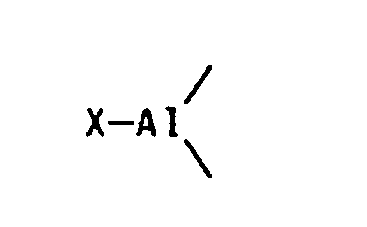
ihrerseits als Friedel-Crafts-Katalysatoren wirken, ermäßigt sich der Bedarf an dem primär eingesetzten Katalysator, z.B. AlCl₃, entsprechend. Im allgemeinen benötigt man nur 60 bis 95 % des primär eingesetzten Katalysators, verglichen mit der Menge, die ohne die Mitverwendung von I für die Acylierung erforderlich wäre. - Größere Mengen an Friedel-Crafts-Katalystoren sind ebenfalls möglich.
- Als Friedel-Crafts-Katalysatoren eignen sich die üblicherweise in diesem Verfahren verwendeten Verbindungen wie FeCl₃, ZnCl₂ oder TiCl₄, vorzugsweise die Aluminiumhalogenide, insbesondere Aluminiumbromid und vor allem Aluminiumchlorid.
- üblicherweise wird der Friedel-Crafts-Katalysator für eine vollständige Umsetzung in Mengen von 1 bis 1,5 mol, vorzugsweise 1,1 bis 1,2 mol pro Äquivalent Carbonsäurehalogenid bzw. 2 bis 2,5 mol, vorzugsweise 2,1 bis 2,2 mol pro Äquivalent Carbonsäureanhydrid eingesetzt. Größere Mengen sind möglich, bringen aber in der Regel keine weiteren Vorteile mehr.
- Die Reaktion kann ohne oder bevorzugt in Gegenwart eines Lösungsmittels durchgeführt werden. Dabei kommen die üblicherweise bei Friedel-Crafts-Reaktionen verwendeten wasserunlöslichen aprotischen Lösungsmittel wie Chlorbenzol, Dichlorbenzol, 1,2-Dichlorethan, Schwefelkohlenstoff, Nitromethan und Nitrobenzol in Betracht. Die Lösungsmittelmenge ist nicht kritisch, beträgt aber im allgemeinen 100 bis 1000 g pro Mol des Alkylaromaten. Größere Mengen sind möglich, bringen aber im allgemeinen keine Vorteile mehr.
- Die Acylierung findet in an sich bekannter Weise statt, wobei die Ausgangsstoffe bei Temperaturen von -20 bis 100°C, vorzugsweise 0 bis 60°C, insbesondere 10 bis 40°C bei vermindertem, erhöhtem oder vorzugsweise bei Normaldruck umgesetzt werden. Dabei wird das Acylierungsmittel normalerweise in dem Lösungsmittel vorgelegt, wonach der Friedel-Crafts-Katalysator und der Alkylaromat mit dem Aluminoxan zugegeben werden.
- Die Aufarbeitung bietet methodisch keine Besonderheiten und erfolgt in an sich bekannter Weise, indem man das Reaktionsgemisch auf Wasser oder Eis gießt und das acylierte Produkt aus der organischen Phase isoliert.
- Als Ausgangsverbindungen kommen prinzipiell alle alkylierten isocyclischen und heterocyclischen Aromaten wie alkylsubstituierte Benzole, Naphthaline, Anthracene, Furane, Benzofurane und Thiophene in Betracht. Alkylreste sind z.B. solche mit 1 bis 20, insbesondere 1 bis 12, vorzugsweise 1 bis 8 Kohlenstoffatomen. Der Alkylrest wie auch der aromatische Kern können weitere Substituenten wie C₁- bis C₄-Alkyl- oder Alkoxygruppen, Halogen wie Chlor oder Brom oder Hydroxygruppen enthalten. Die aliphatischen Reste können auch Doppel- oder Dreifachbindungen enthalten. Besonders bevorzugt werden Alkylbenzole mit 1 oder 2 verzweigten Alkylresten umgesetzt.
- Beispielsweise seien folgende Verbindungen genannt:
Toluol, Ethylbenzol, n-Propylbenzol, n-Butylbenzol, n-Pentylbenzol, n-Hexylbenzol und n-Octylbenzol, insbesondere iso-Propylbenzol, sek.-Butylbenzol, tert.-Butylbenzol, (2-Methylbutyl)-benzol, (3-Methyl-butyl)-benzol, (1-Methylbutyl)-benzol, (1,1-DImethylpropyl)-benzol, (1,1-Dimethylbutyl)-benzol, (1-Methylpentyl)-benzol, (1-Ethyl-1-methyl-butyl)-benzol, (1-Ethylhexyl)-benzol, 1,2-Dimethylbenzol und 1,4-Diethyl-benzol sowie vorzugsweise tert.-Amylbenzol. - Hinsichtlich der Acylierungsmittel unterliegt das erfindungsgemäße Verfahren nach den bisherigen Beobachtungen keinen Beschränkungen. So eignen sich die Fluoride, insbesondere die Bromide und Chloride und die Anhydride aliphatischer, cycloaliphatischer und insbesondere aromatische Carbonsäuren. So kommen Derivate aromatischer Carbonsäuren wie Benzoylchlorid, Benzoesäureanhydrid und besonders bevorzugt Phthalsäureanhydrid, alkylierte aromatische Carbonsäurederivate wie p-Methylbenzoylchlorid und p-tert.-Butylbenzoylchlorid, alkoxylierte Carbonsäurederivate wie 3-Methoxybenzoylchlorid oder 3-Phenoxybenzoylchlorid, halogenierte aromatische Carbonsäurederivate wie o-Chlorbenzoylchlorid und 2,6-Dichlorbenzoylchlorid und p-Nitrobenzoylchlorid, araliphatische Carbonsäurederivate wie Phenylessigsäurechlorid und 4-Chloressigsäurechlorid und heterocyclische Carbonsäurederivate wie Furan-2-carbonsäurechlorid und Thiophen-2-carbon-säurechlorid in Betracht.
- Besondere Bedeutung hat das erfindungsgemäße Verfahren für die Herstellung von 4-(2'-Carboxybenzyl)-tert.-amylbenzol aus tert.-Amylbenzol und Phthalsäureanhydrid, das zu dem wichtigen 2-tert. -Amylanthrachinon weiter umgesetzt wird, welches seinerseits als Sauerstoffüberträger für die Herstellung von Wasserstoffperoxid nach dem Riedl-Pfleiderer-Verfahren dient.
- Eine Lösung aus 74 g (0,5 mol) Phthalsäureanhydrid und 200 ml o-Dichlorbenzol wurde zunächst bei 15 bis 20°C in kleinen Portionen mit 128 g (1,05 mol) Aluminiumtrichlorid und danach im Laufe von 5 Stunden mit einer Lösung aus 74 g (0,5 mol) tert.-Amylbenzol und 27 g des Methylaluminoxans

(entsprechend 0,5 mol Alkylaluminiumbindungen) versetzt und anschließend noch 2 Stunden bei Raumtemperatur gerührt. - Die übliche Aufarbeitung der Reaktionsansätze lieferte das 4-(2'-Carboxybenzoyl)-tert.-amylbenzol in einer Ausbeute von 90 %.
- Das gleiche Ergebnis wurde bei Verwendung des entsprechenden Ethylaluminoxans in gleicher molarer Menge erzielt.
Claims (5)
- Verfahren zur Acylierung von Alkylaromaten mit Carbonsäurederivaten nach Friedel-Crafts in Gegenwart von Friedel-Crafts-Katalysatoren und aluminiumorganischen Verbindungen, dadurch gekennzeichnet, daß man als aluminiumorganische Verbindungen Aluminoxane verwendet.
- Verfahren nach Anspruch 1, dadurch gekennzeichnet, daß man als Aluminoxane Verbindungen der allgemeinen Formel I
 R¹ eine C₁-C₁₂-AlkylgruppeR² eine C₁-C₁₂-Alkyl- oder Alkoxygruppe undR³ R¹ oder einen Rest Ia
- Verfahren nach Anspruch 1 oder 2, dadurch gekennzeichnet, daß man pro Mol des Carbonsäurederivates 0,1 bis 1,1 mol Alkyl-Aluminiumbindungen einsetzt.
- Verfahren nach den Ansprüchen 1 bis 3, dadurch gekennzeichnet, daß man als Friedel-Crafts-Katalysatoren Aluminiumchlorid oder -bromid verwendet.
- Verfahren nach den Ansprüchen 1 bis 4, dadurch gekennzeichnet, daß man es auf die Acylierung von tert.-Amylbenzol mit Phthalsäureanhydrid anwendet.
Applications Claiming Priority (2)
| Application Number | Priority Date | Filing Date | Title |
|---|---|---|---|
| DE4011916A DE4011916A1 (de) | 1990-04-12 | 1990-04-12 | Verfahren zur acylierung von alkylaromaten |
| DE4011916 | 1990-04-12 |
Publications (2)
| Publication Number | Publication Date |
|---|---|
| EP0451714A1 true EP0451714A1 (de) | 1991-10-16 |
| EP0451714B1 EP0451714B1 (de) | 1994-01-05 |
Family
ID=6404328
Family Applications (1)
| Application Number | Title | Priority Date | Filing Date |
|---|---|---|---|
| EP91105384A Expired - Lifetime EP0451714B1 (de) | 1990-04-12 | 1991-04-05 | Verfahren zur Acylierung von Alkylaromaten |
Country Status (5)
| Country | Link |
|---|---|
| US (1) | US5136089A (de) |
| EP (1) | EP0451714B1 (de) |
| JP (1) | JP2504629B2 (de) |
| CA (1) | CA2040081A1 (de) |
| DE (2) | DE4011916A1 (de) |
Families Citing this family (4)
| Publication number | Priority date | Publication date | Assignee | Title |
|---|---|---|---|---|
| JP5603041B2 (ja) * | 2009-09-09 | 2014-10-08 | 東ソー・ファインケム株式会社 | (ヘテロ)ディールス−アルダー反応用触媒、それを用いたおよびジヒドロピラン化合物およびディールス−アルダー反応付加物の製造方法 |
| CN101948382B (zh) * | 2010-09-21 | 2013-06-05 | 浙江工业大学 | 2-(4-烷基取代苯甲酰基)苯甲酸的合成方法 |
| CN103524336A (zh) * | 2013-09-18 | 2014-01-22 | 北京石油化工学院 | 高叔仲比的2-(4-戊基苯甲酰)苯甲酸的制备方法 |
| CN104262131A (zh) * | 2014-08-26 | 2015-01-07 | 湖州吉昌化学有限公司 | 一种生产2-(4′-叔戊基苯甲酰)苯甲酸的方法 |
Citations (1)
| Publication number | Priority date | Publication date | Assignee | Title |
|---|---|---|---|---|
| EP0248423A1 (de) * | 1986-06-06 | 1987-12-09 | BASF Aktiengesellschaft | Verfahren zur Acylierung von Aromaten |
Family Cites Families (3)
| Publication number | Priority date | Publication date | Assignee | Title |
|---|---|---|---|---|
| JP2547589B2 (ja) * | 1987-09-11 | 1996-10-23 | マツダ株式会社 | 4気筒ロータリピストンエンジン |
| US4952714A (en) * | 1988-06-22 | 1990-08-28 | Exxon Chemical Patents Inc. | Non-aqueous process for the preparation of alumoxanes |
| US4968653A (en) * | 1989-06-30 | 1990-11-06 | Quantum Chemical Corporation | Propylene polymerization catalyst |
-
1990
- 1990-04-12 DE DE4011916A patent/DE4011916A1/de not_active Withdrawn
-
1991
- 1991-04-05 EP EP91105384A patent/EP0451714B1/de not_active Expired - Lifetime
- 1991-04-05 DE DE91105384T patent/DE59100793D1/de not_active Expired - Lifetime
- 1991-04-08 JP JP3074901A patent/JP2504629B2/ja not_active Expired - Lifetime
- 1991-04-08 US US07/681,890 patent/US5136089A/en not_active Expired - Fee Related
- 1991-04-09 CA CA002040081A patent/CA2040081A1/en not_active Abandoned
Patent Citations (1)
| Publication number | Priority date | Publication date | Assignee | Title |
|---|---|---|---|---|
| EP0248423A1 (de) * | 1986-06-06 | 1987-12-09 | BASF Aktiengesellschaft | Verfahren zur Acylierung von Aromaten |
Also Published As
| Publication number | Publication date |
|---|---|
| CA2040081A1 (en) | 1991-10-13 |
| DE4011916A1 (de) | 1991-10-17 |
| US5136089A (en) | 1992-08-04 |
| DE59100793D1 (de) | 1994-02-17 |
| JP2504629B2 (ja) | 1996-06-05 |
| EP0451714B1 (de) | 1994-01-05 |
| JPH0665141A (ja) | 1994-03-08 |
Similar Documents
| Publication | Publication Date | Title |
|---|---|---|
| EP0248423B1 (de) | Verfahren zur Acylierung von Aromaten | |
| EP0451714B1 (de) | Verfahren zur Acylierung von Alkylaromaten | |
| EP0607824B1 (de) | Verfahren zur Herstellung mehrfach halogenierter Benzotrichloride und Benzoylchloride sowie neue, mehrfach halogenierte Benzotrichloride | |
| EP0587107B1 (de) | Verfahren zur Herstellung substituierter Indanone | |
| EP0032576B1 (de) | Verfahren zur Herstellung von p-substituierten Phenylpropanolen und deren Estern sowie von p-substituierten 3-Phenyl-2-methyl-propanalen | |
| JP4383449B2 (ja) | 置換アリールカルボン酸塩化物の製造方法 | |
| EP0348464B1 (de) | 2-neopentylanthrachinon | |
| JPH031296B2 (de) | ||
| DE1768578B2 (de) | Verfahren zur herstellung von 2,4- disubstituierten phenylketonen | |
| DE3619169A1 (de) | Verfahren zur acylierung von aromaten | |
| EP0226152B1 (de) | Verfahren zur Herstellung von gegebenenfalls substituierten 2-Benzyl-toluolen | |
| EP0255650B1 (de) | Verfahren zur Herstellung von Indanen | |
| EP0549601B1 (de) | Verfahren zur herstellung von weitgehend fluorierten alkylbromiden | |
| EP0276766A2 (de) | Verfahren zur Herstellung von Beta-Aryl-alkoholen | |
| DE2460292C3 (de) | Verfahren zur Herstellung von 5-Fluor-2-methyl-1 -(p-methyl-sulfinylbenzyliden)-inden-3-essigsäure oder deren Salzen | |
| EP3640235B1 (de) | Verfahren zur herstellung von cyclischem peri-succinoylacenaphthen und zugehörige 1,4-diketo-verbindungen | |
| EP0041672B1 (de) | Verfahren zur Herstellung von aromatischen Aldehyden | |
| DE3642329A1 (de) | Verfahren zur acylierung von aromaten | |
| EP0030701B1 (de) | Verfahren zur Herstellung von 1-(Aralkyl)-2-naphtholen | |
| PL167274B1 (pl) | Sposób wytwarzania 2 ,2 -bis-/3 ,4-dimetylo-fenylo/-propanu PL | |
| DE1568116A1 (de) | Verfahren zur Herstellung von p-Diisopropylbenzol | |
| US3373190A (en) | Dihalocyclopropyl aromatic carboxylic acid | |
| DE19634684C1 (de) | Verfahren zur Herstellung von Indenderivaten | |
| DE1078560B (de) | Verfahren zur Herstellung von Benzylacetophenon oder seinen kernsubstituierten Derivaten | |
| DE2736231A1 (de) | Verfahren zur herstellung von 2-(4-isobutylphenyl)-propionsaeure |
Legal Events
| Date | Code | Title | Description |
|---|---|---|---|
| PUAI | Public reference made under article 153(3) epc to a published international application that has entered the european phase |
Free format text: ORIGINAL CODE: 0009012 |
|
| 17P | Request for examination filed |
Effective date: 19910820 |
|
| AK | Designated contracting states |
Kind code of ref document: A1 Designated state(s): BE DE FR GB NL SE |
|
| 17Q | First examination report despatched |
Effective date: 19930423 |
|
| GRAA | (expected) grant |
Free format text: ORIGINAL CODE: 0009210 |
|
| AK | Designated contracting states |
Kind code of ref document: B1 Designated state(s): BE DE FR GB NL SE |
|
| GBT | Gb: translation of ep patent filed (gb section 77(6)(a)/1977) |
Effective date: 19940119 |
|
| REF | Corresponds to: |
Ref document number: 59100793 Country of ref document: DE Date of ref document: 19940217 |
|
| ET | Fr: translation filed | ||
| PLBE | No opposition filed within time limit |
Free format text: ORIGINAL CODE: 0009261 |
|
| STAA | Information on the status of an ep patent application or granted ep patent |
Free format text: STATUS: NO OPPOSITION FILED WITHIN TIME LIMIT |
|
| 26N | No opposition filed | ||
| EAL | Se: european patent in force in sweden |
Ref document number: 91105384.1 |
|
| REG | Reference to a national code |
Ref country code: GB Ref legal event code: IF02 |
|
| PGFP | Annual fee paid to national office [announced via postgrant information from national office to epo] |
Ref country code: FR Payment date: 20020308 Year of fee payment: 12 |
|
| PGFP | Annual fee paid to national office [announced via postgrant information from national office to epo] |
Ref country code: SE Payment date: 20020311 Year of fee payment: 12 |
|
| PGFP | Annual fee paid to national office [announced via postgrant information from national office to epo] |
Ref country code: NL Payment date: 20020318 Year of fee payment: 12 |
|
| PGFP | Annual fee paid to national office [announced via postgrant information from national office to epo] |
Ref country code: BE Payment date: 20020329 Year of fee payment: 12 |
|
| PGFP | Annual fee paid to national office [announced via postgrant information from national office to epo] |
Ref country code: GB Payment date: 20020402 Year of fee payment: 12 |
|
| PGFP | Annual fee paid to national office [announced via postgrant information from national office to epo] |
Ref country code: DE Payment date: 20020413 Year of fee payment: 12 |
|
| PG25 | Lapsed in a contracting state [announced via postgrant information from national office to epo] |
Ref country code: GB Free format text: LAPSE BECAUSE OF NON-PAYMENT OF DUE FEES Effective date: 20030405 |
|
| PG25 | Lapsed in a contracting state [announced via postgrant information from national office to epo] |
Ref country code: SE Free format text: LAPSE BECAUSE OF NON-PAYMENT OF DUE FEES Effective date: 20030406 |
|
| PG25 | Lapsed in a contracting state [announced via postgrant information from national office to epo] |
Ref country code: BE Free format text: LAPSE BECAUSE OF NON-PAYMENT OF DUE FEES Effective date: 20030430 |
|
| PG25 | Lapsed in a contracting state [announced via postgrant information from national office to epo] |
Ref country code: DE Free format text: LAPSE BECAUSE OF THE APPLICANT RENOUNCES Effective date: 20030522 |
|
| BERE | Be: lapsed |
Owner name: *BASF A.G. Effective date: 20030430 |
|
| PG25 | Lapsed in a contracting state [announced via postgrant information from national office to epo] |
Ref country code: NL Free format text: LAPSE BECAUSE OF NON-PAYMENT OF DUE FEES Effective date: 20031101 |
|
| GBPC | Gb: european patent ceased through non-payment of renewal fee |
Effective date: 20030405 |
|
| NLV4 | Nl: lapsed or anulled due to non-payment of the annual fee |
Effective date: 20031101 |
|
| EUG | Se: european patent has lapsed | ||
| PG25 | Lapsed in a contracting state [announced via postgrant information from national office to epo] |
Ref country code: FR Free format text: LAPSE BECAUSE OF NON-PAYMENT OF DUE FEES Effective date: 20031231 |
|
| REG | Reference to a national code |
Ref country code: FR Ref legal event code: ST |