EP0451919A2 - Styrol-Isopren-Styrolblockcopolymerzusammensetzung für Niedrigviskose, Niedrigtemperatur-Heissschmelzklebemittel - Google Patents
Styrol-Isopren-Styrolblockcopolymerzusammensetzung für Niedrigviskose, Niedrigtemperatur-Heissschmelzklebemittel Download PDFInfo
- Publication number
- EP0451919A2 EP0451919A2 EP91200825A EP91200825A EP0451919A2 EP 0451919 A2 EP0451919 A2 EP 0451919A2 EP 91200825 A EP91200825 A EP 91200825A EP 91200825 A EP91200825 A EP 91200825A EP 0451919 A2 EP0451919 A2 EP 0451919A2
- Authority
- EP
- European Patent Office
- Prior art keywords
- block copolymer
- styrene
- copolymer composition
- isoprene
- hot melt
- Prior art date
- Legal status (The legal status is an assumption and is not a legal conclusion. Google has not performed a legal analysis and makes no representation as to the accuracy of the status listed.)
- Granted
Links
- 239000000203 mixture Substances 0.000 title claims abstract description 46
- 239000004831 Hot glue Substances 0.000 title claims abstract description 12
- 229920000346 polystyrene-polyisoprene block-polystyrene Polymers 0.000 title claims abstract description 5
- 229920001400 block copolymer Polymers 0.000 claims abstract description 32
- 239000004793 Polystyrene Substances 0.000 claims abstract description 24
- 229920002223 polystyrene Polymers 0.000 claims abstract description 24
- 229920005989 resin Polymers 0.000 claims description 18
- 239000011347 resin Substances 0.000 claims description 18
- 229920000642 polymer Polymers 0.000 description 26
- 230000001070 adhesive effect Effects 0.000 description 24
- 239000000853 adhesive Substances 0.000 description 23
- -1 diene compound Chemical class 0.000 description 22
- PPBRXRYQALVLMV-UHFFFAOYSA-N Styrene Chemical compound C=CC1=CC=CC=C1 PPBRXRYQALVLMV-UHFFFAOYSA-N 0.000 description 17
- 238000005859 coupling reaction Methods 0.000 description 17
- 230000008878 coupling Effects 0.000 description 16
- 238000010168 coupling process Methods 0.000 description 16
- 239000003999 initiator Substances 0.000 description 16
- VSKJLJHPAFKHBX-UHFFFAOYSA-N 2-methylbuta-1,3-diene;styrene Chemical compound CC(=C)C=C.C=CC1=CC=CC=C1.C=CC1=CC=CC=C1 VSKJLJHPAFKHBX-UHFFFAOYSA-N 0.000 description 13
- 238000000034 method Methods 0.000 description 13
- RRHGJUQNOFWUDK-UHFFFAOYSA-N Isoprene Chemical compound CC(=C)C=C RRHGJUQNOFWUDK-UHFFFAOYSA-N 0.000 description 12
- 239000000178 monomer Substances 0.000 description 9
- 239000004698 Polyethylene Substances 0.000 description 8
- 229920000573 polyethylene Polymers 0.000 description 8
- 239000007822 coupling agent Substances 0.000 description 7
- 229920001971 elastomer Polymers 0.000 description 7
- 239000003921 oil Substances 0.000 description 7
- BKOOMYPCSUNDGP-UHFFFAOYSA-N 2-methylbut-2-ene Chemical compound CC=C(C)C BKOOMYPCSUNDGP-UHFFFAOYSA-N 0.000 description 6
- 238000004519 manufacturing process Methods 0.000 description 6
- 239000000155 melt Substances 0.000 description 6
- 238000006116 polymerization reaction Methods 0.000 description 6
- 125000003118 aryl group Chemical group 0.000 description 5
- 150000001993 dienes Chemical class 0.000 description 5
- 230000000379 polymerizing effect Effects 0.000 description 5
- 239000003381 stabilizer Substances 0.000 description 5
- 229920001577 copolymer Polymers 0.000 description 4
- 238000002156 mixing Methods 0.000 description 4
- 239000004014 plasticizer Substances 0.000 description 4
- PMJHHCWVYXUKFD-SNAWJCMRSA-N (E)-1,3-pentadiene Chemical group C\C=C\C=C PMJHHCWVYXUKFD-SNAWJCMRSA-N 0.000 description 3
- APQIUTYORBAGEZ-UHFFFAOYSA-N 1,1-dibromoethane Chemical compound CC(Br)Br APQIUTYORBAGEZ-UHFFFAOYSA-N 0.000 description 3
- UHOVQNZJYSORNB-UHFFFAOYSA-N Benzene Chemical compound C1=CC=CC=C1 UHOVQNZJYSORNB-UHFFFAOYSA-N 0.000 description 3
- 239000004743 Polypropylene Substances 0.000 description 3
- YXFVVABEGXRONW-UHFFFAOYSA-N Toluene Chemical compound CC1=CC=CC=C1 YXFVVABEGXRONW-UHFFFAOYSA-N 0.000 description 3
- 125000000129 anionic group Chemical group 0.000 description 3
- 230000015572 biosynthetic process Effects 0.000 description 3
- 238000009472 formulation Methods 0.000 description 3
- DMEGYFMYUHOHGS-UHFFFAOYSA-N heptamethylene Natural products C1CCCCCC1 DMEGYFMYUHOHGS-UHFFFAOYSA-N 0.000 description 3
- WGOPGODQLGJZGL-UHFFFAOYSA-N lithium;butane Chemical compound [Li+].CC[CH-]C WGOPGODQLGJZGL-UHFFFAOYSA-N 0.000 description 3
- PMJHHCWVYXUKFD-UHFFFAOYSA-N piperylene Natural products CC=CC=C PMJHHCWVYXUKFD-UHFFFAOYSA-N 0.000 description 3
- 229920001155 polypropylene Polymers 0.000 description 3
- 230000001737 promoting effect Effects 0.000 description 3
- 239000002904 solvent Substances 0.000 description 3
- 229920006132 styrene block copolymer Polymers 0.000 description 3
- 239000000758 substrate Substances 0.000 description 3
- CXWXQJXEFPUFDZ-UHFFFAOYSA-N tetralin Chemical compound C1=CC=C2CCCCC2=C1 CXWXQJXEFPUFDZ-UHFFFAOYSA-N 0.000 description 3
- 229920002799 BoPET Polymers 0.000 description 2
- RGSFGYAAUTVSQA-UHFFFAOYSA-N Cyclopentane Chemical compound C1CCCC1 RGSFGYAAUTVSQA-UHFFFAOYSA-N 0.000 description 2
- 229920002633 Kraton (polymer) Polymers 0.000 description 2
- 239000005041 Mylar™ Substances 0.000 description 2
- UFWIBTONFRDIAS-UHFFFAOYSA-N Naphthalene Chemical compound C1=CC=CC2=CC=CC=C21 UFWIBTONFRDIAS-UHFFFAOYSA-N 0.000 description 2
- WYURNTSHIVDZCO-UHFFFAOYSA-N Tetrahydrofuran Chemical compound C1CCOC1 WYURNTSHIVDZCO-UHFFFAOYSA-N 0.000 description 2
- 238000010539 anionic addition polymerization reaction Methods 0.000 description 2
- 150000004945 aromatic hydrocarbons Chemical class 0.000 description 2
- 230000015556 catabolic process Effects 0.000 description 2
- 150000001875 compounds Chemical class 0.000 description 2
- 238000010276 construction Methods 0.000 description 2
- ZSWFCLXCOIISFI-UHFFFAOYSA-N cyclopentadiene Chemical compound C1C=CC=C1 ZSWFCLXCOIISFI-UHFFFAOYSA-N 0.000 description 2
- NNBZCPXTIHJBJL-UHFFFAOYSA-N decalin Chemical compound C1CCCC2CCCCC21 NNBZCPXTIHJBJL-UHFFFAOYSA-N 0.000 description 2
- 238000006731 degradation reaction Methods 0.000 description 2
- 238000005227 gel permeation chromatography Methods 0.000 description 2
- 229930195733 hydrocarbon Natural products 0.000 description 2
- 150000002430 hydrocarbons Chemical class 0.000 description 2
- 230000003647 oxidation Effects 0.000 description 2
- 238000007254 oxidation reaction Methods 0.000 description 2
- 229920001195 polyisoprene Polymers 0.000 description 2
- 238000002360 preparation method Methods 0.000 description 2
- 238000010058 rubber compounding Methods 0.000 description 2
- 229920006395 saturated elastomer Polymers 0.000 description 2
- 229920001169 thermoplastic Polymers 0.000 description 2
- 229920002725 thermoplastic elastomer Polymers 0.000 description 2
- XLYOFNOQVPJJNP-UHFFFAOYSA-N water Substances O XLYOFNOQVPJJNP-UHFFFAOYSA-N 0.000 description 2
- HECLRDQVFMWTQS-RGOKHQFPSA-N 1755-01-7 Chemical class C1[C@H]2[C@@H]3CC=C[C@@H]3[C@@H]1C=C2 HECLRDQVFMWTQS-RGOKHQFPSA-N 0.000 description 1
- 241001120493 Arene Species 0.000 description 1
- 239000004215 Carbon black (E152) Substances 0.000 description 1
- 229920000089 Cyclic olefin copolymer Polymers 0.000 description 1
- XDTMQSROBMDMFD-UHFFFAOYSA-N Cyclohexane Chemical compound C1CCCCC1 XDTMQSROBMDMFD-UHFFFAOYSA-N 0.000 description 1
- LCGLNKUTAGEVQW-UHFFFAOYSA-N Dimethyl ether Chemical compound COC LCGLNKUTAGEVQW-UHFFFAOYSA-N 0.000 description 1
- LFQSCWFLJHTTHZ-UHFFFAOYSA-N Ethanol Chemical compound CCO LFQSCWFLJHTTHZ-UHFFFAOYSA-N 0.000 description 1
- 239000004609 Impact Modifier Substances 0.000 description 1
- XOBKSJJDNFUZPF-UHFFFAOYSA-N Methoxyethane Chemical compound CCOC XOBKSJJDNFUZPF-UHFFFAOYSA-N 0.000 description 1
- CTQNGGLPUBDAKN-UHFFFAOYSA-N O-Xylene Chemical compound CC1=CC=CC=C1C CTQNGGLPUBDAKN-UHFFFAOYSA-N 0.000 description 1
- CBENFWSGALASAD-UHFFFAOYSA-N Ozone Chemical compound [O-][O+]=O CBENFWSGALASAD-UHFFFAOYSA-N 0.000 description 1
- BGYHLZZASRKEJE-UHFFFAOYSA-N [3-[3-(3,5-ditert-butyl-4-hydroxyphenyl)propanoyloxy]-2,2-bis[3-(3,5-ditert-butyl-4-hydroxyphenyl)propanoyloxymethyl]propyl] 3-(3,5-ditert-butyl-4-hydroxyphenyl)propanoate Chemical compound CC(C)(C)C1=C(O)C(C(C)(C)C)=CC(CCC(=O)OCC(COC(=O)CCC=2C=C(C(O)=C(C=2)C(C)(C)C)C(C)(C)C)(COC(=O)CCC=2C=C(C(O)=C(C=2)C(C)(C)C)C(C)(C)C)COC(=O)CCC=2C=C(C(O)=C(C=2)C(C)(C)C)C(C)(C)C)=C1 BGYHLZZASRKEJE-UHFFFAOYSA-N 0.000 description 1
- 230000002745 absorbent Effects 0.000 description 1
- 239000002250 absorbent Substances 0.000 description 1
- 125000001931 aliphatic group Chemical group 0.000 description 1
- 229910052783 alkali metal Inorganic materials 0.000 description 1
- 150000001340 alkali metals Chemical class 0.000 description 1
- 150000001336 alkenes Chemical class 0.000 description 1
- 238000004458 analytical method Methods 0.000 description 1
- 238000004873 anchoring Methods 0.000 description 1
- 239000010426 asphalt Substances 0.000 description 1
- 230000000712 assembly Effects 0.000 description 1
- 238000000429 assembly Methods 0.000 description 1
- QVGXLLKOCUKJST-UHFFFAOYSA-N atomic oxygen Chemical compound [O] QVGXLLKOCUKJST-UHFFFAOYSA-N 0.000 description 1
- 230000008901 benefit Effects 0.000 description 1
- 125000004432 carbon atom Chemical group C* 0.000 description 1
- 125000002091 cationic group Chemical group 0.000 description 1
- 238000010538 cationic polymerization reaction Methods 0.000 description 1
- 238000006243 chemical reaction Methods 0.000 description 1
- 239000003153 chemical reaction reagent Substances 0.000 description 1
- 239000003795 chemical substances by application Substances 0.000 description 1
- 230000015271 coagulation Effects 0.000 description 1
- 238000005345 coagulation Methods 0.000 description 1
- 230000000052 comparative effect Effects 0.000 description 1
- 238000013329 compounding Methods 0.000 description 1
- 230000001276 controlling effect Effects 0.000 description 1
- 238000007334 copolymerization reaction Methods 0.000 description 1
- 150000004292 cyclic ethers Chemical class 0.000 description 1
- 230000003247 decreasing effect Effects 0.000 description 1
- 230000001419 dependent effect Effects 0.000 description 1
- 239000003085 diluting agent Substances 0.000 description 1
- 239000000539 dimer Substances 0.000 description 1
- 239000000839 emulsion Substances 0.000 description 1
- 229920003247 engineering thermoplastic Polymers 0.000 description 1
- 150000002148 esters Chemical class 0.000 description 1
- 239000007788 liquid Substances 0.000 description 1
- 229910052744 lithium Inorganic materials 0.000 description 1
- 239000000463 material Substances 0.000 description 1
- 150000002736 metal compounds Chemical class 0.000 description 1
- 230000004048 modification Effects 0.000 description 1
- 238000012986 modification Methods 0.000 description 1
- 238000000465 moulding Methods 0.000 description 1
- 239000004745 nonwoven fabric Substances 0.000 description 1
- 150000002900 organolithium compounds Chemical class 0.000 description 1
- 125000001979 organolithium group Chemical group 0.000 description 1
- 229910052760 oxygen Inorganic materials 0.000 description 1
- 239000001301 oxygen Substances 0.000 description 1
- 239000008188 pellet Substances 0.000 description 1
- 239000004033 plastic Substances 0.000 description 1
- 229920003023 plastic Polymers 0.000 description 1
- 239000002685 polymerization catalyst Substances 0.000 description 1
- 239000003505 polymerization initiator Substances 0.000 description 1
- 229920000098 polyolefin Polymers 0.000 description 1
- 229920005990 polystyrene resin Polymers 0.000 description 1
- 150000003097 polyterpenes Chemical class 0.000 description 1
- 239000000843 powder Substances 0.000 description 1
- 230000008569 process Effects 0.000 description 1
- 230000005855 radiation Effects 0.000 description 1
- 230000001105 regulatory effect Effects 0.000 description 1
- 239000007787 solid Substances 0.000 description 1
- 238000004611 spectroscopical analysis Methods 0.000 description 1
- 238000005507 spraying Methods 0.000 description 1
- 238000003860 storage Methods 0.000 description 1
- YLQBMQCUIZJEEH-UHFFFAOYSA-N tetrahydrofuran Natural products C=1C=COC=1 YLQBMQCUIZJEEH-UHFFFAOYSA-N 0.000 description 1
- 239000004416 thermosoftening plastic Substances 0.000 description 1
- PXXNTAGJWPJAGM-UHFFFAOYSA-N vertaline Natural products C1C2C=3C=C(OC)C(OC)=CC=3OC(C=C3)=CC=C3CCC(=O)OC1CC1N2CCCC1 PXXNTAGJWPJAGM-UHFFFAOYSA-N 0.000 description 1
- 239000008096 xylene Substances 0.000 description 1
Images
Classifications
-
- C—CHEMISTRY; METALLURGY
- C08—ORGANIC MACROMOLECULAR COMPOUNDS; THEIR PREPARATION OR CHEMICAL WORKING-UP; COMPOSITIONS BASED THEREON
- C08F—MACROMOLECULAR COMPOUNDS OBTAINED BY REACTIONS ONLY INVOLVING CARBON-TO-CARBON UNSATURATED BONDS
- C08F297/00—Macromolecular compounds obtained by successively polymerising different monomer systems using a catalyst of the ionic or coordination type without deactivating the intermediate polymer
- C08F297/02—Macromolecular compounds obtained by successively polymerising different monomer systems using a catalyst of the ionic or coordination type without deactivating the intermediate polymer using a catalyst of the anionic type
- C08F297/04—Macromolecular compounds obtained by successively polymerising different monomer systems using a catalyst of the ionic or coordination type without deactivating the intermediate polymer using a catalyst of the anionic type polymerising vinyl aromatic monomers and conjugated dienes
- C08F297/046—Macromolecular compounds obtained by successively polymerising different monomer systems using a catalyst of the ionic or coordination type without deactivating the intermediate polymer using a catalyst of the anionic type polymerising vinyl aromatic monomers and conjugated dienes polymerising vinyl aromatic monomers and isoprene, optionally with other conjugated dienes
-
- C—CHEMISTRY; METALLURGY
- C09—DYES; PAINTS; POLISHES; NATURAL RESINS; ADHESIVES; COMPOSITIONS NOT OTHERWISE PROVIDED FOR; APPLICATIONS OF MATERIALS NOT OTHERWISE PROVIDED FOR
- C09J—ADHESIVES; NON-MECHANICAL ASPECTS OF ADHESIVE PROCESSES IN GENERAL; ADHESIVE PROCESSES NOT PROVIDED FOR ELSEWHERE; USE OF MATERIALS AS ADHESIVES
- C09J125/00—Adhesives based on homopolymers or copolymers of compounds having one or more unsaturated aliphatic radicals, each having only one carbon-to-carbon double bond, and at least one being terminated by an aromatic carbocyclic ring; Adhesives based on derivatives of such polymers
- C09J125/02—Homopolymers or copolymers of hydrocarbons
- C09J125/04—Homopolymers or copolymers of styrene
- C09J125/08—Copolymers of styrene
-
- C—CHEMISTRY; METALLURGY
- C09—DYES; PAINTS; POLISHES; NATURAL RESINS; ADHESIVES; COMPOSITIONS NOT OTHERWISE PROVIDED FOR; APPLICATIONS OF MATERIALS NOT OTHERWISE PROVIDED FOR
- C09J—ADHESIVES; NON-MECHANICAL ASPECTS OF ADHESIVE PROCESSES IN GENERAL; ADHESIVE PROCESSES NOT PROVIDED FOR ELSEWHERE; USE OF MATERIALS AS ADHESIVES
- C09J153/00—Adhesives based on block copolymers containing at least one sequence of a polymer obtained by reactions only involving carbon-to-carbon unsaturated bonds; Adhesives based on derivatives of such polymers
- C09J153/02—Vinyl aromatic monomers and conjugated dienes
-
- C—CHEMISTRY; METALLURGY
- C08—ORGANIC MACROMOLECULAR COMPOUNDS; THEIR PREPARATION OR CHEMICAL WORKING-UP; COMPOSITIONS BASED THEREON
- C08L—COMPOSITIONS OF MACROMOLECULAR COMPOUNDS
- C08L2666/00—Composition of polymers characterized by a further compound in the blend, being organic macromolecular compounds, natural resins, waxes or and bituminous materials, non-macromolecular organic substances, inorganic substances or characterized by their function in the composition
- C08L2666/02—Organic macromolecular compounds, natural resins, waxes or and bituminous materials
Definitions
- This invention relates to a novel block copolymer composition for use in low viscosity low application temperature hot melt adhesives. More particularly, it relates to predominantly linear styrene-isoprene-styrene block copolymer compositions comprised of linear polymeric blocks and adhesives made using such compositions.
- a block copolymer can be obtained by an anionic copolymerization of a conjugated diene compound and an alkenyl arene compound by using an organic alkali metal initiator.
- Block copolymers have been produced which comprise primarily those having a general structure wherein the polymer blocks A comprise thermoplastic polymer blocks of alkenyl arenes such as polystyrene, while block B is a polymer block of a conjugated diene such as polyisoprene.
- the proportion of the thermoplastic blocks to the elastomeric polymer block and the relative molecular weights of each of these blocks is balanced to obtain a rubber having unique performance characteristics.
- the produced block copolymer is a so-called thermoplastic rubber.
- the blocks A are thermodynamically incompatible with the blocks B resulting in a rubber consisting of two phases - a continuous elastomeric phase (blocks B) and a basically discontinuous hard, glass-like plastic phase (blocks A) called domains. Since the A-B-A block copolymers have two A blocks separated by a B block, domain formation results in effectively locking the B blocks and their inherent entanglements in place by the A blocks and forming a network structure.
- These domains act as physical crosslinks anchoring the ends of many block copolymer chains.
- Such a phenomenon allows the A-B-A rubber to behave like a conventionally vulcanised rubber in the unvulcanized state and is applicable for various uses.
- these network forming polymers are applicable for uses such in adhesive formulations; as mouldings of shoe soles, etc.; impact modifier for polystyrene resins and engineering thermoplastics; modification of asphalt; etc.
- Styrenic block copolymers are widely used to make hot melt adhesives for a wide variety of uses including diaper assembly.
- Hot melt adhesives based on styrenic block copolymers such as KRATON thermoplastic rubber (KRATON is a trade mark) provide excellent adhesion to non-polar substrates such as polyethylene which are commonly used in diaper manufacture. Additionally, such styrenic block copolymer based adhesives maintain adhesion in elastically demanding applications such as disposable diapers. Relatively low styrene content (from 15% to 24%) styrene-isoprene-styrene block copolymers are known to be useful for adhesives for such applications.
- the present invention relates to predominantly linear styrene-isoprene-styrene (SIS) block copolymer compositions comprised of linear polymeric blocks. These compositions can be used in low viscosity, low application temperature hot melt adhesives.
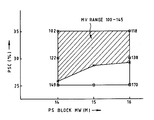
- the compositions are characterized in that the polystyrene block molecular weight ranges from 14,000 to 16,000. The polystyrene content ranges from 25% to 35% by weight of the block copolymer composition and the molecular weight of the block copolymer composition ranges from 80,000 to 145,000 and preferably from 100,000 to 145,000.
- SIS linear styrene-isoprene-styrene
- compositions according to the present invention have been found to fall within the shaded area in figure 1, representing a graph of the polystyrene content versus the polystyrene block molecular weight, on which is shown in addition the block copolymer composition molecular weight.
- the present invention also encompasses a low viscosity, low application temperature hot melt adhesive comprising the above block copolymer composition and a tackifying resin.
- the predominantly linear styrene-isoprene-styrene (SIS) block copolymers comprising linear blocks, can be prepared by methods which are in principle known in the art.
- polymers containing both aromatic and ethylenic unsaturation can be prepared by copolymerizing one or more polyolefins, particularly a diolefin, such as isoprene, with one or more alkenyl aromatic hydrocarbon monomers, such as styrene.
- the copolymers may, of course, be random, tapered, block or a combination of these. However, in this specific case block copolymers are desired, wherein the blocks are linear.
- Polymers containing ethylenic unsaturation or both aromatic and ethylenic unsaturation may be prepared using free-radical, cationic and anionic initiators or polymerization catalysts. Such polymers may be prepared using bulk, solution or emulsion techniques. In any case, the polymer containing at least ethylenic unsaturation will, generally, be recovered as a solid such as a crumb, a powder, a pellet or the like. Polymers containing ethylenic unsaturation and polymers containing both aromatic and ethylenic unsaturation are, of course, available commercially from several suppliers.
- Polymers of conjugated diolefins and copolymers of one or more conjugated diolefins and one or more alkenyl aromatic hydrocarbon monomers such as predominantly linear SIS block copolymers are normally prepared in solution using anionic polymerization techniques.
- these SIS block copolymers are prepared by contacting the momoners to be polymerized simultaneously or sequentially with an organoalkali metal compound in a suitable solvent at a temperature within the range from -150 °C to 300 °C, preferably at a temperature within the range from 0 °C to 100 °C.
- Particularly effective anionic polymerization initiators are organolithium compounds having the general formula: RLi n wherein: R is an aliphatic, cycloaliphatic, aromatic or alkyl-substituted aromatic hydrocarbon radical having from 1 to 20 carbon atoms; and n is an integer of 1 to 4.
- sec.-butyllithium is used.
- Suitable solvents include for example cycloaliphatic hydrocarbons such as cyclopentane, cyclohexane, cycloheptane and the like, as well as, alkyl-substituted derivatives thereof; aromatic and alkyl-substituted aromatic hydrocarbons such as benzene, naphthalene, toluene, xylene and the like; hydrogenated aromatic hydrocarbons such as tetralin, decalin and the like; linear and cyclic ethers such as methyl ether, methyl ethyl ether, tetrahydrofuran and the like.
- cycloaliphatic hydrocarbons such as cyclopentane, cyclohexane, cycloheptane and the like, as well as, alkyl-substituted derivatives thereof; aromatic and alkyl-substituted aromatic hydrocarbons such as benzene, naphthalene, toluene,
- the styrene is contacted with the initiator.
- the living polymer in solution is contacted with isoprene.
- the resulting living polymer has a simplified structure S-I-Li. It is at this point that the living polymer is coupled.
- any polyfunctional coupling agent which contains at least two reactive sites can be employed.
- Examples of the types of compounds which can be used include those which have been described in U.S. Patent Nos. 3,595,941; 3,468,972; 3,135,716; 3,078,254; and 3,594,452.
- the coupling agent has two reactive sites such as dibromoethane
- the polymer will have a linear SIS structure, and since the present block copolymers are linear, such a coupling agent with two reactive sites must be used.
- Coupling efficiency is defined as the number of molecules of coupled polymer divided by the number of molecules of coupled polymer plus the number of molecules of uncoupled polymer.
- Coupling efficiency can be determined theoretically from the stoichiometric quantity of coupling agent required for complete coupling or coupling efficiency can be determined by an analytical method such as gel permeation chromatography, as was known from e.g. U.S. Patent No. 4,096,203, teaching that the coupling efficiency is controlled from 20% to 80%, preferably 30% to 70%.
- the desired copolymers having the desired adhesive properties by blending polymers from processes of differing coupling efficiency. It was found that if the coupling efficiency of the block copolymers is too low, i.e., less than 60%, the SAFT may fall below 71 °C.
- the predominantly linear SIS block copolymer composition of the present invention can also be prepared by initial polymerization of styrene using an organo-lithium initiator up to a predetermined molecular weight of the polystyrene block, adding isoprene in an amount to obtain a predetermined molecular weight of the polyisoprene block and after finishing the polymerization adding styrene in a predetermined amount.
- the product is neutralized such as by the addition of terminators, e.g. water, alcohol or other reagents, for the purpose of removing the lithium radical forming the nucleus for the condensed polymer product.
- terminators e.g. water, alcohol or other reagents
- the product is then recovered such as by coagulation utilizing hot water or steam or both.
- an adhesive formulation must have a melt viscosity of less than 3100 cps at 177 °C and a shear adhesion failure temperature (SAFT) of greater than 71 °C.
- SAFT shear adhesion failure temperature
- the present invention provides a composition and an adhesive which satisfies these requirements.
- the composition is a predominantly linear SIS block copolymer composition which is comprised of linear polymeric blocks and has a relatively high coupling efficiency.
- the compositions and adhesives of the present invention must have the following characteristics:
- Figure 1 is a plot of polystyrene content versus polystyrene block molecular weight which is made using the data from the examples. Those two characteristics define a rectangle from 25 to 35% and from 14,000 to 16,000. When the overall molecular weight range is factored in, the effective area in which the present invention can be practiced is limited to the shaded area. If an SIS block copolymer composition falls within the shaded area, the above melt viscosity and SAFT criterion will be satisfied.
- the concentration of the initiator can be regulated to control the molecular weight of the overall composition and of the polystyrene blocks. Generally, the initiator concentration is in the range of 0.25 to 50 millimoles per 100 grams of monomer. The required initiator level frequently depends upon the solubility of the initiator in the hydrocarbon diluent. The ratio of the initiator to the monomer determines the block size, i.e. the higher the ratio of initiator to monomer the smaller the molecular weight of the block.
- a typical block copolymer composition within the scope of the present invention having a polystyrene block molecular weight of 15,000, a polystyrene content of 30% and an overall molecular weight of 137,000, was prepared by polymerizing styrene with sec.-butyllithium as initiator at a monomer to initiator molar ratio of 144 to 1 and then completing the polymerization, polymerizing isoprene at a monomer to initiator molar ratio of 154 to 1 and then completing the polymerization and finally polymerizing polystyrene again under the same conditions as before, or by polymerizing styrene with sec.-butyllithium as initiator until the predetermined polystyrene block had been obtained, followed by polymerizing isoprene and after completion of this polymerization step coupling the obtained living polymer by means of dibromoethane.
- a common tackifying resin is a diene-olefin copolymer of piperylene and 2-methyl-2-butene having a softening point of 95 °C. This resin is available commercially under the tradename Wingtack 95 and is prepared by the cationic polymerization of 60% piperylene, 10% isoprene, 5% cyclopentadiene, 15% 2-methyl-2-butene and 10% dimer, as taught in U.S. Patent No. 3,577,398.
- tackifying resins of the same general type may be employed in which the resinous copolymer comprises 20-80 weight percent of piperylene and 80-20 weight percent of 2-methyl-2-butene.
- the resins normally have softening points (ring and ball) between 80 °C and 115 °C.
- adhesion promoting resins which are also useful in the compositions of this invention include hydrogenated rosins, esters of rosins, polyterpenes, terpenephenol resins and polymerized mixed olefins.
- the tackifying resin be a saturated resin, e.g., a hydrogenated dicyclopentadiene resin such as Escorez 5000 series resin (Escorez is a trade mark) made by Exxon or a hydrogenated polystyrene or polyalphamethylstyrene resin such as Regalrez resin (Regalrez is a trade mark) made by Hercules.
- the amount of adhesion promoting resin employed varies from 20 to 400 parts by weight per hundred parts rubber (phr), preferably between 100 to 350 phr.
- the selection of the particular tackifying agent is, in large part, dependent upon the specific block copolymer employed in the respective adhesive composition. In the manufacture of disposable articles such as diapers, sanitary napkins and bed pads, there is the additional consideration of having a substantially white or clear adhesive composition.
- the adhesive composition of the instant invention may contain plasticizers, such as rubber extending plasticizers, or compounding oils or liquid resins.
- Plasticizers are well-known in the art and include both high saturates content oils and high aromatics content oils.
- Preferred plasticizers are highly saturated oils, e.g. Tufflo 6056 oil (Tufflo is a trade mark) made by Arco.
- the amounts of rubber compounding oil employed in the invention composition can vary from 0 to 100 phr, and preferably between 0 to 60 phr.
- Optional components of the present invention are stabilizers which inhibit or retard heat degradation, oxidation, skin formation and colour formation.
- Stabilizers are typically added to the commercially available compounds in order to protect the polymers against heat degradation and oxidation during the preparation, use and high temperature storage of the adhesive composition.
- Additional stabilizers known in the art may also be incorporated into the adhesive composition. These may be for protection during the life of the disposable article against, for example, oxygen, ozone and ultraviolet radiation. However, these additional stabilizers should be compatible with the essential stabilizers mentioned herein-above and their intended function as taught herein.
- the adhesive compositions of the present invention are typically prepared by blending the components at an elevated temperature, preferably between 130 °C and 200 °C, until a homogeneous blend is obtained, usually less than three (3) hours.
- elevated temperature preferably between 130 °C and 200 °C
- Various methods of blending are known to the art and any method that produces a homogeneous blend is satisfactory.
- the resultant adhesives may then preferably be used in a wide variety of product assembly applications.
- a particularly preferred application is their use in bonding polyethylene or polypropylene substrates to tissue, non-wovens or other polyethylene or polypropylene substrates using techniques involving multiple dispositions of small quantities of the adhesives according to conventional "multi-line” or “multi-dot” type constructions.
- the adhesive is generally extruded in lines (or dots) at regularly spaced intervals along the length of the article.
- the adhesive may be applied at temperatures as low as 121 °C.
- An additional advantage of the adhesive of the present invention is that it can be effectively applied by spraying.
- the adhesive is usually applied to the polyethylene or polypropylene backing and subsequently the combination is mated with an absorbent inner core and tissue or non-woven liner.
- the coupling efficiency was determined by the method described above.
- the melt viscosity was measured in centipoise-seconds (cps) by using a Brookfield Thermocell viscometer at 177 °C.
- the SAFT was measured by 1" x 1" Mylar to Mylar lap joint with a 1 kg weight. SAFT measures the temperature at which the lap shear assembly fails under load.
- the molecular weights were determined by gel permeation chromatography as styrene equivalent molecular weight.
- the polystyrene content was determined by nuclear magnetic spectroscopy.
- the block copolymer compositions were made according to the procedures discussed above.
- the coupling agent was dibromoethane. They were used to make adhesives by blending 25% polymer with 60% tackifying resin (Escorez 5300) and 15% plasticiser (Tufflo 6056).
- the formulations were stabilized with 1 phr of Irganox 1010 (Irganox is a trade mark).
- samples 1 through 5 all have a polystyrene block molecular weight lower than 14,000 and in one or two of them the other parameters are not met as well. None of these materials meets the criterion since all of them have an SAFT of less than 71 °C. Samples 6 through 9 and 12 through 14 all meet each of the claimed ranges and the criterion since the melt viscosity is less than 3,000 and the SAFT is more than 71 °C. Samples 10, 11, 16 and 17 all have overall molecular weights of greater than 145,000 (1 or 2 do not meet other characteristics as well) and none of these samples satisfies the criterion. Sample 15 has a polystyrene block molecular weight and also a polystyrene content which are too low. It does not satisfy the criterion either.
- the three commercial products all have overall molecular weights which are outside the claimed range. In some instances, other characteristics are not met. None of these products satisfies the criterion since A and B have melt viscosities greater than 3100 cps and the SAFT of C is too low.
Landscapes
- Chemical & Material Sciences (AREA)
- Organic Chemistry (AREA)
- Chemical Kinetics & Catalysis (AREA)
- Inorganic Chemistry (AREA)
- Health & Medical Sciences (AREA)
- Medicinal Chemistry (AREA)
- Polymers & Plastics (AREA)
- Adhesives Or Adhesive Processes (AREA)
- Compositions Of Macromolecular Compounds (AREA)
- Graft Or Block Polymers (AREA)
Applications Claiming Priority (2)
| Application Number | Priority Date | Filing Date | Title |
|---|---|---|---|
| US51090190A | 1990-04-11 | 1990-04-11 | |
| US510901 | 1990-04-11 |
Publications (3)
| Publication Number | Publication Date |
|---|---|
| EP0451919A2 true EP0451919A2 (de) | 1991-10-16 |
| EP0451919A3 EP0451919A3 (en) | 1992-03-25 |
| EP0451919B1 EP0451919B1 (de) | 1995-02-01 |
Family
ID=24032648
Family Applications (1)
| Application Number | Title | Priority Date | Filing Date |
|---|---|---|---|
| EP91200825A Expired - Lifetime EP0451919B1 (de) | 1990-04-11 | 1991-04-09 | Styrol-Isopren-Styrolblockcopolymerzusammensetzung für Niedrigviskose, Niedrigtemperatur-Heissschmelzklebemittel |
Country Status (9)
| Country | Link |
|---|---|
| EP (1) | EP0451919B1 (de) |
| JP (1) | JPH04351689A (de) |
| KR (1) | KR100204813B1 (de) |
| AU (1) | AU637477B2 (de) |
| BR (1) | BR9101415A (de) |
| CA (1) | CA2040090A1 (de) |
| DE (1) | DE69107107T2 (de) |
| DK (1) | DK0451919T3 (de) |
| ES (1) | ES2067843T3 (de) |
Cited By (12)
| Publication number | Priority date | Publication date | Assignee | Title |
|---|---|---|---|---|
| EP0525251A1 (de) * | 1991-07-31 | 1993-02-03 | Findley Adhesives Inc. | Einstellungsklebstoffe für adsorbierende Gegenstände |
| EP0525905A1 (de) * | 1991-07-29 | 1993-02-03 | Shell Internationale Researchmaatschappij B.V. | Klebstoffzusammensetzung aus einem sequenz-polymerisiertem Blockcopolymer aus Styrol-Isopren-Styrol |
| EP0532831A1 (de) * | 1991-09-20 | 1993-03-24 | Findley Adhesives Inc. | Konstruktionsschmelzklebstoffe für weiche Einwegartikel |
| US5266394A (en) * | 1989-08-11 | 1993-11-30 | The Dow Chemical Company | Disposable articles of manufacture containing polystyrene-polyisoprene-polystyrene block copolymers |
| US5401792A (en) * | 1993-11-10 | 1995-03-28 | Minnesota Mining And Manufacturing Company | Sprayable thermoplastic compositions |
| EP0659787A1 (de) * | 1993-12-23 | 1995-06-28 | Shell Internationale Researchmaatschappij B.V. | Blockcopolymere und diese enthaltende Selbstkleberzusammensetzung mit hoher Scherfestigkeit |
| WO1997044404A1 (en) * | 1996-05-20 | 1997-11-27 | The Dow Chemical Company | Hot-melt adhesives for disposable items and articles made therefrom |
| US6162868A (en) * | 1997-09-30 | 2000-12-19 | Elf Atochem S.A. | Pressure-sensitive adhesive which can be applied while hot |
| US7276557B2 (en) | 2001-09-19 | 2007-10-02 | Exxonmobil Chemical Patents Inc. | Adhesive components and process for manufacture |
| US8129464B2 (en) | 2005-10-14 | 2012-03-06 | Bostik, Inc. | Low application temperature hot melt adhesive |
| CN104073202A (zh) * | 2013-03-28 | 2014-10-01 | 奇美实业股份有限公司 | 可剥离型黏着剂组合物、可剥离型材料及电子零件 |
| US10414957B2 (en) | 2015-03-16 | 2019-09-17 | H.B. Fuller Company | Low application temperature hot melt adhesive composition |
Families Citing this family (8)
| Publication number | Priority date | Publication date | Assignee | Title |
|---|---|---|---|---|
| EP1196511B1 (de) * | 1998-08-27 | 2004-01-07 | KRATON Polymers Research B.V. | Schmelzklebstoffzusammensetzung mit hohem abschälwiderstand und hoher tragkraft |
| US7905872B2 (en) | 2004-06-04 | 2011-03-15 | The Procter & Gamble Company | Absorbent articles comprising a slow recovery stretch laminate |
| MX2007008590A (es) | 2005-01-26 | 2007-08-14 | Procter & Gamble | Panal desechable tipo calzon que tiene una cintura elastica de recuperacion lenta con fuerza baja. |
| US20060205877A1 (en) | 2005-03-11 | 2006-09-14 | Kraton Polymers U.S. Llc | Adhesive compositions comprising mixtures of block copolymers |
| US8323257B2 (en) | 2007-11-21 | 2012-12-04 | The Procter & Gamble Company | Absorbent articles comprising a slow recovery stretch laminate and method for making the same |
| US9017305B2 (en) | 2010-11-12 | 2015-04-28 | The Procter Gamble Company | Elastomeric compositions that resist force loss and disintegration |
| WO2013099973A1 (ja) * | 2011-12-29 | 2013-07-04 | 日本ゼオン株式会社 | ホットメルト粘接着剤用ブロック共重合体組成物 |
| CN107532053A (zh) * | 2015-04-23 | 2018-01-02 | 积水富乐株式会社 | 热熔胶粘剂和使用其的一次性产品 |
Family Cites Families (6)
| Publication number | Priority date | Publication date | Assignee | Title |
|---|---|---|---|---|
| BE627652A (de) * | 1962-01-29 | |||
| US3333024A (en) * | 1963-04-25 | 1967-07-25 | Shell Oil Co | Block polymers, compositions containing them and process of their preparation |
| US3427269A (en) * | 1966-03-14 | 1969-02-11 | Shell Oil Co | Adhesive compositions comprising certain block copolymers and selected resins |
| DE2942128A1 (de) * | 1979-10-18 | 1981-04-30 | Basf Ag, 6700 Ludwigshafen | Schmelzhaftkleber auf basis von nichthydrierten, linearen blockcopolymerisaten a-b-a |
| JPH0686586B2 (ja) * | 1985-04-05 | 1994-11-02 | 日東電工株式会社 | 感圧性接着剤組成物 |
| US5143968A (en) * | 1989-08-11 | 1992-09-01 | The Dow Chemical Company | Polystyrene-polyisoprene-polystyrene block copolymers, hot melt adhesive compositions, and articles produced therefrom |
-
1991
- 1991-04-08 KR KR1019910005582A patent/KR100204813B1/ko not_active Expired - Lifetime
- 1991-04-09 EP EP91200825A patent/EP0451919B1/de not_active Expired - Lifetime
- 1991-04-09 DK DK91200825.7T patent/DK0451919T3/da active
- 1991-04-09 CA CA002040090A patent/CA2040090A1/en not_active Abandoned
- 1991-04-09 DE DE69107107T patent/DE69107107T2/de not_active Expired - Fee Related
- 1991-04-09 ES ES91200825T patent/ES2067843T3/es not_active Expired - Lifetime
- 1991-04-09 BR BR919101415A patent/BR9101415A/pt not_active IP Right Cessation
- 1991-04-09 AU AU74245/91A patent/AU637477B2/en not_active Ceased
- 1991-04-09 JP JP3164080A patent/JPH04351689A/ja active Pending
Cited By (13)
| Publication number | Priority date | Publication date | Assignee | Title |
|---|---|---|---|---|
| US5266394A (en) * | 1989-08-11 | 1993-11-30 | The Dow Chemical Company | Disposable articles of manufacture containing polystyrene-polyisoprene-polystyrene block copolymers |
| EP0525905A1 (de) * | 1991-07-29 | 1993-02-03 | Shell Internationale Researchmaatschappij B.V. | Klebstoffzusammensetzung aus einem sequenz-polymerisiertem Blockcopolymer aus Styrol-Isopren-Styrol |
| EP0525251A1 (de) * | 1991-07-31 | 1993-02-03 | Findley Adhesives Inc. | Einstellungsklebstoffe für adsorbierende Gegenstände |
| EP0532831A1 (de) * | 1991-09-20 | 1993-03-24 | Findley Adhesives Inc. | Konstruktionsschmelzklebstoffe für weiche Einwegartikel |
| US5401792A (en) * | 1993-11-10 | 1995-03-28 | Minnesota Mining And Manufacturing Company | Sprayable thermoplastic compositions |
| EP0659787A1 (de) * | 1993-12-23 | 1995-06-28 | Shell Internationale Researchmaatschappij B.V. | Blockcopolymere und diese enthaltende Selbstkleberzusammensetzung mit hoher Scherfestigkeit |
| WO1997044404A1 (en) * | 1996-05-20 | 1997-11-27 | The Dow Chemical Company | Hot-melt adhesives for disposable items and articles made therefrom |
| US6162868A (en) * | 1997-09-30 | 2000-12-19 | Elf Atochem S.A. | Pressure-sensitive adhesive which can be applied while hot |
| US7276557B2 (en) | 2001-09-19 | 2007-10-02 | Exxonmobil Chemical Patents Inc. | Adhesive components and process for manufacture |
| US7279528B2 (en) | 2001-09-19 | 2007-10-09 | Exxonmobil Chemical Patents Inc. | Adhesive components and process for manufacture |
| US8129464B2 (en) | 2005-10-14 | 2012-03-06 | Bostik, Inc. | Low application temperature hot melt adhesive |
| CN104073202A (zh) * | 2013-03-28 | 2014-10-01 | 奇美实业股份有限公司 | 可剥离型黏着剂组合物、可剥离型材料及电子零件 |
| US10414957B2 (en) | 2015-03-16 | 2019-09-17 | H.B. Fuller Company | Low application temperature hot melt adhesive composition |
Also Published As
| Publication number | Publication date |
|---|---|
| EP0451919B1 (de) | 1995-02-01 |
| DE69107107T2 (de) | 1995-05-24 |
| ES2067843T3 (es) | 1995-04-01 |
| JPH04351689A (ja) | 1992-12-07 |
| CA2040090A1 (en) | 1991-10-12 |
| KR910018510A (ko) | 1991-11-30 |
| DK0451919T3 (da) | 1995-04-03 |
| DE69107107D1 (de) | 1995-03-16 |
| KR100204813B1 (ko) | 1999-06-15 |
| AU637477B2 (en) | 1993-05-27 |
| BR9101415A (pt) | 1991-11-26 |
| EP0451919A3 (en) | 1992-03-25 |
| AU7424591A (en) | 1991-10-17 |
Similar Documents
| Publication | Publication Date | Title |
|---|---|---|
| EP0451920B1 (de) | Styrol-Isopren-Styrolblockcopolymerzusammensetzung für Niedrigviskose-, Niedrigtemperatur-Heissschmelzklebemittel | |
| EP0451919B1 (de) | Styrol-Isopren-Styrolblockcopolymerzusammensetzung für Niedrigviskose, Niedrigtemperatur-Heissschmelzklebemittel | |
| US5242984A (en) | Sequentially polymerized styrene-isoprene-styrene block copolymer adhesive composition | |
| EP0730617B1 (de) | Sternförmige aufgebaute blockcopolymere aus styrol-isopren-butadien und zusammensetzungen und gegenstände daraus | |
| KR100346241B1 (ko) | 접착제용수소첨가된다중블록중합체 | |
| US5948527A (en) | Adhesive compositions comprising block copolymers of a monovinylaromatic compound and butadiene | |
| DE69314943T2 (de) | Dreiarmige Styrol-Isopren-Blockcopolymermassen mit grosser Lastaufnahmefähigkeit für Klebstoffe | |
| US5292806A (en) | Compositions containing blends of polystyrene-polyisoprene-polystyrene block copolymers | |
| US5750623A (en) | Hot-melt adhesives for disposable items and articles made therefrom | |
| EP0850284A1 (de) | Niederviskose schmelzbare klebstoffzusammensetzungen für wegwerfartikel | |
| JPH10152663A (ja) | 接着剤組成物 | |
| US5210147A (en) | 100% Triblock hydrogenated styrene-isoprene-styrene block copolymer adhesive composition | |
| US5412032A (en) | High molecular weight low coupled linear styrene-isoprene-styrene block copolymer composition and adhesives made therefrom | |
| US5420203A (en) | Process for producing high diblock content block copolymer compositions | |
| USH1402H (en) | Styrene-isoprene-styrene block copolymer composition and adhesives made therefrom | |
| US5266649A (en) | Color stable coupled diene polymers and hot melt adhesives containing them | |
| KR100506548B1 (ko) | 일회용품용열용융형접착제및이로부터제조된제품 |
Legal Events
| Date | Code | Title | Description |
|---|---|---|---|
| PUAI | Public reference made under article 153(3) epc to a published international application that has entered the european phase |
Free format text: ORIGINAL CODE: 0009012 |
|
| AK | Designated contracting states |
Kind code of ref document: A2 Designated state(s): BE DE DK ES FR GB IT NL SE |
|
| PUAL | Search report despatched |
Free format text: ORIGINAL CODE: 0009013 |
|
| AK | Designated contracting states |
Kind code of ref document: A3 Designated state(s): BE DE DK ES FR GB IT NL SE |
|
| 17P | Request for examination filed |
Effective date: 19920714 |
|
| 17Q | First examination report despatched |
Effective date: 19940621 |
|
| GRAA | (expected) grant |
Free format text: ORIGINAL CODE: 0009210 |
|
| AK | Designated contracting states |
Kind code of ref document: B1 Designated state(s): BE DE DK ES FR GB IT NL SE |
|
| ITF | It: translation for a ep patent filed | ||
| REF | Corresponds to: |
Ref document number: 69107107 Country of ref document: DE Date of ref document: 19950316 |
|
| REG | Reference to a national code |
Ref country code: ES Ref legal event code: FG2A Ref document number: 2067843 Country of ref document: ES Kind code of ref document: T3 |
|
| REG | Reference to a national code |
Ref country code: DK Ref legal event code: T3 |
|
| ET | Fr: translation filed | ||
| PLBE | No opposition filed within time limit |
Free format text: ORIGINAL CODE: 0009261 |
|
| STAA | Information on the status of an ep patent application or granted ep patent |
Free format text: STATUS: NO OPPOSITION FILED WITHIN TIME LIMIT |
|
| 26N | No opposition filed | ||
| PGFP | Annual fee paid to national office [announced via postgrant information from national office to epo] |
Ref country code: SE Payment date: 20010321 Year of fee payment: 11 |
|
| PGFP | Annual fee paid to national office [announced via postgrant information from national office to epo] |
Ref country code: DK Payment date: 20010322 Year of fee payment: 11 |
|
| REG | Reference to a national code |
Ref country code: GB Ref legal event code: IF02 |
|
| PG25 | Lapsed in a contracting state [announced via postgrant information from national office to epo] |
Ref country code: SE Free format text: LAPSE BECAUSE OF NON-PAYMENT OF DUE FEES Effective date: 20020410 |
|
| PG25 | Lapsed in a contracting state [announced via postgrant information from national office to epo] |
Ref country code: DK Free format text: LAPSE BECAUSE OF NON-PAYMENT OF DUE FEES Effective date: 20020430 |
|
| EUG | Se: european patent has lapsed |
Ref document number: 91200825.7 |
|
| REG | Reference to a national code |
Ref country code: DK Ref legal event code: EBP |
|
| PGFP | Annual fee paid to national office [announced via postgrant information from national office to epo] |
Ref country code: NL Payment date: 20040331 Year of fee payment: 14 |
|
| PGFP | Annual fee paid to national office [announced via postgrant information from national office to epo] |
Ref country code: BE Payment date: 20040527 Year of fee payment: 14 |
|
| PGFP | Annual fee paid to national office [announced via postgrant information from national office to epo] |
Ref country code: ES Payment date: 20050415 Year of fee payment: 15 |
|
| PG25 | Lapsed in a contracting state [announced via postgrant information from national office to epo] |
Ref country code: BE Free format text: LAPSE BECAUSE OF NON-PAYMENT OF DUE FEES Effective date: 20050430 |
|
| BERE | Be: lapsed |
Owner name: *SHELL INTERNATIONALE RESEARCH MAATSCHAPPIJ B.V. Effective date: 20050430 |
|
| PG25 | Lapsed in a contracting state [announced via postgrant information from national office to epo] |
Ref country code: NL Free format text: LAPSE BECAUSE OF NON-PAYMENT OF DUE FEES Effective date: 20051101 |
|
| NLV4 | Nl: lapsed or anulled due to non-payment of the annual fee |
Effective date: 20051101 |
|
| PG25 | Lapsed in a contracting state [announced via postgrant information from national office to epo] |
Ref country code: ES Free format text: LAPSE BECAUSE OF NON-PAYMENT OF DUE FEES Effective date: 20060410 |
|
| REG | Reference to a national code |
Ref country code: ES Ref legal event code: FD2A Effective date: 20060410 |
|
| BERE | Be: lapsed |
Owner name: *SHELL INTERNATIONALE RESEARCH MAATSCHAPPIJ B.V. Effective date: 20050430 |
|
| PGFP | Annual fee paid to national office [announced via postgrant information from national office to epo] |
Ref country code: DE Payment date: 20090422 Year of fee payment: 19 Ref country code: IT Payment date: 20090428 Year of fee payment: 19 Ref country code: FR Payment date: 20090414 Year of fee payment: 19 |
|
| PGFP | Annual fee paid to national office [announced via postgrant information from national office to epo] |
Ref country code: GB Payment date: 20090421 Year of fee payment: 19 |
|
| GBPC | Gb: european patent ceased through non-payment of renewal fee |
Effective date: 20100409 |
|
| REG | Reference to a national code |
Ref country code: FR Ref legal event code: ST Effective date: 20101230 |
|
| PG25 | Lapsed in a contracting state [announced via postgrant information from national office to epo] |
Ref country code: DE Free format text: LAPSE BECAUSE OF NON-PAYMENT OF DUE FEES Effective date: 20101103 |
|
| PG25 | Lapsed in a contracting state [announced via postgrant information from national office to epo] |
Ref country code: GB Free format text: LAPSE BECAUSE OF NON-PAYMENT OF DUE FEES Effective date: 20100409 Ref country code: IT Free format text: LAPSE BECAUSE OF NON-PAYMENT OF DUE FEES Effective date: 20100409 |
|
| PG25 | Lapsed in a contracting state [announced via postgrant information from national office to epo] |
Ref country code: FR Free format text: LAPSE BECAUSE OF NON-PAYMENT OF DUE FEES Effective date: 20100430 |