EP0452078B1 - Photoleitfähige Vorrichtung bestehend aus einem organischen Polymidfilm - Google Patents
Photoleitfähige Vorrichtung bestehend aus einem organischen Polymidfilm Download PDFInfo
- Publication number
- EP0452078B1 EP0452078B1 EP91303100A EP91303100A EP0452078B1 EP 0452078 B1 EP0452078 B1 EP 0452078B1 EP 91303100 A EP91303100 A EP 91303100A EP 91303100 A EP91303100 A EP 91303100A EP 0452078 B1 EP0452078 B1 EP 0452078B1
- Authority
- EP
- European Patent Office
- Prior art keywords
- polyimide
- film
- organic
- polyamic acid
- imidation
- Prior art date
- Legal status (The legal status is an assumption and is not a legal conclusion. Google has not performed a legal analysis and makes no representation as to the accuracy of the status listed.)
- Expired - Lifetime
Links
- 229920001721 polyimide Polymers 0.000 title description 35
- 125000000609 carbazolyl group Chemical group C1(=CC=CC=2C3=CC=CC=C3NC12)* 0.000 claims description 15
- 229920000642 polymer Polymers 0.000 claims description 9
- 238000000354 decomposition reaction Methods 0.000 claims description 8
- 150000003949 imides Chemical class 0.000 claims description 7
- 125000000962 organic group Chemical group 0.000 claims description 5
- 125000000753 cycloalkyl group Chemical group 0.000 claims description 3
- 125000004432 carbon atom Chemical group C* 0.000 claims 2
- 239000004642 Polyimide Substances 0.000 description 33
- 239000010408 film Substances 0.000 description 23
- 229920005575 poly(amic acid) Polymers 0.000 description 21
- 238000006358 imidation reaction Methods 0.000 description 18
- 238000010438 heat treatment Methods 0.000 description 16
- 238000000034 method Methods 0.000 description 16
- 239000000758 substrate Substances 0.000 description 15
- 239000000243 solution Substances 0.000 description 14
- 239000010409 thin film Substances 0.000 description 14
- FXHOOIRPVKKKFG-UHFFFAOYSA-N N,N-Dimethylacetamide Chemical compound CN(C)C(C)=O FXHOOIRPVKKKFG-UHFFFAOYSA-N 0.000 description 12
- 150000001875 compounds Chemical class 0.000 description 9
- 239000000463 material Substances 0.000 description 9
- 239000002904 solvent Substances 0.000 description 7
- UJOBWOGCFQCDNV-UHFFFAOYSA-N 9H-carbazole Chemical compound C1=CC=C2C3=CC=CC=C3NC2=C1 UJOBWOGCFQCDNV-UHFFFAOYSA-N 0.000 description 6
- VESMRDNBVZOIEN-UHFFFAOYSA-N 9h-carbazole-1,2-diamine Chemical compound C1=CC=C2C3=CC=C(N)C(N)=C3NC2=C1 VESMRDNBVZOIEN-UHFFFAOYSA-N 0.000 description 6
- 230000007613 environmental effect Effects 0.000 description 6
- 238000005259 measurement Methods 0.000 description 6
- 239000011368 organic material Substances 0.000 description 6
- XAGFODPZIPBFFR-UHFFFAOYSA-N aluminium Chemical compound [Al] XAGFODPZIPBFFR-UHFFFAOYSA-N 0.000 description 5
- 229910052782 aluminium Inorganic materials 0.000 description 5
- ANSXAPJVJOKRDJ-UHFFFAOYSA-N furo[3,4-f][2]benzofuran-1,3,5,7-tetrone Chemical compound C1=C2C(=O)OC(=O)C2=CC2=C1C(=O)OC2=O ANSXAPJVJOKRDJ-UHFFFAOYSA-N 0.000 description 5
- 239000011521 glass Substances 0.000 description 5
- 238000004519 manufacturing process Methods 0.000 description 5
- 238000004528 spin coating Methods 0.000 description 5
- IJGRMHOSHXDMSA-UHFFFAOYSA-N Atomic nitrogen Chemical compound N#N IJGRMHOSHXDMSA-UHFFFAOYSA-N 0.000 description 4
- 230000000694 effects Effects 0.000 description 4
- 238000009413 insulation Methods 0.000 description 4
- 229920003227 poly(N-vinyl carbazole) Polymers 0.000 description 4
- CYIDZMCFTVVTJO-UHFFFAOYSA-N pyromellitic acid Chemical compound OC(=O)C1=CC(C(O)=O)=C(C(O)=O)C=C1C(O)=O CYIDZMCFTVVTJO-UHFFFAOYSA-N 0.000 description 4
- 239000000126 substance Substances 0.000 description 4
- WFDIJRYMOXRFFG-UHFFFAOYSA-N Acetic anhydride Chemical compound CC(=O)OC(C)=O WFDIJRYMOXRFFG-UHFFFAOYSA-N 0.000 description 3
- UHOVQNZJYSORNB-UHFFFAOYSA-N Benzene Chemical compound C1=CC=CC=C1 UHOVQNZJYSORNB-UHFFFAOYSA-N 0.000 description 3
- XUIMIQQOPSSXEZ-UHFFFAOYSA-N Silicon Chemical compound [Si] XUIMIQQOPSSXEZ-UHFFFAOYSA-N 0.000 description 3
- -1 and the like Chemical group 0.000 description 3
- 230000015572 biosynthetic process Effects 0.000 description 3
- 238000011161 development Methods 0.000 description 3
- 230000006872 improvement Effects 0.000 description 3
- 238000002844 melting Methods 0.000 description 3
- 230000008018 melting Effects 0.000 description 3
- 150000002894 organic compounds Chemical class 0.000 description 3
- 229910052710 silicon Inorganic materials 0.000 description 3
- 239000010703 silicon Substances 0.000 description 3
- 238000001228 spectrum Methods 0.000 description 3
- 238000003786 synthesis reaction Methods 0.000 description 3
- XLYOFNOQVPJJNP-UHFFFAOYSA-N water Substances O XLYOFNOQVPJJNP-UHFFFAOYSA-N 0.000 description 3
- YCZUWQOJQGCZKG-UHFFFAOYSA-N 9h-carbazole-3,6-diamine Chemical compound C1=C(N)C=C2C3=CC(N)=CC=C3NC2=C1 YCZUWQOJQGCZKG-UHFFFAOYSA-N 0.000 description 2
- RTZKZFJDLAIYFH-UHFFFAOYSA-N Diethyl ether Chemical compound CCOCC RTZKZFJDLAIYFH-UHFFFAOYSA-N 0.000 description 2
- 239000004952 Polyamide Substances 0.000 description 2
- JUJWROOIHBZHMG-UHFFFAOYSA-N Pyridine Chemical compound C1=CC=NC=C1 JUJWROOIHBZHMG-UHFFFAOYSA-N 0.000 description 2
- 239000006087 Silane Coupling Agent Substances 0.000 description 2
- 238000010521 absorption reaction Methods 0.000 description 2
- 125000003118 aryl group Chemical group 0.000 description 2
- 238000006243 chemical reaction Methods 0.000 description 2
- 150000002148 esters Chemical class 0.000 description 2
- 230000009477 glass transition Effects 0.000 description 2
- NAQMVNRVTILPCV-UHFFFAOYSA-N hexane-1,6-diamine Chemical group NCCCCCCN NAQMVNRVTILPCV-UHFFFAOYSA-N 0.000 description 2
- 150000002430 hydrocarbons Chemical group 0.000 description 2
- NHLUVTZJQOJKCC-UHFFFAOYSA-N n,n-dimethylhexadecan-1-amine Chemical compound CCCCCCCCCCCCCCCCN(C)C NHLUVTZJQOJKCC-UHFFFAOYSA-N 0.000 description 2
- 229910052757 nitrogen Inorganic materials 0.000 description 2
- 229920002647 polyamide Polymers 0.000 description 2
- 229920006122 polyamide resin Polymers 0.000 description 2
- 239000002243 precursor Substances 0.000 description 2
- 238000011160 research Methods 0.000 description 2
- 238000006798 ring closing metathesis reaction Methods 0.000 description 2
- 150000003839 salts Chemical class 0.000 description 2
- 239000007787 solid Substances 0.000 description 2
- ZCYVEMRRCGMTRW-UHFFFAOYSA-N 7553-56-2 Chemical compound [I] ZCYVEMRRCGMTRW-UHFFFAOYSA-N 0.000 description 1
- HBAKJBGOHINNQM-UHFFFAOYSA-N 9-benzylcarbazole Chemical compound C12=CC=CC=C2C2=CC=CC=C2N1CC1=CC=CC=C1 HBAKJBGOHINNQM-UHFFFAOYSA-N 0.000 description 1
- OKTJSMMVPCPJKN-UHFFFAOYSA-N Carbon Chemical compound [C] OKTJSMMVPCPJKN-UHFFFAOYSA-N 0.000 description 1
- 239000004215 Carbon black (E152) Substances 0.000 description 1
- 239000004962 Polyamide-imide Substances 0.000 description 1
- 239000004793 Polystyrene Substances 0.000 description 1
- 238000000862 absorption spectrum Methods 0.000 description 1
- 150000008065 acid anhydrides Chemical class 0.000 description 1
- 125000002015 acyclic group Chemical group 0.000 description 1
- 125000000217 alkyl group Chemical group 0.000 description 1
- 150000001408 amides Chemical class 0.000 description 1
- 125000003277 amino group Chemical group 0.000 description 1
- 229910021417 amorphous silicon Inorganic materials 0.000 description 1
- 229910052799 carbon Inorganic materials 0.000 description 1
- 229930002875 chlorophyll Natural products 0.000 description 1
- 235000019804 chlorophyll Nutrition 0.000 description 1
- ATNHDLDRLWWWCB-AENOIHSZSA-M chlorophyll a Chemical compound C1([C@@H](C(=O)OC)C(=O)C2=C3C)=C2N2C3=CC(C(CC)=C3C)=[N+]4C3=CC3=C(C=C)C(C)=C5N3[Mg-2]42[N+]2=C1[C@@H](CCC(=O)OC\C=C(/C)CCC[C@H](C)CCC[C@H](C)CCCC(C)C)[C@H](C)C2=C5 ATNHDLDRLWWWCB-AENOIHSZSA-M 0.000 description 1
- 239000011248 coating agent Substances 0.000 description 1
- 238000000576 coating method Methods 0.000 description 1
- 238000004040 coloring Methods 0.000 description 1
- 230000000052 comparative effect Effects 0.000 description 1
- 238000007796 conventional method Methods 0.000 description 1
- 238000006210 cyclodehydration reaction Methods 0.000 description 1
- 230000006866 deterioration Effects 0.000 description 1
- 238000001035 drying Methods 0.000 description 1
- 230000008020 evaporation Effects 0.000 description 1
- 238000001704 evaporation Methods 0.000 description 1
- 230000001747 exhibiting effect Effects 0.000 description 1
- 229920006015 heat resistant resin Polymers 0.000 description 1
- 229930195733 hydrocarbon Natural products 0.000 description 1
- 230000001771 impaired effect Effects 0.000 description 1
- 238000002329 infrared spectrum Methods 0.000 description 1
- 238000011835 investigation Methods 0.000 description 1
- 229910052740 iodine Inorganic materials 0.000 description 1
- 239000011630 iodine Substances 0.000 description 1
- DZVCFNFOPIZQKX-LTHRDKTGSA-M merocyanine Chemical compound [Na+].O=C1N(CCCC)C(=O)N(CCCC)C(=O)C1=C\C=C\C=C/1N(CCCS([O-])(=O)=O)C2=CC=CC=C2O\1 DZVCFNFOPIZQKX-LTHRDKTGSA-M 0.000 description 1
- 239000011259 mixed solution Substances 0.000 description 1
- 238000002156 mixing Methods 0.000 description 1
- 229910021421 monocrystalline silicon Inorganic materials 0.000 description 1
- 239000000178 monomer Substances 0.000 description 1
- 230000005693 optoelectronics Effects 0.000 description 1
- 229920000620 organic polymer Polymers 0.000 description 1
- 229920002382 photo conductive polymer Polymers 0.000 description 1
- 239000000049 pigment Substances 0.000 description 1
- 239000004033 plastic Substances 0.000 description 1
- 229920003023 plastic Polymers 0.000 description 1
- 229920003229 poly(methyl methacrylate) Polymers 0.000 description 1
- 229920002312 polyamide-imide Polymers 0.000 description 1
- 238000006116 polymerization reaction Methods 0.000 description 1
- 230000000379 polymerizing effect Effects 0.000 description 1
- 239000004926 polymethyl methacrylate Substances 0.000 description 1
- 229920002223 polystyrene Polymers 0.000 description 1
- 229920000915 polyvinyl chloride Polymers 0.000 description 1
- 239000004800 polyvinyl chloride Substances 0.000 description 1
- 150000004032 porphyrins Chemical group 0.000 description 1
- UMJSCPRVCHMLSP-UHFFFAOYSA-N pyridine Natural products COC1=CC=CN=C1 UMJSCPRVCHMLSP-UHFFFAOYSA-N 0.000 description 1
- 239000010453 quartz Substances 0.000 description 1
- 238000007142 ring opening reaction Methods 0.000 description 1
- 239000004065 semiconductor Substances 0.000 description 1
- VYPSYNLAJGMNEJ-UHFFFAOYSA-N silicon dioxide Inorganic materials O=[Si]=O VYPSYNLAJGMNEJ-UHFFFAOYSA-N 0.000 description 1
- 150000003384 small molecules Chemical class 0.000 description 1
- 238000003892 spreading Methods 0.000 description 1
- 230000007480 spreading Effects 0.000 description 1
- 239000007858 starting material Substances 0.000 description 1
- 125000001424 substituent group Chemical group 0.000 description 1
- 238000012360 testing method Methods 0.000 description 1
- 238000002076 thermal analysis method Methods 0.000 description 1
- 150000003568 thioethers Chemical class 0.000 description 1
- 238000012546 transfer Methods 0.000 description 1
Images
Classifications
-
- C—CHEMISTRY; METALLURGY
- C08—ORGANIC MACROMOLECULAR COMPOUNDS; THEIR PREPARATION OR CHEMICAL WORKING-UP; COMPOSITIONS BASED THEREON
- C08G—MACROMOLECULAR COMPOUNDS OBTAINED OTHERWISE THAN BY REACTIONS ONLY INVOLVING UNSATURATED CARBON-TO-CARBON BONDS
- C08G73/00—Macromolecular compounds obtained by reactions forming a linkage containing nitrogen with or without oxygen or carbon in the main chain of the macromolecule, not provided for in groups C08G12/00 - C08G71/00
- C08G73/06—Polycondensates having nitrogen-containing heterocyclic rings in the main chain of the macromolecule
- C08G73/10—Polyimides; Polyester-imides; Polyamide-imides; Polyamide acids or similar polyimide precursors
- C08G73/1085—Polyimides with diamino moieties or tetracarboxylic segments containing heterocyclic moieties
-
- H—ELECTRICITY
- H10—SEMICONDUCTOR DEVICES; ELECTRIC SOLID-STATE DEVICES NOT OTHERWISE PROVIDED FOR
- H10K—ORGANIC ELECTRIC SOLID-STATE DEVICES
- H10K30/00—Organic devices sensitive to infrared radiation, light, electromagnetic radiation of shorter wavelength or corpuscular radiation
- H10K30/451—Organic devices sensitive to infrared radiation, light, electromagnetic radiation of shorter wavelength or corpuscular radiation comprising a metal-semiconductor-metal [m-s-m] structure
-
- H—ELECTRICITY
- H10—SEMICONDUCTOR DEVICES; ELECTRIC SOLID-STATE DEVICES NOT OTHERWISE PROVIDED FOR
- H10K—ORGANIC ELECTRIC SOLID-STATE DEVICES
- H10K85/00—Organic materials used in the body or electrodes of devices covered by this subclass
- H10K85/10—Organic polymers or oligomers
- H10K85/111—Organic polymers or oligomers comprising aromatic, heteroaromatic, or aryl chains, e.g. polyaniline, polyphenylene or polyphenylene vinylene
-
- H—ELECTRICITY
- H10—SEMICONDUCTOR DEVICES; ELECTRIC SOLID-STATE DEVICES NOT OTHERWISE PROVIDED FOR
- H10K—ORGANIC ELECTRIC SOLID-STATE DEVICES
- H10K85/00—Organic materials used in the body or electrodes of devices covered by this subclass
- H10K85/10—Organic polymers or oligomers
- H10K85/151—Copolymers
-
- H—ELECTRICITY
- H10—SEMICONDUCTOR DEVICES; ELECTRIC SOLID-STATE DEVICES NOT OTHERWISE PROVIDED FOR
- H10K—ORGANIC ELECTRIC SOLID-STATE DEVICES
- H10K85/00—Organic materials used in the body or electrodes of devices covered by this subclass
- H10K85/60—Organic compounds having low molecular weight
- H10K85/615—Polycyclic condensed aromatic hydrocarbons, e.g. anthracene
- H10K85/621—Aromatic anhydride or imide compounds, e.g. perylene tetra-carboxylic dianhydride or perylene tetracarboxylic di-imide
-
- H—ELECTRICITY
- H10—SEMICONDUCTOR DEVICES; ELECTRIC SOLID-STATE DEVICES NOT OTHERWISE PROVIDED FOR
- H10K—ORGANIC ELECTRIC SOLID-STATE DEVICES
- H10K85/00—Organic materials used in the body or electrodes of devices covered by this subclass
- H10K85/60—Organic compounds having low molecular weight
- H10K85/649—Aromatic compounds comprising a hetero atom
- H10K85/657—Polycyclic condensed heteroaromatic hydrocarbons
- H10K85/6572—Polycyclic condensed heteroaromatic hydrocarbons comprising only nitrogen in the heteroaromatic polycondensed ring system, e.g. phenanthroline or carbazole
-
- H—ELECTRICITY
- H10—SEMICONDUCTOR DEVICES; ELECTRIC SOLID-STATE DEVICES NOT OTHERWISE PROVIDED FOR
- H10K—ORGANIC ELECTRIC SOLID-STATE DEVICES
- H10K2102/00—Constructional details relating to the organic devices covered by this subclass
- H10K2102/10—Transparent electrodes, e.g. using graphene
- H10K2102/101—Transparent electrodes, e.g. using graphene comprising transparent conductive oxides [TCO]
- H10K2102/103—Transparent electrodes, e.g. using graphene comprising transparent conductive oxides [TCO] comprising indium oxides, e.g. ITO
-
- H—ELECTRICITY
- H10—SEMICONDUCTOR DEVICES; ELECTRIC SOLID-STATE DEVICES NOT OTHERWISE PROVIDED FOR
- H10K—ORGANIC ELECTRIC SOLID-STATE DEVICES
- H10K30/00—Organic devices sensitive to infrared radiation, light, electromagnetic radiation of shorter wavelength or corpuscular radiation
- H10K30/50—Photovoltaic [PV] devices
-
- H—ELECTRICITY
- H10—SEMICONDUCTOR DEVICES; ELECTRIC SOLID-STATE DEVICES NOT OTHERWISE PROVIDED FOR
- H10K—ORGANIC ELECTRIC SOLID-STATE DEVICES
- H10K71/00—Manufacture or treatment specially adapted for the organic devices covered by this subclass
- H10K71/40—Thermal treatment, e.g. annealing in the presence of a solvent vapour
-
- Y—GENERAL TAGGING OF NEW TECHNOLOGICAL DEVELOPMENTS; GENERAL TAGGING OF CROSS-SECTIONAL TECHNOLOGIES SPANNING OVER SEVERAL SECTIONS OF THE IPC; TECHNICAL SUBJECTS COVERED BY FORMER USPC CROSS-REFERENCE ART COLLECTIONS [XRACs] AND DIGESTS
- Y02—TECHNOLOGIES OR APPLICATIONS FOR MITIGATION OR ADAPTATION AGAINST CLIMATE CHANGE
- Y02E—REDUCTION OF GREENHOUSE GAS [GHG] EMISSIONS, RELATED TO ENERGY GENERATION, TRANSMISSION OR DISTRIBUTION
- Y02E10/00—Energy generation through renewable energy sources
- Y02E10/50—Photovoltaic [PV] energy
- Y02E10/549—Organic PV cells
Definitions
- the present invention relates to a photoconductive device which can be used as a photoelectro-transducing device in a solar cell or photosensor.
- Solar cells and photosensors used for photoelectro-transducing devices in which light energy is converted directly to electric energy.
- the development of improved photoelectro-transducing materials is significant in relation to the use of solar energy and in relation to the development of light receiving devices for opto-electronics.
- organic photoelectro-transducing materials include colouring matters such as chlorophyll, squarilium compounds, phthalocyanines, merocyanines etc, and electro chemically doped semiconductive polymers such as poly(N-vinylcarbozole),poly[4-(N,N-diphenylamino)-phenylmethyl methacrylate] and the like.
- Organic thin films of these materials are being used in the development of novel photoelectro-transducing devices.
- the photoelectro-transducing efficiency should be high. It is also required that the device produced should be stable to heat and that the material should be capable of being worked into the required shaped for the device. For heat stability, resistance to temperatures of at least 200°C is required, and preferably 300°C or above.
- Heat resistance is closely related to the melting point, the decomposition temperature or the glass transition temperature (Tg) of the material. These temperatures will determine the heat resistance temperature.
- Tg glass transition temperature
- merocyanine pigments which are photoconductive organic materials of low molecular weight have a heat resistance temperature of approximately 160°C at most.
- semiconductive polymers which are poly(N-vinylcarbazole compounds) have a heat resistance temperature of about 150°C.
- Polymethylmethacrylate which is a general purpose plastics material has a glass transition temperature of about 100°C, whereas that for polyvinyl chloride is approximately 70°C and that for polystyrene approximately 100°C.
- phthalocyanines have greater heat stability, and some of them exhibit a decomposition temperature of 200°C or above.
- phthalocyanines are significantly inferior in workability and do not readily provide flat uniform thin films, which limit their field of application.
- the present invention provides a photoconductive device having the features of claim 1 of the accompanying claims.
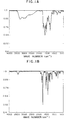
- Fig. 1A and Fig. 1B show the infrared absorption spectra for identifying the polyimide having a carbazole skeleton derived in Example 1, wherein Fig. 1A indicates the spectrum of the polyamic acid before imidation, and Fig. 1B indicates the spectrum after the imidation.
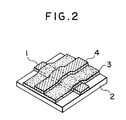
- Fig. 2 is a schematic illustration of a photoconductive device of the present invention.
- the inventors of the present invention as the result of comprehensive investigation to introduce a photoconductive organic moiety into a polymer to achieve satisfactory heat resistance and environmental stability, have found that a combination of an imide linkage and a carbazole unit gives a superior organic photoconductive polymer.
- the present invention provides a polyimide type compound (hereinafter referred to as "the polyimide”) which comprises a polymer having a carbazole skeleton and an imide linkage in the repeating unit, and which has electroconductivity.
- the polyimide a polyimide type compound which comprises a polymer having a carbazole skeleton and an imide linkage in the repeating unit, and which has electroconductivity.
- the carbazole skeleton may form a complex such as a charge-transfer complex with an electron-accepting organic compound, or may have a substituent such as an alkyl group. At least one imide linkage should be present in the repeating unit.
- the polyimide is a polymer having the repeating unit represented by the general formula (1) below: wherein R 1 is a tetravalent organic group having 5 to 13 carbons.
- the repeating unit may be other than that represented by the general formula (1), including polyamideimides, polyimides, and the like having an amide linkage, an ether linkage, thioether linkage, and etc. which have a carbazole moiety introduced therein.
- the group R 1 in the general formula (1) is a tatravalent organic group having 5 to 13 carbons, including those having aromatic rings such as and the like, cyclic hydrocarbon groups such as acyclic hydrocarbon groups such as hexamethylenediamine, among which cyclic hydrocarbons are preferable.
- cyclic hydrocarbon groups such as acyclic hydrocarbon groups such as hexamethylenediamine, among which cyclic hydrocarbons are preferable.
- the polyimide is constituted of the compound with the carbon number outside the range specified above, the heat resistance will be somewhat impaired.
- the group having an aromatic ring is more preferable for improvement of the heat resistance.
- Particularly preferable are the groups below:
- the polyimide constituted of the repeating unit of such a structure have a decomposition temperature exceeding 300°C, thereby exhibiting superior heat resistance.
- the polyimides containing an imide linkage in the repeating unit are superior in environmental resistance such as heat resistance, solvent resistance, and the like.
- the stability is ascribable to the skeleton structure of the polyimide which restricts the degree of freedom of the molecular chain movement to raise the melting point, thereby giving high heat resistance.
- carbazole is a fused ring type hydrocarbon, its structure is plane, so that the degree of freedom of movement of the molecules of the polyimide is not increased by introduction of a carbazole ring, and is kept at the same level as of ordinary polyimides. Therefore the introduction of carbazole rings into the main chain of the polyimide does not impair the heat resistance of the polyimide.
- the introduction of a carbazole ring does not impair the superior environmental stability of common polyimides such as solvent resistance.
- the polyimide containing the carbazole skeleton exhibits characteristics in both a polyimide compound and a carbazole skeleton.
- the above-described polyimide used in the present invention and having a carbazole skeleton in the repeating unit is obtainable in principle by dehydrating a polyamic acid or a polyamic acid derivative to cause ring closure.
- diaminocarbazole as a starting material is reacted with a tetracarboxylic anhydride such as pyromellitic anhydride to cause polyaddition to form a polyamic acid as a precursor of the polyimide, and the polyamic acid is treated chemically or by heating to form the polyimide having the repeating unit of the general formula (1).
- the derived polyamic acid is mixed with an organic compound having an amino group such as N,N-dimethylhexadecyl amine to form a polyamic acid salt, which is then treated in the same manner as in imidation of the polyamic acid to form the polyimide having the repeating unit of the general formula (1).
- an organic compound having an amino group such as N,N-dimethylhexadecyl amine
- diaminocarbazole is reacted with dialkyl tetracarboxylate such as pyromellitic acid distearyl ester dichloride to cause polyaddition to form a polyamic ester, which is converted to the polyimide in the same manner as above.
- dialkyl tetracarboxylate such as pyromellitic acid distearyl ester dichloride
- the polyaddition reaction can be conducted in a known method.
- the polyimide having an imide linkage in the repeating unit can be formed by polymerization reaction with diaminocarbazole.
- a solution of a polyamic acid which is the precursor of the above-mentioned polyimide is applied on the substrate, and dried, and then subjected to imidation treatment to form a thin film of the polyimide.
- the polyamic acid solution may be applied on a substrate by any procedure, insofar as a thin film can be formed, including spin coating, spreading, the Langmuir-Blodgett method, and the like.
- the Langmuir-Blodgett method (or simply the LB method), which builds up a monomolecular layer one by one, is particularly preferable in view of controllability of the thickness and the smoothness of the film.
- the film thickness is selected depending on the use of the film, generally in the range of from several tens to several ten-thousands of angstroms.
- the reaction is conducted at a temperature of from 150°C to 300°C for a predetermined time.
- the imidation by chemical treatment is conducted by drying the applied coating film and subsequently immersing it in a solution which can dehydrate the film-constituting material to cause ring closure.
- the imidation method is not limited to these methods, but can be any known technique.
- a solution of a polyamic acid having the repeating unit represented by the general formula where R 2 is a tetravalent organic group having 5 to 13 carbons is applied on a substrate, and dried, and is imidated.
- the group R 2 herein corresponds to the aforementioned group R 1 .
- an element can be prepared which has superior environmental stability such as heat resistance and solvent resistance.
- the heat stability exceeds 300°C.
- the thin polyimide film is expected to exhibit a photoelectro-transducing efficiency at the same level as that of a polyvinylcarbazole, and its thin film workability is satisfactory.
- the film doped with iodine or the like and the same film dopant-free are built up into a laminated structure.
- the materials for the substrate useful in the present invention include light-transmissive substances such as glass, quartz, and the like.
- the electrodes which are means for applying a voltage or means for outputting the generated electric current, may be of various types, including one pair of an upper electrode and a lower electrode sandwiching the aforementioned film therebetween, or the like.
- the type of electrode may be suitably selected depending on the use and the shape of the element.
- the lower electrode may be a vapor-deposited aluminum film of from 30 to 300 nm thick, or the like.
- the upper electrode may be a vapor-deposited film of ITO or aluminum of 30 nm thick or less, or the like.
- the electrode may be in a shape of layers, stripes, or dots.
- the substrate and the electrodes may be prepared by a conventional method for the element of the present invention.
- the content of the flask was stirred for one hour at room temperature to prepare a solution of a polyamic acid having a carbazole skeleton in dimethylacetamide.
- the intrinsic viscosity of the product was 0.5.
- the DSC thermal analysis of the polymer deposited from the solution showed an endothermal peak of imidation at 130°C, and an exothermal peak of heat decomposition at above 340°C.
- This solution was applied on a silicon substrate by spin coating, and the solvent was evaporated off.
- the resulting film was heated at 300°C for one hour to cause imidation.
- the film thickness was controlled to be 0.5 ⁇ m.
- Fig. 1A shows the infrared spectrum of the polyamic acid before imidation
- Fig. 1B shows the spectrum after the imidation by heat treatment.
- the absorption peak of 1720 cm -1 is assigned to the imide ring of pyromellitic acid
- the absorption peaks of 1490 cm -1 and 3400 cm -1 are assigned to carbazole.
- the content of the flask was stirred for one hour at room temperature to prepare a solution of a polyamic acid having a carbazole skeleton in dimethylacetamide.
- the intrinsic viscosity of the product was 0.5.
- This solution was applied on a silicon substrate by spin coating. After evaporation of the solvent, the film on the substrate was immersed into a mixed solution consisting of benzene, pyridine, and acetic anhydride at a mixing ratio of 3:1:1 to cause imidation. The imidation proceeded similarly as in Example 1.
- the film thickness was controlled to be at 0.5 ⁇ m.
- the thermal property was the same as in Example 1.
- the polyimides were prepared in the same manner as in Example 1 except that the imidation conditions and the tetracarboxylic anhydride employed were as shown in Table 1. The results are shown in Table 1. The polyimides all exhibited high decomposition temperature and superior heat resistance.
- a device as shown in Fig. 2 was prepared.
- the polyamic acid solution used in Example 1 was applied by spin coating on a glass substrate 2 having a light-transmissive electrode (ITO) 1 in stripe shape of 1 mm in width.
- the solvent was evaporated off.
- the coated film was heated at 300°C for one hour to cause imidation.
- the thickness of the film 3 was controlled to be 0.5 ⁇ m.
- an aluminum electrode 4 of 1 mm in width was formed in the direction perpendicular to the light transmissive electrode in a thickness of 100 nm by a resistance-heating method (refer to Fig. 2).
- a polyamic acid monomolecular built-up film from 78 layers was formed on a glass substrate having a light-transmissive electrode (ITO) in stripe shape of 1 mm in width and treated for hydrophobicity with a silane-coupling agent.
- the built-up film was heated at 300°C for one hour to cause imidation and to form a photoconductive thin film.
- the film thickness was 48 nm.
- the polyamic acid built-up film was formed according to the procedure below.
- the polyamic acid solution used in Example 1 was diluted with dimethylacetamide (DMAC) to a concentration of 1 ⁇ 10 -3 mol/l in terms of the monomer concentration.
- DMAC dimethylacetamide
- N,N-dimethylhexadecylamine was mixed at a ratio of 2 relative to one equivalent of the repeating unit of polyamic acid to prepare a solution of a salt of polyamic acid-N,N-dimethylhexadecylamine.
- This solution was spread over pure water at temperature of 20°C to form a monomolecular film on the water surface.
- the surface pressure was raised to 25 mN.
- the aforementioned glass substrate having the electrode was dipped and lifted in a direction of crossing the water surface at a rate of 5 mm/min. By repeating this operation, a built-up film was prepared in 78 monomolecular layers.
- an aluminum electrode of 1 mm in width was formed in the direction perpendicular to the light transmissive electrode in a thickness of 100 nm by a resistance-heating method.
- the polyimides employed were derived by polymerizing diaminocarbazole with the organic compound shown in the column of Acid anhydride in Table 2, and were formed into a thin film on a silicon substrate by the method shown in Table 2. Heat treatment was conducted by heating at 300°C for one hour.
- the test specimens for measurment of the photoconductive properties were provided with an upper electrode of Al (100 nm) and a lower electrode of ITO (500 nm).
- the results are shown in Table 2.
- the resulting polyimide had a high decomposition temperature and deterioration of the photoconductive properties was not observed by further heat treatment at 300°C for one hour.
- a solution of polyvinylcarbazole was applied by spin coating on a glass substrate having a light-transmissive electrode (ITO) in stripe shape of 1 mm in width and having been treated for hydrophobicity with a silane coupling agent.
- the solvent was evaporated off by heating in an oven at 150°C for one hour.
- the thickness of the film was approximately 1 ⁇ m.
- an aluminum electrode of 1 mm in width was formed in the direction perpendicular to the light transmissive electrode in a thickness of 100 nm by a resistance-heating method.
- the photoconductive polyimide compound of the present invention is superior in photoconductivity and heat resistance as well as workability, and enables production of photoelecto-transducing device employing an organic material which was difficult until now.
- the polyimide compound is prepared by a simple operation.
- the present invention is greatly usful practically.
- the photoconductive device comprising the above compound of the present invention enables production of a photoelectro-transducing device extremely superior in heat resistance by using an organic material which has not been readily achievable until now, and the device can be formed in a simple manner. Therefore the present invention is significantly useful from a practical point of view.
Landscapes
- Chemical & Material Sciences (AREA)
- Materials Engineering (AREA)
- Engineering & Computer Science (AREA)
- Physics & Mathematics (AREA)
- Spectroscopy & Molecular Physics (AREA)
- Health & Medical Sciences (AREA)
- Chemical Kinetics & Catalysis (AREA)
- Medicinal Chemistry (AREA)
- Polymers & Plastics (AREA)
- Organic Chemistry (AREA)
- Electromagnetism (AREA)
- Macromolecular Compounds Obtained By Forming Nitrogen-Containing Linkages In General (AREA)
- Photovoltaic Devices (AREA)
- Polymers With Sulfur, Phosphorus Or Metals In The Main Chain (AREA)
Claims (7)
- Photoleitfähige Vorrichtung, welche einen organischen Film umfaßt, der zwischen einem Paar Elektroden gehalten ist, wobei der organische Film ein Polymer umfaßt, dessen Grundeinheiten ein Carbazolgerüst und eine Imidverknüpfung enthalten.
- Vorrichtung nach Anspruch 1, wobei die Grundeinheiten durch die allgemeine Formel

- Vorrichtung nach Anspruch 2, wobei R1 in der in Anspruch 2 aufgeführten allgemeinen Formel eine tetravalente cyclische Kohlenwasserstoffgruppe ist, die 5 bis 13 Kohlenstoffatome enthält.
- Vorrichtung nach Anspruch 3, wobei die Gruppe R1 in der in Anspruch 2 aufgeführten Formel eine der folgenden Gruppen ist:

- Vorrichtung nach einem der Ansprüche 1 bis 4, wobei der organische Film aus einer Vielzahl von monomolekularen Schichten des Polymers aufgebaut ist.
- Vorrichtung nach einem der Ansprüche 1 bis 5, wobei das Polymer eine Zersetzungstemperatur hat, die nicht unter 300°C liegt.
- Vorrichtung nach einem der Ansprüche 1 bis 6, wobei mindestens eine des Paars von Elektroden lichtdurchlässig ist.
Applications Claiming Priority (8)
| Application Number | Priority Date | Filing Date | Title |
|---|---|---|---|
| JP9323490 | 1990-04-10 | ||
| JP93234/90 | 1990-04-10 | ||
| JP9408690 | 1990-04-11 | ||
| JP9408790 | 1990-04-11 | ||
| JP94086/90 | 1990-04-11 | ||
| JP94087/90 | 1990-04-11 | ||
| JP53255/91 | 1991-02-26 | ||
| JP3053255A JPH04213326A (ja) | 1990-04-10 | 1991-02-26 | ポリイミド化合物、該化合物を有した有機膜および該有機膜を有した光導電性素子 |
Publications (2)
| Publication Number | Publication Date |
|---|---|
| EP0452078A1 EP0452078A1 (de) | 1991-10-16 |
| EP0452078B1 true EP0452078B1 (de) | 1997-01-08 |
Family
ID=27462881
Family Applications (1)
| Application Number | Title | Priority Date | Filing Date |
|---|---|---|---|
| EP91303100A Expired - Lifetime EP0452078B1 (de) | 1990-04-10 | 1991-04-09 | Photoleitfähige Vorrichtung bestehend aus einem organischen Polymidfilm |
Country Status (4)
| Country | Link |
|---|---|
| US (1) | US5158619A (de) |
| EP (1) | EP0452078B1 (de) |
| CA (1) | CA2039945C (de) |
| DE (1) | DE69123994T2 (de) |
Families Citing this family (13)
| Publication number | Priority date | Publication date | Assignee | Title |
|---|---|---|---|---|
| WO1994017556A1 (en) * | 1993-01-26 | 1994-08-04 | Fci-Fiberchem, Inc. | Optical sensor with electroluminescent light source and polymer light detector |
| EP0740216A3 (de) * | 1995-04-24 | 1997-10-22 | Canon Kk | Polymer, elektrophotographisches lichtempfindliches Element und dieses Polymer einsetzende elektroluminisierende Vorrichtung, Prozesskassette und elektrophotographisches Apparat unter Verwendung des elektrophotographischen, lichtempfindlichen Elementes |
| DE19533850A1 (de) * | 1995-09-13 | 1997-03-27 | Hoechst Ag | Photovoltaische Zelle |
| JP4419264B2 (ja) * | 2000-03-31 | 2010-02-24 | ソニー株式会社 | 固体撮像装置 |
| JP4013052B2 (ja) * | 2002-09-25 | 2007-11-28 | 日産化学工業株式会社 | 液晶配向処理剤および液晶表示素子 |
| US20060142538A1 (en) * | 2002-12-11 | 2006-06-29 | Nissan Chemical Industries, Ltd. | Liquid crystal orientating agent and liquid crystal display element using it |
| US7201967B2 (en) * | 2003-11-28 | 2007-04-10 | Canon Kabushiki Kaisha | Electrophotographic endless belt, process for producing electrophotographic endless belt, and electrophotographic apparatus |
| US7466376B2 (en) * | 2005-03-22 | 2008-12-16 | Konarka Technologies, Inc. | Photovoltaic cell |
| JP4902810B1 (ja) | 2010-10-04 | 2012-03-21 | キヤノン株式会社 | 帯電部材、プロセスカートリッジ及び電子写真装置 |
| CN103980493A (zh) * | 2014-05-30 | 2014-08-13 | 北京化工大学常州先进材料研究院 | 可用于柔性高密度信息存储材料的异构化聚酰亚胺及其制备 |
| CN105601917A (zh) * | 2015-11-10 | 2016-05-25 | 江苏爱姆欧光电材料有限公司 | 一种可溶性聚酰亚胺及其制备方法 |
| CN106146839B (zh) * | 2016-07-04 | 2018-05-22 | 北京化工大学常州先进材料研究院 | 信息存储性能可调的可溶性含脂肪链聚酰亚胺 |
| CN113045755B (zh) * | 2021-03-19 | 2023-03-17 | 深圳清荷科技有限公司 | 取向膜材料、液晶取向剂、液晶取向膜以及液晶显示元件 |
Family Cites Families (2)
| Publication number | Priority date | Publication date | Assignee | Title |
|---|---|---|---|---|
| US4060426A (en) * | 1974-07-02 | 1977-11-29 | Polaroid Corporation | Tin indium oxide and polyvinylcarbazole layered polarized photovoltaic cell |
| US4127738A (en) * | 1976-07-06 | 1978-11-28 | Exxon Research & Engineering Company | Photovoltaic device containing an organic layer |
-
1991
- 1991-04-08 CA CA002039945A patent/CA2039945C/en not_active Expired - Fee Related
- 1991-04-09 US US07/682,371 patent/US5158619A/en not_active Expired - Fee Related
- 1991-04-09 DE DE69123994T patent/DE69123994T2/de not_active Expired - Fee Related
- 1991-04-09 EP EP91303100A patent/EP0452078B1/de not_active Expired - Lifetime
Also Published As
| Publication number | Publication date |
|---|---|
| DE69123994T2 (de) | 1997-05-15 |
| US5158619A (en) | 1992-10-27 |
| CA2039945C (en) | 1996-07-30 |
| EP0452078A1 (de) | 1991-10-16 |
| DE69123994D1 (de) | 1997-02-20 |
| CA2039945A1 (en) | 1991-10-11 |
Similar Documents
| Publication | Publication Date | Title |
|---|---|---|
| US5486442A (en) | Organic polymer and preparation and use in crystal spatial light modulator | |
| Eldo et al. | New low band gap polymers: control of optical and electronic properties in near infrared absorbing π-conjugated polysquaraines | |
| Wang et al. | Nonvolatile electrical switching and write-once read-many-times memory effects in functional polyimides containing triphenylamine and 1, 3, 4-oxadiazole moieties | |
| US5158619A (en) | Photoconductive device comprising polyimide film | |
| EP0246602B1 (de) | Anordnung mit Polymer-Dünnschicht | |
| Fulghum et al. | Conjugated poly (phenylacetylene) films cross-linked with electropolymerized polycarbazole precursors | |
| US4828917A (en) | Layer of metallomacrocyclic polymer on substrate | |
| US4910293A (en) | Langmuir-Blodgett films of polymers having pendent C10 -C30 hydrocarbon groups | |
| Li et al. | Synthesis and memory characteristics of highly organo-soluble polyimides bearing a noncoplanar twisted biphenyl unit containing aromatic side-chain groups | |
| Zheng et al. | Preparation and multifunction of electrochromic polyamides containing flexible backbone chains with electrochemical, fluorescence and memory properties | |
| US5798197A (en) | Use of low molecular-weight or polymeric organic compounds which are present in the columnar-helical phase and have liquid-crystalline properties | |
| Van Den Eede et al. | Controlled synthesis and supramolecular organization of conjugated star-shaped polymers | |
| Wang et al. | Enhanced redox stability and electrochromic properties of aromatic polyamides based on N, N‐bis (4‐carboxyphenyl)‐N′, N′‐bis (4‐tert‐butylphenyl)‐1, 4‐phenylenediamine | |
| Naarmann | Synthesis, Properties and Applications of Perconjugated Systems | |
| Yang et al. | Organo‐Solubility Carbazole‐Containing Polyimides with Tunable Memory Characteristics Based on Different Dianhydride Moieties | |
| Schwartz et al. | Synthesis, characterization, and surface initiated polymerization of carbazole functionalized isocyanides | |
| Damaceanu et al. | Six-member polyimides incorporating redox chromophores | |
| US4886685A (en) | Layer elements and their production | |
| JPH04213326A (ja) | ポリイミド化合物、該化合物を有した有機膜および該有機膜を有した光導電性素子 | |
| Zhao et al. | Luminescence performance of poly (aryl ether) s membranes with different morphologies | |
| Constantin et al. | Advanced materials based on new structurally designed poly (naphthylimide‐amide) s | |
| Tsunoda et al. | Synthesis of Triphenylamine-Based Hyper-Branched Polymers via Cobalt-Catalyzed [2+ 2+ 2] Cycloaddition Polymerization of Alkynes and Their Conductive Properties | |
| Wu et al. | Synthesis and Optoelectronic Characterizations of Conjugated Polymers Based on Diketopyrrolopyrrole and 2, 2′‐(thieno [3, 2‐b] thiophene‐2, 5‐diyl) diacetonitrile Via Knoevenagel Condensation | |
| Hung et al. | Crosslinkable high dielectric constant polymer dielectrics for low voltage organic field‐effect transistor memory devices | |
| Li et al. | Resistive switching characteristics of polyimides derived from 2, 2′‐aryl substituents tetracarboxylic dianhydrides |
Legal Events
| Date | Code | Title | Description |
|---|---|---|---|
| PUAI | Public reference made under article 153(3) epc to a published international application that has entered the european phase |
Free format text: ORIGINAL CODE: 0009012 |
|
| AK | Designated contracting states |
Kind code of ref document: A1 Designated state(s): BE CH DE ES FR GB IT LI NL SE |
|
| 17P | Request for examination filed |
Effective date: 19920309 |
|
| 17Q | First examination report despatched |
Effective date: 19940922 |
|
| GRAG | Despatch of communication of intention to grant |
Free format text: ORIGINAL CODE: EPIDOS AGRA |
|
| GRAH | Despatch of communication of intention to grant a patent |
Free format text: ORIGINAL CODE: EPIDOS IGRA |
|
| GRAH | Despatch of communication of intention to grant a patent |
Free format text: ORIGINAL CODE: EPIDOS IGRA |
|
| GRAA | (expected) grant |
Free format text: ORIGINAL CODE: 0009210 |
|
| AK | Designated contracting states |
Kind code of ref document: B1 Designated state(s): BE CH DE ES FR GB IT LI NL SE |
|
| PG25 | Lapsed in a contracting state [announced via postgrant information from national office to epo] |
Ref country code: IT Free format text: LAPSE BECAUSE OF FAILURE TO SUBMIT A TRANSLATION OF THE DESCRIPTION OR TO PAY THE FEE WITHIN THE PRE;WARNING: LAPSES OF ITALIAN PATENTS WITH EFFECTIVE DATE BEFORE 2007 MAY HAVE OCCURRED AT ANY TIME BEFORE 2007. THE CORRECT EFFECTIVE DATE MAY BE DIFFERENT FROM THE ONE RECORDED.SCRIBED TIME-LIMIT Effective date: 19970108 Ref country code: ES Free format text: THE PATENT HAS BEEN ANNULLED BY A DECISION OF A NATIONAL AUTHORITY Effective date: 19970108 Ref country code: CH Effective date: 19970108 Ref country code: LI Effective date: 19970108 Ref country code: NL Free format text: LAPSE BECAUSE OF FAILURE TO SUBMIT A TRANSLATION OF THE DESCRIPTION OR TO PAY THE FEE WITHIN THE PRESCRIBED TIME-LIMIT Effective date: 19970108 Ref country code: BE Effective date: 19970108 |
|
| REG | Reference to a national code |
Ref country code: CH Ref legal event code: EP |
|
| REF | Corresponds to: |
Ref document number: 69123994 Country of ref document: DE Date of ref document: 19970220 |
|
| ET | Fr: translation filed | ||
| PG25 | Lapsed in a contracting state [announced via postgrant information from national office to epo] |
Ref country code: SE Effective date: 19970408 |
|
| NLV1 | Nl: lapsed or annulled due to failure to fulfill the requirements of art. 29p and 29m of the patents act | ||
| REG | Reference to a national code |
Ref country code: CH Ref legal event code: PL |
|
| PLBE | No opposition filed within time limit |
Free format text: ORIGINAL CODE: 0009261 |
|
| STAA | Information on the status of an ep patent application or granted ep patent |
Free format text: STATUS: NO OPPOSITION FILED WITHIN TIME LIMIT |
|
| 26N | No opposition filed | ||
| REG | Reference to a national code |
Ref country code: GB Ref legal event code: IF02 |
|
| PGFP | Annual fee paid to national office [announced via postgrant information from national office to epo] |
Ref country code: GB Payment date: 20030326 Year of fee payment: 13 |
|
| PGFP | Annual fee paid to national office [announced via postgrant information from national office to epo] |
Ref country code: FR Payment date: 20030422 Year of fee payment: 13 |
|
| PGFP | Annual fee paid to national office [announced via postgrant information from national office to epo] |
Ref country code: DE Payment date: 20030424 Year of fee payment: 13 |
|
| PG25 | Lapsed in a contracting state [announced via postgrant information from national office to epo] |
Ref country code: GB Free format text: LAPSE BECAUSE OF NON-PAYMENT OF DUE FEES Effective date: 20040409 |
|
| PG25 | Lapsed in a contracting state [announced via postgrant information from national office to epo] |
Ref country code: DE Free format text: LAPSE BECAUSE OF NON-PAYMENT OF DUE FEES Effective date: 20041103 |
|
| GBPC | Gb: european patent ceased through non-payment of renewal fee |
Effective date: 20040409 |
|
| PG25 | Lapsed in a contracting state [announced via postgrant information from national office to epo] |
Ref country code: FR Free format text: LAPSE BECAUSE OF NON-PAYMENT OF DUE FEES Effective date: 20041231 |
|
| REG | Reference to a national code |
Ref country code: FR Ref legal event code: ST |