EP0452342B1 - Procedes et matieres pour la separation magnetique a gradient eleve de matieres biologiques - Google Patents
Procedes et matieres pour la separation magnetique a gradient eleve de matieres biologiques Download PDFInfo
- Publication number
- EP0452342B1 EP0452342B1 EP90900152A EP90900152A EP0452342B1 EP 0452342 B1 EP0452342 B1 EP 0452342B1 EP 90900152 A EP90900152 A EP 90900152A EP 90900152 A EP90900152 A EP 90900152A EP 0452342 B1 EP0452342 B1 EP 0452342B1
- Authority
- EP
- European Patent Office
- Prior art keywords
- particles
- magnetic
- matrix
- anyone
- materials
- Prior art date
- Legal status (The legal status is an assumption and is not a legal conclusion. Google has not performed a legal analysis and makes no representation as to the accuracy of the status listed.)
- Expired - Lifetime
Links
- 238000000034 method Methods 0.000 title claims abstract description 56
- 239000012620 biological material Substances 0.000 title claims abstract description 45
- 238000007885 magnetic separation Methods 0.000 title claims abstract description 8
- 239000000463 material Substances 0.000 title abstract description 48
- 239000002245 particle Substances 0.000 claims abstract description 162
- 230000005291 magnetic effect Effects 0.000 claims abstract description 108
- 230000005415 magnetization Effects 0.000 claims abstract description 52
- 238000000576 coating method Methods 0.000 claims abstract description 45
- 239000000203 mixture Substances 0.000 claims abstract description 44
- 239000011248 coating agent Substances 0.000 claims abstract description 41
- 238000000926 separation method Methods 0.000 claims abstract description 41
- 230000009870 specific binding Effects 0.000 claims abstract description 28
- 150000004676 glycans Chemical class 0.000 claims abstract description 20
- 229920001282 polysaccharide Polymers 0.000 claims abstract description 20
- 239000005017 polysaccharide Substances 0.000 claims abstract description 20
- 230000000295 complement effect Effects 0.000 claims abstract description 9
- 239000011159 matrix material Substances 0.000 claims description 75
- 238000002360 preparation method Methods 0.000 claims description 26
- 230000000717 retained effect Effects 0.000 claims description 23
- HEMHJVSKTPXQMS-UHFFFAOYSA-M Sodium hydroxide Chemical compound [OH-].[Na+] HEMHJVSKTPXQMS-UHFFFAOYSA-M 0.000 claims description 12
- 230000014759 maintenance of location Effects 0.000 claims description 9
- 238000010828 elution Methods 0.000 claims description 6
- 239000000084 colloidal system Substances 0.000 claims description 4
- 239000006185 dispersion Substances 0.000 claims description 3
- 230000000694 effects Effects 0.000 claims description 3
- 239000011553 magnetic fluid Substances 0.000 claims description 3
- BAUYGSIQEAFULO-UHFFFAOYSA-L iron(2+) sulfate (anhydrous) Chemical compound [Fe+2].[O-]S([O-])(=O)=O BAUYGSIQEAFULO-UHFFFAOYSA-L 0.000 claims 1
- 230000003472 neutralizing effect Effects 0.000 claims 1
- 230000006872 improvement Effects 0.000 abstract description 7
- 229920003023 plastic Polymers 0.000 abstract description 7
- 239000004033 plastic Substances 0.000 abstract description 7
- 238000000746 purification Methods 0.000 abstract description 2
- 210000004027 cell Anatomy 0.000 description 27
- 239000012530 fluid Substances 0.000 description 20
- 239000006249 magnetic particle Substances 0.000 description 20
- 229920000642 polymer Polymers 0.000 description 14
- UQSXHKLRYXJYBZ-UHFFFAOYSA-N Iron oxide Chemical compound [Fe]=O UQSXHKLRYXJYBZ-UHFFFAOYSA-N 0.000 description 12
- YBJHBAHKTGYVGT-ZKWXMUAHSA-N (+)-Biotin Chemical compound N1C(=O)N[C@@H]2[C@H](CCCCC(=O)O)SC[C@@H]21 YBJHBAHKTGYVGT-ZKWXMUAHSA-N 0.000 description 10
- 230000021615 conjugation Effects 0.000 description 10
- 239000000243 solution Substances 0.000 description 10
- 239000000725 suspension Substances 0.000 description 10
- XLYOFNOQVPJJNP-UHFFFAOYSA-N water Substances O XLYOFNOQVPJJNP-UHFFFAOYSA-N 0.000 description 9
- 239000000017 hydrogel Substances 0.000 description 8
- 238000002372 labelling Methods 0.000 description 8
- XEEYBQQBJWHFJM-UHFFFAOYSA-N Iron Chemical compound [Fe] XEEYBQQBJWHFJM-UHFFFAOYSA-N 0.000 description 7
- 230000005294 ferromagnetic effect Effects 0.000 description 7
- 239000007788 liquid Substances 0.000 description 7
- 230000008569 process Effects 0.000 description 7
- -1 steel wool Chemical class 0.000 description 7
- 239000000126 substance Substances 0.000 description 7
- 238000005406 washing Methods 0.000 description 7
- 108090001008 Avidin Proteins 0.000 description 6
- 229910000831 Steel Inorganic materials 0.000 description 6
- 239000000178 monomer Substances 0.000 description 6
- 108090000623 proteins and genes Proteins 0.000 description 6
- 102000004169 proteins and genes Human genes 0.000 description 6
- 239000010959 steel Substances 0.000 description 6
- 239000013077 target material Substances 0.000 description 6
- 210000002268 wool Anatomy 0.000 description 6
- 229920002307 Dextran Polymers 0.000 description 5
- 238000013459 approach Methods 0.000 description 5
- 229960002685 biotin Drugs 0.000 description 5
- 235000020958 biotin Nutrition 0.000 description 5
- 239000011616 biotin Substances 0.000 description 5
- 229920001577 copolymer Polymers 0.000 description 5
- 230000007797 corrosion Effects 0.000 description 5
- 238000005260 corrosion Methods 0.000 description 5
- 239000000835 fiber Substances 0.000 description 5
- 125000000524 functional group Chemical group 0.000 description 5
- 150000002500 ions Chemical class 0.000 description 5
- 230000005298 paramagnetic effect Effects 0.000 description 5
- CDBYLPFSWZWCQE-UHFFFAOYSA-L Sodium Carbonate Chemical compound [Na+].[Na+].[O-]C([O-])=O CDBYLPFSWZWCQE-UHFFFAOYSA-L 0.000 description 4
- UIIMBOGNXHQVGW-UHFFFAOYSA-M Sodium bicarbonate Chemical compound [Na+].OC([O-])=O UIIMBOGNXHQVGW-UHFFFAOYSA-M 0.000 description 4
- 239000006285 cell suspension Substances 0.000 description 4
- 230000008878 coupling Effects 0.000 description 4
- 238000010168 coupling process Methods 0.000 description 4
- 238000005859 coupling reaction Methods 0.000 description 4
- ATDGTVJJHBUTRL-UHFFFAOYSA-N cyanogen bromide Chemical compound BrC#N ATDGTVJJHBUTRL-UHFFFAOYSA-N 0.000 description 4
- QTBSBXVTEAMEQO-UHFFFAOYSA-N Acetic acid Chemical compound CC(O)=O QTBSBXVTEAMEQO-UHFFFAOYSA-N 0.000 description 3
- WEVYAHXRMPXWCK-UHFFFAOYSA-N Acetonitrile Chemical compound CC#N WEVYAHXRMPXWCK-UHFFFAOYSA-N 0.000 description 3
- IAZDPXIOMUYVGZ-UHFFFAOYSA-N Dimethylsulphoxide Chemical compound CS(C)=O IAZDPXIOMUYVGZ-UHFFFAOYSA-N 0.000 description 3
- CWYNVVGOOAEACU-UHFFFAOYSA-N Fe2+ Chemical compound [Fe+2] CWYNVVGOOAEACU-UHFFFAOYSA-N 0.000 description 3
- 210000001744 T-lymphocyte Anatomy 0.000 description 3
- 230000004075 alteration Effects 0.000 description 3
- 230000008901 benefit Effects 0.000 description 3
- 230000015572 biosynthetic process Effects 0.000 description 3
- 238000001212 derivatisation Methods 0.000 description 3
- NAQMVNRVTILPCV-UHFFFAOYSA-N hexane-1,6-diamine Chemical compound NCCCCCCN NAQMVNRVTILPCV-UHFFFAOYSA-N 0.000 description 3
- 230000002209 hydrophobic effect Effects 0.000 description 3
- 230000003993 interaction Effects 0.000 description 3
- 229910052742 iron Inorganic materials 0.000 description 3
- 238000002955 isolation Methods 0.000 description 3
- 239000004922 lacquer Substances 0.000 description 3
- 239000000696 magnetic material Substances 0.000 description 3
- 239000004005 microsphere Substances 0.000 description 3
- 238000002156 mixing Methods 0.000 description 3
- 230000004048 modification Effects 0.000 description 3
- 238000012986 modification Methods 0.000 description 3
- 230000009871 nonspecific binding Effects 0.000 description 3
- 210000003463 organelle Anatomy 0.000 description 3
- XJMOSONTPMZWPB-UHFFFAOYSA-M propidium iodide Chemical compound [I-].[I-].C12=CC(N)=CC=C2C2=CC=C(N)C=C2[N+](CCC[N+](C)(CC)CC)=C1C1=CC=CC=C1 XJMOSONTPMZWPB-UHFFFAOYSA-M 0.000 description 3
- 239000007787 solid Substances 0.000 description 3
- DHMQDGOQFOQNFH-UHFFFAOYSA-N Glycine Chemical compound NCC(O)=O DHMQDGOQFOQNFH-UHFFFAOYSA-N 0.000 description 2
- 108060003951 Immunoglobulin Proteins 0.000 description 2
- 241000700605 Viruses Species 0.000 description 2
- 150000001540 azides Chemical class 0.000 description 2
- 239000002585 base Substances 0.000 description 2
- 230000027455 binding Effects 0.000 description 2
- 230000030833 cell death Effects 0.000 description 2
- 238000005119 centrifugation Methods 0.000 description 2
- 238000006243 chemical reaction Methods 0.000 description 2
- 239000003153 chemical reaction reagent Substances 0.000 description 2
- 238000004132 cross linking Methods 0.000 description 2
- 239000013078 crystal Substances 0.000 description 2
- 238000010790 dilution Methods 0.000 description 2
- 239000012895 dilution Substances 0.000 description 2
- KPUWHANPEXNPJT-UHFFFAOYSA-N disiloxane Chemical class [SiH3]O[SiH3] KPUWHANPEXNPJT-UHFFFAOYSA-N 0.000 description 2
- 230000005307 ferromagnetism Effects 0.000 description 2
- 238000001914 filtration Methods 0.000 description 2
- MHMNJMPURVTYEJ-UHFFFAOYSA-N fluorescein-5-isothiocyanate Chemical compound O1C(=O)C2=CC(N=C=S)=CC=C2C21C1=CC=C(O)C=C1OC1=CC(O)=CC=C21 MHMNJMPURVTYEJ-UHFFFAOYSA-N 0.000 description 2
- 239000012634 fragment Substances 0.000 description 2
- 229920001600 hydrophobic polymer Polymers 0.000 description 2
- 102000018358 immunoglobulin Human genes 0.000 description 2
- 125000005647 linker group Chemical group 0.000 description 2
- 230000005389 magnetism Effects 0.000 description 2
- 239000003550 marker Substances 0.000 description 2
- 239000012528 membrane Substances 0.000 description 2
- 229910052751 metal Inorganic materials 0.000 description 2
- 239000002184 metal Substances 0.000 description 2
- 230000003647 oxidation Effects 0.000 description 2
- 238000007254 oxidation reaction Methods 0.000 description 2
- 239000002907 paramagnetic material Substances 0.000 description 2
- KHIWWQKSHDUIBK-UHFFFAOYSA-N periodic acid Chemical compound OI(=O)(=O)=O KHIWWQKSHDUIBK-UHFFFAOYSA-N 0.000 description 2
- 229920002401 polyacrylamide Polymers 0.000 description 2
- 229920000058 polyacrylate Polymers 0.000 description 2
- 238000006116 polymerization reaction Methods 0.000 description 2
- 235000017557 sodium bicarbonate Nutrition 0.000 description 2
- 229910000030 sodium bicarbonate Inorganic materials 0.000 description 2
- 229910000029 sodium carbonate Inorganic materials 0.000 description 2
- 238000001179 sorption measurement Methods 0.000 description 2
- 239000010935 stainless steel Substances 0.000 description 2
- 229910001220 stainless steel Inorganic materials 0.000 description 2
- NLHHRLWOUZZQLW-UHFFFAOYSA-N Acrylonitrile Chemical compound C=CC#N NLHHRLWOUZZQLW-UHFFFAOYSA-N 0.000 description 1
- 108010088751 Albumins Proteins 0.000 description 1
- 102000009027 Albumins Human genes 0.000 description 1
- VHUUQVKOLVNVRT-UHFFFAOYSA-N Ammonium hydroxide Chemical compound [NH4+].[OH-] VHUUQVKOLVNVRT-UHFFFAOYSA-N 0.000 description 1
- 241000894006 Bacteria Species 0.000 description 1
- ZOXJGFHDIHLPTG-UHFFFAOYSA-N Boron Chemical compound [B] ZOXJGFHDIHLPTG-UHFFFAOYSA-N 0.000 description 1
- BVKZGUZCCUSVTD-UHFFFAOYSA-L Carbonate Chemical compound [O-]C([O-])=O BVKZGUZCCUSVTD-UHFFFAOYSA-L 0.000 description 1
- 206010057248 Cell death Diseases 0.000 description 1
- KCXVZYZYPLLWCC-UHFFFAOYSA-N EDTA Chemical compound OC(=O)CN(CC(O)=O)CCN(CC(O)=O)CC(O)=O KCXVZYZYPLLWCC-UHFFFAOYSA-N 0.000 description 1
- VGGSQFUCUMXWEO-UHFFFAOYSA-N Ethene Chemical class C=C VGGSQFUCUMXWEO-UHFFFAOYSA-N 0.000 description 1
- VTLYFUHAOXGGBS-UHFFFAOYSA-N Fe3+ Chemical compound [Fe+3] VTLYFUHAOXGGBS-UHFFFAOYSA-N 0.000 description 1
- 241000233866 Fungi Species 0.000 description 1
- SXRSQZLOMIGNAQ-UHFFFAOYSA-N Glutaraldehyde Chemical compound O=CCCCC=O SXRSQZLOMIGNAQ-UHFFFAOYSA-N 0.000 description 1
- 239000004471 Glycine Substances 0.000 description 1
- 108090000288 Glycoproteins Proteins 0.000 description 1
- 102000003886 Glycoproteins Human genes 0.000 description 1
- 102000001554 Hemoglobins Human genes 0.000 description 1
- 108010054147 Hemoglobins Proteins 0.000 description 1
- 102000004895 Lipoproteins Human genes 0.000 description 1
- 108090001030 Lipoproteins Proteins 0.000 description 1
- CERQOIWHTDAKMF-UHFFFAOYSA-M Methacrylate Chemical compound CC(=C)C([O-])=O CERQOIWHTDAKMF-UHFFFAOYSA-M 0.000 description 1
- 241001529936 Murinae Species 0.000 description 1
- 239000005062 Polybutadiene Substances 0.000 description 1
- 239000004698 Polyethylene Substances 0.000 description 1
- 239000004743 Polypropylene Substances 0.000 description 1
- 239000004793 Polystyrene Substances 0.000 description 1
- 240000004808 Saccharomyces cerevisiae Species 0.000 description 1
- FAPWRFPIFSIZLT-UHFFFAOYSA-M Sodium chloride Chemical compound [Na+].[Cl-] FAPWRFPIFSIZLT-UHFFFAOYSA-M 0.000 description 1
- 101150052863 THY1 gene Proteins 0.000 description 1
- 108010031650 Thy-1 Antigens Proteins 0.000 description 1
- 241000251539 Vertebrata <Metazoa> Species 0.000 description 1
- 239000002253 acid Substances 0.000 description 1
- 238000001042 affinity chromatography Methods 0.000 description 1
- 150000001299 aldehydes Chemical group 0.000 description 1
- 239000003513 alkali Substances 0.000 description 1
- 229920000180 alkyd Polymers 0.000 description 1
- 229910045601 alloy Inorganic materials 0.000 description 1
- 239000000956 alloy Substances 0.000 description 1
- XYLMUPLGERFSHI-UHFFFAOYSA-N alpha-Methylstyrene Chemical compound CC(=C)C1=CC=CC=C1 XYLMUPLGERFSHI-UHFFFAOYSA-N 0.000 description 1
- 125000003277 amino group Chemical group 0.000 description 1
- 239000000908 ammonium hydroxide Substances 0.000 description 1
- 239000000427 antigen Substances 0.000 description 1
- 102000036639 antigens Human genes 0.000 description 1
- 108091007433 antigens Proteins 0.000 description 1
- 239000007864 aqueous solution Substances 0.000 description 1
- 239000003125 aqueous solvent Substances 0.000 description 1
- 229910001423 beryllium ion Inorganic materials 0.000 description 1
- 239000011230 binding agent Substances 0.000 description 1
- 229910052796 boron Inorganic materials 0.000 description 1
- 239000000872 buffer Substances 0.000 description 1
- MTAZNLWOLGHBHU-UHFFFAOYSA-N butadiene-styrene rubber Chemical compound C=CC=C.C=CC1=CC=CC=C1 MTAZNLWOLGHBHU-UHFFFAOYSA-N 0.000 description 1
- 150000001720 carbohydrates Chemical class 0.000 description 1
- 235000014633 carbohydrates Nutrition 0.000 description 1
- 150000001768 cations Chemical class 0.000 description 1
- 230000001413 cellular effect Effects 0.000 description 1
- 238000012993 chemical processing Methods 0.000 description 1
- 238000013375 chromatographic separation Methods 0.000 description 1
- 230000001268 conjugating effect Effects 0.000 description 1
- 210000004748 cultured cell Anatomy 0.000 description 1
- 230000003247 decreasing effect Effects 0.000 description 1
- 238000010586 diagram Methods 0.000 description 1
- 230000005292 diamagnetic effect Effects 0.000 description 1
- 239000004205 dimethyl polysiloxane Substances 0.000 description 1
- 235000013870 dimethyl polysiloxane Nutrition 0.000 description 1
- 238000006073 displacement reaction Methods 0.000 description 1
- 238000010494 dissociation reaction Methods 0.000 description 1
- 230000005593 dissociations Effects 0.000 description 1
- 238000001035 drying Methods 0.000 description 1
- 230000008030 elimination Effects 0.000 description 1
- 238000003379 elimination reaction Methods 0.000 description 1
- 210000003743 erythrocyte Anatomy 0.000 description 1
- 230000007717 exclusion Effects 0.000 description 1
- 229940044631 ferric chloride hexahydrate Drugs 0.000 description 1
- 229910001447 ferric ion Inorganic materials 0.000 description 1
- 239000003302 ferromagnetic material Substances 0.000 description 1
- 229960002089 ferrous chloride Drugs 0.000 description 1
- 229910001448 ferrous ion Inorganic materials 0.000 description 1
- 238000011049 filling Methods 0.000 description 1
- 238000000684 flow cytometry Methods 0.000 description 1
- 239000007789 gas Substances 0.000 description 1
- 238000001641 gel filtration chromatography Methods 0.000 description 1
- 238000010438 heat treatment Methods 0.000 description 1
- UCNNJGDEJXIUCC-UHFFFAOYSA-L hydroxy(oxo)iron;iron Chemical compound [Fe].O[Fe]=O.O[Fe]=O UCNNJGDEJXIUCC-UHFFFAOYSA-L 0.000 description 1
- 238000003384 imaging method Methods 0.000 description 1
- 238000003018 immunoassay Methods 0.000 description 1
- 238000011065 in-situ storage Methods 0.000 description 1
- NMCUIPGRVMDVDB-UHFFFAOYSA-L iron dichloride Chemical compound Cl[Fe]Cl NMCUIPGRVMDVDB-UHFFFAOYSA-L 0.000 description 1
- 159000000014 iron salts Chemical class 0.000 description 1
- NQXWGWZJXJUMQB-UHFFFAOYSA-K iron trichloride hexahydrate Chemical compound O.O.O.O.O.O.[Cl-].Cl[Fe+]Cl NQXWGWZJXJUMQB-UHFFFAOYSA-K 0.000 description 1
- VBMVTYDPPZVILR-UHFFFAOYSA-N iron(2+);oxygen(2-) Chemical group [O-2].[Fe+2] VBMVTYDPPZVILR-UHFFFAOYSA-N 0.000 description 1
- MVZXTUSAYBWAAM-UHFFFAOYSA-N iron;sulfuric acid Chemical compound [Fe].OS(O)(=O)=O MVZXTUSAYBWAAM-UHFFFAOYSA-N 0.000 description 1
- 239000003446 ligand Substances 0.000 description 1
- 150000002632 lipids Chemical class 0.000 description 1
- 238000005259 measurement Methods 0.000 description 1
- 150000002739 metals Chemical class 0.000 description 1
- MYWUZJCMWCOHBA-VIFPVBQESA-N methamphetamine Chemical compound CN[C@@H](C)CC1=CC=CC=C1 MYWUZJCMWCOHBA-VIFPVBQESA-N 0.000 description 1
- 244000005700 microbiome Species 0.000 description 1
- 239000013081 microcrystal Substances 0.000 description 1
- 229910000403 monosodium phosphate Inorganic materials 0.000 description 1
- 235000019799 monosodium phosphate Nutrition 0.000 description 1
- 238000006386 neutralization reaction Methods 0.000 description 1
- 230000005408 paramagnetism Effects 0.000 description 1
- 239000006223 plastic coating Substances 0.000 description 1
- 229920001084 poly(chloroprene) Polymers 0.000 description 1
- 229920000435 poly(dimethylsiloxane) Polymers 0.000 description 1
- 229920002492 poly(sulfone) Polymers 0.000 description 1
- 229920002239 polyacrylonitrile Polymers 0.000 description 1
- 229920001281 polyalkylene Polymers 0.000 description 1
- 229920002857 polybutadiene Polymers 0.000 description 1
- 229920000515 polycarbonate Polymers 0.000 description 1
- 239000004417 polycarbonate Substances 0.000 description 1
- 229920000728 polyester Polymers 0.000 description 1
- 229920000573 polyethylene Polymers 0.000 description 1
- 229920001195 polyisoprene Polymers 0.000 description 1
- 229920000098 polyolefin Polymers 0.000 description 1
- 229920001155 polypropylene Polymers 0.000 description 1
- 229920001296 polysiloxane Polymers 0.000 description 1
- 229920002223 polystyrene Polymers 0.000 description 1
- 239000004800 polyvinyl chloride Substances 0.000 description 1
- 229920000915 polyvinyl chloride Polymers 0.000 description 1
- 229920000131 polyvinylidene Polymers 0.000 description 1
- 229920006214 polyvinylidene halide Polymers 0.000 description 1
- 230000001376 precipitating effect Effects 0.000 description 1
- 125000002924 primary amino group Chemical group [H]N([H])* 0.000 description 1
- 238000000159 protein binding assay Methods 0.000 description 1
- 238000011084 recovery Methods 0.000 description 1
- 238000004064 recycling Methods 0.000 description 1
- 230000009467 reduction Effects 0.000 description 1
- 229920005989 resin Polymers 0.000 description 1
- 239000011347 resin Substances 0.000 description 1
- 150000003839 salts Chemical class 0.000 description 1
- 239000004447 silicone coating Substances 0.000 description 1
- 239000011780 sodium chloride Substances 0.000 description 1
- AJPJDKMHJJGVTQ-UHFFFAOYSA-M sodium dihydrogen phosphate Chemical compound [Na+].OP(O)([O-])=O AJPJDKMHJJGVTQ-UHFFFAOYSA-M 0.000 description 1
- 239000002904 solvent Substances 0.000 description 1
- 125000006850 spacer group Chemical group 0.000 description 1
- 210000004989 spleen cell Anatomy 0.000 description 1
- 238000003756 stirring Methods 0.000 description 1
- 239000000758 substrate Substances 0.000 description 1
- 150000003505 terpenes Chemical class 0.000 description 1
- 125000003396 thiol group Chemical group [H]S* 0.000 description 1
- 229910052723 transition metal Inorganic materials 0.000 description 1
- 150000003624 transition metals Chemical class 0.000 description 1
- 229960001005 tuberculin Drugs 0.000 description 1
Images


Classifications
-
- G—PHYSICS
- G01—MEASURING; TESTING
- G01N—INVESTIGATING OR ANALYSING MATERIALS BY DETERMINING THEIR CHEMICAL OR PHYSICAL PROPERTIES
- G01N33/00—Investigating or analysing materials by specific methods not covered by groups G01N1/00 - G01N31/00
- G01N33/48—Biological material, e.g. blood, urine; Haemocytometers
- G01N33/50—Chemical analysis of biological material, e.g. blood, urine; Testing involving biospecific ligand binding methods; Immunological testing
- G01N33/53—Immunoassay; Biospecific binding assay; Materials therefor
- G01N33/543—Immunoassay; Biospecific binding assay; Materials therefor with an insoluble carrier for immobilising immunochemicals
- G01N33/54313—Immunoassay; Biospecific binding assay; Materials therefor with an insoluble carrier for immobilising immunochemicals the carrier being characterised by its particulate form
- G01N33/54326—Magnetic particles
- G01N33/5434—Magnetic particles using magnetic particle immunoreagent carriers which constitute new materials per se
-
- B—PERFORMING OPERATIONS; TRANSPORTING
- B03—SEPARATION OF SOLID MATERIALS USING LIQUIDS OR USING PNEUMATIC TABLES OR JIGS; MAGNETIC OR ELECTROSTATIC SEPARATION OF SOLID MATERIALS FROM SOLID MATERIALS OR FLUIDS; SEPARATION BY HIGH-VOLTAGE ELECTRIC FIELDS
- B03C—MAGNETIC OR ELECTROSTATIC SEPARATION OF SOLID MATERIALS FROM SOLID MATERIALS OR FLUIDS; SEPARATION BY HIGH-VOLTAGE ELECTRIC FIELDS
- B03C1/00—Magnetic separation
- B03C1/002—High gradient magnetic separation
-
- B—PERFORMING OPERATIONS; TRANSPORTING
- B03—SEPARATION OF SOLID MATERIALS USING LIQUIDS OR USING PNEUMATIC TABLES OR JIGS; MAGNETIC OR ELECTROSTATIC SEPARATION OF SOLID MATERIALS FROM SOLID MATERIALS OR FLUIDS; SEPARATION BY HIGH-VOLTAGE ELECTRIC FIELDS
- B03C—MAGNETIC OR ELECTROSTATIC SEPARATION OF SOLID MATERIALS FROM SOLID MATERIALS OR FLUIDS; SEPARATION BY HIGH-VOLTAGE ELECTRIC FIELDS
- B03C1/00—Magnetic separation
- B03C1/005—Pretreatment specially adapted for magnetic separation
- B03C1/01—Pretreatment specially adapted for magnetic separation by addition of magnetic adjuvants
-
- B—PERFORMING OPERATIONS; TRANSPORTING
- B03—SEPARATION OF SOLID MATERIALS USING LIQUIDS OR USING PNEUMATIC TABLES OR JIGS; MAGNETIC OR ELECTROSTATIC SEPARATION OF SOLID MATERIALS FROM SOLID MATERIALS OR FLUIDS; SEPARATION BY HIGH-VOLTAGE ELECTRIC FIELDS
- B03C—MAGNETIC OR ELECTROSTATIC SEPARATION OF SOLID MATERIALS FROM SOLID MATERIALS OR FLUIDS; SEPARATION BY HIGH-VOLTAGE ELECTRIC FIELDS
- B03C1/00—Magnetic separation
- B03C1/02—Magnetic separation acting directly on the substance being separated
- B03C1/025—High gradient magnetic separators
- B03C1/031—Component parts; Auxiliary operations
- B03C1/033—Component parts; Auxiliary operations characterised by the magnetic circuit
- B03C1/0332—Component parts; Auxiliary operations characterised by the magnetic circuit using permanent magnets
-
- B—PERFORMING OPERATIONS; TRANSPORTING
- B03—SEPARATION OF SOLID MATERIALS USING LIQUIDS OR USING PNEUMATIC TABLES OR JIGS; MAGNETIC OR ELECTROSTATIC SEPARATION OF SOLID MATERIALS FROM SOLID MATERIALS OR FLUIDS; SEPARATION BY HIGH-VOLTAGE ELECTRIC FIELDS
- B03C—MAGNETIC OR ELECTROSTATIC SEPARATION OF SOLID MATERIALS FROM SOLID MATERIALS OR FLUIDS; SEPARATION BY HIGH-VOLTAGE ELECTRIC FIELDS
- B03C1/00—Magnetic separation
- B03C1/02—Magnetic separation acting directly on the substance being separated
- B03C1/025—High gradient magnetic separators
- B03C1/031—Component parts; Auxiliary operations
- B03C1/033—Component parts; Auxiliary operations characterised by the magnetic circuit
- B03C1/034—Component parts; Auxiliary operations characterised by the magnetic circuit characterised by the matrix elements
-
- G—PHYSICS
- G01—MEASURING; TESTING
- G01N—INVESTIGATING OR ANALYSING MATERIALS BY DETERMINING THEIR CHEMICAL OR PHYSICAL PROPERTIES
- G01N2400/00—Assays, e.g. immunoassays or enzyme assays, involving carbohydrates
- G01N2400/10—Polysaccharides, i.e. having more than five saccharide radicals attached to each other by glycosidic linkages; Derivatives thereof, e.g. ethers, esters
- G01N2400/12—Homoglycans, i.e. polysaccharides having a main chain consisting of one single sugar
- G01N2400/14—Homoglycans, i.e. polysaccharides having a main chain consisting of one single sugar alpha-D-Glucans, i.e. having alpha 1,n (n=3,4,6) linkages between saccharide units, e.g. pullulan
- G01N2400/22—Dextran
-
- G—PHYSICS
- G01—MEASURING; TESTING
- G01N—INVESTIGATING OR ANALYSING MATERIALS BY DETERMINING THEIR CHEMICAL OR PHYSICAL PROPERTIES
- G01N2446/00—Magnetic particle immunoreagent carriers
- G01N2446/20—Magnetic particle immunoreagent carriers the magnetic material being present in the particle core
-
- G—PHYSICS
- G01—MEASURING; TESTING
- G01N—INVESTIGATING OR ANALYSING MATERIALS BY DETERMINING THEIR CHEMICAL OR PHYSICAL PROPERTIES
- G01N2446/00—Magnetic particle immunoreagent carriers
- G01N2446/30—Magnetic particle immunoreagent carriers the magnetic material being dispersed in the polymer composition before their conversion into particulate form
-
- G—PHYSICS
- G01—MEASURING; TESTING
- G01N—INVESTIGATING OR ANALYSING MATERIALS BY DETERMINING THEIR CHEMICAL OR PHYSICAL PROPERTIES
- G01N2446/00—Magnetic particle immunoreagent carriers
- G01N2446/80—Magnetic particle immunoreagent carriers characterised by the agent used to coat the magnetic particles, e.g. lipids
- G01N2446/90—Magnetic particle immunoreagent carriers characterised by the agent used to coat the magnetic particles, e.g. lipids characterised by small molecule linker used to couple immunoreagents to magnetic particles
-
- Y—GENERAL TAGGING OF NEW TECHNOLOGICAL DEVELOPMENTS; GENERAL TAGGING OF CROSS-SECTIONAL TECHNOLOGIES SPANNING OVER SEVERAL SECTIONS OF THE IPC; TECHNICAL SUBJECTS COVERED BY FORMER USPC CROSS-REFERENCE ART COLLECTIONS [XRACs] AND DIGESTS
- Y10—TECHNICAL SUBJECTS COVERED BY FORMER USPC
- Y10S—TECHNICAL SUBJECTS COVERED BY FORMER USPC CROSS-REFERENCE ART COLLECTIONS [XRACs] AND DIGESTS
- Y10S435/00—Chemistry: molecular biology and microbiology
- Y10S435/803—Physical recovery methods, e.g. chromatography, grinding
Definitions
- the invention relates to the application of high gradient magnetic separation (HGMS) to the separation of biological cells, organelles and other biological materials. Specifically, the invention relates to improvements in particle compositions for association with the subject materials, to improvements in matrices useful in the separation apparatus, to improved separation methods, and to methods to employ magnetic fluids in such separations.
- HGMS high gradient magnetic separation
- High gradient magnetic separation refers to a procedure for selectively retaining magnetic materials in a chamber or column disposed in a magnetic field.
- This technique can also be applied to non-magnetic targets labeled with magnetic particles.
- a target material typically a biological material
- the attachment is generally through association of the target material with a specific binding partner which is conjugated to a coating on the particle which provides a functional group for the conjugation.
- the material of interest thus coupled to a magnetic "label", is suspended in a fluid which is then applied to the chamber.
- the magnetically labeled target is retained in the chamber; if the chamber contains a matrix, it becomes associated with the matrix. Materials which do not have magnetic labels pass through the chamber. The retained materials can then be eluted by changing the strength of, or by eliminating, the magnetic field.
- the magnetic field can be supplied either by a permanent magnet or by an electromagnet.
- the selectivity for a desired target material is supplied by the specific binding-partner conjugated to the magnetic particle.
- the chamber across which the magnetic field is applied is often provided with a matrix of a material of suitable magnetic susceptibility to induce a high magnetic field gradient locally in the chamber in volumes close to the surface of the matrix. This permits the retention of fairly weakly magnetized particles, and the approach is referred to as high gradient magnetic separation (HGMS).
- HGMS high gradient magnetic separation
- U.S. Patent 4,452,773 ('773) describes the preparation of magnetic iron-dextran microspheres and provides a summary of art describing the various means of preparation of particles suitable for attachment to biological materials. As long ago as 1977, preparation of colloidal iron oxide, gamma-irradiated in the presence of hydrophilic and hydrophobic methacrylate monomers, to provide particles for attachment to biological targets through coupling to immunoglobulin was described (Rembaum, A., et al., Nature (1977) 268 :437-438.
- U.S. Patent 4,230,685 describes an improvement in attaching specific binding agents to the magnetic particles wherein a particle coated with an acrylate polymer or a polysaccharide can be linked through, for example, glutaraldehyde to a preparation of protein A which can then selectively bind antibodies through the Fc portion, leaving the immunoreactive Fab regions exposed.
- Albumin rather than polyacrylamide or polysaccharides, is the preferred matrix. A wide size range of particles is disclosed.
- particles of 100-700 angstroms, particularly 300-400 angstroms are intended to be prepared; many of the particles are thus colloidal, and are ferromagnetic with a coating of dextran.
- the resulting particles are described and claimed as discrete colloidal size particles having a ferromagnetic iron oxide core coated with a polysaccharide derivative having pendant functional groups provided by periodate oxidation.
- These particles are prepared by mixing an aqueous solution of a ferrous and ferric salt with a solution of the polysaccharide or polysaccharide derivative. After this mixing, alkali is added to cause the formation of the magnetic iron oxide particles to which the polysaccharide or derivative attaches.
- the resulting particles are separated from excess dextran using gel filtration chromatography. A single peak containing the entire size range of particles is obtained.
- the polysaccharide is then treated to provide the needed functional groups for conjugation to an immunospecific or other specific binding reagent.
- Magnetic particles ferromagnetic particles, superparamagnetic particles and paramagnetic particles.
- Methods to prepare superparamagnetic particles are described in U.S. Patent 4,770,183.
- “Diamagnetic” as used herein, and as a first approximation refers to materials which do not acquire magnetic properties even in the presence of a magnetic field, i.e., they have no appreciable magnetic susceptibility.
- Paramagnetic materials have only a weak magnetic susceptibility and when the field is removed quickly lose their weak magnetism. They are characterized by containing unpaired electrons which are not coupled to each other through an organized matrix. Paramagnetic materials can be ions in solution or gases, but can also exist in organized particulate form.
- Ferromagnetic materials are strongly susceptible to magnetic fields and are capable of retaining magnetic properties when the field is removed. Ferromagnetism occurs only when unpaired electrons in the material are contained in a crystalline lattice thus permitting coupling of the unpaired electrons. Ferromagnetic particles with permanent magnetization have considerable disadvantages for application to biological material separation since suspension of these particles easily aggregate due to their high magnetic attraction for each other.
- Superparamagnetic materials are highly magnetically susceptible--i.e., they become strongly magnetic when placed in a magnetic field, but, like paramagnetic materials, rapidly lose their magnetism. Superparamagnetism occurs in ferromagnetic materials when the crystal diameter is decreased to less than a critical value. Superparamagnetic particles are preferred in HGMS.
- the extent of magnetization which is acquired by a particle is a function of its magnetic susceptibility and the applied magnetic field.
- the magnetization is a function of the resulting magnetic moment and of the volume of the particle. The higher the magnetic moment and the smaller the volume, the higher the magnetization.
- Graham et al apparatus which has been used by others, also) is the inclusion of a matrix which intensifies the localized magnetic gradient as the fluid passes through the interstices of the matrix; this is a necessity for separation of weakly magnetic materials, such as paramagnetic red blood cells.
- Complex protocols for retention and elution which involve alteration of the position of the magnetic field and alteration of the velocity or viscosity of the carrier fluid are also described.
- the matrix itself is described as constructed of magnetic wires, fibers, spheres and so forth. Such a description would include, for example, steel wool.
- damage to biological materials in the systems is due to the oxidation (corrosion) of the matrix and the resulting ions in solution, or to the chemical alteration of the magnetic particles to which the biological materials are conjugated.
- the propensity of the matrices to corrode is intensified in physiological solutions containing saline.
- the hydrogel polymer in '407 is for the purpose of overcoming some of these drawbacks.
- the hydrogel polymer is defined as a polymer which imbibes or absorbs water to the extent of at least 30% of the weight of the polymer.
- hydrophilic acrylic polymers advantageousously having functional groups for further derivatization.
- the use of anything other than a hydrophilic hydrogel is indicated to be disadvantageous as resulting in nonspecific adsorption of biological materials. Nevertheless, it is clear that hydrogels cannot protect the filaments of the matrix from corrosion or the passage of the ions formed by this corrosion through the hydrogel into the fluid being passed through the interstices.
- the function of the hydrogel appears to be associated mainly with elimination of nonspecific binding. Other features of the separation apparatus are standard.
- the art thus provides methods for effecting HGMS which are useful, but far from optimal.
- the present invention is directed to methods and materials which result in more versatile and more effective magnetic separations of biological materials.
- the present invention is concerned with a method to separate biological materials using HGMS which method comprises applying a sample containing the biological material associated with a particle conjugated to a specific binding partner complementary to the biological material to a separation chamber in the presence of a magnetic gradient of sufficient strength to cause retention of the magnetized particles in the chamber, and eluting the magnetized particles from the chamber, wherein the particles are superparamagnetic colloidal particles coated with an organic coating having a size between 0,01 and 0,1 ⁇ m, forming a stable colloid and being prepared by a method which comprises subjecting a preparation containing a mixture of superparamagnetic particles coated with an organic coating with a range of magnetizations to HGMS under conditions wherein only the fraction of the particles with the highest magnetization is retained, allowing the remainder of the preparation to flow through the matrix, and eluting the retained particles.
- the invention is concerned with colloidal superparamagnetic particles conjugated to a specific binding partner complementary to a biological material for use in separation of biological materials prepared according to the claimed methods.
- the invention provides improvements in the high gradient magnetic separation methods and biological material labeling methods.
- Application of the invention improvements to isolation of particular cells, proteins, polysaccharides, and other biological materials which are magnetic or are capable of a specific binding interaction to associate with a magnetic label results in more specific and more efficient means to isolate these materials.
- One set of improvements is directed to conduct separation in a suitable column or chamber.
- the fluid containing the magnetic and nonmagnetic particles is passed through a vessel or column which is disposed in a magnetic gradient.
- the vessel is filled with a matrix which is capable of creating high magnetic gradients in the neighborhood of its surface. While the strength of the magnetic field imposed on the particles determines their magnetization, their retention is a function of the strength of the magnetic gradient. Magnetized particles are retained by high magnetic gradients.
- Typical matrices are filamentous or particulate metals such as steel wool, wires or filaments or particulates or grids.
- the invention provides a method of coating such matrices which both efficiently and effectively protects biological materials subjected to passage through the matrix from damage which would be caused by exposure of these materials to the metallic surface.
- the coating on the matrix effectively prevents the corrosion of the metallic surfaces and prevents the passage of any ions which might form at the surface into the surrounding fluid.
- the impermeable coating provided by the invention adds physical stability to the matrix.
- configuration of the apparatus comprises a high intensity permanent magnet disposed laterally across a separation chamber, which separation chamber includes an inlet means and an outlet means, wherein the outlet means contains a means for constricting the flow of fluid.
- an apparatus for conducting HGMS comprises a high intensity permanent magnet between the poles of which is disposed a chamber having an inlet means at the top of said chamber and an outlet means at the bottom of said chamber, wherein the outlet means includes a means for constricting the flow of fluid out of the chamber.
- a method of coating a magnetic gradient-creating matrix comprises treating said matrix with a liquid which contains plastic polymer or which contains a monomer capable of forming a solid coating, removing excess amounts of the liquid, and permitting the solid impermeable coating to form.
- the resulting coating will contain ⁇ 30% water by weight.
- the coating may be a preformed polymer which is adhered to the matrix by drying and removal of the carrier liquid, or by cross-linking catalyzed by a suitable reagent, or may be formed by polymerization of a monomer in situ . This process can be conducted with the matrix in a preparation vessel, or with the matrix already disposed in the chamber of the apparatus for HGMS.
- the invention is directed to a method of preparing superparamagnetic colloidal coated particles for use in HGMS, which process comprises precipitating magnetic iron oxide (from ferric/ferrous ion solution) in colloidal form, treating the colloid with a suitable coating material, such as a polysaccharide.
- a suitable coating material such as a polysaccharide.
- the generation of the magnetic iron oxide particles and providing them with a polysaccharide or other organic coating can be simultaneous or sequential.
- the process also includes selecting a subpopulation of the resulting coated particles which have desired magnetic properties.
- the separation is conducted using the HGMS technique itself.
- Another aspect of the invention is the conduct of separation based on intensity of magnetization.
- the invention is directed to the particles prepared as described, and to such particles derivatized to a specificity-conferring moiety as well as such particles further associated with target biological material.
- the invention is directed to superparamagnetic coated particles of uniform intensity of magnetization, either unconjugated or conjugated to a specific binding moiety, regardless of the method of preparation.
- the invention is directed to methods to separate biological materials using the matrix, and particles of the invention.
- the separation method can be used to isolate a particular magnetically labeled material, or can effect a pseudochromatographic separation of mixtures.
- Figure 1 shows a schematic diagram of a suitable apparatus.
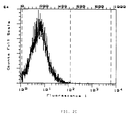
- Figure 2A-2C shows HGMS separation of cells having Thy-1 antigens from cells which do not.
- paramagnetic particles are those which have a minimum of coupling among the unpaired electrons such as those in the iron of the hemoglobin contained in them; ferromagnetic particles are those where the iron atoms (or other magnetic transition metal) are highly coupled.
- superparamagnetic materials occupy the range between these extremes.
- impermeable coating as it relates to the coating provided to the matrix of the invention, is meant a polymeric coating which contains substantially less than 30% water by weight, and is coated to the matrix as a result of passive application, cross-linking or polymerization of a relatively hydrophobic polymer or copolymer.
- Suitable polymers include polystyrenes, polyacrylamides, polyetherurethanes, polysulfones, fluoronated or chlorinated polymers such as polyvinyl chloride, polyethylenes and polypropylenes, polycarbonates and polyesters.
- polymers include polyolefins such as polybutadiene, polydichlorobutadiene, polyisoprene, polychloroprene, polyvinylidene halides, polyvinylidene carbonate, and polyfluorinated ethylenes.
- polyolefins such as polybutadiene, polydichlorobutadiene, polyisoprene, polychloroprene, polyvinylidene halides, polyvinylidene carbonate, and polyfluorinated ethylenes.
- a number of copolymers, including styrene/butadiene, alpha-methyl styrene/dimethyl siloxane, or other polysiloxanes can be used. Included among these are polydimethyl siloxane, polyphenylmethyl siloxane, and polytrifluoropropylmethyl siloxane.
- polyacrylonitriles or acrylonitrile-containing polymers such as poly alpha-acrylanitrile copolymers, alkyd or terpenoid resins, and polyalkylene polysulfonates.
- Any polymeric material which is capable of forming an impermeable coating which contains substantially less than 30% by weight of water, and which does not permit the passage of ions is included within the scope of the invention.
- gradient-intensifying matrix is meant a magnetically susceptible material which typically has a large surface area in comparison to the volume of the separation chamber which serves to create additional gradient in its vicinity so as to retain magnetized particles in a volume defined by the gradient close to its surface.
- the matrix thus behaves in a manner analogous to the adsorption support in an affinity chromatography column wherein the most magnetized particles are most attracted to the neighborhood of the matrix, and these more highly magnetized particles can displace particles of lower magnetization from the surface.
- magnetization of the particles of the invention is meant their magnetic moment per volume. Typically, magnetization is measured in Bohr magnetons per unit volume.
- magnetization is acquired only in the presence of an externally applied magnetic field.
- an identical magnetic field for all particles in the mixture is imposed.
- the extent of magnetization depends on the externally applied magnetic field and the magnetic susceptibility of the particles (the susceptibility is magnetization/imposed field), it also follows that these particles will have homogeneous magnetic (volume) susceptibilities.
- the labeled biological material may have various ratios of volume or numbers with regard to the particles of the invention.
- a multiplicity of the invention particles may be attached to the cellular surface.
- the material to be tagged is a single molecule, a multiplicity of such molecules may reside on a single particle. Attaching a large nonmagnetic material, such as a cell to a label alters the magnetic characteristics of the label to some extent due to the increased volume of the complex. Conversely, attaching a multiplicity of magnetic labels to a cell enhances the overall magnetization associated with the cell. The total magnetization of the labeled target in a magnetic field will thus depend on the individual magnetic moment of the particles, the size (volume) of the resulting labeled complex, and the number of magnetized particles per labeled complex.
- the superparamagnetic particles of the invention are initially prepared in a range of sizes which result in variations in their abilities to acquire magnetic properties upon exposure to a magnetic field.
- the magnetic particles themselves are collections of magnetic iron oxide microcrystal of 50-600 angstroms which are aggregated into particles of colloidal size--i.e., approximately 100-2000 angstroms in diameter, preferably around 400-1000 angstroms in diameter.
- colloidal size--i.e., approximately 100-2000 angstroms in diameter, preferably around 400-1000 angstroms in diameter By sorting the mixture of particles into subfractions which have uniform magnetization, compositions having homogeneous properties with respect to ability to be retained in the magnetic field can be obtained.
- particles of such homogeneity has the advantage of effecting a sharp separation peak in chromatographic procedure, as well as the potential for labeling various components in a mixture with sets of particles of differing magnetic susceptibilities to permit chromatographic separation of these components.
- the particles can also be separated according to size. The desirable size will depend on the nature of the separation desired. It may be desirable to prepare relatively small particles for multiple labeling of a cell, e.g., in order to resolve the number of antigens on a cell, or relatively large particles for separation of a multiplicity of molecules of a single substance. It is, in any event, of interest to obtain sets of particles with uniform magnetizations, i.e., which become equally magnetized in the presence of the same externally applied magnetic field.
- the superparamagnetic particles themselves are prepared by an important modification of the method described in U.S. Patent 4,452,773.
- Solutions containing ferric and ferrous salts in a molar ratio of about 2:1-1.5:1 along with a suitable quantity of coating material, typically a weight of polysaccharide approximately 5-20 times the weight of iron salts in solution are stirred and heated to about 40 o C.
- Preferred coatings to be used in this process are polysaccharide or protein coatings.
- a preferred polysaccharide coating is dextran.
- the mixture is then titrated to basic pH with sodium hydroxide by dropwise addition over a period of about 1 hour.
- the use of sodium hydroxide or other strong base rather than the ammonium hydroxide of the reference is helpful in preventing nonspecific binding in the finished particles. Furthermore, the addition of base at elevated temperatures assists in the formation of the desired size particles.
- the coating material can be included, as above, in the magnetic oxide forming preparation, or can be added after the colloidal oxide particles are formed. After neutralization with acid, aggregates are removed by any convenient means such as filtration or centrifugation and the magnetic particles removed from the uncomplexed coating material by washing in a high gradient magnetic field.
- the superparamagnetic particles can be subjected to HGMS at any stage of this preparation process--before or after coating and before or after size separation.
- the prepared particles are applied to the HGMS apparatus described below, or any alternative standard HGMS apparatus and fractionated according to magnetization (i.e., magnetic susceptibility).
- magnetization i.e., magnetic susceptibility
- the mixture is applied to the HGMS column, containing matrix, at a very high magnetic field strength so that virtually all of the particles are retained.
- the particles are then eluted by gradual reduction of the magnetic field across the column. Fractions are collected at arbitrary intervals resulting in the preparation of a series of compositions each having a desired degree of homogeneity of magnetization.
- the mixture of particles is segregated by overloading an HGMS matrix with the preparation.
- the retained materials can then be eluted by removing the imposed magnetic field.
- any arbitrary fraction of the highest magnetization particles in the distribution resulting from the initial preparation can be retained.
- a sufficiently small amount of matrix should be used so that the majority of the particles, about 80%, preferably about 90%, of the particles, pass through the matrix.
- compositions are then useful for labeling biological materials to permit the isolation of these materials either from unconjugated contaminating materials or from other materials in a mixture which are conjugated to other particle compositions of different magnetizations.
- the polysaccharide or other coating is suitably derivatized to provide functional groups for conjugation to the specific binding moiety.
- a variety of such modifications is known in the art.
- polysaccharides are conveniently oxidized using periodate to provide aldehyde functional groups which can then be conjugated to amino substituents on a proteinaceous binding moiety, or can be reacted with CNBr to provide this functionality.
- Protein coatings can be linked to targets through side chain amino or sulfhydryl groups.
- specific binding moiety or "specific binding partner” means a substance which is specifically reactive with a particular target biological material to the exclusion of other biological materials.
- the most commonly used specific binding moiety is an immunoglobulin or immunoreactive fragment thereof.
- other forms of specific binding moieties such as avidin/biotin or receptor/ligand are included within the scope of the invention.
- Many specific binding moieties are proteins, and can conveniently be conjugated to the coating through amino groups.
- a variety of other methods of conjugation are available, and a large variety of homobifunctional and heterobifunctional linkers useful in effecting such conjugation are available, for example, from Pierce Chemical Co. Linkers can be of specified lengths also, to effect a specific separation between the particle and target.
- Techniques for conjugation of specific binding moieties to polysaccharide solid supports are well known in the art and have been applied extensively to specific binding assays, notably immunoassays. Any suitable derivatization and conjugation method is contemplated by the invention.
- target biological material any biological substrate for which a specific binding moiety (partner) can be found so as to specifically label the material.
- suitable target materials includes microorganisms such as protozoa, bacteria, yeast, and other fungi, cultured cells from multicelled organisms including mammalian and other vertebrate cells, viruses, and fragments of the cells and viruses.
- organelles or suborganelles of eucaryotic cells and aggregates or individual molecules including proteins, glycoproteins, lipoproteins, carbohydrates, lipids, and the like.
- Any biological material either a single substance or an organized or amorphous aggregate of substances, having a characteristic target which is complementary to a specific binding moiety can be isolated or purified using the particles and methods of the invention.
- compositions of coated or uncoated superparamagnetic particles of magnetic iron oxide microspheres said particles being of colloidal size and having magnetizations such that the value of the magnetization in the compositions varies less than 10%, preferably less than 5%, and most preferably less than 1%.
- this level of homogeneity can be obtained in the coated colloidal superparamagnetic particles which have been conjugated to a specific binding moiety, which particles may be further associated with the target biological material.
- Compositions having this level of homogeneity of any of these superparamagnetic particles are so far unknown in the art.
- HGMS HGMS
- the matrix which is comprised of iron or steel or filaments, particles, or other finely divided magnetically susceptible metal is coated by a hydrophobic plastic liquid which is converted to form an impermeable coating at the surface of the matrix.
- the matrix should have an adequate surface area to create sufficient magnetic field gradients in the separation chamber to permit efficient retention of magnetized particles.
- the matrix comprises about 0.5-10% of the total volume occupied by fluid in the separation chamber.
- the matrix serves to create a high magnetic gradient locally to its surface, it is designated a "gradient-intensifying matrix".
- the high gradients at the surface of the matrix serve to attract the magnetic particles to the volume of fluid in the neighborhood of the surface of the matrix.
- the particles with higher magnetization are attracted preferentially.
- the coating of the matrix is performed by treating the matrix with a liquid composition which contains the materials which will form the coating.
- the resulting coating is to be distinguished from the hydrogels of the prior art, and are of very low or no water content.
- Suitable plastic coatings are already prepolymerized lacquers and other hydrophobic compositions, or are monomers capable of forming impermeable polymers or membranes.
- Suitable polymers include various hydrophobic polymers and copolymers, and representative examples have been set forth above. Mixtures of polymers and copolymers can also be used.
- the polymerized plastic is converted to liquid form through dispersion or solution in an appropriate solvent, preferably a non-aqueous solvent, or by appropriate temperature control.
- an appropriate solvent preferably a non-aqueous solvent, or by appropriate temperature control.
- the plastic is contacted with the matrix.
- the matrix can be disposed in the column of the apparatus and the fluid-borne or fluidized plastic poured through the column.
- the matrix and plastic fluid can be mixed and then the excess fluid removed by centrifugation or by decanting.
- the coated matrix is then dried to obtain a uniform film.
- the prepolymerized material or partially prepolymerized material can be crosslinked when in contact with the matrix to obtain the impermeable coating.
- a solution of the monomer or monomers which will polymerize in the presence of the matrix can be used.
- the coating contains substantially less than 30% by weight of water, preferably less than 10%, more preferably less than 5%, and most preferably less than 1% water.
- the coating is essentially impermeable to ions, and thus protects the matrix from interaction with the biological materials, as well as preventing corrosion of the matrix and escape of the resulting cations, which would be damaging to the targeted substances and organelles.
- the finished coated matrix can be further coated, if desired, with additional materials, in particular, by a silicone coating. Any additional coating which does not interfere with the interaction of the matrix with the magnetic field for creation of surface magnetic gradient can be used.
- the coated matrix of the invention is then employed in the conduct HGMS when disposed in a column subjected to a magnetic field, in such manner that a magnetic gradient is created in a volume of fluid close to the surface of the matrix.
- a preferred apparatus is shown in Figure 1.
- a chamber 11 filled with a gradient-intensifying matrix 13 is disposed between the poles of a magnet 12.
- the sample is applied to the inlet means at the top of the chamber 14 and exits at the outlet means in the lower portion of the chamber 15, through a means to constrict the flow of fluid such as the needle 16.
- the magnetic field is applied, the gradient is created and suitable magnetically labeled samples are retained in the chamber.
- a sample containing at least one biological material which has been associated with magnetic particles of the invention containing the appropriate specific binding moiety (or associated with other magnetic particles) is poured over the matrix in the column.
- the magnetic field is applied with sufficient strength to obtain a gradient which retains the magnetic particles on the surface of the matrix, but contaminating substances which have no magnetic properties flow through the column.
- the retained particles are eluted by release or diminution of the magnetic field or both, as is understood in the art.
- a preferred embodiment shown in Figure 1 utilizes a permanent magnet to create the magnetic field.
- the magnet is sufficiently strong to create a field of about 0.5-1 Tesla, preferably about 0.6 Tesla.
- the magnet is constructed of a commercially available alloy of neodinium/iron/boron. Other highly magnetized materials could also be used. Indeed, an electromagnet could be substituted in less preferred embodiments. If the permanent magnet is used, the chamber must be physically removed from the field. If an electromagnet is used, the magnetic field created by the electromagnet is compensated to zero. Upon removal of the magnet field and continued flow of suspension fluid through the chamber, the retained magnetized particles are eluted from the matrix.
- the magnetic labeling particles are readily enough removed from the associated biological materials and separated along with the unreacted particles, for example, by exposure to a magnetic field.
- the geometry of the disposition of the matrix in the chamber can also be designed to provide optimum separations. Longitudinally arranged fibers of the matrix provide a smoother gradient than transversely disposed fibers. Depending on the nature of the magnetic labeling in a particular instance, one or the other of these types of geometries may be more advantageous.
- the retained particles can be eluted by supplying a magnetized fluid--i.e., a fluid containing a suspension or dispersion of particles with higher magnetization than those which are retained.
- the fluid then effectively displaces the retained particles from the matrix surface and results in their flow through the outlet means, or alters the characteristics of the overall magnetic environment in the chamber.
- the retention of the particles can also be affected by the presence of a suitable magnetic fluid.
- a suitable magnetic fluid By adjusting the magnetization of the fluid in which the particles are suspended, and by controlling the available surface area of the matrix, only compositions containing particles of a selected magnetic susceptibility or magnetization can be retained in the column.
- the particles can be obtained in compositions of homogeneous magnetization
- mixtures of target biological materials which do not disrupt this homogeneity for example A and B
- a and B can be separated by treating a mixture containing these materials with compositions of particles with specific binding moieties for each with differing potential magnetizations.
- the mixture is treated with particles conjugated to anti-A which have high magnetic susceptibility and particles conjugated to anti-B which have low magnetic susceptibility.
- the labeled mixture is then applied to the apparatus and a magnetic field strength sufficient to retain both A and B associated magnetic particles is supplied.
- the magnetic field strength or the magnetization of the suspending fluid are altered so as to release particles which are associated with B but not those associated with A, thus effecting a clean separation.
- compositions of particles having various homogeneous magnetizations thus permits considerably more complex separations to be made.
- any number of components in a biological mixture can be labeled with particles of differing magnetizations by treating each homogeneous composition of particles with a different specific binding moiety complementary to a chosen component of the mixture.
- Each component will then uniquely react with one representative composition of a particular magnetization.
- the labeled mixture when subjected to HGMS results in a chromatographic pattern of components separated according to the magnetization of the particles with which they are conjugated. Recovery of each material from the particulate is a straightforward matter of dissociation of the immune or other specific binding complex and removal of the magnetic particles.
- Superparamagnetic particles were prepared by mixing 10 g Dextran R T40 (Pharmacia, Uppsala), 1.5 g ferric chloride hexahydrate, and 0.64 g ferrous chloride tetrahydrate in 20 ml water and heating to 40 o C. The solution was stirred and 20 ml 4 M NaOH was added dropwise with continued stirring. The resulting particle suspension was neutralized with acetic acid, and centrifuged for 10 min at 2,000 x g followed by filtration through a 0.22 uM pore-size filter (Millex R GV) to remove aggregates.
- Unbound dextran was removed by washing in a high gradient magnetic field (HGMF). This was performed by washing the magnetic particles in columns of ordinary household steel wool (average diameter about 30 um) which was placed in the chamber of a HGMS device shown in Figure 1 at a strength of 0.6 Tesla. Ten ml of particle suspension were applied to a 15 x 40 mm column of 2 g of steel wool, and loaded column was washed with 30 ml buffer. About 90% of the particles were washed through the column. The column was then removed from the external field and the remaining 10% of the magnetic particles were eluted.
- HGMF high gradient magnetic field
- the eluted particles form a brown suspension which is stable for more than 6 months at 4 o C.
- Example 2 Four ml of the particle suspension prepared in Example 1 was buffered in 0.2 M sodium carbonate, pH 10.5, and reacted with 10 mg CNBr dissolved in acetonitrile. The reaction was continued for 10 min, and unreacted CNBr was removed by HGMF washing conducted in a manner similar to that set forth in Example 1 above. The activated particles were eluted from the HGMF column in 4 ml 0.1 M sodium bicarbonate containing 5 mg avidin. After overnight conjugation, the reaction was stopped using a 2-hour treatment with 100 mg glycine. Uncoupled avidin was then removed by HGMF washing as set forth above, and the particles were eluted in PBS with 0.01% azide, filtered through a 0.22 uM filter and stored at 4 o C.
- a sample containing 4 x 10⁸ mouse spleen cells was incubated for 15 min with 1 ml biotinylated anti-T-cell antibody (anti-Thy-1, clone CFO-1, 50 ug/ml) and then washed and stained with 1 ml avidin FITC (50 ug/ml, Becton-Dickinson, Mountain View, CA) for 15 min and washed again.
- the T-lymphocytes are thus fluorescent stained to permit certain measurements to be made.
- the stained cells were incubated for 5 min with 1 ml diluted biotin-conjugated particle suspension, as prepared in Example 3, and diluted 1:100 in PBS containing 5 mM EDTA. This dilution and timing represent a major departure from those shown in the art.
- the particles thus bind through biotin to the avidin at the surface of the T-cells.
- the cell suspension at 108 cells/ml was applied to a 4 ml column having an inner surface of 100 cm2 and a sectional surface of 1.2 cm2 and a relatively high retention factor.
- the sample was applied to this column in a magnetic field of about 0.6 Tesla, and the cell suspension was allowed to move through the column at about 3 cm/min.
- the column was then washed with an additional 10 ml PBS, and the unmagnetic fraction collected.
- the column was then removed from the magnetic field, and bound cells were washed off at approximately 30 cm/min to obtain the magnetic fraction.
- Figures 2A-C show the FACScans of the original cell suspension and of the magnetic and non-magnetic portions thereof.
- Figure 2A shows a FACScan of the original cell sample segregated according to fluorescence. There are two major peaks, one of high fluorescence corresponding to the cells which are readily labeled with anti-Thy-1 and a second peak representing low fluorescence of cells not readily labeled with this antibody.
- Figure 2C shows the nonmagnetic fraction corresponding to the low fluorescence peak in Figure 2A.
- Figure 2B shows the profile of the eluted magnetic fraction which corresponds to the anti-Thy-labeled cells of Figure 2A.
- a 2 ml syringe having a diameter of 6.5 mm was filled with 150 mg Cr-Mo-stainless steel wool (material 1.4113S (DIN), average fiber diameter 60 um; 20 mm in length).
- the filling is such that the fibers are oriented in the direction of the axis of the syringe.
- the steel wool was first wetted with a diluter by pulling Lesonal R V83 through the matrix, and the diluter is then removed.
- the commercially available two-component lacquer, Lesonal R K86 (Lesonal GmbH, Nurnberg, West Germany) was then passed through the matrix and washed through.
- the wet column was centrifuged for 1 min at 100 x g to remove excess lacquer.
- the matrix was dried for 2 days. The water content was less than 1%.
- the inner surface was then siliconized in vacuum.
Landscapes
- Health & Medical Sciences (AREA)
- Immunology (AREA)
- Life Sciences & Earth Sciences (AREA)
- Engineering & Computer Science (AREA)
- Molecular Biology (AREA)
- Biomedical Technology (AREA)
- Chemical & Material Sciences (AREA)
- Hematology (AREA)
- Urology & Nephrology (AREA)
- Physics & Mathematics (AREA)
- General Physics & Mathematics (AREA)
- Cell Biology (AREA)
- Food Science & Technology (AREA)
- Medicinal Chemistry (AREA)
- Biotechnology (AREA)
- Analytical Chemistry (AREA)
- Biochemistry (AREA)
- General Health & Medical Sciences (AREA)
- Microbiology (AREA)
- Pathology (AREA)
- Peptides Or Proteins (AREA)
- Compounds Of Iron (AREA)
- Medicines Containing Material From Animals Or Micro-Organisms (AREA)
- Soft Magnetic Materials (AREA)
- Polysaccharides And Polysaccharide Derivatives (AREA)
- Solid-Sorbent Or Filter-Aiding Compositions (AREA)
- Immobilizing And Processing Of Enzymes And Microorganisms (AREA)
- Hard Magnetic Materials (AREA)
Claims (11)
- Procédé pour la séparation de matières biologiques à l'aide d'une séparation magnétique à gradient élevé HGMS; lequel procédé consiste à introduire dans une enceinte de séparation un échantillon contenant la matière biologique associée à une particule qui est conjuguée à un partenaire de liaison spécifique complémentaire à la matière biologique en présence d'un gradient magnétique suffisamment puissant pour provoquer la rétention des particules magnétiques à l'intérieur de l'enceinte, et à éluer les particules magnétiques à partir celle-ci, procédé dans lequel les particules sont des particules colloïdales ultraparamagnétiques enrobées d'un revêtement organique dont la taille est comprise entre 0,01 et 0,1 µm, ces particules étant capables de former une suspension colloïdale stable et préparées selon un procédé qui consiste à soumettre une préparation, contenant un mélange de particules ultraparamagnétiques enrobées d'un revêtement organique doué d'un pouvoir magnétique variable, à une séparation magnétique à gradient élevé HGMS en opérant dans des conditions où seule la fraction de particules ayant le pouvoir magnétique le plus élevé est retenue, à laisser le reste de la préparation s'écouler à travers la matrice et à éluer les particules retenues.
- Procédé selon la revendication 1, dans lequel la matrice de séparation magnétique à gradient élevé HGMS est saturée par la préparation, les particules possédant le pouvoir magnétique le plus élevé sont retenues, le reste de la préparation est entraîné par écoulement à travers la matrice et les particules retenues sont éluées.
- Procédé selon les revendications 1 et 2 dans lequel le reste de la préparation contient plus de 80 % des particules introduites avec la préparation.
- Procédé selon l'une quelconque des revendications 1 à 3 qui comprend en outre la confection des particules ultraparamagnétiques colloïdales par neutralisation d'une dispersion ou d'une solution contenant un sel d'ions ferriques ou ferreux avec de l'hydroxyde de sodium pour ramener le pH à une valeur comprise entre 10 et 11.
- Procédé selon l'une quelconque des revendications 1 à 4 dans lequel l'écart de pouvoir magnétique des particules colloïdales entre elles n'excède pas 10 %.
- Procédé selon l'une quelconque des revendications 1 à 5 dans lequel l'écart de pouvoir magnétique des particules colloïdales n'excède pas 5 %.
- Procédé selon l'une quelconque des revendications 1 à 6 dans lequel les particules sont enrobées de polysaccharide.
- Procédé selon l'une quelconque des revendications 1 à 7 dans lequel les particules sont associées à une matière biologique cible.
- Procédé de séparation de matières biologiques par séparation magnétique à gradient élevé HGMS, selon l'une quelconque des revendications 1 à 8, qui comprend en outre l'élution des particules magnétisées par introduction d'un fluide magnétique.
- Particules ultraparamagnétiques colloïdales conjuguées à un partenaire de liaison spécifique complémentaire à une matière biologique, préparées selon l'une quelconque des revendications 1 à 9, destinées à être utilisées dans la séparation de matières biologiques.
- Procédé pour réaliser en partant d'un mélange la séparation d'au moins deux composants biologiques, lequel procédé consiste à traiter à titre de première magnétisation ledit mélange avec une première composition de particules ultraparamagnétiques colloïdales, selon l'une quelconque des revendications 1 à 9, conjuguées à un partenaire de liaison spécifique complémentaire au premier composant et à titre de seconde magnétisation avec une seconde composition de particules ultraparamagnétiques colloïdales, selon l'une quelconque des revendications 1 à 9, conjuguées à un partenaire de liaison spécifique complémentaire au deuxième composant, à soumettre le mélange traité à un gradient magnétique à l'intérieur d'une chambre de séparation magnétique en opérant dans des conditions où au moins l'une des compositions de particules est retenue, et l'élution des fractions distinctes contenant lesdits premiers et seconds composants.
Applications Claiming Priority (3)
| Application Number | Priority Date | Filing Date | Title |
|---|---|---|---|
| US29117788A | 1988-12-28 | 1988-12-28 | |
| US291177 | 1988-12-28 | ||
| PCT/EP1989/001602 WO1990007380A2 (fr) | 1988-12-28 | 1989-12-22 | Procedes et matieres pour la separation magnetique a gradient eleve de matieres biologiques |
Publications (2)
| Publication Number | Publication Date |
|---|---|
| EP0452342A1 EP0452342A1 (fr) | 1991-10-23 |
| EP0452342B1 true EP0452342B1 (fr) | 1994-11-30 |
Family
ID=23119207
Family Applications (1)
| Application Number | Title | Priority Date | Filing Date |
|---|---|---|---|
| EP90900152A Expired - Lifetime EP0452342B1 (fr) | 1988-12-28 | 1989-12-22 | Procedes et matieres pour la separation magnetique a gradient eleve de matieres biologiques |
Country Status (7)
| Country | Link |
|---|---|
| US (2) | US5411863A (fr) |
| EP (1) | EP0452342B1 (fr) |
| AT (1) | ATE114507T1 (fr) |
| AU (1) | AU4746590A (fr) |
| DE (1) | DE68919715T2 (fr) |
| ES (1) | ES2067018T3 (fr) |
| WO (1) | WO1990007380A2 (fr) |
Cited By (141)
| Publication number | Priority date | Publication date | Assignee | Title |
|---|---|---|---|---|
| EP2433713A2 (fr) | 2007-12-07 | 2012-03-28 | Miltenyi Biotec GmbH | Appareil et procédé de traitement de cellules |
| WO2015164675A1 (fr) | 2014-04-23 | 2015-10-29 | Juno Therapeutics, Inc. | Procédés d'isolement, de culture et de manipulation génétique de populations de cellules immunitaires pour une thérapie adoptive |
| WO2016033570A1 (fr) | 2014-08-28 | 2016-03-03 | Juno Therapeutics, Inc. | Anticorps et récepteurs antigéniques chimériques spécifiques du cd19 |
| WO2016064929A1 (fr) | 2014-10-20 | 2016-04-28 | Juno Therapeutics, Inc. | Procédés et compositions pour dosage en thérapie cellulaire adoptive |
| WO2016073602A2 (fr) | 2014-11-05 | 2016-05-12 | Juno Therapeutics, Inc. | Procédés de transduction et de traitement de cellules |
| WO2016090190A1 (fr) | 2014-12-03 | 2016-06-09 | Juno Therapeutics, Inc. | Procédés et compositions pour thérapie cellulaire adoptive |
| WO2016115559A1 (fr) | 2015-01-16 | 2016-07-21 | Juno Therapeutics, Inc. | Anticorps et récepteurs antigéniques chimériques spécifiques de ror1 |
| WO2016166568A1 (fr) | 2015-04-16 | 2016-10-20 | Juno Therapeutics Gmbh | Procédés, kits et appareil permettant d'augmenter une population de cellules |
| WO2016196388A1 (fr) | 2015-05-29 | 2016-12-08 | Juno Therapeutics, Inc. | Composition et procédés de régulation des interactions inhibitrices dans les cellules génétiquement modifiées |
| WO2017068421A1 (fr) | 2015-10-22 | 2017-04-27 | Juno Therapeutics Gmbh | Procédés, kits et appareil de culture de cellules |
| WO2017068419A2 (fr) | 2015-10-22 | 2017-04-27 | Juno Therapeutics Gmbh | Procédés, kits, agents et appareils de transduction |
| WO2017068425A1 (fr) | 2015-10-22 | 2017-04-27 | Juno Therapeutics Gmbh | Procédés de culture de cellules, kits et appareil associés |
| WO2017079705A1 (fr) | 2015-11-05 | 2017-05-11 | Juno Therapeutics, Inc. | Récepteurs chimériques contenant des domaines induisant traf, et compositions et méthodes associées |
| WO2017079703A1 (fr) | 2015-11-05 | 2017-05-11 | Juno Therapeutics, Inc. | Vecteurs et cellules immunitaires génétiquement modifiées exprimant des modulateurs de voie métabolique et utilisations en thérapie cellulaire adoptive |
| WO2017096329A1 (fr) | 2015-12-03 | 2017-06-08 | Juno Therapeutics, Inc. | Récepteurs chimériques modifiés et compositions et procédés associés |
| WO2017096327A2 (fr) | 2015-12-03 | 2017-06-08 | Juno Therapeutics, Inc. | Compositions et méthodes pour réduire les réponses immunitaires contre les thérapies cellulaires |
| WO2017161212A1 (fr) | 2016-03-16 | 2017-09-21 | Juno Therapeutics, Inc. | Procédés de conception adaptative d'un régime de traitement et traitements associés |
| WO2017161208A1 (fr) | 2016-03-16 | 2017-09-21 | Juno Therapeutics, Inc. | Procédés pour déterminer le dosage d'un agent thérapeutique et traitements associés |
| WO2017165571A1 (fr) | 2016-03-22 | 2017-09-28 | Seattle Children's Hospital (dba Seattle Children's Research Institute) | Procédés d'intervention précoce pour prévenir ou atténuer la toxicité |
| WO2017214207A2 (fr) | 2016-06-06 | 2017-12-14 | Juno Therapeutics, Inc. | Procédés de traitement de malignités de lymphocytes b au moyen d'une thérapie cellulaire adoptive |
| WO2018005559A1 (fr) | 2016-06-27 | 2018-01-04 | Juno Therapeutics, Inc. | Procédé d'identification d'épitopes peptidiques, molécules qui se lient à de tels épitopes et utilisations associées |
| WO2018005556A1 (fr) | 2016-06-27 | 2018-01-04 | Juno Therapeutics, Inc. | Épitopes à restriction cmh-e, molécules de liaison et procédés et utilisations associés |
| WO2018023100A2 (fr) | 2016-07-29 | 2018-02-01 | Juno Therapeutics, Inc. | Anticorps anti-idiotypes et procédés associés |
| WO2018023094A1 (fr) | 2016-07-29 | 2018-02-01 | Juno Therapeutics, Inc. | Procédés d'évaluation de la présence ou de l'absence d'un virus compétent pour la réplication |
| WO2018023093A1 (fr) | 2016-07-29 | 2018-02-01 | Juno Therapeutics, Inc. | Polypeptides immunomdulateurs et compositions et procédés associés |
| WO2018039637A1 (fr) | 2016-08-26 | 2018-03-01 | Juno Therapeutics, Inc. | Procédés de dénombrement de particules présentes dans une composition cellulaire |
| WO2018049420A1 (fr) | 2016-09-12 | 2018-03-15 | Juno Therapeutics, Inc. | Ensembles de poches de bioréacteur de perfusion |
| WO2018067618A1 (fr) | 2016-10-03 | 2018-04-12 | Juno Therapeutics, Inc. | Molécules se liant spécifiquement au vph |
| WO2018071873A2 (fr) | 2016-10-13 | 2018-04-19 | Juno Therapeutics, Inc. | Méthodes et compositions d'immunothérapie impliquant des modulateurs de la voie métabolique du tryptophane |
| WO2018085731A2 (fr) | 2016-11-03 | 2018-05-11 | Juno Therapeutics, Inc. | Polythérapie de type thérapie cellulaire t et inhibiteur de btk |
| WO2018093591A1 (fr) | 2016-11-03 | 2018-05-24 | Juno Therapeutics, Inc. | Polythérapie de thérapie cellulaire et d'inhibiteur de la microglie |
| WO2018102785A2 (fr) | 2016-12-03 | 2018-06-07 | Juno Therapeutics, Inc. | Méthodes et compositions pour l'utilisation de lymphocytes t thérapeutiques en association avec des inhibiteurs de kinase |
| WO2018102787A1 (fr) | 2016-12-03 | 2018-06-07 | Juno Therapeutics, Inc. | Procédés de détermination de dosage de lymphocytes car-t |
| WO2018102786A1 (fr) | 2016-12-03 | 2018-06-07 | Juno Therapeutics, Inc. | Procédés de modulation de lymphocytes t modifiés par car |
| WO2018102612A1 (fr) | 2016-12-02 | 2018-06-07 | Juno Therapeutics, Inc. | Cellules b modifiées et compositions et méthodes associées |
| WO2018106732A1 (fr) | 2016-12-05 | 2018-06-14 | Juno Therapeutics, Inc. | Production de cellules modifiées pour une thérapie cellulaire adoptive |
| WO2018132518A1 (fr) | 2017-01-10 | 2018-07-19 | Juno Therapeutics, Inc. | Analyse épigénétique de thérapie cellulaire et méthodes associées |
| WO2018134691A2 (fr) | 2017-01-20 | 2018-07-26 | Juno Therapeutics Gmbh | Conjugués de surface cellulaire et compositions cellulaires et méthodes associées |
| WO2018157171A2 (fr) | 2017-02-27 | 2018-08-30 | Juno Therapeutics, Inc. | Compositions, articles manufacturés et méthodes associées au dosage en thérapie cellulaire |
| WO2018170188A2 (fr) | 2017-03-14 | 2018-09-20 | Juno Therapeutics, Inc. | Procédés de stockage cryogénique |
| WO2018187791A1 (fr) | 2017-04-07 | 2018-10-11 | Juno Therapeutics, Inc | Cellules génétiquement modifiées exprimant un antigène membranaire spécifique de la prostate (psma) ou une forme modifiée de celui-ci et procédés associés |
| WO2018191723A1 (fr) | 2017-04-14 | 2018-10-18 | Juno Therapeutics, Inc. | Procédés d'évaluation de la glycosylation de surface cellulaire |
| WO2018197949A1 (fr) | 2017-04-27 | 2018-11-01 | Juno Therapeutics Gmbh | Reactifs particulaires oligomères et leurs méthodes d'utilisation |
| WO2018204427A1 (fr) | 2017-05-01 | 2018-11-08 | Juno Therapeutics, Inc. | Combinaison d'une thérapie cellulaire et d'un composé immunomodulateur |
| WO2018223101A1 (fr) | 2017-06-02 | 2018-12-06 | Juno Therapeutics, Inc. | Articles de fabrication et procédés de traitement utilisant une thérapie cellulaire adoptive |
| WO2018223098A1 (fr) | 2017-06-02 | 2018-12-06 | Juno Therapeutics, Inc. | Articles de fabrication et procédés liés à la toxicité associée à la thérapie cellulaire |
| WO2019006427A1 (fr) | 2017-06-29 | 2019-01-03 | Juno Therapeutics, Inc. | Modèle murin pour évaluer des toxicités associées à des immunothérapies |
| WO2019027850A1 (fr) | 2017-07-29 | 2019-02-07 | Juno Therapeutics, Inc. | Réactifs d'expansion de cellules exprimant des récepteurs recombinants |
| WO2019032927A1 (fr) | 2017-08-09 | 2019-02-14 | Juno Therapeutics, Inc. | Procédés de production de compositions de cellules génétiquement modifiées et compositions associées |
| WO2019032929A1 (fr) | 2017-08-09 | 2019-02-14 | Juno Therapeutics, Inc. | Procédés et compositions de préparation de cellules génétiquement modifiées |
| WO2019046832A1 (fr) | 2017-09-01 | 2019-03-07 | Juno Therapeutics, Inc. | Expression génique et évaluation d'un risque de développement d'une toxicité suite à une thérapie cellulaire |
| WO2019051335A1 (fr) | 2017-09-07 | 2019-03-14 | Juno Therapeutics, Inc. | Procédés d'identification de caractéristiques cellulaires relatives à des réponses associées à une thérapie cellulaire |
| WO2019070541A1 (fr) | 2017-10-03 | 2019-04-11 | Juno Therapeutics, Inc. | Molécules de liaison spécifique à l'hpv |
| WO2019090364A1 (fr) | 2017-11-06 | 2019-05-09 | Juno Therapeutics, Inc. | Association d'une thérapie cellulaire et d'un inhibiteur de gamma secrétase |
| WO2019090004A1 (fr) | 2017-11-01 | 2019-05-09 | Juno Therapeutics, Inc. | Procédé pour la production d'une composition de lymphocytes t |
| WO2019089848A1 (fr) | 2017-11-01 | 2019-05-09 | Juno Therapeutics, Inc. | Procédés associés à une charge tumorale pour évaluer une réponse à une thérapie cellulaire |
| WO2019089969A2 (fr) | 2017-11-01 | 2019-05-09 | Juno Therapeutics, Inc. | Anticorps et récepteurs antigéniques chimériques spécifiques de l'antigene de maturation des lymphocytes b |
| WO2019089855A1 (fr) | 2017-11-01 | 2019-05-09 | Juno Therapeutics, Inc. | Procédé de génération de compositions thérapeutiques de cellules modifiées |
| WO2019090003A1 (fr) | 2017-11-01 | 2019-05-09 | Juno Therapeutics, Inc. | Récepteurs d'antigènes chimériques spécifiques de l'antigène de maturation des cellules b (bcma) |
| WO2019089858A2 (fr) | 2017-11-01 | 2019-05-09 | Juno Therapeutics, Inc. | Procédés d'évaluation ou de surveillance d'une réponse à une thérapie cellulaire |
| WO2019094835A1 (fr) | 2017-11-10 | 2019-05-16 | Juno Therapeutics, Inc. | Réservoirs cryogéniques à système fermé |
| WO2019109053A1 (fr) | 2017-12-01 | 2019-06-06 | Juno Therapeutics, Inc. | Procédés de dosage et de modulation de cellules génétiquement modifiées |
| WO2019113556A1 (fr) | 2017-12-08 | 2019-06-13 | Juno Therapeutics, Inc. | Formulation de milieux sans sérum pour la culture de cellules et ses procédés d'utilisation |
| WO2019113559A2 (fr) | 2017-12-08 | 2019-06-13 | Juno Therapeutics, Inc. | Marqueurs phénotypiques pour thérapie cellulaire et procédés associés |
| WO2019113557A1 (fr) | 2017-12-08 | 2019-06-13 | Juno Therapeutics, Inc. | Procédé de production d'une compositions de lymphocytes t modifiés |
| WO2019118937A1 (fr) | 2017-12-15 | 2019-06-20 | Juno Therapeutics, Inc. | Molécules de liaison à l'anti-cct5 et procédés d'utilisation associés |
| WO2019152747A1 (fr) | 2018-01-31 | 2019-08-08 | Juno Therapeutics, Inc. | Méthodes et réactifs d'évaluation de la présence ou de l'absence d'un virus compétent pour la réplication |
| WO2019152743A1 (fr) | 2018-01-31 | 2019-08-08 | Celgene Corporation | Polythérapie utilisant une thérapie cellulaire adoptive et un inhibiteur de point de contrôle |
| WO2019169194A1 (fr) | 2018-02-28 | 2019-09-06 | Juno Therapeutics, Inc. | Procédés de détection de particules présentes dans une composition cellulaire |
| WO2019168984A1 (fr) | 2018-02-27 | 2019-09-06 | Gritstone Oncology, Inc. | Identification de néo-antigène à l'aide de modèles pan-allèles |
| WO2019170845A1 (fr) | 2018-03-09 | 2019-09-12 | Ospedale San Raffaele S.R.L. | Antagoniste de l'il-1 et toxicité induite par la thérapie cellulaire |
| WO2019195486A1 (fr) | 2018-04-05 | 2019-10-10 | Juno Therapeutics, Inc. | Récepteurs de lymphocytes t et cellules modifiées les exprimant |
| WO2019195491A1 (fr) | 2018-04-05 | 2019-10-10 | Juno Therapeutics, Inc. | Lymphocytes t exprimant un récepteur recombinant, polynucléotides et procédés associés |
| WO2019195492A1 (fr) | 2018-04-05 | 2019-10-10 | Juno Therapeutics, Inc. | Procédés de production de cellules exprimant un récepteur recombinant et compositions associées |
| WO2019213184A1 (fr) | 2018-05-03 | 2019-11-07 | Juno Therapeutics, Inc. | Polythérapie d'une thérapie par lymphocytes t à récepteur antigénique chimérique (car) et d'un inhibiteur de btk |
| WO2020033927A2 (fr) | 2018-08-09 | 2020-02-13 | Juno Therapeutics, Inc. | Procédés de génération de cellules modifiées et compositions associées |
| WO2020033916A1 (fr) | 2018-08-09 | 2020-02-13 | Juno Therapeutics, Inc. | Procédés pour évaluer des acides nucléiques intégrés |
| WO2020043899A1 (fr) | 2018-08-31 | 2020-03-05 | Invectys | Récepteurs d'antigènes chimériques contre de multiples isoformes de hla-g |
| WO2020056047A1 (fr) | 2018-09-11 | 2020-03-19 | Juno Therapeutics, Inc. | Procédés d'analyse par spectrométrie de masse de compositions cellulaires modifiées |
| WO2020092848A2 (fr) | 2018-11-01 | 2020-05-07 | Juno Therapeutics, Inc. | Méthodes pour le traitement au moyen de récepteurs antigéniques chimériques spécifiques de l'antigene de maturation des lymphocytes b |
| WO2020092854A2 (fr) | 2018-11-01 | 2020-05-07 | Juno Therapeutics, Inc. | Récepteurs antigéniques chimériques spécifiques du gprc5d (élément d du groupe 5 de classe c des récepteurs couplés à la protéine g) |
| WO2020097132A1 (fr) | 2018-11-06 | 2020-05-14 | Juno Therapeutics, Inc. | Procédé de production de cellules t génétiquement modifiées |
| WO2020097403A1 (fr) | 2018-11-08 | 2020-05-14 | Juno Therapeutics, Inc. | Procédés et combinaisons pour le traitement et la modulation de lymphocytes t |
| WO2020102770A1 (fr) | 2018-11-16 | 2020-05-22 | Juno Therapeutics, Inc. | Méthodes de posologie pour cellules t modifiées pour le traitement de cancers à cellules b |
| WO2020113188A2 (fr) | 2018-11-30 | 2020-06-04 | Juno Therapeutics, Inc. | Méthodes de dosage et de traitement de malignités de lymphocytes b au moyen d'une thérapie cellulaire adoptive |
| WO2020113194A2 (fr) | 2018-11-30 | 2020-06-04 | Juno Therapeutics, Inc. | Méthodes pour le traitement par thérapie cellulaire adoptive |
| WO2020160050A1 (fr) | 2019-01-29 | 2020-08-06 | Juno Therapeutics, Inc. | Anticorps et récepteurs antigéniques chimériques spécifiques du récepteur orphelin-1 de type récepteur à tyrosine kinase (ror1) |
| WO2020223571A1 (fr) | 2019-05-01 | 2020-11-05 | Juno Therapeutics, Inc. | Cellules exprimant un récepteur chimérique à partir d'un locus cd247 modifié, polynucléotides et procédés associés |
| WO2020223535A1 (fr) | 2019-05-01 | 2020-11-05 | Juno Therapeutics, Inc. | Cellules exprimant un récepteur recombinant à base d'un locus modifié du tgfbr2, et polynucléotides et méthodes associés |
| WO2020252218A1 (fr) | 2019-06-12 | 2020-12-17 | Juno Therapeutics, Inc. | Combinaison thérapeutique d'une thérapie cytotoxique à médiation cellulaire et d'un inhibiteur d'une protéine de la famille bcl2 pro-survie |
| WO2021035194A1 (fr) | 2019-08-22 | 2021-02-25 | Juno Therapeutics, Inc. | Polythérapie basée sur une thérapie par lymphocytes t et un inhibiteur de protéine-2 homologue de l'activateur de zeste (ezh2) et procédés associés |
| WO2021041994A2 (fr) | 2019-08-30 | 2021-03-04 | Juno Therapeutics, Inc. | Procédés d'apprentissage automatique pour la classification de cellules |
| WO2021092097A1 (fr) | 2019-11-05 | 2021-05-14 | Juno Therapeutics, Inc. | Procédés de détermination d'attributs de compositions de cellules t thérapeutiques |
| WO2021092498A1 (fr) | 2019-11-07 | 2021-05-14 | Juno Therapeutics, Inc. | Combinaison d'une thérapie par lymphocytes t et (s)-3-[4-(4-morpholin-4 ylméthyl-benzyloxy)-l-oxo-l, 3-dihydro-isoindol-2-yl]-pipéridine -2,6-dione |
| WO2021113776A1 (fr) | 2019-12-06 | 2021-06-10 | Juno Therapeutics, Inc. | Anticorps anti-idiotypiques dirigés contre des domaines de liaison ciblant bcma et compositions et procédés associés |
| WO2021113780A1 (fr) | 2019-12-06 | 2021-06-10 | Juno Therapeutics, Inc. | Anticorps anti-idiotypiques dirigés contre des domaines de liaison ciblant gprc5d et compositions et procédés associés |
| WO2021113770A1 (fr) | 2019-12-06 | 2021-06-10 | Juno Therapeutics, Inc. | Procédés liés à la toxicité et à la réponse associées à une thérapie cellulaire pour le traitement de tumeurs malignes des lymphocytes b |
| WO2021151008A1 (fr) | 2020-01-24 | 2021-07-29 | Juno Therapuetics, Inc. | Méthodes de dosage et de traitement de lymphome folliculaire et de lymphome de la zone marginale en thérapie cellulaire adoptive |
| WO2021154887A1 (fr) | 2020-01-28 | 2021-08-05 | Juno Therapeutics, Inc. | Procédés pour la transduction de lymphocytes t |
| WO2021163389A1 (fr) | 2020-02-12 | 2021-08-19 | Juno Therapeutics, Inc. | Compositions de lymphocytes t à récepteur antigénique chimérique contre bcma et procédés et utilisations associés |
| WO2021163391A1 (fr) | 2020-02-12 | 2021-08-19 | Juno Therapeutics, Inc. | Compositions de lymphocytes t à récepteur antigénique chimérique dirigé contre cd19 et procédés et utilisations associés |
| WO2021207689A2 (fr) | 2020-04-10 | 2021-10-14 | Juno Therapeutics, Inc. | Méthodes et utilisations associées à une thérapie cellulaire modifiée à l'aide d'un récepteur antigénique chimérique ciblant un antigène de maturation des lymphocytes b |
| WO2021222330A2 (fr) | 2020-04-28 | 2021-11-04 | Juno Therapeutics, Inc. | Combinaison d'une thérapie à lymphocytes t de ciblage bcma et d'un composé immunomodulateur |
| WO2021231657A1 (fr) | 2020-05-13 | 2021-11-18 | Juno Therapeutics, Inc. | Procédés d'identification de caractéristiques associées à une réponse clinique et leurs utilisations |
| WO2021231661A2 (fr) | 2020-05-13 | 2021-11-18 | Juno Therapeutics, Inc. | Procédé de production de lots de cellules donneuses exprimant un récepteur recombinant |
| WO2021260186A1 (fr) | 2020-06-26 | 2021-12-30 | Juno Therapeutics Gmbh | Lymphocytes t modifiés exprimant un récepteur recombiné, polynucléotides et procédés associés |
| WO2022029660A1 (fr) | 2020-08-05 | 2022-02-10 | Juno Therapeutics, Inc. | Anticorps anti-idiotypiques dirigés contre des domaines de liaison ciblés sur ror1 et compositions et procédés associés |
| WO2022098787A1 (fr) | 2020-11-04 | 2022-05-12 | Juno Therapeutics, Inc. | Cellules exprimant un récepteur chimérique à partir d'un locus de chaîne de la superfamille des immunoglobines cd3 invariable modifié, polynucléotides et procédés associés |
| EP4012415A2 (fr) | 2015-12-04 | 2022-06-15 | Juno Therapeutics, Inc. | Procédés et compositions liés à la toxicité associée à une thérapie cellulaire |
| EP4011381A1 (fr) | 2016-06-03 | 2022-06-15 | Memorial Sloan-Kettering Cancer Center | Thérapies cellulaires adoptives utilisées en tant qu'options de traitement précoce |
| EP4011388A1 (fr) | 2018-06-13 | 2022-06-15 | Amcyte Pharma, Inc. | Aldesleukine thérapeutiquement active hautement stable dans des compositions pharmaceutiques liquides |
| WO2022133030A1 (fr) | 2020-12-16 | 2022-06-23 | Juno Therapeutics, Inc. | Polythérapie de thérapie cellulaire et d'inhibiteur de bcl2 |
| WO2022187406A1 (fr) | 2021-03-03 | 2022-09-09 | Juno Therapeutics, Inc. | Combinaison d'une thérapie par lymphocytes t et d'un inhibiteur de dgk |
| WO2022204070A1 (fr) | 2021-03-22 | 2022-09-29 | Juno Therapeutics, Inc. | Procédés de détermination de la puissance d'une composition de cellules thérapeutiques |
| WO2022212400A1 (fr) | 2021-03-29 | 2022-10-06 | Juno Therapeutics, Inc. | Méthodes de dosage et de traitement au moyen d'une combinaison d'une thérapie par inhibiteur de point de contrôle et d'une thérapie par lymphocytes car t |
| WO2022212384A1 (fr) | 2021-03-29 | 2022-10-06 | Juno Therapeutics, Inc. | Combinaison d'une thérapie par lymphocytes car-t et d'un composé immunomodulateur pour le traitement d'un lymphome |
| WO2022221726A2 (fr) | 2021-04-16 | 2022-10-20 | Juno Therapeutics, Inc. | Polythérapies avec une thérapie par lymphocytes t dirigés contre bcma |
| WO2023081900A1 (fr) | 2021-11-08 | 2023-05-11 | Juno Therapeutics, Inc. | Lymphocytes t modifiés exprimant un récepteur recombiné de lymphocytes t (tcr) et systèmes et procédés apparentés |
| WO2023081735A1 (fr) | 2021-11-03 | 2023-05-11 | Celgene Corporation | Récepteurs antigéniques chimériques spécifiques de l'antigène de maturation des cellules b destinés à être utilisés dans le traitement d'un myélome |
| WO2023147515A1 (fr) | 2022-01-28 | 2023-08-03 | Juno Therapeutics, Inc. | Procédés de fabrication de compositions cellulaires |
| WO2023164440A1 (fr) | 2022-02-22 | 2023-08-31 | Juno Therapeutics, Inc. | Lymphocytes t de récepteur d'auto-anticorps chimérique de protéinase 3 (pr3) et méthodes et utilisations associées |
| WO2023220655A1 (fr) | 2022-05-11 | 2023-11-16 | Celgene Corporation | Méthodes pour surmonter la résistance aux médicaments par ré-sensibilisation de cellules cancéreuses à un traitement avec une thérapie antérieure par l'intermédiaire d'un traitement avec une thérapie par lymphocytes t |
| WO2023230581A1 (fr) | 2022-05-25 | 2023-11-30 | Celgene Corporation | Procédés de fabrication de thérapies par lymphocytes t |
| WO2023230548A1 (fr) | 2022-05-25 | 2023-11-30 | Celgene Corporation | Procédé de prédiction d'une réponse à une thérapie par lymphocyte t |
| WO2023250400A1 (fr) | 2022-06-22 | 2023-12-28 | Juno Therapeutics, Inc. | Méthodes de traitement pour thérapie de deuxième ligne par cellules car-t ciblées par cd19 |
| WO2024006960A1 (fr) | 2022-06-29 | 2024-01-04 | Juno Therapeutics, Inc. | Nanoparticules lipidiques pour l'administration d'acides nucléiques |
| WO2024031091A2 (fr) | 2022-08-05 | 2024-02-08 | Juno Therapeutics, Inc. | Récepteurs antigéniques chimériques spécifiques de gprc5d et bcma |
| WO2024044779A2 (fr) | 2022-08-26 | 2024-02-29 | Juno Therapeutics, Inc. | Anticorps et récepteurs antigéniques chimériques spécifiques d'un ligand 3 de type delta (dll3) |
| WO2024054944A1 (fr) | 2022-09-08 | 2024-03-14 | Juno Therapeutics, Inc. | Combinaison de thérapie cellulaire t et de dosage continu ou intermittent d'inhibiteurs de dgk |
| WO2024097905A1 (fr) | 2022-11-02 | 2024-05-10 | Celgene Corporation | Méthodes de traitement au moyen d'une thérapie par lymphocytes t et d'une thérapie d'entretien par agent immunomodulateur |
| WO2024129778A2 (fr) | 2022-12-13 | 2024-06-20 | Juno Therapeutics, Inc. | Récepteurs antigéniques chimériques spécifiques de baff-r et cd19 et procédés et utilisations associés |
| WO2024182516A1 (fr) | 2023-02-28 | 2024-09-06 | Juno Therapeutics, Inc. | Thérapie cellulaire pour le traitement de maladies auto-immunes systémiques |
| WO2024220588A1 (fr) | 2023-04-18 | 2024-10-24 | Juno Therapeutics, Inc. | Essai cytotoxique pour évaluer la puissance de compositions de cellules thérapeutiques |
| WO2024226858A1 (fr) | 2023-04-26 | 2024-10-31 | Juno Therapeutics, Inc. | Procédés de fabrication de vecteurs viraux |
| WO2024243365A2 (fr) | 2023-05-23 | 2024-11-28 | Juno Therapeutics, Inc. | Marqueurs d'activation de lymphocytes t et procédé d'évaluation de l'activation de lymphocytes t |
| WO2025059362A1 (fr) | 2023-09-13 | 2025-03-20 | Juno Therapeutics, Inc. | Polythérapies comprenant une thérapie cellulaire exprimant un car ciblant gprc5d, méthodes et utilisations associés |
| WO2025076472A1 (fr) | 2023-10-06 | 2025-04-10 | Juno Therapeutics, Inc. | Polythérapies comprenant une thérapie cellulaire exprimant un car ciblant gprc5d, méthodes et utilisations associés |
| EP4576103A2 (fr) | 2017-10-10 | 2025-06-25 | Gritstone bio, Inc. | Identification de néoantigènes à l'aide de points chauds |
| WO2025147545A1 (fr) | 2024-01-03 | 2025-07-10 | Juno Therapeutics, Inc. | Nanoparticules lipidiques pour l'administration d'acides nucléiques et procédés et utilisations associés |
| WO2025184421A1 (fr) | 2024-02-28 | 2025-09-04 | Juno Therapeutics, Inc. | Récepteurs antigéniques chimériques et anticorps spécifiques du ligand 3 de type delta (dll3) et procédés associés |
| WO2025245381A1 (fr) | 2024-05-23 | 2025-11-27 | The Trustrees Of Dartmouth College | Procédés et compositions pour améliorer la persistance de treg exprimant un car des dans le snc et d'autres tissus |
Families Citing this family (122)
| Publication number | Priority date | Publication date | Assignee | Title |
|---|---|---|---|---|
| AU4746590A (en) * | 1988-12-28 | 1990-08-01 | Stefan Miltenyi | Methods and materials for high gradient magnetic separation of biological materials |
| US5385707A (en) * | 1988-12-28 | 1995-01-31 | Stefan Miltenyi | Metal matrices for use in high gradient magnetic separation of biological materials and method for coating the same |
| US6020210A (en) * | 1988-12-28 | 2000-02-01 | Miltenvi Biotech Gmbh | Methods and materials for high gradient magnetic separation of biological materials |
| US5622831A (en) * | 1990-09-26 | 1997-04-22 | Immunivest Corporation | Methods and devices for manipulation of magnetically collected material |
| US5541072A (en) * | 1994-04-18 | 1996-07-30 | Immunivest Corporation | Method for magnetic separation featuring magnetic particles in a multi-phase system |
| US5665582A (en) * | 1990-10-29 | 1997-09-09 | Dekalb Genetics Corp. | Isolation of biological materials |
| JPH06510363A (ja) * | 1990-10-29 | 1994-11-17 | ディカルブ プラント ジェネティクス | 磁気性粒子を使用する生物学的材料の単離 |
| US5370901A (en) * | 1991-02-15 | 1994-12-06 | Bracco International B.V. | Compositions for increasing the image contrast in diagnostic investigations of the digestive tract of patients |
| US5186827A (en) * | 1991-03-25 | 1993-02-16 | Immunicon Corporation | Apparatus for magnetic separation featuring external magnetic means |
| US5795470A (en) * | 1991-03-25 | 1998-08-18 | Immunivest Corporation | Magnetic separation apparatus |
| US6664114B1 (en) | 1992-08-03 | 2003-12-16 | Sapidyne Instruments, Inc. | Solid phase assay for detection of ligands |
| AU2593192A (en) | 1992-09-14 | 1994-04-12 | Oystein Fodstad | Detection of specific target cells in specialized or mixed cell population and solutions containing mixed cell populations |
| WO1994020855A1 (fr) * | 1993-03-04 | 1994-09-15 | Sapidyne, Inc. | Appareil et procede a flux continu pour realiser des operations de titrage |
| GB9309446D0 (en) * | 1993-05-07 | 1993-06-23 | Carpco Sms Ltd | Improvements in and relating to super-conducting magnets |
| GB9309426D0 (en) * | 1993-05-07 | 1993-06-23 | Carpco Sms Ltd | Improvements in and relating to magnetic separators |
| US5514340A (en) * | 1994-01-24 | 1996-05-07 | Magnetix Biotechnology, Inc. | Device for separating magnetically labelled cells |
| NO180658C (no) | 1994-03-10 | 1997-05-21 | Oeystein Fodstad | Fremgangsmåte og anordning for deteksjon av spesifikke målceller i spesialiserte eller blandede cellepopulasjoner og opplösninger som inneholder blandede cellepopulasjoner |
| DE4416784A1 (de) * | 1994-05-09 | 1995-11-30 | Soft Gene Gmbh | Methode zur Anreicherung von Zellen, die durch ballistischen Transfer modifiziert wurden |
| US5705059A (en) * | 1995-02-27 | 1998-01-06 | Miltenyi; Stefan | Magnetic separation apparatus |
| DE19516323C2 (de) * | 1995-04-27 | 1997-02-27 | Dirk Dipl Chem Guenther | Verfahren zur Herstellung von magnetisierbaren Dispersionen und deren Verwendung |
| DE19520298A1 (de) * | 1995-06-02 | 1996-12-05 | Bayer Ag | Sortiervorrichtung für biologische Zellen oder Viren |
| US5639669A (en) * | 1995-06-07 | 1997-06-17 | Ledley; Robert | Separation of fetal cells from maternal blood |
| US5741714A (en) * | 1995-07-18 | 1998-04-21 | Immunivest Corporation | Detection of bound analyte by magnetic partitioning and masking |
| DE19528029B4 (de) | 1995-07-31 | 2008-01-10 | Chemagen Biopolymer-Technologie Aktiengesellschaft | Magnetische Polymerpartikel auf der Basis von Polyvinylalkohol, Verfahren für ihre Herstellung und Verwendung |
| US6190870B1 (en) | 1995-08-28 | 2001-02-20 | Amcell Corporation | Efficient enrichment and detection of disseminated tumor cells |
| US6140040A (en) * | 1995-10-06 | 2000-10-31 | Advanced Minerals Corporation | Method of mechanically separating microparticles suspended in fluids using particulate media |
| NO961031D0 (no) | 1996-03-13 | 1996-03-13 | Det Norske Radiumshospital Tum | Fremgangsmåte til å drepe uönskede målceller |
| DE19612001A1 (de) * | 1996-03-18 | 1997-09-25 | Silica Gel Gmbh Adsorptions Te | Superparamagnetische Teilchen mit vergrößerter R¶1¶-Relaxivität, Verfahren zur Herstellung und deren Verwendung |
| US5843633A (en) * | 1996-04-26 | 1998-12-01 | Amcell Corporation | Characterization of a human hematopoietic progenitor cell antigen |
| US6455678B1 (en) * | 1996-04-26 | 2002-09-24 | Amcell Corporation | Human hematopoietic stem and progenitor cell antigen |
| US6136182A (en) * | 1996-06-07 | 2000-10-24 | Immunivest Corporation | Magnetic devices and sample chambers for examination and manipulation of cells |
| US7666308B2 (en) * | 1996-06-07 | 2010-02-23 | Veridex, Llc. | Magnetic separation apparatus and methods |
| WO2000032293A1 (fr) * | 1998-11-30 | 2000-06-08 | Immunivest Corporation | Appareil et procedes de separation magnetique |
| US6890426B2 (en) * | 1996-06-07 | 2005-05-10 | Immunivest Corporation | Magnetic separation apparatus and methods |
| US6660159B1 (en) | 1996-06-07 | 2003-12-09 | Immunivest Corporation | Magnetic separation apparatus and methods |
| US6790366B2 (en) * | 1996-06-07 | 2004-09-14 | Immunivest Corporation | Magnetic separation apparatus and methods |
| JP3996644B2 (ja) * | 1996-06-07 | 2007-10-24 | イムニベスト・コーポレイション | 外部及び内部勾配を有する磁気分離 |
| CN1151846C (zh) * | 1996-08-05 | 2004-06-02 | 舍林公开股份有限公司 | 核磁共振断层扫描成像用造影剂的制备方法 |
| US5817458A (en) * | 1996-10-15 | 1998-10-06 | The Avriel Group, Amcas Division Inc. | Reagent system for detecting HIV-infected peripheral blood lymphocytes in whole blood |
| WO1998016101A1 (fr) * | 1996-10-15 | 1998-04-23 | Bio-Tech Imaging, Inc. | Systeme reactif et trousse pour la detection de cellules infectees par le vih |
| US5779892A (en) * | 1996-11-15 | 1998-07-14 | Miltenyi Biotec Gmbh | Magnetic separator with magnetic compensated release mechanism for separating biological material |
| US5798206A (en) * | 1997-01-10 | 1998-08-25 | New York Blood Center | Methods for screening of test compounds for inhibiting binding of a CD4-HIV 1 complex to a chemokine receptor |
| FR2758884B1 (fr) | 1997-01-30 | 1999-04-02 | Bio Merieux | Procede pour isoler, notamment detecter ou quantifier un analyte dans un milieu |
| US6241894B1 (en) | 1997-10-10 | 2001-06-05 | Systemix | High gradient magnetic device and method for cell separation or purification |
| DE69812329T2 (de) | 1997-11-18 | 2004-02-12 | Bio-Rad Laboratories, Inc., Hercules | Multiplex-zufluss-immunotest mit magnetischen teilchen als festphase |
| US6337215B1 (en) * | 1997-12-01 | 2002-01-08 | International Business Machines Corporation | Magnetic particles having two antiparallel ferromagnetic layers and attached affinity recognition molecules |
| DE69934449T2 (de) | 1998-03-12 | 2007-09-27 | Miltenyi Biotech Gmbh | Mikrokolonnen-System für Magnettrennung |
| US7220596B2 (en) | 1998-04-15 | 2007-05-22 | Utah State University | Real time detection of antigens |
| AU765085B2 (en) | 1998-05-11 | 2003-09-11 | Miltenyi Biotec Gmbh | Method of direct selection of antigen-specific T cells |
| US7364921B1 (en) | 1999-01-06 | 2008-04-29 | University Of Medicine And Dentistry Of New Jersey | Method and apparatus for separating biological materials and other substances |
| US6159378A (en) * | 1999-02-23 | 2000-12-12 | Battelle Memorial Institute | Apparatus and method for handling magnetic particles in a fluid |
| US6193892B1 (en) | 1999-03-03 | 2001-02-27 | Promega Corporation | Magnetic separation assembly and method |
| CA2366543A1 (fr) * | 1999-04-09 | 2000-10-19 | John Vellinger | Separateur electromagnetique multiphase destine a purifier des cellules, des produits chimiques et des structures proteiques |
| DE19938372A1 (de) * | 1999-08-09 | 2001-03-08 | Diagnostikforschung Inst | Verfahren und Vorrichtung zur Trennung magnetischer Teilchen |
| CA2383791C (fr) * | 1999-09-03 | 2012-11-06 | Miltenyi Biotec Gmbh | Procedes de modification de cellules selectionnees dans une colonne de separation magnetique de cellules |
| US7169618B2 (en) | 2000-06-28 | 2007-01-30 | Skold Technology | Magnetic particles and methods of producing coated magnetic particles |
| US6984522B2 (en) | 2000-08-03 | 2006-01-10 | Regents Of The University Of Michigan | Isolation and use of solid tumor stem cells |
| JP4585170B2 (ja) * | 2000-10-03 | 2010-11-24 | ミナーヴァ・バイオテクノロジーズ・コーポレーション | 流動の中断に基づく相互作用の電子検出および相互作用の検出 |
| US6649419B1 (en) * | 2000-11-28 | 2003-11-18 | Large Scale Proteomics Corp. | Method and apparatus for protein manipulation |
| FR2817967B1 (fr) * | 2000-12-08 | 2003-02-28 | Diagast | Procede de magnetisation de marqueurs chimiques ou biologiques |
| US20030095897A1 (en) * | 2001-08-31 | 2003-05-22 | Grate Jay W. | Flow-controlled magnetic particle manipulation |
| EP1442115B9 (fr) | 2001-11-15 | 2009-12-16 | Children's Medical Center Corporation | Techniques d'isolation, de developpement et de differenciation de cellules souches provenant de villosites choriales, de liquide amniotique ainsi que de placenta et applications therapeutiques |
| US20030099954A1 (en) * | 2001-11-26 | 2003-05-29 | Stefan Miltenyi | Apparatus and method for modification of magnetically immobilized biomolecules |
| US7232691B2 (en) * | 2001-11-27 | 2007-06-19 | Los Alamos National Security, Llc | Bioassay and biomolecular identification, sorting, and collection methods using magnetic microspheres |
| AU2002359648A1 (en) * | 2001-12-07 | 2003-06-23 | Dyax Corporation | Method and apparatus for washing magnetically responsive particles |
| WO2003086637A1 (fr) * | 2002-04-12 | 2003-10-23 | Instrumentation Laboratory Company | Sonde d'immunodosage |
| US9435799B2 (en) * | 2002-07-31 | 2016-09-06 | Janssen Diagnostics, Inc. | Methods and reagents for improved selection of biological materials |
| US20040067532A1 (en) | 2002-08-12 | 2004-04-08 | Genetastix Corporation | High throughput generation and affinity maturation of humanized antibody |
| AU2003278741B2 (en) | 2002-08-27 | 2008-02-14 | Stemcells California Inc. | Enriched central nervous system stem cell and progenitor cell populations, and methods for identifying, isolating and enriching for such populations |
| US7601491B2 (en) * | 2003-02-06 | 2009-10-13 | Becton, Dickinson And Company | Pretreatment method for extraction of nucleic acid from biological samples and kits therefor |
| DE10331439B3 (de) | 2003-07-10 | 2005-02-03 | Micromod Partikeltechnologie Gmbh | Magnetische Nanopartikel mit verbesserten Magneteigenschaften |
| GB2423522A (en) * | 2003-12-10 | 2006-08-30 | Univ Utah Res Found | Method for obtaining an enriched population of sirna-expressing cells |
| WO2005065267A2 (fr) * | 2003-12-24 | 2005-07-21 | Massachusetts Institute Of Technology | Clarification de cellules magnetophoretiques |
| US8211386B2 (en) * | 2004-06-08 | 2012-07-03 | Biokit, S.A. | Tapered cuvette and method of collecting magnetic particles |
| US9790539B2 (en) * | 2004-06-30 | 2017-10-17 | Russell Biotech, Inc. | Methods and reagents for improved selection of biological molecules |
| US20060024776A1 (en) * | 2004-08-02 | 2006-02-02 | Mcmillian Ray | Magnetic particle capture of whole intact organisms from clinical samples |
| JP2008511816A (ja) * | 2004-08-03 | 2008-04-17 | ベクトン・ディキンソン・アンド・カンパニー | サンプルを分別するための磁性材料の使用 |
| WO2006112771A1 (fr) * | 2005-04-18 | 2006-10-26 | Ge Healthcare Bio-Sciences Ab | Billes magnetiques |
| US7867765B2 (en) * | 2005-12-28 | 2011-01-11 | The General Hospital Corporation | Blood cell sorting methods and systems |
| EP2079483A4 (fr) | 2006-07-29 | 2010-10-20 | Robert Lamar Bjork Jr | Medicament therapeutique d'anticorps monoclonal bispécifique (specifique a la fois a cd3 et cd11b) |
| US8168393B2 (en) | 2007-02-16 | 2012-05-01 | The Brigham And Women's Hospital, Inc. | Compositions and methods for diagnosing tumors using LEDGF/p75 |
| DE102007043281A1 (de) | 2007-09-11 | 2009-05-28 | Sebastian Dr. med. Chakrit Bhakdi | Vorrichtung, Materialien und Verfahren zur Hochgradientenmagnetseparation biologischen Materials |
| EP3124497B1 (fr) | 2007-09-14 | 2020-04-15 | Adimab, LLC | Bibliothèques d'anticorps synthétiques conçus de façon rationnelle et leurs utilisations |
| US8877688B2 (en) | 2007-09-14 | 2014-11-04 | Adimab, Llc | Rationally designed, synthetic antibody libraries and uses therefor |
| US12529164B2 (en) | 2007-09-14 | 2026-01-20 | Adimab, Llc | Rationally designed, synthetic antibody libraries and uses therefor |
| US8338170B2 (en) | 2008-04-21 | 2012-12-25 | Viacyte, Inc. | Methods for purifying endoderm and pancreatic endoderm cells derived from human embryonic stem cells |
| AU2008355123B2 (en) | 2008-04-21 | 2014-12-04 | Viacyte, Inc. | Methods for purifying endoderm and pancreatic endoderm cells derived from human embryonic stem cells |
| US20110177592A1 (en) * | 2008-07-11 | 2011-07-21 | Faustman Denise L | Magnetic apparatus for blood separation |
| JP2012508584A (ja) | 2008-11-14 | 2012-04-12 | ヴィアサイト,インコーポレイテッド | ヒト多能性幹細胞由来膵臓細胞のカプセル化 |
| EP3187581A1 (fr) | 2008-12-23 | 2017-07-05 | BOCO Silicon Valley, Inc. | Populations cibles de cellules précurseurs d'oligodendrocytes et leurs procédés de fabrication et d'utilisation |
| GB0823553D0 (en) * | 2008-12-24 | 2009-01-28 | Immunosolv Ltd | Cell separation technique |
| US8790916B2 (en) * | 2009-05-14 | 2014-07-29 | Genestream, Inc. | Microfluidic method and system for isolating particles from biological fluid |
| EP2454020B1 (fr) | 2009-07-17 | 2019-05-15 | Koninklijke Philips N.V. | Appareil et procédé pour l'enrichissement de particules magnétiques |
| US8083069B2 (en) * | 2009-07-31 | 2011-12-27 | General Electric Company | High throughput magnetic isolation technique and device for biological materials |
| TWI362964B (en) * | 2009-12-23 | 2012-05-01 | Ind Tech Res Inst | Magnetic separation device and method for separating magnetic substances in bio-samples |
| EP2390661B1 (fr) | 2010-05-02 | 2015-06-24 | Miltenyi Biotec GmbH | Supports d'ancrage/capture pour sélectionner ou analyser une cellule CHO en fonction d'un produit sécrété par la cellule CHO |
| DE102011015321A1 (de) | 2011-03-28 | 2012-10-04 | Ralph Heindrichs | Verfahren zur kontinuierlichen selektiven Separation von Partikeln mittels Magnetismus |
| ES2626611T3 (es) | 2011-04-05 | 2017-07-25 | Purdue Research Foundation | Sistema microfluídico usando micro-aberturas para la detección de alto rendimiento de entidades |
| TWI407101B (zh) | 2011-04-11 | 2013-09-01 | Ind Tech Res Inst | 磁分離單元、磁性分離裝置以及分離生化試樣內磁性物質之方法 |
| WO2012148648A2 (fr) | 2011-04-27 | 2012-11-01 | Becton Dickinson & Co. | Dispositifs et procédés de séparation de fragments marqués magnétiquement dans un échantillon |
| ES2602500T3 (es) | 2011-11-25 | 2017-02-21 | Miltenyi Biotec Gmbh | Método de separación celular |
| ES2616289T3 (es) | 2012-03-01 | 2017-06-12 | Miltenyi Biotec Gmbh | Separación de neuronas vivas intactas |
| DE102012213032A1 (de) * | 2012-07-25 | 2014-01-30 | Siemens Aktiengesellschaft | Verfahren zum Entwässern einer wasserhaltigen Zellkultur |
| US10379026B2 (en) | 2012-08-29 | 2019-08-13 | Inguran, Llc | Cell processing using magnetic particles |
| NZ734393A (en) | 2012-08-29 | 2020-02-28 | Inguran Llc | Magnetic removal or identification of damaged or compromised cells or cellular structures |
| CN104736718A (zh) | 2012-10-26 | 2015-06-24 | 贝克顿·迪金森公司 | 用于操纵流体样品中的组分的装置和方法 |
| EP2787006B1 (fr) | 2013-04-02 | 2018-02-28 | Miltenyi Biotec GmbH | Anticorps anti-CD8 dont la liaison dépend de Ca2+ |
| EP3015172B1 (fr) * | 2013-06-28 | 2024-09-18 | National Institute of Advanced Industrial Science and Technology | Matrice pour séparateur magnétique et séparateur magnétique |
| JP2017521091A (ja) | 2014-05-15 | 2017-08-03 | ケルベンクス インコーポレイテッド | 診断試験用の胎児有核赤血球(nrbc)の調製 |
| EP2955521A1 (fr) | 2014-06-11 | 2015-12-16 | Centre Hospitalier Universitaire Vaudois (CHUV) | Procédés pour séparer des cellules |
| KR20170032406A (ko) | 2014-07-15 | 2017-03-22 | 주노 쎄러퓨티크스 인코퍼레이티드 | 입양 세포 치료를 위한 조작된 세포 |
| MA41346A (fr) | 2015-01-12 | 2017-11-21 | Juno Therapeutics Inc | Eléments régulateurs post-transcriptionnels d'hépatite modifiée |
| HK1255161A1 (zh) | 2015-07-15 | 2019-08-09 | Juno Therapeutics, Inc. | 用於过继性细胞治疗的工程细胞 |
| US10625272B2 (en) | 2015-11-18 | 2020-04-21 | Industrial Technology Research Institute | Magnetic separator |
| ES2970865T3 (es) | 2015-12-16 | 2024-05-31 | Gritstone Bio Inc | Identificación, fabricación y uso de neoantígenos |
| MX2019009552A (es) | 2017-02-17 | 2019-10-02 | Hutchinson Fred Cancer Res | Terapias de combinacion para el tratamiento de canceres relacionados con el antigeno de maduracion de celulas b (bcma) y trastornos autoinmunitarios. |
| CN111094547B (zh) | 2017-06-14 | 2024-02-09 | 德国亥姆霍兹慕尼黑中心健康与环境研究中心(有限公司) | 用于纯化源自人胚胎干细胞的内胚层和胰腺内胚层细胞的方法 |
| WO2018231373A1 (fr) * | 2017-06-14 | 2018-12-20 | Russell Biotech, Inc. | Préparation de cellules mononucléaires exemptes de plaquettes |
| CN111630602A (zh) | 2017-11-22 | 2020-09-04 | 磨石肿瘤生物技术公司 | 减少新抗原的接合表位呈递 |
| EP3693739A1 (fr) | 2019-02-06 | 2020-08-12 | Stefan Schreier | Procédé et dispositif d'isolation de cellules souhaitées d'un échantillon des matériaux biologiques non magnétiques |
| WO2020223596A1 (fr) | 2019-05-02 | 2020-11-05 | Kellbenx Incorporated | Procédés basés sur la filtration pour préparer des globules rouges nucléés foetaux (nrbc) pour un test diagnostique |
| WO2024124132A1 (fr) | 2022-12-09 | 2024-06-13 | Juno Therapeutics, Inc. | Procédés d'apprentissage automatique pour prédire un phénotype cellulaire au moyen d'une imagerie holographique |
Family Cites Families (27)
| Publication number | Priority date | Publication date | Assignee | Title |
|---|---|---|---|---|
| US3981776A (en) * | 1967-02-16 | 1976-09-21 | Rolf Saxholm | Magnetically responsive, biologically active substance and associated methods and apparatus |
| US4371624A (en) * | 1976-08-23 | 1983-02-01 | Rolf Saxholm | Apparatus and testing reactions |
| US4992377B1 (en) * | 1967-02-16 | 1996-10-15 | Saxholm As | Article for carrying out biological or chemical procedures containing magnetically responsive material |
| US4021308A (en) * | 1967-02-16 | 1977-05-03 | Rolf Saxholm | Apparatus associated with magnetically responsive, biologically active substance for testing thereof |
| US4213825A (en) * | 1976-08-23 | 1980-07-22 | Rolf Saxholm | Apparatus for testing reactions |
| GB1235686A (en) * | 1967-02-16 | 1971-06-16 | Rolf Saxholm | Improvements in diffusion testing and apparatus therefor |
| NO124603B (fr) * | 1969-05-03 | 1972-05-08 | Rolf Saxholm | |
| US4140582A (en) * | 1969-05-03 | 1979-02-20 | Rolf Saxholm | Supporting element for use in microbiological, serological, immunological clinical-chemical and similar laboratory work |
| US3985608A (en) * | 1969-05-03 | 1976-10-12 | Rolf Saxholm | Supporting element for use in microbiological, serological, immunological, clinical-chemical and similar laboratory work |
| US4018886A (en) * | 1975-07-01 | 1977-04-19 | General Electric Company | Diagnostic method and device employing protein-coated magnetic particles |
| US3970518A (en) * | 1975-07-01 | 1976-07-20 | General Electric Company | Magnetic separation of biological particles |
| US4230685A (en) * | 1979-02-28 | 1980-10-28 | Northwestern University | Method of magnetic separation of cells and the like, and microspheres for use therein |
| US4657868A (en) * | 1980-01-15 | 1987-04-14 | Rolf Saxholm | Apparatus for testing reactions |
| US4375407A (en) * | 1981-06-22 | 1983-03-01 | The Franklin Institute | High gradient magnetic separation device |
| DE3200988A1 (de) * | 1982-01-14 | 1983-07-28 | Thomas A. Dr. 6900 Heidelberg Reed | Verfahren und vorrichtung zur abtrennung von organischen stoffen aus einer suspension oder loesung |
| US4452773A (en) * | 1982-04-05 | 1984-06-05 | Canadian Patents And Development Limited | Magnetic iron-dextran microspheres |
| US4554088A (en) * | 1983-05-12 | 1985-11-19 | Advanced Magnetics Inc. | Magnetic particles for use in separations |
| US4526681A (en) * | 1983-10-31 | 1985-07-02 | Purdue Research Foundation | Magnetic separation method utilizing a colloid of magnetic particles |
| US4677067A (en) * | 1984-06-22 | 1987-06-30 | Bio-Magnetech Corporation | Magnetotactic bacteria in clinical assay, immunoassay, and cell separation procedures and the like |
| DE3522365A1 (de) * | 1985-06-22 | 1987-01-02 | Bayer Ag | Trenngeraet fuer magnetische partikel aus fluessiger phase |
| US4664796A (en) * | 1985-09-16 | 1987-05-12 | Coulter Electronics, Inc. | Flux diverting flow chamber for high gradient magnetic separation of particles from a liquid medium |
| US4666595A (en) * | 1985-09-16 | 1987-05-19 | Coulter Electronics, Inc. | Apparatus for acoustically removing particles from a magnetic separation matrix |
| US4738777A (en) * | 1986-06-12 | 1988-04-19 | Amsted Industries Incorporated | Pressure filter media mounting assembly |
| US4770183A (en) * | 1986-07-03 | 1988-09-13 | Advanced Magnetics Incorporated | Biologically degradable superparamagnetic particles for use as nuclear magnetic resonance imaging agents |
| DE3624626A1 (de) * | 1986-07-18 | 1988-01-28 | Pilgrimm Herbert | Verfahren zur abtrennung von stoffen aus einem stoffgemisch unter verwendung von magnetischen fluessigkeiten |
| AU4746590A (en) * | 1988-12-28 | 1990-08-01 | Stefan Miltenyi | Methods and materials for high gradient magnetic separation of biological materials |
| US5411730A (en) * | 1993-07-20 | 1995-05-02 | Research Corporation Technologies, Inc. | Magnetic microparticles |
-
1989
- 1989-12-22 AU AU47465/90A patent/AU4746590A/en not_active Abandoned
- 1989-12-22 ES ES90900152T patent/ES2067018T3/es not_active Expired - Lifetime
- 1989-12-22 DE DE68919715T patent/DE68919715T2/de not_active Expired - Lifetime
- 1989-12-22 EP EP90900152A patent/EP0452342B1/fr not_active Expired - Lifetime
- 1989-12-22 AT AT90900152T patent/ATE114507T1/de not_active IP Right Cessation
- 1989-12-22 WO PCT/EP1989/001602 patent/WO1990007380A2/fr not_active Ceased
-
1993
- 1993-02-17 US US08/020,019 patent/US5411863A/en not_active Expired - Lifetime
-
1994
- 1994-05-31 US US08/252,102 patent/US5543289A/en not_active Expired - Fee Related
Non-Patent Citations (2)
| Title |
|---|
| IEEE Transactions on Magnetics, volume MAG-18, no. 6, November 1982, IEEE, (New York, US), J.Y. Hwang et al.: "Selective seeding for magnetic separation", pages 1689-1691, see pages 1690-1691, part B * |
| IEEE Transactions onMagnetics, vol. MAG-22, no. 5, September 1986, IEEE, (New York, US), K.O'Grady et al.: "Magnetic filtration of ferrofluids", pages 1134-1136, see the whole article; figure 1 * |
Cited By (177)
| Publication number | Priority date | Publication date | Assignee | Title |
|---|---|---|---|---|
| EP3338896A1 (fr) | 2007-12-07 | 2018-06-27 | Miltenyi Biotec GmbH | Systèmes et procédés de traitement d'échantillons |
| EP2520643A2 (fr) | 2007-12-07 | 2012-11-07 | Miltenyi Biotec GmbH | Systèmes de traitement d'échantillons et procédés |
| EP2433713A2 (fr) | 2007-12-07 | 2012-03-28 | Miltenyi Biotec GmbH | Appareil et procédé de traitement de cellules |
| EP3338895A1 (fr) | 2007-12-07 | 2018-06-27 | Miltenyi Biotec GmbH | Systèmes et procédés de traitement d'échantillons |
| WO2015164675A1 (fr) | 2014-04-23 | 2015-10-29 | Juno Therapeutics, Inc. | Procédés d'isolement, de culture et de manipulation génétique de populations de cellules immunitaires pour une thérapie adoptive |
| EP4450615A2 (fr) | 2014-04-23 | 2024-10-23 | Juno Therapeutics, Inc. | Procédés d'isolement, de culture et de modification génétique de populations de cellules immunitaires pour une thérapie adoptive |
| EP4219687A1 (fr) | 2014-04-23 | 2023-08-02 | Juno Therapeutics, Inc. | Procédés d'isolement, de culture et de modification génétique de populations de cellules immunitaires pour une thérapie adoptive |
| EP3647412A1 (fr) | 2014-04-23 | 2020-05-06 | Juno Therapeutics, Inc. | Procédés d'isolation, de culture et de modification génétique de populations de cellules immunitaires pour thérapie adoptive |
| WO2016033570A1 (fr) | 2014-08-28 | 2016-03-03 | Juno Therapeutics, Inc. | Anticorps et récepteurs antigéniques chimériques spécifiques du cd19 |
| EP3805267A1 (fr) | 2014-08-28 | 2021-04-14 | Juno Therapeutics, Inc. | Anticorps et récepteurs d'antigène chimérique spécifiques à cd19 |
| US11633426B2 (en) | 2014-10-20 | 2023-04-25 | Juno Therapeutics, Inc. | Methods and compositions for dosing in adoptive cell therapy |
| EP3932950A1 (fr) | 2014-10-20 | 2022-01-05 | Juno Therapeutics, Inc. | Procédés et compositions pour dosage en thérapie cellulaire adoptive |
| WO2016064929A1 (fr) | 2014-10-20 | 2016-04-28 | Juno Therapeutics, Inc. | Procédés et compositions pour dosage en thérapie cellulaire adoptive |
| EP3757206A1 (fr) | 2014-11-05 | 2020-12-30 | Juno Therapeutics, Inc. | Procédés de transduction et de traitement de cellules |
| EP4407036A2 (fr) | 2014-11-05 | 2024-07-31 | Juno Therapeutics, Inc. | Procédés de transduction et de traitement cellulaire |
| WO2016073602A2 (fr) | 2014-11-05 | 2016-05-12 | Juno Therapeutics, Inc. | Procédés de transduction et de traitement de cellules |
| WO2016090190A1 (fr) | 2014-12-03 | 2016-06-09 | Juno Therapeutics, Inc. | Procédés et compositions pour thérapie cellulaire adoptive |
| EP3766895A1 (fr) | 2014-12-03 | 2021-01-20 | Juno Therapeutics, Inc. | Procédés et compositions pour la thérapie cellulaire adoptive |
| EP3760644A1 (fr) | 2015-01-16 | 2021-01-06 | Juno Therapeutics, Inc. | Anticorps et récepteurs d'antigène chimérique spécifiques à ror1 |
| WO2016115559A1 (fr) | 2015-01-16 | 2016-07-21 | Juno Therapeutics, Inc. | Anticorps et récepteurs antigéniques chimériques spécifiques de ror1 |
| WO2016166568A1 (fr) | 2015-04-16 | 2016-10-20 | Juno Therapeutics Gmbh | Procédés, kits et appareil permettant d'augmenter une population de cellules |
| WO2016196388A1 (fr) | 2015-05-29 | 2016-12-08 | Juno Therapeutics, Inc. | Composition et procédés de régulation des interactions inhibitrices dans les cellules génétiquement modifiées |
| WO2017068421A1 (fr) | 2015-10-22 | 2017-04-27 | Juno Therapeutics Gmbh | Procédés, kits et appareil de culture de cellules |
| US11913024B2 (en) | 2015-10-22 | 2024-02-27 | Juno Therapeutics Gmbh | Methods for culturing cells and kits and apparatus for same |
| US12129477B2 (en) | 2015-10-22 | 2024-10-29 | Juno Therapeutics Gmbh | Methods, kits, agents and apparatuses for transduction |
| WO2017068419A2 (fr) | 2015-10-22 | 2017-04-27 | Juno Therapeutics Gmbh | Procédés, kits, agents et appareils de transduction |
| WO2017068425A1 (fr) | 2015-10-22 | 2017-04-27 | Juno Therapeutics Gmbh | Procédés de culture de cellules, kits et appareil associés |
| WO2017079705A1 (fr) | 2015-11-05 | 2017-05-11 | Juno Therapeutics, Inc. | Récepteurs chimériques contenant des domaines induisant traf, et compositions et méthodes associées |
| WO2017079703A1 (fr) | 2015-11-05 | 2017-05-11 | Juno Therapeutics, Inc. | Vecteurs et cellules immunitaires génétiquement modifiées exprimant des modulateurs de voie métabolique et utilisations en thérapie cellulaire adoptive |
| EP4212547A1 (fr) | 2015-12-03 | 2023-07-19 | Juno Therapeutics, Inc. | Récepteurs chimériques modifiés et compositions et procédés associés |
| EP4212166A1 (fr) | 2015-12-03 | 2023-07-19 | Juno Therapeutics, Inc. | Compositions et procédés pour réduire les réponses immunitaires contre les thérapies cellulaires |
| WO2017096327A2 (fr) | 2015-12-03 | 2017-06-08 | Juno Therapeutics, Inc. | Compositions et méthodes pour réduire les réponses immunitaires contre les thérapies cellulaires |
| WO2017096329A1 (fr) | 2015-12-03 | 2017-06-08 | Juno Therapeutics, Inc. | Récepteurs chimériques modifiés et compositions et procédés associés |
| EP4012415A2 (fr) | 2015-12-04 | 2022-06-15 | Juno Therapeutics, Inc. | Procédés et compositions liés à la toxicité associée à une thérapie cellulaire |
| WO2017161208A1 (fr) | 2016-03-16 | 2017-09-21 | Juno Therapeutics, Inc. | Procédés pour déterminer le dosage d'un agent thérapeutique et traitements associés |
| WO2017161212A1 (fr) | 2016-03-16 | 2017-09-21 | Juno Therapeutics, Inc. | Procédés de conception adaptative d'un régime de traitement et traitements associés |
| EP4015536A1 (fr) | 2016-03-22 | 2022-06-22 | Seattle Children's Hospital (DBA Seattle Children's Research Institute) | Procédés d'intervention précoce pour prévenir ou atténuer la toxicité |
| EP4545143A2 (fr) | 2016-03-22 | 2025-04-30 | Seattle Children's Hospital (DBA Seattle Children's Research Institute) | Procédés d'intervention précoce pour prévenir ou améliorer la toxicité |
| WO2017165571A1 (fr) | 2016-03-22 | 2017-09-28 | Seattle Children's Hospital (dba Seattle Children's Research Institute) | Procédés d'intervention précoce pour prévenir ou atténuer la toxicité |
| EP4011381A1 (fr) | 2016-06-03 | 2022-06-15 | Memorial Sloan-Kettering Cancer Center | Thérapies cellulaires adoptives utilisées en tant qu'options de traitement précoce |
| WO2017214207A2 (fr) | 2016-06-06 | 2017-12-14 | Juno Therapeutics, Inc. | Procédés de traitement de malignités de lymphocytes b au moyen d'une thérapie cellulaire adoptive |
| WO2018005556A1 (fr) | 2016-06-27 | 2018-01-04 | Juno Therapeutics, Inc. | Épitopes à restriction cmh-e, molécules de liaison et procédés et utilisations associés |
| WO2018005559A1 (fr) | 2016-06-27 | 2018-01-04 | Juno Therapeutics, Inc. | Procédé d'identification d'épitopes peptidiques, molécules qui se lient à de tels épitopes et utilisations associées |
| EP3992632A1 (fr) | 2016-06-27 | 2022-05-04 | Juno Therapeutics, Inc. | Épitopes restreints au cmh-e, molécules de liaison et procédés et utilisations associés |
| WO2018023093A1 (fr) | 2016-07-29 | 2018-02-01 | Juno Therapeutics, Inc. | Polypeptides immunomdulateurs et compositions et procédés associés |
| WO2018023094A1 (fr) | 2016-07-29 | 2018-02-01 | Juno Therapeutics, Inc. | Procédés d'évaluation de la présence ou de l'absence d'un virus compétent pour la réplication |
| WO2018023100A2 (fr) | 2016-07-29 | 2018-02-01 | Juno Therapeutics, Inc. | Anticorps anti-idiotypes et procédés associés |
| WO2018039637A1 (fr) | 2016-08-26 | 2018-03-01 | Juno Therapeutics, Inc. | Procédés de dénombrement de particules présentes dans une composition cellulaire |
| EP3957997A1 (fr) | 2016-08-26 | 2022-02-23 | Juno Therapeutics, Inc. | Procédé de comptage de particules présentés dans une composition cellulaire |
| WO2018049420A1 (fr) | 2016-09-12 | 2018-03-15 | Juno Therapeutics, Inc. | Ensembles de poches de bioréacteur de perfusion |
| WO2018067618A1 (fr) | 2016-10-03 | 2018-04-12 | Juno Therapeutics, Inc. | Molécules se liant spécifiquement au vph |
| EP4190335A1 (fr) | 2016-10-13 | 2023-06-07 | Juno Therapeutics, Inc. | Procédés et compositions d'immunothérapie impliquant des modulateurs de la voie métabolique du tryptophane |
| WO2018071873A2 (fr) | 2016-10-13 | 2018-04-19 | Juno Therapeutics, Inc. | Méthodes et compositions d'immunothérapie impliquant des modulateurs de la voie métabolique du tryptophane |
| WO2018085731A2 (fr) | 2016-11-03 | 2018-05-11 | Juno Therapeutics, Inc. | Polythérapie de type thérapie cellulaire t et inhibiteur de btk |
| WO2018093591A1 (fr) | 2016-11-03 | 2018-05-24 | Juno Therapeutics, Inc. | Polythérapie de thérapie cellulaire et d'inhibiteur de la microglie |
| WO2018102612A1 (fr) | 2016-12-02 | 2018-06-07 | Juno Therapeutics, Inc. | Cellules b modifiées et compositions et méthodes associées |
| WO2018102785A2 (fr) | 2016-12-03 | 2018-06-07 | Juno Therapeutics, Inc. | Méthodes et compositions pour l'utilisation de lymphocytes t thérapeutiques en association avec des inhibiteurs de kinase |
| WO2018102787A1 (fr) | 2016-12-03 | 2018-06-07 | Juno Therapeutics, Inc. | Procédés de détermination de dosage de lymphocytes car-t |
| WO2018102786A1 (fr) | 2016-12-03 | 2018-06-07 | Juno Therapeutics, Inc. | Procédés de modulation de lymphocytes t modifiés par car |
| US11590167B2 (en) | 2016-12-03 | 2023-02-28 | Juno Therapeutic, Inc. | Methods and compositions for use of therapeutic T cells in combination with kinase inhibitors |
| EP4279136A2 (fr) | 2016-12-03 | 2023-11-22 | Juno Therapeutics, Inc. | Méthodes pour déterminer le dosage de céllules car-t |
| WO2018106732A1 (fr) | 2016-12-05 | 2018-06-14 | Juno Therapeutics, Inc. | Production de cellules modifiées pour une thérapie cellulaire adoptive |
| WO2018132518A1 (fr) | 2017-01-10 | 2018-07-19 | Juno Therapeutics, Inc. | Analyse épigénétique de thérapie cellulaire et méthodes associées |
| WO2018134691A2 (fr) | 2017-01-20 | 2018-07-26 | Juno Therapeutics Gmbh | Conjugués de surface cellulaire et compositions cellulaires et méthodes associées |
| EP4353818A2 (fr) | 2017-02-27 | 2024-04-17 | Juno Therapeutics, Inc. | Compositions, articles manufacturés et procédés associés au dosage en thérapie cellulaire |
| WO2018157171A2 (fr) | 2017-02-27 | 2018-08-30 | Juno Therapeutics, Inc. | Compositions, articles manufacturés et méthodes associées au dosage en thérapie cellulaire |
| WO2018170188A2 (fr) | 2017-03-14 | 2018-09-20 | Juno Therapeutics, Inc. | Procédés de stockage cryogénique |
| WO2018187791A1 (fr) | 2017-04-07 | 2018-10-11 | Juno Therapeutics, Inc | Cellules génétiquement modifiées exprimant un antigène membranaire spécifique de la prostate (psma) ou une forme modifiée de celui-ci et procédés associés |
| WO2018191723A1 (fr) | 2017-04-14 | 2018-10-18 | Juno Therapeutics, Inc. | Procédés d'évaluation de la glycosylation de surface cellulaire |
| US11866465B2 (en) | 2017-04-27 | 2024-01-09 | Juno Therapeutics Gmbh | Oligomeric particle reagents and methods of use thereof |
| WO2018197949A1 (fr) | 2017-04-27 | 2018-11-01 | Juno Therapeutics Gmbh | Reactifs particulaires oligomères et leurs méthodes d'utilisation |
| EP4647493A2 (fr) | 2017-04-27 | 2025-11-12 | Juno Therapeutics, Inc. | Reactifs a particules oligomeres et procedes d'utilisation associes |
| EP4327878A2 (fr) | 2017-05-01 | 2024-02-28 | Juno Therapeutics, Inc. | Combinaison d'une thérapie cellulaire et d'un composé immunomodulateur |
| WO2018204427A1 (fr) | 2017-05-01 | 2018-11-08 | Juno Therapeutics, Inc. | Combinaison d'une thérapie cellulaire et d'un composé immunomodulateur |
| WO2018223101A1 (fr) | 2017-06-02 | 2018-12-06 | Juno Therapeutics, Inc. | Articles de fabrication et procédés de traitement utilisant une thérapie cellulaire adoptive |
| US11413310B2 (en) | 2017-06-02 | 2022-08-16 | Juno Therapeutics, Inc. | Articles of manufacture and methods for treatment using adoptive cell therapy |
| WO2018223098A1 (fr) | 2017-06-02 | 2018-12-06 | Juno Therapeutics, Inc. | Articles de fabrication et procédés liés à la toxicité associée à la thérapie cellulaire |
| WO2019006427A1 (fr) | 2017-06-29 | 2019-01-03 | Juno Therapeutics, Inc. | Modèle murin pour évaluer des toxicités associées à des immunothérapies |
| EP4549554A2 (fr) | 2017-07-29 | 2025-05-07 | Juno Therapeutics, Inc. | Reactifs pour l'expansion de cellules exprimant des recepteurs recombines |
| WO2019027850A1 (fr) | 2017-07-29 | 2019-02-07 | Juno Therapeutics, Inc. | Réactifs d'expansion de cellules exprimant des récepteurs recombinants |
| WO2019032927A1 (fr) | 2017-08-09 | 2019-02-14 | Juno Therapeutics, Inc. | Procédés de production de compositions de cellules génétiquement modifiées et compositions associées |
| WO2019032929A1 (fr) | 2017-08-09 | 2019-02-14 | Juno Therapeutics, Inc. | Procédés et compositions de préparation de cellules génétiquement modifiées |
| US11851678B2 (en) | 2017-08-09 | 2023-12-26 | Juno Therapeutics, Inc. | Methods for producing genetically engineered cell compositions and related compositions |
| EP4516896A2 (fr) | 2017-08-09 | 2025-03-05 | Juno Therapeutics, Inc. | Procédés et compositions pour préparer des cellules génétiquement modifiées |
| WO2019046832A1 (fr) | 2017-09-01 | 2019-03-07 | Juno Therapeutics, Inc. | Expression génique et évaluation d'un risque de développement d'une toxicité suite à une thérapie cellulaire |
| WO2019051335A1 (fr) | 2017-09-07 | 2019-03-14 | Juno Therapeutics, Inc. | Procédés d'identification de caractéristiques cellulaires relatives à des réponses associées à une thérapie cellulaire |
| WO2019070541A1 (fr) | 2017-10-03 | 2019-04-11 | Juno Therapeutics, Inc. | Molécules de liaison spécifique à l'hpv |
| EP4215543A2 (fr) | 2017-10-03 | 2023-07-26 | Juno Therapeutics, Inc. | Molécules de liaison spécifiques du vph |
| EP4576103A2 (fr) | 2017-10-10 | 2025-06-25 | Gritstone bio, Inc. | Identification de néoantigènes à l'aide de points chauds |
| WO2019089855A1 (fr) | 2017-11-01 | 2019-05-09 | Juno Therapeutics, Inc. | Procédé de génération de compositions thérapeutiques de cellules modifiées |
| WO2019089969A2 (fr) | 2017-11-01 | 2019-05-09 | Juno Therapeutics, Inc. | Anticorps et récepteurs antigéniques chimériques spécifiques de l'antigene de maturation des lymphocytes b |
| EP4512823A2 (fr) | 2017-11-01 | 2025-02-26 | Juno Therapeutics, Inc. | Procédé de génération de compositions thérapeutiques de cellules modifiées |
| WO2019089848A1 (fr) | 2017-11-01 | 2019-05-09 | Juno Therapeutics, Inc. | Procédés associés à une charge tumorale pour évaluer une réponse à une thérapie cellulaire |
| WO2019090004A1 (fr) | 2017-11-01 | 2019-05-09 | Juno Therapeutics, Inc. | Procédé pour la production d'une composition de lymphocytes t |
| WO2019090003A1 (fr) | 2017-11-01 | 2019-05-09 | Juno Therapeutics, Inc. | Récepteurs d'antigènes chimériques spécifiques de l'antigène de maturation des cellules b (bcma) |
| WO2019089858A2 (fr) | 2017-11-01 | 2019-05-09 | Juno Therapeutics, Inc. | Procédés d'évaluation ou de surveillance d'une réponse à une thérapie cellulaire |
| WO2019090364A1 (fr) | 2017-11-06 | 2019-05-09 | Juno Therapeutics, Inc. | Association d'une thérapie cellulaire et d'un inhibiteur de gamma secrétase |
| WO2019094835A1 (fr) | 2017-11-10 | 2019-05-16 | Juno Therapeutics, Inc. | Réservoirs cryogéniques à système fermé |
| WO2019109053A1 (fr) | 2017-12-01 | 2019-06-06 | Juno Therapeutics, Inc. | Procédés de dosage et de modulation de cellules génétiquement modifiées |
| WO2019113556A1 (fr) | 2017-12-08 | 2019-06-13 | Juno Therapeutics, Inc. | Formulation de milieux sans sérum pour la culture de cellules et ses procédés d'utilisation |
| WO2019113557A1 (fr) | 2017-12-08 | 2019-06-13 | Juno Therapeutics, Inc. | Procédé de production d'une compositions de lymphocytes t modifiés |
| WO2019113559A2 (fr) | 2017-12-08 | 2019-06-13 | Juno Therapeutics, Inc. | Marqueurs phénotypiques pour thérapie cellulaire et procédés associés |
| WO2019118937A1 (fr) | 2017-12-15 | 2019-06-20 | Juno Therapeutics, Inc. | Molécules de liaison à l'anti-cct5 et procédés d'utilisation associés |
| WO2019152747A1 (fr) | 2018-01-31 | 2019-08-08 | Juno Therapeutics, Inc. | Méthodes et réactifs d'évaluation de la présence ou de l'absence d'un virus compétent pour la réplication |
| WO2019152743A1 (fr) | 2018-01-31 | 2019-08-08 | Celgene Corporation | Polythérapie utilisant une thérapie cellulaire adoptive et un inhibiteur de point de contrôle |
| WO2019168984A1 (fr) | 2018-02-27 | 2019-09-06 | Gritstone Oncology, Inc. | Identification de néo-antigène à l'aide de modèles pan-allèles |
| WO2019169194A1 (fr) | 2018-02-28 | 2019-09-06 | Juno Therapeutics, Inc. | Procédés de détection de particules présentes dans une composition cellulaire |
| WO2019170845A1 (fr) | 2018-03-09 | 2019-09-12 | Ospedale San Raffaele S.R.L. | Antagoniste de l'il-1 et toxicité induite par la thérapie cellulaire |
| WO2019195492A1 (fr) | 2018-04-05 | 2019-10-10 | Juno Therapeutics, Inc. | Procédés de production de cellules exprimant un récepteur recombinant et compositions associées |
| WO2019195486A1 (fr) | 2018-04-05 | 2019-10-10 | Juno Therapeutics, Inc. | Récepteurs de lymphocytes t et cellules modifiées les exprimant |
| WO2019195491A1 (fr) | 2018-04-05 | 2019-10-10 | Juno Therapeutics, Inc. | Lymphocytes t exprimant un récepteur recombinant, polynucléotides et procédés associés |
| WO2019213184A1 (fr) | 2018-05-03 | 2019-11-07 | Juno Therapeutics, Inc. | Polythérapie d'une thérapie par lymphocytes t à récepteur antigénique chimérique (car) et d'un inhibiteur de btk |
| EP4011388A1 (fr) | 2018-06-13 | 2022-06-15 | Amcyte Pharma, Inc. | Aldesleukine thérapeutiquement active hautement stable dans des compositions pharmaceutiques liquides |
| WO2020033916A1 (fr) | 2018-08-09 | 2020-02-13 | Juno Therapeutics, Inc. | Procédés pour évaluer des acides nucléiques intégrés |
| WO2020033927A2 (fr) | 2018-08-09 | 2020-02-13 | Juno Therapeutics, Inc. | Procédés de génération de cellules modifiées et compositions associées |
| WO2020043899A1 (fr) | 2018-08-31 | 2020-03-05 | Invectys | Récepteurs d'antigènes chimériques contre de multiples isoformes de hla-g |
| WO2020056047A1 (fr) | 2018-09-11 | 2020-03-19 | Juno Therapeutics, Inc. | Procédés d'analyse par spectrométrie de masse de compositions cellulaires modifiées |
| WO2020092854A2 (fr) | 2018-11-01 | 2020-05-07 | Juno Therapeutics, Inc. | Récepteurs antigéniques chimériques spécifiques du gprc5d (élément d du groupe 5 de classe c des récepteurs couplés à la protéine g) |
| WO2020092848A2 (fr) | 2018-11-01 | 2020-05-07 | Juno Therapeutics, Inc. | Méthodes pour le traitement au moyen de récepteurs antigéniques chimériques spécifiques de l'antigene de maturation des lymphocytes b |
| WO2020097132A1 (fr) | 2018-11-06 | 2020-05-14 | Juno Therapeutics, Inc. | Procédé de production de cellules t génétiquement modifiées |
| WO2020097403A1 (fr) | 2018-11-08 | 2020-05-14 | Juno Therapeutics, Inc. | Procédés et combinaisons pour le traitement et la modulation de lymphocytes t |
| WO2020102770A1 (fr) | 2018-11-16 | 2020-05-22 | Juno Therapeutics, Inc. | Méthodes de posologie pour cellules t modifiées pour le traitement de cancers à cellules b |
| WO2020113188A2 (fr) | 2018-11-30 | 2020-06-04 | Juno Therapeutics, Inc. | Méthodes de dosage et de traitement de malignités de lymphocytes b au moyen d'une thérapie cellulaire adoptive |
| EP4427810A2 (fr) | 2018-11-30 | 2024-09-11 | Juno Therapeutics, Inc. | Procédés de traitement utilisant une thérapie cellulaire adoptive |
| WO2020113194A2 (fr) | 2018-11-30 | 2020-06-04 | Juno Therapeutics, Inc. | Méthodes pour le traitement par thérapie cellulaire adoptive |
| EP4393547A2 (fr) | 2018-11-30 | 2024-07-03 | Juno Therapeutics, Inc. | Procédés de dosage et de traitement de tumeurs malignes de lymphocytes b dans une thérapie cellulaire adoptive |
| WO2020160050A1 (fr) | 2019-01-29 | 2020-08-06 | Juno Therapeutics, Inc. | Anticorps et récepteurs antigéniques chimériques spécifiques du récepteur orphelin-1 de type récepteur à tyrosine kinase (ror1) |
| WO2020223571A1 (fr) | 2019-05-01 | 2020-11-05 | Juno Therapeutics, Inc. | Cellules exprimant un récepteur chimérique à partir d'un locus cd247 modifié, polynucléotides et procédés associés |
| WO2020223535A1 (fr) | 2019-05-01 | 2020-11-05 | Juno Therapeutics, Inc. | Cellules exprimant un récepteur recombinant à base d'un locus modifié du tgfbr2, et polynucléotides et méthodes associés |
| WO2020252218A1 (fr) | 2019-06-12 | 2020-12-17 | Juno Therapeutics, Inc. | Combinaison thérapeutique d'une thérapie cytotoxique à médiation cellulaire et d'un inhibiteur d'une protéine de la famille bcl2 pro-survie |
| WO2021035194A1 (fr) | 2019-08-22 | 2021-02-25 | Juno Therapeutics, Inc. | Polythérapie basée sur une thérapie par lymphocytes t et un inhibiteur de protéine-2 homologue de l'activateur de zeste (ezh2) et procédés associés |
| WO2021041994A2 (fr) | 2019-08-30 | 2021-03-04 | Juno Therapeutics, Inc. | Procédés d'apprentissage automatique pour la classification de cellules |
| WO2021092097A1 (fr) | 2019-11-05 | 2021-05-14 | Juno Therapeutics, Inc. | Procédés de détermination d'attributs de compositions de cellules t thérapeutiques |
| WO2021092498A1 (fr) | 2019-11-07 | 2021-05-14 | Juno Therapeutics, Inc. | Combinaison d'une thérapie par lymphocytes t et (s)-3-[4-(4-morpholin-4 ylméthyl-benzyloxy)-l-oxo-l, 3-dihydro-isoindol-2-yl]-pipéridine -2,6-dione |
| WO2021113770A1 (fr) | 2019-12-06 | 2021-06-10 | Juno Therapeutics, Inc. | Procédés liés à la toxicité et à la réponse associées à une thérapie cellulaire pour le traitement de tumeurs malignes des lymphocytes b |
| WO2021113776A1 (fr) | 2019-12-06 | 2021-06-10 | Juno Therapeutics, Inc. | Anticorps anti-idiotypiques dirigés contre des domaines de liaison ciblant bcma et compositions et procédés associés |
| WO2021113780A1 (fr) | 2019-12-06 | 2021-06-10 | Juno Therapeutics, Inc. | Anticorps anti-idiotypiques dirigés contre des domaines de liaison ciblant gprc5d et compositions et procédés associés |
| WO2021151008A1 (fr) | 2020-01-24 | 2021-07-29 | Juno Therapuetics, Inc. | Méthodes de dosage et de traitement de lymphome folliculaire et de lymphome de la zone marginale en thérapie cellulaire adoptive |
| WO2021154887A1 (fr) | 2020-01-28 | 2021-08-05 | Juno Therapeutics, Inc. | Procédés pour la transduction de lymphocytes t |
| WO2021163389A1 (fr) | 2020-02-12 | 2021-08-19 | Juno Therapeutics, Inc. | Compositions de lymphocytes t à récepteur antigénique chimérique contre bcma et procédés et utilisations associés |
| WO2021163391A1 (fr) | 2020-02-12 | 2021-08-19 | Juno Therapeutics, Inc. | Compositions de lymphocytes t à récepteur antigénique chimérique dirigé contre cd19 et procédés et utilisations associés |
| WO2021207689A2 (fr) | 2020-04-10 | 2021-10-14 | Juno Therapeutics, Inc. | Méthodes et utilisations associées à une thérapie cellulaire modifiée à l'aide d'un récepteur antigénique chimérique ciblant un antigène de maturation des lymphocytes b |
| WO2021222330A2 (fr) | 2020-04-28 | 2021-11-04 | Juno Therapeutics, Inc. | Combinaison d'une thérapie à lymphocytes t de ciblage bcma et d'un composé immunomodulateur |
| WO2021231661A2 (fr) | 2020-05-13 | 2021-11-18 | Juno Therapeutics, Inc. | Procédé de production de lots de cellules donneuses exprimant un récepteur recombinant |
| WO2021231657A1 (fr) | 2020-05-13 | 2021-11-18 | Juno Therapeutics, Inc. | Procédés d'identification de caractéristiques associées à une réponse clinique et leurs utilisations |
| WO2021260186A1 (fr) | 2020-06-26 | 2021-12-30 | Juno Therapeutics Gmbh | Lymphocytes t modifiés exprimant un récepteur recombiné, polynucléotides et procédés associés |
| WO2022029660A1 (fr) | 2020-08-05 | 2022-02-10 | Juno Therapeutics, Inc. | Anticorps anti-idiotypiques dirigés contre des domaines de liaison ciblés sur ror1 et compositions et procédés associés |
| WO2022098787A1 (fr) | 2020-11-04 | 2022-05-12 | Juno Therapeutics, Inc. | Cellules exprimant un récepteur chimérique à partir d'un locus de chaîne de la superfamille des immunoglobines cd3 invariable modifié, polynucléotides et procédés associés |
| WO2022133030A1 (fr) | 2020-12-16 | 2022-06-23 | Juno Therapeutics, Inc. | Polythérapie de thérapie cellulaire et d'inhibiteur de bcl2 |
| WO2022187406A1 (fr) | 2021-03-03 | 2022-09-09 | Juno Therapeutics, Inc. | Combinaison d'une thérapie par lymphocytes t et d'un inhibiteur de dgk |
| WO2022204070A1 (fr) | 2021-03-22 | 2022-09-29 | Juno Therapeutics, Inc. | Procédés de détermination de la puissance d'une composition de cellules thérapeutiques |
| WO2022212384A1 (fr) | 2021-03-29 | 2022-10-06 | Juno Therapeutics, Inc. | Combinaison d'une thérapie par lymphocytes car-t et d'un composé immunomodulateur pour le traitement d'un lymphome |
| WO2022212400A1 (fr) | 2021-03-29 | 2022-10-06 | Juno Therapeutics, Inc. | Méthodes de dosage et de traitement au moyen d'une combinaison d'une thérapie par inhibiteur de point de contrôle et d'une thérapie par lymphocytes car t |
| WO2022221726A2 (fr) | 2021-04-16 | 2022-10-20 | Juno Therapeutics, Inc. | Polythérapies avec une thérapie par lymphocytes t dirigés contre bcma |
| WO2023081735A1 (fr) | 2021-11-03 | 2023-05-11 | Celgene Corporation | Récepteurs antigéniques chimériques spécifiques de l'antigène de maturation des cellules b destinés à être utilisés dans le traitement d'un myélome |
| WO2023081900A1 (fr) | 2021-11-08 | 2023-05-11 | Juno Therapeutics, Inc. | Lymphocytes t modifiés exprimant un récepteur recombiné de lymphocytes t (tcr) et systèmes et procédés apparentés |
| WO2023147515A1 (fr) | 2022-01-28 | 2023-08-03 | Juno Therapeutics, Inc. | Procédés de fabrication de compositions cellulaires |
| WO2023164440A1 (fr) | 2022-02-22 | 2023-08-31 | Juno Therapeutics, Inc. | Lymphocytes t de récepteur d'auto-anticorps chimérique de protéinase 3 (pr3) et méthodes et utilisations associées |
| WO2023220655A1 (fr) | 2022-05-11 | 2023-11-16 | Celgene Corporation | Méthodes pour surmonter la résistance aux médicaments par ré-sensibilisation de cellules cancéreuses à un traitement avec une thérapie antérieure par l'intermédiaire d'un traitement avec une thérapie par lymphocytes t |
| WO2023230581A1 (fr) | 2022-05-25 | 2023-11-30 | Celgene Corporation | Procédés de fabrication de thérapies par lymphocytes t |
| WO2023230548A1 (fr) | 2022-05-25 | 2023-11-30 | Celgene Corporation | Procédé de prédiction d'une réponse à une thérapie par lymphocyte t |
| WO2023250400A1 (fr) | 2022-06-22 | 2023-12-28 | Juno Therapeutics, Inc. | Méthodes de traitement pour thérapie de deuxième ligne par cellules car-t ciblées par cd19 |
| WO2024006960A1 (fr) | 2022-06-29 | 2024-01-04 | Juno Therapeutics, Inc. | Nanoparticules lipidiques pour l'administration d'acides nucléiques |
| WO2024031091A2 (fr) | 2022-08-05 | 2024-02-08 | Juno Therapeutics, Inc. | Récepteurs antigéniques chimériques spécifiques de gprc5d et bcma |
| WO2024044779A2 (fr) | 2022-08-26 | 2024-02-29 | Juno Therapeutics, Inc. | Anticorps et récepteurs antigéniques chimériques spécifiques d'un ligand 3 de type delta (dll3) |
| WO2024054944A1 (fr) | 2022-09-08 | 2024-03-14 | Juno Therapeutics, Inc. | Combinaison de thérapie cellulaire t et de dosage continu ou intermittent d'inhibiteurs de dgk |
| WO2024097905A1 (fr) | 2022-11-02 | 2024-05-10 | Celgene Corporation | Méthodes de traitement au moyen d'une thérapie par lymphocytes t et d'une thérapie d'entretien par agent immunomodulateur |
| WO2024129778A2 (fr) | 2022-12-13 | 2024-06-20 | Juno Therapeutics, Inc. | Récepteurs antigéniques chimériques spécifiques de baff-r et cd19 et procédés et utilisations associés |
| WO2024182516A1 (fr) | 2023-02-28 | 2024-09-06 | Juno Therapeutics, Inc. | Thérapie cellulaire pour le traitement de maladies auto-immunes systémiques |
| WO2024220588A1 (fr) | 2023-04-18 | 2024-10-24 | Juno Therapeutics, Inc. | Essai cytotoxique pour évaluer la puissance de compositions de cellules thérapeutiques |
| WO2024226858A1 (fr) | 2023-04-26 | 2024-10-31 | Juno Therapeutics, Inc. | Procédés de fabrication de vecteurs viraux |
| WO2024243365A2 (fr) | 2023-05-23 | 2024-11-28 | Juno Therapeutics, Inc. | Marqueurs d'activation de lymphocytes t et procédé d'évaluation de l'activation de lymphocytes t |
| WO2025059362A1 (fr) | 2023-09-13 | 2025-03-20 | Juno Therapeutics, Inc. | Polythérapies comprenant une thérapie cellulaire exprimant un car ciblant gprc5d, méthodes et utilisations associés |
| WO2025076472A1 (fr) | 2023-10-06 | 2025-04-10 | Juno Therapeutics, Inc. | Polythérapies comprenant une thérapie cellulaire exprimant un car ciblant gprc5d, méthodes et utilisations associés |
| WO2025147545A1 (fr) | 2024-01-03 | 2025-07-10 | Juno Therapeutics, Inc. | Nanoparticules lipidiques pour l'administration d'acides nucléiques et procédés et utilisations associés |
| WO2025184421A1 (fr) | 2024-02-28 | 2025-09-04 | Juno Therapeutics, Inc. | Récepteurs antigéniques chimériques et anticorps spécifiques du ligand 3 de type delta (dll3) et procédés associés |
| WO2025245381A1 (fr) | 2024-05-23 | 2025-11-27 | The Trustrees Of Dartmouth College | Procédés et compositions pour améliorer la persistance de treg exprimant un car des dans le snc et d'autres tissus |
Also Published As
| Publication number | Publication date |
|---|---|
| US5543289A (en) | 1996-08-06 |
| WO1990007380A2 (fr) | 1990-07-12 |
| DE68919715T2 (de) | 1995-04-06 |
| WO1990007380A3 (fr) | 1990-09-07 |
| AU4746590A (en) | 1990-08-01 |
| ATE114507T1 (de) | 1994-12-15 |
| EP0452342A1 (fr) | 1991-10-23 |
| DE68919715D1 (de) | 1995-01-12 |
| ES2067018T3 (es) | 1995-03-16 |
| US5411863A (en) | 1995-05-02 |
Similar Documents
| Publication | Publication Date | Title |
|---|---|---|
| EP0452342B1 (fr) | Procedes et matieres pour la separation magnetique a gradient eleve de matieres biologiques | |
| US5693539A (en) | Methods for coating metal matrices for use in high gradient magnetic separation of biological materials and method for coating the same | |
| US6417011B1 (en) | Methods and materials for improved high gradient magnetic separation of biological materials | |
| Miltenyi et al. | High gradient magnetic cell separation with MACS | |
| Šafařı́k et al. | Use of magnetic techniques for the isolation of cells | |
| US7169618B2 (en) | Magnetic particles and methods of producing coated magnetic particles | |
| CA1217934A (fr) | Microspheres de fer magnetique enrobees de dextran | |
| CA1339053C (fr) | Methode de preparation de particules polymeriques possedant des proprietes magnetiques; utilisation | |
| US6623982B1 (en) | Increased separation efficiency via controlled aggregation of magnetic nanoparticles | |
| US4672040A (en) | Magnetic particles for use in separations | |
| US4695392A (en) | Magnetic particles for use in separations | |
| DK1311820T3 (en) | Increased separation efficiency via a controlled aggregation of magnetic nanoparticles | |
| EP0125995A2 (fr) | Particules magnétiques pour l'utilisation dans des séparations | |
| US20010046602A1 (en) | Magnetically-responsive microspheres | |
| CA2060194A1 (fr) | Conversion de colloides pour faciliter leur separation par voie magnetique | |
| WO2000045169A9 (fr) | Procedes pour ameliorer des interactions de liaison entre des elements de paires de liaison specifique | |
| AU2000263456A1 (en) | Increased separation efficiency via controlled aggregation of magnetic nanoparticles | |
| AU2000263456A2 (en) | Increased separation efficiency via controlled aggregation of magnetic nanoparticles | |
| WO2001017687A2 (fr) | Procedes de modification de cellules selectionnees dans une colonne de separation magnetique de cellules | |
| CA2087976C (fr) | Procede de fabrication de particules de polymere sensibles au magnetisme, et son application | |
| Kronick | Magnetic microspheres in cell separation | |
| Owen | Magnetic sorting of leukocytes | |
| AU620838B2 (en) | Process for producing magnetically responsive polymer particles and application thereof | |
| CA1339545C (fr) | Proede de fabrication de particules de polymere sensibles a un champ magnetique et applications de ce procede | |
| Yen et al. | Method for producing a biological reagent |
Legal Events
| Date | Code | Title | Description |
|---|---|---|---|
| PUAI | Public reference made under article 153(3) epc to a published international application that has entered the european phase |
Free format text: ORIGINAL CODE: 0009012 |
|
| 17P | Request for examination filed |
Effective date: 19910624 |
|
| AK | Designated contracting states |
Kind code of ref document: A1 Designated state(s): AT BE CH DE ES FR GB IT LI LU NL SE |
|
| 17Q | First examination report despatched |
Effective date: 19920828 |
|
| GRAA | (expected) grant |
Free format text: ORIGINAL CODE: 0009210 |
|
| AK | Designated contracting states |
Kind code of ref document: B1 Designated state(s): AT BE CH DE ES FR GB IT LI LU NL SE |
|
| REF | Corresponds to: |
Ref document number: 114507 Country of ref document: AT Date of ref document: 19941215 Kind code of ref document: T |
|
| REF | Corresponds to: |
Ref document number: 68919715 Country of ref document: DE Date of ref document: 19950112 |
|
| ITF | It: translation for a ep patent filed | ||
| REG | Reference to a national code |
Ref country code: ES Ref legal event code: FG2A Ref document number: 2067018 Country of ref document: ES Kind code of ref document: T3 |
|
| ET | Fr: translation filed | ||
| PLBE | No opposition filed within time limit |
Free format text: ORIGINAL CODE: 0009261 |
|
| STAA | Information on the status of an ep patent application or granted ep patent |
Free format text: STATUS: NO OPPOSITION FILED WITHIN TIME LIMIT |
|
| 26N | No opposition filed | ||
| REG | Reference to a national code |
Ref country code: CH Ref legal event code: PUE Owner name: STEFAN MILTENYI TRANSFER- MILTENYI BIOTECH GMBH. |
|
| PGFP | Annual fee paid to national office [announced via postgrant information from national office to epo] |
Ref country code: LU Payment date: 19991220 Year of fee payment: 11 |
|
| REG | Reference to a national code |
Ref country code: FR Ref legal event code: TP |
|
| NLS | Nl: assignments of ep-patents |
Owner name: MILTENYI BIOTEC GMBH |
|
| REG | Reference to a national code |
Ref country code: GB Ref legal event code: 732E |
|
| REG | Reference to a national code |
Ref country code: ES Ref legal event code: PC2A |
|
| PG25 | Lapsed in a contracting state [announced via postgrant information from national office to epo] |
Ref country code: LU Free format text: LAPSE BECAUSE OF NON-PAYMENT OF DUE FEES Effective date: 20001222 |
|
| REG | Reference to a national code |
Ref country code: GB Ref legal event code: IF02 |
|
| PGFP | Annual fee paid to national office [announced via postgrant information from national office to epo] |
Ref country code: NL Payment date: 20081203 Year of fee payment: 20 Ref country code: CH Payment date: 20081230 Year of fee payment: 20 |
|
| PGFP | Annual fee paid to national office [announced via postgrant information from national office to epo] |
Ref country code: AT Payment date: 20081211 Year of fee payment: 20 |
|
| PGFP | Annual fee paid to national office [announced via postgrant information from national office to epo] |
Ref country code: SE Payment date: 20081205 Year of fee payment: 20 |
|
| PGFP | Annual fee paid to national office [announced via postgrant information from national office to epo] |
Ref country code: FR Payment date: 20081212 Year of fee payment: 20 Ref country code: ES Payment date: 20090120 Year of fee payment: 20 |
|
| PGFP | Annual fee paid to national office [announced via postgrant information from national office to epo] |
Ref country code: DE Payment date: 20081219 Year of fee payment: 20 |
|
| PGFP | Annual fee paid to national office [announced via postgrant information from national office to epo] |
Ref country code: GB Payment date: 20081217 Year of fee payment: 20 |
|
| PGFP | Annual fee paid to national office [announced via postgrant information from national office to epo] |
Ref country code: BE Payment date: 20090119 Year of fee payment: 20 |
|
| PGFP | Annual fee paid to national office [announced via postgrant information from national office to epo] |
Ref country code: IT Payment date: 20081229 Year of fee payment: 20 |
|
| BE20 | Be: patent expired |
Owner name: *MILTENYI BIOTEC G.M.B.H. Effective date: 20091222 |
|
| REG | Reference to a national code |
Ref country code: CH Ref legal event code: PL |
|
| REG | Reference to a national code |
Ref country code: GB Ref legal event code: PE20 Expiry date: 20091221 |
|
| PG25 | Lapsed in a contracting state [announced via postgrant information from national office to epo] |
Ref country code: NL Free format text: LAPSE BECAUSE OF EXPIRATION OF PROTECTION Effective date: 20091222 |
|
| NLV7 | Nl: ceased due to reaching the maximum lifetime of a patent |
Effective date: 20091222 |
|
| REG | Reference to a national code |
Ref country code: ES Ref legal event code: FD2A Effective date: 20091223 |
|
| PG25 | Lapsed in a contracting state [announced via postgrant information from national office to epo] |
Ref country code: GB Free format text: LAPSE BECAUSE OF EXPIRATION OF PROTECTION Effective date: 20091221 Ref country code: ES Free format text: LAPSE BECAUSE OF EXPIRATION OF PROTECTION Effective date: 20091223 |