EP0452384B1 - Fentanyl enthaltende aerosolzubereitungen - Google Patents
Fentanyl enthaltende aerosolzubereitungen Download PDFInfo
- Publication number
- EP0452384B1 EP0452384B1 EP90901641A EP90901641A EP0452384B1 EP 0452384 B1 EP0452384 B1 EP 0452384B1 EP 90901641 A EP90901641 A EP 90901641A EP 90901641 A EP90901641 A EP 90901641A EP 0452384 B1 EP0452384 B1 EP 0452384B1
- Authority
- EP
- European Patent Office
- Prior art keywords
- aerosol
- weight
- formulation
- fentanyl
- tetrafluoroethane
- Prior art date
- Legal status (The legal status is an assumption and is not a legal conclusion. Google has not performed a legal analysis and makes no representation as to the accuracy of the status listed.)
- Expired - Lifetime
Links
- 239000000203 mixture Substances 0.000 title claims abstract description 77
- 239000000443 aerosol Substances 0.000 title claims abstract description 47
- 229960002428 fentanyl Drugs 0.000 title claims abstract description 20
- PJMPHNIQZUBGLI-UHFFFAOYSA-N fentanyl Chemical compound C=1C=CC=CC=1N(C(=O)CC)C(CC1)CCN1CCC1=CC=CC=C1 PJMPHNIQZUBGLI-UHFFFAOYSA-N 0.000 title abstract 2
- 238000009472 formulation Methods 0.000 claims abstract description 51
- 239000003380 propellant Substances 0.000 claims abstract description 33
- IVLVTNPOHDFFCJ-UHFFFAOYSA-N fentanyl citrate Chemical compound OC(=O)CC(O)(C(O)=O)CC(O)=O.C=1C=CC=CC=1N(C(=O)CC)C(CC1)CCN1CCC1=CC=CC=C1 IVLVTNPOHDFFCJ-UHFFFAOYSA-N 0.000 claims description 25
- 239000004094 surface-active agent Substances 0.000 claims description 22
- LVGUZGTVOIAKKC-UHFFFAOYSA-N 1,1,1,2-tetrafluoroethane Chemical compound FCC(F)(F)F LVGUZGTVOIAKKC-UHFFFAOYSA-N 0.000 claims description 17
- 239000011343 solid material Substances 0.000 claims description 11
- -1 sulfonamide alcohol phosphate esters Chemical class 0.000 claims description 11
- 235000019441 ethanol Nutrition 0.000 claims description 8
- 229960004207 fentanyl citrate Drugs 0.000 claims description 8
- 229910019142 PO4 Inorganic materials 0.000 claims description 7
- OFBQJSOFQDEBGM-UHFFFAOYSA-N Pentane Chemical compound CCCCC OFBQJSOFQDEBGM-UHFFFAOYSA-N 0.000 claims description 7
- 239000002671 adjuvant Substances 0.000 claims description 7
- 150000003839 salts Chemical class 0.000 claims description 7
- LFQSCWFLJHTTHZ-UHFFFAOYSA-N Ethanol Natural products CCO LFQSCWFLJHTTHZ-UHFFFAOYSA-N 0.000 claims description 6
- KFZMGEQAYNKOFK-UHFFFAOYSA-N Isopropanol Chemical compound CC(C)O KFZMGEQAYNKOFK-UHFFFAOYSA-N 0.000 claims description 6
- 150000001875 compounds Chemical class 0.000 claims description 6
- 239000002270 dispersing agent Substances 0.000 claims description 6
- 239000010452 phosphate Substances 0.000 claims description 6
- PXBRQCKWGAHEHS-UHFFFAOYSA-N dichlorodifluoromethane Chemical compound FC(F)(Cl)Cl PXBRQCKWGAHEHS-UHFFFAOYSA-N 0.000 claims description 5
- 235000019404 dichlorodifluoromethane Nutrition 0.000 claims description 5
- CYRMSUTZVYGINF-UHFFFAOYSA-N trichlorofluoromethane Chemical compound FC(Cl)(Cl)Cl CYRMSUTZVYGINF-UHFFFAOYSA-N 0.000 claims description 5
- VOPWNXZWBYDODV-UHFFFAOYSA-N Chlorodifluoromethane Chemical compound FC(F)Cl VOPWNXZWBYDODV-UHFFFAOYSA-N 0.000 claims description 4
- QWTDNUCVQCZILF-UHFFFAOYSA-N isopentane Chemical compound CCC(C)C QWTDNUCVQCZILF-UHFFFAOYSA-N 0.000 claims description 4
- CRSOQBOWXPBRES-UHFFFAOYSA-N neopentane Chemical compound CC(C)(C)C CRSOQBOWXPBRES-UHFFFAOYSA-N 0.000 claims description 4
- 229940124530 sulfonamide Drugs 0.000 claims description 4
- 239000004338 Dichlorodifluoromethane Substances 0.000 claims description 3
- 239000002253 acid Substances 0.000 claims description 3
- 150000007513 acids Chemical class 0.000 claims description 3
- 125000000547 substituted alkyl group Chemical group 0.000 claims description 3
- QIROQPWSJUXOJC-UHFFFAOYSA-N 1,1,2,2,3,3,4,4,5,5,6-undecafluoro-6-(trifluoromethyl)cyclohexane Chemical compound FC(F)(F)C1(F)C(F)(F)C(F)(F)C(F)(F)C(F)(F)C1(F)F QIROQPWSJUXOJC-UHFFFAOYSA-N 0.000 claims description 2
- PRXRUNOAOLTIEF-ADSICKODSA-N Sorbitan trioleate Chemical group CCCCCCCC\C=C/CCCCCCCC(=O)OC[C@@H](OC(=O)CCCCCCC\C=C/CCCCCCCC)[C@H]1OC[C@H](O)[C@H]1OC(=O)CCCCCCC\C=C/CCCCCCCC PRXRUNOAOLTIEF-ADSICKODSA-N 0.000 claims description 2
- 239000004147 Sorbitan trioleate Substances 0.000 claims description 2
- 125000004422 alkyl sulphonamide group Chemical group 0.000 claims description 2
- AFABGHUZZDYHJO-UHFFFAOYSA-N dimethyl butane Natural products CCCC(C)C AFABGHUZZDYHJO-UHFFFAOYSA-N 0.000 claims description 2
- 235000010445 lecithin Nutrition 0.000 claims description 2
- 239000000787 lecithin Substances 0.000 claims description 2
- BCCOBQSFUDVTJQ-UHFFFAOYSA-N octafluorocyclobutane Chemical compound FC1(F)C(F)(F)C(F)(F)C1(F)F BCCOBQSFUDVTJQ-UHFFFAOYSA-N 0.000 claims description 2
- 235000019407 octafluorocyclobutane Nutrition 0.000 claims description 2
- QYSGYZVSCZSLHT-UHFFFAOYSA-N octafluoropropane Chemical compound FC(F)(F)C(F)(F)C(F)(F)F QYSGYZVSCZSLHT-UHFFFAOYSA-N 0.000 claims description 2
- 235000021313 oleic acid Nutrition 0.000 claims description 2
- 229960004692 perflenapent Drugs 0.000 claims description 2
- 229960004624 perflexane Drugs 0.000 claims description 2
- KAVGMUDTWQVPDF-UHFFFAOYSA-N perflubutane Chemical compound FC(F)(F)C(F)(F)C(F)(F)C(F)(F)F KAVGMUDTWQVPDF-UHFFFAOYSA-N 0.000 claims description 2
- 229950003332 perflubutane Drugs 0.000 claims description 2
- 229950011087 perflunafene Drugs 0.000 claims description 2
- UWEYRJFJVCLAGH-IJWZVTFUSA-N perfluorodecalin Chemical compound FC1(F)C(F)(F)C(F)(F)C(F)(F)[C@@]2(F)C(F)(F)C(F)(F)C(F)(F)C(F)(F)[C@@]21F UWEYRJFJVCLAGH-IJWZVTFUSA-N 0.000 claims description 2
- ZJIJAJXFLBMLCK-UHFFFAOYSA-N perfluorohexane Chemical compound FC(F)(F)C(F)(F)C(F)(F)C(F)(F)C(F)(F)C(F)(F)F ZJIJAJXFLBMLCK-UHFFFAOYSA-N 0.000 claims description 2
- NJCBUSHGCBERSK-UHFFFAOYSA-N perfluoropentane Chemical compound FC(F)(F)C(F)(F)C(F)(F)C(F)(F)C(F)(F)F NJCBUSHGCBERSK-UHFFFAOYSA-N 0.000 claims description 2
- RVZRBWKZFJCCIB-UHFFFAOYSA-N perfluorotributylamine Chemical compound FC(F)(F)C(F)(F)C(F)(F)C(F)(F)N(C(F)(F)C(F)(F)C(F)(F)C(F)(F)F)C(F)(F)C(F)(F)C(F)(F)C(F)(F)F RVZRBWKZFJCCIB-UHFFFAOYSA-N 0.000 claims description 2
- 229960004065 perflutren Drugs 0.000 claims description 2
- 239000002904 solvent Substances 0.000 claims description 2
- 235000019337 sorbitan trioleate Nutrition 0.000 claims description 2
- 229960000391 sorbitan trioleate Drugs 0.000 claims description 2
- 229940029284 trichlorofluoromethane Drugs 0.000 claims description 2
- WRIDQFICGBMAFQ-UHFFFAOYSA-N (E)-8-Octadecenoic acid Natural products CCCCCCCCCC=CCCCCCCC(O)=O WRIDQFICGBMAFQ-UHFFFAOYSA-N 0.000 claims 1
- IIZPXYDJLKNOIY-JXPKJXOSSA-N 1-palmitoyl-2-arachidonoyl-sn-glycero-3-phosphocholine Chemical compound CCCCCCCCCCCCCCCC(=O)OC[C@H](COP([O-])(=O)OCC[N+](C)(C)C)OC(=O)CCC\C=C/C\C=C/C\C=C/C\C=C/CCCCC IIZPXYDJLKNOIY-JXPKJXOSSA-N 0.000 claims 1
- LQJBNNIYVWPHFW-UHFFFAOYSA-N 20:1omega9c fatty acid Natural products CCCCCCCCCCC=CCCCCCCCC(O)=O LQJBNNIYVWPHFW-UHFFFAOYSA-N 0.000 claims 1
- QSBYPNXLFMSGKH-UHFFFAOYSA-N 9-Heptadecensaeure Natural products CCCCCCCC=CCCCCCCCC(O)=O QSBYPNXLFMSGKH-UHFFFAOYSA-N 0.000 claims 1
- 239000004341 Octafluorocyclobutane Substances 0.000 claims 1
- 239000005642 Oleic acid Substances 0.000 claims 1
- ZQPPMHVWECSIRJ-UHFFFAOYSA-N Oleic acid Natural products CCCCCCCCC=CCCCCCCCC(O)=O ZQPPMHVWECSIRJ-UHFFFAOYSA-N 0.000 claims 1
- 125000005909 ethyl alcohol group Chemical group 0.000 claims 1
- QXJSBBXBKPUZAA-UHFFFAOYSA-N isooleic acid Natural products CCCCCCCC=CCCCCCCCCC(O)=O QXJSBBXBKPUZAA-UHFFFAOYSA-N 0.000 claims 1
- 229940067606 lecithin Drugs 0.000 claims 1
- ZQPPMHVWECSIRJ-KTKRTIGZSA-N oleic acid Chemical compound CCCCCCCC\C=C/CCCCCCCC(O)=O ZQPPMHVWECSIRJ-KTKRTIGZSA-N 0.000 claims 1
- 229960002969 oleic acid Drugs 0.000 claims 1
- 241001465754 Metazoa Species 0.000 description 17
- BQJCRHHNABKAKU-KBQPJGBKSA-N morphine Chemical compound O([C@H]1[C@H](C=C[C@H]23)O)C4=C5[C@@]12CCN(C)[C@@H]3CC5=CC=C4O BQJCRHHNABKAKU-KBQPJGBKSA-N 0.000 description 12
- 239000003814 drug Substances 0.000 description 10
- 239000000725 suspension Substances 0.000 description 9
- 206010039897 Sedation Diseases 0.000 description 8
- 229940035676 analgesics Drugs 0.000 description 8
- 239000000730 antalgic agent Substances 0.000 description 8
- 230000000694 effects Effects 0.000 description 8
- 229940071648 metered dose inhaler Drugs 0.000 description 8
- 230000036280 sedation Effects 0.000 description 8
- 229960002069 diamorphine Drugs 0.000 description 7
- 239000002245 particle Substances 0.000 description 6
- 235000021317 phosphate Nutrition 0.000 description 6
- 239000007787 solid Substances 0.000 description 6
- 241000282472 Canis lupus familiaris Species 0.000 description 5
- 241000283984 Rodentia Species 0.000 description 5
- FZJYQGFGNHGSFX-PVQKIFDLSA-N [(4r,4ar,7s,7ar,12bs)-9-acetyloxy-3-methyl-1,2,3,4,4a,7,7a,13-octahydro-4,12-methanobenzofuro[3,2-e]isoquinoline-3-ium-7-yl] acetate;chloride Chemical compound [Cl-].O([C@H]1[C@H](C=C[C@H]23)OC(C)=O)C4=C5[C@@]12CC[NH+](C)[C@@H]3CC5=CC=C4OC(C)=O FZJYQGFGNHGSFX-PVQKIFDLSA-N 0.000 description 5
- 229940079593 drug Drugs 0.000 description 5
- NBIIXXVUZAFLBC-UHFFFAOYSA-K phosphate Chemical compound [O-]P([O-])([O-])=O NBIIXXVUZAFLBC-UHFFFAOYSA-K 0.000 description 5
- LCGLNKUTAGEVQW-UHFFFAOYSA-N Dimethyl ether Chemical compound COC LCGLNKUTAGEVQW-UHFFFAOYSA-N 0.000 description 4
- 238000010304 firing Methods 0.000 description 4
- 229960005181 morphine Drugs 0.000 description 4
- GRVOTVYEFDAHCL-RTSZDRIGSA-N morphine sulfate pentahydrate Chemical compound O.O.O.O.O.OS(O)(=O)=O.O([C@H]1[C@H](C=C[C@H]23)O)C4=C5[C@@]12CCN(C)[C@@H]3CC5=CC=C4O.O([C@H]1[C@H](C=C[C@H]23)O)C4=C5[C@@]12CCN(C)[C@@H]3CC5=CC=C4O GRVOTVYEFDAHCL-RTSZDRIGSA-N 0.000 description 4
- 230000003389 potentiating effect Effects 0.000 description 4
- DNIAPMSPPWPWGF-UHFFFAOYSA-N Propylene glycol Chemical compound CC(O)CO DNIAPMSPPWPWGF-UHFFFAOYSA-N 0.000 description 3
- 230000000202 analgesic effect Effects 0.000 description 3
- 125000004432 carbon atom Chemical group C* 0.000 description 3
- 239000004973 liquid crystal related substance Substances 0.000 description 3
- 239000000463 material Substances 0.000 description 3
- 238000000034 method Methods 0.000 description 3
- 230000003533 narcotic effect Effects 0.000 description 3
- 230000036407 pain Effects 0.000 description 3
- 239000000843 powder Substances 0.000 description 3
- 239000000243 solution Substances 0.000 description 3
- DDMOUSALMHHKOS-UHFFFAOYSA-N 1,2-dichloro-1,1,2,2-tetrafluoroethane Chemical compound FC(F)(Cl)C(F)(F)Cl DDMOUSALMHHKOS-UHFFFAOYSA-N 0.000 description 2
- RFCAUADVODFSLZ-UHFFFAOYSA-N 1-Chloro-1,1,2,2,2-pentafluoroethane Chemical compound FC(F)(F)C(F)(F)Cl RFCAUADVODFSLZ-UHFFFAOYSA-N 0.000 description 2
- GVGLGOZIDCSQPN-PVHGPHFFSA-N Heroin Chemical compound O([C@H]1[C@H](C=C[C@H]23)OC(C)=O)C4=C5[C@@]12CCN(C)[C@@H]3CC5=CC=C4OC(C)=O GVGLGOZIDCSQPN-PVHGPHFFSA-N 0.000 description 2
- ATUOYWHBWRKTHZ-UHFFFAOYSA-N Propane Chemical compound CCC ATUOYWHBWRKTHZ-UHFFFAOYSA-N 0.000 description 2
- 208000010513 Stupor Diseases 0.000 description 2
- 125000000217 alkyl group Chemical group 0.000 description 2
- XAGFODPZIPBFFR-UHFFFAOYSA-N aluminium Chemical compound [Al] XAGFODPZIPBFFR-UHFFFAOYSA-N 0.000 description 2
- 229910052782 aluminium Inorganic materials 0.000 description 2
- 239000004411 aluminium Substances 0.000 description 2
- 230000036592 analgesia Effects 0.000 description 2
- 239000012298 atmosphere Substances 0.000 description 2
- 229940124630 bronchodilator Drugs 0.000 description 2
- 238000010586 diagram Methods 0.000 description 2
- 150000005690 diesters Chemical class 0.000 description 2
- 239000011521 glass Substances 0.000 description 2
- 229930195733 hydrocarbon Natural products 0.000 description 2
- 150000002430 hydrocarbons Chemical class 0.000 description 2
- 231100000824 inhalation exposure Toxicity 0.000 description 2
- 238000001990 intravenous administration Methods 0.000 description 2
- NNPPMTNAJDCUHE-UHFFFAOYSA-N isobutane Chemical compound CC(C)C NNPPMTNAJDCUHE-UHFFFAOYSA-N 0.000 description 2
- 229960005195 morphine hydrochloride Drugs 0.000 description 2
- 230000000144 pharmacologic effect Effects 0.000 description 2
- 150000003013 phosphoric acid derivatives Chemical class 0.000 description 2
- 238000002360 preparation method Methods 0.000 description 2
- 230000001105 regulatory effect Effects 0.000 description 2
- PPKXEPBICJTCRU-XMZRARIVSA-N (R,R)-tramadol hydrochloride Chemical compound Cl.COC1=CC=CC([C@]2(O)[C@H](CCCC2)CN(C)C)=C1 PPKXEPBICJTCRU-XMZRARIVSA-N 0.000 description 1
- BOSAWIQFTJIYIS-UHFFFAOYSA-N 1,1,1-trichloro-2,2,2-trifluoroethane Chemical compound FC(F)(F)C(Cl)(Cl)Cl BOSAWIQFTJIYIS-UHFFFAOYSA-N 0.000 description 1
- AJDIZQLSFPQPEY-UHFFFAOYSA-N 1,1,2-Trichlorotrifluoroethane Chemical compound FC(F)(Cl)C(F)(Cl)Cl AJDIZQLSFPQPEY-UHFFFAOYSA-N 0.000 description 1
- NPNPZTNLOVBDOC-UHFFFAOYSA-N 1,1-difluoroethane Chemical compound CC(F)F NPNPZTNLOVBDOC-UHFFFAOYSA-N 0.000 description 1
- MRVKVVBSJPLZNN-UHFFFAOYSA-N 5-(1,1,2,2,3,3,4,4,5,5,6,6,7,7,8,8,8-heptadecafluorooctylsulfonylamino)pentanoic acid Chemical compound C(=O)(O)CCCCNS(=O)(=O)C(C(C(C(C(C(C(C(F)(F)F)(F)F)(F)F)(F)F)(F)F)(F)F)(F)F)(F)F MRVKVVBSJPLZNN-UHFFFAOYSA-N 0.000 description 1
- CBENFWSGALASAD-UHFFFAOYSA-N Ozone Chemical compound [O-][O+]=O CBENFWSGALASAD-UHFFFAOYSA-N 0.000 description 1
- 206010039424 Salivary hypersecretion Diseases 0.000 description 1
- FAPWRFPIFSIZLT-UHFFFAOYSA-M Sodium chloride Chemical compound [Na+].[Cl-] FAPWRFPIFSIZLT-UHFFFAOYSA-M 0.000 description 1
- 230000004308 accommodation Effects 0.000 description 1
- 239000011149 active material Substances 0.000 description 1
- 150000001298 alcohols Chemical class 0.000 description 1
- 150000001335 aliphatic alkanes Chemical class 0.000 description 1
- 125000002947 alkylene group Chemical group 0.000 description 1
- 150000003863 ammonium salts Chemical class 0.000 description 1
- 238000010171 animal model Methods 0.000 description 1
- 208000006673 asthma Diseases 0.000 description 1
- 230000037396 body weight Effects 0.000 description 1
- 239000000168 bronchodilator agent Substances 0.000 description 1
- RMRJXGBAOAMLHD-IHFGGWKQSA-N buprenorphine Chemical compound C([C@]12[C@H]3OC=4C(O)=CC=C(C2=4)C[C@@H]2[C@]11CC[C@]3([C@H](C1)[C@](C)(O)C(C)(C)C)OC)CN2CC1CC1 RMRJXGBAOAMLHD-IHFGGWKQSA-N 0.000 description 1
- 229960001889 buprenorphine hydrochloride Drugs 0.000 description 1
- UAIXRPCCYXNJMQ-RZIPZOSSSA-N buprenorphine hydrochlorie Chemical compound [Cl-].C([C@]12[C@H]3OC=4C(O)=CC=C(C2=4)C[C@@H]2[C@]11CC[C@]3([C@H](C1)[C@](C)(O)C(C)(C)C)OC)C[NH+]2CC1CC1 UAIXRPCCYXNJMQ-RZIPZOSSSA-N 0.000 description 1
- 239000001273 butane Substances 0.000 description 1
- 239000002775 capsule Substances 0.000 description 1
- KYKAJFCTULSVSH-UHFFFAOYSA-N chloro(fluoro)methane Chemical compound F[C]Cl KYKAJFCTULSVSH-UHFFFAOYSA-N 0.000 description 1
- 235000019406 chloropentafluoroethane Nutrition 0.000 description 1
- AFYPFACVUDMOHA-UHFFFAOYSA-N chlorotrifluoromethane Chemical compound FC(F)(F)Cl AFYPFACVUDMOHA-UHFFFAOYSA-N 0.000 description 1
- 239000011248 coating agent Substances 0.000 description 1
- 238000000576 coating method Methods 0.000 description 1
- 230000000052 comparative effect Effects 0.000 description 1
- 239000006184 cosolvent Substances 0.000 description 1
- 239000013078 crystal Substances 0.000 description 1
- 150000001924 cycloalkanes Chemical class 0.000 description 1
- OYJKUWQKVQPCHD-UHFFFAOYSA-M decyl-[1,1,2,2,3,3-hexafluoro-3-(1,1,2,2,3,3,4,4,5,5,6,6,7,7,8,8,8-heptadecafluorooctylsulfonylamino)propyl]-dimethylazanium;bromide Chemical compound [Br-].CCCCCCCCCC[N+](C)(C)C(F)(F)C(F)(F)C(F)(F)NS(=O)(=O)C(F)(F)C(F)(F)C(F)(F)C(F)(F)C(F)(F)C(F)(F)C(F)(F)C(F)(F)F OYJKUWQKVQPCHD-UHFFFAOYSA-M 0.000 description 1
- 230000001419 dependent effect Effects 0.000 description 1
- UMNKXPULIDJLSU-UHFFFAOYSA-N dichlorofluoromethane Chemical compound FC(Cl)Cl UMNKXPULIDJLSU-UHFFFAOYSA-N 0.000 description 1
- 229940099364 dichlorofluoromethane Drugs 0.000 description 1
- 229940087091 dichlorotetrafluoroethane Drugs 0.000 description 1
- ZBCBWPMODOFKDW-UHFFFAOYSA-N diethanolamine Chemical class OCCNCCO ZBCBWPMODOFKDW-UHFFFAOYSA-N 0.000 description 1
- 239000002552 dosage form Substances 0.000 description 1
- 230000000857 drug effect Effects 0.000 description 1
- OFKDAAIKGIBASY-VFGNJEKYSA-N ergotamine Chemical compound C([C@H]1C(=O)N2CCC[C@H]2[C@]2(O)O[C@@](C(N21)=O)(C)NC(=O)[C@H]1CN([C@H]2C(C3=CC=CC4=NC=C([C]34)C2)=C1)C)C1=CC=CC=C1 OFKDAAIKGIBASY-VFGNJEKYSA-N 0.000 description 1
- 229960004943 ergotamine Drugs 0.000 description 1
- XCGSFFUVFURLIX-UHFFFAOYSA-N ergotaminine Natural products C1=C(C=2C=CC=C3NC=C(C=23)C2)C2N(C)CC1C(=O)NC(C(N12)=O)(C)OC1(O)C1CCCN1C(=O)C2CC1=CC=CC=C1 XCGSFFUVFURLIX-UHFFFAOYSA-N 0.000 description 1
- 150000002148 esters Chemical class 0.000 description 1
- 230000005669 field effect Effects 0.000 description 1
- 239000001257 hydrogen Substances 0.000 description 1
- 229910052739 hydrogen Inorganic materials 0.000 description 1
- 125000004435 hydrogen atom Chemical group [H]* 0.000 description 1
- 238000002664 inhalation therapy Methods 0.000 description 1
- 230000000977 initiatory effect Effects 0.000 description 1
- 238000010255 intramuscular injection Methods 0.000 description 1
- 238000010253 intravenous injection Methods 0.000 description 1
- 125000003010 ionic group Chemical class 0.000 description 1
- 239000001282 iso-butane Substances 0.000 description 1
- 230000002045 lasting effect Effects 0.000 description 1
- 210000004072 lung Anatomy 0.000 description 1
- IJDNQMDRQITEOD-UHFFFAOYSA-N n-butane Chemical compound CCCC IJDNQMDRQITEOD-UHFFFAOYSA-N 0.000 description 1
- 231100000344 non-irritating Toxicity 0.000 description 1
- 231100000252 nontoxic Toxicity 0.000 description 1
- 230000003000 nontoxic effect Effects 0.000 description 1
- 230000000474 nursing effect Effects 0.000 description 1
- 150000002889 oleic acids Chemical class 0.000 description 1
- 150000002894 organic compounds Chemical class 0.000 description 1
- 230000002085 persistent effect Effects 0.000 description 1
- 239000008194 pharmaceutical composition Substances 0.000 description 1
- 229920000515 polycarbonate Polymers 0.000 description 1
- 239000004417 polycarbonate Substances 0.000 description 1
- 229920000139 polyethylene terephthalate Polymers 0.000 description 1
- 239000005020 polyethylene terephthalate Substances 0.000 description 1
- 230000002980 postoperative effect Effects 0.000 description 1
- 239000012254 powdered material Substances 0.000 description 1
- 239000001294 propane Substances 0.000 description 1
- 230000001179 pupillary effect Effects 0.000 description 1
- 239000010453 quartz Substances 0.000 description 1
- 150000003254 radicals Chemical class 0.000 description 1
- 230000011514 reflex Effects 0.000 description 1
- 230000000241 respiratory effect Effects 0.000 description 1
- 230000029058 respiratory gaseous exchange Effects 0.000 description 1
- 230000036387 respiratory rate Effects 0.000 description 1
- 208000026451 salivation Diseases 0.000 description 1
- VYPSYNLAJGMNEJ-UHFFFAOYSA-N silicon dioxide Inorganic materials O=[Si]=O VYPSYNLAJGMNEJ-UHFFFAOYSA-N 0.000 description 1
- 210000004894 snout Anatomy 0.000 description 1
- 239000011780 sodium chloride Substances 0.000 description 1
- 150000003431 steroids Chemical class 0.000 description 1
- 238000010254 subcutaneous injection Methods 0.000 description 1
- 239000000829 suppository Substances 0.000 description 1
- 230000009885 systemic effect Effects 0.000 description 1
- 150000005691 triesters Chemical class 0.000 description 1
- 230000009278 visceral effect Effects 0.000 description 1
Images
Classifications
-
- A—HUMAN NECESSITIES
- A61—MEDICAL OR VETERINARY SCIENCE; HYGIENE
- A61K—PREPARATIONS FOR MEDICAL, DENTAL OR TOILETRY PURPOSES
- A61K9/00—Medicinal preparations characterised by special physical form
- A61K9/0012—Galenical forms characterised by the site of application
- A61K9/007—Pulmonary tract; Aromatherapy
- A61K9/0073—Sprays or powders for inhalation; Aerolised or nebulised preparations generated by other means than thermal energy
- A61K9/008—Sprays or powders for inhalation; Aerolised or nebulised preparations generated by other means than thermal energy comprising drug dissolved or suspended in liquid propellant for inhalation via a pressurized metered dose inhaler [MDI]
-
- A—HUMAN NECESSITIES
- A61—MEDICAL OR VETERINARY SCIENCE; HYGIENE
- A61K—PREPARATIONS FOR MEDICAL, DENTAL OR TOILETRY PURPOSES
- A61K31/00—Medicinal preparations containing organic active ingredients
- A61K31/33—Heterocyclic compounds
- A61K31/395—Heterocyclic compounds having nitrogen as a ring hetero atom, e.g. guanethidine or rifamycins
- A61K31/435—Heterocyclic compounds having nitrogen as a ring hetero atom, e.g. guanethidine or rifamycins having six-membered rings with one nitrogen as the only ring hetero atom
- A61K31/44—Non condensed pyridines; Hydrogenated derivatives thereof
- A61K31/445—Non condensed piperidines, e.g. piperocaine
-
- A—HUMAN NECESSITIES
- A61—MEDICAL OR VETERINARY SCIENCE; HYGIENE
- A61K—PREPARATIONS FOR MEDICAL, DENTAL OR TOILETRY PURPOSES
- A61K31/00—Medicinal preparations containing organic active ingredients
- A61K31/33—Heterocyclic compounds
- A61K31/395—Heterocyclic compounds having nitrogen as a ring hetero atom, e.g. guanethidine or rifamycins
- A61K31/435—Heterocyclic compounds having nitrogen as a ring hetero atom, e.g. guanethidine or rifamycins having six-membered rings with one nitrogen as the only ring hetero atom
- A61K31/47—Quinolines; Isoquinolines
- A61K31/485—Morphinan derivatives, e.g. morphine, codeine
Definitions
- This invention relates to analgesic formulations and in particular to analgesic formulations comprising fentanyl suitable for administration by inhalation.
- Narcotic analgesics are used to relieve moderate to severe pain, particularly of a visceral origin.
- the narcotic analgesics are generally administered by subcutaneous, intra-muscular or intravenous injection, or orally in the form of elixirs, tablets (optionally sublingual) and capsules, or by rectal administration in the form of suppositories.
- narcotic analgesics are often administered in the form of saline drips.
- inhalation Since the metered dose pressurised inhaler was introduced in the mid 1950's, inhalation has become the most widely used route for delivering bronchodilator drugs and steroids to the airways of asthmatic patients. Compared with oral administration of bronchodilators, inhalation offers a rapid onset of action and a low instance of systemic side effects. More recently, inhalation from a pressurised inhaler has been a route selected for the administration of other drugs, e.g., ergotamine, which are not primarily concerned with treatment of a bronchial malady.
- other drugs e.g., ergotamine
- DE3602370 discloses the administration of analgesics by inhalation for the treatment of pain.
- the specification discloses the administration of analgesics by insufflation and the use of inhalation solutions. Tests were conducted on patients for post-operative treatment of pain and the results indicate satisfactory analgesia may be obtained with morphine and other analgesics including Buprenorphin, Tramal, Fentanyl and AL-fentanyl. Suitable administration doses are provided for each drug. There is no disclosure of the administration of the analgesics by use of a self-propelling aerosol composition.
- morphine and diamorphine hydrochloride are considerably less potent when administered by inhalation using self-propelling aerosol compositions than might have been expected from the known intravenous and other dosing data. It has also been found that fentanyl and in particular fentanyl citrate exhibits a potent, quick acting effect when administered by inhalation from a self-propelling aerosol formulation.
- an aerosol formulation comprising fentanyl or a physiologically acceptable derivative thereof dispersed or dissolved in an aerosol propellant.
- the invention also provides a pressurised aerosol inhaler comprising a container, containing an aerosol formulation as defined above, and a valve capable of dispensing metered doses of the formulation.
- the pressurised aerosol preferably incorporates the means to control the dosing frequency from the valve such that not more than a predetermined maximum number of doses may be dispensed within a set period of time.
- Such a pressurised inhaler allows the maximum dosage frequency available to the patient to be pre-set, whilst insuring the patient cannot receive an overdose.
- the inhaler provides the benefits of on-demand dosing for the patient with dosage control, and may be used both in hospitals and homes without requiring medical personnel to administer each dose.
- the formulations used in the invention contain fentanyl or a derivative thereof either in solution or suspension in the aerosol propellant system, optionally in the presence of a cosolvent.
- the solvent for fentanyl will generally be present in an amount in the range 5 to 25% by weight of the composition.
- the compositions may additionally comprise one or more surface active agents, for example oleic acids, complex esters and ester-ethers, e.g., sorbitan trioleate, commercially available under the registered trade mark SPAN® 85, lecithins, commercially available under the registered trade mark EPIKURON® 200, and fluorinated surfactants.
- the weight ratio of surface active agent to fentanyl is generally in the range 1 : 100 to 10 : 1.
- the concentration of fentanyl will generally be from 0.05 to 5.00%, preferably 0.1 to 1.0%, by weight based on the total composition.
- a wide range of propellants may be used in the aerosol formulations of the invention including:
- the formulations may contain other propellants, or example, DME (dimethylether), hydrocarbons and perfluorocarbons.
- One preferred propellant system is disclosed in our co-pending British Patent Application No. 8828477.3 and comprises 1,1,1,2-tetrafluoroethane, a surface active agent and at least one compound having a higher polarity than 1,1,1,2-tetrafluoroethane.
- Suitable compounds having a higher polarity than 1,1,1,2-tetrafluoroethane include alcohols, such as ethyl alcohol, isopropyl alcohol, propylene glycol, hydrocarbons such as propane, butane, isobutane, pentane, isopentane, neopentane, and mixtures thereof.
- the 1,1,1,2-tetrafluoroethane preferably comprises at least 50% by weight of the formulation, preferably from 60 to 95% by weight of the formulation.
- the weight ratio of 1,1,1,2-tetrafluoroethane to the compound of higher polarity is generally in the range 50 : 50 to 99 : 1, preferably 70 : 30 to 98: 2, more preferably 85 : 15 to 95 : 5.
- the fentanyl or derivative thereof in the form of a finely divided solid is coated with a dry coating of a perfluorinated surface-active dispersing agent and thereafter mixed with an aerosol propellant.
- a perfluorinated surface-active dispersing agent such systems are disclosed generally in U.S. Patent No. 4,352,789.
- the preferred propellant for such formulation is 1,1,1,2-tetrafluoroethane, preferably with an adjuvant having a polarity equal to or lower than the polarity of 1,1,1,2-tetrafluoroethane.
- Suitable adjuvants having a polarity equal to or lower than Propellant 134a include perfluorinated organic compounds such as perfluorinated alkanes and cycloalkanes. Specific examples of adjuvants include perfluoropropane, perfluorobutane, perfluorocyclobutane, perfluoropentane, perfluorohexane, perfluorotributylamine, perfluoromethylcyclohexane and perfluorodecalin.
- compositions generally comprise from 0.001 to 20% by weight of finely-divided solid fentanyl coated with a perfluorinated surface-active dispersing agent which constitutes at least 0.001%, normally 0.001 to 50%, preferably 0.001 to 20% by weight of the coated solid material, and suspended in an aerosol propellant comprising 1,1,1,2-tetrafluoroethane and an adjuvant having a polarity equal to or lower than that of 1,1,1,2-tetrafluoroethane.
- a perfluorinated surface-active dispersing agent which constitutes at least 0.001%, normally 0.001 to 50%, preferably 0.001 to 20% by weight of the coated solid material, and suspended in an aerosol propellant comprising 1,1,1,2-tetrafluoroethane and an adjuvant having a polarity equal to or lower than that of 1,1,1,2-tetrafluoroethane.
- perfluorinated surfactants are substantially insoluble in the propellant. This insolubility is due to the relatively ionic character of one end of the surfactant molecule. This ionic group is compatible with the solid powdered material and enables the surfactant to wet the solid material. Although the perfluorinated surfactant is insoluble in the propellant, when coated on the solid material, the outermost perfluorinated groups of the surfactant allow the solid coated material to be dispersed in the propellant due to the compatibility between the perfluorinated groups and the propellant.
- Perfluorinated surfactants most useful in the compositions of the present invention include perfluorinated alcohol phosphate esters and their salts; perfluorinated sulfonamide alcohol phosphate esters and their salts; perfluorinated alkyl sulfonamide alkylene quaternary ammonium salts; N,N-(carboxyl-up to C4 substituted alkyl) perfluorinated alkyl sulfonamides and their salts; and mixtures thereof.
- perfluorinated it is meant that the surfactant contains at least one perfluorinated alkyl group.
- Particularly preferred perfluorinated alcohol phosphate esters are the free acids of the diethanolamine salts of mono- and bis(1H,1H,2H,2H-perfluoroalkyl) phosphates.
- the phosphate salts available under the registered trade mark "Zonyl® RP" from E. I Dupont de Nemours and Company, Wilmington, Del., are converted to the corresponding free acids.
- R is hydrogen or an alkyl group having from 1 to 12, preferably from 1 to 6, carbon atoms;
- R' is an alkylene bridging group containing 2 to 12 carbon atoms, preferably from 2 to 8 carbon atoms;
- R f is a perfluorinated radical selected from perfluoroaliphatic groups of general formula C n F 2n+1 or perfluorocycloaliphatic groups of general formula C n F 2n-1 in which; n is an integer from 1 to 18, preferably from 6 to 12, and m is an integer from 1 to 3.
- perfluorinated sulfanomide alcohol phosphate esters and salts of these include perfluoro-n-octyl-N-ethylsulfonamidoethyl phosphate, bis(perfluoro-n-octyl-N-ethylsulfonamidoethyl)phosphate, the ammonium salt of bis(perfluoro-n-octyl-N-ethyl-sulfonamidoethyl) phosphate, bis(perfluorodecyl-N-ethylsulfonamidoethyl) phosphate and bis(perfluorohexyl-N-ethylsulfonamidoethyl) phosphate.
- the above named preferred surfactants are of particular use in medicinal aerosol compositions due to their non-irrit
- the preferred perfluorinated alkyl sulfonamide alkylene quaternary ammonium salt for use in the preparation of aerosol medicaments according to the present invention is N,N-dimethyl-N-decyl-N-(perfluoro-n-octylsulfonamidopropyl)ammonium bromide.
- a preferred N,N-bis(carboxyl-up to C4 substituted alkyl)perfluorinated alkyl sulfonamide for use with medicaments in aerosol compositions of the present invention is N,N-bis(4-carboxyl-n-butylperfluoro-n-octylsulfonamide).
- the perfluorinated surfactant constitutes at least 0.001% and generally up to 50%, usually up to 20%, desirably between 0.01 and 5%, and preferably, for medicinal purposes, between 0.01 and 1% by weight of the solid material to be suspended.
- the minimum amount of perfluorinated surfactant required is dependent upon the concentration of solid material present. For best results, the concentration of perfluorinated surface-active agent is kept at a minimum as it may tend to increase the droplet size of the aerosol particles.
- the particle size of the powder should desirably be no greater than 100 ⁇ m diameter, since larger particles may tend to agglomerate, separate from the suspension and may clog the valve or orifice of the container.
- the particle size should be less than 25 ⁇ m in diameter.
- the particle size of the finely-divided solid powder should for physiological reasons be less than 25 ⁇ m and preferably less than 10 ⁇ m in diameter.
- the particle size of the powder for inhalation therapy should preferably be in the range 2 to 10 ⁇ m.
- the finely-divided solid material may constitute up to 20% by weight of the total composition. Desirably it shall constitute up to 10%, generally up to 5% and preferably up to 3%, by weight of the total composition.
- the minimum concentration of the solid material is governed by its specific activity and in the case of highly active material can be as low as 0.001% by weight of the total composition although a concentration of 0.01% is preferred.
- Propellant 134a is preferred because of its ozone friendly properties.
- propellant systems which may be employed include mixtures of aerosol propellants.
- General concentration ranges for specific propellants which may be employed in admixtures are as follows:
- the aerosol formulations of the invention are preferably used in a pressurised aerosol inhaler comprising a container and a valve capable of dispensing doses of the formulation, in which the inhaler additionally comprises means to control the dosing frequency from the valve.
- the control means preferably comprises an electronic timing device associated with means to prevent actuation of the valve of the pressurised aerosol inhaler such that the inhaler may be disabled until the end of a controlled period of time during which a pre-set maximum number of doses have been dispensed.
- the electronic time control of the dosing frequency can take either of the following forms:
- Option (ii) is the preferred dosage-control mode for most situations.
- the control period, 'T', and the maximum number of doses 'N' can be either factory pre-set or adjustable by medical or nursing staff.
- the inhaler device may have provision for internal adjustment of these control parameters.
- the controls may be positioned externally using one-way rotary switches which allow only increase of time 'T' and reduction of the maximum number of doses 'N' to prevent overdosage.
- the parameters may be set to ensure a sufficient time has elapsed for a dose to take effect before the patient may take a further dose.
- a further control feature which may be incorporated in the device is a locking mechanism designed to effect permanent disablement of the device after the label-claim number of doses has been dispensed, thus allowing precise control of the number of doses available from each aerosol container.
- a further feature which may be incorporated into the inhaler device is a liquid crystal display which may display a variety of information, for example:
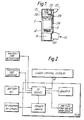
- the inhalation device comprises a housing 2 accommodating an aerosol container 4 having a dispensing valve 6.
- the aerosol container 4 is mounted vertically with the outlet valve 6 positioned within a nozzle block 8.
- the housing 2 has a mouthpiece 10 which may be adapted by the provision of a nasal adaptor if the medicament is to be administered via the nose.
- the patient inhales via the mouthpiece 10, initiating movement of the container relative to the valve, causing a dose of medicament to be fired from the valve, through the nozzle block, into the mouthpiece, and thence into the lungs as the patient inhales.
- the start of inhalation is sensed by a precision-moulded triggering mechanism which responds to an inhalation flow rate of about 30 litres/minute.
- the triggering mechanism comprises a vane 20 associated with a locking device acting on the nozzle block 8, allowing actuation of the aerosol device only during inhalation. Examples of such arrangements are disclosed in European Patent No. 0147028B. Force is first applied to the aerosol container by the manual raising of cocking lever 22. However, when the device is locked-out by the control means the cocking force will not facilitate actuation of the valve since movement of the vane of the triggering mechanism is blocked by lever 24.
- the control means When doses are available to the patient, the control means causes operation of the solenoid 26, causing lever 28 to be pushed forwards and its hooked end to engage within an aperture in lever 24. When cocking lever 22 is then raised, levers 28 and 24 are also raised, so freeing the triggering mechanism for operation. Inhalation will then move the vane, freeing the nozzle block and allowing the cocking force to move the container relative to the valve, thereby firing the aerosol valve and delivering a dose of medicament.
- the electronic circuitry is illustrated in diagrammatical form in Figure 2 and comprises an integrated circuit incorporating a clock regulated by a separate quartz crystal oscillator.
- the bi-stable d.c. solenoid is controlled via a power switch comprising field effect transistors (F.E.T's).
- the circuit includes a control switch for selecting the control period 'T', the dosage period 't' and the number of doses 'N'.
- a liquid crystal display is provided to display one or more types of information defined herein before.
- the electronic circuitry may readily be reduced to a chip and printed circuit board for accommodation within the device as shown at 13.
- a battery provides the necessary power.
- the liquid crystal display may be positioned at any suitable place on the housing.
- the entire inhalation device may be compacted and the outer dimensions of the housing may be of the order of 90 mm x 60 mm x 30 mm.
- the inhaler may be provided in either a disposable or re-usable form. In the former case the device is completely sealed to prevent access to the aerosol canister. In the latter, it is openable but has a locking mechanism to prevent unauthorised opening.
- This lock may be either mechanical or take the form of a code-operated electronic lock integrated with the device's electronic circuitry.
- the fentanyl citrate employed in the Examples contained 64% of the anhydrous base.
- suspension formulations were prepared: The formulations were filled into glass bottles fitted with non-metering valves. Suspension formulations having a high Span® content exhibited a reduced tendency to agglomerate compared with formulations having a lower Span® content.
- the following suspension formulation was prepared: The formulation was filled into 5ml plain aluminium vials fitted with 50 ⁇ l valves using a 2 stage pressure fitting in which the non-volatile components were admixed and introduced into the vial, the valve crimped in place and the volatile propellant introduced into the vial through the valve under pressure. Dosage can be varied by varying the valve size as follows:
- Formulations were calculated for a delivery of 100 ⁇ g of base per shot when a 50 ⁇ l valve was fitted, and for a fill weight of 16g.
- the suspensions were filled into polyethylene terephthalate bottles to allow the appearance of the gross formulation to be studied. All units were prepared by two-stage pressure filling.
- the following stable suspensions contained Propellant 134a and ethanol in a weight ratio of 90 : 10.
- Example 4 The following stable suspensions were prepared as in Example 4 and contained Propellant 134a and n-Pentane in a ratio of 90 : 10.
- Example 4 The following suspensions were prepared as in Example 4 and contained Propellant 134a and Propellant 11 in a ration of 95 : 5.
- Fentanyl citrate formulations of the invention were compared with morphine sulphate, morphine base and diamorphine hydrochloride formulations presented as metered-dose inhalation aerosols in various single-dose and repeat-dose experiments in rodent and non-rodent species.
- the comparative formulations were as follows. Each formulation was filled into 5ml vials equipped with 50 ⁇ l dispensing valves.
- the system consisted of an aluminium cylindrical chamber of approximately 41.5 litre volume. It was fitted with a flat top which supported an electrically driven mechanism, capable of actuating up to six inverted metered-dose inhaler (MDI) aerosol cans simultaneously. The duration and frequency of operation was controlled by a time switch.
- MDI inverted metered-dose inhaler
- the MDI can nozzles opened directly into the exposure chamber where the administered aerosol dose was mixed and dispersed by a regulated constant supply of clean dry air.
- An extract duct at the base of the chamber was connected via a filter to a vacuum system. The pressure within the chamber was maintained just below atmospheric pressure.
- MDI cans were selected, weighed and inverted in the template of the actuating mechanism.
- the ram mechanism was positioned to cover the bases of the cans so that each downward stroke of the ram would actuate the cans causing them to fire simultaneously into the exposure chamber.
- Each rodent was held in an individual, tapered, polycarbonate restraint tube, fitted onto the exposure chamber and sealed by means of a push fit through a rubber 'O' ring. Only the animal's nose was exposed to the test atmosphere.
- Inhalation dosing to Beagle dogs was performed using a dosing apparatus, comprising a mouthpiece, face mask, and modified MDI.
- the mouthpiece was located inside the animal's mouth on top of the tongue, and the face mask, incorporating the mouthpiece, sealed around the dog's snout by means of a rubber sleeve.
- the mask was connected via a one-way flap valve and exhaust tube to an extract system.
- the modified MDI was attached by a push fit connection to the distal end of the mouthpiece.
- the MDI can was actuated manually in the normal way, by downward pressure at a time to coincide with inspiration.
- test material was performed, by the inhalation and intranasal routes. Doses administered ranged from 8 to 25 actuations per session for the inhalation administration and from 5 to 35 actuations per session for the intranasal route of administration. Following inhalation, fentanyl citrate caused rapid and marked sedation with the effect lasting for at least one hour at high doses. Similar observations were seen following intranasal administration.
- mice were treated with a nominal dose of 0.13mg/kg fentanyl three times daily over a five day period. To achieve the correct dose, animals were weighed daily, and the body weight used to calculate the requisite number of metered dose aerosol actuations to be administered. (Results are shown in Table 2).
- a nominal dose of 30mg diamorphine hydrochloride administered by the inhalation route caused sedation in 1 out of 2 dogs.
- subsequent administration of the high dose formulation at similar or higher nominal doses failed to produce signs of sedation in either animal.
- a nominal dose of 8 - 9 mg/kg diamorphine hydrochloride administered intranasally was capable of producing a marked degree of sedation in dogs whilst a nominal dose of 10 - 13 mg/kg administered over three sessions caused a constant state of sedation throughout the whole dosing period.
- a total daily dose of 450 actuations of the formulation were administered by the intranasal route. Minimal drug-related clinical signs were observed during and following treatment. Up to 330 actuations of a higher concentration formulation were also administered intranasally. At the higher dose, animals exhibited a reduced pupillary constriction on reflex to a light stimulus, became subdued and slightly sedated.
- Fentanyl citrate has been demonstrated in two animal models to be a highly potent, quick acting compound with pharmacological actions persisting for about two hours. These properties make it a good candidate for developing into a patient controlled analgesia dosage form for administration via the inhalation route. Morphine base and Morphine sulphate preparations did not show a suitable rapid onset of action, and were considerably less potent by the inhalation route than might have been expected from the intravenous dosing data.
Landscapes
- Health & Medical Sciences (AREA)
- General Health & Medical Sciences (AREA)
- Veterinary Medicine (AREA)
- Medicinal Chemistry (AREA)
- Pharmacology & Pharmacy (AREA)
- Epidemiology (AREA)
- Life Sciences & Earth Sciences (AREA)
- Chemical & Material Sciences (AREA)
- Animal Behavior & Ethology (AREA)
- Public Health (AREA)
- Engineering & Computer Science (AREA)
- Bioinformatics & Cheminformatics (AREA)
- Emergency Medicine (AREA)
- Otolaryngology (AREA)
- Pulmonology (AREA)
- Medicinal Preparation (AREA)
- Pharmaceuticals Containing Other Organic And Inorganic Compounds (AREA)
Claims (17)
- Aerosolformulierung, umfassend Fentanyl oder ein physiologisch verträgliches Derivat davon, das in einem Aerosoltreibmittel dispergiert oder gelöst ist.
- Aerosolformulierung nach Anspruch 1, umfassend Fentanylcitrat.
- Aerosolformulierung nach Anspruch 1 oder 2, wobei Fentanyl oder ein physiologisch verträgliches Derivat davon in einer Menge von 0,05 bis 5,0 Gew.-%, bezogen auf die Gesamtzusammensetzung vorhanden ist.
- Aerosolformulierung nach einem der vorstehenden Ansprüche, die zusätzlich ein Lösungsmittel für Fentanyl in einer Menge im Bereich von 5 bis 25 Gew.-%, bezogen auf die Gesamtzusammensetzung, umfaßt.
- Aerosolformulierung nach einem der vorstehenden Ansprüche, die zusätzlich ein oberflächenaktives Mittel umfaßt, wobei das Gewichtsverhältnis des Tensids zu Fentanyl im Bereich von 1 : 100 bis 10 : 1 ist.
- Aerosolformulierung nach Anspruch 5, wobei das oberflächenaktive Mittel ausgewählt ist aus Sorbitantrioleat, Ölsäure, Lecithin und fluorierten oberflächenaktiven Mitteln.
- Aerosolformulierung nach einem der vorstehenden Ansprüche, umfassend eines oder mehrere der folgenden Treibmittel in einer Konzentration im angegebenen Bereich:
15 bis 25 Gew.-% Trichlormonofluormethan,
50 bis 90 Gew.-% Dichlordifluormethan und
5 bis 50 Gew.-% Monochlordifluormethan. - Aerosolformulierung nach einem der Ansprüche 1 bis 6, wobei das Aerosoltreibmittel 1,1,1,2-Tetrafluorethan in einer Menge von mindestens 50 Gew.-%, bezogen auf die Formulierung, umfaßt.
- Aerosolformulierung nach Anspruch 8, die 1,1,1,2-Tetrafluorethan, ein oberflächenaktives Mittel und mindestens ein Adjuvans mit einer höheren Polarität als 1,1,1,2-Tetrafluorethan umfaßt, wobei das Gewichtsverhältnis von 1,1,1,2-Tetrafluorethan zu der Verbindung mit der höheren Polarität im Bereich von 50 : 50 bis 99 : 1 liegt.
- Aerosolformulierung nach Anspruch 9, wobei die Verbindung mit einer höheren Polarität ausgewählt ist aus Ethanol, Isopropanol, n-Pentan, Isopentan, Neopentan und Gemischen davon.
- Aerosolformulierung nach Anspruch 8, wobei das Fentanyl oder das physiologisch verträgliche Derivat davon in Form eines mit einem oberflächenaktiven Dispersionsmittel beschichteten feinverteilten, festen Materials vorliegt, wobei das Dispersionsmittel mindestens 0,001 Gew.-% des beschichteten, festen Materials ausmacht, und in einem Aerosoltreibmittel, umfassend 1,1,1,2-Tetrafluorethan und gegebenenfalls einem Adjuvans mit einer Polarität, die gleich oder geringer ist als die von 1,1,1,2-Tetrafluorethan suspendiert ist.
- Aerosolformulierung nach Anspruch 11, wobei das feinverteilte, feste Material bis zu 10 Gew.-% der Gesamtzusammensetzung ausmacht und das oberflächenaktive Dispersionsmittel zwischen 0,01 und 1,0 Gew.-% des feinverteilten, festen Materials ausmacht.
- Aerosolformulierung nach Anspruch 11 oder 12, wobei das oberflächenaktive Dispersionsmittel ausgewählt ist aus perfluorierten Sulfonamidalkoholphosphatestern und deren Salzen, perfluorierten alkoholphosphatesterfreien Säuren und deren Salzen, perfluorierten alkylsulfonamidalkylenquaternären Ammoniumsalzen, N,N-(Carboxyl-substituierten-bis zu C₄-Alkyl)perfluorierten Alkylsulfonamiden und deren Salzen und Gemischen davon.
- Aerosolformulierung nach einem der Ansprüche 11 bis 13, wobei das Treibmittel ein Gemisch aus 1,1,1,2-Tetrafluorethan und einem Adjuvans, ausgewählt aus Perfluorpropan, Perfluorbutan, Octafluorcyclobutan, Perfluorpentan, Perfluorhexan, Perfluortributylamin, Perfluormethylcyclohexan und Perfluordecalin umfaßt.
- Unter Druck stehender Aerosolinhalator, umfassend einen Behälter, enthaltend eine Aerosolformulierung nach einem der vorstehenden Ansprüche und ein Ventil, das fähig ist, Dosierungen der Formulierung auszugeben.
- Unter Druck stehender Aerosolinhalator nach Anspruch 15, der zusätzlich eine Regelvorrichtung zur Regelung der Frequenz, mit der von dem Ventil Dosierungen ausgegeben werden, umfaßt.
- Unter Druck stehender Aerosolinhalator nach Anspruch 16, wobei die Regelvorrichtung derart beschaffen und angeordnet ist, daß nicht mehr als eine vorbestimmte Maximalzahl von Dosierungen während einer vorgegebenen Zeitdauer ausgegeben werden können.
Priority Applications (1)
| Application Number | Priority Date | Filing Date | Title |
|---|---|---|---|
| AT90901641T ATE95420T1 (de) | 1989-01-06 | 1990-01-04 | Fentanyl enthaltende aerosolzubereitungen. |
Applications Claiming Priority (2)
| Application Number | Priority Date | Filing Date | Title |
|---|---|---|---|
| GB8900267 | 1989-01-06 | ||
| GB898900267A GB8900267D0 (en) | 1989-01-06 | 1989-01-06 | Narcotic analgesic formulations and apparatus containing same |
Publications (2)
| Publication Number | Publication Date |
|---|---|
| EP0452384A1 EP0452384A1 (de) | 1991-10-23 |
| EP0452384B1 true EP0452384B1 (de) | 1993-10-06 |
Family
ID=10649685
Family Applications (1)
| Application Number | Title | Priority Date | Filing Date |
|---|---|---|---|
| EP90901641A Expired - Lifetime EP0452384B1 (de) | 1989-01-06 | 1990-01-04 | Fentanyl enthaltende aerosolzubereitungen |
Country Status (7)
| Country | Link |
|---|---|
| EP (1) | EP0452384B1 (de) |
| JP (1) | JPH04504566A (de) |
| CA (1) | CA2058428C (de) |
| DE (1) | DE69003804T2 (de) |
| GB (1) | GB8900267D0 (de) |
| NZ (1) | NZ232020A (de) |
| WO (1) | WO1990007333A1 (de) |
Families Citing this family (83)
| Publication number | Priority date | Publication date | Assignee | Title |
|---|---|---|---|---|
| US5225183A (en) * | 1988-12-06 | 1993-07-06 | Riker Laboratories, Inc. | Medicinal aerosol formulations |
| GB8828477D0 (en) * | 1988-12-06 | 1989-01-05 | Riker Laboratories Inc | Medical aerosol formulations |
| US5776434A (en) | 1988-12-06 | 1998-07-07 | Riker Laboratories, Inc. | Medicinal aerosol formulations |
| GB8921222D0 (en) * | 1989-09-20 | 1989-11-08 | Riker Laboratories Inc | Medicinal aerosol formulations |
| IL97065A (en) * | 1990-02-02 | 1994-01-25 | Fisons Plc | Repellent preparations for aerosol |
| DE69131867T2 (de) * | 1990-03-23 | 2000-05-18 | Minnesota Mining And Mfg. Co., Saint Paul | Anwendung von löslichen fluorhaltigen Tensiden zur Herstellung von Aerosol-Präparaten mit dosierter Abgabe |
| US5785952A (en) * | 1990-11-09 | 1998-07-28 | Glaxo Group Limited | Aerosol medicament formulation having a surface coating of surfactant |
| US5919435A (en) | 1990-11-09 | 1999-07-06 | Glaxo Group Limited | Aerosol formulation containing a particulate medicament |
| EP0504112A3 (en) * | 1991-03-14 | 1993-04-21 | Ciba-Geigy Ag | Pharmaceutical aerosol formulations |
| CA2111002C (en) * | 1991-06-10 | 2000-08-22 | Julianne Fassberg | Non-chlorofluorocarbon aerosol formulations |
| ATE339952T1 (de) | 1991-06-10 | 2006-10-15 | Schering Corp | Fluorchlorkohlenwasserstofffreie aerosolformulierungen |
| IT1250691B (it) | 1991-07-22 | 1995-04-21 | Giancarlo Santus | Composizioni terapeutiche per somministrazione intranasale comprendenti ketorolac. |
| US5658549A (en) * | 1991-12-12 | 1997-08-19 | Glaxo Group Limited | Aerosol formulations containing propellant 134a and fluticasone propionate |
| NZ246046A (en) * | 1991-12-12 | 1995-12-21 | Glaxo Group Ltd | Aerosol comprising a particulate medicament in a fluorocarbon or chlorofluorohydrocarbon and a polar cosolvent |
| US5916540A (en) | 1994-10-24 | 1999-06-29 | Glaxo Group Limited | Aerosol formulations containing P134A and/or P227 and particulate medicament |
| CA2455115C (en) | 1991-12-12 | 2008-05-27 | Glaxo Group Limited | Pharmaceutical aerosol formulation |
| US5674471A (en) * | 1991-12-12 | 1997-10-07 | Glaxo Group Limited | Aerosol formulations containing P134a and salbutamol |
| US5653962A (en) * | 1991-12-12 | 1997-08-05 | Glaxo Group Limited | Aerosol formulations containing P134a and particulate medicaments |
| US5736124A (en) * | 1991-12-12 | 1998-04-07 | Glaxo Group Limited | Aerosol formulations containing P134a and particulate medicament |
| US5744123A (en) * | 1991-12-12 | 1998-04-28 | Glaxo Group Limited | Aerosol formulations containing P134a and particulate medicaments |
| IL104068A (en) * | 1991-12-12 | 1998-10-30 | Glaxo Group Ltd | Surfactant-free pharmaceutical aerosol formulation comprising 1,1,1,2-tetrafluoroethane or 1,1,1,2,3,3,3-heptafluoro-n- propane as propellant |
| US7101534B1 (en) | 1991-12-18 | 2006-09-05 | 3M Innovative Properties Company | Suspension aerosol formulations |
| US7105152B1 (en) | 1991-12-18 | 2006-09-12 | 3M Innovative Properties Company | Suspension aerosol formulations |
| ATE177941T1 (de) * | 1992-12-09 | 1999-04-15 | Boehringer Ingelheim Pharma | Stabilisierte medizinische aerosollösungen |
| ZA939195B (en) * | 1992-12-09 | 1995-06-08 | Boehringer Ingelheim Pharma | Stabilized medicinal aerosol solution formulations |
| US5724957A (en) * | 1993-01-29 | 1998-03-10 | Aradigm Corporation | Intrapulmonary delivery of narcotics |
| US5934272A (en) * | 1993-01-29 | 1999-08-10 | Aradigm Corporation | Device and method of creating aerosolized mist of respiratory drug |
| US6098620A (en) * | 1993-01-29 | 2000-08-08 | Aradigm Corporation | Device for aerosolizing narcotics |
| US6012450A (en) * | 1993-01-29 | 2000-01-11 | Aradigm Corporation | Intrapulmonary delivery of hematopoietic drug |
| US5558085A (en) * | 1993-01-29 | 1996-09-24 | Aradigm Corporation | Intrapulmonary delivery of peptide drugs |
| EP0681491B1 (de) * | 1993-01-29 | 2000-12-13 | Aradigm Corporation | Intrapulmonares hormonabgabesystem |
| US5593661A (en) * | 1993-03-29 | 1997-01-14 | Henry; Richard A. | Lidocaine aerosol anaesthetic |
| JP3618346B2 (ja) * | 1993-03-29 | 2005-02-09 | リンクリス ファーマスーティカルズ リミテッド | リドカインエーロゾル麻酔薬 |
| US6632456B1 (en) | 1993-06-24 | 2003-10-14 | Astrazeneca Ab | Compositions for inhalation |
| IS1796B (is) * | 1993-06-24 | 2001-12-31 | Ab Astra | Fjölpeptíð lyfjablanda til innöndunar sem einnig inniheldur eykjaefnasamband |
| TW402506B (en) | 1993-06-24 | 2000-08-21 | Astra Ab | Therapeutic preparation for inhalation |
| US5747445A (en) * | 1993-06-24 | 1998-05-05 | Astra Aktiebolag | Therapeutic preparation for inhalation |
| US5830853A (en) * | 1994-06-23 | 1998-11-03 | Astra Aktiebolag | Systemic administration of a therapeutic preparation |
| US5589156A (en) * | 1994-05-02 | 1996-12-31 | Henry; Richard A. | Prilocaine and hydrofluourocarbon aerosol preparations |
| AU700162B2 (en) * | 1994-05-13 | 1998-12-24 | Aradigm Corporation | Narcotic containing aerosol formulation |
| US6165976A (en) | 1994-06-23 | 2000-12-26 | Astra Aktiebolag | Therapeutic preparation for inhalation |
| EE9700138A (et) | 1994-12-22 | 1997-12-15 | Astra Aktiebolag | Aerosoolravimvormid |
| US6524557B1 (en) | 1994-12-22 | 2003-02-25 | Astrazeneca Ab | Aerosol formulations of peptides and proteins |
| US5496537A (en) * | 1995-03-23 | 1996-03-05 | Henry; Richard A. | Propofol hydrofluorocarbon propellant formulations |
| US6652837B1 (en) | 1996-05-24 | 2003-11-25 | Massachusetts Institute Of Technology | Preparation of novel particles for inhalation |
| US20020052310A1 (en) | 1997-09-15 | 2002-05-02 | Massachusetts Institute Of Technology The Penn State Research Foundation | Particles for inhalation having sustained release properties |
| US5874064A (en) | 1996-05-24 | 1999-02-23 | Massachusetts Institute Of Technology | Aerodynamically light particles for pulmonary drug delivery |
| US6120752A (en) * | 1997-05-21 | 2000-09-19 | 3M Innovative Properties Company | Medicinal aerosol products containing formulations of ciclesonide and related steroids |
| US7052678B2 (en) | 1997-09-15 | 2006-05-30 | Massachusetts Institute Of Technology | Particles for inhalation having sustained release properties |
| US6956021B1 (en) | 1998-08-25 | 2005-10-18 | Advanced Inhalation Research, Inc. | Stable spray-dried protein formulations |
| US6849263B2 (en) * | 1998-12-21 | 2005-02-01 | Generex Pharmaceutical Incorporated | Pharmaceutical compositions for buccal delivery of pain relief medications |
| US6749835B1 (en) | 1999-08-25 | 2004-06-15 | Advanced Inhalation Research, Inc. | Formulation for spray-drying large porous particles |
| US7678364B2 (en) | 1999-08-25 | 2010-03-16 | Alkermes, Inc. | Particles for inhalation having sustained release properties |
| US7074803B2 (en) | 2001-03-02 | 2006-07-11 | Durect Corporation | Opioid formulations |
| AU4341401A (en) * | 2000-03-10 | 2001-09-24 | Durect Corp | Opioid formulations |
| WO2001097780A2 (en) * | 2000-06-22 | 2001-12-27 | Pharmasol Ltd | Pharmaceutical compositions comprising an opioid analgesic |
| EA006384B1 (ru) * | 2000-07-31 | 2005-12-29 | Нюкомед Данмарк А/С | Композиция фентанила для интраназального введения |
| JP2005504715A (ja) | 2000-12-29 | 2005-02-17 | アドバンスト インハレーション リサーチ,インコーポレイテッド | 持続放出特性を有する吸入用粒子 |
| US20030138508A1 (en) * | 2001-12-18 | 2003-07-24 | Novack Gary D. | Method for administering an analgesic |
| JP2005503425A (ja) | 2001-05-24 | 2005-02-03 | アレックザ モレキュラー デリヴァリー コーポレイション | 所定の吸入ルートによる薬剤エステルの送出 |
| US7585493B2 (en) | 2001-05-24 | 2009-09-08 | Alexza Pharmaceuticals, Inc. | Thin-film drug delivery article and method of use |
| US20070122353A1 (en) | 2001-05-24 | 2007-05-31 | Hale Ron L | Drug condensation aerosols and kits |
| US7090830B2 (en) | 2001-05-24 | 2006-08-15 | Alexza Pharmaceuticals, Inc. | Drug condensation aerosols and kits |
| US20030051728A1 (en) | 2001-06-05 | 2003-03-20 | Lloyd Peter M. | Method and device for delivering a physiologically active compound |
| US7458374B2 (en) | 2002-05-13 | 2008-12-02 | Alexza Pharmaceuticals, Inc. | Method and apparatus for vaporizing a compound |
| DE10130449A1 (de) * | 2001-06-23 | 2003-01-09 | Martin Schmidt | Inhalierbare Sedativa und Hypnotika für den medizinischen Gebrauch |
| GB0208742D0 (en) | 2002-04-17 | 2002-05-29 | Bradford Particle Design Ltd | Particulate materials |
| AU2002352836B2 (en) | 2001-11-20 | 2005-09-29 | Alkermes, Inc. | Improved particulate compositions for pulmonary delivery |
| US7582284B2 (en) | 2002-04-17 | 2009-09-01 | Nektar Therapeutics | Particulate materials |
| GB0300531D0 (en) | 2003-01-10 | 2003-02-12 | West Pharm Serv Drug Res Ltd | Pharmaceutical compositions |
| EP1732555A4 (de) * | 2003-02-28 | 2008-07-16 | Ym Biosciences Inc | Opioid-abgabesystem |
| NZ542005A (en) * | 2003-02-28 | 2009-05-31 | Ym Biosciences Inc | Opioid delivery system for pulmonary administration |
| US7648981B2 (en) | 2003-02-28 | 2010-01-19 | Ym Biosciences Inc. | Opioid delivery system |
| US7648982B2 (en) | 2003-02-28 | 2010-01-19 | Ym Biosciences Inc. | Opioid delivery system |
| US20040234916A1 (en) | 2003-05-21 | 2004-11-25 | Alexza Molecular Delivery Corporation | Optically ignited or electrically ignited self-contained heating unit and drug-supply unit employing same |
| US7540286B2 (en) | 2004-06-03 | 2009-06-02 | Alexza Pharmaceuticals, Inc. | Multiple dose condensation aerosol devices and methods of forming condensation aerosols |
| EP1781360A1 (de) | 2004-08-12 | 2007-05-09 | Alexza Pharmaceuticals, Inc. | Aerosol-arzneiabgabevorrichtung mit perkussiv aktivierten wärmepackungen |
| ES2535233T3 (es) | 2006-01-25 | 2015-05-06 | Insys Therapeutics, Inc. | Pulverización de fentanilo sublingual |
| WO2008097664A1 (en) | 2007-02-11 | 2008-08-14 | Map Pharmaceuticals, Inc. | Method of therapeutic administration of dhe to enable rapid relief of migraine while minimizing side effect profile |
| EP1964564A1 (de) * | 2007-04-19 | 2008-09-03 | LAB International SRL | Durchbruchsschmerzbehandlung |
| WO2008112661A2 (en) | 2007-03-09 | 2008-09-18 | Alexza Pharmaceuticals, Inc. | Heating unit for use in a drug delivery device |
| PT2180844T (pt) | 2007-08-02 | 2018-04-06 | Insys Dev Co Inc | Nebulizador sub-lingual de fentanilo |
| US12214118B2 (en) | 2018-02-02 | 2025-02-04 | Alexza Pharmaceuticals, Inc. | Electrical condensation aerosol device |
Family Cites Families (1)
| Publication number | Priority date | Publication date | Assignee | Title |
|---|---|---|---|---|
| DE3602370A1 (de) * | 1986-01-27 | 1987-08-06 | Chrubasik Sigrun | Verwendung von analgetica durch inhalation |
-
1989
- 1989-01-06 GB GB898900267A patent/GB8900267D0/en active Pending
-
1990
- 1990-01-04 EP EP90901641A patent/EP0452384B1/de not_active Expired - Lifetime
- 1990-01-04 JP JP2501782A patent/JPH04504566A/ja active Pending
- 1990-01-04 CA CA002058428A patent/CA2058428C/en not_active Expired - Fee Related
- 1990-01-04 DE DE90901641T patent/DE69003804T2/de not_active Expired - Fee Related
- 1990-01-04 WO PCT/GB1990/000015 patent/WO1990007333A1/en not_active Ceased
- 1990-01-05 NZ NZ23202090A patent/NZ232020A/en unknown
Non-Patent Citations (1)
| Title |
|---|
| Remington's Pharmaceutical Sciences, 5th ed.(1975), Mack Publishing Company, p. 1044 * |
Also Published As
| Publication number | Publication date |
|---|---|
| CA2058428C (en) | 2000-09-05 |
| GB8900267D0 (en) | 1989-03-08 |
| DE69003804T2 (de) | 1994-05-05 |
| CA2058428A1 (en) | 1990-07-07 |
| EP0452384A1 (de) | 1991-10-23 |
| NZ232020A (en) | 1992-03-26 |
| JPH04504566A (ja) | 1992-08-13 |
| DE69003804D1 (de) | 1993-11-11 |
| WO1990007333A1 (en) | 1990-07-12 |
Similar Documents
| Publication | Publication Date | Title |
|---|---|---|
| EP0452384B1 (de) | Fentanyl enthaltende aerosolzubereitungen | |
| US4232002A (en) | Procedures and pharmaceutical products for use in the administration of antihistamines | |
| JP3911290B2 (ja) | エアゾールを含む麻酔用処方 | |
| EP0731688B1 (de) | Aerosole als darreichungsform mit cfc-freiem treibmittel | |
| AU714303B2 (en) | Formulation for intranasal administration | |
| US8367734B1 (en) | Stable epinephrine suspension formulation with high inhalation delivery efficiency | |
| US5603918A (en) | Aerosol composition of a salt of ipratropium and a salt of albuterol | |
| JP2003533439A (ja) | 薬学的組成物 | |
| KR19990022296A (ko) | 폐병치료에 유용한 디뉴클레오티드 | |
| SK284430B6 (sk) | Farmaceutický prostriedok na použitie v aerosólovom inhalátore, aerosólový inhalátor a spôsob plnenia aerosólového inhalátora | |
| RU94040361A (ru) | Аэрозольная фармацевтическая композиция, баллончик для доставки композиции, дозировочный ингалятор, способ лечения респираторных заболеваний, способ получения композиции | |
| WO1997039745A1 (en) | Use of inhaled retinoids in the prevention of cancer | |
| JP2002528399A (ja) | Δ9テトラヒドロカナビノール(δ9thc)溶液計量ずみ投与量吸入器および使用方法 | |
| JP2005538136A (ja) | 鎮痛薬の口腔送達用薬学的組成物 | |
| CN116173025A (zh) | 一种含格隆铵盐及茚达特罗盐的气雾剂药物组合物及其制备方法与应用 | |
| JP2004521950A (ja) | Δ8テトラヒドロカンナビノールのエアロゾル製剤 | |
| ES2207867T3 (es) | Preparacion farmaceutica para inhalacion de un opioide. | |
| US6193954B1 (en) | Formulations for pulmonary delivery of dopamine agonists | |
| SK286139B6 (sk) | Zariadenie na podávanie odmeraných dávok aerosólov | |
| JP4721520B2 (ja) | エアロゾル噴射剤に溶解した薬剤 | |
| US7273604B2 (en) | Anti-asthmatic combinations comprising surface active phospholipids | |
| WO1992014466A1 (en) | Pharmaceutical antitussive compositions | |
| JPH02142729A (ja) | 吸入用医薬組成物 | |
| WO2000030654A1 (en) | Anti-asthmatic combinations comprising surface active phospholipids | |
| US20050118108A1 (en) | Pulmonary delivery of a liquid medicament aerosol |
Legal Events
| Date | Code | Title | Description |
|---|---|---|---|
| PUAI | Public reference made under article 153(3) epc to a published international application that has entered the european phase |
Free format text: ORIGINAL CODE: 0009012 |
|
| 17P | Request for examination filed |
Effective date: 19910627 |
|
| AK | Designated contracting states |
Kind code of ref document: A1 Designated state(s): AT BE CH DE DK ES FR GB IT LI LU NL SE |
|
| 17Q | First examination report despatched |
Effective date: 19920220 |
|
| GRAA | (expected) grant |
Free format text: ORIGINAL CODE: 0009210 |
|
| AK | Designated contracting states |
Kind code of ref document: B1 Designated state(s): AT BE CH DE DK ES FR GB IT LI LU NL SE |
|
| PG25 | Lapsed in a contracting state [announced via postgrant information from national office to epo] |
Ref country code: LI Effective date: 19931006 Ref country code: DK Effective date: 19931006 Ref country code: CH Effective date: 19931006 Ref country code: BE Effective date: 19931006 Ref country code: AT Effective date: 19931006 |
|
| REF | Corresponds to: |
Ref document number: 95420 Country of ref document: AT Date of ref document: 19931015 Kind code of ref document: T |
|
| REF | Corresponds to: |
Ref document number: 69003804 Country of ref document: DE Date of ref document: 19931111 |
|
| ITF | It: translation for a ep patent filed | ||
| ET | Fr: translation filed | ||
| REG | Reference to a national code |
Ref country code: CH Ref legal event code: PL |
|
| PG25 | Lapsed in a contracting state [announced via postgrant information from national office to epo] |
Ref country code: ES Free format text: LAPSE BECAUSE OF FAILURE TO SUBMIT A TRANSLATION OF THE DESCRIPTION OR TO PAY THE FEE WITHIN THE PRESCRIBED TIME-LIMIT Effective date: 19940117 |
|
| PG25 | Lapsed in a contracting state [announced via postgrant information from national office to epo] |
Ref country code: LU Free format text: LAPSE BECAUSE OF NON-PAYMENT OF DUE FEES Effective date: 19940131 |
|
| PLBE | No opposition filed within time limit |
Free format text: ORIGINAL CODE: 0009261 |
|
| STAA | Information on the status of an ep patent application or granted ep patent |
Free format text: STATUS: NO OPPOSITION FILED WITHIN TIME LIMIT |
|
| 26N | No opposition filed | ||
| EAL | Se: european patent in force in sweden |
Ref document number: 90901641.2 |
|
| PGFP | Annual fee paid to national office [announced via postgrant information from national office to epo] |
Ref country code: ES Payment date: 19970120 Year of fee payment: 8 |
|
| PGFP | Annual fee paid to national office [announced via postgrant information from national office to epo] |
Ref country code: SE Payment date: 20011220 Year of fee payment: 13 |
|
| REG | Reference to a national code |
Ref country code: GB Ref legal event code: IF02 |
|
| PGFP | Annual fee paid to national office [announced via postgrant information from national office to epo] |
Ref country code: NL Payment date: 20020107 Year of fee payment: 13 |
|
| PG25 | Lapsed in a contracting state [announced via postgrant information from national office to epo] |
Ref country code: SE Free format text: LAPSE BECAUSE OF NON-PAYMENT OF DUE FEES Effective date: 20030105 |
|
| PG25 | Lapsed in a contracting state [announced via postgrant information from national office to epo] |
Ref country code: NL Free format text: LAPSE BECAUSE OF NON-PAYMENT OF DUE FEES Effective date: 20030801 |
|
| EUG | Se: european patent has lapsed | ||
| NLV4 | Nl: lapsed or anulled due to non-payment of the annual fee |
Effective date: 20030801 |
|
| PGFP | Annual fee paid to national office [announced via postgrant information from national office to epo] |
Ref country code: GB Payment date: 20031230 Year of fee payment: 15 |
|
| PGFP | Annual fee paid to national office [announced via postgrant information from national office to epo] |
Ref country code: FR Payment date: 20040122 Year of fee payment: 15 |
|
| PGFP | Annual fee paid to national office [announced via postgrant information from national office to epo] |
Ref country code: DE Payment date: 20040301 Year of fee payment: 15 |
|
| PG25 | Lapsed in a contracting state [announced via postgrant information from national office to epo] |
Ref country code: IT Free format text: LAPSE BECAUSE OF NON-PAYMENT OF DUE FEES;WARNING: LAPSES OF ITALIAN PATENTS WITH EFFECTIVE DATE BEFORE 2007 MAY HAVE OCCURRED AT ANY TIME BEFORE 2007. THE CORRECT EFFECTIVE DATE MAY BE DIFFERENT FROM THE ONE RECORDED. Effective date: 20050104 Ref country code: GB Free format text: LAPSE BECAUSE OF NON-PAYMENT OF DUE FEES Effective date: 20050104 |
|
| PG25 | Lapsed in a contracting state [announced via postgrant information from national office to epo] |
Ref country code: DE Free format text: LAPSE BECAUSE OF NON-PAYMENT OF DUE FEES Effective date: 20050802 |
|
| GBPC | Gb: european patent ceased through non-payment of renewal fee |
Effective date: 20050104 |
|
| PG25 | Lapsed in a contracting state [announced via postgrant information from national office to epo] |
Ref country code: FR Free format text: LAPSE BECAUSE OF NON-PAYMENT OF DUE FEES Effective date: 20050930 |
|
| REG | Reference to a national code |
Ref country code: FR Ref legal event code: ST |