EP0452395B1 - Vorrichtung zur messung eines rauschfreien signals, das in einem verrauschten, diskreten signal vorhanden ist und bei einem konstanten mittleren rauschniveau gemessen wird - Google Patents
Vorrichtung zur messung eines rauschfreien signals, das in einem verrauschten, diskreten signal vorhanden ist und bei einem konstanten mittleren rauschniveau gemessen wird Download PDFInfo
- Publication number
- EP0452395B1 EP0452395B1 EP19900901833 EP90901833A EP0452395B1 EP 0452395 B1 EP0452395 B1 EP 0452395B1 EP 19900901833 EP19900901833 EP 19900901833 EP 90901833 A EP90901833 A EP 90901833A EP 0452395 B1 EP0452395 B1 EP 0452395B1
- Authority
- EP
- European Patent Office
- Prior art keywords
- signal
- count
- noise
- period
- during
- Prior art date
- Legal status (The legal status is an assumption and is not a legal conclusion. Google has not performed a legal analysis and makes no representation as to the accuracy of the status listed.)
- Expired - Lifetime
Links
- 238000001514 detection method Methods 0.000 claims abstract description 52
- 230000005855 radiation Effects 0.000 claims abstract description 27
- 230000006870 function Effects 0.000 claims description 32
- 238000005259 measurement Methods 0.000 claims description 9
- 238000007493 shaping process Methods 0.000 claims description 7
- 238000012545 processing Methods 0.000 claims description 6
- 230000005236 sound signal Effects 0.000 claims description 6
- 230000000630 rising effect Effects 0.000 claims 3
- 230000001419 dependent effect Effects 0.000 claims 1
- 238000004364 calculation method Methods 0.000 description 5
- 239000002245 particle Substances 0.000 description 5
- 230000011664 signaling Effects 0.000 description 5
- 241001080024 Telles Species 0.000 description 4
- 238000000034 method Methods 0.000 description 4
- 238000001228 spectrum Methods 0.000 description 3
- 238000012550 audit Methods 0.000 description 2
- JJWKPURADFRFRB-UHFFFAOYSA-N carbonyl sulfide Chemical compound O=C=S JJWKPURADFRFRB-UHFFFAOYSA-N 0.000 description 2
- 238000013461 design Methods 0.000 description 2
- 229910052732 germanium Inorganic materials 0.000 description 2
- GNPVGFCGXDBREM-UHFFFAOYSA-N germanium atom Chemical compound [Ge] GNPVGFCGXDBREM-UHFFFAOYSA-N 0.000 description 2
- 239000011435 rock Substances 0.000 description 2
- 238000004458 analytical method Methods 0.000 description 1
- 238000013459 approach Methods 0.000 description 1
- 230000000295 complement effect Effects 0.000 description 1
- 238000012217 deletion Methods 0.000 description 1
- 230000037430 deletion Effects 0.000 description 1
- 238000010586 diagram Methods 0.000 description 1
- 238000011156 evaluation Methods 0.000 description 1
- 238000002474 experimental method Methods 0.000 description 1
- 238000004519 manufacturing process Methods 0.000 description 1
- 238000012986 modification Methods 0.000 description 1
- 230000004048 modification Effects 0.000 description 1
- 238000011897 real-time detection Methods 0.000 description 1
- 238000005070 sampling Methods 0.000 description 1
- 230000035945 sensitivity Effects 0.000 description 1
- 239000002689 soil Substances 0.000 description 1
- 230000001960 triggered effect Effects 0.000 description 1
- 230000000007 visual effect Effects 0.000 description 1
Images


Classifications
-
- G—PHYSICS
- G01—MEASURING; TESTING
- G01T—MEASUREMENT OF NUCLEAR OR X-RADIATION
- G01T1/00—Measuring X-radiation, gamma radiation, corpuscular radiation, or cosmic radiation
- G01T1/16—Measuring radiation intensity
- G01T1/17—Circuit arrangements not adapted to a particular type of detector
-
- G—PHYSICS
- G01—MEASURING; TESTING
- G01T—MEASUREMENT OF NUCLEAR OR X-RADIATION
- G01T1/00—Measuring X-radiation, gamma radiation, corpuscular radiation, or cosmic radiation
- G01T1/16—Measuring radiation intensity
Definitions
- the present invention relates to a system for detecting the presence of a pure signal in a measured discrete noisy signal, this detection being carried out with a probability of false detection less than a predetermined false detection rate.
- the invention relates to the detection of discrete signals, that is to say the signals produced by discontinuous events.
- the invention applies in particular to the detection of corpuscular radiation such as neutron rays or gamma rays.
- the detection of a pure signal in a measured noisy signal supposes that one can overcome the presence of noise in said measured signal.
- the invention relates to a detection method when the average noise level varies in an interval having an upper limit MB. This condition is almost always fulfilled for neutron radiation because there are very few free neutrons in the environment. It is also often performed in a given location for a certain period of time for gamma radiation.
- the detection of a particular corpuscular radiation is done in the presence of a corpuscular noise having several causes.
- part of the noise is due to cosmic radiation and the other part is due to the natural radioactivity of soils and rocks.
- Cosmic radiation can vary over time and the corpuscular noise due to rocks and terrain is essentially variable, depending on where the measurement is taken. A particular radiation can therefore only be detected if we know the noise or if we have a sufficient estimate.
- Information is stored for a limited period of time ⁇ t. This storage of information is done discreetly: when a particle is detected, the content of a memory is increased by one.
- one or more parameters define the nuclear event detected. In the case where this event depends only on a single parameter, this can for example be energy: this is the typical case of the detection of gamma radiation using an intrinsic germanium or a NaI scintillator associated with a photomultiplier.
- This unique parameter can also be time, for example when measuring the time of flight of a particle.
- the current practice consists in assessing by what value the count obtained exceeds the estimate of the noise available.
- This noise can be estimated in different ways. It can be known in advance by a measurement made beforehand in circumstances where one is sure that there is no particular signal. It can also be appreciated during the experiment in the absence of any signal source by extrapolating or interpolating the levels of the detected signal in different intervals, for example energetic.
- the counting rate in the intervals where it is certain that there is no noise is sufficient, to be able to make an estimate of the probability density of the noise in the intervals where it is sought to detect a particular radiation.
- An object of the invention is to provide a detection system based on a rational criterion, deduced from the laws of probability of the appearance of noise and of the expected radiation. Detection according to the invention thus has the advantage of depending only on an objective criterion.
- the practical criterion for detecting a pure signal is therefore the obtaining of sufficient information, that is to say greater than a threshold Im, that is to say a probability of false detection less than a rate predetermined false detection.
- Detection according to this method therefore consists in comparing the probability of false detection PF, defined by the counting rate N measured and an estimate of the average constant noise rate M, with a predetermined false detection rate TF. A pure signal is detected if said probability is lower than said rate.
- the probability of false detection is expressed as a function of the count rate N and of the estimated average noise rate M. This density the probability is for example that of Poisson's law for corpuscular radiation.
- the duration of the calculation depends on the value of the count rate N and is usually incompatible with real-time detection, if the duration of each count is of the order of a second for example.
- This method was applied to the design of portable devices and consisted in making an estimate of the information from a threshold value corresponding to a false alarm rate of 10 ⁇ 3.
- This algorithm involves splitting the energy spectrum into a few windows (in practice four windows have been chosen); in each of these windows, the probability of false signal, according to the so-called "Fluctuating Reference” algorithm, is evaluated online.
- the applicant has sought to facilitate the production of portable detectors.
- the applicant sought to simplify the electronics used in the known portable detector, for example that which is described in the patent application already mentioned and published. under No. 2 580 819 by eliminating the use of the table of values, which led it to delete the memory in which this table was recorded. The deletion of this table could only take place because the plaintiff weighed the detection problem differently.
- this simplification is the result of a semi-phenomenological shaping of the quantity of information I obtained as a function of the count.
- the quantity of information I is expressed according to the invention by a function F linked to the upper limit of the noise MB and to the average signal rate observed during a measurement of determined duration.
- the applicant has chosen the upper limit MB of the noise M.
- the invention applies to all discrete radiations, such as corpuscular radiations, and more precisely relates to the analysis of the signal delivered by a detector to decide, with a probability of false detection lower than a predetermined false detection rate, if the analyzed signal contains a pure signal due to the presence of a particular source or if this signal consists only of noise.
- the method of the invention applies in particular to the detection of gamma rays and neutron rays.
- the apparatus represented in FIG. 1 comprises a detector 2, a shaping means 4, a binary counting scale 6 which can notably comprise an analog-digital converter, a processing means 8 and a human-machine dialogue interface 10 conventional in itself constituted by control buttons (for example switches), a voltage-frequency converter and a signaling means (an alarm for example).
- the detector 2 depends on the radiation to be detected.
- this detector can be an intrinsic germanium or a NaI scintillator associated with a photomultiplier; for the detection of neutrons, the detector is for example a He3 counter.
- the detector 2 delivers a voltage pulse for each detected event. This pulse is received by the shaping means 4.
- the latter can notably comprise in series an amplifier, a shaping circuit and a discriminator.
- the binary counting scale 6 is arranged downstream of the shaping means 4. It counts the number of pulses delivered by the means 4 during counting times ⁇ t i .
- the processing means 8 comprises a processor 14 and an input-output circuit 18. These elements are connected by a channel 20 comprising address lines, data lines and control lines.
- the signaling and control means 10 is in connection with the processor 14 through the input-output circuit 18 and a channel 21. It notably comprises visual and audible alert means which are triggered when a pure signal is detected and supply means and switches (not shown) for sending control signals corresponding to external commands C and P.
- the number of particles detected during a measurement time ⁇ t i is a random variable whose probability density is that of Poisson's law.
- the complementary probability is the probability of false detection PF which defines the probability for a particular radiation to be detected when no particular radiation exists.
- the detection system of the invention makes it possible to translate this probability in the form of information I which is a function of the average signal rate M1 and of the upper limit of the estimated noise MB.
- the function F is previously stored in the processor memory, which performs the calculation with the data M1 and MB which have been entered beforehand.
- Block I of FIG. 2 represents a step consisting in entering into memory once and for all the function F, the duration of the periods ⁇ t i .
- Block A represents the initialization phase which takes place before any detection and which consists in carrying out an estimation of the average noise rate M and in retaining its upper bound.
- This block A comprises the blocks II to V corresponding to each of the stages of the phase initialization A.
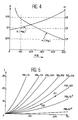
- This block B represents the signal detection phase consisting in declaring that there is a signal as soon as the rate M1 is positive and in transmitting a signal S whose frequency is an increasing function of the quantity of information, this quantity I having a semi-phenomenological expression given in figure 4.
- Block B includes blocks VI to XII corresponding to the different stages taking place during phase B.
- the detector user can start counting as many times as he wishes during durations ⁇ t i .
- the number k is therefore previously stored in the processor memory.
- the count N i-1 corresponds to the count obtained in the previous period
- n i corresponds to the count during the period Dt i of the period ⁇ t i + 1
- n ik corresponds to the count during the period Dt ik .
- Block XV represents a step of successive counts for a duration k.Dt i .
- a first count is carried out for a duration k.Dt i .
- the parameter k corresponding to the number of sub-periods Dt i is entered into memory.
- Block XVI represents the step of counting measurement during each time interval Dt i .
- a signal S which may be an audible signal is emitted.
- This signal is an increasing function H of the quantity of information I.
- a digital control signal D corresponding for example to a low level (state 0) is sent by the processor to the signaling means ( block XI, fig. 2) which will then not emit any signal.
- a new count or a new series of counts can be started again.
- the digital control signal D then has a high level (state 1) and is sent by the processor to the signaling means (block XII, fig. 2).
- the signal S is for example an audible signal whose frequency is an increasing function of the quantity I.
- the signal emitted S has a frequency which is a function of the frequency fo of the signal emitted for the threshold.
- control button C placed on the human-machine dialogue interface 10 so that the latter send a signal (a given voltage level for example) to a control input of the microprocessor 14 in order to trigger phase B of detection.
- Another control button P is provided on the man-machine dialogue interface 10 so that the latter send a signal (a voltage level gives for example) to a microprocessor control input in order to select the operating mode corresponding to either of the variants described.
Landscapes
- Physics & Mathematics (AREA)
- Health & Medical Sciences (AREA)
- Life Sciences & Earth Sciences (AREA)
- General Physics & Mathematics (AREA)
- High Energy & Nuclear Physics (AREA)
- Molecular Biology (AREA)
- Spectroscopy & Molecular Physics (AREA)
- Measurement Of Radiation (AREA)
Claims (5)
- Vorrichtung zum Detektieren eines rauschfreien Signals, das in einem verrauschten, diskreten Signal vorhanden ist und bei einem konstanten mittleren Rauschniveau mit einer Fehldetektionswahrscheinlichkeit PF, die unterhalb einer vorherbestimmten Fehldetektionsrate TF liegt, gemessen wird, wobei die Vorrichtung seriell aus einem Detektor (2) zur Umwandlung der empfangenen Strahlung in elektrische Impulse, einem Formgeber (4), einem Binärzähler (6), einer Verarbeitungseinrichtung (8) und einer Signalisierungseinrichtung (10) besteht, wobei die Verarbeitungseinrichtung aus einem Prozessor (14), der während n aufeinanderfolgender gleicher Zeitintervalle Δti eine Zählmessung mit der Zählung N₀ und aus dieser Zählung N₀ die Abschätzung eines mittleren Rauschniveauwerts M erlaubt, und einem Eingangs-/Ausgangsschaltkreis (18) besteht, wobei die genannte Vorrichtung dadurch gekennzeichnet ist, daß sie erlaubt:A) im voraus eine Initialisierungsphase durchzuführen, die darin besteht,- eine obere Grenze MB für das Rauschen derart zu bestimmen, daß
MB = βM, wobei β eine ganze Zahl größer als 1 ist,B) um ein Signal zu messen:- während mindestens eines Zeitintervalls Δti eine Zählmessung mit der Zählung Ni durchzuführen,- eine dem genannten Signal zugeordnete Zählung M1 abzuschätzen,
so daß M1 = Ni - NM,- die Informationsmenge I derart zu berechnen, daß: - ein Signal S auszusenden, wenn das Signalniveau M1 positiv ist,
wobei die Frequenz dieses Signals eine steigende Funktion der Informationsmenge I ist. - Vorrichtung zum Detektieren eines rauschfreien Signals, das in einem verrauschten Signal vorhanden ist, gemäß Anspruch 1, dadurch gekennzeichnet, daß die Funktion F von zwei Funktionen α und K der oberen Grenze MB für das Rauschen abhängt, gemäß folgender Schätzung:

- Vorrichtung zum Detektieren eines rauschfreien Signals, das in einem verrauschten Signal vorhanden ist, gemäß Anspruch 1 oder 2, dadurch gekennzeichnet, daß die Detektion B umfaßt:- eine Zählmessung während mehrerer aufeinanderfolgender Intervalle Δti, indem eine Division jedes Intervalls Δti in k aufeinanderfolgende Intervalle Dti, i = 1,k, durchgeführt und die Zählung ni während der Dauer jedes Intervalls Dti durchgeführt wird, wobei jede Zählmessung Ni so durchgeführt wird, daß:

- Vorrichtung zum Detektieren eines rauschfreien Signals, das in einem verrauschten Signal vorhanden ist, gemäß eines der Ansprüche 1 bis 3, dadurch gekennzeichnet, daß das am Ende jeder Zählung, die am Ende jeder Zeitdauer Δti erhalten wird, ausgesandte Signal S ein akustisches Signal der Form S = H(I).f₀ ist, wobei f₀ die Frequenz des akustischen Signals ist, das sobald das Signalniveau M1 positiv ist, ausgesandt wird, und H(I) eine steigende Funktion der Größe I ist.
- Vorrichtung gemäß Anspruch 3, dadurch gekennzeichnet, daß das ausgesandte Signal S ein akustisches Signal ist, dessen Frequenz unmittelbar nach jeder Zählung der Dauer Dti variiert, wobei dieses Signal von der Form S = H(I).f₀ ist, wobei f₀ die Frequenz des akustischen Signals ist, das sobald das Signalniveau M1 positiv ist, ausgesandt wird, und H(I) eine steigende Funktion der Informationsmenge I ist.
Applications Claiming Priority (2)
| Application Number | Priority Date | Filing Date | Title |
|---|---|---|---|
| FR8900204 | 1989-01-10 | ||
| FR8900204A FR2641615B1 (fr) | 1989-01-10 | 1989-01-10 | Systeme pour detecter la presence d'un signal pur dans un signal bruite discret mesure a taux moyen de bruit constant |
Publications (2)
| Publication Number | Publication Date |
|---|---|
| EP0452395A1 EP0452395A1 (de) | 1991-10-23 |
| EP0452395B1 true EP0452395B1 (de) | 1992-12-09 |
Family
ID=9377571
Family Applications (1)
| Application Number | Title | Priority Date | Filing Date |
|---|---|---|---|
| EP19900901833 Expired - Lifetime EP0452395B1 (de) | 1989-01-10 | 1990-01-09 | Vorrichtung zur messung eines rauschfreien signals, das in einem verrauschten, diskreten signal vorhanden ist und bei einem konstanten mittleren rauschniveau gemessen wird |
Country Status (3)
| Country | Link |
|---|---|
| EP (1) | EP0452395B1 (de) |
| FR (1) | FR2641615B1 (de) |
| WO (1) | WO1990008331A2 (de) |
Families Citing this family (2)
| Publication number | Priority date | Publication date | Assignee | Title |
|---|---|---|---|---|
| FR2738693B1 (fr) * | 1995-09-12 | 1997-10-10 | Commissariat Energie Atomique | Systeme de traitement d'impulsions provenant de l'interaction d'une particule gamma avec un detecteur de rayonnement cdte |
| WO1998032032A1 (en) * | 1997-01-16 | 1998-07-23 | Herr Mher Partnership | Method of determining mean intensity of pulse stream from ionizing-radiation detectors |
Family Cites Families (2)
| Publication number | Priority date | Publication date | Assignee | Title |
|---|---|---|---|---|
| FR2579767B1 (fr) * | 1985-04-02 | 1987-05-07 | Commissariat Energie Atomique | Systeme de suppression du bruit et de ses variations pour la detection d'un signal pur dans un signal discret bruite mesure |
| FR2580819B1 (fr) * | 1985-04-23 | 1987-05-15 | Commissariat Energie Atomique | Systeme pour detecter la presence d'un signal pur dans un signal bruite discret mesure a taux moyen de bruit constant avec une probabilite de fausse detection inferieure a un taux de fausse detection predetermine. |
-
1989
- 1989-01-10 FR FR8900204A patent/FR2641615B1/fr not_active Expired - Lifetime
-
1990
- 1990-01-09 WO PCT/FR1990/000017 patent/WO1990008331A2/fr not_active Ceased
- 1990-01-09 EP EP19900901833 patent/EP0452395B1/de not_active Expired - Lifetime
Also Published As
| Publication number | Publication date |
|---|---|
| FR2641615A1 (fr) | 1990-07-13 |
| WO1990008331A2 (fr) | 1990-07-26 |
| FR2641615B1 (fr) | 1991-03-08 |
| EP0452395A1 (de) | 1991-10-23 |
| WO1990008331A3 (fr) | 2004-04-29 |
Similar Documents
| Publication | Publication Date | Title |
|---|---|---|
| EP0202980B1 (de) | System für die Feststellung eines reinen Signals in einem mit konstantem Mittelwert verrauschten Signal mit einer Wahrscheinlichkeit von falscher Nachweisung die kleiner ist als ein vorherbestimmter Wert | |
| EP0043313B1 (de) | Verfahren und Vorrichtung zum Messen der Gammastrahlung in einem Bohrloch | |
| FR2513387A1 (fr) | Procede et dispositif de diagraphie nucleaire pour determiner une caracteristique corrigee des formations | |
| EP0215703B1 (de) | Messanordnung des akustischen Reflektionskoeffizienten von Unterwasserreflektoren | |
| CH666134A5 (fr) | Detecteur d'incendie analogique et installation d'alarme utilisant ce detecteur. | |
| EP3305186B1 (de) | Verfahren und system zur stressüberwachung eines benutzers | |
| EP2537047B1 (de) | Online-verfahren zur messung ionisierender strahlung | |
| EP3259608A1 (de) | Verfahren zur charakterisierung eines unklaren fehlers in einem kabel | |
| EP2359124B1 (de) | Verfahren zum nicht störenden nachweis eines chemischen elements | |
| EP0452395B1 (de) | Vorrichtung zur messung eines rauschfreien signals, das in einem verrauschten, diskreten signal vorhanden ist und bei einem konstanten mittleren rauschniveau gemessen wird | |
| EP3631517B1 (de) | Verfahren und vorrichtung zur verarbeitung von neutronenflusssignalen, zugehöriges computerprogrammprodukt und steuersystem | |
| EP0200596B1 (de) | System für die Unterdrückung des Rauschens und dessen Schwankungen um ein reines Signal in einem verrauschten Signal festzustellen | |
| FR2620829A1 (fr) | Systeme de suppression du bruit et de ses variations pour la detection d'un signal pur dans un signal discret bruite mesure | |
| EP3528224B1 (de) | Vorrichtung und verfahren zur präsenz- und/oder bewegungserkennung durch infrarot-messung | |
| WO2010125062A1 (fr) | Procédé de mesure du taux de comptage d'impulsions, utilisant une méthode du type des temps morts reconductibles avec mesure du temps actif | |
| EP4001859A1 (de) | Verfahren zur verarbeitung eines messsignals zur erstellung einer signatur, und entsprechende messvorrichtung | |
| EP3629063A1 (de) | Spektrometriesystem, entsprechendes spektrometrieverfahren und computerprogrammprodukt | |
| FR2719138A1 (fr) | Procédé et dispositif de compactage d'informations à mémoriser et de traitement des informations compactées. | |
| WO2006064024A2 (fr) | Traitement d' un signal representatif de rayonnement, en particulier des photons x et gamma, et des particules nucléaires | |
| EP2605409B1 (de) | Asynchrone Digitalisierung von transienten Signalen aus Strahlungsdetektoren | |
| FR2731541A1 (fr) | Procede et dispositif acoustique de detection d'intrusion | |
| EP0146432B1 (de) | Verfahren und Vorrichtung zur Ultraschallmessung einer Fahrzeuggeschwindigkeit gegenüber dem Boden | |
| FR2552552A1 (fr) | Dispositif de constitution d'un histogramme en temps reel | |
| FR2885758A1 (fr) | Systeme d'acquisition multimode | |
| FR2765420A1 (fr) | Procede et dispositif pour detecter un evenement susceptible d'affecter la transmission d'un signal |
Legal Events
| Date | Code | Title | Description |
|---|---|---|---|
| PUAI | Public reference made under article 153(3) epc to a published international application that has entered the european phase |
Free format text: ORIGINAL CODE: 0009012 |
|
| 17P | Request for examination filed |
Effective date: 19910615 |
|
| AK | Designated contracting states |
Kind code of ref document: A1 Designated state(s): BE DE GB IT |
|
| 17Q | First examination report despatched |
Effective date: 19920227 |
|
| GRAA | (expected) grant |
Free format text: ORIGINAL CODE: 0009210 |
|
| AK | Designated contracting states |
Kind code of ref document: B1 Designated state(s): BE DE GB IT |
|
| REF | Corresponds to: |
Ref document number: 69000577 Country of ref document: DE Date of ref document: 19930121 |
|
| PG25 | Lapsed in a contracting state [announced via postgrant information from national office to epo] |
Ref country code: BE Effective date: 19930131 |
|
| ITF | It: translation for a ep patent filed | ||
| GBT | Gb: translation of ep patent filed (gb section 77(6)(a)/1977) |
Effective date: 19930301 |
|
| BERE | Be: lapsed |
Owner name: COMMISSARIAT A L'ENERGIE ATOMIQUE ETABLISSEMENT D Effective date: 19930131 |
|
| PG25 | Lapsed in a contracting state [announced via postgrant information from national office to epo] |
Ref country code: DE Effective date: 19931001 |
|
| PLBE | No opposition filed within time limit |
Free format text: ORIGINAL CODE: 0009261 |
|
| STAA | Information on the status of an ep patent application or granted ep patent |
Free format text: STATUS: NO OPPOSITION FILED WITHIN TIME LIMIT |
|
| 26N | No opposition filed | ||
| PG25 | Lapsed in a contracting state [announced via postgrant information from national office to epo] |
Ref country code: GB Effective date: 19940109 |
|
| GBPC | Gb: european patent ceased through non-payment of renewal fee |
Effective date: 19940109 |
|
| D17D | Deferred search report published (deleted) | ||
| PG25 | Lapsed in a contracting state [announced via postgrant information from national office to epo] |
Ref country code: IT Free format text: LAPSE BECAUSE OF NON-PAYMENT OF DUE FEES;WARNING: LAPSES OF ITALIAN PATENTS WITH EFFECTIVE DATE BEFORE 2007 MAY HAVE OCCURRED AT ANY TIME BEFORE 2007. THE CORRECT EFFECTIVE DATE MAY BE DIFFERENT FROM THE ONE RECORDED. Effective date: 20050109 |