EP0452759A2 - Procédé et appareil pour l'analyse rapide d'images en couleurs - Google Patents
Procédé et appareil pour l'analyse rapide d'images en couleurs Download PDFInfo
- Publication number
- EP0452759A2 EP0452759A2 EP91105478A EP91105478A EP0452759A2 EP 0452759 A2 EP0452759 A2 EP 0452759A2 EP 91105478 A EP91105478 A EP 91105478A EP 91105478 A EP91105478 A EP 91105478A EP 0452759 A2 EP0452759 A2 EP 0452759A2
- Authority
- EP
- European Patent Office
- Prior art keywords
- color
- image
- light
- leds
- light source
- Prior art date
- Legal status (The legal status is an assumption and is not a legal conclusion. Google has not performed a legal analysis and makes no representation as to the accuracy of the status listed.)
- Withdrawn
Links
Images




Classifications
-
- H—ELECTRICITY
- H04—ELECTRIC COMMUNICATION TECHNIQUE
- H04N—PICTORIAL COMMUNICATION, e.g. TELEVISION
- H04N1/00—Scanning, transmission or reproduction of documents or the like, e.g. facsimile transmission; Details thereof
- H04N1/024—Details of scanning heads ; Means for illuminating the original
- H04N1/028—Details of scanning heads ; Means for illuminating the original for picture information pick-up
- H04N1/02815—Means for illuminating the original, not specific to a particular type of pick-up head
- H04N1/02845—Means for illuminating the original, not specific to a particular type of pick-up head using an elongated light source, e.g. tubular lamp, LED array
- H04N1/0285—Means for illuminating the original, not specific to a particular type of pick-up head using an elongated light source, e.g. tubular lamp, LED array in combination with at least one reflector which is in fixed relation to the light source
-
- H—ELECTRICITY
- H04—ELECTRIC COMMUNICATION TECHNIQUE
- H04N—PICTORIAL COMMUNICATION, e.g. TELEVISION
- H04N1/00—Scanning, transmission or reproduction of documents or the like, e.g. facsimile transmission; Details thereof
- H04N1/024—Details of scanning heads ; Means for illuminating the original
- H04N1/028—Details of scanning heads ; Means for illuminating the original for picture information pick-up
- H04N1/02815—Means for illuminating the original, not specific to a particular type of pick-up head
-
- H—ELECTRICITY
- H04—ELECTRIC COMMUNICATION TECHNIQUE
- H04N—PICTORIAL COMMUNICATION, e.g. TELEVISION
- H04N1/00—Scanning, transmission or reproduction of documents or the like, e.g. facsimile transmission; Details thereof
- H04N1/024—Details of scanning heads ; Means for illuminating the original
- H04N1/028—Details of scanning heads ; Means for illuminating the original for picture information pick-up
- H04N1/02815—Means for illuminating the original, not specific to a particular type of pick-up head
- H04N1/02845—Means for illuminating the original, not specific to a particular type of pick-up head using an elongated light source, e.g. tubular lamp, LED array
- H04N1/02865—Means for illuminating the original, not specific to a particular type of pick-up head using an elongated light source, e.g. tubular lamp, LED array using an array of light sources or a combination of such arrays, e.g. an LED bar
-
- H—ELECTRICITY
- H04—ELECTRIC COMMUNICATION TECHNIQUE
- H04N—PICTORIAL COMMUNICATION, e.g. TELEVISION
- H04N1/00—Scanning, transmission or reproduction of documents or the like, e.g. facsimile transmission; Details thereof
- H04N1/024—Details of scanning heads ; Means for illuminating the original
- H04N1/028—Details of scanning heads ; Means for illuminating the original for picture information pick-up
- H04N1/02815—Means for illuminating the original, not specific to a particular type of pick-up head
- H04N1/02845—Means for illuminating the original, not specific to a particular type of pick-up head using an elongated light source, e.g. tubular lamp, LED array
- H04N1/0287—Means for illuminating the original, not specific to a particular type of pick-up head using an elongated light source, e.g. tubular lamp, LED array using a tubular lamp or a combination of such lamps
-
- H—ELECTRICITY
- H04—ELECTRIC COMMUNICATION TECHNIQUE
- H04N—PICTORIAL COMMUNICATION, e.g. TELEVISION
- H04N1/00—Scanning, transmission or reproduction of documents or the like, e.g. facsimile transmission; Details thereof
- H04N1/387—Composing, repositioning or otherwise geometrically modifying originals
- H04N1/3872—Repositioning or masking
- H04N1/3873—Repositioning or masking defined only by a limited number of coordinate points or parameters, e.g. corners, centre; for trimming
- H04N1/3875—Repositioning or masking defined only by a limited number of coordinate points or parameters, e.g. corners, centre; for trimming combined with enlarging or reducing
-
- H—ELECTRICITY
- H04—ELECTRIC COMMUNICATION TECHNIQUE
- H04N—PICTORIAL COMMUNICATION, e.g. TELEVISION
- H04N1/00—Scanning, transmission or reproduction of documents or the like, e.g. facsimile transmission; Details thereof
- H04N1/387—Composing, repositioning or otherwise geometrically modifying originals
- H04N1/393—Enlarging or reducing
-
- H—ELECTRICITY
- H04—ELECTRIC COMMUNICATION TECHNIQUE
- H04N—PICTORIAL COMMUNICATION, e.g. TELEVISION
- H04N1/00—Scanning, transmission or reproduction of documents or the like, e.g. facsimile transmission; Details thereof
- H04N1/46—Colour picture communication systems
- H04N1/48—Picture signal generators
- H04N1/482—Picture signal generators using the same detector device sequentially for different colour components
- H04N1/484—Picture signal generators using the same detector device sequentially for different colour components with sequential colour illumination of the original
-
- H—ELECTRICITY
- H04—ELECTRIC COMMUNICATION TECHNIQUE
- H04N—PICTORIAL COMMUNICATION, e.g. TELEVISION
- H04N1/00—Scanning, transmission or reproduction of documents or the like, e.g. facsimile transmission; Details thereof
- H04N1/04—Scanning arrangements, i.e. arrangements for the displacement of active reading or reproducing elements relative to the original or reproducing medium, or vice versa
- H04N1/19—Scanning arrangements, i.e. arrangements for the displacement of active reading or reproducing elements relative to the original or reproducing medium, or vice versa using multi-element arrays
- H04N1/191—Scanning arrangements, i.e. arrangements for the displacement of active reading or reproducing elements relative to the original or reproducing medium, or vice versa using multi-element arrays the array comprising a one-dimensional [1D] array
- H04N1/192—Simultaneously or substantially simultaneously scanning picture elements on one main scanning line
- H04N1/193—Simultaneously or substantially simultaneously scanning picture elements on one main scanning line using electrically scanned linear arrays, e.g. linear CCD arrays
-
- H—ELECTRICITY
- H04—ELECTRIC COMMUNICATION TECHNIQUE
- H04N—PICTORIAL COMMUNICATION, e.g. TELEVISION
- H04N2201/00—Indexing scheme relating to scanning, transmission or reproduction of documents or the like, and to details thereof
- H04N2201/04—Scanning arrangements
- H04N2201/0402—Arrangements not specific to a particular one of the scanning methods covered by groups H04N1/04 - H04N1/207
- H04N2201/0404—Scanning transparent media, e.g. photographic film
- H04N2201/0406—Scanning slides
Definitions
- This invention relates to a method and apparatus for digitizing 35mm transparencies or negatives and, more particularly, to such a method and apparatus implemented in a compact and inexpensive system component capable of being installed in a standard half-height disk drive bay in a conventional personal computer.
- Color printers are becoming available at affordable costs, and consequently color scanners are becoming popular. The users will want and need access to color images, and in particular will want to access the images stored on color slides.
- Objects of the present invention include provision of a scanner system which can generate a digital image from a transparency, which is compact, reliable, flexible and inexpensive, and which facilitates computer-based illustration, artwork, presentation graphics, desktop publishing and image database management.
- a further object is the provision of capability to display an image with minimal delay, and preferably to effect a full color scan digitizing 480 x 640 pixels in less than ten seconds from the moment a slide starts to move into the system.
- a further object is the provision of a mechanical chassis with the size and shape of a conventional floppy disk drive so that the scanner can be directly installed in a conventional personal computer frame, wherein transparencies or negative strips are inserted into the system through an opening in its front panel, and power requirements of the scanner are met by the internal power (5 Volt, 12 Volt, 20 Watt maximum) supplied in popular computer systems for use by peripherals.
- a further object is to provide a system which is self-calibrating, and does not require extensive warm-up periods or set-up procedures.
- the objects and purposes of the invention are met by providing a method for rapid digitization of a transparency using an illumination system, an optical image forming arrangement, and a linear solid-state detection arrangement to achieve high resolution, color separation, and sizing of the image to any desired scale, including the steps of: moving the transparency at selected rate in a first direction, thus defining the scale factor in a first dimension; sampling the image data obtained through the solid-state detection arrangement at a selected sample rate in a second dimension; defocusing the image to adjust the spatial band-width to the selected sample rate; acquiring a sequence of spectral bands for every line sampled; rapidly reducing the number of colors required to faithfully represent the original image; and compensating for nonuniformities of the illumination system and the detection arrangement.
- an apparatus for rapid digitization of a transparency including: a light source, an optical image forming element, a linear solid-state detector, a digitization arrangement for providing high resolution and full color rendition and for facilitating sizing of the image to any desired scale, a variable-feed drive mechanism which establishes a scale factor in a first dimension; an element which provides adjustable defocusing; a rate multiplier which generates a variable scale factor in a second dimension; a color separation element which extracts different spectral bands from the light source; a programmable sequencer which controls the exposure times assigned to respective spectral bands; and an arithmetic unit to convert digitized values of respective spectral bands into a palette containing a reduced number of colors.
- FIG. 2 shows the architecture of the inventive system and shows the interaction of the various components in a diagrammatic fashion, which will be described in more detail below.
- the scanner is housed in a chassis 506 having the same dimensions as a standard half-height 5-1/4" floppy disk drive.
- the front panel or bezel 504 has an opening 504A through which a slide or negative 531 clamped in a 50 x 50mm frame is inserted into the scanner.
- the scanner will pull the slide in as described in more detail below, thereby establishing optimum exposure and color balance.
- a preview scan is accomplished as a first pass during pull-in, yielding a full size representation of the image in less than 10 seconds. Based on this representation the operator selects the portion of the image to be scanned at a higher resolution, and defines the appropriate scale factor (the number of pixels in X and Y directions).
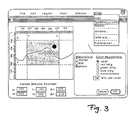
- the scanning parameters are selected by using the setup window shown in Figure 3.
- the slide is then rescanned, the highest possible resolution being 2400 x 3600 pixels capturing the entire image. This process is schematically represented in the flow chart of figure 1.
- the optical portion 501 includes a conventional stepper motor 510 mounted on the chassis 506 and driving a lead screw 511 by means of a flexible coupling 512.
- the lead screw 511 which is rotationally supported at a front end on chassis 506 by a front bearing 513, positions a movably supported slide tray 520 which has two nuts 521 engaging the screw 511.
- the slide tray 520 grips a slide 531 without obstructing the transparency in it in order to permit passage therethrough of an optical beam.
- the slide tray 520 includes upper 521 and lower 522 shells or frames.
- the shells slide on polished rods 523 and 524 by means of small bushings 525.
- the lower rods 524 each pivot about a support 526 located at the front end of the mechanism.
- the upper rods are each supported by a bearing 527 at the back end.
- the supporting bearings are spaced equal distances from the focus line (indicated at 622).
- the line of the slide being scanned is, at any time, kept in focus regardless of the thickness of the mounting.
- the extreme positions of the slide tray 520 are detected by front 550 and back 551 optical limit switches actuated by a lip 522 protruding from the tray.
- the limit switches 550 and 551 are mounted on a printed circuit board 505, which holds all the analog, digital and power electronics.
- the unit connects to the host computer through a power supply connector 552 and an interface connector 553 provided on the circuit board.
- the mechanical operation of the unit is as follows:
- the slide tray 520 is disposed in a front or "home" position. With the tray 520 in the home position, a set of reference filters 532 for color and density are positioned in the optical path.
- the color balance can be obtained, because the characteristics of the filters are preset.
- the routine compares the three resulting values against a standard set of R/G/B (red/green/blue) values. It then loads the equalization RAM 801 in Figure 8, such that the three colors are properly balanced (as discussed in more detail later).
- the motor 510 then pulls the tray 520 carrying slide 531 in, at a rate determined by a selected zoom factor discussed later.
- a first scan is done during pull-in and is used by the program to optimize the color palette.
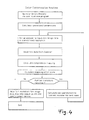
- a second scan is performed which applies the optimized data. This process can be iterated, as shown in Figure 4, to achieve the optimum color assignment.
- the components of the optical portion 501 are shown in more detail in Figure 6, and include: a conventional light source 601, a toroidal mirror 611, an upper folding mirror 621, a lens assembly 631, and a conventional CCD sensor 641 for the image forming path.
- Figure 6 shows the illumination and image forming optics used in the preferred set-up.
- the purpose of the illumination optics is to generate a narrow line of concentrated light onto a line or swath 622. This feature makes the most efficient use of the light source, resulting in a compact and low-wattage system. A requirement is that the light bundle converge and fill the aperture of the image forming lens 631.
- the light source 601 includes a tungsten halogen lamp with an axial filament 602.
- the light bulb is centered in a cylindrical housing 603.
- An exit slit 604 is machined into the side of the housing 603 facing the convex toroidal mirror 611.
- the light from bulb 601 exiting slit 604 travels to mirror 611 and is reflected and focused, is then reflected by mirror 620 and converges to a line on the transparency at 622, then travels to and is reflected by mirror 621, travels through image forming lens 631, and is focused as a line on sensor 641.
- the convex mirror 611 is of toroidal design, i.e. it has two different axes of curvature.
- the imaging lens 631 is symmetrical and has two identical outer elements 633 and 634 and two symmetrical doublets 635 and 636.
- An aperture stop 632 is located at the center of the system.
- the line image is formed on the CCD sensor 641 ( Figure 6), which converts the detected intensity to a proportional analog voltage.
- Color separation could be accomplished by a spinning color wheel, which contains sectors of the appropriate filters.
- this color separation filter arrangement has been replaced in the embodiment of Figure 7B with a sandwich 606 of liquid crystal cells and polarizers inserted into the illumination path.
- the sandwich element 606 has three liquid crystal cells 606A-606C and four polarizers 606D-606G. The cells correspond to the three primary colors and are independently selectable.
- solid state light emitting diodes can partly or wholly replace the incandescent filament/filter combination described above.
- Blue LEDs are new, but are commercially available from Siemens, Sanyo, Panasonic and Cree. It will be recognized that the source 602 in Figure 2 can be replaced by red, green and blue diode chips arranged in a row, thereby yielding a light source assembly which is completely solid state.
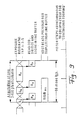
- FIGS 7C and 7D Such an embodiment is shown in Figures 7C and 7D.
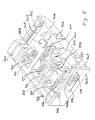
- a plurality of red, green and blue 150 x 150 micron LED die are mounted in individual, reflective recesses arranged in two rows on a common substrata 650, namely a row 655 of blue LEDs and a mixed row 656 of green and red LEDs.
- the length of each row is selected so that the image of the source fills the aperture of the imaging lens 631.
- the linear source geometry is functionally similar to the elongate filament 602 of the incandescent bulb 601.
- the toroidal mirror 611 will superimpose the individual beams of light 622 generated by the respective LEDs.
- the mirror 660 and the light source are encapsulated in an optical grade epoxy 663.
- the mirror is a blue dichroic matched to the index of the encapsulant.
- the majority of the blue light is reflected at the first dichroic surface 666 of the mirror 660, while the red/green light will pass that surface and be reflected from the back surface which has been coated with an aluminum layer 667.
- the separate bands combine at the front surface, so that, when looking into the light source, one sees a strip of essentially white light.
- the assembly has three leads, namely the common 670 which is connected to the substrata 650, the blue 671 connected to the anodes of the blue LEDs and the red/green lead 672.
- the LED elements are wire-bonded to the leads.
- the red and green LEDs are mounted with opposing polarities, so that a bipolar current driver can drive each color separately.
- red typically 750..585nm
- green typically 575..505nm
- blue typically 495..400nm
- the net amounts of light intensity for the three bands could, for example, have the ratio 10:5:1.
- Such a coarse balance is necessary primarily to compensate for the spectrum of the source or negative film.
- a fine adjustment for proper color balance must also be provided.
- a system is adjusted to yield the desired white or flesh tone.
- the latest generation of solid state image sensors can be timed so as to control the effective exposure using their "integration control" input.
- the exposure can be controlled by the duration of the pulse applied to the LEDs of each individual color.
- a key feature of the inventive system is its ability to reduce the image from a maximum of 2400 x 3600 pixels (10 microns per pixel) to any desired scale. This scaling operation is accomplished along the X axis by adjusting the step rate of the motor 510.
- the motor is controlled by the host computer with two control lines via the controller 201 and driver 221.
- One line establishes the direction of rotation of the motor.
- the other is the clock input which defines the step rate and thereby the speed in the X direction.
- the zoom in the X direction can be varied in a continuous fashion
- the pixel spacing of the CCD determines the resolution. It is therefore not possible to digitally expand and contract the spacing of the samples in a continuous way.
- Many commercial document scanners are set for a maximum digitizing rate of 300 dots per inch (dpi). Typically, such a scanner would also allow the rates of 150, 100, 75 or 50 dpi, which are all integer multiples of the original pitch.
- a readout rate generator has an adder, which accumulates this sampling period over one line interval, in particular by successively incrementing an accumulated count by this amount in the following fashion: 0 / 2.22 / 4.44 / 6.67 / 8.89 / 11.11 / 13.33 ...
- the integer part of the output of the generator is the desired pixel.
- the system must be able to zoom into a window located anywhere in the image, or in other words start reading data from a user selected point. This offset is loaded into a Y latch and from there is loaded into the adder at the beginning of each line.
- the spatial filtering is accomplished in the optical domain.
- the image is artificially defocused or "blurred" before the limited resolution sampling takes place.
- Defocusing can be accomplished in a variety of ways.
- one approach is to shift the sensor 641 out of the focal plane.
- the image forming lens 631 could be shifted in a similar fashion.
- the image-forming path can be lengthened or shortened by selectively inserting a prism or wedge 661 ( Figure 6). Focus is adjusted by the operator based on visual judgement.
- the first problem could be overcome by appropriate baffles "shading" the illumination light bundle.
- the second problem needs a "personality module” to account for the repetitive but spatially random non-uniformity.
- a combination of a random access table 801 ( Figure 8) and a read-only table 802 compensates for both effects.
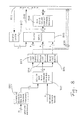
- Figure 8 shows the relevant section of the circuit diagram. The output from the sensor, after being digitized, becomes the 8 lower address bits for an 8k x 8 ROM 802, which performs a scaling function.
- the five higher address lines originate from an equalizing RAM 801.
- This RAM can be loaded by the host computer with calibration coefficients for each pixel and color.
- the second piece of dedicated hardware is another RAM 808, which is loadable from the host.
- the circuit described below establishes a transform which reduces the number of input bits from 8 bits per color to a smaller number, typically 8 or 16 bits.
- the data is a maximum of 8 bits per color.
- One essential feature of the system is its ability to produce this triplet in a rapid line-by-line fashion. This allows the immediate combination of the three separate colors with line buffers as opposed to page buffers. This task can be done exclusively with the hardware, by simply loading data representing the transformation formula into the color lookup table 808 and into a configuration latch 807 which controls an input selector 806.
- Input data of 24 bits would require a 16M table (808), which is uneconomic.
- the inventive system therefore reduces the size of this table by limiting the number of input lines. For example, by reducing the number from 24 to 16, only a 64k table is needed. Of these 16 bits, a typical distribution assigns 6 bits to green, 5 bit to red and blue. If 24 bits have to be transferred to the host, on the other hand, the 8 bit lines from buffers 803-805 bypass the table 808, as shown diagrammatically at 830.
- the selection and assignment of input lines to table 808 is done by the input selector (multiplexor) 806.
- the configuration latch 807 holds 5 bits which can provide an appropriate 2 bit select code for each multiplexor to provide a distribution such as the two just mentioned.
- the table 808 can be located in the RAM of the host, in which case the 16 bit output of selector 806 is transferred over the data bus as shown diagrammatically at 840.
- the host will read each pixel (the address determined by the hard-wired read address generator).
- the 16-bit value read is then used as an index to address the table.
- the output of this table (which table is functionally identical to 808) is then the compressed color value representing the output of the inventive system. This data can then be transferred to the display memory, to disk, or to some other storage device.
- the data can be presented on a color per color sequential basis, assuming a data bus is limited to either 8 or 16 bits.
- a software program is used to control the scanner hardware.
- the software is not the focus of the present invention and is therefore not illustrated or described in detail.
- This software executes on a microprocessor located on the printed circuit card. Portions of the software are resident in ROM programmed into the processor. The main portion of the software is down-loaded from the host computer through one of the interfaces.
- the software interacts with the host through either a serial, bidirectional parallel or SCSI interface. No software is provided for the host personal computer, but rather the scanner is compatible with several commercially available software packages.
Landscapes
- Engineering & Computer Science (AREA)
- Multimedia (AREA)
- Signal Processing (AREA)
- Facsimile Scanning Arrangements (AREA)
- Facsimiles In General (AREA)
- Facsimile Image Signal Circuits (AREA)
- Image Input (AREA)
Applications Claiming Priority (2)
| Application Number | Priority Date | Filing Date | Title |
|---|---|---|---|
| US51164990A | 1990-04-20 | 1990-04-20 | |
| US511649 | 1990-04-20 |
Publications (2)
| Publication Number | Publication Date |
|---|---|
| EP0452759A2 true EP0452759A2 (fr) | 1991-10-23 |
| EP0452759A3 EP0452759A3 (en) | 1992-10-28 |
Family
ID=24035819
Family Applications (1)
| Application Number | Title | Priority Date | Filing Date |
|---|---|---|---|
| EP19910105478 Withdrawn EP0452759A3 (en) | 1990-04-20 | 1991-04-06 | Method and apparatus for rapid scanning of color images |
Country Status (2)
| Country | Link |
|---|---|
| EP (1) | EP0452759A3 (fr) |
| JP (1) | JP3175190B2 (fr) |
Cited By (9)
| Publication number | Priority date | Publication date | Assignee | Title |
|---|---|---|---|---|
| EP0410608A3 (en) * | 1989-07-24 | 1992-03-04 | Sony Corporation | Image data inputting systems for image processing apparatus |
| EP0500220A3 (en) * | 1991-02-18 | 1993-02-10 | Scitex Corporation Ltd. | Apparatus and method for separating transparencies |
| EP0574242A1 (fr) * | 1992-06-10 | 1993-12-15 | Nikon Corporation | Dispositif de balayage |
| EP0606736A3 (fr) * | 1992-12-11 | 1995-03-15 | Nippon Kogaku Kk | Un dispositif de balayage en couleurs à plusieurs LED's et procédé de balayage d'image en couleur associé. |
| US5579146A (en) * | 1995-08-17 | 1996-11-26 | Must Systems Inc. | Scanning optical set |
| EP0835582A4 (fr) * | 1995-06-30 | 1998-05-20 | ||
| EP0836133A3 (fr) * | 1996-10-08 | 1998-08-12 | Spectronic Instruments, Inc. | Appareil d'accouplement pour un instrument d'ordinateur |
| EP0831639A3 (fr) * | 1996-09-23 | 1999-07-07 | Hewlett-Packard Company | Dispositif d'images |
| EP0903930A3 (fr) * | 1997-09-17 | 2002-04-03 | Konica Corporation | Appareil de lecture d'images |
Families Citing this family (1)
| Publication number | Priority date | Publication date | Assignee | Title |
|---|---|---|---|---|
| US7812872B2 (en) * | 2005-06-02 | 2010-10-12 | Xerox Corporation | System for controlling image data readout from an imaging device |
Family Cites Families (4)
| Publication number | Priority date | Publication date | Assignee | Title |
|---|---|---|---|---|
| GB8421512D0 (en) * | 1984-08-24 | 1984-09-26 | Crosfield Electronics Ltd | Image enhancement |
| IL78674A0 (en) * | 1986-05-02 | 1986-08-31 | Scitex Corp Ltd | Scanner |
| US4907280A (en) * | 1987-07-22 | 1990-03-06 | Barney Howard H | Slide scanner |
| KR920005856B1 (ko) * | 1988-04-25 | 1992-07-23 | 소니 가부시기가이샤 | 컬러화상 독해장치 |
-
1991
- 1991-04-06 EP EP19910105478 patent/EP0452759A3/en not_active Withdrawn
- 1991-04-18 JP JP11405291A patent/JP3175190B2/ja not_active Expired - Fee Related
Cited By (16)
| Publication number | Priority date | Publication date | Assignee | Title |
|---|---|---|---|---|
| US5107347A (en) * | 1989-07-24 | 1992-04-21 | Sony Corporation | Image data inputting system for image processing apparatus |
| EP0410608A3 (en) * | 1989-07-24 | 1992-03-04 | Sony Corporation | Image data inputting systems for image processing apparatus |
| EP0500220A3 (en) * | 1991-02-18 | 1993-02-10 | Scitex Corporation Ltd. | Apparatus and method for separating transparencies |
| US5612811A (en) * | 1992-06-10 | 1997-03-18 | Nikon Corporation | Scanning device |
| EP0574242A1 (fr) * | 1992-06-10 | 1993-12-15 | Nikon Corporation | Dispositif de balayage |
| US5640264A (en) * | 1992-06-10 | 1997-06-17 | Nikon Corporation | Scanning device |
| US5420712A (en) * | 1992-06-10 | 1995-05-30 | Nikon Corporation | Scanning device |
| US5625470A (en) * | 1992-12-11 | 1997-04-29 | Nikon Corporation | Color image scanner having multiple LEDS and color image scanning method thereof |
| EP0606736A3 (fr) * | 1992-12-11 | 1995-03-15 | Nippon Kogaku Kk | Un dispositif de balayage en couleurs à plusieurs LED's et procédé de balayage d'image en couleur associé. |
| EP0835582A4 (fr) * | 1995-06-30 | 1998-05-20 | ||
| US5579146A (en) * | 1995-08-17 | 1996-11-26 | Must Systems Inc. | Scanning optical set |
| EP0831639A3 (fr) * | 1996-09-23 | 1999-07-07 | Hewlett-Packard Company | Dispositif d'images |
| EP1349365A3 (fr) * | 1996-09-23 | 2004-01-21 | Hewlett-Packard Company | Dispositif d'image |
| EP1292103A3 (fr) * | 1996-09-23 | 2004-01-21 | Hewlett-Packard Company | Dispositif d'image |
| EP0836133A3 (fr) * | 1996-10-08 | 1998-08-12 | Spectronic Instruments, Inc. | Appareil d'accouplement pour un instrument d'ordinateur |
| EP0903930A3 (fr) * | 1997-09-17 | 2002-04-03 | Konica Corporation | Appareil de lecture d'images |
Also Published As
| Publication number | Publication date |
|---|---|
| JP3175190B2 (ja) | 2001-06-11 |
| EP0452759A3 (en) | 1992-10-28 |
| JPH066521A (ja) | 1994-01-14 |
Similar Documents
| Publication | Publication Date | Title |
|---|---|---|
| US6044180A (en) | Method and apparatus for rapid scanning of color images | |
| US7423784B2 (en) | Processing of signals from image sensing apparatus whose image sensing area includes a plurality of areas | |
| US5652663A (en) | Preview buffer for electronic scanner | |
| US5606630A (en) | Photographed image reproducing apparatus | |
| US5414535A (en) | Apparatus for reading image from original image on translucent film with automatic adjustment of the quantity of light from a light source | |
| JPH10126796A (ja) | デュアル・モード・ソフトウェア処理を用いた動画・静止画像用デジタル・カメラ | |
| JP4083042B2 (ja) | 画像読取り装置,画像読取り方法 | |
| US4704633A (en) | Method for reading out image information on an image having a wide dynamic range | |
| US5070405A (en) | Electronic still camera with multi-area light metering and gray scale modification | |
| US5025313A (en) | System for minimizing optical distortions and chromatic aberrations in a linear color scanner | |
| JP3175190B2 (ja) | 画像読取装置及びカラーバランス設定装置 | |
| US5920407A (en) | Method and apparatus for applying tonal correction to image data | |
| JP2633850B2 (ja) | 入力画像の色分解走査の方法および装置 | |
| US4737857A (en) | Overhead document scanner lighting and scanning apparatus | |
| JP2001169055A (ja) | スキャナの照明システムおよびその操作方法 | |
| US5376961A (en) | Method and apparatus for a rotating shutter in real-time film-to-video conversion | |
| JPS5913465A (ja) | 原稿読取装置 | |
| KR100408265B1 (ko) | 칼라 이미지 스캐너 | |
| MacDonald | Tone and quality issues in digital cameras | |
| Davis | Kodak professional PCD film scanner 4045 | |
| JPH06237340A (ja) | 画像入力装置 | |
| WO2000063832A1 (fr) | Procede de balayage d'images en couleur et dispositif mettant en oeuvre ledit procede | |
| EP0484134A2 (fr) | Commande d'un capteur d'image à l'état solide | |
| JPH10210282A (ja) | 画像読取装置 | |
| JPH0715735A (ja) | 発光管の光減衰方法及び装置 |
Legal Events
| Date | Code | Title | Description |
|---|---|---|---|
| PUAI | Public reference made under article 153(3) epc to a published international application that has entered the european phase |
Free format text: ORIGINAL CODE: 0009012 |
|
| AK | Designated contracting states |
Kind code of ref document: A2 Designated state(s): BE CH DE FR GB IT LI NL SE |
|
| PUAL | Search report despatched |
Free format text: ORIGINAL CODE: 0009013 |
|
| RHK1 | Main classification (correction) |
Ipc: H04N 1/46 |
|
| AK | Designated contracting states |
Kind code of ref document: A3 Designated state(s): BE CH DE FR GB IT LI NL SE |
|
| 17P | Request for examination filed |
Effective date: 19930417 |
|
| 17Q | First examination report despatched |
Effective date: 19950804 |
|
| STAA | Information on the status of an ep patent application or granted ep patent |
Free format text: STATUS: THE APPLICATION IS DEEMED TO BE WITHDRAWN |
|
| 18D | Application deemed to be withdrawn |
Effective date: 19960215 |