EP0452837B1 - Dispositif adhésif d'administration d'un principe actif par voie transdermique - Google Patents
Dispositif adhésif d'administration d'un principe actif par voie transdermique Download PDFInfo
- Publication number
- EP0452837B1 EP0452837B1 EP91105933A EP91105933A EP0452837B1 EP 0452837 B1 EP0452837 B1 EP 0452837B1 EP 91105933 A EP91105933 A EP 91105933A EP 91105933 A EP91105933 A EP 91105933A EP 0452837 B1 EP0452837 B1 EP 0452837B1
- Authority
- EP
- European Patent Office
- Prior art keywords
- water
- hydrochloride
- plaster layer
- amount
- weight
- Prior art date
- Legal status (The legal status is an assumption and is not a legal conclusion. Google has not performed a legal analysis and makes no representation as to the accuracy of the status listed.)
- Expired - Lifetime
Links
Images
Classifications
-
- A—HUMAN NECESSITIES
- A61—MEDICAL OR VETERINARY SCIENCE; HYGIENE
- A61K—PREPARATIONS FOR MEDICAL, DENTAL OR TOILETRY PURPOSES
- A61K9/00—Medicinal preparations characterised by special physical form
- A61K9/70—Web, sheet or filament bases ; Films; Fibres of the matrix type containing drug
- A61K9/7023—Transdermal patches and similar drug-containing composite devices, e.g. cataplasms
- A61K9/703—Transdermal patches and similar drug-containing composite devices, e.g. cataplasms characterised by shape or structure; Details concerning release liner or backing; Refillable patches; User-activated patches
- A61K9/7038—Transdermal patches of the drug-in-adhesive type, i.e. comprising drug in the skin-adhesive layer
- A61K9/7046—Transdermal patches of the drug-in-adhesive type, i.e. comprising drug in the skin-adhesive layer the adhesive comprising macromolecular compounds
- A61K9/7053—Transdermal patches of the drug-in-adhesive type, i.e. comprising drug in the skin-adhesive layer the adhesive comprising macromolecular compounds obtained by reactions only involving carbon to carbon unsaturated bonds, e.g. polyvinyl, polyisobutylene, polystyrene
-
- A—HUMAN NECESSITIES
- A61—MEDICAL OR VETERINARY SCIENCE; HYGIENE
- A61K—PREPARATIONS FOR MEDICAL, DENTAL OR TOILETRY PURPOSES
- A61K9/00—Medicinal preparations characterised by special physical form
- A61K9/70—Web, sheet or filament bases ; Films; Fibres of the matrix type containing drug
- A61K9/7023—Transdermal patches and similar drug-containing composite devices, e.g. cataplasms
- A61K9/703—Transdermal patches and similar drug-containing composite devices, e.g. cataplasms characterised by shape or structure; Details concerning release liner or backing; Refillable patches; User-activated patches
- A61K9/7038—Transdermal patches of the drug-in-adhesive type, i.e. comprising drug in the skin-adhesive layer
- A61K9/7046—Transdermal patches of the drug-in-adhesive type, i.e. comprising drug in the skin-adhesive layer the adhesive comprising macromolecular compounds
- A61K9/7053—Transdermal patches of the drug-in-adhesive type, i.e. comprising drug in the skin-adhesive layer the adhesive comprising macromolecular compounds obtained by reactions only involving carbon to carbon unsaturated bonds, e.g. polyvinyl, polyisobutylene, polystyrene
- A61K9/7061—Polyacrylates
Definitions
- This invention relates to a medical adhesive which is excellent in terms of release and percutaneous and per mucosa (hereinafter when referred to as percutaneous, the term includes per mucosa unless otherwise specified) absorption of medicinal ingredient from preparation and also excellent in producibility and stability of the preparation.
- medicinal ingredients consisting of hydrophilic compounds in forms of salts or others are generally difficult to be percutaneously absorbed, and even release of the medicinal ingredients from the preparations thereof is often difficult in matrix type adhesives in which the medicinal ingredients are incorporated or dispersed in polymers having relatively high hydrophobicity which are in wide use as the bases for adhesives.
- incorporation of percutaneous absorption-promoting agents may be employed. Active studies have recently been made of absorption-promoting agents, and a number of absorption-promoting agents have been reported. Many examples of the adhesives containing absorption-promoting agents are described in, for example, Japanese Patent Unexamined Application Nos. 24517/1986 and 221121/1986. However, such adhesives are not entirely satisfactory in solubility of the medicinal ingredients in the base and release thereof from the base or in percutaneous absorbability.
- solubilizers for the medicinal ingredients are normally necessary.
- water is generally selected in view of its low stimulus against the skin.
- adhesives in which water is used as a solubilizer, mention can be made of the adhesives as described in Japanese Patent Unexamined Publication No. 02253/1985, wherein no absorption-promoting agent is contained, permitting relatively easy provision of stable plaster layers.
- This invention relates to improvement of the adhesives using water as a solubilizer as mentioned above.
- the present invention provides a medical adhesive excellent in release and percutaneous absorption of the medicinal ingredient, which adhesive comprises a base mainly consisting of a hydrophobic polymer, an effective amount of a medicinal ingredient of low solubility in said hydrophobic polymer or poor in release from said hydrophobic polymer and an effective amount of percutaneous absorption-promoting agents which are admixed with or dispersed throughout said base.
- a solubilizer for the medicinal ingredient is required.
- the effective amounts of medicinal ingredients are generally decided primarily on the basis of the results of initial studies of physical properties, pharmacological effects, effective concentration in blood and the like of the medicinal ingredients, and the effective amounts are not in general decided taking account of the forms and usability of the preparations, which leaves a problem that a stable preparation which exhibits the expected pharmacological effect cannot be necessarily obtained in many cases only by incorporating and mixing an effective amount of said medicinal ingredients, an effective amount of percutaneous absorption-promoting agents and the other ingredients.
- percutaneous absorption-promoting agents are generally classified into two types, hydrophobic absorption-promoting agents and hydrophilic absorption-promoting agents as mentioned below, and they are normally used solely or in combination.
- hydrophobic absorption-promoting agents and hydrophilic absorption-promoting agents as mentioned below, and they are normally used solely or in combination.
- poor compatibility of the percutaneous absorption-promoting agents with solubilizers for medicinal ingredients or hydrophobic polymers gives rise to separation of the ingredients during the course of production of the preparations or with the lapse of days after production, which results in failure to provide the desired adhesives.
- compatibility of each component is critical to feasibility of the preparations for those containing multiple components, and when components of the preparation have poor compatibility, the preparation lacks stability.
- An object of the present invention is to provide an adhesive comprising a base mainly composed of a hydrophobic polymer, in which a medicinal ingredient hardly absorbed percutaneously, for example, a medicinal ingredient having relatively high hydrophilicity is incorporated and water as a solubilizer is further contained, and having satisfactory solubility, release property and percutaneous absorption of the medicinal ingredients.
- Another object of the present invention is to provide an adhesive as mentioned above which is excellent in stability as a preparation and in production efficiency.
- the inventors of the present invention have made intensive studies for the purpose of solving the before-mentioned problems, and as a result, obtained the following findings.
- Water to be used as a solubilizer is inferior in compatibility with a hydrophobic polymer, and use of a large amount of water makes uniform mixture difficult.
- the present inventors have found that the steps of incorporating a hydrophilic polymer which is soluble or capable of swelling in water for increasing viscosity of a solution and mixing the solution with a solution of a hydrophobic polymer in an organic solvent, followed by homogeneous dispersion suppress separation among the respective components in the obtained applicable solution or the plaster layer obtained by drying same even if a large amount of water is incorporated, whereby sufficient solubility, release and percutaneous absorbability of the medicinal ingredients can be attained.
- a preparation of particularly stable system can be obtained by incorporating the hydrophobic polymer as the main component of the base in a proportion of not less than 25% by weight relative to the total amount of the below-mentioned ingredients 1 ⁇ 5 excluding the organic solvent of the hydrophobic polymer and further making the plaster layer of the finished adhesive a W/O type.
- water is incorporated as a solubilizer in an amount necessary for making the plaster layer a W/O type.
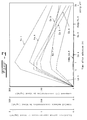
- Fig. 1 is a graph showing change in concentration in blood of the medicinal ingredient in each adhesive.
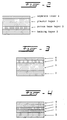
- Figs. 2-4 are cross sectional views of the adhesives of the present invention having a porous base layer, wherein 1 is a plaster layer, 2 is a backing layer, 3 is a porous base layer and 4 is a separate liner.
- percutaneously absorbable preparations containing water there can be mentioned, for example, ointments, cream preparations, lotions, liquid preparations, suspensions, emulsions and so on, besides adhesives.
- These preparations can be classified into solution type, dispersion type such as W/O (water in oil) type or O/W (oil in water) type, and other types.
- W/O water in oil
- O/W oil in water
- a hydrophobic polymer which is a continuous phase, namely a W/O type, is selected for the base.
- the medicinal ingredient (ingredient1) to be used for the present invention as long as it can display the expected actions through percutaneous administration.
- drugs as come to have the above-mentioned solubility in water as a result of concomitance with an acid or a base.
- the medicinal ingredients preferably have a molecular weight of 50 - 1,000, more preferably 100 - 500.
- the amount of the medicinal ingredient to be incorporated in the present invention is not particularly limited provided that the medicinal ingredient displays the pharmacological effects, preferred amount is in the range from 0.1 to 50% by weight relative to the weight of the plaster in which the medicinal ingredient is contained, more preferably from 1 to 30% by weight, and is in the range from 20 to 5,000 »g/cm2 per unit area, preferably from 100 to 3,000 »g/cm2.
- the hydrophobic polymer (ingredient2) to be used in the present invention is the main ingredient constituting the continuous phase of the W/O type plaster, in which there are contained a medicinal ingredient, percutaneous absorption-promoting agents, water and a hydrophilic polymer.
- the hydrophobic polymer is not limited provided that it is capable of imparting the objective adhesives with adhesion to the skin and acting for shape-retention of the adhesives. It is extremely important not to lose shape-retention in view of the fact that it is difficult for the adhesives of the present invention containing water to retain shape.
- the hydrophobic polymer is incorporated in an amount of not less than 25% by weight relative to the total amount of the ingredients 1 ⁇ 5, preferably 25 -80% by weight. Where the hydrophobic polymer is incorporated in an amount of less than 25% by weight, it fails to contain and to retain the other ingredients, especially percutaneous absorption-promoting agents which are in a liquid form at room temperature, and water stably, resulting in failure to maintain its shape-retention.
- hydrophobic polymers there can be mentioned pressure-sensitive adhesive polymers exemplified by acrylic-type polymers; gum-type polymers such as silicone gums, polyisobutylene gums, polyisoprene gums and styrene-butadiene (or-isoprene)-styrene block copolymer gums; poly vinylalkyl ether-type polymers; vinyl-type polymers such as poly vinyl-acetate and poly vinyl-propionate; and polyurethane elastic bodies.
- acrylic-type polymers such as silicone gums, polyisobutylene gums, polyisoprene gums and styrene-butadiene (or-isoprene)-styrene block copolymer gums
- poly vinylalkyl ether-type polymers vinyl-type polymers such as poly vinyl-acetate and poly vinyl-propionate
- polyurethane elastic bodies exemplified by acrylic-type polymers
- gum-type polymers such as
- pressure-sensitive adhesive acryl-type copolymers over adhesivity to the skin are particularly preferred.
- the preferred ones are exemplified by one polymer or two or more polymers of alkyl esters of (meth)acrylic acid such as butyl (meth)acrylate, pentyl (meth)acrylate, hexyl (meth)acrylate, heptyl (meth)acrylate, octyl (meth)acrylate, nonyl (meth)acrylate, decyl (meth)acrylate, undecyl (meth)acrylate, dodecyl (meth)acrylate and tridecyl (meth)acrylate, or copolymers of one or more species of said esters with a monomer copolymerizable therewith.
- Examples of the copolymerizable monomers include functional monomers exemplified by carboxyl group-containing monomers such as (meth)acrylic acid, itaconic acid, crotonic acid, maleic acid, maleic anhydride and fumaric acid; sulfoxyl group-containing monomers such as styrenesulfonic acid, allylsulfonic acid, sulfopropylacrylate, (meth)acryloyloxynaphthalenesulfonic acid, acrylamidemethylpropanesulfonic acid and acryloxyloxybenzenesulfonic acid; hydroxyl group-containing monomers such as hydroxyethyl (meth)acrylate and hydroxypropyl (meth)acrylate; amido group-containing acrylic-type monomers such as (meth)acrylamide, dimethyl(meth)acrylamide, N-butylacrylamide, tetramethylbutylacrylate and N-methylol(meth)acrylamide; alkylamin
- alkyl esters of (meth)acrylic acid and copolymerizable monomers in the present invention include a variety of isomers in which the alkyl moiety is straight chain or branched chain, and various isomers which have substituents at different positions, and their derivatives.
- the proportion of the above alkyl ester of (meth)acrylic acid to the copolymerizable monomer in the pressure-sensitive adhesive acryl-type copolymers is preferably in the range of 50 - 99/1 - 50 by weight, in terms of the balance of aggregation properties of adhesivity to the skin.
- polymers having a lower skin-stimulus and excellent solubility for the drugs especially copolymers of (meth)acrylic acid alkyl esters, (meth)acrylic acid alkyl esters containing ether linkage in the molecule and the above copolymerizable monomers other than these.
- the proportion of the (meth)acrylic acid alkyl esters, the (meth)acrylic acid alkyl esters containing ether linkage in the molecule and the copolymerizable monomers other than these is in the range of 40-80/59-10/1-40.
- the composition it is preferable to subject the composition to an appropriate chemical crosslinking treatment (copolymerization of the monomers having crosslinking property, further addition of a crosslinking agent, etc.) or physical crosslinking treatment (radiation of radioactive rays such as electronic rays causing electrolytic dissociation, crosslinking by ultraviolet rays, etc.) to a degree not imparing adhesive property.
- an appropriate chemical crosslinking treatment copolymerization of the monomers having crosslinking property, further addition of a crosslinking agent, etc.
- physical crosslinking treatment radiation of radioactive rays such as electronic rays causing electrolytic dissociation, crosslinking by ultraviolet rays, etc.
- the above-mentioned hydrophobic polymers have a glass transition temperature (Tg) ranging from -65°C to 35°C, preferably -50°C to 0°C.
- the percutaneous absorption-promoting agents (ingredient 3) to be used in the present invention can be defined, in brief, as materials which promote release of the medicinal ingredients from the composition and/or migration of the medicinal ingredients into the body.
- these agents include a wide variety of substances possessing improving actions on solubility or dispersibility of the medicinal ingredients in the plaster layer, skin keratin emollient property and permeation of drugs into skin keratin, auxiliaries for permeation of drugs into skin keratin, agents for dilation of pores of the skin, substances for changing the surface conditions and the like.
- percutaneous absorption-promoting agents are generally classified into hydrophobic absorption-promoting agents and hydrophilic absorption-promoting agents.
- hydrophobic absorption-promoting agents include aliphatic carboxylic acid having 6 - 20 carbon atoms, preferably 10 - 20 carbon atoms, their lower alcohol esters, and aliphatic alcohols having 6 - 20 carbon atoms, preferably 10 - 20 carbon atoms.
- aliphatic carboxylic acids having 6 - 20 carbon atoms there may be mentioned, for example, saturated or unsaturated aliphatic monocarboxylic or dicarboxylic acids such as caproic acid, caprylic acid, lauric acid, myristic acid, palmitic acid, stearic acid, arachic acid, obtusilic acid, linderic acid, oleic acid, linoleic acid, linolenic acid, arachidonic acid and sebacic acid.
- the lower alcohol esters of the aliphatic carboxylic acids having 6 - 20 carbon atoms mention can be made of, for example, esters of lower alcohol having about 1 - 5 carbon atoms (e.g.
- aliphatic acids having 6 - 20 carbon atoms examples include, for example, mono- or diester in which one of the carboxyl groups or two of the carboxyl groups thereof is(are) esterified.
- Specific examples of the lower alcohol esters of the aliphatic carboxylic acids having 6 - 20 carbon atoms include diester of sebacinic acid, isopropyl ester of myristic acid, etc.
- aliphatic alcohols having 6 - 20 carbon atoms mention can be made of, for example, saturated or unsaturated aliphatic alcohols such as caproyl alcohols, caprylyl alcohols, capryl alcohols, lauryl alcohols, myristyl alcohols, cetyl alcohols, stearyl alcohols, oleyl alcohols, linoleyl alcohols and linolenyl alcohols.
- saturated or unsaturated aliphatic alcohols such as caproyl alcohols, caprylyl alcohols, capryl alcohols, lauryl alcohols, myristyl alcohols, cetyl alcohols, stearyl alcohols, oleyl alcohols, linoleyl alcohols and linolenyl alcohols.
- lower alcohol esters of the aliphatic carboxylic acids and the aliphatic alcohols preferred are lower (C1 ⁇ 5) alcohol esters of the aliphatic monocarboxylic acids, most preferably isopropyl myristate.
- hydrophilic absorption-promoting agents mention can be made of, for example, alkanepolyols.
- alkanepolyols As the alkanepolyols, mention can be made of, for example, lower alkanediols having 2 - 5 carbon atoms such as ethylene glycol (1,2-ethanol), propylene glycol (1,2-propanediol), 1,3-propanediol, 1,2-butanediol, 1,3-butanediol, 1,4-butanediol, 2,3-butanediol and 1,5-pentanediol, and lower alkanetriols having 2 - 5 carbon atoms of glycerine.
- propylene glycol and 1,3-butanediol particularly preferred are propylene glycol and 1,3-butanediol.
- Two or more species of the above-mentioned percutaneous absorption-promoting agents can be used in combination, and hydrophobic absorption-promoting agents and hydrophilic absorption-promoting agents may be used combinedly.
- the amount of the absorption-promoting agents is optional, preferred total amount is in the range from 0.1 to 80% by weight, more preferably from 1 to 50% by weight.
- water is essentially incorporated as a solubilizer for the medicinal ingredients.
- Water is especially selected as an ingredient for the adhesive compositions of the present invention owing to the following advantageous properties 1) - 5).
- water-containing percutaneously absorbable preparations include ointments, creams, lotions, liquid preparations, suspensions and emulsions besides adhesives, which are classified into solution types and dispersion types exemplified by W/O types (water in oil) and O/W types (oil in water).
- W/O types water in oil
- O/W types oil in water
- the amount of water to be incorporated is not limited as long as it enables the plaster layer to be a W/O type. Not all the medicinal ingredients to be incorporated need be dissolved in water. That is, a part of the medicinal ingredients may remain solid in the plaster layer.
- the particularly preferred amount of water is in the range of from 1 to 20% by weight by water content of the plaster layer. If the water content of the plaster layer is less than 1% by weight, release of the medicinal ingredients from the preparation tends to be poor, leading to failure to exhibit expected medicinal effects. On the other hand, if the water content is over 20% by weight, containing and retaining the medicinal ingredients and percutaneous absorption-promoting agents as well as water stably in the plaster layer for a long period tends to be difficult.
- a solubilizer may be incorporated as an ingredient of the plaster layer, whereby the medicinal ingredient is dissolved better in water.
- acidic or basic inorganic or organic substances there can be mentioned acidic or basic inorganic or organic substances.
- the inorganic acidic substances include hydrochloric acid, sulfuric acid, nitric acid and phosphoric acid.
- organic acidic substances include acetic acid, lactic acid, maleic acid, citric acid, succinic acid and tartaric acid.
- the inorganic basic substances include sodium hydroxide, potassium hydroxide, sodium carbonate, potassium carbonate, sodium hydrogencarbonate and potassium hydrogencarbonate.
- the organic basic substances include amines such as triethanolamine, diethanolamine, triisopropanolamine, diisopropanolamine, etc., and amino acids such as L-arginine.
- solubilizers are added to dissolve the medicinal ingredients in an optional proportion in the plaster layer, and while the amount of the solubilizers to be added is dependent upon the amount of a drug to be incorporated, it is preferably in the range of 0.01 to 30% by weight, more preferably in the range of 0.1 to 20% by weight.
- the hydrophilic polymer (ingredient5) is a polymer which is soluble or capable of swelling in water, and it is incorporated to increase the viscosity of water and, in some cases, that of the hydrophilic percutaneous absorption-promoting agents, thereby retaining these ingredients stably in the plaster layer.
- Such hydrophilic polymers include, for example, water-soluble polymers and water-absorbing polymers.
- water-soluble polymers there can be mentioned natural water-soluble polymers such as starch types, pullulan types, cellulose types, tannin types, lignin types, alginic acid, gum arabic, gum guar, gum tragacanth and gelatin, and synthetic polymers such as polyvinyl alcohol types, polyvinyl ethyleneoxide types, acrylic acid types, maleic anhydride types, phthalic acid types, acrylamide types, polyvinyl pyrrolidones, polyamines, polyelectrolytes, urea types and melamine types.
- natural water-soluble polymers such as starch types, pullulan types, cellulose types, tannin types, lignin types, alginic acid, gum arabic, gum guar, gum tragacanth and gelatin
- synthetic polymers such as polyvinyl alcohol types, polyvinyl ethyleneoxide types, acrylic acid types, maleic anhydride types, phthalic acid types, acrylamide types, polyvinyl pyrrolidone
- water-absorbing polymers preferred are polymers capable of absorbing water in at least a several decades times amount, preferably about 50 - 2,000 times amount their own weight, which are exemplified by vinyl acetate-acrylic acid ester copolymer suspensions, polyacrylic acid salt types, polyvinyl alcohol-maleic anhydride crosslinked copolymers, isobutylene-maleic acid crosslinked copolymers, polyacrylonitrile graft polymer suspensions and starch-acrylic acid graft polymers.
- the amount of these hydrophilic polymers to be used in the present invention is not particularly limited as long as it does not surpass the amount of the hydrophobic polymer (ingredient 2), and is preferably in the range of about 0.1 to 15% by weight, more preferably about 0.2 to 5% by weight.
- the percutaneous preparations of the present invention may incorporate nonionic surfactants to enable uniform mixing of the respective ingredients.
- esters of polyoxyethylene sorbitan fatty acid e.g. polyoxyethylene sorbitan monooleate, polyoxyethylene sorbitan monostearate, polyoxyethylene sorbitan monopalmitate, polyoxyethylene sorbitan monolaurate, etc.
- esters of polyoxyethylene sorbitol fatty acid e.g. polyoxyethylene sorbitol monolaurate, etc.
- esters of polyoxyethylene fatty acid e.g. polyoxyethylene stearate, etc.
- polyoxyethylene higher alcohol ethers e.g. polyoxyethylene lauryl alcohol, polyoxyethylene oleyl alcohol, etc.
- polyoxyethylene alkylaryl ethers e.g.
- polyoxyethylene nonyl phenol, etc. polyoxyethylene castor oil derivatives (e.g. polyoxyethylene hydrogenated castor oil derivatives such as HCO-50, HCO-60, etc.), polyoxyethylene lanolin alcohol derivatives and block polymer type nonionic surfactants (e.g. pluronic, L-62, L-64, F-68, etc.). While the amount of the nonionic surfactant to be incorporated can be optionally selected as a whole provided that HLB is maintained in the range of 5 to 20, it is preferably about 0.5 - 20% by weight, more preferably about 0.5 - 10% by weight, most preferably about 1 - 8% by weight.
- nonionic surfactant to be incorporated can be optionally selected as a whole provided that HLB is maintained in the range of 5 to 20, it is preferably about 0.5 - 20% by weight, more preferably about 0.5 - 10% by weight, most preferably about 1 - 8% by weight.
- the adhesives of the present invention can be produced by per se known means except the process for drying the plaster layer. Drying of the plaster layer is preferably conducted to the effect that the water content of the plaster layer after drying amounts to 1 - 20% by weight, and therefore, the drying is conducted at a temperature lower than that in the conventional drying of the plaster layers, for a shorter time, for example, at 65 - 75°C for about 1 - 5 minutes.
- the plaster layer may contain a trace amount of solvent from the solution of the adherent compositions.
- the plaster layer is likely to leave the paste on the applied site of the skin upon removal due to the shortage of aggregation strength caused by water, percutaneous absorption-promoting agents and a large amount of the other liquid components contained in the plaster layer, and thereby-induced plasticization of the hydrophobic polymers, and give soil on the skin, it is preperable to place a porous base layer in the plaster layer or in contact with the plaster layer.
- porous base layer While there is no particular limitation on the porous base layer as long as it does not interfere with free diffusion and migration throughout the plaster layer and release toward the surface of the skin of the medicinal ingredients, percutaneous absorption-promoting agents, water and the other ingredients, it is also possible to permit the porous base layer to control the above-mentioned phenomena.
- porous base layers examples include sheet bases such as non-woven fabrics, woven fabrics, Japanese paper, porous films, pierced films, or the like.
- the thickness of the porous base layer is preferably less than that of the plaster layer when the porous base layer is placed in the plaster layer. Needless to say, there can be placed a thick porous base layer as long as release of the medicinal ingredients is not prevented.
- the plaster may be embedded in the porous base layer, whereby aggregation strength is enhanced with that of the plaster per se unchanged.
- the plasters are not necessarily required to be embedded in the porous base layers, and the ingredients of the plaster migrate through the porous base layer due to capillarity.
- the embodiment (I) is desirable in view of efficiency of production.
- the embodiment (1) offers a merit that the porous base layer can be in advance laminated on the backing layer with a binder or the like.
- the medical adhesives of the present invention solely can be applied to the skin or may be covered with other adhesives having a skin-adhering property, for example, surgical tapes, or with bandages after application of the adhesives for prevention of loosening.
- the medical adhesive of the present invention comprises the plaster layer of a W/O type wherein the hydrophobic polymer which is the main constituent component of the continuous phase of the plaster and the hydrophilic polymer are incorporated in appropriate amounts, the components having poor compatibility among the medicinal ingredients, percutaneous absorption-promoting agents, water and the other additives can be easily dissolved or dispersed homogeneously.
- the medical adhesive has the effect that the medicinal ingredients, the percutaneous absorption-promoting agents and so on can be released stably, and thus, pharmacological effects can be sustained sufficiently over a long period.
- a medical adhesive in which the water content of the plaster after formation is 1 - 20% by weight has the effect that the ingredients can be contained and retained in the formed preparations for a long period.
- part means “part by weight”.
- hydrophilic phase and lipophilic phase were uniformly mixed, applied onto a separate-type liner made of polyester of 75 »m in thickness so that the thickness of the plaster after drying became 100 »m , and dried at 70°C for 4 minutes to form a plaster layer of a W/O type.
- the plaster layer was adhered by rolling on the side of the polyethylene of a polyester film of 25 »m in thicknes with the polyethylene of 30 »m in thickness laminated thereon and on the non-woven fabric side of a backing layer with the non-woven fabric sheet made of polyester laminated thereon at the basis weight of 40 g/m2 to obtain a medical adhesive of the present invention.
- hydrophilic phase and lipophilic phase were uniformly mixed, applied onto a polyester separate-type liner of 75 »m in thickness so that the thickness of the plaster after drying became 100 »m , and dried at 75°C for 5 minutes to form a plaster layer of a W/O type.
- the separate-type liner was stripped off and a nylon woven fabric was adhered by pressing onto the exposed plaster layer at the basis weight of 25 g/m2, followed by adhesion of the separate-type liner to give a medical adhesive of the present invention.
- hydrophilic phase and lipophilic phase were uniformly mixed, applied onto a polyester separate-type liner of 75 »m in thickness so that the thickness of the plaster after drying became 50 »m , and dried at 68°C for 4 minutes to form a plaster layer of a W/O type.
- Two sheets of the plaster layer formed on the separate-type liner were prepared. After one of the plaster layers was adhered by rolling onto a backing layer made of a polyester film of 25 »m in thickness, the separate-type liner was stripped off. Japanese paper was laminated on the exposed surface of the other plaster layer at the basis weight of 20 g/m2, whereon the exposed surface of the above-mentioned plaster layer adhered by rolling onto the backing layer was adhered by pressure to afford a medical adhesive of the present invention.
- hydrophilic phase and lipophilic phase were uniformly mixed, applied onto a polyester separate-type liner of 75 »m in thicknessso that the thickness of the plaster after drying became 120 »m , and dried at 70°C for 6 minutes to form a plaster layer of a W/O type.
- the plaster layer was then adhered by rolling onto a backing layer of 6 »m in thickness made of a polyester film to afford a medical adhesive of the present invention.
- hydrophilic phase and lipophilic phase were uniformly mixed, applied onto the polyester separate-liner of 75 »m in thickness so that the thickness of the plaster after drying became 100 »m , and dried at 70°C for 5 minutes to form a plaster layer of a W/O type.
- the obtained plaster layer was then adhered by rolling onto a backing layer made of a polyester film of 25 »m in thickness to afford a medical adhesive of the present invention.
- hydrophilic phase and lipophilic phase were uniformly mixed, applied onto a polyester separate-type liner of 75 »m in thickness so that the thickness of the plaster after drying became 100 »m , and dried at 75°C for 5 minutes to form a plaster layer of a W/O type.
- the plaster layer was then adhered by rolling onto a backing layer made of a polyester film of 25 »m in thickness to afford a medical adhesive of the present invention.
- An adhesive was obtained in the same manner as in Example 1 except that the propylene glycol and isopropyl myristate as the percutaneous absorption-promoting agents were excluded from the ingredients to be incorporated.
- An adhesive was obtained in the same manner as in Example 1 except that purified water was excluded from the ingredients to be incorporated.
- An adhesive was obtained in the same manner as in Example 3 except that oleic acid as a percutaneous absorption-promoting agent was excluded from the ingredients to be incorporated.
- An adhesive was obtained in the same manner as in Example 3 except that the proportion of the purified water to be incorporated was changed from 10 parts to 70 parts, but the liquid ingredients blotted on the surface of the plaster layer immediately after preparation. Thus, the adhesive was considered to fail to retain the liquid ingredients stably and was not subjected to the animal tests as shown below.
- An adhesive was obtained in the same manner as in Example 5 except that the 1,3-butandiol as a percutaneous absorption-promoting agent, potassium hydroxide and purified water were excluded from the ingredients to be incorporated.
- the water contents were quantitatively determined for the plaster layers of all Examples in which the uniform and stable plaster layers could be prepared, the plaster layers of Comparative Examples 3, 4, 6 and 9 and the unstable plaster layer obtained according to Comparative Example 7. As far as Comparative Example 7 was concerned, the plaster layer from which the blotted liquid ingredients were wiped off with filter paper was quantitatively determined for the water content. Furthermore, for the above-mentioned adhesives other than the adhesive according to Comparative Example 7, animal experiments were conducted.
- the pieces of the size of 30 mm ⁇ cut out from the adhesives of Examples 1 - 7 and Comparative Examples 3, 4, 6 and 9 were adhered to the skin in the depilated back of rabbits (male white Japanese native species aged 12 weeks) for 24 hours and stripped off.
- the residual medicinal ingredient was quantitatively determined by high performance liquid chromatography, and the apparent migration ratio of the midicinal ingredient to the skin based on the initial content (hereinafter referred to briefly as skin-migration ratio) was calculated.
- the round pieces cut out from the adhesives were adhered to the skin in the depilated abdomens of male SD rats aged 9 weeks at the dose of the medicinal ingredient of 6 mg/rat for compound (I), 10 mg/rat for timolol maleate and 10 mg/rat for diclofenac sodium for 24 hours. Blood was collected at 5, 7 and 24 hours' lapse after adhesion.
- the medicinal ingredient was extracted from the blood in accordance with a conventional method, and the concentration in blood was quantitatively determined by gas chromatography or high performance liquid chromatography.
- test results are shown in Fig. 1. Each of the values indicates the mean value of three samples.
Landscapes
- Health & Medical Sciences (AREA)
- Engineering & Computer Science (AREA)
- Bioinformatics & Cheminformatics (AREA)
- Dermatology (AREA)
- Chemical & Material Sciences (AREA)
- Medicinal Chemistry (AREA)
- Pharmacology & Pharmacy (AREA)
- Epidemiology (AREA)
- Life Sciences & Earth Sciences (AREA)
- Animal Behavior & Ethology (AREA)
- General Health & Medical Sciences (AREA)
- Public Health (AREA)
- Veterinary Medicine (AREA)
- Medicinal Preparation (AREA)
- Pharmaceuticals Containing Other Organic And Inorganic Compounds (AREA)
Claims (17)
- Procédé de préparation d'un adhésif médical comprenant une couche de pansement adhésif contenant les ingrédients suivants, dans lequel l'ingrédient (2) est incorporé en une plus grande quantité que l'ingrédient (5) et en une quantité d'au moins 25% en poids relativement à la quantité totale des ingrédients (1)-(5), et la couche de pansement est du type eau/huile:(1) un ingrédient médicinal;(2) un polymère hydrophobe ayant une température de transition vitreuse (Tg) de -65°C à 35°C;(3) un agent favorisant l'absorption par voie percutanée;(4) de l'eau, et(5) un polymère hydrophile qui est soluble ou capable de gonfler dans l'eau,ce procédé comprenant le séchage de la couche de pansement à 65-75°C pendant 1-5 minutes.
- Procédé selon la revendication 1, dans lequel on dissout 1 g ou 1 ml de l'ingrédient médicinal dans moins de 10 000 ml d'eau.
- Procédé selon la revendication 2, dans lequel l'ingrédient médicinal est choisi dans le groupe constitué par l'acide (R)-3-[(S)-1-carboxy-5-(4-pipéridyl)pentyl]amino-4-oxo-2,3,4,5-tétrahydro-1,5-benzothiazépine-5-acétique, le maléate de timolol et le diclofénac sodique.
- Procédé selon la revendication 1, dans lequel l'ingrédient médicinal est incorporé en une quantité allant de 0,1 à 50% en poids relativement au poids du pansement contenant l'ingrédient médicinal.
- Procédé selon la revendication 1, dans lequel la Tg du polymère ayant une Tg comprise entre -65°C et 35°C est comprise entre -50°C et 0°C.
- Procédé selon la revendication 1, dans lequel la quantité de polymère hydrophobe ayant une Tg comprise entre -65°C et 35°C est de 25-80% en poids par rapport à la quantité totale des ingrédients (1)-(5).
- Procédé selon la revendication 1, dans lequel le polymère hydrophobe ayant une Tg comprise entre -65°C et 35°C est un polymère adhésif de type acrylique sensible à la pression.
- Procédé selon la revendication 7, où le polymère adhésif de type acrylique sensible à la pression comprend un ester alkylique de l'acide (méth)acrylique et un monomère copolymérisable dans un rapport de mélange de 50-99 / 1-50 en poids.
- Procédé selon la revendication 7, dans lequel le polymère adhésif de type acrylique sensible à la pression est un copolymère d'ester alkylique de l'acide (méth)acrylique, un ester alkylique de l'acide (méth)acrylique contenant une liaison éther dans la molécule et un monomère copolymérisable autre que ceux-ci et la proportion de l'ester alkylique d'acide (méth)acrylique, de l'ester alkylique d'acide (méth)acrylique contenant une liaison éther dans la molécule et du monomère copolymérisable autre que ceux-ci est de 40-80 / 59-10 / 1-40 en poids.
- Procédé selon la revendication 1, dans lequel le polymère hydrophobe ayant une Tg comprise entre -65°C et 35°C est réticulé.
- Procédé selon la revendication 1, dans lequel l'agent favorisant l'absorption par voie percutanée est au moins une espèce choisie dans le groupe constitué par les acides carboxyliques aliphatiques ayant de 6 à 20 atomes de carbone, leurs esters d'alcools inférieurs, les alcools aliphatiques ayant de 6 à 20 atomes de carbone et les alcanepolyols.
- Procédé selon la revendication 1, dans lequel l'agent favorisant l'absorption par voie percutanée est contenu en une quantité allant de 0,1 à 80% en poids.
- Procédé selon la revendication 1, dans lequel l'eau est contenue en une quantité allant de 1 à 20% en poids dans la teneur en eau de la couche de pansement adhésif.
- Procédé selon la revendication 1, dans lequel le polymère hydrophile soluble ou capable de gonfler dans l'eau est un polymère absorbant l'eau capable d'absorber 50-2000 fois son propre poids d'eau.
- Procédé selon la revendication 1, dans lequel le polymère hydrophile soluble ou capable de gonfler dans l'eau est contenu en une quantité allant de 0,1 à 15% en poids.
- Procédé selon la revendication 1, dans lequel l'adhésif médical comprend une couche de base poreuse dans la couche de pansement ou en contact avec la couche de pansement.
- Procédé selon la revendication 1, dans lequel la couche de base poreuse est mise en contact avec une couche de renforcement du côté faisant face à la couche de renforcement de la couche de pansement.
Applications Claiming Priority (2)
| Application Number | Priority Date | Filing Date | Title |
|---|---|---|---|
| JP104294/90 | 1990-04-18 | ||
| JP2104294A JP2849937B2 (ja) | 1990-04-18 | 1990-04-18 | 医療用貼付剤 |
Publications (3)
| Publication Number | Publication Date |
|---|---|
| EP0452837A2 EP0452837A2 (fr) | 1991-10-23 |
| EP0452837A3 EP0452837A3 (en) | 1992-03-04 |
| EP0452837B1 true EP0452837B1 (fr) | 1995-08-16 |
Family
ID=14376914
Family Applications (1)
| Application Number | Title | Priority Date | Filing Date |
|---|---|---|---|
| EP91105933A Expired - Lifetime EP0452837B1 (fr) | 1990-04-18 | 1991-04-13 | Dispositif adhésif d'administration d'un principe actif par voie transdermique |
Country Status (7)
| Country | Link |
|---|---|
| US (1) | US5176916A (fr) |
| EP (1) | EP0452837B1 (fr) |
| JP (1) | JP2849937B2 (fr) |
| AT (1) | ATE126445T1 (fr) |
| CA (1) | CA2040698A1 (fr) |
| DE (1) | DE69112108T2 (fr) |
| ES (1) | ES2075249T3 (fr) |
Cited By (1)
| Publication number | Priority date | Publication date | Assignee | Title |
|---|---|---|---|---|
| US6193996B1 (en) | 1998-04-02 | 2001-02-27 | 3M Innovative Properties Company | Device for the transdermal delivery of diclofenac |
Families Citing this family (74)
| Publication number | Priority date | Publication date | Assignee | Title |
|---|---|---|---|---|
| US5248676A (en) * | 1990-05-17 | 1993-09-28 | Hisamitsu Pharmaceutical Co., Inc. | Estradiol percutaneous administration preparations |
| US6197325B1 (en) | 1990-11-27 | 2001-03-06 | The American National Red Cross | Supplemented and unsupplemented tissue sealants, methods of their production and use |
| US6117425A (en) * | 1990-11-27 | 2000-09-12 | The American National Red Cross | Supplemented and unsupplemented tissue sealants, method of their production and use |
| US6054122A (en) | 1990-11-27 | 2000-04-25 | The American National Red Cross | Supplemented and unsupplemented tissue sealants, methods of their production and use |
| JP3523275B2 (ja) * | 1992-03-26 | 2004-04-26 | 東光薬品工業株式会社 | 貼付剤 |
| WO1993023019A1 (fr) * | 1992-05-11 | 1993-11-25 | Sri International | Dispositifs d'apport medicamenteux transcutane, compositions qui y sont associees et procedes d'utilisation |
| US6162456A (en) * | 1992-09-24 | 2000-12-19 | Ortho-Mcneil Pharmaceutical, Inc. | Adhesive transdermal drug delivery matrix of a physical blend of hydrophilic and hydrophobic polymers |
| US5989586A (en) * | 1992-10-05 | 1999-11-23 | Cygnus, Inc. | Two-phase matrix for sustained release drug delivery device |
| GB2273044B (en) * | 1992-12-02 | 1997-04-09 | Pacific Chem Co Ltd | Medicinal patches for percutaneous administration |
| US5613958A (en) * | 1993-05-12 | 1997-03-25 | Pp Holdings Inc. | Transdermal delivery systems for the modulated administration of drugs |
| US5919478A (en) * | 1993-06-25 | 1999-07-06 | Alza Corporation | Incorporating poly-N-vinyl amide in a transdermal system |
| DE4337945A1 (de) * | 1993-11-06 | 1995-05-11 | Labtec Gmbh | Pflaster zur Behandlung von Nagelmykosen |
| JP2753800B2 (ja) * | 1994-04-14 | 1998-05-20 | 日東電工株式会社 | 経皮吸収型製剤 |
| US5552153A (en) * | 1994-04-28 | 1996-09-03 | Hoffman-La Roche Inc. | Pharmaceutical composition for transdermal delivery |
| US5580574A (en) * | 1994-04-28 | 1996-12-03 | Hoffmann-La Roche Inc. | Pharmaceutical composition for transdermal delivery |
| EP0788794A4 (fr) * | 1994-08-09 | 2000-06-28 | Tsumura & Co | Composition pour preparation a usage externe |
| CA2198390C (fr) * | 1994-09-14 | 2009-08-11 | James E. Garbe | Matrice pour l'administration transdermique de medicaments |
| AU685673B2 (en) * | 1994-09-16 | 1998-01-22 | Hisamitsu Pharmaceutical Co., Inc. | Patch for external use |
| JP3947564B2 (ja) | 1994-10-28 | 2007-07-25 | キンバリー クラーク ワールドワイド インコーポレイテッド | 接着剤付き吸収性物品 |
| JP3908795B2 (ja) * | 1994-11-29 | 2007-04-25 | 久光製薬株式会社 | ケトチフェン含有経皮投与製剤 |
| US5686083A (en) * | 1994-12-08 | 1997-11-11 | Schering-Plough Healthcare Products Inc. | Compositions for treating corns and calluses |
| US5573778A (en) * | 1995-03-17 | 1996-11-12 | Adhesives Research, Inc. | Drug flux enhancer-tolerant pressure sensitive adhesive composition |
| DE19512181C2 (de) | 1995-03-31 | 2003-11-06 | Hexal Pharma Gmbh | Transdermales System mit Ramipril und/oder Trandolapril als ACE-Hemmer |
| US5780050A (en) * | 1995-07-20 | 1998-07-14 | Theratech, Inc. | Drug delivery compositions for improved stability of steroids |
| FR2739031B1 (fr) * | 1995-09-27 | 1997-11-21 | Lhd Lab Hygiene Dietetique | Systeme matriciel transdermique d'administration d'un oestrogene et/ou d'un progestatif a base de copolymere styrene-isoprene-styrene, procede de preparation et utilisation en therapeutique |
| US5755758A (en) * | 1995-11-07 | 1998-05-26 | Medtronic, Inc. | Intramuscular stimulation lead with enhanced infection resistance |
| TW411277B (en) * | 1996-05-13 | 2000-11-11 | Hisamitsu Pharmaceutical Co | Percutaneous tape preparation containing fentanyl |
| US5968547A (en) | 1997-02-24 | 1999-10-19 | Euro-Celtique, S.A. | Method of providing sustained analgesia with buprenorphine |
| DK48997A (da) * | 1997-04-30 | 1999-01-05 | Coloplast As | Klæbemiddel samt anvendelse af dette middel |
| US7150881B2 (en) * | 1997-06-26 | 2006-12-19 | Mylan Technologies, Inc. | Adhesive mixture for transdermal delivery of highly plasticizing drugs |
| JP4138910B2 (ja) * | 1997-07-02 | 2008-08-27 | 帝國製薬株式会社 | 経皮吸収性が良好で且つ皮膚刺激性の少ない塩酸アゼラスチン含有経皮製剤 |
| EP0891782B1 (fr) * | 1997-07-17 | 2005-05-25 | Nitto Denko Corporation | Feuille adhésive médicale et sa procédé de fabrication |
| KR19990026792A (ko) * | 1997-09-26 | 1999-04-15 | 김윤 | 디클로페낙 디에틸암모늄염을 함유한 매트릭스형 패취제제 |
| WO1999032153A1 (fr) | 1997-12-22 | 1999-07-01 | Alza Corporation | Compositions de monoglyceride et de palmitate d'ethyle stimulatrices de permeation |
| DE19800277B4 (de) * | 1998-01-07 | 2004-09-02 | Lts Lohmann Therapie-Systeme Ag | Verfahren zur Rückgewinnung von Arzneistoffen aus Zubereitungen, deren Vorprodukten oder Abfällen |
| US6146656A (en) * | 1998-01-22 | 2000-11-14 | Nitto Denko Corporation | Percutaneous absorption preparation |
| IT1309588B1 (it) * | 1999-03-05 | 2002-01-24 | Altergon Sa | Cerotto con spessore sottile contenente betametasone ed acidoialuronico per il trattamento di psoriasi, dermatite, dermatosi. |
| IT1312088B1 (it) * | 1999-04-21 | 2002-04-04 | Altergon Sa | Cerotto per uso topico contenente eparina e diclofenac. |
| DE19918105C1 (de) * | 1999-04-22 | 2000-09-21 | Lohmann Therapie Syst Lts | Transdermales therapeutisches System mit einem stark wirksamen Neuroleptikum |
| US7063859B1 (en) | 1999-04-28 | 2006-06-20 | Noven Pharmaceuticals, Inc. | Barrier film lined backing layer composition and method for topical administration of active agents |
| US6733785B1 (en) * | 1999-06-11 | 2004-05-11 | Lintec Corporation | Moisture-sensitive preparation of percutaneous absorption type |
| KR100686527B1 (ko) | 1999-07-15 | 2007-02-27 | 히사미쓰 세이야꾸 가부시키가이샤 | 경피흡수제제 |
| US6673826B2 (en) | 1999-07-23 | 2004-01-06 | Alwyn Company, Inc. | Methods for treatment of inflammatory diseases |
| US20020054895A1 (en) | 1999-07-23 | 2002-05-09 | Alwyn Company, Inc. | Allantoin-containing skin cream |
| US6896897B2 (en) * | 1999-07-23 | 2005-05-24 | Alwyn Company, Inc. | Flexible applicator for applying oil-in-water emulsion with improved stability |
| US6864274B2 (en) * | 1999-07-23 | 2005-03-08 | Alwyn Company, Inc. | Allantoin-containing skin cream |
| US20020055531A1 (en) * | 1999-07-23 | 2002-05-09 | Elliott Farber | Methods for treatment of inflammatory diseases |
| JP4659943B2 (ja) * | 2000-02-25 | 2011-03-30 | 帝三製薬株式会社 | 塩酸ブプレノルフィン含有貼付剤 |
| DE10033855A1 (de) * | 2000-07-12 | 2002-01-31 | Hexal Ag | Matrixkontrolliertes transdermales System mit Sulfonsäuresalz eines ACE-Hemmers |
| ATE424817T1 (de) * | 2000-09-19 | 2009-03-15 | Dermal Therapy Barbados Inc | Topische analgetische zusammensetzungen enthaltend aliphatische polyamine und methoden für ihre verwendung |
| US6648911B1 (en) | 2000-11-20 | 2003-11-18 | Avantec Vascular Corporation | Method and device for the treatment of vulnerable tissue site |
| BRPI0210074B1 (pt) * | 2001-05-31 | 2017-05-30 | Hisamitsu Pharmaceutical Co | emplastro de anti-inflamatórios não esteroidais percutaneamente absorvível, contendo sais de amônio, promotores de permeação e/ou agentes de solubilização em uma camada de substrato adesivo |
| US7842752B2 (en) | 2003-09-02 | 2010-11-30 | Coloplast A/S | Adhesive composition |
| JP4268527B2 (ja) * | 2004-01-16 | 2009-05-27 | 積水化学工業株式会社 | 外用治療シート |
| US20080138388A1 (en) * | 2005-02-04 | 2008-06-12 | Hisamitsu Pharmaceutical Co., Inc. | Transdermal Absorption Patch |
| DE102005058166A1 (de) | 2005-12-05 | 2007-06-06 | Hexal Ag | Matrixkontrolliertes transdermales System mit Amin-Salzen der ACE-Hemmer-Dicarbonsäuren |
| US20090017120A1 (en) * | 2007-03-23 | 2009-01-15 | Humco Holding Group, Inc. | Phase stable lecithin organogel composition |
| US8182647B2 (en) | 2007-07-23 | 2012-05-22 | Cohera Medical, Inc. | Hydrophilic biodegradable adhesives |
| AU2010319065B2 (en) * | 2009-11-12 | 2015-03-26 | Nihon University | Pharmaceutical composition for external use |
| US20140135372A1 (en) | 2010-02-02 | 2014-05-15 | Elliott Farber | Compositions and methods of treatment of inflammatory skin conditions using allantoin |
| ES2608782T3 (es) | 2010-04-30 | 2017-04-17 | Teikoku Pharma Usa, Inc. | Composiciones transdérmicas de propinilaminoindano |
| EP2688561B1 (fr) | 2011-03-24 | 2018-08-22 | Teikoku Pharma USA, Inc. | Compositions transdermiques comprenant une couche d'agent actif et une couche de conversion d'agent actif |
| FR2975002B1 (fr) * | 2011-05-12 | 2020-08-14 | Jean-Noel Thorel | Procede de traitement cosmetique de la peau en deux etapes successives |
| JP5913614B2 (ja) | 2011-11-09 | 2016-04-27 | テイコク ファーマ ユーエスエー インコーポレーテッド | 皮膚新生物の処置方法 |
| AU2013338243B2 (en) | 2012-11-02 | 2016-09-29 | Teikoku Seiyaku Co., Ltd. | Propynylaminoindan transdermal compositions |
| BR112016003675B1 (pt) * | 2013-08-23 | 2022-11-22 | Hisamitsu Pharmaceutical Co., Inc | Cataplasma e método para produzir o mesmo |
| KR101948779B1 (ko) | 2013-10-07 | 2019-05-21 | 테이코쿠 팔마 유에스에이, 인코포레이티드 | 덱스메데토미딘 경피 전달 장치 및 이의 사용 방법 |
| CA2924233C (fr) | 2013-10-07 | 2018-10-23 | Teikoku Pharma Usa, Inc. | Methodes et compositions permettant de traiter le trouble d'hyperactivite avec deficit de l'attention, l'anxiete et l'insomnie a l'aide de compositions transdermiques de dexmedetomidine |
| CA2924236C (fr) | 2013-10-07 | 2020-01-07 | Teikoku Pharma Usa, Inc. | Procedes et compositions pour l'administration transdermique d'une quantite non sedative de dexmedetomidine |
| US9974754B2 (en) | 2013-12-18 | 2018-05-22 | Maruishi Pharmaceutical Co., Ltd. | Hydrous adhesive patch |
| WO2016104227A1 (fr) | 2014-12-22 | 2016-06-30 | 久光製薬株式会社 | Cataplasme |
| JP6632810B2 (ja) * | 2015-03-31 | 2020-01-22 | 小林製薬株式会社 | 外用医薬組成物 |
| BR112019006955A2 (pt) | 2016-10-31 | 2019-07-02 | Teikoku Pharma Usa Inc | métodos de controle da dor usando dispositivos de distribuição transdérmica de dexmedetomidina |
| JP7219623B2 (ja) * | 2018-01-30 | 2023-02-08 | 日東電工株式会社 | 経皮吸収型製剤 |
Family Cites Families (13)
| Publication number | Priority date | Publication date | Assignee | Title |
|---|---|---|---|---|
| GB2045618B (en) * | 1979-04-03 | 1983-05-11 | Hisamitsu Pharmaceutical Co | Adhesive plaster |
| JPH0614957B2 (ja) * | 1983-06-20 | 1994-03-02 | 帝国製薬株式会社 | テ−プ状含水貼付剤及びその製造方法 |
| JPS6124517A (ja) * | 1984-07-11 | 1986-02-03 | Nichiban Co Ltd | 循環器疾患用貼布治療製剤 |
| JPS61221121A (ja) * | 1985-03-27 | 1986-10-01 | Nitto Electric Ind Co Ltd | テ−プ製剤 |
| JPS61280426A (ja) * | 1985-06-04 | 1986-12-11 | Ikeda Mohandou:Kk | 消炎鎮痛用貼付剤 |
| US4732808A (en) * | 1985-11-14 | 1988-03-22 | Minnesota Mining And Manufacturing Company | Macromer reinforced pressure sensitive skin adhesive sheet material |
| US4983396A (en) * | 1985-12-06 | 1991-01-08 | Key Pharmaceuticals, Inc. | Percutaneous penetration enhancer of oleic acid and 2-ethyl-1,3-hexanediol |
| KR950013750B1 (ko) * | 1986-08-20 | 1995-11-15 | 테이고쿠 세이야쿠 가부시키가이샤 | 스테로이드제 함유 외용 첩부제(貼付劑) |
| US4855142A (en) * | 1987-02-27 | 1989-08-08 | Ciba-Geigy Corporation | Pharmaceutical plaster |
| CH674618A5 (fr) * | 1987-04-02 | 1990-06-29 | Ciba Geigy Ag | |
| IL86170A (en) * | 1987-05-01 | 1992-12-01 | Elan Transdermal Ltd | Preparations and compositions comprising nicotine for percutaneous administration |
| DE3823070A1 (de) * | 1988-07-07 | 1990-02-22 | Kettelhack Riker Pharma Gmbh | Selbstklebendes heftpflaster |
| EP0359004A1 (fr) * | 1988-09-05 | 1990-03-21 | Takeda Chemical Industries, Ltd. | Composition thérapeutique à administration transdermale pour le traitement de l'hypertension |
-
1990
- 1990-04-18 JP JP2104294A patent/JP2849937B2/ja not_active Expired - Lifetime
-
1991
- 1991-04-13 DE DE69112108T patent/DE69112108T2/de not_active Expired - Fee Related
- 1991-04-13 AT AT91105933T patent/ATE126445T1/de not_active IP Right Cessation
- 1991-04-13 ES ES91105933T patent/ES2075249T3/es not_active Expired - Lifetime
- 1991-04-13 EP EP91105933A patent/EP0452837B1/fr not_active Expired - Lifetime
- 1991-04-17 CA CA002040698A patent/CA2040698A1/fr not_active Abandoned
- 1991-04-17 US US07/686,383 patent/US5176916A/en not_active Expired - Lifetime
Cited By (1)
| Publication number | Priority date | Publication date | Assignee | Title |
|---|---|---|---|---|
| US6193996B1 (en) | 1998-04-02 | 2001-02-27 | 3M Innovative Properties Company | Device for the transdermal delivery of diclofenac |
Also Published As
| Publication number | Publication date |
|---|---|
| JP2849937B2 (ja) | 1999-01-27 |
| US5176916A (en) | 1993-01-05 |
| EP0452837A3 (en) | 1992-03-04 |
| DE69112108T2 (de) | 1996-01-11 |
| DE69112108D1 (de) | 1995-09-21 |
| CA2040698A1 (fr) | 1991-10-19 |
| ATE126445T1 (de) | 1995-09-15 |
| EP0452837A2 (fr) | 1991-10-23 |
| JPH041127A (ja) | 1992-01-06 |
| ES2075249T3 (es) | 1995-10-01 |
Similar Documents
| Publication | Publication Date | Title |
|---|---|---|
| EP0452837B1 (fr) | Dispositif adhésif d'administration d'un principe actif par voie transdermique | |
| EP0651984B1 (fr) | Feuille adhésive médicale | |
| US8389001B2 (en) | Precursor composition for crosslinkable pressure-sensitive adhesive for skin | |
| EP0711551B1 (fr) | Préparation pour absorption percutanée | |
| WO2001087276A1 (fr) | Composition d'hydrogel pour administration transdermique de medicaments | |
| US6797280B1 (en) | Pressure-sensitive adhesive composition and moisture-permeable pressure-sensitive adhesive tape, pressure-sensitive adhesive drug composition, and pressure-sensitive adhesive tape preparation each containing the composition | |
| AU2001295211A1 (en) | Hydrogel composition for transdermal drug delivery | |
| DE60116202T2 (de) | Perkutan absorbierende Zubereitung | |
| JP2007511605A (ja) | オランザピン含有経皮薬物送達組成物 | |
| EP0529123B1 (fr) | Préparation pharmaceutique pour l'absorption percutanée | |
| TW201603835A (zh) | 里曼提明(rivastigmine)經皮組成物及使用其之方法 | |
| WO2004032927A1 (fr) | Preparations transdermiques comprenant l'eperisone, la tolperisone ou leurs sels | |
| EP1733719B1 (fr) | Préparation pharmaceutique pour absorption percutanée employant un chloride de métal, préférablement le chloride de sodium, pour empêcher la défaillance de cohésion | |
| EP1477189B1 (fr) | Processus de production de moulages d'adhesif autocollant constitue de polymeres reticules comme composant principal | |
| KR20090051191A (ko) | 첩부제 | |
| JPH11502836A (ja) | アルフゾシン送達経皮デバイス | |
| KR20020037616A (ko) | 케토롤락의 경피흡수제제 | |
| JPWO2000006659A1 (ja) | 粘着性組成物、並びにこの組成物を含む透湿性粘着テープ、粘着性薬剤組成物及び粘着テープ製剤 |
Legal Events
| Date | Code | Title | Description |
|---|---|---|---|
| PUAI | Public reference made under article 153(3) epc to a published international application that has entered the european phase |
Free format text: ORIGINAL CODE: 0009012 |
|
| AK | Designated contracting states |
Kind code of ref document: A2 Designated state(s): AT BE CH DE DK ES FR GB GR IT LI LU NL SE |
|
| RAP1 | Party data changed (applicant data changed or rights of an application transferred) |
Owner name: TAKEDA CHEMICAL INDUSTRIES, LTD. Owner name: NITTO DENKO CORPORATION |
|
| PUAL | Search report despatched |
Free format text: ORIGINAL CODE: 0009013 |
|
| AK | Designated contracting states |
Kind code of ref document: A3 Designated state(s): AT BE CH DE DK ES FR GB GR IT LI LU NL SE |
|
| RAP3 | Party data changed (applicant data changed or rights of an application transferred) |
Owner name: TAKEDA CHEMICAL INDUSTRIES, LTD. Owner name: NITTO DENKO CORPORATION |
|
| 17P | Request for examination filed |
Effective date: 19920506 |
|
| 17Q | First examination report despatched |
Effective date: 19940428 |
|
| RAP1 | Party data changed (applicant data changed or rights of an application transferred) |
Owner name: TAKEDA CHEMICAL INDUSTRIES, LTD. Owner name: NITTO DENKO CORPORATION |
|
| GRAA | (expected) grant |
Free format text: ORIGINAL CODE: 0009210 |
|
| RAP1 | Party data changed (applicant data changed or rights of an application transferred) |
Owner name: NITTO DENKO CORPORATION |
|
| AK | Designated contracting states |
Kind code of ref document: B1 Designated state(s): AT BE CH DE DK ES FR GB GR IT LI LU NL SE |
|
| PG25 | Lapsed in a contracting state [announced via postgrant information from national office to epo] |
Ref country code: GR Free format text: LAPSE BECAUSE OF FAILURE TO SUBMIT A TRANSLATION OF THE DESCRIPTION OR TO PAY THE FEE WITHIN THE PRESCRIBED TIME-LIMIT Effective date: 19950816 Ref country code: DK Effective date: 19950816 Ref country code: BE Effective date: 19950816 Ref country code: AT Effective date: 19950816 |
|
| REF | Corresponds to: |
Ref document number: 126445 Country of ref document: AT Date of ref document: 19950915 Kind code of ref document: T |
|
| REF | Corresponds to: |
Ref document number: 69112108 Country of ref document: DE Date of ref document: 19950921 |
|
| REG | Reference to a national code |
Ref country code: ES Ref legal event code: FG2A Ref document number: 2075249 Country of ref document: ES Kind code of ref document: T3 |
|
| ET | Fr: translation filed | ||
| ITF | It: translation for a ep patent filed | ||
| PG25 | Lapsed in a contracting state [announced via postgrant information from national office to epo] |
Ref country code: SE Effective date: 19951116 |
|
| PG25 | Lapsed in a contracting state [announced via postgrant information from national office to epo] |
Ref country code: LU Free format text: LAPSE BECAUSE OF NON-PAYMENT OF DUE FEES Effective date: 19960430 |
|
| PLBE | No opposition filed within time limit |
Free format text: ORIGINAL CODE: 0009261 |
|
| STAA | Information on the status of an ep patent application or granted ep patent |
Free format text: STATUS: NO OPPOSITION FILED WITHIN TIME LIMIT |
|
| 26N | No opposition filed | ||
| PGFP | Annual fee paid to national office [announced via postgrant information from national office to epo] |
Ref country code: FR Payment date: 19970326 Year of fee payment: 7 |
|
| PGFP | Annual fee paid to national office [announced via postgrant information from national office to epo] |
Ref country code: GB Payment date: 19970404 Year of fee payment: 7 |
|
| PGFP | Annual fee paid to national office [announced via postgrant information from national office to epo] |
Ref country code: ES Payment date: 19970407 Year of fee payment: 7 |
|
| PGFP | Annual fee paid to national office [announced via postgrant information from national office to epo] |
Ref country code: CH Payment date: 19970409 Year of fee payment: 7 |
|
| PGFP | Annual fee paid to national office [announced via postgrant information from national office to epo] |
Ref country code: NL Payment date: 19970430 Year of fee payment: 7 |
|
| PGFP | Annual fee paid to national office [announced via postgrant information from national office to epo] |
Ref country code: DE Payment date: 19970526 Year of fee payment: 7 |
|
| PG25 | Lapsed in a contracting state [announced via postgrant information from national office to epo] |
Ref country code: GB Free format text: LAPSE BECAUSE OF NON-PAYMENT OF DUE FEES Effective date: 19980413 |
|
| PG25 | Lapsed in a contracting state [announced via postgrant information from national office to epo] |
Ref country code: ES Free format text: LAPSE BECAUSE OF EXPIRATION OF PROTECTION Effective date: 19980414 |
|
| PG25 | Lapsed in a contracting state [announced via postgrant information from national office to epo] |
Ref country code: LI Free format text: LAPSE BECAUSE OF NON-PAYMENT OF DUE FEES Effective date: 19980430 Ref country code: FR Free format text: THE PATENT HAS BEEN ANNULLED BY A DECISION OF A NATIONAL AUTHORITY Effective date: 19980430 Ref country code: CH Free format text: LAPSE BECAUSE OF NON-PAYMENT OF DUE FEES Effective date: 19980430 |
|
| PG25 | Lapsed in a contracting state [announced via postgrant information from national office to epo] |
Ref country code: NL Free format text: LAPSE BECAUSE OF NON-PAYMENT OF DUE FEES Effective date: 19981101 |
|
| GBPC | Gb: european patent ceased through non-payment of renewal fee |
Effective date: 19980413 |
|
| REG | Reference to a national code |
Ref country code: CH Ref legal event code: PL |
|
| NLV4 | Nl: lapsed or anulled due to non-payment of the annual fee |
Effective date: 19981101 |
|
| PG25 | Lapsed in a contracting state [announced via postgrant information from national office to epo] |
Ref country code: DE Free format text: LAPSE BECAUSE OF NON-PAYMENT OF DUE FEES Effective date: 19990202 |
|
| REG | Reference to a national code |
Ref country code: FR Ref legal event code: ST |
|
| REG | Reference to a national code |
Ref country code: ES Ref legal event code: FD2A Effective date: 20000201 |
|
| PG25 | Lapsed in a contracting state [announced via postgrant information from national office to epo] |
Ref country code: IT Free format text: LAPSE BECAUSE OF NON-PAYMENT OF DUE FEES Effective date: 20050413 |