EP0452922B1 - Kompositschicht, Glaskompositmaterial und Verfahren zu seiner Herstellung - Google Patents
Kompositschicht, Glaskompositmaterial und Verfahren zu seiner Herstellung Download PDFInfo
- Publication number
- EP0452922B1 EP0452922B1 EP19910106214 EP91106214A EP0452922B1 EP 0452922 B1 EP0452922 B1 EP 0452922B1 EP 19910106214 EP19910106214 EP 19910106214 EP 91106214 A EP91106214 A EP 91106214A EP 0452922 B1 EP0452922 B1 EP 0452922B1
- Authority
- EP
- European Patent Office
- Prior art keywords
- substrate
- glass
- solution
- color filter
- coloring agent
- Prior art date
- Legal status (The legal status is an assumption and is not a legal conclusion. Google has not performed a legal analysis and makes no representation as to the accuracy of the status listed.)
- Expired - Lifetime
Links
Images


Classifications
-
- C—CHEMISTRY; METALLURGY
- C03—GLASS; MINERAL OR SLAG WOOL
- C03C—CHEMICAL COMPOSITION OF GLASSES, GLAZES OR VITREOUS ENAMELS; SURFACE TREATMENT OF GLASS; SURFACE TREATMENT OF FIBRES OR FILAMENTS MADE FROM GLASS, MINERALS OR SLAGS; JOINING GLASS TO GLASS OR OTHER MATERIALS
- C03C17/00—Surface treatment of glass, not in the form of fibres or filaments, by coating
- C03C17/006—Surface treatment of glass, not in the form of fibres or filaments, by coating with materials of composite character
- C03C17/008—Surface treatment of glass, not in the form of fibres or filaments, by coating with materials of composite character comprising a mixture of materials covered by two or more of the groups C03C17/02, C03C17/06, C03C17/22 and C03C17/28
- C03C17/009—Mixtures of organic and inorganic materials, e.g. ormosils and ormocers
-
- C—CHEMISTRY; METALLURGY
- C03—GLASS; MINERAL OR SLAG WOOL
- C03C—CHEMICAL COMPOSITION OF GLASSES, GLAZES OR VITREOUS ENAMELS; SURFACE TREATMENT OF GLASS; SURFACE TREATMENT OF FIBRES OR FILAMENTS MADE FROM GLASS, MINERALS OR SLAGS; JOINING GLASS TO GLASS OR OTHER MATERIALS
- C03C17/00—Surface treatment of glass, not in the form of fibres or filaments, by coating
- C03C17/02—Surface treatment of glass, not in the form of fibres or filaments, by coating with glass
-
- Y—GENERAL TAGGING OF NEW TECHNOLOGICAL DEVELOPMENTS; GENERAL TAGGING OF CROSS-SECTIONAL TECHNOLOGIES SPANNING OVER SEVERAL SECTIONS OF THE IPC; TECHNICAL SUBJECTS COVERED BY FORMER USPC CROSS-REFERENCE ART COLLECTIONS [XRACs] AND DIGESTS
- Y10—TECHNICAL SUBJECTS COVERED BY FORMER USPC
- Y10S—TECHNICAL SUBJECTS COVERED BY FORMER USPC CROSS-REFERENCE ART COLLECTIONS [XRACs] AND DIGESTS
- Y10S428/00—Stock material or miscellaneous articles
- Y10S428/918—Material abnormally transparent
-
- Y—GENERAL TAGGING OF NEW TECHNOLOGICAL DEVELOPMENTS; GENERAL TAGGING OF CROSS-SECTIONAL TECHNOLOGIES SPANNING OVER SEVERAL SECTIONS OF THE IPC; TECHNICAL SUBJECTS COVERED BY FORMER USPC CROSS-REFERENCE ART COLLECTIONS [XRACs] AND DIGESTS
- Y10—TECHNICAL SUBJECTS COVERED BY FORMER USPC
- Y10T—TECHNICAL SUBJECTS COVERED BY FORMER US CLASSIFICATION
- Y10T428/00—Stock material or miscellaneous articles
- Y10T428/24—Structurally defined web or sheet [e.g., overall dimension, etc.]
- Y10T428/24802—Discontinuous or differential coating, impregnation or bond [e.g., artwork, printing, retouched photograph, etc.]
- Y10T428/24893—Discontinuous or differential coating, impregnation or bond [e.g., artwork, printing, retouched photograph, etc.] including particulate material
-
- Y—GENERAL TAGGING OF NEW TECHNOLOGICAL DEVELOPMENTS; GENERAL TAGGING OF CROSS-SECTIONAL TECHNOLOGIES SPANNING OVER SEVERAL SECTIONS OF THE IPC; TECHNICAL SUBJECTS COVERED BY FORMER USPC CROSS-REFERENCE ART COLLECTIONS [XRACs] AND DIGESTS
- Y10—TECHNICAL SUBJECTS COVERED BY FORMER USPC
- Y10T—TECHNICAL SUBJECTS COVERED BY FORMER US CLASSIFICATION
- Y10T428/00—Stock material or miscellaneous articles
- Y10T428/24—Structurally defined web or sheet [e.g., overall dimension, etc.]
- Y10T428/24802—Discontinuous or differential coating, impregnation or bond [e.g., artwork, printing, retouched photograph, etc.]
- Y10T428/24893—Discontinuous or differential coating, impregnation or bond [e.g., artwork, printing, retouched photograph, etc.] including particulate material
- Y10T428/24901—Discontinuous or differential coating, impregnation or bond [e.g., artwork, printing, retouched photograph, etc.] including particulate material including coloring matter
-
- Y—GENERAL TAGGING OF NEW TECHNOLOGICAL DEVELOPMENTS; GENERAL TAGGING OF CROSS-SECTIONAL TECHNOLOGIES SPANNING OVER SEVERAL SECTIONS OF THE IPC; TECHNICAL SUBJECTS COVERED BY FORMER USPC CROSS-REFERENCE ART COLLECTIONS [XRACs] AND DIGESTS
- Y10—TECHNICAL SUBJECTS COVERED BY FORMER USPC
- Y10T—TECHNICAL SUBJECTS COVERED BY FORMER US CLASSIFICATION
- Y10T428/00—Stock material or miscellaneous articles
- Y10T428/24—Structurally defined web or sheet [e.g., overall dimension, etc.]
- Y10T428/24802—Discontinuous or differential coating, impregnation or bond [e.g., artwork, printing, retouched photograph, etc.]
- Y10T428/24926—Discontinuous or differential coating, impregnation or bond [e.g., artwork, printing, retouched photograph, etc.] including ceramic, glass, porcelain or quartz layer
-
- Y—GENERAL TAGGING OF NEW TECHNOLOGICAL DEVELOPMENTS; GENERAL TAGGING OF CROSS-SECTIONAL TECHNOLOGIES SPANNING OVER SEVERAL SECTIONS OF THE IPC; TECHNICAL SUBJECTS COVERED BY FORMER USPC CROSS-REFERENCE ART COLLECTIONS [XRACs] AND DIGESTS
- Y10—TECHNICAL SUBJECTS COVERED BY FORMER USPC
- Y10T—TECHNICAL SUBJECTS COVERED BY FORMER US CLASSIFICATION
- Y10T428/00—Stock material or miscellaneous articles
- Y10T428/26—Web or sheet containing structurally defined element or component, the element or component having a specified physical dimension
- Y10T428/263—Coating layer not in excess of 5 mils thick or equivalent
- Y10T428/264—Up to 3 mils
- Y10T428/265—1 mil or less
-
- Y—GENERAL TAGGING OF NEW TECHNOLOGICAL DEVELOPMENTS; GENERAL TAGGING OF CROSS-SECTIONAL TECHNOLOGIES SPANNING OVER SEVERAL SECTIONS OF THE IPC; TECHNICAL SUBJECTS COVERED BY FORMER USPC CROSS-REFERENCE ART COLLECTIONS [XRACs] AND DIGESTS
- Y10—TECHNICAL SUBJECTS COVERED BY FORMER USPC
- Y10T—TECHNICAL SUBJECTS COVERED BY FORMER US CLASSIFICATION
- Y10T428/00—Stock material or miscellaneous articles
- Y10T428/31504—Composite [nonstructural laminate]
- Y10T428/31551—Of polyamidoester [polyurethane, polyisocyanate, polycarbamate, etc.]
- Y10T428/31609—Particulate metal or metal compound-containing
- Y10T428/31612—As silicone, silane or siloxane
Definitions
- the present invention relates to a process for preparing a color filter which can be employed for purposes such as color compensation in VTR cameras, color separation used in colored copying machines such as input colored scanners, etc., RGB color separation in liquid crystal color matrices, general photographic applications, special purposes such as UV cutoff, etc., which process is defined in claim 1, as well as a color filter itself as defined in claim 9.
- the coloring of glass arises from a nonuniformity in the degree to which light of the various wave lengths contained in the visible spectrum is transmitted when visible light passes through the glass. Utilizing this property, four principal methods of manufacturing colored glass have hitherto been developed and used, as follows.
- Metal ions such as titanium, vanadium, or chromium, etc., are used as a colorant in the aforesaid method (a).
- this method is employed, the colors change in a complex manner owing to the changes in coordination numbers of the metal ions which are determined by the specific composition of the glass.
- coloration is effected through colloid precipitation induced by heat treatment. Copper and gold are used to create red colors, while silver is used for yellow coloration.
- Method (c) is used for the creation of certain special colors.
- Method (d) is the so-called coating method, and involves no coloration arising from the composition of the glass itself.
- composite materials prepared with finely powdered glass since the glass powder is colored with organic pigments, the weather resistance of the product with respect to ultraviolet radiation is poor.
- composite materials for color filters prepared with crushed glass colored with metallic ions or colloids the range of color selection for such composite materials is limited.
- composite materials prepared with aluminum hydroxide powder are generally colored with organic pigments, such composite materials are subject to considerable fading.
- Color filters are classified in accordance with their uses, as follows;
- color correction filters for a VTR camera color corrections thereof are necessary due to the large difference between human visibility and the sensitivity of a photoelectric conversion element (solid image pick-up element).
- color correction filters appropriate for the brightness of the scene and the color of the light source are necessary for photography.
- the types of filters used for color correction in recent years comprise near infrared cutoff filters, ultraviolet cutoff filters, and three color filters, i.e., red (R), green (G), and blue (B).
- FIGs 10, 11, and 12 illustrate cross-sections of representative light receptors of conventional color sensors.
- the color sensor light receptor illustrated shown in Figure 10 comprises a photomask IC 20 with spacers 19 arranged on its surface, and a film filter 21 located above the photomask IC 20, with a red (R), a green (G), a blue (B) filter arrayed in a plane on the surface of the film filter for the purpose of color separation, above which are situated an ultraviolet cutoff filter 22 and a near infrared cutoff filter 23.
- Translucent glass or a vapor deposition film is used as the near infrared cutoff filter 23, while translucent glass or an organic film is used as the ultraviolet cutoff filter 22.
- the sensor light receptor illustrated in Figure 11 has, in place of the film filter 21 shown in Figure 10, a printed filter 25. On this printed filter 25, red, green, and blue colored layers 21 are formed by the printing of dyes on the surface of the translucent glass substrate 24 opposing the photomask IC 20.
- the light sensor receptor illustrated in Figure 12 employs, in place of the film filter shown in Figure 10 or the printed filter 25 shown in Figure 11, a glass filter 26 comprising red, green, and blue colored glass filter elements. The colored elements of this glass filter 26 do not fade upon exposure to ultraviolet rays, and therefore the above-mentioned ultraviolet cutoff filter 22 is not required in this case.
- Organic film filters, printed filters, electrodeposited filters, etc. all employ organic substances as binders for dyes or pigments. Consequently, such filters are prone to fading upon exposure to ultraviolet rays. If dyes are used as a colorant, since the binder possesses no ultraviolet cutoff effect, then the dyes themselves are substantially faded by ultraviolet rays, and as a result the peak absorption wave length of the filter changes with the passage of time. In order to prevent this, the filter is covered with a substance such as crystal or quartz which can absorb ultraviolet radiation, or is placed in a vacuum to ensure long-term reliability, etc.
- US-A-3,421,921 discloses films on glass, which are fabricated using transparent durable titania.
- Organic colorants are used in connection with copper salts or other salts to prevent the titania from precipitating from the solution which provides the color for the transparent glass articles. It is disclosed that the coloring titania film would be deteriorated if the copper salt or comparable other salts to stabilize the titania film should be omitted.
- temperatures of more than 200°C are used. Film thicknesses of 0.02 to 0.05 ⁇ are disclosed.
- pigment grains are baked to a glass sinter layer to provide a color layer.
- a glass sinter layer includes hollow spaces between the adjoining pigment grains forming the color layer, baking temperatures of 200°C or more are disclosed.
- the grains have diameters from about 0.1 to 5 microns.
- US-A-3,087,829 discloses pigment compositions on the basis of metal oxides and according to this prior art calcination temperatures or baking temperatures of more than 300°C are used.
- a process for preparing a color filter comprising a substrate and a colored layer formed on the surface of said substrate, wherein said colored layer contains the transparent layer and coloring agent dissolved or dispersed within said transparent layer, comprising the steps of preparing a colorant solution or dispersion by dissolving or dispersing the coloring agent in an alkoxide solution, wherein the coloring agent contains at least one element selected from the group consisting of dyes and pigments, and wherein the alkoxide solution contains an alkoxide of at least one element selected from the group consisting of silicon, germanium, titanium, zirconium, lead, boron, aluminium, phosphorus and arsenic; of applying said colorant solution or dispersion to the substrate; of forming the colored layer on the surface of the substrate in a thickness of 10 ⁇ m or less by heating the substrate which the colorant solution or dispersion is applied; and of heating the colored layer at temperatures from 60°C to 150°C.
- a color filter comprising a substrate and a colored layer formed on the surface of said substrate, wherein said colored layer contains a transparent layer and a coloring agent dissolved or dispersed within said transparent layer, and has a thickness of 10 ⁇ m or less, said transparent layer being made from an alkoxide solution of at least one element selected from the group consisting of silicon, germanium, zirconium, lead, boron, aluminium, phosphorus and arsenic; and said coloring agent consists of at least one element selected from the group consisting of dyes and pigments, where the colored layer is heated on the surface of the substrate at temperatures from 60°C to 150°C.
- the substrate is made of glass or plastic material.
- the inorganic material contains at least one element selected from the group consisting of silicon, germanium, titanium, zirconium, lead, boron, aluminum, phosphorus, arsenic, magnesium, calcium, strontium, barium, lithium, sodium, potassium, sulphur, selenium, tellurium, and fluorine.
- the coloring agent is an organic dye.
- the coloring agent is an organic pigment.
- the coloring agent is formed from several kinds of dyes and/or several kinds of pigments having absorption peaks at different wave lengths.
- the transparent layer is capable of absorbing ultraviolet radiation.
- the applying and the forming are performed at least twice.
- colorant solution contains, as a film-forming auxiliary, an organic compound selected from the group consisting of hydroxypropyl cellulose and hydroxyethyl cellulose.
- the substrate forming the composite layer is made of glass.
- the colorant solution further contains a coupling agent.
- the color filter of the invention have a transparent substrate and a colored layer formed on the surface of the substrate, wherein the colored layer contains a transparent layer and a coloring agent dispersed within the transparent layer, the transparent layer is made of an inorganic gel or glass material, and the coloring agent contains at least one selected from the group consisting of dyes and pigments.
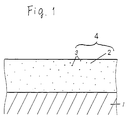
- a composite layer of the present invention comprises a substrate 1 and a colored layer 4 formed on the surface of the substrate 1.
- the colored layer 4 may be formed on either one or both sides of the substrate 1.
- the substrate 1 may be formed from transparent glass or plastic.
- the colored layer 4 contains a transparent layer 2 and a coloring agent 3 dispersed within the transparent layer 2.
- the transparent layer 2 is composed of an inorganic gel or glass material, while the coloring agent 3 contains at least one selected from the group consisting of dyes and pigments.
- the colored layer is formed in the following manner.
- a colorant solution is prepared by dissolving or dispersing a coloring agent in an alkoxide or mercaptide solution.
- the colorant solution is coated onto the substrate, then the substrate, coated with the colorant solution, is dried and/or heated.
- This drying and/or heating process results in the formation of a transparent layer of inorganic gel or glass from the alkoxide or mercaptide by a dehydration-condensation reaction If the dehydration-condensation reaction is incomplete, then a transparent layer of gel is formed, whereas if the said dehydration-condensation reaction is complete, then a transparent layer of glass is formed.
- the coloring agent is uniformly dispersed within the aforesaid transparent layer. Since the dehydration-condensation reaction is conducted at relative low temperature, the coloring agent is sealed into the transparent layer without decomposition.
- the thickness of the colored layer is 10 micrometers or less.
- the materials from which the transparent layer is formed may contain one or more elements selected from the group consisting of silicon, germanium, titanium, zirconium, lead, boron, aluminum, phosphorus and arsenic.
- the transparent layer may be formed from soda glass, borosilicate glass, lead glass, or natural quartz.
- the transparent layer is formed of inorganic materials, hence, weather resistance is superior to that of transparent layers formed of conventional organic materials such as alkyd resins. Moreover, since a transparent layer formed from inorganic materials can prevent the passage of ultraviolet rays, fading effects can also be diminished.
- the coloring agent used for the purposes of the present invention is preferably an organic dye or organic pigment.
- organic dyes or organic pigments in the category of azo, anthraquinone, naphthoquinone, perylene, indigo, fluorenone, phenazine, phenothiazine, polymethine, polyene, diphenylmethane, triphenylmethane, acridine, phthalocyanine can be used.
- organic dyes or pigments suitable for the purpose of the present invention are as follows.
- inorganic pigments may also be used as coloring agents for this purpose.
- 0.1 g of methylene blue was dissolved in 50 ml of ethanol, 25 g of tetraethoxysilane was added to this solution, and the mixture was thoroughly agitated. Next, 23.5 g of an aqueous solution containing 0.3 ml of hydrochloric acid was added, and the mixture was stirred at room temperature for 10 minutes, thereby preparing a solution designated as A-1. Also, another solution, designated as B-1, was prepared in entirely the same manner as A-1, except for the use of 2-(p-dimethylaminostyryl)-3-ethyl-benzooxazolium iodide in place of methylene blue.
- C-1 still another solution, designated as A-1, was prepared in entirely the same manner as A-1, except for the use of 3-(4'-dimethylaminophenylazo)-pyridinium chloride in place of methylene blue. Then, 200 g of crushed glass particles with a grain size of 3 mm were immersed in each of the solutions A-1, B-1, and C-1 obtained as indicated above. After drying at room temperature, the mixtures were heated for 60 minutes at 100°C, thereby forming a gel film on the surfaces of the glass particles. The colored glass particles formed using the solutions A-1, B-1, and C-1 displayed blue, red, and yellow colors, respectively.
- 0.2 g of copper phthalocyanine was dispersed in a mixed solution of 50 ml of ethanol and 40 g of hydroxypropyl cellulose, then this solution was added to 25 g of tetraethoxysilane and the mixture was thoroughly stirred. Next, 23.5 g of an aqueous solution containing 0.3 ml of hydrochloric acid was added, and the mixture was stirred at room temperature for 10 minutes, thereby preparing a solution designated as D-1. Also, another solution, designated as E-1, was prepared in entirely the same manner as D-1, except for the use of phthaloperinone in place of copper phthalocyanine.
- Figure 3 shows an example of an ornament employing the colored glass filaments obtained by the method of the present Example 2.
- This ornament is composed of a group (15, 16, 17) of glass filaments with three colors and a light-emitting unit 18.
- Table 1 Pigment added Peak absorption wave length Copper phthalocyanine 660 nm Phthaloperinone 520 nm 4,5,6,7-tetrachloroquinophthalone 430 nm
- the colored glass particles obtained as indicated in the description of Example 1 above were mixed with an unsaturated polyester resin in a weight ratio of 50:50, then, 2 weight parts each of a cure accelarator, a catalyst, and a low shrinkage agent were added to 100 parts of the mixture so obtained, and the mixture was thoroughly stirred.
- the constituents mixed in this manner were then poured into a mold, and thermally hardened for 100 minutes at 100°C. The hardened mass was then removed from the mold, and the surface of the mass was polished, thus obtaining a glass composite material.
- Acetylacetone was added to an ethanol solution of titanium tetrabutoxide, then methylene blue was added, and the solution was agitated for 20 minutes.
- glass particles of a mean grain size of 0.5 mm were lifted out of the solution and heated for 5 hours at 120°C.
- the colored glass particles so obtained were then mixed with an unsaturated polyester resin, a silicone coupling agent, a curing averator, and a low shrinkage agent in the weight ratio 50:50:2:2:2.
- the constituents mixed in this manner were poured into a mold, and thermally hardened for 100 minutes at 100°C. The hardened mass was then removed from the mold, and the surface of the mass was polished, thus obtaining a glass composite material.
- a composite glass material was obtained by the same procedure as was used in the preparation of Example 4, except that the solution for immersion of the glass particles was prepared with added hydroxypropyl cellulose.
- Comparative Example 1 is a glass bead material colored with an organic pigment
- Comparative Example 2 is an artificial marble composed of an organic pigment, glass powder, and a synthetic resin.
- 0.1 g of the azo type dye with the structure shown in diagram (a) above was dissolved in 50 ml of ethanol, then this solution was added to 25 g of tetraethoxysilane and the mixture was thoroughly stirred. Next, 23.5 g of an aqueous solution containing 0.3 ml of hydrochloric acid was added and the mixture was agitated at room temperature for 10 minutes, thereby preparing a solution designated as A-2.
- a solution designated as B-2 was obtained by the same procedure as was used in the preparation of solution A-2, except that a mixture of Direct Blue 86 and C. I. Acid Yellow, with the structures shown in diagram (b) above, was used in place of the dye (a) which was used in solution A-2.
- a solution designated as C-2 was obtained by the same procedure as was used in the preparation of solution A-2, except that the triphenylmethane type dye with the structure shown in diagram (c) above was used in place of the dye (a) which was used in solution A-2.
- Each of the solutions A-2, B-2, and C-2 so obtained were coated onto the portions (a), (b), (c), respectively, of a #7059 glass substrate 30, as illustrated in Figure 4, and after drying in air, the coated substrate was heated for 30 minutes in an electric oven, thereby forming the red, green, and blue colored films 35, 36, and 37, respectively.
- the thickness of the films 35, 36, and 37 so obtained was 500 nm, i.e. 0,5 ⁇ m.
- the filter obtained in this manner was the color separation filter 34, with the component red, green, and blue filters formed by the portions (a), (b), and (c), respectively.
- a color sensor receptor was constructed by assembling this color separation filter with a photomask IC 31, spacers 32, and a near infrared cut off filter 33.
- Example 8 Using a printing method, the solutions A-2, B-2, and C-2 obtained in Example 8 were coated onto a glass substrate 45, as illustrated in Figure 5. Then, the substrate was heated in the same manner as in the preparation of Example 8, thereby forming red, green, and blue colored films 46, 47, and 48, respectively, and so obtaining a color filter suitable for liquid crystal displays.
- 0.1 g of methylene blue was dissolved in 50 ml of ethanol, then this solution was added to 25 g of tetraethoxysilane and the mixture was thoroughly agitated. Next, 23.5 g of an aqueous solution containing 0.3 ml of hydrochloric acid was added, and the mixture was stirred at room temperature for 10 minutes, thereby preparing a solution designated as D-2. Also, another solution, designated as E-2, was prepared in entirely the same manner as D-2, except for the use of 2-(p-dimethylaminostyryl)-3-ethyl-benzooxazolium iodide in place of methylene blue.
- 0.2 g of copper phthalocyanine was dispersed in a mixed solution of 50 ml of ethanol and 40 g of hydroxypropyl cellulose. Then this solution was added to 25 g of tetraethoxysilane and the mixture was thoroughly stirred. Next, 23.5 g of an aqueous solution containing 0.3 ml of hydrochloric acid was added, and the mixture was stirred at room temperature for 10 minutes, thereby preparing a solution designated as G. Also, another solution, designated as H, was prepared in the same manner as G, except for the use of phthaloperinone in place of copper phthalocyanine.
- a solution was prepared by adding acetylacetone to an ethanol solution of zirconium tetrabutoxide, and then adding methylene blue to the mixture.
- the solution so obtained was sprayed onto a #7059 glass substrate with a thickness of 0.5 mm by a spray method and then was heated at 100°C for 30 minutes, thereby forming a colored film.
- a solution was prepared by adding 3-(4'-dimethylaminophenylazo)-pyridinium chloride and terpineol, as a thickener, to a ethanol solution of methyltriethoxysilane. This solution was applied to one surface of a transparent acrylic resin plate 1 mm in thickness by a screen printing technique, after which the plate was dried at 60°C for 60 minutes, thereby forming a colored film.
- FIG 6 is a graph showing the transmittance-wave length relationship of a color filter fabricated with the solution D-2 obtained in Example 10.
- This filter exhibits an absorption at around 620 nm, while light of the other wave lengths is transmitted very well. Therefore, this filter can be effectively used for luminosity correction. That is, as shown in Figure 7, by using the aforesaid filter, the relative luminosity curve (indicated by the solid line (b)), which, owing to high sensitivity at 620 nm, deviates from a curve (showing the standard relative luminous efficiency function V(lambda)) indicated by the broken line (a), can be corrected so as to coincide with the latter curve (a).
- the filters fabricated by the methods of the present invention are effective for applications requiring absorption only of specified wave lengths.
- the absorption wave lengths of the color filters can be adjusted by mixing a plurality of dyes.
- Figure 8 is a graph showing the transmittance-wave length relationship of a color filter fabricated with the solution E-2 obtained in Example 10
- Figure 9 is a graph showing the transmittance-wave length relationship of a color filter fabricated by coating and drying a mixture of solutions E-2 and D-2 onto a glass substrate.
- the transmittance curve (d) shown in Figure 9 corresponds to the sum of the transmittance curve (a) of a filter fabricated using solution D-2 and the transmittance curve (c) of a filter fabricated using solution E-2.
- the absorption wave lengths of the color filters so obtained can be controlled.
- the same effect as above can also be obtained by superimposing a filter fabricated from solution D-2 and a filter fabricated from solution E-2.
- Comparative Example 3 is a color sensor light receptor employing an organic film filter of the type illustrated in Figure 10
- Example 4 is a color sensor light receptor employing a printed film of the type illustrated in Figure 11.
- Table 4 Changes in wave length dependence of transmittance at 70°C and 90% relative humidity Long-term reliability Embodiment 8 None No fading by UV radiation 9 None No fading by UV radiation 10 None No fading by UV radiation 11 None No fading by UV radiation 12 None No fading by UV radiation 13 None Extremely high weather resistance 14 None Excellent adhesion to plastic substrates Comparative examples 3 Transmitted wave lengths shifted UV cutoff filter required 4 Transmitted wave lengths shifted UV cutoff filter required
Landscapes
- Chemical & Material Sciences (AREA)
- General Chemical & Material Sciences (AREA)
- Life Sciences & Earth Sciences (AREA)
- Engineering & Computer Science (AREA)
- Chemical Kinetics & Catalysis (AREA)
- Geochemistry & Mineralogy (AREA)
- Materials Engineering (AREA)
- Organic Chemistry (AREA)
- Composite Materials (AREA)
- Inorganic Chemistry (AREA)
- Optical Filters (AREA)
- Laminated Bodies (AREA)
- Compositions Of Macromolecular Compounds (AREA)
Claims (15)
- Verfahren zur Herstellung eines Farbfilters mit einem Substrat (1) und einer gefärbten Schicht (4), die auf der Oberfläche des Substrats (1) ausgebildet ist, wobei die gefärbte Schicht (4) eine transparente Schicht (2) und ein Färbungsmittel (3) enthält, das in der transparenten Schicht (2) gelöst oder dispergiert ist, wobei das Verfahren folgende Schritte umfaßt:(i) Herstellung einer Färbemittellösung oder -dispersion durch das Lösen oder Dispergieren des Färbungsmittels (3) in einer Alkoxidlösung, wobei das Färbungsmittel mindestens ein Element enthält, das aus der Gruppe ausgewählt wird, die aus Farbstoffen und Pigmenten besteht, und wobei die Alkoxidlösung ein Alkoxid mindestens eines Elements enthält, das aus der Gruppe ausgewählt wird, die aus Silizium, Germanium, Titan, Zircon, Blei, Bor, Aluminium, Phosphor und Arsen besteht;(ii) Aufbringen der Färbemittellösung oder -dispersion auf das Substrat (1);(iii) Ausbildung der gefärbten Schicht (4) auf der Oberfläche des Substrats (1) mit einer Dicke von 10 µm oder weniger durch das Erwärmen des Substrats, auf welches die Färbemittellösung oder -dispersion aufgebracht ist; und(iv) Erwärmen der gefärbten Schicht (4) auf Temperaturen von 60 °C bis 150 °C.
- Verfahren gemaß Anspruch 1, bei dem das Substrat (1) aus Glas oder Kunststoffmaterial hergestellt ist.
- Verfahren gemaß Anspruch 1 oder 2, bei dem das Färbungsmittel (3) aus verschiedenen Arten von Farbstoffen und/oder verschiedenen Arten von Pigmenten mit Absorptionsspitzen bei verschiedenen Wellenlängen ausgebildet ist.
- Verfahren gemaß einem der Ansprüche 1 bis 3, bei dem die transparente Schicht (2) dazu in der Lage ist, ultraviolette Strahlung zu absorbieren.
- Verfahren gemaß Anspruch 4, bei dem das Aufbringen und das Ausbilden mindestens zweimal durchgeführt wird.
- Verfahren gemaß Anspruch 4 oder 5, bei dem die Färbemittellösung als Filmbildungszusatz eine organische Verbindung enthält, die aus der Gruppe ausgebildet wird, die aus Hydroxylpropyl-Cellulose und Hydroxylethyl-Cellulose besteht.
- Verfahren gemaß einem der Ansprüche 1 bis 6, das ferner die Behandlung der Oberfläche des Substrats (1) mit einem Verbindungsmittel vor der Aufbringung der Färbemittellösung auf das Substrat (1) umfaßt.
- Verfahren gemäß Anspruch 7, bei dem die Färbemittellösung ein Verbindungsmittel enthält.
- Farbfilter mit einem Substrat (1) und einer gefärbten Schicht (4), die auf der Oberfläche des Substrats (1) ausgebildet ist, bei dem die gefärbte Schicht (4) eine transparente Schicht (2) und ein Färbungsmittel (3) enthält, das in der transparenten Schicht (2) gelöst oder dispergiert ist, und eine Dicke von 10 µm oder weniger hat, wobei die transparente Schicht aus einer Alkoxidlösung mindestens eines Elements hergestellt ist, das aus der Gruppe ausgewählt wird, die aus Silizium, Germanium, Zircon, Blei, Bor, Aluminium, Phosphor und Arsen besteht; und wobei das Färbungsmittel aus mindestens einem Element besteht, das aus der Gruppe ausgewählt wird, die aus Farbstoffen und Pigmenten besteht, wobei die gefärbte Schicht (4) auf der Oberfläche des Substrats (1) bei Temperaturen von 60 °C bis 150 °C erwärmt wird.
- Farbfilter gemaß Anspruch 9, bei dem das Substrat (1) aus Glas oder Kunststoffmaterial hergestellt ist.
- Farbfilter gemäß einem der Ansprüche 9 oder 10, bei dem das Färbungsmittel (3) aus verschiedenen Arten von Farbstoffen und/oder verschiedenen Arten von Pigmenten ausgebildet ist, die Absorptionsspitzen bei verschiedenen Wellenlängen haben.
- Farbfilter gemaß einem der Ansprüche 9 bis 11, bei dem die transparente Schicht (2) dazu in der Lage ist, ultraviolette Strahlung zu absorbieren.
- Farbfilter gemäß Anspruch 12, bei dem die Färbemittellösung als Filmbildungszusatz eine organische Verbindung enthält, die aus der Gruppe ausgewählt wird, die aus Hydroxylpropyl-Cellulose und Hydroxylethyl-Cellulose besteht.
- Farbfilter gemäß einem der Ansprüche 9 bis 13, der ferner die Behandlung der Oberfläche des Substrats (1) mit einem Verbindungsmittel vor der Aufbringung der Färbemittellösung auf das Substrat (1) umfaßt.
- Farbfilter gemäß Anspruch 14, bei dem die Färbemittellösung ein Verbindungsmittel enthält.
Applications Claiming Priority (4)
| Application Number | Priority Date | Filing Date | Title |
|---|---|---|---|
| JP101936/90 | 1990-04-18 | ||
| JP2101936A JPH041602A (ja) | 1990-04-18 | 1990-04-18 | カラーフィルタおよびその製造法 |
| JP2103479A JP2825926B2 (ja) | 1990-04-19 | 1990-04-19 | ガラス材料,ガラス複合材料およびその製造法 |
| JP103479/90 | 1990-04-19 |
Publications (2)
| Publication Number | Publication Date |
|---|---|
| EP0452922A1 EP0452922A1 (de) | 1991-10-23 |
| EP0452922B1 true EP0452922B1 (de) | 1997-01-29 |
Family
ID=26442704
Family Applications (1)
| Application Number | Title | Priority Date | Filing Date |
|---|---|---|---|
| EP19910106214 Expired - Lifetime EP0452922B1 (de) | 1990-04-18 | 1991-04-18 | Kompositschicht, Glaskompositmaterial und Verfahren zu seiner Herstellung |
Country Status (3)
| Country | Link |
|---|---|
| US (1) | US5667888A (de) |
| EP (1) | EP0452922B1 (de) |
| DE (1) | DE69124410T2 (de) |
Cited By (5)
| Publication number | Priority date | Publication date | Assignee | Title |
|---|---|---|---|---|
| US5731091A (en) * | 1993-11-10 | 1998-03-24 | Institut Fuer Neue Materialien Gemeinnuetzige Gmbh | Process for producing functional vitreous layers |
| US5811209A (en) * | 1994-09-21 | 1998-09-22 | Canon Kabushiki Kaisha | Color filter, production process thereof, and liquid crystal display panel equipped with the color filter |
| US6156388A (en) * | 1996-10-31 | 2000-12-05 | Institut Fuer Neue Materialen Gemeinnuetzige Gmbh | Method for manufacturing substrates with transparent and color coatings stable at high temperatures and in the presence of ultraviolet rays |
| WO2003063197A1 (en) * | 2002-01-24 | 2003-07-31 | Koninklijke Philips Electronics N.V. | Light-transmitting substrate provided with a light-absorbing coating |
| US10308541B2 (en) | 2014-11-13 | 2019-06-04 | Gerresheimer Glas Gmbh | Glass forming machine particle filter, a plunger unit, a blow head, a blow head support and a glass forming machine adapted to or comprising said filter |
Families Citing this family (18)
| Publication number | Priority date | Publication date | Assignee | Title |
|---|---|---|---|---|
| GB9315584D0 (en) * | 1993-07-28 | 1993-09-08 | Mckee Frederick B | Improvements in or relating to energy saving windows & cladding |
| DE4417405A1 (de) * | 1994-05-18 | 1995-11-23 | Inst Neue Mat Gemein Gmbh | Verfahren zur Herstellung von strukturierten anorganischen Schichten |
| DE19501640C2 (de) * | 1995-01-20 | 1999-07-01 | Schott Glas | Recyclierbare Bildschirme für Kathodenstrahlröhren mit einem einstellbaren spektralen Transmissionsverlauf aus Glas und Verfahren zu ihrer Herstellung |
| US5846677A (en) * | 1996-03-12 | 1998-12-08 | Futaba Denshi Kogyo K.K. | Color filter, color filter-equipped display device and method for manufacturing same |
| JP3690006B2 (ja) * | 1996-10-31 | 2005-08-31 | ソニー株式会社 | 映像投射装置 |
| WO1998059010A1 (en) * | 1997-06-20 | 1998-12-30 | Teikoku Chemical Industries Co., Ltd. | Color coating compositions |
| US6342762B1 (en) | 1997-07-03 | 2002-01-29 | Osram Sylvania Inc. | Amber vehicle lamp |
| JP3410024B2 (ja) * | 1998-06-18 | 2003-05-26 | 富士通株式会社 | ガス放電表示装置 |
| KR100531045B1 (ko) * | 1998-07-01 | 2005-11-28 | 오스람 실바니아 인코포레이티드 | 차량용 황색 램프 |
| US6607818B1 (en) * | 1999-03-26 | 2003-08-19 | Ronald Mark Associates, Inc. | Composite materials with bulk decorative features and process for producing same |
| JP2000303025A (ja) * | 1999-04-19 | 2000-10-31 | Toyo Ink Mfg Co Ltd | ガラス着色用コーティング組成物 |
| CN1278284C (zh) * | 2002-02-28 | 2006-10-04 | 日本电产科宝株式会社 | 纸张类荧光检测传感器 |
| EP1418448A1 (de) * | 2002-11-06 | 2004-05-12 | Koninklijke DSM N.V. | Herstellung einer mechanisch haltbaren, einlagigen Beschichtung mit Antireflex-Eigenschaften |
| DE10313630A1 (de) * | 2003-03-26 | 2004-10-07 | BSH Bosch und Siemens Hausgeräte GmbH | Glasartige Bedruckung mittels Siebdruck |
| US7514149B2 (en) * | 2003-04-04 | 2009-04-07 | Corning Incorporated | High-strength laminated sheet for optical applications |
| JP2007311447A (ja) * | 2006-05-17 | 2007-11-29 | Sanyo Electric Co Ltd | 光電変換装置 |
| US20100209695A1 (en) * | 2006-06-13 | 2010-08-19 | LG Chem ,Ltd., | Artificial marble containing chip with transparent and light reflecting materials, and process for preparing the same |
| DE202011110029U1 (de) * | 2011-06-06 | 2012-10-08 | Schott Ag | Anzeigevorrichtung |
Family Cites Families (8)
| Publication number | Priority date | Publication date | Assignee | Title |
|---|---|---|---|---|
| US3087829A (en) * | 1961-06-28 | 1963-04-30 | Du Pont | Micaceous pigment composition |
| US3421921A (en) * | 1966-07-25 | 1969-01-14 | Ppg Industries Inc | Colored,transparent,durable titania films on glass |
| US3574651A (en) * | 1967-03-20 | 1971-04-13 | Wacker Chemie Gmbh | Water based paint compositions containing an alkali metal organosiliconate |
| JPS5520222A (en) * | 1978-07-28 | 1980-02-13 | Asahi Chemical Ind | Bright aggregate composition |
| HU178517B (en) * | 1978-12-12 | 1982-05-28 | Egyesuelt Izzolampa | Method for improving bulb coating of electric light sources |
| US4435219A (en) * | 1982-06-02 | 1984-03-06 | Ppg Industries, Inc. | Stable inorganic coating composition for adherent, inorganic coatings |
| US4671990A (en) * | 1986-07-01 | 1987-06-09 | Manville Corporation | Process for the production of polymers from silicon alkoxides |
| US4929278A (en) * | 1988-01-26 | 1990-05-29 | United States Department Of Energy | Sol-gel antireflective coating on plastics |
-
1991
- 1991-04-18 DE DE69124410T patent/DE69124410T2/de not_active Expired - Fee Related
- 1991-04-18 EP EP19910106214 patent/EP0452922B1/de not_active Expired - Lifetime
-
1996
- 1996-08-26 US US08/697,476 patent/US5667888A/en not_active Expired - Fee Related
Cited By (5)
| Publication number | Priority date | Publication date | Assignee | Title |
|---|---|---|---|---|
| US5731091A (en) * | 1993-11-10 | 1998-03-24 | Institut Fuer Neue Materialien Gemeinnuetzige Gmbh | Process for producing functional vitreous layers |
| US5811209A (en) * | 1994-09-21 | 1998-09-22 | Canon Kabushiki Kaisha | Color filter, production process thereof, and liquid crystal display panel equipped with the color filter |
| US6156388A (en) * | 1996-10-31 | 2000-12-05 | Institut Fuer Neue Materialen Gemeinnuetzige Gmbh | Method for manufacturing substrates with transparent and color coatings stable at high temperatures and in the presence of ultraviolet rays |
| WO2003063197A1 (en) * | 2002-01-24 | 2003-07-31 | Koninklijke Philips Electronics N.V. | Light-transmitting substrate provided with a light-absorbing coating |
| US10308541B2 (en) | 2014-11-13 | 2019-06-04 | Gerresheimer Glas Gmbh | Glass forming machine particle filter, a plunger unit, a blow head, a blow head support and a glass forming machine adapted to or comprising said filter |
Also Published As
| Publication number | Publication date |
|---|---|
| DE69124410T2 (de) | 1997-07-10 |
| EP0452922A1 (de) | 1991-10-23 |
| US5667888A (en) | 1997-09-16 |
| DE69124410D1 (de) | 1997-03-13 |
Similar Documents
| Publication | Publication Date | Title |
|---|---|---|
| EP0452922B1 (de) | Kompositschicht, Glaskompositmaterial und Verfahren zu seiner Herstellung | |
| US4057408A (en) | Method for making photosensitive colored glasses | |
| DE69612630T2 (de) | Fotoempfindliche Harzzusammensetzung und Verfahren zur Herstellung von Feinstrukturen damit | |
| US5340673A (en) | Method of manufacturing a phosphor screen of a cathode ray tube | |
| JP2025122241A (ja) | 光学フィルタ | |
| US5766980A (en) | Method of manufacturing a solid state imaging device | |
| DE68921444T2 (de) | Staubschutzkörper mit hoher Lichttransmission und Verfahren zu seiner Herstellung. | |
| US7335322B2 (en) | Photochromic material comprising composite oxides | |
| EP0505892B1 (de) | Glasfritten und ihre Verwendung in Emailbarriereschichten zur Verhinderung der Silbermigration | |
| US3986069A (en) | Color stripe filter with two protective layers | |
| US5534443A (en) | Method of manufacturing a solid state imaging device | |
| JP2825926B2 (ja) | ガラス材料,ガラス複合材料およびその製造法 | |
| JPH0381122B2 (de) | ||
| JP3259059B2 (ja) | カラーフィルター | |
| JPS6132802A (ja) | 色分離フイルタ | |
| JPS62246887A (ja) | 写真陶磁器板の製造方法 | |
| JP2578466B2 (ja) | 固体撮像素子 | |
| JPH041602A (ja) | カラーフィルタおよびその製造法 | |
| US4266012A (en) | Color photographic process utilizing polychromatic glass | |
| JPH05232308A (ja) | カラーフィルタの製造方法 | |
| JPH0139271B2 (de) | ||
| JPH0231371B2 (de) | ||
| JPH04234705A (ja) | カラーフィルタの製造方法 | |
| JP2001192236A (ja) | 光吸収パターン膜被覆物品の製造方法および光吸収パターン膜被覆物品 | |
| JPH05238777A (ja) | カラーフィルタおよびその製造方法 |
Legal Events
| Date | Code | Title | Description |
|---|---|---|---|
| PUAI | Public reference made under article 153(3) epc to a published international application that has entered the european phase |
Free format text: ORIGINAL CODE: 0009012 |
|
| 17P | Request for examination filed |
Effective date: 19910418 |
|
| AK | Designated contracting states |
Kind code of ref document: A1 Designated state(s): DE FR GB |
|
| 17Q | First examination report despatched |
Effective date: 19930427 |
|
| GRAG | Despatch of communication of intention to grant |
Free format text: ORIGINAL CODE: EPIDOS AGRA |
|
| GRAH | Despatch of communication of intention to grant a patent |
Free format text: ORIGINAL CODE: EPIDOS IGRA |
|
| GRAH | Despatch of communication of intention to grant a patent |
Free format text: ORIGINAL CODE: EPIDOS IGRA |
|
| GRAA | (expected) grant |
Free format text: ORIGINAL CODE: 0009210 |
|
| AK | Designated contracting states |
Kind code of ref document: B1 Designated state(s): DE FR GB |
|
| ET | Fr: translation filed | ||
| REF | Corresponds to: |
Ref document number: 69124410 Country of ref document: DE Date of ref document: 19970313 |
|
| PLBE | No opposition filed within time limit |
Free format text: ORIGINAL CODE: 0009261 |
|
| STAA | Information on the status of an ep patent application or granted ep patent |
Free format text: STATUS: NO OPPOSITION FILED WITHIN TIME LIMIT |
|
| 26N | No opposition filed | ||
| REG | Reference to a national code |
Ref country code: GB Ref legal event code: IF02 |
|
| PGFP | Annual fee paid to national office [announced via postgrant information from national office to epo] |
Ref country code: FR Payment date: 20050408 Year of fee payment: 15 |
|
| PGFP | Annual fee paid to national office [announced via postgrant information from national office to epo] |
Ref country code: GB Payment date: 20050413 Year of fee payment: 15 |
|
| PGFP | Annual fee paid to national office [announced via postgrant information from national office to epo] |
Ref country code: DE Payment date: 20050414 Year of fee payment: 15 |
|
| PG25 | Lapsed in a contracting state [announced via postgrant information from national office to epo] |
Ref country code: GB Free format text: LAPSE BECAUSE OF NON-PAYMENT OF DUE FEES Effective date: 20060418 |
|
| PG25 | Lapsed in a contracting state [announced via postgrant information from national office to epo] |
Ref country code: DE Free format text: LAPSE BECAUSE OF NON-PAYMENT OF DUE FEES Effective date: 20061101 |
|
| GBPC | Gb: european patent ceased through non-payment of renewal fee |
Effective date: 20060418 |
|
| REG | Reference to a national code |
Ref country code: FR Ref legal event code: ST Effective date: 20061230 |
|
| PG25 | Lapsed in a contracting state [announced via postgrant information from national office to epo] |
Ref country code: FR Free format text: LAPSE BECAUSE OF NON-PAYMENT OF DUE FEES Effective date: 20060502 |