EP0453216B1 - Utilisation de promoteurs autologues pour l'expression de produits de gène chez Bordetella - Google Patents
Utilisation de promoteurs autologues pour l'expression de produits de gène chez Bordetella Download PDFInfo
- Publication number
- EP0453216B1 EP0453216B1 EP91303320A EP91303320A EP0453216B1 EP 0453216 B1 EP0453216 B1 EP 0453216B1 EP 91303320 A EP91303320 A EP 91303320A EP 91303320 A EP91303320 A EP 91303320A EP 0453216 B1 EP0453216 B1 EP 0453216B1
- Authority
- EP
- European Patent Office
- Prior art keywords
- gene
- pertussis
- fha
- strain
- tox
- Prior art date
- Legal status (The legal status is an assumption and is not a legal conclusion. Google has not performed a legal analysis and makes no representation as to the accuracy of the status listed.)
- Expired - Lifetime
Links
- 108090000623 proteins and genes Proteins 0.000 title claims abstract description 129
- 241000588807 Bordetella Species 0.000 title claims description 26
- 241000588832 Bordetella pertussis Species 0.000 claims abstract description 61
- 201000005702 Pertussis Diseases 0.000 claims abstract description 32
- 230000014509 gene expression Effects 0.000 claims abstract description 26
- 238000004519 manufacturing process Methods 0.000 claims abstract description 24
- 239000013612 plasmid Substances 0.000 claims abstract description 19
- 102000004169 proteins and genes Human genes 0.000 claims abstract description 19
- 238000000034 method Methods 0.000 claims abstract description 14
- 230000000694 effects Effects 0.000 claims abstract description 5
- 230000006801 homologous recombination Effects 0.000 claims abstract description 5
- 238000002744 homologous recombination Methods 0.000 claims abstract description 5
- 210000000349 chromosome Anatomy 0.000 claims abstract description 3
- 108091007433 antigens Proteins 0.000 claims description 19
- 102000036639 antigens Human genes 0.000 claims description 18
- 239000000427 antigen Substances 0.000 claims description 17
- 108091081024 Start codon Proteins 0.000 claims description 10
- 101150006855 PRN gene Proteins 0.000 claims description 8
- 101150017997 Tox gene Proteins 0.000 claims description 6
- 229940030156 cell vaccine Drugs 0.000 claims description 4
- 238000012258 culturing Methods 0.000 claims description 4
- 230000009466 transformation Effects 0.000 claims description 2
- 230000001131 transforming effect Effects 0.000 claims description 2
- 230000000890 antigenic effect Effects 0.000 abstract description 4
- 108020004705 Codon Proteins 0.000 abstract description 3
- 238000003780 insertion Methods 0.000 abstract 1
- 230000037431 insertion Effects 0.000 abstract 1
- 108010081690 Pertussis Toxin Proteins 0.000 description 17
- 108010021711 pertactin Proteins 0.000 description 16
- 101000702488 Rattus norvegicus High affinity cationic amino acid transporter 1 Proteins 0.000 description 14
- 108020004414 DNA Proteins 0.000 description 12
- 238000002105 Southern blotting Methods 0.000 description 11
- 239000012634 fragment Substances 0.000 description 8
- 229960005486 vaccine Drugs 0.000 description 8
- 108091034117 Oligonucleotide Proteins 0.000 description 5
- 238000000855 fermentation Methods 0.000 description 5
- 230000004151 fermentation Effects 0.000 description 5
- 238000002360 preparation method Methods 0.000 description 5
- 108020005065 3' Flanking Region Proteins 0.000 description 4
- 108700039691 Genetic Promoter Regions Proteins 0.000 description 4
- 239000013611 chromosomal DNA Substances 0.000 description 4
- 238000010276 construction Methods 0.000 description 4
- 201000010099 disease Diseases 0.000 description 4
- 208000037265 diseases, disorders, signs and symptoms Diseases 0.000 description 4
- 238000005516 engineering process Methods 0.000 description 4
- 238000013507 mapping Methods 0.000 description 4
- 239000000047 product Substances 0.000 description 4
- 230000001105 regulatory effect Effects 0.000 description 4
- 241000588780 Bordetella parapertussis Species 0.000 description 3
- 108010042407 Endonucleases Proteins 0.000 description 3
- 102000004533 Endonucleases Human genes 0.000 description 3
- JLCPHMBAVCMARE-UHFFFAOYSA-N [3-[[3-[[3-[[3-[[3-[[3-[[3-[[3-[[3-[[3-[[3-[[5-(2-amino-6-oxo-1H-purin-9-yl)-3-[[3-[[3-[[3-[[3-[[3-[[5-(2-amino-6-oxo-1H-purin-9-yl)-3-[[5-(2-amino-6-oxo-1H-purin-9-yl)-3-hydroxyoxolan-2-yl]methoxy-hydroxyphosphoryl]oxyoxolan-2-yl]methoxy-hydroxyphosphoryl]oxy-5-(5-methyl-2,4-dioxopyrimidin-1-yl)oxolan-2-yl]methoxy-hydroxyphosphoryl]oxy-5-(6-aminopurin-9-yl)oxolan-2-yl]methoxy-hydroxyphosphoryl]oxy-5-(6-aminopurin-9-yl)oxolan-2-yl]methoxy-hydroxyphosphoryl]oxy-5-(6-aminopurin-9-yl)oxolan-2-yl]methoxy-hydroxyphosphoryl]oxy-5-(6-aminopurin-9-yl)oxolan-2-yl]methoxy-hydroxyphosphoryl]oxyoxolan-2-yl]methoxy-hydroxyphosphoryl]oxy-5-(5-methyl-2,4-dioxopyrimidin-1-yl)oxolan-2-yl]methoxy-hydroxyphosphoryl]oxy-5-(4-amino-2-oxopyrimidin-1-yl)oxolan-2-yl]methoxy-hydroxyphosphoryl]oxy-5-(5-methyl-2,4-dioxopyrimidin-1-yl)oxolan-2-yl]methoxy-hydroxyphosphoryl]oxy-5-(5-methyl-2,4-dioxopyrimidin-1-yl)oxolan-2-yl]methoxy-hydroxyphosphoryl]oxy-5-(6-aminopurin-9-yl)oxolan-2-yl]methoxy-hydroxyphosphoryl]oxy-5-(6-aminopurin-9-yl)oxolan-2-yl]methoxy-hydroxyphosphoryl]oxy-5-(4-amino-2-oxopyrimidin-1-yl)oxolan-2-yl]methoxy-hydroxyphosphoryl]oxy-5-(4-amino-2-oxopyrimidin-1-yl)oxolan-2-yl]methoxy-hydroxyphosphoryl]oxy-5-(4-amino-2-oxopyrimidin-1-yl)oxolan-2-yl]methoxy-hydroxyphosphoryl]oxy-5-(6-aminopurin-9-yl)oxolan-2-yl]methoxy-hydroxyphosphoryl]oxy-5-(4-amino-2-oxopyrimidin-1-yl)oxolan-2-yl]methyl [5-(6-aminopurin-9-yl)-2-(hydroxymethyl)oxolan-3-yl] hydrogen phosphate Polymers Cc1cn(C2CC(OP(O)(=O)OCC3OC(CC3OP(O)(=O)OCC3OC(CC3O)n3cnc4c3nc(N)[nH]c4=O)n3cnc4c3nc(N)[nH]c4=O)C(COP(O)(=O)OC3CC(OC3COP(O)(=O)OC3CC(OC3COP(O)(=O)OC3CC(OC3COP(O)(=O)OC3CC(OC3COP(O)(=O)OC3CC(OC3COP(O)(=O)OC3CC(OC3COP(O)(=O)OC3CC(OC3COP(O)(=O)OC3CC(OC3COP(O)(=O)OC3CC(OC3COP(O)(=O)OC3CC(OC3COP(O)(=O)OC3CC(OC3COP(O)(=O)OC3CC(OC3COP(O)(=O)OC3CC(OC3COP(O)(=O)OC3CC(OC3COP(O)(=O)OC3CC(OC3COP(O)(=O)OC3CC(OC3COP(O)(=O)OC3CC(OC3CO)n3cnc4c(N)ncnc34)n3ccc(N)nc3=O)n3cnc4c(N)ncnc34)n3ccc(N)nc3=O)n3ccc(N)nc3=O)n3ccc(N)nc3=O)n3cnc4c(N)ncnc34)n3cnc4c(N)ncnc34)n3cc(C)c(=O)[nH]c3=O)n3cc(C)c(=O)[nH]c3=O)n3ccc(N)nc3=O)n3cc(C)c(=O)[nH]c3=O)n3cnc4c3nc(N)[nH]c4=O)n3cnc4c(N)ncnc34)n3cnc4c(N)ncnc34)n3cnc4c(N)ncnc34)n3cnc4c(N)ncnc34)O2)c(=O)[nH]c1=O JLCPHMBAVCMARE-UHFFFAOYSA-N 0.000 description 3
- 238000011065 in-situ storage Methods 0.000 description 3
- 230000010354 integration Effects 0.000 description 3
- 101710118506 69 kDa protein Proteins 0.000 description 2
- 241000588851 Bordetella avium Species 0.000 description 2
- 241000588779 Bordetella bronchiseptica Species 0.000 description 2
- 241000700199 Cavia porcellus Species 0.000 description 2
- 238000002965 ELISA Methods 0.000 description 2
- 108010001336 Horseradish Peroxidase Proteins 0.000 description 2
- HRNLUBSXIHFDHP-UHFFFAOYSA-N N-(2-aminophenyl)-4-[[[4-(3-pyridinyl)-2-pyrimidinyl]amino]methyl]benzamide Chemical compound NC1=CC=CC=C1NC(=O)C(C=C1)=CC=C1CNC1=NC=CC(C=2C=NC=CC=2)=N1 HRNLUBSXIHFDHP-UHFFFAOYSA-N 0.000 description 2
- 101710116435 Outer membrane protein Proteins 0.000 description 2
- 108010076504 Protein Sorting Signals Proteins 0.000 description 2
- 101150027674 S1 gene Proteins 0.000 description 2
- 239000002253 acid Substances 0.000 description 2
- 150000007513 acids Chemical class 0.000 description 2
- 238000013459 approach Methods 0.000 description 2
- 230000033228 biological regulation Effects 0.000 description 2
- 210000004027 cell Anatomy 0.000 description 2
- 230000002759 chromosomal effect Effects 0.000 description 2
- 230000029087 digestion Effects 0.000 description 2
- 238000011143 downstream manufacturing Methods 0.000 description 2
- 238000004520 electroporation Methods 0.000 description 2
- 230000004927 fusion Effects 0.000 description 2
- 238000009396 hybridization Methods 0.000 description 2
- 238000000746 purification Methods 0.000 description 2
- 239000000523 sample Substances 0.000 description 2
- UCSJYZPVAKXKNQ-HZYVHMACSA-N streptomycin Chemical compound CN[C@H]1[C@H](O)[C@@H](O)[C@H](CO)O[C@H]1O[C@@H]1[C@](C=O)(O)[C@H](C)O[C@H]1O[C@@H]1[C@@H](NC(N)=N)[C@H](O)[C@@H](NC(N)=N)[C@H](O)[C@H]1O UCSJYZPVAKXKNQ-HZYVHMACSA-N 0.000 description 2
- 230000014616 translation Effects 0.000 description 2
- 108020005029 5' Flanking Region Proteins 0.000 description 1
- 206010003445 Ascites Diseases 0.000 description 1
- 108091026890 Coding region Proteins 0.000 description 1
- 229920000858 Cyclodextrin Polymers 0.000 description 1
- 238000001712 DNA sequencing Methods 0.000 description 1
- 239000001116 FEMA 4028 Substances 0.000 description 1
- -1 FHA Proteins 0.000 description 1
- 241000283973 Oryctolagus cuniculus Species 0.000 description 1
- 239000004098 Tetracycline Substances 0.000 description 1
- 238000004458 analytical method Methods 0.000 description 1
- QVGXLLKOCUKJST-UHFFFAOYSA-N atomic oxygen Chemical compound [O] QVGXLLKOCUKJST-UHFFFAOYSA-N 0.000 description 1
- 230000001580 bacterial effect Effects 0.000 description 1
- WHGYBXFWUBPSRW-FOUAGVGXSA-N beta-cyclodextrin Chemical compound OC[C@H]([C@H]([C@@H]([C@H]1O)O)O[C@H]2O[C@@H]([C@@H](O[C@H]3O[C@H](CO)[C@H]([C@@H]([C@H]3O)O)O[C@H]3O[C@H](CO)[C@H]([C@@H]([C@H]3O)O)O[C@H]3O[C@H](CO)[C@H]([C@@H]([C@H]3O)O)O[C@H]3O[C@H](CO)[C@H]([C@@H]([C@H]3O)O)O3)[C@H](O)[C@H]2O)CO)O[C@@H]1O[C@H]1[C@H](O)[C@@H](O)[C@@H]3O[C@@H]1CO WHGYBXFWUBPSRW-FOUAGVGXSA-N 0.000 description 1
- 235000011175 beta-cyclodextrine Nutrition 0.000 description 1
- 229960004853 betadex Drugs 0.000 description 1
- 230000015572 biosynthetic process Effects 0.000 description 1
- 235000010633 broth Nutrition 0.000 description 1
- 239000012228 culture supernatant Substances 0.000 description 1
- 230000003247 decreasing effect Effects 0.000 description 1
- 238000002474 experimental method Methods 0.000 description 1
- 239000012530 fluid Substances 0.000 description 1
- 238000001502 gel electrophoresis Methods 0.000 description 1
- 229930186900 holotoxin Natural products 0.000 description 1
- 244000052637 human pathogen Species 0.000 description 1
- 210000004408 hybridoma Anatomy 0.000 description 1
- 230000000521 hyperimmunizing effect Effects 0.000 description 1
- 230000002163 immunogen Effects 0.000 description 1
- 244000005700 microbiome Species 0.000 description 1
- 238000012986 modification Methods 0.000 description 1
- 230000004048 modification Effects 0.000 description 1
- 238000010369 molecular cloning Methods 0.000 description 1
- 238000012261 overproduction Methods 0.000 description 1
- 229910052760 oxygen Inorganic materials 0.000 description 1
- 239000001301 oxygen Substances 0.000 description 1
- 229940066827 pertussis vaccine Drugs 0.000 description 1
- 229920001184 polypeptide Polymers 0.000 description 1
- 239000002243 precursor Substances 0.000 description 1
- 108090000765 processed proteins & peptides Proteins 0.000 description 1
- 102000004196 processed proteins & peptides Human genes 0.000 description 1
- 238000011002 quantification Methods 0.000 description 1
- 230000003362 replicative effect Effects 0.000 description 1
- 108091008146 restriction endonucleases Proteins 0.000 description 1
- 230000028327 secretion Effects 0.000 description 1
- 238000000926 separation method Methods 0.000 description 1
- 238000012163 sequencing technique Methods 0.000 description 1
- 210000002966 serum Anatomy 0.000 description 1
- 241000894007 species Species 0.000 description 1
- 229960005322 streptomycin Drugs 0.000 description 1
- 238000012916 structural analysis Methods 0.000 description 1
- 208000024891 symptom Diseases 0.000 description 1
- 238000003786 synthesis reaction Methods 0.000 description 1
- 229930101283 tetracycline Natural products 0.000 description 1
- 229960002180 tetracycline Drugs 0.000 description 1
- 235000019364 tetracycline Nutrition 0.000 description 1
- 150000003522 tetracyclines Chemical class 0.000 description 1
- 238000013518 transcription Methods 0.000 description 1
- 230000035897 transcription Effects 0.000 description 1
- 230000002103 transcriptional effect Effects 0.000 description 1
- 238000013519 translation Methods 0.000 description 1
- 238000002255 vaccination Methods 0.000 description 1
- 239000013598 vector Substances 0.000 description 1
- 230000001018 virulence Effects 0.000 description 1
Images




Classifications
-
- C—CHEMISTRY; METALLURGY
- C12—BIOCHEMISTRY; BEER; SPIRITS; WINE; VINEGAR; MICROBIOLOGY; ENZYMOLOGY; MUTATION OR GENETIC ENGINEERING
- C12N—MICROORGANISMS OR ENZYMES; COMPOSITIONS THEREOF; PROPAGATING, PRESERVING, OR MAINTAINING MICROORGANISMS; MUTATION OR GENETIC ENGINEERING; CULTURE MEDIA
- C12N15/00—Mutation or genetic engineering; DNA or RNA concerning genetic engineering, vectors, e.g. plasmids, or their isolation, preparation or purification; Use of hosts therefor
- C12N15/09—Recombinant DNA-technology
- C12N15/63—Introduction of foreign genetic material using vectors; Vectors; Use of hosts therefor; Regulation of expression
- C12N15/74—Vectors or expression systems specially adapted for prokaryotic hosts other than E. coli, e.g. Lactobacillus, Micromonospora
-
- A—HUMAN NECESSITIES
- A61—MEDICAL OR VETERINARY SCIENCE; HYGIENE
- A61K—PREPARATIONS FOR MEDICAL, DENTAL OR TOILETRY PURPOSES
- A61K39/00—Medicinal preparations containing antigens or antibodies
- A61K39/02—Bacterial antigens
- A61K39/099—Bordetella
-
- A—HUMAN NECESSITIES
- A61—MEDICAL OR VETERINARY SCIENCE; HYGIENE
- A61P—SPECIFIC THERAPEUTIC ACTIVITY OF CHEMICAL COMPOUNDS OR MEDICINAL PREPARATIONS
- A61P31/00—Antiinfectives, i.e. antibiotics, antiseptics, chemotherapeutics
- A61P31/04—Antibacterial agents
-
- C—CHEMISTRY; METALLURGY
- C07—ORGANIC CHEMISTRY
- C07K—PEPTIDES
- C07K14/00—Peptides having more than 20 amino acids; Gastrins; Somatostatins; Melanotropins; Derivatives thereof
- C07K14/195—Peptides having more than 20 amino acids; Gastrins; Somatostatins; Melanotropins; Derivatives thereof from bacteria
- C07K14/235—Peptides having more than 20 amino acids; Gastrins; Somatostatins; Melanotropins; Derivatives thereof from bacteria from Bordetella (G)
-
- A—HUMAN NECESSITIES
- A61—MEDICAL OR VETERINARY SCIENCE; HYGIENE
- A61K—PREPARATIONS FOR MEDICAL, DENTAL OR TOILETRY PURPOSES
- A61K39/00—Medicinal preparations containing antigens or antibodies
Definitions
- the present invention relates to a novel approach to vary the production of gene products, particularly protein antigens, particularly in species of Bordetella , by changing the promoters of the gene coding for the respective proteins and altering their level of expression.
- Bordetella comprises B. pertussis , B. parapertussis , B. bronchiseptica , and B. avium .
- the first two microorganisms are human pathogens, while the latter two are generally restricted to non-human hosts.
- B. pertussis and B. parapertussis cause the disease whooping cough with the former generating more severe symptoms.
- the disease, or vaccination against the disease elicits antibodies agains several antigens, typically pertussis toxin (PT), filamentous haemagglutinin (FHA), agglutinogens or fimbriae and the 69kDa outer membrane protein or pertactin.
- B. pertussis antigen genes also may be influenced by the relative strength and the regulation of their respective promoters. Thus, it may be possible to optimize antigen production by substituting autologous promoters, which may either increase or decrease the yield of selected antigens.
- the resulting B. pertussis strains would be more economical and better immunogens to use directly in whole-cell vaccines.
- promoter interchange also may represent a means to enhance fermentation and downstream processing efficiencies for component vaccines by altering the kinetics of production and yields of specific antigens.
- the pertussis toxin operon ( TOX ), the FHA operon, and the pertactin gene ( PRN ) are all positively regulated by the Bordetella virulence regulating gene ( Bvg ), formerly known as VIR .
- Bvg Bordetella virulence regulating gene
- the nucelotide sequences of the TOX , FHA , and PRN structural genes and their promoters have been established and the corresponding protein sequences derived (see below) .
- the Bvg responsive region of the promoter has been mapped to a position -170 bp from the start of transcription.
- the corresponding regulatory regions of the other genes have not yet been determined.
- EP-A-0426059 discloses Bordetella pertussis gene promoter regions. These promoter regions are said to be suitable for constructing vectors for the regulated expression of immunogenic protein genes of B. pertussis .
- EP-A-0336413 describes expression of heterologous proteins of interest under the control of the pertussis FHA and TOX promoters in Bordetella.
- the present invention provides a strain of Bordetella , particulary, Bordetella pertussis , which has been transformed by a hybrid pertussis gene comprising a structural pertussis gene fused at an ATG start codon to a native but autologous pertussis promoter, wherein said promoter is the TOX promoter and the structural pertussis gene is the FHA or PRN gene, said promoter is the FHA promoter and the structural pertussis gene is the TOX or PRN gene, or said promoter is the PRN promoter and the structural pertussis gene is the TOX or FHA gene.
- This transformed strain produces, upon culture of the transformed strain, the gene product at a yield of production which is altered from the yield of production achieved by the same Bordetella strain transformed by a homologous gene comprising a structural pertussis gene fused at an ATG start codon to its own natural pertussis promoter.
- B. pertussis strains Specific transformants of specific B. pertussis strains are described in the disclosure which follows, in particular those identified as B. pertussis strains Nos. 1290-4, 390-59, 590-4 and 890-49.
- non-transformed B. pertussis strains Nos. 390-101 and 1090-108-3, from which the FHA operon and the PRN gene respectively have been removed form other aspects of the invention.
- the invention further includes the plasmids useful in effecting transformation of B. pertussis strains.
- the gene products, namely the antigenic proteins, produced by culturing the transformed cells are useful in component vaccines against B. pertussis .
- An aspect of the invention allows for the easier downstream separation of the resulting proteins, which makes the production of a component vaccine more economical.
- a further aspect of the invention allows for the preparation of a whole-cell pertussis vaccine in which, because of improved gene expression, antigenic proteins are better distributed.
- a method of expression of a gene product from an organism which comprises transforming the organism with a hybrid gene as defined above, and culturing the transformed organism to effect expression of the gene product from the transformed organism.
- Bordetella pertussis 10536 is the vaccine production strain of the assignee hereof and it has been used as the initial strain for all the work detailed by the inventors herein.
- the genes for PT, FHA, and pertactin have been cloned and sequenced (Nicosia et al., Proc. Natl. Acad. Sci., U.S.A., 83 , 4631, [1986]; Loosmore et al., Nucl. Acids Res., 17 , 8365, [1989] Relman et al., Proc. Natl. Acad. Sci., U.S.A., 86 , 2637, [1989]; Charles et al., Proc.
- the inventors have generated hybrid genes by substituting the native promoters of a given gene by promoters from another gene of the organism. This was accomplished by fusing the promoters with the structural genes at the ATG start codon of the structural gene. Such fusions result in a native but autologous promoter, and a structural gene with its natural signal sequence. The resultant hybrid genes then have been integrated at the appropriate gene loci in the chromosome of B. pertussis by homologous recombination.
- genes have been created containing an FHA promoter with the TOX operon (FHAp/TOX), an FHA promoter with the PRN gene (FHAp/PRN), and the TOX promoter with the FHA gene (TOXp/FHA).
- FHAp/TOX FHA promoter with the TOX operon
- FHAp/PRN FHA promoter with the PRN gene
- TOXp/FHA TOX promoter with the FHA gene
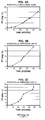
- the yield and kinetics of PT production were consistant with the expression from two TOX genes, one directed by the FHA promoter in the hybrid operon, and the other from the native operon (see Figure 3C). This experiment demonstrated that the FHAp/TOX hybrid gene may be integrated at two different loci in the genome.
- PT holotoxin is an oligomeric protein composed of six subunits encoded by five different genes.
- FHA promoter In order to determine whether the FHA promoter can direct the expression of an increased amount of protein if the protein were not as structurally complex, a strain was generated containing the FHAp/PRN hybrid gene ( B. pertussis strain 1290-4).
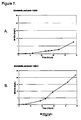
- the pertactin protein is a single polypeptide produced from a larger precursor. The yield of pertactin was increased by three-fold in fermenters and ten-fold in shake flasks when its synthesis was directed by the FHA promoter (see Figure 7B, with the normal kinetics of pertactin production in a 10-litre fermenter shown in Figure 7A).
- the overproduction of FHA can pose a problem in certain purification protocols.
- the native promoter was substituted by the TOX promoter.
- the TOXp/FHA hybrid gene was directed to the FHA locus ( B. pertussis strain 890-49) and the amount of FHA produced was significantly reduced, 50 to 100-fold (see Figure 5B, with normal kinetics of FHA production shown in Figure 5A).
- oligonucleotides were synthesized on an ABI model 380A DNA synthesizer and were purified by polycrylamide gel electrophoresis. DNA manipulations were according to Sambrook et al. (Molecular cloning: a laboratory manual, second edition, Cold Spring Harbor Laboratory, Cold Spring Harbor, N.Y. [1989]). Restriction enzymes were used according to manifacturers' specifications. The TOX , FHA , and PRN genes were cloned from a lambda Charon 35 library containing Sau3A I fragments of pertussis DNA from strain 10536. The structures of the chromosomal genes were confirmed by restriction mapping and partial or complete gene sequencing.
- Promoters of given genes were linked to the coding sequences of other genes using synthetic oligonucleotides. The correct fusions between the promoters and structural genes were confirmed by dideoxy DNA sequencing (Sanger et al., Proc. Natl. Acad. Sci., U.S.A. 74 , 5463, [1977]). Gene replacement in B. pertussis was achieved by homologous recombination following introduction of plasmid DNA into the cell by electroporation (Zealey et al., Bio/Technology, 8 , 1025, [1990]).
- the TOX -deleted strain 29-8, FHA -deleted strain 390-101, and PRN -deleted strain 1090-108-3 were all prepared in a similar manner.
- genes were integrated as non-replicating plasmids and allelic replacement achieved by growth of primary transformants under streptomycin selection (Stibitz et al., Gene, 50 , 133, [1986]).
- Chromosomal DNA was prepared as described by Yacoob and Zealey (Nucl. Acids Res. 16 , 1639, [1988]) and Southern blot analysis performed according to Sambrook et al. using Gene Screen Plus (Dupont).
- This Example illustrates the construction of the FHAp/TOX hybrid operon and its introduction into B. pertussis 10536.
- a pUC-based plasmid (S-3680-10) was constructed which contains the FHA promoter directing the expression of the native pertussis toxin structural gene and surrounded by the TOX flanking regions.
- the FHA promoter is an EcoR I/Hinf I fragment of approximately 240 bp which includes any Bvg responsive elements (the TOX operon requires 170 bp for the Bvg responsive region).
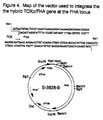
- the complimentary oligonucleotides bridging the two gene sequences were annealed as an approximately 45 bp Hinf I/Ava I cassette which includes the start codon of the DNA segment coding for the leader sequence of PT subunit S1 (see Figure 1).
- the FHAp/TOX hybrid plasmid was introduced into a TOX deleted derivative of B. pertussis 10536 (strain 29-8) by electroporation and this generated a strain (390-59) in which PT expression is directed by the FHA promoter.
- the kinetics and yield of PT expression from strain 390-59 were equivalent to those obtained with the parent strain 10536 ( Figures 3A and 3B).
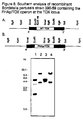
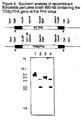
- the correct in situ integration of the FHAp/TOX hybrid operon at the TOX locus was demonstrated by restriction mapping and Southern blot analysis as shown in Figure 8.
- the TOX deleted strain 29-8 has been deposited with the ATCC (accession number 53973) and is described in the aforementioned USSN 275,376.
- This Example illustrates the construction of the FHAp/TOX hybrid operon and its introduction into an FHA -deleted strain of B. pertussis .
- a pBR322-based plasmid (S-3749-18) was constructed which contains the FHA promoter fused to the structural genes for TOX at the start codon of the DNA segment coding for the S1 subunit leader sequence, surrounded by the FHA flanking regions.
- the hybrid operon was constructed as in Example 1. A 2.5 kb Bgl II/EcoR I 5′-flanking and a 1.7 kb EcoR I/Cla I 3′-flanking regions were used to direct the hybrid operon to the FHA locus ( Figure 2).
- This FHAp/TOX hybrid plasmid was introduced into the FHA -deleted strain (390-101). This generated a strain (590-11) with two copies of TOX , one transcribed by its native promoter and one by the FHA promoter. The overall yield of PT was about twice that of strain 10536 and the kinetics of PT production were unchanged (see Figures 3A and 3B).
- the FHA -deleted strain 390-101 has been deposited with the ATCC on March 6, 1991 (accession number ATCC 55157).
- This Example illustrates the construction of the TOXp/FHA hybrid gene and its introduction into B. pertussis .
- a pBR322-based plasmid (S-3838-9) was constructed which contains an approximately 500 bp of the TOX promoter region, starting at the EcoR I site. This sequence includes the Bvg responsive region at -170 bp. The 460 bp EcoR I/Nco I fragment of the TOX promoter is bridged to the FHA structural gene through an -100 bp Nco I/Sph I oligonucleotide ( Figure 4). The remainder of the FHA B structural gene from the Sph I site to the EcoR I site completed the hybrid operon.
- strain (890-49) resulting from the chromosomal integration of the hybrid operon produced significantly reduced levels of FHA ( Figures 5A and 5B).
- This example illustrates the construction of the FHAp/PRN hybrid gene and its introduction into B. pertussis .
- the pUC-based plasmid S-3982-7 contains the FHA promoter fused at the start codon for the signal sequence of the pertactin structural gene and surrounded by PRN flanking sequences.
- the FHA promoter is an approximately 240 bp EcoR I/Hinf I fragment which is fused to the PRN structural gene through a 93 bp Hinf I/Nco I oligonucleotide ( Figure 6). The remainder of the pertactin structural gene from the Nco I site was added to complete the hybrid gene.
- Strain 1290-4 containing the FHAp/PRN hybrid produced enhanced amounts of the pertactin outer membrane protein (see Figures 7A and 7B).
- the PRN deleted strain 1090-108-3 and strain 1290-4 have been deposited with the ATCC on March 6, 1991 (accession numbers ATCC 55156 and ATCC 55155, respectively).
- This Example illustrates the preparation of B. pertussis strains containing hybrid operons and their structural analysis.
- This Example illustrates the preparation of Southern blots for the B. pertussis strain 390-59 (see Figure 8).
- Chromosomal DNA was isolated from wild-type (WT) B. pertussis 10536 (lanes 1-2) and B. pertussis 390-59 (lanes 3-4), restricted with the endonucleases Kpn I/Sma I (lanes 1 and 3) and Bgl II (lanes 2 and 4) and probed with a 4.7 kb EcoR I restriction fragment that represents the entire TOX coding sequence. Replacement of the TOX promoter by the FHA promoter resulted in the loss of a KpnI site as shown by the arrow on Figure 8. Digestion with KpnI and SmaI produced TOX -specific hybridization fragments of 3.0, 1.6 and 5.1 kb for B. pertussis 10536 and 4.8 and 5.1 for B. pertussis 390-59.
- Chromosomal DNA was isolated from wild-type (WT) B. pertussis 10536 (lanes 1-2) and B. pertussis 890-49 (lanes 3-4), restricted with the endonucleases Kpn I/Bgl II (lanes 1 and 3) and Bam HI (lanes 2 and 4) and probed with an FHA specific probe. Replacement of the FHA promoter by the TOX promoter resulted in the introduction of a Kpn I site as shown in Figure 9. Digestion with Kpn I and Bgl II produced FHA -specific hybridizaion fragments of 9 kb for B. pertussis 10536 and 6 kb for B. pertussis 890-49.
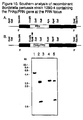
- This Example illustrates the preparation of a Southern blot for B. pertussis strain 1290-4 (see Figure 10).
- Chromosomal DNA was isolated from wild-type (WT) B. pertussis 10536 (lanes 1-2) and B. pertussis 1290-4 (lanes 3-4), restricted with the endonucleases Apa I (lanes 1 and 3) and Sal I (lanes 2 and 4) and probed with a PRN specific probe. Replacement of the PRN promoter by the FHA promoter resulted in the introduction of an ApaI site which produced PRN -specific hybridization fragments of 4.4 kb for B. pertussis 10536 and 2.5 kb for B. pertussis 1290-4 as shown in Figure 10.
- This Example illustrates the growth of B. pertussis strains and immunoasays for the quantification of specific antigens.
- Bordetella pertussis strains were grown in modified Stainer-Scholte medium containing 0.2% heptakis (2,6-0-dimethyl) ⁇ -cyclodextrin (Imaizumi et al, Infect. Immun. 41 , 1138, [1983]) either in 10 litre ChemAp fermenters, controlled for pH and dissolved oxygen, or in 10 ml culture. Culture supernatants were tested for antigen production in antigen-specific ELISAs. PT was measured in a fetuin-capture ELISA as described in Loosmore et al. (Infect. and Immun. 58 , 3653, [1990]).
- FHA was captured by a mouse monoclonal anti-FHA antibody purified from ascites fluid and the second antibody was a polyclonal rabbit IgG anti-FHA conjugated to horse-radish peroxidase.
- Pertactin was captured with a polyclonal antibody purified from a monospecific guinea pig hyperimmune serum and the second antibody was a guinea pig IgG anti-69 kDa conjugated to horse-radish peroxidase.
- PT, FHA and 69 kDa proteins purified from fermentation broths of the wild-type production strain 10536 were used as standards.
- the present invention provides a novel gene product expression method having particular application to Bordetella species. Modifications are possible within the scope of this invention.
Landscapes
- Health & Medical Sciences (AREA)
- Life Sciences & Earth Sciences (AREA)
- Chemical & Material Sciences (AREA)
- Genetics & Genomics (AREA)
- Organic Chemistry (AREA)
- General Health & Medical Sciences (AREA)
- Medicinal Chemistry (AREA)
- Engineering & Computer Science (AREA)
- Molecular Biology (AREA)
- Pharmacology & Pharmacy (AREA)
- Veterinary Medicine (AREA)
- Bioinformatics & Cheminformatics (AREA)
- Microbiology (AREA)
- Wood Science & Technology (AREA)
- Zoology (AREA)
- Biotechnology (AREA)
- Biochemistry (AREA)
- Biophysics (AREA)
- Biomedical Technology (AREA)
- Public Health (AREA)
- Animal Behavior & Ethology (AREA)
- General Engineering & Computer Science (AREA)
- Epidemiology (AREA)
- Chemical Kinetics & Catalysis (AREA)
- Physics & Mathematics (AREA)
- Immunology (AREA)
- Plant Pathology (AREA)
- Communicable Diseases (AREA)
- Oncology (AREA)
- Mycology (AREA)
- General Chemical & Material Sciences (AREA)
- Nuclear Medicine, Radiotherapy & Molecular Imaging (AREA)
- Gastroenterology & Hepatology (AREA)
- Proteomics, Peptides & Aminoacids (AREA)
- Micro-Organisms Or Cultivation Processes Thereof (AREA)
- Medicines Containing Antibodies Or Antigens For Use As Internal Diagnostic Agents (AREA)
- Preparation Of Compounds By Using Micro-Organisms (AREA)
- Peptides Or Proteins (AREA)
Claims (15)
- Souche de Bordetella caractérisée en ce qu'elle est transformée par un gène hybride de coqueluche comprenant un gène structural de la coqueluche fusionné au niveau d'un codon d'initiation ATG à un promoteur de coqueluche natif mais autologue, ledit promoteur étant le promoteur TOX et le gène structural de la coqueluche étant le gène FHA ou PRN, ledit promoteur étant le promoteur FHA et le gène structural de la coqueluche étant le gène TOX ou PRN, ou ledit promoteur étant le promoteur PRN et le gène structural de la coqueluche étant le gène TOX ou FHA.
- Souche selon la revendication 1, la souche de Bordetella transformée par ledit gène hybride de coqueluche étant Bordetella pertussis.
- Souche selon la revendication 2, ladite souche transformée produisant, par culture de ladite souche transformée, un produit génétique avec un rendement de production modifié par rapport au rendement de production obtenu avec la même souche de Bordetella contenant un gène homologue comprenant un gène structural de la coqueluche fusionné au niveau d'un codon d'initiation ATG à son propre promoteur de coqueluche natif.
- Souche de Bordetella génétiquement modifiée caractérisée en ce que le gène FHA est supprimé et en ce qu'un gène hybride FHAp/TOX est inséré dans le génome pour donner au moins deux copies du gène TOX dans le génome afin d'obtenir des niveaux d'expression des protéines codées par le gène TOX présent dans ladite souche génétiquement modifiée augmentés comparativement à la souche naturelle non modifiée.
- Souche de B. pertussis PRN - transformée par FHAp/PRN n° 1290-4, déposée auprès de l'ATCC sous le numéro d'entrée 55155, ou souche de B. pertussis TOX - transformée par FHAp/TOX (TOX) n° 390-59, construite comme décrit dans l'exemple 1, ou souche de B. pertussis FHA -transformée par FHAp/TOX (FHA) n° 590-11, construite comme décrit dans l'exemple 2, ou souche de B. pertussis FHA - transformée par TOXp/FHA (FHA) n° 890-49, construite comme décrit dans l'exemple 3.
- Souche FHA - de Bordetella pertussis n° 390-101, ayant le numéro d'entrée ATCC 55157, ou souche PRN - de Bordetella pertussis n° 1090-108-3, ayant le numéro d'entrée ATCC 55156.
- Plasmide S-3680-10 comprenant FHAp/TOX et des régions flanquantes TOX ayant la carte de restriction représentée dans la figure 1, ou plasmide S-3749-18 comprenant FHAp/TOX et des régions flanquantes FHA ayant la carte de restriction représentée dans la figure 2, ou plasmide S-3838-9 comprenant TOXp/FHA avec des régions flanquantes FHA ayant la carte de restriction représentée dans la figure 4, ou plasmide S-3982-7 comprenant FHAp/PRN avec des régions flanquantes PRN ayant la carte de restriction représentée dans la figure 6.
- Vaccin à cellules entières contre Bordetella pertussis comprenant une forme tuée d'une souche transformée de Bordetella pertussis selon une quelconque des revendications 1 à 5 et un support physiologiquement acceptable de cette souche.
- Méthode d'expression d'un produit génétique à partir d'une souche de Bordetella transformée, caractérisée en ce que (a) on transforme une souche de Bordetella par un gène hybride de la coqueluche comprenant un gène structural de la coqueluche codant pour un antigène de la coqueluche fusionné au niveau d'un codon d'initiation ATG à un promoteur de la coqueluche natif mais autologue, ledit promoteur étant le promoteur TOX et le gène structural de la coqueluche étant le gène FHA ou PRN, ledit promoteur étant le promoteur FHA et le gène structural de la coqueluche étant le gène TOX ou PRN, ou ledit promoteur étant le promoteur PRN et le gène structural de la coqueluche étant le gène TOX ou FHA et (b) on cultive ladite souche de Bordetella transformée pour obtenir l'expression dudit antigène de la coqueluche constituant ledit produit génétique à partir de ladite souche transformée.
- Méthode selon la revendication 9, ladite expression dudit produit génétique s'effectuant avec un rendement de production différent du rendement de production atteint quand la souche de Bordetella contient un gène homologue comprenant ledit gène structural et son propre promoteur natif.
- Méthode selon la revendication 9 ou 10, la transformation de ladite souche de Bordetella s'effectuant par intégration dudit gène hybride au niveau des loci appropriés dans le chromosome de la souche de Bordetella par recombinaison homologue.
- Méthode selon une quelconque des revendications 9 à 11, dans laquelle ladite souche de Bordetella est Bordetella pertussis.
- Méthode d'expression d'un produit génétique à partir d'une souche de Bordetella transformée, comprenant la culture de la souche de Bordetella de la revendication 1.
- Méthode selon la revendication 13, dans laquelle ladite souche de Bordetella est Bordetella pertussis.
- Méthode selon les revendications 13 et 14, incluant l'isolement et la purification du produit génétique.
Applications Claiming Priority (2)
| Application Number | Priority Date | Filing Date | Title |
|---|---|---|---|
| GB909008746A GB9008746D0 (en) | 1990-04-18 | 1990-04-18 | The use of autologous promoters to express gene products in bordetella |
| GB9008746 | 1990-04-18 |
Publications (3)
| Publication Number | Publication Date |
|---|---|
| EP0453216A2 EP0453216A2 (fr) | 1991-10-23 |
| EP0453216A3 EP0453216A3 (en) | 1992-04-22 |
| EP0453216B1 true EP0453216B1 (fr) | 2000-08-02 |
Family
ID=10674630
Family Applications (1)
| Application Number | Title | Priority Date | Filing Date |
|---|---|---|---|
| EP91303320A Expired - Lifetime EP0453216B1 (fr) | 1990-04-18 | 1991-04-16 | Utilisation de promoteurs autologues pour l'expression de produits de gène chez Bordetella |
Country Status (9)
| Country | Link |
|---|---|
| EP (1) | EP0453216B1 (fr) |
| JP (1) | JP3004414B2 (fr) |
| AT (1) | ATE195143T1 (fr) |
| CA (1) | CA2040548C (fr) |
| DE (1) | DE69132342T2 (fr) |
| DK (1) | DK0453216T3 (fr) |
| ES (1) | ES2150414T3 (fr) |
| GB (1) | GB9008746D0 (fr) |
| GR (1) | GR3034693T3 (fr) |
Families Citing this family (6)
| Publication number | Priority date | Publication date | Assignee | Title |
|---|---|---|---|---|
| GB9115332D0 (en) * | 1991-07-16 | 1991-08-28 | Connaught Lab | Manipulation of gene copy number in bordetella |
| FR2718750B1 (fr) | 1994-04-19 | 1996-06-14 | Pasteur Institut | Protéines recombinantes de l'hémagglutinine filamenteuse de Bordetella, notamment, B. Pertussis, production et application à la production de protéines étrangères ou de principes actifs vaccinants. |
| US5932714A (en) * | 1995-02-23 | 1999-08-03 | Connaught Laboratories Limited | Expression of gene products from genetically manipulated strains of Bordetella |
| US5998168A (en) * | 1995-06-07 | 1999-12-07 | Connaught Laboratories Limited | Expression of gene products from genetically manipulated strains of bordetella |
| AU2002301780B2 (en) * | 1997-09-19 | 2007-02-08 | Institut Pasteur | Clostridium toxin and method for preparing immunogenic compositions |
| FR2768747B1 (fr) | 1997-09-19 | 2000-12-01 | Pasteur Institut | Acides nucleiques, cellules recombinantes, et procede de preparation de compositions immunogenes |
Family Cites Families (6)
| Publication number | Priority date | Publication date | Assignee | Title |
|---|---|---|---|---|
| GB8727489D0 (en) * | 1987-11-24 | 1987-12-23 | Connaught Lab | Detoxification of pertussis toxin |
| IT1224254B (it) * | 1988-04-08 | 1990-09-26 | Sclavo Spa | Sistema di regolazione positivo inducibile utile per la produzione di proteine eterologhe |
| US5000952A (en) * | 1988-08-02 | 1991-03-19 | The Board Of Trustees Of The Leland Stanford, Jr. University | Polypeptide pertussis toxin vaccine |
| CA1341123C (fr) * | 1988-10-27 | 2000-10-17 | David A. Relman | Hemagglutinine filamenteuse de b. pertussis |
| IT1236971B (it) * | 1989-11-03 | 1993-05-07 | Eniricerche Spa | Regione promotore dei geni codificanti le subunita' piliniche fim2, fm3 e fimx di bordetella pertussis e loro impiego per l'espressione di geni che codificano una proteina di interesse. |
| ES2151463T5 (es) * | 1989-12-22 | 2012-10-29 | Merck Serono Sa | Constructos de ADN para la activación y la modificación de la expresión de genes endógenos |
-
1990
- 1990-04-18 GB GB909008746A patent/GB9008746D0/en active Pending
-
1991
- 1991-04-16 ES ES91303320T patent/ES2150414T3/es not_active Expired - Lifetime
- 1991-04-16 AT AT91303320T patent/ATE195143T1/de not_active IP Right Cessation
- 1991-04-16 EP EP91303320A patent/EP0453216B1/fr not_active Expired - Lifetime
- 1991-04-16 CA CA002040548A patent/CA2040548C/fr not_active Expired - Lifetime
- 1991-04-16 DK DK91303320T patent/DK0453216T3/da active
- 1991-04-16 DE DE69132342T patent/DE69132342T2/de not_active Expired - Lifetime
- 1991-04-18 JP JP3228212A patent/JP3004414B2/ja not_active Expired - Lifetime
-
2000
- 2000-10-27 GR GR20000402380T patent/GR3034693T3/el not_active IP Right Cessation
Also Published As
| Publication number | Publication date |
|---|---|
| CA2040548A1 (fr) | 1991-10-19 |
| DE69132342T2 (de) | 2001-02-15 |
| GR3034693T3 (en) | 2001-01-31 |
| JP3004414B2 (ja) | 2000-01-31 |
| JPH0568556A (ja) | 1993-03-23 |
| CA2040548C (fr) | 1998-06-30 |
| EP0453216A3 (en) | 1992-04-22 |
| ATE195143T1 (de) | 2000-08-15 |
| DE69132342D1 (de) | 2000-09-07 |
| ES2150414T3 (es) | 2000-12-01 |
| EP0453216A2 (fr) | 1991-10-23 |
| DK0453216T3 (da) | 2000-09-04 |
| GB9008746D0 (en) | 1990-06-13 |
Similar Documents
| Publication | Publication Date | Title |
|---|---|---|
| EP0306318B2 (fr) | Analogues de sous-unité de toxine de bordetella dérivée d'ADN recombinant | |
| EP0712442B1 (fr) | Compositions vaccinales | |
| US5358868A (en) | Genetic detoxification of pertussis toxin | |
| US5849530A (en) | Manipulation of gene copy number in bordetella | |
| US5332583A (en) | Vaccine containing genetically-detoxified pertussis holotoxin | |
| JP5966018B2 (ja) | 改変ボルデテラ・パータシス株 | |
| EP0453216B1 (fr) | Utilisation de promoteurs autologues pour l'expression de produits de gène chez Bordetella | |
| EP0275689B1 (fr) | Exotoxine modifiée de pertussis | |
| EP0617128B1 (fr) | Vaccin recombiné contre la pleuro-pneumonie porcine | |
| US5643753A (en) | Use of autologous promoters to express gene products in bordetella | |
| CN112118865A (zh) | 肺炎球菌表面蛋白a(pspa)的表达 | |
| EP0527752A1 (fr) | Expression d'une proteine heterologue dans de la levure | |
| Zealey et al. | Construction of Bordetella pertussis strains that overproduce genetically inactivated pertussis toxin | |
| US5942418A (en) | Expression of gene products from genetically manipulated strains of Bordetella | |
| EP0426059B1 (fr) | Regions du promoteur des gènes codants pour les sous-unités, piliniques fim2, fim3 et fimx de Bordetella pertussis et leur utilisation pour l'expression des gènes codants pour une protéine d'interêt | |
| Loosmore et al. | Hybrid genes over-express pertactin from Bordetella pertussis | |
| US5643747A (en) | Genes for the export of pertussis holotoxin | |
| Cockle et al. | Detoxification of pertussis toxin by site-directed mutagenesis | |
| US5998168A (en) | Expression of gene products from genetically manipulated strains of bordetella | |
| US6197548B1 (en) | Transformed Pichia expressing the pertactin antigen | |
| EP0419997A1 (fr) | Clonage du gène codant pour la sous-unité pilinique fim3 de Bordetella pertussis |
Legal Events
| Date | Code | Title | Description |
|---|---|---|---|
| PUAI | Public reference made under article 153(3) epc to a published international application that has entered the european phase |
Free format text: ORIGINAL CODE: 0009012 |
|
| AK | Designated contracting states |
Kind code of ref document: A2 Designated state(s): AT BE CH DE DK ES FR GB GR IT LI LU NL SE |
|
| PUAL | Search report despatched |
Free format text: ORIGINAL CODE: 0009013 |
|
| AK | Designated contracting states |
Kind code of ref document: A3 Designated state(s): AT BE CH DE DK ES FR GB GR IT LI LU NL SE |
|
| 17P | Request for examination filed |
Effective date: 19921005 |
|
| 17Q | First examination report despatched |
Effective date: 19960126 |
|
| GRAG | Despatch of communication of intention to grant |
Free format text: ORIGINAL CODE: EPIDOS AGRA |
|
| GRAG | Despatch of communication of intention to grant |
Free format text: ORIGINAL CODE: EPIDOS AGRA |
|
| GRAG | Despatch of communication of intention to grant |
Free format text: ORIGINAL CODE: EPIDOS AGRA |
|
| GRAH | Despatch of communication of intention to grant a patent |
Free format text: ORIGINAL CODE: EPIDOS IGRA |
|
| GRAH | Despatch of communication of intention to grant a patent |
Free format text: ORIGINAL CODE: EPIDOS IGRA |
|
| GRAA | (expected) grant |
Free format text: ORIGINAL CODE: 0009210 |
|
| AK | Designated contracting states |
Kind code of ref document: B1 Designated state(s): AT BE CH DE DK ES FR GB GR IT LI LU NL SE |
|
| REF | Corresponds to: |
Ref document number: 195143 Country of ref document: AT Date of ref document: 20000815 Kind code of ref document: T |
|
| REG | Reference to a national code |
Ref country code: CH Ref legal event code: EP |
|
| REG | Reference to a national code |
Ref country code: CH Ref legal event code: NV Representative=s name: KATZAROV S.A. |
|
| REG | Reference to a national code |
Ref country code: DK Ref legal event code: T3 |
|
| REF | Corresponds to: |
Ref document number: 69132342 Country of ref document: DE Date of ref document: 20000907 |
|
| ITF | It: translation for a ep patent filed | ||
| ET | Fr: translation filed | ||
| REG | Reference to a national code |
Ref country code: ES Ref legal event code: FG2A Ref document number: 2150414 Country of ref document: ES Kind code of ref document: T3 |
|
| RAP2 | Party data changed (patent owner data changed or rights of a patent transferred) |
Owner name: AVENTIS PASTEUR LIMITED |
|
| PLBE | No opposition filed within time limit |
Free format text: ORIGINAL CODE: 0009261 |
|
| STAA | Information on the status of an ep patent application or granted ep patent |
Free format text: STATUS: NO OPPOSITION FILED WITHIN TIME LIMIT |
|
| 26N | No opposition filed | ||
| NLT2 | Nl: modifications (of names), taken from the european patent patent bulletin |
Owner name: AVENTIS PASTEUR LIMITED |
|
| REG | Reference to a national code |
Ref country code: GB Ref legal event code: IF02 |
|
| NLT1 | Nl: modifications of names registered in virtue of documents presented to the patent office pursuant to art. 16 a, paragraph 1 |
Owner name: AVENTIS PASTEUR LIMITED |
|
| PGFP | Annual fee paid to national office [announced via postgrant information from national office to epo] |
Ref country code: GB Payment date: 20100325 Year of fee payment: 20 |
|
| PGFP | Annual fee paid to national office [announced via postgrant information from national office to epo] |
Ref country code: FR Payment date: 20100521 Year of fee payment: 20 Ref country code: ES Payment date: 20100505 Year of fee payment: 20 Ref country code: DK Payment date: 20100412 Year of fee payment: 20 Ref country code: LU Payment date: 20100506 Year of fee payment: 20 |
|
| PGFP | Annual fee paid to national office [announced via postgrant information from national office to epo] |
Ref country code: AT Payment date: 20100413 Year of fee payment: 20 Ref country code: NL Payment date: 20100402 Year of fee payment: 20 Ref country code: IT Payment date: 20100419 Year of fee payment: 20 Ref country code: DE Payment date: 20100430 Year of fee payment: 20 |
|
| PGFP | Annual fee paid to national office [announced via postgrant information from national office to epo] |
Ref country code: CH Payment date: 20100414 Year of fee payment: 20 Ref country code: BE Payment date: 20100423 Year of fee payment: 20 |
|
| PGFP | Annual fee paid to national office [announced via postgrant information from national office to epo] |
Ref country code: SE Payment date: 20100409 Year of fee payment: 20 |
|
| PGFP | Annual fee paid to national office [announced via postgrant information from national office to epo] |
Ref country code: GR Payment date: 20100317 Year of fee payment: 20 |
|
| REG | Reference to a national code |
Ref country code: DE Ref legal event code: R071 Ref document number: 69132342 Country of ref document: DE |
|
| REG | Reference to a national code |
Ref country code: NL Ref legal event code: V4 Effective date: 20110416 |
|
| REG | Reference to a national code |
Ref country code: CH Ref legal event code: PL |
|
| BE20 | Be: patent expired |
Owner name: *CONNAUGHT LABORATORIES LTD Effective date: 20110416 |
|
| REG | Reference to a national code |
Ref country code: DK Ref legal event code: EUP |
|
| REG | Reference to a national code |
Ref country code: GB Ref legal event code: PE20 Expiry date: 20110415 |
|
| PG25 | Lapsed in a contracting state [announced via postgrant information from national office to epo] |
Ref country code: NL Free format text: LAPSE BECAUSE OF EXPIRATION OF PROTECTION Effective date: 20110416 Ref country code: GB Free format text: LAPSE BECAUSE OF EXPIRATION OF PROTECTION Effective date: 20110415 |
|
| PG25 | Lapsed in a contracting state [announced via postgrant information from national office to epo] |
Ref country code: DE Free format text: LAPSE BECAUSE OF EXPIRATION OF PROTECTION Effective date: 20110416 |
|
| REG | Reference to a national code |
Ref country code: ES Ref legal event code: FD2A Effective date: 20130730 |
|
| PG25 | Lapsed in a contracting state [announced via postgrant information from national office to epo] |
Ref country code: ES Free format text: LAPSE BECAUSE OF EXPIRATION OF PROTECTION Effective date: 20110417 |