EP0453384B1 - Dampferzeuger - Google Patents
Dampferzeuger Download PDFInfo
- Publication number
- EP0453384B1 EP0453384B1 EP91460024A EP91460024A EP0453384B1 EP 0453384 B1 EP0453384 B1 EP 0453384B1 EP 91460024 A EP91460024 A EP 91460024A EP 91460024 A EP91460024 A EP 91460024A EP 0453384 B1 EP0453384 B1 EP 0453384B1
- Authority
- EP
- European Patent Office
- Prior art keywords
- vessel
- electrodes
- water
- container
- current
- Prior art date
- Legal status (The legal status is an assumption and is not a legal conclusion. Google has not performed a legal analysis and makes no representation as to the accuracy of the status listed.)
- Expired - Lifetime
Links
Images

Classifications
-
- F—MECHANICAL ENGINEERING; LIGHTING; HEATING; WEAPONS; BLASTING
- F24—HEATING; RANGES; VENTILATING
- F24F—AIR-CONDITIONING; AIR-HUMIDIFICATION; VENTILATION; USE OF AIR CURRENTS FOR SCREENING
- F24F6/00—Air-humidification, e.g. cooling by humidification
- F24F6/02—Air-humidification, e.g. cooling by humidification by evaporation of water in the air
- F24F6/025—Air-humidification, e.g. cooling by humidification by evaporation of water in the air using electrical heating means
-
- B—PERFORMING OPERATIONS; TRANSPORTING
- B64—AIRCRAFT; AVIATION; COSMONAUTICS
- B64D—EQUIPMENT FOR FITTING IN OR TO AIRCRAFT; FLIGHT SUITS; PARACHUTES; ARRANGEMENT OR MOUNTING OF POWER PLANTS OR PROPULSION TRANSMISSIONS IN AIRCRAFT
- B64D13/00—Arrangements or adaptations of air-treatment apparatus for aircraft crew or passengers, or freight space
-
- F—MECHANICAL ENGINEERING; LIGHTING; HEATING; WEAPONS; BLASTING
- F22—STEAM GENERATION
- F22B—METHODS OF STEAM GENERATION; STEAM BOILERS
- F22B1/00—Methods of steam generation characterised by form of heating method
- F22B1/28—Methods of steam generation characterised by form of heating method in boilers heated electrically
- F22B1/30—Electrode boilers
-
- F—MECHANICAL ENGINEERING; LIGHTING; HEATING; WEAPONS; BLASTING
- F24—HEATING; RANGES; VENTILATING
- F24F—AIR-CONDITIONING; AIR-HUMIDIFICATION; VENTILATION; USE OF AIR CURRENTS FOR SCREENING
- F24F6/00—Air-humidification, e.g. cooling by humidification
- F24F6/18—Air-humidification, e.g. cooling by humidification by injection of steam into the air
-
- B—PERFORMING OPERATIONS; TRANSPORTING
- B64—AIRCRAFT; AVIATION; COSMONAUTICS
- B64D—EQUIPMENT FOR FITTING IN OR TO AIRCRAFT; FLIGHT SUITS; PARACHUTES; ARRANGEMENT OR MOUNTING OF POWER PLANTS OR PROPULSION TRANSMISSIONS IN AIRCRAFT
- B64D13/00—Arrangements or adaptations of air-treatment apparatus for aircraft crew or passengers, or freight space
- B64D13/06—Arrangements or adaptations of air-treatment apparatus for aircraft crew or passengers, or freight space the air being conditioned
- B64D2013/0603—Environmental Control Systems
- B64D2013/0644—Environmental Control Systems including electric motors or generators
-
- B—PERFORMING OPERATIONS; TRANSPORTING
- B64—AIRCRAFT; AVIATION; COSMONAUTICS
- B64D—EQUIPMENT FOR FITTING IN OR TO AIRCRAFT; FLIGHT SUITS; PARACHUTES; ARRANGEMENT OR MOUNTING OF POWER PLANTS OR PROPULSION TRANSMISSIONS IN AIRCRAFT
- B64D13/00—Arrangements or adaptations of air-treatment apparatus for aircraft crew or passengers, or freight space
- B64D13/06—Arrangements or adaptations of air-treatment apparatus for aircraft crew or passengers, or freight space the air being conditioned
- B64D2013/0603—Environmental Control Systems
- B64D2013/0662—Environmental Control Systems with humidity control
-
- Y—GENERAL TAGGING OF NEW TECHNOLOGICAL DEVELOPMENTS; GENERAL TAGGING OF CROSS-SECTIONAL TECHNOLOGIES SPANNING OVER SEVERAL SECTIONS OF THE IPC; TECHNICAL SUBJECTS COVERED BY FORMER USPC CROSS-REFERENCE ART COLLECTIONS [XRACs] AND DIGESTS
- Y02—TECHNOLOGIES OR APPLICATIONS FOR MITIGATION OR ADAPTATION AGAINST CLIMATE CHANGE
- Y02T—CLIMATE CHANGE MITIGATION TECHNOLOGIES RELATED TO TRANSPORTATION
- Y02T50/00—Aeronautics or air transport
- Y02T50/50—On board measures aiming to increase energy efficiency
Definitions
- the invention relates to a steam generator container which is used in a humidifier for an air conditioning system and, more particularly, for an aircraft air conditioning system.
- Humidifiers for aircraft air conditioning systems are known and reference may be made, for example, to patent application EP-A-0 345 190.
- a humidifier for an air conditioning system which comprises a duct for circulating hot air to be humidified, a steam generator whose outlet is located at the top of a divergent cone. extending to the internal wall of the sheath, the lateral surface of the cone being provided with holes to let the hot air pass and to mix it, in a homogeneous manner, with the water vapor generated by the steam generator.
- An object of the invention is to provide a steam generator and, in particular, a container which can be used in such a humidifier.
- a container in such a steam generator of a humidifier of an air conditioning system has a water vapor outlet port supplying the humidifier, a water filling port connected to the outlet of a supply valve, the inlet of which is connected to a water supply source, a drain orifice connected to the inlet of a drain valve and at least two electrodes partially plunging into the water it contains, said container being associated with a regulation unit supplying said electrodes at a constant voltage, measuring the intensity of the current in said electrodes, controlling the maintenance of this intensity within a range by controlling the opening or closing of the supply valve, and controlling the opening of the drain valve to cause partial evacuations of water out of the container and the suppression of the supply voltage of the electrodes, these operations being followed by a command to close the supply valve, then to restore the supply voltage of the electrodes to bring said current intensity back inside the range.
- the drain orifice is at a level which is situated a little above the bottom of the container so as to always keep a small amount of water in the container.
- the drain orifice and the filling orifice of the container are combined at the base of the container and materialized by a single tube slightly protruding above the bottom of the container. It is the part of the tube projecting from the bottom and inside the container which forms with the bottom and the side walls of the container, the reserve of water allowing restarts.
- the container is removably mounted on a support which also carries the control unit and the supply and drain valves, the control unit also controlling, d on the one hand, the supply valve to fill the container when it has just been installed on the support or has just been started and, on the other hand, the drain valve to empty the container each time generator stopped and at the time of its change.
- a humidifier equipped with a steam generator which has this characteristic is particularly healthy since no water, or at least little water, stagnates in the container.
- the container comprises a level detection electrode the lower edge of which is at a level higher than the normal maximum level of the water contained in the container and to which the control unit is connected which, when 'it detects a current on this electrode, controls the cut of the current in the electrodes and the drain valve to empty the container.
- the steam generator is provided with a support movable in translation along the main axis of the container and supporting a tubular part connected to the tube of the humidifier and which is connected, so removable, on the vapor outlet orifice of the container, and connection pads which receive the connection pads of the container to which the container electrodes are connected.
- the support disconnects the studs from the container and disconnects the orifice from the container, the latter then being able to be removed.
- the container is provided with an electrode connected to the regulation unit, and which is connected, inside the container to a first terminal of a fuse, the other terminal of which is connected to one of the main electrodes, the regulating unit verifying, when installing a new container, whether the fuse is conductive or not, the regulating unit, in the first case, sending a sufficiently strong current in the fuse to melt it and, in the second case, preventing the generator from starting.
- Fig. 1 shows an air circulation duct 1 of an aircraft, this previously heated air being to be humidified.
- the cylindrical sheath 1 In the cylindrical sheath 1, is installed, in the axis of the sheath, the outlet mouth 2 of a steam generator 3, the means for fixing the mouth 2 not being shown.
- the outlet mouth 2 is connected to the steam generator 3 by a pipe 4 which passes through the wall of the sheath 1.
- the steam generator 3 receives by a pipe 5 water from the source (not shown) of the aircraft, while, by the pipe 6, it is connected to an overflow (not shown). It is connected, by a multi-wire line 7, to an electrical supply (not shown). It is also connected, by a wire 8, to a humidity detector 9 mounted, for example, in the cockpit of the aircraft, by wires 10, 11, respectively to a temperature detector 12 and to a temperature detector. humidity 13.
- the side wall of the cone 14 is pierced with holes through which the hot air passes which thus enters the cone 14 (arrow A), the air flow regime downstream of the cone 14 being turbulent so ensure a homogeneous mixture of air and water vapor emitted by the mouth 2.
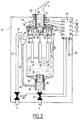
- the steam generator 3 shown in detail in FIG. 2 comprises a support 20 on which is mounted a container 21 of shape essentially cylindrical, the two bases of which are frustoconical.
- the latter respectively has orifices 22, 23 bounded by axial tubes 24, 25.
- the end inside the container 21 of the tube 25 is at a level higher than that of the bottom 26 of the container. Indeed, the lower tube 25 projects from either side of the bottom of the container 21.
- the upper tube 24 projects only towards the outside of the container 21.
- the container 21 On its upper wall 27, the container 21 is provided with three studs 28, 29, 30 equidistant to which are connected, inside the container 21, three metal electrodes 31, 32, 33. These are parallel to the longitudinal axis of the container and are immersed to a certain depth in the water contained, up to a certain level in the container.
- thin dashed lines inside the container 21 represent the water contained in the container 21.
- a fourth stud 34 also provided on the upper wall 27 is connected to a fourth metal electrode 35 parallel to the axis longitudinal of the container 21 and whose lower edge is at a level higher than the lower edges of the main electrodes 31, 32, 33.
- a fifth stud 37 is provided on the upper wall 27 of the container 21 and is connected, inside that here, to a first terminal of a fuse 38, the other terminal of which is connected to one of the electrodes 31.
- the lower tube 25 is fitted at a first end of a tube 39 which laterally receives a pipe 40, the other end of the tube 39 being connected to the inlet of an electrically controlled drain valve 41.
- the outlet of the valve 41 is connected to the pipe 6 already shown in FIG. 1. It is mounted integral with the support 20.
- the pipe 40 has a bend 42 and a linear part 43 substantially parallel to the longitudinal axis of the container 21.
- a flare 44 is provided opposite the end 45 of a second pipe comprising an elbow 46 and a connection part 47 at the outlet of an electrically controlled filling valve 48.
- the valve 48 has its inlet connected to the pipe 5 already shown in FIG. 1.
- the free end 45 of the second pipe 46, 47 is advantageously provided with a small orifice so that the water which escapes from it falls drop by drop into the flare 43 of the first pipe 40.
- This arrangement is intended to electrically isolate the water contained in the container 21 from the electrical mass of the valve 48.
- the upper tube 24 of the container 21 is fitted onto a tubular part 49 of a support 50.
- This consists of a plate 51 integral with the tubular part 49 and on which are provided five female studs 52 to 56 which come respectively fit on the stud 37, on the three male studs 28, 29, 30, and on the male stud 34 of the container 21.
- the tubular part 49 is designed to slide axially in a socket 57 secured to the support 20.
- the tubular part 49 is provided with a rack 58 meshing with a toothed wheel 59 whose axis is rotatably mounted on the support 20.
- the tubular part 49 receives, in its upper part, the pipe 4 already shown in Fig. 1 and which connects the steam generator 3 to the humidifier.
- a regulation unit 60 comprising three outputs 61, 62, 63 respectively connected to the three female pads 53, 54, 55 (themselves connected to the electrodes 31, 32, 33), an input / output 64 connected to the pad 52, an input 65 to which the fourth pad 56 is connected, two outputs 66, 67 respectively connected to the control inputs of the valves 48, 41, an input 68 connected to a temperature probe 69 mounted on the support 20 , a multi-wire input 70 receiving, by the multi-wire line 7 already shown in FIG. 1, the supply voltages necessary for the proper functioning of the generator, and three inputs 71, 72, 73 respectively connected to lines 8, 10, 11 already shown in FIG. 1. Recall that these lines 8, 10, 11 are respectively connected to a hygrometer 9 advantageously mounted in the cockpit of the aircraft, a temperature probe 12 and a humidity probe 13 both mounted in the sheath 1.
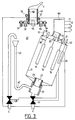
- the toothed wheel 59 When the toothed wheel 59 is rotated, the latter drives upward, by means of the rack 58, the support 50.
- the female studs 52 to 56 separate from the male studs 28, 29, 30, 34, 37 of the container 21 and its tubular part 49 emerges from the upper tube 24 of container 21.
- the tubular part 39 can pivot by a certain angle around an axis perpendicular to the plane of the support 20 and cause, in this movement, the container 21. The latter can then be extracted liter if its lower tube 25 is separated from the tubular part 39.
- the regulation unit 60 is advantageously controlled by a microprocessor, so that the operation of the steam generator of the invention is linked to the control programs of this microprocessor.
- the regulation unit 60 receives the signals from the two temperature probes 12, 69, a humidity probe 13 and a hygrometer 9 and controls, as a function of the signals received and their processing by the microprocessor, the electrodes 31, 32, 33 and the valves 41, 48.
- the operating principle is as follows: the three electrodes 31, 32, 33 are supplied with three-phase alternating voltage of substantially constant value and are immersed, to a certain depth, in the water contained in the container 21.
- the latter does not is only partially filled with water.
- the value of the current flowing in the electrodes 31, 32, 33 is proportional to the height of water which wets them and to the conductivity of the water in the container. This increases with the concentration of mineral elements.
- the water in the container heats up by Joule effect and the quantity of water which evaporates is directly proportional to the value of the current which circulates in the electrodes 31, 32, 33.
- the water vapor generated is extracted from the container through line 4 and joins the small base of the cone 14 in the sheath 1 to mix with the air which circulates there and humidify it.
- the water level in the container 21 drops and the electrodes 31, 32, 33 bathe in a lesser depth, which has the effect of reducing the intensity of the current passing between them.
- this decrease in the level of water is accompanied by an increase in the concentration of water in mineral elements.
- the drop in level is however preponderant over the increase in concentration and the electrodes 31, 32, 33 are then the seat of a lesser amount of vapor.
- the regulation unit 60 When the regulation unit 60 detects a drop in intensity electrode current of a certain amount relative to a given current setpoint (quantity, for example, of the order of 10%), it controls the opening of the valve 48.
- the end 45 of the pipe 46 provides, drop by drop, water in the pipe 40, which adds, by the principle of communicating vessels (the upper end of the flare 44 being at a level higher than the level of the water in the container), water in the container 21.
- the water level therein increases and the intensity of the electrode current increases proportionally.
- the regulating unit 60 controls the closing of the valve 48.
- the intensity of the current which circulates in the electrodes 31, 32, 33 therefore remains within a current range centered on the value of the current setpoint.
- the control unit therefore performs cycles during which water is introduced into the container to readjust the drops in current obtained during evaporation.
- the unit 60 commands the opening of the valve 41 to evacuate a certain amount. of water which is also either predetermined or determined by the regulating unit itself according to this history.
- the opening of the valve 41 is carried out simultaneously with the cutting of the current on the electrodes, this in order to avoid leaks of current by the draining water downstream of the valve 41.
- the value of the signal supplied by the hygrometer 9 is compared with a set value of the humidity level and the result of this comparison is used to establish, in the regulation unit 60 itself, of the current setpoint in the electrodes. It is, as we have seen above, from this current setpoint that the regulating unit 60 maintains the current between electrodes within a certain current range. If the humidity level in the cockpit is lower than the humidity setpoint, the control unit 60 increases the current setpoint in proportion to the difference between these rates. Likewise, if the rate is greater than the humidity setpoint, the regulating unit 60 establishes an electrode current setpoint reduced in proportion to the difference in rates.
- the temperature sensors one near the container, the other in the sheath, can have, according to a simplified operation of the invention (operation linked to the programs of the microprocessor of unit 60), a safety role. If the temperature is too high or if it changes too suddenly, the current in the electrodes is interrupted.
- the tubular part projects on either side of the bottom of the container.
- the role of the projecting part inside the container is to be able to constitute a reserve of water loaded with mineral elements.
- the control unit checks the conductive state of the fuse by injecting, for example, through the stud. If the fuse is conductive, the regulating unit sends a sufficiently strong current in the fuse to melt it, then it initializes a clock and, at the end of a period which is defined as the lifetime of the container, triggers an alarm (not shown). On the other hand, if it is not conductive, it means that a container has been installed which has already been used and the control unit signals this, for example, by an indicator installed in the cabin. The purpose of this function is to limit the clogging of the electrodes 31, 32, 33.
Landscapes
- Engineering & Computer Science (AREA)
- Mechanical Engineering (AREA)
- General Engineering & Computer Science (AREA)
- Combustion & Propulsion (AREA)
- Chemical & Material Sciences (AREA)
- Aviation & Aerospace Engineering (AREA)
- Sustainable Development (AREA)
- Sustainable Energy (AREA)
- Physics & Mathematics (AREA)
- Thermal Sciences (AREA)
- Life Sciences & Earth Sciences (AREA)
- Health & Medical Sciences (AREA)
- Pulmonology (AREA)
- General Health & Medical Sciences (AREA)
- Air Humidification (AREA)
- Organic Low-Molecular-Weight Compounds And Preparation Thereof (AREA)
Claims (6)
- Behälter für Dampferzeuger für Luftbefeuchter von Klimaanlagen, umfassend eine Austrittsöffnung (22) zur Versorgung des Luftbefeuchters, eine Wassereinfüllöffnung (23), die mit dem Austritt eines Versorgungsventils (48) verbunden ist, dessen Einlauf mit einer Wasserversorgungsquelle verbunden ist, eine Ablaßöffnung (23), die mit dem Einlauf eines Ablaßventils (41) verbunden ist, und mindestens zwei Elektroden (31, 32, 33), die teilweise in das Wasser tauchen, das er enthält, wobei der genannte Behälter mit einer Regeleinheit (60) verbunden ist, die die Elektroden (31, 32, 33) bei einer konstanten Spannung mit Strom versorgt, die Stromstärke in den Elektroden (31, 32, 33) mißt, die Aufrechterhaltung dieser Stärke innerhalb einer Spanne regelt, indem sie die Öffnung oder Schließung des Ventils (48) steuert, und die Öffnung des Ablaßventils (41) steuert, um einen Teil des Wassers aus dem Behälter abzulassen, und die Unterdrückung der Versorgungsspannung der Elektroden (31, 32, 33) veranlaßt, wobei auf diese Vorgänge ein Befehl zur Schließung des Ablaßventils (41), ein Befehl zur Öffnung des Versorgungsventils (48) und dann zur Wiederherstellung der Versorgungsspannung der Elektroden (31, 32, 33) folgt, um die genannte Stromstärke wieder auf einen Wert in der Spanne zu bringen, dadurch gekennzeichnet, daß sich die Ablaßöffnung (23) an einer Stelle befindet, die sich etwas oberhalb des Bodens (26) des Behälters (21) befindet, um im Behälter (21) immer eine geringe Wassermenge zu behalten.
- Behälter nach Patentanspruch 1, dadurch gekennzeichnet, daß die Ablaßöffnung (23) und die Einfüllöffnung (23) im unteren Teil des Behälters zusammenfallen und aus einem einzigen Rohr (25) bestehen, das ein wenig aus dem Boden (26) des Behälters hervorragt.
- Behälter nach Patentanspruch 1 oder 2, dadurch gekennzeichnet, daß er abnehmbar auf einen Träger (20) montiert ist, der außerdem die Regeleinheit (60) und die Versorgungs- (48) und Ablaßventile (41) trägt.
- Behälter nach einem der vorangehenden Patentansprüche 1 bis 3, dadurch gekennzeichnet, daß er mit einer Elektrode (35) zur Feststellung des Wasserstandes versehen ist, deren unterer Rand (36) sich in einer Höhe befindet, die über dem normalen Maximalwasserstand des Behälters (21) liegt und mit der die Regeleinheit (60) verbunden ist, die die Unterdrückung der Versorgungsspannung der Elektroden (31, 32, 33) und das Ablaßventil (41) zur Leerung des Behälters veranlaßt, wenn sie in dieser Elektrode (35) einen Strom feststellt.
- Behälter nach einem der vorangehenden Patentansprüche 1 bis 4, dadurch gekennzeichnet, daß er mit einem Träger (50) versehen ist, der längs der Hauptachse des Behälters verschiebbar ist und einen röhrenförmigen Teil (49) trägt, der mit dem Luftbefeuchter verbunden ist und sich lösbar mit der Austrittsöffnung (24) verbindet, und Anschlußsteckstellen (53, 54, 55), die die Anschlußsteckstellen (28, 29, 30) aufnehmen, an die die Elektroden (31, 32, 33) angeschlossen sind.
- Behälter nach einem der vorangehenden Patentansprüche 1 bis 5, dadurch gekennzeichnet, daß er mit einer Steckstelle (37) versehen ist, die mit der Regeleinheit (60) verbunden ist und die im Inneren des Behälters mit einem ersten Anschluß einer Sicherung (38) verbunden ist, deren anderer Anschluß mit einer der Elektroden (31, 32, 33) verbunden ist, wobei die Regeleinheit (60) zum Zeitpunkt der Installation eines neuen Behälters feststellt, ob die Sicherung (38) leitfähig ist oder nicht, wobei die Regeleinheit (60) im ersten Fall einen ausreichend starken Strom in die Sicherung (38) sendet, um sie zu schmelzen, und im zweiten Fall die Inbetriebnahme des Behälters verhindert.
Applications Claiming Priority (2)
| Application Number | Priority Date | Filing Date | Title |
|---|---|---|---|
| FR9005099A FR2661233B1 (fr) | 1990-04-18 | 1990-04-18 | Generateur de vapeur. |
| FR9005099 | 1990-04-18 |
Publications (2)
| Publication Number | Publication Date |
|---|---|
| EP0453384A1 EP0453384A1 (de) | 1991-10-23 |
| EP0453384B1 true EP0453384B1 (de) | 1995-07-12 |
Family
ID=9395958
Family Applications (1)
| Application Number | Title | Priority Date | Filing Date |
|---|---|---|---|
| EP91460024A Expired - Lifetime EP0453384B1 (de) | 1990-04-18 | 1991-04-18 | Dampferzeuger |
Country Status (6)
| Country | Link |
|---|---|
| US (1) | US5359692A (de) |
| EP (1) | EP0453384B1 (de) |
| AT (1) | ATE125026T1 (de) |
| DE (1) | DE69111129T2 (de) |
| ES (1) | ES2075398T3 (de) |
| FR (1) | FR2661233B1 (de) |
Families Citing this family (15)
| Publication number | Priority date | Publication date | Assignee | Title |
|---|---|---|---|---|
| DE102004028037B4 (de) * | 2004-06-09 | 2009-04-02 | Airbus Deutschland Gmbh | Verdampferanordnung für ein Klimasystem eines Flugzeugs |
| DE502005007261D1 (de) | 2004-06-09 | 2009-06-25 | Airbus Gmbh | Verdampferanordnung für ein Klimasystem eines Flugzeugs und ihr Verfahren zum Betreiben |
| EP2037190B1 (de) * | 2007-09-13 | 2014-07-16 | Ludwig Michelbach | Dampfbefeuchter |
| KR100913918B1 (ko) * | 2009-06-10 | 2009-09-02 | 유춘희 | 컴팩트형 전자전극봉식 가습기 |
| FR3013802B1 (fr) | 2013-11-26 | 2015-12-18 | Snecma | Generateur de vapeur ameliore par dissipation de chaleur d'une pile a combustible |
| CN105180330B (zh) * | 2015-10-26 | 2018-06-29 | 青岛海信电子设备股份有限公司 | 一种自循环加湿器 |
| US10989423B2 (en) * | 2016-01-29 | 2021-04-27 | Condair Group Ag | Steam humidifier |
| US11085656B2 (en) * | 2017-02-24 | 2021-08-10 | Ademco Inc. | Configurable electrode humidifier allowing for various injects |
| US12066202B2 (en) | 2017-07-25 | 2024-08-20 | Condair Ltd. | Field replaceable fluid element methods and systems for fluidic processors |
| US11428357B2 (en) | 2017-07-25 | 2022-08-30 | Condair Ltd. | Field replaceable fluid element methods and systems for fluidic processors |
| CA3056504C (en) * | 2017-07-25 | 2021-05-11 | Condair Ltd. | Field replaceable fluid element methods and systems for fluidic processors |
| US12313293B2 (en) * | 2018-03-16 | 2025-05-27 | Lg Electronics Inc. | Indoor unit for an air conditioner |
| KR102053125B1 (ko) | 2018-03-16 | 2020-01-08 | 엘지전자 주식회사 | 공기조화기의 실내기 |
| CN111043657A (zh) * | 2019-12-31 | 2020-04-21 | 无锡卫生高等职业技术学校(无锡市医药技工学校、江苏联合职业技术学院无锡卫生分院) | 一种可净化加湿的空调 |
| US11492269B2 (en) | 2020-08-18 | 2022-11-08 | Saudi Arabian Oil Company | Incinerator system for on-site completion fluid removal and methods of using the same |
Family Cites Families (14)
| Publication number | Priority date | Publication date | Assignee | Title |
|---|---|---|---|---|
| CH389208A (de) * | 1962-01-04 | 1965-03-15 | Badertscher Hans | Einrichtung zum Befeuchten von Luft |
| CH563000A5 (de) * | 1973-03-09 | 1975-06-13 | Plascon Ag | |
| US4146775A (en) * | 1976-09-16 | 1979-03-27 | Armstrong Machine Works | Automatic control system for an electrode-type air humidifier |
| US4382173A (en) * | 1978-06-26 | 1983-05-03 | Howard Leicester Michael | System for automatically regulating water conductivity in an electrode-type humidifier evaporator |
| US4262191A (en) * | 1979-03-28 | 1981-04-14 | Wehr Corporation | Digital electronic steam humidifier control |
| US4347430A (en) * | 1980-02-14 | 1982-08-31 | Michael Howard-Leicester | Vapor generator with cycling monitoring of conductivity |
| EP0069155A1 (de) * | 1981-06-29 | 1983-01-12 | Condair AG | Verfahren zum Betreiben eines Wasserdampferzeugers |
| HU183598B (en) * | 1981-10-02 | 1984-05-28 | Fotoelektronik Isz | Control device for automatic washing the evaporating cylinder of damp air blowers |
| GB2154896B (en) * | 1984-03-02 | 1987-08-12 | Atlas Air Australia | Air humidifying apparatus |
| US4705936A (en) * | 1985-01-17 | 1987-11-10 | Masco Corporation | Electronically controlled electric steam humidifier |
| US4675505A (en) * | 1986-01-21 | 1987-06-23 | Armstrong International, Inc. | Stepped output steam humidifier |
| US4792660A (en) * | 1986-03-21 | 1988-12-20 | Carnes Company, Inc. | Humidifier controller having automatic over-current correcting means |
| CH672015A5 (en) * | 1986-11-19 | 1989-10-13 | Nordmann Engineering Ag | Generating steam to moisture air - monitoring current to check conductivity of water and regulating top-up and drainage |
| ES2034737T3 (es) * | 1988-06-03 | 1993-04-01 | Industrielle Du Ponant Sa | Humectador para sistemas de acondicionamiento de aire. |
-
1990
- 1990-04-18 FR FR9005099A patent/FR2661233B1/fr not_active Expired - Lifetime
-
1991
- 1991-04-17 US US07/686,700 patent/US5359692A/en not_active Expired - Lifetime
- 1991-04-18 EP EP91460024A patent/EP0453384B1/de not_active Expired - Lifetime
- 1991-04-18 DE DE69111129T patent/DE69111129T2/de not_active Expired - Lifetime
- 1991-04-18 ES ES91460024T patent/ES2075398T3/es not_active Expired - Lifetime
- 1991-04-18 AT AT91460024T patent/ATE125026T1/de not_active IP Right Cessation
Also Published As
| Publication number | Publication date |
|---|---|
| DE69111129T2 (de) | 1996-01-25 |
| FR2661233B1 (fr) | 1993-10-29 |
| ES2075398T3 (es) | 1995-10-01 |
| DE69111129D1 (de) | 1995-08-17 |
| FR2661233A1 (fr) | 1991-10-25 |
| ATE125026T1 (de) | 1995-07-15 |
| US5359692A (en) | 1994-10-25 |
| EP0453384A1 (de) | 1991-10-23 |
Similar Documents
| Publication | Publication Date | Title |
|---|---|---|
| EP0453384B1 (de) | Dampferzeuger | |
| EP0453385B1 (de) | Dampferzeuger | |
| BE898116A (fr) | Dispositif de commande de chauffage à température variable pour un appareil thérapeutique à inhalation. | |
| FR2673541A1 (fr) | Dispositif de dosage pour un narcotique liquide traversant un recipient intermediaire. | |
| EP0843039B1 (de) | Dampferzeuger | |
| FR2458260A1 (fr) | Appareil de cuisson a la vapeur destine a la preparation d'aliments | |
| EP2247897B1 (de) | Anlage zur produktion von haushalts-warmwasser | |
| EP0406092A1 (de) | Vorrichtung zum Füllen von Behältern mit abgewogenen Mengen | |
| WO2015177434A1 (fr) | Dispositif et procédé de production et de distribution de liquide en ébullition et appareil de préparation de boisson équipé d'un tel dispositif | |
| FR2599162A1 (fr) | Systeme de regulation de temperature d'eau chaude pour des chaudieres a gaz murales a melange instantane | |
| EP0894714B1 (de) | Luftbefeuchtungsverfahren und Anlage für Flugzeugkabinen | |
| FR2680393A1 (fr) | Procede et dispositif de commande d'une installation de pompage. | |
| EP1681967B1 (de) | Verfahren und dampfgargerät mit einer verbesserten vorrichtung zur wasserzuführung | |
| EP1065431A1 (de) | Druckregelvorrichtung für einen kryogenen Behälter und entsprechende Anlage zum Zuführen eines Fluids | |
| EP1098138A1 (de) | Vorrichtung zur Regelung eines Erzeugers von heissen Fluid in flüssigem oder gasförmigem Zustand | |
| EP1591734B1 (de) | Verfahren zum Regulieren der Feuchtigkeit eines elektrischen Haushaltsweinkellers | |
| WO2006035171A1 (fr) | Procede de protection electrique d'un appareil electromenager | |
| EP0674919B1 (de) | Vorrichtung zum Einspritzen und Dosieren eines Produktes in eine Wasserleitung einer Feuerlöschvorrichtung | |
| FR2583141A1 (fr) | Generateur de vapeur a resistance electrique pour appareil electromenager | |
| FR2707734A1 (fr) | Procédé de production en continu de vapeur d'eau circulante, générateur de vapeur et installation en faisant application. | |
| FR2551187A1 (fr) | Procede et installation pour la production d'eau chaude sanitaire a partir d'une installation generatrice de chaleur a bruleur | |
| FR2735673A1 (fr) | Autocuiseur electrique a pression de vapeur regulee par pilotage de son chauffage | |
| FR2679631A1 (fr) | Dispositif de production d'eau chaude sanitaire a thermosiphon integre. | |
| FR2681137A1 (fr) | Dispositif pour mesurer et regler la concentration en air d'une enceinte. | |
| FR3003339A1 (fr) | Procede pour le recyclage et le chauffage d'eau sanitaire au moyen d'un dispositif de recirculation et de chauffage |
Legal Events
| Date | Code | Title | Description |
|---|---|---|---|
| PUAI | Public reference made under article 153(3) epc to a published international application that has entered the european phase |
Free format text: ORIGINAL CODE: 0009012 |
|
| AK | Designated contracting states |
Kind code of ref document: A1 Designated state(s): AT BE CH DE DK ES GB GR IT LI LU NL SE |
|
| RIN1 | Information on inventor provided before grant (corrected) |
Inventor name: ALIX, GUY-PAUL Inventor name: MANCHEC, JEAN-MARC Inventor name: TRANVOEZ, JEAN-MICHEL Inventor name: KOHLER, MARC |
|
| 17P | Request for examination filed |
Effective date: 19920210 |
|
| 17Q | First examination report despatched |
Effective date: 19930416 |
|
| GRAA | (expected) grant |
Free format text: ORIGINAL CODE: 0009210 |
|
| ITF | It: translation for a ep patent filed | ||
| AK | Designated contracting states |
Kind code of ref document: B1 Designated state(s): AT BE CH DE DK ES GB GR IT LI LU NL SE |
|
| PG25 | Lapsed in a contracting state [announced via postgrant information from national office to epo] |
Ref country code: NL Free format text: LAPSE BECAUSE OF FAILURE TO SUBMIT A TRANSLATION OF THE DESCRIPTION OR TO PAY THE FEE WITHIN THE PRESCRIBED TIME-LIMIT Effective date: 19950712 Ref country code: DK Effective date: 19950712 Ref country code: AT Effective date: 19950712 Ref country code: GR Free format text: LAPSE BECAUSE OF FAILURE TO SUBMIT A TRANSLATION OF THE DESCRIPTION OR TO PAY THE FEE WITHIN THE PRESCRIBED TIME-LIMIT Effective date: 19950712 |
|
| REF | Corresponds to: |
Ref document number: 125026 Country of ref document: AT Date of ref document: 19950715 Kind code of ref document: T |
|
| GBT | Gb: translation of ep patent filed (gb section 77(6)(a)/1977) |
Effective date: 19950719 |
|
| REF | Corresponds to: |
Ref document number: 69111129 Country of ref document: DE Date of ref document: 19950817 |
|
| REG | Reference to a national code |
Ref country code: ES Ref legal event code: FG2A Ref document number: 2075398 Country of ref document: ES Kind code of ref document: T3 |
|
| PG25 | Lapsed in a contracting state [announced via postgrant information from national office to epo] |
Ref country code: SE Effective date: 19951012 |
|
| NLV1 | Nl: lapsed or annulled due to failure to fulfill the requirements of art. 29p and 29m of the patents act | ||
| PG25 | Lapsed in a contracting state [announced via postgrant information from national office to epo] |
Ref country code: BE Effective date: 19960430 Ref country code: LU Free format text: LAPSE BECAUSE OF NON-PAYMENT OF DUE FEES Effective date: 19960430 |
|
| PLBE | No opposition filed within time limit |
Free format text: ORIGINAL CODE: 0009261 |
|
| STAA | Information on the status of an ep patent application or granted ep patent |
Free format text: STATUS: NO OPPOSITION FILED WITHIN TIME LIMIT |
|
| 26N | No opposition filed | ||
| BERE | Be: lapsed |
Owner name: S.A. INDUSTRIELLE DU PONANT Effective date: 19960430 |
|
| REG | Reference to a national code |
Ref country code: GB Ref legal event code: IF02 |
|
| REG | Reference to a national code |
Ref country code: CH Ref legal event code: NV Representative=s name: AVV. FRANCO PAGANI |
|
| PGFP | Annual fee paid to national office [announced via postgrant information from national office to epo] |
Ref country code: GB Payment date: 20100324 Year of fee payment: 20 |
|
| PGFP | Annual fee paid to national office [announced via postgrant information from national office to epo] |
Ref country code: ES Payment date: 20100423 Year of fee payment: 20 |
|
| PGFP | Annual fee paid to national office [announced via postgrant information from national office to epo] |
Ref country code: IT Payment date: 20100419 Year of fee payment: 20 Ref country code: DE Payment date: 20100511 Year of fee payment: 20 |
|
| PGFP | Annual fee paid to national office [announced via postgrant information from national office to epo] |
Ref country code: CH Payment date: 20100512 Year of fee payment: 20 |
|
| REG | Reference to a national code |
Ref country code: CH Ref legal event code: PFA Owner name: INDUSTRIELLE DU PONANT SA Free format text: INDUSTRIELLE DU PONANT SA#Z.I. SAINT-ELOI#LANDERNEAU (FR) -TRANSFER TO- INDUSTRIELLE DU PONANT SA#Z.I. SAINT-ELOI#LANDERNEAU (FR) |
|
| REG | Reference to a national code |
Ref country code: DE Ref legal event code: R071 Ref document number: 69111129 Country of ref document: DE |
|
| REG | Reference to a national code |
Ref country code: CH Ref legal event code: PL |
|
| REG | Reference to a national code |
Ref country code: GB Ref legal event code: PE20 Expiry date: 20110417 |
|
| PG25 | Lapsed in a contracting state [announced via postgrant information from national office to epo] |
Ref country code: GB Free format text: LAPSE BECAUSE OF EXPIRATION OF PROTECTION Effective date: 20110417 |
|
| REG | Reference to a national code |
Ref country code: ES Ref legal event code: FD2A Effective date: 20120110 |
|
| PG25 | Lapsed in a contracting state [announced via postgrant information from national office to epo] |
Ref country code: ES Free format text: LAPSE BECAUSE OF EXPIRATION OF PROTECTION Effective date: 20110419 |
|
| PG25 | Lapsed in a contracting state [announced via postgrant information from national office to epo] |
Ref country code: DE Free format text: LAPSE BECAUSE OF EXPIRATION OF PROTECTION Effective date: 20110418 |