EP0453396A1 - Lackzusammensetzungen - Google Patents
Lackzusammensetzungen Download PDFInfo
- Publication number
- EP0453396A1 EP0453396A1 EP91810192A EP91810192A EP0453396A1 EP 0453396 A1 EP0453396 A1 EP 0453396A1 EP 91810192 A EP91810192 A EP 91810192A EP 91810192 A EP91810192 A EP 91810192A EP 0453396 A1 EP0453396 A1 EP 0453396A1
- Authority
- EP
- European Patent Office
- Prior art keywords
- carbon atoms
- alkyl
- hydrogen
- formula
- hydroxyl
- Prior art date
- Legal status (The legal status is an assumption and is not a legal conclusion. Google has not performed a legal analysis and makes no representation as to the accuracy of the status listed.)
- Granted
Links
- 0 C*1=CC*C1 Chemical compound C*1=CC*C1 0.000 description 7
Classifications
-
- C—CHEMISTRY; METALLURGY
- C09—DYES; PAINTS; POLISHES; NATURAL RESINS; ADHESIVES; COMPOSITIONS NOT OTHERWISE PROVIDED FOR; APPLICATIONS OF MATERIALS NOT OTHERWISE PROVIDED FOR
- C09K—MATERIALS FOR MISCELLANEOUS APPLICATIONS, NOT PROVIDED FOR ELSEWHERE
- C09K3/00—Materials not provided for elsewhere
-
- C—CHEMISTRY; METALLURGY
- C08—ORGANIC MACROMOLECULAR COMPOUNDS; THEIR PREPARATION OR CHEMICAL WORKING-UP; COMPOSITIONS BASED THEREON
- C08K—Use of inorganic or non-macromolecular organic substances as compounding ingredients
- C08K5/00—Use of organic ingredients
- C08K5/16—Nitrogen-containing compounds
- C08K5/34—Heterocyclic compounds having nitrogen in the ring
- C08K5/3467—Heterocyclic compounds having nitrogen in the ring having more than two nitrogen atoms in the ring
- C08K5/3477—Six-membered rings
- C08K5/3492—Triazines
-
- C—CHEMISTRY; METALLURGY
- C08—ORGANIC MACROMOLECULAR COMPOUNDS; THEIR PREPARATION OR CHEMICAL WORKING-UP; COMPOSITIONS BASED THEREON
- C08K—Use of inorganic or non-macromolecular organic substances as compounding ingredients
- C08K5/00—Use of organic ingredients
- C08K5/04—Oxygen-containing compounds
- C08K5/13—Phenols; Phenolates
- C08K5/132—Phenols containing keto groups, e.g. benzophenones
-
- C—CHEMISTRY; METALLURGY
- C08—ORGANIC MACROMOLECULAR COMPOUNDS; THEIR PREPARATION OR CHEMICAL WORKING-UP; COMPOSITIONS BASED THEREON
- C08K—Use of inorganic or non-macromolecular organic substances as compounding ingredients
- C08K5/00—Use of organic ingredients
- C08K5/16—Nitrogen-containing compounds
- C08K5/20—Carboxylic acid amides
-
- C—CHEMISTRY; METALLURGY
- C08—ORGANIC MACROMOLECULAR COMPOUNDS; THEIR PREPARATION OR CHEMICAL WORKING-UP; COMPOSITIONS BASED THEREON
- C08K—Use of inorganic or non-macromolecular organic substances as compounding ingredients
- C08K5/00—Use of organic ingredients
- C08K5/16—Nitrogen-containing compounds
- C08K5/34—Heterocyclic compounds having nitrogen in the ring
- C08K5/3467—Heterocyclic compounds having nitrogen in the ring having more than two nitrogen atoms in the ring
- C08K5/3472—Five-membered rings
- C08K5/3475—Five-membered rings condensed with carbocyclic rings
-
- C—CHEMISTRY; METALLURGY
- C09—DYES; PAINTS; POLISHES; NATURAL RESINS; ADHESIVES; COMPOSITIONS NOT OTHERWISE PROVIDED FOR; APPLICATIONS OF MATERIALS NOT OTHERWISE PROVIDED FOR
- C09D—COATING COMPOSITIONS, e.g. PAINTS, VARNISHES OR LACQUERS; FILLING PASTES; CHEMICAL PAINT OR INK REMOVERS; INKS; CORRECTING FLUIDS; WOODSTAINS; PASTES OR SOLIDS FOR COLOURING OR PRINTING; USE OF MATERIALS THEREFOR
- C09D7/00—Features of coating compositions, not provided for in group C09D5/00; Processes for incorporating ingredients in coating compositions
- C09D7/40—Additives
- C09D7/48—Stabilisers against degradation by oxygen, light or heat
-
- C—CHEMISTRY; METALLURGY
- C08—ORGANIC MACROMOLECULAR COMPOUNDS; THEIR PREPARATION OR CHEMICAL WORKING-UP; COMPOSITIONS BASED THEREON
- C08K—Use of inorganic or non-macromolecular organic substances as compounding ingredients
- C08K5/00—Use of organic ingredients
- C08K5/0008—Organic ingredients according to more than one of the "one dot" groups of C08K5/01 - C08K5/59
- C08K5/005—Stabilisers against oxidation, heat, light, ozone
-
- C—CHEMISTRY; METALLURGY
- C08—ORGANIC MACROMOLECULAR COMPOUNDS; THEIR PREPARATION OR CHEMICAL WORKING-UP; COMPOSITIONS BASED THEREON
- C08K—Use of inorganic or non-macromolecular organic substances as compounding ingredients
- C08K5/00—Use of organic ingredients
- C08K5/04—Oxygen-containing compounds
- C08K5/07—Aldehydes; Ketones
Definitions
- the present invention relates to new coating compositions which contain mixtures of different UV absorbers.
- the present invention thus relates to coating compositions which, as UV absorbers, contain a mixture of at least one 2-hydroxyphenylbenztriazole and at least one 2-hydroxyphenyltriazine, and to coating compositions which contain a mixture of at least one 2-hydroxyphenyltriazine and at least one 2-hydroxybenzophenone and / or oxalanilide contain.
- R 1 can denote hydrogen or alkyl having 1 to 24 carbon atoms, such as methyl, ethyl, propyl butyl, hexyl, octyl, nonyl, dodecyl, tetradecyl, hexadecyl, octadecyl, nonadecyl and eicosyl and corresponding branched isomers .
- R 1 can also contain cycloalkyl with 5 to 8 carbon atoms, for example cyclopentyl, hexyl and octyl, or else a radical of the formula be in which R 4 and R 5 independently of one another are alkyl with 1 to 5 carbon atoms, in particular methyl, or R 4 with the C n H 2n + 1-m radical forms a cycloalkyl radical with 5 to 12 carbon atoms, such as cyclohexyl, Cyclooctyl and cyclodecyl.
- M represents a radical of the formula -COOR 6 , in which R 6 in addition to hydrogen also denotes alkyl having 1 to 12 carbon atoms or alkoxyalkyl each having 1 to 20 carbon atoms in the alkyl and alkoxy part.
- Possible alkyl radicals R e are those listed for R 1 .
- Suitable alkoxyalkyl groups are, for example, -C 2 H 4 OC 2 H 5 , -C 2 H 4 OC 8 H 17 and -C 4 H 8 OC 4 H 9 .
- R 6 means, for example, benzyl, cumyl, a-methylbenzyl or phenylbutyl.
- R 2 can also denote alkyl having 1 to 18 carbon atoms. Examples of such alkyl radicals are given in the definitions of R 1 .
- R 2 can also mean phenylalkyl having 1 to 4 carbon atoms in the alkyl part, for example benzyl, a-methylbenzyl and cumyl.
- At least one of R 1 and R 2 must be different from hydrogen.
- R 3 is also alkyl or alkoxy each having 1 to 4 carbon atoms, for example methyl, butyl, methoxy and ethoxy, and also -COOR e .
- T is hydrogen or alkyl having 1 to 6 carbon atoms, such as methyl and butyl
- T 1 is, in addition to hydrogen or chlorine, alkyl or alkoxy each having 1 to 4 carbon atoms, for example methyl, methoxy and butoxy
- T 2 is chlorine or a radical of the formula -OT 3 or-NT 4 T 5
- T 3 is hydrogen or alkyl with 1 to 18 carbon atoms (see definition of R 1 ).
- These alkyl radicals can be substituted by 1 to 3 hydroxyl groups or by a radical OCOT 6 .
- T 3 can denote alkyl having 3 to 18 carbon atoms (cf.
- R 1 which is interrupted one or more times by -O- or-NT 6 - and is optionally substituted by hydroxyl or -OCOT 6 .
- T 3 is, for example, cyclopentyl. -hexyl or -octyl.
- T 3 can also mean alkenyl having 2 to 18 carbon atoms. Suitable alkenyl radicals are derived from the alkyl radicals listed in the definitions of R 1 . These alkenyl radicals can be substituted by hydroxyl.
- T 3 as phenylalkyl is, for example, benzyl, phenylethyl, cumyl, a-methylbenzyl or benzyl.
- T 3 can be a radical of the formula CH 2 CH (OH) -T 7 or
- T 4 and T 5 can , in addition to hydrogen, independently of one another denote alkyl having 1 to 18 carbon atoms or alkyl having 3 to 18 carbon atoms which is interrupted one or more times by -O- or -NT e .
- T 4 and T 5 can mean cycloalkyl having 5 to 12 carbon atoms, such as, for example, cyclopentyl, hexyl and octyl.
- alkenyl groups T 4 and T 5 can be found in the explanations of T 3 .
- T 4 and T 5 are, for example, benzyl or phenylbutyl.
- these substituents can also mean hydroxyalkyl having 1 to 3 carbon atoms.
- T 2 represents a divalent radical of the formula or -OT 9 -O-.
- T 6 means in addition to hydrogen, alkyl, cycloalkyl, alkenyl, aryl or phenylalkyl, examples of such radicals having already been given above.
- T 7 can be phenyl or hydroxyphenyl and —CH 2 OT 8 , where T 8 can be one of the alkyl, alkenyl, cycloalkyl, aryl or phenylalkyl radicals listed.
- the divalent radical T 9 can mean alkylene with 2 to 8 carbon atoms, it being also possible for such radicals to be branched. This also applies to the T 9 alkenylene and alkinyfenes.
- T 9 can also be a radical of the formula -CH 2 CH (OH) CH 2 OT 11 OCH 2 CH (OH) CH 2 - or -CH 2 -C (CH 2 OH) 2 -CH 2 -.
- T 10 is a divalent radical and, in addition to cyclohexylene, also means alkylene with 2 to 20 carbon atoms, which may or may not be interrupted one or more times by -O-.
- Suitable alkylene radicals are derived from the alkyl radicals mentioned in the definitions of R 1 .
- T 11 also means an alkylene radical. It contains 2 to 8 carbon atoms or, if it is interrupted one or more times by -O-, 4 to 10 carbon atoms. T 11 is also 1,3- or 1,4-cyclohexylene or 1,3- or 1,4-phenylene.
- T 6 and T 10 together with the two nitrogen atoms can also represent a piperazine ring
- alkyl, alkoxy, phenylalkyl, alkylene, alkenylene, alkoxyalkyl and cycloalkyl radicals as well as alkylthio, oxaalkylene or azoalkylene radicals in the compounds of the formulas (2), (3) and (4) can be found in the above statements will.
- UV absorbers of the formulas (1a), (1b), (2), (3) and (4) are known per se and, for example, with their preparation in EP-A-323.408, EP-A-57.160, US Patent Application Serial No. 07 / 446,369 (prior: December 5, 1989), US-A-4,619,956, DE-A-31 35 810 and GB-A-1,336,391.
- Preferred substituent meanings and individual compounds can be found in the documents mentioned. They can be incorporated into lacquers or lacquer compositions using customary methods known per se.
- the proportions are 0.01 to 5, in particular 0.02 to 3.0% by weight (of all) UV absorbers used, based on the coating composition, the amounts of UV absorber to be selected depending on the nature of the Paint composition and the requirements for its stability may depend.
- the individual UV absorber components can be added individually or as a mixture to the corresponding coating compositions.
- the two-layer lacquers can be added to the lower layer and / or upper layer.
- the top layer preferably contains the UV absorber mixtures.
- the usual further additives such as antioxidants, corrosion inhibitors and other light stabilizers can also be added to the coating compositions without the protective effect of the UV absorber mixtures used according to the invention being impaired thereby.
- the paint compositions according to the invention can comprise any type of paint, e.g. pigmented or unpigmented paints or metallic effects. They can contain an organic solvent or be solvent-free or be aqueous lacquers.
- the paints can also be radiation-curable paints.
- the binder consists of monomeric or oligomeric compounds which contain ethylenic double bonds and are converted into a crosslinked high-molecular form by irradiation with actinic light or with electron beams. This is usually a mixture of such compounds.
- lacquers can be applied as single-layer or two-layer lacquers, the stabilizers according to the invention preferably being added to the unpigmented top layer.
- the lacquers can be applied to the substrates (metal, plastic, wood, etc.) by the usual methods, for example by brushing, spraying, pouring, dipping or electrophoresis.
- the compositions according to the invention are particularly preferably paints for motor vehicles. Suitable paint systems and binders are e.g. in U.S.-A-4,314,933, 4,344,876, 4,426,471, 4,426,472 and 4,429,077.
- the present invention also relates to lacquer films which can be obtained by application to a surface and curing.
- coating compositions are preferred in which the molar ratio of 2-hydroxyphenylbenztriazole to 2-hydroxyphenyltriazine, 2-hydroxybenzophenone and / or oxalanilide in the UV absorber mixture is 3: 1 to 1: 3, and in particular 2: 1 to 1: 2
- compositions contain a mixture of at least one 2-hydroxyphenylbenztriazole and at least one 2-hydroxyphenyltriazine as UV absorber. Also of interest are those compositions which contain at least one 2-hydroxyphenyltriazine and at least one 2-hydroxybenzophenone and / or oxalanilide.
- UV absorber mixtures those UV absorbers of the formula (1a) in which the substituent R or R 2 is ortho or para to the hydroxyl group have proven particularly useful
- UV absorbers of the formula (1a) in which R 1 is hydrogen, alkyl with 1 to 20 carbon atoms, R 2 is hydrogen, alkyl with 1 to 18 carbon atoms, phenylalkyl with 1 to 4 carbon atoms in the alkyl part, and R 3 is hydrogen, Is chlorine or alkyl with 1 to 4 carbon atoms, especially for those UV absorbers from this group in which R is in the ortho position to the hydroxyl group and is hydrogen, alkyl with 4 to 12 carbon atoms, R 2 is in the para position to the hydroxyl group and Alkyl with 1 to 6 carbon atoms or cumyf and R 3 is hydrogen or chlorine, and in particular for those UV absorbers of the form) (1a), in which R 1 is alkyl with 8 to 12 carbon atoms, R 2 alkyl with 4 to 6 carbon atoms and R 3 is hydrogen.
- Suitable UV absorbers of the formula (1 b) are characterized in that T alkyl with 1 to 6 carbon atoms, Ti hydrogen, chlorine or alkyl with 1 to 4 carbon atoms, n 1 or 2 and T 2 , if n is 1, one of the Residues of the formula -OT 3 or and when n is 2, a radical of the formula -OT 9 -O- or is, in which T 3 is hydrogen, alkyl having 1 to 18 carbon atoms or interrupted one or more times by -O- nes is alkyl with 3 to 18 carbon atoms, T 4 and T 5 are independently hydrogen, alkyl with 1 to 18 carbon atoms, alkenyl with 3 to 8 carbon atoms or hydroxyalkyl with 1 to 3 carbon atoms, T e is hydrogen or alkyl with 1 to 6 carbon atoms is, and Tg and T 10 is alkylene with 2 to 8 carbon atoms, alkenylene with 4 to 8 carbon atoms or alkylene with 4 to 18 carbon
- T 3 is alkyl having 1 to 12 carbon atoms or a radical of the formula
- the substituents Y 1 are hydrogen, alkyl having 1 to 12 carbon atoms or halogen, Y 2 , if u is 1, alkyl having 1 to 18 carbon atoms, by hydroxyl, alkoxy alkyl having 1 to 18 carbon atoms, -COOY B , -CONY 9 Y 10 , and / or -OCOY 11 substituted alkyl having 1 to 12 carbon atoms, glycidyl or phenylalkyl having 1 to 4 carbon atoms in the alkyl part, or Y 2 if u is 2 , Alkylene with 2 to 16 carbon atoms, alkenylene with 4 to 12 carbon atoms, xylylene or interrupted by one or more -O- andl or substituted by hydroxyl-substituted alkylene with 3 to 20 carbon atoms, where the substituents Y 8 to Y 11 have the meanings given above to
- those UV absorbers are suitable in which the substituents Y 1 are hydrogen, alkyl having 1 to 4 carbon atoms or chlorine, Y 2 , if u is 1, unsubstituted or by hydroxyl, alkoxy having 1 to 18 carbon atoms, -COOY 8 , -CONY 9 Y 10 , and / or-OCOY 11 is substituted alkyl with 1 to 4 carbon atoms, glycidyl or benzyl, or Y 2 , if u is 2, alkylene with 6 to 12 carbon atoms, butenylene, xylylene or by one or more - O- interrupted and / or hydroxyl-substituted alkylene with 3 to 20 carbon atoms, where Y 8 is alkyl with 4 to 12 carbon atoms, alkenylene with 12 to 18 carbon atoms or with one or more -0- interrupted and / or with hydroxyl-substituted alkyl 6 to 20 carbon atoms
- Another group of compounds of the formula (2) which is particularly suitable for use in paint compositions is characterized in that u is 1 and r 2, Y 1 is alkyl having 1 to 4 carbon atoms and Y 2 alkyl is having 1 to 12 carbon atoms or by hydroxyl, alkoxy with 1 to 18 carbon atoms, -CO-OY 8 and / or-OCOY 11 substituted alkyl having 1 to 12 carbon atoms, wherein Y 8 is alkyl with 1 to 18 carbon atoms, alkenyl with 3 to 18 carbon atoms or interrupted by one or more oxygen atoms and / or is hydroxyl-substituted alkyl having 3 to 20 carbon atoms and Y 11 alkenyl is 2 to 18 carbon atoms.
- Y 2 is alkyl having 1 to 8 carbon atoms or alkyl having 1 to 4 carbon atoms substituted by hydroxyl, alkoxy with 12 to 15 carbon atoms, -COOY 8 and / or-OCOY 11 , in which Y 8 is alkyl with 8 to 12 Carbon atoms, alkenyl having 12 to 18 carbon atoms or alkyl interrupted by an oxygen atom and hydroxyl substituted alkyl having 5 to 10 carbon atoms and Y 11 alkenyl being 2 to 8 carbon atoms, and in particular those compounds in which Y 1 is methyl and Y 2 is an octyl radical or by hydroxyl, Alkoxy having 13 or 15 carbon atoms, -COOY a andl or -OCOY 11 is substituted alkyl having 1 to 3 carbon atoms, in which Y 8 is a decyl or octadecenyl radical or hydroxyl-substituted
- UV absorbers of the formula (3) in which v and w are independently 1 or 2 and the substituents Z are independently hydrogen, halogen or alkoxy having 1 to 12 carbon atoms, and also such UV absorbers of the formula (4) wherein x and y are independently 1 or 2 and the substituents L are independently hydrogen or alkyl or alkoxy each having 1 to 12 carbon atoms.
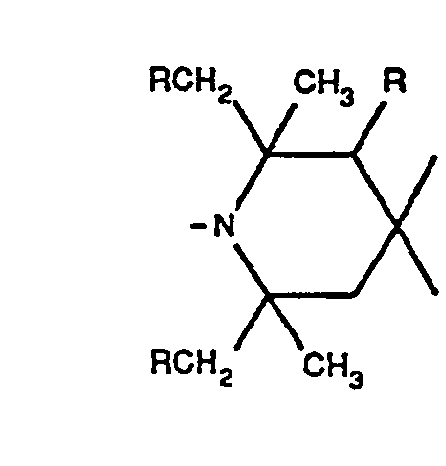
- At least one further light stabilizer from the class of the hindered amines in particular one, in combination with the UV absorber mixtures according to the invention
- Compound containing at least one radical of the formula contains, wherein R is hydrogen or preferably methyl.
- polyalkylpiperidines in particular 2,2,6,6-tetramethylpiperidine.
- These compounds preferably bear one or two polar substituents or a polar spiro ring system in the 4-position of the piperidine ring.
- These compounds can be low molecular weight or oligomeric or polymeric compounds.
- n is a number from 1 to 4, preferably 1 or 2
- R is hydrogen or methyl
- R 21 is hydrogen, oxyl, hydroxyl, C 1 -C 12 alkyl, C 3 -C 8 alkenyl, C 3 -C 8 Alkynyl, C 7 -C 12 aralkyl, C 1 -C 18 alkoxy, C 5 -C 8 cycloalkoxy, C 7 -C 9 phenylalkoxy, C 1 -C 8 alkanoyl, C 3 -C s -Alkenoyl, C 1 -C 18 -alkanoyloxy, benzyloxy, glycidyl or a group -CH 2 CH (OH) -Z, where Z is hydrogen, methyl or phenyl, where R 21 is preferably H, C 1 -C 4 - Is alkyl, allyl, benzyl, acetyl or acryloyl and R 22 , if
- any substituents are C 1 -C 12 -alkyl, they represent, for example, methyl, ethyl, n-propyl, n-butyl, sec-butyl, tert-butyl, n-hexyl, n-octyl, 2-ethyl-hexyl, n-nonyl, n-decyl, n-undecyl or n-dodecyl.
- R 21 or R 22 can represent, for example, the groups mentioned above and, for example, n-tridecyl, n-tetradecyl, n-hexadecyl or n-octadecyl.
- R 21 is C 3 -C 8 alkenyl, it can be, for example, 1-propenyl, allyl, methallyl, 2-butenyl, 2-pentenyl, 2-hexenyl, 2-octenyl, 4-tert-butyl-2 -butenyl act.
- R 21 as C 3 -C 8 alkynyl is preferably propargyl.
- R 21 is especially phenethyl and especially benzyl.
- R 21 is as C 1 -C 8 alkanoyl, for example formyl, propionyl, butyryl, octanoyl, but preferably acetyl and as C 3 -C 5 alkenoyl, in particular acryloyl.
- R 22 is a monovalent radical of a carboxylic acid, it is, for example, acetic, caproic, stearic, acrylic, methacrylic, benzoic or ⁇ - (3,5-di-tert-butyl-4- hydroxyphenylpropionic acid residue.
- R 22 is a divalent radical of a dicarboxylic acid, it represents, for example, malonic, succinic, glutaric, adipic, suberic, sebacic, maleic, itaconic, phthalic, dibutylmalonic, dibenzylmalonic, butyl ( 3,5-di-tert-butyl-4-hydroxybenzyl) malonic acid or bicycloheptenedicarboxylic acid residue.
- R 22 represents a trivalent residue of a tricarboxylic acid, it means for example a trimellitic acid, citric acid or nitrilotriacetic acid residue.
- R 22 represents a tetravalent residue of a tetracarboxylic acid, it means, for example, the tetravalent residue of butane-1,2,3,4-tetracarboxylic acid or of pyromellitic acid.
- R 22 is a divalent radical of a dicarbamic acid, it is, for example, a hexamethylene dicarbamic acid or a 2,4-tolylene dicarbamic acid radical.
- Preferred compounds of the formula III are those in which R is hydrogen, R 21 is hydrogen or methyl, n is 1 and R 22 is C 1 -C 18 alkyl or n 2 and R22 is the diacyl radical of an aliphatic dicarboxylic acid with 4-12 C- Atoms.
- any substituents are C 5 -G 7 cycloalkyl, they are in particular cyclohexyl.
- R 23 is in particular phenylethyl or especially benzyl.
- R 23 is in particular 2-hydroxyethyl or 2-hydroxypropyl.
- R 23 is as C 2 -C 18 alkanoyl, for example propionyl, butyryl, octanoyl, dodecanoyl, hexadecanoyl, octadecanoyl, but preferably acetyl, and as C 3 -C 5 alkenoyl in particular acryloyl.
- R 24 is C 2 -C 8 alkenyl, then it is, for example, allyl, methallyl, 2-butenyl, 2-pentenyl, 2-hexenyl or 2-octenyl.
- R 24 as a C 1 -C 4 -alkyl substituted by a hydroxy, cyano, alkoxycarbonyl or carbamide group can, for example, 2-hydroxyethyl, 2-hydroxypropyl, 2-cyanoethyl, methoxycarbonylmethyl, 2-ethoxycarbonylethyl, 2-aminocarbonylpropyl or 2- ( Be dimethylaminocarbonyl) ethyl.
- Any C 2 -C 12 alkylene substituents are, for example, ethylene, propylene, 2,2-dimethylpropylene, tetramethylene, hexamethylene, octamethylene, decamethylene or dodecamethylene.
- Any C 8 -C 15 arylene substituents are, for example, o-, m- or p-phenytes, 1,4-naphthylene or 4,4'-diphenylene.
- C 8 -C 12 cycloalkylene is, in particular, cyclohexylene.
- R and R 21 have the meaning given under (a) and R 25 , if n is 1, C 2 -C 8 alkylene or hydroxyalkylene or C 4 -C 12 acyloxyalkylene, if n is 2, the group is (-CH 2 ) 2 C (CH 2 -) 2 .
- R 25 is C 2 -C 8 -alkylene or -hydroxyalkylene, it represents, for example, ethylene, 1-methyl-ethylene, propylene, 2-ethyl-propylene or 2-ethyl-2-hydroxymethylpropylene.
- R 25 means, for example, 2-ethyl-2-acetoxymethyl-propylene.
- R 28 is hydrogen, C 1 -C 12 alkyl, allyl, benzyl, glycidyl or C 2 -C 8 alkoxyalkyl and R 27 if n is 1, hydrogen, C 1 -C 12 alkyl, C 3 -C 5 alkenyl, C 7 -C 9 aralkyl, C 5 -C 7 cycloalkyl, C r C 4 hydroxyalkyl, C 2 - C 8 alkoxyalkyl, C 8 -C 10 aryl, glycidyl or a group of the formula - (CH 2 ) p -COO-Q or of the formula - (CH 2 ) pO-CO-Q, where p is 1 or 2 and QC is 1 -C 4 -alkyl or phenyl when n is 2 is, C 2 -C 12 alkylene, C 4 -C 12 alkenylene
- any substituents are C 1 -C 12 -alkyl, they represent, for example, methyl, ethyl, n-propyl, n-butyl, sec-butyl, terL-butyl, n-hexyl, n-octyl, 2-ethyl-hexyl, n-nonyl, n-decyl, n-undecyl or n-dodecyl.
- C 1 -C 18 alkyl can represent, for example, the groups mentioned above and, for example, n-tridecyl, n-tetradecyl, n-hexadecyl or n-octadecyl.
- any substituents are C 2 -C 6 -alkoxyalkyl, they are, for example, methoxymethyl, ethoxymethyl, propoxymethyl, tert-butoxymethyl, ethoxyethyl, ethoxypropyl, n-butoxyethyl, tert-butoxyethyl, isopropoxyethyl or propoxypropyl.
- R 27 represents C 3 -C 5 alkenyl, it means, for example, 1-propenyl, allyl, methallyl, 2-butenyl or 2-pentenyl.
- R 27 , T and T 2 are in particular phenethyl or especially benzyl. If T and T 2 form a cycloalkane ring together with the C atom, this can be, for example, a cyclopentane, cyclohexane, cyclooctane or cyclododecane ring.
- R 27 is C 2 -C 4 -hydroxyalkyl, it is, for example, 2-hydroxyethyl, 2-hydroxypropyl, 2-hydroxybutyl or 4-hydroxybutyl.
- R 17 , T and T 2 are in particular phenyl, ⁇ - or ⁇ -naphthyl, which are optionally substituted by halogen or C 1 -C 4 alkyl.
- R 27 is C 2 -C 12 alkylene, it is, for example, ethylene, propylene, 2,2-dimethylpropylene, tetramethylene, hexamethylene, octamethylene, decamethylene or dodecamethylene.
- R 27 means in particular 2-butenylene, 2-pentenylene or 3-hexenylene.
- R 27 is C 6 -C 12 arylene, it is, for example, o-, m- or p-phenylene, 1,4-naphthylene or 4,4'-diphenylene.
- Z ' is C 2 -C 12 -alkanoyl, it is, for example, propionyl, butyryl, octanoyl, dodecanoyl, but preferably acetyl.
- C 2 -C 10 alkylene, C 6 -C 15 arylene or C 6 -C 12 cycloalkylene has the meaning given under (b).
- polyalkylpiperidine compounds of this class are the following compounds:
- n is the number 1 or 2 and R 28 is a group of the formula means in which R and R 21 have the meaning given under (a), EO- or -NR 21 -, AC 2 -C 6 alkylene or - (CH 2 ) 3 -O- and x is the number 0 or 1
- any substituents are C 1 -C 12 -alkyl, they are, for example, methyl, ethyl, n-propyl, n-butyl, sec-butyl, tert-butyt, n-hexyl, n-octyl, 2-ethylhexyl, n -Nonyl, n-decyl, n-undecyl or n-dodecyl.
- substituents are C 1 -C 4 -hydroxyalkyl, they are, for example, 2-hydroxyethyl, 2-hydroxypropyl, 3-hydroxypropyl, 2-hydroxybutyl or 4-hydroxybutyl.
- AC 2 -C 6 alkylene is, it represents, for example, ethylene, propylene, 2,2-dimethylpropylene, tetramethylene or hexamethylene.
- R 31 and R 32 together represent C 4 -C 5 alkylene or oxaalkylene, this means, for example, tetramethylene, pentamethylene or 3-oxapentamethylene.
- polyalkylpiperidine compounds of this class are the compounds of the following formulas:
- oligomers or polymeric compounds whose recurring structural unit contains a 2,2,6,6-tetraalkylpiperidine radical of the formula 111, in particular polyesters, polyethers, polyamides, polyamines, polyurethanes, polyureas, polyaminotriazines, poly (meth) acrylates, poly (meth ) acrylamides and their copolymers which contain such radicals.
- 2,2,6,6-polyalkylpiperidine light stabilizers of this class are the compounds of the following formulas, where m is a number from 2 to about 200.
- classes a), d), e) and f) are particularly suitable, especially those
- Example 1 The UV absorbers of the formulas and are tested in a two-layer metallic paint.
- the UV absorbers are incorporated into 10 g of xylene and, in the amounts added in the table below (% of pure UV absorber, in each case based on solids constituents of the lacquer), a clear lacquer of 22nd added the following composition:
- the clearcoat is diluted with a mixture of xylene / butanol / butylglycol acetate (13: 6: 1) for sprayability and sprayed onto a prepared substrate (coil coat-coated aluminum sheet, automotive filler, silver metallic base coat) and baked at 130 ° C for 30 minutes.
- a prepared substrate coated aluminum sheet, automotive filler, silver metallic base coat
- the result is a dry film thickness of 40-50 ⁇ m clear coat.
- the samples are subjected to accelerated weathering.
- the samples stabilized with the UV absorber mixtures have a higher resistance to weathering than samples which contain only a single UV absorber in the same amount.
- Example 2 Example 1 is repeated with the compounds of the formulas (100) and (101), and the corresponding samples are also subjected to a twelve-month outdoor exposure in Florida. Table 2 shows the results obtained:
- Example 3 A 2K PUR clear coat is made from the following components:
- UV absorbers to be tested are added to this clear lacquer in the stated amounts, dissolved in 10 ml of xylene.
- the sprayability is diluted with xylene, the finished paint is applied to a prepared substrate (coil coat-coated aluminum sheet, automotive filler, silver metallic basecoat) and baked at 90 ° C for 30 minutes. This results in a dry film thickness of approx. 40-50 ⁇ m.
- the samples are weathered in a xenon weatherometer (Atlas; CAM 159; KFA method) and the 20 ° gloss (DIN 67530) is measured.
- the compounds of the formulas (103), (104) and (105) have the following structure with polyethylene glycol with a molecular weight of 300.
- Example 4 Samples according to Example 3 with compounds of the formulas (103), (106) and (107) as UV absorbers are subjected to UVCON weathering (Atlas, UVB-313, 8 hours UV exposure at 70 ° C., 4 hours Subjected to condensation at 50 ° C). The 20 ° gloss (DIN 67530) is then determined after 1600 hours of weathering.
- Example 5 Example 4 is repeated with the compounds of the formulas (108) and (109) as UV absorbers.
- Example 6 The coating system according to Example 2 is applied with the compounds of the formulas (105), (106) and (109) as UV absorber to Uniprime (PPG; ED 3150) coated aluminum sheets and weathered as follows: QUV (Q -Panel; UVA-340; 8 hours UV exposure at 70 ° C; 4 hours condensation at 50 ° C). The change in the yellowness index (AYI, ASTM D 1925) and the color difference AE (DIN 6174; weathered / weathered) are then determined
- Example 7 A Kladack of the following composition is produced:
- UV absorbers to be tested of the formulas (103) and (110), dissolved in 10 g of xylene, are incorporated into this clear lacquer.
- the clear coat With a mixture of xylene, butanol and butyl glycol acetate (weight ratio 13: 6: 1), the clear coat is diluted to be sprayable and applied to a glass plate. After baking (130 ° C, 30 minutes) a dry film thickness of about 20 ⁇ m results.
- UVCON weathering Alignlas; UVB-313; 8 hours of UV radiation at 70 ° C, 4 hours of condensation at 50 ° C
- the loss of UV absorber is determined by means of UV spectroscopy
- the compound of formula (110) has the following structure:
- Example 8 The coating system according to Example 7 with the compounds of the formulas (103) and (110) as UV absorber is applied to Uniprime (PPG; ED 3150) coated aluminum sheets and exposed to UVCON weathering as described in Example 7 the cross-cut is carried out on the samples in accordance with DIN 53151 followed by a tape tear test. The cross-cut evaluation is also carried out according to DIN 53151.
Landscapes
- Chemical & Material Sciences (AREA)
- Organic Chemistry (AREA)
- Chemical Kinetics & Catalysis (AREA)
- Medicinal Chemistry (AREA)
- Polymers & Plastics (AREA)
- Health & Medical Sciences (AREA)
- Materials Engineering (AREA)
- Engineering & Computer Science (AREA)
- Life Sciences & Earth Sciences (AREA)
- Wood Science & Technology (AREA)
- Paints Or Removers (AREA)
- Compositions Of Macromolecular Compounds (AREA)
- Cosmetics (AREA)
Abstract
Description
- Die vorliegende Erfindung betrifft neue Lackzusammensetzungen, welche Mischungen verschiedener UV-Absorber enthalten.
- Die Einflüsse von Luftsauerstoff, Feuchtigkeit und vor allem UV-Licht führen in Lacken zu einem Abbau des Polymermaterials. Dies äussert sich z.B. in Rissbildungen, Glanzverlust, Farbtonänderungen, Delaminierung und Blasenbildung. Bekanntlich kann man solche Vorgänge in Lacken durch Verwendung geeigneter Stabilisatoren verzögern.
- Es wurde nun gefunden, dass auch gewisse Kombinationen von UV-Absorbem unterschiedlicher chemischer Struktur in der Lage sind, die Bildung der genannten Schäden in Lacken weitgehend verhindern zu können.
- Gegenstand der vorliegenden Erfindung sind somit Lackzusammensetzungen, die als UV-Absorber eine Mischung aus mindestens einem 2-Hydroxyphenylbenztriazol und mindestens einem 2-Hydroxyphenyltriazin enthalten sowie Lackzusammensetzungen, die eine Mischung aus mindestens einem 2-Hydroxyphenyltriazin und mindestens einem 2-Hydroxybenzophenon und/oder Oxalanilid enthalten.
- Bevorzugte Lackzusammensetzungen sind dadurch gekennzeichnet, dass das 2-Hydroxyphenylbenztriazol der Formel


- in den Verbindungen der Formel (1a)
- R1 Wasserstoff, Alkyl mit 1 bis 24 Kohlenstoffatomen, Phenylalkyl mit 1 bis 4 Kohlenstoffatomen im Alkylteil, Cycloalkyl mit 5 bis 8 Kohlenstoffatomen oder ein Rest der Formel

- R2 Wasserstoff, Halogen, Alkyl mit 1 bis 18 Kohlenstoffatomen, Phenylalkyl mit 1 bis 4 Kohlenstoffatomen im Alkylteil, und
- R3 Wasserstoff, Chlor, Alkyl oder Alkoxy mit je 1 bis 4 Kohlenstoffatomen oder-COOR6, worin Re die angegebene Bedeutung hat, bedeutet, wobei mindestens einer der Reste R1 und R2 von Wasserstoff verschieden ist,
- in den Verbindungen der Formel (1b) T Wasserstoff oder Alkyl mit 1 bis 6 Kohlenstoffatomen, T1 Wasserstoff, Chlor oder Alkyl oder Alkoxy mit je 1 bis 4 Kohlenstoffatomen, n 1 oder 2 und T2, wenn n 1 ist, Chlor oder ein Rest der Formel -OT3 oder


- in den Verbindungen der Formel (2)
- u 1 oder 2 ist, und r eine ganze Zahl von 1 bis 3 bedeutet, die Substituenten Y, unabhängig voneinander Wasserstoff, Hydroxyl, Halogenmethyl, Alkyl mit 1 bis 12 Kohlenstoffatomen, Alkoxy mit 1 bis 18 Kohlenstoffatomen oder Halogen bedeuten, Y2, wenn u 1 ist, Alkyl mit 1 bis 18 Kohlenstoffatomen, durch Hydroxyl, Alkoxy mit 1 bis 18 Kohlenstoffatomen, Halogen, unsubstituiertes oder durch Alkyl oder Alkoxy mit je 1 bis 18 Kohlenstoffatomen oder Halogen substituiertes Phenoxy, durch -COOH, -COOY8, -CONH2, -CONHY9, - CONY9Y10, -NH2, -NHY9, -NY9Y10, -NHCOY11, -CN und/oder -OCOY11 substituiertes Alkyl mit 1 bis 12 Kohlenstoffatomen, durch ein oder mehrere Sauerstofftatome unterbrochenes und gegebenenfalls durch Hydroxyl oder Alkoxy mit 1 bis 12 Kohlenstoffatomen substituiertes Alkyl mit4 bis 20 Kohlenstoffatomen, Alkenyl mit 3 bis 6 Kohlenstoffatomen, Glycidyl, gegebenenfalls durch Hydroxyl, Alkyl mit 1 bis 4 Kohlenstoffatomen undloder -OCOY11 substituiertes Cyclohexyl, unsubstituiertes oder durch Hydroxyl, Chlor und/oder Methyl substituiertes Phenylalkyl mit 1 bis 5 Kohlenstoffatomen im Alkylteil, -COY12 oder-SO2Y13 bedeutet, oder Y2 wenn u 2 ist, Alkylen mit 2 bis 16 Kohlenstoffatomen, Alkenylen mit 4 bis 12 Kohlenstoffatomen, Xylylen, durch ein oder mehrere -O- unterbrochenes und/oder durch Hydroxyl substituiertes Alkylen mit 3 bis 20 Kohlenstoffatomen, -CH2CH(OH)CH2-O-Y15-OCH2CH(OH)CH2 -CO-Y16-CO-, -CO-NH-Y17-NH-CO- oder -(CH2)m-CO2-Y18-OCO-(CH2)m- ist, worin m 1, 2 oder 3 ist, Y8 Alkyl mit 1 bis 18 Kohlenstoffatomen, Alkenyl mit 3 bis 18 Kohlenstoffatomen, durch ein oder mehrere Sauerstoff- oder Schwefelatome oder -NT6- unterbrochenes und/oder durch Hydroxyl substituiertes Alkyl mit 3 bis 20 Kohlenstoffatomen, durch -P(O)(OY14)2, -NY9Y10 oder - OCOY11 und/oder Hydroxyl substituiertes Alkyl mit 1 bis 4 Kohlenstoffatomen, Alkenyl mit 3 bis 18 Kohlenstoffatomen, Glycidyl oder Phenylalkyl mit 1 bis 5 Kohlenstoffatomen im Alkylteil bedeutet, Yg und Y10 unabhängig voneinander Alkyl mit 1 bis 12 Kohlenstoffatomen, Alkoxyalkyl mit3 bis 12 Kohlenstoffatomen, Dia-Ikylaminoalkyl mit 4 bis 16 Kohlenstoffatomen oder Cyclohexyl mit 5 bis 12 Kohlenstoffatomen bedeuten, oder Yg und Y10 zusammen Alkylen, Oxaalkylen- oder Azaalkylen mit je 3 bis 9 Kohlenstoffatomen bedeuten, Y11 Alkyl mit 1 bis 18 Kohlenstoffatomen, Alkenyl mit 2 bis 18 Kohlenstoffatomen oder Phenyl, Y12 Alkyl mit 1 bis 18 Kohlenstoffatomen, Alkenyl mit2 bis 18 Kohlenstoffatomen, Phenyl, Alkoxy mit 1 bis 12 Kohlenstoffatomen, Phenoxy, Alkylamino mit 1 bis 12 Kohlenstoffatomen oder Phenylamino, Y13 Alkyl mit 1 bis 18 Kohlenstoffatomen, Phenyl, Alkylphenyl mit 1 bis 8 Kohlenstoffatomen im Alkylrest, Y14 Alkyl mit 1 bis 12 Kohlenstoffatomen oder Phenyl, Y15 Alkylen mit 2 bis 10 Kohlenstoffatomen, Phenylen oder eine Gruppe -Phenylen-M-Phenylen-, worin M -O-, -S-, -SO2-, -CH2- oder -C(CH3)2- ist, Y16 Alkylen, Oxaalkylen oder Thiaalkylen mit je 2 bis 10 Kohlenstoffatomen, Phenylen oder Alkenylen mit 2 bis 6 Kohlenstoffatomen, Y17 Alkylen mit 2 bis 10 Kohlenstoff atomen, Phenylen, Alkylphenylen mit 1 bis 11 Kohlenstoffatomen im Alkylteil und Y18 Alkylen mit 2 bis 10 Kohlenstoffatomen oder durch Sauerstoff ein- oder mehrfach unterbrochenes Alkylen mit 4 bis 20 Kohlenstoffatomen ist,
- in den Verbindungen der Formel (3)
- v eine ganze Zahl von 1 bis 3 und w 1 oder 2 ist, und die Substituenten Z unabhängig voneinander Wasserstoff, Halogen, Hydroxyl oder Alkoxy mit 1 bis 12 Kohlenstoffatomen sind, und
- in den Verbindungen der Formel (4)
- x eine ganze Zahl von 1 bis 3 ist, und die Substituenten L unabhängig voneinander Wasserstoff, Alkyl, Alkoxy oder Alkylthio mit je 1 bis 22 Kohlenstoffatomen, Phenoxy oder Phenylthio bedeuten.
- R1 Wasserstoff, Alkyl mit 1 bis 24 Kohlenstoffatomen, Phenylalkyl mit 1 bis 4 Kohlenstoffatomen im Alkylteil, Cycloalkyl mit 5 bis 8 Kohlenstoffatomen oder ein Rest der Formel
- In den Verbindungen der Formel (1a) kann R1 Wasserstoff oder Alkyl mit 1 bis 24 Kohlenstoffatomen bedeuten, wie Methyl, Aethyl, Propyl Butyl, Hexyl, Octyl, Nonyl, Dodecyl, Tetradecyl, Hexadecyl, Octadecyl, Nonadecyl und Eicosyl sowie entsprechende verzweigte Isomere. Ferner kann R1 neben Phenylalkyl mit 1 bis 4 Kohlenstoffatomen im Alkylteil, wie z.B. Benzyl, auch Cycloalkyl mit 5 bis 8 Kohlenstoffatomen, z.B. Cyclopentyl, -hexyl und -octyl oder auch ein Rest der Formel

- R2 kann neben Wasserstoff und Halogen, z.B. Chlor und Brom, auch Alkyl mit 1 bis 18 Kohlenstoffatomen bedeuten. Beispiele solcher Alkylreste sind in den Definitionen von R1 angegeben. R2 kann ferner Phenylalkyl mit 1 bis 4 Kohlenstoffatomen im Alkylteil, z.B. Benzyl, a-Methylbenzyl und Cumyl bedeuten.
- Mindestens einer der Reste R1 und R2 muss von Wasserstoff verschieden sein.
- R3 ist neben Wasserstoff oder Chlor auch Alkyl oder Alkoxy mit je 1 bis 4 Kohlenstoffatomen, z.B. Methyl, Butyl, Methoxy und Aethoxy, und auch -COORe.
- In den Verbindungen der Formel (1b) bedeutet T Wasserstoff oder Alkyl mit 1 bis 6 Kohlenstoffatomen, wie Methyl und Butyl, T1ist neben Wasserstoff oder Chlor auch Alkyl oder Alkoxy mit je 1 bis 4 Kohlenstoffatomen, beispielsweise Methyl, Methoxy und Butoxy, und T2 ist, wenn n 1 ist, Chlor oder ein Rest der Formel -OT3 oder-NT4T5. Hierin ist T3 Wasserstoff oder Alkyl mit 1 bis 18 Kohlenstoffatomen (vgl. Definition von R1). Diese Alkylreste können mit 1 bis 3 Hydroxylgruppen oder durch einen Rest-OCOT6 substituiert sein. Des weiteren kann T3 Alkyl mit 3 bis 18 Kohlenstoffatomen bedeuten (vgl. Definition von R1), welches durch -O- oder-NT6- ein- oder mehrfach unterbrochen ist und gegebenenfalls durch Hydroxyl oder -OCOT6 substituiert ist. In der Bedeutung von Cycloalkyl ist T3 z.B. Cyclopentyl. -hexyl oder -octyl. T3 kann ferner Alkenyl mit 2 bis 18 Kohlenstoffatomen bedeuten. Geeignete Alkenylreste leiten isch von den in den Definitionen von R1 aufgezählten Alkylreste ab. Diese Alkenylreste können durch Hydroxyl substituiert sein. Als Phenylalkyl ist T3 z.B. Benzyl, Phenyläthyl, Cumyl, a-Methylbenzyl oder Benzyl. Ferner kann T3 ein Rest der Formel-CH2CH(OH)-T7 oder

- Wie T3 können T4 und T5, neben Wasserstoff unabhängig voneinander Alkyl mit 1 bis 18 Kohlenstoffatomen oder durch -O- oder -NTe- ein- oder mehrfach unterbrochenes Alkyl mit 3 bis 18 Kohlenstoffatomen bedeuten. Ferner können T4 und T5 Cycloalkyl mit 5 bis 12 Kohlenstoffatomen, wie z.B. Cyclopentyl, -hexyl und -octyl bedeuten. Beispiele für Alkenylgruppen T4 und T5 sind in den Erläuterungen von T3 zu finden. In der Bedeutung von Phenylalkyl mit 1 bis 4 Kohlenstoffatomen im Alkylteil sind T4 und T5 z.B. Benzyl oder Phenylbutyl. Schliesslich können diese Substituenten auch Hydroxyalkyl mit 1 bis 3 Kohlenstoffatomen bedeuten.
- Wenn n 2 ist, bedeutet T2 einen zweiwertigen Rest der Formel

- T6 (siehe auch oben) bedeutet neben Wasserstoff, Alkyl, Cycloalkyl, Alkenyl, Aryl oder Phenylalkyl, wobei Beispiele für solche Reste oben bereits angegeben sind.
- Ausser Wassestoff den oben genannten Phenylalkylresten und langkettigen Alkylresten kann T7 Phenyl oder Hydroxyphenyl sowie -CH2OT8 bedeuten, wobei T8 einer der aufgezählten Alkyl-, Alkenyl -, Cycloalkyl-, Aryl - oder Phenylalkylreste sein kann.
- Der zweiwertige Rest T9 kann Alkylen mit 2 bis 8 Kohlenstoffatomen bedeuten, wobei solche Reste auch verzweigt sein können. Dies trifft auch für die Alkenylen- und Alkinyfenreste T9 zu. Neben Cyclohexylen kann T9 auch ein Rest der Formel -CH2CH(OH)CH2OT11OCH2CH(OH)CH2- oder -CH2-C(CH2OH)2-CH2- bedeuten.
- T10 ist ein zweiwertiger Rest und bedeutet neben Cyclohexylen auch Alkylen mit 2 bis 20 Kohlenstoffatomen, das gegebenefalls durch -O- ein- oder mehrfach unterbrochen ist. Geeignete Alkylenreste leiten sich von den in den Definitionen von R1 genannte Alkylresten ab.
- T11 bedeutet ebenfalls einen Alkylenrest. Er enthält 2 bis 8 Kohlenstoffatome oder, wenn er durch -O- ein-oder mehrfach unterbrochen ist, 4 bis 10 Kohlenstoffatome. Ferner ist T11 1,3- oder 1,4-Cyclohexylen oder 1,3-oder 1,4-Phenylen.
- T6 und T10 können zusammen mit den beiden Stickstoffatomen auch einen Piperazinring darstellen,
- Beispiele für Alkyl-, Alkoxy-, Phenylalkyl-, Alkylen-, Alkenylen-, Alkoxyalkyl- und Cycloalkylreste sowie Alkylthio-, Oxaalkylen- oder Azoalkylenreste in den Verbindungen der Formeln (2), (3) und (4) können den obigen Ausführungen entnommen werden.
- Die UV-Absorber der Formeln (1a), (1b), (2), (3) und (4) sind an sich bekannt und beispielsweise mit ihrer Herstellung in EP-A-323,408, EP-A-57,160, US Patent Application Serial No. 07/446,369 (Prio.: 5.12.89), US-A-4,619,956, DE-A-31 35 810 und GB-A-1,336,391 beschrieben. Bevorzugte Substituentenbedeutungen und Einzelverbindungen können den genannten Dokumenten entnommen werden. Sie können nach üblichen, an sich bekannten Methoden in Lacke bzw. Lackzusammensetzungen eingearbeitet werden. In der Regel betragen die Mengenverhältnisse 0,01 bis 5, insbesondere 0,02 bis 3,0 Gew.-% (aller eingesetzter) UV-Absorber, bezogen auf die Lackzusammensetzung, wobei die zu wählenden Mengen an UV-Absorber von der Natur der Lackzusammensetzung und den Anforderungen an ihre Stabilität abhängig sein können. Die einzelnen UV-Absorberkomponenten können einzeln oder als Gemisch den entsprechenden Lackzusammensetzungen zugefügt werden. Den Zweischichtlacken kann die Zugabe zur Unterschicht und/oder Obeschicht erfolgen. Bevorzugt enthält die Oberschicht die UV-Absorbermischungen. Den Lackzusammensetzungen können auch die üblichen weiteren Zusätze wie Antioxidantien, Korrosionsschutzmittel und weitere Lichtschutzmittel hinzugefügt werden, ohne dass die Schutzwirkung der erfindungsgemäss eingesetzten UV-Absorbermischungen dadurch beeinträchtigt wird.
- Die erfindungsgemässen Lackzusammensetzungen können jede beliebige Art von Lacken umfassen, z.B. pigmentierte oder unpigmentierte Lacke oder Metalleffektiacke sein. Sie können ein organisches Lösungsmittel enthalten oder lösungsmittelfrei sein oder wässrige Lacke sein.
- Beispiele für Lacke mit speziellen Bindemitteln sind die folgenden:
- 1. Lacke auf Basis von kalt- oder heiss-vemetzbaren Alkyd-, Acrylat-, Polyester-, Epoxid- oder Melaminharzen oder Mischungen solcher Harze, gegebenenfalls mit Zusatz eines sauren Härtungskatalysators;
- 2. Zweikomponenten-Polyurethanlacke auf Basis von hydroxylgruppenhaltigen Acrylat-, Polyester- oder Polyetherharien und aliphatischen oder aromatischen Polyisocyanaten;
- 3. Einkomponenten-Polyurethanlacke auf Basis von blockierten Polyisocyanaten, die während des Einbrennens deblockiert werden;
- 4. Zweikomponentenlacke auf Basis von (Poly)ketiminen und aliphatischen oder aromatischen Polyisocyanaten;
- 5. Zweikomponentenlacke auf Basis von (Poly)ketiminen und einem ungesättigten Acrylatharz oder einem Polyacetoacetatharz oder einem Methylacrylamidoglykolatmethylester,
- 6. Zweikomponentenlacke auf Basis von carboxyl- oderaminogruppenhaltigen Polyacrylaten und Polyepoxiden;
- 7. Zweikomponentenlacke auf Basis von anhydridgruppenhaltigen Acrylatharzen und einer Polyhydroxy-oder Polyaminokomponente;
- 8. Zweikomponentenlacke auf Basis von (Poly)oxazolidinen und anhydridgruppenhaltign Acrylatharzen oder ungesättigten Acrylatharzen oder aliphatischen oder aromatischen Polyisocyanaten.
- 9. Zweikomponentenlacke auf Basis von ungesättigten Polyacrylaten und Polymalonaten;
- 10. thermoplastische Polyacrylatlacke auf Basis von thermoplastischen Acrylatharzen oder fremdvernet zenden Acrylatharzen in Kombination mit veretherten Melaminharzen;
- 11. Lacksysteme auf Basis von siloxanmodifizierten Acrylatharzen.
- 12. Lacksysteme auf Basis von fluormodifizierten Acrylatharzen.
- Die Lacke können auch strahlenhärtbare Lacke sein. In diesem Fall besteht das Bindemittel aus monomeren oder oligomeren Verbindungen, die ethylenische Doppelbindungen enthalten und durch Bestrahlung mit aktinischem Licht oder mit Elektronenstrahlen in eine vemetzte hochmolekulare Form übergehen. Meist handelt es sich hierbei um ein Gemisch solcher Verbindungen.
- Die Lacke können als Einschicht- oderZweischichtlacke appliziertwerden, wobei die erfindungsgemässen Stabilisatoren vorzugsweise der unpigmentierten obersten Schicht zugesetzt werden.
- Die Lacke können auf die Substrate (Metall, Plastik, Holz etc.) nach den üblichen Verfahren aufgebracht werden, beispielsweise durch Streichen, Besprühen, Giessen, Tauchen oder Elektrophorese. Besonders bevorzugt stellen die erfindungsgemässen Zusammensetzungen Lacke für Kraftfahrzeuge dar. Geeignete Lacksysteme und Bindemittel sind z.B. in den US-A-4,314,933, 4,344,876, 4,426,471, 4,426,472 und 4,429,077 beschrieben.
- Die vorliegende Erfindung betrifft auch Lackfilme, die durch Aufbringen auf eine Oberfläche und Härtung erhältlich ist.
- Erfindungsgemäss werden Lackzusammensetzungen bevorzugt, in denen das Molverhältnis von 2-Hydroxyphenylbenztriazol zu 2-Hydroxyphenyltriazin, 2-Hydroxybenzophenon und/oder Oxalanilid in der UV-Absorbermischung 3:1 bis 1:3, und insbesondere 2: 1 bis 1:2 beträgt
- Weitere bevorzugte Lackzusammensetzungen enthalten als UV-Absorber eine Mischung aus mindestens einem 2-Hydroxyphenylbenztriazol und mindestens einem 2-Hydroxyphenyltriazin. Des weiteren sind solche Zusammensetzungen von Interesse, die mindstens ein 2-Hydroxyphenyltriazin und mindestens ein 2-Hydroxybenzophenon und/oder Oxalanilid enthalten.
- In den UV-Absorbermischungen haben sich solche UV-Absorber der Formel (1a) besonders bewährt, worin der Substituent R, oder R2 in ortho- oder para-Stellung zur Hydroxylgruppe steht
- Dies trifft auch für UV-Absorber der Formel (1a) zu worin R1 Wasserstoff, Alkyl mit 1 bis 20 Kohlenstoffatomen, R2 Wasserstoff, Alkyl mit 1 bis 18 Kohlenstoffatomen, Phenylalkyl mit 1 bis 4 Kohlenstoffatomen im Alkylteil, und R3 Wasserstoff, Chlor oder Alkyl mit 1 bis4 Kohlenstoffatomen ist, besonders für solche UV-Absorber aus dieser Gruppe, worin R, in ortho-Stellung zur Hydroxylgruppe steht und Wasserstoff, Alkyl mit 4 bis 12 Kohlenstoffatomen ist, R2 in para-Stellung zur Hydroxylgruppe steht und Alkyl mit 1 bis 6 Kohlenstoffatomen oder Cumyf und R3 Wasserstoff oder Chtor ist, und insbesondere für solche UV-Absorber der Forme) (1a), worin R1 Alkyl mit 8 bis 12 Kohlenstoffatomen, R2 Alkyl mit 4 bis 6 Kohlenstoffatomen und R3 Wasserstoff ist.
- Geeignete UV-Absorber der Formel (1 b) sind dadurch gekennzeichnet, dass T Alkyl mit 1 bis 6 Kohlenstoffatomen, Ti Wasserstoff, Chlor oder Alkyl mit 1 bis 4 Kohlenstoffatomen, n 1 oder 2 und T2, wenn n 1 ist, einer der Reste der Formel -OT3 oder
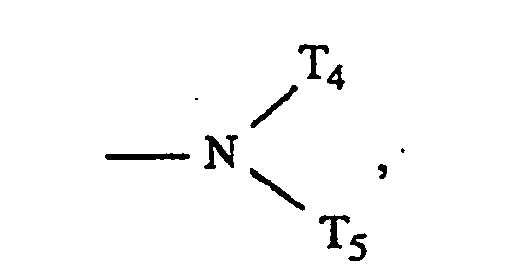


- In besonders geeigneten Verbindungen der Formel (1 b) ist T3 Alkyl mit 1 bis 12 Kohlenstoffatomen oder ein Rest der Formel

- Von den UV-Absorbem der Formel (2) werden solche bevorzugt, worin die Substituenten Y1 Wasserstoff, Alkyl mit 1 bis 12 Kohlenstoffatomen oder Halogen bedeuten, Y2, wenn u 1 ist, Alkyl mit 1 bis 18 Kohlenstoffatomen, durch Hydroxyl, Alkoxy mit 1 bis 18 Kohlenstoffatomen, -COOYB, -CONY9Y10, und/oder-OCOY11 substituiertes Alkyl mit 1 bis 12 Kohlenstoffatomen, Glycidyl oder Phenylalkyl mit 1 bis 4 Kohlenstoffatomen im Alkylteil ist, oder Y2, wenn u 2 ist, Alkylen mit 2 bis 16 Kohlenstoffatomen, Alkenylen mit 4 bis 12 Kohlenstoff atomen, Xylylen oder durch ein oder mehrere -O- unterbrochenes undloder durch Hydroxyl substituiertes Alkylen mit 3 bis 20 Kohlenstoffatomen ist, wobei die Substituenten Y8 bis Y11 die oben angegebenen Bedeutungen haben. Insbesondere kommen hiervon jene UV-Absorber in Frage, in denen die Substituenten Y1 Wasserstoff, Alkyl mit 1 bis 4 Kohlenstoffatomen oder Chlor sind, Y2, wenn u 1 ist, unsubstituiertes oder durch Hydroxyl, Alkoxy mit 1 bis 18 Kohlenstoffatomen, -COOY8, -CONY9Y10, undloder-OCOY11 substituiertes Alkyl mit 1 bis 4 Kohlenstoffatomen, Glycidyl oder Benzyl ist, oder Y2, wenn u 2 ist, Alkylen mit 6 bis 12 Kohlenstoffatomen, Butenylen, Xylylen oder durch ein oder mehrere -O- unterbrochenes und/oder durch Hydroxyl substituiertes Alkylen mit 3 bis 20 Kohlenstoffatomen ist, wobei Y8 Alkyl mit 4 bis 12 Kohlenstoffatomen, Alkenylen mit 12 bis 18 Kohlenstoffatomen oder durch ein oder mehrere -0- unterbrochenes und/oder durch Hydroxyl substituiertes Alkyl mit 6 bis 20 Kohlenstoffatomen, ist, Yg und Y10 Alkyl mit 4 bis 8 Kohlenstoffatomen sind, und Y11 Alkyl mit 1 bis 8 Kohlenstoffatomen oder Alkenyl mit 2 oder 3 Kohlenstoffatomen ist.
- Eine weitere zur Verwendung in Lackzusammensetzungen besonders geeignete Gruppe von Verbindungen der Formel (2) ist dadurch gekennzeichnet, dass u 1 und r 2 ist, Y1 Alkyl mit 1 bis 4 Kohlenstoffatomen und Y2 Alkyl mit 1 bis 12 Kohlenstoffatomen oder durch Hydroxyl, Alkoxy mit 1 bis 18 Kohlenstoffatomen, -CO-OY8 und/oder-OCOY11 substituiertes Alkyl mit 1 bis 12 Kohlenstoffatomen ist, worin Y8 Alkyl mit 1 bis 18 Kohlenstoffatomen, Alkenyl mit 3 bis 18 Kohlenstoffatomen oder durch ein oder mehrere Sauerstoffatome unterbrochenes und/oder durch Hydroxyl substituiertes Alkyl mit 3 bis 20 Kohlenstoffatomen und Y11 Alkenyl 2 bis 18 Kohlenstoffatomen ist.
- Bevorzugt hiervon sind solche Verbindungen, worin Y2 Alkyl mit 1 bis 8 Kohlenstoffatomen oder durch Hydroxyl, Alkoxy mit 12 bis 15 Kohlenstoffatomen, -COOY8 undloder-OCOY11 substituiertes Alkyl mit 1 bis 4 Kohlenstoffatomen ist, worin Y8 Alkyl mit 8 bis 12 Kohlenstoffatomen, Alkenyl mit 12 bis 18 Kohlenstoffatomen oder durch ein Sauerstoffatom unterbrochenes und Hydroxyl substituiertes Alkyl mit 5 bis 10 Kohlenstoffatomen und Y11 Alkenyl 2 bis 8 Kohlenstoffatomen ist, und insbesondere jene Verbindungen, worin Y1 Methyl und Y2 ein Octylrest oder durch Hydroxyl, Alkoxy mit 13 oder 15 Kohlenstoffatomen, -COOYa undloder -OCOY11 substituiertes Alkyl mit 1 bis 3 Kohlenstoffatomen ist, worin Y8 ein Decyl- oder Octadecenylrest oder durch Hydroxyl substituiertes und ein Sauerstoffatom unterbrochenes Alkyl mit 7 Kohlenstoffatomen und Y11 Propenyl ist
- Von Interesse sind auch solche UV-Absorber der Formel (3), worin v und w unabhängig voneinander 1 oder 2 sind, und die Substituenten Z unabhängig voneinander Wasserstoff, Halogen oder Alkoxy mit 1 bis 12 Kohlenstoffatomen sind, sowie solche UV-Absorber der Formel (4), worin x und y unabhängig voneinander 1 oder 2 sind, und die Substituenten L unabhängig voneinander Wasserstoff oder Alkyl oder Alkoxy mit je 1 bis 12 Kohlenstoffatomen sind.
- Es hatsich als vorteilhaft erwiesen, in Kombination mit erfindungsgemässen UV-Absorbermischungen mindestens ein weiteres Lichtschutzmittel aus der Klasse dergehinderten Amine zu verwenden, insbesondere eine Verbindung, die mindestens einen Rest der Formel

- Es handelt sich dabei um Derivate von Polyalkylpiperidinen, insbesondere von 2,2,6,6-Tetramethylpiperidin. Bevorzugt tragen diese Verbindungen in 4-Stellung des Piperidinringes einen oderzwei polare Substituenten oder ein polares Spiro-Ringsystem. Es kann sich bei diesen Verbindungen um niedermolekulare oder oligomere oder polymere Verbindungen handeln.
- Von Bedeutung sind insbesondere die folgenden Klassen von Polyalkylpiperidinen.
-

- Bedeuten etwaige Substituenten C1-C12-Alkyl, so stellen sie z.B. Methyl, Ethyl, n-Propyl, n-Butyl, sek.-Butyl, tert-Butyl, n-Hexyl, n-Octyl, 2-Ethyl-hexyl, n-Nonyl, n-Decyl, n-Undecyl oder n-Dodecyl dar.
- In der Bedeutung von C1-C18-Alkyl kann R21 oder R22 z.B. die oben angeführten Gruppen und dazu noch beispielsweise n-Tridecyl, n-Tetradecyl, n-Hexadecyl oder n-Octadecyl darstellen.
- Wenn R21 C3-C8-Alkenyl bedeutet, so kann es sich z.B. um 1-Propenyl, Allyl, Methallyl, 2-Butenyl, 2-Pentenyl, 2-Hexenyl, 2-Octenyl, 4-tert.- Butyl-2-butenyl handeln.
- R21 ist als C3-C8-Alkinyl bevorzugt Propargyl.
- Als C7-C12-Aralkyl ist R21 insbesondere Phenethyl und vor allem Benzyl.
- R21 ist als C1-C8-Alkanoyl beispielsweise Formyl, Propionyl, Butyryl, Octanoyl, aber bevorzugt Acetyl und als C3-C5-Alkenoyl insbesondere Acryloyl.
- Bedeutet R22 einen einwertigen Rest einer Carbonsäure, so stellt es beispielsweise einen Essigsäure-, Capronsäure-, Stearinsäure-, Acryl- säure-, Methacrylsäure-, Benzoe- oder β-(3,5-Di-tert.-butyl-4-hydroxy- phenylrpropionsäurerest dar.
- Bedeutet R22 einen zweiwertigen Rest einer Dicarbonsäure, so stellt es beispielsweise einen Malonsäure-, Bemsteinsäure-, Glutarsäure-, Adipinsäure-, Korksäure-, Sebacinsäure-, Maleinsäure-, Itaconsäure-, Phthalsäure-, Dibutylmalonsäure-, Dibenzylmalonsäure-, Butyl-(3,5-di-tert.-butyl-4-hydroxybenzyl)-malonsäure-oder Bicycloheptendicarbonsäurerest dar.
- Stellt R22 einen dreiwertigen Rest einerTricarbonsäure dar, so bedeutet es z.B. einen Trimellitsäure-, Citronensäure- oder Nitrilotriessigsäurerest.
- Stellt R22 einen vierwertigen Rest einer Tetracarbonsäure dar, so bedeutet es z.B. den vierwertigen Rest von Butan-1,2,3,4-tetracarbonsäure oder von Pyromellitsäure.
- Bedeutet R22 einen zweiwertigen Rest einer Dicarbaminsäure, so stellt es beispielsweise einen Hexamethylendicarbaminsäure- oder einen 2,4-Toluylen-dicarbaminsäurerest dar.
- Bevorzugt sind Verbindungen der Formel III, worin R Wasserstoff ist, R21 Wasserstoff oder Methyl ist, n 1 ist und R22 C1-C18-Alkyl ist oder n 2 ist und R22 der Diacylrest einer aliphatischen Dicarbonsäure mit 4-12 C-Atomen ist.
- Beispiele für Polyalkylpiperidin-Verbindungen dieser Klasse sind folgende Verbindungen:
- 1) 4-Hydroxy-2,2,6,6-tetramethylpiperidin
- 2) 1-Allyl-4-hydroxy-2,2,6,6-tetramethylpiperidin
- 3) 1-Benzyl-4-hydroxy-2,2,6,6-tetramethylpiperidin
- 4) 1-(4-tert-Buiyl-2-butenyl)-4-hydroxy-2,2,6,6-tetramethylpiperidin
- 5) 4-Stearoyloxy-2,2,6,6-tetramethylpiperidin
- 6) 1-Ethyl-4-salicyloyfoxy-2,2,6,6-tetramethylpiperidin
- 7) 4-Methacryloyloxy 1,2,2,6,6-pentamethylpiperidin
- 8) 1,2,2,6,6-Pentamethylpiperidin-4-yl-β-(3,5-di-tert-butyl-4-hydroxyphenyl)-propionat
- 9) Di-(1-benzyl-2,2,6,6-tetramethylpiperidin-4-yl)-maleinat
- 10) Di-(2,2,6,6-tetramethylpiperidin-4-yl)-succinat
- 11) Di-(2,2,6,6-tetramethylpiperidin-4-yl)-glutarat
- 12) Di-(2,2,6,6-tetramethylpiperidin-4-yl)-adipat
- 13) Di-(2,2,6,6-tetramethylpiperidin-4-yl)-sebacat
- 14) Di-(1,2,2,6,6-pentamethylpiperidin-4-yl)-sebacat
- 15) Di-(1,2,3,6-tetramethyl-2,6-diethyl-piperidin-4-yl)-sebacat
- 16) Di-(1-allyl-2,2,6,6-tetramethylpiperidin-4-yl)-phthalat
- 17) 1-Hydroxy-4-ß-cyanoethyloxy-2,2,6,6-tetramethylpiperidin
- 18) 1-Acetyl-2,2,6,6-tetramethylpiperidin-4-yl-acetat
- 19) Trimellithsäure-tri-(2,2,6,6-tetramethylpiperidin-4-yl)-ester
- 20) 1-Acryloyl-4-benzyloxy-2,2,6,6-tetramethylpiperidin
- 21) Diethylmalonsäure-di(2,2,6,6-tetramethylpiperidin-4-yl)-este
- 22) Dibutyl-malonsäure-di-( 1,2,2,6,6-pentamethylpiperidin-4-yl)-ester
- 23) Butyl-(3,5-di-tert.-butyl-4-hydroxybenzyl)-malonsäure-di-(1,2,2,6,6-pentamethylpiperidin-4-yl)-ester
- 24) Di-(1-octyloxy-2,2,6,6-tetramethylpiperidin-4-yl)-sebacat
- 25) Di-(1-cydohexyloxy-2,2,6,6-tetramethylpiperidin-4-yl)-sebacat
- 26) Hexan-1',6'-bis-(4-carbamoyloxy-1-n-butyl-2,2,6,6-tetramethylpiperidin)
- 27) Toluol-2',4'-bis-(4-carbamoyloxy-1-n-propyl-2,2,6,6-tetramethylpiperidin)
- 28) Dimethyl-bis-(2,2,6,6-tetramethylpiperidin-4-oxy)-silan
- 29) Phenyl-tris(2,2,6,6-pentamethylpiperidin-4-oxy)-silan
- 30) Tris-(1-propyl-2,2,6,6-tetramethylpiperidin-4-yl)-phosihit
- 31) Tris-(1-propyl-2,2,6,6-tetramethylpiperidin-4-yl)phosphat
- 32) Phenyl-[bis-( 1,2,2,6,6-pentamethylpiperidin-4-yl)]-phosphonat
- 33) 4-Hydroxy-1,2,2,6,6-pentamethylpiperidin
- 34) 4-Hydroxy-N-hydroxyethyl-2,2,6,6-tetramethylpiperidin
- 35) 4-Hydroxy-N-(2-hydroxypropyl)-2,2,6,6-tetramethylpiperidin
- 36) 1-Glycidyl-4-hydroxy-2,2,6,6-tetramethylpiperidin
- b) Verbindungen der Formel IV,


- Stellen etwaige Substituenten C1-C12- oder C1-C18-Alkyl dar, so haben sie die bereits unter (a) angegebene Bedeutung.
- Bedeuten etwaige Substituenten C5-G7-Cycloalkyl, so stellen sie insbesondere Cyclohexyl dar.
- Als C7-C8-Aralkyl ist R23 insbesondere Phenylethyl oder vor allem Benzyl. Als C2-C5-Hydroxyalkyl ist R23 insbesondere 2-Hydroxyethyl oder 2-Hydroxypropyl.
- R23 ist als C2-C18-Alkanoyl beispielsweise Propionyl, Butyryl, Octanoyl, Dodecanoyl, Hexadecanoyl, Octadecanoyl, aber bevorzugt Acetyl und als C3-C5-Alkenoyl insbesondere Acryloyl.
- Bedeutet R24 C2-C8-Alkenyl, dann handelt es sich z.B. um Allyl, Methallyl, 2-Butenyl, 2-Pentenyl, 2-Hexenyl oder 2-Octenyl.
- R24 als mit einer Hydroxy-, Cyano-, Alkoxycarbonyl- oder Carbamidgruppe substituiertes C1-C4-Alkyl kann z.B. 2-Hydroxyethyl, 2-Hydroxypropyl, 2-Cyanethyl, Methoxycarbonylmethyl, 2-Ethoxycarbonylethyl, 2-Aminocarbonylpropyl oder 2-(Dimethylaminocarbonyl)-ethyl sein.
- Stellen etwaige Substituenten C2-C12-Alkylen dar, so handelt es sich z.B. um Ethylen, Propylen, 2,2-Dimethylpropylen, Tetramethylen, Hexamethylen, Octamethylen, Decamethylen oder Dodecamethylen.
- Bedeuten etwaige Substituenten C8-C15-Arylen, so stellen sie z.B. o-, m- oder p-Phenyten, 1,4-Naphthylen oder 4,4'-Diphenylen dar.
- Als C8-C12-Cycloalkylen ist insbesondere Cyclohexylen zu nennen.
- Bevorzugt sind Verbindungen der Formel V, worin n 1 oder 2 ist, R Wasserstoff ist, R21 Wasserstoff oder Methyl ist, R23 Wasserstoff, C1-C12-Alkyl oder eine Gruppe der Formel

- Beispiele für Polyalkylpiperidin-Verbindungen dieser Klasse sind folgende Verbindungen:
- 37) N,N'-Bis-(2,2,6,6-tetramethylpiperidin-4-yl)-hexamethylen-1,6-diamin
- 38) N,N'-Bis-(2,2,6,6-tetramethylpiperidin-4-yl)-hexamethylen-1,6-di-acetamid
- 39) Bis-(2,2,6,6-tetramethylpiperidin-4-yl)-amin
- 40) 4-Benzoylamino-2,2,6,6-tetramethylpiperidin
- 41) N,N'-Bis-(2,2,6,6-tetramethylpiperidin-4-yl)-N,N'-dibutyl-adipamid
- 42) N,N'-Bis-(2,2,6,6-tetramethylpiperidin-4-yl)-N,N'-dicyclohexyl-2-hydroxypropylen-1,3-diamin
- 43) N,N'-Bis-(2,2,6,6-tetramethylpiperidin-4-yl)-p-xylylen-diamin
- 44) N,N'-Bis-(2,2,6,6-tetramethylpiperidin-4-yl)-succindiamid
- 45) N-(2,2,6,6-Tetramethylpiperidin-4-yl)-β-aminodipropionsäure-di-(2,2,6,6-tetramethylpiperidin-4-yl)-ester
- 46) Die Verbindung der Formel
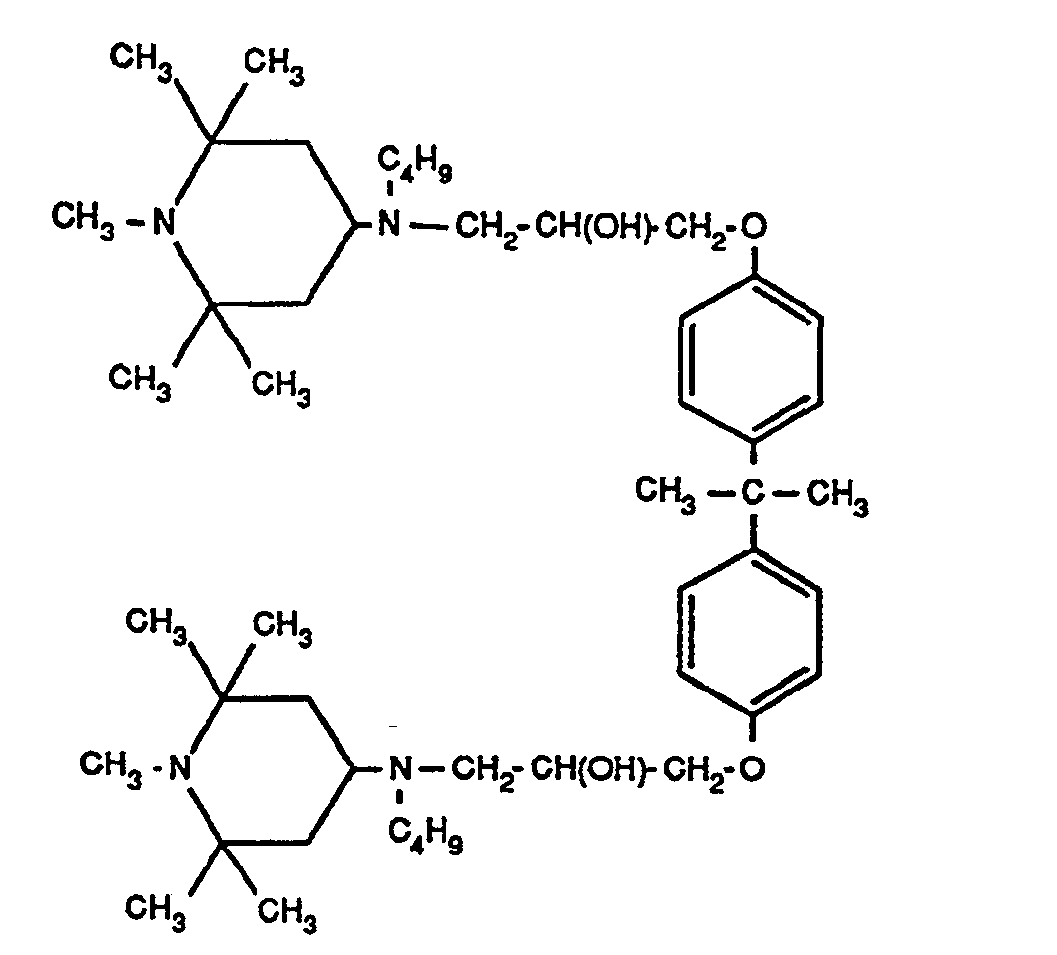
- 47) 4-(Bis-2-hydroxyethyi-amino)-1,2,2,6,6-pentaniethyipiperidin
- 48) 4-(3-Methyl-4-hydroxy-5-tert.-butyl-benzoesäureamido)-2,2,6,6-tetra-methylpiperidin
- 49) 4-Methacrylamido-1,2,2,6,6-pentamethylpiperidin
- 49) (a) bis (c) Die Verbindungen der Formel

-

- Bedeutet R25 C2-C8-Alkylen oder -Hydroxyalkylen, so stellt es beispielsweise Ethylen, 1-Methyl-ethylen, Propylen, 2-Ethyl-propylen oder 2-Ethyl-2-hydroxymethylpropylen dar.
- Als C4-C22-Acyloxyalkylen bedeutet R25 z.B. 2-Ethyl-2-acetoxymethyl-propylen.
- Beispiele für Polyalkylpiperidin-Verbindungen dieser Klasse sind folgende Verbindungen :
- 50) 9-Aza-8,8,10,10-tetramethyl-1,5-dioxaspiro[5.5]undecan
- 51) 9-Aza-8,8,10,10-tetramethyl-3-ethyl-1,5-dioxaspiro[5.5]undecan
- 52) 8-Aza-2,7,7,8,9,9-hexamethyl-1,4-dioxaspiro[4.5]decan
- 53) 9-Aza-3-hydroxymethyl-3-ethyl-8,8,9,10,10-pentamethyl-1,5-dioxaspiro [5.5]undecan
- 54) 9-Aza-3-ethyl-3-acetoxymethyl-9-acetyl-8,8,10,10-tetramethyl-1,5-dioxaspiro[5.5]undecan
- 55) 2,2,6,6-Tetramethylpiperidin-4-spiro-2'-(1',3'-dioxan)-5'-spiro-5"-(1".3''-dioxan)-2"-spiro -4"'-(2"',2"',6"',8"'-tetramethylpiperidin).
-


- Bedeuten etwaige Substituenten C1-C12-Alkyl, so stellen sie z.B. Methyl, Ethyl, n-Propyl, n-Butyl, sek.-Butyl, terL-Butyl, n-Hexyl, n-Octyl, 2-Ethyl-hexyl, n-Nonyl, n-Decyl, n-Undecyl oder n-Dodecyl dar.
- Etwaige Substituenten in der Bedeutung von C1-C18-Alkyl können z.B. die oben angeführten Gruppen und dazu noch beispielsweise n-Tridecyl, n-Tetradecyl, n-Hexadecyl oder n-Octadecyl darstellen.
- Bedeuten etwaige Substituenten C2-C6-Alkoxyalkyl, so stellen sie z.B. Methoxymethyl, Ethoxymethyl, Propoxymethyl, tert.-Butoxymethyl, Ethoxy- ethyl, Ethoxypropyl, n-Butoxyethyl, tert.-Butoxyethyl, Isopropoxyethyl oder Propoxypropyl dar.
- Stellt R27 C3-C5-Alkenyl dar, so bedeutet es z.B. 1-Propenyl, Allyl, Methallyl, 2-Butenyl oder 2-Pentenyl.
- Als C7-C9-Aralkyl sind R27, T, und T2 insbesondere Phenethyl oder vor allem Benzyl. Bilden T, und T2 zusammen mit dem C-Atom einen Cycloalkanring, so kann dies z.B. ein Cyclopentan-, Cyclohexan-, Cyclooctan- oder Cyclododecanring sein.
- Bedeutet R27 C2-C4-Hydroxyalkyl, so stellt es z.B. 2-Hydroxyethyl, 2-Hydroxypropyl, 2-Hydroxybutyl oder 4-Hydroxybutyl dar.
- Als C6-C10-Aryl bedeuten R17, T, und T2 insbesondere Phenyl, α-oder β-Naphthyl, die gegebenenfalls mit Halogen oder C1-C4-Alkyl substituiert sind.
- Stellt R27 C2-C12- Alkylen dar, so handelt es sich z.B. um Ethylen, Propylen, 2,2-Dimethylpropylen, Tetramethylen, Hexamethylen, Octamethylen, Decamethylen oder Dodecamethylen.
- Als C4-C12-Alkenylen bedeutet R27 insbesondere 2-Butenylen, 2-Pentenylen oder 3-Hexenylen.
- Bedeutet R27 C6-C12-Arylen, so stellt es beispielsweise o-, m- oder p-Phenylen, 1,4-Naphthylen oder 4,4'-Diphenylen dar.
- Bedeutet Z' C2-C12-Alkanoyl, so stellt es beispielsweise Propionyl, Butyryl, Octanoyl, Dodecanoyl, aber bevorzugt Acetyl dar.
- D hat als C2-C10-Atkylen, C6-C15- Arylen oder C6-C12-Cycloalkylen die unter (b) angegebene Bedeutung.
- Beispiele für Polyalkylpiperidin-Verbindungen dieser Klasse sind folgende Verbindungen:
-
- 56) 3-Benzyl-1,3,8-triaza-7,7,9,9-tetramethylspiro[4.5]decan-2,4-dion
- 57) 3-n-Octyl-1,3,8-triaza-7,7,9,9-tetramethylspiro[4.5]decan-2,4-dion
- 58) 3 Allyl-1,3,8-triaza-1,7,7,9,9-pentamethylspiro[4.5]decan-2,4-dion
- 59) 3-Glycidyl-1,3,8-triaza-7,7,8,9,9-pentamethylspiro[4.5]decan-2,4-dion
- 60) 1,3,7,7,8,9,9-Heptamethyl-1,3,8-triazaspiro[4.5]decan-2,4-dion
- 61) 2-Iso-propyl-7,7,9,9-tetramethyl-1-oxa-3,8-diaza-4-oxo-spiro-[4.5]decan
- 62) 2.2-Dibutyl-7,7,9,9-tetramethyl-1-oxa-3,8-diaza-4-oxo-spiro-[4.5]-decan
- 63) 2,2,4,4-Tetramethyl-7-oxa-3,20-diaza-21-oxo-dispiro[5.1.11.2]-heneicosan
- 64) 2-Butyl-7,7,9,9-tetramethyl-1-oxa-4,8-diaza-3-oxo-spiro-[4,5]decan
- 65) 8-Acetyl-3-dodecyl-1,3,8-triaza-7,7,9,9-tetramethylspiro[4,5]-decan-2,4-dion
-


- Bedeuten etwaige Substituenten C1-C12-Alkyl, so stellen sie beispielsweise Methyl, Ethyl, n-Propyl, n-Butyl, sek.-Butyl, tert.-Butyt, n-Hexyl, n-Octyl, 2-Ethylhexyl, n-Nonyl, n-Decyl, n-Undecyl oder n-Dodecyl dar.
- Bedeuten etwaige Substituenten C1-C4-Hydroxyalkyl, so stellen sie z.B. 2-Hydroxyethyl, 2-Hydroxypropyl, 3-Hydroxypropyl, 2-Hydroxybutyl oder 4-Hydroxybutyl dar.
- Bedeutet A C2-C6-Alkylen, so stellt es beispielsweise Ethylen, Propylen, 2,2-Dimethylpropylen, Tetramethylen oder Hexamethylen dar.
- Stellen R31 und R32 zusammen C4-C5-Alkylen oder Oxaalkylen dar, so bedeutet dies z.B Tetramethylen, Pentamethylen oder 3-Oxapentamethylen.
- Beispiele für Polyalkylpiperidin-Verbindungen dieser Klasse sind die Verbindungen der folgenden Formeln:


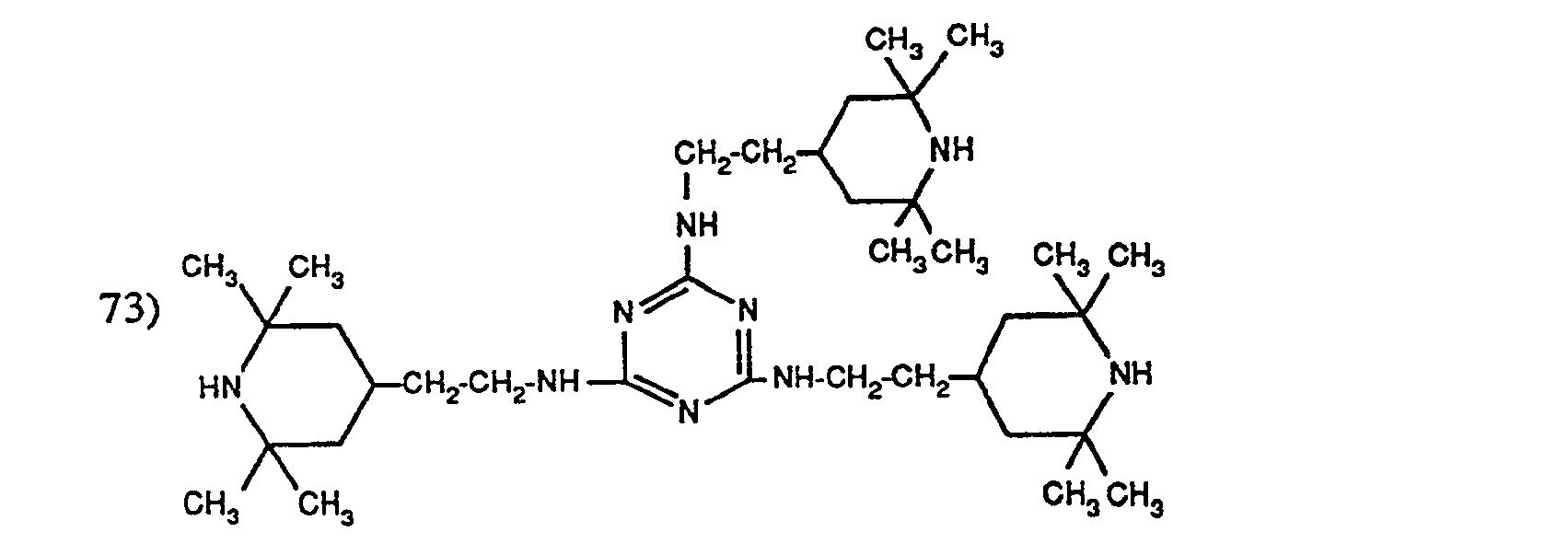


- (f) Oligomere oder polymere Verbindungen, deren wiederkehrende Struktureinheit einen 2,2,6,6-Tetraalkylpiperidinrest der Formel 111 enthält, insbesondere Polyester, Polyäther, Polyamide, Polyamine, Polyurethane, Polyhamstoffe, Polyaminotriazine, Poly(meth)acrylate, Poly(meth)acrylamide und deren Copolymere, die solche Reste enthalten.
- Beispiele für 2,2,6,6-Polyalkylpiperidin-Lichtschutzmittel dieser Klasse sind die Verbindungen der folgenden Formeln, wobei m eine Zahl von 2 bis etwa 200 bedeutet.


- Von diesen Verbindungsklassen sind die Klassen a), d), e) und f) besonders geeignet, insbesondere die
- Verbindungen Nr. 10, 13, 14, 23, 24, 28, 29, 63, 65, 75, 77, 81, 84, 92 und 93.
- Verbindungen der Formel

- Das folgende Beispiel erläutert die Erfindung weiter, ohne sie darauf zu beschränken. Teile und Prozente beziehen sich auf das Gewicht, sofern nicht anders angegeben.
- Beispiel 1: Die UV-Absorber der Formeln


- Die UV-Absorber werden in 10 g Xylol eingearbeitet und in den in der nachfolgenden Tabelle zugegebenen Mengen (% reiner UV-Absorber, jeweils bezogen auf Festkörperbestandteile des Lackes) einem Klarlack der 22 folgenden Zusammensetzung zugefügt:

- Der Klarlack wird mit einem Gemisch aus Xylol/Butanol/Butylglykolacetat ( 13:6: 1 ) auf Spritzfähigkeit verdünntund auf ein vorbereitetes Substrat (coil coat beschichtetes Aluminiumblech, Automobilfiller, silbermetallic Basislack) gespritzt und bei 130°C 30 Minuten eingebrannt. Es resultiert eine Trockenschichtdicke von 40-50 µm Klarlack.
- Die Proben werden einer beschleunigten Bewitterung unterworfen.
- Resultate einer 1600stündigen Bewitterung der Proben in einem Xenon-Weatherometer (CAM 159, Atlas Corp.) sind in der Tabelle 1 zusammengefasst

- Die mit den UV-Absorbermischungen stabilisierten Proben weisen eine höhere Beständigkeit gegen Bewitterung auf als Proben, die nur einen einzigen UV-Absorber in gleicher Menge enthalten.
- Beispiel 2: Man wiederholt Beispiel 1 mit den Verbindungen der Formeln (100) und (101), und unterwirft entsprechende Proben auch einer zwölfmonatigen Freibewitterung in Florida. Tabelle 2 zeigt die erhaltenen Ergebnisse:

- Beispiel 3: Ein 2K-PUR-Klarlack wird aus den folgenden Komponenten hergestellt:

- Diesem Klarlack werden die zu prüfenden UV-Absorber in den angegebenen Mengen, gelöst in 10 ml Xylol zugegeben. Nach Hinzufügen von 30 Teilen Desmodur® N75 als Härter wird mit Xylol auf Spritzfähigkeit verdünnt, derfertige Lack auf ein vorbereitetes Substrat (coil coat beschichtetes Aluminiumblech, Automobilfüller, silbermetallic Basislack) appliziert und bei 90°C 30 Minuten eingebrannt Es resultiert eine Trockenfilmdicke von ca. 40-50 µm.
- Die Proben werden in einem Xenon-Weatherometer (Fa. Atlas; CAM 159; KFA-Methode) bewittert und der 20° Glanz (DIN 67530) gemessen.

- Die Verbindungen der Formeln (103), (104) und (105) besitzen die folgende Struktur


- Beispiel 4: Proben gemäss Beispiel 3 mit Verbindungen der Formeln (103),(106) und (107) als UV-Absorber werden einer UVCON-Bewitterung (Atlas, UVB-313, 8 Stunden UV-Belichtung bei 70°C, 4 Stunden Kondensation bei 50°C) unterworfen. Anschliessend ermittelt man den 20° Glanz (DIN 67530) nach 1600 Stunden Bewitterung.

- Die Verbindungen der Formeln (106) und (107) besitzen die folgende Struktur:


- Beispiel 5: Man wiederholt Beispiel 4 mit den Verbindungen der Formeln (108) und (109) als UV-Absorber.

- Die Verbindungen der Formeln (108) und (109) besitzen die folgende Struktur.


- Beispiel 6: Das Lacksystem gemäss Beispiel 2 wird mit den Verbindungen der Formeln (105), (106) und (109) als UV-Absorber auf Uniprime (Fa. PPG; ED 3150) beschichtete Aluminiumbleche appliziert und wie folgt bewittert: QUV (Q-Panel; UVA-340; 8 Stunden UV-Belichtung bei 70°C; 4 Stunden Kondensation bei 50°C). Danach wird die Veränderung des Yellowness-Index (AYI, ASTM D 1925) und der Farbabstand AE (DIN 6174; bewittert/unbewittert) ermittelt

- Beispiel 7: Man stellt einen Kladack folgender Zusammensetzung her:

- Die zu prüfenden UV-Absorber der Formeln ( 103) und ( 110) werden, gelöst in 10 g Xylol, in diesen Klarlack eingearbeitet. Mit einer Mischung aus Xylol, Butanol und Butylglykolacetat (Gewichtsverhältnis 13:6:1) wird der Klarlack auf Spritzfähigkeit verdünnt und auf ein Glasplättchen appliziert. Nach dem Einbrennen ( 130°C, 30 Minuten) resultiert eine Trockenfilmdicke von etwa 20 µm. Nach einer UVCON-Bewitterung (Atlas; UVB-313; 8 Stunden UV-Bestrahlung bei 70°C, 4 Stunden Kondensation bei 50°C) wird mittels UV-Spektroskopie der Verlust an UV-Absorber bestimmt

- Die Verbindung der Formel (110) besitzt folgende Struktur:

- Beispiel 8: Das Lacksystem gemäss Beispiel 7 mit den Verbindungen der Formeln (103) und (110) als UV-Absorber wird auf Uniprime (Fa. PPG; ED 3150) beschichtete Aluminiumbleche appliziert und einer UVCON-Bewitterung wie in Beispiel 7 beschrieben ausgesetzt Danach wird an den Proben der Gitterschnitt gemäss DIN 53151 mitanschliessendem Bandabreisstestausgeführt. Die Gitterschnittbewertung erfolgt ebenfalls nach DIN 53151.

oder die Verbindungen der folgenden Formeln:
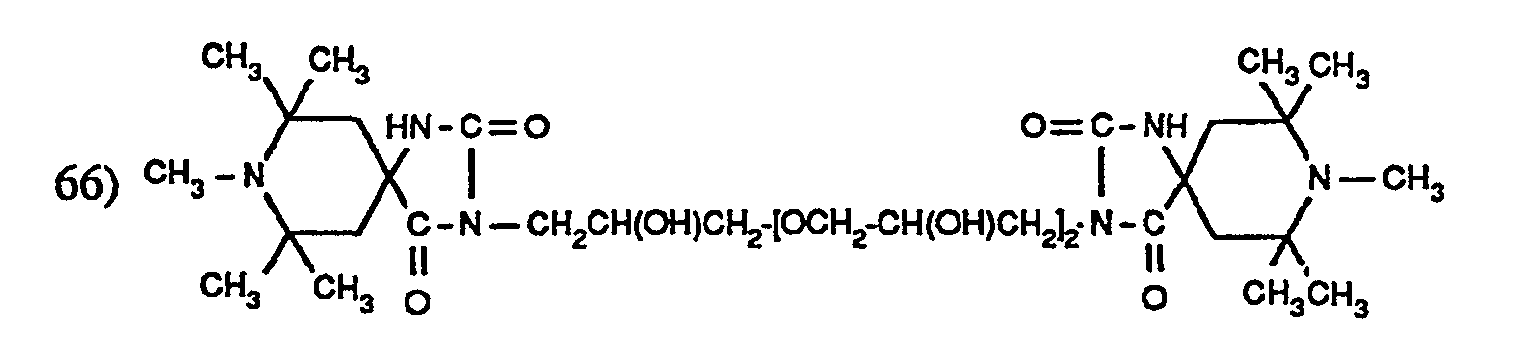


Claims (28)


Applications Claiming Priority (2)
| Application Number | Priority Date | Filing Date | Title |
|---|---|---|---|
| CH105690 | 1990-03-30 | ||
| CH1056/90 | 1990-03-30 |
Publications (2)
| Publication Number | Publication Date |
|---|---|
| EP0453396A1 true EP0453396A1 (de) | 1991-10-23 |
| EP0453396B1 EP0453396B1 (de) | 1995-12-13 |
Family
ID=4201419
Family Applications (1)
| Application Number | Title | Priority Date | Filing Date |
|---|---|---|---|
| EP91810192A Expired - Lifetime EP0453396B1 (de) | 1990-03-30 | 1991-03-21 | Lackzusammensetzungen |
Country Status (11)
| Country | Link |
|---|---|
| US (1) | US5106891A (de) |
| EP (1) | EP0453396B1 (de) |
| JP (1) | JP3243566B2 (de) |
| KR (1) | KR0168054B1 (de) |
| BR (1) | BR9101254A (de) |
| CA (1) | CA2039405C (de) |
| CZ (1) | CZ288592B6 (de) |
| DE (1) | DE59107052D1 (de) |
| ES (1) | ES2081458T3 (de) |
| MX (1) | MX171974B (de) |
| SK (1) | SK279724B6 (de) |
Cited By (15)
| Publication number | Priority date | Publication date | Assignee | Title |
|---|---|---|---|---|
| FR2694291A1 (fr) * | 1992-07-30 | 1994-02-04 | Sandoz Sa | Nouveaux imino-éthers, leur préparation et leur utilisation comme stabilisants des matières polymères. |
| FR2715161A1 (fr) * | 1994-01-14 | 1995-07-21 | Sandoz Sa | Compositions de revêtement en poudre et revêtements en poudre stabilisés. |
| EP0764686A1 (de) * | 1995-09-20 | 1997-03-26 | Ciba SC Holding AG | S-Triazin-Lichtstabilisatorhybride, substituiert mit Benzotriazol- oder Benzophenon-Einheiten und damit stabilisierte Zusammensetzungen |
| WO1997039069A1 (de) * | 1991-01-07 | 1997-10-23 | Clariant Finance (Bvi) Limited | Stabilisierung von lacken |
| FR2755444A1 (fr) * | 1996-11-07 | 1998-05-07 | Ciba Geigy Ag | Composition de revetement comprenant un compose stabilisant ledit compose et son utilisation |
| WO1998027168A1 (en) * | 1996-12-18 | 1998-06-25 | Basf Corporation | Coating composition and method for reducing ultraviolet light degradation |
| US5977219A (en) * | 1997-10-30 | 1999-11-02 | Ciba Specialty Chemicals Corporation | Benzotriazole UV absorbers having enhanced durability |
| US6051164A (en) * | 1998-04-30 | 2000-04-18 | Cytec Technology Corp. | Methods and compositions for protecting polymers from UV light |
| WO2000025731A1 (en) * | 1998-11-02 | 2000-05-11 | Ciba Specialty Chemicals Holding Inc. | Stabilisation of body-care and household products |
| US6166218A (en) * | 1996-11-07 | 2000-12-26 | Ciba Specialty Chemicals Corporation | Benzotriazole UV absorbers having enhanced durability |
| FR2807048A1 (fr) * | 2000-04-04 | 2001-10-05 | Ciba Sc Holding Ag | Melanges synergiques d'absorbants d'uv dans les polyolefines |
| EP1094094A4 (de) * | 1999-04-12 | 2002-07-24 | Asahi Denka Kogyo Kk | Zusammensetzung aus polymermaterial |
| DE19739797B4 (de) * | 1996-09-13 | 2008-06-05 | Ciba Specialty Chemicals Holding Inc. | Stabilisatorkombination |
| WO2010081625A2 (en) | 2009-01-19 | 2010-07-22 | Basf Se | Organic black pigments and their preparation |
| CN112608516A (zh) * | 2020-12-15 | 2021-04-06 | 沈阳化工研究院有限公司 | 一种多功能光稳定组合物及其制备方法 |
Families Citing this family (67)
| Publication number | Priority date | Publication date | Assignee | Title |
|---|---|---|---|---|
| US5489503A (en) * | 1992-12-03 | 1996-02-06 | Ciba-Geigy Corp. | UV absorbers |
| US5556973A (en) * | 1994-07-27 | 1996-09-17 | Ciba-Geigy Corporation | Red-shifted tris-aryl-s-triazines and compositions stabilized therewith |
| TW308601B (de) * | 1995-01-18 | 1997-06-21 | Ciba Sc Holding Ag | |
| GB9511486D0 (en) * | 1995-06-07 | 1995-08-02 | Sandoz Ag | Organic compounds |
| CA2230604C (en) * | 1995-08-30 | 2008-12-02 | Cytec Technology Corp. | Compositions containing 1,3,5-triazine carbamates and epoxy compounds |
| US5726309A (en) * | 1996-08-27 | 1998-03-10 | Ciba Specialty Chemicals Corporation | Tris-aryls-triazines substituted with biphenylyl groups |
| KR20000048959A (ko) * | 1996-10-08 | 2000-07-25 | 마이클 제이. 켈리 | 가교결합제 조성물 및 이로부터의 저광택 에폭시 코팅 |
| US6147163A (en) * | 1996-12-18 | 2000-11-14 | Basf Corporation | Acrylic oligomeric and polymeric durability enhancing agents, method therefore and cured coating compositions containing the same |
| US6166148A (en) * | 1996-12-18 | 2000-12-26 | Basf Corporation | Durability enhancing agents, method therefore and cured coating compositions containing the same |
| US6037441A (en) * | 1996-12-18 | 2000-03-14 | Basf Corporation | Non-acrylic durability enhancing agents, method therefore and cured coating compositions containing the same |
| ZA9810605B (en) | 1997-11-21 | 1999-05-25 | Cytec Techonoly Corp | Trisaryl-1,3,5-triazine ultraviolet light absorbers |
| US6096886A (en) * | 1997-12-08 | 2000-08-01 | Cytec Technology Corp. | Morpholino end-capped, hindered amine substituted aminotriazine |
| JP2002518489A (ja) | 1998-06-22 | 2002-06-25 | チバ スペシャルティ ケミカルズ ホールディング インコーポレーテッド | ポリ(トリスアリール−1,3,5−トリアジン=カルバマート)紫外光吸収剤 |
| EP1089985B1 (de) | 1998-06-22 | 2005-09-21 | Cytec Technology Corp. | Rotverschobene trisaryl-1,3,5-triazine als uv- licht-absorber |
| US6297377B1 (en) | 1998-06-22 | 2001-10-02 | Cytec Technology Corporation | Benzocycle-substituted triazine and pyrimidine ultraviolet light absorbers |
| US6239276B1 (en) | 1998-06-22 | 2001-05-29 | Cytec Technology Corporation | Non-yellowing para-tertiary-alkyl phenyl substituted triazine and pyrimidine ultraviolet light absorbers |
| TWI259182B (en) | 1998-11-17 | 2006-08-01 | Cytec Tech Corp | Process for preparing triazines using a combination of Lewis acids with reaction promoters |
| DE19917906A1 (de) * | 1999-04-20 | 2000-10-26 | Basf Ag | Verwendung von aminosubstituierten Hydroxybenzophenonen als photostabile UV-Filter in kosmetischen und pharmazeutischen Zubereitungen |
| US6191199B1 (en) | 1999-05-03 | 2001-02-20 | Ciba Speciatly Chemicals Corporation | Stabilized adhesive compositions containing highly soluble, high extinction photostable hydroxyphenyl-s-triazine UV absorbers and laminated articles derived therefrom |
| CA2396221C (en) | 2000-02-01 | 2010-03-23 | Ciba Specialty Chemicals Holding Inc. | Method of content protection with durable uv absorbers |
| GB2390608B (en) * | 2000-04-04 | 2004-05-12 | Ciba Sc Holding Ag | Synergistic mixtures of UV-absorbers in polyolefins |
| GB2376949B (en) * | 2000-04-04 | 2004-05-12 | Ciba Sc Holding Ag | Synergistic mixtures of UV-absorbers in polyolefins |
| DE10053152A1 (de) * | 2000-10-26 | 2002-05-08 | Bayer Ag | Zusammensetzung enthaltend thermoplastische Kunststoffe |
| US6867250B1 (en) | 2000-10-30 | 2005-03-15 | Cytec Technology Corp. | Non-yellowing ortho-dialkyl aryl substituted triazine ultraviolet light absorbers |
| JP4843852B2 (ja) * | 2001-02-28 | 2011-12-21 | 旭硝子株式会社 | 塗料用組成物 |
| ATE359325T1 (de) | 2001-03-22 | 2007-05-15 | Ciba Sc Holding Ag | Verwendung von aromatischen verbindungen als mittel zur kontrolle der phase sowie zur reduzierung der teilchengrösse von chinacridonpigmenten |
| TWI316513B (en) * | 2001-07-02 | 2009-11-01 | Ciba Sc Holding Ag | Highly compatible hydroxyphenyltriazine uv-absorbers |
| US6855269B2 (en) * | 2001-11-09 | 2005-02-15 | Cytec Technology Corp. | Phenyl ether-substituted hydroxyphenyl triazine ultraviolet light absorbers |
| ZA200301683B (en) * | 2002-03-04 | 2004-09-06 | Ciba Sc Holding Ag | Synergistic combinations of UV absorbers for pigmented polyolefins. |
| ITMI20021622A1 (it) * | 2002-07-23 | 2004-01-23 | 3V Sigma Spa | Combinazioni sinergiche di derivati di tetrametilpiperidina e di derivati benzotriazolici per la protezione del legno dalla luce |
| MEP14008A (en) * | 2003-02-21 | 2010-06-10 | Bayer Schering Pharma Ag | Uv stable transdermal therapeutic plaster |
| ATE539058T1 (de) | 2003-02-26 | 2012-01-15 | Basf Se | Wasserverträgliche sterisch gehinderte hydroxysubstitutierte alkoxyamine |
| JP5288520B2 (ja) * | 2003-10-10 | 2013-09-11 | セメダイン株式会社 | 耐候性に優れた硬化性組成物 |
| US8668925B2 (en) | 2003-12-12 | 2014-03-11 | Bayer Intellectual Property Gmbh | Transdermal delivery of hormones without the need of penetration enhancers |
| JP4875834B2 (ja) * | 2003-12-24 | 2012-02-15 | ローム・アンド・ハース・エレクトロニック・マテリアルズ,エル.エル.シー. | マスク |
| US7595011B2 (en) | 2004-07-12 | 2009-09-29 | Ciba Specialty Chemicals Corporation | Stabilized electrochromic media |
| US20060122293A1 (en) * | 2004-12-03 | 2006-06-08 | Rick Wilk | Ultraviolet light absorber stabilizer combination |
| EP1719504A1 (de) * | 2005-05-02 | 2006-11-08 | Schering AG | Festes transdermales therapeutisches System mit UV-Absorber |
| US8962013B2 (en) * | 2005-05-02 | 2015-02-24 | Bayer Intellectual Property Gmbh | Multi-layered transdermal system with triazine UV absorber |
| EP2167570A1 (de) | 2007-06-29 | 2010-03-31 | Basell Poliolefine Italia S.R.L. | Bestrahlte polyolefinzusammensetzung mit nicht-phenolischem stabilisator |
| CN102604181B (zh) | 2007-08-06 | 2014-08-13 | 通用电缆技术公司 | 耐受树枝化的绝缘组合物 |
| KR100815158B1 (ko) * | 2007-10-08 | 2008-03-19 | 신승현 | 맨홀뚜껑의 가변정보 표시방법 및 그 맨홀뚜껑 |
| US8349925B2 (en) | 2008-09-05 | 2013-01-08 | Thor Gmbh | Flame-retardant composition comprising a phosphonic acid derivative |
| BRPI0923420A2 (pt) | 2008-12-22 | 2018-10-16 | Basf Se | uso, ou método de uso, ou processo de uso de um agente de redução de fricção em combinação com um polímero enxertado , em adição a uma amida de acido graxo. |
| CN102471090B (zh) | 2009-07-07 | 2015-11-25 | 巴斯夫欧洲公司 | 钾铯钨青铜颗粒 |
| US8362357B2 (en) * | 2009-11-24 | 2013-01-29 | Nesbitt Jeffrey E | Environmentally-friendly coatings and environmentally-friendly systems and methods for generating energy |
| JP5672473B2 (ja) * | 2010-04-09 | 2015-02-18 | 三菱レイヨン株式会社 | 活性エネルギー線硬化性被覆材組成物及び積層体 |
| WO2011139111A1 (en) * | 2010-05-07 | 2011-11-10 | Rohm And Haas Electronic Materials Korea Ltd. | Resin composition, insulating film using the same, and electronic component |
| US9394244B2 (en) | 2012-10-23 | 2016-07-19 | Basf Se | Ethylenically unsaturated oligomers |
| US10196537B2 (en) | 2013-03-15 | 2019-02-05 | The Sherwin-Williams Company | Dirt pick-up resistant composition |
| AU2014237825B2 (en) | 2013-03-15 | 2017-10-19 | Swimc Llc | Water-based compositions that resist dirt pick-up |
| WO2015044785A2 (en) | 2013-09-27 | 2015-04-02 | Basf Se | Polyolefin compositions for building materials |
| US10294423B2 (en) | 2013-11-22 | 2019-05-21 | Polnox Corporation | Macromolecular antioxidants based on dual type moiety per molecule: structures, methods of making and using the same |
| TWI685524B (zh) | 2013-12-17 | 2020-02-21 | 美商畢克美國股份有限公司 | 預先脫層之層狀材料 |
| KR102580043B1 (ko) | 2015-07-20 | 2023-09-20 | 바스프 에스이 | 난연성 폴리올레핀 물품 |
| JP7110606B2 (ja) | 2017-02-27 | 2022-08-02 | 東ソー株式会社 | 熱可塑性ポリウレタン樹脂組成物、および該樹脂組成物を用いた成形体 |
| WO2018155396A1 (ja) | 2017-02-27 | 2018-08-30 | 東ソー株式会社 | 熱可塑性ポリウレタン樹脂組成物、および該樹脂組成物を用いた成形体 |
| WO2018199927A1 (en) | 2017-04-25 | 2018-11-01 | Basf Se | Coating compositions having covalently bound ultraviolet absorbers |
| AU2019279863A1 (en) | 2018-05-29 | 2020-11-26 | Swimc Llc | Water-based compositions with long term gloss retention |
| PL3841166T5 (pl) | 2018-08-22 | 2025-08-18 | Basf Se | Stabilizowana poliolefina wytwarzana w procesie formowania rotacyjnego |
| CN113574094B (zh) | 2019-03-18 | 2023-07-21 | 巴斯夫欧洲公司 | 用于耐沾污性的uv可固化组合物 |
| KR20220038394A (ko) * | 2019-07-19 | 2022-03-28 | 에스더블유엠 룩셈부르크 | 광학 필름용 수지 조성물 |
| US20220282064A1 (en) | 2019-07-30 | 2022-09-08 | Basf Se | Stabilizer composition |
| KR20240058933A (ko) | 2021-09-16 | 2024-05-07 | 루브리졸 어드밴스드 머티어리얼스, 인코포레이티드 | 스티어링 휠 구성 |
| EP4402199A1 (de) | 2021-09-16 | 2024-07-24 | Lubrizol Advanced Materials, Inc. | Lenkradabdeckung aus thermoplastischem polyurethanschaumstoff |
| WO2026015328A1 (en) | 2024-07-09 | 2026-01-15 | Lubrizol Advanced Materials, Inc. | Thermoplastic polyurethanes |
| WO2026096421A1 (en) | 2024-10-30 | 2026-05-07 | Lubrizol Advanced Materials, Inc. | Thermoplastic polyurethane composition for high rebound foam |
Citations (14)
| Publication number | Priority date | Publication date | Assignee | Title |
|---|---|---|---|---|
| US3268474A (en) * | 1961-03-06 | 1966-08-23 | American Cyanamid Co | Polymers stabilized with orthohydroxyaryl-s-triazines |
| GB1336391A (en) | 1970-02-27 | 1973-11-07 | Ciba Geigy Ag | Stabilised compositions |
| US4314933A (en) | 1979-02-15 | 1982-02-09 | Ciba-Geigy Corporation | Method for light stabilization of two-layer uni-lacquer coatings |
| DE3135810A1 (de) | 1980-09-20 | 1982-04-22 | Sandoz-Patent-GmbH, 7850 Lörrach | Oxamidloesungen hoher konzentration |
| EP0057160A1 (de) | 1981-01-23 | 1982-08-04 | Ciba-Geigy Ag | 2-(2-Hydroxyphenyl)-benztriazole, ihre Verwendung als UV-Absorber und ihre Herstellung |
| US4344876A (en) | 1978-06-21 | 1982-08-17 | Ciba-Geigy Corporation | Stabilization of acid catalyzed stoving lacquers |
| DE3320615A1 (de) * | 1982-06-16 | 1983-12-22 | Sandoz-Patent-GmbH, 7850 Lörrach | Verwendung von alkylsubstituierten 2,4-hydroxybenzophenonen zum stabilisieren von einbrennlackierungen |
| US4426472A (en) | 1977-12-30 | 1984-01-17 | Ciba-Geigy Corporation | Light stabilization of metallic lacquers |
| US4429077A (en) | 1980-12-19 | 1984-01-31 | Ciba-Geigy Corporation | Process for curing stoving lacquers |
| EP0180548A2 (de) * | 1984-11-01 | 1986-05-07 | Ciba-Geigy Ag | Gegen Lichteinwirkung stabilisierte Ueberzugsmittel |
| US4619956A (en) | 1985-05-03 | 1986-10-28 | American Cyanamid Co. | Stabilization of high solids coatings with synergistic combinations |
| FR2607494A1 (fr) * | 1986-12-02 | 1988-06-03 | Sandoz Sa | Nouveaux oxalanilides, leur preparation et leur utilisation comme stabilisants des matieres polymeres |
| FR2619814A1 (fr) * | 1987-08-28 | 1989-03-03 | Sandoz Sa | Nouveaux derives du benzotriazole, leur preparation et leur utilisation comme absorbants u.v. |
| EP0323408A1 (de) | 1987-12-28 | 1989-07-05 | Ciba-Geigy Ag | Neue 2-(2-Hydroxyphenyl)-benztriazol-derivate |
Family Cites Families (3)
| Publication number | Priority date | Publication date | Assignee | Title |
|---|---|---|---|---|
| CH656874A5 (de) * | 1980-09-20 | 1986-07-31 | Sandoz Ag | Oxamidverbindungen, hochkonzentrierte loesungen davon und ihre verwendung als stabilisatoren in polymeren organischen verbindungen. |
| US4853471A (en) * | 1981-01-23 | 1989-08-01 | Ciba-Geigy Corporation | 2-(2-Hydroxyphenyl)-benztriazoles, their use as UV-absorbers and their preparation |
| US4412024A (en) * | 1981-09-14 | 1983-10-25 | Sandoz Ltd. | Concentrated solutions of aromatic oxamide stabilizers |
-
1991
- 1991-03-21 ES ES91810192T patent/ES2081458T3/es not_active Expired - Lifetime
- 1991-03-21 DE DE59107052T patent/DE59107052D1/de not_active Expired - Lifetime
- 1991-03-21 EP EP91810192A patent/EP0453396B1/de not_active Expired - Lifetime
- 1991-03-22 US US07/675,355 patent/US5106891A/en not_active Expired - Lifetime
- 1991-03-27 MX MX025093A patent/MX171974B/es unknown
- 1991-03-28 CA CA002039405A patent/CA2039405C/en not_active Expired - Lifetime
- 1991-03-28 KR KR1019910004910A patent/KR0168054B1/ko not_active Expired - Lifetime
- 1991-03-28 BR BR919101254A patent/BR9101254A/pt not_active Application Discontinuation
- 1991-03-29 JP JP09176191A patent/JP3243566B2/ja not_active Expired - Lifetime
- 1991-03-29 CZ CS1991882A patent/CZ288592B6/cs unknown
- 1991-03-29 SK SK882-91A patent/SK279724B6/sk unknown
Patent Citations (16)
| Publication number | Priority date | Publication date | Assignee | Title |
|---|---|---|---|---|
| US3268474A (en) * | 1961-03-06 | 1966-08-23 | American Cyanamid Co | Polymers stabilized with orthohydroxyaryl-s-triazines |
| GB1336391A (en) | 1970-02-27 | 1973-11-07 | Ciba Geigy Ag | Stabilised compositions |
| US4426472A (en) | 1977-12-30 | 1984-01-17 | Ciba-Geigy Corporation | Light stabilization of metallic lacquers |
| US4426471A (en) | 1978-06-21 | 1984-01-17 | Ciba-Geigy Corporation | Stabilization of acid catalyzed stoving lacquers |
| US4344876A (en) | 1978-06-21 | 1982-08-17 | Ciba-Geigy Corporation | Stabilization of acid catalyzed stoving lacquers |
| US4314933A (en) | 1979-02-15 | 1982-02-09 | Ciba-Geigy Corporation | Method for light stabilization of two-layer uni-lacquer coatings |
| DE3135810A1 (de) | 1980-09-20 | 1982-04-22 | Sandoz-Patent-GmbH, 7850 Lörrach | Oxamidloesungen hoher konzentration |
| US4429077A (en) | 1980-12-19 | 1984-01-31 | Ciba-Geigy Corporation | Process for curing stoving lacquers |
| EP0057160A1 (de) | 1981-01-23 | 1982-08-04 | Ciba-Geigy Ag | 2-(2-Hydroxyphenyl)-benztriazole, ihre Verwendung als UV-Absorber und ihre Herstellung |
| DE3320615A1 (de) * | 1982-06-16 | 1983-12-22 | Sandoz-Patent-GmbH, 7850 Lörrach | Verwendung von alkylsubstituierten 2,4-hydroxybenzophenonen zum stabilisieren von einbrennlackierungen |
| EP0180548A2 (de) * | 1984-11-01 | 1986-05-07 | Ciba-Geigy Ag | Gegen Lichteinwirkung stabilisierte Ueberzugsmittel |
| US4619956A (en) | 1985-05-03 | 1986-10-28 | American Cyanamid Co. | Stabilization of high solids coatings with synergistic combinations |
| EP0200190A2 (de) * | 1985-05-03 | 1986-11-05 | American Cyanamid Company | Stabilisierung von Beschichtungsmassen mit hohem Feststoffgehalt durch synergistisch wirkende Verbindungen |
| FR2607494A1 (fr) * | 1986-12-02 | 1988-06-03 | Sandoz Sa | Nouveaux oxalanilides, leur preparation et leur utilisation comme stabilisants des matieres polymeres |
| FR2619814A1 (fr) * | 1987-08-28 | 1989-03-03 | Sandoz Sa | Nouveaux derives du benzotriazole, leur preparation et leur utilisation comme absorbants u.v. |
| EP0323408A1 (de) | 1987-12-28 | 1989-07-05 | Ciba-Geigy Ag | Neue 2-(2-Hydroxyphenyl)-benztriazol-derivate |
Cited By (27)
| Publication number | Priority date | Publication date | Assignee | Title |
|---|---|---|---|---|
| WO1997039069A1 (de) * | 1991-01-07 | 1997-10-23 | Clariant Finance (Bvi) Limited | Stabilisierung von lacken |
| FR2694291A1 (fr) * | 1992-07-30 | 1994-02-04 | Sandoz Sa | Nouveaux imino-éthers, leur préparation et leur utilisation comme stabilisants des matières polymères. |
| US5489632A (en) * | 1992-07-30 | 1996-02-06 | Sandoz Ltd. | Imino ethers |
| FR2715161A1 (fr) * | 1994-01-14 | 1995-07-21 | Sandoz Sa | Compositions de revêtement en poudre et revêtements en poudre stabilisés. |
| EP0764686A1 (de) * | 1995-09-20 | 1997-03-26 | Ciba SC Holding AG | S-Triazin-Lichtstabilisatorhybride, substituiert mit Benzotriazol- oder Benzophenon-Einheiten und damit stabilisierte Zusammensetzungen |
| DE19739797B4 (de) * | 1996-09-13 | 2008-06-05 | Ciba Specialty Chemicals Holding Inc. | Stabilisatorkombination |
| US6166218A (en) * | 1996-11-07 | 2000-12-26 | Ciba Specialty Chemicals Corporation | Benzotriazole UV absorbers having enhanced durability |
| FR2755444A1 (fr) * | 1996-11-07 | 1998-05-07 | Ciba Geigy Ag | Composition de revetement comprenant un compose stabilisant ledit compose et son utilisation |
| BE1011537A3 (fr) * | 1996-11-07 | 1999-10-05 | Ciba Sc Holding Ag | Composition de revetement comprenant un compose stabilisant, ledit compose et son utilisation. |
| US6262151B1 (en) | 1996-11-07 | 2001-07-17 | Ciba Specialty Chemicals Corporation | Benzotriazole UV absorbers having enhanced durability |
| GB2319035B (en) * | 1996-11-07 | 2001-01-10 | Ciba Sc Holding Ag | Benzotriazole UV absorbers and compositions containing them |
| GB2319035A (en) * | 1996-11-07 | 1998-05-13 | Ciba Geigy Ag | Benzotriazole UV absorbers and compositions containing them |
| WO1998027168A1 (en) * | 1996-12-18 | 1998-06-25 | Basf Corporation | Coating composition and method for reducing ultraviolet light degradation |
| US6515051B2 (en) | 1997-05-23 | 2003-02-04 | Ciba Specialty Chemicals Corporation | Benzotriazole UV absorbers having enhanced durability |
| US5977219A (en) * | 1997-10-30 | 1999-11-02 | Ciba Specialty Chemicals Corporation | Benzotriazole UV absorbers having enhanced durability |
| US6458872B1 (en) | 1997-10-30 | 2002-10-01 | Ciba Specialty Chemicals Corporation | Benzotriazole UV absorbers having enhanced durability |
| EP1500675A1 (de) | 1998-04-30 | 2005-01-26 | Cytec Technology Corp. | Methoden und Zusammensetzungen zum Schutz von Polymeren vor UV-Licht |
| US6051164A (en) * | 1998-04-30 | 2000-04-18 | Cytec Technology Corp. | Methods and compositions for protecting polymers from UV light |
| US8404257B1 (en) | 1998-11-02 | 2013-03-26 | Basf Se | Stabilisation of body-care and household products |
| WO2000025731A1 (en) * | 1998-11-02 | 2000-05-11 | Ciba Specialty Chemicals Holding Inc. | Stabilisation of body-care and household products |
| US6500887B1 (en) | 1999-04-12 | 2002-12-31 | Asahi Denka Kogyo K.K. | Polymeric material composition |
| EP1094094A4 (de) * | 1999-04-12 | 2002-07-24 | Asahi Denka Kogyo Kk | Zusammensetzung aus polymermaterial |
| BE1014092A5 (fr) * | 2000-04-04 | 2003-04-01 | Ciba Sc Holding Ag | Melanges synergiques d'absorbants d'uv dans les polyolefines. |
| FR2807048A1 (fr) * | 2000-04-04 | 2001-10-05 | Ciba Sc Holding Ag | Melanges synergiques d'absorbants d'uv dans les polyolefines |
| WO2010081625A2 (en) | 2009-01-19 | 2010-07-22 | Basf Se | Organic black pigments and their preparation |
| CN112608516A (zh) * | 2020-12-15 | 2021-04-06 | 沈阳化工研究院有限公司 | 一种多功能光稳定组合物及其制备方法 |
| CN112608516B (zh) * | 2020-12-15 | 2022-04-08 | 沈阳化工研究院有限公司 | 一种多功能光稳定组合物及其制备方法 |
Also Published As
| Publication number | Publication date |
|---|---|
| BR9101254A (pt) | 1991-11-05 |
| MX171974B (es) | 1993-11-25 |
| SK279724B6 (sk) | 1999-02-11 |
| DE59107052D1 (de) | 1996-01-25 |
| ES2081458T3 (es) | 1996-03-16 |
| EP0453396B1 (de) | 1995-12-13 |
| KR0168054B1 (ko) | 1999-01-15 |
| JPH0693217A (ja) | 1994-04-05 |
| CA2039405A1 (en) | 1991-10-01 |
| CS88291A3 (en) | 1991-10-15 |
| KR910016894A (ko) | 1991-11-05 |
| JP3243566B2 (ja) | 2002-01-07 |
| HK1004566A1 (en) | 1998-11-27 |
| CZ288592B6 (cs) | 2001-07-11 |
| CA2039405C (en) | 2002-04-30 |
| US5106891A (en) | 1992-04-21 |
Similar Documents
| Publication | Publication Date | Title |
|---|---|---|
| EP0453396B1 (de) | Lackzusammensetzungen | |
| EP0016723B2 (de) | Lichtstabilisierung von Zweischicht-Unilackierungen | |
| EP0006213B1 (de) | Lichtstabilisierung von sauerkatalysierten Einbrennlacken | |
| DE3851931T2 (de) | Stabilisierung einer Beschichtung mit sterisch gehinderten N-hydroxysubstituierten Aminen. | |
| US5112890A (en) | Stabilization of acid catalyzed thermoset resins | |
| DD141429A5 (de) | Lichtstabilisierung von metalleffektlacken | |
| US6187919B1 (en) | Stabilized organic material | |
| CA1339741C (en) | N-acyloxy hindered amine stabilizers | |
| CA1263525A (en) | Stabilization of high solids coatings with synergistic combinations | |
| EP0114784B1 (de) | Verfahren zur Elektronenstrahl-Härtung von Überzugsmassen | |
| DE69030362T2 (de) | Stabilisiertes organisches Material | |
| EP0293871B1 (de) | Lichtstabilisierte, sternförmig polymerisierte Mikropartikel | |
| EP0083308B2 (de) | Verfahren zum Stabilisieren von Fungiciden | |
| EP0592364B1 (de) | Verfahren zur Stabilisierung dreiwertiger Phosphorverbindungen mit Aminen | |
| EP0296391B1 (de) | Lichtstabilisierte, epoxygruppenhaltige Polymermikropartikel | |
| US5064883A (en) | Stabilization of acid catalyzed thermoset resins with n-hydroxy hindered amines | |
| EP0226538A2 (de) | Lichtstabilisierte Polymermikropartikel | |
| EP0816442A2 (de) | Stabilisatoren für Pulverlacke | |
| CA1130489A (en) | Light stabilisation of metallic lacquers | |
| EP0592363B1 (de) | Erhöhung der Lagerstabilität von organischen Phosphiten und Phosphoniten | |
| EP0015230B1 (de) | Stabilisiertes organisches Polymer enthaltend als Lichtstabilisator ein 2-(2-Hydroxy-3,5-di-tert-octylphenyl)-2H-benzotriazol | |
| DE19500204B4 (de) | Pulverlackzusammensetzung und Verfahren zur Stabilisierung von Pulverlacken | |
| EP0323803A1 (de) | Stabilisierung von Lacken mit N-formylierten gehinderten Aminen | |
| CA2032692A1 (en) | Photosensitive organic material containing uv absorbers | |
| CS227004B2 (cs) | Způsob stabilizace jednovrstvových nebo dvouvrstvových vypalovacích laků |
Legal Events
| Date | Code | Title | Description |
|---|---|---|---|
| PUAI | Public reference made under article 153(3) epc to a published international application that has entered the european phase |
Free format text: ORIGINAL CODE: 0009012 |
|
| 17P | Request for examination filed |
Effective date: 19910325 |
|
| AK | Designated contracting states |
Kind code of ref document: A1 Designated state(s): BE DE ES FR GB IT NL |
|
| 17Q | First examination report despatched |
Effective date: 19940211 |
|
| GRAA | (expected) grant |
Free format text: ORIGINAL CODE: 0009210 |
|
| AK | Designated contracting states |
Kind code of ref document: B1 Designated state(s): BE DE ES FR GB IT NL |
|
| REF | Corresponds to: |
Ref document number: 59107052 Country of ref document: DE Date of ref document: 19960125 |
|
| ITF | It: translation for a ep patent filed | ||
| REG | Reference to a national code |
Ref country code: ES Ref legal event code: FG2A Ref document number: 2081458 Country of ref document: ES Kind code of ref document: T3 |
|
| GBT | Gb: translation of ep patent filed (gb section 77(6)(a)/1977) |
Effective date: 19960217 |
|
| ET | Fr: translation filed | ||
| PLBQ | Unpublished change to opponent data |
Free format text: ORIGINAL CODE: EPIDOS OPPO |
|
| PLBI | Opposition filed |
Free format text: ORIGINAL CODE: 0009260 |
|
| PLBF | Reply of patent proprietor to notice(s) of opposition |
Free format text: ORIGINAL CODE: EPIDOS OBSO |
|
| 26 | Opposition filed |
Opponent name: CYTEC INDUSTRIES INC. Effective date: 19960913 |
|
| BECN | Be: change of holder's name |
Effective date: 19961129 |
|
| NLR1 | Nl: opposition has been filed with the epo |
Opponent name: CYTEC INDUSTRIES INC. |
|
| PLBF | Reply of patent proprietor to notice(s) of opposition |
Free format text: ORIGINAL CODE: EPIDOS OBSO |
|
| NLS | Nl: assignments of ep-patents |
Owner name: CIBA SC HOLDING AG |
|
| RAP2 | Party data changed (patent owner data changed or rights of a patent transferred) |
Owner name: CIBA SPECIALTY CHEMICALS HOLDING INC. |
|
| REG | Reference to a national code |
Ref country code: GB Ref legal event code: 732E |
|
| NLT1 | Nl: modifications of names registered in virtue of documents presented to the patent office pursuant to art. 16 a, paragraph 1 |
Owner name: CIBA SPECIALTY CHEMICALS HOLDING INC. |
|
| NLT2 | Nl: modifications (of names), taken from the european patent patent bulletin |
Owner name: CIBA SPECIALTY CHEMICALS HOLDING INC. |
|
| PLBO | Opposition rejected |
Free format text: ORIGINAL CODE: EPIDOS REJO |
|
| APAC | Appeal dossier modified |
Free format text: ORIGINAL CODE: EPIDOS NOAPO |
|
| PLBQ | Unpublished change to opponent data |
Free format text: ORIGINAL CODE: EPIDOS OPPO |
|
| PLAB | Opposition data, opponent's data or that of the opponent's representative modified |
Free format text: ORIGINAL CODE: 0009299OPPO |
|
| REG | Reference to a national code |
Ref country code: FR Ref legal event code: TP |
|
| APAE | Appeal reference modified |
Free format text: ORIGINAL CODE: EPIDOS REFNO |
|
| REG | Reference to a national code |
Ref country code: ES Ref legal event code: PC2A |
|
| R26 | Opposition filed (corrected) |
Opponent name: CYTEC INDUSTRIES INC. Effective date: 19960913 |
|
| APAC | Appeal dossier modified |
Free format text: ORIGINAL CODE: EPIDOS NOAPO |
|
| NLR1 | Nl: opposition has been filed with the epo |
Opponent name: CYTEC INDUSTRIES INC. |
|
| APAC | Appeal dossier modified |
Free format text: ORIGINAL CODE: EPIDOS NOAPO |
|
| PLBN | Opposition rejected |
Free format text: ORIGINAL CODE: 0009273 |
|
| 27O | Opposition rejected |
Effective date: 20000107 |
|
| NLR2 | Nl: decision of opposition | ||
| REG | Reference to a national code |
Ref country code: GB Ref legal event code: IF02 |
|
| APAH | Appeal reference modified |
Free format text: ORIGINAL CODE: EPIDOSCREFNO |
|
| PGFP | Annual fee paid to national office [announced via postgrant information from national office to epo] |
Ref country code: GB Payment date: 20100330 Year of fee payment: 20 |
|
| PGFP | Annual fee paid to national office [announced via postgrant information from national office to epo] |
Ref country code: ES Payment date: 20100409 Year of fee payment: 20 Ref country code: FR Payment date: 20100419 Year of fee payment: 20 |
|
| PGFP | Annual fee paid to national office [announced via postgrant information from national office to epo] |
Ref country code: NL Payment date: 20100325 Year of fee payment: 20 Ref country code: IT Payment date: 20100330 Year of fee payment: 20 Ref country code: DE Payment date: 20100531 Year of fee payment: 20 |
|
| PGFP | Annual fee paid to national office [announced via postgrant information from national office to epo] |
Ref country code: BE Payment date: 20100519 Year of fee payment: 20 |
|
| REG | Reference to a national code |
Ref country code: DE Ref legal event code: R071 Ref document number: 59107052 Country of ref document: DE |
|
| REG | Reference to a national code |
Ref country code: NL Ref legal event code: V4 Effective date: 20110321 |
|
| BE20 | Be: patent expired |
Owner name: *CIBA SPECIALTY CHEMICALS HOLDING INC. Effective date: 20110321 |
|
| REG | Reference to a national code |
Ref country code: GB Ref legal event code: PE20 Expiry date: 20110320 |
|
| PG25 | Lapsed in a contracting state [announced via postgrant information from national office to epo] |
Ref country code: NL Free format text: LAPSE BECAUSE OF EXPIRATION OF PROTECTION Effective date: 20110321 |
|
| PG25 | Lapsed in a contracting state [announced via postgrant information from national office to epo] |
Ref country code: GB Free format text: LAPSE BECAUSE OF EXPIRATION OF PROTECTION Effective date: 20110320 |
|
| REG | Reference to a national code |
Ref country code: ES Ref legal event code: FD2A Effective date: 20120510 |
|
| PG25 | Lapsed in a contracting state [announced via postgrant information from national office to epo] |
Ref country code: ES Free format text: LAPSE BECAUSE OF EXPIRATION OF PROTECTION Effective date: 20110322 |
|
| PG25 | Lapsed in a contracting state [announced via postgrant information from national office to epo] |
Ref country code: DE Free format text: LAPSE BECAUSE OF EXPIRATION OF PROTECTION Effective date: 20110321 |