EP0453568B1 - Elektronische tafel - Google Patents
Elektronische tafel Download PDFInfo
- Publication number
- EP0453568B1 EP0453568B1 EP90900995A EP90900995A EP0453568B1 EP 0453568 B1 EP0453568 B1 EP 0453568B1 EP 90900995 A EP90900995 A EP 90900995A EP 90900995 A EP90900995 A EP 90900995A EP 0453568 B1 EP0453568 B1 EP 0453568B1
- Authority
- EP
- European Patent Office
- Prior art keywords
- electronic blackboard
- input
- screen
- blackboard apparatus
- displayed
- Prior art date
- Legal status (The legal status is an assumption and is not a legal conclusion. Google has not performed a legal analysis and makes no representation as to the accuracy of the status listed.)
- Expired - Lifetime
Links
Images



Classifications
-
- G—PHYSICS
- G06—COMPUTING OR CALCULATING; COUNTING
- G06F—ELECTRIC DIGITAL DATA PROCESSING
- G06F3/00—Input arrangements for transferring data to be processed into a form capable of being handled by the computer; Output arrangements for transferring data from processing unit to output unit, e.g. interface arrangements
- G06F3/01—Input arrangements or combined input and output arrangements for interaction between user and computer
- G06F3/03—Arrangements for converting the position or the displacement of a member into a coded form
- G06F3/033—Pointing devices displaced or positioned by the user, e.g. mice, trackballs, pens or joysticks; Accessories therefor
-
- G—PHYSICS
- G06—COMPUTING OR CALCULATING; COUNTING
- G06F—ELECTRIC DIGITAL DATA PROCESSING
- G06F3/00—Input arrangements for transferring data to be processed into a form capable of being handled by the computer; Output arrangements for transferring data from processing unit to output unit, e.g. interface arrangements
- G06F3/01—Input arrangements or combined input and output arrangements for interaction between user and computer
- G06F3/048—Interaction techniques based on graphical user interfaces [GUI]
- G06F3/0487—Interaction techniques based on graphical user interfaces [GUI] using specific features provided by the input device, e.g. functions controlled by the rotation of a mouse with dual sensing arrangements, or of the nature of the input device, e.g. tap gestures based on pressure sensed by a digitiser
- G06F3/0488—Interaction techniques based on graphical user interfaces [GUI] using specific features provided by the input device, e.g. functions controlled by the rotation of a mouse with dual sensing arrangements, or of the nature of the input device, e.g. tap gestures based on pressure sensed by a digitiser using a touch-screen or digitiser, e.g. input of commands through traced gestures
-
- H—ELECTRICITY
- H04—ELECTRIC COMMUNICATION TECHNIQUE
- H04N—PICTORIAL COMMUNICATION, e.g. TELEVISION
- H04N1/00—Scanning, transmission or reproduction of documents or the like, e.g. facsimile transmission; Details thereof
- H04N1/0035—User-machine interface; Control console
-
- H—ELECTRICITY
- H04—ELECTRIC COMMUNICATION TECHNIQUE
- H04N—PICTORIAL COMMUNICATION, e.g. TELEVISION
- H04N1/00—Scanning, transmission or reproduction of documents or the like, e.g. facsimile transmission; Details thereof
- H04N1/0035—User-machine interface; Control console
- H04N1/00352—Input means
-
- H—ELECTRICITY
- H04—ELECTRIC COMMUNICATION TECHNIQUE
- H04N—PICTORIAL COMMUNICATION, e.g. TELEVISION
- H04N1/00—Scanning, transmission or reproduction of documents or the like, e.g. facsimile transmission; Details thereof
- H04N1/0035—User-machine interface; Control console
- H04N1/00405—Output means
Definitions
- This invention relates to an electronic blackboard apparatus consisting of a combination of a coordinate input device integrally formed with a screen and a projection device for projecting information onto this screen.
- a coordinate input device has been in use in which physical variates are exchanged between a position indicator, such as a stylus pen or a cursor, and an input surface, thereby detecting the coordinate values of a point on the input surface indicated by the position indicator.
- a position indicator such as a stylus pen or a cursor
- the coordinate values detected by the coordinate input device are first transmitted to a personal computer or the like and stored in the memory thereof.
- a personal computer or the like an image signal which represents, by dots or the like, the point indicated by the position indicator, is prepared on the basis of the above coordinate values, or else a predetermined calculation is performed, preparing an image signal indicating the results thereof.
- Such an image signal is transmitted to, for example, a CRT and displayed on the screen thereof.
- the input surface of the coordinate input device and the screen of the CRT are totally separate from each other in terms of the place where they are displayed. Accordingly, when entering a character or a figure by operating the position indicator on the input surface, the image of what is entered may be displayed at a place totally separate from where the position indicator is being operated, resulting in operational anxiety and a rather poor operability.
- the largest flat display put into practical use provides a display area of only approximately that of the B5 size.
- the area for coordinate input in the above apparatus is limited to the size of a B5 or less.
- JP 62 - 256024 discloses a large tablet of integrated input/output type, by providing a projector screen on the opposite side and on the input plane of a light transparent tablet to display an image on a screen by a projector, and coinciding a video from the projector with a position data obtained from the tablet
- a screen a coordinate input device integrally formed with the screen, an input instrument for indicating to the coordinate input device a position on one input side of the screen which it should measure, and a projection means adapted to project, from the input side, information input by the input instrument onto the screen at a position corresponding to the position where it is input.
- information input by the input instrument can be immediately projected for display from the input side onto the screen irrespective of the size of the screen. Accordingly, operations related to the displayed image, such as entering, can be performed comfortably and accurately, and the image can be confirmed with ease even from a relatively distant place, allowing, at the same time, installation in a small place.
- a second object of this invention is to provide an electronic blackboard apparatus which allows input and erasing of information to be performed comfortably and accurately.
- the input instrument is composed of a marker for entering at the screen information to be displayed and an eraser for erasing the information displayed on the screen.
- a third object of this invention is to provide an electronic blackboard apparatus which allows information to be written on a screen by means of a drawing medium such as ink and to be erased therefrom.
- the screen consists of a drawing board for hand drawing input on which drawing can be performed with a drawing medium such as ink and which allows repeated use, a marker being equipped with the drawing medium allowing drawing on the drawing board, and an eraser being equipped with an erasing member capable of erasing information drawn on the drawing board with the drawing medium.
- Figs. 1 through 4 show a first embodiment of the present invention, of which:
- Figs. 5 through 10 show a second embodiment of the present invention, of which:
- Fig. 1 shows the present invention as embodied in an electronic blackboard apparatus, which includes an electronic blackboard 1, a wand 2, a marker 3, an eraser 4, a control box 5, a video projector 6 and a telephone line 7.
- the electronic blackboard 1 has a plain white drawing board 1a, which constitutes a screen. Manipulation of the wand 2, the marker 3, or the eraser 4 on this drawing board 1a causes sensor control sections (not shown) to operate so as to detect the position of the instrument being manipulated and discriminate the kind of instrument, generating data composed of coordinate values representing the position and a discrimination signal indicating the kind of instrument.
- markers 3 respectively equipped with pen bodies having inks of different colors, such as black, red, and blue. Discrimination between these markers is also possible.
- the electronic blackboard 1 and the instruments belonging thereto, i.e., the wand 2, the marker 3, and the eraser 4, may consist of those proposed by the present applicant in "Electronic Blackboard Apparatus" (Japanese Patent Laid-Open No. 62-284377).
- the control box 5 has on its front surface various switches 5a and a discharge slot 5b for printing paper and, as shown in Fig. 2, contains a data processor 8, a printer 9 and a modem 10.
- the video projector 6 is of a well-known type which receives image signals such as a video signal and an RGB signal to generate a projection light in accordance therewith, forming an image by projecting this projection light.
- the projection light is projected onto the drawing board 1a of the electronic blackboard 1.
- Fig. 3 shows details of the data processor 8, which is equipped with a microprocessor (CPU) 11, a frame memory 12, an overlay memory 13, an electronic blackboard interface 14, a switch interface 15, a printer interface 16, a modem interface 17, and a display control circuit 18.
- CPU microprocessor
- the frame memory 12 and the overlay memory 13 are each endowed with a memory capacity corresponding to the resolution of the drawing board 1a of the electronic blackboard 1 (e.g., 1584 x 992 dots) (More specifically, the memory capacities of the frame memory 12 and the overlay memory 13 are so provided as to correspond to each of the three primary colors of light: red, green, and blue.).
- the contents of the frame memory 12 are retained unless other items of data are added thereto.
- the contents of the overlay memory 13 disappear unless data is written thereto again within a fixed period of time (which is usually several milliseconds).
- the display control circuit 18 is composed of a synchronization separator circuit 19, a signal converter circuit 20, a clock generator circuit 21, an RGB processor 22, and a mixer circuit 23.
- the electronic blackboard 1 detects the coordinate values in the X- and Y-directions based on the locus thereof and, at the same time, identifies the use of the marker 3 along with its color, transmitting the detection results to the data processor 8.
- the microprocessor 11 of the data processor 8 Upon receiving the coordinate values in the X- and Y-directions based on the manipulation of the marker 3 through the electronic blackboard interface 14, the microprocessor 11 of the data processor 8 writes the bit "1" to the address which corresponds to the above coordinates values and which is situated in that area of the frame memory 12 which corresponds to one of the three primary colors of light assumed by the color of the marker 3 when decomposed into the primary colors.
- the electronic blackboard 1 detects the coordinate values in the X- and Y-directions of the position of the erased image and identifies the use of the eraser 4, transmitting the detection results to the data processor 8.
- the microprocessor 11 of the data processor 8 Upon receiving the coordinate values in the X- and Y-directions based on the manipulation of the eraser 3, the microprocessor 11 of the data processor 8 writes the bit "0" to the address which corresponds to a predetermined range around the above coordinate values in each of the areas of the frame memory 12 corresponding to the three primary colors of light.
- the electronic blackboard detects the coordinate values in the X- and Y-directions of the position and identifies the use of the wand 2, transmitting the detection results to the data processor 8.
- the microprocessor 11 of the data processor 8 Upon receiving the coordinate values in the X- and Y-directions based on the use of the wand 2, the microprocessor 11 of the data processor 8 causes a predetermined cursor pattern, e.g., an arrow " ⁇ ", to be generated from a character generator (not shown) and writes this pattern " ⁇ " to the address which corresponds to the above coordinate values and which is in that area of the overlay memory 13 corresponding to one of the three primary colors of light assumed by the color of this cursor pattern " ⁇ " when decomposed into the three primary colors of light.
- a predetermined cursor pattern e.g., an arrow " ⁇ ”
- the RGB processor 22 of the display control circuit 18 reads, with a predetermined timing, the contents of the frame memory 12 and the overlay memory 13 and prepares a well-known RGB signal, transmitting it to the video projector 6 through the mixer circuit 23.
- the video projector 6 generates a projection light in accordance with the above RGB signal and projects it onto the drawing board 1a of the electronic blackboard 1. As a result, a color image based on the use of the marker 3 and the eraser 4 is displayed on the drawing board 1a, along with the cursor pattern " ⁇ " based on the use of the wand 2.
- the projection light is so projected onto the drawing board 1a that the point indicated by the wand 2, the marker 3, and the eraser 4 coincides with the position at which the corresponding image is projected
- the projection light representing the image of the point can be projected in correspondence with its position on the drawing board 1a indicated by the wand 2, the marker 3 or the eraser 4. Accordingly, when the marker 3 is moved on the drawing board 1a, an image in accordance with the locus of the movement is displayed on the drawing board 1a.
- the synchronization separator circuit 19 in the display control circuit 18 separates a synchronization signal from this video signal, and clocks based on this synchronization signal are generated by the clock generator circuit 21 and supplied to the RGB processor 22, with the above video signal being converted into an RGB signal by the signal converter circuit 20.
- the RGB processor 22 reads the contents of the frame memory 12 and the overlay memory 13 in accordance with the above-mentioned clocks to prepare an RGB signal, which is inserted, by the mixer circuit 23, into the RGB signal from the signal converter circuit 20 and transmitted to the video projector 6.
- displayed on the drawing board 1a is a composite image consisting of the video image from the other image apparatus and the image drawn with the marker 3, etc. superimposed thereon.
- the microprocessor 11 transmits the contents of the frame memory 12 to the printer 9 through the printer interface 16 to produce a hard copy thereof.
- the image entered at the electronic blackboard 1 can be superimposed on an image read by a scanner or on an image prepared beforehand by a computer or the like as well as on a video signal before it is displayed.
- a cursor pattern different from the above-mentioned pattern " ⁇ " may be written to the corresponding position in the overlay memory 13 and displayed so as to indicate the kind of instrument being used.
- an electronic blackboard is used as the coordinate input device
- a well-known tablet input device a digitizer
- Figs. 5 through 10 show the second embodiment of the present invention.
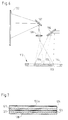
- the reference numeral 101 of Fig. 5 indicates a projection means, which includes a base case 102, to which is attached, through a support shaft 103 or the like, the lower end of a support arm 104. Attached to the upper end of this support arm 104 is a projector case 109, which contains a light source 105, two reflecting mirrors 106 and 107, and a convex lens 108. Light from the light source 105 is reflected down by the reflecting lens 106 and travels through a lower opening 110, illuminating the upper surface of the base case 102. A condenser lens (not shown) is provided between the light source 105 and the reflecting mirror 106.
- a well-known transmission type liquid crystal display 111 comprising a plurality of horizontal and vertical electrodes which cross each other in a liquid crystal medium. Attached to the lower surface of this liquid crystal display 111 is a concave mirror 112, a detailed view of which is shown in Fig. 6.
- the concave mirror 112 includes a thin aluminum substrate 113 having a thickness of approximately 1mm, on the upper surface of which are provided at small pitches a multitude of concentric-circle-like grooves 114 each of which exhibits a surface inclined towards the center.
- a cover layer 115 of transparent synthetic resin is provided so as to cover these grooves 114, so that the upper surface of the concave mirror 112 is formed as a flat surface. Accordingly, the refraction by this concave mirror 112 is very small, so that image information displayed on the liquid crystal display 111 is reflected free from distortion.
- this concave mirror 112 Due to the presence of this concave mirror 112, the light from the light source 105, which is reflected by the reflecting mirror 106, is then reflected by the concave mirror 112 and focused by the convex lens 108 before it is projected onto a screen 122 constituting the drawing board, by the reflecting mirror 107, which is supported in such a manner as to allow angular adjustment.
- the liquid crystal display 111 is driven by a control circuit 151 for calculating coordinate data from an electronic blackboard 121 and by a processor 161 for transmitting the data from this control circuit 151 to the liquid crystal display 111 so as to display it there.
- the electronic blackboard 121 is composed of a screen 122 and a tablet section 123 on the back surface thereof.
- the hand drawing section 122 includes a base 124 consisting of a flat plate of asbestos calcium silicate, urethane foam or the like, and a drawing board 122a consisting of a non-magnetic material such as austenite-type stainless steel.
- the tablet section 123 includes a plurality of X-direction magnetostrictive transmission media 125 arranged at fixed intervals in the X-direction, a plurality of Y-direction magnetostrictive transmission media 126 arranged at fixed intervals in the Y-direction, and a spacer 127 arranged between the X-direction magnetostrictive transmission media 125 and Y-direction magnetostrictive transmission media 126.
- a back board 128 is attached to the back side of the Y-direction magnetostrictive transmission media 126.
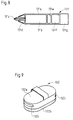
- the surface of the drawing board 122a is made smooth by, for example, porcelain enameled finish, and thus drawing with the marker 131 shown in Fig. 8 and erasing with the eraser 132 shown in Fig. 9 can be performed thereon.
- a description of the magnetostrictive tablet 123 will be omitted here since it is described in detail in, for example, Japanese Patent Application No. 59-41376.
- the marker 131 includes a cylindrical case 131a of a non-magnetic metal, an ink chamber 131b lodged in this case 131a, a drawing core material 131c, one end of which protrudes beyond the tip of the case 131a and the other end of which is lodged in the ink chamber 131b, and an approximately truncated-cone-like permanent magnet 131d which has a central through-hole for the core material 131c to extend through and which serves to impart magnetic flux to the tablet 123.
- the ink chamber 131b and the core material 131c are slidably lodged in the case 131a so that they may be withdrawn by pressure which is caused when a character, etc.
- a push-button-type switch 131e such as a microswitch, which is adapted to operate upon the withdrawal of the ink chamber 131b
- a light-emission control section 131f adapted to emit to the exterior, upon the operation of the switch 131e, a light, e.g., infrared rays, modulated in a way peculiar to this marker 131, and a light emitting section 131g composed of a battery and a light emitting element (neither of which are shown).
- the eraser 132 has basically the same structure as an ordinary eraser, namely, an erasing member 132b consisting of a sponge or the like is attached to the lower surface of an approximately elliptical hollow case 132a of synthetic resin. It differs from an ordinary eraser in that the case 132a contains a battery and a light emission control section (neither of which are shown). Further, provided in either end section of the case 132a are a permanent magnet for positional detection, a switch, and a light emitting section (none of which are shown) whose functions are similar to those of the permanent magnet 131d, switch 131e, and light emitting section 131f of the marker 131.
- a light emission control section (not shown) whose function is similar to that of the light emission control section 131f of the marker 131, the battery of this light emission control section and that of the light emitting section being shared by the switch and the light emitting element which are provided in either end section of the case 132a.
- a window 132c Provided at either end of the case 132 is a window 132c, through which are emitted infrared rays modulated to correspond to the switches.
- a tablet control circuit 141 has a tablet 123, an X-direction multiplexer 142, and a Y-direction multiplexer 143. An induced voltage due to electromagnetic induction is detected by a detection line in the tablet 123, and this induced voltage is transmitted to the control circuit 151 through the X-direction and Y-direction multiplexers 142 and 143, indicating the locus of a figure or of a character in X- and Y-coordinates.
- the induced voltage is amplified by an amplifier 152, rectified into a DC voltage by a detector 153, and converted into a digital value by an analog/digital (A/D) converter 154.
- This digital signal is applied through an input buffer 155 to an arithmetic processing circuit 156, where arithmetic processing is performed using the previous induced voltage sample (the digital value) temporarily stored in a memory 157 and data received from an input buffer 155, thereby determining the X- or Y-coordinate value.
- this arithmetic processing circuit 156 transmits control signals through an output buffer 158 to the X- and Y-direction multiplexers 142 and 143, so as to alternately transmit induced voltages in the X- and Y-directions to the amplifier 152.
- a drive power source 159 supplies a sinusoidal current to the excitation line of the tablet 123.
- a light receiving section is provided in, for example, the electronic blackboard apparatus 121, so that this section can receive the infrared rays from the marker 131 or the eraser 132, and an output signal from this light receiving section is used as a timing signal to be supplied to the input buffer 155.
- This timing signal is used for transmitting, from the arithmetic processing circuit 156 to the processor 161, the data from the tablet 123 only when a figure or a character is being drawn on the hand drawing section 122 with the marker 131 or being erased therefrom by the eraser 132.
- X- and Y-direction drivers 184 and 185 Supplied to these X- and Y-direction drivers 184 and 185 are scanning pulses generated by a scanning circuit 186 in synchronism with the timing pulses, and the drivers 184 and 185 drive those electrodes of the liquid crystal display 111 corresponding to the X- and Y-direction coordinates, displaying at the corresponding position on the liquid crystal display 111 the point indicated on the tablet 123.
- a figure or a character drawn on the liquid crystal display 111 with the marker 131 is displayed on this liquid crystal display 111 in a visible form and in exactly the same style.
- This display on the liquid crystal display 111 is projected onto the screen 122 by the light from the light source 105. Further, this display can be monitored by a monitor 172, which is connected to the processor 161, and produced as a hard copy by a printer 173 connected likewise to the processor 161. Further, connected to the processor 161 is a modem 171, by means of which coordinate data can be transmitted through the telephone line to the tablet section 123 of a similar apparatus installed in a distant place, and coordinate data from that apparatus can be received.
- an external memory device 174 for storing on a floppy disk positional data transmitted to this processor 161 and for transmitting to this processor 161 information on figures, characters, etc. stored on a floppy disk by an external input means.
- a text editing function to the processor 161
- adding a figure processing function to the processor makes it possible to utilize CAD, CAM, etc., so that not only hand-drawn characters or figures, but also texts, figures, etc. prepared beforehand can be displayed.
- the eraser 132 When the eraser 132 is used for the purpose of erasing a character or a figure drawn with the marker 131 on the screen 122 or correcting the position thereof, the character, etc. is erased by the erasing material 132b of the eraser 132, and, at the same time, the control circuit 151 is so instructed that the positional information already detected by the tablet 123 by infrared rays from the eraser 132 should be deleted. Then, the coordinate values of the positions indicated by the magnets of the eraser 132 are erased, with only the remaining coordinate positions being displayed.
- position detecting magnets are arranged at two positions on the eraser 132; when both of these magnets abut against the drawing board 122, the control circuit 151 calculates from the coordinate values related to these two positions the position of the straight line connecting them, and calculates the erasion range based on this straight line, deleting the coordinate values concerned from the stored coordinate values.
- the tablet 123 is of a magnetostrictive type, it may, of course, be of an electromagnetic-induction type or a capacitance type. Further, while in the above embodiment infrared rays are used for the timing signal, it is also possible to use electric waves through wire or by wireless. Further, when the projection is performed in a dark environment with a view to making clear the projection on the screen, it may be so arranged that a spot lighting is applied exclusively to the screen 122.
- a tablet and a screen are formed integrally, and image information entered at this tablet is displayed on a liquid crystal display, with this display being projected onto the screen. Accordingly, this embodiment allows effective use of the area of the place of meeting where it is used. Further, it is made possible to display data along with a figure or a table previously input to an external memory device and to project onto the screen synthesized information consisting of information drawn on the drawing board and information stored in an external memory device.
Landscapes
- Engineering & Computer Science (AREA)
- General Engineering & Computer Science (AREA)
- Theoretical Computer Science (AREA)
- Multimedia (AREA)
- Signal Processing (AREA)
- Human Computer Interaction (AREA)
- Physics & Mathematics (AREA)
- General Physics & Mathematics (AREA)
- Position Input By Displaying (AREA)
- Drawing Aids And Blackboards (AREA)
- Dot-Matrix Printers And Others (AREA)
- Facsimiles In General (AREA)
Claims (12)
- Elektronische Tafel mit:
einem Bildschirm (1, 121),
einer Koordinateneingabeeinrichtung (1a, 123), die in den Bildschirm integriert ist,
einem Eingabeinstrument (2, 3, 4, 131, 132) zur Angabe einer Eingabeposition auf einer Eingabeseite des Bildschirms, welche Eingabeposition von der Koordinateneingabeeinrichtung zu messen ist, und
einer Projektionseinrichtung (6, 101) zum Projizieren der mit dem Eingabeinstrument eingegebenen Information von der Eingabeseite aus auf den Bildschirm, in Übereinstimmung mit der eingegebenen Position auf dem Bildschirm. - Elektronische Tafel nach Anspruch 1, bei der das Eingabeinstrument aus einem Markierer zur Eingabe von auf dem Bildschirm anzuzeigender Information und einem Löscher zum Löschen der auf dem Bildschirm angezeigten Information besteht.
- Elektronische Tafel nach Anspruch 2, bei der der Bildschirm aus einem Zeichenbrett besteht, auf dem mit einem Zeichenmedium wie etwa Tinte gezeichnet werden kann und das eine wiederholte Verwendung gestattet,
der Markierer ein Zeichenmedium enthält, mit dem auf dem Zeichenbrett gezeichnet werden kann und
der Löscher ein Löschelement aufweist, das in der Lage ist, die mit dem Zeichenmedium gezeichnete Information auf dem Zeichenbrett zu löschen. - Elektronische Tafel nach einem der Ansprüche 1, 2 und 3, bei dem die Projektionseinrichtung ein mit einer Flüssigkristall-Anzeigetafel versehener Overhead-Projektor ist.
- Elektronische Tafel nach einem der Ansprüche 1, 2 und 3, bei dem die Projektionseinrichtung ein Video-Projektor ist.
- Elektronische Tafel nach einem der Ansprüche 1, 2, 3 und 5, bei dem ein Videobild und die eingegebene Information miteinander kombiniert und gemeinsam auf dem Bildschirm dargestellt werden.
- Elektronische Tafel nach einem der Ansprüche 1, 2, 3, 4, 5 und 6, mit einem Drucker zum Drucken der eingegebenen Information.
- Elektronische Tafel nach einem der Ansprüche 1, 2, 3, 4, 5, 6 und 7, mit einer Modulator-Demodulator-Schaltung, die die eingegebene Information über eine Telefonleitung sendet und empfängt.
- Elektronische Tafel nach einem der Ansprüche 1, 2, 3, 4, 5, 6, 7 und 8, mit einer Zeichenerkennungsfunktion.
- Elektronische Tafel nach einem der Ansprüche, 1, 2, 3, 4, 5, 6, 7, 8 und 9, mit einer Text-Edierfunktion.
- Elektronische Tafel nach einem der Ansprüche. 1, 2, 3. 4, 5, 6, 7, 8, 9 und 10, mit einer Plotter-Funktion.
- Elektronische Tafel nach einem der Ansprüche, 1, 2, 3, 4, 5, 6, 7, 8. 9, 10 und 11, bei der eine vorab in einem externen Speicher vorbereitete Figur dargestellt werden kann.
Applications Claiming Priority (3)
| Application Number | Priority Date | Filing Date | Title |
|---|---|---|---|
| JP63313015A JPH02158822A (ja) | 1988-12-13 | 1988-12-13 | 画像入力表示装置 |
| JP313015/88 | 1988-12-13 | ||
| PCT/JP1989/001251 WO1990007150A1 (fr) | 1988-12-13 | 1989-12-13 | Affichage d'images en entree et procede |
Publications (3)
| Publication Number | Publication Date |
|---|---|
| EP0453568A1 EP0453568A1 (de) | 1991-10-30 |
| EP0453568A4 EP0453568A4 (en) | 1992-06-03 |
| EP0453568B1 true EP0453568B1 (de) | 1995-11-02 |
Family
ID=18036201
Family Applications (1)
| Application Number | Title | Priority Date | Filing Date |
|---|---|---|---|
| EP90900995A Expired - Lifetime EP0453568B1 (de) | 1988-12-13 | 1989-12-13 | Elektronische tafel |
Country Status (4)
| Country | Link |
|---|---|
| EP (1) | EP0453568B1 (de) |
| JP (1) | JPH02158822A (de) |
| DE (1) | DE68924712T2 (de) |
| WO (1) | WO1990007150A1 (de) |
Families Citing this family (4)
| Publication number | Priority date | Publication date | Assignee | Title |
|---|---|---|---|---|
| WO1992005483A1 (de) * | 1990-09-15 | 1992-04-02 | Fraunhofer-Gesellschaft zur Förderung der angewandten Forschung e.V. | Vorrichtung zur dateneingabe |
| JPH08179888A (ja) * | 1994-12-21 | 1996-07-12 | Hitachi Ltd | 大画面ディスプレイ用入力装置 |
| US8890842B2 (en) | 2008-06-13 | 2014-11-18 | Steelcase Inc. | Eraser for use with optical interactive surface |
| US9076261B2 (en) * | 2012-09-27 | 2015-07-07 | Siemens Product Lifecycle Management Software Inc. | Virtual drafting tools |
Family Cites Families (9)
| Publication number | Priority date | Publication date | Assignee | Title |
|---|---|---|---|---|
| JPS5886630A (ja) * | 1981-11-18 | 1983-05-24 | Agency Of Ind Science & Technol | 濃淡図形用デイスプレ−装置 |
| JPS61211095A (ja) * | 1985-03-15 | 1986-09-19 | 日本電気株式会社 | 電子黒板装置 |
| JPS61246829A (ja) * | 1985-04-24 | 1986-11-04 | Fujitsu Ltd | 電子黒板 |
| JPS61252197A (ja) * | 1985-05-01 | 1986-11-10 | 日本電信電話株式会社 | 電子黒板における入力色判定方法 |
| JPS6222136A (ja) * | 1985-07-23 | 1987-01-30 | Casio Comput Co Ltd | 電子式黒板 |
| JPS62165235A (ja) * | 1986-01-17 | 1987-07-21 | Daikin Ind Ltd | 電子黒板入力用黒板消し |
| JPS62165234A (ja) * | 1986-01-17 | 1987-07-21 | Daikin Ind Ltd | 電子黒板入力用筆具 |
| JPS62254227A (ja) * | 1986-04-28 | 1987-11-06 | Wacom Co Ltd | 投影型液晶表示装置 |
| JPS62256024A (ja) * | 1986-04-30 | 1987-11-07 | Hitachi Ltd | 投射形座標入力システム |
-
1988
- 1988-12-13 JP JP63313015A patent/JPH02158822A/ja active Pending
-
1989
- 1989-12-13 DE DE68924712T patent/DE68924712T2/de not_active Expired - Lifetime
- 1989-12-13 WO PCT/JP1989/001251 patent/WO1990007150A1/ja not_active Ceased
- 1989-12-13 EP EP90900995A patent/EP0453568B1/de not_active Expired - Lifetime
Also Published As
| Publication number | Publication date |
|---|---|
| DE68924712T2 (de) | 1996-06-20 |
| JPH02158822A (ja) | 1990-06-19 |
| DE68924712D1 (de) | 1995-12-07 |
| EP0453568A1 (de) | 1991-10-30 |
| WO1990007150A1 (fr) | 1990-06-28 |
| EP0453568A4 (en) | 1992-06-03 |
Similar Documents
| Publication | Publication Date | Title |
|---|---|---|
| US6437314B1 (en) | Coordinate input pen, and electronic board, coordinate input system and electronic board system using the coordinate input pen | |
| US7015894B2 (en) | Information input and output system, method, storage medium, and carrier wave | |
| EP0615209B1 (de) | Eingabevorrichtung für Informationen, Speichervorrichtung für Lageinformationen und Lageerkennungssystem mit diesen Vorrichtungen | |
| US20030034961A1 (en) | Input system and method for coordinate and pattern | |
| US20020145595A1 (en) | Information input/output apparatus, information input/output control method, and computer product | |
| JPH0125470B2 (de) | ||
| JPH11212691A (ja) | ペン入力方法及び装置 | |
| US4853494A (en) | Information processing apparatus for inputting coordinate data selectively from either the obverse or the reverse surface of an input tablet | |
| JP2001243006A (ja) | 座標入力装置および座標入力方法 | |
| JPH07129322A (ja) | コンピュータディスプレイシステム | |
| EP0453568A1 (de) | Elektronische tafel | |
| JP4266076B2 (ja) | 電子黒板システム | |
| EP0396358B1 (de) | Bildlesegerät | |
| JPH0329193Y2 (de) | ||
| JP2001013935A (ja) | 画像投影システム | |
| JPH0737911Y2 (ja) | 投影ディスプレイ付電子黒板装置 | |
| JPS6180327A (ja) | 電子黒板装置 | |
| JPH0494998A (ja) | 電子黒板システム | |
| JP2002312113A (ja) | ペン型手書き入力データ処理装置、筆記具およびペン型手書き入力データ処理方法、並びにプログラム | |
| JPH1153113A (ja) | 表示入力装置 | |
| JPS59181389A (ja) | 表示制御方式 | |
| JP2011060115A (ja) | 情報処理システムおよび表示処理プログラム | |
| JPH0426910Y2 (de) | ||
| JP3210327B2 (ja) | 座標入力装置及び該装置を有する電子機器 | |
| JPH05173709A (ja) | イメージセンサ付表示入力一体型装置 |
Legal Events
| Date | Code | Title | Description |
|---|---|---|---|
| PUAI | Public reference made under article 153(3) epc to a published international application that has entered the european phase |
Free format text: ORIGINAL CODE: 0009012 |
|
| 17P | Request for examination filed |
Effective date: 19910607 |
|
| AK | Designated contracting states |
Kind code of ref document: A1 Designated state(s): DE FR GB IT |
|
| A4 | Supplementary search report drawn up and despatched |
Effective date: 19920413 |
|
| AK | Designated contracting states |
Kind code of ref document: A4 Designated state(s): DE FR GB IT |
|
| 17Q | First examination report despatched |
Effective date: 19950124 |
|
| GRAA | (expected) grant |
Free format text: ORIGINAL CODE: 0009210 |
|
| AK | Designated contracting states |
Kind code of ref document: B1 Designated state(s): DE FR GB IT |
|
| REF | Corresponds to: |
Ref document number: 68924712 Country of ref document: DE Date of ref document: 19951207 |
|
| ITF | It: translation for a ep patent filed | ||
| ET | Fr: translation filed | ||
| PLBE | No opposition filed within time limit |
Free format text: ORIGINAL CODE: 0009261 |
|
| STAA | Information on the status of an ep patent application or granted ep patent |
Free format text: STATUS: NO OPPOSITION FILED WITHIN TIME LIMIT |
|
| 26N | No opposition filed | ||
| PGFP | Annual fee paid to national office [announced via postgrant information from national office to epo] |
Ref country code: FR Payment date: 19971230 Year of fee payment: 9 |
|
| PG25 | Lapsed in a contracting state [announced via postgrant information from national office to epo] |
Ref country code: FR Free format text: LAPSE BECAUSE OF NON-PAYMENT OF DUE FEES Effective date: 19990831 |
|
| REG | Reference to a national code |
Ref country code: FR Ref legal event code: ST |
|
| REG | Reference to a national code |
Ref country code: GB Ref legal event code: IF02 |
|
| PG25 | Lapsed in a contracting state [announced via postgrant information from national office to epo] |
Ref country code: IT Free format text: LAPSE BECAUSE OF NON-PAYMENT OF DUE FEES Effective date: 20051213 |
|
| PGFP | Annual fee paid to national office [announced via postgrant information from national office to epo] |
Ref country code: DE Payment date: 20081223 Year of fee payment: 20 |
|
| PGFP | Annual fee paid to national office [announced via postgrant information from national office to epo] |
Ref country code: GB Payment date: 20081204 Year of fee payment: 20 |
|
| REG | Reference to a national code |
Ref country code: GB Ref legal event code: PE20 Expiry date: 20091212 |
|
| PG25 | Lapsed in a contracting state [announced via postgrant information from national office to epo] |
Ref country code: GB Free format text: LAPSE BECAUSE OF EXPIRATION OF PROTECTION Effective date: 20091212 |