EP0453913B1 - Procédé de préparation de bichromate de sodium - Google Patents
Procédé de préparation de bichromate de sodium Download PDFInfo
- Publication number
- EP0453913B1 EP0453913B1 EP91105917A EP91105917A EP0453913B1 EP 0453913 B1 EP0453913 B1 EP 0453913B1 EP 91105917 A EP91105917 A EP 91105917A EP 91105917 A EP91105917 A EP 91105917A EP 0453913 B1 EP0453913 B1 EP 0453913B1
- Authority
- EP
- European Patent Office
- Prior art keywords
- solution
- sodium
- monochromate
- weight
- acidification
- Prior art date
- Legal status (The legal status is an assumption and is not a legal conclusion. Google has not performed a legal analysis and makes no representation as to the accuracy of the status listed.)
- Expired - Lifetime
Links
- JHWIEAWILPSRMU-UHFFFAOYSA-N 2-methyl-3-pyrimidin-4-ylpropanoic acid Chemical compound OC(=O)C(C)CC1=CC=NC=N1 JHWIEAWILPSRMU-UHFFFAOYSA-N 0.000 title claims description 33
- 238000000034 method Methods 0.000 title claims description 12
- 238000002360 preparation method Methods 0.000 title description 3
- 230000020477 pH reduction Effects 0.000 claims description 33
- PXLIDIMHPNPGMH-UHFFFAOYSA-N sodium chromate Chemical compound [Na+].[Na+].[O-][Cr]([O-])(=O)=O PXLIDIMHPNPGMH-UHFFFAOYSA-N 0.000 claims description 28
- KRVSOGSZCMJSLX-UHFFFAOYSA-L chromic acid Substances O[Cr](O)(=O)=O KRVSOGSZCMJSLX-UHFFFAOYSA-L 0.000 claims description 24
- AWJWCTOOIBYHON-UHFFFAOYSA-N furo[3,4-b]pyrazine-5,7-dione Chemical compound C1=CN=C2C(=O)OC(=O)C2=N1 AWJWCTOOIBYHON-UHFFFAOYSA-N 0.000 claims description 23
- ZCDOYSPFYFSLEW-UHFFFAOYSA-N chromate(2-) Chemical compound [O-][Cr]([O-])(=O)=O ZCDOYSPFYFSLEW-UHFFFAOYSA-N 0.000 claims description 18
- UIIMBOGNXHQVGW-UHFFFAOYSA-M Sodium bicarbonate Chemical compound [Na+].OC([O-])=O UIIMBOGNXHQVGW-UHFFFAOYSA-M 0.000 claims description 16
- 238000001816 cooling Methods 0.000 claims description 12
- 238000004519 manufacturing process Methods 0.000 claims description 12
- 238000006243 chemical reaction Methods 0.000 claims description 11
- 238000001914 filtration Methods 0.000 claims description 11
- XLYOFNOQVPJJNP-UHFFFAOYSA-N water Substances O XLYOFNOQVPJJNP-UHFFFAOYSA-N 0.000 claims description 10
- 229910000030 sodium bicarbonate Inorganic materials 0.000 claims description 8
- 235000017557 sodium bicarbonate Nutrition 0.000 claims description 8
- VYZAMTAEIAYCRO-UHFFFAOYSA-N Chromium Chemical compound [Cr] VYZAMTAEIAYCRO-UHFFFAOYSA-N 0.000 claims description 7
- -1 dichromate ions Chemical class 0.000 claims description 7
- 230000029087 digestion Effects 0.000 claims description 6
- 239000000470 constituent Substances 0.000 claims description 4
- 150000002500 ions Chemical class 0.000 claims description 4
- 238000002386 leaching Methods 0.000 claims description 3
- 230000001590 oxidative effect Effects 0.000 claims description 3
- 239000000243 solution Substances 0.000 description 73
- CURLTUGMZLYLDI-UHFFFAOYSA-N Carbon dioxide Chemical compound O=C=O CURLTUGMZLYLDI-UHFFFAOYSA-N 0.000 description 28
- 229910002092 carbon dioxide Inorganic materials 0.000 description 14
- 239000001569 carbon dioxide Substances 0.000 description 12
- 239000000203 mixture Substances 0.000 description 11
- QAOWNCQODCNURD-UHFFFAOYSA-N Sulfuric acid Chemical compound OS(O)(=O)=O QAOWNCQODCNURD-UHFFFAOYSA-N 0.000 description 10
- 238000005868 electrolysis reaction Methods 0.000 description 10
- XLYOFNOQVPJJNP-ZSJDYOACSA-N heavy water Substances [2H]O[2H] XLYOFNOQVPJJNP-ZSJDYOACSA-N 0.000 description 10
- KIEOKOFEPABQKJ-UHFFFAOYSA-N sodium dichromate Chemical compound [Na+].[Na+].[O-][Cr](=O)(=O)O[Cr]([O-])(=O)=O KIEOKOFEPABQKJ-UHFFFAOYSA-N 0.000 description 10
- HEMHJVSKTPXQMS-UHFFFAOYSA-M Sodium hydroxide Chemical compound [OH-].[Na+] HEMHJVSKTPXQMS-UHFFFAOYSA-M 0.000 description 9
- 238000001704 evaporation Methods 0.000 description 6
- CDBYLPFSWZWCQE-UHFFFAOYSA-L Sodium Carbonate Chemical compound [Na+].[Na+].[O-]C([O-])=O CDBYLPFSWZWCQE-UHFFFAOYSA-L 0.000 description 5
- 150000001768 cations Chemical class 0.000 description 5
- 239000013078 crystal Substances 0.000 description 5
- 238000002425 crystallisation Methods 0.000 description 5
- 230000008025 crystallization Effects 0.000 description 5
- SOCTUWSJJQCPFX-UHFFFAOYSA-N dichromate(2-) Chemical compound [O-][Cr](=O)(=O)O[Cr]([O-])(=O)=O SOCTUWSJJQCPFX-UHFFFAOYSA-N 0.000 description 5
- 239000012452 mother liquor Substances 0.000 description 5
- 238000001556 precipitation Methods 0.000 description 5
- 239000007864 aqueous solution Substances 0.000 description 4
- 230000008020 evaporation Effects 0.000 description 4
- 239000007787 solid Substances 0.000 description 4
- PMZURENOXWZQFD-UHFFFAOYSA-L Sodium Sulfate Chemical compound [Na+].[Na+].[O-]S([O-])(=O)=O PMZURENOXWZQFD-UHFFFAOYSA-L 0.000 description 3
- QVGXLLKOCUKJST-UHFFFAOYSA-N atomic oxygen Chemical compound [O] QVGXLLKOCUKJST-UHFFFAOYSA-N 0.000 description 3
- 229910052804 chromium Inorganic materials 0.000 description 3
- 239000011651 chromium Substances 0.000 description 3
- 238000002474 experimental method Methods 0.000 description 3
- 239000012528 membrane Substances 0.000 description 3
- 229910052760 oxygen Inorganic materials 0.000 description 3
- 239000001301 oxygen Substances 0.000 description 3
- 229910001415 sodium ion Inorganic materials 0.000 description 3
- 229910052938 sodium sulfate Inorganic materials 0.000 description 3
- 235000011152 sodium sulphate Nutrition 0.000 description 3
- 238000005406 washing Methods 0.000 description 3
- XEEYBQQBJWHFJM-UHFFFAOYSA-N Iron Chemical compound [Fe] XEEYBQQBJWHFJM-UHFFFAOYSA-N 0.000 description 2
- 238000009825 accumulation Methods 0.000 description 2
- 229910001420 alkaline earth metal ion Inorganic materials 0.000 description 2
- 238000001035 drying Methods 0.000 description 2
- 239000011521 glass Substances 0.000 description 2
- 229910052739 hydrogen Inorganic materials 0.000 description 2
- 239000001257 hydrogen Substances 0.000 description 2
- 239000012535 impurity Substances 0.000 description 2
- 239000007788 liquid Substances 0.000 description 2
- VNWKTOKETHGBQD-UHFFFAOYSA-N methane Chemical compound C VNWKTOKETHGBQD-UHFFFAOYSA-N 0.000 description 2
- 229920006395 saturated elastomer Polymers 0.000 description 2
- 238000000926 separation method Methods 0.000 description 2
- 239000000725 suspension Substances 0.000 description 2
- OYPRJOBELJOOCE-UHFFFAOYSA-N Calcium Chemical compound [Ca] OYPRJOBELJOOCE-UHFFFAOYSA-N 0.000 description 1
- BVKZGUZCCUSVTD-UHFFFAOYSA-L Carbonate Chemical compound [O-]C([O-])=O BVKZGUZCCUSVTD-UHFFFAOYSA-L 0.000 description 1
- UFHFLCQGNIYNRP-UHFFFAOYSA-N Hydrogen Chemical compound [H][H] UFHFLCQGNIYNRP-UHFFFAOYSA-N 0.000 description 1
- XUIMIQQOPSSXEZ-UHFFFAOYSA-N Silicon Chemical compound [Si] XUIMIQQOPSSXEZ-UHFFFAOYSA-N 0.000 description 1
- UIIMBOGNXHQVGW-DEQYMQKBSA-M Sodium bicarbonate-14C Chemical compound [Na+].O[14C]([O-])=O UIIMBOGNXHQVGW-DEQYMQKBSA-M 0.000 description 1
- QAOWNCQODCNURD-UHFFFAOYSA-L Sulfate Chemical compound [O-]S([O-])(=O)=O QAOWNCQODCNURD-UHFFFAOYSA-L 0.000 description 1
- 238000006887 Ullmann reaction Methods 0.000 description 1
- 239000002253 acid Substances 0.000 description 1
- 239000003513 alkali Substances 0.000 description 1
- 229910052782 aluminium Inorganic materials 0.000 description 1
- XAGFODPZIPBFFR-UHFFFAOYSA-N aluminium Chemical compound [Al] XAGFODPZIPBFFR-UHFFFAOYSA-N 0.000 description 1
- 229910052791 calcium Inorganic materials 0.000 description 1
- 239000011575 calcium Substances 0.000 description 1
- BRPQOXSCLDDYGP-UHFFFAOYSA-N calcium oxide Chemical compound [O-2].[Ca+2] BRPQOXSCLDDYGP-UHFFFAOYSA-N 0.000 description 1
- 239000000292 calcium oxide Substances 0.000 description 1
- ODINCKMPIJJUCX-UHFFFAOYSA-N calcium oxide Inorganic materials [Ca]=O ODINCKMPIJJUCX-UHFFFAOYSA-N 0.000 description 1
- BVKZGUZCCUSVTD-UHFFFAOYSA-N carbonic acid Chemical compound OC(O)=O BVKZGUZCCUSVTD-UHFFFAOYSA-N 0.000 description 1
- 150000004649 carbonic acid derivatives Chemical class 0.000 description 1
- 238000005341 cation exchange Methods 0.000 description 1
- 238000005119 centrifugation Methods 0.000 description 1
- 239000003795 chemical substances by application Substances 0.000 description 1
- 239000011476 clinker brick Substances 0.000 description 1
- 230000000052 comparative effect Effects 0.000 description 1
- 150000001875 compounds Chemical class 0.000 description 1
- 238000005260 corrosion Methods 0.000 description 1
- 230000007797 corrosion Effects 0.000 description 1
- 238000010790 dilution Methods 0.000 description 1
- 239000012895 dilution Substances 0.000 description 1
- 238000005516 engineering process Methods 0.000 description 1
- 239000000446 fuel Substances 0.000 description 1
- 150000004679 hydroxides Chemical class 0.000 description 1
- 238000011065 in-situ storage Methods 0.000 description 1
- 238000009776 industrial production Methods 0.000 description 1
- 239000003112 inhibitor Substances 0.000 description 1
- 229910052742 iron Inorganic materials 0.000 description 1
- 239000007791 liquid phase Substances 0.000 description 1
- 239000003345 natural gas Substances 0.000 description 1
- 150000002894 organic compounds Chemical class 0.000 description 1
- 230000003647 oxidation Effects 0.000 description 1
- 238000007254 oxidation reaction Methods 0.000 description 1
- 238000006864 oxidative decomposition reaction Methods 0.000 description 1
- 238000010979 pH adjustment Methods 0.000 description 1
- 238000005192 partition Methods 0.000 description 1
- 239000002244 precipitate Substances 0.000 description 1
- 230000001376 precipitating effect Effects 0.000 description 1
- 238000004064 recycling Methods 0.000 description 1
- 229910052710 silicon Inorganic materials 0.000 description 1
- 239000010703 silicon Substances 0.000 description 1
- 229910000029 sodium carbonate Inorganic materials 0.000 description 1
- 229910052717 sulfur Inorganic materials 0.000 description 1
- 239000011593 sulfur Substances 0.000 description 1
- 229920001864 tannin Polymers 0.000 description 1
- 239000001648 tannin Substances 0.000 description 1
- 235000018553 tannin Nutrition 0.000 description 1
- LSGOVYNHVSXFFJ-UHFFFAOYSA-N vanadate(3-) Chemical compound [O-][V]([O-])([O-])=O LSGOVYNHVSXFFJ-UHFFFAOYSA-N 0.000 description 1
- 238000010626 work up procedure Methods 0.000 description 1
Images
Classifications
-
- C—CHEMISTRY; METALLURGY
- C01—INORGANIC CHEMISTRY
- C01G—COMPOUNDS CONTAINING METALS NOT COVERED BY SUBCLASSES C01D OR C01F
- C01G37/00—Compounds of chromium
- C01G37/14—Chromates; Bichromates
Definitions
- the invention relates to a process for the preparation of sodium dichromate and sodium dichromate solutions.
- sodium dichromate is produced by alkaline oxidizing digestion of chrome ore with soda and / or sodium hydroxide and atmospheric oxygen.
- a sodium monochromate solution with a content of 300 to 500 g / l Na2CrO4 is obtained by leaching out the kiln clinker leaving the digestion furnace with water or chromate-containing aqueous solution, adjusting the pH of the mash to 7 to 9.5 and removing the insoluble constituents by filtration.
- the pH is usually set with sulfuric acid and / or with sodium dichromate solution.
- the monochromations of the solution are converted into dichromations either by acidification with sulfuric acid, by acidification with carbon dioxide under pressure or by electrolytic acidification. Acidification with sulfuric acid produces sodium sulfate, which precipitates when the solution is concentrated to about 70% by weight of Na2Cr2O7 ⁇ 2H2O.
- the resulting chromate-containing sodium sulfate must be processed.
- the sodium monochromate solution is concentrated to a concentration of 750 to 1000 g / l Na2CrO4 and saturated with carbonic acid in autoclaves by supplying carbon dioxide at a pressure of 0.5 to 1.5 MPa (5-15 bar) with cooling.
- a pressure of 0.5 to 1.5 MPa (5-15 bar) With the precipitation of sodium hydrogen carbonate, an approximately 75 to 95% conversion of monochromations into dichromations is achieved.
- the remaining conversion up to 100% can be carried out in a further stage after concentration to 1300 g / l Na2CrO4 (already formed Na2CrO7 ⁇ 2H2O in Na2CrO4 equivalents) by adding carbon dioxide.
- this step to the remaining sales is technically very complex. It is also possible to carry out the remaining conversion with sulfuric acid or by electrolysis.
- chromate-containing sodium sulfate is formed in the reaction with sulfuric acid and must be subjected to a workup.
- the electrolytic acidification takes place by introducing the sodium monochromate solution or the sodium monochromate solution, which is 75 to 95% converted into sodium dichromate, into the anode compartment of an electrolysis cell provided with a cation exchange membrane.
- sodium ions migrate through the membrane into the cathode space of the cell filled with water or an aqueous solution.
- the sodium ions form an aqueous solution containing sodium hydroxide with the hydroxide ions formed on the cathode with evolution of hydrogen.
- the chromate ions are converted into dichromate ions by the hydrogen ions formed on the anode with simultaneous oxygen evolution. This process is also technically complex.
- the sodium dichromate solutions obtainable in the processes mentioned are concentrated by evaporating water.
- the sodium dichromate which crystallizes is separated off and dried.
- the present invention now follows another technically simple route for the production of sodium dichromate solutions and sodium dichromate crystals which does not have the disadvantages of the methods described.
- the invention relates to a process for the preparation of sodium dichromate and sodium dichromate solutions by alkaline oxidizing digestion of chromium ores, leaching out of the oven clinker obtained with water or chromate-containing aqueous solution, adjusting the pH to 7-9.5, separating off the insoluble constituents by filtration, where a sodium monochromate solution is obtained, conversion of the monochromations of this solution into dichromations by acidification with CO2, separation of sodium hydrogen carbonate formed, cooling of the solution for the precipitation of sodium monochromate and recycling of precipitated sodium monochromate to the monochromate solution before acidification, characterized in that the monochromate solution before acidification a concentration of 750 to 1000 g / l is concentrated, the acidification with CO2 is carried out under pressure up to a degree of acidification of 80 to 95% and the solution is cooled to precipitate ng of sodium monochromate to a temperature of -10 to -25 ° C, preferably to -10 to -20 ° C, takes place.
- Acidification of sodium monochromate solutions with carbon dioxide under pressure and cooling of the solution after separation of sodium hydrogen carbonate to temperatures below -10 ° C. and filtration of precipitated sodium monochromate give solutions in which up to 99% of the chromate ions of the solution are present from dichromations.
- Such solutions which contain only small amounts of residual sodium monochromate, can be used in many manufacturing processes, such as the electrolytic production of chromic acid, the production of chromium tannins and the oxidation of organic compounds.
- the remaining monochromate ions of the solution can be converted into dichromate ions with an acid or by electrolysis.
- the monochromations still present after cooling and filtration are preferably converted by adding chromic acid and / or a solution containing chromic acid. Suitable solutions containing chromic acid are obtained, for example, in the electrolytic production of chromic acid.
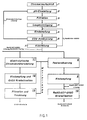
- the method according to the invention is explained with reference to FIG. 1.
- the variant of the method according to the invention described in FIG. 1 represents a particularly advantageous embodiment.
- Chrome ore is broken down by alkaline oxidative decomposition with soda and atmospheric oxygen at 1000 to 1100 ° C in the presence of a lean agent in a rotary kiln (1).
- the resulting clinker brick is then leached with water or dilute chromate solution and adjusted to a pH between 7 and 9.5 with a solution containing sodium dichromate (2).
- This turns soluble alkali compounds of iron, aluminum and silicon into insoluble and good Filterable hydroxides or oxyhydrates converted, which are separated together with the insoluble constituents of the kiln clinker (3).
- the resulting sodium monochromate solution with a content of 300 to 500 g / l of Na2CrO4 is then, as described in EP-A-47799, freed from dissolved vanadate by adding calcium oxide at pH values from 10 to 13.
- the solution, which now contains calcium, is freed from the main amount of alkaline earth metal ions and other polyvalent cations by addition or in situ generation of sodium carbonate by precipitation as carbonates (4).
- the precipitation is preferably carried out at temperatures from 50 to 100 ° C., at pH values between 8 and 12 and with an approximately 2 to 10-fold molar excess of carbonate, based on the amount of alkaline earth metal ions.
- a sodium monochromate solution freed from polyvalent cations except for less than 5 mg / l taken together is obtained.
- the content of polyvalent cations can be reduced even further with the aid of suitable selective cation exchangers.
- the sodium monochromate solution is then concentrated to a content of 750 to 1000 g / l of Na2CrO4 by single or multi-stage evaporation (5).
- the now concentrated solution is adjusted by one-stage or multi-stage supply of carbon dioxide up to a final pressure of 0.5 to 1.5 MPa (5-15 bar) at a final temperature of not more than 50 ° C and a pH value below 6.5 and in this way, with the precipitation of sodium hydrogen carbonate, an 80 to 95% conversion of the sodium monochromate into sodium dichromate is achieved (6).
- Carbon dioxide can be fed in gaseous or liquid.
- the sodium bicarbonate is separated from the resulting suspension under continuing carbon dioxide pressure or, after the pressure has been let down, the sodium bicarbonate is rapidly separated off before it reacts with the sodium dichromate.
- the separated sodium bicarbonate is calcined at 200 to 300 ° C., optionally with the addition of sodium hydroxide solution, to soda, which is fed to the chromium ore digestion (1).
- the resulting sodium monochromate / sodium dichromate solution, separated from the sodium bicarbonate, is then cooled to -10 to -20 ° C. in a vessel or vessels equipped with stirrers and after a dwell time of 5 to 5 minutes after removal of a partial stream for adjusting the pH of the leached kiln clinker Sodium monochromate is removed by filtration for 60 minutes (7).
- Sodium dichromate solutions are obtained in which 97 to 99% of the chromate is present as dichromate.
- the filtered sodium monochromate is added to the evaporation (5) or before the pH adjustment (2), if appropriate after adding water.
- sodium monochromate which has been filtered off, if appropriate after washing and drying, for use such as, for example, the production of corrosion inhibitors.
- the cooling of the sodium monochromate / sodium dichromate solution can be carried out using methods which are customary in industry, as described, for example, in "Ullmanns Encyklopadie der Technischen Chemie, 4th Edition, Volume 3, pp. 186 to 218, Verlag Chemie, Weinheim, 1973" . If liquid carbon dioxide is used for acidification, it makes sense to cool the solution directly or indirectly via a heat exchanger with a suitable heat exchange medium by evaporating carbon dioxide.
- a part of the solution obtained in the cooling (7) is now fed to the electrolytic chromic acid production (11) or another use.
- the other part is transferred with chromic acid-containing mother liquor from chromic acid filtration (13), with solid chromic acid or with chromic acid solution to a sodium dichromate solution in which all chromate ions are present as dichromate ions (8).
- These Solution is now fed directly or after evaporation to 60 to 70 wt .-% Na2Cr2O7 ⁇ 2H2O (9) for their use.
- the solution is concentrated to about 1650 g / l Na2Cr2O7 ⁇ 2H2O, sodium dichromate precipitating out, which is separated from the solution by filtration (10).
- the sodium dichromate / sodium monochromate solution is converted into a chromic acid-containing solution in a multi-stage electrolysis at 50 to 90 ° C in two-chamber electrolysis cells with cation-selective membranes as partitions (11).
- the electrolysis is operated in such a way that the solution mentioned is introduced into the anode chamber of the first stage and, after a partial conversion of the dichromate into chromic acid, then flows to the second stage, which in some cases causes further conversion to chromic acid, and so on step by step to the last Stage is carried out in which a degree of conversion of the dichromate into chromic acid of 55 to 70% corresponding to a molar ratio of sodium ions to chromic acid of 0.45: 0.55 to 0.30: 0.70 is reached.
- the number of stages can be chosen as desired, a 6 to 15-stage electrolysis being preferred.
- the chromic acid formed during electrolysis and a solution containing residual sodium dichromate is brought to a water content of approx. 12 to 22% by weight of water at temperatures between 55 and 110 ° C. by evaporation, the majority of the chromic acid crystallizing out (12).
- the resulting suspension is then separated by centrifugation at 50 to 110 ° C in a solid consisting essentially of crystalline chromic acid and in a liquid phase, hereinafter called mother liquor (13).
- the mother liquor obtained if appropriate after dilution with water, is returned to the electrolysis at a suitable point, ie in a degree of dichromate conversion which is as similar as possible.
- part of the mother liquor is removed and used in the residual acidification (8).
- the crystalline Chromic acid is freed from adhering mother liquor by washing once or several times with 10 to 50% by weight, based on the weight of the solid, of saturated or almost saturated chromic acid solution and by centrifuging after each washing process.
- the washed pure chromic acid crystals can now be used directly or after drying.
- sodium dichromate / sodium monochromate solutions were used, which were prepared by dissolving sodium dichromate and sodium monochromate.
- the compositions of the solutions were chosen in such a way that they can be present in the industrial production of sodium dichromate after acidification with carbon dioxide under pressure.
- a partially acidified sodium dichromate solution was used, which was obtained in an industrial process after acidification with carbon dioxide.
- the solutions were cooled using an electrically operated laboratory cryostat.
- Example 1 50 ml each were cooled to the specified temperatures, held at these temperatures for 60 minutes and then filtered through a cooled glass frit.
- the Na2CrO4 crystallization occurred at 10 ° C. When cooling below -13 ° C, the solution solidified to a solid mass.
Landscapes
- Chemical & Material Sciences (AREA)
- Organic Chemistry (AREA)
- Inorganic Chemistry (AREA)
- Inorganic Compounds Of Heavy Metals (AREA)
- Organic Low-Molecular-Weight Compounds And Preparation Thereof (AREA)
Claims (2)
- Procédé pour la préparation de bichromate de sodium et de solutions de bichromate de sodium par dissolution oxydante alcaline de minerais de chrome, lavage du clinker de four obtenu avec de l'eau ou avec une solution aqueuse contenant du chromate, ajustement du pH à une valeur de 7 à 9,5, séparation des constituants insolubles par filtration, sur quoi on obtient une solution de monochromate de sodium, conversion des ions monochromates de cette solution en ions bichromates par acidification avec du CO₂, séparation de l'hydrogénocarbonate de sodium formé, refroidissement de la solution pour faire précipiter le monochromate de sodium et recyclage du monochromate de sodium précipité dans la solution de monochromate avant l'acidification, caractérisé en ce qu'on concentre la solution de monochromate avant l'acidification à une concentration de 750 à 1 000 g/l, on met en oeuvre l'acidification avec du CO₂ sous pression jusqu'à un degré d'acidification de 80 à 95 % et on réalise le refroidissement de la solution pour faire précipiter le monochromate de sodium à une température de -10 à -25°C.
- Procédé selon la revendication 1, caractérisé en ce qu'on réalise la conversion des ions monochromates encore présents après le refroidissement et la filtration par addition d'acide chromique et/ou d'une solution contenant de l'acide chromique.
Applications Claiming Priority (2)
| Application Number | Priority Date | Filing Date | Title |
|---|---|---|---|
| DE4013335A DE4013335A1 (de) | 1990-04-26 | 1990-04-26 | Verfahren zur herstellung von natriumdichtromat |
| DE4013335 | 1990-04-26 |
Publications (3)
| Publication Number | Publication Date |
|---|---|
| EP0453913A2 EP0453913A2 (fr) | 1991-10-30 |
| EP0453913A3 EP0453913A3 (en) | 1992-05-20 |
| EP0453913B1 true EP0453913B1 (fr) | 1994-11-17 |
Family
ID=6405152
Family Applications (1)
| Application Number | Title | Priority Date | Filing Date |
|---|---|---|---|
| EP91105917A Expired - Lifetime EP0453913B1 (fr) | 1990-04-26 | 1991-04-13 | Procédé de préparation de bichromate de sodium |
Country Status (11)
| Country | Link |
|---|---|
| EP (1) | EP0453913B1 (fr) |
| JP (1) | JP3262127B2 (fr) |
| BR (1) | BR9101664A (fr) |
| CA (1) | CA2041005A1 (fr) |
| DE (2) | DE4013335A1 (fr) |
| ES (1) | ES2063394T3 (fr) |
| PL (1) | PL165627B1 (fr) |
| RO (1) | RO110459B1 (fr) |
| RU (1) | RU2008262C1 (fr) |
| TR (1) | TR25954A (fr) |
| ZA (1) | ZA913113B (fr) |
Families Citing this family (4)
| Publication number | Priority date | Publication date | Assignee | Title |
|---|---|---|---|---|
| DE4333349C2 (de) * | 1993-09-30 | 1999-03-11 | Bayer Ag | Verfahren zur Herstellung von Alkalichromaten aus Chromerz |
| JP2001060590A (ja) | 1999-08-20 | 2001-03-06 | Denso Corp | 半導体装置の電気配線及びその製造方法 |
| DE10217206A1 (de) * | 2002-04-18 | 2003-11-06 | Bayer Ag | Verfahren zur Verwertung von Vanadium aus Chromerz als Vanadium-V-oxid |
| CN102649585B (zh) * | 2011-08-22 | 2014-05-14 | 四川省银河化学股份有限公司 | 一种红矾钠的制备方法 |
Family Cites Families (5)
| Publication number | Priority date | Publication date | Assignee | Title |
|---|---|---|---|---|
| DE379410C (de) * | 1921-04-14 | 1923-08-22 | Griesheim Elektron Chem Fab | Verfahren zur Herstellung von Natriumbichromat aus Natriumchromat mittels Kohlensaeure |
| FR1223186A (fr) * | 1958-05-05 | 1960-06-15 | Diamond Alkali Co | Procédé de purification de liqueurs de chromates et bichromates |
| RO64038A2 (fr) * | 1972-12-01 | 1978-07-15 | Inst De Chime | Procede pour conversion du chromate de sodium en bichromate de sodium |
| US3933972A (en) * | 1974-02-11 | 1976-01-20 | Products Chimiques Ugine Kuhlmann | Process for preparing pure sodium bichromate |
| DE3837266A1 (de) * | 1988-11-03 | 1990-05-10 | Bayer Ag | Verfahren zur herstellung von natriumdichromat |
-
1990
- 1990-04-26 DE DE4013335A patent/DE4013335A1/de not_active Withdrawn
-
1991
- 1991-04-13 ES ES91105917T patent/ES2063394T3/es not_active Expired - Lifetime
- 1991-04-13 EP EP91105917A patent/EP0453913B1/fr not_active Expired - Lifetime
- 1991-04-13 DE DE59103520T patent/DE59103520D1/de not_active Expired - Fee Related
- 1991-04-22 RO RO147405A patent/RO110459B1/ro unknown
- 1991-04-22 JP JP11654291A patent/JP3262127B2/ja not_active Expired - Fee Related
- 1991-04-23 CA CA002041005A patent/CA2041005A1/fr not_active Abandoned
- 1991-04-24 PL PL91290011A patent/PL165627B1/pl unknown
- 1991-04-25 TR TR91/0389A patent/TR25954A/xx unknown
- 1991-04-25 BR BR919101664A patent/BR9101664A/pt not_active IP Right Cessation
- 1991-04-25 ZA ZA913113A patent/ZA913113B/xx unknown
- 1991-04-25 RU SU914895129A patent/RU2008262C1/ru active
Also Published As
| Publication number | Publication date |
|---|---|
| EP0453913A2 (fr) | 1991-10-30 |
| PL165627B1 (pl) | 1995-01-31 |
| DE4013335A1 (de) | 1991-10-31 |
| RU2008262C1 (ru) | 1994-02-28 |
| CA2041005A1 (fr) | 1991-10-27 |
| TR25954A (tr) | 1993-11-01 |
| DE59103520D1 (de) | 1994-12-22 |
| ES2063394T3 (es) | 1995-01-01 |
| RO110459B1 (ro) | 1996-01-30 |
| EP0453913A3 (en) | 1992-05-20 |
| JPH04228432A (ja) | 1992-08-18 |
| JP3262127B2 (ja) | 2002-03-04 |
| PL290011A1 (en) | 1992-01-13 |
| BR9101664A (pt) | 1991-12-10 |
| ZA913113B (en) | 1992-02-26 |
Similar Documents
| Publication | Publication Date | Title |
|---|---|---|
| DE69829994T2 (de) | Verfahren zur reinigung von lithiumcarbonat | |
| EP0433748B1 (fr) | Procédé de préparation d'acide chromique | |
| US1148062A (en) | Method of utilizing battery-waste. | |
| EP0453913B1 (fr) | Procédé de préparation de bichromate de sodium | |
| DE2841271A1 (de) | Verfahren zur aufarbeitung von buntmetallhydroxidschlammrueckstaenden | |
| US5250274A (en) | Process for the production of sodium dichromate | |
| DE1952104B2 (de) | Verfahren zur Herstellung von reinen Alkaliphosphaten aus Naßverfahrensphosphorsäure | |
| DE1186451B (de) | Verfahren zur Herstellung von festem Kaliumdisulfit | |
| EP0368066B1 (fr) | Procédé de préparation du bichromate de sodium | |
| DE1543801A1 (de) | Verfahren zur Herstellung einer aliphatischen alpha-Aminocarbonsaeure aus der entsprechenden alpha-Chlorcarbonsaeure und Ammoniak | |
| DE2365881B2 (de) | Verfahren zur Reinigung von Naßphosphorsäure | |
| US4600565A (en) | Process for making manganese (II) salt solutions containing ammonium salt | |
| DE2757068A1 (de) | Verfahren zur abtrennung von gallium aus bei der verarbeitung aluminiumhaltiger erze anfallenden alkalialuminatloesungen | |
| EP0433750B1 (fr) | Procédé de préparation d'acide chromique | |
| DE2151323A1 (de) | Verfahren zur Herstellung von Chromverbindungen | |
| EP4480918A1 (fr) | Procédé de récupération d'hydroxyde de lithium | |
| WO2025215014A1 (fr) | Récupération de phosphate de fer à partir d'un mélange multi-métallique | |
| DE102024112841A1 (de) | Verfahren zur Kristallisation von hochreinem Lithiumchlorid | |
| DE3908127A1 (de) | Verfahren zur herstellung von kaliumpersulfat hoher reinheit | |
| DE1952751C (de) | Verfahren zur hydrometallurgischen Verhüttung von schwefelhaltigen Nickelkonzentraten | |
| AT230395B (de) | Verfahren zur Herstellung von im wesentlichen wasserfreiem Natriumkarbonat | |
| DE616173C (de) | Herstellung von Tonerde | |
| DE2145084A1 (de) | Verfahren zur Abtrennung von Citronensäure aus wäßrigen Lösungen, die Citronensäure und L(+)-Isocitronensäure enthalten | |
| EP0157152A2 (fr) | Procédé de préparation de carbonate de manganèse | |
| DD292891A5 (de) | Verfahren zur abtrennung von strontium aus bariumsalzen |
Legal Events
| Date | Code | Title | Description |
|---|---|---|---|
| PUAI | Public reference made under article 153(3) epc to a published international application that has entered the european phase |
Free format text: ORIGINAL CODE: 0009012 |
|
| AK | Designated contracting states |
Kind code of ref document: A2 Designated state(s): DE ES GB IT |
|
| PUAL | Search report despatched |
Free format text: ORIGINAL CODE: 0009013 |
|
| AK | Designated contracting states |
Kind code of ref document: A3 Designated state(s): DE ES GB IT |
|
| 17P | Request for examination filed |
Effective date: 19920609 |
|
| 17Q | First examination report despatched |
Effective date: 19930603 |
|
| GRAA | (expected) grant |
Free format text: ORIGINAL CODE: 0009210 |
|
| AK | Designated contracting states |
Kind code of ref document: B1 Designated state(s): DE ES GB IT |
|
| REF | Corresponds to: |
Ref document number: 59103520 Country of ref document: DE Date of ref document: 19941222 |
|
| ITF | It: translation for a ep patent filed | ||
| REG | Reference to a national code |
Ref country code: ES Ref legal event code: FG2A Ref document number: 2063394 Country of ref document: ES Kind code of ref document: T3 |
|
| GBT | Gb: translation of ep patent filed (gb section 77(6)(a)/1977) |
Effective date: 19950306 |
|
| PLBE | No opposition filed within time limit |
Free format text: ORIGINAL CODE: 0009261 |
|
| STAA | Information on the status of an ep patent application or granted ep patent |
Free format text: STATUS: NO OPPOSITION FILED WITHIN TIME LIMIT |
|
| 26N | No opposition filed | ||
| PGFP | Annual fee paid to national office [announced via postgrant information from national office to epo] |
Ref country code: ES Payment date: 19960411 Year of fee payment: 6 |
|
| PGFP | Annual fee paid to national office [announced via postgrant information from national office to epo] |
Ref country code: DE Payment date: 19970313 Year of fee payment: 7 |
|
| PG25 | Lapsed in a contracting state [announced via postgrant information from national office to epo] |
Ref country code: ES Free format text: LAPSE BECAUSE OF NON-PAYMENT OF DUE FEES Effective date: 19970414 |
|
| PG25 | Lapsed in a contracting state [announced via postgrant information from national office to epo] |
Ref country code: DE Free format text: LAPSE BECAUSE OF NON-PAYMENT OF DUE FEES Effective date: 19990202 |
|
| REG | Reference to a national code |
Ref country code: ES Ref legal event code: FD2A Effective date: 19990503 |
|
| REG | Reference to a national code |
Ref country code: GB Ref legal event code: IF02 |
|
| PGFP | Annual fee paid to national office [announced via postgrant information from national office to epo] |
Ref country code: GB Payment date: 20030409 Year of fee payment: 13 |
|
| PG25 | Lapsed in a contracting state [announced via postgrant information from national office to epo] |
Ref country code: GB Free format text: LAPSE BECAUSE OF NON-PAYMENT OF DUE FEES Effective date: 20040413 |
|
| GBPC | Gb: european patent ceased through non-payment of renewal fee |
Effective date: 20040413 |
|
| PG25 | Lapsed in a contracting state [announced via postgrant information from national office to epo] |
Ref country code: IT Free format text: LAPSE BECAUSE OF NON-PAYMENT OF DUE FEES;WARNING: LAPSES OF ITALIAN PATENTS WITH EFFECTIVE DATE BEFORE 2007 MAY HAVE OCCURRED AT ANY TIME BEFORE 2007. THE CORRECT EFFECTIVE DATE MAY BE DIFFERENT FROM THE ONE RECORDED. Effective date: 20050413 |