EP0454058A2 - Verwendung von Anthrachinonderivaten zur Prophylaxe und Therapie von Viruserkrankungen - Google Patents
Verwendung von Anthrachinonderivaten zur Prophylaxe und Therapie von Viruserkrankungen Download PDFInfo
- Publication number
- EP0454058A2 EP0454058A2 EP91106517A EP91106517A EP0454058A2 EP 0454058 A2 EP0454058 A2 EP 0454058A2 EP 91106517 A EP91106517 A EP 91106517A EP 91106517 A EP91106517 A EP 91106517A EP 0454058 A2 EP0454058 A2 EP 0454058A2
- Authority
- EP
- European Patent Office
- Prior art keywords
- alkyl
- virus
- test
- prophylaxis
- viral diseases
- Prior art date
- Legal status (The legal status is an assumption and is not a legal conclusion. Google has not performed a legal analysis and makes no representation as to the accuracy of the status listed.)
- Granted
Links
- 0 *c(c(*)c1C(c2c(*)c(*)c(*)c(*)c22)=O)c(*)c(*)c1C2=O Chemical compound *c(c(*)c1C(c2c(*)c(*)c(*)c(*)c22)=O)c(*)c(*)c1C2=O 0.000 description 1
Classifications
-
- A—HUMAN NECESSITIES
- A61—MEDICAL OR VETERINARY SCIENCE; HYGIENE
- A61K—PREPARATIONS FOR MEDICAL, DENTAL OR TOILETRY PURPOSES
- A61K31/00—Medicinal preparations containing organic active ingredients
- A61K31/185—Acids; Anhydrides, halides or salts thereof, e.g. sulfur acids, imidic, hydrazonic or hydroximic acids
-
- A—HUMAN NECESSITIES
- A61—MEDICAL OR VETERINARY SCIENCE; HYGIENE
- A61K—PREPARATIONS FOR MEDICAL, DENTAL OR TOILETRY PURPOSES
- A61K31/00—Medicinal preparations containing organic active ingredients
- A61K31/12—Ketones
Definitions
- the invention relates to the use of certain anthraquinone derivatives for prophylaxis and therapy of viral diseases.
- Anthraquinones are the largest group of naturally occurring quinones. Almost all naturally occurring anthraquinones are hydroxylated. Many representatives of these natural substances were isolated from lower fungi, another, larger part, from plants.
- One of the best-known anthraquinone derivatives, alizarin (1,2-dihydroxy-9,10-anthraquinone) occurs in the roots of the Rubia tinctorum plant glycosidically linked to the disaccharide primverose as ruberythric acid. Enzymatic hydrolysis produces the red dye alizarin during the drying of the madder root from the ruberythric acid. Alizarin was used as a dye in ancient times. Alizarin has been chemically synthesized since 1869 [Caro et al., 1870 (1)].
- anthraquinone derivatives of the following general formula (I) have a virustatic effect: in which R1 to R8 is H, OH, C1-alkyl, C2-alkyl, C3-alkyl, C4-alkyl, NH2, COOH, SO3 CH2OH or C6H11O5, not each of the radicals R1 to R8 having the same meaning, and pharmaceutically acceptable salts, esters and ethers.
- a preferred group of compounds is that in which R1: H, OH, CH3, NH2 R2: H, OH, CH3, CH2OH, COOH, C2H5, NH2, SO3 R3: H, OH, CH3 R4: H, OH, NH2 R5: H, OH, HN2 R6: H, OH, CH3 R7: H, OH, C6H11O5 and R8: H, OH, NH2 mean.
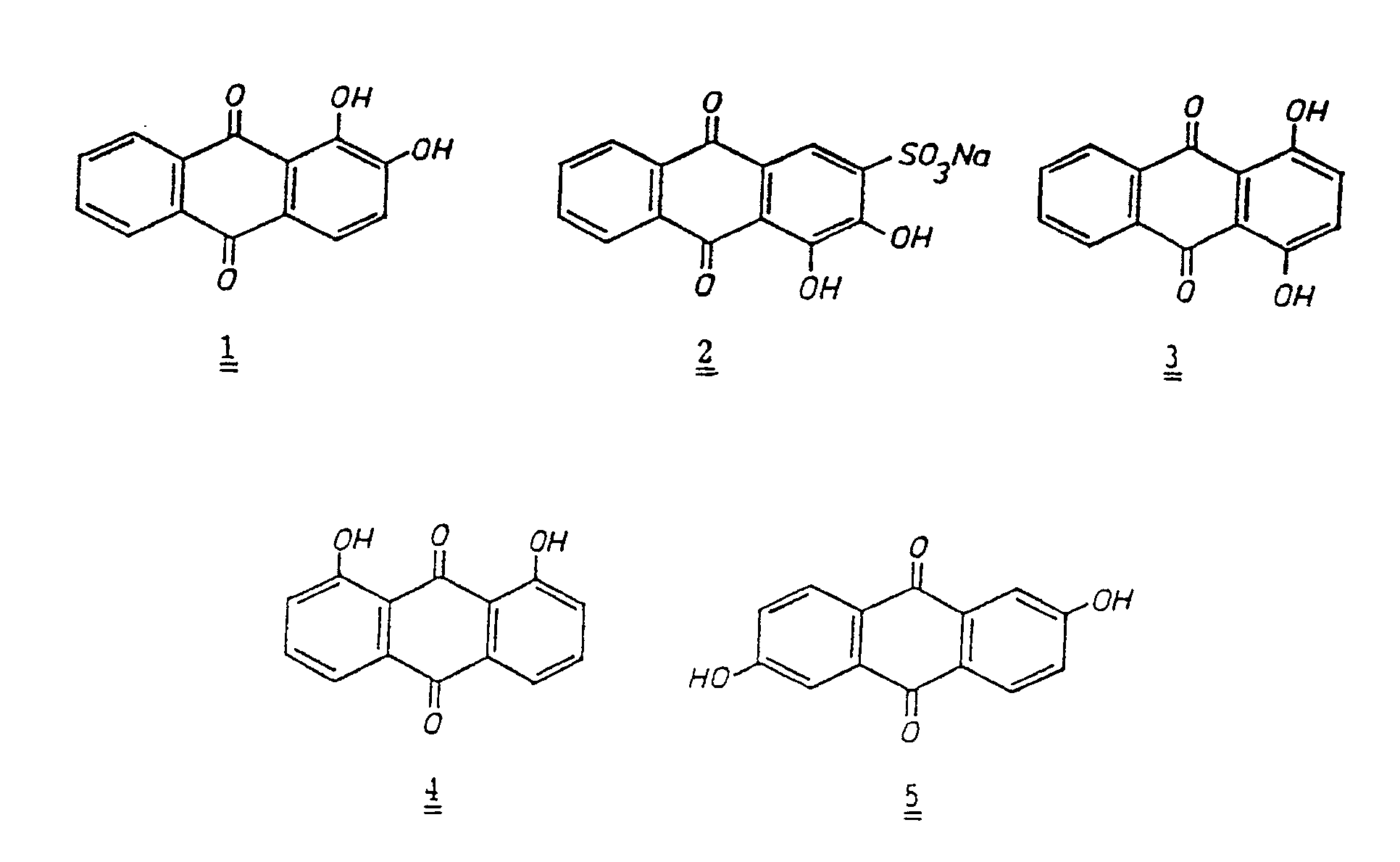
- alizarin 1,2-dihydroxy-9,10-anthracenedione, 1,2-dihydroxyanthraquinone
- alizarinesulfonic acid (2: 9,10-dihydro- 3,4-dihydroxy-9,10-dioxo-2-anthracensulfonic acid, monosodium salt
- quinizarin (3: 1,4-dihydroxyanthraquinone)
- chrysazine (4: danthrone, 1,8-dihydroxyanthraquinone) and anthraflavic acid (5: 2.6 -Dihydroxyanthraquinone).
- the compounds mentioned have the following structural formulas:
- the compounds of the formula (I) can be prepared by known processes (cf., for example, Beyer and Walter, Textbook of Organic Chemistry, 21st edition, pages 639 to 643, Hirzel-Verlag, Stuttgart, 1988). Various anthraquinone derivatives of formula (I) are also commercially available.
- C1-alkyl, C2-alkyl, C3-alkyl and C4-alkyl means alkyl groups with 1, 2, 3 or 4 carbon atoms with a straight or branched chain.
- the pharmaceutically acceptable salts can be acid addition salts or ammonium, alkali metal or alkaline earth metal salts.
- Suitable esters and ethers include compounds having C1 to C4 alkyl groups, wherein the alkyl group is a straight or branched chain.
- the compounds can be used to prepare any of the pharmaceutical formulations known in the art.
- the virustatic effect is particularly evident against viruses of the Herpetoviridae family, for example HSV (herpes simplex virus), CMV (cytomegalovirus) and HHV 6 (human herpes virus type 6).
- HSV herpes simplex virus
- CMV cytomegalovirus
- HHV 6 human herpes virus type 6
- the Varicella zoster virus and the Epstein-Barr virus are still included in the Herpetoviridae family.
- the virustatic activity of the compounds of the formula (I) is described in more detail below.
- virustatic effect is tested in vitro using virus-infected animal cell cultures.
- different test variants and host cells must be selected for the tests.
- the color test as described by Armstrong, 1971 (5), is based on the fact that the cells destroyed by the viruses can no longer be stained. The higher the proportion of intact cells after the incubation with the respective virus due to the virustatic effect of a substance, the more dye is bound. The dye can be extracted from the stained cells and its amount can be measured in a photometer, e.g. B. when using crystal violet at 546 nm. The test thus allows measurable and reproducible information on both the virustatic and, in parallel experiments with cell cultures without viruses, the cytotoxic effects of substances.
- test substance 10 mg was dissolved in 10 ml of ethyl alcohol.
- a dilution series with concentrations of 1.56 ⁇ g / ml to 25 ⁇ g / ml test substance was set using the medium for cell culture. These solutions are placed on 24 hour old MK2, HeLa, Rita cells or other suitable cells after they have been overlaid for 45 minutes for infection with a suspension of viruses.
- parallel batches without virus addition are covered analogously with the different dilution levels of the test substance.
- the test batches with virus and test substance or only the test substance are incubated for 72 hours at 37 ° C.
- the cells are then fixed and stained with crystal violet solution for 15 minutes. After rinsing with water, the dye bound to the cells is extracted with ethanol and the absorbance at 546 nm (absorption for crystal violet) is measured in a photometer.
- the extinctions and also the concentration are calculated with a cell protection of 50%.
- the plaque inhibition test (agar diffusion test) is carried out according to the method of E. C. Herrmann et al., 1960 (6). Virus-infected animal cell cultures are also used in this test. In this case, the uncontrolled spreading of the viruses is prevented in Petri dishes by a medium solidified with the aid of agar. There is a locally limited destruction of the cells, which after staining is recognizable as holes in the cell turf.
- the test substances are applied to filter paper sheets and placed on the solid medium. In an area around these leaflets, the cells are protected by the virustatic effect of the test substance and circular inhibition zones are created. The size of the zone of inhibition can be evaluated as a measure of the virustatic effectiveness.
- CMV cytomegalovirus
- the absorbance with 50% cell protection (ZK + VK) / 2 is 0.4.
- a concentration of 5.96 ⁇ g / ml alizarin results in a cell protection of 50% (results see Table I a).
- the effect of alizarin against cytomegalovirus can be determined using a similar test arrangement as in the plaque inhibition test (see plaque reduction test, method 3).
- the examination for the cytomegalovirus in a cell line of human foreskin fibroblasts gave the values for the inhibition in Table II compared to the virus control.
- the plaques formed were counted here and evaluated in comparison to the virus control (see Table II).
- HHV 6 human herpes virus type 6
- alizarin has excellent virustatic properties which make its use in therapy and prophylaxis, in particular for herpes and cytomegalovirus infections, advantageous.
Landscapes
- Health & Medical Sciences (AREA)
- Chemical & Material Sciences (AREA)
- Medicinal Chemistry (AREA)
- Pharmacology & Pharmacy (AREA)
- Epidemiology (AREA)
- Life Sciences & Earth Sciences (AREA)
- Animal Behavior & Ethology (AREA)
- General Health & Medical Sciences (AREA)
- Public Health (AREA)
- Veterinary Medicine (AREA)
- Acyclic And Carbocyclic Compounds In Medicinal Compositions (AREA)
- Pharmaceuticals Containing Other Organic And Inorganic Compounds (AREA)
Abstract
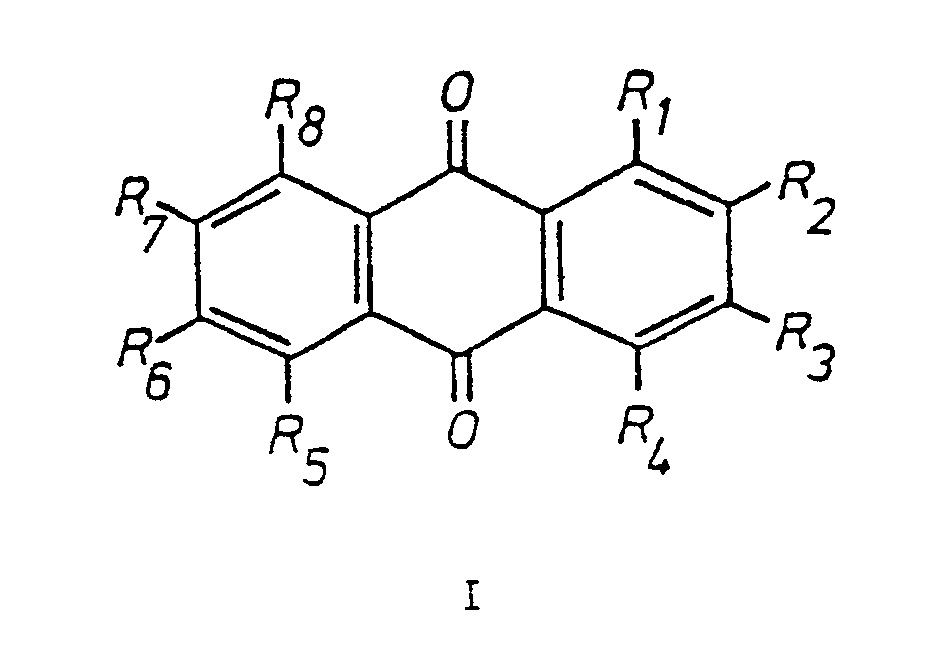
worin R₁ bis R₈ H, OH, C₁-Alkyl, C₂-Alkyl, C₃-Alkyl, C₄-Alkyl, NH₂, COOH, SO₃, CH₂OH oder C₆H₁₁O₅ bedeuten, wobei nicht jeder der Reste R1 bis R8 die gleiche Bedeutung aufweist, und die pharmazeutisch annehmbaren Salze, Ester und Ether, zur Herstellung eines Medikamentes für die Prophylaxe und Therapie von Viruserkrankungen, insbesondere von Viruserkrankungen die von Viren der Familie Herpetoviridae ausgelöst werden.
Description
- Die Erfindung betrifft die Verwendung bestimmter Anthrachinonderivate zur Propyhlaxe und Therapie von Viruserkrankungen.
- Anthrachinone stellen die größte Gruppe natürlich vorkommender Chinone dar. Fast alle natürlich vorkommenden Anthrachinone sind hydroxyliert. Viele Vertreter dieser Naturstoffe wurden aus niederen Pilzen, ein weiterer, größerer Teil, aus Pflanzen isoliert. Eines der bekanntesten Anthrachinonderivate, das Alizarin (1,2-Dihydroxy-9,10-anthrachinon), kommt in den Wurzeln der Pflanze Rubia tinctorum glykosidisch gebunden an das Disaccharid Primverose als Ruberythrinsäure vor. Durch enzymatische Hydrolyse entsteht während der Trocknung der Krappwurzel aus der Ruberythrinsäure der rote Farbstoff Alizarin. Das Alizarin wurde als Farbstoff schon im Altertum eingesetzt. Seit 1869 [Caro et al., 1870 (1)] kann Alizarin chemisch synthetisiert werden.
- Für die Droge der Krappwurzel wurden diuretische [Formanek und Rácz-Kotilla, 1972 (2)] und harnsteinauflösende [Formanek et al., 1973 (3)] Wirkungen in vitro beschrieben, die vor allem der Ruberythrinsäure zugeordnet werden. Beide Wirkungen werden jedoch inzwischen bezweifelt. Dagegen ist eine mäßige spasmolytische Wirkung gesichert. Bestimmte Anthrachinonderivate werden als Abführmittel verwendet.
- Die Anmelderin hat nun überraschend gefunden, daß Anthrachinonderivate der folgenden allgemeinen Formel (I) eine virustatische Wirkung zeigen:

in der R₁ bis R₈ H, OH, C₁-Alkyl, C₂-Alkyl, C₃-Alkyl, C₄-Alkyl, NH₂, COOH, SO₃ CH₂OH oder C₆H₁₁O₅ bedeuten, wobei nicht jeder der Reste R1 bis R8 die gleiche Bedeutung aufweist, und die pharmazeutisch annehmbaren Salze, Ester und Ether. - Eine bevorzugte Gruppe von Verbindungen ist jene, in der
R₁: H, OH, CH₃, NH₂
R₂: H, OH, CH₃, CH₂OH, COOH, C₂H₅, NH₂, SO₃
R₃: H, OH, CH₃
R₄: H, OH, NH₂
R₅: H, OH, HN₂
R₆: H, OH, CH₃
R₇: H, OH, C₆H₁₁O₅ und
R₈: H, OH, NH₂ bedeuten. - Von den Verbindungen der Formel (I) wurden als besonders wirksam die folgenden Verbindungen gefunden: Alizarin (1: 1,2-Dihydroxy-9,10-anthracendion, 1,2-Dihydroxyanthrachinon), Alizarinsulfonsäure (2: 9,10-Dihydro-3,4-dihydroxy-9,10-dioxo-2-anthracensulfonsäure.Mononatriumsalz), Chinizarin (3: 1,4-Dihydroxyanthrachinon), Chrysazin (4: Danthron, 1,8-Dihydroxyanthrachinon) und Anthraflavinsäure (5: 2,6-Dihydroxyanthrachinon). Die erwähnten Verbindungen haben die folgenden Strukturformeln:
- Die Verbindungen der Formel (I) können nach bekannten Verfahren hergestellt werden (vgl. z. B. Beyer und Walter, Lehrbuch der organischen Chemie, 21. Auflage, Seiten 639 bis 643, Hirzel-Verlag, Stuttgart, 1988). Verschiedene Anthrachinonderivate der Formel (I) sind auch kommerziell erhältlich.
- Unter der Bezeichnung C₁-Alkyl, C₂-Alkyl, C₃-Alkyl und C₄-Alkyl sind Alkylgruppen mit 1, 2, 3 oder 4 C-Atomen mit gerader oder verzweigter Kette zu verstehen.
- Die pharmazeutisch annehmbaren Salze können Säureadditionssalze oder Ammonium-, Alkalimetall- oder Erdalkalimetallsalze sein.
- Geeignete Ester und Ether umfassen Verbindungen mit C₁- bis C₄-Alkylgruppen, worin die Alkylgruppe eine gerade oder verzweigte Kette ist.
- Die Verbindungen können zur Herstellung jeder der im Stand der Technik bekannten pharmazeutischen Formulierung verwendet werden.
- Die virustatische Wirkung zeigt sich insbesondere gegen Viren der Familie Herpetoviridae, Z. B. HSV (Herpes simplex-Virus), CMV (Cytomegalie-Virus) und HHV 6 (Humanes Herpes-Virus Typ 6). Zur Familie der Herpetoviridae rechnet man weiterhin das Varicella-Zoster-Virus und das Epstein-Barr-Virus.
- Im folgenden wird die virustatische Wirkung der Verbindungen der Formel (I) näher beschrieben.
- Die Prüfung der virustatischen Wirkung erfolgt in vitro mit virusinfizierten tierischen Zellkulturen. Entsprechend der Eigenschaften der eingesetzten Testviren müssen unterschiedliche Testvarianten und Wirtszellen für die Untersuchungen ausgewählt werden.
- Der Farbtest, wie von Armstrong, 1971 (5) beschrieben, beruht darauf, daß die durch die Viren zerstörten Zellen nicht mehr gefärbt werden können. Je höher der Anteil an intakten Zellen nach der Inkubation mit dem jeweiligen Virus durch die virustatische Wirkung einer Substanz ist, um so mehr Farbstoff wird gebunden. Der Farbstoff läßt sich aus den gefärbten Zellen extrahieren und seine Menge kann in einem Photometer, z. B. bei Verwendung von Kristallviolett bei 546 nm, gemessen werden. Damit erlaubt der Test meßbare und reproduzierbare Angaben sowohl über die virustatische, wie auch durch Parallelversuche mit Zellkulturen ohne Viren über die cytotoxische Wirkung von Substanzen.
- Durchführung: 10 mg der Testsubstanz wurden in 10 ml Ethylalkohol gelöst. Unter Verwendung des Mediums für die Zellkultur wurde eine Verdünnungsreihe mit Konzentrationen von 1,56 µg/ml bis 25 µg/ml Testsubstanz eingestellt. Diese Lösungen werden auf 24 Stunden alte MK2-, HeLa-, Rita-Zellen oder andere geeignete Zellen gegeben, nachdem diese vorher 45 Minuten zur Infektion mit einer Suspension von Viren überschichtet worden waren. Zur Prüfung der Cytotoxizität werden Parallelansätze ohne Viruszugabe analog mit den verschiedenen Verdünnungsstufen der Prüfsubstanz überschichtet. Die Versuchsansätze mit Virus und Testsubstanz bzw. nur der Testsubstanz werden 72 Stunden bei 37 °C bebrütet. Anschließend werden die Zellen fixiert und für 15 Minuten mit Kristallviolettlösung gefärbt. Nach Spülen mit Wasser wird der an die Zellen gebundene Farbstoff mit Ethanol extrahiert und in einem Photometer die Extinktion bei 546 nm (Absorption für Kristallviolett) gemessen.
- Zur Auswertung werden die Extinktionen und auch die Konzentration mit einem Zellschutz von 50 % berechnet.
- Falls die Testsubstanz keine wesentlichen cytotoxischen Eigenschaft besitzt, kann die antivirale Schutzwirkung nach nach folgender Formel in Prozent berechnet werden:

E₁ = Extinktion der Zellkontrolle
E₂ = Extinktion der Viruskontrolle
E₃ = Extinktion der Versuchsansätze mit Virus und Alizarin - Der Plaquehemmungstest (Agardiffusionstest) wird nach der Methode von E. C. Herrmann et al., 1960 (6) durchgeführt. Auch bei diesem Test werden virusinfizierte tierische Zellkulturen verwendet. In diesem Fall wird in Petrischalen durch ein mit Hilfe von Agar verfestigtes Medium das unkontrollierte Ausbreiten der Viren verhindert. Es kommt zu einer lokal begrenzten Zerstörung der Zellen, die nach einer Färbung als Löcher im Zellrasen erkennbar ist. Die Testsubstanzen werden auf Filterpapierblättchen aufgetragen und auf das feste Medium aufgelegt. In einem Bereich um diese Blättchen werden durch die virustatische Wirkung der Testsubstanz die Zellen geschützt und es entstehen so kreisförmige Hemmzonen. Die Größe der Hemmzone kann als Maß für die virustatische Wirksamkeit ausgewertet werden.
- Durchführung: Ein Monolayer von MK2-, HeLa-, Rita-Zellen oder einer anderen geeigneten Zellinie wird in einer Petrischale mit Viren infiziert, so daß eine große Zahl von einzelnen Plaques entsteht. Nach einer Bindung von 45 Minuten bei Zimmertemperatur wird der Zellrasen einmal mit phosphatgepufferter Kochsalzlösung gewaschen und mit einer Agar-Oberschicht versehen. Auf diese Agarschicht werden Filterpapierblättchen (10 mm Durchmesser) gelegt, die mit einer Lösung der Testsubstanz getränkt sind. Nach 48 bis 72 Stunden Bebrütung bei 37 °C in CO₂-Atmosphäre (5 %) wird eine zweite Oberschicht darübergegeben, die den Vitalfarbstoff Tetrazoliumchlorid enthält. Nach weiteren 24 Stunden Bebrütung wird der Hemmhofdurchmesser, unterteilt in "toxische Zone" und "therapeutische Zone", in mm ausgemessen.
- Für die Prüfung der Wirksamkeit gegenüber Cytomegalie-Viren (CMV) werden mit diesen Viren infizierte menschliche Vorhautfibroblasten eingesetzt. Nach der Inkubation werden die entstandenen Plaques angefärbt und ausgezählt. Zur Auswertung wird die Plaquezahl unter dem Einfluß einer definierten Substanzmenge mit der Viruskontrolle verglichen.
- Die Ergebnisse der Untersuchungen mit verschiedenen Anthrachinonderivaten werden im folgenden beschrieben:
- Die Ergebnisse der Untersuchungen mit Alizarin (1) im Farbtest gegen Herpes simplex-Viren sind in den Tabelle Ia und I b wiedergegeben. Im Vergleich zur Viruskontrolle, d. h. virusinfizierten Ansätzen ohne Testsubstanz, sind deutlich höhere Extinktionswerte (siehe Tabelle I a) und damit eine antivirale Wirkung des Alizarins (1) erkennbar.

- Die Extinktion mit 50 %-Zellschutz (ZK + VK)/2 liegt bei 0,4. Eine Konzentration von 5,96 µg/ml Alizarin bewirkt einen Zellschutz von 50 % (Ergebnisse siehe Tabelle I a).
- Weiterhin liegt der Mittelwert für eine 50 %ige Hemmung der Virusvermehrung aus vier Versuchen bei 4,87 µg/ml Alizarin.

- Die Abnahme der Schutzwirkung (Ergebnisse siehe Tabelle I b) bei den höheren Konzentrationen wird durch eine schwache cytotoxische Wirkung verursacht, die bei diesen Konzentrationen die virustatische Wirkung überlagert (siehe Tabelle I a und I b).
- In Gegenwart von 10 % Serum, das als Beispiel für ein Fremdprotein zugegeben wurde, ist der 50 % Hemmwert geringfügig höher bei 11,3 µg/ml. Daran ist zu erkennen, daß Alizarin auch in Gegenwart von Fremdproteinen eine sehr gute antivirale Wirkung hat.
- Mit einer ähnlichen Versuchsanordnung wie im Plaquehemmungstest kann die Wirkung des Alizarins gegen Cytomegalie-Viren bestimmt werden (siehe Plaquereduktionstest, Methode 3). Die Untersuchung für das Cytomegalie-Virus in einer Zellinie von menschlichen Vorhautfibroblasten ergab die in Tabelle II angegebenen Werte für die Hemmung im Vergleich zur Viruskontrolle. Zur Auswertung wurden hier die gebildeten Plaques gezählt und im Vergleich zur Viruskontrolle ausgewertet (siehe Tabelle II).

- In weiteren Versuchen wurde die Wirkung von Alizarin auf die Vermehrung von HHV 6 (Human herpes-Virus Typ 6) untersucht. Diese Viren lassen sich aus dem Blut von immunsupprimierten Patienten mit Leukämie, Lymphomen oder Aids sowie von Kindern mit Roseola infantum isolieren.
- Die Testung erfolgte in menschlichen Lymphocytenkulturen.
- In den Zellen war schon nach drei Passagen in Gegenwart von 10 µg/ml Alizarin kein Virus mehr nachweisbar, so daß im Gegensatz zur Viruskontrolle keine cytopathischen Veränderungen erkennbar sind.
- Die vorstehenden Ergebnisse zeigen, daß Alizarin über ausgezeichnete virustatische Eigenschaften verfügt, die seine Verwendung in der Therapie und Prophylaxe, insbesondere für Herpes- und Cytomegalie-Virusinfektionen, als vorteilhaft erkennen lassen.
- Im folgenden wird beispielhaft die virustatische Wirkung von weiteren Anthrachinonderivaten gezeigt.
- Neben dem Alizarin zeigen auch andere Anthrachinonderivate eine gute virustatische Wirksamkeit. Die Ergebnisse der Untersuchungen mit diesen Substanzen im Plaquehemmungstest mit Herpes simplex-Viren in Rita-Zellen sind in der Tabelle III zusammengefaßt.

- Die beschriebenen Eigenschaften eröffnen aussichtsreiche Möglichkeiten für den Einsatz dieser Verbindungen in der Prophylaxe und Therapie von Viruserkrankungen, insbesondere bei Infektionen mit Viren der Herpes-Gruppe.
-
- (1) Caro et al., Ber. 3, 359 (1870)
- (2) Formanek, I und Rácz-Kotilla E., Farmacia (Bucuresti) 7, 439 (1972)
- (3) Formanek, I., Rácz-Kotilla E. und Sebe A., Rev. Med. (Tirgu-Mures) 17, 427 (1971)
- (4) Beyer und Walter, Lehrbuch für organische Chemie, 21. Auflage, s. Hirzel-Verlag, Stuttgart, 1988, Seiten 639 bis 643
- (5) Armstrong, J. A., Semi-micor, dye-binding assay for rabbit interferon, Appl. Microbiol. 21, 723 bis 7256 (1971)
- (6) Hermann, E. C., Gabliks, J., Engle, C. And Perlman, P. L., Agar diffusion method for detection and bioassay of antiviral antibiotics, Proc. Soc. Exp. Biol. Med., N. Y. 103, 625 bis 628 (1960)
Claims (5)
- Verwendung einer Verbindung der allgemeinen Formel (I) zur Herstellung eines Medikamentes für die Prophylaxe und/oder Therapie von Viruserkrankungen:

- Verwendung nach Anspruch 1 mit mindestens einer Verbindung, worin die Reste R₁ bis R₈ in der allgemeinen Formel (I) bedeuten:
R₁: H, OH, CH₃, NH₂
R₂: H, OH, CH₃, CH₂OH, COOH, C₂H₅, NH₂, SO₃
R₃: H, OH, CH₃
R₄: H, OH, NH₂
R₅: H, OH, HN₂
R₆: H, OH, CH₃
R₇: H, OH, C₆H₁₁O₅ und
R₈: H, OH, NH₂. - Verwendung nach Anspruch 1 oder 2, mit mindestens einer der folgenden Verbindungen: 1,2-Dihydroxy-9,10-anthracendion, 9,10-Dihydro-3,4-dihydroxy-9,10-dioxo-2-anthracensulfonsäure.Mononatriumsalz, 1,4-Dihydroxyanthrachinon, 1,8-Dihydroxyanthrachinon und 2,6-Dihydroxyanthrachinon.
- Verwendung nach Anspruch 1 bis 3, bei der das Virus ein Virus der Familie Herpetoviridae ist.
- Verwendung nach Anspruch 4, bei der das Virus ein Herpes simplex-Virus (HSV), Cytomegalie-Virus (CMV) oder ein Herpesvirus vom Typ 6 (HHV 6) ist.
Applications Claiming Priority (2)
| Application Number | Priority Date | Filing Date | Title |
|---|---|---|---|
| DE4013023A DE4013023A1 (de) | 1990-04-24 | 1990-04-24 | Verwendung von anthrachinonderivaten zur prophylaxe und therapie von viruserkrankungen |
| DE4013023 | 1990-04-24 |
Publications (3)
| Publication Number | Publication Date |
|---|---|
| EP0454058A2 true EP0454058A2 (de) | 1991-10-30 |
| EP0454058A3 EP0454058A3 (en) | 1992-06-03 |
| EP0454058B1 EP0454058B1 (de) | 1998-06-17 |
Family
ID=6404972
Family Applications (1)
| Application Number | Title | Priority Date | Filing Date |
|---|---|---|---|
| EP91106517A Expired - Lifetime EP0454058B1 (de) | 1990-04-24 | 1991-04-23 | Verwendung von Anthrachinonderivaten zur Prophylaxe und Therapie von Viruserkrankungen |
Country Status (3)
| Country | Link |
|---|---|
| EP (1) | EP0454058B1 (de) |
| AT (1) | ATE167397T1 (de) |
| DE (2) | DE4013023A1 (de) |
Cited By (7)
| Publication number | Priority date | Publication date | Assignee | Title |
|---|---|---|---|---|
| GB2254554A (en) * | 1991-02-13 | 1992-10-14 | Radopath Ltd | Pharmaceutical quinone composition |
| WO1992018123A3 (en) * | 1991-04-10 | 1993-03-04 | Octamer Inc | A method for inhibition of retroviral replication |
| EP0705601A1 (de) * | 1994-10-04 | 1996-04-10 | LOMAPHARM Rudolf Lohmann GmbH KG Pharmazeutische Fabrik | Lösungen von Anthrachinonen zur parenteralen Applikation |
| US5792797A (en) * | 1994-08-24 | 1998-08-11 | Lilly Industries Limited | Pharmaceutical compounds |
| US6267946B1 (en) * | 1996-07-24 | 2001-07-31 | Govind Kapadia | Inhibitory effects of synthetic and natural colorants on carcinogenesis VI |
| WO2006019955A3 (en) * | 2004-07-14 | 2006-08-24 | Harvard College | Antiviral methods and compositions |
| EP2130436A1 (de) * | 2000-02-17 | 2009-12-09 | Garnett, Inc. | Verfahren zur kontrolle des wachstums von Wasserpflanzen und -tieren |
Family Cites Families (9)
| Publication number | Priority date | Publication date | Assignee | Title |
|---|---|---|---|---|
| US3974186A (en) * | 1970-05-14 | 1976-08-10 | Richardson-Merrell Inc. | Bis-basic ethers of 2,6- and 2,7-dihydroxyanthraquinones |
| US3838177A (en) * | 1972-12-21 | 1974-09-24 | Richardson Merrell Inc | Substituted 9,10-dihydroanthracenes |
| US4105758A (en) * | 1976-12-27 | 1978-08-08 | Colgate-Palmolive Company | Oral compositions containing an anticalculus agent |
| GB2009171B (en) * | 1977-11-28 | 1982-08-18 | American Cyanamid Co | Anthracene bis-carbonyl hydrazones and derivatives |
| US4258181A (en) * | 1978-09-05 | 1981-03-24 | American Cyanamid Company | Substituted 9,10-anthracenebishydrazones |
| US4670265A (en) * | 1983-07-22 | 1987-06-02 | Sydiskis Robert J | Aloe emodin and other anthraquinones and anthraquinone-like compounds from plants virucidal against herpes simplex viruses |
| US4781957A (en) * | 1987-07-27 | 1988-11-01 | Minnesota Mining And Manufacturing Company | Easy tear masking tape |
| DE3879688T2 (de) * | 1987-12-10 | 1993-07-01 | Tsumura & Co | Anti-retrovirales arzneimittel. |
| DE3913040A1 (de) * | 1989-04-20 | 1990-10-25 | Ludwig Roth Gmbh Dr | Pharmazeutische zubereitung und ihre verwendung |
-
1990
- 1990-04-24 DE DE4013023A patent/DE4013023A1/de active Granted
-
1991
- 1991-04-23 AT AT91106517T patent/ATE167397T1/de active
- 1991-04-23 EP EP91106517A patent/EP0454058B1/de not_active Expired - Lifetime
- 1991-04-23 DE DE59109011T patent/DE59109011D1/de not_active Expired - Fee Related
Cited By (9)
| Publication number | Priority date | Publication date | Assignee | Title |
|---|---|---|---|---|
| GB2254554A (en) * | 1991-02-13 | 1992-10-14 | Radopath Ltd | Pharmaceutical quinone composition |
| GB2254554B (en) * | 1991-02-13 | 1995-09-20 | Radopath Ltd | Pharmaceutical quinone compositions |
| WO1992018123A3 (en) * | 1991-04-10 | 1993-03-04 | Octamer Inc | A method for inhibition of retroviral replication |
| US5792797A (en) * | 1994-08-24 | 1998-08-11 | Lilly Industries Limited | Pharmaceutical compounds |
| EP0705601A1 (de) * | 1994-10-04 | 1996-04-10 | LOMAPHARM Rudolf Lohmann GmbH KG Pharmazeutische Fabrik | Lösungen von Anthrachinonen zur parenteralen Applikation |
| US6267946B1 (en) * | 1996-07-24 | 2001-07-31 | Govind Kapadia | Inhibitory effects of synthetic and natural colorants on carcinogenesis VI |
| EP2130436A1 (de) * | 2000-02-17 | 2009-12-09 | Garnett, Inc. | Verfahren zur kontrolle des wachstums von Wasserpflanzen und -tieren |
| WO2006019955A3 (en) * | 2004-07-14 | 2006-08-24 | Harvard College | Antiviral methods and compositions |
| US7893108B2 (en) | 2004-07-14 | 2011-02-22 | President And Fellows Of Harvard College | Antiviral methods and compositions |
Also Published As
| Publication number | Publication date |
|---|---|
| EP0454058B1 (de) | 1998-06-17 |
| DE4013023C2 (de) | 1992-03-12 |
| DE59109011D1 (de) | 1998-07-23 |
| DE4013023A1 (de) | 1991-11-07 |
| ATE167397T1 (de) | 1998-07-15 |
| EP0454058A3 (en) | 1992-06-03 |
Similar Documents
| Publication | Publication Date | Title |
|---|---|---|
| DE2954076C2 (de) | ||
| DE3507024C2 (de) | Lösung zur Augenbehandlung | |
| DE69010807T2 (de) | Thee oder Thee-Polyphenole enthaltendes Vorbeugungs- und Behandlungsmittel gegen Influenzavireninfektion. | |
| DE3832219A1 (de) | Zusammensetzungen zur topischen anwendung mit melaninsynthese-inhibitoraktivitaet | |
| DE69411812T2 (de) | Kosmetisches oder pharmazeutisches Präparat zur topischer Verwendung gegen freien Radikale | |
| US4670265A (en) | Aloe emodin and other anthraquinones and anthraquinone-like compounds from plants virucidal against herpes simplex viruses | |
| DE4013023C2 (de) | ||
| DE69634530T2 (de) | Antivirales mittel und verfahren zu dessen herstellung | |
| DE69219470T2 (de) | Topisches Präparat zur besseren Heilung von Herpesverletzungen | |
| EP0493662B1 (de) | Verwendung von Superoxiddismutasen für die Herstellung von Arzneimitteln zur Prophylaxe und/oder Behandlung von Organversagen bei Risikopatienten mit Polytrauma als Unfallfolge | |
| DE2262427C3 (de) | Immunostimulierendes Mittel | |
| DE3879575T2 (de) | Alpha-Carotin zur Wachstumshemmung von Krebszellen. | |
| Kristensson et al. | Changes in vascular permeability of the central nervous system by experimental herpes simplex and vaccinia virus infections | |
| DE69724861T2 (de) | Haarwuchsmittel enthaltend einen spezifischen Hemmer der Protein-Kinase C | |
| DE3750248T2 (de) | Zubereitung und Behandlung der Haut mit Human-Leukocyten-Interferon. | |
| DE69126977T2 (de) | Verwendung von Leukoregulin zur Behandlung von mit einem envelope-Virus infizierten Tier | |
| EP0294538A2 (de) | Verwendung von Nigerizin zur Herstellung eines Mittels zur Behandlung von Virus-Erkrankungen | |
| DE1913489B2 (de) | Stabilisiertes, lichtgeschuetztes kosmetisches mittel | |
| DE19536589C2 (de) | Verwendung von Vitamin E und Vitamin C | |
| DE3137237A1 (de) | Test-blutfilterpapier zur messung der methioninkonzentration im blut | |
| DE4224509A1 (de) | Wirkstoff zur Hemmung der Proliferationsrate von Leberzellen | |
| DE3202347A1 (de) | Lecithin-hydrogenperoxid-zusammensetzung | |
| DE69200794T2 (de) | Verwendung von 4,9,11-Trien-Steroiden in Zusammensetzungen für Truthühner. | |
| DE19628514C1 (de) | Kombination von S-Adenosylmethionin und Azidothymidin zur Hemmung der HIV-Replikation | |
| WO1981001514A1 (fr) | Preparation cosmetique |
Legal Events
| Date | Code | Title | Description |
|---|---|---|---|
| PUAI | Public reference made under article 153(3) epc to a published international application that has entered the european phase |
Free format text: ORIGINAL CODE: 0009012 |
|
| AK | Designated contracting states |
Kind code of ref document: A2 Designated state(s): AT BE CH DE DK ES FR GB GR IT LI LU NL SE |
|
| PUAL | Search report despatched |
Free format text: ORIGINAL CODE: 0009013 |
|
| AK | Designated contracting states |
Kind code of ref document: A3 Designated state(s): AT BE CH DE DK ES FR GB GR IT LI LU NL SE |
|
| 17P | Request for examination filed |
Effective date: 19921126 |
|
| 17Q | First examination report despatched |
Effective date: 19940909 |
|
| GRAG | Despatch of communication of intention to grant |
Free format text: ORIGINAL CODE: EPIDOS AGRA |
|
| GRAG | Despatch of communication of intention to grant |
Free format text: ORIGINAL CODE: EPIDOS AGRA |
|
| GRAH | Despatch of communication of intention to grant a patent |
Free format text: ORIGINAL CODE: EPIDOS IGRA |
|
| GRAH | Despatch of communication of intention to grant a patent |
Free format text: ORIGINAL CODE: EPIDOS IGRA |
|
| GRAA | (expected) grant |
Free format text: ORIGINAL CODE: 0009210 |
|
| ITF | It: translation for a ep patent filed | ||
| AK | Designated contracting states |
Kind code of ref document: B1 Designated state(s): AT BE CH DE DK ES FR GB GR IT LI LU NL SE |
|
| PG25 | Lapsed in a contracting state [announced via postgrant information from national office to epo] |
Ref country code: NL Free format text: LAPSE BECAUSE OF FAILURE TO SUBMIT A TRANSLATION OF THE DESCRIPTION OR TO PAY THE FEE WITHIN THE PRESCRIBED TIME-LIMIT Effective date: 19980617 Ref country code: GR Free format text: LAPSE BECAUSE OF NON-PAYMENT OF DUE FEES Effective date: 19980617 Ref country code: ES Free format text: THE PATENT HAS BEEN ANNULLED BY A DECISION OF A NATIONAL AUTHORITY Effective date: 19980617 |
|
| REF | Corresponds to: |
Ref document number: 167397 Country of ref document: AT Date of ref document: 19980715 Kind code of ref document: T |
|
| REG | Reference to a national code |
Ref country code: CH Ref legal event code: NV Representative=s name: DR. CONRAD A. RIEDERER PATENTANWALT Ref country code: CH Ref legal event code: EP |
|
| GBT | Gb: translation of ep patent filed (gb section 77(6)(a)/1977) |
Effective date: 19980618 |
|
| REF | Corresponds to: |
Ref document number: 59109011 Country of ref document: DE Date of ref document: 19980723 |
|
| PG25 | Lapsed in a contracting state [announced via postgrant information from national office to epo] |
Ref country code: SE Free format text: LAPSE BECAUSE OF FAILURE TO SUBMIT A TRANSLATION OF THE DESCRIPTION OR TO PAY THE FEE WITHIN THE PRESCRIBED TIME-LIMIT Effective date: 19980917 Ref country code: DK Free format text: LAPSE BECAUSE OF FAILURE TO SUBMIT A TRANSLATION OF THE DESCRIPTION OR TO PAY THE FEE WITHIN THE PRESCRIBED TIME-LIMIT Effective date: 19980917 |
|
| ET | Fr: translation filed | ||
| NLV1 | Nl: lapsed or annulled due to failure to fulfill the requirements of art. 29p and 29m of the patents act | ||
| PG25 | Lapsed in a contracting state [announced via postgrant information from national office to epo] |
Ref country code: LU Free format text: LAPSE BECAUSE OF NON-PAYMENT OF DUE FEES Effective date: 19990423 Ref country code: AT Free format text: LAPSE BECAUSE OF NON-PAYMENT OF DUE FEES Effective date: 19990423 |
|
| PGFP | Annual fee paid to national office [announced via postgrant information from national office to epo] |
Ref country code: GB Payment date: 19990423 Year of fee payment: 9 |
|
| PLBE | No opposition filed within time limit |
Free format text: ORIGINAL CODE: 0009261 |
|
| STAA | Information on the status of an ep patent application or granted ep patent |
Free format text: STATUS: NO OPPOSITION FILED WITHIN TIME LIMIT |
|
| PGFP | Annual fee paid to national office [announced via postgrant information from national office to epo] |
Ref country code: DE Payment date: 19990426 Year of fee payment: 9 Ref country code: CH Payment date: 19990426 Year of fee payment: 9 |
|
| PGFP | Annual fee paid to national office [announced via postgrant information from national office to epo] |
Ref country code: FR Payment date: 19990428 Year of fee payment: 9 |
|
| PG25 | Lapsed in a contracting state [announced via postgrant information from national office to epo] |
Ref country code: BE Free format text: LAPSE BECAUSE OF NON-PAYMENT OF DUE FEES Effective date: 19990430 |
|
| 26N | No opposition filed | ||
| BERE | Be: lapsed |
Owner name: RUDOLF LOHMANN G.M.B.H. K.G. PHARMAZEUTISCHE FABRI Effective date: 19990430 |
|
| PG25 | Lapsed in a contracting state [announced via postgrant information from national office to epo] |
Ref country code: GB Free format text: LAPSE BECAUSE OF NON-PAYMENT OF DUE FEES Effective date: 20000423 |
|
| PG25 | Lapsed in a contracting state [announced via postgrant information from national office to epo] |
Ref country code: LI Free format text: LAPSE BECAUSE OF NON-PAYMENT OF DUE FEES Effective date: 20000430 Ref country code: CH Free format text: LAPSE BECAUSE OF NON-PAYMENT OF DUE FEES Effective date: 20000430 |
|
| GBPC | Gb: european patent ceased through non-payment of renewal fee |
Effective date: 20000423 |
|
| REG | Reference to a national code |
Ref country code: CH Ref legal event code: PL |
|
| PG25 | Lapsed in a contracting state [announced via postgrant information from national office to epo] |
Ref country code: FR Free format text: LAPSE BECAUSE OF NON-PAYMENT OF DUE FEES Effective date: 20001229 |
|
| PG25 | Lapsed in a contracting state [announced via postgrant information from national office to epo] |
Ref country code: DE Free format text: LAPSE BECAUSE OF NON-PAYMENT OF DUE FEES Effective date: 20010201 |
|
| REG | Reference to a national code |
Ref country code: FR Ref legal event code: ST |
|
| PG25 | Lapsed in a contracting state [announced via postgrant information from national office to epo] |
Ref country code: IT Free format text: LAPSE BECAUSE OF NON-PAYMENT OF DUE FEES;WARNING: LAPSES OF ITALIAN PATENTS WITH EFFECTIVE DATE BEFORE 2007 MAY HAVE OCCURRED AT ANY TIME BEFORE 2007. THE CORRECT EFFECTIVE DATE MAY BE DIFFERENT FROM THE ONE RECORDED. Effective date: 20050423 |