EP0454796B1 - Aktives dämpfungssystem für fahrzeugaufhängungen - Google Patents
Aktives dämpfungssystem für fahrzeugaufhängungen Download PDFInfo
- Publication number
- EP0454796B1 EP0454796B1 EP90909546A EP90909546A EP0454796B1 EP 0454796 B1 EP0454796 B1 EP 0454796B1 EP 90909546 A EP90909546 A EP 90909546A EP 90909546 A EP90909546 A EP 90909546A EP 0454796 B1 EP0454796 B1 EP 0454796B1
- Authority
- EP
- European Patent Office
- Prior art keywords
- coil
- mass
- damping system
- sprung mass
- current
- Prior art date
- Legal status (The legal status is an assumption and is not a legal conclusion. Google has not performed a legal analysis and makes no representation as to the accuracy of the status listed.)
- Expired - Lifetime
Links
Images



Classifications
-
- B—PERFORMING OPERATIONS; TRANSPORTING
- B60—VEHICLES IN GENERAL
- B60G—VEHICLE SUSPENSION ARRANGEMENTS
- B60G11/00—Resilient suspensions characterised by arrangement, location or kind of springs
-
- B—PERFORMING OPERATIONS; TRANSPORTING
- B60—VEHICLES IN GENERAL
- B60G—VEHICLE SUSPENSION ARRANGEMENTS
- B60G17/00—Resilient suspensions having means for adjusting the spring or vibration-damper characteristics, for regulating the distance between a supporting surface and a sprung part of vehicle or for locking suspension during use to meet varying vehicular or surface conditions, e.g. due to speed or load
- B60G17/015—Resilient suspensions having means for adjusting the spring or vibration-damper characteristics, for regulating the distance between a supporting surface and a sprung part of vehicle or for locking suspension during use to meet varying vehicular or surface conditions, e.g. due to speed or load the regulating means comprising electric or electronic elements
- B60G17/0152—Resilient suspensions having means for adjusting the spring or vibration-damper characteristics, for regulating the distance between a supporting surface and a sprung part of vehicle or for locking suspension during use to meet varying vehicular or surface conditions, e.g. due to speed or load the regulating means comprising electric or electronic elements characterised by the action on a particular type of suspension unit
- B60G17/0157—Resilient suspensions having means for adjusting the spring or vibration-damper characteristics, for regulating the distance between a supporting surface and a sprung part of vehicle or for locking suspension during use to meet varying vehicular or surface conditions, e.g. due to speed or load the regulating means comprising electric or electronic elements characterised by the action on a particular type of suspension unit non-fluid unit, e.g. electric motor
-
- F—MECHANICAL ENGINEERING; LIGHTING; HEATING; WEAPONS; BLASTING
- F16—ENGINEERING ELEMENTS AND UNITS; GENERAL MEASURES FOR PRODUCING AND MAINTAINING EFFECTIVE FUNCTIONING OF MACHINES OR INSTALLATIONS; THERMAL INSULATION IN GENERAL
- F16F—SPRINGS; SHOCK-ABSORBERS; MEANS FOR DAMPING VIBRATION
- F16F15/00—Suppression of vibrations in systems; Means or arrangements for avoiding or reducing out-of-balance forces, e.g. due to motion
- F16F15/02—Suppression of vibrations of non-rotating, e.g. reciprocating systems; Suppression of vibrations of rotating systems by use of members not moving with the rotating systems
- F16F15/03—Suppression of vibrations of non-rotating, e.g. reciprocating systems; Suppression of vibrations of rotating systems by use of members not moving with the rotating systems using magnetic or electromagnetic means
-
- B—PERFORMING OPERATIONS; TRANSPORTING
- B60—VEHICLES IN GENERAL
- B60G—VEHICLE SUSPENSION ARRANGEMENTS
- B60G2202/00—Indexing codes relating to the type of spring, damper or actuator
- B60G2202/10—Type of spring
- B60G2202/16—Magnetic spring
-
- B—PERFORMING OPERATIONS; TRANSPORTING
- B60—VEHICLES IN GENERAL
- B60G—VEHICLE SUSPENSION ARRANGEMENTS
- B60G2202/00—Indexing codes relating to the type of spring, damper or actuator
- B60G2202/40—Type of actuator
- B60G2202/42—Electric actuator
- B60G2202/422—Linear motor
-
- B—PERFORMING OPERATIONS; TRANSPORTING
- B60—VEHICLES IN GENERAL
- B60G—VEHICLE SUSPENSION ARRANGEMENTS
- B60G2400/00—Indexing codes relating to detected, measured or calculated conditions or factors
- B60G2400/10—Acceleration; Deceleration
- B60G2400/102—Acceleration; Deceleration vertical
-
- B—PERFORMING OPERATIONS; TRANSPORTING
- B60—VEHICLES IN GENERAL
- B60G—VEHICLE SUSPENSION ARRANGEMENTS
- B60G2400/00—Indexing codes relating to detected, measured or calculated conditions or factors
- B60G2400/25—Stroke; Height; Displacement
- B60G2400/252—Stroke; Height; Displacement vertical
-
- B—PERFORMING OPERATIONS; TRANSPORTING
- B60—VEHICLES IN GENERAL
- B60G—VEHICLE SUSPENSION ARRANGEMENTS
- B60G2500/00—Indexing codes relating to the regulated action or device
- B60G2500/10—Damping action or damper
-
- B—PERFORMING OPERATIONS; TRANSPORTING
- B60—VEHICLES IN GENERAL
- B60G—VEHICLE SUSPENSION ARRANGEMENTS
- B60G2500/00—Indexing codes relating to the regulated action or device
- B60G2500/20—Spring action or springs
-
- B—PERFORMING OPERATIONS; TRANSPORTING
- B60—VEHICLES IN GENERAL
- B60G—VEHICLE SUSPENSION ARRANGEMENTS
- B60G2500/00—Indexing codes relating to the regulated action or device
- B60G2500/30—Height or ground clearance
-
- B—PERFORMING OPERATIONS; TRANSPORTING
- B60—VEHICLES IN GENERAL
- B60G—VEHICLE SUSPENSION ARRANGEMENTS
- B60G2600/00—Indexing codes relating to particular elements, systems or processes used on suspension systems or suspension control systems
- B60G2600/18—Automatic control means
- B60G2600/184—Semi-Active control means
-
- B—PERFORMING OPERATIONS; TRANSPORTING
- B60—VEHICLES IN GENERAL
- B60G—VEHICLE SUSPENSION ARRANGEMENTS
- B60G2600/00—Indexing codes relating to particular elements, systems or processes used on suspension systems or suspension control systems
- B60G2600/22—Magnetic elements
- B60G2600/26—Electromagnets; Solenoids
-
- B—PERFORMING OPERATIONS; TRANSPORTING
- B60—VEHICLES IN GENERAL
- B60G—VEHICLE SUSPENSION ARRANGEMENTS
- B60G2600/00—Indexing codes relating to particular elements, systems or processes used on suspension systems or suspension control systems
- B60G2600/60—Signal noise suppression; Electronic filtering means
- B60G2600/602—Signal noise suppression; Electronic filtering means high pass
Definitions
- the present invention relates generally to automobile suspensions and more particularly to an active damping system for use in such suspensions.
- a quarter car model of a passively suspended vehicle The portion of the sprung mass corresponding to one corner of the vehicle is represented by the mass, M s , and the unsprung mass of the combined tire and hub assembly wheel at one corner by the mass, M u .
- the suspension is modeled as a linear spring having a spring constant, K s , and a linear damper having a damping rate, C s .
- the tire is represented by a spring stiffness, K u . Since the damping in the tire is typically very small it may be neglected. It may be assumed that the tire acts as a point contact follower that is in contact with the road at all times.
- the vehicle is assumed to travel at a constant forward velocity over a random road surface.
- Road measurements have shown that, except at very low frequencies, the road profile (vertical displacement of the road surface) can be reasonably well approximated by an integrated white nose input.
- the vertical velocity at the tire-road interface may be modeled as a white noise input.
- the principle areas of analytical interest are vibration isolation, suspension travel and road holding characteristics of the vehicle.
- the vehicle response variables that need to be examined are the deflection of the sprung mass from the unsprung mass, x1, the deflection of the unsprung mass from the road surface, x2, and the vertical acceleration of the sprung mass, d 2 (x 1 +x 2 )/dt 2 .
- the rms vertical acceleration of the sprung mass may be used as a measure of the vibration level.
- the only suspension parameters that can be changed are the stiffness of the spring, K s , and damping rate, C s , respectively.
- the stiffness of the spring K s
- C s damping rate
- four suspension parameters may as a result be controlled.
- active control of the spring constant between the sprung and unsprung basses affecting the natural frequency of the sprung mass
- active control of the absolute velocity of the sprung mass affecting the damping
- active control of the tire deflection affecting the wheel hop frequency
- the velocity of the unsprung mass which affects the damping of the wheel hop mode
- FIG. 2 there are shown two acceleration response curves of the vertical acceleration of the sprung mass plotted as a function of the frequency of the white noise input vibrations.
- Fig. 2 is obtained from R.M. Chalasani, Ride Performance Potential of Active Suspension Systems, Part I, Simplified Analysis Based On A Quarter Car Model, Power Systems Research Department, General Motors Research Laboratories, pp. 187-204.
- Chalasani an analysis and comparison is made between the quarter car model of the passive suspension of Fig. 1 and the quarter car mode of an ideal active suspension.
- Fig. 2 is but one result of the analysis.
- the lightly damped passive suspension exhibits resonances at the sprung and unsprung mass natural frequencies, ⁇ s and ⁇ u , respectively.
- the active suspension exhibits a well damp behaviour near the sprung mass natural frequency, ⁇ s , and a lightly damp behaviour, similar to the passive suspension, at the unsprung natural frequency ⁇ u . Since the rms vertical acceleration of the sprung mass is the measure of vibration level, most of the improvement in vibration isolation occurs in the low frequency range below 25 rad/sec. (4 Hz).
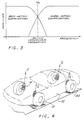
- Fig. 3 qualitatively illustrates that this frequency may be represented by a crossover frequency, ⁇ c , between body motion and wheel motion compensation concerns in the suspension. Generally, the crossover frequency, ⁇ c , lies between the natural frequencies, ⁇ s , and ⁇ u , of the sprung and unsprung mass.
- An active damping system is disclosed in DE-A-3640152. Active damping systems have the disadvantage that they are more complicated and expensive than passive damping systems, and may have higher power requirements.
- an active damping system for a vehicle having an unsprung mass, a sprung mass and a spring means supporting the sprung mass on the unsprung mass
- the system comprising an electrically conducting coil fixed with respect to one of the unsprung mass and the sprung mass, magnetic means fixed with respect to the other of the unsprung mass and the sprung mass and arranged to provide magnetic flux intersecting the coil thereby introducing a current in the coil by relative motion between the coil and the magnetic means, the induced current being such as to develop a force on the magnetic means to oppose said relative motion, and means for providing active damping by injecting a control current into the coil for developing a force on the magnetic means, to oppose relative motion between the coil and the magnetic means, characterised in that a high pass filter is coupled to the coil to provide a path at frequencies in the pass range of the filter for said induced current to provide passive damping for frequencies in the pass range whereby said path is provided parallel to the coil to shunt the high frequency components of the induced current to the ground and said pass
- the present invention can provide an active damping system which retains the advantages of an active suspension system at lower frequencies while retaining the simplified attributes of the passive suspension system at higher frequencies.
- a particular advantage thereof is that the active damping system may have lesser power requirements, be simpler and have lower cost than a purely active suspension.
- An advantage of such a system is that a spring to support the sprung mass on the unsprung mass may be retained such that a failure of the active damping system does not disable the vehicle.
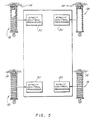
- a vehicle 10 having four wheels 12 and a chassis 14. Interconnecting each wheel 12 to the chassis 14 is a strut assembly 16.
- Strut assembly 16 generally includes an upper mounting bracket 18 and a hub assembly 20.
- the upper mounting bracket 18 is adapted to be mounted to the chassis 14 of the vehicle 10 in a known manner.
- the wheel 12 is rotatably mounted to the hub assembly 20. Accordingly, the mass of each wheel 12 and the corresponding hub assembly 20 is generally defined as the unsprung mass of the vehicle.
- wheel 12 includes both wheel and tire.
- Strut assembly 16 also includes a spring 22 mounted between the upper mounting bracket 18 and the hub assembly 20.
- the spring 22 supports the entire remaining mass at each corner of the vehicle 10, this mass being generally referred to as the sprung mass.
- the active damping system 24 constructed in accordance with the principles of the present invention is shown incorporated within the strut assembly 16.
- the active damping system 24 includes at least one electrical current conductive coil 26 spatially fixed with respect to one of the sprung mass or the unsprung mass, and a magnetic element 28 spatially fixed with respect to the other of the sprung mass and unsprung mass.
- the magnetic element 28 develops a magnetic flux intersecting the coil 26.
- the coil 26 is affixed to the hub assembly 20, which forms part of the unsprung mass whereas the magnetic elements 28 are affixed to the upper mounting bracket 18 which is attached to the sprung mass, i.e. the remainder of the mass of the respective corner of the vehicle 10.
- the active damping system 24 further includes means 30 for developing a control current through the coil 26 to oppose motion of the sprung mass relative to the road surface 32.
- a detailed description of the developing means 30 may be obtained from a study of commonly-owned Serial No. 07/200,025, filed May 27, 1988, now U.S. Patent No. 4,892,328 . (EP-A-0343809).
- the developing means 30 includes an accelerometer 32 and linear voltage differential transformer (LVDT) 34.
- the accelerometer 32 and the LVDT 34 may be included in the strut assembly 16 as disclosed in the above-referenced application Serial No. 07/200,025.
- the developing means 30 also includes a multiplexer 35 from which the signals from each of the accelerometer 32 and the LVDT 34 are applied.
- the multiplexed signal developed by the multiplexer 35 is applied to a differential amplifier 36.
- the amplified signal is then applied to an analog to digital converter 38.
- the digital signal developed thereby is then applied to the microprocessor 40.
- the programming for the microprocessor 40 may be obtained from the above referenced application, Serial No. 07/200,025.
- a feedback path as described therein is also provided from the microprocessor 40 to the multiplexer 34.
- the digital output signal from the microprocessor 40 is applied to a digital to analog converter 42.
- the digital to analog converter thereby develops a controller output signal. Therefore, the combination of the elements between the multiplexer 34 and the digital to analog converter 42 within the developing means 30 may be termed, for purposes herein, a controller 44 which is responsive to the displacement between the sprung mass and the unsprung mass, the first time derivative and a second time derivative of that displacement which are derived from the signals generated by the LVDT 34 and accelerometer 32.
- the controller output signal is applied to a current amplifier 46 which develops the control current for application to the coil 26.
- the developing means 30 further includes a high pass filter 48.
- the high pass filter 48 is electrically connected in parallel with the coil 26 and has a cutoff frequency substantially equivalent to the selected frequency.
- the selected frequency is chosen to be commensurate with the crossover frequency described in reference to Fig. 3.
- the high pass filter 48 includes a capacitor 50 having a selected capacitance and a resistor 52 electrically coupled in series with the capacitor 50 and having a selected resistance.
- the control current applied to the coil 26 for frequency components below the selected frequency are applied to the coil.
- those frequency components of the control current above the selected frequency of the high pass filter 48 are shunted to ground.
- An induced current in the coil 26 is developed when the coil 26 moves through the flux of the magnetic element 28 in response to the motion of the sprung and unsprung masses relative to each other.
- the induced current has mostly high frequency components which are shunted to ground through the high pass filter 48.
- the current amplifier 46 has an output impedance substantially greater than the input impedance to the high pass filter 48 such that most of the induced current in the coil 26 is shunted through the high pass filter 48.
- the induced current in the coil 26 is proportional to the relative velocity between the coil 26 and the flux developed by the magnetic element 28. Therefore, the induced current is also proportional to the velocity of the sprung mass relative to the unsprung mass.
- the electromotive force caused by the induced current and acting on the magnetic element 28 to oppose its relative motion to the coil 26 is equal to the product of the induced current, the magnetic flux density and the inductance of the coil 26. Since this force is a linear function of the induced current which is, in turn, proportional to the velocity, the electromotive force opposing the relative motion is also linearly proportional to velocity and is a true damping force.
- the level of the damping force is also proportional to the amplitude of the induced current, this amplitude being determined by the resistor 52. Therefore, the resistance of the resistor 52 is then selected to adjust the level of this electromotive to achieve the desired damping level. Once the value of resistor 52 is chosen, the capacitance of the capacitor 50 is then selected so that the RC time constant of the resistor 52 and capacitor 50 is commensurate with the selected frequency.
- the present invention has been described in conjunction with a strut type suspension. It is within the ordinary skill in the art to adapt the active damping system to other suspension systems including double wishbone, A-arm and trailing arm suspensions. One skilled in the art would replace the passive damper with the active damping system disclosed herein.
- the spring 22 need not be a coil spring as disclosed but also be a pneumatic spring a torsion bar, or a longitudinal or transverse leaf spring.
Landscapes
- Engineering & Computer Science (AREA)
- Mechanical Engineering (AREA)
- Physics & Mathematics (AREA)
- General Engineering & Computer Science (AREA)
- Electromagnetism (AREA)
- Acoustics & Sound (AREA)
- Aviation & Aerospace Engineering (AREA)
- Vehicle Body Suspensions (AREA)
Claims (8)
- Aktives Dämpfungssystem für ein Fahrzeug, umfassend
eine ungefederte Masse (20),
eine gefederte Masse (18) und eine Federvorrichtung (22), die die gefederte Masse auf der ungefederten Masse abstützt, wobei das System eine elektrisch leitende Spule (26) enthält, die entweder bezüglich der ungefederten Masse (20) oder der gefederten Masse (18) befestigt ist,
eine magnetische Vorrichtung (28), die bezüglich der anderen Masse - der ungefederten Masse oder der gefederten Masse - befestigt und so angeordnet ist, daß sie einen magnetischen Fluß bereitstellt, der die Spule schneidet, wobei die Relativbewegung zwischen der Spule (26) und der magnetischen Vorrichtung (28) einen Strom in der Spule induziert, und der induzierte Strom so ist, daß auf die magnetische Vorrichtung eine Kraft entgegengesetzt zur Relativbewegung ausgeübt wird, und
Vorrichtungen (30, 32, 34, 46), geeignet zum Bereitstellen einer aktiven Dämpfung durch Einspeisen eines Steuerstroms in die Spule (26), um eine Kraft auf die magnetische Vorrichtung (28) auszuüben, die der Relativbewegung zwischen der Spule und der magnetischen Vorrichtung entgegenwirkt, dadurch gekennzeichnet,
daß an die Spule ein Hochpaßfilter (48) angeschlossen ist, um für den induzierten Strom einen Durchlaß bei Frequenzen im Durchlaßbereich des Filters bereitzustellen und eine passive Dämpfung für Frequenzen im Durchlaßbereich bereitzustellen, wobei der Durchlaß parallel zur Spule bereitgestellt ist, um die hochfrequenten Anteile des induzierten Stroms gegen Masse abzuleiten, und der Durchlaßbereich Frequenzen über einer Übergangsfrequenz darstellt, die zwischen der Resonanzfrequenz der gefederten Masse und der Resonanzfrequenz der ungefederten Masse liegt. - Dämpfungssystem nach Anspruch 1, wobei die Kraft eine Funktion der Geschwindigkeit der ungefederten Masse relativ zur gefederten Masse ist.
- Dämpfungssystem nach Anspruch 1 oder 2, wobei die aktive Dämpfungsvorrichtung (30, 32, 34, 46) eine Vorrichtung (52) enthält, geeignet zum Einstellen der Amplitude des induzierten Stroms, um die Höhe der Kraft zu regeln.
- Dämpfungssystem nach Anspruch 3, wobei die Einstellvorrichtung (52) einen Widerstand enthält, der elektrisch an die Spule (26) angeschlossen ist.
- Dämpfungssystem nach irgendeinem der vorhergehenden Ansprüche, wobei das Hochpaßfilter einen Widerstand (52) und einen Kondensator (50) in Reihe im Pfad des induzierten Stroms enthält.
- Dämpfungssystem nach irgendeinem der vorhergehenden Ansprüche, wobei die aktive Dämpfungseinrichtung einen Regler (3) enthält, der zum Bereitstellen des Regelstroms eingerichtet ist, und zwar abhängig von der Verschiebung der gefederten Masse (18) gegen die ungefederte Masse (20) und der zweiten Ableitung dieser Verschiebung bezüglich der Zeit.
- Dämpfungssystem nach Anspruch 6, wobei der Regler so eingerichtet ist, daß er den Regelstrom abhängig von der ersten und der zweiten zeitlichen Ableitung der Verschiebung der gefederten Masse (18) gegen die ungefederte Masse (20) bereitstellt.
- Dämpfungssystem nach Anspruch 6 oder 7, wobei die aktive Dämpfungsvorrichtung einen Stromverstärker (46) enthält, geeignet zum Verstärken des Reglerausgangstroms für die Einspeisung in die Spule (26).
Applications Claiming Priority (3)
| Application Number | Priority Date | Filing Date | Title |
|---|---|---|---|
| US363502 | 1989-06-08 | ||
| US07/363,502 US4969662A (en) | 1989-06-08 | 1989-06-08 | Active damping system for an automobile suspension |
| PCT/US1990/003238 WO1990014969A1 (en) | 1989-06-08 | 1990-06-07 | Active damping system for an automobile suspension |
Publications (3)
| Publication Number | Publication Date |
|---|---|
| EP0454796A1 EP0454796A1 (de) | 1991-11-06 |
| EP0454796A4 EP0454796A4 (en) | 1993-07-14 |
| EP0454796B1 true EP0454796B1 (de) | 1996-02-28 |
Family
ID=23430491
Family Applications (1)
| Application Number | Title | Priority Date | Filing Date |
|---|---|---|---|
| EP90909546A Expired - Lifetime EP0454796B1 (de) | 1989-06-08 | 1990-06-07 | Aktives dämpfungssystem für fahrzeugaufhängungen |
Country Status (4)
| Country | Link |
|---|---|
| US (1) | US4969662A (de) |
| EP (1) | EP0454796B1 (de) |
| DE (1) | DE69025595T2 (de) |
| WO (1) | WO1990014969A1 (de) |
Families Citing this family (53)
| Publication number | Priority date | Publication date | Assignee | Title |
|---|---|---|---|---|
| JPH0764174B2 (ja) * | 1989-03-04 | 1995-07-12 | トヨタ自動車株式会社 | 流体圧式アクティブサスペンション |
| US5257523A (en) * | 1990-09-07 | 1993-11-02 | Coors Brewing Company | Can body maker with magnetic ram bearing and redraw actuator |
| US5263558A (en) * | 1990-10-20 | 1993-11-23 | Atsugi Unisia Corporation | Electromagnetic strut assembly |
| US5293969A (en) * | 1991-02-14 | 1994-03-15 | Atsugi Unisia Corporation | Electromagnetic suspension device |
| US5430646A (en) * | 1991-02-22 | 1995-07-04 | Atsugi Unisia Corporation | System and method for controlling damping force coefficient of shock absorber applicable to automotive supension |
| US5087866A (en) * | 1991-05-22 | 1992-02-11 | Lucas Industries | Temperature compensating circuit for LVDT and control system |
| US5155399A (en) * | 1991-10-31 | 1992-10-13 | Caterpillar Inc. | Coil assembly for an electromechanical actuator |
| US5257014A (en) * | 1991-10-31 | 1993-10-26 | Caterpillar Inc. | Actuator detection method and apparatus for an electromechanical actuator |
| US5254926A (en) * | 1991-11-04 | 1993-10-19 | Ford Motor Company | Current-mode hysteresis control for controlling a motor |
| USH1191H (en) | 1991-12-23 | 1993-06-01 | Caterpillar Inc. | Electromagnetically actuated spool valve |
| US5296785A (en) * | 1991-12-23 | 1994-03-22 | Ford Motor Company | Fail-safe vehicle suspension system including switched reluctance motor |
| US5350983A (en) * | 1992-12-21 | 1994-09-27 | Ford Motor Company | Suspension damper with integrated controls |
| US5306031A (en) * | 1993-04-06 | 1994-04-26 | Quinn Thomas N | Automatic wedge chassis adjuster |
| US5456341A (en) * | 1993-04-23 | 1995-10-10 | Moog Inc. | Method and apparatus for actively adjusting and controlling a resonant mass-spring system |
| JP3036297B2 (ja) * | 1993-06-04 | 2000-04-24 | 神鋼電機株式会社 | 自動搬送車両 |
| US5441298A (en) * | 1993-10-22 | 1995-08-15 | Ford Motor Company | Apparatus for stabilizing an electric active suspension system upon interruption of the power supply |
| AU1196395A (en) * | 1993-12-09 | 1995-06-27 | Denne Developments Limited | Motion control systems |
| US5488278A (en) * | 1994-09-23 | 1996-01-30 | The United States Of America As Represented By The Secretary Of The Navy | Load limit system for mechanical linear actuator |
| US5630440A (en) * | 1995-02-21 | 1997-05-20 | Applied Power Inc. | Piezo composite sheet actuated valve |
| US5593134A (en) * | 1995-02-21 | 1997-01-14 | Applied Power Inc. | Magnetically assisted piezo-electric valve actuator |
| US5696677A (en) * | 1995-03-27 | 1997-12-09 | General Motors Corporation | Vehicle chassis control |
| DE19529151A1 (de) * | 1995-08-08 | 1997-02-13 | Fev Motorentech Gmbh & Co Kg | Verfahren zum Schalten eines elektromagnetischen Aktuators |
| JP2000016047A (ja) * | 1998-07-06 | 2000-01-18 | Toyota Motor Corp | ばね上質量推定装置 |
| ES2162557B1 (es) * | 1999-05-27 | 2002-06-01 | Orti Javier Porcar | Amortiguador electromagnetico. |
| DE50211806D1 (de) * | 2001-05-09 | 2008-04-17 | Continental Ag | Verfahren zur Regelung des Dämpferstromes für elektrisch verstellbare Dämpfer |
| US6945541B2 (en) * | 2003-01-21 | 2005-09-20 | Bose Corporation | Vehicle suspension |
| US6926288B2 (en) * | 2003-06-02 | 2005-08-09 | Bose Corporation | Electromagnetic interference filter |
| US20060219499A1 (en) * | 2005-03-30 | 2006-10-05 | Organek Gregory J | Residual magnetic devices and methods |
| US8403124B2 (en) | 2005-03-30 | 2013-03-26 | Strattec Security Corporation | Residual magnetic devices and methods |
| US20060225973A1 (en) * | 2005-03-30 | 2006-10-12 | Dimig Steven J | Residual magnetic devices and methods |
| US20060219498A1 (en) * | 2005-03-30 | 2006-10-05 | Organek Gregory J | Residual magnetic devices and methods |
| US7969705B2 (en) | 2005-03-30 | 2011-06-28 | Strattec Security Corporation | Residual magnetic devices and methods |
| US8616351B2 (en) | 2009-10-06 | 2013-12-31 | Tenneco Automotive Operating Company Inc. | Damper with digital valve |
| US8376373B2 (en) * | 2009-11-23 | 2013-02-19 | General Dynamics Land Systems | Controllable suspension architecture for enhanced armoured vehicle survivability |
| CN101844497B (zh) * | 2010-06-02 | 2012-04-25 | 重庆大学 | 圆筒型车辆主动悬架电磁作动器 |
| EP2574821B1 (de) * | 2011-09-30 | 2013-10-30 | Siemens Aktiengesellschaft | Aktiver Schwingungsdämpfer ohne direkte Beschleunigungserfassung |
| US9217483B2 (en) | 2013-02-28 | 2015-12-22 | Tenneco Automotive Operating Company Inc. | Valve switching controls for adjustable damper |
| WO2014134500A1 (en) | 2013-02-28 | 2014-09-04 | Tenneco Automotive Operating Company Inc. | Damper with integrated electronics |
| US9884533B2 (en) | 2013-02-28 | 2018-02-06 | Tenneco Automotive Operating Company Inc. | Autonomous control damper |
| US9163691B2 (en) | 2013-03-15 | 2015-10-20 | Tenneco Automotive Operating Company Inc. | Rod guide arrangement for electronically controlled valve applications |
| EP2971847A4 (de) | 2013-03-15 | 2016-12-21 | Tenneco Automotive Operating Co Inc | Stangenführungsanordnung mit mehrteiliger ventilanordnung |
| US9879748B2 (en) | 2013-03-15 | 2018-01-30 | Tenneco Automotive Operating Company Inc. | Two position valve with face seal and pressure relief port |
| US9879746B2 (en) | 2013-03-15 | 2018-01-30 | Tenneco Automotive Operating Company Inc. | Rod guide system and method with multiple solenoid valve cartridges and multiple pressure regulated valve assemblies |
| US9365089B2 (en) | 2013-12-16 | 2016-06-14 | GM Global Technology Operations LLC | Method and apparatus for active suspension damping including negative stiffness |
| US9133900B2 (en) | 2013-12-16 | 2015-09-15 | GM Global Technology Operations LLC | Method and apparatus for suspension damping including negative stiffness employing a permanent magnet |
| US9370982B2 (en) | 2013-12-16 | 2016-06-21 | GM Global Technology Operations LLC | Method and apparatus for suspension damping including negative stiffness |
| FR3032686B1 (fr) * | 2015-02-18 | 2017-03-10 | Messier Bugatti Dowty | Atterrisseur d'aeronef comprenant une tige lineaire telescopique |
| US9884545B1 (en) | 2016-11-01 | 2018-02-06 | Ford Global Technologies, Llc | Traction battery mounting assembly and securing method |
| EP3357719A1 (de) * | 2017-02-06 | 2018-08-08 | Ovalo GmbH | Aktive radaufhängung für ein fahrzeug |
| US10588233B2 (en) | 2017-06-06 | 2020-03-10 | Tenneco Automotive Operating Company Inc. | Damper with printed circuit board carrier |
| US10479160B2 (en) | 2017-06-06 | 2019-11-19 | Tenneco Automotive Operating Company Inc. | Damper with printed circuit board carrier |
| US10752072B2 (en) | 2018-09-05 | 2020-08-25 | Ford Global Technologies, Llc | Electrified vehicle with vibration isolator within frame and corresponding method |
| US12097734B2 (en) * | 2022-12-30 | 2024-09-24 | Karma Automotive Llc | Hybrid planar active electromagnetic suspension |
Family Cites Families (13)
| Publication number | Priority date | Publication date | Assignee | Title |
|---|---|---|---|---|
| AT278897B (de) * | 1965-02-26 | 1970-02-10 | Rheinstahl Henschel Ag | Drehgestellanordung an Schienenfahzeugen |
| US3770290A (en) * | 1972-01-24 | 1973-11-06 | F Bottalico | Vehicle shock absorber |
| JPS5610844A (en) * | 1979-07-02 | 1981-02-03 | Toyota Motor Corp | Feedback control system vibration absorbing suspension |
| DE3314335A1 (de) * | 1983-04-20 | 1984-10-31 | Tillmann 6108 Weiterstadt Freudenberg | Motorlager |
| JPH075009B2 (ja) * | 1985-10-22 | 1995-01-25 | トヨタ自動車株式会社 | 車輌用車高調整装置 |
| DE3640152A1 (de) * | 1985-12-04 | 1988-11-24 | Volkswagen Ag | Radaufhaengung fuer ein fahrzeug mit einem frequenzabhaengigen daempfer |
| DE3543492A1 (de) * | 1985-12-09 | 1987-06-11 | Harald Teinzer | Elektromagnetische stossdaempfung, verfahren und vorrichtung |
| JPS62288741A (ja) * | 1986-06-06 | 1987-12-15 | Tokai Rubber Ind Ltd | パワ−ユニツトのマウンテイング装置 |
| US4829436A (en) * | 1987-06-29 | 1989-05-09 | General Motors Corporation | Vehicle air suspension system with accurate side to side leveling |
| US4805923A (en) * | 1987-12-16 | 1989-02-21 | Ford Motor Company | Adaptive control system for operating adjustable automotive suspension units |
| US4815575A (en) * | 1988-04-04 | 1989-03-28 | General Motors Corporation | Electric, variable damping vehicle suspension |
| US4892328A (en) * | 1988-05-27 | 1990-01-09 | Aura Systems, Inc. | Electromagnetic strut assembly |
| US4912343A (en) * | 1988-08-31 | 1990-03-27 | Aura Systems, Inc. | Electromagnetic actuator |
-
1989
- 1989-06-08 US US07/363,502 patent/US4969662A/en not_active Expired - Fee Related
-
1990
- 1990-06-07 WO PCT/US1990/003238 patent/WO1990014969A1/en not_active Ceased
- 1990-06-07 EP EP90909546A patent/EP0454796B1/de not_active Expired - Lifetime
- 1990-06-07 DE DE69025595T patent/DE69025595T2/de not_active Expired - Fee Related
Also Published As
| Publication number | Publication date |
|---|---|
| US4969662A (en) | 1990-11-13 |
| WO1990014969A1 (en) | 1990-12-13 |
| EP0454796A4 (en) | 1993-07-14 |
| EP0454796A1 (de) | 1991-11-06 |
| DE69025595D1 (de) | 1996-04-04 |
| DE69025595T2 (de) | 1996-07-11 |
Similar Documents
| Publication | Publication Date | Title |
|---|---|---|
| EP0454796B1 (de) | Aktives dämpfungssystem für fahrzeugaufhängungen | |
| CA1312630C (en) | Electromagnetic strut assembly | |
| US4960290A (en) | Wheel assembly suspending | |
| EP0538965B1 (de) | Vibrationsdämpfung mittels eines stufenlos verstellbaren, halbaktiven Dämpfers | |
| US2973969A (en) | Electrical shock absorbing system | |
| EP0139145B1 (de) | Radaufhängung für Kraftfahrzeuge | |
| US7333882B2 (en) | Suspension control apparatus | |
| US5265704A (en) | Apparatus for damping courses of motion | |
| DE3461153D1 (en) | Suspension system for a motor vehicle | |
| JPH05612A (ja) | 車両用サスペンシヨンの取付装置 | |
| EP0476714A2 (de) | Niveauregelung für Kraftfahrzeuge | |
| US5218546A (en) | Frequency shaping method for minimizing impact harshness of suspension system | |
| EP0579182A1 (de) | Aktive Fahrzeugfederung, insbesondere Fahrerhausfederung eines Nutzfahrzeuges | |
| JPH06312616A (ja) | 防振支持装置 | |
| JPH04129815A (ja) | 自動車の磁力式サスペンション装置 | |
| JPH0530483Y2 (de) | ||
| GB2222684A (en) | Acceleration sensor | |
| JPH0542812A (ja) | 車両の懸架装置 | |
| JPH06117485A (ja) | 周波数対応型吸振器 | |
| JPH06344739A (ja) | 車両用サスペンション | |
| SU1124266A1 (ru) | Устройство дл виброзащиты сидень транспортного средства | |
| JPH07276955A (ja) | 車両用サスペンション | |
| JPS61253207A (ja) | サスペンシヨン装置 | |
| JPH03182829A (ja) | 自動車用サスペンション装置 | |
| JPH06313460A (ja) | 防振支持構造 |
Legal Events
| Date | Code | Title | Description |
|---|---|---|---|
| PUAI | Public reference made under article 153(3) epc to a published international application that has entered the european phase |
Free format text: ORIGINAL CODE: 0009012 |
|
| 17P | Request for examination filed |
Effective date: 19910821 |
|
| AK | Designated contracting states |
Kind code of ref document: A1 Designated state(s): DE FR GB IT SE |
|
| RHK1 | Main classification (correction) |
Ipc: B60G 11/00 |
|
| A4 | Supplementary search report drawn up and despatched |
Effective date: 19930527 |
|
| AK | Designated contracting states |
Kind code of ref document: A4 Designated state(s): DE FR GB IT SE |
|
| 17Q | First examination report despatched |
Effective date: 19930727 |
|
| GRAA | (expected) grant |
Free format text: ORIGINAL CODE: 0009210 |
|
| AK | Designated contracting states |
Kind code of ref document: B1 Designated state(s): DE FR GB IT SE |
|
| ET | Fr: translation filed | ||
| REF | Corresponds to: |
Ref document number: 69025595 Country of ref document: DE Date of ref document: 19960404 |
|
| ITF | It: translation for a ep patent filed | ||
| PLBE | No opposition filed within time limit |
Free format text: ORIGINAL CODE: 0009261 |
|
| STAA | Information on the status of an ep patent application or granted ep patent |
Free format text: STATUS: NO OPPOSITION FILED WITHIN TIME LIMIT |
|
| 26N | No opposition filed | ||
| PGFP | Annual fee paid to national office [announced via postgrant information from national office to epo] |
Ref country code: GB Payment date: 19980421 Year of fee payment: 9 |
|
| PGFP | Annual fee paid to national office [announced via postgrant information from national office to epo] |
Ref country code: FR Payment date: 19980615 Year of fee payment: 9 |
|
| PGFP | Annual fee paid to national office [announced via postgrant information from national office to epo] |
Ref country code: SE Payment date: 19980616 Year of fee payment: 9 |
|
| PGFP | Annual fee paid to national office [announced via postgrant information from national office to epo] |
Ref country code: DE Payment date: 19980626 Year of fee payment: 9 |
|
| PG25 | Lapsed in a contracting state [announced via postgrant information from national office to epo] |
Ref country code: GB Free format text: LAPSE BECAUSE OF NON-PAYMENT OF DUE FEES Effective date: 19990607 |
|
| PG25 | Lapsed in a contracting state [announced via postgrant information from national office to epo] |
Ref country code: SE Free format text: THE PATENT HAS BEEN ANNULLED BY A DECISION OF A NATIONAL AUTHORITY Effective date: 19990629 |
|
| PG25 | Lapsed in a contracting state [announced via postgrant information from national office to epo] |
Ref country code: FR Free format text: THE PATENT HAS BEEN ANNULLED BY A DECISION OF A NATIONAL AUTHORITY Effective date: 19990630 |
|
| GBPC | Gb: european patent ceased through non-payment of renewal fee |
Effective date: 19990607 |
|
| EUG | Se: european patent has lapsed |
Ref document number: 90909546.5 |
|
| PG25 | Lapsed in a contracting state [announced via postgrant information from national office to epo] |
Ref country code: DE Free format text: LAPSE BECAUSE OF NON-PAYMENT OF DUE FEES Effective date: 20000503 |
|
| REG | Reference to a national code |
Ref country code: FR Ref legal event code: ST |
|
| PG25 | Lapsed in a contracting state [announced via postgrant information from national office to epo] |
Ref country code: IT Free format text: LAPSE BECAUSE OF NON-PAYMENT OF DUE FEES Effective date: 20050607 |