EP0454879A1 - Appareil de ventilation pour installation de ventilation individuelle - Google Patents
Appareil de ventilation pour installation de ventilation individuelle Download PDFInfo
- Publication number
- EP0454879A1 EP0454879A1 EP90108270A EP90108270A EP0454879A1 EP 0454879 A1 EP0454879 A1 EP 0454879A1 EP 90108270 A EP90108270 A EP 90108270A EP 90108270 A EP90108270 A EP 90108270A EP 0454879 A1 EP0454879 A1 EP 0454879A1
- Authority
- EP
- European Patent Office
- Prior art keywords
- front wall
- plate
- spring
- fan
- passage
- Prior art date
- Legal status (The legal status is an assumption and is not a legal conclusion. Google has not performed a legal analysis and makes no representation as to the accuracy of the status listed.)
- Granted
Links
- 238000009423 ventilation Methods 0.000 title claims abstract description 32
- 238000009434 installation Methods 0.000 title abstract description 4
- 238000013022 venting Methods 0.000 claims description 11
- 239000000463 material Substances 0.000 claims description 9
- 239000003779 heat-resistant material Substances 0.000 claims description 7
- 238000002844 melting Methods 0.000 claims description 6
- 230000006835 compression Effects 0.000 claims description 5
- 238000007906 compression Methods 0.000 claims description 5
- 230000008018 melting Effects 0.000 claims description 5
- 239000002184 metal Substances 0.000 claims description 3
- 230000001960 triggered effect Effects 0.000 abstract 1
- 239000007789 gas Substances 0.000 description 6
- 238000009413 insulation Methods 0.000 description 5
- 239000000155 melt Substances 0.000 description 4
- 239000010425 asbestos Substances 0.000 description 2
- 238000000034 method Methods 0.000 description 2
- 229910052895 riebeckite Inorganic materials 0.000 description 2
- 210000000078 claw Anatomy 0.000 description 1
- 239000000567 combustion gas Substances 0.000 description 1
- 238000010276 construction Methods 0.000 description 1
- 238000011161 development Methods 0.000 description 1
- 230000018109 developmental process Effects 0.000 description 1
- 230000000694 effects Effects 0.000 description 1
- 239000003063 flame retardant Substances 0.000 description 1
- 239000004519 grease Substances 0.000 description 1
- 230000001771 impaired effect Effects 0.000 description 1
- 238000007689 inspection Methods 0.000 description 1
- 239000011810 insulating material Substances 0.000 description 1
- 230000000149 penetrating effect Effects 0.000 description 1
- 238000003825 pressing Methods 0.000 description 1
- 230000001681 protective effect Effects 0.000 description 1
Images


Classifications
-
- A—HUMAN NECESSITIES
- A62—LIFE-SAVING; FIRE-FIGHTING
- A62C—FIRE-FIGHTING
- A62C2/00—Fire prevention or containment
- A62C2/06—Physical fire-barriers
- A62C2/18—Sliding dampers
-
- F—MECHANICAL ENGINEERING; LIGHTING; HEATING; WEAPONS; BLASTING
- F24—HEATING; RANGES; VENTILATING
- F24F—AIR-CONDITIONING; AIR-HUMIDIFICATION; VENTILATION; USE OF AIR CURRENTS FOR SCREENING
- F24F7/00—Ventilation
- F24F7/04—Ventilation with ducting systems, e.g. by double walls; with natural circulation
- F24F7/06—Ventilation with ducting systems, e.g. by double walls; with natural circulation with forced air circulation, e.g. by fan positioning of a ventilator in or against a conduit
-
- F—MECHANICAL ENGINEERING; LIGHTING; HEATING; WEAPONS; BLASTING
- F24—HEATING; RANGES; VENTILATING
- F24F—AIR-CONDITIONING; AIR-HUMIDIFICATION; VENTILATION; USE OF AIR CURRENTS FOR SCREENING
- F24F11/00—Control or safety arrangements
- F24F11/30—Control or safety arrangements for purposes related to the operation of the system, e.g. for safety or monitoring
- F24F11/32—Responding to malfunctions or emergencies
- F24F11/33—Responding to malfunctions or emergencies to fire, excessive heat or smoke
- F24F11/35—Responding to malfunctions or emergencies to fire, excessive heat or smoke by closing air passages
-
- F—MECHANICAL ENGINEERING; LIGHTING; HEATING; WEAPONS; BLASTING
- F24—HEATING; RANGES; VENTILATING
- F24F—AIR-CONDITIONING; AIR-HUMIDIFICATION; VENTILATION; USE OF AIR CURRENTS FOR SCREENING
- F24F2221/00—Details or features not otherwise provided for
- F24F2221/30—Details or features not otherwise provided for comprising fireproof material
Definitions
- the invention relates to a ventilation device for a single ventilation system with a common main line, each device being equipped with an electric motor-driven fan, the pressure side of which is connected to the main line via a spur line, and the fan is arranged in a housing, one with a passage for the Air drawn in has front wall on which a filter arrangement is placed, each device being equipped with a fire damper made of heat-resistant material and a thermal release device, by means of which the fire damper is held in a closed position by means of a spring in the event of triggering, in which the air passage over the Passage to the main line is blocked.
- Individual ventilation systems are understood to mean systems in which a large number of ventilation devices each have their own branch line to the common one
- the ventilation devices for such individual ventilation systems represent independent units that can work together or independently of the other units.
- the ventilation devices are each equipped with their own fan.
- Single ventilation systems with a common main line are mainly used for the ventilation of windowless rooms in buildings.
- Such rooms are mostly sanitary rooms such as bathrooms, toilets or the like. However, other rooms such as kitchens, storage rooms or the like can also be used for ventilation.
- the main line is arranged in a vertical shaft of the building, which is usually designed as a supply shaft.
- the main line ends in an outlet or a chimney in the roof area of the house.
- the branch line with which the connection between the housing and the main line is made, usually consists of a so-called "flex tube”.
- the existing fire damper in such ventilators serves to prevent in the event of a fire that hot fire gases pass through the ventilator and the branch line into the riser pipe and thus possibly into other connected rooms and can thus cause the fire to spread.
- the fire protection flap is arranged between the fan of the ventilation device and the spur line. In this way, the combustion gases can be prevented from entering the ventilation riser pipe from the burning room. Due to the location of the fire damper, however, the majority of the fan in the event of a fire is completely exposed to the hot fire gases even after the fire damper has been closed.
- the entire ventilation device must always be removed in order to be able to reach the fire damper.
- the fire damper is to be checked for its effectiveness without a fire having preceded it, which is necessary from time to time.
- a fire protection device has already become known for individual fans, which has a flap designed as a drop flap behind the intake grille of the front panel.
- this fire protection device can only be accommodated in a large housing, so that the appearance of the fan from the front, that is to say from the side of the room to be ventilated, is not ideal.
- the installation of the housing is only possible in one position because of the function of the drop flap, which must always be arranged pivotably about a horizontal axis.
- the front panel has to Special dowels are anchored to the wall, which further affects the appearance from the room and requires increased installation effort.
- the invention has for its object to further develop a ventilation device of the generic type in such a way that, while maintaining the advantages of a fire damper arranged in front of the fan, the ventilation device can be installed with little assembly effort in practically any position and a shapely design of the ventilation device.
- the fire damper is designed as a flat plate which is arranged on one side of the front wall in a plane running parallel to the wall plane close to the wall in this plane between a closed position and an open position, the plate Cover passage in the front wall in the closed position and releases in the open position, and that the spring of the thermal release device moves the plate from its open position to the closed position in the event of tripping.
- the invention is based on the idea of providing the fire damper on the front of the ventilation device close behind the filter arrangement, in order to enable easy filter change on the one hand and good accessibility of the fire damper for inspection on the other without major dismantling work.
- a ventilation device of the type according to the invention is built very flat, so that practically any shape and design is possible is.
- the flat plate is designed as a type of slide that can be moved in a straight line on the front wall from its open position into the closed position via guides.
- the flat plate is arranged on a lever and can thus be pivoted from its open position into the closed position on an arc. Both types have the advantage that they can be made relatively flat and therefore only require relatively little space perpendicular to the plane of the front wall.
- the front wall can also carry a plate made of heat-resistant material for further fire and sound insulation.
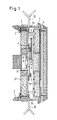
- the reference numeral 1 denotes the housing for a ventilation device, in which a fan with a motor and fan blades is arranged.
- the motor and the fan blade and the part of the housing which extends to the left in FIG. 1 have been omitted for the sake of clarity.
- the housing 1 is embedded in a masonry that its right edge in Fig. 1 is flush with the wall.
- the housing is anchored in the wall with claws 10. Starting from the housing part, not shown, the housing is connected to the main line, also not shown, via a connecting piece and a spur line.
- This front wall 3 can consist of a sheet metal plate provided with a bent edge. Within the bent edge, on the side of the fan blade, not shown, a plate 21 made of a heat-resistant material, e.g. Asbestos. This plate 21 can serve the additional fire retardancy, but also the further sound insulation of the motor and fan noise.
- a passage 15 for the air to be extracted from the room to be vented In the present exemplary embodiment, the part of the electric motor (not shown) protrudes into the passage 15.
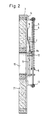
- straight guides 7 are fastened parallel to one another and have a double cranked, Z-shaped cross section and such a distance have from each other that between them the flat plate 8 of the fire protection device is easily moved back and forth.
- a guide rod 5 is attached to the front wall 3 with the aid of two rod holders 13, 14 and is surrounded by a compression spring 6.
- the rod holder 14 located at the top in FIG. 2 serves as a first spring abutment for the compression spring 6.
- the second spring abutment is formed by a part 9 projecting at right angles from the flat plate 8, through which the guide rod 5 extends. In this way, the plate 8 is additionally guided on the guide rod 5.
- the plate 8 itself can be moved back and forth in a straight line so that, in an end position in which it strikes end stops 7a in the plate guides 7, it completely covers the passage 15 in the front wall 3 and in the plate 21, thus closing this passage . In its other end position, it completely clears the passage 15.
- the compression spring 6 strives to move the flat plate 8 into its closed position in contact with the end stops 7a of the plate guides 7.
- a slightly melting part 12 acting as a thermal release device is firmly arranged, which protrudes beyond the adjacent plate guide 7 into the path of the flat plate 8 and is thus able to counter this plate Force the spring 6 to lock in its open position.
- the part 12 consists of a material that is strong enough on the one hand to perform the function mentioned, but on the other hand melts at a certain temperature, approximately 72 ° C.
- the part 12 can also be designed as a bimetallic strip which deforms approximately at the temperature mentioned so that it releases the path of the flat plate 8.
- a perforated attachment frame 4 which is detachably attached to the housing and which contains a filter material 4a, serves as a cover for the ventilation device to the space to be vented.
- a grille with a soundproofing filling which is also made of a highly heat-resistant material (e.g. asbestos) and thus also has a fire-retardant effect.
- the plate guide 7 and the guide rod 5 can be arranged obliquely on the sound insulation wall 3, e.g. diagonally, as shown in Fig. 3.
- the part forming the release device melts.
- the plate 8 is no longer locked and is held by the force of the spring 6 moved up to the stops 7a in the plate guides 7. This position corresponds to the complete closing of the passage 15.
- the free end of the end position safety device for example designed as a leaf spring, falls behind the surface of the flat plate 8 in the open position under slight spring pressure the folded rear edge 8a of the plate 8. As a result, the flat plate 8 is locked in this position.
- the hot (fire) gases are prevented from penetrating further into the interior of the fan, for example up to the heat-sensitive motor or even via the connecting piece and the branch line into the main line.
- the plate 21 behind the front wall 3 causes less heat energy to get into the space behind the front wall 3, so that the risk of ignition of the engine and any grease residues or other combustible materials in the subsequent pipe system is reduced. Due to the hot (fire) gases and the heat energy generated, the front frame 4 in FIG. 1 to the right of the front wall 3 and the protective grille in front of it can be destroyed, but not the interior of the ventilation device itself Fire in other rooms connected to the main line can be prevented.
- a flat plate 16 in the form of a disc is than the diameter of the passage 15.
- the disk can be circular.
- This disc is attached to one end of a lever 17, the other end of which is fixedly connected to an eccentrically to the center of the passage 15 and perpendicular to the front wall 3 in this shaft 18.
- the length of the lever 17 and the location of the bearing of the shaft 18 in the front wall 3 are selected so that the disk 16 can be pivoted around the shaft 18 into a position against the stop 24 in which it closes the passage 15 (in Fig.
- a thermal release device designed as a strip 22 made of an easily meltable material is also fastened, in such a way that it opposes the tension of the disc 16 on the other side of the front wall attached tension spring 20 holds in its "open position".
- the thermal release device can have a bimetallic strip instead of the strip 22 made of easily meltable material, which locks the disc in its open position at normal temperature. If the room temperature rises above the permissible level, the strip 22 of easily meltable material melts and thus releases the pivoting path of the disc 16 into the closed position or the bimetallic strip bends so that the pivoting path of the disc 16 also is released.
- a plate 21 can be attached, which also fulfills both fire protection and sound insulation tasks and is made of a highly heat-resistant material.
- the parts 19 and 20 are correspondingly further out.
- the mode of operation of the second embodiment corresponds analogously to that of the first embodiment:
- the disk 16 In the normal operating position, that is to say in the position in which the pivotable disk 16 clears the passage, the disk 16 is located, for example, in one shown in FIG Location.
- the spring 20 endeavors to bring the disk 16 via the lever 19, the shaft 18 and the lever 17 in the direction of the arrow 23 into the position shown in dashed lines in FIG. 4, in which it abuts the stop 24.
- the disc 22 is prevented from this pivoting movement by the strip 22 made of easily meltable material or by the bimetal strip which lies in the pivoting path of the disc 16.
- the thermal release device or the corresponding bimetallic strip which is designed as a strip of easily meltable material, melts and the disk 16 is brought up to the stop 24 by the tensile force of the spring 20, whereby the passage 15 is closed.
- the fan motor and the space behind it can only come into contact with hot gases to a very limited extent, so that there is a saving on insulating material. It is also an advantage that the part of the fan facing the space to be ventilated can be made very flat and therefore elegant. In addition, the claimed design enables much better sound insulation.
Landscapes
- Engineering & Computer Science (AREA)
- Combustion & Propulsion (AREA)
- General Engineering & Computer Science (AREA)
- Emergency Management (AREA)
- Chemical & Material Sciences (AREA)
- Public Health (AREA)
- Health & Medical Sciences (AREA)
- Mechanical Engineering (AREA)
- Business, Economics & Management (AREA)
- Ventilation (AREA)
- Air-Flow Control Members (AREA)
- Orthopedics, Nursing, And Contraception (AREA)
- Arc Welding In General (AREA)
- External Artificial Organs (AREA)
- Specific Sealing Or Ventilating Devices For Doors And Windows (AREA)
Priority Applications (4)
| Application Number | Priority Date | Filing Date | Title |
|---|---|---|---|
| DE59009820T DE59009820D1 (de) | 1990-04-30 | 1990-04-30 | Entlüftungsgerät für eine Einzel-Entlüftungsanlage. |
| AT90108270T ATE129418T1 (de) | 1990-04-30 | 1990-04-30 | Entlüftungsgerät für eine einzel- entlüftungsanlage. |
| EP90108270A EP0454879B1 (fr) | 1990-04-30 | 1990-04-30 | Appareil de ventilation pour installation de ventilation individuelle |
| DE9101993U DE9101993U1 (de) | 1990-04-30 | 1991-02-20 | Entlüftungsgerät für eine Einzel-Entlüftungsanlage |
Applications Claiming Priority (1)
| Application Number | Priority Date | Filing Date | Title |
|---|---|---|---|
| EP90108270A EP0454879B1 (fr) | 1990-04-30 | 1990-04-30 | Appareil de ventilation pour installation de ventilation individuelle |
Publications (2)
| Publication Number | Publication Date |
|---|---|
| EP0454879A1 true EP0454879A1 (fr) | 1991-11-06 |
| EP0454879B1 EP0454879B1 (fr) | 1995-10-25 |
Family
ID=8203942
Family Applications (1)
| Application Number | Title | Priority Date | Filing Date |
|---|---|---|---|
| EP90108270A Expired - Lifetime EP0454879B1 (fr) | 1990-04-30 | 1990-04-30 | Appareil de ventilation pour installation de ventilation individuelle |
Country Status (3)
| Country | Link |
|---|---|
| EP (1) | EP0454879B1 (fr) |
| AT (1) | ATE129418T1 (fr) |
| DE (2) | DE59009820D1 (fr) |
Cited By (2)
| Publication number | Priority date | Publication date | Assignee | Title |
|---|---|---|---|---|
| DE102021104147A1 (de) | 2020-02-21 | 2021-08-26 | Kordial Media Gmbh | Brandschutzeinrichtung zum Verschließen einer Öffnung in einer Trennwand |
| CN115887967A (zh) * | 2023-01-06 | 2023-04-04 | 北京松山国家级自然保护区管理处(北京市松山林场管理处) | 一种具有加热保温结构的森林灭火装置及其灭火方法 |
Families Citing this family (3)
| Publication number | Priority date | Publication date | Assignee | Title |
|---|---|---|---|---|
| DE19946046C2 (de) * | 1999-06-08 | 2001-04-19 | Haewa Programmgehaeuse Und Kom | Lüftungselement |
| CN110617355A (zh) * | 2019-09-03 | 2019-12-27 | 山东中科恒基建材有限公司 | 烟道防火阀和具有其的烟道系统 |
| CN112212446B (zh) * | 2020-11-11 | 2022-07-26 | 克州鑫源建筑安装有限责任公司 | 一种建筑通风装置及其使用方法 |
Citations (2)
| Publication number | Priority date | Publication date | Assignee | Title |
|---|---|---|---|---|
| FR2338091A1 (fr) * | 1976-01-13 | 1977-08-12 | Sirulik Wilhelm | Dispositif de securite applicable notamment aux hottes de cuisine |
| DE2854267A1 (de) * | 1978-12-14 | 1980-06-26 | Benno Schoettler | Brandschutzsicherung |
-
1990
- 1990-04-30 EP EP90108270A patent/EP0454879B1/fr not_active Expired - Lifetime
- 1990-04-30 AT AT90108270T patent/ATE129418T1/de not_active IP Right Cessation
- 1990-04-30 DE DE59009820T patent/DE59009820D1/de not_active Expired - Fee Related
-
1991
- 1991-02-20 DE DE9101993U patent/DE9101993U1/de not_active Expired - Lifetime
Patent Citations (2)
| Publication number | Priority date | Publication date | Assignee | Title |
|---|---|---|---|---|
| FR2338091A1 (fr) * | 1976-01-13 | 1977-08-12 | Sirulik Wilhelm | Dispositif de securite applicable notamment aux hottes de cuisine |
| DE2854267A1 (de) * | 1978-12-14 | 1980-06-26 | Benno Schoettler | Brandschutzsicherung |
Cited By (3)
| Publication number | Priority date | Publication date | Assignee | Title |
|---|---|---|---|---|
| DE102021104147A1 (de) | 2020-02-21 | 2021-08-26 | Kordial Media Gmbh | Brandschutzeinrichtung zum Verschließen einer Öffnung in einer Trennwand |
| CN115887967A (zh) * | 2023-01-06 | 2023-04-04 | 北京松山国家级自然保护区管理处(北京市松山林场管理处) | 一种具有加热保温结构的森林灭火装置及其灭火方法 |
| CN115887967B (zh) * | 2023-01-06 | 2023-12-29 | 北京松山国家级自然保护区管理处(北京市松山林场管理处) | 一种具有加热保温结构的森林灭火装置及其灭火方法 |
Also Published As
| Publication number | Publication date |
|---|---|
| ATE129418T1 (de) | 1995-11-15 |
| DE9101993U1 (de) | 1991-05-08 |
| EP0454879B1 (fr) | 1995-10-25 |
| DE59009820D1 (de) | 1995-11-30 |
Similar Documents
| Publication | Publication Date | Title |
|---|---|---|
| EP1731685B1 (fr) | Façade isolée et ventilée pour bâtiment | |
| EP0512414A2 (fr) | Clapet coupe-feu | |
| DE2731979B2 (de) | Fenster mit erhöhter Feuerwiderstandsfähigkeit | |
| DE9410744U1 (de) | Brandschutz-Sperrvorrichtung für Lüftungsleitungen | |
| EP0454879B1 (fr) | Appareil de ventilation pour installation de ventilation individuelle | |
| DE2308705A1 (de) | Feuerschutz-tuer und sicherheitsinstallation gegen brand | |
| DE10134839A1 (de) | Einrichtung zum rauch- und feuerbeständigen Verschliessen eines Wand- oder Deckendurchbruchs | |
| DE19643854A1 (de) | Brandschutzeinrichtung für Rohrleitungen | |
| DE10043774B4 (de) | Brandschutzeinrichtung | |
| DE3212715C2 (fr) | ||
| DE3236661C2 (fr) | ||
| DE202016100191U1 (de) | Schornstein für Feuerstätten in Wohngebäuden und Verschlusseinrichtung hierfür | |
| EP0003614A1 (fr) | Fermeture pare-feu pour ouvertures dans des murs et des plafonds | |
| DE2262541A1 (de) | Absperrvorrichtung gegen feuer und rauch | |
| DE2420548A1 (de) | Brandwand-abschluss in form von feuerschutzelementen | |
| DE2854267A1 (de) | Brandschutzsicherung | |
| EP0046481A1 (fr) | Volet coupe-feu | |
| DE102022133291A1 (de) | Entrauchungseinrichtung | |
| DE29614941U1 (de) | Brandschutzeinrichtung für eine Lüftungsrohrleitung | |
| DE19649126C2 (de) | Absperrvorrichtung gegen eine Brandübertragung | |
| EP1852146A1 (fr) | Appareil de protection contre le feu, en particulier pour système d'aération | |
| AT411849B (de) | Lüftungsanlage | |
| DE2519666A1 (de) | Feuerschutztuer | |
| AT405864B (de) | Brandschutzklappe | |
| DE2405692A1 (de) | Vorrichtung zur absperrung von brandabschnitten |
Legal Events
| Date | Code | Title | Description |
|---|---|---|---|
| PUAI | Public reference made under article 153(3) epc to a published international application that has entered the european phase |
Free format text: ORIGINAL CODE: 0009012 |
|
| AK | Designated contracting states |
Kind code of ref document: A1 Designated state(s): AT BE CH DE FR GB LI NL |
|
| 17P | Request for examination filed |
Effective date: 19920401 |
|
| 17Q | First examination report despatched |
Effective date: 19930720 |
|
| GRAA | (expected) grant |
Free format text: ORIGINAL CODE: 0009210 |
|
| AK | Designated contracting states |
Kind code of ref document: B1 Designated state(s): AT BE CH DE FR GB LI NL |
|
| REF | Corresponds to: |
Ref document number: 129418 Country of ref document: AT Date of ref document: 19951115 Kind code of ref document: T |
|
| REF | Corresponds to: |
Ref document number: 59009820 Country of ref document: DE Date of ref document: 19951130 |
|
| GBT | Gb: translation of ep patent filed (gb section 77(6)(a)/1977) |
Effective date: 19951115 |
|
| ET | Fr: translation filed | ||
| REG | Reference to a national code |
Ref country code: CH Ref legal event code: NV Representative=s name: BUECHEL & PARTNER AG PATENTBUERO |
|
| PGFP | Annual fee paid to national office [announced via postgrant information from national office to epo] |
Ref country code: GB Payment date: 19960415 Year of fee payment: 7 |
|
| PGFP | Annual fee paid to national office [announced via postgrant information from national office to epo] |
Ref country code: NL Payment date: 19960430 Year of fee payment: 7 Ref country code: FR Payment date: 19960430 Year of fee payment: 7 Ref country code: BE Payment date: 19960430 Year of fee payment: 7 |
|
| PLBE | No opposition filed within time limit |
Free format text: ORIGINAL CODE: 0009261 |
|
| STAA | Information on the status of an ep patent application or granted ep patent |
Free format text: STATUS: NO OPPOSITION FILED WITHIN TIME LIMIT |
|
| 26N | No opposition filed | ||
| PG25 | Lapsed in a contracting state [announced via postgrant information from national office to epo] |
Ref country code: GB Effective date: 19970430 Ref country code: BE Effective date: 19970430 |
|
| BERE | Be: lapsed |
Owner name: LUFTUNGSTECHNISCHE INGENIEUR-GESELLSCHAFT M.B.H. Effective date: 19970430 |
|
| PG25 | Lapsed in a contracting state [announced via postgrant information from national office to epo] |
Ref country code: NL Effective date: 19971101 |
|
| GBPC | Gb: european patent ceased through non-payment of renewal fee |
Effective date: 19970430 |
|
| PG25 | Lapsed in a contracting state [announced via postgrant information from national office to epo] |
Ref country code: FR Free format text: LAPSE BECAUSE OF NON-PAYMENT OF DUE FEES Effective date: 19971231 |
|
| NLV4 | Nl: lapsed or anulled due to non-payment of the annual fee |
Effective date: 19971101 |
|
| REG | Reference to a national code |
Ref country code: FR Ref legal event code: ST |
|
| PGFP | Annual fee paid to national office [announced via postgrant information from national office to epo] |
Ref country code: DE Payment date: 19980430 Year of fee payment: 9 Ref country code: AT Payment date: 19980430 Year of fee payment: 9 |
|
| PGFP | Annual fee paid to national office [announced via postgrant information from national office to epo] |
Ref country code: CH Payment date: 19980624 Year of fee payment: 9 |
|
| PG25 | Lapsed in a contracting state [announced via postgrant information from national office to epo] |
Ref country code: LI Free format text: LAPSE BECAUSE OF NON-PAYMENT OF DUE FEES Effective date: 19990430 Ref country code: CH Free format text: LAPSE BECAUSE OF NON-PAYMENT OF DUE FEES Effective date: 19990430 Ref country code: AT Free format text: LAPSE BECAUSE OF NON-PAYMENT OF DUE FEES Effective date: 19990430 |
|
| REG | Reference to a national code |
Ref country code: CH Ref legal event code: PL |
|
| PG25 | Lapsed in a contracting state [announced via postgrant information from national office to epo] |
Ref country code: DE Free format text: LAPSE BECAUSE OF NON-PAYMENT OF DUE FEES Effective date: 20000201 |