EP0455395A2 - Verfahren zum Einstricken von Falten und Strickware mit eingestrickten Falten - Google Patents
Verfahren zum Einstricken von Falten und Strickware mit eingestrickten Falten Download PDFInfo
- Publication number
- EP0455395A2 EP0455395A2 EP91303621A EP91303621A EP0455395A2 EP 0455395 A2 EP0455395 A2 EP 0455395A2 EP 91303621 A EP91303621 A EP 91303621A EP 91303621 A EP91303621 A EP 91303621A EP 0455395 A2 EP0455395 A2 EP 0455395A2
- Authority
- EP
- European Patent Office
- Prior art keywords
- knitted
- section
- fold
- knitting
- overlap
- Prior art date
- Legal status (The legal status is an assumption and is not a legal conclusion. Google has not performed a legal analysis and makes no representation as to the accuracy of the status listed.)
- Granted
Links
Images
Classifications
-
- D—TEXTILES; PAPER
- D04—BRAIDING; LACE-MAKING; KNITTING; TRIMMINGS; NON-WOVEN FABRICS
- D04B—KNITTING
- D04B1/00—Weft knitting processes for the production of fabrics or articles not dependent on the use of particular machines; Fabrics or articles defined by such processes
- D04B1/22—Weft knitting processes for the production of fabrics or articles not dependent on the use of particular machines; Fabrics or articles defined by such processes specially adapted for knitting goods of particular configuration
- D04B1/24—Weft knitting processes for the production of fabrics or articles not dependent on the use of particular machines; Fabrics or articles defined by such processes specially adapted for knitting goods of particular configuration wearing apparel
-
- D—TEXTILES; PAPER
- D04—BRAIDING; LACE-MAKING; KNITTING; TRIMMINGS; NON-WOVEN FABRICS
- D04B—KNITTING
- D04B1/00—Weft knitting processes for the production of fabrics or articles not dependent on the use of particular machines; Fabrics or articles defined by such processes
- D04B1/22—Weft knitting processes for the production of fabrics or articles not dependent on the use of particular machines; Fabrics or articles defined by such processes specially adapted for knitting goods of particular configuration
-
- D—TEXTILES; PAPER
- D04—BRAIDING; LACE-MAKING; KNITTING; TRIMMINGS; NON-WOVEN FABRICS
- D04B—KNITTING
- D04B7/00—Flat-bed knitting machines with independently-movable needles
- D04B7/24—Flat-bed knitting machines with independently-movable needles for producing patterned fabrics
-
- D—TEXTILES; PAPER
- D10—INDEXING SCHEME ASSOCIATED WITH SUBLASSES OF SECTION D, RELATING TO TEXTILES
- D10B—INDEXING SCHEME ASSOCIATED WITH SUBLASSES OF SECTION D, RELATING TO TEXTILES
- D10B2403/00—Details of fabric structure established in the fabric forming process
- D10B2403/03—Shape features
- D10B2403/033—Three dimensional fabric, e.g. forming or comprising cavities in or protrusions from the basic planar configuration, or deviations from the cylindrical shape as generally imposed by the fabric forming process
Definitions
- the present invention relates to a method of knitting in pleats, e.g. forming pleats in the waist or hem region of a knitwear such as a one-piece garment or a skirt, and a knitted texture having knitted pleats.
- each of pleats e.g. box pleats arranged in the hem of a one-piece garment or a skirt
- a knitted fragment which constitutes fold-back sections and an overlap section of the box pleat, into the slit of a surface knitted base, where the box pleat is arranged, fabricated with the same material as of the fragment.
- the disadvantage is that as the knitted fragment attached to the slit and the surface knitted base are fabricated separately, the process of knitting is doubled and takes a considerable length of time and also, the sewing of the fragment onto the base requires a cost of labor and time.
- the assignment of corresponding stitches on the knitted base for matching the fragment with the slit has to be made at high accuracy to prevent the remains of unfastened stitches which may cause loose of thread in the knitting. This job demands a sort of skill thus causing a declination in the productivity.
- the applicant of the present invention has previously introduced a method comprising the steps of: knitting a succession of surface knitted sections, fold-back knitted sections, and overlap knitted sections with the use of arrays of knitting needles mounted on at least a pair of front and rear needle beds, one or both of which are arranged movable leftward and rightward; folding the fold-back knitted section over the back of the surface knitted section along a boundary line extending between the fold-back section and the surface section; folding the overlap knitted section over the fold-back section along a boundary between the overlap section and the fold-back section so that the surface, fold-back, and overlap knitted sections are overlapped in "Z" form; and binding the uppermost ends of the triple-folded regions in pleats.
- the arrangement of pleats on a knitwear is essential for allowing a person who wears the knitwear to have a feeling of close fitness and move more freely.
- the aforementioned method proposed by the same applicant provides each pleat arranged at upper end in the "Z" or triple-folded form. Accordingly, when knitted with the use of a needle bed capable of traveling on a rack a 14-pitch distance at maximum, the pleat will be limited in the size to seven pitches-a half the 14-pitch distance-at each side due to its symmetrical shape.
- the drawback thus resides in a fact that pleats of larger than that size are hardly feasible allowing only a limited quality of fashionable knitwear to be served.
- the triple-folded regions become bulky and extending outward, thus providing a less fashionable appearance.
- the upper end of the triple-folded regions provides less flexibility declining functional properties and ensuring less comfortableness in wear.
- a method of knitting in pleats comprises the steps of: knitting a succession of surface knitted sections, fold-back knitted sections, and overlap knitted sections with the use of arrays of knitting needles mounted on at least a pair of front and rear needle beds, one or both of which are arranged movable leftward and rightward; removing the fold-back knitted sections from the corresponding needles after fastening of thread ends; displacing the surface knitted section and/or the overlap knitted section close to the needles, from which the fold-back knitted sections are removed, so that they are located next to each other; loading a succession of the surface, overlap, and surface knitted sections onto the array of needles on one of the two needle beds; after moving the other needle bed in a direction opposite to the fold-back direction of the bold-back section, loading the overlap or surface knitted section onto the knitting needles of the other needle bed; after moving the other needle bed in the knitting direction of the fold-back knitted section, overlapping the overlap section with the surface section through stitch shifting; and binding
- a knitted texture having pleats of the present invention comprises a succession of surface knitted sections, fold-back knitted sections, and overlap knitted sections which all are knitted with the use of arrays of knitting needles mounted on at least a pair of front and rear needle beds, one or both of which being arranged movable leftward and rightward.
- Each overlap section adjoined to the fold-back knitted section is folded over the back of the surface knitted section adjoined to the fold-back knitted section so that it can be spaced from the surface knitted section, while the fold-back sections are removed off the corresponding knitting needles after fastening thread ends. Then, the double-folded regions are bound up in pleats.
- front needles an array of knitting needles mounted on the front needle bed
- rear needles an array of knitting needles mounted on the rear needle bed
- the fold-back knitted sections are removed from the corresponding needles after fastening of thread ends by closed stitch knitting or thermal shrinkage thread fusing. Then, at least either the surface knitted section or the overlap knitted section is displaced so that the surface and overlap knitted sections are located next to each other.
- the overlap knitted section is folded over the back of the surface section by displacing the end of the overlap section located next to the end of the surface section in an opposite direction and the two knitted sections are bound together at uppermost. Then, the fold-back knitted sections remain not suspended at upper end and the double-folded regions are formed in less bulky arrangement thus maintaining flexibility.
- a knitting machine eligible for this embodiment is of a transverse knitting type having a pair of front and rear needle beds (not shown) arranged in parallel to each other and with their upper ends spaced closer.
- Each of the needle beds has at top a multiplicity of knitting needles mounted in a line for forward and backward sliding motion with the bed.
- the rear needle bed is arranged for lengthwise racking movement through a distance of seven gages.
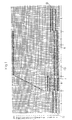
- Fig.1 illustrates the arrangement of primary knitting courses for forming box pleats, in which the vertical axis represents successive courses and the horizontal axis exhibits a series of loops in knitting.
- each course carries a series of loops of thread interlooped with the knitting needles of the front needle bed (referred to as front knitting needles hereinafter) and the upper-half carries a series of loops interlooped with the knitting needles of the rear needle bed (referred to as rear knitting needles).
- each of the courses 1, 2, and 3 consists of a surface knitted section A of sheeting form fabricated with the front knitting needles, a fold-back knitted section B of elastic form fabricated with the front and rear knitting needles, an overlap knitted section C of elastic form, another fold-back knitted section D of elastic form, and another surface knitted section E of sheeting form.
- the knitted sections are knitted with threads 1, 2, and 3, which are fed from their respective carriers, not shown, by action of the front and rear knitting needles controlled with a carriage (not shown). Also, the knitted sections are coupled at ends to one another by means of tack knitting using the threads 1, 2, and 3.
- Two junctions I and II between the fold-back sections B and D and the overlap section C are arranged in single-side knitting for ease of making creases.
- the series of thread loops of the elastic fold-back knitted section B provided in the left are divided into two successions on the front and rear knitting needles respectively for preparation for closing the section B.
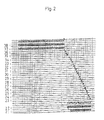
- the series of the thread loops of the elastic fold-back knitted section D provided in the right, like the fold-back section B in the left, are divided into two successions on the front and rear knitting needles respectively at the courses 21 and 22, as shown in Fig.2.
- the "slim" in the surface knitted section A of sheeting form is compensated. Also, at the courses 41 and 42, the "slim" in the surface knitted section E is compensated.
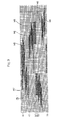
- the two surface knitted sections A and E of sheeting form are transferred and loaded onto the foregoing knitting needles besides the overlap section C during the courses 39 to 40, as denoted by the arrows in Fig.3.
- the surface knitted section E For dislocating the surface knitted section E, it starts with the rear needle bed moving on a rack from the original position to the right limit (by seven pitches because the knitting machine permits travel of a seven gage distance) while the loops of thread of the surface knitted section E remain loaded on the front needles. Then, the successive loops of the surface knitted section E are transferred from the front needles onto the target rear needles. When the rear needle bed has been returned back to the original position, the loops of the surface knitted section E are displaced seven pitches to the left as denoted by the arrows M1 in Fig.3.
- the rear needle bed is moved again from the original position by seven pitches to the left.
- the surface knitted section E is further displaced by seven pitches to the left as denoted by the arrows M2.
- the surface knitted section E is displaced a distance of 14 pitches leftward from the original position at the course 2 and stays with its left end located next to the right end of the overlap knitted section C.
- the surface knitted section A For dislocating the surface knitted section A, it starts with the rear needle bed moving on a rack from the original position to the left limit (by seven pitches) while the successive loops of the surface knitted section E remain held on the front needles. Then, the successive loops of the surface knitted section E are transferred from the front needles onto the target rear needles. When the rear needle bed has been returned back to the original position, the loops of the surface knitted section A are displaced seven pitches to the right as denoted by the arrows M3 in Fig.3.
- the rear needle bed is moved again from the original position by seven pitches to the right.
- the surface knitted section A is further displaced by seven pitches to the left as denoted by the arrows M4.
- the surface knitted section A is displaced a distance of 14 pitches rightward from the original position at the course 2 and stays with its right end located next to the left end of the overlap section C.
- the surface knitted section E Prior to the course 43 where the thread 3 for knitting the overlap section C is removed from the corresponding needles, the surface knitted section E is shifted leftward for forming the right half of a box pleat and the surface knitted section A is shifted rightward for forming the left half of the same.
- the rear needle bed is moved on a rack by seven pitches from the original position to the left and the loops of the surface section E are transferred from their respective rear needles to the front needles.
- the loops of the surface section E are displaced seven pitches to the left as denoted by the arrows M5.
- the rear needle bed is moved by seven pitches from the original position to the right and then, returned to the left by seven pitches.
- the surface knitted section E is displaced seven pitches more to the left as denoted by the arrows M6. Accordingly, the surface knitted section E is overlapped with the right half of the overlap knitted section C forming the right half of a box pleat.
- the left half of the box pleat For forming the left half of the box pleat, it starts with the rear needle bed moving on a rack by seven pitches from the original position to the left. Then, the loops of the surface knitted section A are transferred to the rear needles as followed by transferring back to the front needles after the returning of the rear needle bed to the start position. Accordingly, the surface knitted section A is displaced seven pitches to the right as denoted by the arrows M7.
- fold-back knitted sections B and D of elastic form have their uppermost ends not suspended, they will cause no declination in the quality and fitness.
- the knitting machine in the embodiment has one pair of the confronting needle beds, it may have two or more pairs for successfully achieving the object of the present invention. It is also understood that the method of the present invention is applicable to form common pleats other than the box pleats.
- the uppermost ends of the fold-back knitted sections B and D are finished with closed stitches, they may be fastened not to come loose with the use of thermal shrinkage thread woven into the knitted texture and fused by heat.
- the knitting arrangement of the embodiment in which the fold-back and overlap sections B, D, and C are knitted in elastic form and the surface section A and E are knitted in sheeting form may be altered or modified as desired.
Landscapes
- Engineering & Computer Science (AREA)
- Textile Engineering (AREA)
- Knitting Of Fabric (AREA)
- Knitting Machines (AREA)
Applications Claiming Priority (2)
| Application Number | Priority Date | Filing Date | Title |
|---|---|---|---|
| JP11663690A JPH07111021B2 (ja) | 1990-05-02 | 1990-05-02 | 襞の編成方法 |
| JP116636/90 | 1990-05-02 |
Publications (3)
| Publication Number | Publication Date |
|---|---|
| EP0455395A2 true EP0455395A2 (de) | 1991-11-06 |
| EP0455395A3 EP0455395A3 (de) | 1991-12-18 |
| EP0455395B1 EP0455395B1 (de) | 1995-07-12 |
Family
ID=14692109
Family Applications (1)
| Application Number | Title | Priority Date | Filing Date |
|---|---|---|---|
| EP19910303621 Expired - Lifetime EP0455395B1 (de) | 1990-05-02 | 1991-04-23 | Verfahren zum Einstricken von Falten und Strickware mit eingestrickten Falten |
Country Status (6)
| Country | Link |
|---|---|
| US (1) | US5253492A (de) |
| EP (1) | EP0455395B1 (de) |
| JP (1) | JPH07111021B2 (de) |
| KR (1) | KR0173313B1 (de) |
| DE (1) | DE69111132T2 (de) |
| ES (1) | ES2074658T3 (de) |
Cited By (6)
| Publication number | Priority date | Publication date | Assignee | Title |
|---|---|---|---|---|
| EP0794276A1 (de) * | 1996-03-08 | 1997-09-10 | Guilford Mills, Inc. | Kettengewirkter textiler Stoff mit Muster von gefalteten Stoffteilen |
| DE19709695A1 (de) * | 1997-03-10 | 1998-09-17 | Stoll & Co H | Verfahren zur Herstellung eines Gestrickes auf einer Flachstrickmaschine |
| EP1004695A3 (de) * | 1998-11-26 | 2001-01-17 | Shima Seiki Manufacturing Limited | Verfahren zum Stricken einer Strickware mit darin geformtes Verbindungsteil |
| RU2581006C2 (ru) * | 2014-02-07 | 2016-04-10 | Федеральное государственное бюджетное образовательное учреждение высшего профессионального образования "Амурский государственный университет" | Способ изготовления трикотажной складки на основе неполных переплетений |
| CN110670219A (zh) * | 2019-10-25 | 2020-01-10 | 惠州学院 | 一种z字褶提花的编织方法 |
| CN117385544A (zh) * | 2023-09-22 | 2024-01-12 | 石狮市汇星机械有限公司 | 上、下盘三工位双面电子针织提花机 |
Families Citing this family (12)
| Publication number | Priority date | Publication date | Assignee | Title |
|---|---|---|---|---|
| GB9422650D0 (en) * | 1994-11-10 | 1995-01-04 | Gen Motors Corp | A knitting method |
| GB9422674D0 (en) * | 1994-11-10 | 1995-01-04 | Gen Motors Corp | Knitting method |
| US6840064B2 (en) * | 2001-05-25 | 2005-01-11 | Shima Seiki Mfg., Ltd. | Cylindrical knitting fabric sound with depth formed and method of knitting it |
| KR101014192B1 (ko) | 2003-04-15 | 2011-02-14 | 가부시키가이샤 시마세이키 세이사쿠쇼 | 니트 디자인 방법과 그 장치 및 프로그램 |
| CN100519870C (zh) * | 2003-04-15 | 2009-07-29 | 株式会社岛精机制作所 | 编织设计方法及其装置 |
| RU2309208C1 (ru) * | 2006-04-04 | 2007-10-27 | Государственное образовательное учреждение высшего профессионального образования "Московский государственный текстильный университет им. А.Н. Косыгина" | Способ выработки складок на трикотажных изделиях |
| JP5161063B2 (ja) * | 2008-12-26 | 2013-03-13 | 株式会社島精機製作所 | ニットパンツの編成方法とニットパンツ |
| US8734928B1 (en) * | 2011-01-17 | 2014-05-27 | Melody LaVigna | Decorative cover for outdoor patio heaters |
| CN103668737B (zh) * | 2012-08-30 | 2016-01-27 | 江苏景盟针织企业有限公司 | 一种带有褶皱的织物与编织该织物的编织机以及编织方法 |
| JP7217731B2 (ja) * | 2020-12-03 | 2023-02-03 | 株式会社島精機製作所 | 編成方法 |
| JP7843725B2 (ja) * | 2023-03-03 | 2026-04-10 | 株式会社島精機製作所 | 編地の編成方法、および編地 |
| CN117248321B (zh) * | 2023-08-23 | 2025-11-21 | 东华大学 | 一种数码针织仿真苗族百褶裙及其工艺方法 |
Family Cites Families (4)
| Publication number | Priority date | Publication date | Assignee | Title |
|---|---|---|---|---|
| JPS5735038A (en) * | 1980-08-01 | 1982-02-25 | Teijin Ltd | Production of pleated knitted cloth |
| US4722202A (en) * | 1986-02-06 | 1988-02-02 | Nantucket Industries, Inc. | Knitted brief and method making same |
| DE3709669C1 (de) * | 1987-03-24 | 1988-06-01 | Mueller Karl Heinz | Shorts oder Roeckchen mit Innenslip |
| US4888964A (en) * | 1988-02-22 | 1989-12-26 | Svein Klinge | Pleated knit fabric |
-
1990
- 1990-05-02 JP JP11663690A patent/JPH07111021B2/ja not_active Expired - Lifetime
-
1991
- 1991-04-20 KR KR1019910006349A patent/KR0173313B1/ko not_active Expired - Fee Related
- 1991-04-23 DE DE69111132T patent/DE69111132T2/de not_active Expired - Fee Related
- 1991-04-23 EP EP19910303621 patent/EP0455395B1/de not_active Expired - Lifetime
- 1991-04-23 ES ES91303621T patent/ES2074658T3/es not_active Expired - Lifetime
- 1991-04-25 US US07/691,261 patent/US5253492A/en not_active Expired - Fee Related
Cited By (6)
| Publication number | Priority date | Publication date | Assignee | Title |
|---|---|---|---|---|
| EP0794276A1 (de) * | 1996-03-08 | 1997-09-10 | Guilford Mills, Inc. | Kettengewirkter textiler Stoff mit Muster von gefalteten Stoffteilen |
| DE19709695A1 (de) * | 1997-03-10 | 1998-09-17 | Stoll & Co H | Verfahren zur Herstellung eines Gestrickes auf einer Flachstrickmaschine |
| EP1004695A3 (de) * | 1998-11-26 | 2001-01-17 | Shima Seiki Manufacturing Limited | Verfahren zum Stricken einer Strickware mit darin geformtes Verbindungsteil |
| RU2581006C2 (ru) * | 2014-02-07 | 2016-04-10 | Федеральное государственное бюджетное образовательное учреждение высшего профессионального образования "Амурский государственный университет" | Способ изготовления трикотажной складки на основе неполных переплетений |
| CN110670219A (zh) * | 2019-10-25 | 2020-01-10 | 惠州学院 | 一种z字褶提花的编织方法 |
| CN117385544A (zh) * | 2023-09-22 | 2024-01-12 | 石狮市汇星机械有限公司 | 上、下盘三工位双面电子针织提花机 |
Also Published As
| Publication number | Publication date |
|---|---|
| DE69111132T2 (de) | 1995-12-21 |
| ES2074658T3 (es) | 1995-09-16 |
| DE69111132D1 (de) | 1995-08-17 |
| KR0173313B1 (ko) | 1999-02-18 |
| JPH0418154A (ja) | 1992-01-22 |
| KR910020234A (ko) | 1991-12-19 |
| JPH07111021B2 (ja) | 1995-11-29 |
| EP0455395A3 (de) | 1991-12-18 |
| US5253492A (en) | 1993-10-19 |
| EP0455395B1 (de) | 1995-07-12 |
Similar Documents
| Publication | Publication Date | Title |
|---|---|---|
| EP0455395A2 (de) | Verfahren zum Einstricken von Falten und Strickware mit eingestrickten Falten | |
| RU2091524C1 (ru) | Трубчатое вязаное изделие | |
| EP0534689B1 (de) | Gestrick mit einer von einem Ripprand versehenen Tasche und Strickverfahren | |
| EP0522778B1 (de) | Schlauchartig gestrickter Stoff mit dreidimensionaler Form und Verfahren zum Stricken von diesem Stoff | |
| EP0504412B1 (de) | Verfahren zum stricken von rundstrickwaren und damit erhaltene strickwaren | |
| EP0826808B1 (de) | Verfahren zum Stricken eines Kragens | |
| US5127242A (en) | Pocketed fabric with rib knitting and its knitting method | |
| CN100554551C (zh) | 针织物的编织方法 | |
| KR100706647B1 (ko) | 코 빼기 처리방법 및 코 빼기 처리된 편성포, 및 코 빼기처리를 위한 캐드장치 | |
| CN1018463B (zh) | 接缝织物的针织方法 | |
| JPH0415301B2 (de) | ||
| US5487282A (en) | Process for knitting tubular fabric on a flat bed knitting machine | |
| DE69232234D1 (de) | Verfahren zum Stricken von nahtlosen Kleidungstücken an Flachstrickmaschinen | |
| JPH04263654A (ja) | 袖を持つ衣服用成形編地の製造方法 | |
| JPH0737699B2 (ja) | 厚手の伸縮性の少ないしっかりした編地の編成方法 | |
| US3668901A (en) | Knitting method and knitting garment | |
| US5257514A (en) | Connective knitting method of tape-shaped knit end and tape-shaped knit fabric having an end part linked in a knit state | |
| JP2573101B2 (ja) | ニット製品におけるボタンホールの編成方法 | |
| US5444995A (en) | Process for manufacturing a complete garment on a two needle bed flat knitting machine | |
| EP0638678B1 (de) | Verfahren zum Maschenweitern an einer Zwischenposition in einer Maschenreihe eines Rippgestricks | |
| EP1471175B1 (de) | Formgerechte herstellung des halsausschnitts | |
| EP0466439B1 (de) | Verfahren zum Maschenanschlag bei Stricken und derart hergestelltes Gestrick | |
| JP3783186B2 (ja) | 2針床横編機上で製造される筒状編物の編目増加方法 | |
| EP0449544B1 (de) | Verbindungsstrickverfahren für gurtförmiges Gestrick und gurtförmige Strickware mit in gestrickter Form verbundenen Enden | |
| EP0484078B1 (de) | Verfahren zum Bearbeiten von Stoffrändern und mit einer dekorativen Bearbeitung versehenes Gestrick |
Legal Events
| Date | Code | Title | Description |
|---|---|---|---|
| PUAI | Public reference made under article 153(3) epc to a published international application that has entered the european phase |
Free format text: ORIGINAL CODE: 0009012 |
|
| PUAL | Search report despatched |
Free format text: ORIGINAL CODE: 0009013 |
|
| AK | Designated contracting states |
Kind code of ref document: A2 Designated state(s): DE ES FR GB IT |
|
| AK | Designated contracting states |
Kind code of ref document: A3 Designated state(s): DE ES FR GB IT |
|
| 17P | Request for examination filed |
Effective date: 19920226 |
|
| 17Q | First examination report despatched |
Effective date: 19940203 |
|
| ITF | It: translation for a ep patent filed | ||
| GRAA | (expected) grant |
Free format text: ORIGINAL CODE: 0009210 |
|
| AK | Designated contracting states |
Kind code of ref document: B1 Designated state(s): DE ES FR GB IT |
|
| REF | Corresponds to: |
Ref document number: 69111132 Country of ref document: DE Date of ref document: 19950817 |
|
| ET | Fr: translation filed | ||
| REG | Reference to a national code |
Ref country code: ES Ref legal event code: FG2A Ref document number: 2074658 Country of ref document: ES Kind code of ref document: T3 |
|
| PLBE | No opposition filed within time limit |
Free format text: ORIGINAL CODE: 0009261 |
|
| STAA | Information on the status of an ep patent application or granted ep patent |
Free format text: STATUS: NO OPPOSITION FILED WITHIN TIME LIMIT |
|
| 26N | No opposition filed | ||
| PGFP | Annual fee paid to national office [announced via postgrant information from national office to epo] |
Ref country code: FR Payment date: 19990409 Year of fee payment: 9 |
|
| PGFP | Annual fee paid to national office [announced via postgrant information from national office to epo] |
Ref country code: ES Payment date: 19990420 Year of fee payment: 9 |
|
| PGFP | Annual fee paid to national office [announced via postgrant information from national office to epo] |
Ref country code: GB Payment date: 19990421 Year of fee payment: 9 |
|
| PGFP | Annual fee paid to national office [announced via postgrant information from national office to epo] |
Ref country code: DE Payment date: 19990430 Year of fee payment: 9 |
|
| PG25 | Lapsed in a contracting state [announced via postgrant information from national office to epo] |
Ref country code: GB Free format text: LAPSE BECAUSE OF NON-PAYMENT OF DUE FEES Effective date: 20000423 |
|
| PG25 | Lapsed in a contracting state [announced via postgrant information from national office to epo] |
Ref country code: ES Free format text: THE PATENT HAS BEEN ANNULLED BY A DECISION OF A NATIONAL AUTHORITY Effective date: 20000424 |
|
| GBPC | Gb: european patent ceased through non-payment of renewal fee |
Effective date: 20000423 |
|
| PG25 | Lapsed in a contracting state [announced via postgrant information from national office to epo] |
Ref country code: FR Free format text: LAPSE BECAUSE OF NON-PAYMENT OF DUE FEES Effective date: 20001229 |
|
| PG25 | Lapsed in a contracting state [announced via postgrant information from national office to epo] |
Ref country code: DE Free format text: LAPSE BECAUSE OF NON-PAYMENT OF DUE FEES Effective date: 20010201 |
|
| REG | Reference to a national code |
Ref country code: FR Ref legal event code: ST |
|
| REG | Reference to a national code |
Ref country code: ES Ref legal event code: FD2A Effective date: 20020304 |
|
| PG25 | Lapsed in a contracting state [announced via postgrant information from national office to epo] |
Ref country code: IT Free format text: LAPSE BECAUSE OF NON-PAYMENT OF DUE FEES;WARNING: LAPSES OF ITALIAN PATENTS WITH EFFECTIVE DATE BEFORE 2007 MAY HAVE OCCURRED AT ANY TIME BEFORE 2007. THE CORRECT EFFECTIVE DATE MAY BE DIFFERENT FROM THE ONE RECORDED. Effective date: 20050423 |