EP0455546A1 - Isotherme Verpackung und Verfahren zur Herstellung einer solchen Verpackung - Google Patents
Isotherme Verpackung und Verfahren zur Herstellung einer solchen Verpackung Download PDFInfo
- Publication number
- EP0455546A1 EP0455546A1 EP91401117A EP91401117A EP0455546A1 EP 0455546 A1 EP0455546 A1 EP 0455546A1 EP 91401117 A EP91401117 A EP 91401117A EP 91401117 A EP91401117 A EP 91401117A EP 0455546 A1 EP0455546 A1 EP 0455546A1
- Authority
- EP
- European Patent Office
- Prior art keywords
- shell
- edge
- shape
- packaging
- elements
- Prior art date
- Legal status (The legal status is an assumption and is not a legal conclusion. Google has not performed a legal analysis and makes no representation as to the accuracy of the status listed.)
- Withdrawn
Links
- 238000004519 manufacturing process Methods 0.000 title description 9
- 238000007789 sealing Methods 0.000 claims abstract description 31
- 229920002635 polyurethane Polymers 0.000 claims abstract description 14
- 239000004814 polyurethane Substances 0.000 claims abstract description 14
- 239000004794 expanded polystyrene Substances 0.000 claims abstract description 5
- 238000004806 packaging method and process Methods 0.000 claims description 24
- 230000000295 complement effect Effects 0.000 claims description 10
- 239000000463 material Substances 0.000 claims description 8
- PCTMTFRHKVHKIS-BMFZQQSSSA-N (1s,3r,4e,6e,8e,10e,12e,14e,16e,18s,19r,20r,21s,25r,27r,30r,31r,33s,35r,37s,38r)-3-[(2r,3s,4s,5s,6r)-4-amino-3,5-dihydroxy-6-methyloxan-2-yl]oxy-19,25,27,30,31,33,35,37-octahydroxy-18,20,21-trimethyl-23-oxo-22,39-dioxabicyclo[33.3.1]nonatriaconta-4,6,8,10 Chemical compound C1C=C2C[C@@H](OS(O)(=O)=O)CC[C@]2(C)[C@@H]2[C@@H]1[C@@H]1CC[C@H]([C@H](C)CCCC(C)C)[C@@]1(C)CC2.O[C@H]1[C@@H](N)[C@H](O)[C@@H](C)O[C@H]1O[C@H]1/C=C/C=C/C=C/C=C/C=C/C=C/C=C/[C@H](C)[C@@H](O)[C@@H](C)[C@H](C)OC(=O)C[C@H](O)C[C@H](O)CC[C@@H](O)[C@H](O)C[C@H](O)C[C@](O)(C[C@H](O)[C@H]2C(O)=O)O[C@H]2C1 PCTMTFRHKVHKIS-BMFZQQSSSA-N 0.000 claims description 2
- 239000011810 insulating material Substances 0.000 abstract 1
- 235000005921 Cynara humilis Nutrition 0.000 description 7
- 240000002228 Cynara humilis Species 0.000 description 7
- 238000002347 injection Methods 0.000 description 4
- 239000007924 injection Substances 0.000 description 4
- 238000000465 moulding Methods 0.000 description 4
- 239000004793 Polystyrene Substances 0.000 description 3
- 229920002223 polystyrene Polymers 0.000 description 3
- 238000009413 insulation Methods 0.000 description 2
- 238000009451 isothermal packaging Methods 0.000 description 2
- 241000219504 Caryophyllales Species 0.000 description 1
- 241000270295 Serpentes Species 0.000 description 1
- 230000000903 blocking effect Effects 0.000 description 1
- 230000005494 condensation Effects 0.000 description 1
- 238000009833 condensation Methods 0.000 description 1
- 239000000470 constituent Substances 0.000 description 1
- 239000003814 drug Substances 0.000 description 1
- 229940079593 drug Drugs 0.000 description 1
- 235000013305 food Nutrition 0.000 description 1
- 235000021189 garnishes Nutrition 0.000 description 1
- 238000012423 maintenance Methods 0.000 description 1
- 238000000034 method Methods 0.000 description 1
- 230000002093 peripheral effect Effects 0.000 description 1
- 229920003023 plastic Polymers 0.000 description 1
- 239000004033 plastic Substances 0.000 description 1
- 230000002441 reversible effect Effects 0.000 description 1
- 239000000243 solution Substances 0.000 description 1
- 229960005486 vaccine Drugs 0.000 description 1
Images


Classifications
-
- B—PERFORMING OPERATIONS; TRANSPORTING
- B65—CONVEYING; PACKING; STORING; HANDLING THIN OR FILAMENTARY MATERIAL
- B65D—CONTAINERS FOR STORAGE OR TRANSPORT OF ARTICLES OR MATERIALS, e.g. BAGS, BARRELS, BOTTLES, BOXES, CANS, CARTONS, CRATES, DRUMS, JARS, TANKS, HOPPERS, FORWARDING CONTAINERS; ACCESSORIES, CLOSURES, OR FITTINGS THEREFOR; PACKAGING ELEMENTS; PACKAGES
- B65D81/00—Containers, packaging elements, or packages, for contents presenting particular transport or storage problems, or adapted to be used for non-packaging purposes after removal of contents
- B65D81/38—Containers, packaging elements, or packages, for contents presenting particular transport or storage problems, or adapted to be used for non-packaging purposes after removal of contents with thermal insulation
- B65D81/3813—Containers, packaging elements, or packages, for contents presenting particular transport or storage problems, or adapted to be used for non-packaging purposes after removal of contents with thermal insulation rigid container being in the form of a box, tray or like container
- B65D81/3823—Containers, packaging elements, or packages, for contents presenting particular transport or storage problems, or adapted to be used for non-packaging purposes after removal of contents with thermal insulation rigid container being in the form of a box, tray or like container formed of different materials, e.g. laminated or foam filling between walls
-
- B—PERFORMING OPERATIONS; TRANSPORTING
- B65—CONVEYING; PACKING; STORING; HANDLING THIN OR FILAMENTARY MATERIAL
- B65D—CONTAINERS FOR STORAGE OR TRANSPORT OF ARTICLES OR MATERIALS, e.g. BAGS, BARRELS, BOTTLES, BOXES, CANS, CARTONS, CRATES, DRUMS, JARS, TANKS, HOPPERS, FORWARDING CONTAINERS; ACCESSORIES, CLOSURES, OR FITTINGS THEREFOR; PACKAGING ELEMENTS; PACKAGES
- B65D81/00—Containers, packaging elements, or packages, for contents presenting particular transport or storage problems, or adapted to be used for non-packaging purposes after removal of contents
- B65D81/38—Containers, packaging elements, or packages, for contents presenting particular transport or storage problems, or adapted to be used for non-packaging purposes after removal of contents with thermal insulation
Definitions
- the present invention relates to an insulated box and a method of manufacturing such a packaging formed of two elements (box, cover), made of an insulating expanded material.
- Isothermal packaging which consists of two parts made of expanded plastic, in many forms and uses, such as packaging for the conservation and transport of food products, the transport of certain fragile medicines, vaccines, etc. .
- an insulating packaging formed from an expanded polyurethane box produced in an outer cardboard box and receiving a polyurethane cover as well as a cardboard cover.
- each packaging dimension corresponds to a mold, which requires the production of as many molds as one wishes to have packaging to take into account the different shape of the objects to be packaged or, more generally, the volume different that certain packaging must present.
- the present invention aims to remedy these drawbacks and proposes to create a packaging based on polyurethane, which is easy to manufacture and allows for packaging of very different capacity with a reduced number of molds.
- its two elements are elements of the same shape, each having a sealing edge intended to cooperate with the sealing edge of the other element, packaging characterized in that the sealing edge is produced on one half. of the periphery defined by a return line MM with a section corresponding to a first shape and on the second half, with a section corresponding to a second shape complementary to the first shape.
- the precision of the molding of the polyurethane in the polystyrene shell makes it possible to produce a sealing edge forming a perfectly closed baffle when the two elements are joined together to form the packaging. This precision of closing is obtained thanks to the holding of the shell in the mold used to mold the granitation. This seal between the shell and the mold results from the flexibility of the contact and the closing pressure.
- the insulating combination of the shell and the lining also prevents any condensation on the outside of the packaging, which also results in better insulation characteristics at this level.
- the shell provides direct impact protection; it offers possibilities of nesting or stacking packages on top of each other.
- the section of the sealing edge is symmetrical with respect to a point and the section of the first shape and that of the second shape are identical but opposite shapes.
- This symmetrical shape is advantageous for the production of the mold and for sealing. In addition, this allows the material and the forces to be distributed evenly.
- the edge of the shell has a recess reducing the thickness of the edge.
- This step is advantageous in the case of a very thick edge; on the other hand, if the material is thin, it is not necessary.
- the offset improves the seal in the mold by a higher pressure in contact with the mold.
- the bottom of the shell can have a rim.
- the section of the sealing edge consists of a concave trapezoid and a convex trapezoid and of the complementary shape.
- the invention is characterized by very simple means making it possible to produce isothermal packaging of very variable capacity for a very small number of molds, the combination of the capacities of the various elements making it possible to obtain packaging capacities very close to the theoretical capacities sought. .
- Reliability in the repeatability of the manufacturing makes it possible by study in a laboratory to determine for each type of boxes perfectly defined cold resistance characteristics with repeatability for all boxes of the same type produced under the same conditions.
- the insulated packaging of the prior art consists of a polyurethane box 1 produced in a cardboard box 2.
- the box 1 is closed by a cover 3 also made of polyurethane and the assembly thus assembled is complete with a cardboard cover 4.
- the present invention relates to a packaging formed by a box 10 and a cover 11. These two parts can be of identical, similar or different shape, but their structure is the same so that the terms: box and cover correspond to interchangeable elements whose sealing means produced on or in the assembly edges are compatible. This means that all the elements are made in the same mold.
- Each of these elements 10, 11 consists of a shell 12 of expanded polystyrene forming the external framework and receiving an internal lining 13 which defines the housing 14 receiving the products to be packaged.
- Each element 10, 11 has a peripheral edge 15, 16 complementary. This means, since the elements 10, 11 are identical, that the edge of each element is itself formed by two complementary parts, as will be explained with the aid of FIG. 3 which is a schematic view from above of a element (box or cover).
- the sealing edge consists of three sections 30, 31, 32 which here correspond to three sides or parts of sides of the rectangle formed by the edge of the element.
- the part of the sealing edge above the line MM consists of the segments 30 , 31 , 32 .
- the sealing segment 30 can cover segment 30, the snake 32 can style segment 32, segment 31 can cover segment 31.
- the segments must therefore be 30 , 30, 31 , 31 and 32 , 32 are of complementary shape.
- the segments 30, 31, 32, on the one hand, and 30 , 31 , 32 on the other hand could have every time the same form, so that it would suffice that one form is complementary to the other.
- Figure 4 shows a form of sealing edge section with hollow parts ABCD and raised parts A1, B1, C1, D1. This shape is symmetrical with respect to the medium O which can advantageously be found in the middle of the thickness of one side of the lining of an element (box or cover).
- the advantage of the symmetrical shape is on the one hand the greatest facility for producing the mold and, on the other hand, the regularity of the sealing baffle produced by the assembly of two elements.
- Figure 5 shows the assembly of two identical elements 40, 41 to form a package
- Figure 6 showing a partial perspective view of the element 40 at the line of reversal NN.
- the elements 40, 41 each consist of a shell 42, 43 and a lining 44, 45.
- the edge 46, 47 of the shells 42, 43 has a reduction in thickness leaving only the protruding part 48, 49 to have a reduced support surface in the mold ensuring a better seal during the molding of the garnish.
- the edges 46, 47 are provided with the actual sealing edges 50, 51 of the elements 40, 41 constituting by assembly, a sealing baffle.
- the shape of this baffle is that of a concave trapezoid associated with a convex trapezoid.
- Figure 6 shows more explicitly the shape of the sealing edge 49 and the reversal of this shape on either side of the reversal line NN.
- FIG. 7 shows in partial section a variant of the element described above, showing the injection orifice 60 in the bottom of the shell 61.
- the injected polyurethane constituting the lining 62 forms a plug 63 which participates in fixing the lining 62 in the shell 61.
- the step 64 of the edge of the shell 61 and the shape of the section of the sealing edge 65 of the lining 62 are more accentuated than previously. Furthermore, the shell 61 ends with a rim 66 facilitating the stacking of the packaging, all the more since this rim 66 may have concave and convex parts (not shown).
- the cavity 33 (fig. 3), 51 (fig. 5, 6) and 67 (fig. 7) of the package has been shown with a rectangular section. This shape can however be adapted to the shape of the products to be packaged to facilitate the maintenance or blocking.
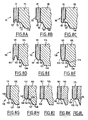
- FIG. 8A the edge 70 of the shell 71 has a form of niche forming two lips 72, 73 and the lining 75 forms a step comprising a dish 76, a ramp 77 and a new dish 78.
- the edge 80 of the shell 81 has a single recess forming a lip 82 of reduced thickness and the lining 85 has a section of the same shape as the previous one with a plate 86 followed by a ramp 87 and a dish 88.
- the variant has an external lip 92 at the edge 90 of the shell 91 and the lining 95 partially fills the hollow behind the lip 92.
- This lining has a shape similar to that of the linings of the other figures with a dish 96, a ramp 97 and a dish 98.
- FIG. 8D can be considered as a development of the embodiment of FIG. 8A; this variant consists of two lips 102, 103 of identical or different section formed in the edge 100 of the shell 101.
- the lining has a shape comprising, as above, a dish 106, a ramp 107 and a dish 108.
- FIG. 8E constitutes a development of the embodiment of FIG. 8B in that the shell 111 comprises at its edge 110, a lip 112 formed by a ramp portion 113, the section of the lining 115 being formed a dish 116, a ramp 117 and a dish 118.
- the edge 120 of the shell 121 forms a lip 122 defined by two ramp parts 123, 124 and the section of the lining 125 comprises a dish 126, a ramp 127 and a dish 128.
- the edge 130 of the shell 131 forms a lip 132 through the rounded part 133; the lining 135 has a shape similar to the previous ones with a dish 136, a ramp 137 and a dish 138.
- the lip 142 of the edge 140 of the shell 141 is formed by two rounded parts 142, 143 which may or may not be symmetrical and the lining 145 fills the cavity behind the rounded part 145 at the level of the dish 146 which continues with a ramp 147 and a dish 148.
- FIG. 81 corresponds to an edge 150 of the shell 151 without a lip and a form of lining 155 similar to the previous ones.
- the shape of the edge according to FIGS. 8K and 8L corresponds to a variant of shapes of FIGS. 8G and 8H, with respectively a lip 162, 172 at the edge 160, 170 of the shell 161, 171 formed from one or two very rounded parts 163 , 173, 174.
- the lining 165, 175 has a shape similar to the previous shapes.
- the method of manufacturing an element consists first of making the shell 42, 43, 61 of expanded polystyrene and then molding in this shell the lining 44, 45, 62 of polyurethane, the shell and the gasket being connected over their entire contact surface and the "plug" 63 of polyurethane in the orifice 60 of injection completing this connection.
- the shell When the lining is produced, the shell is strongly pressed by its reduced section edge (64) against the mold to ensure good sealing at this level.
- reservations can be made to receive marking or identification labels. It can also be planned to make a mark or logo in relief or recessed in the shell.
Landscapes
- Engineering & Computer Science (AREA)
- Mechanical Engineering (AREA)
- Buffer Packaging (AREA)
- Packages (AREA)
Applications Claiming Priority (2)
| Application Number | Priority Date | Filing Date | Title |
|---|---|---|---|
| FR9005423A FR2661402A1 (fr) | 1990-04-27 | 1990-04-27 | Emballage isotherme et procede de fabrication d'un tel emballage. |
| FR9005423 | 1990-04-27 |
Publications (1)
| Publication Number | Publication Date |
|---|---|
| EP0455546A1 true EP0455546A1 (de) | 1991-11-06 |
Family
ID=9396189
Family Applications (1)
| Application Number | Title | Priority Date | Filing Date |
|---|---|---|---|
| EP91401117A Withdrawn EP0455546A1 (de) | 1990-04-27 | 1991-04-26 | Isotherme Verpackung und Verfahren zur Herstellung einer solchen Verpackung |
Country Status (4)
| Country | Link |
|---|---|
| EP (1) | EP0455546A1 (de) |
| KR (1) | KR910018280A (de) |
| CA (1) | CA2041096A1 (de) |
| FR (1) | FR2661402A1 (de) |
Cited By (2)
| Publication number | Priority date | Publication date | Assignee | Title |
|---|---|---|---|---|
| GB2265706A (en) * | 1992-04-01 | 1993-10-06 | Styropack | Insulated containers |
| ES2253015A1 (es) * | 2003-04-04 | 2006-05-16 | Jose Antonio Pelaez Montilla | Garrafa termica. |
Citations (1)
| Publication number | Priority date | Publication date | Assignee | Title |
|---|---|---|---|---|
| EP0007777A2 (de) * | 1978-07-21 | 1980-02-06 | Thomas J. Goetting | Inkubationsumhüllung und Verfahren zur Herstellung von fermentierten Molkereinahrungsmitteln |
-
1990
- 1990-04-27 FR FR9005423A patent/FR2661402A1/fr not_active Withdrawn
-
1991
- 1991-04-07 KR KR1019910006917A patent/KR910018280A/ko not_active Withdrawn
- 1991-04-24 CA CA002041096A patent/CA2041096A1/fr not_active Abandoned
- 1991-04-26 EP EP91401117A patent/EP0455546A1/de not_active Withdrawn
Patent Citations (1)
| Publication number | Priority date | Publication date | Assignee | Title |
|---|---|---|---|---|
| EP0007777A2 (de) * | 1978-07-21 | 1980-02-06 | Thomas J. Goetting | Inkubationsumhüllung und Verfahren zur Herstellung von fermentierten Molkereinahrungsmitteln |
Cited By (3)
| Publication number | Priority date | Publication date | Assignee | Title |
|---|---|---|---|---|
| GB2265706A (en) * | 1992-04-01 | 1993-10-06 | Styropack | Insulated containers |
| ES2253015A1 (es) * | 2003-04-04 | 2006-05-16 | Jose Antonio Pelaez Montilla | Garrafa termica. |
| ES2253015B1 (es) * | 2003-04-04 | 2007-07-16 | Jose Antonio Pelaez Montilla | Garrafa termica. |
Also Published As
| Publication number | Publication date |
|---|---|
| CA2041096A1 (fr) | 1991-10-28 |
| FR2661402A1 (fr) | 1991-10-31 |
| KR910018280A (ko) | 1991-11-30 |
Similar Documents
| Publication | Publication Date | Title |
|---|---|---|
| FR2948342A1 (fr) | Caisse isotherme se presentant sous la forme d'un kit | |
| FR2813384A1 (fr) | Conteneur scelle empli d'eau destine a la fabrication de glacons et conditionnement le comportant | |
| EP1346925B1 (de) | Verfahren zum schwebenden Verpacken von verschiedenen Produkten und dadurch hergestellte Packungen | |
| FR2596366A1 (fr) | Recipient scelle utilisable a des fins de cuisson | |
| WO1998016434A1 (fr) | Emballage, procede et dispositif pour le conditionnement de lots d'articles de volume indetermine | |
| EP0262047B1 (de) | Luftdichter Behälter insbesondere für Nahrungsmittel und Verfahren zu seiner Herstellung | |
| FR2661402A1 (fr) | Emballage isotherme et procede de fabrication d'un tel emballage. | |
| FR2678584A1 (fr) | Emballage en matiere plastique, forme de deux coquilles symetriques assemblees. | |
| EP1428643B1 (de) | Isotherme Verpackung und Verfahren zu ihrer Herstellung | |
| FR2911122A1 (fr) | Caisse isotherme a enveloppe metalisee en mousse a cellules fermees | |
| EP0409731A2 (de) | Verpackungsschachtel | |
| EP0306394B1 (de) | Verfahren zum Formen von Einheiten formbaren Materials, so hergestellte Einheiten sowie Formen und Verpackungen | |
| FR2637933A1 (fr) | Bloc de coffrage empilable en materiau leger et procede de moulage de ce bloc | |
| FR2494673A1 (fr) | Doublure thermiquement isolante et amovible pour contenant isotherme et son procede de fabrication | |
| FR3137075A1 (fr) | Caisse isotherme triple isolation | |
| FR2928903A1 (fr) | Emballage pour aliments | |
| US20080292221A1 (en) | Zipper Pack | |
| FR2552018A1 (en) | Composite structure, method of manufacture and boxes obtained with the composite structure | |
| EP2851310B1 (de) | Isolierverpackung, Verfahrem | |
| FR2646410A1 (fr) | Boite, en particulier pour produits laitiers | |
| CH644057A5 (en) | Method for manufacturing a case, or a part of a case, case or part of a case resulting from the method | |
| EP4108585A1 (de) | Einteilige verpackung mit siegelrand, die aus zwei nicht überlappenden zuschnitten hergestellt wird | |
| FR2769896A1 (fr) | Boite de calage en materiau alveolaire, moule et procede pour sa fabrication | |
| FR2723917A1 (fr) | Terrine destinee a contenir un aliment pouvant etre tranche | |
| BE823939A (fr) | Procede de fabrication d'un emballage en resine expansee surmoule sur son contenu. |
Legal Events
| Date | Code | Title | Description |
|---|---|---|---|
| PUAI | Public reference made under article 153(3) epc to a published international application that has entered the european phase |
Free format text: ORIGINAL CODE: 0009012 |
|
| AK | Designated contracting states |
Kind code of ref document: A1 Designated state(s): AT BE CH DE DK ES FR GB GR IT LI LU NL SE |
|
| STAA | Information on the status of an ep patent application or granted ep patent |
Free format text: STATUS: THE APPLICATION IS DEEMED TO BE WITHDRAWN |
|
| 18D | Application deemed to be withdrawn |
Effective date: 19920507 |