EP0455794B1 - Hybrides hierarchisches verfahren auf basis von resten, zur speicherung und anzeige von hochauflösenden digitalen bildern in einer mehrzweckumgebung - Google Patents
Hybrides hierarchisches verfahren auf basis von resten, zur speicherung und anzeige von hochauflösenden digitalen bildern in einer mehrzweckumgebung Download PDFInfo
- Publication number
- EP0455794B1 EP0455794B1 EP91900444A EP91900444A EP0455794B1 EP 0455794 B1 EP0455794 B1 EP 0455794B1 EP 91900444 A EP91900444 A EP 91900444A EP 91900444 A EP91900444 A EP 91900444A EP 0455794 B1 EP0455794 B1 EP 0455794B1
- Authority
- EP
- European Patent Office
- Prior art keywords
- image
- resolution
- residual
- images
- steps
- Prior art date
- Legal status (The legal status is an assumption and is not a legal conclusion. Google has not performed a legal analysis and makes no representation as to the accuracy of the status listed.)
- Expired - Lifetime
Links
Images










Classifications
-
- G—PHYSICS
- G06—COMPUTING OR CALCULATING; COUNTING
- G06T—IMAGE DATA PROCESSING OR GENERATION, IN GENERAL
- G06T3/00—Geometric image transformations in the plane of the image
- G06T3/40—Scaling of whole images or parts thereof, e.g. expanding or contracting
- G06T3/4007—Scaling of whole images or parts thereof, e.g. expanding or contracting based on interpolation, e.g. bilinear interpolation
-
- G—PHYSICS
- G06—COMPUTING OR CALCULATING; COUNTING
- G06F—ELECTRIC DIGITAL DATA PROCESSING
- G06F16/00—Information retrieval; Database structures therefor; File system structures therefor
- G06F16/50—Information retrieval; Database structures therefor; File system structures therefor of still image data
- G06F16/53—Querying
- G06F16/532—Query formulation, e.g. graphical querying
-
- H—ELECTRICITY
- H04—ELECTRIC COMMUNICATION TECHNIQUE
- H04N—PICTORIAL COMMUNICATION, e.g. TELEVISION
- H04N11/00—Colour television systems
- H04N11/04—Colour television systems using pulse code modulation
- H04N11/042—Codec means
-
- H—ELECTRICITY
- H04—ELECTRIC COMMUNICATION TECHNIQUE
- H04N—PICTORIAL COMMUNICATION, e.g. TELEVISION
- H04N19/00—Methods or arrangements for coding, decoding, compressing or decompressing digital video signals
- H04N19/10—Methods or arrangements for coding, decoding, compressing or decompressing digital video signals using adaptive coding
- H04N19/169—Methods or arrangements for coding, decoding, compressing or decompressing digital video signals using adaptive coding characterised by the coding unit, i.e. the structural portion or semantic portion of the video signal being the object or the subject of the adaptive coding
- H04N19/186—Methods or arrangements for coding, decoding, compressing or decompressing digital video signals using adaptive coding characterised by the coding unit, i.e. the structural portion or semantic portion of the video signal being the object or the subject of the adaptive coding the unit being a colour or a chrominance component
-
- H—ELECTRICITY
- H04—ELECTRIC COMMUNICATION TECHNIQUE
- H04N—PICTORIAL COMMUNICATION, e.g. TELEVISION
- H04N19/00—Methods or arrangements for coding, decoding, compressing or decompressing digital video signals
- H04N19/50—Methods or arrangements for coding, decoding, compressing or decompressing digital video signals using predictive coding
- H04N19/59—Methods or arrangements for coding, decoding, compressing or decompressing digital video signals using predictive coding involving spatial sub-sampling or interpolation, e.g. alteration of picture size or resolution
-
- H—ELECTRICITY
- H04—ELECTRIC COMMUNICATION TECHNIQUE
- H04N—PICTORIAL COMMUNICATION, e.g. TELEVISION
- H04N19/00—Methods or arrangements for coding, decoding, compressing or decompressing digital video signals
- H04N19/60—Methods or arrangements for coding, decoding, compressing or decompressing digital video signals using transform coding
- H04N19/63—Methods or arrangements for coding, decoding, compressing or decompressing digital video signals using transform coding using sub-band based transform, e.g. wavelets
Definitions
- the present invention is related to a method of storing and displaying digital images and more particularly to a multiresolution method which makes available reduced resolution versions of original images for quick display and full resolution original images for making photographic quality hardcopies.
- a multiuse environment is one where the user has the option of selecting the type of display medium and the desired resolution on this medium.
- two types of display media are considered: video monitors and color hardcopies, through photographic, thermal imaging, or other means. Versions of an original digital image are made available at various resolutions to allow for the display of an HDTV quality image on video, an NTSC quality image with PAL/SECAM compatibility on video, and a sub-NTSC quality image on video, as well as a very high quality image on color hardcopy.
- the techniques described herein are not limited to these display media or resolutions.
- the present invention uses a multiresolution or hierarchical structuring of the image data to allow for rapid access to the various image formats. It is also desirable to encode this hierarchical image data in an efficient manner so as to reduce the storage requirements on a digital storage media,'e.g., optical discs or magnetic tape, and to allow for the rapid transfer of the image data from the storage media to the output device. Furthermore, it is desirable to minimize the hardware required to implement such a system. In particular, it is desirable to minimize the hardware required to access the lower resolution images along with its cost. Systems which use a hierarchical structuring of the image data are often termed progressive transmission since they allow image quality to be progressively refined; however, they are generally not designed specifically for a multiuse environment.
- the publication by Burt et al teaches an encoding method for images termed the Laplacian pyramid, the Burt pyramid, or the residual pyramid.
- the original image G 0 is lowpass filtered (LPF), and this lowpass image is subsampled to take advantage of its reduced bandwidth to provide the image G 1 ,.
- LPF lowpass filtered
- This process of lowpass filtering and decimation is repeated three, times to generate a hierarchical structure, or pyramid, of images (G 0 , G 1 , G 2 , and G 3 ) of successively smaller dimensions. Although four resolution levels are shown, more or less can be used, depending on the application.
- Each lowpass image in this pyramid is then expanded to the dimensions of the next higher level by upsampling (inserting zeros) and filtering to form a prediction image for that level.
- This prediction image is subtracted from its corresponding lowpass image in a subtractor to generate difference, or residual, images L 0 , L 1 , and L 2 .
- the residual images corresponding to the levels of the lowpass pyramid form another pyramid which is termed the Laplacian, Burt, or residual pyramid.
- the encoded residuals are denoted L ⁇ 0, L ⁇ 1 , L ⁇ 2 , and L ⁇ 3 .
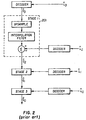
- Reconstruction is performed by interpolating the decoded lowpass image at the bottom of the lowpass pyramid and adding in the corresponding decoded residual to generate the next level in the lowpass pyramid. This process is iterated until the original image size is reached; the decoding process is illustrated in Figure 2.
- a progressive improvement in reconstructed image quality and resolution can thus be obtained by displaying the reconstructed lowpass filtered image at each level of the pyramid, i.e., ⁇ 3 , ⁇ 2 , ⁇ 1 , and ⁇ 0 . Note that errors introduced in the encoding process are propagated from one level to the next higher level in the decoding process.
- the patent to Anderson teaches a modification of the Burt pyramid scheme in which the lowpass filtered image is subtracted directly from the image at the previous level and then subsampled; it is not subsampled and interpolated prior to subtraction as in the Burt pyramid.
- This technique is termed the filter-subtract-decimate (FSD) pyramid.
- FSD filter-subtract-decimate
- the to be disclosed system fills the need for very high quality at the highest resolution level (for hardcopies of photographic quality) while providing efficient access to images at lower resolution levels.
- the present invention overcomes the above limitations by using a hybrid scheme which permits fast reconstruction of the lower resolution images with relatively simple hardware while yielding very high reconstruction quality at the highest resolution level.
- the image hierarchy can still be encoded efficiently, i.e., at a low bit rate, and is stored in such a manner that it can be accessed efficiently when being read from the storage medium.
- the proposed technique uses the residual pyramid to provide efficient storage of the higher resolution levels combined with other techniques for the lower resolution levels to satisfy the system requirement of fast access to these lower levels.
- the image data is encoded using an entropy coding technique such as Huffman coding or Q-coding, although it may be advantageous in some cases to store the data without entropy coding to provide immediate access to these records.
- the data may also be quantized prior to encoding, or it may be encoded in a lossless manner, i.e., without quantization.
- the present method effectively decouples the lower resolution images from tile higher resolution images to prevent the propagation of quantization noise from the lower levels and to provide quick access to the lower resolution images.
- the present invention provides a method for storing and displaying digital images with selectable multiresolution levels.
- the present invention provides a hierarchical storage and display method which minimizes hardware requirements, storage space, and cost.
- Figure 1 is a block diagram illustrating a prior art pyramid residual image encoder method.
- Figure 2 is a block diagram illustrating a prior art pyramid residual image decoder method.
- Figure 3 is a block diagram illustrating the hierarchical storage and display method.
- Figure 4 is a block diagram illustrating the decomposition and encoder portion of a first preferred embodiment of the present invention using a residual pyramid with progressive partitioning.
- Figure 5 is a block diagram illustrating the progressive partitioning of a full resolution image into lesser resolution images.
- Figure 6 is a block diagram illustrating the decoder and reconstruction portion of a first preferred embodiment of the present invention using a residual pyramid with progressive partitioning.
- Figure 7 is a block diagram illustrating the decomposition and encoder portion of a second preferred embodiment of the present invention using a residual pyramid with direct access to multiresolution images.
- Figure 8 is a block diagram illustrating the decoder and reconstruction portion of a second preferred embodiment of the present invention using a residual pyramid with direct access to multiresolution images.
- Figure 9 is a block diagram illustrating the decomposition and encoder portion of a third preferred embodiment of the present invention using a residual pyramid with CD-1 compatibility.
- Figure 10 is a block diagram illustrating the decoder and reconstruction portion of a third preferred embodiment of the present invention using a residual pyramid with CD-1 compatibility.
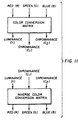
- Figure 11 is a, block diagram illustrating the color conversion method.
- Figure 12 is a block diagram illustrating the decomposition and encoder portion of a first preferred embodiment of the present invention for chrominance signals.
- Figure 13 is a block diagram illustrating the decoder and reconstruction portion of a first, preferred embodiment of the present invention for chrominance signals.
- Figure 14 is a block diagram illustrating the decomposition and encoder portion of a second preferred embodiment of the present invention for chrominance signals.
- Figure 15 is a block diagram illustrating the decoder and reconstruction portion of a second preferred embodiment of the present invention for chrominance signals.
- Figure 16 is a block diagram illustrating the decomposition and encoder portion of a third preferred embodiment of the present invention for chrominance signals.
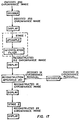
- Figure 17 is a block diagram illustrating the decoder and reconstruction portion of a third preferred embodiment of the present invention for chrominance signals.
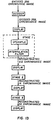
- Figure 18 is a block diagram illustrating an alternate method for the decoder and reconstruction portion of a third preferred embodiment of the present invention for chrominance signals.
- Figure 19 is a block diagram illustrating the decomposition and encoder portion of a fourth preferred embodiment of the present invention for chrominance signals.
- Figure 20 is a block diagram illustrating the decoder and reconstruction portion of a fourth preferred embodiment of the present invention for chrominance signals.
- Figure 21 is a block diagram illustrating the decomposition and encoder portion of a fifth preferred embodiment, of the present invention for chrominance signals.
- Figure 22 is a block diagram illustrating the decoder and reconstruction portion of a fifth preferred embodiment of the present invention for chrominance signals.
- Figure 23 is a block diagram illustrating an alternate method for the decoder and reconstruction portion of a fifth preferred embodiment of the present invention for chrominance signals.
- the highest resolution image is composed of 2048 x 3072 pixels and that this resolution is adequate to produce photographic quality originals on an appropriate digital output device. It is also assumed that the lowest resolution level is composed of 256 x 384 pixels and that this resolution is adequate for preliminary, but relatively low quality, display on an NTSC-quality video monitor.
- the other resolution levels are 512 x 768 pixels for high quality display on an NTSC-quality video monitor and 1024 x 1536 for high quality display on proposed HDTV video monitors.
- resolutions will be denoted as 256 (for 256 x 384), 512 (for 512 x 768), 1K (for 1024 x 1536), and 2K (for 2048 x 3072) for convenience.
- the basic diagram for the hierarchical storage and display method is illustrated in Figure 3.
- the invention is not limited to these resolutions or output devices. Indeed, many variations with other resolutions and output devices may be used, and these resolutions may not necessarily be related to each other by some power of two as the previously described resolutions are (assuming some form of interpolation is available.)
- the number of resolution levels and the type of decomposition at each level may vary to some extent, yet still be consistent with the described embodiments.
- the embodiments are first described in general terms for a single channel image, i.e., one-color or luminance image, and then further embodiments are described for the case of three-channel color images.
- the 2K image is decomposed into a residual pyramid consisting of a 512 base image, a 1K residual, and a 2K residual.
- a separate technique is used whereby the 512 image is decomposed into four 256 images by subsampling the original 512 image in a staggered fashion as shown in Figure 5.
- This technique progressive partitioning.
- the information to be stored is then composed of the four 256 partitioned images (which can be used to reconstruct the 512 image) and the 1K and 2K residuals.
- the residuals can then be used to reconstruct the 1K image and the 2K image.
- the reconstruction process is illustrated in Figure 6. This technique is motivated by the following:
- the 2K image is decomposed into a residual pyramid consisting of a 512 base image, a 1K residual, and a 2K residual.
- the 512 image is not decomposed into 256 images using progressive partitioning, but is merely prefiltered and subsampled to create a 256 image suitable for display.
- This process is shown in Figure 7.
- the information to be stored consists of the 256 image, the 512 image, the 1K residual, and the 2K residual.
- the residuals can be used to reconstruct the 1K and 2K images.
- the reconstruction process is illustrated in Figure 8. The advantages of this approach are:
- the third embodiment uses a residual pyramid, but also incorporates the Philips CD-I (Compact Disc-Interactive) real-time video data format (as referenced in the publication by A. C. Luther in Prior Art) at the 256 and 512 levels in order to provide compatibility with this format.
- the 2K image is decomposed into a residual pyramid consisting of a 512 image, a 1K residual, and a 2K residual.
- the 512 image is then lowpass filtered and subsampled to form a 256 base image as in the previous embodiment.
- the technique differs in the encoding of the 256 base image and the 512 image in order to be compatible with the CD-I format.
- the 256 base image is encoded using the CD-I encoding scheme, namely, differential pulse code modulation (DPCM), rather than an entropy coding technique as was used in the other embodiments.
- This 256 image is then decoded with the CD-I decoder and interpolated to the dimensions of the 512 image, forming a 512 prediction image.
- a 512 residual image is formed by subtracting this prediction image from the 512 image.
- the 512 residual image is first encoded using the CD-I "extended resolution" format which is a 7-bit quantization of the residual.
- a secondary 512 residual is then formed as the difference between the original 512 residual and the 7-bit CD-I residual.
- the information to be stored thus consists of the CD-I 256 base image, the CD-I 512 extended resolution residual, the 512 secondary residual, the 1K residual, and the 2K residual images.
- the reconstruction decoding process is illustrated in Figure 10. The advantage of this technique is the compatibility with the CD-I format at the 256 and 512 levels.
- the described embodiments may be extended to handle images that are composed of more than one-channel, specifically, three-channel color images.
- the direct approach is to encode each channel in the same manner, using one of the described embodiments.
- the three-color signal is comprised of a luminance signal, Y, and two chrominance signals, C 1 , and C 2 .
- RGB red
- G green
- B blue
- the color conversion to Y , C 1 , and C 2 is a linear transformation of the R, G, and B signals, and hence an inverse color conversion from Y , C 1 , and C 2 to R, G, and B is also a linear transformation.
- the color conversion apparatus is illustrated in Figure 11.
- An example of the luminance/chrominance conversion from R, G, and B signals is the NTSC (National Television Standards Committee) YIQ conversion given by the following equations.
- Y 0.299R + 0.587G + 0.114B
- the chrominance signals C 1 , and C 2 may also be simple color difference signals such as R - Y and B - Y , for example. We define the color conversion to be of these forms or their like.
- the human visual system has a reduced bandwidth for the chrominance signals as compared to the luminance signal, and thus a substantial savings in storage can be achieved by subsampling the chrominance signals, C 1 , and C 2 relative to the luminance signal Y .
- Typical subsampling factors for C 1 and C 2 relative to Y at a given resolution level are 2 or 4. It may be advantageous, to prefilter the chrominance signals prior to subsampling reduce aliasing artifacts.
- the luminance signal is encoded using one of the embodiments described previously.
- any of the preferred embodiments for chrominance signals may be modified by using DPCM encoding and decoding of the 256 base image.
- the apparatus of Figure 12 is used for decomposition and encoding.
- the chrominance information to be stored consists solely of a 256 base image for each chrominance signal.
- the apparatus of Figure 13 is used. This embodiment has the advantage of requiring a minimal amount of storage space for the chrominance signals and requiring only an interpolation process to generate the chrominance signals at higher resolution levels. A limitation of this method is that chrominance errors may be introduced at the higher resolution levels.
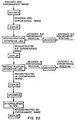
- the apparatus of Figure 14 is used for decomposition and encoding.
- the chrominance information to be stored consists of a 256 base image and a 512 residual. Images are reconstructed using the apparatus of Figure 15. This method improves reconstructed quality at the 512, 1K, and 2K levels compared to the first embodiment while still providing significant compression of the chrominance signals.
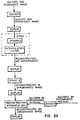
- the apparatus of Figure 16 is used for decomposition and encoding.
- the chrominance information to be stored consists of a 256 base image and a 1K residual. Images can be reconstructed using the apparatus of Figure 17 or by using the apparatus of Figure 18 where the 512 chrominance signal is generated by subsampling the reconstructed 1K chrominance signal. This method improves reconstructed quality at the 1K and 2K levels compared to the second embodiment.
- the apparatus of Figure 19 is used for decomposition and encoding.
- the chrominance information to be stored consists of a 256 base image, a 512 residual image, and a 1K residual image. Images are reconstructed using the apparatus of Figure 20.
- the advantage of this embodiment over the third embodiment is that it is not necessary to reconstruct the 1K image first before the 512 image can be computed (since the 512 image is reconstructed by adding a 512 residual to an interpolated 256 image.)
- the disadvantage is the additional storage required as compared to the third embodiment.
- the apparatus of Figure 21 is used for decomposition and encoding.
- the chrominance information to be stored consists of a 256 base image and a 2K residual. Images are reconstructed using the apparatus of Figure 22 or by using the apparatus of Figure 23 where the 512 and 1K chrominance signals are generated by subsampling the 2K reconstructed signal.
- This method provides very high quality at the 2K level compared to the other embodiments, and still provides good quality at the 512 and 1K levels since the chrominance signals at these levels can be generated from a higher resolution signal. Since residuals for the 512 and 1K levels are not stored, this approach provides some compression over a full residual pyramid approach.
Landscapes
- Engineering & Computer Science (AREA)
- Multimedia (AREA)
- Signal Processing (AREA)
- Physics & Mathematics (AREA)
- Theoretical Computer Science (AREA)
- General Physics & Mathematics (AREA)
- Mathematical Physics (AREA)
- Data Mining & Analysis (AREA)
- Databases & Information Systems (AREA)
- General Engineering & Computer Science (AREA)
- Compression Of Band Width Or Redundancy In Fax (AREA)
- Compression Or Coding Systems Of Tv Signals (AREA)
Claims (34)
- Hierarchisches Speicherverfahren mit folgenden Schritten:a) Erzeugen einer digitalen Darstellung eines Bildes (2K);b) Zerlegen der digitalen Darstellung nach folgenden Schritten:gekennzeichnet durch1. Tiefpaßfiltern und Zusammenstellen von Bildbereichen der digitalen Darstellung eines Bildes, um ein Bild (1K) mit geringerer Auflösung zu erzeugen;2. Interpolieren oder Replizieren des Bildes mit geringerer Auflösung auf die Abmessungen eines Bildes mit höherer Auflösung, um ein Voransichtsbild zu erzeugen;3. Subtrahieren des Voransichtsbildes vom Bild mit der höheren Auflösung, um ein Restbild (2K Rest, 1K Rest) zu erzeugen;4. Kodieren und Speichern des Restbildes; und5. Erzeugen mehrerer kodierter und gespeicherter Restbilder unterschiedlicher Auflösung durch Wiederholen der Schritte 1, 2, 3 und 4, wobei die Eingabe zum Tiefpaßfiltern und Zusammenstellen von Bildbereichen in Schritt 1 das Bild mit der geringeren Auflösung ist, das bei der vorhergehenden Wiederholung von Schritt 1 erzeugt wurde;c) weiteres Zerlegen des in Schritt b) erzeugten Bildes (512) mit der geringsten Auflösung, ohne das Zerlegungsverfahren von Schritt b) anzuwenden, in mindestens ein Bild (Fig.4: Teilbilder 256; Fig.7: Bilder 256,512; Fig.9: Bild 256) mit einer Auflösung, die dem in Schritt b) erzeugten Bild (512) mit der geringsten Auflösung entspricht oder geringer ist und das für die Wiedergabe unmittelbar verfügbar ist, undd) Kodieren und Speichern des in Schritt c) erzeugten Bildes.
- Hierarchisches Speicherverfahren nach Anspruch 1, dadurch gekennzeichnet, daß Schritt c) folgende Schritte umfaßt:- Zusammenstellen der geradzahligen Pixel in den geradzahligen Zeilen, um ein erstes Teilbild zu erzeugen;- Zusammenstellen der ungeradzahligen Pixel in den geradzahligen Zeilen, um ein zweites Teilbild zu erzeugen;- Zusammenstellen der geradzahligen Pixel in den ungeradzahligen Zeilen, um ein drittes Teilbild zu erzeugen; und- Zusammenstellen der ungeradzahligen Pixel in den ungeradzahligen Zeilen, um ein viertes Teilbild (Fig.4,5) zu erzeugen.
- Hierarchisches Speicherverfahren nach Anspruch 1, dadurch gekennzeichnet, daß Schritt c) folgende Teilschritte umfaßt:- Tiefpaßfiltern und Zusammenstellen von Bildbereichen des in Schritt b) erzeugten Bildes mit der geringsten Auflösung, um ein Bild mit geringerer Auflösung (Fig. 7: 256) zu erzeugen, wobei das Bild (512) mit der geringsten Auflösung in Schritt d) kodiert und gespeichert wird.
- Hierarchisches Speicherverfahren nach Anspruch 1, dadurch gekennzeichnet, daß Schritt c) das Tiefpaßfiltern und Zusammenstellen von Bereichen des Bildes umfaßt, bis das erzeugte Bild mit der niedrigsten Auflösung Abmessungen von 256 Pixeln x 384 Zeilen hat, und daß Schritt d) das Kodieren und Speichern des Bildes mit der geringsten Auflösung aus Schritt c) unter Verwendung des Philips CD-I (Compact Disk - Interactive) Echtzeit-Videodaten-Formats umfaßt; und weiteres Zerlegen der übrigen Bilder aus Schritt c) gemäß folgenden Schritten:1. Dekodieren des Bildes mit der geringsten Auflösung aus Schritt d);2. Interpolieren oder Replizieren des dekodierten Bildes auf die Abmessungen der nächsthöheren Auflösungsstufe, um ein Voransichtsbild zu erzeugen;3. Subtrahieren des Voransichtsbildes von dem in Schritt c) erzeugten Bild mit der nächsthöheren Auflösung, um ein Restbild zu erzeugen;4. Quantisieren des Restbildes unter Verwendung des Philips CD-I 7-Stufen-Quantisierungsplans, um ein CD-I Restbild mit erweiterter Auflösung zu erzeugen;5. Kodieren und Speichern des CD-I Restbildes mit erweiterter Auflösung unter Verwendung des Philips CD-I Echtzeit-Video-Formats;6. Subtrahieren des CD-I Restbildes mit erweiterter Auflösung aus dem Restbild von Schritt 3, um ein zusätzliches Restbild zu erzeugen;7. Kodieren und Speichern des Restbildes; und8. Wiederholen der Schritte 2, 3 und 7 für jedes in Schritt c) verbleibende Bild.
- Hierarchisches Speicherverfahren einer digitalen Darstellung eines Farbbildes, das ein digitales Luminanzsignal, welches nach einem der vorhergehenden Ansprüche gespeichert wird, und zwei digitale Chrominanzsignale aufweist, von denen jedes nach einem hierarchischen Speicherverfahren gespeichert wird, das eine Struktur aufweist, die derjenigen des Luminanzsignals entspricht und weniger gespeicherte Information enthält.
- Hierarchisches Speicherverfahren nach Anspruch 5, dadurch gekennzeichnet, daß das hierarchische Speicherverfahren für jedes der Chrominanzsignale folgende Schritte umfaßt:1. Tiefpaßfiltern und Zusammenstellen von Bildbereichen des Chrominanzbildes, um ein Chrominanzbild mit geringerer Auflösung zu erzeugen; und2. Wiederholen von Schritt 1, bis die Abmessungen des Chrominanzbildes mit der geringeren Auflösung den Abmessungen der Teilbilder entsprechen, wobei die Eingabe zum Tiefpaßfiltern und Zusammenstellen der Bildbereiche bei jeder Wiederholung das bei der vorhergehenden Wiederholung erzeugte Chrominanzbild mit der geringeren Auflösung ist und wobei nur die von jedem Chrominanzsignal erzeugten Chrominanzbilder mit der geringsten Auflösung kodiert und gespeichert werden.
- Hierarchisches Speicherverfahren nach Anspruch 6, gekennzeichnet durch folgende Schritte für jedes der Chrominanzsignale:a) Interpolieren des Chrominanzbildes mit der geringsten Auflösung auf die Abmessungen eines entsprechenden Chrominanzbildes mit höherer Auflösung, um ein Voransichtsbild zu erzeugen;b) Subtrahieren des Voransichtsbildes vom Chrominanzbild mit der höheren Auflösung, um ein Chrominanz-Restbild zu erzeugen; undc) Kodieren und Speichern des ersten Chrominanz-Restbildes.
- Hierarchisches Speicherverfahren nach Anspruch 6, gekennzeichnet durch folgende Schritte für jedes der Chrominanzsignale:a) Interpolieren des Chrominanzbildes mit der geringsten Auflösung auf die Abmessungen eines entsprechenden Chrominanzbildes höherer Auflösung, um ein Voransichtsbild zu erzeugen;b) Subtrahieren des Voransichtsbildes von dem Chrominanzbild höherer Auflösung, um ein Chrominanz-Restbild zu erzeugen;c) Erzeugen einer ersten Gruppe von Chrominanz-Restbildern unterschiedlicher Auflösung durch Wiederholen folgender Schritte:- Anwenden von Schritt a) ein- oder mehrmals für das bei der früheren Wiederholung verwendete Chrominanzbild höherer Auflösung, um ein Voransichtsbild zu erzeugen; und Anwenden von Schritt b), wobei das Voransichtsbild vom Chrominanzbild höherer Auflösung mit den gleichen Abmessungen wie das Voransichtsbild subtrahiert wird; undd) Kodieren und Speichern der ersten Gruppe von Chrominanz-Restbildern.
- Hierarchisches Wiedergabeverfahren zur Wiedergabe eines nach Anspruch 1 gespeicherten Bildes mit folgenden Schritten:- Abrufen und Dekodieren eines der Bilder geringerer Auflösung aus Schritt c); und- Wiedergeben des abgerufenen Bildes.
- Hierarchisches Wiedergabeverfahren nach Anspruch 9, gekennzeichnet durch folgende Schritte:- Abrufen und Dekodieren von mindestens einem der restlichen Bilder geringerer Auflösung aus Schritt c);- Kombinieren aller abgerufenen Bilder geringerer Auflösung, um ein Bild höherer Auflösung für die Wiedergabe zu erzeugen; und- Wiedergeben des kombinierten, abgerufenen Bildes.
- Hierarchisches Wiedergabeverfahren nach Anspruch 9, gekennzeichnet durch folgende Schritte:- Abrufen und Dekodieren aller Bilder geringerer Auflösung aus Schritt c);- Kombinieren aller abgerufenen Bilder geringerer Auflösung, um ein Bild höherer Auflösung für die Wiedergabe zu erzeugen; und- Wiedergeben des kombinierten, abgerufenen Bildes.
- Hierarchisches Wiedergabeverfahren nach Anspruch 11, gekennzeichnet durch folgende Schritte:- Interpolieren oder Replizieren des kombinierten, abgerufenen Bildes auf die Abmessungen der nächsthöheren Auflösungsstufe, um ein Voransichtsbild zu erzeugen;- Abrufen und Dekodieren des der nächsthöheren Auflösungsstufe entsprechenden Restbildes;- Addieren des Restbildes zum Voransichtsbild, um ein Bild höherer Auflösung für die Wiedergabe zu erzeugen;- Wiedergeben des Bildes höherer Auflösung; und- Wiederholen dieser Schritte für jedes verbleibende Restbild aus Schritt b).
- Hierarchisches Wiedergabeverfahren zum Wiedergeben eines nach Anspruch 4 gespeicherten Bildes mit folgenden Schritten:- Abrufen und Dekodieren des Bildes mit der geringsten Auflösung mit den Abmessungen von 256 Pixeln x 384 Zeilen; und- Wiedergeben des abgerufenen Bildes.
- Hierarchisches Wiedergabeverfahren nach Anspruch 13, gekennzeichnet durch folgende Schritte:- Interpolieren oder Replizieren des abgerufenen Bildes auf die Abmessungen der nächsthöheren Auflösungsstufe, um ein Voransichtsbild zu erzeugen;- Abrufen und Dekodieren des CD-I Restbildes mit erweiterter Auflösung;- Addieren des Voransichtsbildes zum dekodierten Restbild mit erweiterter Auflösung, um ein Bild für die Wiedergabe zu rekonstruieren;- Wiedergeben des rekonstruierten Bildes.
- Hierarchisches Wiedergabeverfahren nach Anspruch 14, gekennzeichnet durch folgende Schritte:- Abrufen und Dekodieren des zusätzlichen Restbildes;- Addieren des rekonstruierten Bildes zu dem dekodierten zusätzlichen Restbild, um ein Bild für die Wiedergabe zu rekonstruieren;- Wiedergeben des rekonstruierten Bildes.
- Hierarchisches Wiedergabeverfahren nach Anspruch 15, gekennzeichnet durch folgende Schritte:- Interpolieren oder Replizieren des nach Anspruch 10 rekonstruierten Bildes auf die Abmessungen der nächsthöheren Auflösungsstufe, um ein Voransichtsbild zu erzeugen;- Abrufen und Dekodieren des entsprechenden Restbildes;- Addieren des rekonstruierten Bildes zu dem dekodierten Restbild, um ein Bild für die Wiedergabe zu rekonstruieren;- Wiedergeben des rekonstruierten Bildes; und- Wiederholen dieser Schritte, bis das Bild mit der geringsten Auflösung aus Anspruch 1, Schritt b) rekonstruiert ist.
- Hierarchisches Wiedergabeverfahren nach Anspruch 16, gekennzeichnet durch folgende Schritte:- Interpolieren oder Replizieren des rekonstruierten Bildes auf die Abmessungen der nächsthöheren Auflösungsstufe, um ein Voransichtsbild zu erzeugen;- Abrufen und Dekodieren des entsprechenden in Anspruch 1, Schritt b) erhaltenen Restbildes;- Addieren des rekonstruierten Bildes zu dem dekodierten Restbild,um ein Bild für die Wiedergabe zu rekonstruieren;- Wiedergeben des rekonstruierten Bildes; und- Wiederholen dieser Schritte für jedes verbleibende Restbild aus Schritt b).
- Hierarchisches Wiedergabeverfahren nach Anspruch 9 zum Wiedergeben eines nach einem der Ansprüche 6 oder 7 gespeicherten Bildes, gekennzeichnet durch folgende Schritte:- Abrufen und Dekodieren der beiden Chrominanzteilbilder mit der geringsten Auflösung;- Kombinieren der Luminanz- und Chrominanzwerte für jedes Pixel unter Verwendung eines Farbmatrixverfahrens, um drei ein Farbbild darstellende Farbwerte zu erzeugen; und- Wiedergeben des Farbbildes.
- Hierarchisches Wiedergabeverfahren nach Anspruch 18, gekennzeichnet durch folgende Schritte:- Abrufen und Dekodieren von mindestens einem der restlichen Luminanzteilbilder;- Kombinieren aller abgerufenen Teilbilder, um ein Luminanzbild höherer Auflösung zu erzeugen;- Erzeugen eines ersten Chrominanzbildes höherer Auflösung durch Interpolieren des ersten Chrominanzbildes mit der geringsten Auflösung auf die Abmessungen des Luminanzbildes höherer Auflösung;- Erzeugen eines zweiten Chrominanzbildes höherer Auflösung durch Interpolieren des zweiten Chrominanzbildes mit der geringsten Auflösung auf die Abmessungen des Luminanzbildes höherer Auflösung;- Kombinieren der Luminanz- und Chrominanzwerte für jedes Pixel unter Verwendung eines Farbmatrixverfahrens, um drei ein Farbbild darstellende Farbwerte zu erzeugen; und- Wiedergeben des Farbbildes.
- Hierarchisches Wiedergabeverfahren nach Anspruch 19, gekennzeichnet durch folgende Schritte:- Abrufen und Dekodieren der restlichen Luminanzteilbilder;- Kombinieren aller abgerufenen Teilbilder, um ein Luminanzbild höherer Auflösung zu erzeugen;- Kombinieren der Luminanz- und Chrominanzwerte für jedes Pixel unter Verwendung eines Farbmatrixverfahrens, um drei ein Farbbild darstellende Farbwerte zu erzeugen; und- Wiedergeben des Farbbildes.
- Hierarchisches Wiedergabeverfahren nach Anspruch 20, gekennzeichnet durch folgende Schritte:- Interpolieren des kombinierten, abgerufenen Luminanzbildes auf die Abmessungen der nächsthöheren Auflösungsstufe, um ein Voransichtsbild zu erzeugen;- Abrufen und Dekodieren des der nächsthöheren Auflösungsstufe entsprechenden Luminanz-Restbildes;- Addieren des Restbildes zum Voransichtsbild, um ein Luminanzbild höherer Auflösung zu erzeugen;- Interpolieren des ersten Chrominanzbildes höherer Auflösung auf die Abmessungen des Luminanzbildes höherer Auflösung;- Kombinieren der Luminanz- und Chrominanzwerte für jedes Pixel unter Verwendung eines Farbmatrixverfahrens, um drei ein Farbbild darstellende Farbwerte zu erzeugen;- Wiedergeben des Farbbildes; und- Wiederholen dieser Schritte für jedes verbleibende Luminanz-Restbild, wobei die Eingaben zu den Interpolationsoperationen die in der vorhergehenden Wiederholung erzeugten Bilder höherer Auflösung sind.
- Verfahren zum Herstellen eines Speichermediums durch Speichern hierarchischer Daten in dem Medium, wobei das Verfahren folgende Schritte umfaßt:a) Speichern eines kodierten, durch folgende Schritte erzeugbaren Restbildes in dem Speichermedium:1. Tiefpaßfiltern und Zusammenstellen von Bildbereichen einer digitalen Darstellung eines Bildes, um ein Bild mit geringerer Auflösung zu erzeugen;2. Interpolieren oder Replizieren des Bildes mit geringerer Auflösung auf die Abmessungen eines Bildes mit höherer Auflösung, um ein Voransichtsbild zu erzeugen;3. Subtrahieren des Voransichtsbildes vom Bild mit der höheren Auflösung, um ein Restbild zu erzeugen; und4. Kodieren des Restbildes;b) Speichern einer Vielzahl kodierter Restbilder unterschiedlicher Auflösung in dem Medium, welche durch Wiederholen der Schritte 1, 2, 3 und 4 erzeugbar sind, wobei die Eingabe für das Tiefpaßfiltern und Zusammenstellen der Bildbereiche von Schritt 1 das in der vorhergehenden Wiederholung von Schritt 1 erzeugte Bild geringerer Auflösung ist, um eine Vielzahl von Restbildern unterschiedlicher Auflösung zu erzeugen, und Kodieren der Vielzahl der Restbilder; undc) Speichern mindestens eines kodierten Bildes, das erzeugbar ist durch weiteres Zerlegen des in Schritt b) erzeugten Bildes (512) mit der geringsten Auflösung, ohne das Zerlegungsverfahren von Schritt b) anzuwenden, in mindestens ein Bild (Fig.4: Teilbilder 256; Fig.7: Bilder 256,512; Fig.9: Bild 256) mit einer Auflösung, die dem in Schritt b) erzeugten Bild mit der geringsten Auflösung entspricht oder geringer ist und das für die Wiedergabe unmittelbar verfügbar ist.
- Verfahren nach Anspruch 22, dadurch gekennzeichnet, daß die in Schritt c) gespeicherten Bilder eine Vielzahl kodierter Teilbilder darstellen, die durch die Schritte zum weiteren Zerlegen des in Schritt b) erzeugten Bildes mit der geringsten Auflösung in eine Vielzahl von Bildern geringerer Auflösung nach den folgenden Schritten erhalten wurden:- Zusammenstellen der geradzahligen Pixel in den geradzahligen Zeilen, um das Teilbild zu erzeugen;- Zusammenstellen der ungeradzahligen Pixel in den geradzahligen Zeilen, um das Teilbild zu erzeugen;- Zusammenstellen der geradzahligen Pixel in den ungeradzahligen Zeilen, um das Teilbild zu erzeugen; und- Zusammenstellen der ungeradzahligen Pixel in den ungeradzahligen Zeilen, um das Teilbild zu erzeugen, und Kodieren der Vielzahl von Teilbildern.
- Verfahren nach Anspruch 22, dadurch gekennzeichnet, daß Schritt c) ein CD-I kodiertes Bild ist, das hergestellt wurde durch die Schritte zum weiteren Zerlegen des in Schritt b) erzeugten Bildes mit der geringsten Auflösung in eines oder mehrere Bilder geringerer Auflösung durch wiederholtes Tiefpaßfiltern und Zusammenstellen von Bildbereichen, bis das erzeugte Bild mit der geringsten Auflösung die Abmessungen von 256 Pixel x 384 Zeilen aufweist, und zum Kodieren des zerlegten Bildes mit der geringsten Auflösung unter Verwendung des Philips CD-I Echtzeit-Videodaten-Formats; und daß das Verfahren zusätzlich folgende Schritte umfaßt:d) Speichern eines kodierten Restbildes mit erweiterter Auflösung, das durch die Schritte zum weiteren Zerlegen der in'Schritt c) erzeugten verbleibenden Bilder nach folgenden Schritten erzeugt wurde:1. Dekodieren des kodierten Bildes mit der geringsten Auflösung aus Schritt c);2. Interpolieren oder Replizieren des dekodierten Bildes auf die Abmessungen der nächsthöheren Auflösungsstufe, um ein Voransichtsbild zu erzeugen;3. Subtrahieren des Voransichtsbildes von dem in Schritt c) zerlegten Bild mit der nächsthöheren Auflösung, um ein Restbild zu erzeugen;4. Quantisieren des Restbildes unter Verwendung des Philips CD-I 7-Stufen-Quantisierungsplans, um ein CD-I Restbild mit erweiterter Auflösung zu erzeugen; und Kodieren des CD-I Restbildes mit erweiterter Auflösung unter Verwendung des Philips CD-I Echtzeit-Video-Formats; wobei das Speichern der Daten zusätzlich folgende Schritte umfaßt:e) Speichern eines kodierten Sekundär-Restbildes, das durch die Schritte: Subtrahieren des CD-I Restbildes mit erweiterter Auflösung aus Schritt 4 vom Restbild aus Schritt 3 und Kodieren des Sekundär-Restbildes hergestellt wurde, um ein Sekundär-Restbild zu erzeugen; undf) Speichern eines kodierten Sekundär-Restbildes, das durch Wiederholen der Schritte 2, 3 und e) für jedes in Schritt c) erzeugte verbleibende Bild hergestellt wurde.
- Verfahren nach Anspruch 22, dadurch gekennzeichnet, daß die Daten aus Schritt c) eine Vielzahl von kodierten Bildern geringerer Auflösung sind, die hergestellt wurden durch die Schritte des weiteren Zerlegens des in Schritt b) erzeugten Bildes mit der geringsten Auflösung in eine Vielzahl von Bildern geringerer Auflösung nach dem Schritt des wiederholten Tiefpaßfilterns und Zusammenstellens der Bildbereiche des Bildes mit der geringsten Auflösung, um eines oder mehrere Bilder geringerer Auflösung zu erzeugen, und zum Kodieren der Bilder geringerer Auflösung.
- System zur Wiedergabe gespeicherter digitaler Bilddaten, wobei das System ein die gespeicherten Daten enthaltendes Medium und eine Vorrichtung zum Auslesen der gespeicherten Daten aus dem Medium und zum Erzeugen und Wiedergeben von Bilddarstellungen unterschiedlicher Auflösung aufweist, und wobei die gespeicherten Bilddaten umfassen:a) mindestens ein betrachtbares, aus einer digitalisierten Darstellung des Bildes mit geringer Auflösung bestehendes Basisbild (512);b) ein erstes und zweites komprimiertes Restbild (1K, 2K); undc) andere betrachtbare digitalisierte Darstellungen des Bildes mit geringer Auflösung, wobei die anderen Auflösungen so geartet sind, daß ein zweites betrachtbares digitalisiertes Bild höherer Auflösung erzeugt wird, wenn sie mittels der genannten Vorrichtung kombiniert werden; und wobei das erste komprimierte Restbild so geartet ist, daß es ein drittes betrachtbares digitalisiertes Bild mit einer gegenüber dem Basisbild höheren Auflösung erzeugt, wenn es mittels der Vorrichtung mit einem erweiterten Bild des zweiten betrachtbaren Bildes kombiniert wird, und wobei das zweite komprimierte Restbild so geartet ist, daß es ein viertes betrachtbares digitalisiertes Bild mit einer gegenüber dem dritten betrachtbaren digitalisierten Bild höheren Auflösung erzeugt, wenn es mittels der Vorrichtung mit einem erweiterten Bild des dritten betrachtbaren digitalisierten Bildes kombiniert wird.
- Speichermedium zur Verwendung in einer Bildwiedergabevorrichtung zum Wiedergeben von Bildern mit unterschiedlichen Auflösungen, wobei in dem Speichermedium folgende hierarchischen Daten gespeichert sind:a) ein kodiertes Restbild, das durch folgende Schritte erhalten wird:1. Tiefpaßfiltern und Zusammenstellen von Bildbereichen einer digitalisierten Darstellung eines Bildes, um ein Bild geringerer Auflösung zu erzeugen;2. Interpolieren oder Replizieren des Bildes geringerer Auflösung auf die Abmessungen des Bildes höherer Auflösung, um ein Voransichtsbild zu erzeugen;3. Subtrahieren des Voransichtsbildes von dem Bild mit der höheren Auflösung, um ein Restbild zu erzeugen; und4. Kodieren des Restbildes;b) eine Vielzahl kodierter Restbilder unterschiedlicher Auflösung, die durch Wiederholen der Schritte 1, 2, 3 und 4 erhalten weden, wobei die Eingabe zum Tiefpaßfiltern und Zusammenstellen von Bildbereichen in Schritt 1 das in der vorhergehenden Wiederholung von Schritt 1 erzeugte Bild geringerer Auflösung ist, um eine Vielzahl von Restbildern unterschiedlicher Auflösung zu erzeugen, und Kodieren der Vielzahl von Restbildern; undc) wobei mindestens ein kodiertes Bild (Fig.4: Teilbilder 256; Fig.7: Bilder 256, 512; Fig.9: Bild 256) geringerer Auflösung erhalten wird durch weiteres Zerlegen des in Schritt b) erzeugten Bildes mit der geringsten Auflösung, ohne das Zerlegungsverfahren von Schritt b) anzuwenden, in mindestens ein Bild (Fig.4: Teilbilder 256; Fig.7: Bilder 256, 512; Fig.9: Bild 256) mit einer Auflösung, die dem in Schritt b) erzeugten Bild mit der geringsten Auflösung entspricht oder geringer ist und das für die Wiedergabe unmittelbar verfügbar ist.
- Speichermedium nach Anspruch 27, dadurch gekennzeichnet, daß die Daten aus Schritt c) eine Vielzahl kodierter Teilbilder sind, die erhalten wurden durch die Schritte zum weiteren Zerlegen des in Schritt b) erzeugten Bildes mit der geringsten Auflösung in eine Vielzahl von Bildern geringerer Auflösung nach folgenden Schritten:- Zusammenstellen der geradzahligen Pixel in den geradzahligen Zeilen, um ein erstes Teilbild zu erzeugen;- Zusammenstellen der ungeradzahligen Pixel in den geradzahligen Zeilen, um ein zweites Teilbild zu erzeugen;- Zusammenstellen der geradzahligen Pixel in den ungeradzahligen Zeilen, um ein drittes Teilbild zu erzeugen; und- Zusammenstellen der ungeradzahligen Pixel in den ungeradzahligen Zeilen, um ein viertes Teilbild zu erzeugen, und Kodieren der Vielzahl von Teilbildern.
- Speichermedium nach Anspruch 27, dadurch gekennzeichnet, daß die Daten aus Schritt c) ein CD-I kodiertes Bild darstellen, das hergestellt wurde durch die Schritte zum weiteren Zerlegen des in Schritt b) erzeugten Bildes mit der geringsten Auflösung in eines oder mehrere Bilder geringerer Auflösung durch wiederholtes Tiefpaßfiltern und Zusammenstellen von Bildbereichen, bis das erzeugte Bild mit der geringsten Auflösung die Abmessungen von 256 Pixel x 384 Zeilen aufweist, und zum Kodieren des zerlegten Bildes mit der geringsten Auflösung unter Verwendung des Philips CD-I Echtzeit-Videodaten-Formats; wobeid) ein kodiertes CD-I Restbild mit erweiterter Auflösung, das durch die Schritte zum weiteren Zerlegen der in Schritt c) erzeugten verbleibenden Bilder nach folgenden Schritten hergestellt wurde:1. Dekodieren des kodierten Bildes mit der geringsten Auflösung von Schritt c);2. Interpolieren oder Replizieren des dekodierten Bildes auf die Abmessungen des Bildes mit der nächsthöheren Auflösung, um ein Voransichtsbild zu erzeugen;3. Subtrahieren des Voransichtsbildes von dem in Schritt c) zerlegten Bild mit der nächsthöheren Auflösung, um ein Restbild zu erzeugen;4. Quantisieren des Restbildes unter Verwendung des Philips CD-I 7-Stufen Quantisierungsplans, um ein CD-I Restbild mit erweiterter Auflösung zu erzeugen;und Kodieren des CD-I Restbildes mit erweiterter Auflösung unter Verwendung des Philips CD-I Echtzeit-Videoformats;
wobei die gespeicherten Daten zusätzlich darstellen:e) ein kodiertes Sekundär-Restbild, das durch die Schritte zum Subtrahieren des CD-I Restbildes mit erweiterter Auflösung aus Schritt 4 vom Restbild aus Schritt 3 hergestellt wurde, um ein Sekundär-Restbild zu erzeugen, und Kodieren des Sekundär-Restbildes; undf) ein kodiertes Sekundär-Restbild, das durch Wiederholen der Schritte 2, 3 und e) für jedes in Schritt c) erzeugte verbleibende Bild hergestellt wurde. - Speichermedium nach Anspruch 27, dadurch gekennzeichnet, daß die Daten aus Schritt c) eine Vielzahl von kodierten Bildern geringerer Auflösung sind, die hergestellt wurden durch die Schritte zum weiteren Zerlegen des in Schritt b) erzeugten Bildes mit der geringsten Auflösung in eine Vielzahl von Bildern geringerer Auflösung nach dem Schritt zum wiederholten Tiefpaßfiltern und Zusammenstellen der Bildbereiche des Bildes mit der geringsten Auflösung, um eines oder mehrere Bilder geringerer Auflösung zu erzeugen, und zum Kodieren der Bilder geringerer Auflösung.
- Speichermedium nach Anspruch 27, mit- einem komprimierten Restbild (kodiertes Restbild 1K), das einer ersten Auflösung zugeordnet und so geartet ist, daß die Kombination des komprimierten Restbildes mit einem Bild (512) nach Schritt c) ein Digitalbild (Fig.8, rekonstruiertes Bild 1K) der ersten Auflösung erzeugt; und- mindestens einem anderen Digitalbild (256), das durch Zerlegung des Digitalbildes (512) nach Schritt c) erhalten wird.
- Speichermedium nach Anspruch 31, gekennzeichnet durch ein zweites komprimiertes Restbild (kodiertes Restbild 2K), das einer zweiten, gegenüber der ersten höheren Auflösung zugeordnet und so geartet ist, daß bei seiner Kombination mit dem Digitalbild (kodiertes Restbild 1K) der ersten Auflösung ein Digitalbild der zweiten auflösung erzeugt wird.
- Speichermedium nach Anspruch 32, gekennzeichnet durch andere komprimierte Restbilder, die anderen, gegenüber den ersten und zweiten Auflösungen höheren Auflösungen zugeordnet sind, wobei nachfolgende Kombinationen jedes der anderen Restbilder anderer Auflösungen mit dem Digitalbild der nächstgeringeren Auflösung Digitalbilder mit immer höheren Auflösungen erzeugen.
- Speichermedium nach einem der Ansprüche 31 bis 33, dadurch gekennzeichnet, daß das mindestens eine andere Digitalbild durch wiederholtes Tiefpaßfiltern und Zusammenstellen der Bildbereiche von Bild (512) nach Schritt c) erzeugt wird.
Applications Claiming Priority (3)
| Application Number | Priority Date | Filing Date | Title |
|---|---|---|---|
| US442872 | 1989-11-29 | ||
| US07/442,872 US4969204A (en) | 1989-11-29 | 1989-11-29 | Hybrid residual-based hierarchical storage and display method for high resolution digital images in a multiuse environment |
| PCT/US1990/006718 WO1991008648A1 (en) | 1989-11-29 | 1990-11-19 | A hybrid residual-based hierarchical storage and display method for high resolution digital images in a multiuse environment |
Publications (2)
| Publication Number | Publication Date |
|---|---|
| EP0455794A1 EP0455794A1 (de) | 1991-11-13 |
| EP0455794B1 true EP0455794B1 (de) | 1997-01-15 |
Family
ID=23758486
Family Applications (1)
| Application Number | Title | Priority Date | Filing Date |
|---|---|---|---|
| EP91900444A Expired - Lifetime EP0455794B1 (de) | 1989-11-29 | 1990-11-19 | Hybrides hierarchisches verfahren auf basis von resten, zur speicherung und anzeige von hochauflösenden digitalen bildern in einer mehrzweckumgebung |
Country Status (5)
| Country | Link |
|---|---|
| US (1) | US4969204A (de) |
| EP (1) | EP0455794B1 (de) |
| JP (1) | JPH04503295A (de) |
| DE (1) | DE69029725T2 (de) |
| WO (1) | WO1991008648A1 (de) |
Families Citing this family (108)
| Publication number | Priority date | Publication date | Assignee | Title |
|---|---|---|---|---|
| US5136396A (en) * | 1988-08-30 | 1992-08-04 | Canon Kabushiki Kaisha | Image encoding method |
| JP2584840B2 (ja) * | 1988-08-30 | 1997-02-26 | キヤノン株式会社 | 画像の階層的符号化装置 |
| US5210623A (en) * | 1989-12-21 | 1993-05-11 | Eastman Kodak Company | Apparatus and method for quantizing and/or reconstructing multi-dimensional digital image signals |
| NL9000424A (nl) * | 1990-02-22 | 1991-09-16 | Philips Nv | Overdrachtsysteem voor gedigitaliseerde televisiebeelden. |
| US5255105A (en) * | 1990-03-17 | 1993-10-19 | International Computers Limited | Encoding image data |
| JP3013089B2 (ja) * | 1990-05-24 | 2000-02-28 | 富士通株式会社 | 自然画表現方式 |
| WO1992005657A1 (en) * | 1990-09-19 | 1992-04-02 | N.V. Philips' Gloeilampenfabrieken | Digitized picture play back device and method for playing back digitized pictures |
| US5440401A (en) * | 1990-09-14 | 1995-08-08 | Eastman Kodak Company | Image database incorporating low resolution index image data |
| NL9002108A (nl) * | 1990-09-19 | 1992-04-16 | Koninkl Philips Electronics Nv | Registratiedrager waarop een hoofddatabestand en een besturingsdatabestand is opgetekend, een werkwijze en inrichting voor het optekenen van het hoofddatabestand en het besturingsbestand alsmede een inrichting voor het uitlezen van de registratiedrager. |
| US5373375A (en) * | 1990-12-21 | 1994-12-13 | Eastman Kodak Company | Metric conversion mechanism for digital images in a hierarchical, multi-resolution, multi-use environment |
| US5852674A (en) * | 1991-04-08 | 1998-12-22 | Canon Kabushiki Kaisha | Apparatus and method for processing images using position-dependent weighing factor |
| US5263136A (en) * | 1991-04-30 | 1993-11-16 | Optigraphics Corporation | System for managing tiled images using multiple resolutions |
| EP0516477B1 (de) * | 1991-05-30 | 1998-01-07 | Canon Kabushiki Kaisha | Kompressionssteigerung bei graphischen Systemen |
| FR2677836B1 (fr) | 1991-06-11 | 1997-08-29 | Thomson Csf | Codeur-decodeur sous bandes de signaux de television a niveaux compatibilite differents. |
| US5297219A (en) * | 1991-06-27 | 1994-03-22 | Eastman Kodak Company | Transforms for digital images in a hierarchical environment |
| US5227789A (en) * | 1991-09-30 | 1993-07-13 | Eastman Kodak Company | Modified huffman encode/decode system with simplified decoding for imaging systems |
| JP2865467B2 (ja) * | 1991-11-22 | 1999-03-08 | 富士写真フイルム株式会社 | 画像データ供給システム |
| US5434838A (en) * | 1991-12-05 | 1995-07-18 | Fuji Photo Film Co., Ltd. | Data recording apparatus and method with verification of optical disc |
| US5359674A (en) * | 1991-12-11 | 1994-10-25 | David Sarnoff Research Center, Inc. | Pyramid processor integrated circuit |
| US5448372A (en) * | 1991-12-18 | 1995-09-05 | Eastman Kodak Company | Storage and retrieval of digitized photographic images |
| US5521717A (en) * | 1992-02-03 | 1996-05-28 | Canon Kabushiki Kaisha | Image processing apparatus and method therefor |
| US5751893A (en) * | 1992-03-24 | 1998-05-12 | Kabushiki Kaisha Toshiba | Variable length code recording/playback apparatus |
| GB2267194B (en) * | 1992-05-13 | 1995-10-04 | Sony Broadcast & Communication | Apparatus and method for processing image data |
| JP2666662B2 (ja) * | 1992-06-29 | 1997-10-22 | 日本ビクター株式会社 | 階層型符号化装置及び復号化装置 |
| US6181826B1 (en) * | 1992-07-22 | 2001-01-30 | Eastman Kodak Company | Method and associated apparatus for achieving additional signal level resolution from a quantized digital representation of an image |
| US5381526A (en) * | 1992-09-11 | 1995-01-10 | Eastman Kodak Company | Method and apparatus for storing and retrieving generalized image data |
| EP0610607A1 (de) * | 1993-02-11 | 1994-08-17 | Agfa-Gevaert N.V. | Verfahren zur Bewertung der mit einem radiographischen Bild ausgeführten Bildverarbeitung |
| DE69326320T2 (de) * | 1993-02-11 | 2000-04-13 | Agfa-Gevaert N.V., Mortsel | Verfahren zur schnellen interaktiven Offline-Verarbeitung von Röntgenbildern |
| EP0610602B2 (de) * | 1993-02-11 | 2010-11-24 | Agfa HealthCare N.V. | Verfahren zur Darstellung von Strahlungsbildern |
| EP0610606A1 (de) * | 1993-02-11 | 1994-08-17 | Agfa-Gevaert N.V. | Verfahren zur Darstellung eines Bildteils |
| EP0610604A1 (de) * | 1993-02-11 | 1994-08-17 | Agfa-Gevaert N.V. | Mehrfachverarbeitung von Röntgenbildern unter Verwendung einer pyramidalen Bildzerlegung |
| EP0614308A1 (de) * | 1993-03-05 | 1994-09-07 | Eastman Kodak Company | Methode und Vorrichtung zur Zugangskontrolle zu ausgewählten Bildkomponenten in einem Bildspeicher und Bildwiedergewinnungssystem |
| TW280884B (de) | 1993-10-14 | 1996-07-11 | Philips Electronics Nv | |
| US5477345A (en) * | 1993-12-15 | 1995-12-19 | Xerox Corporation | Apparatus for subsampling chrominance |
| US6084978A (en) * | 1993-12-16 | 2000-07-04 | Eastman Kodak Company | Hierarchical storage and display of digital images used in constructing three-dimensional image hard copy |
| US5577134A (en) * | 1994-01-07 | 1996-11-19 | Panasonic Technologies, Inc. | Method and apparatus for encoding a segmented image without loss of information |
| CA2163239C (en) * | 1994-03-18 | 2004-05-25 | Francis Paul Carrubba | Audio-visual presentation system |
| EP0684565A1 (de) * | 1994-05-27 | 1995-11-29 | Eastman Kodak Company | Archivierung von medizinischen Bildern, Bildern mit und ohne Informationsverlust, auf einer aufnehmbaren CD |
| JPH0865659A (ja) * | 1994-05-27 | 1996-03-08 | Eastman Kodak Co | 無損失データのアップロード中に有損失圧縮データを生成する方法 |
| US5724582A (en) * | 1994-05-27 | 1998-03-03 | Eastman Kodak Company | Medical image archiving with lossy images on two or more recordable CDs |
| EP0684567A1 (de) * | 1994-05-27 | 1995-11-29 | Eastman Kodak Company | Doppelbetriebsmoden für Vorwärts/Rückwärts und Verlust-/Ohne-Verlust-Darstellung von medizinischen Bildern |
| CN1084107C (zh) * | 1994-08-31 | 2002-05-01 | 索尼公司 | 静止图像系统 |
| JPH08110950A (ja) * | 1994-09-08 | 1996-04-30 | Sony Corp | 図形データの階層的近似化方式を利用した描画装置および描画方法 |
| US5568570A (en) | 1994-09-30 | 1996-10-22 | Eastman Kodak Company | Method and apparatus for reducing quantization artifacts in a hierarchical image storage and retrieval system |
| US5619590A (en) * | 1994-10-06 | 1997-04-08 | Eastman Kodak Company | System for electronic image signal processing to provide a tonescale corrected full resolution luminance and two half resolution chrominance signals |
| US7362775B1 (en) | 1996-07-02 | 2008-04-22 | Wistaria Trading, Inc. | Exchange mechanisms for digital information packages with bandwidth securitization, multichannel digital watermarks, and key management |
| US5835637A (en) * | 1995-03-20 | 1998-11-10 | Eastman Kodak Company | Method and apparatus for sharpening an image by scaling spatial residual components during image reconstruction |
| JP4174083B2 (ja) * | 1995-05-01 | 2008-10-29 | キヤノン株式会社 | 画像処理方法及びその装置 |
| DE69528635T2 (de) * | 1995-05-01 | 2003-06-26 | Agfa-Gevaert, Mortsel | Verfahren zur Wiedergabe eines Strahlungsbildes |
| US5613004A (en) | 1995-06-07 | 1997-03-18 | The Dice Company | Steganographic method and device |
| US5896465A (en) * | 1995-06-20 | 1999-04-20 | Harris Corporation | Reverse prioritized image transmission |
| JP3785700B2 (ja) | 1995-12-18 | 2006-06-14 | ソニー株式会社 | 近似化方法および装置 |
| US6205249B1 (en) | 1998-04-02 | 2001-03-20 | Scott A. Moskowitz | Multiple transform utilization and applications for secure digital watermarking |
| US7664263B2 (en) | 1998-03-24 | 2010-02-16 | Moskowitz Scott A | Method for combining transfer functions with predetermined key creation |
| US5764235A (en) * | 1996-03-25 | 1998-06-09 | Insight Development Corporation | Computer implemented method and system for transmitting graphical images from server to client at user selectable resolution |
| ATE280979T1 (de) * | 1996-05-08 | 2004-11-15 | Koninkl Philips Electronics Nv | Übertragung eines digitalen informationssignals mit einer ersten spezifischen abtastrate |
| US7457962B2 (en) | 1996-07-02 | 2008-11-25 | Wistaria Trading, Inc | Optimization methods for the insertion, protection, and detection of digital watermarks in digitized data |
| US7095874B2 (en) | 1996-07-02 | 2006-08-22 | Wistaria Trading, Inc. | Optimization methods for the insertion, protection, and detection of digital watermarks in digitized data |
| US5889868A (en) | 1996-07-02 | 1999-03-30 | The Dice Company | Optimization methods for the insertion, protection, and detection of digital watermarks in digitized data |
| US7159116B2 (en) | 1999-12-07 | 2007-01-02 | Blue Spike, Inc. | Systems, methods and devices for trusted transactions |
| US7177429B2 (en) | 2000-12-07 | 2007-02-13 | Blue Spike, Inc. | System and methods for permitting open access to data objects and for securing data within the data objects |
| US7123718B1 (en) | 1999-03-24 | 2006-10-17 | Blue Spike, Inc. | Utilizing data reduction in stegnographic and cryptographic systems |
| US7346472B1 (en) | 2000-09-07 | 2008-03-18 | Blue Spike, Inc. | Method and device for monitoring and analyzing signals |
| JPH10134208A (ja) | 1996-10-31 | 1998-05-22 | Sony Corp | 形状データの近似化方法及び描画装置 |
| JP3785709B2 (ja) * | 1996-12-13 | 2006-06-14 | ソニー株式会社 | 形状データの近似化方法及び描画装置 |
| US7730317B2 (en) | 1996-12-20 | 2010-06-01 | Wistaria Trading, Inc. | Linear predictive coding implementation of digital watermarks |
| JPH10233995A (ja) * | 1997-02-20 | 1998-09-02 | Eastman Kodak Japan Kk | 電子スチルカメラおよびその再生表示方法 |
| US6021224A (en) * | 1997-03-28 | 2000-02-01 | International Business Machines Corporation | Multiresolution lossless/lossy compression and storage of data for efficient processing thereof |
| JPH114367A (ja) * | 1997-04-16 | 1999-01-06 | Seiko Epson Corp | 高速画像選択方法および高速画像選択機能付デジタルカメラ |
| JPH10304334A (ja) * | 1997-04-25 | 1998-11-13 | Canon Inc | 通信方法、通信装置、送信装置、受信装置、通信システム、及び記憶媒体 |
| JP2000067270A (ja) | 1998-06-12 | 2000-03-03 | Sony Corp | 形状デ―タの近似化方法及び情報処理装置並びに媒体 |
| US6208770B1 (en) | 1998-09-18 | 2001-03-27 | Eastman Kodak Company | Digital colored corrected prints produced from colored film |
| EP1172001A4 (de) * | 1999-03-24 | 2002-08-14 | Blue Spike Inc | Verwendung von datenreduktion in steganographischen und kryptografischen systemen |
| US7664264B2 (en) | 1999-03-24 | 2010-02-16 | Blue Spike, Inc. | Utilizing data reduction in steganographic and cryptographic systems |
| US6614471B1 (en) | 1999-05-10 | 2003-09-02 | Banctec, Inc. | Luminance correction for color scanning using a measured and derived luminance value |
| US7221782B1 (en) | 1999-06-24 | 2007-05-22 | General Electric Company | Method and apparatus for determining a dynamic range of a digital medical image |
| US6704440B1 (en) | 1999-06-24 | 2004-03-09 | General Electric Company | Method and apparatus for processing a medical image containing clinical and non-clinical regions |
| US6460003B1 (en) | 1999-07-01 | 2002-10-01 | General Electric Company | Apparatus and method for resolution calibration of radiographic images |
| US6633657B1 (en) | 1999-07-15 | 2003-10-14 | General Electric Company | Method and apparatus for controlling a dynamic range of a digital diagnostic image |
| US7475246B1 (en) | 1999-08-04 | 2009-01-06 | Blue Spike, Inc. | Secure personal content server |
| US6785423B1 (en) * | 2000-05-26 | 2004-08-31 | Eastman Kodak Company | Producing a compressed digital image organized into layers having information relating to different viewing conditions and resolutions |
| US7127615B2 (en) | 2000-09-20 | 2006-10-24 | Blue Spike, Inc. | Security based on subliminal and supraliminal channels for data objects |
| JP3969981B2 (ja) * | 2000-09-22 | 2007-09-05 | キヤノン株式会社 | 電子源の駆動方法、駆動回路、電子源および画像形成装置 |
| JP3969985B2 (ja) | 2000-10-04 | 2007-09-05 | キヤノン株式会社 | 電子源及び画像形成装置の駆動方法、並びに画像形成装置 |
| US7133597B2 (en) * | 2001-07-05 | 2006-11-07 | Eastman Kodak Company | Recording audio enabling software and images on a removable storage medium |
| US7287275B2 (en) | 2002-04-17 | 2007-10-23 | Moskowitz Scott A | Methods, systems and devices for packet watermarking and efficient provisioning of bandwidth |
| KR100518849B1 (ko) * | 2004-03-02 | 2005-09-30 | 엘지전자 주식회사 | 영상 압축 및 복원 방법 |
| GB0514555D0 (en) | 2005-07-15 | 2005-08-24 | Nonlinear Dynamics Ltd | A method of analysing separation patterns |
| GB0514553D0 (en) * | 2005-07-15 | 2005-08-24 | Nonlinear Dynamics Ltd | A method of analysing a representation of a separation pattern |
| US20080212883A1 (en) * | 2005-08-17 | 2008-09-04 | Pixoneer Geomatics, Inc. | Processing Method of Data Structure for Real-Time Image Processing |
| US7571064B2 (en) * | 2006-03-31 | 2009-08-04 | Apple Inc. | Display digital signal visualizations with increasing accuracy |
| FR2909474B1 (fr) * | 2006-12-04 | 2009-05-15 | Canon Kk | Procede et dispositif de codage d'images numeriques et procede et dispositif de decodage d'images numeriques codees |
| GB2445008B (en) * | 2006-12-20 | 2008-12-31 | Sony Comp Entertainment Europe | Image compression and/or decompression |
| US8063901B2 (en) * | 2007-06-19 | 2011-11-22 | Siemens Aktiengesellschaft | Method and apparatus for efficient client-server visualization of multi-dimensional data |
| US8605786B2 (en) * | 2007-09-04 | 2013-12-10 | The Regents Of The University Of California | Hierarchical motion vector processing method, software and devices |
| US8391638B2 (en) * | 2008-06-04 | 2013-03-05 | Microsoft Corporation | Hybrid image format |
| US9041723B2 (en) | 2011-05-05 | 2015-05-26 | Arm Limited | Method of and apparatus for encoding and decoding data |
| US9886945B1 (en) * | 2011-07-03 | 2018-02-06 | Reality Analytics, Inc. | System and method for taxonomically distinguishing sample data captured from biota sources |
| JP5474887B2 (ja) | 2011-08-01 | 2014-04-16 | 株式会社ソニー・コンピュータエンタテインメント | 動画データ生成装置、動画像表示装置、動画データ生成方法、動画像表示方法、および動画像ファイルのデータ構造 |
| US10147202B2 (en) | 2013-03-15 | 2018-12-04 | Arm Limited | Methods of and apparatus for encoding and decoding data |
| US9489104B2 (en) | 2013-11-14 | 2016-11-08 | Apple Inc. | Viewable frame identification |
| US9582160B2 (en) | 2013-11-14 | 2017-02-28 | Apple Inc. | Semi-automatic organic layout for media streams |
| US20150254806A1 (en) * | 2014-03-07 | 2015-09-10 | Apple Inc. | Efficient Progressive Loading Of Media Items |
| US10303498B2 (en) | 2015-10-01 | 2019-05-28 | Microsoft Technology Licensing, Llc | Performance optimizations for emulators |
| US20230401750A1 (en) * | 2018-05-09 | 2023-12-14 | Shawn L. Kelly | Image processing system and method |
| US11403100B2 (en) | 2020-08-31 | 2022-08-02 | Microsoft Technology Licensing, Llc | Dual architecture function pointers having consistent reference addresses |
| US11042422B1 (en) | 2020-08-31 | 2021-06-22 | Microsoft Technology Licensing, Llc | Hybrid binaries supporting code stream folding |
| US11231918B1 (en) | 2020-08-31 | 2022-01-25 | Microsoft Technologly Licensing, LLC | Native emulation compatible application binary interface for supporting emulation of foreign code |
Family Cites Families (6)
| Publication number | Priority date | Publication date | Assignee | Title |
|---|---|---|---|---|
| US4674125A (en) * | 1983-06-27 | 1987-06-16 | Rca Corporation | Real-time hierarchal pyramid signal processing apparatus |
| JPS60148279A (ja) * | 1983-12-28 | 1985-08-05 | インタ−ナショナル ビジネス マシ−ンズ コ−ポレ−ション | 画像処理システム |
| US4742558A (en) * | 1984-02-14 | 1988-05-03 | Nippon Telegraph & Telephone Public Corporation | Image information retrieval/display apparatus |
| GB8429879D0 (en) * | 1984-11-27 | 1985-01-03 | Rca Corp | Signal processing apparatus |
| US4709394A (en) * | 1985-08-23 | 1987-11-24 | Rca Corporation | Multiplexed real-time pyramid signal processing system |
| US4829453A (en) * | 1987-03-05 | 1989-05-09 | Sharp Kabushiki Kaisha | Apparatus for cataloging and retrieving image data |
-
1989
- 1989-11-29 US US07/442,872 patent/US4969204A/en not_active Expired - Lifetime
-
1990
- 1990-11-19 EP EP91900444A patent/EP0455794B1/de not_active Expired - Lifetime
- 1990-11-19 DE DE69029725T patent/DE69029725T2/de not_active Expired - Fee Related
- 1990-11-19 JP JP3501069A patent/JPH04503295A/ja active Pending
- 1990-11-19 WO PCT/US1990/006718 patent/WO1991008648A1/en not_active Ceased
Also Published As
| Publication number | Publication date |
|---|---|
| DE69029725T2 (de) | 1997-07-03 |
| WO1991008648A1 (en) | 1991-06-13 |
| JPH04503295A (ja) | 1992-06-11 |
| EP0455794A1 (de) | 1991-11-13 |
| DE69029725D1 (de) | 1997-02-27 |
| US4969204A (en) | 1990-11-06 |
Similar Documents
| Publication | Publication Date | Title |
|---|---|---|
| EP0455794B1 (de) | Hybrides hierarchisches verfahren auf basis von resten, zur speicherung und anzeige von hochauflösenden digitalen bildern in einer mehrzweckumgebung | |
| US5050230A (en) | Hybrid residual-based hierarchical storage and display method for high resolution digital images in a multiuse environment | |
| EP0452473B1 (de) | Verfahren für die hierarchische speicherung und anzeige von digitalen bildern in einer mehrbenutzerumgebung | |
| EP0460191B1 (de) | Verfahren zur verringerung des quantisierungsfehlers in hierarchischen zerlegungs- und wiederaufbauschemen | |
| US5325126A (en) | Method and apparatus for real time compression and decompression of a digital motion video signal | |
| EP0516826B1 (de) | Metrischer umsetzungsmechanismus für digitale bilder in einem hierarchischen mehrfachauflösungs- und mehrfachanwendungsumfeld | |
| SU1581230A3 (ru) | Устройство кодировани параметров элементов изображени и устройство декодировани параметров элементов изображени | |
| JP2677574B2 (ja) | データ表示装置 | |
| US6665343B1 (en) | Methods and arrangements for a converting a high definition image to a lower definition image using wavelet transforms | |
| EP0515143B1 (de) | Videosignal-Kodierungs- und Dekodierungsgerät | |
| US6819801B2 (en) | System and method for processing demosaiced images to reduce color aliasing artifacts | |
| JPH0799646A (ja) | ディジタル画像信号の階層符号化および復号装置 | |
| US4858026A (en) | Image display | |
| JP2529709B2 (ja) | 影像表示方法と装置 | |
| US6181826B1 (en) | Method and associated apparatus for achieving additional signal level resolution from a quantized digital representation of an image | |
| JPH05191653A (ja) | カラー画像の符号化と復号化の方法およびそれを用いた符号器と復号器 | |
| US20060008154A1 (en) | Video compression and decompression to virtually quadruple image resolution | |
| JP2003264830A (ja) | 画像符号化装置および画像復号装置 | |
| US6445870B1 (en) | Image compression and expansion device | |
| JPH1141597A (ja) | 二進形状信号復元方法 | |
| JPH07322255A (ja) | ディジタル画像信号の階層符号化装置 | |
| JP2698675B2 (ja) | カラー画像情報の符号化及び再生方法 | |
| JP2937057B2 (ja) | ディジタルコンポジットビデオ信号符号化装置および復号装置 | |
| JP2698641B2 (ja) | カラー画像データ符号化方法及び複号方法 | |
| JPS62247677A (ja) | 画像デ−タ圧縮処理方法 |
Legal Events
| Date | Code | Title | Description |
|---|---|---|---|
| PUAI | Public reference made under article 153(3) epc to a published international application that has entered the european phase |
Free format text: ORIGINAL CODE: 0009012 |
|
| AK | Designated contracting states |
Kind code of ref document: A1 Designated state(s): DE FR GB |
|
| 17P | Request for examination filed |
Effective date: 19911031 |
|
| 17Q | First examination report despatched |
Effective date: 19931025 |
|
| GRAG | Despatch of communication of intention to grant |
Free format text: ORIGINAL CODE: EPIDOS AGRA |
|
| GRAH | Despatch of communication of intention to grant a patent |
Free format text: ORIGINAL CODE: EPIDOS IGRA |
|
| GRAH | Despatch of communication of intention to grant a patent |
Free format text: ORIGINAL CODE: EPIDOS IGRA |
|
| GRAA | (expected) grant |
Free format text: ORIGINAL CODE: 0009210 |
|
| AK | Designated contracting states |
Kind code of ref document: B1 Designated state(s): DE FR GB |
|
| REF | Corresponds to: |
Ref document number: 69029725 Country of ref document: DE Date of ref document: 19970227 |
|
| ET | Fr: translation filed | ||
| PLBE | No opposition filed within time limit |
Free format text: ORIGINAL CODE: 0009261 |
|
| STAA | Information on the status of an ep patent application or granted ep patent |
Free format text: STATUS: NO OPPOSITION FILED WITHIN TIME LIMIT |
|
| 26N | No opposition filed | ||
| REG | Reference to a national code |
Ref country code: GB Ref legal event code: IF02 |
|
| PGFP | Annual fee paid to national office [announced via postgrant information from national office to epo] |
Ref country code: GB Payment date: 20051004 Year of fee payment: 16 |
|
| PGFP | Annual fee paid to national office [announced via postgrant information from national office to epo] |
Ref country code: FR Payment date: 20051104 Year of fee payment: 16 |
|
| PGFP | Annual fee paid to national office [announced via postgrant information from national office to epo] |
Ref country code: DE Payment date: 20051130 Year of fee payment: 16 |
|
| PG25 | Lapsed in a contracting state [announced via postgrant information from national office to epo] |
Ref country code: DE Free format text: LAPSE BECAUSE OF NON-PAYMENT OF DUE FEES Effective date: 20070601 |
|
| GBPC | Gb: european patent ceased through non-payment of renewal fee |
Effective date: 20061119 |
|
| REG | Reference to a national code |
Ref country code: FR Ref legal event code: ST Effective date: 20070731 |
|
| PG25 | Lapsed in a contracting state [announced via postgrant information from national office to epo] |
Ref country code: GB Free format text: LAPSE BECAUSE OF NON-PAYMENT OF DUE FEES Effective date: 20061119 |
|
| PG25 | Lapsed in a contracting state [announced via postgrant information from national office to epo] |
Ref country code: FR Free format text: LAPSE BECAUSE OF NON-PAYMENT OF DUE FEES Effective date: 20061130 |