EP0455883B1 - Dispositif de réglage pour un papillon des gaz - Google Patents
Dispositif de réglage pour un papillon des gaz Download PDFInfo
- Publication number
- EP0455883B1 EP0455883B1 EP90124833A EP90124833A EP0455883B1 EP 0455883 B1 EP0455883 B1 EP 0455883B1 EP 90124833 A EP90124833 A EP 90124833A EP 90124833 A EP90124833 A EP 90124833A EP 0455883 B1 EP0455883 B1 EP 0455883B1
- Authority
- EP
- European Patent Office
- Prior art keywords
- throttle valve
- adjusting device
- spring
- idle
- valve spindle
- Prior art date
- Legal status (The legal status is an assumption and is not a legal conclusion. Google has not performed a legal analysis and makes no representation as to the accuracy of the status listed.)
- Expired - Lifetime
Links
Images

Classifications
-
- B—PERFORMING OPERATIONS; TRANSPORTING
- B60—VEHICLES IN GENERAL
- B60K—ARRANGEMENT OR MOUNTING OF PROPULSION UNITS OR OF TRANSMISSIONS IN VEHICLES; ARRANGEMENT OR MOUNTING OF PLURAL DIVERSE PRIME-MOVERS IN VEHICLES; AUXILIARY DRIVES FOR VEHICLES; INSTRUMENTATION OR DASHBOARDS FOR VEHICLES; ARRANGEMENTS IN CONNECTION WITH COOLING, AIR INTAKE, GAS EXHAUST OR FUEL SUPPLY OF PROPULSION UNITS IN VEHICLES
- B60K28/00—Safety devices for propulsion-unit control, specially adapted for, or arranged in, vehicles, e.g. preventing fuel supply or ignition in the event of potentially dangerous conditions
- B60K28/10—Safety devices for propulsion-unit control, specially adapted for, or arranged in, vehicles, e.g. preventing fuel supply or ignition in the event of potentially dangerous conditions responsive to conditions relating to the vehicle
- B60K28/16—Safety devices for propulsion-unit control, specially adapted for, or arranged in, vehicles, e.g. preventing fuel supply or ignition in the event of potentially dangerous conditions responsive to conditions relating to the vehicle responsive to, or preventing, spinning or skidding of wheels
-
- F—MECHANICAL ENGINEERING; LIGHTING; HEATING; WEAPONS; BLASTING
- F02—COMBUSTION ENGINES; HOT-GAS OR COMBUSTION-PRODUCT ENGINE PLANTS
- F02D—CONTROLLING COMBUSTION ENGINES
- F02D11/00—Arrangements for, or adaptations to, non-automatic engine control initiation means, e.g. operator initiated
- F02D11/06—Arrangements for, or adaptations to, non-automatic engine control initiation means, e.g. operator initiated characterised by non-mechanical control linkages, e.g. fluid control linkages or by control linkages with power drive or assistance
- F02D11/10—Arrangements for, or adaptations to, non-automatic engine control initiation means, e.g. operator initiated characterised by non-mechanical control linkages, e.g. fluid control linkages or by control linkages with power drive or assistance of the electric type
-
- F—MECHANICAL ENGINEERING; LIGHTING; HEATING; WEAPONS; BLASTING
- F02—COMBUSTION ENGINES; HOT-GAS OR COMBUSTION-PRODUCT ENGINE PLANTS
- F02D—CONTROLLING COMBUSTION ENGINES
- F02D11/00—Arrangements for, or adaptations to, non-automatic engine control initiation means, e.g. operator initiated
- F02D11/06—Arrangements for, or adaptations to, non-automatic engine control initiation means, e.g. operator initiated characterised by non-mechanical control linkages, e.g. fluid control linkages or by control linkages with power drive or assistance
- F02D11/10—Arrangements for, or adaptations to, non-automatic engine control initiation means, e.g. operator initiated characterised by non-mechanical control linkages, e.g. fluid control linkages or by control linkages with power drive or assistance of the electric type
- F02D2011/101—Arrangements for, or adaptations to, non-automatic engine control initiation means, e.g. operator initiated characterised by non-mechanical control linkages, e.g. fluid control linkages or by control linkages with power drive or assistance of the electric type characterised by the means for actuating the throttles
- F02D2011/103—Arrangements for, or adaptations to, non-automatic engine control initiation means, e.g. operator initiated characterised by non-mechanical control linkages, e.g. fluid control linkages or by control linkages with power drive or assistance of the electric type characterised by the means for actuating the throttles at least one throttle being alternatively mechanically linked to the pedal or moved by an electric actuator
Definitions
- Adjustment devices for throttle valves or injection pumps of internal combustion engines must ensure optimal control over the entire performance range. This requires a complicated structure or a complicated control.
- carburetors have additional devices that lean, start, idle, accelerate, save, etc.
- the facilities complicate the construction of the carburetor and require an increased construction outlay, since additional injection nozzles, pumps, special designs of the nozzle needles and separate air feeds are required, quite apart from the high control requirements associated therewith.
- the adjustment device must be regulated between a minimum idle position (LL min ) and a maximum idle position (LL max ). If the control fails, an idle emergency position of the actuator or control element must be ensured.
- LL min minimum idle position
- LL max maximum idle position
- the invention has for its object to provide an adjusting device of the type mentioned that the mechanical opening in the driving area under normal conditions Throttle valve enables the fine control of the different load cases occurring in idle mode and can also be used for an anti-slip control without significant additional construction work.
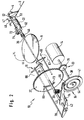
- the parts shown in the frame 18 according to Figure 1 form an actuator or an adjusting device 10, which are combined in one unit.
- the adjusting device 10 includes a servomotor or electric motor 14, which is connected to a throttle valve shaft 36 and a throttle valve 9 via a second gear 33, only schematically indicated, a freewheel device 69, a linkage 70 and a first gear 34 and a driver 42 .
- the actuating forces of the electric motor 14 are transmitted to the throttle valve 9 via the gears 33, 34, and an adjustment to the desired position is thereby brought about.
- the adjusting device 10 can be adjusted via an accelerator pedal 1, a lever 2 and an accelerator cable 3, the lever 2 being shifted between an idling stop (LL) and a full load stop (VL) by actuating the accelerator pedal 1, and the accelerator cable 3 is biased by a return spring 5 in the idle direction (LL).
- the accelerator pedal 1 is connected to a driver 4 by means of an accelerator cable 3, so that when the accelerator pedal 1 is actuated, the driver 4 is displaced in the direction of the full load stop (VL).
- At least one return spring 6 is connected to the driver 4, which prestresses it in the idling direction (LL). As long as the throttle cable 3 is not acted on, the driver 4 rests against the idling stop (LL) assigned to it.
- the driver 4 interacts via a lever 52 with a freewheel hook 47 which, according to the invention, consists of a bushing 62 pivotably mounted on the throttle valve shaft 36 with two spaced drivers 49, 51, which form a recess in which the lever 52 is received.
- the freewheel hook 47 forms a first control element part 8a (see FIG. 1).
- the control element part 8a corresponds to the bushing 62 and the throttle valve shaft 36 in FIG. 2. It is also possible to fasten the freewheel hook 47 to the driver 4 and the lever 52 to the bushing 62.
- the freewheel hook 47 is pulled in the idling direction (LL min ) by means of the spring 22, so that the driver 51 provided on the bushing 62 is pulled against the lever 52 provided on the driver 4, the spring 22 mainly ensuring that the lever 43 and and the stop 74 are brought into contact.
- Another spring 46 provided on the throttle valve shaft 36 causes the throttle valve shaft 36 and thus the throttle valve 9 to be constantly pressed against a stop.
- a driver 72 is provided on the bushing 62 and a lever 71 is provided on the throttle valve shaft 36.
- the throttle valve 9 which then has taken a position outside the idle control range, is pivoted back in the closing direction to the position LL min , as will be explained in more detail below.
- the adjusting device 10 has a second control element part 8b which is drive-connected to the first gear 34 and to the electric motor 14. Within the second control element part 8b, a translation of the servomotor movement takes place by means of a gear 34, which is described in more detail below in terms of its structure and its function.
- a third control element part 8c designed as a freewheel device 69 is provided, which can also be coupled to the electric motor 14 via a second gear 33.
- the electric motor 14 has an output shaft 38, on which an output disk 35 is rotatably arranged, which is used to adjust the throttle valve shaft 36 and for this purpose is drive-connected to a drive disk 37.
- the drive pulley 37 is rotatably arranged on the throttle valve shaft (36) and is equipped with a freewheel device 69, which consists of a slot guide 73 arranged concentrically to the throttle valve shaft 36, in which the linkage 70 running parallel to the throttle valve shaft 36 is received.
- a driver 42 is arranged in a rotationally fixed manner, which at one end can be brought into contact with the linkage 70 at the other end by means of a stop 74 against the underside of a link 43 which is freely pivotable on the throttle valve shaft 36.
- the handlebar 43 is assigned an emergency-running spring 20, which in case of failure of the electric motor 14 or other control devices the handlebar 43, the driver 42, the throttle valve shaft 36, and thus the throttle valve 9 is shifted into the neutral position not.
- the electric motor 14 is permanently connected indirectly to the throttle valve shaft 36 via the first and the gears 33, 34.
- the first gear 34 consists of a cam 41 arranged on the output shaft 38 and the with this in drive connection link 43.
- the link 43 has a cam 55 at its end opposite the linkage 7o. This is received in a groove 54 provided in a cam disk 41.
- the groove 54 has the shape of an Archimedes spiral and can advantageously extend over a total angle of 720 degrees, so that within two revolutions of the electric motor 14 an adjustment of the handlebar 43 and thus an adjustment of the throttle valve shaft 36 in the idle control range between LL min and LL max .
- the first gear 34 has the advantage that large ratios are possible in a simple manner, for example 1:30 to 1:40 and more.
- the output shaft 38 of the electric motor 14 is rotated by 720 o .
- the emergency running spring 20 ensures that, in the event of a defect in an electronic control device 17 or the electric motor 14, the resistance moments of the electric motor 14 or the transmission parts are overcome and the throttle valve 9 is returned to the idling emergency position (LL not ).
- the actual value detection device 19 of the throttle valve 9 is advantageously mounted in the region of the pivotable linkage 70, while the setpoint value detection device 65 is provided in the region of the drive disk 37.
- the two transmissions 33, 34 are matched to one another in such a way that the second transmission 33 only above the idle control range, i.e. in the part-load or full-load control range of the internal combustion engine.
- the throttle valve shaft 36 is preloaded with the associated throttle valve 9 in the direction of the minimal idling position (LL min ) by means of the spring 22.
- the first control element part 8a can also be brought into contact with the lever 52 with its freewheel hook 47 and the associated driver 51, the spring 22 mainly ensuring that the driver 42 with its stop 74 on the handlebar 43 is present.
- the throttle valve shaft 36 is moved outside the idle control range via the driver 51. Part-load or full-load operation, operated.
- the lever 71 bears against the driver 72, as already explained. Furthermore, the throttle valve shaft 36 is operatively connected via the linkage 70 to the first transmission 33 and via the driver 42 to the link 43 of the second transmission 34.
- the actuator shown in Figure 1 is shown in the idle min position. From Figure 1 it can also be seen that the linkage 70 acts on the throttle valve shaft 36 only in the direction of closing, so that the throttle valve shaft when the electric motor 14 is switched on 36 is only adjusted in the direction of idle position LL min via the first gear 33.
- the electronic control device 17 which contains conditioning, logic and control circuits, is indicated schematically.
- the control device 17 stores values for vehicle adaptation and processes the digital or digitized values of various input variables, which then regulate the desired position of the throttle valve 9 via an analog part.
- a potentiometer 66 is assigned to the first actual value detection device 19 and a second potentiometer 67 to the setpoint value detection device 65.
- the control device 17 has the task of all input signals, e.g. Velocity, by means of potentiometers 66, 67 (FIG. 2) and to compare them with one another. If, for example, the vehicle speed deviates from the setpoint, the actuator is activated until the specified speed is reached.
- input signals e.g. Velocity
- the electronic control device 17 also detects signals via an idle contact 68, which is activated by the driver 4, when the latter contacts the idle stop (LL) assigned to it System comes to drive the electric motor 14 only for the anti-slip control (ASR) outside the idle control range.
- an idle contact 68 which is activated by the driver 4, when the latter contacts the idle stop (LL) assigned to it System comes to drive the electric motor 14 only for the anti-slip control (ASR) outside the idle control range.
- the electronic control device 17 serves the purpose of building up a safety logic relating to the control of the first and second control element parts 8a, 8b. Once the electronic control device 17 or the electric motor 14 is no longer working properly, the throttle 9 is moved by the prestressed in the direction of maximum idle position the spring 22 in the idle position not (LL not).
- regulation can be carried out upwards (LLmax) and downwards (LL min ) over the entire idling range by means of a single actuator.
- ASR anti-slip control event
Landscapes
- Engineering & Computer Science (AREA)
- Chemical & Material Sciences (AREA)
- Combustion & Propulsion (AREA)
- Mechanical Engineering (AREA)
- Transportation (AREA)
- General Engineering & Computer Science (AREA)
- Control Of Throttle Valves Provided In The Intake System Or In The Exhaust System (AREA)
Claims (9)
- Dispositif de réglage d'un papillon (9) de carburateur tourillonné dans la tubulure d'aspiration d'un moteur à combustion interne, dispositif dans lequel la position angulaire de l'axe (36) de ce papillon peut être modifiée dans le sens de l'ouverture dudit papillon- pendant la marche entre le ralenti (LL) et la pleine charge (VL) ; par une pédale d'accélérateur (1), par l'entremise d'un levier entraîneur (4) accouplé à cette pédale (1) et contre l'action d'un premier ressort de rappel (6), et- au ralenti -entre LLmin et LLmax- par un servomoteur électrique (14) piloté électroniquement, par l'entremise d'une première transmission (34), et contre l'action d'un second ressort de rappel (22),
ce dispositif étant caractérisé en ce que- une seconde transmission (33), qui comprend une roue menante (35) solidaire en rotation de l'arbre de sortie (38) du servomoteur (14) et une roue menée (37), qui tourne sur l'axe (36) de papillon (9), est disposée entre cet axe (36) et ce servomoteur (14),- la roue menante (35) et la roue menée (37) restent constamment en prise, et- cette roue menée (37) comporte un mécanisme (69) à course à vide, qui coopère avec une tige (70) reliée à l'axe (36) de papillon, de façon que la seconde transmission (33) ne puisse faire pivoter ce papillon (9) que pendant la marche et uniquement dans le sens de sa fermeture. - Dispositif de réglage selon la revendication 1, caractérisé en ce que le mécanisme (69) à course à vide est composé d'une rainure-guide (73), qui est formée dans la roue menée (37) concentriquement à l'axe (36) du papillon et dans laquelle la tige (70) passe.
- Dispositif de réglage selon la revendication 1, caractérisé en ce que la première transmission (34) comprend un disque de came (41) qui est calé sur l'arbre de sortie (38) du moteur (14) et qui comporte une rainure (54) en forme de spirale d'Archimède, et une bielle (43), qui pivote librement sur l'axe (36) du papillon et qui porte un doigt (55) à son extrémité, ce doigt (55) étant engagé dans la rainure (54) et la bielle (43) pouvant osciller dans les deux sens sous l'effet de la rotation du disque de came (41).
- Dispositif de réglage selon la revendication 3, caractérisé en ce que la bielle (43) peut osciller entre une position (LLmin) correspondant à la puissance minimale au ralenti et une position (LLmax) correspondant à la puissance maximale au ralenti.
- Dispositif de réglage selon la revendication 4, caractérisé en ce que l'axe (36) du papillon peut pivoter dans le sens de l'ouverture, sous l'action de la bielle (43) par l'entremise d'une butée (74) et d'un taquet (42) de la tige (70), et pivoter dans le sens de la fermeture du papillon (9) sous l'action d'un ressort (22).
- Dispositif de réglage selon la revendication 5, caractérisé en ce que le ressort (22) agit sur un manchon (62) qui tourne librement sur l'axe (36) du papillon et qui est sollicité par un ressort (46) à pivoter dans le sens de la fermeture de ce papillon (9) et à s'appliquer contre un levier (71) solidaire en rotation de cet axe (36).
- Dispositif de réglage selon la revendication 6, caractérisé en ce que le manchon (62) porte un crochet (47) de course à vide formé par deux taquets (49, 51) et dans lequel est engagé un levier (52) d'un entraîneur (4) accouplé à la pédale d'accélérateur (1).
- Dispositif de réglage selon la revendication 7, caractérisé en ce que la distance comprise entre les taquets (49, 51) correspond à la plage de réglage du papillon (9) entre les positions LLmin et LLmax de puissance minimale et maximale au ralenti.
- Dispositif de réglage selon l'une des revendications 1 à 8, caractérisé en ce qu'un ressort de secours (20) sollicite la bielle (43) à pivoter dans le sens de l'ouverture du papillon (9) jusqu'à une position de secours (LLnot).
Applications Claiming Priority (2)
| Application Number | Priority Date | Filing Date | Title |
|---|---|---|---|
| DE4014556 | 1990-05-07 | ||
| DE4014556A DE4014556A1 (de) | 1990-05-07 | 1990-05-07 | Lastverstelleinrichtung |
Publications (3)
| Publication Number | Publication Date |
|---|---|
| EP0455883A2 EP0455883A2 (fr) | 1991-11-13 |
| EP0455883A3 EP0455883A3 (en) | 1992-02-26 |
| EP0455883B1 true EP0455883B1 (fr) | 1994-08-03 |
Family
ID=6405845
Family Applications (1)
| Application Number | Title | Priority Date | Filing Date |
|---|---|---|---|
| EP90124833A Expired - Lifetime EP0455883B1 (fr) | 1990-05-07 | 1990-12-19 | Dispositif de réglage pour un papillon des gaz |
Country Status (2)
| Country | Link |
|---|---|
| EP (1) | EP0455883B1 (fr) |
| DE (2) | DE4014556A1 (fr) |
Families Citing this family (1)
| Publication number | Priority date | Publication date | Assignee | Title |
|---|---|---|---|---|
| DE19622141A1 (de) * | 1996-06-01 | 1997-12-04 | Mannesmann Vdo Ag | Lastverstellvorrichtung |
Family Cites Families (5)
| Publication number | Priority date | Publication date | Assignee | Title |
|---|---|---|---|---|
| EP0030022B1 (fr) * | 1979-11-30 | 1984-09-19 | Yamaha Hatsudoki Kabushiki Kaisha | Dispositif de commande de papillon pour moteur |
| US4411231A (en) * | 1982-04-16 | 1983-10-25 | Ford Motor Company | Carburetor throttle valve actuator |
| US4526060A (en) * | 1982-09-28 | 1985-07-02 | Ford Motor Company | Carburetor throttle valve actuator |
| DE3641244C3 (de) * | 1986-12-03 | 1995-02-23 | Vdo Schindling | Anordnung für ein Kraftfahrzeug |
| DE3900437C1 (fr) * | 1989-01-10 | 1989-11-16 | Vdo Adolf Schindling Ag, 6000 Frankfurt, De |
-
1990
- 1990-05-07 DE DE4014556A patent/DE4014556A1/de not_active Withdrawn
- 1990-12-19 EP EP90124833A patent/EP0455883B1/fr not_active Expired - Lifetime
- 1990-12-19 DE DE59006707T patent/DE59006707D1/de not_active Expired - Fee Related
Also Published As
| Publication number | Publication date |
|---|---|
| DE4014556A1 (de) | 1991-11-14 |
| EP0455883A2 (fr) | 1991-11-13 |
| DE59006707D1 (de) | 1994-09-08 |
| EP0455883A3 (en) | 1992-02-26 |
Similar Documents
| Publication | Publication Date | Title |
|---|---|---|
| DE4313993C2 (de) | Leistungsübertragungs-Steuervorrichtung für ein Fahrzeug mit einem Verbrennungsmotor | |
| EP0413082B1 (fr) | Dispositif de réglage de charge | |
| DE3927004A1 (de) | Lastverstelleinrichtung | |
| DE69103002T2 (de) | Drosselklappe. | |
| DE102007035089B4 (de) | Drosselklappenöffnungs-Steuerungssystem und -Verfahren für einen Verbrennungsmotor | |
| EP0412237B1 (fr) | Papillon | |
| EP0208222A2 (fr) | Dispositif de commande de la vitesse de ralenti pour moteur à allumage commandé, plus particulièrement pour véhicule | |
| EP0269780B1 (fr) | Dispositif de transmission de la position d'un élément de commande actionnable par le conducteur d'un véhicule | |
| DE3918852A1 (de) | Elektrisch ansteuerbare drosselklappenbetaetigungseinrichtung fuer brennkraftmaschinen | |
| DE4034575A1 (de) | Lastverstelleinrichtung | |
| EP0378737B1 (fr) | Dispositif de réglage de la charge | |
| EP0456904B1 (fr) | Dispositif de réglage de la puissance | |
| EP0455883B1 (fr) | Dispositif de réglage pour un papillon des gaz | |
| EP0455882B1 (fr) | Dispositif de réglage pour un papillon des gaz | |
| EP0378736B1 (fr) | Dispositif de réglage de la charge | |
| EP0104539B1 (fr) | Dispositif pour réduire le frein moteur de moteurs à combustion, particulièrement Diesel, dans les camions en décéleration | |
| EP0455877B1 (fr) | Dispositif de réglage de charge | |
| DE68904644T2 (de) | Drosselklappenkontrolleinrichtung fuer einen verbrennungsmotor. | |
| DE3809910A1 (de) | Vorrichtung zur leistungsbeeinflussung von brennkraftmaschinen | |
| EP0570623A2 (fr) | Dispositif d'ajustement de papillon d'admission | |
| DE4005905A1 (de) | Elektromotorisch betaetigbare leistungssteuervorrichtung einer brennkraftmaschine | |
| DE4033802A1 (de) | Lastverstelleinrichtung | |
| EP0540811B1 (fr) | Dispositif pour le positionnement d'un clapet d'étranglement | |
| DE3445341C2 (fr) | ||
| DE4124972A1 (de) | Lastverstelleinrichtung fuer eine antriebsmaschine |
Legal Events
| Date | Code | Title | Description |
|---|---|---|---|
| PUAI | Public reference made under article 153(3) epc to a published international application that has entered the european phase |
Free format text: ORIGINAL CODE: 0009012 |
|
| AK | Designated contracting states |
Kind code of ref document: A2 Designated state(s): DE FR GB IT SE |
|
| PUAL | Search report despatched |
Free format text: ORIGINAL CODE: 0009013 |
|
| AK | Designated contracting states |
Kind code of ref document: A3 Designated state(s): DE FR GB IT SE |
|
| 17P | Request for examination filed |
Effective date: 19920115 |
|
| 17Q | First examination report despatched |
Effective date: 19930714 |
|
| GRAA | (expected) grant |
Free format text: ORIGINAL CODE: 0009210 |
|
| AK | Designated contracting states |
Kind code of ref document: B1 Designated state(s): DE FR GB IT SE |
|
| PG25 | Lapsed in a contracting state [announced via postgrant information from national office to epo] |
Ref country code: IT Free format text: LAPSE BECAUSE OF FAILURE TO SUBMIT A TRANSLATION OF THE DESCRIPTION OR TO PAY THE FEE WITHIN THE PRE;WARNING: LAPSES OF ITALIAN PATENTS WITH EFFECTIVE DATE BEFORE 2007 MAY HAVE OCCURRED AT ANY TIME BEFORE 2007. THE CORRECT EFFECTIVE DATE MAY BE DIFFERENT FROM THE ONE RECORDED.SCRIBED TIME-LIMIT Effective date: 19940803 Ref country code: GB Effective date: 19940803 |
|
| ET | Fr: translation filed | ||
| REF | Corresponds to: |
Ref document number: 59006707 Country of ref document: DE Date of ref document: 19940908 |
|
| PG25 | Lapsed in a contracting state [announced via postgrant information from national office to epo] |
Ref country code: SE Effective date: 19941103 |
|
| GBV | Gb: ep patent (uk) treated as always having been void in accordance with gb section 77(7)/1977 [no translation filed] |
Effective date: 19940803 |
|
| PLBE | No opposition filed within time limit |
Free format text: ORIGINAL CODE: 0009261 |
|
| STAA | Information on the status of an ep patent application or granted ep patent |
Free format text: STATUS: NO OPPOSITION FILED WITHIN TIME LIMIT |
|
| 26N | No opposition filed | ||
| PG25 | Lapsed in a contracting state [announced via postgrant information from national office to epo] |
Ref country code: FR Effective date: 19950831 |
|
| REG | Reference to a national code |
Ref country code: FR Ref legal event code: ST |
|
| PGFP | Annual fee paid to national office [announced via postgrant information from national office to epo] |
Ref country code: DE Payment date: 19961108 Year of fee payment: 7 |
|
| PG25 | Lapsed in a contracting state [announced via postgrant information from national office to epo] |
Ref country code: DE Free format text: LAPSE BECAUSE OF NON-PAYMENT OF DUE FEES Effective date: 19980901 |