EP0456035A2 - Roadsurfacing for traffic area - Google Patents
Roadsurfacing for traffic area Download PDFInfo
- Publication number
- EP0456035A2 EP0456035A2 EP91106556A EP91106556A EP0456035A2 EP 0456035 A2 EP0456035 A2 EP 0456035A2 EP 91106556 A EP91106556 A EP 91106556A EP 91106556 A EP91106556 A EP 91106556A EP 0456035 A2 EP0456035 A2 EP 0456035A2
- Authority
- EP
- European Patent Office
- Prior art keywords
- mixture
- grain size
- grain
- sealing layer
- road surface
- Prior art date
- Legal status (The legal status is an assumption and is not a legal conclusion. Google has not performed a legal analysis and makes no representation as to the accuracy of the status listed.)
- Granted
Links
Images
Classifications
-
- E—FIXED CONSTRUCTIONS
- E01—CONSTRUCTION OF ROADS, RAILWAYS, OR BRIDGES
- E01C—CONSTRUCTION OF, OR SURFACES FOR, ROADS, SPORTS GROUNDS, OR THE LIKE; MACHINES OR AUXILIARY TOOLS FOR CONSTRUCTION OR REPAIR
- E01C5/00—Pavings made of prefabricated single units
- E01C5/003—Pavings made of prefabricated single units characterised by material or composition used for beds or joints; characterised by the way of laying
-
- E—FIXED CONSTRUCTIONS
- E01—CONSTRUCTION OF ROADS, RAILWAYS, OR BRIDGES
- E01C—CONSTRUCTION OF, OR SURFACES FOR, ROADS, SPORTS GROUNDS, OR THE LIKE; MACHINES OR AUXILIARY TOOLS FOR CONSTRUCTION OR REPAIR
- E01C3/00—Foundations for pavings
- E01C3/06—Methods or arrangements for protecting foundations from destructive influences of moisture, frost or vibration
Definitions
- the invention relates to a road surface for drivable traffic areas, primarily in the area of filling stations for fuels, petrol stations or the like, from a road surface resting on a frost-proof substructure made of prefabricated individual components laid separately from one another, such as e.g. Paving stones made of natural or artificial materials.
- pavements made of hardening material such as e.g. Concrete, or bituminous binders
- pavements made of prefabricated individual components e.g. from paving stones made of natural or artificial materials. Since a pavement made of paving stones makes it easier to adjust irregular floor plans, but also different heights, than a continuous, closed pavement, pavings are usually used for traffic areas that cannot be used to manufacture pavers, i.e. for smaller, even angled areas, e.g. Courtyards, petrol station entrances or the like.
- Road surfaces made of paving stones are usually laid on a substructure made of a material that is frost-proof and able to distribute the loads resulting from the traffic load.
- a substructure made of a material that is frost-proof and able to distribute the loads resulting from the traffic load.
- paving has the property of allowing rainwater to flow directly into the subsoil, which makes it particularly valuable from the point of view of environmental protection.
- this also results in the risk of contamination of the soil by liquid or solid pollutants that go underground with the water can be rinsed.
- paving requires a layer of a material that is non-cohesive and therefore peelable to a flat surface; this underlay usually consists of sand and is therefore permeable to water.
- this layer of sand it would be possible to apply this layer of sand to a sealing layer, for example made from a plastic film or from clay minerals.
- the invention has for its object to provide a secure seal for road surfaces from prefabricated individual components, e.g. To create paving stones that are not only stable and frost-proof, but also resistant to hydrocarbons and durable.
- this object is achieved in that a sealing layer made of a mixture of mineral sealing materials, in particular clay minerals, such as e.g. Montmorillonite, and minerals with a high solids content is arranged, that the mixture consists of fractions of different grain size and is composed such that the volume of the respectively finer grain size is greater than the pore volume of the respective coarser grain size and the largest grain size of the finer grain size is equal to or less than approximately 1/10 of the smallest grain size of the coarser grain size and that the mixture introduced in the dry state is compacted after placing the individual components by vibrating them with a surface vibrator, whereby the finer grain parts fill the pore spaces of the coarser grain size and excess fine parts fill the joints between the individual components of the road surface fill in and that the moisture required for the effectiveness of the mixture as a sealing layer is supplied after installation.
- clay minerals such as e.g. Montmorillonite
- the invention also relates to a dry mixture for producing such a sealing layer, which is either about 70% sand with grain sizes 0 to 2 mm and about 30% clay minerals, e.g. montmorillonite, or about 65% gravel with sizes 8 to 16 mm, can consist of about 25% sand of grain sizes 0 to 2 mm and about 10% clay minerals, eg montmorillonite.
- a dry mixture for producing such a sealing layer which is either about 70% sand with grain sizes 0 to 2 mm and about 30% clay minerals, e.g. montmorillonite, or about 65% gravel with sizes 8 to 16 mm, can consist of about 25% sand of grain sizes 0 to 2 mm and about 10% clay minerals, eg montmorillonite.
- the mixture can also contain materials which are able to retain pollutants contained in liquids which pass through the roadway surface by physical and / or chemical adsorption.
- the components of the mixture can also be made hydrophobic at least until they are incorporated.
- the invention is based on the knowledge that a mixture of gravel and sand with high-quality clay minerals, e.g. Montmorillonite, the existing sealing layer is frost-proof on the one hand because the individual components of the mixture do not cause frost elevations, i.e. they can also be installed within the frost depth, but on the other hand they are sufficiently load-bearing due to the coarse grain structure.
- high-quality clay minerals e.g. Montmorillonite
- the installation of the material forming the sealing layer in a dry, ie pre-dried state has the effect that, as with sand, a flat surface suitable for placing the individual components can be created by pulling off with the usual tools.
- the dry material is compacted while filling the pore spaces. Since the volume of the fine grain fraction of the mixture is greater than the pore volume of the coarse grain fraction, fine material remains after the pore spaces of the coarser material are filled, which rises to the surface and from below into the joint spaces between the individual components and fills them up solely due to the vibrating energy .
- the methods of installation and compaction can be coordinated and the grain size graded so that the coarse grains are surrounded by the fine grains. This results in a very small pore space of 25 to 20%, which is additionally sealed when moisture is added by the swelling of the montmorillonite.
- a sealing layer assembled and installed according to the invention has the necessary load-bearing capacity even for heavy traffic.
- frost the pore water remains finely distributed in the mixture; there is no water absorption from the outside, i.e. there is no increase in the water content or enlargement of the pore space. Ice lenses and thus uplifts do not occur.
- 1 denotes a conventional base layer, which is usually e.g. a thickness of approx. 15 cm and has the task of frost-proof foundation and transmission of the loads resulting from the traffic loads to the ground.
- a frost protection layer (not shown); below the upcoming floor.
- a sealing layer 2 on which the actual road surface 3 is then made up of individual components, here made of concrete paving stones 4, e.g. Compound paving stones.
- the sealing layer 2 suitably consists of a mixture of approx. 65% grown gravel with a grain size of 8 to 16 mm, approx. 25% sand with a grain size of 0 to 2 mm and approx. 10% bentonite.
- the materials for this mixture are dry, i.e. pre-dried, non-cohesive state mixed and installed in this state.
- FIG 2 shows an embodiment in which a support layer 1 is first assembled and installed in the usual way, eg Rolled mixed floor seal 7 is arranged.
- the correspondingly thinner sealing layer 2 'according to the invention arranged above consists here only of fine fractions, e.g. about 70% from sand of grain sizes 0 to 2 mm and about 30% from clay minerals, e.g. Montmorillonite.
- This mixture is installed and removed in a dry state, that is to say without cohesion, and compacted by paving stones 4 after the pavement 3 has been laid on, from paving stones 4.
- the vibrating energy entered in this way not only causes the particles of the clay mineral fraction in a particle size of 1 to 2 my to penetrate into the pore spaces of the sand portion, which nevertheless has a particle size of about 100 my up to 1 to 2 mm; since here too the volume fraction of clay mineral is larger than the pore space of the sand fraction, the portions of the clay mineral that are no longer required to fill the pore spaces enter upwards and penetrate into the joints 6 between the individual paving stones 4 from below.
- the sealing layer 2 'immediately below the paving stones 4 reaches a thickness of about 2 cm in the final state.
Landscapes
- Engineering & Computer Science (AREA)
- Architecture (AREA)
- Civil Engineering (AREA)
- Structural Engineering (AREA)
- Road Paving Structures (AREA)
- Road Signs Or Road Markings (AREA)
- Steering Control In Accordance With Driving Conditions (AREA)
- Instructional Devices (AREA)
- Navigation (AREA)
Abstract
Bei einer Fahrbahndecke für befahrbare Verkehrsflächen, vornehmlich im Bereich von Tankstellen, befindet sich unmittelbar unterhalb des Fahrbahnbelages (3), z.B. aus Verbundpflastersteinen (4), eine Dichtungsschicht (2) aus einer Mischung aus Tonmineralien, z.B. Montmorillonit, und anderen Mineralstoffen. Diese Mischung ist aus Fraktionen unterschiedlicher Körnung so zusammengesetzt, daß das Volumen der jeweils feineren Körnung größer als das Porenvolumen der jeweils gröberen Körnung und das Größtkorn der feineren Körnung gleich oder kleiner als etwa 1/10 des Kleinstkornes der gröberen Körnung sind. Die Mischung wird in trockenem, kohäsionslosem Zustand eingebracht und nach Auflegen der Pflastersteine (4) bei Einrütteln derselben mittels Flächenrüttler verdichtet. Dabei füllen die feineren Kornanteile jeweils die Porenräume der gröberen Körnung aus; überschüssige Feinanteile steigen nach oben und füllen von unten her die Fugen (6) zwischen den Einzelbauteilen (4). Die für die Wirksamkeit der Mischung als Dichtungsschicht erforderliche Feuchtigkeit wird nach dem Einbau zugeführt.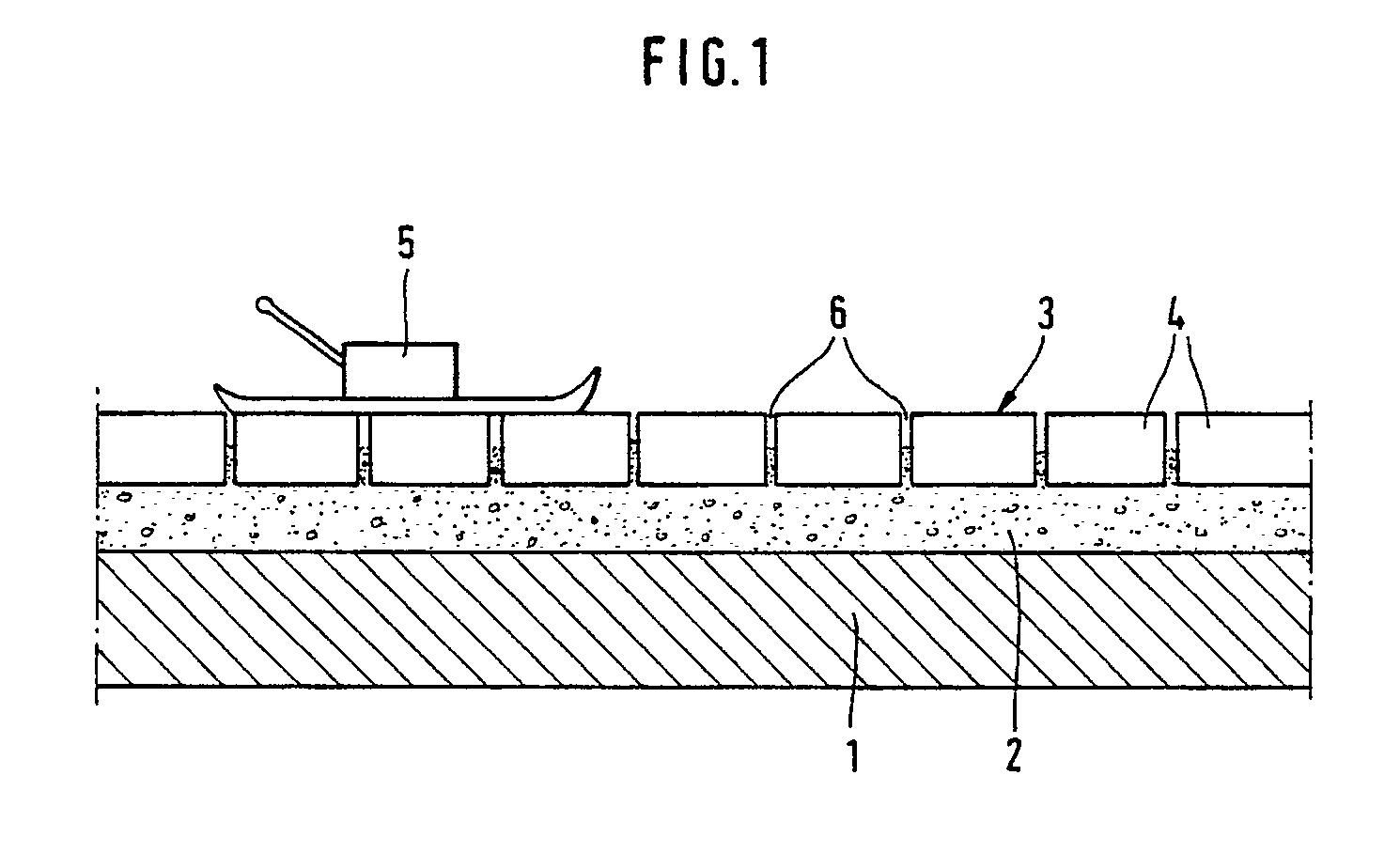
Description
Die Erfindung bezieht sich auf eine Fahrbahndecke für befahrbare Verkehrsflächen, vornehmlich im Bereich von Abfüllstationen für Treibstoffe, Tankstellen oder dergleichen aus einem auf einem frostsicheren Unterbau ruhenden Fahrbahnbelag aus durch Fugen voneinander getrennt verlegten, vorgefertigten Einzelbauteilen, wie z.B. Pflastersteinen aus natürlichen oder künstlichen Materialien.The invention relates to a road surface for drivable traffic areas, primarily in the area of filling stations for fuels, petrol stations or the like, from a road surface resting on a frost-proof substructure made of prefabricated individual components laid separately from one another, such as e.g. Paving stones made of natural or artificial materials.
Zur Befestigung von befahrbaren Verkehrsflächen kennt man neben geschlossenen Fahrbahndecken aus erhärtendem Material, wie z.B. Beton, oder bituminösen Bindemitteln, auch Fahrbahndecken aus vorgefertigten Einzelbauteilen, wie z.B. aus Pflastersteinen aus natürlichen oder künstlichen Materialien. Da ein Fahrbahnbelag aus Pflastersteinen sich unregelmäßigen Grundrissen, aber auch unterschiedlichen Höhen leichter anpassen läßt als ein durchgehender geschlossener Fahrbahnbelag, werden Pflasterungen üblicherweise für Verkehrsflächen verwendet, zu deren Herstellung Deckenfertiger nicht eingesetzt werden können, also für kleinere, auch verwinkelte Flächen, wie z.B. Höfe, Tankstellenzufahrten oder dergleichen.In addition to closed pavement ceilings made of hardening material, such as e.g. Concrete, or bituminous binders, also pavements made of prefabricated individual components, e.g. from paving stones made of natural or artificial materials. Since a pavement made of paving stones makes it easier to adjust irregular floor plans, but also different heights, than a continuous, closed pavement, pavings are usually used for traffic areas that cannot be used to manufacture pavers, i.e. for smaller, even angled areas, e.g. Courtyards, petrol station entrances or the like.
Fahrbahnbeläge aus Pflastersteinen werden üblicherweise auf einem Unterbau aus einem Material verlegt, das frostsicher und in der Lage ist, die aus der Verkehrsbelastung herrührenden Lasten zu verteilen. Pflasterungen haben infolge der zwischen den einzelnen Pflastersteinen bestehenden, meist mit Sand gefüllten Fugen die Eigenschaft, Niederschlagswasser unmittelbar in den Untergrund abfließen zu lassen, was sie aus der Sicht des Umweltschutzes besonders wertvoll macht. Daraus resultiert aber auch die Gefahr einer Kontaminierung des Bodens durch flüssige oder feste Schadstoffe, die mit dem Wasser in den Untergrund gespült werden können.Road surfaces made of paving stones are usually laid on a substructure made of a material that is frost-proof and able to distribute the loads resulting from the traffic load. As a result of the joints between the paving stones, which are mostly filled with sand, paving has the property of allowing rainwater to flow directly into the subsoil, which makes it particularly valuable from the point of view of environmental protection. However, this also results in the risk of contamination of the soil by liquid or solid pollutants that go underground with the water can be rinsed.
Bei der Betankung von Kraftfahrzeugen an Tankstellen entstehen Tropfverluste an Kraftstoffen. Wenn auch durch Vergaserkraftstoff infolge höherer Verdunstungsraten kaum Kontamination in den Boden gelangt, ist diese Gefahr bei Dieselkraftstoffen und leichtem Heizöl in sehr viel stärkerem Maße gegeben, so daß, ebenfalls aus Gründen des Umweltschutzes, gepflasterte Flächen abgedichtet werden müssen. Dieses Problem stellt sich vor allem bei der Pflasterung von Zufahrten zu sowie Bereichen von Tankstellen.When refueling motor vehicles at petrol stations, drip losses on fuels occur. Even if hardly any contamination gets into the ground due to the gasification fuel due to higher evaporation rates, this danger is much greater with diesel fuels and light heating oil, so that, also for reasons of environmental protection, paved surfaces must be sealed. This problem arises especially when paving driveways to and areas of petrol stations.
Pflasterungen erfordern als unmittelbare Unterlage eine Schicht aus einem Material, das kohäsionslos und deshalb zu einer ebenen Oberfläche abziehbar ist; diese Unterlage besteht meist aus Sand und ist somit wasserdurchlässig.
Theoretisch wäre es zwar möglich, diese Sandschicht auf eine Dichtungsschicht, z.B. aus einer Kunststoffolie oder aus Tonmineralien, aufzubringen. Abgesehen davon, daß Dichtungen aus Kunststoffolien gegenüber Kohlenwasserstoffen nicht beständig und konventionelle Dichtungen aus mineralischen Dichtungsmaterialien nicht ausreichend tragfähig und auch nicht frostsicher sind, hat die Anordnung einer Sandschicht oberhalb einer Dichtungsschicht den zusätzlichen Nachteil, daß sich durch die Fugen der Pflasterung einsickernde Kohlenwasserstoffe in der Sandschicht horizontal ausbreiten und dann durch Diffusion oder gar durch Risse in der Dichtungsschicht auch einen Weg in den Untergrund finden können.As an immediate underlay, paving requires a layer of a material that is non-cohesive and therefore peelable to a flat surface; this underlay usually consists of sand and is therefore permeable to water.
Theoretically, it would be possible to apply this layer of sand to a sealing layer, for example made from a plastic film or from clay minerals. In addition to the fact that seals made of plastic films are not resistant to hydrocarbons and conventional seals made from mineral sealing materials are not sufficiently load-bearing and also not frost-proof, the arrangement of a sand layer above a sealing layer has the additional disadvantage that hydrocarbons seeping into the sand layer through the joints of the paving Spread horizontally and then find a way into the ground through diffusion or even cracks in the sealing layer.
Die gleichen Probleme entstehen auch, wenn, was ebenfalls bekannt ist, Pflastersteine in einem Mörtelbett aus erhärtendem Material, wie z.B. Zementmörtel, Traßkalkmörtel oder dergleichen verlegt werden. Selbst wenn dieser Mörtel wasserdicht sein sollte, ist er nicht dicht gegen Kohlenwasserstoffe.The same problems also arise when, as is also known, paving stones are laid in a mortar bed made of hardening material, such as cement mortar, lime mortar or the like. Even if this mortar is waterproof, it is not tight against Hydrocarbons.
Vor diesem Hintergrund liegt der Erfindung die Aufgabe zugrunde, eine sichere Dichtung für Fahrbahnbeläge aus vorgefertigten Einzelbauteilen, z.B. Pflastersteinen, zu schaffen, die nicht nur tragfähig und frostsicher, sondern auch beständig gegen Kohlenwasserstoffe und dauerhaft haltbar ist.Against this background, the invention has for its object to provide a secure seal for road surfaces from prefabricated individual components, e.g. To create paving stones that are not only stable and frost-proof, but also resistant to hydrocarbons and durable.
Nach der Erfindung wird diese Aufgabe dadurch gelöst, daß unmittelbar unterhalb des Fahrbahnbelages eine Dichtungsschicht aus einer Mischung aus mineralischen Dichtungsmaterialien, insbesondere Tonmineralien, wie z.B. Montmorillonit, und Mineralstoffen mit hohem Feststoffanteil angeordnet ist, daß die Mischung aus Fraktionen unterschiedlicher Körnung besteht und so zusammengesetzt ist, daß das Volumen der jeweils feineren Körnung größer ist als das Porenvolumen der jeweils gröberen Körnung und das Größtkorn der feineren Körnung gleich oder kleiner als etwa 1/10 des Kleinstkornes der gröberen Körnung ist und daß die in trockenem Zustand eingebrachte Mischung nach Auflegen der Einzelbauteile bei Einrütteln derselben mittels Flächenrüttler verdichtet wird, wobei die feineren Kornanteile die Porenräume der jeweils gröberen Körnung ausfüllen und überschüssige Feinanteile die Fugen zwischen den Einzelbauteilen des Fahrbahnbelages ausfüllen und daß die für die Wirksamkeit der Mischung als Dichtungsschicht erforderliche Feuchtigkeit nach dem Einbau zugeführt wird.According to the invention, this object is achieved in that a sealing layer made of a mixture of mineral sealing materials, in particular clay minerals, such as e.g. Montmorillonite, and minerals with a high solids content is arranged, that the mixture consists of fractions of different grain size and is composed such that the volume of the respectively finer grain size is greater than the pore volume of the respective coarser grain size and the largest grain size of the finer grain size is equal to or less than approximately 1/10 of the smallest grain size of the coarser grain size and that the mixture introduced in the dry state is compacted after placing the individual components by vibrating them with a surface vibrator, whereby the finer grain parts fill the pore spaces of the coarser grain size and excess fine parts fill the joints between the individual components of the road surface fill in and that the moisture required for the effectiveness of the mixture as a sealing layer is supplied after installation.
Gegenstand der Erfindung ist noch eine Trockenmischung zum Herstellen einer solchen Dichtungsschicht, die entweder zu etwa 70 % aus Sand der Korngrößen 0 bis 2 mm und zu etwa 30 % aus Tonmineralien, z.B. Montmorillonit oder auch zu etwa 65 % aus Kies der Korngrößen 8 bis 16 mm, zu etwa 25 % aus Sand der Korngrößen 0 bis 2 mm und zu etwa 10 % aus Tonmineralien, z.B. Montmorillonit bestehen kann.The invention also relates to a dry mixture for producing such a sealing layer, which is either about 70% sand with grain sizes 0 to 2 mm and about 30% clay minerals, e.g. montmorillonite, or about 65% gravel with sizes 8 to 16 mm, can consist of about 25% sand of grain sizes 0 to 2 mm and about 10% clay minerals, eg montmorillonite.
Die Mischung kann in Form von Beimengungen auch Materialien enthalten, die in der Lage sind, in etwa durch den Fahrbahnbelag hindurchtretenden Flüssigkeiten enthaltene Schadstoffe durch physikalische und/oder chemische Adsorption zurückzuhalten. Auch können die Bestandteile der Mischung zumindest bis zu ihrem Einbau hydrophob ausgerüstet sein.In the form of admixtures, the mixture can also contain materials which are able to retain pollutants contained in liquids which pass through the roadway surface by physical and / or chemical adsorption. The components of the mixture can also be made hydrophobic at least until they are incorporated.
Der Erfindung liegt die Erkenntnis zugrunde, daß eine aus einer Mischung aus Kiesen und Sanden mit hochwertigen Tonmineralien, wie z.B. Montmorillonit, bestehende Dichtungsschicht einerseits frostsicher ist, weil die einzelnen Bestandteile der Mischung keine Frosthebungen verursachen, also auch innerhalb der Frosttiefe eingebaut werden kann, andererseits durch das Traggerüst aus grober Körnung aber auch ausreichend tragfähig ist.The invention is based on the knowledge that a mixture of gravel and sand with high-quality clay minerals, e.g. Montmorillonite, the existing sealing layer is frost-proof on the one hand because the individual components of the mixture do not cause frost elevations, i.e. they can also be installed within the frost depth, but on the other hand they are sufficiently load-bearing due to the coarse grain structure.
Der Einbau des die Dichtungsschicht bildenden Materials in trockenem, d.h. vorgetrocknetem Zustand, hat die Wirkung, daß, wie bei Sand, durch Abziehen mit den üblichen Werkzeugen eine ebene, zum Auflegen der Einzelbauteile geeignete Oberfläche geschaffen werden kann. Bei dem nachfolgenden Einrütteln der Einzelbauteile wird das trockene Material unter Füllung der Porenräume verdichtet. Da das Volumen des Feinkornanteils der Mischung größer ist als das Porenvolumen des Grobkornanteils, verbleibt, nachdem die Porenräume des gröberen Materials gefüllt sind noch Feinmaterial, das allein infolge der Rüttelenergie an die Oberfläche und von unten her in die Fugenräume zwischen den Einzelbauteilen aufsteigt und diese ausfüllt. Damit wird eine optimale Abdichtung aller Hohlräume des Gesamtsystems "Fahrbahndecke" erreicht, wenn man die Fugen des Fahrbahnbelages ebenso als Hohlräume betrachtet wie die Porenräume des tragfähigen Korngerüstes. Die Einzelbauteile selbst setzen sich auf das Korngerüst des verdichteten Grobkornanteils ab und bewirken so die hohe Tragfähigkeit. Die gewünschte Dichtwirkung wird danach durch Zutritt von Bodeneigenfeuchte von unten her erzielt; ihr Zustandekommen kann durch Wässern der Oberfläche beschleunigt werden.The installation of the material forming the sealing layer in a dry, ie pre-dried state, has the effect that, as with sand, a flat surface suitable for placing the individual components can be created by pulling off with the usual tools. When the individual components are subsequently shaken in, the dry material is compacted while filling the pore spaces. Since the volume of the fine grain fraction of the mixture is greater than the pore volume of the coarse grain fraction, fine material remains after the pore spaces of the coarser material are filled, which rises to the surface and from below into the joint spaces between the individual components and fills them up solely due to the vibrating energy . This ensures an optimal sealing of all cavities in the overall "road surface" system, if one considers the joints of the road surface as cavities as well as the pore spaces of the load-bearing grain structure. The individual components themselves sit on the grain structure of the compacted Coarse grain content and thus cause the high load capacity. The desired sealing effect is then achieved by accessing soil moisture from below; their formation can be accelerated by watering the surface.
Die Verfahren des Einbaus und der Verdichtung können so aufeinander abgestimmt und die Körnungslinie so abgestuft werden, daß die Grobkörner jeweils von den Feinkörnern umgeben sind. Dadurch stellt sich ein sehr geringer Porenraum von 25 bis 20 % ein, der bei Feuchtigkeitszufuhr durch die Quellung des Montmorillonits zusätzlich abgedichtet wird.The methods of installation and compaction can be coordinated and the grain size graded so that the coarse grains are surrounded by the fine grains. This results in a very small pore space of 25 to 20%, which is additionally sealed when moisture is added by the swelling of the montmorillonite.
Stauhöhen von Kraftstoffen auf der Fahrbahnoberfläche, die eine Strömung infolge Druck hervorrufen könnten, dürften in der Praxis nicht auftreten, zumal Pflasterungen aus Verbundpflastersteinen mit abgedichteten Fugen üblicherweise mit Gefälle zu den Bodenabläufen und Leichtflüssigkeitsabscheidern hin verlegt werden. Ein in eine Fuge einsickernder Tropfen von z.B. Dieselkraftstoff kann kaum in die Dichtungsschicht eindringen, da zwischen diesem hydrophoben Stoff und der hydrophilen Dichtungsschicht keine Vernetzung eintritt. Der gegenüber sonst üblichen Dichtungsschichten hohe Anteil an Montmorillonit erhöht vor allem auch die Sorptionsfähigkeit für flüchtige bis nichtflüchtige Stoffe, die durch geeignete Zusätze noch gesteigert werden kann.Accumulation of fuels on the road surface, which could cause a flow due to pressure, should not occur in practice, especially since paving made of composite paving stones with sealed joints is usually laid with a slope to the floor drains and light liquid separators. A drop of e.g. Diesel fuel can hardly penetrate the sealing layer, since no crosslinking occurs between this hydrophobic substance and the hydrophilic sealing layer. The high proportion of montmorillonite compared to the usual sealing layers also increases the sorption capacity for volatile to non-volatile substances, which can be increased with suitable additives.
Im Gegensatz zu den sonst üblichen, in feuchtem Zustand eingebauten Dichtungsschichten aus Tonmineralien hat eine nach der Erfindung zusammengesetzte und eingebaute Dichtungsschicht die erforderliche Tragfähigkeit auch für Schwerverkehr. Bei Frost bleibt das Porenwasser fein in der Mischung verteilt; es erfolgt keine Wasseraufnahme von außen, also keine Zunahme des Wassergehalts bzw. Vergrößerung des Porenraumes. Eislinsen und somit Hebungen treten nicht auf.In contrast to the usual sealing layers of clay minerals installed in a moist state, a sealing layer assembled and installed according to the invention has the necessary load-bearing capacity even for heavy traffic. In the event of frost, the pore water remains finely distributed in the mixture; there is no water absorption from the outside, i.e. there is no increase in the water content or enlargement of the pore space. Ice lenses and thus uplifts do not occur.
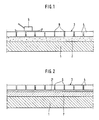
Die Erfindung wird nachstehend anhand der Zeichnung näher erläutert. Es zeigt
- Fig. 1
- einen Teilquerschnitt durch eine erste Ausführungsform einer Fahrbahndecke nach der Erfindung und
- Fig. 2
- eine andere Ausführungsform einer Fahrbahndecke nach der Erfindung.
- Fig. 1
- a partial cross section through a first embodiment of a pavement according to the invention and
- Fig. 2
- another embodiment of a pavement according to the invention.
Bei dem in Fig. 1 dargestellten Ausführungsbeispiel einer Fahrbahndecke ist mit 1 eine konventionelle Tragschicht bezeichnet, die üblicherweise z.B. eine Dicke von ca. 15 cm und die Aufgabe einer frostsicheren Gründung und Übertragung der aus den Verkehrslasten herrührenden Belastungen auf den Untergrund hat. Unterhalb der Tragschicht 1 befindet sich eine - nicht dargestellte - Frostschutzschicht; darunter der anstehende Boden. über der Tragschicht 1 befindet sich eine Dichtungsschicht 2 nach der Erfindung, auf der dann der eigentliche Fahrbahnbelag 3 aus Einzelbauteilen, hier aus Betonpflastersteinen 4, z.B. Verbundpflastersteinen liegt.In the embodiment of a road surface shown in Fig. 1, 1 denotes a conventional base layer, which is usually e.g. a thickness of approx. 15 cm and has the task of frost-proof foundation and transmission of the loads resulting from the traffic loads to the ground. Below the
Die Dichtungsschicht 2 besteht zweckmäßig aus einer Mischung aus ca. 65 % gewachsenem Kies der Körnung 8 bis 16 mm, ca. 25 % Sand der Körnung 0 bis 2 mm und ca. 10 % Bentonit. Die Materialien für diese Mischung werden in trockenem, d.h. vorgetrocknetem, kohäsionslosem Zustand gemischt und in diesem Zustand eingebaut.The sealing layer 2 suitably consists of a mixture of approx. 65% grown gravel with a grain size of 8 to 16 mm, approx. 25% sand with a grain size of 0 to 2 mm and approx. 10% bentonite. The materials for this mixture are dry, i.e. pre-dried, non-cohesive state mixed and installed in this state.
Der Aufbau einer solchen Trockenmischung aus einem Grob- und einem Feinkornanteil baut auf der Lehre der DE 38 23 874 C1 auf. Deren Grundgedanke besteht darin, bei einer Mischung aus zwei jeweils in sich stabilen Komponenten, nämlich einem Fein- und einem Grobkornanteil die Struktur des Grobkornanteils so zu dimensionieren, daß das Feinkorn gleichsam wie eine Flüssigkeit bei Anwendung geringer Verdichtungsenergie in die freien Porenräume eindringen kann. Dies ist z.B. dann der Fall, wenn das Größtkorn des Feinkornanteils gleich oder kleiner ist als etwa 1/10 des Kleinstkornes des Grobkornanteils. Die Gesamtmischung ist, solange sie trocken ist, bezüglich des Feinkornanteils instabil. Damit läßt sich unabhängig von dem Anlieferungszustand der Trockenmischung ein Füllen aller Poren des Korngerüstes bis nahe an den theoretischen Dichtgrad erzielen. Diese Eigenschaft der Trockenmischung ist die Voraussetzung für die Erzielung großer Homogenität und Dichte im Endzustand; ihre innere Stabilität erhält die Mischung dann, wenn Feuchtigkeit hinzutritt und die Kohäsion der Feinanteile geweckt wird.The construction of such a dry mixture from a coarse and a fine grain fraction is based on the teaching of DE 38 23 874 C1. The basic idea is to combine the structure of a mixture of two inherently stable components, namely a fine and a coarse grain fraction Dimension the coarse-grain fraction so that the fine grain can penetrate the free pore spaces as if it were a liquid with low compression energy. This is the case, for example, if the largest grain of the fine grain fraction is equal to or less than approximately 1/10 of the smallest grain of the coarse grain fraction. As long as it is dry, the total mixture is unstable with regard to the fine grain fraction. This allows filling of all pores of the grain structure up to close to the theoretical degree of sealing regardless of the delivery condition of the dry mixture. This property of the dry mix is the prerequisite for achieving great homogeneity and density in the final state; The mixture gets its internal stability when moisture is added and the cohesion of the fine particles is awakened.
Grundsätzlich ist eine Vielzahl von Mischungszusammensetzungen denkbar, die diesen Bedingungen genügen, solange nur die Voraussetzung erfüllt ist, daß das Grobkorngerüst, das aus einer oder mehreren Kornfraktionen bestehen kann, eine ausreichend große Durchlässigkeit für das Feinkorn aufweist und das Volumen des Feinkornanteils größer ist als das Porenvolumen des Grobkornanteils. Dies hat nämlich zur Folge, daß bei dem Einrütteln der Pflastersteine 4 mittels eines Flächenrüttlers 5 nicht nur der Feinkornanteil die Poren des Grobkornanteils ausfüllt, der seinerseits ein Korngerüst bildet, sondern daß der überschüssige Feinkornanteil von unten her in die Fugen 6 zwischen den Pflastersteinen aufsteigt und auch hier eine Dichtung bildet.In principle, a large number of mixture compositions are conceivable that meet these conditions, as long as only the requirement is met that the coarse grain structure, which can consist of one or more grain fractions, has a sufficiently large permeability for the fine grain and the volume of the fine grain fraction is greater than that Pore volume of the coarse grain fraction. The result of this is that when the paving stones 4 are shaken in by means of a surface vibrator 5, not only does the fine-grain fraction fill the pores of the coarse-grain fraction, which in turn forms a grain structure, but that the excess fine-grain fraction rises from below into the
Es hat sich gezeigt, daß es mit einem derartigen Mischungsaufbau technisch gelingt, ein Porenvolumen von unter 15 % zu erzielen. Damit läßt sich sicherstellen, daß bei Einbau großer Mengen von Dichtungsmaterial unter Anwendung der üblichen Geräte und unter Berücksichtigung der Streuung in der endgültigen Dichtungsschicht ein Porenvolumen von 25 bis 20 % erreicht werden kann.It has been shown that with such a mixture structure it is technically possible to achieve a pore volume of less than 15%. This ensures that when installing large amounts of sealing material using the usual equipment and taking into account the Scattering in the final sealing layer can achieve a pore volume of 25 to 20%.
Während bei dem vorbeschriebenen Ausführungsbeispiel nach Fig. 1 die trocken eingebaute Mischung nicht nur die Dichtung unmittelbar unterhalb des Fahrbahnbelages 3 und im Bereich deren Fugen 6, sondern aufgrund ihrer Zusammensetzung aus einem Grobkorngerüst, Feinanteilen und Tonmineralien auch die tragfähige Dichtungsschicht 2 bildet, ist in Fig. 2 eine Ausführungsform dargestellt, bei der auf der Tragschicht 1 zunächst eine in üblicher Weise zusammengesetzte und eingebaute, z.B. abgewalzte Mischbodendichtung 7 angeordnet ist. Die darüber angeordnete, entsprechend dünnere Dichtungsschicht 2' nach der Erfindung besteht hier nur aus Feinanteilen, z.B. zu etwa 70 % aus Sand der Korngrößen 0 bis 2 mm und zu etwa 30 % aus Tonmineralien, z.B. Montmorillonit. Auch diese Mischung wird in trockenem Zustand, also kohäsionslos, eingebaut und abgezogen und nach dem Auflegen des Fahrbahnbelages 3 aus Pflastersteinen 4 durch Flächenrüttler verdichtet. Die so eingetragene Rüttelenergie bewirkt nicht nur, daß die Teilchen des Tonmineralanteils in einer Partikelgröße von 1 bis 2 my in die Porenräume des Sandanteils eindringen, der immerhin eine Partikelgröße von etwa 100 my bis zu 1 bis 2 mm aufweist; da auch hier der Volumenanteil an Tonmineral größer ist als der Porenraum des Sandanteils, treten auch hier die zum Ausfüllen der Porenräume nicht mehr benötigten Anteile des Tonminerals nach oben und dringen von unten her in die Fugen 6 zwischen den einzelnen Pflastersteinen 4 ein. Die Dichtungsschicht 2' unmittelbar unterhalb der Pflastersteine 4 erreicht hier im Endzustand etwa eine Dicke von etwa 2 cm.1, the dry installed mixture not only forms the seal immediately below the
Claims (5)
Priority Applications (1)
| Application Number | Priority Date | Filing Date | Title |
|---|---|---|---|
| AT91106556T ATE94926T1 (en) | 1990-05-09 | 1991-04-24 | ROAD SURFACE FOR TRAFFIC AREAS. |
Applications Claiming Priority (2)
| Application Number | Priority Date | Filing Date | Title |
|---|---|---|---|
| DE4014858A DE4014858A1 (en) | 1990-05-09 | 1990-05-09 | ROAD COVER FOR TRAFFIC AREAS |
| DE4014858 | 1990-05-09 |
Publications (3)
| Publication Number | Publication Date |
|---|---|
| EP0456035A2 true EP0456035A2 (en) | 1991-11-13 |
| EP0456035A3 EP0456035A3 (en) | 1992-03-25 |
| EP0456035B1 EP0456035B1 (en) | 1993-09-22 |
Family
ID=6406024
Family Applications (1)
| Application Number | Title | Priority Date | Filing Date |
|---|---|---|---|
| EP91106556A Expired - Lifetime EP0456035B1 (en) | 1990-05-09 | 1991-04-24 | Roadsurfacing for traffic area |
Country Status (3)
| Country | Link |
|---|---|
| EP (1) | EP0456035B1 (en) |
| AT (1) | ATE94926T1 (en) |
| DE (2) | DE4014858A1 (en) |
Cited By (7)
| Publication number | Priority date | Publication date | Assignee | Title |
|---|---|---|---|---|
| DE9415479U1 (en) * | 1994-09-24 | 1994-11-24 | Kruß, Heinrich, 47669 Wachtendonk | Floor surface contaminated with toxins and paved with water-permeable paving stones |
| FR2732701A1 (en) * | 1995-04-05 | 1996-10-11 | Chatelet Andre | DECORATIVE SLABS WITH MOLDED PREPARED FRAME ELEMENTS AND METHOD OF IMPLEMENTING |
| DE19647361A1 (en) * | 1996-11-16 | 1998-05-28 | Paul Lingen | Laminated floor surface for roads, etc. |
| EP1229168A1 (en) | 2001-02-01 | 2002-08-07 | Albrecht Braun GmbH | Road surface and method for its construction |
| DE10115009A1 (en) * | 2001-03-27 | 2002-10-31 | Lothar Zimmermann | Road surface, for industrial zones and fuel stations, has sealed slabs supported over the ground on a layer of concrete to protect the ground against contamination |
| DE102010026863A1 (en) * | 2010-07-12 | 2012-01-12 | K+S Aktiengesellschaft | Base seal of a heap, especially a residue salt heap |
| US8920693B2 (en) | 2011-02-04 | 2014-12-30 | Universität Kassel | Method for the production of a fiber-reinforced thermoplastic polymer and extrusion die and device for the temperature control a fiber strand impregnated with a polymer melt |
Families Citing this family (2)
| Publication number | Priority date | Publication date | Assignee | Title |
|---|---|---|---|---|
| DE4235512C2 (en) * | 1992-10-21 | 1994-12-08 | Envichem Abfallbehandlung Und | Method and motor vehicle for disinfecting, in particular medical or the like, waste |
| DE202009004848U1 (en) | 2009-05-25 | 2009-08-27 | Funke Kunststoffe Gmbh | Passable floor covering with grout material |
Family Cites Families (5)
| Publication number | Priority date | Publication date | Assignee | Title |
|---|---|---|---|---|
| DE1070556B (en) * | ||||
| AT293465B (en) * | 1969-04-21 | 1971-10-11 | Ebenseer Betonwerke Gmbh | Floor covering consisting of shaped stones, in particular shaped concrete blocks |
| AT329617B (en) * | 1973-08-17 | 1976-05-25 | Waibel Peter Dipl Ing Dr | PROCESS FOR PRODUCING BASE COATING IN ROAD CONSTRUCTION |
| DE2845827A1 (en) * | 1978-10-20 | 1980-04-30 | Wacker Chemie Gmbh | Sand and/or grit treated with organo-silicon cpds. - to make them hydrophobic for sealing layers underneath roads |
| DE3823874C1 (en) * | 1988-07-14 | 1989-11-16 | Dyckerhoff & Widmann Ag, 8000 Muenchen, De | Dry mixture for producing a flat-spread sealing layer |
-
1990
- 1990-05-09 DE DE4014858A patent/DE4014858A1/en not_active Withdrawn
-
1991
- 1991-04-24 DE DE91106556T patent/DE59100394D1/en not_active Expired - Fee Related
- 1991-04-24 AT AT91106556T patent/ATE94926T1/en not_active IP Right Cessation
- 1991-04-24 EP EP91106556A patent/EP0456035B1/en not_active Expired - Lifetime
Cited By (10)
| Publication number | Priority date | Publication date | Assignee | Title |
|---|---|---|---|---|
| DE9415479U1 (en) * | 1994-09-24 | 1994-11-24 | Kruß, Heinrich, 47669 Wachtendonk | Floor surface contaminated with toxins and paved with water-permeable paving stones |
| FR2732701A1 (en) * | 1995-04-05 | 1996-10-11 | Chatelet Andre | DECORATIVE SLABS WITH MOLDED PREPARED FRAME ELEMENTS AND METHOD OF IMPLEMENTING |
| DE19647361A1 (en) * | 1996-11-16 | 1998-05-28 | Paul Lingen | Laminated floor surface for roads, etc. |
| EP1229168A1 (en) | 2001-02-01 | 2002-08-07 | Albrecht Braun GmbH | Road surface and method for its construction |
| DE10115009A1 (en) * | 2001-03-27 | 2002-10-31 | Lothar Zimmermann | Road surface, for industrial zones and fuel stations, has sealed slabs supported over the ground on a layer of concrete to protect the ground against contamination |
| DE10115009C2 (en) * | 2001-03-27 | 2003-05-28 | Lothar Zimmermann | Construction of a drivable industrial floor or a carriageway Process for the production of a drivable industrial floor or a carriageway |
| DE102010026863A1 (en) * | 2010-07-12 | 2012-01-12 | K+S Aktiengesellschaft | Base seal of a heap, especially a residue salt heap |
| WO2012006981A1 (en) | 2010-07-12 | 2012-01-19 | K + S Aktiengesellschaft | Base seal for a stockpile, in particular a residual salt stockpile |
| DE102010026863B4 (en) * | 2010-07-12 | 2013-05-29 | K+S Aktiengesellschaft | Base seal of a heap, especially a residue salt heap |
| US8920693B2 (en) | 2011-02-04 | 2014-12-30 | Universität Kassel | Method for the production of a fiber-reinforced thermoplastic polymer and extrusion die and device for the temperature control a fiber strand impregnated with a polymer melt |
Also Published As
| Publication number | Publication date |
|---|---|
| DE59100394D1 (en) | 1993-10-28 |
| DE4014858A1 (en) | 1991-11-14 |
| EP0456035A3 (en) | 1992-03-25 |
| EP0456035B1 (en) | 1993-09-22 |
| ATE94926T1 (en) | 1993-10-15 |
Similar Documents
| Publication | Publication Date | Title |
|---|---|---|
| DE60118298T2 (en) | REINFORCED, TRANSPARENT PAVER CONSTRUCTION | |
| DE69928530T2 (en) | PAVERS | |
| EP0135478A1 (en) | Method of stabilising soils so as to improve their bearing capacity | |
| EP0456035B1 (en) | Roadsurfacing for traffic area | |
| DE2727077C2 (en) | Process for the production of a liquid-tight barrier layer as lining of a pit for a landfill or the like. | |
| DE20305149U1 (en) | Drainage structure, especially for parking lots or driveways | |
| EP0355014A1 (en) | Consolidation of earth's surface | |
| DE69418653T2 (en) | Drainage covering element, method for its production and covering produced with it | |
| DE20002066U1 (en) | Infiltration system | |
| DE60111446T2 (en) | A container assembly | |
| RU2714547C1 (en) | Method for construction of road pavement and construction of road pavement | |
| DE4329652A1 (en) | Method and arrangement for fixing a built-in element in a road | |
| DE60128057T2 (en) | Street ceiling and process for its manufacture | |
| DE872959C (en) | Road paving made of blocks and their production | |
| EP0453619A1 (en) | Multilayered ground for areas in which water polluting substances are poured or transferred | |
| DE3823874C1 (en) | Dry mixture for producing a flat-spread sealing layer | |
| EP0859084A2 (en) | Paving area with rainwater removal | |
| DE2358033A1 (en) | FIXED STONE BED | |
| EP3134581B1 (en) | Method and soil-stabilizing means | |
| DE2230218C3 (en) | Process for the production of a building material for base courses for the road superstructure | |
| DE1816704A1 (en) | Flexible bearing layer for road surfaces | |
| DE202004001884U1 (en) | Water-permeable ground cover for a building site comprises a layer consisting of at least one sand sublayer next to the building ground and a sublayer of broken stone above it | |
| EP0216148A2 (en) | Bituminous surfacing for roads and process for making bituminous surfacings in the cold state for roads | |
| DE9215913U1 (en) | Landfill and asphalt sealing for this | |
| DE19822620A1 (en) | Building material for consolidating and draining earth and field surfaces to form riding surfaces for temporary uses |
Legal Events
| Date | Code | Title | Description |
|---|---|---|---|
| PUAI | Public reference made under article 153(3) epc to a published international application that has entered the european phase |
Free format text: ORIGINAL CODE: 0009012 |
|
| AK | Designated contracting states |
Kind code of ref document: A2 Designated state(s): AT DE FR LU NL |
|
| PUAL | Search report despatched |
Free format text: ORIGINAL CODE: 0009013 |
|
| AK | Designated contracting states |
Kind code of ref document: A3 Designated state(s): AT DE FR LU NL |
|
| 17P | Request for examination filed |
Effective date: 19920226 |
|
| 17Q | First examination report despatched |
Effective date: 19921111 |
|
| GRAA | (expected) grant |
Free format text: ORIGINAL CODE: 0009210 |
|
| AK | Designated contracting states |
Kind code of ref document: B1 Designated state(s): AT DE FR LU NL |
|
| REF | Corresponds to: |
Ref document number: 94926 Country of ref document: AT Date of ref document: 19931015 Kind code of ref document: T |
|
| REF | Corresponds to: |
Ref document number: 59100394 Country of ref document: DE Date of ref document: 19931028 |
|
| ET | Fr: translation filed | ||
| PLBE | No opposition filed within time limit |
Free format text: ORIGINAL CODE: 0009261 |
|
| STAA | Information on the status of an ep patent application or granted ep patent |
Free format text: STATUS: NO OPPOSITION FILED WITHIN TIME LIMIT |
|
| EPTA | Lu: last paid annual fee | ||
| 26N | No opposition filed | ||
| PGFP | Annual fee paid to national office [announced via postgrant information from national office to epo] |
Ref country code: LU Payment date: 19950401 Year of fee payment: 5 |
|
| PGFP | Annual fee paid to national office [announced via postgrant information from national office to epo] |
Ref country code: FR Payment date: 19950413 Year of fee payment: 5 |
|
| PGFP | Annual fee paid to national office [announced via postgrant information from national office to epo] |
Ref country code: NL Payment date: 19950430 Year of fee payment: 5 |
|
| PGFP | Annual fee paid to national office [announced via postgrant information from national office to epo] |
Ref country code: AT Payment date: 19960322 Year of fee payment: 6 |
|
| PGFP | Annual fee paid to national office [announced via postgrant information from national office to epo] |
Ref country code: DE Payment date: 19960419 Year of fee payment: 6 |
|
| PG25 | Lapsed in a contracting state [announced via postgrant information from national office to epo] |
Ref country code: LU Free format text: LAPSE BECAUSE OF NON-PAYMENT OF DUE FEES Effective date: 19960424 |
|
| PG25 | Lapsed in a contracting state [announced via postgrant information from national office to epo] |
Ref country code: NL Effective date: 19961101 |
|
| PG25 | Lapsed in a contracting state [announced via postgrant information from national office to epo] |
Ref country code: FR Effective date: 19961227 |
|
| NLV4 | Nl: lapsed or anulled due to non-payment of the annual fee |
Effective date: 19961101 |
|
| REG | Reference to a national code |
Ref country code: FR Ref legal event code: ST |
|
| PG25 | Lapsed in a contracting state [announced via postgrant information from national office to epo] |
Ref country code: AT Effective date: 19970424 |
|
| PG25 | Lapsed in a contracting state [announced via postgrant information from national office to epo] |
Ref country code: DE Free format text: LAPSE BECAUSE OF NON-PAYMENT OF DUE FEES Effective date: 19980101 |