EP0456069A1 - Cyclohexenonoximether, Verfahren und Zwischenprodukte zu ihrer Herstellung und ihre Verwendung als Herbizide - Google Patents
Cyclohexenonoximether, Verfahren und Zwischenprodukte zu ihrer Herstellung und ihre Verwendung als Herbizide Download PDFInfo
- Publication number
- EP0456069A1 EP0456069A1 EP91106893A EP91106893A EP0456069A1 EP 0456069 A1 EP0456069 A1 EP 0456069A1 EP 91106893 A EP91106893 A EP 91106893A EP 91106893 A EP91106893 A EP 91106893A EP 0456069 A1 EP0456069 A1 EP 0456069A1
- Authority
- EP
- European Patent Office
- Prior art keywords
- alkyl
- group
- alkoxy
- halogen
- alkylthio
- Prior art date
- Legal status (The legal status is an assumption and is not a legal conclusion. Google has not performed a legal analysis and makes no representation as to the accuracy of the status listed.)
- Granted
Links
- 238000000034 method Methods 0.000 title claims abstract description 22
- 230000008569 process Effects 0.000 title claims description 8
- 239000004009 herbicide Substances 0.000 title abstract description 5
- 239000000543 intermediate Substances 0.000 title abstract description 4
- -1 Cyclohexenone oxime ethers Chemical class 0.000 claims abstract description 169
- 229910052736 halogen Inorganic materials 0.000 claims abstract description 33
- 150000002367 halogens Chemical class 0.000 claims abstract description 30
- 150000003839 salts Chemical class 0.000 claims abstract description 16
- 125000001997 phenyl group Chemical group [H]C1=C([H])C([H])=C(*)C([H])=C1[H] 0.000 claims abstract description 14
- 125000001584 benzyloxycarbonyl group Chemical group C(=O)(OCC1=CC=CC=C1)* 0.000 claims abstract description 10
- 125000003178 carboxy group Chemical group [H]OC(*)=O 0.000 claims abstract description 10
- 125000000623 heterocyclic group Chemical group 0.000 claims abstract description 10
- UYWQUFXKFGHYNT-UHFFFAOYSA-N phenylmethyl ester of formic acid Natural products O=COCC1=CC=CC=C1 UYWQUFXKFGHYNT-UHFFFAOYSA-N 0.000 claims abstract description 10
- 238000002360 preparation method Methods 0.000 claims abstract description 10
- 125000001424 substituent group Chemical group 0.000 claims abstract description 10
- NINIDFKCEFEMDL-UHFFFAOYSA-N Sulfur Chemical group [S] NINIDFKCEFEMDL-UHFFFAOYSA-N 0.000 claims abstract description 9
- 229910052760 oxygen Inorganic materials 0.000 claims abstract description 9
- 125000005843 halogen group Chemical group 0.000 claims abstract description 8
- 239000001301 oxygen Substances 0.000 claims abstract description 8
- 150000002148 esters Chemical class 0.000 claims abstract description 7
- QVGXLLKOCUKJST-UHFFFAOYSA-N atomic oxygen Chemical compound [O] QVGXLLKOCUKJST-UHFFFAOYSA-N 0.000 claims abstract description 6
- 125000005842 heteroatom Chemical group 0.000 claims abstract description 5
- 125000001072 heteroaryl group Chemical group 0.000 claims abstract description 4
- 150000007522 mineralic acids Chemical class 0.000 claims abstract description 4
- 125000004430 oxygen atom Chemical group O* 0.000 claims abstract description 4
- 125000000951 phenoxy group Chemical group [H]C1=C([H])C([H])=C(O*)C([H])=C1[H] 0.000 claims abstract description 4
- 125000004433 nitrogen atom Chemical group N* 0.000 claims abstract description 3
- 125000004076 pyridyl group Chemical group 0.000 claims abstract description 3
- 150000001875 compounds Chemical class 0.000 claims description 35
- 150000002443 hydroxylamines Chemical class 0.000 claims description 26
- 239000000203 mixture Substances 0.000 claims description 21
- 125000004093 cyano group Chemical group *C#N 0.000 claims description 18
- 125000000449 nitro group Chemical group [O-][N+](*)=O 0.000 claims description 16
- 125000004765 (C1-C4) haloalkyl group Chemical group 0.000 claims description 15
- RTZKZFJDLAIYFH-UHFFFAOYSA-N ether Substances CCOCC RTZKZFJDLAIYFH-UHFFFAOYSA-N 0.000 claims description 14
- 239000002904 solvent Substances 0.000 claims description 14
- 125000004178 (C1-C4) alkyl group Chemical group 0.000 claims description 11
- SNOOUWRIMMFWNE-UHFFFAOYSA-M sodium;6-[(3,4,5-trimethoxybenzoyl)amino]hexanoate Chemical compound [Na+].COC1=CC(C(=O)NCCCCCC([O-])=O)=CC(OC)=C1OC SNOOUWRIMMFWNE-UHFFFAOYSA-M 0.000 claims description 11
- 239000002253 acid Substances 0.000 claims description 9
- AVXURJPOCDRRFD-UHFFFAOYSA-N Hydroxylamine Chemical compound ON AVXURJPOCDRRFD-UHFFFAOYSA-N 0.000 claims description 7
- 230000002363 herbicidal effect Effects 0.000 claims description 7
- 125000002887 hydroxy group Chemical group [H]O* 0.000 claims description 7
- FWFSEYBSWVRWGL-UHFFFAOYSA-N cyclohex-2-enone Chemical compound O=C1CCCC=C1 FWFSEYBSWVRWGL-UHFFFAOYSA-N 0.000 claims description 6
- 229910052739 hydrogen Inorganic materials 0.000 claims description 6
- 239000001257 hydrogen Substances 0.000 claims description 6
- 229910052717 sulfur Inorganic materials 0.000 claims description 6
- 150000007513 acids Chemical class 0.000 claims description 5
- 125000003118 aryl group Chemical group 0.000 claims description 5
- 125000001570 methylene group Chemical group [H]C([H])([*:1])[*:2] 0.000 claims description 4
- 239000011593 sulfur Substances 0.000 claims description 4
- 125000006273 (C1-C3) alkyl group Chemical group 0.000 claims description 3
- 125000004169 (C1-C6) alkyl group Chemical group 0.000 claims description 3
- 125000000882 C2-C6 alkenyl group Chemical group 0.000 claims description 3
- 125000003320 C2-C6 alkenyloxy group Chemical group 0.000 claims description 3
- 229910052799 carbon Inorganic materials 0.000 claims description 3
- 125000005725 cyclohexenylene group Chemical group 0.000 claims description 3
- 125000004957 naphthylene group Chemical group 0.000 claims description 3
- 239000003960 organic solvent Substances 0.000 claims description 3
- 125000000843 phenylene group Chemical group C1(=C(C=CC=C1)*)* 0.000 claims description 3
- LEVJVKGPFAQPOI-UHFFFAOYSA-N phenylmethanone Chemical compound O=[C]C1=CC=CC=C1 LEVJVKGPFAQPOI-UHFFFAOYSA-N 0.000 claims description 3
- 125000005551 pyridylene group Chemical group 0.000 claims description 3
- 125000004434 sulfur atom Chemical group 0.000 claims description 3
- 125000004767 (C1-C4) haloalkoxy group Chemical group 0.000 claims description 2
- 125000006823 (C1-C6) acyl group Chemical group 0.000 claims description 2
- 125000006643 (C2-C6) haloalkenyl group Chemical group 0.000 claims description 2
- 229910052792 caesium Inorganic materials 0.000 claims description 2
- 150000001735 carboxylic acids Chemical class 0.000 claims description 2
- 125000004956 cyclohexylene group Chemical group 0.000 claims description 2
- 125000004979 cyclopentylene group Chemical group 0.000 claims description 2
- WNPVAXLJVUXYFU-UHFFFAOYSA-N n-cyclohex-2-en-1-ylidenehydroxylamine Chemical compound ON=C1CCCC=C1 WNPVAXLJVUXYFU-UHFFFAOYSA-N 0.000 claims description 2
- 229920006395 saturated elastomer Polymers 0.000 claims description 2
- 125000004435 hydrogen atom Chemical class [H]* 0.000 claims 2
- 239000000654 additive Substances 0.000 claims 1
- 230000008635 plant growth Effects 0.000 claims 1
- 125000000217 alkyl group Chemical group 0.000 abstract description 12
- 125000004414 alkyl thio group Chemical group 0.000 abstract description 7
- 125000003545 alkoxy group Chemical group 0.000 abstract description 6
- 125000001188 haloalkyl group Chemical group 0.000 abstract description 5
- 125000004453 alkoxycarbonyl group Chemical group 0.000 abstract description 4
- 125000004438 haloalkoxy group Chemical group 0.000 abstract description 4
- 125000004183 alkoxy alkyl group Chemical group 0.000 abstract description 2
- 125000000392 cycloalkenyl group Chemical group 0.000 abstract description 2
- 125000006350 alkyl thio alkyl group Chemical group 0.000 abstract 1
- 125000005346 substituted cycloalkyl group Chemical group 0.000 abstract 1
- XLYOFNOQVPJJNP-UHFFFAOYSA-N water Substances O XLYOFNOQVPJJNP-UHFFFAOYSA-N 0.000 description 24
- 239000002585 base Substances 0.000 description 22
- OKKJLVBELUTLKV-UHFFFAOYSA-N Methanol Chemical compound OC OKKJLVBELUTLKV-UHFFFAOYSA-N 0.000 description 21
- 239000006185 dispersion Substances 0.000 description 19
- 239000004480 active ingredient Substances 0.000 description 16
- 241000196324 Embryophyta Species 0.000 description 14
- LFQSCWFLJHTTHZ-UHFFFAOYSA-N Ethanol Chemical compound CCO LFQSCWFLJHTTHZ-UHFFFAOYSA-N 0.000 description 13
- 238000006243 chemical reaction Methods 0.000 description 13
- YMWUJEATGCHHMB-UHFFFAOYSA-N Dichloromethane Chemical compound ClCCl YMWUJEATGCHHMB-UHFFFAOYSA-N 0.000 description 12
- YXFVVABEGXRONW-UHFFFAOYSA-N Toluene Chemical compound CC1=CC=CC=C1 YXFVVABEGXRONW-UHFFFAOYSA-N 0.000 description 12
- VYPSYNLAJGMNEJ-UHFFFAOYSA-N Silicium dioxide Chemical compound O=[Si]=O VYPSYNLAJGMNEJ-UHFFFAOYSA-N 0.000 description 11
- 239000003921 oil Substances 0.000 description 10
- 150000003254 radicals Chemical class 0.000 description 10
- KWYUFKZDYYNOTN-UHFFFAOYSA-M Potassium hydroxide Chemical compound [OH-].[K+] KWYUFKZDYYNOTN-UHFFFAOYSA-M 0.000 description 9
- 125000000229 (C1-C4)alkoxy group Chemical group 0.000 description 8
- IAYPIBMASNFSPL-UHFFFAOYSA-N Ethylene oxide Chemical compound C1CO1 IAYPIBMASNFSPL-UHFFFAOYSA-N 0.000 description 8
- KFZMGEQAYNKOFK-UHFFFAOYSA-N Isopropanol Chemical compound CC(C)O KFZMGEQAYNKOFK-UHFFFAOYSA-N 0.000 description 8
- 150000001298 alcohols Chemical class 0.000 description 8
- 125000003277 amino group Chemical group 0.000 description 8
- 159000000000 sodium salts Chemical class 0.000 description 8
- 239000007858 starting material Substances 0.000 description 8
- 125000004974 2-butenyl group Chemical group C(C=CC)* 0.000 description 7
- PXGOKWXKJXAPGV-UHFFFAOYSA-N Fluorine Chemical compound FF PXGOKWXKJXAPGV-UHFFFAOYSA-N 0.000 description 7
- HEMHJVSKTPXQMS-UHFFFAOYSA-M Sodium hydroxide Chemical compound [OH-].[Na+] HEMHJVSKTPXQMS-UHFFFAOYSA-M 0.000 description 7
- 125000001160 methoxycarbonyl group Chemical group [H]C([H])([H])OC(*)=O 0.000 description 7
- 125000002496 methyl group Chemical group [H]C([H])([H])* 0.000 description 7
- HZAXFHJVJLSVMW-UHFFFAOYSA-N 2-Aminoethan-1-ol Chemical compound NCCO HZAXFHJVJLSVMW-UHFFFAOYSA-N 0.000 description 6
- IAZDPXIOMUYVGZ-UHFFFAOYSA-N Dimethylsulphoxide Chemical compound CS(C)=O IAZDPXIOMUYVGZ-UHFFFAOYSA-N 0.000 description 6
- XEKOWRVHYACXOJ-UHFFFAOYSA-N Ethyl acetate Chemical compound CCOC(C)=O XEKOWRVHYACXOJ-UHFFFAOYSA-N 0.000 description 6
- ZMXDDKWLCZADIW-UHFFFAOYSA-N N,N-Dimethylformamide Chemical compound CN(C)C=O ZMXDDKWLCZADIW-UHFFFAOYSA-N 0.000 description 6
- ZMANZCXQSJIPKH-UHFFFAOYSA-N Triethylamine Chemical compound CCN(CC)CC ZMANZCXQSJIPKH-UHFFFAOYSA-N 0.000 description 6
- 125000001797 benzyl group Chemical group [H]C1=C([H])C([H])=C(C([H])=C1[H])C([H])([H])* 0.000 description 6
- VLKZOEOYAKHREP-UHFFFAOYSA-N n-Hexane Chemical compound CCCCCC VLKZOEOYAKHREP-UHFFFAOYSA-N 0.000 description 6
- 239000011541 reaction mixture Substances 0.000 description 6
- 239000000741 silica gel Substances 0.000 description 6
- 229910002027 silica gel Inorganic materials 0.000 description 6
- 239000007787 solid Substances 0.000 description 6
- 239000000243 solution Substances 0.000 description 6
- 239000005995 Aluminium silicate Substances 0.000 description 5
- ZAMOUSCENKQFHK-UHFFFAOYSA-N Chlorine atom Chemical compound [Cl] ZAMOUSCENKQFHK-UHFFFAOYSA-N 0.000 description 5
- UFHFLCQGNIYNRP-UHFFFAOYSA-N Hydrogen Chemical compound [H][H] UFHFLCQGNIYNRP-UHFFFAOYSA-N 0.000 description 5
- SECXISVLQFMRJM-UHFFFAOYSA-N N-Methylpyrrolidone Chemical compound CN1CCCC1=O SECXISVLQFMRJM-UHFFFAOYSA-N 0.000 description 5
- 241000209504 Poaceae Species 0.000 description 5
- 229910052784 alkaline earth metal Inorganic materials 0.000 description 5
- 235000012211 aluminium silicate Nutrition 0.000 description 5
- JHIVVAPYMSGYDF-UHFFFAOYSA-N cyclohexanone Chemical compound O=C1CCCCC1 JHIVVAPYMSGYDF-UHFFFAOYSA-N 0.000 description 5
- 229910052731 fluorine Inorganic materials 0.000 description 5
- 239000011737 fluorine Substances 0.000 description 5
- 229910052500 inorganic mineral Inorganic materials 0.000 description 5
- NLYAJNPCOHFWQQ-UHFFFAOYSA-N kaolin Chemical compound O.O.O=[Al]O[Si](=O)O[Si](=O)O[Al]=O NLYAJNPCOHFWQQ-UHFFFAOYSA-N 0.000 description 5
- 235000010755 mineral Nutrition 0.000 description 5
- 239000011707 mineral Substances 0.000 description 5
- 125000004747 1,1-dimethylethoxycarbonyl group Chemical group CC(C)(OC(=O)*)C 0.000 description 4
- AFVFQIVMOAPDHO-UHFFFAOYSA-N Methanesulfonic acid Chemical compound CS(O)(=O)=O AFVFQIVMOAPDHO-UHFFFAOYSA-N 0.000 description 4
- UFWIBTONFRDIAS-UHFFFAOYSA-N Naphthalene Chemical compound C1=CC=CC2=CC=CC=C21 UFWIBTONFRDIAS-UHFFFAOYSA-N 0.000 description 4
- ISWSIDIOOBJBQZ-UHFFFAOYSA-N Phenol Chemical compound OC1=CC=CC=C1 ISWSIDIOOBJBQZ-UHFFFAOYSA-N 0.000 description 4
- JUJWROOIHBZHMG-UHFFFAOYSA-N Pyridine Chemical compound C1=CC=NC=C1 JUJWROOIHBZHMG-UHFFFAOYSA-N 0.000 description 4
- WYURNTSHIVDZCO-UHFFFAOYSA-N Tetrahydrofuran Chemical compound C1CCOC1 WYURNTSHIVDZCO-UHFFFAOYSA-N 0.000 description 4
- 125000002777 acetyl group Chemical group [H]C([H])([H])C(*)=O 0.000 description 4
- 229910052783 alkali metal Inorganic materials 0.000 description 4
- 239000000460 chlorine Substances 0.000 description 4
- 229910052801 chlorine Inorganic materials 0.000 description 4
- HPXRVTGHNJAIIH-UHFFFAOYSA-N cyclohexanol Chemical compound OC1CCCCC1 HPXRVTGHNJAIIH-UHFFFAOYSA-N 0.000 description 4
- 125000001028 difluoromethyl group Chemical group [H]C(F)(F)* 0.000 description 4
- 125000005879 dioxolanyl group Chemical group 0.000 description 4
- 239000000839 emulsion Substances 0.000 description 4
- 125000003754 ethoxycarbonyl group Chemical group C(=O)(OCC)* 0.000 description 4
- 125000001495 ethyl group Chemical group [H]C([H])([H])C([H])([H])* 0.000 description 4
- 125000002541 furyl group Chemical group 0.000 description 4
- 239000005457 ice water Substances 0.000 description 4
- ZXEKIIBDNHEJCQ-UHFFFAOYSA-N isobutanol Chemical compound CC(C)CO ZXEKIIBDNHEJCQ-UHFFFAOYSA-N 0.000 description 4
- 125000000959 isobutyl group Chemical group [H]C([H])([H])C([H])(C([H])([H])[H])C([H])([H])* 0.000 description 4
- 125000001449 isopropyl group Chemical group [H]C([H])([H])C([H])(*)C([H])([H])[H] 0.000 description 4
- 125000000842 isoxazolyl group Chemical group 0.000 description 4
- 230000000269 nucleophilic effect Effects 0.000 description 4
- AICOOMRHRUFYCM-ZRRPKQBOSA-N oxazine, 1 Chemical compound C([C@@H]1[C@H](C(C[C@]2(C)[C@@H]([C@H](C)N(C)C)[C@H](O)C[C@]21C)=O)CC1=CC2)C[C@H]1[C@@]1(C)[C@H]2N=C(C(C)C)OC1 AICOOMRHRUFYCM-ZRRPKQBOSA-N 0.000 description 4
- 239000006072 paste Substances 0.000 description 4
- BWHMMNNQKKPAPP-UHFFFAOYSA-L potassium carbonate Chemical compound [K+].[K+].[O-]C([O-])=O BWHMMNNQKKPAPP-UHFFFAOYSA-L 0.000 description 4
- 125000001501 propionyl group Chemical group O=C([*])C([H])([H])C([H])([H])[H] 0.000 description 4
- 125000000999 tert-butyl group Chemical group [H]C([H])([H])C(*)(C([H])([H])[H])C([H])([H])[H] 0.000 description 4
- 238000012360 testing method Methods 0.000 description 4
- 125000003718 tetrahydrofuranyl group Chemical group 0.000 description 4
- 238000011282 treatment Methods 0.000 description 4
- WBIQQQGBSDOWNP-UHFFFAOYSA-N 2-dodecylbenzenesulfonic acid Chemical compound CCCCCCCCCCCCC1=CC=CC=C1S(O)(=O)=O WBIQQQGBSDOWNP-UHFFFAOYSA-N 0.000 description 3
- CSCPPACGZOOCGX-UHFFFAOYSA-N Acetone Chemical compound CC(C)=O CSCPPACGZOOCGX-UHFFFAOYSA-N 0.000 description 3
- WEVYAHXRMPXWCK-UHFFFAOYSA-N Acetonitrile Chemical compound CC#N WEVYAHXRMPXWCK-UHFFFAOYSA-N 0.000 description 3
- UHOVQNZJYSORNB-UHFFFAOYSA-N Benzene Chemical compound C1=CC=CC=C1 UHOVQNZJYSORNB-UHFFFAOYSA-N 0.000 description 3
- CPELXLSAUQHCOX-UHFFFAOYSA-M Bromide Chemical compound [Br-] CPELXLSAUQHCOX-UHFFFAOYSA-M 0.000 description 3
- OYPRJOBELJOOCE-UHFFFAOYSA-N Calcium Chemical compound [Ca] OYPRJOBELJOOCE-UHFFFAOYSA-N 0.000 description 3
- DGAQECJNVWCQMB-PUAWFVPOSA-M Ilexoside XXIX Chemical compound C[C@@H]1CC[C@@]2(CC[C@@]3(C(=CC[C@H]4[C@]3(CC[C@@H]5[C@@]4(CC[C@@H](C5(C)C)OS(=O)(=O)[O-])C)C)[C@@H]2[C@]1(C)O)C)C(=O)O[C@H]6[C@@H]([C@H]([C@@H]([C@H](O6)CO)O)O)O.[Na+] DGAQECJNVWCQMB-PUAWFVPOSA-M 0.000 description 3
- CTQNGGLPUBDAKN-UHFFFAOYSA-N O-Xylene Chemical compound CC1=CC=CC=C1C CTQNGGLPUBDAKN-UHFFFAOYSA-N 0.000 description 3
- CDBYLPFSWZWCQE-UHFFFAOYSA-L Sodium Carbonate Chemical compound [Na+].[Na+].[O-]C([O-])=O CDBYLPFSWZWCQE-UHFFFAOYSA-L 0.000 description 3
- LSNNMFCWUKXFEE-UHFFFAOYSA-N Sulfurous acid Chemical compound OS(O)=O LSNNMFCWUKXFEE-UHFFFAOYSA-N 0.000 description 3
- 239000013543 active substance Substances 0.000 description 3
- 125000001931 aliphatic group Chemical group 0.000 description 3
- 150000001340 alkali metals Chemical class 0.000 description 3
- 150000003863 ammonium salts Chemical class 0.000 description 3
- 239000011575 calcium Substances 0.000 description 3
- 235000013877 carbamide Nutrition 0.000 description 3
- 239000000969 carrier Substances 0.000 description 3
- 239000004359 castor oil Substances 0.000 description 3
- 235000019438 castor oil Nutrition 0.000 description 3
- 150000008280 chlorinated hydrocarbons Chemical class 0.000 description 3
- 239000012141 concentrate Substances 0.000 description 3
- 244000038559 crop plants Species 0.000 description 3
- 150000002170 ethers Chemical class 0.000 description 3
- ZEMPKEQAKRGZGQ-XOQCFJPHSA-N glycerol triricinoleate Natural products CCCCCC[C@@H](O)CC=CCCCCCCCC(=O)OC[C@@H](COC(=O)CCCCCCCC=CC[C@@H](O)CCCCCC)OC(=O)CCCCCCCC=CC[C@H](O)CCCCCC ZEMPKEQAKRGZGQ-XOQCFJPHSA-N 0.000 description 3
- 239000008187 granular material Substances 0.000 description 3
- 150000002431 hydrogen Chemical class 0.000 description 3
- RAXXELZNTBOGNW-UHFFFAOYSA-N imidazole Natural products C1=CNC=N1 RAXXELZNTBOGNW-UHFFFAOYSA-N 0.000 description 3
- 239000002480 mineral oil Substances 0.000 description 3
- 235000010446 mineral oil Nutrition 0.000 description 3
- 239000012071 phase Substances 0.000 description 3
- 239000004033 plastic Substances 0.000 description 3
- 229920003023 plastic Polymers 0.000 description 3
- NLKNQRATVPKPDG-UHFFFAOYSA-M potassium iodide Chemical compound [K+].[I-] NLKNQRATVPKPDG-UHFFFAOYSA-M 0.000 description 3
- 239000000843 powder Substances 0.000 description 3
- 241000894007 species Species 0.000 description 3
- 125000000876 trifluoromethoxy group Chemical group FC(F)(F)O* 0.000 description 3
- SCYULBFZEHDVBN-UHFFFAOYSA-N 1,1-Dichloroethane Chemical compound CC(Cl)Cl SCYULBFZEHDVBN-UHFFFAOYSA-N 0.000 description 2
- 125000004711 1,1-dimethylethylthio group Chemical group CC(C)(S*)C 0.000 description 2
- RYHBNJHYFVUHQT-UHFFFAOYSA-N 1,4-Dioxane Chemical compound C1COCCO1 RYHBNJHYFVUHQT-UHFFFAOYSA-N 0.000 description 2
- RXYPXQSKLGGKOL-UHFFFAOYSA-N 1,4-dimethylpiperazine Chemical compound CN1CCN(C)CC1 RXYPXQSKLGGKOL-UHFFFAOYSA-N 0.000 description 2
- 125000006018 1-methyl-ethenyl group Chemical group 0.000 description 2
- 125000004743 1-methylethoxycarbonyl group Chemical group CC(C)OC(=O)* 0.000 description 2
- 125000004206 2,2,2-trifluoroethyl group Chemical group [H]C([H])(*)C(F)(F)F 0.000 description 2
- XSZGFOWVVYTAEI-UHFFFAOYSA-N 2-[3-(4-bromophenyl)prop-2-enoxy]isoindole-1,3-dione Chemical compound C1=CC(Br)=CC=C1C=CCON1C(=O)C2=CC=CC=C2C1=O XSZGFOWVVYTAEI-UHFFFAOYSA-N 0.000 description 2
- 125000000069 2-butynyl group Chemical group [H]C([H])([H])C#CC([H])([H])* 0.000 description 2
- CFMZSMGAMPBRBE-UHFFFAOYSA-N 2-hydroxyisoindole-1,3-dione Chemical compound C1=CC=C2C(=O)N(O)C(=O)C2=C1 CFMZSMGAMPBRBE-UHFFFAOYSA-N 0.000 description 2
- LBLYYCQCTBFVLH-UHFFFAOYSA-M 2-methylbenzenesulfonate Chemical compound CC1=CC=CC=C1S([O-])(=O)=O LBLYYCQCTBFVLH-UHFFFAOYSA-M 0.000 description 2
- 125000001494 2-propynyl group Chemical group [H]C#CC([H])([H])* 0.000 description 2
- FOGYNLXERPKEGN-UHFFFAOYSA-N 3-(2-hydroxy-3-methoxyphenyl)-2-[2-methoxy-4-(3-sulfopropyl)phenoxy]propane-1-sulfonic acid Chemical compound COC1=CC=CC(CC(CS(O)(=O)=O)OC=2C(=CC(CCCS(O)(=O)=O)=CC=2)OC)=C1O FOGYNLXERPKEGN-UHFFFAOYSA-N 0.000 description 2
- QGZKDVFQNNGYKY-UHFFFAOYSA-N Ammonia Chemical compound N QGZKDVFQNNGYKY-UHFFFAOYSA-N 0.000 description 2
- QGZKDVFQNNGYKY-UHFFFAOYSA-O Ammonium Chemical compound [NH4+] QGZKDVFQNNGYKY-UHFFFAOYSA-O 0.000 description 2
- BVKZGUZCCUSVTD-UHFFFAOYSA-M Bicarbonate Chemical class OC([O-])=O BVKZGUZCCUSVTD-UHFFFAOYSA-M 0.000 description 2
- 0 CC(C1)CC(O)=C(C(*)=*C2=CCC(*)CC=C2)C1=O Chemical compound CC(C1)CC(O)=C(C(*)=*C2=CCC(*)CC=C2)C1=O 0.000 description 2
- VTYYLEPIZMXCLO-UHFFFAOYSA-L Calcium carbonate Chemical compound [Ca+2].[O-]C([O-])=O VTYYLEPIZMXCLO-UHFFFAOYSA-L 0.000 description 2
- HEDRZPFGACZZDS-UHFFFAOYSA-N Chloroform Chemical compound ClC(Cl)Cl HEDRZPFGACZZDS-UHFFFAOYSA-N 0.000 description 2
- RYGMFSIKBFXOCR-UHFFFAOYSA-N Copper Chemical compound [Cu] RYGMFSIKBFXOCR-UHFFFAOYSA-N 0.000 description 2
- XDTMQSROBMDMFD-UHFFFAOYSA-N Cyclohexane Chemical compound C1CCCCC1 XDTMQSROBMDMFD-UHFFFAOYSA-N 0.000 description 2
- MYMOFIZGZYHOMD-UHFFFAOYSA-N Dioxygen Chemical compound O=O MYMOFIZGZYHOMD-UHFFFAOYSA-N 0.000 description 2
- XEEYBQQBJWHFJM-UHFFFAOYSA-N Iron Chemical compound [Fe] XEEYBQQBJWHFJM-UHFFFAOYSA-N 0.000 description 2
- FYYHWMGAXLPEAU-UHFFFAOYSA-N Magnesium Chemical compound [Mg] FYYHWMGAXLPEAU-UHFFFAOYSA-N 0.000 description 2
- CSNNHWWHGAXBCP-UHFFFAOYSA-L Magnesium sulfate Chemical compound [Mg+2].[O-][S+2]([O-])([O-])[O-] CSNNHWWHGAXBCP-UHFFFAOYSA-L 0.000 description 2
- JLTDJTHDQAWBAV-UHFFFAOYSA-N N,N-dimethylaniline Chemical compound CN(C)C1=CC=CC=C1 JLTDJTHDQAWBAV-UHFFFAOYSA-N 0.000 description 2
- LRHPLDYGYMQRHN-UHFFFAOYSA-N N-Butanol Chemical compound CCCCO LRHPLDYGYMQRHN-UHFFFAOYSA-N 0.000 description 2
- 240000007594 Oryza sativa Species 0.000 description 2
- 235000007164 Oryza sativa Nutrition 0.000 description 2
- SMWDFEZZVXVKRB-UHFFFAOYSA-N Quinoline Chemical compound N1=CC=CC2=CC=CC=C21 SMWDFEZZVXVKRB-UHFFFAOYSA-N 0.000 description 2
- UIIMBOGNXHQVGW-UHFFFAOYSA-M Sodium bicarbonate Chemical compound [Na+].OC([O-])=O UIIMBOGNXHQVGW-UHFFFAOYSA-M 0.000 description 2
- FAPWRFPIFSIZLT-UHFFFAOYSA-M Sodium chloride Chemical class [Na+].[Cl-] FAPWRFPIFSIZLT-UHFFFAOYSA-M 0.000 description 2
- 229920001807 Urea-formaldehyde Polymers 0.000 description 2
- HCHKCACWOHOZIP-UHFFFAOYSA-N Zinc Chemical compound [Zn] HCHKCACWOHOZIP-UHFFFAOYSA-N 0.000 description 2
- ZVQOOHYFBIDMTQ-UHFFFAOYSA-N [methyl(oxido){1-[6-(trifluoromethyl)pyridin-3-yl]ethyl}-lambda(6)-sulfanylidene]cyanamide Chemical compound N#CN=S(C)(=O)C(C)C1=CC=C(C(F)(F)F)N=C1 ZVQOOHYFBIDMTQ-UHFFFAOYSA-N 0.000 description 2
- 125000002252 acyl group Chemical group 0.000 description 2
- 239000000853 adhesive Substances 0.000 description 2
- 230000001070 adhesive effect Effects 0.000 description 2
- 239000003513 alkali Substances 0.000 description 2
- 125000003342 alkenyl group Chemical group 0.000 description 2
- 150000001408 amides Chemical class 0.000 description 2
- 150000001450 anions Chemical class 0.000 description 2
- 239000007864 aqueous solution Substances 0.000 description 2
- 150000004945 aromatic hydrocarbons Chemical class 0.000 description 2
- 159000000009 barium salts Chemical class 0.000 description 2
- 230000015572 biosynthetic process Effects 0.000 description 2
- 238000009835 boiling Methods 0.000 description 2
- 150000001649 bromium compounds Chemical class 0.000 description 2
- 125000000484 butyl group Chemical group [H]C([*])([H])C([H])([H])C([H])([H])C([H])([H])[H] 0.000 description 2
- 125000004744 butyloxycarbonyl group Chemical group 0.000 description 2
- 125000004063 butyryl group Chemical group O=C([*])C([H])([H])C([H])([H])C([H])([H])[H] 0.000 description 2
- 229910052791 calcium Inorganic materials 0.000 description 2
- 239000007795 chemical reaction product Substances 0.000 description 2
- 239000003795 chemical substances by application Substances 0.000 description 2
- MVPPADPHJFYWMZ-UHFFFAOYSA-N chlorobenzene Chemical compound ClC1=CC=CC=C1 MVPPADPHJFYWMZ-UHFFFAOYSA-N 0.000 description 2
- 239000007859 condensation product Substances 0.000 description 2
- 229910052802 copper Inorganic materials 0.000 description 2
- 239000010949 copper Substances 0.000 description 2
- 125000004122 cyclic group Chemical group 0.000 description 2
- HJSLFCCWAKVHIW-UHFFFAOYSA-N cyclohexane-1,3-dione Chemical class O=C1CCCC(=O)C1 HJSLFCCWAKVHIW-UHFFFAOYSA-N 0.000 description 2
- 230000006378 damage Effects 0.000 description 2
- 125000005393 dicarboximide group Chemical group 0.000 description 2
- 239000002270 dispersing agent Substances 0.000 description 2
- 125000005411 dithiolanyl group Chemical group S1SC(CC1)* 0.000 description 2
- 230000000694 effects Effects 0.000 description 2
- 239000003995 emulsifying agent Substances 0.000 description 2
- 125000004705 ethylthio group Chemical group C(C)S* 0.000 description 2
- 125000002534 ethynyl group Chemical group [H]C#C* 0.000 description 2
- 238000000605 extraction Methods 0.000 description 2
- 150000002191 fatty alcohols Chemical class 0.000 description 2
- 235000013312 flour Nutrition 0.000 description 2
- 125000000592 heterocycloalkyl group Chemical group 0.000 description 2
- 125000003104 hexanoyl group Chemical group O=C([*])C([H])([H])C([H])([H])C([H])([H])C([H])([H])C([H])([H])[H] 0.000 description 2
- 125000002883 imidazolyl group Chemical group 0.000 description 2
- 239000011872 intimate mixture Substances 0.000 description 2
- HJOVHMDZYOCNQW-UHFFFAOYSA-N isophorone Chemical compound CC1=CC(=O)CC(C)(C)C1 HJOVHMDZYOCNQW-UHFFFAOYSA-N 0.000 description 2
- 125000001786 isothiazolyl group Chemical group 0.000 description 2
- 229920005610 lignin Polymers 0.000 description 2
- 239000011777 magnesium Substances 0.000 description 2
- 229910052749 magnesium Inorganic materials 0.000 description 2
- 239000000395 magnesium oxide Substances 0.000 description 2
- CPLXHLVBOLITMK-UHFFFAOYSA-N magnesium oxide Inorganic materials [Mg]=O CPLXHLVBOLITMK-UHFFFAOYSA-N 0.000 description 2
- AXZKOIWUVFPNLO-UHFFFAOYSA-N magnesium;oxygen(2-) Chemical compound [O-2].[Mg+2] AXZKOIWUVFPNLO-UHFFFAOYSA-N 0.000 description 2
- WPBNNNQJVZRUHP-UHFFFAOYSA-L manganese(2+);methyl n-[[2-(methoxycarbonylcarbamothioylamino)phenyl]carbamothioyl]carbamate;n-[2-(sulfidocarbothioylamino)ethyl]carbamodithioate Chemical compound [Mn+2].[S-]C(=S)NCCNC([S-])=S.COC(=O)NC(=S)NC1=CC=CC=C1NC(=S)NC(=O)OC WPBNNNQJVZRUHP-UHFFFAOYSA-L 0.000 description 2
- 238000002844 melting Methods 0.000 description 2
- 230000008018 melting Effects 0.000 description 2
- 229910052751 metal Inorganic materials 0.000 description 2
- 239000002184 metal Substances 0.000 description 2
- WSFSSNUMVMOOMR-NJFSPNSNSA-N methanone Chemical compound O=[14CH2] WSFSSNUMVMOOMR-NJFSPNSNSA-N 0.000 description 2
- 125000002816 methylsulfanyl group Chemical group [H]C([H])([H])S[*] 0.000 description 2
- 125000004108 n-butyl group Chemical group [H]C([H])([H])C([H])([H])C([H])([H])C([H])([H])* 0.000 description 2
- 150000002790 naphthalenes Chemical class 0.000 description 2
- OCHQKLUUQDMCTI-WEVVVXLNSA-N o-[(e)-5-phenylpent-4-enyl]hydroxylamine Chemical compound NOCCC\C=C\C1=CC=CC=C1 OCHQKLUUQDMCTI-WEVVVXLNSA-N 0.000 description 2
- XGLWCLMGFYVWKU-UHFFFAOYSA-N o-[3-(4-bromophenyl)prop-2-enyl]hydroxylamine Chemical compound NOCC=CC1=CC=C(Br)C=C1 XGLWCLMGFYVWKU-UHFFFAOYSA-N 0.000 description 2
- 150000007524 organic acids Chemical class 0.000 description 2
- 150000007530 organic bases Chemical class 0.000 description 2
- 239000012074 organic phase Substances 0.000 description 2
- 125000005880 oxathiolanyl group Chemical group 0.000 description 2
- 125000002971 oxazolyl group Chemical group 0.000 description 2
- 125000006340 pentafluoro ethyl group Chemical group FC(F)(F)C(F)(F)* 0.000 description 2
- 239000003208 petroleum Substances 0.000 description 2
- 238000003408 phase transfer catalysis Methods 0.000 description 2
- 239000003444 phase transfer catalyst Substances 0.000 description 2
- XYFCBTPGUUZFHI-UHFFFAOYSA-O phosphonium Chemical compound [PH4+] XYFCBTPGUUZFHI-UHFFFAOYSA-O 0.000 description 2
- 150000004714 phosphonium salts Chemical class 0.000 description 2
- 229920001223 polyethylene glycol Polymers 0.000 description 2
- 229920000151 polyglycol Polymers 0.000 description 2
- 239000010695 polyglycol Substances 0.000 description 2
- 229910000027 potassium carbonate Inorganic materials 0.000 description 2
- 125000001436 propyl group Chemical group [H]C([*])([H])C([H])([H])C([H])([H])[H] 0.000 description 2
- 125000004742 propyloxycarbonyl group Chemical group 0.000 description 2
- 239000011814 protection agent Substances 0.000 description 2
- 125000003226 pyrazolyl group Chemical group 0.000 description 2
- UMJSCPRVCHMLSP-UHFFFAOYSA-N pyridine Natural products COC1=CC=CN=C1 UMJSCPRVCHMLSP-UHFFFAOYSA-N 0.000 description 2
- 125000000168 pyrrolyl group Chemical group 0.000 description 2
- 235000009566 rice Nutrition 0.000 description 2
- 125000002914 sec-butyl group Chemical group [H]C([H])([H])C([H])([H])C([H])(*)C([H])([H])[H] 0.000 description 2
- 229910000029 sodium carbonate Inorganic materials 0.000 description 2
- 238000001228 spectrum Methods 0.000 description 2
- 239000007921 spray Substances 0.000 description 2
- 238000003756 stirring Methods 0.000 description 2
- 239000000758 substrate Substances 0.000 description 2
- RWSOTUBLDIXVET-UHFFFAOYSA-O sulfonium Chemical compound [SH3+] RWSOTUBLDIXVET-UHFFFAOYSA-O 0.000 description 2
- 239000000725 suspension Substances 0.000 description 2
- 238000003786 synthesis reaction Methods 0.000 description 2
- YLQBMQCUIZJEEH-UHFFFAOYSA-N tetrahydrofuran Natural products C=1C=COC=1 YLQBMQCUIZJEEH-UHFFFAOYSA-N 0.000 description 2
- 125000005958 tetrahydrothienyl group Chemical group 0.000 description 2
- 125000000335 thiazolyl group Chemical group 0.000 description 2
- 125000001544 thienyl group Chemical group 0.000 description 2
- 125000003866 trichloromethyl group Chemical group ClC(Cl)(Cl)* 0.000 description 2
- 125000002023 trifluoromethyl group Chemical group FC(F)(F)* 0.000 description 2
- GETQZCLCWQTVFV-UHFFFAOYSA-N trimethylamine Chemical compound CN(C)C GETQZCLCWQTVFV-UHFFFAOYSA-N 0.000 description 2
- 150000003672 ureas Chemical class 0.000 description 2
- 125000003774 valeryl group Chemical group O=C([*])C([H])([H])C([H])([H])C([H])([H])C([H])([H])[H] 0.000 description 2
- 235000013311 vegetables Nutrition 0.000 description 2
- 239000002699 waste material Substances 0.000 description 2
- 239000000080 wetting agent Substances 0.000 description 2
- 239000008096 xylene Substances 0.000 description 2
- 239000011701 zinc Substances 0.000 description 2
- 229910052725 zinc Inorganic materials 0.000 description 2
- RHLWQEFHFQTKNT-UHFFFAOYSA-N (2z)-1-cyclooctyl-2-diazocyclooctane Chemical compound [N-]=[N+]=C1CCCCCCC1C1CCCCCCC1 RHLWQEFHFQTKNT-UHFFFAOYSA-N 0.000 description 1
- QFLWZFQWSBQYPS-AWRAUJHKSA-N (3S)-3-[[(2S)-2-[[(2S)-2-[5-[(3aS,6aR)-2-oxo-1,3,3a,4,6,6a-hexahydrothieno[3,4-d]imidazol-4-yl]pentanoylamino]-3-methylbutanoyl]amino]-3-(4-hydroxyphenyl)propanoyl]amino]-4-[1-bis(4-chlorophenoxy)phosphorylbutylamino]-4-oxobutanoic acid Chemical compound CCCC(NC(=O)[C@H](CC(O)=O)NC(=O)[C@H](Cc1ccc(O)cc1)NC(=O)[C@@H](NC(=O)CCCCC1SC[C@@H]2NC(=O)N[C@H]12)C(C)C)P(=O)(Oc1ccc(Cl)cc1)Oc1ccc(Cl)cc1 QFLWZFQWSBQYPS-AWRAUJHKSA-N 0.000 description 1
- FIARMZDBEGVMLV-UHFFFAOYSA-N 1,1,2,2,2-pentafluoroethanolate Chemical group [O-]C(F)(F)C(F)(F)F FIARMZDBEGVMLV-UHFFFAOYSA-N 0.000 description 1
- 125000006079 1,1,2-trimethyl-2-propenyl group Chemical group 0.000 description 1
- 125000006059 1,1-dimethyl-2-butenyl group Chemical group 0.000 description 1
- 125000006033 1,1-dimethyl-2-propenyl group Chemical group 0.000 description 1
- 125000006060 1,1-dimethyl-3-butenyl group Chemical group 0.000 description 1
- 125000006061 1,2-dimethyl-1-butenyl group Chemical group 0.000 description 1
- 125000006062 1,2-dimethyl-2-butenyl group Chemical group 0.000 description 1
- 125000006035 1,2-dimethyl-2-propenyl group Chemical group 0.000 description 1
- 125000006063 1,2-dimethyl-3-butenyl group Chemical group 0.000 description 1
- 125000006064 1,3-dimethyl-1-butenyl group Chemical group 0.000 description 1
- 125000006065 1,3-dimethyl-2-butenyl group Chemical group 0.000 description 1
- 125000006066 1,3-dimethyl-3-butenyl group Chemical group 0.000 description 1
- 125000004973 1-butenyl group Chemical group C(=CCC)* 0.000 description 1
- 125000004972 1-butynyl group Chemical group [H]C([H])([H])C([H])([H])C#C* 0.000 description 1
- CMCBDXRRFKYBDG-UHFFFAOYSA-N 1-dodecoxydodecane Chemical compound CCCCCCCCCCCCOCCCCCCCCCCCC CMCBDXRRFKYBDG-UHFFFAOYSA-N 0.000 description 1
- 125000006073 1-ethyl-1-butenyl group Chemical group 0.000 description 1
- 125000006080 1-ethyl-1-methyl-2-propenyl group Chemical group 0.000 description 1
- 125000006036 1-ethyl-1-propenyl group Chemical group 0.000 description 1
- 125000006074 1-ethyl-2-butenyl group Chemical group 0.000 description 1
- 125000006081 1-ethyl-2-methyl-1-propenyl group Chemical group 0.000 description 1
- 125000006082 1-ethyl-2-methyl-2-propenyl group Chemical group 0.000 description 1
- 125000006037 1-ethyl-2-propenyl group Chemical group 0.000 description 1
- 125000006075 1-ethyl-3-butenyl group Chemical group 0.000 description 1
- 125000004776 1-fluoroethyl group Chemical group [H]C([H])([H])C([H])(F)* 0.000 description 1
- 125000006039 1-hexenyl group Chemical group 0.000 description 1
- 125000006025 1-methyl-1-butenyl group Chemical group 0.000 description 1
- 125000006044 1-methyl-1-pentenyl group Chemical group 0.000 description 1
- 125000006019 1-methyl-1-propenyl group Chemical group 0.000 description 1
- 125000006028 1-methyl-2-butenyl group Chemical group 0.000 description 1
- 125000006048 1-methyl-2-pentenyl group Chemical group 0.000 description 1
- 125000006021 1-methyl-2-propenyl group Chemical group 0.000 description 1
- 125000006052 1-methyl-3-pentenyl group Chemical group 0.000 description 1
- 125000006055 1-methyl-4-pentenyl group Chemical group 0.000 description 1
- 125000006023 1-pentenyl group Chemical group 0.000 description 1
- 125000006017 1-propenyl group Chemical group 0.000 description 1
- 125000000530 1-propynyl group Chemical group [H]C([H])([H])C#C* 0.000 description 1
- XUJLWPFSUCHPQL-UHFFFAOYSA-N 11-methyldodecan-1-ol Chemical compound CC(C)CCCCCCCCCCO XUJLWPFSUCHPQL-UHFFFAOYSA-N 0.000 description 1
- 125000000453 2,2,2-trichloroethyl group Chemical group [H]C([H])(*)C(Cl)(Cl)Cl 0.000 description 1
- 125000004781 2,2-dichloro-2-fluoroethyl group Chemical group [H]C([H])(*)C(F)(Cl)Cl 0.000 description 1
- 125000004778 2,2-difluoroethyl group Chemical group [H]C([H])(*)C([H])(F)F 0.000 description 1
- 125000006067 2,2-dimethyl-3-butenyl group Chemical group 0.000 description 1
- 125000006068 2,3-dimethyl-1-butenyl group Chemical group 0.000 description 1
- 125000006069 2,3-dimethyl-2-butenyl group Chemical group 0.000 description 1
- 125000006070 2,3-dimethyl-3-butenyl group Chemical group 0.000 description 1
- QFUSCYRJMXLNRB-UHFFFAOYSA-N 2,6-dinitroaniline Chemical class NC1=C([N+]([O-])=O)C=CC=C1[N+]([O-])=O QFUSCYRJMXLNRB-UHFFFAOYSA-N 0.000 description 1
- PAWQVTBBRAZDMG-UHFFFAOYSA-N 2-(3-bromo-2-fluorophenyl)acetic acid Chemical compound OC(=O)CC1=CC=CC(Br)=C1F PAWQVTBBRAZDMG-UHFFFAOYSA-N 0.000 description 1
- LBLYYCQCTBFVLH-UHFFFAOYSA-N 2-Methylbenzenesulfonic acid Chemical compound CC1=CC=CC=C1S(O)(=O)=O LBLYYCQCTBFVLH-UHFFFAOYSA-N 0.000 description 1
- VUJVVMIXSIVCTL-VZUCSPMQSA-N 2-[(e)-5-phenylpent-4-enoxy]isoindole-1,3-dione Chemical compound O=C1C2=CC=CC=C2C(=O)N1OCCC\C=C\C1=CC=CC=C1 VUJVVMIXSIVCTL-VZUCSPMQSA-N 0.000 description 1
- AEBAARFAMYWBFX-UHFFFAOYSA-N 2-[N-[3-(4-bromophenyl)prop-2-enoxy]-C-ethylcarbonimidoyl]-3-hydroxy-5-(thian-3-yl)cyclohex-2-en-1-one Chemical compound OC=1CC(C2CSCCC2)CC(=O)C=1C(CC)=NOCC=CC1=CC=C(Br)C=C1 AEBAARFAMYWBFX-UHFFFAOYSA-N 0.000 description 1
- JUSXLWAFYVKNLT-UHFFFAOYSA-N 2-bromobenzenesulfonic acid Chemical compound OS(=O)(=O)C1=CC=CC=C1Br JUSXLWAFYVKNLT-UHFFFAOYSA-N 0.000 description 1
- 125000004780 2-chloro-2,2-difluoroethyl group Chemical group [H]C([H])(*)C(F)(F)Cl 0.000 description 1
- 125000006076 2-ethyl-1-butenyl group Chemical group 0.000 description 1
- 125000006077 2-ethyl-2-butenyl group Chemical group 0.000 description 1
- 125000006078 2-ethyl-3-butenyl group Chemical group 0.000 description 1
- 125000004777 2-fluoroethyl group Chemical group [H]C([H])(F)C([H])([H])* 0.000 description 1
- 125000006040 2-hexenyl group Chemical group 0.000 description 1
- 125000004200 2-methoxyethyl group Chemical group [H]C([H])([H])OC([H])([H])C([H])([H])* 0.000 description 1
- 125000006026 2-methyl-1-butenyl group Chemical group 0.000 description 1
- 125000006045 2-methyl-1-pentenyl group Chemical group 0.000 description 1
- 125000006020 2-methyl-1-propenyl group Chemical group 0.000 description 1
- 125000006029 2-methyl-2-butenyl group Chemical group 0.000 description 1
- 125000006049 2-methyl-2-pentenyl group Chemical group 0.000 description 1
- 125000006022 2-methyl-2-propenyl group Chemical group 0.000 description 1
- 125000006031 2-methyl-3-butenyl group Chemical group 0.000 description 1
- 125000006053 2-methyl-3-pentenyl group Chemical group 0.000 description 1
- 125000006056 2-methyl-4-pentenyl group Chemical group 0.000 description 1
- 125000006024 2-pentenyl group Chemical group 0.000 description 1
- QIXCQYTXBBDZJP-UHFFFAOYSA-N 2-propanoyl-5-(thian-3-yl)cyclohexane-1,3-dione Chemical compound C1C(=O)C(C(=O)CC)C(=O)CC1C1CSCCC1 QIXCQYTXBBDZJP-UHFFFAOYSA-N 0.000 description 1
- 125000003903 2-propenyl group Chemical group [H]C([*])([H])C([H])=C([H])[H] 0.000 description 1
- REEXLQXWNOSJKO-UHFFFAOYSA-N 2h-1$l^{4},2,3-benzothiadiazine 1-oxide Chemical class C1=CC=C2S(=O)NN=CC2=C1 REEXLQXWNOSJKO-UHFFFAOYSA-N 0.000 description 1
- 125000006071 3,3-dimethyl-1-butenyl group Chemical group 0.000 description 1
- 125000004975 3-butenyl group Chemical group C(CC=C)* 0.000 description 1
- 125000000474 3-butynyl group Chemical group [H]C#CC([H])([H])C([H])([H])* 0.000 description 1
- 125000006041 3-hexenyl group Chemical group 0.000 description 1
- 125000006027 3-methyl-1-butenyl group Chemical group 0.000 description 1
- 125000006046 3-methyl-1-pentenyl group Chemical group 0.000 description 1
- 125000006050 3-methyl-2-pentenyl group Chemical group 0.000 description 1
- 125000006032 3-methyl-3-butenyl group Chemical group 0.000 description 1
- 125000006054 3-methyl-3-pentenyl group Chemical group 0.000 description 1
- 125000006057 3-methyl-4-pentenyl group Chemical group 0.000 description 1
- KJPRLNWUNMBNBZ-UHFFFAOYSA-N 3-phenylprop-2-enal Chemical class O=CC=CC1=CC=CC=C1 KJPRLNWUNMBNBZ-UHFFFAOYSA-N 0.000 description 1
- 125000004800 4-bromophenyl group Chemical group [H]C1=C([H])C(*)=C([H])C([H])=C1Br 0.000 description 1
- 125000006042 4-hexenyl group Chemical group 0.000 description 1
- 125000006047 4-methyl-1-pentenyl group Chemical group 0.000 description 1
- 125000006051 4-methyl-2-pentenyl group Chemical group 0.000 description 1
- 125000003119 4-methyl-3-pentenyl group Chemical group [H]\C(=C(/C([H])([H])[H])C([H])([H])[H])C([H])([H])C([H])([H])* 0.000 description 1
- 125000006058 4-methyl-4-pentenyl group Chemical group 0.000 description 1
- XAZNOOMRYLFDQO-UHFFFAOYSA-N 4h-3,1-benzoxazine Chemical class C1=CC=C2COC=NC2=C1 XAZNOOMRYLFDQO-UHFFFAOYSA-N 0.000 description 1
- 125000006043 5-hexenyl group Chemical group 0.000 description 1
- 125000006163 5-membered heteroaryl group Chemical group 0.000 description 1
- 125000003341 7 membered heterocyclic group Chemical group 0.000 description 1
- QTBSBXVTEAMEQO-UHFFFAOYSA-M Acetate Chemical compound CC([O-])=O QTBSBXVTEAMEQO-UHFFFAOYSA-M 0.000 description 1
- 239000004254 Ammonium phosphate Substances 0.000 description 1
- 241000894006 Bacteria Species 0.000 description 1
- ROFVEXUMMXZLPA-UHFFFAOYSA-N Bipyridyl Chemical compound N1=CC=CC=C1C1=CC=CC=N1 ROFVEXUMMXZLPA-UHFFFAOYSA-N 0.000 description 1
- WKBOTKDWSSQWDR-UHFFFAOYSA-N Bromine atom Chemical compound [Br] WKBOTKDWSSQWDR-UHFFFAOYSA-N 0.000 description 1
- VEXZGXHMUGYJMC-UHFFFAOYSA-M Chloride anion Chemical compound [Cl-] VEXZGXHMUGYJMC-UHFFFAOYSA-M 0.000 description 1
- 244000223760 Cinnamomum zeylanicum Species 0.000 description 1
- 235000008733 Citrus aurantifolia Nutrition 0.000 description 1
- BDAGIHXWWSANSR-UHFFFAOYSA-M Formate Chemical compound [O-]C=O BDAGIHXWWSANSR-UHFFFAOYSA-M 0.000 description 1
- 241000233866 Fungi Species 0.000 description 1
- 239000005909 Kieselgur Substances 0.000 description 1
- 235000019738 Limestone Nutrition 0.000 description 1
- 208000002720 Malnutrition Diseases 0.000 description 1
- OFOBLEOULBTSOW-UHFFFAOYSA-L Malonate Chemical compound [O-]C(=O)CC([O-])=O OFOBLEOULBTSOW-UHFFFAOYSA-L 0.000 description 1
- JGFZNNIVVJXRND-UHFFFAOYSA-N N,N-Diisopropylethylamine (DIPEA) Chemical compound CCN(C(C)C)C(C)C JGFZNNIVVJXRND-UHFFFAOYSA-N 0.000 description 1
- PHSPJQZRQAJPPF-UHFFFAOYSA-N N-alpha-Methylhistamine Chemical compound CNCCC1=CN=CN1 PHSPJQZRQAJPPF-UHFFFAOYSA-N 0.000 description 1
- 229910002651 NO3 Inorganic materials 0.000 description 1
- NHNBFGGVMKEFGY-UHFFFAOYSA-N Nitrate Chemical compound [O-][N+]([O-])=O NHNBFGGVMKEFGY-UHFFFAOYSA-N 0.000 description 1
- IGFHQQFPSIBGKE-UHFFFAOYSA-N Nonylphenol Natural products CCCCCCCCCC1=CC=C(O)C=C1 IGFHQQFPSIBGKE-UHFFFAOYSA-N 0.000 description 1
- MUBZPKHOEPUJKR-UHFFFAOYSA-N Oxalic acid Chemical compound OC(=O)C(O)=O MUBZPKHOEPUJKR-UHFFFAOYSA-N 0.000 description 1
- 229910019142 PO4 Inorganic materials 0.000 description 1
- 239000005662 Paraffin oil Substances 0.000 description 1
- 239000002202 Polyethylene glycol Substances 0.000 description 1
- 239000004721 Polyphenylene oxide Substances 0.000 description 1
- ZLMJMSJWJFRBEC-UHFFFAOYSA-N Potassium Chemical compound [K] ZLMJMSJWJFRBEC-UHFFFAOYSA-N 0.000 description 1
- QAOWNCQODCNURD-UHFFFAOYSA-L Sulfate Chemical compound [O-]S([O-])(=O)=O QAOWNCQODCNURD-UHFFFAOYSA-L 0.000 description 1
- 235000011941 Tilia x europaea Nutrition 0.000 description 1
- 206010044278 Trace element deficiency Diseases 0.000 description 1
- 241000209140 Triticum Species 0.000 description 1
- 235000021307 Triticum Nutrition 0.000 description 1
- 241000607479 Yersinia pestis Species 0.000 description 1
- 240000008042 Zea mays Species 0.000 description 1
- 235000016383 Zea mays subsp huehuetenangensis Nutrition 0.000 description 1
- 235000002017 Zea mays subsp mays Nutrition 0.000 description 1
- DGEZNRSVGBDHLK-UHFFFAOYSA-N [1,10]phenanthroline Chemical compound C1=CN=C2C3=NC=CC=C3C=CC2=C1 DGEZNRSVGBDHLK-UHFFFAOYSA-N 0.000 description 1
- 150000001242 acetic acid derivatives Chemical class 0.000 description 1
- 230000002378 acidificating effect Effects 0.000 description 1
- 150000001338 aliphatic hydrocarbons Chemical class 0.000 description 1
- 229910000272 alkali metal oxide Inorganic materials 0.000 description 1
- 229910001860 alkaline earth metal hydroxide Inorganic materials 0.000 description 1
- 150000001342 alkaline earth metals Chemical class 0.000 description 1
- 125000004450 alkenylene group Chemical group 0.000 description 1
- 125000003302 alkenyloxy group Chemical group 0.000 description 1
- 125000006193 alkinyl group Chemical group 0.000 description 1
- 125000002877 alkyl aryl group Chemical group 0.000 description 1
- 150000008055 alkyl aryl sulfonates Chemical class 0.000 description 1
- 125000002947 alkylene group Chemical group 0.000 description 1
- 125000000304 alkynyl group Chemical group 0.000 description 1
- HSFWRNGVRCDJHI-UHFFFAOYSA-N alpha-acetylene Natural products C#C HSFWRNGVRCDJHI-UHFFFAOYSA-N 0.000 description 1
- 150000001412 amines Chemical class 0.000 description 1
- 229910021529 ammonia Inorganic materials 0.000 description 1
- 150000003868 ammonium compounds Chemical class 0.000 description 1
- 229910000148 ammonium phosphate Inorganic materials 0.000 description 1
- 235000019289 ammonium phosphates Nutrition 0.000 description 1
- BFNBIHQBYMNNAN-UHFFFAOYSA-N ammonium sulfate Chemical compound N.N.OS(O)(=O)=O BFNBIHQBYMNNAN-UHFFFAOYSA-N 0.000 description 1
- 229910052921 ammonium sulfate Inorganic materials 0.000 description 1
- 235000011130 ammonium sulphate Nutrition 0.000 description 1
- 239000011260 aqueous acid Substances 0.000 description 1
- 125000004104 aryloxy group Chemical group 0.000 description 1
- AYJRCSIUFZENHW-DEQYMQKBSA-L barium(2+);oxomethanediolate Chemical compound [Ba+2].[O-][14C]([O-])=O AYJRCSIUFZENHW-DEQYMQKBSA-L 0.000 description 1
- 230000009286 beneficial effect Effects 0.000 description 1
- SRSXLGNVWSONIS-UHFFFAOYSA-M benzenesulfonate Chemical compound [O-]S(=O)(=O)C1=CC=CC=C1 SRSXLGNVWSONIS-UHFFFAOYSA-M 0.000 description 1
- 229940077388 benzenesulfonate Drugs 0.000 description 1
- SRSXLGNVWSONIS-UHFFFAOYSA-N benzenesulfonic acid Chemical compound OS(=O)(=O)C1=CC=CC=C1 SRSXLGNVWSONIS-UHFFFAOYSA-N 0.000 description 1
- 229940092714 benzenesulfonic acid Drugs 0.000 description 1
- GDTBXPJZTBHREO-UHFFFAOYSA-N bromine Substances BrBr GDTBXPJZTBHREO-UHFFFAOYSA-N 0.000 description 1
- CODNYICXDISAEA-UHFFFAOYSA-N bromine monochloride Chemical compound BrCl CODNYICXDISAEA-UHFFFAOYSA-N 0.000 description 1
- 229910052794 bromium Inorganic materials 0.000 description 1
- 229910000019 calcium carbonate Inorganic materials 0.000 description 1
- BRPQOXSCLDDYGP-UHFFFAOYSA-N calcium oxide Chemical compound [O-2].[Ca+2] BRPQOXSCLDDYGP-UHFFFAOYSA-N 0.000 description 1
- 239000000292 calcium oxide Substances 0.000 description 1
- ODINCKMPIJJUCX-UHFFFAOYSA-N calcium oxide Inorganic materials [Ca]=O ODINCKMPIJJUCX-UHFFFAOYSA-N 0.000 description 1
- 159000000007 calcium salts Chemical class 0.000 description 1
- OSGAYBCDTDRGGQ-UHFFFAOYSA-L calcium sulfate Inorganic materials [Ca+2].[O-]S([O-])(=O)=O OSGAYBCDTDRGGQ-UHFFFAOYSA-L 0.000 description 1
- OOCMUZJPDXYRFD-UHFFFAOYSA-L calcium;2-dodecylbenzenesulfonate Chemical compound [Ca+2].CCCCCCCCCCCCC1=CC=CC=C1S([O-])(=O)=O.CCCCCCCCCCCCC1=CC=CC=C1S([O-])(=O)=O OOCMUZJPDXYRFD-UHFFFAOYSA-L 0.000 description 1
- 125000004432 carbon atom Chemical group C* 0.000 description 1
- 150000004649 carbonic acid derivatives Chemical class 0.000 description 1
- 125000002915 carbonyl group Chemical group [*:2]C([*:1])=O 0.000 description 1
- 235000013339 cereals Nutrition 0.000 description 1
- 150000001805 chlorine compounds Chemical class 0.000 description 1
- 125000001309 chloro group Chemical group Cl* 0.000 description 1
- 125000004775 chlorodifluoromethyl group Chemical group FC(F)(Cl)* 0.000 description 1
- 150000001851 cinnamic acid derivatives Chemical class 0.000 description 1
- 235000017803 cinnamon Nutrition 0.000 description 1
- 239000004927 clay Substances 0.000 description 1
- 239000011280 coal tar Substances 0.000 description 1
- 230000021615 conjugation Effects 0.000 description 1
- 238000001816 cooling Methods 0.000 description 1
- 150000001907 coumarones Chemical class 0.000 description 1
- 150000003983 crown ethers Chemical class 0.000 description 1
- 238000002425 crystallisation Methods 0.000 description 1
- 230000008025 crystallization Effects 0.000 description 1
- 150000004292 cyclic ethers Chemical class 0.000 description 1
- 125000000753 cycloalkyl group Chemical group 0.000 description 1
- MNNHAPBLZZVQHP-UHFFFAOYSA-N diammonium hydrogen phosphate Chemical compound [NH4+].[NH4+].OP([O-])([O-])=O MNNHAPBLZZVQHP-UHFFFAOYSA-N 0.000 description 1
- 150000004891 diazines Chemical class 0.000 description 1
- 150000001991 dicarboxylic acids Chemical class 0.000 description 1
- 125000004774 dichlorofluoromethyl group Chemical group FC(Cl)(Cl)* 0.000 description 1
- 239000002283 diesel fuel Substances 0.000 description 1
- 235000014113 dietary fatty acids Nutrition 0.000 description 1
- 125000004786 difluoromethoxy group Chemical group [H]C(F)(F)O* 0.000 description 1
- 238000010790 dilution Methods 0.000 description 1
- 239000012895 dilution Substances 0.000 description 1
- USIUVYZYUHIAEV-UHFFFAOYSA-N diphenyl ether Chemical class C=1C=CC=CC=1OC1=CC=CC=C1 USIUVYZYUHIAEV-UHFFFAOYSA-N 0.000 description 1
- 229940060296 dodecylbenzenesulfonic acid Drugs 0.000 description 1
- 239000010459 dolomite Substances 0.000 description 1
- 229910000514 dolomite Inorganic materials 0.000 description 1
- 238000001035 drying Methods 0.000 description 1
- 239000000428 dust Substances 0.000 description 1
- 238000010410 dusting Methods 0.000 description 1
- FZTDWZQGFQIIDA-UHFFFAOYSA-N ethoxyethane;isoindole-1,3-dione Chemical compound CCOCC.C1=CC=C2C(=O)NC(=O)C2=C1 FZTDWZQGFQIIDA-UHFFFAOYSA-N 0.000 description 1
- 125000005448 ethoxyethyl group Chemical group [H]C([H])([H])C([H])([H])OC([H])([H])C([H])([H])* 0.000 description 1
- 125000005745 ethoxymethyl group Chemical group [H]C([H])([H])C([H])([H])OC([H])([H])* 0.000 description 1
- LYCAIKOWRPUZTN-UHFFFAOYSA-N ethylene glycol Natural products OCCO LYCAIKOWRPUZTN-UHFFFAOYSA-N 0.000 description 1
- 238000011156 evaluation Methods 0.000 description 1
- 238000002474 experimental method Methods 0.000 description 1
- 239000000194 fatty acid Substances 0.000 description 1
- 229930195729 fatty acid Natural products 0.000 description 1
- 150000004665 fatty acids Chemical class 0.000 description 1
- 239000003337 fertilizer Substances 0.000 description 1
- 125000004216 fluoromethyl group Chemical group [H]C([H])(F)* 0.000 description 1
- 238000009472 formulation Methods 0.000 description 1
- 239000000499 gel Substances 0.000 description 1
- 230000035784 germination Effects 0.000 description 1
- 238000000227 grinding Methods 0.000 description 1
- 125000000262 haloalkenyl group Chemical group 0.000 description 1
- 150000003977 halocarboxylic acids Chemical class 0.000 description 1
- 150000002390 heteroarenes Chemical class 0.000 description 1
- 238000004128 high performance liquid chromatography Methods 0.000 description 1
- 239000003864 humus Substances 0.000 description 1
- 150000002429 hydrazines Chemical class 0.000 description 1
- XMBWDFGMSWQBCA-UHFFFAOYSA-N hydrogen iodide Chemical compound I XMBWDFGMSWQBCA-UHFFFAOYSA-N 0.000 description 1
- WGCNASOHLSPBMP-UHFFFAOYSA-N hydroxyacetaldehyde Natural products OCC=O WGCNASOHLSPBMP-UHFFFAOYSA-N 0.000 description 1
- 125000005462 imide group Chemical group 0.000 description 1
- 150000003949 imides Chemical class 0.000 description 1
- PNDPGZBMCMUPRI-UHFFFAOYSA-N iodine Chemical compound II PNDPGZBMCMUPRI-UHFFFAOYSA-N 0.000 description 1
- 229910052742 iron Inorganic materials 0.000 description 1
- 159000000014 iron salts Chemical class 0.000 description 1
- 239000003350 kerosene Substances 0.000 description 1
- 239000004571 lime Substances 0.000 description 1
- 239000006028 limestone Substances 0.000 description 1
- 239000012280 lithium aluminium hydride Substances 0.000 description 1
- ZLNQQNXFFQJAID-UHFFFAOYSA-L magnesium carbonate Chemical compound [Mg+2].[O-]C([O-])=O ZLNQQNXFFQJAID-UHFFFAOYSA-L 0.000 description 1
- 239000001095 magnesium carbonate Substances 0.000 description 1
- 229910000021 magnesium carbonate Inorganic materials 0.000 description 1
- 229910052943 magnesium sulfate Inorganic materials 0.000 description 1
- 235000019341 magnesium sulphate Nutrition 0.000 description 1
- 235000009973 maize Nutrition 0.000 description 1
- 239000000463 material Substances 0.000 description 1
- 150000002739 metals Chemical class 0.000 description 1
- HZVOZRGWRWCICA-UHFFFAOYSA-N methanediyl Chemical compound [CH2] HZVOZRGWRWCICA-UHFFFAOYSA-N 0.000 description 1
- 229940098779 methanesulfonic acid Drugs 0.000 description 1
- 125000004184 methoxymethyl group Chemical group [H]C([H])([H])OC([H])([H])* 0.000 description 1
- 229920000609 methyl cellulose Polymers 0.000 description 1
- 239000001923 methylcellulose Substances 0.000 description 1
- 235000010981 methylcellulose Nutrition 0.000 description 1
- 238000002156 mixing Methods 0.000 description 1
- 238000012986 modification Methods 0.000 description 1
- 230000004048 modification Effects 0.000 description 1
- SQDFHQJTAWCFIB-UHFFFAOYSA-N n-methylidenehydroxylamine Chemical compound ON=C SQDFHQJTAWCFIB-UHFFFAOYSA-N 0.000 description 1
- 125000004123 n-propyl group Chemical group [H]C([H])([H])C([H])([H])C([H])([H])* 0.000 description 1
- PSZYNBSKGUBXEH-UHFFFAOYSA-N naphthalene-1-sulfonic acid Chemical class C1=CC=C2C(S(=O)(=O)O)=CC=CC2=C1 PSZYNBSKGUBXEH-UHFFFAOYSA-N 0.000 description 1
- 150000002825 nitriles Chemical class 0.000 description 1
- 231100001184 nonphytotoxic Toxicity 0.000 description 1
- SNQQPOLDUKLAAF-UHFFFAOYSA-N nonylphenol Chemical compound CCCCCCCCCC1=CC=CC=C1O SNQQPOLDUKLAAF-UHFFFAOYSA-N 0.000 description 1
- 235000016709 nutrition Nutrition 0.000 description 1
- 125000002347 octyl group Chemical group [H]C([*])([H])C([H])([H])C([H])([H])C([H])([H])C([H])([H])C([H])([H])C([H])([H])C([H])([H])[H] 0.000 description 1
- ZQPPMHVWECSIRJ-KTKRTIGZSA-N oleic acid group Chemical group C(CCCCCCC\C=C/CCCCCCCC)(=O)O ZQPPMHVWECSIRJ-KTKRTIGZSA-N 0.000 description 1
- 235000005985 organic acids Nutrition 0.000 description 1
- 239000012188 paraffin wax Substances 0.000 description 1
- PWXJULSLLONQHY-UHFFFAOYSA-N phenylcarbamic acid Chemical class OC(=O)NC1=CC=CC=C1 PWXJULSLLONQHY-UHFFFAOYSA-N 0.000 description 1
- 239000010452 phosphate Substances 0.000 description 1
- NBIIXXVUZAFLBC-UHFFFAOYSA-K phosphate Chemical compound [O-]P([O-])([O-])=O NBIIXXVUZAFLBC-UHFFFAOYSA-K 0.000 description 1
- 230000003032 phytopathogenic effect Effects 0.000 description 1
- 239000003880 polar aprotic solvent Substances 0.000 description 1
- 239000002798 polar solvent Substances 0.000 description 1
- 229920000570 polyether Polymers 0.000 description 1
- ODGAOXROABLFNM-UHFFFAOYSA-N polynoxylin Chemical compound O=C.NC(N)=O ODGAOXROABLFNM-UHFFFAOYSA-N 0.000 description 1
- 239000011591 potassium Substances 0.000 description 1
- 229910052700 potassium Inorganic materials 0.000 description 1
- 239000002243 precursor Substances 0.000 description 1
- 125000001844 prenyl group Chemical group [H]C([*])([H])C([H])=C(C([H])([H])[H])C([H])([H])[H] 0.000 description 1
- 238000012545 processing Methods 0.000 description 1
- 239000000047 product Substances 0.000 description 1
- BDERNNFJNOPAEC-UHFFFAOYSA-N propan-1-ol Chemical compound CCCO BDERNNFJNOPAEC-UHFFFAOYSA-N 0.000 description 1
- 150000003222 pyridines Chemical class 0.000 description 1
- 150000003242 quaternary ammonium salts Chemical class 0.000 description 1
- LOAUVZALPPNFOQ-UHFFFAOYSA-N quinaldic acid Chemical class C1=CC=CC2=NC(C(=O)O)=CC=C21 LOAUVZALPPNFOQ-UHFFFAOYSA-N 0.000 description 1
- 238000001953 recrystallisation Methods 0.000 description 1
- 230000004044 response Effects 0.000 description 1
- 239000012266 salt solution Substances 0.000 description 1
- 239000004576 sand Substances 0.000 description 1
- 150000004760 silicates Chemical class 0.000 description 1
- 239000000377 silicon dioxide Substances 0.000 description 1
- 229910000030 sodium bicarbonate Inorganic materials 0.000 description 1
- 235000017557 sodium bicarbonate Nutrition 0.000 description 1
- 239000002689 soil Substances 0.000 description 1
- 238000009331 sowing Methods 0.000 description 1
- 239000000126 substance Substances 0.000 description 1
- 238000006467 substitution reaction Methods 0.000 description 1
- HXJUTPCZVOIRIF-UHFFFAOYSA-N sulfolane Chemical compound O=S1(=O)CCCC1 HXJUTPCZVOIRIF-UHFFFAOYSA-N 0.000 description 1
- 150000003459 sulfonic acid esters Chemical class 0.000 description 1
- 125000005537 sulfoxonium group Chemical group 0.000 description 1
- 230000002195 synergetic effect Effects 0.000 description 1
- 239000000454 talc Substances 0.000 description 1
- 235000012222 talc Nutrition 0.000 description 1
- 229910052623 talc Inorganic materials 0.000 description 1
- 150000003512 tertiary amines Chemical class 0.000 description 1
- 150000005621 tetraalkylammonium salts Chemical class 0.000 description 1
- CXWXQJXEFPUFDZ-UHFFFAOYSA-N tetralin Chemical compound C1=CC=C2CCCCC2=C1 CXWXQJXEFPUFDZ-UHFFFAOYSA-N 0.000 description 1
- 150000003918 triazines Chemical class 0.000 description 1
- IMFACGCPASFAPR-UHFFFAOYSA-N tributylamine Chemical compound CCCCN(CCCC)CCCC IMFACGCPASFAPR-UHFFFAOYSA-N 0.000 description 1
- ITMCEJHCFYSIIV-UHFFFAOYSA-N triflic acid Chemical compound OS(=O)(=O)C(F)(F)F ITMCEJHCFYSIIV-UHFFFAOYSA-N 0.000 description 1
- 125000000391 vinyl group Chemical group [H]C([*])=C([H])[H] 0.000 description 1
- 239000004562 water dispersible granule Substances 0.000 description 1
- 239000002023 wood Substances 0.000 description 1
- 238000010626 work up procedure Methods 0.000 description 1
Classifications
-
- C—CHEMISTRY; METALLURGY
- C07—ORGANIC CHEMISTRY
- C07D—HETEROCYCLIC COMPOUNDS
- C07D207/00—Heterocyclic compounds containing five-membered rings not condensed with other rings, with one nitrogen atom as the only ring hetero atom
- C07D207/02—Heterocyclic compounds containing five-membered rings not condensed with other rings, with one nitrogen atom as the only ring hetero atom with only hydrogen or carbon atoms directly attached to the ring nitrogen atom
- C07D207/30—Heterocyclic compounds containing five-membered rings not condensed with other rings, with one nitrogen atom as the only ring hetero atom with only hydrogen or carbon atoms directly attached to the ring nitrogen atom having two double bonds between ring members or between ring members and non-ring members
- C07D207/32—Heterocyclic compounds containing five-membered rings not condensed with other rings, with one nitrogen atom as the only ring hetero atom with only hydrogen or carbon atoms directly attached to the ring nitrogen atom having two double bonds between ring members or between ring members and non-ring members with only hydrogen atoms, hydrocarbon or substituted hydrocarbon radicals, directly attached to ring carbon atoms
- C07D207/33—Heterocyclic compounds containing five-membered rings not condensed with other rings, with one nitrogen atom as the only ring hetero atom with only hydrogen or carbon atoms directly attached to the ring nitrogen atom having two double bonds between ring members or between ring members and non-ring members with only hydrogen atoms, hydrocarbon or substituted hydrocarbon radicals, directly attached to ring carbon atoms with substituted hydrocarbon radicals, directly attached to ring carbon atoms
- C07D207/335—Radicals substituted by nitrogen atoms not forming part of a nitro radical
-
- C—CHEMISTRY; METALLURGY
- C07—ORGANIC CHEMISTRY
- C07D—HETEROCYCLIC COMPOUNDS
- C07D309/00—Heterocyclic compounds containing six-membered rings having one oxygen atom as the only ring hetero atom, not condensed with other rings
- C07D309/02—Heterocyclic compounds containing six-membered rings having one oxygen atom as the only ring hetero atom, not condensed with other rings having no double bonds between ring members or between ring members and non-ring members
- C07D309/08—Heterocyclic compounds containing six-membered rings having one oxygen atom as the only ring hetero atom, not condensed with other rings having no double bonds between ring members or between ring members and non-ring members with hetero atoms or with carbon atoms having three bonds to hetero atoms with at the most one bond to halogen, e.g. ester or nitrile radicals, directly attached to ring carbon atoms
-
- A—HUMAN NECESSITIES
- A01—AGRICULTURE; FORESTRY; ANIMAL HUSBANDRY; HUNTING; TRAPPING; FISHING
- A01N—PRESERVATION OF BODIES OF HUMANS OR ANIMALS OR PLANTS OR PARTS THEREOF; BIOCIDES, e.g. AS DISINFECTANTS, AS PESTICIDES OR AS HERBICIDES; PEST REPELLANTS OR ATTRACTANTS; PLANT GROWTH REGULATORS
- A01N35/00—Biocides, pest repellants or attractants, or plant growth regulators containing organic compounds containing a carbon atom having two bonds to hetero atoms with at the most one bond to halogen, e.g. aldehyde radical
- A01N35/08—Biocides, pest repellants or attractants, or plant growth regulators containing organic compounds containing a carbon atom having two bonds to hetero atoms with at the most one bond to halogen, e.g. aldehyde radical at least one of the bonds to hetero atoms is to nitrogen
- A01N35/10—Biocides, pest repellants or attractants, or plant growth regulators containing organic compounds containing a carbon atom having two bonds to hetero atoms with at the most one bond to halogen, e.g. aldehyde radical at least one of the bonds to hetero atoms is to nitrogen containing a carbon-to-nitrogen double bond
-
- A—HUMAN NECESSITIES
- A01—AGRICULTURE; FORESTRY; ANIMAL HUSBANDRY; HUNTING; TRAPPING; FISHING
- A01N—PRESERVATION OF BODIES OF HUMANS OR ANIMALS OR PLANTS OR PARTS THEREOF; BIOCIDES, e.g. AS DISINFECTANTS, AS PESTICIDES OR AS HERBICIDES; PEST REPELLANTS OR ATTRACTANTS; PLANT GROWTH REGULATORS
- A01N43/00—Biocides, pest repellants or attractants, or plant growth regulators containing heterocyclic compounds
- A01N43/02—Biocides, pest repellants or attractants, or plant growth regulators containing heterocyclic compounds having rings with one or more oxygen or sulfur atoms as the only ring hetero atoms
- A01N43/04—Biocides, pest repellants or attractants, or plant growth regulators containing heterocyclic compounds having rings with one or more oxygen or sulfur atoms as the only ring hetero atoms with one hetero atom
- A01N43/14—Biocides, pest repellants or attractants, or plant growth regulators containing heterocyclic compounds having rings with one or more oxygen or sulfur atoms as the only ring hetero atoms with one hetero atom six-membered rings
-
- C—CHEMISTRY; METALLURGY
- C07—ORGANIC CHEMISTRY
- C07C—ACYCLIC OR CARBOCYCLIC COMPOUNDS
- C07C239/00—Compounds containing nitrogen-to-halogen bonds; Hydroxylamino compounds or ethers or esters thereof
- C07C239/08—Hydroxylamino compounds or their ethers or esters
- C07C239/20—Hydroxylamino compounds or their ethers or esters having oxygen atoms of hydroxylamino groups etherified
-
- C—CHEMISTRY; METALLURGY
- C07—ORGANIC CHEMISTRY
- C07C—ACYCLIC OR CARBOCYCLIC COMPOUNDS
- C07C251/00—Compounds containing nitrogen atoms doubly-bound to a carbon skeleton
- C07C251/32—Oximes
- C07C251/34—Oximes with oxygen atoms of oxyimino groups bound to hydrogen atoms or to carbon atoms of unsubstituted hydrocarbon radicals
- C07C251/42—Oximes with oxygen atoms of oxyimino groups bound to hydrogen atoms or to carbon atoms of unsubstituted hydrocarbon radicals with the carbon atom of at least one of the oxyimino groups bound to a carbon atom of a ring other than a six-membered aromatic ring
-
- C—CHEMISTRY; METALLURGY
- C07—ORGANIC CHEMISTRY
- C07C—ACYCLIC OR CARBOCYCLIC COMPOUNDS
- C07C251/00—Compounds containing nitrogen atoms doubly-bound to a carbon skeleton
- C07C251/32—Oximes
- C07C251/50—Oximes having oxygen atoms of oxyimino groups bound to carbon atoms of substituted hydrocarbon radicals
- C07C251/52—Oximes having oxygen atoms of oxyimino groups bound to carbon atoms of substituted hydrocarbon radicals of hydrocarbon radicals substituted by halogen atoms or by nitro or nitroso groups
-
- C—CHEMISTRY; METALLURGY
- C07—ORGANIC CHEMISTRY
- C07D—HETEROCYCLIC COMPOUNDS
- C07D261/00—Heterocyclic compounds containing 1,2-oxazole or hydrogenated 1,2-oxazole rings
- C07D261/02—Heterocyclic compounds containing 1,2-oxazole or hydrogenated 1,2-oxazole rings not condensed with other rings
- C07D261/06—Heterocyclic compounds containing 1,2-oxazole or hydrogenated 1,2-oxazole rings not condensed with other rings having two or more double bonds between ring members or between ring members and non-ring members
- C07D261/08—Heterocyclic compounds containing 1,2-oxazole or hydrogenated 1,2-oxazole rings not condensed with other rings having two or more double bonds between ring members or between ring members and non-ring members with only hydrogen atoms, hydrocarbon or substituted hydrocarbon radicals, directly attached to ring carbon atoms
-
- C—CHEMISTRY; METALLURGY
- C07—ORGANIC CHEMISTRY
- C07D—HETEROCYCLIC COMPOUNDS
- C07D275/00—Heterocyclic compounds containing 1,2-thiazole or hydrogenated 1,2-thiazole rings
- C07D275/02—Heterocyclic compounds containing 1,2-thiazole or hydrogenated 1,2-thiazole rings not condensed with other rings
-
- C—CHEMISTRY; METALLURGY
- C07—ORGANIC CHEMISTRY
- C07D—HETEROCYCLIC COMPOUNDS
- C07D309/00—Heterocyclic compounds containing six-membered rings having one oxygen atom as the only ring hetero atom, not condensed with other rings
- C07D309/02—Heterocyclic compounds containing six-membered rings having one oxygen atom as the only ring hetero atom, not condensed with other rings having no double bonds between ring members or between ring members and non-ring members
- C07D309/04—Heterocyclic compounds containing six-membered rings having one oxygen atom as the only ring hetero atom, not condensed with other rings having no double bonds between ring members or between ring members and non-ring members with only hydrogen atoms, hydrocarbon or substituted hydrocarbon radicals, directly attached to ring carbon atoms
- C07D309/06—Radicals substituted by oxygen atoms
-
- C—CHEMISTRY; METALLURGY
- C07—ORGANIC CHEMISTRY
- C07D—HETEROCYCLIC COMPOUNDS
- C07D319/00—Heterocyclic compounds containing six-membered rings having two oxygen atoms as the only ring hetero atoms
- C07D319/04—1,3-Dioxanes; Hydrogenated 1,3-dioxanes
- C07D319/06—1,3-Dioxanes; Hydrogenated 1,3-dioxanes not condensed with other rings
-
- C—CHEMISTRY; METALLURGY
- C07—ORGANIC CHEMISTRY
- C07D—HETEROCYCLIC COMPOUNDS
- C07D333/00—Heterocyclic compounds containing five-membered rings having one sulfur atom as the only ring hetero atom
- C07D333/02—Heterocyclic compounds containing five-membered rings having one sulfur atom as the only ring hetero atom not condensed with other rings
- C07D333/04—Heterocyclic compounds containing five-membered rings having one sulfur atom as the only ring hetero atom not condensed with other rings not substituted on the ring sulphur atom
- C07D333/06—Heterocyclic compounds containing five-membered rings having one sulfur atom as the only ring hetero atom not condensed with other rings not substituted on the ring sulphur atom with only hydrogen atoms, hydrocarbon or substituted hydrocarbon radicals, directly attached to the ring carbon atoms
- C07D333/22—Radicals substituted by doubly bound hetero atoms, or by two hetero atoms other than halogen singly bound to the same carbon atom
-
- C—CHEMISTRY; METALLURGY
- C07—ORGANIC CHEMISTRY
- C07D—HETEROCYCLIC COMPOUNDS
- C07D335/00—Heterocyclic compounds containing six-membered rings having one sulfur atom as the only ring hetero atom
- C07D335/02—Heterocyclic compounds containing six-membered rings having one sulfur atom as the only ring hetero atom not condensed with other rings
-
- C—CHEMISTRY; METALLURGY
- C07—ORGANIC CHEMISTRY
- C07C—ACYCLIC OR CARBOCYCLIC COMPOUNDS
- C07C2601/00—Systems containing only non-condensed rings
- C07C2601/12—Systems containing only non-condensed rings with a six-membered ring
-
- C—CHEMISTRY; METALLURGY
- C07—ORGANIC CHEMISTRY
- C07C—ACYCLIC OR CARBOCYCLIC COMPOUNDS
- C07C2601/00—Systems containing only non-condensed rings
- C07C2601/12—Systems containing only non-condensed rings with a six-membered ring
- C07C2601/14—The ring being saturated
Definitions
- the invention also relates to a process and intermediates for their preparation and their use as crop protection agents.
- cyclohexenones I according to the invention are obviously acidic in nature, i.e. they can form simple reaction products such as salts of Akali or alkaline earth compounds or enol esters.
- the new cyclohexenone oxime ethers of formula 1 have been found which have a good herbicidal action, preferably against species from the grass family (Gramineae). They are tolerated and therefore selective in broadleaved crops and in monocotyledonous plants, which are not among the Gramineae. Also included are compounds which also behave selectively in gramineae crops such as rice, maize or wheat and at the same time combat undesirable grasses.
- the cyclohexenones of the formula 1 can be prepared in a manner known per se from already known derivatives of the formula II (EP-A 80 301, EP-A-125 094, EP-A 142 741, US-A 4 249 937, EP-A 137 174 and EP-A 177 913) and the corresponding hydroxylamines of the formula III (Houben-Weyl, 10/1 p. 1181ff) can be prepared (DE-A-34 33 767, EP-A-48 911).
- the reaction is expediently carried out in a heterogeneous phase in a solvent at a sufficient temperature below about 80 ° C. in the presence of a base and the hydroxylamine 111 is used in the form of its ammonium salt.
- Suitable bases are e.g. B. carbonates, bicarbonates, acetates, alcoholates or oxides of alkali or alkaline earth metals, especially sodium hydroxide, potassium hydroxide, magnesium oxide, calcium oxide.
- Organic bases such as pyridine or tertiary amines can also be used. The base is added, for example, in an amount of 0.5 to 2 molar equivalents based on the ammonium compound.
- solvents examples include dimethyl sulfoxide; Alcohols such as methanol, ethanol and isopropanol; aromatic hydrocarbons such as benzene and toluene; chlorinated hydrocarbons such as chloroform and dichloroethane; aliphatic hydrocarbons such as hexane and cyclohexane; Esters such as ethyl acetate and ethers such as diethyl ether, dioxane and tetrahydrofuran.
- the reaction is preferably carried out in methanol using sodium bicarbonate as the base.
- the reaction is complete after a few hours.
- the target connection can e.g. by isolating the mixture, distributing the residue in methylene chloride / water and distilling off the solvent under reduced pressure.
- the free hydroxylamine base e.g. in the form of an aqueous solution; depending on the solvent used for compound 11, a one- or two-phase reaction mixture is obtained.
- Suitable solvents for this variant are, for example, alcohols such as methanol, ethanol, isopropanol and cyclohexanol; aliphatic and aromatic, optionally chlorinated hydrocarbons such as hexane, cyclohexane, methylene chloride, toluene and dichloroethane; Esters such as ethyl acetate; Nitriles such as acetonitrile and cyclic ethers such as dioxane and tetrahydrofuran.
- alcohols such as methanol, ethanol, isopropanol and cyclohexanol
- aliphatic and aromatic, optionally chlorinated hydrocarbons such as hexane, cyclohexane, methylene chloride, toluene and dichloroethane
- Esters such as ethyl acetate
- Nitriles such as acetonitrile and cyclic ethers such as dio
- Alkali metal salts of the compounds I can be obtained by treating the 3-hydroxy compounds with sodium or potassium hydroxide or alcoholate in aqueous solution or in an organic solvent such as methanol, ethanol, acetone and toluene.
- metal salts such as manganese, copper, zinc, iron, calcium, magnesium and barium salts can be prepared from the sodium salts in a conventional manner, as can ammonium and phosphonium salts using ammonia, phosphonium, sulfonium or sulfoxonium hydroxides.
- the compounds of type 11 can, for example, from the corresponding cyclohexane-1,3-diones of the formula IV in the Y represents hydrogen or methoxycarbonyl by known methods (Tetrahedron Lett., 2491 (1975)).
- the compounds of the formula IV are obtained via a number of known process steps starting from known precursors.
- the hydroxylamines of formula III can be prepared by known processes, for example as described in Houben-Weyl, Methods of Organic Chemistry, Vol. 10/1, page 1181 ff.
- the procedure described in the earlier European Application No. 244 786 is particularly preferred when A stands for an alkenylene chain.
- L is a leaving group which can be displaced under nucleophilic conditions and A denotes a C 3 -, Cs or C 6 -alkylene group in which the double bond is either in conjugation with the aromatic system or is separated from it by 1 or 2 carbon atoms.
- methyl, chlorine or fluorine can be considered as substituents of the alkylene group.
- X n has the meanings given for the oxime ether I.
- the compounds VI are first reacted with a hydroxyimide of the formula VIII in which Z represents a phenylene, naphthylene, pyridinylene, cyclopentylene, cyclohexylene, cyclohexenylene, C 2 to C 4 alkenylene or C 1 to C 4 alkylene radical, these radicals Z being unsubstituted or 1 , 2, 3 or 4 halogen, C 1 - to C 4 -alkyl and / or Ci- to C 4 -haloalkyl substituents, can react in the presence of a solvent and a base at temperatures from 0 to 140 ° C and the hydroxylamines III are released from the imide ethers obtained by means of bases or acids.
- Z represents a phenylene, naphthylene, pyridinylene, cyclopentylene, cyclohexylene, cyclohexenylene, C 2 to C 4 alkenylene or C 1 to C 4 al
- VIII is the dicarboximide group of those dicarboxylic acids in which the carboxyl groups are in the 1,2-position to one another.
- the residues are thus under naphthylene the residues under pyridinylene and the residues under cyclohexenylene to understand.
- the substitution pattern can be any. However, unsubstituted Z radicals are preferred. Particularly preferred due to the easy and inexpensive availability of the starting materials are the hydroxylamine derivatives in which Z is a C 2 -C 3 -alkylene, C 2 -C 4 -alkenylene and in particular a phenylene group.
- Both the hydroxylamine derivatives in which the amino group is protected by a dicarboximide group and the hydroxylamine derivatives containing a free amino group are stable compounds and as such can be isolated, stored and further processed.
- To isolate the hydroxylamine derivatives with a free amino group it can prove to be advantageous if they are converted into their salts with organic or inorganic acids, since these salts are easier to obtain in crystalline form.
- the choice of the acid anion can specifically influence the solubility behavior of these hydroxylammonium salts in organic solvents or water - a measure which facilitates the further processing of the hydroxylamine derivatives according to the invention.
- hydroxylammonium salts with anions such as chloride, bromide, sulfate, nitrate, phosphate, formate, acetate, malonate, oxalate, methanesulfonate, benzenesulfonate and toluenesulfonate are particularly preferably used from the corresponding hydroxylamine derivatives.
- the starting compounds VI are known from the literature or can be prepared according to the processes described therein (for example Org. Synth. Coll. Vol. V, 249 cit. Lit; EP 48911, EP 143952, US 4,686,735).
- A is a prop-2-enylene group
- cinnamic acid esters or cinnamaldehydes eg Organikum, p. 508 ff
- the cinnamon alcohols thus obtained are converted into the corresponding bromides as described above.
- Preferred leaving groups L are the halides chloride, bromide and iodide and the sulfonic acid esters of methanesulfonic acid, trifluoromethanesulfonic acid, benzenesulfonic acid, bromobenzenesulfonic acid or toluenesulfonic acid.
- Particularly preferred leaving groups are the halides chloride and bromide as well as methanesulfonate and toluenesulfonate.
- the reaction of the starting compounds VI with the hydroxyimides is advantageously carried out in the presence of a base.
- bases which are capable of deprotonating the hydroxyimides VIII without attacking the imide system are suitable. These are in particular the so-called non-nucleophilic bases. Examples include mineral bases such as alkali metal and alkaline earth metal carbonates, alkali metal and alkaline earth metal hydrogen carbonates, organic bases such as aliphatic, cycloaliphatic and aromatic tertiary amines. Mixtures of these bases can also be used.
- the inexpensive bases sodium and potassium carbonate are preferred.
- the base is generally added in equivalent amounts up to an excess of 5 equivalents, based on the hydroxyimide. A higher excess is possible, but lacks additional advantages. It is also possible to use a small amount of base. However, a base amount of 1 to 3, in particular 1 to 2 equivalents, based on the hydroxyimide VIII, is preferably used.
- nucleophilic bases e.g. Alkali metal and alkaline earth metal hydroxides, especially sodium and potassium hydroxide
- base in equivalent amounts with respect to the hydroxyimide VI in order to prevent nucleophilic attack of the hydroxyl ions on the carbonyl function of the imide group.
- the starting compounds VI are expediently reacted with the hydroxyimides VIII in a solvent which is inert under the reaction conditions.
- Advantageous solvents are e.g. polar aprotic solvents such as dimethylformamide, N-methylpyrrolidone, dimethyl sulfoxide, sulfolane and cyclic ureas.
- the amount of solvent is generally not critical.
- phase transfer catalysis The reaction of the starting compounds VI with the hydroxyimides VIII can also be carried out using phase transfer catalysis.
- two-phase solvents preferably chlorinated hydrocarbons
- Suitable phase transfer catalysts are the quaternary ammonium and phosphonium salts, polyethylene glycols, polyethylene glycol ethers and crown ethers, such as are used, for example, for such purposes. in Dehmlow et al., Phase Transfer Catalysis, pp. 37-45 and pp. 86-93, Verlag Chemie, Weinheim 1980.
- the phase transfer catalysts are advantageously used in amounts of 1 to 10% by volume, preferably in amounts of 3 to 5% by volume, based on the volume of the reaction mixture.
- the reaction of the starting compounds VI with the hydroxyimides VIII is generally carried out in the temperature range between 0 and 140 ° C., preferably between 20 and 100 ° C., in particular between 40 and 80 ° C.
- the procedure is such that the hydroxyimide VIII submitted together with the base in the solvent and the starting material VI metered into this solution. It can prove to be advantageous if the hydroxyimide is added at a lower temperature, for example at 0 to 50 ° C., and the reaction mixture is heated to the actual reaction temperature only after this addition.
- the hydroxylamine derivatives IX can be stored temporarily or immediately converted into the hydroxylamine derivatives with a free amino group. This conversion can be carried out by methods known per se, as described, for example, in DE-A 36 15 973 and the documents cited therein.
- the method according to DE-A 36 15 973 is preferably used, according to which the hydroxylamine derivatives 111 are released by means of ethanolamine.
- the release of the hydroxylamine derivatives 111 with the aid of other bases such as aqueous mineral bases, with amines, hydrazines, hydroxylamines or with aqueous acids is also possible.
- the hydroxylamine derivatives 111 can be isolated from the reaction mixtures obtained by these processes by means of customary workup methods, for example by extraction or by crystallization. To increase the tendency of these hydroxylamine derivatives to crystallize, it can often be beneficial to convert them into their salts with mineral acids or organic acids. For this purpose, dilute solutions of these acids are generally reacted with the hydroxylamine derivatives, expediently in equivalent amounts.
- the hydroxylammonium salts obtained can, like the hydroxylamine derivatives with a free amino group, be further processed directly to the herbicides of the formula I or, if desired, can also be stored.
- Suitable substituents here are in particular nitro, cyano, carboxyl, benzyloxycarbonyl and the abovementioned halogen atoms, alkyl groups, alkoxy groups, alkylthio groups, haloalkyl groups, haloalkoxy groups and / or alkoxycarbonyl groups.
- the 5-membered heteroaromatics with the meaning R 2 can carry the following radicals as substituents: halogen atom as mentioned under X, especially fluorine and chlorine, alkoxyalkyl such as methoxymethyl, 2-methoxyethyl, 2-methoxypropyl, 3-methoxypropyl, 2-methoxy-1- methylethyl, ethoxymethyl, 2-ethoxyethyl, 2-ethoxypropyl, 3-ethoxypropyl, 2-ethoxy-1-methylethyl and 1-ethoxy-1-methylethyl, especially methoxyethyl and ethoxyethyl, alkenyl such as ethenyl, 1-propenyl, 2-propenyl, 1 -Methylethenyl, 1-butenyl, 2-butenyl, 3-butenyl, 1-methyl-1-propenyl, 1-methyl-2-propenyl, 2-methyl-1-propenyl, 2-methyl-2-prop
- the 6- and 7-membered heterocycles can also carry hydroxyl groups.
- radicals such as cyano, nitro and amino groups can also be used as substituents, it being possible for the amino groups to be unsubstituted or substituted one to two times by the alkyl and / or alkenyl groups mentioned.
- Suitable salts of the compounds of the formula I are agriculturally useful salts, for example alkali metal salts such as the potassium or sodium salt, alkaline earth metal salts such as the calcium, magnesium or barium salt, manganese, copper, zinc or iron salts and ammonium, phosphonium, Sulfonium or sulfoxonium salts, for example ammonium salts, tetraalkylammonium salts, benzyltrialkylammonium salts, trialkylsulfonium salts or trialkylsulfoxonium salts.
- alkali metal salts such as the potassium or sodium salt
- alkaline earth metal salts such as the calcium, magnesium or barium salt, manganese, copper, zinc or iron salts and ammonium, phosphonium, Sulfonium or sulfoxonium salts, for example ammonium salts, tetraalkylammonium salts, benzyltrialkylammonium salts, trialkyl
- the cyclohexenone oxime ethers 1 or the herbicidal compositions comprising them can be sprayed, atomized, for example in the form of directly sprayable solutions, powders, suspensions, including high-strength aqueous, oily or other suspensions or dispersions, emulsions, oil dispersions, pastes, dusts, sprinkling agents or granules. Dusting, scattering or pouring can be used.
- the application forms depend on the purposes; they should in any case ensure the finest possible distribution of the active compounds according to the invention.
- the compounds I are generally suitable for the preparation of directly sprayable solutions, emulsions, pastes or oil dispersions.
- Mineral oil fractions of medium to high boiling point such as kerosene or diesel oil, furthermore coal tar oils as well as oils of vegetable or animal origin, aliphatic, cyclic and aromatic hydrocarbons, e.g.
- strongly polar solvents such as N, N-dimethylformamide, dimethyl sulfoxide, N-methylpyrrolidone or water .
- Aqueous use forms can be prepared from emulsion concentrates, dispersions, pastes, wettable powders or water-dispersible granules by adding water.
- emulsions, pastes or oil dispersions the substrates as such or dissolved in an oil or solvent can be homogenized in water by means of wetting agents, adhesives, dispersants or emulsifiers.
- concentrates consisting of active substance, wetting agent, adhesive, dispersant or emulsifier and possibly solvent or oil can also be prepared which are suitable for dilution with water.
- alkali, alkaline earth, ammonium salts of aromatic sulfonic acids e.g. Lignin, phenol, naphthalene and dibutylnaphthalenesulfonic acid, as well as of fatty acids, alkyl and alkylarylsulfonates, alkyl, lauryl ether and fatty alcohol sulfates, as well as salts of sulfated hexa-, hepta- and octadecanols, and of fatty alcohol glycol ethers, condensation products of sulfonated naphthalene and its derivatives with formaldehyde, condensation products of naphthalene or naphthalenesulfonic acids with phenol and formaldehyde, polyoxyethylene octylphenol ether, ethoxylated isooctyl, octyl or nonylphenol, alkylphenol, tributylphenyl polyg
- Powders, materials for broadcasting and dusts can be prepared by mixing or grinding the active substances together with a solid carrier.
- Granules e.g. Coated, impregnated and homogeneous granules can be produced by binding the active ingredients to solid carriers.
- Solid carriers are mineral soils such as silica gel, silicas, silica gels, silicates, talc, kaolin, limestone, lime, chalk, bolus, loess, clay, dolomite, diatomaceous earth, calcium and magnesium sulfate, magnesium oxide, ground plastics, fertilizers such as ammonium sulfate, ammonium phosphate, Ammonium nitrate, ureas and vegetable products, such as cereal flour, tree bark, wood and nutshell flour, cellulose powder or other solid carriers.
- the formulations generally contain between 0.01 and 95% by weight, preferably between 0.5 and 90% by weight, of active ingredient.
- the active ingredients are used in a purity of 90% to 100%, preferably 95% to 100% (according to NMR / HPLC / GC spectrum).
- the herbicidal compositions or the active compounds can be applied pre- or post-emergence. If the active ingredients are less compatible with certain crop plants, application techniques can be used in which the herbicidal compositions are sprayed with the aid of sprayers in such a way that the leaves of the sensitive crop plants are not struck wherever possible, while the active ingredients are applied to the leaves of undesirable plants growing below them or the uncovered floor area (post-directed, lay-by).
- the application rates of active ingredient are 0.001 to 3.0, preferably 0.01 to 2.0 kg / ha of active substance (a.S.).
- the compounds according to the invention or compositions containing them can also be used in a further number of crop plants for eliminating unwanted plants.
- the following crops are considered, for example:
- the compounds I according to the invention can be mixed with numerous representatives of other herbicidal or growth-regulating active compound groups and applied together.
- ⁇ (ppm) 1.75-1.95 (m, 2H), 2.3-2.5 (m, 2H), 4.21 (t, 2H), 6.25-6.55 (m, 2H), 7.1-7.5 (m, 5H), 7.87 (s, 4H).
- the hydroxylamines III shown in Table 5 can be obtained in a corresponding manner.
- Plastic flower pots with loamy sand with about 3.0% humus as a substrate served as culture vessels.
- the seeds of the test plants were sown separately according to species.
- the active ingredients suspended or emulsified in water were applied directly after sowing by means of finely distributing nozzles.
- the tubes were lightly sprinkled to promote germination and growth and then covered with clear plastic hoods until the plants had grown. This cover causes the test plants to germinate evenly, unless this was affected by the active ingredients.
- test plants were treated with the active ingredients suspended or emulsified in water only at a height of 3 to 15 cm, depending on the growth habit.
- the application rate for post-emergence treatment was 0.25 kg / ha a.S.
- the plants were kept at 10-25 ° C and 20-35 ° C depending on the species.
- the trial period lasted 2 to 4 weeks. During this time, the plants were cared for and their response to the individual treatments was evaluated.
- Evaluation was carried out on a scale from 0 to 100. 100 means no emergence of the plants or complete destruction of at least the aerial parts and 0 means no damage or normal growth.
- the plants used in the greenhouse experiments are composed of the following types:
- Example 1.1 With 0.25 kg / ha a.S. used in the post-emergence process, undesirable grass-like plants can be combated very well with Example 1.1, while being compatible with the example culture rice.
Landscapes
- Chemical & Material Sciences (AREA)
- Organic Chemistry (AREA)
- Life Sciences & Earth Sciences (AREA)
- Environmental Sciences (AREA)
- Plant Pathology (AREA)
- Health & Medical Sciences (AREA)
- Engineering & Computer Science (AREA)
- Dentistry (AREA)
- General Health & Medical Sciences (AREA)
- Wood Science & Technology (AREA)
- Zoology (AREA)
- Agronomy & Crop Science (AREA)
- Pest Control & Pesticides (AREA)
- Agricultural Chemicals And Associated Chemicals (AREA)
- Organic Low-Molecular-Weight Compounds And Preparation Thereof (AREA)
- Pyridine Compounds (AREA)
- Plural Heterocyclic Compounds (AREA)
- Thiazole And Isothizaole Compounds (AREA)
- Furan Compounds (AREA)
- Heterocyclic Carbon Compounds Containing A Hetero Ring Having Nitrogen And Oxygen As The Only Ring Hetero Atoms (AREA)
- Pyrane Compounds (AREA)
- Heterocyclic Compounds That Contain Two Or More Ring Oxygen Atoms (AREA)
- Heterocyclic Compounds Containing Sulfur Atoms (AREA)
- Acyclic And Carbocyclic Compounds In Medicinal Compositions (AREA)
Abstract
Description
- Die Erfindung betrifft neue herbizid wirksame Cyclohexenonoximether der Formel I

- R1 eine C1-C6-Alkylgruppe;
- A eine C3-, Cs-, C6-Alkylen- oder C3-, Cs-, Cs-Alkenylenkette, wobei diese Ketten ein bis drei C1-C3-Alkylgruppen und/oder Halogenatome oder eine Methylengruppe tragen können;
- X Nitro, Cyano, Halogen, Ci-C4-Alkyl, C1-C4-Alkoxy, Phenoxy-C1-C4-Alkylthio, C1-C4-Halogenalkyl, C1-C4-Halogenalkoxy, Carboxyl, C1-C4-Alkoxycarbonyl, Benzyloxycarbonyl und/oder Phenyl, wobei die aromatischen Substituenten noch einen bis drei Reste tragen können, ausgewählt aus einer Gruppe bestehend aus Nitro, Cyano, Halogen, C1-C4-Alkyl, C1-C4-Alkoxy, C1-C4-Alkylthio, C1-C4-Halogenalkyl, C1-C4-Halogenalkyloxy, Carboxyl, C1-C4-Alkoxycarbonyl- und Benzyloxycarbonyl, C1-C4-Alkoxy-C1-C6-alkyl;
- n 0 bis 3 oder 1 bis 5 für den Fall, daß X Halogen bedeutet;
-
- R2 eine C1-C4-Alkoxy-C1-C6-alkyl- oder C1-C4-Alkylthio-C1-C6-alkylgruppe; eine C3-C7-Cycloalkylgruppe oder eine C5-C7-Cycloalkenylgruppe, wobei diese Gruppen einen bis drei Reste tragen können, ausgewählt aus einer Gruppe bestehend aus C1-C4-Alkyl, C1-C4-Alkoxy, C1-C4-Alkylthio, Cl-C4-Halogenalkyl, Hydroxy und Halogen;
- ein 5-gliedriger gesättigter Heterocyclus der ein oder zwei Heteroatome enthält, ausgewählt aus einer Gruppe bestehend aus Sauerstoff und Schwefel, und der noch einen bis drei Reste tragen kann, ausgewählt aus einer Gruppe bestehend aus C1-C4-Alkyl, C1-C4-Alkoxy, C1-C4-Alkylthio und C1-C4-Halogenalkyl;
- ein gesättigter oder partiell oder vollständig ungesättigter 6- oder 7-gliedriger Heterocyclus, enthaltend ein oder zwei Heteroatome, ausgewählt aus einer Gruppe bestehend aus Sauerstoff und Schwefel, wobei der Heterocyclus noch einen bis drei Reste tragen kann, ausgewählt aus einer Gruppe bestehend aus Hydroxy, Halogen, C1-C4-Alkyl, C1-C4-Alkoxy, C1-C4-Alkylthio und C1-C4-Halogenalkyl,
- ein 5-gliedriger Heteroaromat, enthaltend ein bis zwei Stickstoffatome und ein Sauerstoffatom oder ein Schwefelatom, wobei dieser Ring noch einen bis drei Reste tragen kann, ausgewählt aus einer Gruppe bestehend aus Halogen, Cyano, C1-C4-Alkyl, C1-C4-Alkoxy. C1-C4-Alkylthio, C1-C4-Halogenalkyl, C2-C6-Alkenyl, C2-C6-Alkenyloxy, C2-C6-Halogenalkenyl und C1-C4-Alkoxy-C1-C4- alkyl,
- die Phenyl- oder die Pyridylgruppe, wobei diese Gruppen noch einen bis drei Reste tragen können, ausgewählt aus einer Gruppe bestehend aus Halogen, Nitro, Cyano, C1-C4-Alkyl, C1-C4-Alkoxy, Ci-C4-Alkylthio, C1-C4-Halogenalkyl, C3-C6-Alkenyloxy, C3-C6-Alkinyloxy und -NR3R4, worin
- R3 Wasserstoff, eine Ci-C4-Alkylgruppe, eine C3-C6-Alkenylgruppe oder eine C3-C6-Alkinylgruppe und
- R4 Wasserstoff, eine Ci-C4-Alkylgruppe, eine C3-C6-Alkenylgruppe, eine C3-C6-Alkinylgruppe, eine C1-C6-Acylgruppe oder ein Benzoylrest, wobei der aromatische Ring noch einen bis drei Reste tragen kann, ausgewählt aus einer Gruppe bestehend aus Nitro, Cyano, Halogen, C1-C4-Alkyl, C1-C4-Alkoxy, C1-C4-Alkylthio und C1-C4-Halogenalkyl
- Außerdem betrifft die Erfindung ein verfahren und Zwischenprodukte zu ihrer Herstellung sowie ihre Anwendung als Pflanzenschutzmittel.
- Die erfindungsgemäßen Cyclohexenone I haben offensichtlich sauren Charakter, d.h. sie können einfache Umsetzungsprodukte wie Salze von Akali- oder Erdalkaliverbindungen oder Enolester bilden.
- Die Verbindungen der Formel I können in mehreren tautomeren Formen auftreten, die alle vom Anspruch erfaßt werden.
- In der Literatur sind Cyclohexenone der allgemeinen Formel I'

- - D Benzyl und E 2-Ethylthiopropyl (US-A 4 440 566);
- - D Benzyl, But-2-enyl und E einen substituierten 5-gliedrigen Heteroarylrest (EP-A 238 021, EP-A 125 094);
- - D Benzyl, But-2-enyl und E ein substituiertes Phenyl (EP-A 80 301);
- - D But-2-enyl und E einen 5- bis 7-gliedrigen heterocyclischen Ring mit bis zu zwei O-, S-Atomen und mit bis zu zwei Doppelbindungen (EP-A 218 233)
- Es werden jedoch Verbindungen gesucht, die bei geringer Aufwandmenge hohe Selektivität aufweisen, d.h. unerwünschte Pflanzen bekämpfen, ohne dabei die Kulturpflanzen zu schädigen.
- Entsprechend dieser Aufgabe wurden die neuen Cyclohexenonoximether der Formel 1 gefunden, die eine gute herbizide Wirkung, vorzugsweise gegen Arten aus der Familie der Gräser (Gramineen) besitzen. Sie sind verträglich und somit selektiv in breitblättrigen Kulturen sowie in monokotylen Gewächsen, welche nicht zu den Gramineen zählen. Ferner sind Verbindungen darunter, welche sich auch in Gramineenkulturen wie Reis, Mais oder Weizen selektiv verhalten und gleichzeitig unerwünschte Gräser bekämpfen.
- Die Cyclohexenone der Formel 1 können in an sich bekannter Weise aus schon bekannten Derivaten der Formel II (EP-A 80 301, EP-A-125 094, EP-A 142 741, US-A 4 249 937, EP-A 137 174 und EP-A 177 913) und den entsprechenden Hydroxylaminen der Formel III (Houben-Weyl, 10/1 S. 1181ff) hergestellt werden (DE-A-34 33 767, EP-A-48 911).

- Zweckmäßig führt man die Umsetzung in heterogener Phase in einem Lösungsmittel, bei einer ausreichenden Temperatur unterhalb von etwa 80 C, in Gegenwart einer Base durch und verwendet das Hydroxylamin 111 in Form seines Ammoniumsalzes.
- Geeignete Basen sind z. B. Carbonate, Hydrogencarbonate, Acetate, Alkoholate oder Oxide von Alkali-oder Erdalkalimetallen, insbesondere Natriumhydroxid, Kaliumhydroxid, Magnesiumoxid, Calciumoxid. Außerdem können organische Basen wie Pyridin oder tertiäre Amine Verwendung finden. Die Base wird beispielsweise in einer Menge von 0,5 bis 2 Mol-Äquivalent bezogen auf die Ammoniumverbindung zugesetzt.
- Als Lösungsmittel eignen sich beispielsweise Dimethylsulfoxid; Alkohole wie Methanol, Ethanol und Isopropanol; aromatische Kohlenwasserstoffe wie Benzol und Toluol; chlorierte Kohlenwasserstoffe wie Chloroform und Dichlorethan; aliphatische Kohlenwasserstoffe wie Hexan und Cyclohexan; Ester wie Essigsäureethylester und Ether wie Diethylether, Dioxan und Tetrahydrofuran. Vorzugsweise führt man die Umsetzung in Methanol mit Natriumhydrogencarbonat als Base durch.
- Die Reaktion ist nach wenigen Stunden beendet. Die Zielverbindung kann z.B. durch Einengen der Mischung, Verteilung des Rückstandes in Methylenchlorid/Wasser und Abdestillieren des Lösungsmittels unter vermindertem Druck isoliert werden.
- Man kann für diese Umsetzung aber auch unmittelbar die freie Hydroxylaminbase, z.B. in Form einer wäßrigen Lösung, verwenden; je nach verwendetem Lösungsmittel für die Verbindung 11 erhält man ein ein-oder zweiphasiges Reaktionsgemisch.
- Geeignete Lösungsmittel für diese Variante sind beispielsweise Alkohole wie Methanol, Ethanol, Isopropanol und Cyclohexanol; aliphatische und aromatische, gegebenenfalls chlorierte Kohlenwasserstoffe wie Hexan, Cyclohexan, Methylenchlorid, Toluol und Dichlorethan; Ester wie Essigsäureethylester; Nitrile wie Acetonitril und cyclische Ether wie Dioxan und Tetrahydrofuran.
- Alkalimetallsalze der Verbindungen I können durch Behandeln der 3-Hydroxyverbindungen mit Natrium-oder Kaliumhydroxid bzw. -alkoholat in wäßriger Lösung oder in einem organischen Lösungsmittel wie Methanol, Ethanol, Aceton und Toluol erhalten werden.
- Andere Metallsalze wie Mangan-, Kupfer, Zink-, Eisen-, Calcium-, Magnesium- und Bariumsalze können aus den Natriumsalzen in üblicher Weise hergestellt werden, ebenso Ammonium- und Phosphoniumsalze mittels Ammoniak, Phosphonium-, Sulfonium- oder Sulfoxoniumhydroxiden.
- Die Verbindungen des Typs 11 können z.B. aus den entsprechenden Cyclohexan-1,3-dionen der Formel IV

Y Wasserstoff oder Methoxycarbonyl bedeutet
nach bekannten Methoden (Tetrahedron Lett., 2491 (1975)) hergestellt werden. - Es ist auch möglich, die Verbindungen der Formel II über die Zwischenstufe der Enolester V herzustellen, die bei der Umsetzung von Verbindungen der Formel IV mit Säurechloriden VII in Gegenwart von Basen anfallen und anschließend mit bestimmten Imidazol- oder Pyridinderivaten umgelagert werden (JP-OS 79/063 052).

- Zu den Verbindungen der Formel IV gelangt man über eine Reihe bekannter Verfahrensschritte ausgehend von bekannten Vorprodukten.
- Die Hydroxylamine der Formel III


- Die Verbindungen VI werden zunächst umgesetzt mit einem Hydroxyimid der Formel VIII

- Steht die Gruppe Z für einen cyclischen, aromatischen oder heteroaromatischen Rest, so versteht es sich von selbst, daß es sich bei VIII um die Dicarbonsäureimidgruppe solcher Dicarbonsäuren handelt, in denen die Carboxylgruppen in 1,2-Stellung zueinander stehen. Unter Naphthylen- sind somit die Reste
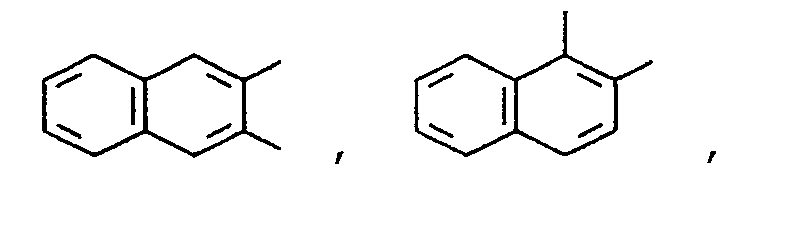


- Sind die Reste Z substituiert, so kann das Substitutionsmuster beliebig sein. Bevorzugt sind jedoch unsubstituierte Reste Z. Besonders bevorzugt aufgrund der leichten und kostengünstigen Verfügbarkeit der Ausgangsmaterialien sind die Hydroxylaminderivate, in denen Z eine C2- bis C3-Alkylen, C2- bis C4-Alkenylen- und insbesondere eine Phenylengruppe ist.
- Sowohl die Hydroxylaminderivate in denen die Aminogruppe durch eine Dicarbonsäureimidgruppe geschützt ist als auch die eine freie Aminogruppe enthaltenden Hydroxylaminderivate sind stabile Verbindungen und können als solche isoliert, gelagert und weiterverarbeitet werden. Zur Isolierung der Hydroxylaminderivate mit freier Aminogruppe kann es sich jedoch als vorteilhaft erweisen, wenn diese in ihre Salze mit organischen oder anorganischen Säuren überführt werden, da diese Salze leichter kristallin zu erhalten sind. Darüberhinaus kann durch die Wahl des Säureanions das Löslichkeitsverhalten dieser Hydroxylammoniumsalze in organischen Lösungsmitteln oder Wasser gezielt beeinflußt werden - eine Maßnahme, welche die Weiterverarbeitung der erfindungsgemäßen Hydroxylaminderivate erleichtert. Besonders bevorzugt werden die aus den entsprechenden Hydroxylaminderivaten hergestellten Hydroxylammoniumsalze mit Anionen wie Chlorid, Bromid, Sulfat, Nitrat, Phosphat, Formiat, Acetat, Malonat, Oxalat, Methansulfonat, Benzolsulfonat und Toluolsulfonat genutzt.
- Die Ausgangsverbindungen VI sind literaturbekanntt oder lassen sich entsprechend dort beschriebenen Verfahren herstellen (z.B. Org. Synth. Coll. Vol. V, 249 cit. lit; EP 48911, EP 143952, US 4 686 735). Die für die Umsetzung bevorzugten Bromide (VI, L = Br) lassen sich aus den entsprechenden Alkoholen nach allgemeinen Vorschriften (z.B. Houben-Weyl, Bd. 5/4, S. 354 ff) synthetisieren. Zur Herstellung der bevorzugten Verbindungen VI, in denen A eine Prop-2-enylengruppe bedeutet, reduziert man Zimtsäureester oder Zimtaldehyde (z.B. Organikum, S. 508 ff) nach allgemein üblichen Verfahren und überführt die so erhalenen Zimtalkohole wie oben beschrieben in die entsprechenden Bromide.
- Die Herstellung der Hydroxylamine kann durch folgendes Reaktionsschema dargestellt werden:

- Bevorzugte Abgangsgruppen L sind die Halogenide Chlorid, Bromid und Jodid und die Sulfonsäureester der Methansulfonsäure, Trifluormethansulfonsäure, Benzolsulfonsäure, Brombenzolsulfonsäure oder der Toluolsulfonsäure. Besonders bevorzugte Abgangsgruppen sind die Halogenide Chlorid und Bromid sowie Methansulfonat und Toluolsulfonat.
- Die Umsetzung der Ausgangsverbindungen VI mit den Hydroxyimiden wird zweckmäßigerweise in Gegenwart einer Base ausgeführt. Geeignet sind prinzipiell alle Basen, die in der Lage sind, die Hydroxyimide VIII zu deprotonieren ohne das Imidsystem anzugreifen. Dies sind insbesondere die sogenannten nicht-nucleophilen Basen. Beispielsweise genannt seien Mineralbasen wie Alkalimetall- und Erdalkalimetallcarbonate, Alkalimetall-und Erdalkalimetallhydrogencarbnate, organische Basen wie aliphatische, cycloaliphatische und aromatische tertiäre Amine. Es können auch Gemische dieser Basen verwendet werden.
- Als Einzelverbindungen seien folgende Basen beispielhaft aufgeführt: Natriumcarbonat, Kaliumcarbonat, Magnesiumcarbonat, Calciumcarbonat, Bariumcarbonat, die Hydrogencarbonate dieser Metalle, Trimethylamin, Triethylamin, Tributylamin, Ethyldiisopropylamin, N,N-Dimethylanilin, 4-N,N-Dimethylaminopyridin, Diazobicyclooctan, Diazobicycloundecan, N-Methylpiperidin, 1,4-Dimethylpiperazin, Pyridin, Chinolin, Bipyridin, Phenanthrolin. Bevorzugt sind die preiswerten Basen Natrium- und Kaliumcarbonat.
- Die Base wird im allgemeinen in äquivalenten Mengen bis zu einem Überschuß von 5 Äquivalenten, bezogen auf das Hydroxyimid, zugegeben. Ein höherer Überschuß ist möglich, entbehrt aber zusätzliche Vorteile. Die Verwendung einer geringen Basenmenge ist ebenfalls möglich. Bevorzugt wird jedoch eine Basenmenge von 1 bis 3, insbesondere von 1 bis 2 Äquivalenten, bezogen auf das Hydroxyimid VIII eingesetzt.
- Die Verwendung von nucleophilen Basen, z.B. Alkalimetall- und Erdalkalimetallhydroxiden, insbesondere Natrium- und Kaliumhydroxid, ist ebenfalls möglich. In diesem Falle ist es vorteilhaft, die Base in äquivalenten Mengen bezüglich des Hydroxyimids VI einzusetzen, um einem nucleophilen Angriff der Hydroxylionen auf die Carbonylfunktion der Imidgruppierung vorzubeugen.
- Zweckmäßigerweise setzt man die Ausgangsverbindungen VI mit den Hydroxyimiden VIII in einem Lösungsmittel um, das sich unter den Reaktionsbedingungen inert verhält. Vorteilhafte Lösungsmittel sind z.B. polareaprotische Lösungsmittel wie Dimethylformamid, N-Methylpyrrolidon, Dimethylsulfoxid, Sulfolan und cyclische Harnstoffe. Die Lösungsmittelmenge ist im allgemeinen nicht kritisch.
- Die Umsetzung der Ausgangsverbindungen VI mit den Hydroxyimiden VIII kann auch unter Anwendung der Phasentransfer-Katalyse ausgeführt werden. In diesem Falle werden mit Wasser zwei Phasen bildende Lösungsmittel, bevorzugt Chlorkohlenwasserstoffe, eingesetzt. Als Phasentransferkatalysatoren eignen sich die üblicherweise zu solchen Zwecken verwendeten quartären Ammonium- und Phosphoniumsalze, Polyethylenglykole, Polyethylenglykolether und Kronenether, wie sie z.B. in Dehmlow et al., Phase Transfer Catalysis, S. 37 - 45 und S. 86 - 93, Verlag Chemie, Weinheim 1980, beschrieben sind. Die Phasentransferkatalysatoren werden zweckmäßigerweise in Mengen von 1 bis 10 Vol%, bevorzugt in Mengen von 3 bis 5 Vol%, bezogen auf das Volumen der Reaktionsmischung, eingesetzt.
- Die Umsetzung der Ausgangsverbindungen VI mit den Hydroxyimiden VIII wird im allgemeinen im Temperaturbereich zwischen 0 und 140°C, bevorzugt zwischen 20 und 100°C, insbesondere zwischen 40 und 80 C, durchgeführt. Zweckmäßigerweise wird dabei so vorgegangen, daß man das Hydroxyimid VIII zusammen mit der Base im Lösungsmittel vorlegt und das Ausgangsmaterial VI zu dieser Lösung dosiert. Dabei kann es sich als günstig erweisen, wenn das Hydroxyimid bei einer tieferen Temperatur, bespielsweise bei 0 bis 50 C, zugegeben und die Reaktionsmischung erst nach dieser Zugabe auf die eigentliche Reaktionstemperatur erhitzt wird.
- Nach beendeter Reaktion wird die abgekühlte Reaktionsmischung zweckmäßigerweise mit Wasser versetzt, wobei sich die gebildeten Hydroxylaminderivate IX als kristalline Festkörper oder als Öle abscheiden. Die auf diese Weise erhaltenen Hydroxylaminderivate können, falls gewünscht, durch Umkristallisation oder durch Extraktion weiter gereinigt werden.
- Die Hydroxylaminderivate IX können zwischengelagert werden oder sogleich in die Hydroxylaminderivate mit freier Aminogruppe umgewandelt werden. Diese Umwandlung kann nach an sich bekannten Verfahren durchgeführt werden, wie sie beispielsweise in DE-A 36 15 973 und den darin zitierten Schriften beschrieben sind. Bevorzugt wird das Verfahren gemäß DE-A 36 15 973 angewandt, nach dem die Hydroxylaminderivate 111 mittels Ethanolamin freigesetzt werden. Die Freisetzung der Hydroxylaminderivate 111 mit Hilfe anderer Basen wie wäßrigen Mineralbasen, mit Aminen, Hydrazinen, Hydroxylaminen oder mittels wäßriger Säuren ist ebenfalls möglich.
- Aus den nach diesen Verfahren erhaltenen Reaktionsgemischen können die Hydroxylaminderivate 111 mittels üblicher Aufarbeitungsmethoden isoliert werden, beispielsweise durch Extraktion oder durch Kristallisation. Zur Erhöhung der Kristallisationstendenz dieser Hydroxylaminderivate kann es oftmals förderlich sein, diese in ihre Salze mit Mineralsäuren oder organischen Säuren überzuführen. Dazu werden im allgemeinen verdünnte Lösungen dieser Säuren mit den Hydroxylaminderivaten umgesetzt, und zwar zweckmäßigerweise in äquivalenten Mengen. Die erhaltenen Hydroxylammoniumsalze können wie die Hydroxylaminderivate mit freier Aminogruppe direkt zu den Herbiziden der Formel I weiterverarbeitet werden oder auch, falls gewünscht, gelagert werden.
- Bevorzugt werden Cyclohexenone der Formel 1, in denen die Substituenten folgende Bedeutung haben:
- R1 eine Alkylgruppe wie Methyl, iso-Propyl, n-Butyl, i-Butyl und t-Butyl, insbesondere aber die Ethyl-und die n-Propylgruppe;
- A Propylen, Prop-2-enylen, Pentylen, Pent-2-enylen, Pent-3-enylen, Pent-4-enylen, Hexylen, Hex-2-enylen, Hex-3-enylen, Hex-4-enylen, Hex-5-enylen, jeweils gegebenenfalls substituiert durch bis zu 3 Methylreste oder einen Methylenrest und/oder Fluor- oder Chloratome; bei den ungesättigten Ketten können sowohl die cis- als auch die trans-Form auftreten. Besonders bevorzugt ist Prop-2-enylen.
- X Halogen wie Fluor, Chlor, Brom und lod, insbesondere Fluor und Chlor;
- Alkyl wie Methyl, Ethyl, Propyl, 1-Methylethyl, Butyl, 1-Methylpropyl, 2-Methylpropyl und 1,1-Dimethylethyl, insbesondere Methyl, Alkoxy wie Methoxy, Ethoxy, Propoxy, 1-Methylethoxy, Butoxy, 1-Methylpropoxy, 2-Methylpropoxy und 1,1-Dimethylethoxy, insbesondere Methoxy, Ethoxy, 1-Methylethoxy und 1,1-Dimethylethoxy,
- Alkylthio wie Methylthio, Ethylthio, Propylthio, 1-Methylethylthio, Butylthio, 1-Methylpropylthio, 2-Methylpropylthio und 1,1-Dimethylethylthio, insbesondere Methylthio und Ethylthio,
- Halogenalkyl wie Fluormethyl, Difluormethyl, Trifluormethyl, Chlordifluormethyl, Dichlorfluormethyl, Trichlormethyl, 1-Fluorethyl, 2-Fluorethyl, 2,2-Difluorethyl, 2,2,2-Trifluorethyl, 2-Chlor-2,2- difluorethyl, 2,2-Dichlor-2-fluorethyl, 2,2,2-Trichlorethyl und Pentafluorethyl, insbesondere Difluormethyl, Trifuormethyl, 2,2,2-Trifluorethyl und Pentafluorethyl,
- Halogenalkoxy wie Difluormethoxy, Trifluormethoxy, Chlor-difluormethoxy, Dichlorfluormethoxy, 1-Fluorethoxy, 2-Fluorethoxy, 2,2-Difluorethoxy, 1,1,2,2-Tetrafluorethoxy, 2,2,2-Trifluorethoxy, 2-Chlor-1,1,2-trifluorethoxy und Pentafluorethoxy, insbesondere Trifluormethoxy,
- Alkoxycarbonyl wie Methoxycarbonyl, Ethoxycarbonyl, Propyloxycarbonyl, 1-Methylethoxycarbonyl, Butyloxycarbonyl und 1,1-Dimethylethoxycarbonyl, insbesondere Methoxycarbonyl, Ethoxycarbonyl und 1,1-Dimethylethoxycarbonyl, insbesondere Methoxycarbonyl
- sowie Wasserstoff, Nitro, Cyano, Benzoxycarbonyl, Phenoxy und Phenyl, wobei die aromatischen Reste substituiert sein können.
- Dabei kommen als Substituenten hier besonders Nitro, Cyano, Carboxyl, Benzyloxycarbonyl sowie die obengenannten Halogenatome, Alkylgruppen, Alkoxygruppen, Alkylthiogruppen, Halogenalkylgruppen, Halogenalkoxygruppen und/oder Alkoxycarbonylgruppen in Betracht.
- Besonders bevorzugt sind bei diesen aromatischen Resten unsubstituierte oder einfach substituierte Vertreter.
- n 0, 1, 2 oder 3, insbesondere 0, 1 oder 2. Bei mehreren Resten X können die Substituenten gleich oder verschieden sein.
- R2 Alkyl wie unter R1 genannt, welches eine der unter X genannten Alkoxy- oder Alkylthiogruppe bevorzugt in 1-, 2- oder 3-Position tragen kann, insbesondere 2-Ethylthiopropyl;
- 5-gliedriges Heterocycloalkyl wie Tetrahydrofuranyl, Tetrahydrothienyl, Dioxolanyl, Dithiolanyl und Oxathiolanyl, insbesondere Tetrahydrofuranyl und Dioxolanyl, wobei diese Ringe ein bis drei der bereits unter X genannten C1-C4--Alkylgruppen, Ci-C4-Alkoxygruppen, C1-C4--Alkylthiogruppen und/oder C,-Ca-Halogenalkylgruppen tragen können,
- 5-gliedriges Heteroaryl wie Pyrrolyl, Pyrazolyl, Imidazolyl, Isoxazolyl, Oxazolyl, Isothiazolyl, Thiazolyl, Furanyl und Thienyl, insbesondere Isoxazolyl und Furanyl,
- ein 6- oder 7-gliedriger Heterocyclus wie Tetrahydropyran-3-yl, Dihydropyran-3-yl, Tetrahydropyran-4-yl, Dihydropyran-4-yl, Tetrahydrothiopyran-3-yl, Dihydrothiopyran-3-yl, Tetrahydrothiopyran-4-yl, Dihydrothiopyran-4-yl und Dioxepan-5-yl, insbesondere Tetrahydropyran-3-yl, Tetrahydropyran-4-yl und Tetrahydrothiopyran-3-yl,
- ein Phenyl- oder ein Pyridylrest,
- wobei die cyclischen Reste ein bis drei der unter X genannten Alkylgruppen, Alkoxygruppen, Alkylthiogruppen und/oder Halogenalkylgruppen tragen können.
- Die 5-gliedrigen Heteroaromaten in der Bedeutung R2 können als Substituenten folgende Reste tragen: Halogenatom wie unter X genannt, insbesondere Fluor und Chlor, Alkoxyalkyl wie Methoxymethyl, 2-Methoxyethyl, 2-Methoxypropyl, 3-Methoxypropyl, 2-Methoxy-1-methylethyl, Ethoxymethyl, 2-Ethoxyethyl, 2-Ethoxypropyl, 3-Ethoxypropyl, 2-Ethoxy-1-methylethyl und 1-Ethoxy-1-methylethyl, insbesondere Methoxyethyl und Ethoxyethyl, Alkenyl wie Ethenyl, 1-Propenyl, 2-Propenyl, 1-Methylethenyl, 1-Butenyl, 2-Butenyl, 3-Butenyl, 1-Methyl-1-propenyl, 1-Methyl-2-propenyl, 2-Methyl-1-propenyl, 2-Methyl-2-propenyl, 1-Pentenyl, 2-Pentenyl, 3-Pentenyl, 4-Pentenyl, 1-Methyl-1-butenyl, 2-Methyl-1-butenyl, 3-Methyl-1-butenyl, 1-Methyl-2-butenyl, 2-Methyl-2-butenyl, 3-Methyl-2-butenyl, 1-Methyl-3-butnyl, 2-Methyl-3-butenyl, 3-Methyl-3-butenyl, 1,1-Dimethyl-2-propenyl, 1,-Dimethyl-1-propenyl, 1,2-Dimethyl-2-propenyl, 1-Ethyl-1-propenyl, 1-Ethyl-2-propenyl, 1-Hexenyl, 2-Hexenyl, 3-Hexenyl, 4-Hexenyl, 5-Hexenyl, 1-Methyl-1-pentenyl, 2-Methyl-1-pentenyl, 3-Methyl-1-pentenyl, 4-Methyl-1-pentenyl, 1-Methyl-2-pentenyl, 2-Methyl-2-pentenyl, 3-Methyl-2-pentenyl, 4-Methyl-2-pentenyl, 1-Methyl-3-pentenyl, 2-Methyl-3-pentenyl, 3-Methyl-3-pentenyl, 4-Methyl-3-pentenyl, 1-Mthyl-4-pentenyl, 2-Methyl-4-pentenyl, 3-Methyl-4-pentenyl, 4-Methyl-4-pentenyl, 1,1-Dimethyl-2-butenyl, 1,1-Dimethyl-3-butenyl, 1,2-Dimethyl-1-butenyl, 1,2-Dimethyl-2-butenyl, 1,2-Dimethyl-3-butenyl, 1,3-Dimethyl-1-butenyl, 1,3-Dimethyl-2-butenyl, 1,3-Dimethyl-3-butenyl, 2,2-Dimethyl-3-butenyl, 2,3-Dimethyl-1-butenyl, 2,3-Dimethyl-2-butenyl, 2,3-Dimethyl-3-butenyl, 3,3-Dimethyl-1-butenyl, 1-Ethyl-1-butenyl, 1-Ethyl-2-butenyl, 1-Ethyl-3-butenyl, 2-Ethyl-1-butenyl, 2-Ethyl-2-butenyl, 2-Ethyl-3-butenyl, 1,1,2-Trimethyl-2-propenyl, 1-Ethyl-1-methyl-2-propenyl, 1-Ethyl-2-methyl-1-propenyl und 1-Ethyl-2-methyl-2-propenyl, insbesondere 1-Methylethenyl bzw. entsprechendes Alkenyloxy und/oder Halogenalkenyl.
- Die 6- und 7-gliedrigen Heterocyclen können neben den vorstehend genannten Substituenten auch Hydroxygruppen tragen.
- Bei den Phenyl- und Pyridylresten kommen als Substituenten neben den obengenannten Gruppen auch Reste wie Cyano-, Nitro- und Aminogruppen in Betracht, wobei die Aminogruppen unsubstituiert oder einbis zweifach durch die erwähnten Alkyl- und/oder Alkenylgruppen substituiert sein können.
- Daneben kommen als Substituenten an Aminogruppen auch folgende Reste in Betracht:
- Alkinyl wie Ethinyl, 1-Propinyl, 2-Propinyl, 1-Butinyl, 2-Butinyl, 3-Butinyl, 1-Methyl-2-propinyl, 1-Pentinyl, 2-Pentinyl, 3-Pentinyl, 4-Pentinyl, 1-Methyl-3-butinyl, 2-Methyl-3-butinyl, 1-Methyl-2-butinyl, 3-Methyl-1-butinyl, 1,1-Dimethyl-2-propinyl, 1-Ethyl-2-propinyl, 1-Hexinyl, 2-Hexinyl, 3-Hexinyl, 4-Alkinyl, 5-Hexinyl, 1-Methyl-2-pentinyl, 1-Methyl-3-pentinyl, 1-Methyl-4-pentinyl, 2-Methyl-3-pentinyl, 2-Methyl-4-pentinyl, 3-Methyl-1-pentinyl, 3-Methyl-4-pentinyl, 4-Methyl-1-pentinyl, 4-Methyl-2-pentinyl, 1,1-Dimethyl-2-butinyl, 1,1-Dimethyl-3-butinyl, 1,2-Dimethyl-3-butinyl, 2,2-Dimethyl-3-butinyl, 3,3-Dimethyl-1-butinyl, 1-Ethyl-2-butinyl, 1-Ethyl-3-butinyl, 2-Ethyl-3-butinyl und 1-Ethyl-1-methyl-2-propinyl, insbesondere 2-Propinyl und 2-Butinyl und/oder
- Acyl wie Acetyl, Propionyl, Butyryl, 2-Methyl-propionyl, Pentanoyl, 2-Methylbutyryl, 3-Methylbutyryl, 2,2-Dimethylpropionyl, Hexanoyl, 2-Methylpentanoyl, 3-Methylpentanoyl, 4-Methylpentanoyl, 2,2-Dimethylbutyryl, 2,3-Dimethylbutyryl, 3,3-Dimethylbutyryl und 2-Ethylbutyryl, insbesondere Acetyl und Propionyl oder ein Benzoylrest.
- Als Salze der Verbindungen der Formel I kommen landwirtschaftlich brauchbare Salze, beispielsweise Alkalimetallsalze, wie das Kalium- oder Natriumsalz, Erdalkalimetallsalze, wie das Calcium-, Magnesium-oder Bariumsalz, Mangan-, Kupfer-, Zink- oder Eisensalze sowie Ammonium, Phosphonium-, Sulfonium-oder Sulfoxoniumsalze, beispielsweise Ammoniumsalze, Tetraalkylammoniumsalze, Benzyltrialkylammoniumsalze, Trialkylsulfoniumsalze oder Trialkylsulfoxoniumsalze in Betracht.
- Im Hinblick auf die biologische Wirksamkeit seien spezielle Beispiele für diese Cyclohexenonoximether in den folgenden Tabellen zusammengefaßt.


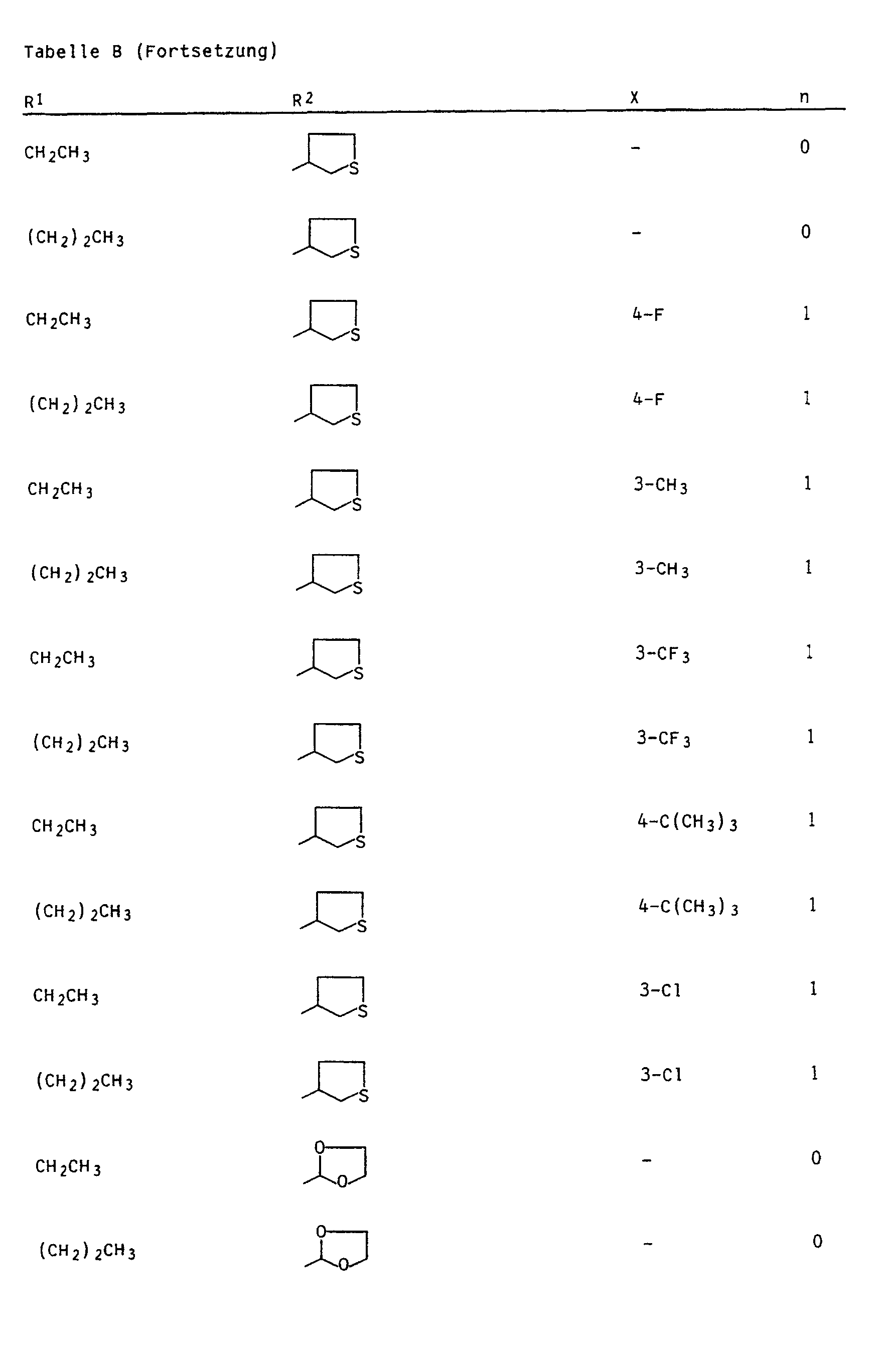


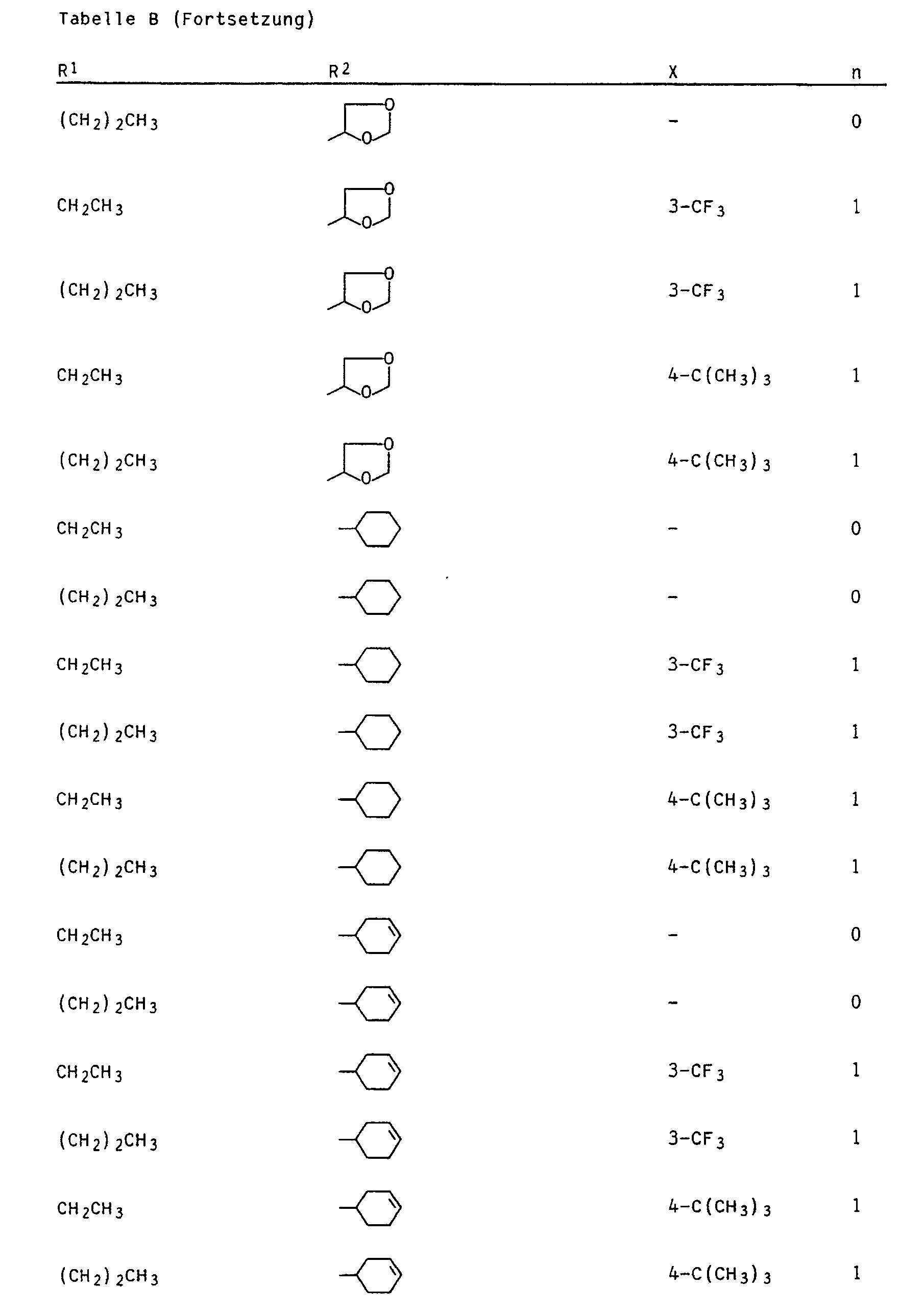
- Die Cyclohexenonoximether 1 bzw. die sie enthaltenden herbiziden Mittel können beispielsweise in Form von direkt versprühbaren Lösungen, Pulvern, Suspensionen, auch hochprozentigen wäßrigen, öligen oder sonstigen Suspensionen oder Dispersionen, Emulsionen, öldispersionen, Pasten, Stäubemitteln, Streumitteln oder Granulaten durch Versprühen, Vernebeln, Verstäuben, Verstreuen oder Gießen angewendet werden. Die Anwendungformen richten sich nach den Verwendungszwecken; sie sollten in jedem Fall möglichst die feinste Verteilung der erfindungsgemäßen Wirkstoffe gewährleisten.
- Die Verbindungen I eignen sich allgemein zur Herstellung von direkt versprühbaren Lösungen, Emulsionen, Pasten oder öldispersionen. Als inerte Zusatzstoffe kommen Mineralölfraktionen von mittlerem bis hohem Siedepunkt, wie Kerosin oder Dieselöl, ferner Kohlenteeröle sowie Öle pflanzlichen oder tierischen Ursprungs, aliphatische, cyclische und aromatische Kohlenwasserstoffe, z.B. Toluol, Xylol, Paraffin, Tetrahydronaphthalin, alkylierte Naphthaline oder deren Derivate, Methanol, Ethanol, Propanol, Butanol, Cyclohexanol, Cyclohexanon, Chlorbenzol, Isophoron oder stark polare Lösungsmittel, wie N,N-Dimethylformamid, Dimethylsulfoxid, N-Methylpyrrolidon oder Wasser in Betracht.
- Wäßrige Anwendungsformen können aus Emulsionskonzentraten, Dispersionen, Pasten, netzbaren Pulvern oder wasserdispergierbaren Granulaten durch Zusatz von Wasser bereitet werden. Zur Herstellung von Emulsionen, Pasten oder Öldispersionen können die Substrate als solche oder in einem Öl oder Lösungsmittel gelöst, mittels Netz-, Haft-, Dispergier- oder Emulgiermittel in Wasser homogenisiert werden. Es können aber auch aus wirksamer Substanz, Netz-, Haft-, Dispergier- oder Emulgiermittel und eventuell Lösungsmittel oder öl bestehende Konzentrate hergestellt werden, die zur Verdünnung mit Wasser geeignet sind.
- Als oberflächenaktive Stoffe kommen die Alkali-, Erdalkali-, Ammoniumsalze von aromatischen Sulfonsäuren, z.B. Lignin-, Phenol-, Naphthalin- und Dibutylnaphthalinsulfonsäure, sowie von Fettsäuren, Alkyl-und Alkylarylsulfonaten, Alkyl-, Laurylether- und Fettalkoholsulfaten, sowie Salze sulfatierter Hexa-, Hepta-und Octadecanolen, sowie von Fettalkoholglykolether, Kondensationsprodukte von sulfoniertem Naphthalin und seiner Derivate mit Formaldehyd, Kondensationsprodukte des Naphthalins bzw. der Naphthalinsulfonsäuren mit Phenol und Formaldehyd, Polyoxyethylenoctylphenolether, ethoxyliertes Isooctyl-, Octyl- oder Nonylphenol, Alkylphenol-, Tributylphenylpolyglykolether, Alkylarylpolyetheralkohole, Isotridecylalkohol, Fettalkoholethylenoxid-Kondensate, ethoxyliertes Rizinusöl, Polyoxyethylenalkylether oder Polyoxypropylen, Laurylalkoholpolyglykoletheracetat, Sorbitester, Lignin-Sulfitablaugen oder Methylcellulose in Betracht.
- Pulver-, Streu- und Stäubemittel können durch Mischen oder gemeinsames Vermahlen der wirksamen Substanzen mit einem festen Trägerstoff hergestellt werden.
- Granulate, z.B. Umhüllungs-, Imprägnierungs- und Homogengranulate können durch Bindung der Wirkstoffe an feste Trägerstoffe hergestellt werden. Feste Trägerstoffe sind Mineralerden wie Silicagel, Kieselsäuren, Kieselgele, Silikate, Talkum, Kaolin, Kalkstein, Kalk, Kreide, Bolus, Löß, Ton, Dolomit, Diatomeenerde, Calcium- und Magnesiumsulfat, Magnesiumoxid, gemahlene Kunststoffe, Düngemittel, wie Ammoniumsulfat, Ammoniumphosphat, Ammoniumnitrat, Harnstoffe und pflanzliche Produkte, wie Getreidemehl, Baumrinden-, Holz- und Nußschalenmehl, Cellulosepulver oder andere feste Trägerstoffe.
- Die Formulierungen enthalten im allgemeinen zwischen 0,01 und 95 Gew.%, vorzugsweise zwischen 0,5 und 90 Gew.%, Wirkstoff. Die Wirkstoffe werden dabei in einer Reinheit von 90 % bis 100 %, vorzugsweise 95 % bis 100 % (nach NMR/HPLC/GC-Spektrum) eingesetzt.
- Beispiele für solche Zubereitungen sind:
- I. eine Lösung aus 90 Gew.-Teilen der Verbindung 1.1 und 10 Gew.-Teilen N-Methyl-a-pyrrolidon, die zur Anwendung in Form kleinster Tropfen geeignet ist;
- 11. eine Mischung aus 20 Gew.-Teilen der Verbindung 1.2, 80 Gew.-Teilen Xylol, 10 Gew.-Teilen des Anlagerungsproduktes von 8 bis 10 Mol Ethylenoxid an 1 Mol Ölsäure-N-monoethanolamid, 5 Gew.-Teilen Calciumsalz der Dodecylbenzolsulfonsäure, 5 Gew.-Teilen des Anlagerungsproduktes und 40 Mol Ethylenoxid an 1 Mol Ricinusöl. Durch feines Verteilen des Gemisches in 100 000 Gew.-Teilen Wasser erhält man eine Dispersion, die 0,02 Gew.-% des Wirkstoffs enthält.
- 111. eine wäßrige Dispersion aus 20 Gew.-Teilen der Verbindung 1.4, 40 Gew.-Teilen Cyclohexanon, 30 Gew.-Teilen Isobutanol, 20 Gew.-Teilen des Anlagerungsproduktes von 40 mol Ethylenoxid an 1 mol Ricinusöl. Die Mischung dieser Dispersion mit 100 000 Gewichtsteilen Wasser enthält 0,02 Gew.-% des Wirkstoffes.
- IV. eine wäßrige Dispersion aus 20 Gew.-Teilen der Verbindung 1.17, 25 Gew.-Teilen Cyclohexanol, 65 Gew.-Teilen einer Mineralölfraktion vom Siedepunkt 210 bis 280° C und 10 Gew.-Teilen des Anlagerungsproduktes von 40 mol Ethylenoxid an 1 mol Ricinusöl. Die Mischung dieser Dispersion mit 100 000 Gew.-Teilen Wasser enthält 0,02 % des Wirkstoffes;
- V. eine in einer Hammermühle vermahlene Mischung aus 80 Gew.-Teilen der Verbindung 2.2, 3 Gew.-Teilen des Natriumsalzes der Diisobutylnaphtalin-a-sulfonsäure, 10 Gew.-Teilen des Natriumsalzes einer Ligninsulfonsäure aus einer Sulfitablauge und 7 Gew.-Teilen pulverförmigem Kieselsäuregel. Durch feines Verteilen der Mischung in 20 000 Gew.-Teilen Wasser erhält man eine Spritzbrühe, die 0,1 Gew.- % des Wirkstoffs enthält;
- Vl. eine innige Mischung aus 3 Gew.-Teilen der Verbindung 2.4 und 97 Gew.-Teilen feinteiligem Kaolin. Dieses Stäubemittel enthält 3 Gew.-% Wirkstoff;
- Vii. eine innige Mischung aus 30 Gew.-Teilen der Verbindung 2.7, 92 Gew.-Teilen pulverförmigem Kieselsäuregel und 8 Gew.-Teilen Paraffinöl, das auf die Oberfläche dieses Kieselsäuregels gesprüht wurde. Diese Aufbereitung gibt dem Wirkstoff eine gute Haftfähigkeit;
- VIII. eine stabile wäßrige Dispersion aus 40 Gew.-Teilen der Verbindung 3.1, 10 Gew.-Teilen des Natriumsalzes eines Phenosulfonsäureharnstoff-formaldehyd-Kondensates, 2 Gew.-Teilen Kieselgel und 48 Gew.-Teilen Wasser, die weiter verdünnt werden kann;
- IX. eine stabile ölige Dispersion aus 20 Gew.-Teilen der Verbindung 4.1, 2 Gew.-Teilen des Calciumsalzes der Dodecylbenzolsulfonsäure, 8 Gew.-Teilen Fettalkohol-polyglykolether, 20 Gew.-Teilen des Natriumsalzes eines Phenolsulfonsäure-harnstoff-formaldehyd-Kondensates und 68 Gew.-Teilen eines paraffinischen Mineralöls;
- X. eine in einer Hammermühle vermahlene Mischung aus 10 Gew.-Teilen der Verbindung 3.17, 4 Gew.-Teilen des Natriumsalzes der Diisobutylnaphthalin-a-sulfonsäure, 20 Gew.-Teilen des Natriumsalzes einer Ligninsulfonsäure aus einer Sulfitablauge, 38 Gew.-Teilen Kieselsäuregel und 38 Gew.-Teilen Kaolin. Durch feines Verteilen der Mischung in 10 000 Gew.-Teilen Wasser erhält man eine Spritzbrühe, die 0,1 Gew.% des Wirkstoffs enthält.
- Die Applikation der herbiziden Mittel bzw. der Wirkstoffe kann im Vorauflauf-oder im Nachauflaufverfahren erfolgen. Sind die Wirkstoffe für gewisse Kulturpflanzen weniger verträglich, so können Ausbringungstechniken angewandt werden, bei welchen die herbiziden Mittel mit Hilfe der Spritzgeräte so gespritzt werden, daß die Blätter der empfindlichen Kulturpflanzen nach Möglichkeit nicht getroffen werden, während die Wirkstoffe auf die Blätter darunter wachsender unerwünschter Pflanzen oder die unbedeckte Bodenfläche gelangen (post-directed, lay-by).
- Die Aufwandmengen an Wirkstoff betragen je nach Bekämpfungsziel, Jahreszeit, Zielpflanzen und Wachstumsstadium 0,001 bis 3,0, vorzugsweise 0,01 bis 2,0 kg/ha aktive Substanz (a.S.).
- In Anbetracht der Vielseitigkeit der Applikationsmethoden können die erfindungsgemäßen Verbindungen bzw. sie enthaltende Mittel noch in einer weiteren Zahl von Kulturplfanzen zur Beseitigung unerwünschter Pflanzen eingesetzt werden. In Betracht kommen beispielsweise folgende Kulturen:


- Zur Verbreiterung des Wirkungsspektrums und zur Erzielung synergistischer Effekte können die erfindungsgemäßen Verbindungen I mit zahlreichen Vertretern anderer herbizider oder wachstumsregulierender Wirkstoffgruppen gemischt und gemeinsam ausgebracht werden. Beispielsweise kommen als Mischungspartner Diazine, 4H-3,1-Benzoxazinderivate, Benzothiadiazinone, 2,6-Dinitroaniline, N-Phenylcarbamate, Thiolcarbamate, Halogencarbonsäuren, Triazine, Amide, Harnstoffe, Diphenylether, Triazinone, Uracile, Benzofuranderivate, Cyclohexan-1,3-dionderivate, Chinolincarbonsäurederivate, Aryloxy-, Heteroaryloxyphenoxypropionsäuren sowie deren Salze, Ester und Amide und andere in Betracht.
- Außerdem kann es von Nutzen sein, die Verbindungen I allein oder in Kombination mit anderen Herbiziden auch noch mit weiteren Pflanzenschutzmitteln gemischt gemeinsam auszubringen, beispielsweise mit Mitteln zur Bekämpfung von Schädlingen oder phytopathogenen Pilzen bzw. Bakterien. Von Interesse ist ferner die Mischbarkeit mit Mineralsalzlösungen, welche zur Behebung von Ernährungs-und Spurenelementmängeln eingesetzt werden. Es können auch nichtphytotoxische Öle und Ölkonzentrate zugesetzt werden.
- Die im nachstehenden Synthesebeispiel I wiedergegebene Vorschrift wurde unter entsprechender Abwandlung der Ausgangsverbindung zur Gewinnung weiterer Verbindungen der Formel I benutzt; die erhaltenen Verbindungen sind in den nachfolgenden Tabellen mit physikalischen Angaben aufgeführt; Verbindungen ohne diese Angaben lassen sich aus den entsprechenden Stoffen in analoger Weise aufbauen. Sie lassen aufgrund ihrer nahen strukturellen Beziehungen zu den hergestellten und untersuchten Verbindungen eine gleichartige Wirkung erwarten.
- In 350 ml trockenes N-Methylpyrrolidon gab man nacheinander 18,5 g (0,11 mol) N-Hydroxyphthalimid und 31,4 g (0,11 mol) 1-Brom-[3-(4-Bromphenyl)]-prop-2-en und tropfte anschließend bei Raumtemperatur 12,1 g (0,12 mol) Triethylamin zu. Nach viertägigem Rühren bei 20° C wurde die Reaktionsmischung auf 1,5 I Eiswasser gegossen, abfiltriert und mit Wasser und Isopropanol nachgewaschen. Man erhielt 34,3 g (86,8 % d.Th.) N-[3-(4-Bromphenyl)-prop-2-enyloxi]-phthalimid mit dem Schmelzpunkt 161-162 C.
- 33,4 g (0,093 mol) N-[3(4-Bromphenyl)-prop-2-enyloxy]-phthalimid wurden portionsweise in 50 ml Ethanolamin eingetragen; die Temperatur stieg dabei bis auf 30°C an. Nach zweistündigem Rühren bei 60°C ließ man abkühlen und versetzte die Mischung mit 200 ml Dichlormethan. Es wurde mit Eiswasser ausgeschüttelt. Die organische Phase getrocknet und eingeengt und aus Petrolether kristallisiert. Dabei fielen 20,2 g (95,3 % d.Th.) 3-(4-Bromphenyl)-prop-2-enyloxiamin an. Schmp. 35-38°C.
- 3,0 g (0,011 mol) 2-Propionyl-5-(3-tetrahydrothiopyranyl)-cyclohexan-1,3-dion und 3,0 g (0,013 mol) 3-(4-Bromphenyl)-prop-2-enyloxiamin wurden in 100 ml Methanol bei 20°C 16 Stunden gerührt. Das dabei ausgefallene Reaktionsprodukt wurde bei 0°C abgesaugt und mit eiskaltem Methanol und Petrolether nachgewaschen. Nach dem Trocknen erhielt man 3,7 g (68,4 % d.Th.) 2[1-(3-(4-Bromphenyl)-prop-2-enyloximino)-propyl]-3-hydroxy-5-(3-tetrahydrothiopyranyl)-cyclohex-2-en-1-on mit dem Schmelzpunkt 97-99 °C.
-


- E-5-Aminooxy-1-phenyl-1-penten (Bsp. 5.14)
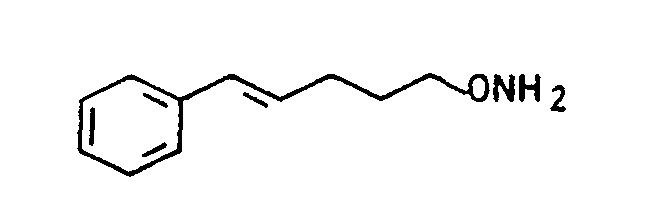
- 75,4 g (0,335 Mol) 5-Brom-1-phenyl-1-pentan (hergestellt durch Reduktion von E-5-Phenyl-4-pentansäu- reethylester mit Lithiumaluminiumhydrid und Behandlung des Alkohols mit Phosphortribromid) wurden zu einer Mischung, bestehend aus 340 ml N-Metthylpyrrolidin-2-on, 54,7 g (0,335 Mol) N-Hydroxyphthalimid und 5 g Kaliumiodid, innerhalb von 30 min bei 40 C getropft. Man rührte noch 4 Stunden bei 60 C, goß nach Abkühlen in 1,2 I Eiswasser, saugte den Festkörper ab, wusch diesen mit Wasser und kristallisierte aus Isopropanol um. Ausbeute: 91,4 g (89 %); Fp.: 93-94° C; 250-MHz-1H-NMR (DMSO-d6):
- δ (ppm) = 1,75-1,95 (m,2H), 2,3-2,5 (m,2H), 4,21 (t,2H), 6,25-6,55 (m,2H), 7,1-7,5 (m,5H), 7,87 (s,4H).
- 87,8 g (0,286 Mol) des oben hergestellten Phthalimidethers wurden in 130 ml Ethanolamin eingetragen. Nach 3 Stunden bei 60 C wurde die Mischung auf Raumtemperaur abgekühlt und in 200 ml Eiswasser gegossen. Man fügte 200 ml gesättigte Kochsalzlösung zu, wonach die Titelverbindung mit Dichlormethan (dreimal je 150 ml) extrahiert wurde. Die vereinigten organischen Phasen wurden mit gesättigter Kochsalzlösung (dreimal je 100 ml) gewaschen, getrocknet und unter reduziertem Druck eingeengt. Ausbeute: 40 g (79 %); 250-MHz-1H-NMR (DCl3):
- δ (ppm) = 1,7-1,86 (m,2H), 2,2-2,37 (m,2H), 3,72 (t,2H), 5,35 (breites s,2H), 6,1-6,3 (m,1 H), 6,4 (d,1 H), 7,1-7,4 (m,5H).
- In entsprechender Weise können die in Tabelle 5 wiedergegebenen Hydroxylamine III erhalten werden.


- Die herbizide Wirkung der Cyclohexenoximether der Formel I ließ sich durch Gewächshausversuche zeigen:
- Als Kulturgefäße dienten Plastikblumentöpfe mit lehmigem Sand mit etwa 3,0 % Humus als Substrat. Die Samen der Testpflanzen wurden nach Arten getrennt eingesät.
- Bei Vorauflaufbehandlung wurden die in Wasser suspendierten oder emulgierten Wirkstoffe direkt nach Einsaat mittels fein verteilender Düsen aufgebracht. Die Gefäße wurden leicht beregnet, um Keimung und Wachstum zu fördern und anschließend mit durchsichtigen Plastikhauben abgedeckt, bis die Pflanzen angewachsen waren. Diese Abdeckung bewirkt ein gleichmäßiges Keimen der Testpflanzen, sofern dies nicht durch die Wirkstoffe beeinträchtigt wurde.
- Zum Zwecke der Nachauflaufbehandlung wurden die Testpflanzen je nach Wuchsform erst bei einer Wuchshöhe von 3 bis 15 cm mit den in Wasser suspendierten oder emulgierten Wirkstoffen behandelt. Die Aufwandmenge für die Nachauflaufbehandlung betrug 0,25 kg/ha a.S.
- Die Pflanzen wurden artenspezifisch bei Temperaturen von 10-25°C bzw. 20-35 °C gehalten. Die Versuchsperiode erstreckte sich über 2 bis 4 Wochen. Während dieser Zeit wurden die Pflanzen gepflegt und ihre Reaktion auf die einzelnen Behandlungen wurde ausgewertet.
- Bewertet wurde nach einer Skala von 0 bis 100. Dabei bedeutet 100 kein Aufgang der Pflanzen bzw. völlige Zerstörung zumindest der oberirdischen Teile und 0 keine Schädigung oder normaler Wachstumsverlauf.
- Die in den Gewächshausversuchen verwendeten Pflanzen setzten sich aus folgenden Arten zusammen:

- Mit 0,25 kg/ha a.S. im Nachauflaufverfahren eingesetzt, lassen sich mit dem Beispiel 1.1 unerwünschte grasartige Pflanzen sehr gut bekämpfen, bei gleichzeitiger Verträglichkeit an der Beispielkultur Reis.
bedeuten,
sowie ihre landwirtschaftlich nutzbaren Salze und Ester von C1-C10-Carbonsäuren und anorganischen Säuren.
bedeutet, als Herbizide beschrieben.
Claims (6)

bedeuten, sowie ihre landwirtschaftlich nutzbaren Salze und Ester von C1-C10-Carbonsäuren und anorganischen Säuren.


Applications Claiming Priority (2)
| Application Number | Priority Date | Filing Date | Title |
|---|---|---|---|
| DE4014983 | 1990-05-09 | ||
| DE4014983A DE4014983A1 (de) | 1990-05-09 | 1990-05-09 | Cyclohexenonoximether, verfahren und zwischenprodukte zu ihrer herstellung und ihre verwendung als herbizide |
Publications (2)
| Publication Number | Publication Date |
|---|---|
| EP0456069A1 true EP0456069A1 (de) | 1991-11-13 |
| EP0456069B1 EP0456069B1 (de) | 1996-10-23 |
Family
ID=6406105
Family Applications (1)
| Application Number | Title | Priority Date | Filing Date |
|---|---|---|---|
| EP91106893A Expired - Lifetime EP0456069B1 (de) | 1990-05-09 | 1991-04-27 | Cyclohexenonoximether, Verfahren und Zwischenprodukte zu ihrer Herstellung und ihre Verwendung als Herbizide |
Country Status (13)
| Country | Link |
|---|---|
| US (1) | US5563114A (de) |
| EP (1) | EP0456069B1 (de) |
| JP (1) | JPH05105658A (de) |
| KR (1) | KR910019997A (de) |
| AT (1) | ATE144504T1 (de) |
| BR (1) | BR9101866A (de) |
| CA (1) | CA2041588C (de) |
| DE (2) | DE4014983A1 (de) |
| ES (1) | ES2093044T3 (de) |
| HU (1) | HU212626B (de) |
| RU (2) | RU2091022C1 (de) |
| UA (1) | UA27028A1 (de) |
| ZA (1) | ZA913485B (de) |
Cited By (4)
| Publication number | Priority date | Publication date | Assignee | Title |
|---|---|---|---|---|
| WO1993010081A1 (en) * | 1991-11-15 | 1993-05-27 | Dunlena Pty. Limited | Herbicidal 2(substituted oxime)-cyclohexan-1,3-dione derivatives |
| WO1994026696A1 (en) * | 1993-05-11 | 1994-11-24 | Dunlena Pty. Limited | Herbicidal cyclohexanes |
| EP0552493B1 (de) * | 1992-01-23 | 1996-09-11 | BASF Aktiengesellschaft | Thiochromenonderivate als Antidots und sie enthaltende herbizide Mittel |
| US5674812A (en) * | 1994-03-31 | 1997-10-07 | Basf Aktiengesellschaft | 5(sulfo-/carbamoylmethyl)cyclohexenone oxime ethers |
Families Citing this family (5)
| Publication number | Priority date | Publication date | Assignee | Title |
|---|---|---|---|---|
| DE4135265A1 (de) * | 1991-10-25 | 1993-04-29 | Basf Ag | Cyclohexenonderivate |
| DE4227896A1 (de) * | 1992-08-22 | 1994-02-24 | Basf Ag | Cyclohexenonoximether, ihre Herstellung und ihre Verwendung |
| ES2196176T3 (es) * | 1995-09-20 | 2003-12-16 | Basf Ag | Mezclas herbicidas sinergicas que contienen eteres de ciclohexenon-oxima. |
| DE19545212A1 (de) * | 1995-12-05 | 1997-06-12 | Basf Ag | Cyclohexenonoximether-Metallsalze |
| CN105884665B (zh) * | 2016-04-21 | 2017-12-22 | 潍坊先达化工有限公司 | 一种环己烯酮类化合物及其制备方法与应用 |
Citations (3)
| Publication number | Priority date | Publication date | Assignee | Title |
|---|---|---|---|---|
| US4440566A (en) * | 1982-08-05 | 1984-04-03 | Chevron Research Company | Herbicidal substituted 2-(1-(oxyamino)-alkylidene)-cyclohexane-1,3-diones |
| EP0125094A2 (de) * | 1983-05-06 | 1984-11-14 | Ici Australia Limited | Herbizide Cyclohexan-1,3-dion-Derivate |
| EP0218233A2 (de) * | 1985-10-10 | 1987-04-15 | BASF Aktiengesellschaft | Cyclohexenonderivate, Verfahren zu ihrer Herstellung und ihre Verwendung zur Bekämpfung unerwünschten Pflanzenwuchses |
Family Cites Families (15)
| Publication number | Priority date | Publication date | Assignee | Title |
|---|---|---|---|---|
| DE218233C (de) * | ||||
| DE238021C (de) * | ||||
| DE142741C (de) * | ||||
| DE137174C (de) * | ||||
| DE177913C (de) * | ||||
| DE169521C (de) * | 1903-12-02 | 1906-04-06 | Winklig zum handgriff verstellbarer bohrkopf für zahnbohrmaschinen | |
| US4249937A (en) * | 1977-05-23 | 1981-02-10 | Nippon Soda Company, Ltd. | Cyclohexane derivatives |
| NZ202284A (en) * | 1981-11-20 | 1986-06-11 | Ici Australia Ltd | 2-(1-(alkoxyimino)alkyl)-3-hydroxy-5-poly(methyl)phenyl-cyclohex-2-en-1-ones and herbicidal compositions |
| DE3340265A1 (de) * | 1983-11-08 | 1985-05-15 | Basf Ag, 6700 Ludwigshafen | Cyclohexan-1,3-dionderivate, verfahren zu ihrer herstellung und ihre verwendung zur bekaempfung unerwuenschten pflanzenwuchses |
| DE3329017A1 (de) * | 1983-08-11 | 1985-02-28 | Basf Ag, 6700 Ludwigshafen | Cyclohexan-1,3-dionderivate, verfahren zu ihrer herstellung und ihre verwendung zur bekaempfung unerwuenschten pflanzenwuchses |
| DE3433767A1 (de) * | 1984-07-27 | 1986-01-30 | Basf Ag, 6700 Ludwigshafen | Cyclohexenonderivate, verfahren zu ihrer herstellung und ihre verwendung zur bekaempfung unerwuenschten pflanzenwuchses |
| DE3437238A1 (de) * | 1984-10-11 | 1986-04-17 | Basf Ag, 6700 Ludwigshafen | Neue verbindungen, verfahren zu ihrer herstellung und ihre verwendung zur bekaempfung unerwuenschten pflanzenwuchses |
| DE3609181A1 (de) * | 1986-03-19 | 1987-09-24 | Basf Ag | Cyclohexenonderivate, verfahren zu ihrer herstellung und ihre verwendung zur bekaempfung unerwuenschten pflanzenwachstums |
| DE3838309A1 (de) * | 1988-11-11 | 1990-05-31 | Basf Ag | Cyclohexenonoximether, verfahren zu ihrer herstellung und ihre verwendung als herbizid |
| US5364833A (en) * | 1990-05-09 | 1994-11-15 | Basf Aktiengesellschaft | Cyclohexenone oxime ethers, their preparation and their use as herbicides |
-
1990
- 1990-05-09 DE DE4014983A patent/DE4014983A1/de not_active Withdrawn
-
1991
- 1991-04-27 AT AT91106893T patent/ATE144504T1/de not_active IP Right Cessation
- 1991-04-27 ES ES91106893T patent/ES2093044T3/es not_active Expired - Lifetime
- 1991-04-27 EP EP91106893A patent/EP0456069B1/de not_active Expired - Lifetime
- 1991-04-27 DE DE59108291T patent/DE59108291D1/de not_active Expired - Lifetime
- 1991-04-30 JP JP3098640A patent/JPH05105658A/ja not_active Withdrawn
- 1991-05-01 CA CA002041588A patent/CA2041588C/en not_active Expired - Fee Related
- 1991-05-08 BR BR919101866A patent/BR9101866A/pt not_active Application Discontinuation
- 1991-05-08 ZA ZA913485A patent/ZA913485B/xx unknown
- 1991-05-08 RU SU914895408A patent/RU2091022C1/ru active
- 1991-05-08 HU HU911542A patent/HU212626B/hu not_active IP Right Cessation
- 1991-05-08 UA UA4895408A patent/UA27028A1/uk unknown
- 1991-05-09 KR KR1019910007476A patent/KR910019997A/ko not_active Ceased
-
1992
- 1992-12-04 RU RU9292004580A patent/RU2084447C1/ru active
-
1995
- 1995-03-24 US US08/409,969 patent/US5563114A/en not_active Expired - Fee Related
Patent Citations (3)
| Publication number | Priority date | Publication date | Assignee | Title |
|---|---|---|---|---|
| US4440566A (en) * | 1982-08-05 | 1984-04-03 | Chevron Research Company | Herbicidal substituted 2-(1-(oxyamino)-alkylidene)-cyclohexane-1,3-diones |
| EP0125094A2 (de) * | 1983-05-06 | 1984-11-14 | Ici Australia Limited | Herbizide Cyclohexan-1,3-dion-Derivate |
| EP0218233A2 (de) * | 1985-10-10 | 1987-04-15 | BASF Aktiengesellschaft | Cyclohexenonderivate, Verfahren zu ihrer Herstellung und ihre Verwendung zur Bekämpfung unerwünschten Pflanzenwuchses |
Cited By (4)
| Publication number | Priority date | Publication date | Assignee | Title |
|---|---|---|---|---|
| WO1993010081A1 (en) * | 1991-11-15 | 1993-05-27 | Dunlena Pty. Limited | Herbicidal 2(substituted oxime)-cyclohexan-1,3-dione derivatives |
| EP0552493B1 (de) * | 1992-01-23 | 1996-09-11 | BASF Aktiengesellschaft | Thiochromenonderivate als Antidots und sie enthaltende herbizide Mittel |
| WO1994026696A1 (en) * | 1993-05-11 | 1994-11-24 | Dunlena Pty. Limited | Herbicidal cyclohexanes |
| US5674812A (en) * | 1994-03-31 | 1997-10-07 | Basf Aktiengesellschaft | 5(sulfo-/carbamoylmethyl)cyclohexenone oxime ethers |
Also Published As
| Publication number | Publication date |
|---|---|
| ATE144504T1 (de) | 1996-11-15 |
| BR9101866A (pt) | 1991-12-17 |
| DE4014983A1 (de) | 1991-11-14 |
| ZA913485B (en) | 1993-01-27 |
| RU2091022C1 (ru) | 1997-09-27 |
| ES2093044T3 (es) | 1996-12-16 |
| JPH05105658A (ja) | 1993-04-27 |
| HUT57000A (en) | 1991-11-28 |
| KR910019997A (ko) | 1991-12-19 |
| EP0456069B1 (de) | 1996-10-23 |
| DE59108291D1 (de) | 1996-11-28 |
| UA27028A1 (uk) | 2000-02-28 |
| US5563114A (en) | 1996-10-08 |
| RU2084447C1 (ru) | 1997-07-20 |
| HU212626B (en) | 1996-09-30 |
| CA2041588C (en) | 2002-03-26 |
| CA2041588A1 (en) | 1991-11-10 |
Similar Documents
| Publication | Publication Date | Title |
|---|---|---|
| EP0456112B1 (de) | Cyclohexenonoximether, Verfahren zu ihrer Herstellung und ihre Verwendung als Herbizide | |
| EP0368227B1 (de) | Cyclohexenonoximether, Verfahren zu ihrer Herstellung und ihre Verwendung als Herbizid | |
| EP0418667B1 (de) | Carbonsäureamide | |
| EP0419944B1 (de) | Oxazol- bzw. Thiazolcarbonsäureamide | |
| EP0467206B1 (de) | Dicarbonsäureimide, Verfahren zu ihrer Herstellung und ihre Verwendung als Herbizide | |
| EP0456118B1 (de) | Cyclohexenonoximether, Verfahren und Zwischenprodukte zu ihrer Herstellung und ihre Verwendung als Herbizide | |
| EP0481354A1 (de) | Ungesättigte Cyclohexenonoximether | |
| EP0456068B1 (de) | Cyclohexenonoximether, Verfahren und Zwischenprodukte zu ihrer Herstellung und ihre Verwendung als Herbizide | |
| EP0456069B1 (de) | Cyclohexenonoximether, Verfahren und Zwischenprodukte zu ihrer Herstellung und ihre Verwendung als Herbizide | |
| EP0888343B1 (de) | Pyrazol-4-yl-hetaroylderivate als herbizide | |
| EP0353667A1 (de) | Bithienylderivate, Verfahren zu ihrer Herstellung und sie enthaltende Mittel | |
| EP0599906B1 (de) | Herbizide mittel, enthaltend 3-aminobenzo b]thiophene als antidots | |
| EP0456089B1 (de) | Cyclohexenonoximether, Verfahren zu ihrer Herstellung und ihre Verwendung als Herbizid | |
| EP0625975B1 (de) | Cyclohexenonoximether, verfahren zu ihrer herstellung und ihre verwendung als herbizide | |
| EP0344660B1 (de) | Thiophenverbindungen | |
| WO1993016033A1 (de) | Cyclohexenonoximether, verfahren zu ihrer herstellung und ihre verwendung als herbizide | |
| EP0419917B1 (de) | Pyrazol-3-carbonsäureamide | |
| EP0599892B1 (de) | Cyclohexenonoximether | |
| EP0456090B1 (de) | Herbizide Mittel, die Cyclohexenonderivate als herbizide Wirkstoffe und Naphthalinderivate als Antidots enthalten | |
| DE4014986A1 (de) | Cyclohexenonoximether, verfahren zu ihrer herstellung und ihre verwendung als herbizide | |
| DE4227896A1 (de) | Cyclohexenonoximether, ihre Herstellung und ihre Verwendung | |
| DE4018508A1 (de) | Cyclohexenonoximether, verfahren und zwischenprodukte zu ihrer herstellung und ihre verwendung als herbizide | |
| DE4018623A1 (de) | Cyclohexenonoximether, verfahren und zwischenprodukte zu ihrer herstellung und ihre verwendung als herbizide | |
| EP0365833A2 (de) | Cyclohexen-Derivate | |
| EP0332076A2 (de) | Cyclohexenonverbindungen, Verfahren zu ihrer Herstellung und ihre Verwendung zur Bekämpfung unerwünschten Pflanzenwuchses |
Legal Events
| Date | Code | Title | Description |
|---|---|---|---|
| PUAI | Public reference made under article 153(3) epc to a published international application that has entered the european phase |
Free format text: ORIGINAL CODE: 0009012 |
|
| 17P | Request for examination filed |
Effective date: 19910816 |
|
| AK | Designated contracting states |
Kind code of ref document: A1 Designated state(s): AT BE CH DE ES FR GB IT LI NL |
|
| 17Q | First examination report despatched |
Effective date: 19941228 |
|
| GRAH | Despatch of communication of intention to grant a patent |
Free format text: ORIGINAL CODE: EPIDOS IGRA |
|
| GRAH | Despatch of communication of intention to grant a patent |
Free format text: ORIGINAL CODE: EPIDOS IGRA |
|
| GRAA | (expected) grant |
Free format text: ORIGINAL CODE: 0009210 |
|
| AK | Designated contracting states |
Kind code of ref document: B1 Designated state(s): AT BE CH DE ES FR GB IT LI NL |
|
| PG25 | Lapsed in a contracting state [announced via postgrant information from national office to epo] |
Ref country code: NL Free format text: LAPSE BECAUSE OF FAILURE TO SUBMIT A TRANSLATION OF THE DESCRIPTION OR TO PAY THE FEE WITHIN THE PRESCRIBED TIME-LIMIT Effective date: 19961023 |
|
| REF | Corresponds to: |
Ref document number: 144504 Country of ref document: AT Date of ref document: 19961115 Kind code of ref document: T |
|
| REF | Corresponds to: |
Ref document number: 59108291 Country of ref document: DE Date of ref document: 19961128 |
|
| GBT | Gb: translation of ep patent filed (gb section 77(6)(a)/1977) |
Effective date: 19961108 |
|
| REG | Reference to a national code |
Ref country code: ES Ref legal event code: FG2A Ref document number: 2093044 Country of ref document: ES Kind code of ref document: T3 |
|
| ITF | It: translation for a ep patent filed | ||
| ET | Fr: translation filed | ||
| NLV1 | Nl: lapsed or annulled due to failure to fulfill the requirements of art. 29p and 29m of the patents act | ||
| PLBE | No opposition filed within time limit |
Free format text: ORIGINAL CODE: 0009261 |
|
| STAA | Information on the status of an ep patent application or granted ep patent |
Free format text: STATUS: NO OPPOSITION FILED WITHIN TIME LIMIT |
|
| 26N | No opposition filed | ||
| REG | Reference to a national code |
Ref country code: GB Ref legal event code: IF02 |
|
| PGFP | Annual fee paid to national office [announced via postgrant information from national office to epo] |
Ref country code: FR Payment date: 20020308 Year of fee payment: 12 |
|
| PGFP | Annual fee paid to national office [announced via postgrant information from national office to epo] |
Ref country code: AT Payment date: 20020315 Year of fee payment: 12 |
|
| PGFP | Annual fee paid to national office [announced via postgrant information from national office to epo] |
Ref country code: CH Payment date: 20020318 Year of fee payment: 12 |
|
| PGFP | Annual fee paid to national office [announced via postgrant information from national office to epo] |
Ref country code: BE Payment date: 20020329 Year of fee payment: 12 |
|
| PGFP | Annual fee paid to national office [announced via postgrant information from national office to epo] |
Ref country code: ES Payment date: 20020403 Year of fee payment: 12 |
|
| PGFP | Annual fee paid to national office [announced via postgrant information from national office to epo] |
Ref country code: DE Payment date: 20020413 Year of fee payment: 12 |
|
| PGFP | Annual fee paid to national office [announced via postgrant information from national office to epo] |
Ref country code: GB Payment date: 20020415 Year of fee payment: 12 |
|
| PG25 | Lapsed in a contracting state [announced via postgrant information from national office to epo] |
Ref country code: GB Free format text: LAPSE BECAUSE OF NON-PAYMENT OF DUE FEES Effective date: 20030427 Ref country code: AT Free format text: LAPSE BECAUSE OF NON-PAYMENT OF DUE FEES Effective date: 20030427 |
|
| PG25 | Lapsed in a contracting state [announced via postgrant information from national office to epo] |
Ref country code: ES Free format text: LAPSE BECAUSE OF NON-PAYMENT OF DUE FEES Effective date: 20030428 |
|
| PG25 | Lapsed in a contracting state [announced via postgrant information from national office to epo] |
Ref country code: LI Free format text: LAPSE BECAUSE OF NON-PAYMENT OF DUE FEES Effective date: 20030430 Ref country code: CH Free format text: LAPSE BECAUSE OF NON-PAYMENT OF DUE FEES Effective date: 20030430 Ref country code: BE Free format text: LAPSE BECAUSE OF NON-PAYMENT OF DUE FEES Effective date: 20030430 |
|
| PG25 | Lapsed in a contracting state [announced via postgrant information from national office to epo] |
Ref country code: DE Free format text: LAPSE BECAUSE OF THE APPLICANT RENOUNCES Effective date: 20030522 |
|
| BERE | Be: lapsed |
Owner name: *BASF A.G. Effective date: 20030430 |
|
| REG | Reference to a national code |
Ref country code: CH Ref legal event code: PL |
|
| GBPC | Gb: european patent ceased through non-payment of renewal fee | ||
| PG25 | Lapsed in a contracting state [announced via postgrant information from national office to epo] |
Ref country code: FR Free format text: LAPSE BECAUSE OF NON-PAYMENT OF DUE FEES Effective date: 20031231 |
|
| REG | Reference to a national code |
Ref country code: FR Ref legal event code: ST |
|
| REG | Reference to a national code |
Ref country code: ES Ref legal event code: FD2A Effective date: 20030428 |
|
| PG25 | Lapsed in a contracting state [announced via postgrant information from national office to epo] |
Ref country code: IT Free format text: LAPSE BECAUSE OF NON-PAYMENT OF DUE FEES;WARNING: LAPSES OF ITALIAN PATENTS WITH EFFECTIVE DATE BEFORE 2007 MAY HAVE OCCURRED AT ANY TIME BEFORE 2007. THE CORRECT EFFECTIVE DATE MAY BE DIFFERENT FROM THE ONE RECORDED. Effective date: 20050427 |