EP0419944B1 - Oxazol- bzw. Thiazolcarbonsäureamide - Google Patents
Oxazol- bzw. Thiazolcarbonsäureamide Download PDFInfo
- Publication number
- EP0419944B1 EP0419944B1 EP90117567A EP90117567A EP0419944B1 EP 0419944 B1 EP0419944 B1 EP 0419944B1 EP 90117567 A EP90117567 A EP 90117567A EP 90117567 A EP90117567 A EP 90117567A EP 0419944 B1 EP0419944 B1 EP 0419944B1
- Authority
- EP
- European Patent Office
- Prior art keywords
- halogen
- alkyl
- alkoxy
- carry
- following
- Prior art date
- Legal status (The legal status is an assumption and is not a legal conclusion. Google has not performed a legal analysis and makes no representation as to the accuracy of the status listed.)
- Expired - Lifetime
Links
- -1 thiazole carboxylic acid amines Chemical class 0.000 title claims description 298
- ZCQWOFVYLHDMMC-UHFFFAOYSA-N Oxazole Chemical compound C1=COC=N1 ZCQWOFVYLHDMMC-UHFFFAOYSA-N 0.000 title description 16
- 229910052736 halogen Inorganic materials 0.000 claims description 153
- 150000002367 halogens Chemical group 0.000 claims description 152
- 125000004093 cyano group Chemical group *C#N 0.000 claims description 76
- 125000000449 nitro group Chemical group [O-][N+](*)=O 0.000 claims description 72
- 125000001997 phenyl group Chemical group [H]C1=C([H])C([H])=C(*)C([H])=C1[H] 0.000 claims description 55
- 125000001495 ethyl group Chemical group [H]C([H])([H])C([H])([H])* 0.000 claims description 53
- 125000000229 (C1-C4)alkoxy group Chemical group 0.000 claims description 52
- 150000001875 compounds Chemical class 0.000 claims description 51
- 125000004178 (C1-C4) alkyl group Chemical group 0.000 claims description 46
- 239000000203 mixture Substances 0.000 claims description 45
- NINIDFKCEFEMDL-UHFFFAOYSA-N Sulfur Chemical group [S] NINIDFKCEFEMDL-UHFFFAOYSA-N 0.000 claims description 40
- 125000004767 (C1-C4) haloalkoxy group Chemical group 0.000 claims description 38
- IJGRMHOSHXDMSA-UHFFFAOYSA-N Atomic nitrogen Chemical compound N#N IJGRMHOSHXDMSA-UHFFFAOYSA-N 0.000 claims description 38
- 229910052760 oxygen Inorganic materials 0.000 claims description 38
- 239000001301 oxygen Substances 0.000 claims description 38
- 239000001257 hydrogen Substances 0.000 claims description 34
- 229910052739 hydrogen Inorganic materials 0.000 claims description 34
- 125000004765 (C1-C4) haloalkyl group Chemical group 0.000 claims description 32
- UFHFLCQGNIYNRP-UHFFFAOYSA-N Hydrogen Chemical compound [H][H] UFHFLCQGNIYNRP-UHFFFAOYSA-N 0.000 claims description 32
- 238000000034 method Methods 0.000 claims description 30
- 229910052717 sulfur Chemical group 0.000 claims description 29
- 239000011593 sulfur Chemical group 0.000 claims description 29
- QVGXLLKOCUKJST-UHFFFAOYSA-N atomic oxygen Chemical group [O] QVGXLLKOCUKJST-UHFFFAOYSA-N 0.000 claims description 27
- 238000006243 chemical reaction Methods 0.000 claims description 27
- 239000002585 base Substances 0.000 claims description 26
- 125000001559 cyclopropyl group Chemical group [H]C1([H])C([H])([H])C1([H])* 0.000 claims description 23
- 125000002887 hydroxy group Chemical group [H]O* 0.000 claims description 22
- 125000001511 cyclopentyl group Chemical group [H]C1([H])C([H])([H])C([H])([H])C([H])(*)C1([H])[H] 0.000 claims description 21
- 229910052757 nitrogen Inorganic materials 0.000 claims description 19
- 125000006552 (C3-C8) cycloalkyl group Chemical group 0.000 claims description 18
- 125000004169 (C1-C6) alkyl group Chemical group 0.000 claims description 15
- 150000001412 amines Chemical class 0.000 claims description 15
- 150000001732 carboxylic acid derivatives Chemical class 0.000 claims description 15
- 125000005544 phthalimido group Chemical group 0.000 claims description 15
- 125000006274 (C1-C3)alkoxy group Chemical group 0.000 claims description 13
- 229910052784 alkaline earth metal Inorganic materials 0.000 claims description 12
- 125000001797 benzyl group Chemical group [H]C1=C([H])C([H])=C(C([H])=C1[H])C([H])([H])* 0.000 claims description 12
- 125000003178 carboxy group Chemical group [H]OC(*)=O 0.000 claims description 12
- 125000002541 furyl group Chemical group 0.000 claims description 12
- 125000002485 formyl group Chemical group [H]C(*)=O 0.000 claims description 11
- 125000005842 heteroatom Chemical group 0.000 claims description 11
- 125000005843 halogen group Chemical group 0.000 claims description 10
- 125000005913 (C3-C6) cycloalkyl group Chemical group 0.000 claims description 9
- 150000003857 carboxamides Chemical class 0.000 claims description 9
- 230000002363 herbicidal effect Effects 0.000 claims description 9
- HCXJFMDOHDNDCC-UHFFFAOYSA-N 5-$l^{1}-oxidanyl-3,4-dihydropyrrol-2-one Chemical group O=C1CCC(=O)[N]1 HCXJFMDOHDNDCC-UHFFFAOYSA-N 0.000 claims description 8
- QGZKDVFQNNGYKY-UHFFFAOYSA-O Ammonium Chemical compound [NH4+] QGZKDVFQNNGYKY-UHFFFAOYSA-O 0.000 claims description 8
- XEEYBQQBJWHFJM-UHFFFAOYSA-N Iron Chemical compound [Fe] XEEYBQQBJWHFJM-UHFFFAOYSA-N 0.000 claims description 8
- 125000000951 phenoxy group Chemical group [H]C1=C([H])C([H])=C(O*)C([H])=C1[H] 0.000 claims description 8
- 125000003356 phenylsulfanyl group Chemical group [*]SC1=C([H])C([H])=C([H])C([H])=C1[H] 0.000 claims description 8
- 125000003718 tetrahydrofuranyl group Chemical group 0.000 claims description 8
- 125000006273 (C1-C3) alkyl group Chemical group 0.000 claims description 7
- 150000001408 amides Chemical class 0.000 claims description 7
- 150000005690 diesters Chemical class 0.000 claims description 7
- 150000001342 alkaline earth metals Chemical class 0.000 claims description 6
- 150000008064 anhydrides Chemical class 0.000 claims description 6
- 150000004820 halides Chemical class 0.000 claims description 6
- 125000001624 naphthyl group Chemical group 0.000 claims description 6
- 125000004076 pyridyl group Chemical group 0.000 claims description 6
- 125000001544 thienyl group Chemical group 0.000 claims description 6
- 150000003863 ammonium salts Chemical class 0.000 claims description 5
- 150000003839 salts Chemical class 0.000 claims description 5
- 125000006559 (C1-C3) alkylamino group Chemical group 0.000 claims description 4
- 125000004455 (C1-C3) alkylthio group Chemical group 0.000 claims description 4
- 125000006698 (C1-C3) dialkylamino group Chemical group 0.000 claims description 4
- 125000002861 (C1-C4) alkanoyl group Chemical group 0.000 claims description 4
- 125000000171 (C1-C6) haloalkyl group Chemical group 0.000 claims description 4
- QWEWLLNSJDTOKH-UHFFFAOYSA-N 1,3-thiazole-2-carboxamide Chemical compound NC(=O)C1=NC=CS1 QWEWLLNSJDTOKH-UHFFFAOYSA-N 0.000 claims description 4
- 125000000882 C2-C6 alkenyl group Chemical group 0.000 claims description 4
- RYGMFSIKBFXOCR-UHFFFAOYSA-N Copper Chemical compound [Cu] RYGMFSIKBFXOCR-UHFFFAOYSA-N 0.000 claims description 4
- 230000003213 activating effect Effects 0.000 claims description 4
- 230000002862 amidating effect Effects 0.000 claims description 4
- 125000003236 benzoyl group Chemical group [H]C1=C([H])C([H])=C(C([H])=C1[H])C(*)=O 0.000 claims description 4
- 125000000051 benzyloxy group Chemical group [H]C1=C([H])C([H])=C(C([H])=C1[H])C([H])([H])O* 0.000 claims description 4
- 150000001768 cations Chemical class 0.000 claims description 4
- 239000003153 chemical reaction reagent Substances 0.000 claims description 4
- 229910052802 copper Inorganic materials 0.000 claims description 4
- 239000010949 copper Substances 0.000 claims description 4
- 229910052742 iron Inorganic materials 0.000 claims description 4
- WPBNNNQJVZRUHP-UHFFFAOYSA-L manganese(2+);methyl n-[[2-(methoxycarbonylcarbamothioylamino)phenyl]carbamothioyl]carbamate;n-[2-(sulfidocarbothioylamino)ethyl]carbamodithioate Chemical compound [Mn+2].[S-]C(=S)NCCNC([S-])=S.COC(=O)NC(=S)NC1=CC=CC=C1NC(=S)NC(=O)OC WPBNNNQJVZRUHP-UHFFFAOYSA-L 0.000 claims description 4
- 125000003601 C2-C6 alkynyl group Chemical group 0.000 claims description 3
- 229910052783 alkali metal Inorganic materials 0.000 claims description 3
- 230000003301 hydrolyzing effect Effects 0.000 claims description 3
- 125000006700 (C1-C6) alkylthio group Chemical group 0.000 claims description 2
- 125000004737 (C1-C6) haloalkoxy group Chemical group 0.000 claims description 2
- 125000006771 (C1-C6) haloalkylthio group Chemical group 0.000 claims description 2
- FIWILGQIZHDAQG-UHFFFAOYSA-N NC1=C(C(=O)NCC2=CC=C(C=C2)OCC(F)(F)F)C=C(C(=N1)N)N1N=C(N=C1)C1(CC1)C(F)(F)F Chemical compound NC1=C(C(=O)NCC2=CC=C(C=C2)OCC(F)(F)F)C=C(C(=N1)N)N1N=C(N=C1)C1(CC1)C(F)(F)F FIWILGQIZHDAQG-UHFFFAOYSA-N 0.000 claims description 2
- 239000004009 herbicide Substances 0.000 claims description 2
- 125000004435 hydrogen atom Chemical group [H]* 0.000 claims 11
- 238000004519 manufacturing process Methods 0.000 claims 6
- 125000000325 methylidene group Chemical group [H]C([H])=* 0.000 claims 4
- HZAXFHJVJLSVMW-UHFFFAOYSA-N 2-Aminoethan-1-ol Chemical compound NCCO HZAXFHJVJLSVMW-UHFFFAOYSA-N 0.000 claims 2
- 150000001340 alkali metals Chemical class 0.000 claims 2
- 230000008635 plant growth Effects 0.000 claims 2
- WCEMBBFHSMWKHE-UHFFFAOYSA-N 1,3-oxazole 1,3-thiazole-2-carboxamide Chemical class C1=COC=N1.NC(=O)C1=NC=CS1 WCEMBBFHSMWKHE-UHFFFAOYSA-N 0.000 claims 1
- 239000000654 additive Substances 0.000 claims 1
- 125000002496 methyl group Chemical group [H]C([H])([H])* 0.000 description 55
- ZAMOUSCENKQFHK-UHFFFAOYSA-N Chlorine atom Chemical compound [Cl] ZAMOUSCENKQFHK-UHFFFAOYSA-N 0.000 description 54
- RTZKZFJDLAIYFH-UHFFFAOYSA-N Diethyl ether Chemical compound CCOCC RTZKZFJDLAIYFH-UHFFFAOYSA-N 0.000 description 54
- PXGOKWXKJXAPGV-UHFFFAOYSA-N Fluorine Chemical compound FF PXGOKWXKJXAPGV-UHFFFAOYSA-N 0.000 description 53
- YMWUJEATGCHHMB-UHFFFAOYSA-N Dichloromethane Chemical compound ClCCl YMWUJEATGCHHMB-UHFFFAOYSA-N 0.000 description 48
- LFQSCWFLJHTTHZ-UHFFFAOYSA-N Ethanol Chemical compound CCO LFQSCWFLJHTTHZ-UHFFFAOYSA-N 0.000 description 45
- 125000003545 alkoxy group Chemical group 0.000 description 44
- 125000000217 alkyl group Chemical group 0.000 description 44
- 125000000956 methoxy group Chemical group [H]C([H])([H])O* 0.000 description 44
- 125000001301 ethoxy group Chemical group [H]C([H])([H])C([H])([H])O* 0.000 description 42
- 239000000243 solution Substances 0.000 description 42
- 239000002904 solvent Substances 0.000 description 38
- 125000001449 isopropyl group Chemical group [H]C([H])([H])C([H])(*)C([H])([H])[H] 0.000 description 36
- WYURNTSHIVDZCO-UHFFFAOYSA-N Tetrahydrofuran Chemical compound C1CCOC1 WYURNTSHIVDZCO-UHFFFAOYSA-N 0.000 description 34
- XLYOFNOQVPJJNP-UHFFFAOYSA-N water Substances O XLYOFNOQVPJJNP-UHFFFAOYSA-N 0.000 description 32
- ZMXDDKWLCZADIW-UHFFFAOYSA-N N,N-Dimethylformamide Chemical compound CN(C)C=O ZMXDDKWLCZADIW-UHFFFAOYSA-N 0.000 description 30
- YXFVVABEGXRONW-UHFFFAOYSA-N Toluene Chemical compound CC1=CC=CC=C1 YXFVVABEGXRONW-UHFFFAOYSA-N 0.000 description 30
- 239000000460 chlorine Substances 0.000 description 30
- 229910052801 chlorine Inorganic materials 0.000 description 30
- 150000003254 radicals Chemical class 0.000 description 30
- 239000004480 active ingredient Substances 0.000 description 29
- 125000000876 trifluoromethoxy group Chemical group FC(F)(F)O* 0.000 description 29
- 229910052731 fluorine Inorganic materials 0.000 description 28
- 239000011737 fluorine Substances 0.000 description 28
- 125000004705 ethylthio group Chemical group C(C)S* 0.000 description 26
- 125000001188 haloalkyl group Chemical group 0.000 description 26
- 125000002816 methylsulfanyl group Chemical group [H]C([H])([H])S[*] 0.000 description 26
- 125000002023 trifluoromethyl group Chemical group FC(F)(F)* 0.000 description 26
- 125000004414 alkyl thio group Chemical group 0.000 description 24
- 125000004438 haloalkoxy group Chemical group 0.000 description 24
- 125000005034 trifluormethylthio group Chemical group FC(S*)(F)F 0.000 description 23
- UHOVQNZJYSORNB-UHFFFAOYSA-N Benzene Chemical compound C1=CC=CC=C1 UHOVQNZJYSORNB-UHFFFAOYSA-N 0.000 description 21
- OKKJLVBELUTLKV-UHFFFAOYSA-N Methanol Chemical compound OC OKKJLVBELUTLKV-UHFFFAOYSA-N 0.000 description 21
- HEMHJVSKTPXQMS-UHFFFAOYSA-M Sodium hydroxide Chemical compound [OH-].[Na+] HEMHJVSKTPXQMS-UHFFFAOYSA-M 0.000 description 21
- RFFLAFLAYFXFSW-UHFFFAOYSA-N 1,2-dichlorobenzene Chemical compound ClC1=CC=CC=C1Cl RFFLAFLAYFXFSW-UHFFFAOYSA-N 0.000 description 18
- WEVYAHXRMPXWCK-UHFFFAOYSA-N Acetonitrile Chemical compound CC#N WEVYAHXRMPXWCK-UHFFFAOYSA-N 0.000 description 18
- 125000000113 cyclohexyl group Chemical group [H]C1([H])C([H])([H])C([H])([H])C([H])(*)C([H])([H])C1([H])[H] 0.000 description 18
- VEXZGXHMUGYJMC-UHFFFAOYSA-N Hydrochloric acid Chemical compound Cl VEXZGXHMUGYJMC-UHFFFAOYSA-N 0.000 description 16
- IAZDPXIOMUYVGZ-UHFFFAOYSA-N Dimethylsulphoxide Chemical compound CS(C)=O IAZDPXIOMUYVGZ-UHFFFAOYSA-N 0.000 description 15
- XEKOWRVHYACXOJ-UHFFFAOYSA-N Ethyl acetate Chemical compound CCOC(C)=O XEKOWRVHYACXOJ-UHFFFAOYSA-N 0.000 description 15
- BZLVMXJERCGZMT-UHFFFAOYSA-N Methyl tert-butyl ether Chemical compound COC(C)(C)C BZLVMXJERCGZMT-UHFFFAOYSA-N 0.000 description 15
- YLQBMQCUIZJEEH-UHFFFAOYSA-N tetrahydrofuran Natural products C=1C=COC=1 YLQBMQCUIZJEEH-UHFFFAOYSA-N 0.000 description 15
- CSNNHWWHGAXBCP-UHFFFAOYSA-L Magnesium sulfate Chemical compound [Mg+2].[O-][S+2]([O-])([O-])[O-] CSNNHWWHGAXBCP-UHFFFAOYSA-L 0.000 description 14
- MVPPADPHJFYWMZ-UHFFFAOYSA-N chlorobenzene Chemical compound ClC1=CC=CC=C1 MVPPADPHJFYWMZ-UHFFFAOYSA-N 0.000 description 14
- 238000002360 preparation method Methods 0.000 description 14
- 241000196324 Embryophyta Species 0.000 description 13
- 125000000753 cycloalkyl group Chemical group 0.000 description 13
- 239000006185 dispersion Substances 0.000 description 13
- 239000003921 oil Substances 0.000 description 13
- 239000007787 solid Substances 0.000 description 13
- 125000004995 haloalkylthio group Chemical group 0.000 description 12
- FYSNRJHAOHDILO-UHFFFAOYSA-N thionyl chloride Chemical compound ClS(Cl)=O FYSNRJHAOHDILO-UHFFFAOYSA-N 0.000 description 12
- RYHBNJHYFVUHQT-UHFFFAOYSA-N 1,4-Dioxane Chemical compound C1COCCO1 RYHBNJHYFVUHQT-UHFFFAOYSA-N 0.000 description 11
- MYMOFIZGZYHOMD-UHFFFAOYSA-N Dioxygen Chemical compound O=O MYMOFIZGZYHOMD-UHFFFAOYSA-N 0.000 description 11
- QPFMBZIOSGYJDE-UHFFFAOYSA-N 1,1,2,2-tetrachloroethane Chemical compound ClC(Cl)C(Cl)Cl QPFMBZIOSGYJDE-UHFFFAOYSA-N 0.000 description 10
- HEDRZPFGACZZDS-UHFFFAOYSA-N Chloroform Chemical compound ClC(Cl)Cl HEDRZPFGACZZDS-UHFFFAOYSA-N 0.000 description 10
- IAYPIBMASNFSPL-UHFFFAOYSA-N Ethylene oxide Chemical compound C1CO1 IAYPIBMASNFSPL-UHFFFAOYSA-N 0.000 description 10
- CTQNGGLPUBDAKN-UHFFFAOYSA-N O-Xylene Chemical compound CC1=CC=CC=C1C CTQNGGLPUBDAKN-UHFFFAOYSA-N 0.000 description 10
- VYPSYNLAJGMNEJ-UHFFFAOYSA-N Silicium dioxide Chemical compound O=[Si]=O VYPSYNLAJGMNEJ-UHFFFAOYSA-N 0.000 description 10
- 150000001298 alcohols Chemical class 0.000 description 10
- 150000002170 ethers Chemical class 0.000 description 10
- 125000000959 isobutyl group Chemical group [H]C([H])([H])C([H])(C([H])([H])[H])C([H])([H])* 0.000 description 10
- 125000001160 methoxycarbonyl group Chemical group [H]C([H])([H])OC(*)=O 0.000 description 10
- 239000007858 starting material Substances 0.000 description 10
- ZWEHNKRNPOVVGH-UHFFFAOYSA-N 2-Butanone Chemical compound CCC(C)=O ZWEHNKRNPOVVGH-UHFFFAOYSA-N 0.000 description 9
- CSCPPACGZOOCGX-UHFFFAOYSA-N Acetone Chemical compound CC(C)=O CSCPPACGZOOCGX-UHFFFAOYSA-N 0.000 description 9
- 125000001995 cyclobutyl group Chemical group [H]C1([H])C([H])([H])C([H])(*)C1([H])[H] 0.000 description 9
- SBZXBUIDTXKZTM-UHFFFAOYSA-N diglyme Chemical compound COCCOCCOC SBZXBUIDTXKZTM-UHFFFAOYSA-N 0.000 description 9
- 239000000047 product Substances 0.000 description 9
- 238000010992 reflux Methods 0.000 description 9
- SNOOUWRIMMFWNE-UHFFFAOYSA-M sodium;6-[(3,4,5-trimethoxybenzoyl)amino]hexanoate Chemical compound [Na+].COC1=CC(C(=O)NCCCCCC([O-])=O)=CC(OC)=C1OC SNOOUWRIMMFWNE-UHFFFAOYSA-M 0.000 description 9
- 239000008096 xylene Substances 0.000 description 9
- FIARMZDBEGVMLV-UHFFFAOYSA-N 1,1,2,2,2-pentafluoroethanolate Chemical group [O-]C(F)(F)C(F)(F)F FIARMZDBEGVMLV-UHFFFAOYSA-N 0.000 description 8
- 125000003903 2-propenyl group Chemical group [H]C([*])([H])C([H])=C([H])[H] 0.000 description 8
- 125000001494 2-propynyl group Chemical group [H]C#CC([H])([H])* 0.000 description 8
- WKBOTKDWSSQWDR-UHFFFAOYSA-N Bromine atom Chemical compound [Br] WKBOTKDWSSQWDR-UHFFFAOYSA-N 0.000 description 8
- 0 CC(*1)=NC(C(*)=O)=C1C(*)=O Chemical compound CC(*1)=NC(C(*)=O)=C1C(*)=O 0.000 description 8
- XTHFKEDIFFGKHM-UHFFFAOYSA-N Dimethoxyethane Chemical compound COCCOC XTHFKEDIFFGKHM-UHFFFAOYSA-N 0.000 description 8
- MZRVEZGGRBJDDB-UHFFFAOYSA-N N-Butyllithium Chemical compound [Li]CCCC MZRVEZGGRBJDDB-UHFFFAOYSA-N 0.000 description 8
- JUJWROOIHBZHMG-UHFFFAOYSA-N Pyridine Chemical compound C1=CC=NC=C1 JUJWROOIHBZHMG-UHFFFAOYSA-N 0.000 description 8
- 125000004453 alkoxycarbonyl group Chemical group 0.000 description 8
- JHIVVAPYMSGYDF-UHFFFAOYSA-N cyclohexanone Chemical compound O=C1CCCCC1 JHIVVAPYMSGYDF-UHFFFAOYSA-N 0.000 description 8
- VLKZOEOYAKHREP-UHFFFAOYSA-N n-Hexane Chemical compound CCCCCC VLKZOEOYAKHREP-UHFFFAOYSA-N 0.000 description 8
- 125000001436 propyl group Chemical group [H]C([*])([H])C([H])([H])C([H])([H])[H] 0.000 description 8
- 125000002914 sec-butyl group Chemical group [H]C([H])([H])C([H])([H])C([H])(*)C([H])([H])[H] 0.000 description 8
- 125000000999 tert-butyl group Chemical group [H]C([H])([H])C(*)(C([H])([H])[H])C([H])([H])[H] 0.000 description 8
- 150000003573 thiols Chemical class 0.000 description 8
- 238000005160 1H NMR spectroscopy Methods 0.000 description 7
- SECXISVLQFMRJM-UHFFFAOYSA-N N-Methylpyrrolidone Chemical compound CN1CCCC1=O SECXISVLQFMRJM-UHFFFAOYSA-N 0.000 description 7
- 230000015572 biosynthetic process Effects 0.000 description 7
- GDTBXPJZTBHREO-UHFFFAOYSA-N bromine Substances BrBr GDTBXPJZTBHREO-UHFFFAOYSA-N 0.000 description 7
- 229910052794 bromium Inorganic materials 0.000 description 7
- 239000003795 chemical substances by application Substances 0.000 description 7
- 125000000582 cycloheptyl group Chemical group [H]C1([H])C([H])([H])C([H])([H])C([H])([H])C([H])(*)C([H])([H])C1([H])[H] 0.000 description 7
- 150000008282 halocarbons Chemical class 0.000 description 7
- 229910052943 magnesium sulfate Inorganic materials 0.000 description 7
- 235000019341 magnesium sulphate Nutrition 0.000 description 7
- 239000003960 organic solvent Substances 0.000 description 7
- 239000000843 powder Substances 0.000 description 7
- 238000003786 synthesis reaction Methods 0.000 description 7
- CYSGHNMQYZDMIA-UHFFFAOYSA-N 1,3-Dimethyl-2-imidazolidinon Chemical compound CN1CCN(C)C1=O CYSGHNMQYZDMIA-UHFFFAOYSA-N 0.000 description 6
- KFZMGEQAYNKOFK-UHFFFAOYSA-N Isopropanol Chemical compound CC(C)O KFZMGEQAYNKOFK-UHFFFAOYSA-N 0.000 description 6
- SMWDFEZZVXVKRB-UHFFFAOYSA-N Quinoline Chemical compound N1=CC=CC2=CC=CC=C21 SMWDFEZZVXVKRB-UHFFFAOYSA-N 0.000 description 6
- DKGAVHZHDRPRBM-UHFFFAOYSA-N Tert-Butanol Chemical compound CC(C)(C)O DKGAVHZHDRPRBM-UHFFFAOYSA-N 0.000 description 6
- 125000000484 butyl group Chemical group [H]C([*])([H])C([H])([H])C([H])([H])C([H])([H])[H] 0.000 description 6
- 125000004663 dialkyl amino group Chemical group 0.000 description 6
- 125000002147 dimethylamino group Chemical group [H]C([H])([H])N(*)C([H])([H])[H] 0.000 description 6
- GUVUOGQBMYCBQP-UHFFFAOYSA-N dmpu Chemical compound CN1CCCN(C)C1=O GUVUOGQBMYCBQP-UHFFFAOYSA-N 0.000 description 6
- 125000004123 n-propyl group Chemical group [H]C([H])([H])C([H])([H])C([H])([H])* 0.000 description 6
- 239000012074 organic phase Substances 0.000 description 6
- 239000000741 silica gel Substances 0.000 description 6
- 229910002027 silica gel Inorganic materials 0.000 description 6
- 125000001424 substituent group Chemical group 0.000 description 6
- 125000004784 trichloromethoxy group Chemical group ClC(O*)(Cl)Cl 0.000 description 6
- SCYULBFZEHDVBN-UHFFFAOYSA-N 1,1-Dichloroethane Chemical compound CC(Cl)Cl SCYULBFZEHDVBN-UHFFFAOYSA-N 0.000 description 5
- 239000003513 alkali Substances 0.000 description 5
- 125000003342 alkenyl group Chemical group 0.000 description 5
- 239000008346 aqueous phase Substances 0.000 description 5
- 244000309464 bull Species 0.000 description 5
- 125000004775 chlorodifluoromethyl group Chemical group FC(F)(Cl)* 0.000 description 5
- 238000002844 melting Methods 0.000 description 5
- 230000008018 melting Effects 0.000 description 5
- 239000011541 reaction mixture Substances 0.000 description 5
- 125000004711 1,1-dimethylethylthio group Chemical group CC(C)(S*)C 0.000 description 4
- 125000006052 1-methyl-3-pentenyl group Chemical group 0.000 description 4
- WBIQQQGBSDOWNP-UHFFFAOYSA-N 2-dodecylbenzenesulfonic acid Chemical compound CCCCCCCCCCCCC1=CC=CC=C1S(O)(=O)=O WBIQQQGBSDOWNP-UHFFFAOYSA-N 0.000 description 4
- 125000006051 4-methyl-2-pentenyl group Chemical group 0.000 description 4
- CURLTUGMZLYLDI-UHFFFAOYSA-N Carbon dioxide Chemical compound O=C=O CURLTUGMZLYLDI-UHFFFAOYSA-N 0.000 description 4
- LYCAIKOWRPUZTN-UHFFFAOYSA-N Ethylene glycol Chemical compound OCCO LYCAIKOWRPUZTN-UHFFFAOYSA-N 0.000 description 4
- FXHOOIRPVKKKFG-UHFFFAOYSA-N N,N-Dimethylacetamide Chemical compound CN(C)C(C)=O FXHOOIRPVKKKFG-UHFFFAOYSA-N 0.000 description 4
- UFWIBTONFRDIAS-UHFFFAOYSA-N Naphthalene Chemical compound C1=CC=CC2=CC=CC=C21 UFWIBTONFRDIAS-UHFFFAOYSA-N 0.000 description 4
- ISWSIDIOOBJBQZ-UHFFFAOYSA-N Phenol Chemical compound OC1=CC=CC=C1 ISWSIDIOOBJBQZ-UHFFFAOYSA-N 0.000 description 4
- 125000002777 acetyl group Chemical group [H]C([H])([H])C(*)=O 0.000 description 4
- 239000000010 aprotic solvent Substances 0.000 description 4
- 238000009835 boiling Methods 0.000 description 4
- 230000021523 carboxylation Effects 0.000 description 4
- 238000006473 carboxylation reaction Methods 0.000 description 4
- 239000000839 emulsion Substances 0.000 description 4
- 125000006125 ethylsulfonyl group Chemical group 0.000 description 4
- 230000002140 halogenating effect Effects 0.000 description 4
- 150000002391 heterocyclic compounds Chemical class 0.000 description 4
- 125000000623 heterocyclic group Chemical group 0.000 description 4
- 150000002431 hydrogen Chemical class 0.000 description 4
- ZXEKIIBDNHEJCQ-UHFFFAOYSA-N isobutanol Chemical compound CC(C)CO ZXEKIIBDNHEJCQ-UHFFFAOYSA-N 0.000 description 4
- 125000005394 methallyl group Chemical group 0.000 description 4
- 125000006216 methylsulfinyl group Chemical group [H]C([H])([H])S(*)=O 0.000 description 4
- 125000004170 methylsulfonyl group Chemical group [H]C([H])([H])S(*)(=O)=O 0.000 description 4
- 125000004108 n-butyl group Chemical group [H]C([H])([H])C([H])([H])C([H])([H])C([H])([H])* 0.000 description 4
- 239000006072 paste Substances 0.000 description 4
- UMJSCPRVCHMLSP-UHFFFAOYSA-N pyridine Natural products COC1=CC=CN=C1 UMJSCPRVCHMLSP-UHFFFAOYSA-N 0.000 description 4
- 238000012360 testing method Methods 0.000 description 4
- 238000011282 treatment Methods 0.000 description 4
- 125000006053 2-methyl-3-pentenyl group Chemical group 0.000 description 3
- 125000004105 2-pyridyl group Chemical group N1=C([*])C([H])=C([H])C([H])=C1[H] 0.000 description 3
- QSUZPQYFUZZGGR-UHFFFAOYSA-N 5-(tert-butylcarbamoyl)-2-methyl-1,3-oxazole-4-carboxylic acid Chemical compound CC1=NC(C(O)=O)=C(C(=O)NC(C)(C)C)O1 QSUZPQYFUZZGGR-UHFFFAOYSA-N 0.000 description 3
- ZCYVEMRRCGMTRW-UHFFFAOYSA-N 7553-56-2 Chemical compound [I] ZCYVEMRRCGMTRW-UHFFFAOYSA-N 0.000 description 3
- 239000005995 Aluminium silicate Substances 0.000 description 3
- KWYUFKZDYYNOTN-UHFFFAOYSA-M Potassium hydroxide Chemical compound [OH-].[K+] KWYUFKZDYYNOTN-UHFFFAOYSA-M 0.000 description 3
- PMZURENOXWZQFD-UHFFFAOYSA-L Sodium Sulfate Chemical compound [Na+].[Na+].[O-]S([O-])(=O)=O PMZURENOXWZQFD-UHFFFAOYSA-L 0.000 description 3
- UIIMBOGNXHQVGW-UHFFFAOYSA-M Sodium bicarbonate Chemical class [Na+].OC([O-])=O UIIMBOGNXHQVGW-UHFFFAOYSA-M 0.000 description 3
- ZMANZCXQSJIPKH-UHFFFAOYSA-N Triethylamine Chemical compound CCN(CC)CC ZMANZCXQSJIPKH-UHFFFAOYSA-N 0.000 description 3
- 239000002253 acid Substances 0.000 description 3
- 239000013543 active substance Substances 0.000 description 3
- 235000012211 aluminium silicate Nutrition 0.000 description 3
- 150000001414 amino alcohols Chemical class 0.000 description 3
- 229910002092 carbon dioxide Inorganic materials 0.000 description 3
- 150000001735 carboxylic acids Chemical class 0.000 description 3
- 239000000969 carrier Substances 0.000 description 3
- 239000004359 castor oil Substances 0.000 description 3
- 235000019438 castor oil Nutrition 0.000 description 3
- KRKNYBCHXYNGOX-UHFFFAOYSA-N citric acid Chemical compound OC(=O)CC(O)(C(O)=O)CC(O)=O KRKNYBCHXYNGOX-UHFFFAOYSA-N 0.000 description 3
- 239000012141 concentrate Substances 0.000 description 3
- 244000038559 crop plants Species 0.000 description 3
- 125000006310 cycloalkyl amino group Chemical group 0.000 description 3
- 125000000640 cyclooctyl group Chemical group [H]C1([H])C([H])([H])C([H])([H])C([H])([H])C([H])(*)C([H])([H])C([H])([H])C1([H])[H] 0.000 description 3
- 125000004786 difluoromethoxy group Chemical group [H]C(F)(F)O* 0.000 description 3
- 150000002148 esters Chemical class 0.000 description 3
- CKJXRUQZTQJHKY-UHFFFAOYSA-N ethyl 5-(tert-butylcarbamoyl)-2-methyl-1,3-oxazole-4-carboxylate Chemical compound CCOC(=O)C=1N=C(C)OC=1C(=O)NC(C)(C)C CKJXRUQZTQJHKY-UHFFFAOYSA-N 0.000 description 3
- NYYWKRZBDCJRET-UHFFFAOYSA-N ethyl 5-carbonochloridoyl-2-methyl-1,3-oxazole-4-carboxylate Chemical compound CCOC(=O)C=1N=C(C)OC=1C(Cl)=O NYYWKRZBDCJRET-UHFFFAOYSA-N 0.000 description 3
- 150000002191 fatty alcohols Chemical class 0.000 description 3
- 230000022244 formylation Effects 0.000 description 3
- 238000006170 formylation reaction Methods 0.000 description 3
- 238000001640 fractional crystallisation Methods 0.000 description 3
- ZEMPKEQAKRGZGQ-XOQCFJPHSA-N glycerol triricinoleate Natural products CCCCCC[C@@H](O)CC=CCCCCCCCC(=O)OC[C@@H](COC(=O)CCCCCCCC=CC[C@@H](O)CCCCCC)OC(=O)CCCCCCCC=CC[C@H](O)CCCCCC ZEMPKEQAKRGZGQ-XOQCFJPHSA-N 0.000 description 3
- 239000008187 granular material Substances 0.000 description 3
- 229910052740 iodine Inorganic materials 0.000 description 3
- 239000011630 iodine Substances 0.000 description 3
- 229960004592 isopropanol Drugs 0.000 description 3
- NLYAJNPCOHFWQQ-UHFFFAOYSA-N kaolin Chemical compound O.O.O=[Al]O[Si](=O)O[Si](=O)O[Al]=O NLYAJNPCOHFWQQ-UHFFFAOYSA-N 0.000 description 3
- 150000002576 ketones Chemical class 0.000 description 3
- 239000002480 mineral oil Substances 0.000 description 3
- 235000010446 mineral oil Nutrition 0.000 description 3
- 125000000896 monocarboxylic acid group Chemical group 0.000 description 3
- AZVZCJMKILEUKP-UHFFFAOYSA-N n-cyclopropyl-2-propan-2-yl-1,3-oxazole-4-carboxamide Chemical compound O1C(C(C)C)=NC(C(=O)NC2CC2)=C1 AZVZCJMKILEUKP-UHFFFAOYSA-N 0.000 description 3
- QEXJJZULPLYORD-UHFFFAOYSA-N n-tert-butyl-2-methoxy-1,3-thiazole-4-carboxamide Chemical compound COC1=NC(C(=O)NC(C)(C)C)=CS1 QEXJJZULPLYORD-UHFFFAOYSA-N 0.000 description 3
- 239000004033 plastic Substances 0.000 description 3
- 229920003023 plastic Polymers 0.000 description 3
- 230000000717 retained effect Effects 0.000 description 3
- 159000000000 sodium salts Chemical class 0.000 description 3
- 229910052938 sodium sulfate Inorganic materials 0.000 description 3
- 235000011152 sodium sulphate Nutrition 0.000 description 3
- 125000006059 1,1-dimethyl-2-butenyl group Chemical group 0.000 description 2
- 125000006033 1,1-dimethyl-2-propenyl group Chemical group 0.000 description 2
- 125000006060 1,1-dimethyl-3-butenyl group Chemical group 0.000 description 2
- 125000005919 1,2,2-trimethylpropyl group Chemical group 0.000 description 2
- 125000006061 1,2-dimethyl-1-butenyl group Chemical group 0.000 description 2
- 125000006062 1,2-dimethyl-2-butenyl group Chemical group 0.000 description 2
- 125000006035 1,2-dimethyl-2-propenyl group Chemical group 0.000 description 2
- 125000006063 1,2-dimethyl-3-butenyl group Chemical group 0.000 description 2
- 125000005918 1,2-dimethylbutyl group Chemical group 0.000 description 2
- 125000006064 1,3-dimethyl-1-butenyl group Chemical group 0.000 description 2
- 125000006065 1,3-dimethyl-2-butenyl group Chemical group 0.000 description 2
- 125000006066 1,3-dimethyl-3-butenyl group Chemical group 0.000 description 2
- 125000004973 1-butenyl group Chemical group C(=CCC)* 0.000 description 2
- 125000006073 1-ethyl-1-butenyl group Chemical group 0.000 description 2
- 125000006080 1-ethyl-1-methyl-2-propenyl group Chemical group 0.000 description 2
- 125000006036 1-ethyl-1-propenyl group Chemical group 0.000 description 2
- 125000006074 1-ethyl-2-butenyl group Chemical group 0.000 description 2
- 125000006081 1-ethyl-2-methyl-1-propenyl group Chemical group 0.000 description 2
- 125000006082 1-ethyl-2-methyl-2-propenyl group Chemical group 0.000 description 2
- 125000006037 1-ethyl-2-propenyl group Chemical group 0.000 description 2
- 125000006075 1-ethyl-3-butenyl group Chemical group 0.000 description 2
- 125000006218 1-ethylbutyl group Chemical group [H]C([H])([H])C([H])([H])C([H])([H])C([H])(*)C([H])([H])C([H])([H])[H] 0.000 description 2
- 125000006039 1-hexenyl group Chemical group 0.000 description 2
- 125000006025 1-methyl-1-butenyl group Chemical group 0.000 description 2
- 125000006044 1-methyl-1-pentenyl group Chemical group 0.000 description 2
- 125000006019 1-methyl-1-propenyl group Chemical group 0.000 description 2
- 125000006048 1-methyl-2-pentenyl group Chemical group 0.000 description 2
- 125000006021 1-methyl-2-propenyl group Chemical group 0.000 description 2
- 125000006030 1-methyl-3-butenyl group Chemical group 0.000 description 2
- 125000006055 1-methyl-4-pentenyl group Chemical group 0.000 description 2
- 125000006018 1-methyl-ethenyl group Chemical group 0.000 description 2
- 125000006023 1-pentenyl group Chemical group 0.000 description 2
- 125000006017 1-propenyl group Chemical group 0.000 description 2
- 125000006067 2,2-dimethyl-3-butenyl group Chemical group 0.000 description 2
- 125000006068 2,3-dimethyl-1-butenyl group Chemical group 0.000 description 2
- 125000006069 2,3-dimethyl-2-butenyl group Chemical group 0.000 description 2
- 125000006070 2,3-dimethyl-3-butenyl group Chemical group 0.000 description 2
- NFAOATPOYUWEHM-UHFFFAOYSA-N 2-(6-methylheptyl)phenol Chemical compound CC(C)CCCCCC1=CC=CC=C1O NFAOATPOYUWEHM-UHFFFAOYSA-N 0.000 description 2
- 125000004974 2-butenyl group Chemical group C(C=CC)* 0.000 description 2
- 125000006076 2-ethyl-1-butenyl group Chemical group 0.000 description 2
- 125000006077 2-ethyl-2-butenyl group Chemical group 0.000 description 2
- 125000006078 2-ethyl-3-butenyl group Chemical group 0.000 description 2
- 125000006176 2-ethylbutyl group Chemical group [H]C([H])([H])C([H])([H])C([H])(C([H])([H])*)C([H])([H])C([H])([H])[H] 0.000 description 2
- 125000002941 2-furyl group Chemical group O1C([*])=C([H])C([H])=C1[H] 0.000 description 2
- 125000006040 2-hexenyl group Chemical group 0.000 description 2
- 125000006026 2-methyl-1-butenyl group Chemical group 0.000 description 2
- 125000006045 2-methyl-1-pentenyl group Chemical group 0.000 description 2
- 125000006020 2-methyl-1-propenyl group Chemical group 0.000 description 2
- 125000006029 2-methyl-2-butenyl group Chemical group 0.000 description 2
- 125000006049 2-methyl-2-pentenyl group Chemical group 0.000 description 2
- 125000006022 2-methyl-2-propenyl group Chemical group 0.000 description 2
- 125000006031 2-methyl-3-butenyl group Chemical group 0.000 description 2
- 125000006056 2-methyl-4-pentenyl group Chemical group 0.000 description 2
- 125000004493 2-methylbut-1-yl group Chemical group CC(C*)CC 0.000 description 2
- 125000005916 2-methylpentyl group Chemical group 0.000 description 2
- 125000006024 2-pentenyl group Chemical group 0.000 description 2
- 125000000389 2-pyrrolyl group Chemical group [H]N1C([*])=C([H])C([H])=C1[H] 0.000 description 2
- 125000000175 2-thienyl group Chemical group S1C([*])=C([H])C([H])=C1[H] 0.000 description 2
- 125000006071 3,3-dimethyl-1-butenyl group Chemical group 0.000 description 2
- 125000004975 3-butenyl group Chemical group C(CC=C)* 0.000 description 2
- 125000003682 3-furyl group Chemical group O1C([H])=C([*])C([H])=C1[H] 0.000 description 2
- 125000006041 3-hexenyl group Chemical group 0.000 description 2
- 125000006046 3-methyl-1-pentenyl group Chemical group 0.000 description 2
- 125000006050 3-methyl-2-pentenyl group Chemical group 0.000 description 2
- 125000006032 3-methyl-3-butenyl group Chemical group 0.000 description 2
- 125000006054 3-methyl-3-pentenyl group Chemical group 0.000 description 2
- 125000006057 3-methyl-4-pentenyl group Chemical group 0.000 description 2
- 125000003542 3-methylbutan-2-yl group Chemical group [H]C([H])([H])C([H])(*)C([H])(C([H])([H])[H])C([H])([H])[H] 0.000 description 2
- 125000005917 3-methylpentyl group Chemical group 0.000 description 2
- 125000003349 3-pyridyl group Chemical group N1=C([H])C([*])=C([H])C([H])=C1[H] 0.000 description 2
- 125000001397 3-pyrrolyl group Chemical group [H]N1C([H])=C([*])C([H])=C1[H] 0.000 description 2
- 125000001541 3-thienyl group Chemical group S1C([H])=C([*])C([H])=C1[H] 0.000 description 2
- CBBFCTZWGIPJRG-UHFFFAOYSA-N 4-(cyclopropylcarbamoyl)-2-propan-2-yl-1,3-oxazole-5-carboxylic acid Chemical compound O1C(C(C)C)=NC(C(=O)NC2CC2)=C1C(O)=O CBBFCTZWGIPJRG-UHFFFAOYSA-N 0.000 description 2
- QSCLEDSDKGRSEX-UHFFFAOYSA-N 4-(tert-butylcarbamoyl)-2-methoxy-1,3-thiazole-5-carboxylic acid Chemical compound COC1=NC(C(=O)NC(C)(C)C)=C(C(O)=O)S1 QSCLEDSDKGRSEX-UHFFFAOYSA-N 0.000 description 2
- VHYFNPMBLIVWCW-UHFFFAOYSA-N 4-Dimethylaminopyridine Chemical compound CN(C)C1=CC=NC=C1 VHYFNPMBLIVWCW-UHFFFAOYSA-N 0.000 description 2
- YXFJBLGYQXNBHR-UHFFFAOYSA-N 4-ethoxycarbonyl-2-methyl-1,3-oxazole-5-carboxylic acid Chemical compound CCOC(=O)C=1N=C(C)OC=1C(O)=O YXFJBLGYQXNBHR-UHFFFAOYSA-N 0.000 description 2
- FCSMPDKJGNNVGO-UHFFFAOYSA-N 4-ethoxycarbonyl-2-methylsulfanyl-1,3-thiazole-5-carboxylic acid Chemical compound CCOC(=O)C=1N=C(SC)SC=1C(O)=O FCSMPDKJGNNVGO-UHFFFAOYSA-N 0.000 description 2
- 125000006042 4-hexenyl group Chemical group 0.000 description 2
- 125000006047 4-methyl-1-pentenyl group Chemical group 0.000 description 2
- 125000003119 4-methyl-3-pentenyl group Chemical group [H]\C(=C(/C([H])([H])[H])C([H])([H])[H])C([H])([H])C([H])([H])* 0.000 description 2
- 125000006058 4-methyl-4-pentenyl group Chemical group 0.000 description 2
- 125000000339 4-pyridyl group Chemical group N1=C([H])C([H])=C([*])C([H])=C1[H] 0.000 description 2
- 125000004487 4-tetrahydropyranyl group Chemical group [H]C1([H])OC([H])([H])C([H])([H])C([H])(*)C1([H])[H] 0.000 description 2
- KDDQRKBRJSGMQE-UHFFFAOYSA-N 4-thiazolyl Chemical group [C]1=CSC=N1 KDDQRKBRJSGMQE-UHFFFAOYSA-N 0.000 description 2
- VPZUHPCSGYMLJC-UHFFFAOYSA-N 5-(tert-butylcarbamoyl)-2-methoxy-1,3-thiazole-4-carboxylic acid Chemical compound COC1=NC(C(O)=O)=C(C(=O)NC(C)(C)C)S1 VPZUHPCSGYMLJC-UHFFFAOYSA-N 0.000 description 2
- 125000006043 5-hexenyl group Chemical group 0.000 description 2
- CWDWFSXUQODZGW-UHFFFAOYSA-N 5-thiazolyl Chemical group [C]1=CN=CS1 CWDWFSXUQODZGW-UHFFFAOYSA-N 0.000 description 2
- QTBSBXVTEAMEQO-UHFFFAOYSA-N Acetic acid Chemical compound CC(O)=O QTBSBXVTEAMEQO-UHFFFAOYSA-N 0.000 description 2
- CPELXLSAUQHCOX-UHFFFAOYSA-M Bromide Chemical compound [Br-] CPELXLSAUQHCOX-UHFFFAOYSA-M 0.000 description 2
- XDTMQSROBMDMFD-UHFFFAOYSA-N Cyclohexane Chemical compound C1CCCCC1 XDTMQSROBMDMFD-UHFFFAOYSA-N 0.000 description 2
- QOSSAOTZNIDXMA-UHFFFAOYSA-N Dicylcohexylcarbodiimide Chemical compound C1CCCCC1N=C=NC1CCCCC1 QOSSAOTZNIDXMA-UHFFFAOYSA-N 0.000 description 2
- PWHULOQIROXLJO-UHFFFAOYSA-N Manganese Chemical compound [Mn] PWHULOQIROXLJO-UHFFFAOYSA-N 0.000 description 2
- LRHPLDYGYMQRHN-UHFFFAOYSA-N N-Butanol Chemical compound CCCCO LRHPLDYGYMQRHN-UHFFFAOYSA-N 0.000 description 2
- SJRJJKPEHAURKC-UHFFFAOYSA-N N-Methylmorpholine Chemical compound CN1CCOCC1 SJRJJKPEHAURKC-UHFFFAOYSA-N 0.000 description 2
- FAPWRFPIFSIZLT-UHFFFAOYSA-M Sodium chloride Chemical class [Na+].[Cl-] FAPWRFPIFSIZLT-UHFFFAOYSA-M 0.000 description 2
- WQDUMFSSJAZKTM-UHFFFAOYSA-N Sodium methoxide Chemical compound [Na+].[O-]C WQDUMFSSJAZKTM-UHFFFAOYSA-N 0.000 description 2
- 240000008042 Zea mays Species 0.000 description 2
- 235000002017 Zea mays subsp mays Nutrition 0.000 description 2
- PXAJQJMDEXJWFB-UHFFFAOYSA-N acetone oxime Chemical compound CC(C)=NO PXAJQJMDEXJWFB-UHFFFAOYSA-N 0.000 description 2
- 150000004703 alkoxides Chemical class 0.000 description 2
- 125000005083 alkoxyalkoxy group Chemical group 0.000 description 2
- 125000003282 alkyl amino group Chemical group 0.000 description 2
- 125000004644 alkyl sulfinyl group Chemical group 0.000 description 2
- 125000004390 alkyl sulfonyl group Chemical group 0.000 description 2
- 125000002947 alkylene group Chemical group 0.000 description 2
- 125000000304 alkynyl group Chemical group 0.000 description 2
- 230000009435 amidation Effects 0.000 description 2
- 238000007112 amidation reaction Methods 0.000 description 2
- 125000003368 amide group Chemical group 0.000 description 2
- 239000012964 benzotriazole Substances 0.000 description 2
- 125000004063 butyryl group Chemical group O=C([*])C([H])([H])C([H])([H])C([H])([H])[H] 0.000 description 2
- 159000000007 calcium salts Chemical class 0.000 description 2
- 235000013877 carbamide Nutrition 0.000 description 2
- 125000001589 carboacyl group Chemical group 0.000 description 2
- 239000001569 carbon dioxide Substances 0.000 description 2
- 238000004587 chromatography analysis Methods 0.000 description 2
- 239000012230 colorless oil Substances 0.000 description 2
- 239000007859 condensation product Substances 0.000 description 2
- 125000006317 cyclopropyl amino group Chemical group 0.000 description 2
- 230000006378 damage Effects 0.000 description 2
- 239000012024 dehydrating agents Substances 0.000 description 2
- 125000004473 dialkylaminocarbonyl group Chemical group 0.000 description 2
- OKGNYCSXCAFQAY-UHFFFAOYSA-N diethyl 2-methylsulfanyl-1,3-thiazole-4,5-dicarboxylate Chemical compound CCOC(=O)C=1N=C(SC)SC=1C(=O)OCC OKGNYCSXCAFQAY-UHFFFAOYSA-N 0.000 description 2
- 125000001664 diethylamino group Chemical group [H]C([H])([H])C([H])([H])N(*)C([H])([H])C([H])([H])[H] 0.000 description 2
- 239000002270 dispersing agent Substances 0.000 description 2
- 229940060296 dodecylbenzenesulfonic acid Drugs 0.000 description 2
- 239000003995 emulsifying agent Substances 0.000 description 2
- 125000003754 ethoxycarbonyl group Chemical group C(=O)(OCC)* 0.000 description 2
- UCNPPQBBLCLBIL-UHFFFAOYSA-N ethyl 5-(tert-butylcarbamoyl)-2-methylsulfanyl-1,3-thiazole-4-carboxylate Chemical compound CCOC(=O)C=1N=C(SC)SC=1C(=O)NC(C)(C)C UCNPPQBBLCLBIL-UHFFFAOYSA-N 0.000 description 2
- XHSMFBNSYFKJQS-UHFFFAOYSA-N ethyl 5-carbonochloridoyl-2-methylsulfanyl-1,3-thiazole-4-carboxylate Chemical compound CCOC(=O)C=1N=C(SC)SC=1C(Cl)=O XHSMFBNSYFKJQS-UHFFFAOYSA-N 0.000 description 2
- 125000000031 ethylamino group Chemical group [H]C([H])([H])C([H])([H])N([H])[*] 0.000 description 2
- 125000002534 ethynyl group Chemical group [H]C#C* 0.000 description 2
- 235000013312 flour Nutrition 0.000 description 2
- 125000004051 hexyl group Chemical group [H]C([H])([H])C([H])([H])C([H])([H])C([H])([H])C([H])([H])C([H])([H])* 0.000 description 2
- 150000004678 hydrides Chemical class 0.000 description 2
- 239000012433 hydrogen halide Substances 0.000 description 2
- 229910000039 hydrogen halide Inorganic materials 0.000 description 2
- 229910052500 inorganic mineral Inorganic materials 0.000 description 2
- PNDPGZBMCMUPRI-UHFFFAOYSA-N iodine Chemical compound II PNDPGZBMCMUPRI-UHFFFAOYSA-N 0.000 description 2
- 125000004491 isohexyl group Chemical group C(CCC(C)C)* 0.000 description 2
- 125000001972 isopentyl group Chemical group [H]C([H])([H])C([H])(C([H])([H])[H])C([H])([H])C([H])([H])* 0.000 description 2
- HJOVHMDZYOCNQW-UHFFFAOYSA-N isophorone Chemical compound CC1=CC(=O)CC(C)(C)C1 HJOVHMDZYOCNQW-UHFFFAOYSA-N 0.000 description 2
- 229920005610 lignin Polymers 0.000 description 2
- WSFSSNUMVMOOMR-NJFSPNSNSA-N methanone Chemical compound O=[14CH2] WSFSSNUMVMOOMR-NJFSPNSNSA-N 0.000 description 2
- 125000000250 methylamino group Chemical group [H]N(*)C([H])([H])[H] 0.000 description 2
- 125000001570 methylene group Chemical group [H]C([H])([*:1])[*:2] 0.000 description 2
- 235000010755 mineral Nutrition 0.000 description 2
- 239000011707 mineral Substances 0.000 description 2
- LCEDQNDDFOCWGG-UHFFFAOYSA-N morpholine-4-carbaldehyde Chemical compound O=CN1CCOCC1 LCEDQNDDFOCWGG-UHFFFAOYSA-N 0.000 description 2
- 125000001280 n-hexyl group Chemical group C(CCCCC)* 0.000 description 2
- 150000002790 naphthalenes Chemical class 0.000 description 2
- 125000001971 neopentyl group Chemical group [H]C([*])([H])C(C([H])([H])[H])(C([H])([H])[H])C([H])([H])[H] 0.000 description 2
- 239000012299 nitrogen atmosphere Substances 0.000 description 2
- 125000004433 nitrogen atom Chemical group N* 0.000 description 2
- 125000003538 pentan-3-yl group Chemical group [H]C([H])([H])C([H])([H])C([H])(*)C([H])([H])C([H])([H])[H] 0.000 description 2
- 125000001147 pentyl group Chemical group C(CCCC)* 0.000 description 2
- 239000012071 phase Substances 0.000 description 2
- XHXFXVLFKHQFAL-UHFFFAOYSA-N phosphoryl trichloride Chemical compound ClP(Cl)(Cl)=O XHXFXVLFKHQFAL-UHFFFAOYSA-N 0.000 description 2
- 239000003495 polar organic solvent Substances 0.000 description 2
- 229920000151 polyglycol Polymers 0.000 description 2
- 239000010695 polyglycol Substances 0.000 description 2
- BDERNNFJNOPAEC-UHFFFAOYSA-N propan-1-ol Chemical compound CCCO BDERNNFJNOPAEC-UHFFFAOYSA-N 0.000 description 2
- 125000001501 propionyl group Chemical group O=C([*])C([H])([H])C([H])([H])[H] 0.000 description 2
- 125000003548 sec-pentyl group Chemical group [H]C([H])([H])C([H])([H])C([H])([H])C([H])(*)C([H])([H])[H] 0.000 description 2
- 239000011877 solvent mixture Substances 0.000 description 2
- 241000894007 species Species 0.000 description 2
- 239000000758 substrate Substances 0.000 description 2
- 239000000725 suspension Substances 0.000 description 2
- YBRBMKDOPFTVDT-UHFFFAOYSA-N tert-butylamine Chemical compound CC(C)(C)N YBRBMKDOPFTVDT-UHFFFAOYSA-N 0.000 description 2
- 125000001973 tert-pentyl group Chemical group [H]C([H])([H])C([H])([H])C(*)(C([H])([H])[H])C([H])([H])[H] 0.000 description 2
- 125000001412 tetrahydropyranyl group Chemical group 0.000 description 2
- 125000004044 trifluoroacetyl group Chemical group FC(C(=O)*)(F)F 0.000 description 2
- 125000000026 trimethylsilyl group Chemical group [H]C([H])([H])[Si]([*])(C([H])([H])[H])C([H])([H])[H] 0.000 description 2
- 150000003672 ureas Chemical class 0.000 description 2
- 235000013311 vegetables Nutrition 0.000 description 2
- 125000000391 vinyl group Chemical group [H]C([*])=C([H])[H] 0.000 description 2
- 239000000080 wetting agent Substances 0.000 description 2
- IJVLVRYLIMQVDD-UHFFFAOYSA-N 1,3-thiazole-2-carboxylic acid Chemical compound OC(=O)C1=NC=CS1 IJVLVRYLIMQVDD-UHFFFAOYSA-N 0.000 description 1
- 125000004972 1-butynyl group Chemical group [H]C([H])([H])C([H])([H])C#C* 0.000 description 1
- CMCBDXRRFKYBDG-UHFFFAOYSA-N 1-dodecoxydodecane Chemical compound CCCCCCCCCCCCOCCCCCCCCCCCC CMCBDXRRFKYBDG-UHFFFAOYSA-N 0.000 description 1
- 125000000530 1-propynyl group Chemical group [H]C([H])([H])C#C* 0.000 description 1
- XUJLWPFSUCHPQL-UHFFFAOYSA-N 11-methyldodecan-1-ol Chemical compound CC(C)CCCCCCCCCCO XUJLWPFSUCHPQL-UHFFFAOYSA-N 0.000 description 1
- UTQNKKSJPHTPBS-UHFFFAOYSA-N 2,2,2-trichloroethanone Chemical group ClC(Cl)(Cl)[C]=O UTQNKKSJPHTPBS-UHFFFAOYSA-N 0.000 description 1
- QFUSCYRJMXLNRB-UHFFFAOYSA-N 2,6-dinitroaniline Chemical class NC1=C([N+]([O-])=O)C=CC=C1[N+]([O-])=O QFUSCYRJMXLNRB-UHFFFAOYSA-N 0.000 description 1
- PAWQVTBBRAZDMG-UHFFFAOYSA-N 2-(3-bromo-2-fluorophenyl)acetic acid Chemical compound OC(=O)CC1=CC=CC(Br)=C1F PAWQVTBBRAZDMG-UHFFFAOYSA-N 0.000 description 1
- NGNBDVOYPDDBFK-UHFFFAOYSA-N 2-[2,4-di(pentan-2-yl)phenoxy]acetyl chloride Chemical compound CCCC(C)C1=CC=C(OCC(Cl)=O)C(C(C)CCC)=C1 NGNBDVOYPDDBFK-UHFFFAOYSA-N 0.000 description 1
- SBBIRVVZOPLXKC-UHFFFAOYSA-N 2-bromo-n-tert-butyl-1,3-thiazole-4-carboxamide Chemical compound CC(C)(C)NC(=O)C1=CSC(Br)=N1 SBBIRVVZOPLXKC-UHFFFAOYSA-N 0.000 description 1
- 125000000069 2-butynyl group Chemical group [H]C([H])([H])C#CC([H])([H])* 0.000 description 1
- OIYQJZAGTOCYLA-UHFFFAOYSA-N 2-methyl-1,3-oxazole-4,5-dicarboxylic acid Chemical compound CC1=NC(C(O)=O)=C(C(O)=O)O1 OIYQJZAGTOCYLA-UHFFFAOYSA-N 0.000 description 1
- RNFLNLHKYIYMNK-UHFFFAOYSA-N 2-propan-2-yl-1,3-oxazole-4-carboxylic acid Chemical compound CC(C)C1=NC(C(O)=O)=CO1 RNFLNLHKYIYMNK-UHFFFAOYSA-N 0.000 description 1
- REEXLQXWNOSJKO-UHFFFAOYSA-N 2h-1$l^{4},2,3-benzothiadiazine 1-oxide Chemical class C1=CC=C2S(=O)NN=CC2=C1 REEXLQXWNOSJKO-UHFFFAOYSA-N 0.000 description 1
- FOGYNLXERPKEGN-UHFFFAOYSA-N 3-(2-hydroxy-3-methoxyphenyl)-2-[2-methoxy-4-(3-sulfopropyl)phenoxy]propane-1-sulfonic acid Chemical compound COC1=CC=CC(CC(CS(O)(=O)=O)OC=2C(=CC(CCCS(O)(=O)=O)=CC=2)OC)=C1O FOGYNLXERPKEGN-UHFFFAOYSA-N 0.000 description 1
- 125000000474 3-butynyl group Chemical group [H]C#CC([H])([H])C([H])([H])* 0.000 description 1
- XAZNOOMRYLFDQO-UHFFFAOYSA-N 4h-3,1-benzoxazine Chemical class C1=CC=C2COC=NC2=C1 XAZNOOMRYLFDQO-UHFFFAOYSA-N 0.000 description 1
- ACDWNMHVYHERGD-UHFFFAOYSA-N 5-(tert-butylcarbamoyl)-2-methylsulfanyl-1,3-thiazole-4-carboxylic acid Chemical compound CSC1=NC(C(O)=O)=C(C(=O)NC(C)(C)C)S1 ACDWNMHVYHERGD-UHFFFAOYSA-N 0.000 description 1
- 239000004254 Ammonium phosphate Substances 0.000 description 1
- 241000894006 Bacteria Species 0.000 description 1
- OYPRJOBELJOOCE-UHFFFAOYSA-N Calcium Chemical compound [Ca] OYPRJOBELJOOCE-UHFFFAOYSA-N 0.000 description 1
- VMJKLYRJAUHDNH-UHFFFAOYSA-N Cc1nc(C(OC2=O)=O)c2[s]1 Chemical compound Cc1nc(C(OC2=O)=O)c2[s]1 VMJKLYRJAUHDNH-UHFFFAOYSA-N 0.000 description 1
- 235000008733 Citrus aurantifolia Nutrition 0.000 description 1
- HTJDQJBWANPRPF-UHFFFAOYSA-N Cyclopropylamine Chemical compound NC1CC1 HTJDQJBWANPRPF-UHFFFAOYSA-N 0.000 description 1
- 241000233866 Fungi Species 0.000 description 1
- DGAQECJNVWCQMB-PUAWFVPOSA-M Ilexoside XXIX Chemical compound C[C@@H]1CC[C@@]2(CC[C@@]3(C(=CC[C@H]4[C@]3(CC[C@@H]5[C@@]4(CC[C@@H](C5(C)C)OS(=O)(=O)[O-])C)C)[C@@H]2[C@]1(C)O)C)C(=O)O[C@H]6[C@@H]([C@H]([C@@H]([C@H](O6)CO)O)O)O.[Na+] DGAQECJNVWCQMB-PUAWFVPOSA-M 0.000 description 1
- 239000005909 Kieselgur Substances 0.000 description 1
- 235000019738 Limestone Nutrition 0.000 description 1
- 208000002720 Malnutrition Diseases 0.000 description 1
- 241001465754 Metazoa Species 0.000 description 1
- 238000005481 NMR spectroscopy Methods 0.000 description 1
- IGFHQQFPSIBGKE-UHFFFAOYSA-N Nonylphenol Natural products CCCCCCCCCC1=CC=C(O)C=C1 IGFHQQFPSIBGKE-UHFFFAOYSA-N 0.000 description 1
- 239000005662 Paraffin oil Substances 0.000 description 1
- YGYAWVDWMABLBF-UHFFFAOYSA-N Phosgene Chemical compound ClC(Cl)=O YGYAWVDWMABLBF-UHFFFAOYSA-N 0.000 description 1
- 239000004721 Polyphenylene oxide Substances 0.000 description 1
- CDBYLPFSWZWCQE-UHFFFAOYSA-L Sodium Carbonate Chemical class [Na+].[Na+].[O-]C([O-])=O CDBYLPFSWZWCQE-UHFFFAOYSA-L 0.000 description 1
- LSNNMFCWUKXFEE-UHFFFAOYSA-N Sulfurous acid Chemical compound OS(O)=O LSNNMFCWUKXFEE-UHFFFAOYSA-N 0.000 description 1
- FZWLAAWBMGSTSO-UHFFFAOYSA-N Thiazole Chemical compound C1=CSC=N1 FZWLAAWBMGSTSO-UHFFFAOYSA-N 0.000 description 1
- 235000011941 Tilia x europaea Nutrition 0.000 description 1
- 206010044278 Trace element deficiency Diseases 0.000 description 1
- 241000209140 Triticum Species 0.000 description 1
- 235000021307 Triticum Nutrition 0.000 description 1
- 229920001807 Urea-formaldehyde Polymers 0.000 description 1
- 241000607479 Yersinia pestis Species 0.000 description 1
- 235000005824 Zea mays ssp. parviglumis Nutrition 0.000 description 1
- 235000016383 Zea mays subsp huehuetenangensis Nutrition 0.000 description 1
- CIUQDSCDWFSTQR-UHFFFAOYSA-N [C]1=CC=CC=C1 Chemical compound [C]1=CC=CC=C1 CIUQDSCDWFSTQR-UHFFFAOYSA-N 0.000 description 1
- 229960000583 acetic acid Drugs 0.000 description 1
- 150000007513 acids Chemical class 0.000 description 1
- 239000000853 adhesive Substances 0.000 description 1
- 230000001070 adhesive effect Effects 0.000 description 1
- 125000001931 aliphatic group Chemical group 0.000 description 1
- 125000006193 alkinyl group Chemical group 0.000 description 1
- 125000002877 alkyl aryl group Chemical group 0.000 description 1
- 150000008055 alkyl aryl sulfonates Chemical class 0.000 description 1
- 230000029936 alkylation Effects 0.000 description 1
- 238000005804 alkylation reaction Methods 0.000 description 1
- HSFWRNGVRCDJHI-UHFFFAOYSA-N alpha-acetylene Natural products C#C HSFWRNGVRCDJHI-UHFFFAOYSA-N 0.000 description 1
- 229910000148 ammonium phosphate Inorganic materials 0.000 description 1
- 235000019289 ammonium phosphates Nutrition 0.000 description 1
- BFNBIHQBYMNNAN-UHFFFAOYSA-N ammonium sulfate Chemical compound N.N.OS(O)(=O)=O BFNBIHQBYMNNAN-UHFFFAOYSA-N 0.000 description 1
- 229910052921 ammonium sulfate Inorganic materials 0.000 description 1
- 235000011130 ammonium sulphate Nutrition 0.000 description 1
- 239000007864 aqueous solution Substances 0.000 description 1
- 150000004945 aromatic hydrocarbons Chemical class 0.000 description 1
- 125000004104 aryloxy group Chemical group 0.000 description 1
- FFBHFFJDDLITSX-UHFFFAOYSA-N benzyl N-[2-hydroxy-4-(3-oxomorpholin-4-yl)phenyl]carbamate Chemical compound OC1=C(NC(=O)OCC2=CC=CC=C2)C=CC(=C1)N1CCOCC1=O FFBHFFJDDLITSX-UHFFFAOYSA-N 0.000 description 1
- CODNYICXDISAEA-UHFFFAOYSA-N bromine monochloride Chemical compound BrCl CODNYICXDISAEA-UHFFFAOYSA-N 0.000 description 1
- 150000001649 bromium compounds Chemical class 0.000 description 1
- 239000011575 calcium Substances 0.000 description 1
- OSGAYBCDTDRGGQ-UHFFFAOYSA-L calcium sulfate Inorganic materials [Ca+2].[O-]S([O-])(=O)=O OSGAYBCDTDRGGQ-UHFFFAOYSA-L 0.000 description 1
- 125000006297 carbonyl amino group Chemical group [H]N([*:2])C([*:1])=O 0.000 description 1
- 150000001805 chlorine compounds Chemical class 0.000 description 1
- 125000001309 chloro group Chemical group Cl* 0.000 description 1
- 239000004927 clay Substances 0.000 description 1
- 239000011280 coal tar Substances 0.000 description 1
- 238000004440 column chromatography Methods 0.000 description 1
- 235000005822 corn Nutrition 0.000 description 1
- 150000001907 coumarones Chemical class 0.000 description 1
- 239000013078 crystal Substances 0.000 description 1
- 125000004122 cyclic group Chemical group 0.000 description 1
- 125000000392 cycloalkenyl group Chemical group 0.000 description 1
- HJSLFCCWAKVHIW-UHFFFAOYSA-N cyclohexane-1,3-dione Chemical class O=C1CCCC(=O)C1 HJSLFCCWAKVHIW-UHFFFAOYSA-N 0.000 description 1
- HPXRVTGHNJAIIH-UHFFFAOYSA-N cyclohexanol Chemical compound OC1CCCCC1 HPXRVTGHNJAIIH-UHFFFAOYSA-N 0.000 description 1
- MNNHAPBLZZVQHP-UHFFFAOYSA-N diammonium hydrogen phosphate Chemical compound [NH4+].[NH4+].OP([O-])([O-])=O MNNHAPBLZZVQHP-UHFFFAOYSA-N 0.000 description 1
- 150000004891 diazines Chemical class 0.000 description 1
- 150000001991 dicarboxylic acids Chemical class 0.000 description 1
- 239000002283 diesel fuel Substances 0.000 description 1
- 235000014113 dietary fatty acids Nutrition 0.000 description 1
- MHDVOHPCBKEFQZ-UHFFFAOYSA-N diethyl 2-chloro-1,3-thiazole-4,5-dicarboxylate Chemical compound CCOC(=O)C=1N=C(Cl)SC=1C(=O)OCC MHDVOHPCBKEFQZ-UHFFFAOYSA-N 0.000 description 1
- 238000010790 dilution Methods 0.000 description 1
- 239000012895 dilution Substances 0.000 description 1
- USIUVYZYUHIAEV-UHFFFAOYSA-N diphenyl ether Chemical class C=1C=CC=CC=1OC1=CC=CC=C1 USIUVYZYUHIAEV-UHFFFAOYSA-N 0.000 description 1
- 239000010459 dolomite Substances 0.000 description 1
- 229910000514 dolomite Inorganic materials 0.000 description 1
- 239000003814 drug Substances 0.000 description 1
- 239000000428 dust Substances 0.000 description 1
- 238000010410 dusting Methods 0.000 description 1
- 230000000694 effects Effects 0.000 description 1
- 238000011156 evaluation Methods 0.000 description 1
- 230000007717 exclusion Effects 0.000 description 1
- 238000002474 experimental method Methods 0.000 description 1
- 238000000605 extraction Methods 0.000 description 1
- 239000000194 fatty acid Substances 0.000 description 1
- 229930195729 fatty acid Natural products 0.000 description 1
- 150000004665 fatty acids Chemical class 0.000 description 1
- 239000003337 fertilizer Substances 0.000 description 1
- 239000000706 filtrate Substances 0.000 description 1
- 238000001914 filtration Methods 0.000 description 1
- 238000009472 formulation Methods 0.000 description 1
- 239000007789 gas Substances 0.000 description 1
- 239000000499 gel Substances 0.000 description 1
- 230000035784 germination Effects 0.000 description 1
- 239000012362 glacial acetic acid Substances 0.000 description 1
- 238000000227 grinding Methods 0.000 description 1
- 150000003977 halocarboxylic acids Chemical class 0.000 description 1
- 238000004128 high performance liquid chromatography Methods 0.000 description 1
- 239000003864 humus Substances 0.000 description 1
- 229930195733 hydrocarbon Natural products 0.000 description 1
- 150000002430 hydrocarbons Chemical class 0.000 description 1
- 230000007062 hydrolysis Effects 0.000 description 1
- 238000006460 hydrolysis reaction Methods 0.000 description 1
- 150000004679 hydroxides Chemical class 0.000 description 1
- WGCNASOHLSPBMP-UHFFFAOYSA-N hydroxyacetaldehyde Natural products OCC=O WGCNASOHLSPBMP-UHFFFAOYSA-N 0.000 description 1
- 150000007928 imidazolide derivatives Chemical class 0.000 description 1
- 230000001771 impaired effect Effects 0.000 description 1
- 239000012442 inert solvent Substances 0.000 description 1
- 239000000543 intermediate Substances 0.000 description 1
- 238000002955 isolation Methods 0.000 description 1
- 239000003350 kerosene Substances 0.000 description 1
- 239000004571 lime Substances 0.000 description 1
- 239000006028 limestone Substances 0.000 description 1
- UBJFKNSINUCEAL-UHFFFAOYSA-N lithium;2-methylpropane Chemical compound [Li+].C[C-](C)C UBJFKNSINUCEAL-UHFFFAOYSA-N 0.000 description 1
- WGOPGODQLGJZGL-UHFFFAOYSA-N lithium;butane Chemical compound [Li+].CC[CH-]C WGOPGODQLGJZGL-UHFFFAOYSA-N 0.000 description 1
- 239000000395 magnesium oxide Substances 0.000 description 1
- CPLXHLVBOLITMK-UHFFFAOYSA-N magnesium oxide Inorganic materials [Mg]=O CPLXHLVBOLITMK-UHFFFAOYSA-N 0.000 description 1
- AXZKOIWUVFPNLO-UHFFFAOYSA-N magnesium;oxygen(2-) Chemical compound [O-2].[Mg+2] AXZKOIWUVFPNLO-UHFFFAOYSA-N 0.000 description 1
- 235000009973 maize Nutrition 0.000 description 1
- OHZZTXYKLXZFSZ-UHFFFAOYSA-I manganese(3+) 5,10,15-tris(1-methylpyridin-1-ium-4-yl)-20-(1-methylpyridin-4-ylidene)porphyrin-22-ide pentachloride Chemical compound [Cl-].[Cl-].[Cl-].[Cl-].[Cl-].[Mn+3].C1=CN(C)C=CC1=C1C(C=C2)=NC2=C(C=2C=C[N+](C)=CC=2)C([N-]2)=CC=C2C(C=2C=C[N+](C)=CC=2)=C(C=C2)N=C2C(C=2C=C[N+](C)=CC=2)=C2N=C1C=C2 OHZZTXYKLXZFSZ-UHFFFAOYSA-I 0.000 description 1
- 239000000463 material Substances 0.000 description 1
- AUHZEENZYGFFBQ-UHFFFAOYSA-N mesitylene Substances CC1=CC(C)=CC(C)=C1 AUHZEENZYGFFBQ-UHFFFAOYSA-N 0.000 description 1
- 125000001827 mesitylenyl group Chemical group [H]C1=C(C(*)=C(C([H])=C1C([H])([H])[H])C([H])([H])[H])C([H])([H])[H] 0.000 description 1
- 229920000609 methyl cellulose Polymers 0.000 description 1
- 239000001923 methylcellulose Substances 0.000 description 1
- 235000010981 methylcellulose Nutrition 0.000 description 1
- DVSDBMFJEQPWNO-UHFFFAOYSA-N methyllithium Chemical compound C[Li] DVSDBMFJEQPWNO-UHFFFAOYSA-N 0.000 description 1
- 238000002156 mixing Methods 0.000 description 1
- 230000004048 modification Effects 0.000 description 1
- 238000012986 modification Methods 0.000 description 1
- PSZYNBSKGUBXEH-UHFFFAOYSA-N naphthalene-1-sulfonic acid Chemical class C1=CC=C2C(S(=O)(=O)O)=CC=CC2=C1 PSZYNBSKGUBXEH-UHFFFAOYSA-N 0.000 description 1
- 150000002825 nitriles Chemical class 0.000 description 1
- 231100001184 nonphytotoxic Toxicity 0.000 description 1
- SNQQPOLDUKLAAF-UHFFFAOYSA-N nonylphenol Chemical compound CCCCCCCCCC1=CC=CC=C1O SNQQPOLDUKLAAF-UHFFFAOYSA-N 0.000 description 1
- 238000000655 nuclear magnetic resonance spectrum Methods 0.000 description 1
- 235000016709 nutrition Nutrition 0.000 description 1
- 125000002347 octyl group Chemical group [H]C([*])([H])C([H])([H])C([H])([H])C([H])([H])C([H])([H])C([H])([H])C([H])([H])C([H])([H])[H] 0.000 description 1
- ZQPPMHVWECSIRJ-KTKRTIGZSA-N oleic acid group Chemical group C(CCCCCCC\C=C/CCCCCCCC)(=O)O ZQPPMHVWECSIRJ-KTKRTIGZSA-N 0.000 description 1
- 150000002902 organometallic compounds Chemical class 0.000 description 1
- 150000002916 oxazoles Chemical class 0.000 description 1
- 230000003647 oxidation Effects 0.000 description 1
- 238000007254 oxidation reaction Methods 0.000 description 1
- CFHIDWOYWUOIHU-UHFFFAOYSA-N oxomethyl Chemical compound O=[CH] CFHIDWOYWUOIHU-UHFFFAOYSA-N 0.000 description 1
- 239000012188 paraffin wax Substances 0.000 description 1
- NHKJPPKXDNZFBJ-UHFFFAOYSA-N phenyllithium Chemical compound [Li]C1=CC=CC=C1 NHKJPPKXDNZFBJ-UHFFFAOYSA-N 0.000 description 1
- FAIAAWCVCHQXDN-UHFFFAOYSA-N phosphorus trichloride Chemical compound ClP(Cl)Cl FAIAAWCVCHQXDN-UHFFFAOYSA-N 0.000 description 1
- 230000003032 phytopathogenic effect Effects 0.000 description 1
- 239000002798 polar solvent Substances 0.000 description 1
- 229920000570 polyether Polymers 0.000 description 1
- 239000002244 precipitate Substances 0.000 description 1
- 239000011814 protection agent Substances 0.000 description 1
- LOAUVZALPPNFOQ-UHFFFAOYSA-N quinaldic acid Chemical class C1=CC=CC2=NC(C(=O)O)=CC=C21 LOAUVZALPPNFOQ-UHFFFAOYSA-N 0.000 description 1
- 238000001953 recrystallisation Methods 0.000 description 1
- 239000012266 salt solution Substances 0.000 description 1
- 239000004576 sand Substances 0.000 description 1
- 238000007127 saponification reaction Methods 0.000 description 1
- 238000000926 separation method Methods 0.000 description 1
- 150000004760 silicates Chemical class 0.000 description 1
- 239000000377 silicon dioxide Substances 0.000 description 1
- 239000002002 slurry Substances 0.000 description 1
- 239000011734 sodium Substances 0.000 description 1
- 229910052708 sodium Inorganic materials 0.000 description 1
- 238000009331 sowing Methods 0.000 description 1
- 238000001228 spectrum Methods 0.000 description 1
- 239000007921 spray Substances 0.000 description 1
- 238000005507 spraying Methods 0.000 description 1
- 238000010561 standard procedure Methods 0.000 description 1
- 239000000126 substance Substances 0.000 description 1
- 230000002195 synergetic effect Effects 0.000 description 1
- 239000000454 talc Substances 0.000 description 1
- 235000012222 talc Nutrition 0.000 description 1
- 229910052623 talc Inorganic materials 0.000 description 1
- 150000003512 tertiary amines Chemical class 0.000 description 1
- CXWXQJXEFPUFDZ-UHFFFAOYSA-N tetralin Chemical compound C1=CC=C2CCCCC2=C1 CXWXQJXEFPUFDZ-UHFFFAOYSA-N 0.000 description 1
- 230000001225 therapeutic effect Effects 0.000 description 1
- 150000003557 thiazoles Chemical class 0.000 description 1
- HFRXJVQOXRXOPP-UHFFFAOYSA-N thionyl bromide Chemical compound BrS(Br)=O HFRXJVQOXRXOPP-UHFFFAOYSA-N 0.000 description 1
- 150000003918 triazines Chemical class 0.000 description 1
- 239000002699 waste material Substances 0.000 description 1
- 239000004562 water dispersible granule Substances 0.000 description 1
- 239000002023 wood Substances 0.000 description 1
Classifications
-
- C—CHEMISTRY; METALLURGY
- C07—ORGANIC CHEMISTRY
- C07D—HETEROCYCLIC COMPOUNDS
- C07D263/00—Heterocyclic compounds containing 1,3-oxazole or hydrogenated 1,3-oxazole rings
- C07D263/02—Heterocyclic compounds containing 1,3-oxazole or hydrogenated 1,3-oxazole rings not condensed with other rings
- C07D263/30—Heterocyclic compounds containing 1,3-oxazole or hydrogenated 1,3-oxazole rings not condensed with other rings having two or three double bonds between ring members or between ring members and non-ring members
- C07D263/34—Heterocyclic compounds containing 1,3-oxazole or hydrogenated 1,3-oxazole rings not condensed with other rings having two or three double bonds between ring members or between ring members and non-ring members with hetero atoms or with carbon atoms having three bonds to hetero atoms with at the most one bond to halogen, e.g. ester or nitrile radicals, directly attached to ring carbon atoms
-
- A—HUMAN NECESSITIES
- A01—AGRICULTURE; FORESTRY; ANIMAL HUSBANDRY; HUNTING; TRAPPING; FISHING
- A01N—PRESERVATION OF BODIES OF HUMANS OR ANIMALS OR PLANTS OR PARTS THEREOF; BIOCIDES, e.g. AS DISINFECTANTS, AS PESTICIDES OR AS HERBICIDES; PEST REPELLANTS OR ATTRACTANTS; PLANT GROWTH REGULATORS
- A01N43/00—Biocides, pest repellants or attractants, or plant growth regulators containing heterocyclic compounds
- A01N43/72—Biocides, pest repellants or attractants, or plant growth regulators containing heterocyclic compounds having rings with nitrogen atoms and oxygen or sulfur atoms as ring hetero atoms
- A01N43/74—Biocides, pest repellants or attractants, or plant growth regulators containing heterocyclic compounds having rings with nitrogen atoms and oxygen or sulfur atoms as ring hetero atoms five-membered rings with one nitrogen atom and either one oxygen atom or one sulfur atom in positions 1,3
-
- C—CHEMISTRY; METALLURGY
- C07—ORGANIC CHEMISTRY
- C07D—HETEROCYCLIC COMPOUNDS
- C07D277/00—Heterocyclic compounds containing 1,3-thiazole or hydrogenated 1,3-thiazole rings
- C07D277/02—Heterocyclic compounds containing 1,3-thiazole or hydrogenated 1,3-thiazole rings not condensed with other rings
- C07D277/20—Heterocyclic compounds containing 1,3-thiazole or hydrogenated 1,3-thiazole rings not condensed with other rings having two or three double bonds between ring members or between ring members and non-ring members
- C07D277/32—Heterocyclic compounds containing 1,3-thiazole or hydrogenated 1,3-thiazole rings not condensed with other rings having two or three double bonds between ring members or between ring members and non-ring members with hetero atoms or with carbon atoms having three bonds to hetero atoms with at the most one bond to halogen, e.g. ester or nitrile radicals, directly attached to ring carbon atoms
- C07D277/56—Carbon atoms having three bonds to hetero atoms with at the most one bond to halogen
-
- C—CHEMISTRY; METALLURGY
- C07—ORGANIC CHEMISTRY
- C07D—HETEROCYCLIC COMPOUNDS
- C07D417/00—Heterocyclic compounds containing two or more hetero rings, at least one ring having nitrogen and sulfur atoms as the only ring hetero atoms, not provided for by group C07D415/00
- C07D417/02—Heterocyclic compounds containing two or more hetero rings, at least one ring having nitrogen and sulfur atoms as the only ring hetero atoms, not provided for by group C07D415/00 containing two hetero rings
- C07D417/04—Heterocyclic compounds containing two or more hetero rings, at least one ring having nitrogen and sulfur atoms as the only ring hetero atoms, not provided for by group C07D415/00 containing two hetero rings directly linked by a ring-member-to-ring-member bond
Definitions
- the invention further relates to herbicidal compositions comprising the compounds Ia and Ib and processes for the preparation of these compounds.
- the invention further relates to a process for controlling unwanted vegetation, which is characterized in that the undesired plants and / or the area to be kept free of undesired vegetation is treated with a herbicidally effective amount of an oxazole or thiazolecarboxamide of the formulas Ia 'or Ib' in which the substituents have the meaning given for the formulas Ia and Ib and R 1 furthermore denotes: cyclobutyl, cyclohexyl, cycloheptyl and cyclooctyl, which can each carry one to three C 1 -C 4 -alkyl or halogen radicals; a 5- to 6-membered heterocyclic radical containing one or two heteroatoms selected from the group consisting of oxygen, sulfur and nitrogen, it being possible for the ring to carry one or two of the following radicals: C 1 -C 3 alkyl, halogen, C 1 -C 3 alkoxy or C 1 -C 3 alkoxycarbonyl; Ph
- Oxazole and thiazole carboxylic acid or their derivatives are known e.g. from DE-A 22 54 955, Bull. Soc. Chim. Fr., 1969, 2152, and DE-A 22 21 647.
- FR-A 1 516 777 discloses thiazolecarboxamides with a phenyl or heteroaromatic radical in the 2-position as intermediates or for therapeutic applications.
- FR-A 2 201 895 describes 2-pyridyl substituted thiazoles as pharmaceuticals.
- the object of the present invention was to find and synthesize new herbicidally active compounds.
- the partial saponification of the diester 11 to form the monoesters Va and Vb is usually carried out at temperatures of from -20 to 60 ° C., preferably from -10 to 30 ° C., in an inert, water-miscible organic solvent in the presence of from 1.0 to 1.2 mol-eq. a base.
- Particularly suitable bases are hydroxides of alkali metal cations.
- the base is generally added as a 5 to 20% aqueous solution.
- Preferred solvents for this reaction are, for example, dioxane or the alcohol corresponding to the ester component in formula 11.
- reaction mixture is usually acidified, the desired product separating out as a solid or as an oil. Isolation is carried out in the usual way by filtration or extraction.
- the mixture of the two isomeric monoesters Illa and Illb can be separated by fractional crystallization or by chromatographic means or it can be reacted further without separation.
- Activated forms of the carboxylic acid are, in addition to halides such as, in particular, the chlorides and the bromides, for example also imidazolides. In general, the halides are preferred.
- halogenating agent such as thionyl chloride, thionyl bromide, phosphorus oxychloride or bromide, phosphorus tri- and pentachloride or bromide, phosgene and elemental chlorine and bromine.
- the halogenating agent is used in 1 to 5 mol-eq., Preferably 1 to 2 mol-eq.
- the reaction takes place at temperatures from 0 ° C. to the boiling point of the halogenating agent or, if one is working in the presence of an inert organic solvent, also its boiling point, preferably 20 to 120 ° C.
- suitable solvents are hydrocarbons and halogenated hydrocarbons, such as tetrachloroethane, methylene chloride, chloroform, dichloroethane, chlorobenzene, 1,2-dichlorobenzene, benzene, toluene and xylene.
- the activated carboxylic acid derivatives are usually isolated, for example by distilling off the halogenating agent and, if present, the solvent, and only then reacting with the amines IV.
- the amidation is carried out at temperatures from -20 to 100 ° C, preferably -10 to 20 ° C in an inert aprotic polar organic solvent.
- Halogenated hydrocarbons such as dichloromethane and ethers such as diethyl ether and tert-butyl methyl ether are particularly suitable as solvents for this reaction.
- halogenated hydrocarbons e.g. Tetrachloroethane, methylene chloride, chloroform, dichloroethane, chlorobenzene and 1,2-dichlorobenzene
- Ethers e.g. Diethyl ether, methyl tert-butyl ether, dimethoxyethane, diethylene glycol dimethyl ether, tetrahydrofuran and dioxane
- dipolar aprotic solvents e.g.
- the amine IV is generally in equimolar amounts or in excess, preferably in amounts of 1.0 to 5.0 mol-eq. based on V.
- the dicarboxylic anhydrides required for this process are known or can be prepared by known methods (Bull. Soc. Chim. Fr. 1969, 1762; CS-A-195 369; CS-A-195 370).
- the carboxylation or formylation of the oxazole or thiazolecarboxamides Vla or Vlb is usually carried out at temperatures from 0 to -100 ° C., preferably -50 to -80 ° C. in an aprotic polar inert organic solvent in the presence of a base with exclusion of moisture.
- the preferred carboxylation reagent is gaseous or solid carbon dioxide, and dimethylformamide and N-formylmorpholine in particular are used as the formylation reagent.
- Suitable solvents are especially ethers, e.g. Diethyl ether, methyl tert-butyl ether, dimethoxyethane, diethylene glycol dimethyl ether, tetrahydrofuran and dioxane.
- ethers e.g. Diethyl ether, methyl tert-butyl ether, dimethoxyethane, diethylene glycol dimethyl ether, tetrahydrofuran and dioxane.
- Organometallic compounds methyl lithium, n-butyllithium, s-butyllithium, t-butyllithium or phenyllithium are preferably used as bases.
- the reaction is usually carried out in such a way that a solution of the oxazole or thiazolecarboxamide Vla or Vlb is first mixed with up to 3 mol-eq of the dissolved base, a derivative metallized on the heterocycle being formed which is then added when the electrophilic carboxylation or Formyl michsreagens' reacted to the desired product la or Ib.
- R 3 is hydrogen, correspondingly more molar equivalents. the base, because in this case the amide nitrogen is first deprotonated. It is therefore preferred to use Vla or Vlb in which R 3 is hydrogen for the reaction of carboxamides, 2 to 2.5 mol-eq of the base.
- Compounds Vla or Vlb in which R 1 is hydrogen are first metalated in the 2-position of the heterocycle during the reaction with the base.
- Oxazole or thiazolecarboxamides la or Ib in which R 1 is hydrogen and R 3 is not hydrogen, are obtained from the compounds obtainable by the above process, in which R 1 and R 3 are hydrogen, in a manner known per se by subsequent Alkylation or cycloalkylation.
- the carboxylic acids IIIc and IIId required for the above process are known from the literature Beilstein, (Volume 27, 1-5. Erg. Values) or they can be prepared by known methods, for example by oxidation of the corresponding alcohols or aldehydes or by hydrolysis of the corresponding nitriles (JV Metzger in "The Chemistry of Heterocyclic Compounds, Vol. 34, Part 1, Thiazole and its Derivatives", Arnold Weissberger and ED Ward C. Taylor (Editors), John Wiley and Sons, pp. 519 ff, 1.J. Turchi in "The Chemistry of Heterocyclic Compounds, Vol. 45, Oxazoles", Arnold Weissberger and ED Ward, C. Taylor (Editors), John Wiley and Sons).
- Solvents such as halogenated hydrocarbons, e.g. Tetrachloroethane, methylene chloride, chloroform, dichloroethane, chlorobenzene and 1,2-dichlorobenzene; Ethers e.g. Diethyl ether, methyl tert-butyl ether, dimethoxyethane, diethylene glycol dimethyl ether, tetrahydrofuran and dioxane; Aromatics e.g. Benzene, toluene or xylene; or corresponding mixtures.
- halogenated hydrocarbons e.g. Tetrachloroethane, methylene chloride, chloroform, dichloroethane, chlorobenzene and 1,2-dichlorobenzene
- Ethers e.g. Diethyl ether, methyl tert-butyl ether, dimethoxyethane, diethylene glycol dimethyl ether, tetrahydr
- Suitable dehydrating agents are dicyclohexylcarbodiimide or propanephosphonic anhydride.
- the molar ratios in which the required starting compounds are reacted with one another are generally 0.5: 1 to 2: 1 for the ratio of carboxylic acid IVa to alcohol or thiol and 1: 1 to 1: 3 for the ratio of carboxylic acid IVa to dehydrating agent.
- the concentration of the starting materials in the solvent is generally 0.1 to 5 mol / l, preferably 0.2 to 2 mol / l.
- ethers such as diethyl ether, tetrahydrofuran or dioxane; with propanephosphonic anhydride as a dehydrating agent at 20 to 60 ° C.
- Halogenated hydrocarbons such as chlorobenzene and 1,2-dichlorobenzene, ether, e.g. Methyl tert-butyl ether, 1,2-dimethoxyethane, diethylene glycol dimethyl ether, tetrahydrofuran and dioxane; Alcohols such as methanol, ethanol, propanol or ethylene glycol, dipolar aprotic solvents, e.g.
- concentration of the starting materials in the solvent is generally 0.1 to 5.0 mol / l, preferably 0.2 to 2.0 mol / l.
- the reaction is generally complete after 14 hours;
- the carboxamides Ia and Ib are then optionally precipitated by adding water, filtered off with suction or extracted with an organic solvent and purified using customary standard methods such as recrystallization or chromatography.
- Solvents such as halogenated hydrocarbons, e.g. Tetrachloroethane, methylene chloride, chloroform, dichloroethane, chlorobenzene and 1,2-dichlorobenzene; Ethers, e.g. Diethyl ether, methyl tert-butyl ether, dimethoxyethane, diethylene glycol dimethyl ether, tetrahydrofuran and dioxane; dipolar aprotic solvents, e.g.
- the reaction can be carried out at temperatures from -100 ° C. to the reflux temperature of the respective solvent or mixture, preferably at -60 ° C. to 150 ° C.
- the bases used are hydrides and alkoxides of alkali and alkaline earth metal cations, in particular NaH, KH, CaH 2 , LiH and KO-t.-Bu. Sometimes it is also useful to use combinations of the bases listed above.
- the molar ratios in which the required starting compounds are reacted with one another are generally 3: 1 to 1: 1 for the ratio of alcohol or thiol to 2-halothiazole-4-carboxamide Vla and 1: 1 to 1: 3 for the ratio of alcohol or thiol to the active base.
- the concentration of the starting materials in the solvent is generally 0.1 to 5 mol / l, preferably 0.2 to 2 mol / l.
- Aprotic dipolar solvents such as acetonitrile, dimethylformamide, dimethyl sulfoxide, N-methylpyrrolidone, 1,3-dimethyltetrahydro-2 (1 H) -pyrimidinone, 1,3-dimethylimidazolidin-2-one or ethers such as 1,2-dimethoxiethan are particularly preferred , Diethylene glycol dimethyl ether, tetrahydrofuran or dioxane at temperatures between 50 ° C and 150 ° C using NaH or KO-t.-Ba as bases.
- the 2-halothiazole-4-carboxamides of the formula IIla required for the reaction can be obtained from the corresponding carboxylic acid halides by reaction with amines by methods known from the literature (DE-A 22 41 035).
- the alcohols or thiols used are in many cases commercially available or can be prepared in a manner known per se.
- the compounds of the formula VIb are obtained in a manner known per se (Helv. Chim. Acta, 37, 2059 (1954)) by reacting a 2-halogenothiazole-5-carboxamide Illb in an inert organic solvent in the presence of a base an alcohol or thiol according to scheme 2:
- Hal in formula VIb means a halogen atom such as fluorine, chlorine, bromine and iodine; Compounds VIb in which Hal is chlorine or bromine are particularly suitable.
- R 1 in formula VIb denotes C1-C4-alkoxy, C 1 -C 4 -alkylthio, which can be substituted up to three times with halogen; in particular methoxy, ethoxy, 1-methylethoxy, 1,1-dimethylethoxy, trifluoromethoxy, methylthio, ethylthio, difluoromethylthio; or phenoxy or phenylthio, which can be substituted up to three times by C 1 -C 4 alkyl, C 1 -C 4 haloalkyl, C 1 -C 4 alkylthio, C1-C4 haloalkylthio, halogen, cyano or nitro; in particular 2,4-dichlorophenoxy, 2,4-difluorophenoxy, 2,4,6-trifluorophenoxy, p-trifluoromethylphenoxy, 2-chloro-4-trifluorophenoxy, 3-cyanophenoxy, 4-cyano-2-
- Solvents such as halogenated hydrocarbons, e.g. Tetrachloroethane, methylene chloride, chloroform, dichloroethane, chlorobenzene and 1,2-dichlorobenzene; Ethers, e.g. Diethyl ether, methyl tert-butyl ether, dimethoxyethane, diethylene glycol dimethyl ether, tetrahydrofuran and dioxane; dipolar aprotic solvents, e.g.
- the reaction can be carried out at temperatures from -100 ° C. to the reflux temperature of the respective solvent or mixture, preferably at -60 ° C. to 150 ° C.
- the bases used are hydrides and alkoxides of alkali and alkaline earth metal cations, in particular NaH, KH, CaH 2 , LiH and KO-t.-Bu. Sometimes it is also useful to use combinations of the bases listed above.
- the molar ratios in which the required starting compounds are reacted with one another are generally 3: 1 to 1: 1 for the ratio of alcohol or thiol to 2-halothiazole-4-carboxamide Vlb and 1: 1 to 1: 3 for the ratio of alcohol or thiol to the active base.
- the concentration of the starting materials in the solvent is generally 0.1 to 5 mol / l, preferably 0.2 to 2 mol / l.
- Aprotic dipolar solvents such as acetonitrile, dimethylformamide, dimethyl sulfoxide, N-methylpyrrolidone, 1,3-dimethyltetrahydro-2 (1 H) -pyrimidinone, 1,3-dimethylimidazolidin-2-one or ethers such as 1,2-dimethoxiethan are particularly preferred , Diethylene glycol dimethyl ether, tetrahydrofuran or dioxane at temperatures between 50 ° C and 150 ° C using NaH or KO-t-butoxide as bases.
- Diethylene glycol dimethyl ether tetrahydrofuran or dioxane at temperatures between 50 ° C and 150 ° C using NaH or KO-t-butoxide as bases.
- the 2-halothiazole-4-carboxamides of the formula VIb required for the reaction can be obtained from the corresponding carboxylic acid halides by reaction with amines by methods known from the literature (US Pat. No. 4,001,421).
- the solvents used for these reactions are ethers, e.g. Diethyl ether, methyl tert-butyl ether, dimethoxyethane, diethylene glycol dimethyl ether, tetrahydrofuran and dioxane; Aromatics, e.g. Benzene, toluene, xylene or mesitylene; Alcohols, e.g. Methanol, ethanol, iso-propanol and tert-butanol or corresponding mixtures.
- ethers e.g. Diethyl ether, methyl tert-butyl ether, dimethoxyethane, diethylene glycol dimethyl ether, tetrahydrofuran and dioxane
- Aromatics e.g. Benzene, toluene, xylene or mesitylene
- Alcohols e.g. Methanol, ethanol, iso-propanol and tert-butanol or
- the reaction can be carried out at temperatures from -100 ° C. to the reflux temperature of the respective solvent or mixture, preferably at -60 ° C. to 150 ° C.
- the molar ratio in which diester II and amine are used is 1: 1 to 1: 2, preferably 1: 1 to 1: 1.2.
- the concentration of the starting materials in the solvent is generally 0.1 to 5 mol / l, preferably 0.2 to 2.0 mol / l.
- the oxazole or thiazolecarboxamides la 'and Ib' or the herbicidal compositions comprising them can be used, for example, in the form of directly sprayable solutions, powders, suspensions, and also high-strength aqueous, oily or other suspensions or dispersions, emulsions, oil dispersions, pastes, dusts, Scattering agents or granules can be applied by spraying, atomizing, dusting, scattering or pouring.
- the application forms depend on the purposes; in any case, they should ensure the finest possible distribution of the active compounds according to the invention.
- the compounds Ia 'and Ib' are generally suitable for the preparation of directly sprayable solutions, emulsions, pastes or oil dispersions.
- Mineral oil fractions of medium to high boiling point such as kerosene or diesel oil, furthermore coal tar oils as well as oils of vegetable or animal origin, aliphatic, cyclic and aromatic hydrocarbons, e.g.
- strongly polar solvents such as N, N-dimethylformamide, dimethyl sulfoxide, N-methylpyrrolidone or water .
- Aqueous use forms can be prepared from emulsion concentrates, dispersions, pastes, wettable powders or water-dispersible granules by adding water.
- emulsions, pastes or oil dispersions the substrates as such or dissolved in an oil or solvent can be homogenized in water by means of wetting agents, adhesives, dispersants or emulsifiers.
- concentrates consisting of an active substance, wetting agent, tackifier, dispersant or emulsifier and possibly solvent or oil, which are suitable for dilution with water.
- alkali, alkaline earth, ammonium salts of aromatic sulfonic acids e.g. Lignin, phenol, naphthalene and dibutylnaphthalenesulfonic acid, as well as of fatty acids, alkyl and alkylarylsulfonates, alkyl, lauryl ether and fatty alcohol sulfates, as well as salts of sulfated hexa-, hepta- and octadecanols, as well as of fatty alcohol glycol ethers, condensation products of sulfonated naphthalene and its derivatives with formaldehyde, condensation products of naphthalene or naphthalenesulphonic acids with phenol and formaldehyde, polyoxyethylene octylphenol ether, ethoxylated isooctyl, octyl or nonylphenol, alkylphenol, tributylphenyl poly
- Powders, materials for broadcasting and dusts can be prepared by mixing or grinding the active substances together with a solid carrier.
- Granules e.g. Coated, impregnated and homogeneous granules can be produced by binding the active ingredients to solid carriers.
- Solid carriers are mineral earths such as silica gel, silicas, silica gels, silicates, talc, kaolin, limestone, lime, chalk, bolus, loess, clay, dolomite, diatomaceous earth, calcium and magnesium sulfate, magnesium oxide, ground plastics, fertilizers such as ammonium sulfate, ammonium phosphate, Ammonium nitrate, ureas and vegetable products such as corn flour, tree bark, wood and nutshell flour, cellulose powder or other solid carriers.
- mineral earths such as silica gel, silicas, silica gels, silicates, talc, kaolin, limestone, lime, chalk, bolus, loess, clay, dolomite, diatomaceous earth, calcium and magnesium sulfate, magnesium oxide, ground plastics
- the formulations contain between 0.1 and 95% by weight, preferably between 0.5 and 90% by weight, of active ingredient.
- the active ingredients are used in a purity of 90% to 100%, preferably 95% to 100% (according to the NMR spectrum).
- the herbicidal compositions or the active compounds can be applied pre- or post-emergence. If the active ingredients are less compatible with certain crop plants, application techniques can be used in which the herbicidal compositions are sprayed with the aid of sprayers in such a way that the leaves of the sensitive crop plants are not hit as far as possible, while the active ingredients are applied to the leaves of undesirable plants growing below them or the uncovered floor area (post-directed, lay-by).
- the active compound application rates are 0.001 to 5, preferably 0.01 to 2 kg / ha of active substance (a.S.).
- the compounds according to the invention or compositions containing them can be used in a large number of crop plants for eliminating unwanted plants.
- the oxazole and thiazolecarboxamides la and Ib can be mixed with numerous representatives of other herbicidal or growth-regulating active compound groups and applied together.
- the herbicidal activity of the oxazole and thiazolecarboxamides of the formulas la 'and Ib' was demonstrated by greenhouse tests: Plastic flower pots with loamy sand with about 3.0% humus as substrate served as culture vessels. The seeds of the test plants were sown separately according to species.
- the active ingredients suspended or emulsified in water were applied directly after sowing using finely distributing nozzles.
- the tubes were lightly sprinkled to promote germination and growth and then covered with clear plastic hoods until the plants had grown. This cover causes the test plants to germinate evenly, provided that this has not been impaired by the active ingredients.
- test plants were treated with the active ingredients suspended or emulsified in water only at a height of 3 to 15 cm, depending on the growth habit.
- the application rate for post-emergence treatment was 1.0 kg / ha a.S.
- the plants were kept at 10-25 ° C and 20-35 ° C depending on the species.
- the trial period lasted 2 to 4 weeks. During this time, the plants were cared for and their response to the individual treatments was evaluated.
- Evaluation was carried out on a scale from 0 to 100. 100 means no emergence of the plants or complete destruction of at least the aerial parts and 0 means no damage or normal growth.
- the plants used in the greenhouse experiments are composed of the following types:
- examples 1,001, 1,003, 1,004, 1,009, 1,010, 1,011, 3,002, 3,005 and 3,024 can be used to control broad-leaved undesired plants very well.
- Compounds 1,001, 1,003 and 1,009 show crop tolerance on wheat at the same time.
- Compound 3.005 is very well tolerated by the maize crop.
Landscapes
- Organic Chemistry (AREA)
- Chemical & Material Sciences (AREA)
- Life Sciences & Earth Sciences (AREA)
- Health & Medical Sciences (AREA)
- Environmental Sciences (AREA)
- Engineering & Computer Science (AREA)
- Dentistry (AREA)
- General Health & Medical Sciences (AREA)
- Wood Science & Technology (AREA)
- Zoology (AREA)
- Plant Pathology (AREA)
- Pest Control & Pesticides (AREA)
- Agronomy & Crop Science (AREA)
- Plural Heterocyclic Compounds (AREA)
- Thiazole And Isothizaole Compounds (AREA)
- Heterocyclic Carbon Compounds Containing A Hetero Ring Having Nitrogen And Oxygen As The Only Ring Hetero Atoms (AREA)
- Agricultural Chemicals And Associated Chemicals (AREA)
- Pharmaceuticals Containing Other Organic And Inorganic Compounds (AREA)
Description
- Die vorliegende Erfindung betrifft Oxazol- bzw. Thiazolcarbonsäureamide der Formeln la und Ib

- X Sauerstoff oder Schwefel;
- R1 Wasserstoff; Halogen; C1-C6-Alkyl, welches ein bis fünf Halogenatome und/oder einen oder zwei der folgenden Reste tragen kann: C3-C6-Cycloalkyl, C1-C4-Alkoxy, C1-C4-Halogenalkoxy, C1-C4-Alkylthio, C1-C4-Halogenalkylthio oder Cyano; Benzyl, welches ein bis drei der folgenden Reste tragen kann: C1-C4-Alkyl, C1-C4-Halogenalkyl, C1-C4-Alkoxy, C1-C4-Halogenalkoxy, C1-C4-Alkylthio, C1-C4-Halogenalkylthio, Halogen, Cyano oder Nitro; Cyclopropyl oder Cyclopentyl, welche einen bis drei der folgenden Reste tragen können: C1-C4-Alkyl oder Halogen; C2-C6-Alkenyl, welches ein bis drei der folgenden Reste tragen kann: Halogen, C1-C3-Alkoxy und/oder ein Phenyl, das seinerseits eine bis drei der folgenden Gruppen tragen kann: C1-C4-Alkyl, C1-C4-Halogenalkyl, C1-C4-Alkoxy, C1-C4-Halogenalkoxy, C1-C4-Alkylthio, C1-C4-Halogenalkylthio, Halogen, Cyano oder Nitro; C2-C6-Alkinyl, welches ein bis drei der folgenden Reste tragen kann: Halogen oder C1-C3-Alkoxy und/oder ein Phenyl, das seinerseits eine bis drei der folgenden Gruppen tragen kann: C1-C4-Alkyl, C1-C4-Halogenalkyl, C1-C4-Alkoxy, C1-C4-Halogenalkoxy, C1-C4-Alkylthio, C1-C4-Halogenalkylthio, Halogen, Cyano oder Nitro; C1-C4-Alkoxy; C1-C4-Alkylthio; C1-C4-Halogenalkoxy; C1-C4-Halogenalkylthio; Phenoxy oder Phenylthio, welches ein bis drei der folgenden Reste tragen kann: C1-C4-Alkyl, C1-C4-Halogenalkyl, C1-C4-Alkoxy, C1-C4-Halogenalkoxy, C1-C4-Alkylthio, C1-C4-Halogenalkylthio, Halogen, Cyano oder Nitro;
- R2 formyl, 4,5-Dihydrooxazol-2-yl oder den Rest -COYRs;
- Y Sauerstoff oder Schwefel;
- R 5 Wasserstoff; Ci-C6-Alkyl, welches ein bis fünf Halogenatome oder Hydroxygruppen und/oder einen der folgenden Reste tragen kann: C1-C4-Alkoxy, C2-C4-Alkoxy-Ci-C4-alkoxy, Cyano, Trimethylsilyl, C1-C3-Alkylthio, C1-C3-Alkylamino, C1-C3-Dialkylamino, C3-C7-Cycloalkylamino, C1-C3-Alkylsulfinyl, C1-C3-Alkylsulfonyl, Carboxyl, C1-C3-Alkoxycarbonyl, C1-C3-Dialkylaminocarbonyl, C1-C3-Dialkoxyphosphonyl, Alkaniminoxy, Thienyl, Furyl, Tetrahydrofuryl, Phthalimido, Pyridyl, Benzyloxy, Benzoyl, wobei die cyclischen Reste ihrerseits eine bis drei der folgenden Gruppen tragen können: C1-C3-Alkyl, C1-C3-Alkoxy oder Halogen; Benzyl, das eine bis drei der folgenden Gruppen tragen kann: C1-C3-Alkyl, C1-C3-Alkoxy, C1-C3-Halogenalkyl, Halogen, Nitro und Cyano; C3-C8-Cycloalkyl; Phenyl, das eine bis drei der folgenden Gruppen tragen kann: C1-C4-Alkyl, C1-C4-Alkoxy, C1-C4-Halogenalkyl, C1-C4-Halogenalkoxy, C1-C4-Alkoxycarbonyl, Halogen, Nitro und Cyano; C3-C8-Alkenyl, C5-C6-Cycloalkenyl oder C3-C8-Alkinyl, wobei diese Reste eine der folgenden Gruppen tragen können: Hydroxy, C1-C4-Alkoxy, Halogen oder einen Phenylring, welcher seinerseits eine bis drei der folgenden Gruppen tragen kann: C1-C4-Alkyl, C1-C4-Alkoxy, C1-C4-Halogenalkyl, Halogen, Nitro und Cyano; einen fünf- bis sechsgliedrigen heterocyclischen Rest enthaltend ein oder zwei Heteroatome, ausgewählt aus der Gruppe Sauerstoff, Schwefel und Stickstoff oder einen Benzotriazolrest; Phthalimido; Tetrahydrophthalimido; Succinimido; Maleinimido; ein Äquivalent eines Kations aus der Gruppe der Alkali- oder Erdalkalimetalle, Mangan, Kupfer, Eisen, Ammonium und substituiertes Ammonium; einen Rest -N = CR6 R7 ; R6, R7 Wasserstoff; C1-C4-Alkyl ; C3-C6-Cycloalkyl; Phenyl oder Furyl oder zusammen eine Methylenkette der Formel -(CH2)m- mit m = 4 bis 7 Kettengliedern;
- R3 Wasserstoff; C1-C6-Alkyl, das einen bis drei der folgenden Substituenten tragen kann: Hydroxy, Halogen, C1-C4-Alkoxy, C1-C4-Alkylthio oder Di-C1-C3-Alkylamino; C3-C8-Cycloalkyl, welches ein bis drei der folgenden Reste tragen kann: C1-C4-Alkyl, Halogen und C1-C4-Halogenalkyl;
- R4 Hydroxy; C1-C4-Alkoxy; C1-C6-Alkyl, das eine bis drei der folgenden Gruppen tragen kann: C1-C4-Alkoxy, C1-C4-Halogenalkoxy, C1-C4-Alkylthio, C1-C4-Halogenalkylthio, C1-C4-Dialkylamino, Halogen, C3-C8-Cycloalkyl oder Phenyl, welches seinerseits ein bis drei der folgenden Reste tragen kann: Halogen, Cyano, Nitro, C1-C4-Alkyl, C1-C4-Halogenalkyl, C1-C4-Alkoxy, C1-C4-Halogenalkoxy, C1-C4-Alkylthio oder C1 -C4-Halogenalkylthio; C3-C8-Cycloalkyl, das eine bis drei der folgenden Grupen tragen kann: Ci-C6-Alkyl, Ci-C6-Halogenalkyl, C1-C4-Alkoxy, C1-C4-Halogenalkoxy, Halogen, Nitro oder Cyano; C3-C6-Alkenyl oder C3-C6-Alkinyl, das ein- bis dreimal durch Halogen und/oder einmal durch Phenyl substituiert sein kann, wobei der Phenylring seinerseits eine bis drei der folgenden Gruppen tragen kann: C1-C4-Alkyl, C1-C4-Halogenalkyl, C1-C4-Alkoxy, C1-C4-Halogenalkoxy, Ci-C4-Alkylthio, C1-C4-Halogenalkylthio, Halogen, Cyano oder Nitro; ein 5- bis 6-gliedriger heterocyclischer Rest enthaltend ein oder zwei Heteroatome, ausgewählt aus der Gruppe Sauerstoff, Schwefel oder Stickstoff, welcher ein bis drei der folgenden Reste tragen kann: C1-C4-Alkyl oder Halogen; Phenyl, das eine bis vier der folgenden Gruppen tragen kann: C1-C4-Alkyl, C1-C4-Halogenalkyl, C1-C4-Alkoxy, C1-C4-Halogenalkoxy, C1-C4-Alkylthio, C1-C4-Halogenalkylthio, Halogen, Nitro, Cyano, Formyl, C1-C4-Alkanoyl, C1-C4-Halogenalkanoyl oder C1-C4-Alkoxycarbonyl; Naphthyl, das ein- bis dreimal durch C1-C4-Alkyl oder Halogen substituiert sein kann, oder R3 und R4 gemeinsam einen Rest der Struktur -(CH2)n-Yp-(CH2)q-, wobei n und q 1, 2 oder 3, p 0 oder 1 und Y Sauerstoff, Schwefel oder N-Methyl bedeuten oder den Rest der Formel -(CH2)3-CO- bilden, sowie deren umweltverträgliche Salze, ausgenommen Verbindungen der Formel la, in der R1 für unsubstituiertes Ethyl steht, wenn gleichzeitig X = Schwefel, R2 = COOH, R3 Wasserstoff und R4 eine C1-C4-Dialkylamino-C1-C3-alkylgruppe bedeuten.
- Weiterhin betrifft die Erfindung herbizide Mittel, enthaltend die Verbindungen la bzw. Ib und Verfahren zur Herstellung dieser Verbindungen.
- Gegenstand der Erfindung ist ferner ein Verfahren zur Bekämpfung unerwünschten Pflanzenwuchses, das dadurch gekennzeichnet ist, daß man die unerwünschten Pflanzen und/oder die von unerwünschten Pflanzenwuchs freizuhaltende Fläche mit einer herbizid wirksamen Menge eines Oxazol- bzw. Thiazolcarbonsäureamids der Formeln la' bzw. Ib'

- Oxazol- und Thiazolcarbonsäure bzw. deren Derivate sind bekannt z.B. aus DE-A 22 54 955, Bull. Soc. Chim. Fr., 1969, 2152, sowie DE-A 22 21 647. FR-A 1 516 777 offenbart Thiazolcarbonsäureamide mit einem Phenyl- oder heteroaromatischen Rest in 2-Position als Zwischenprodukte bzw. für therapeutische Anwendungen.
- In dieser Schrift werden ferner 2-Ethyl-thiazol-4,5-diamid und die zugrundeliegende 4,5-Dicarbonsäure bzw. der entsprechende Diethylester expressis verbis genannt. Auf Seite 16, Punkt E der allgemeinen Beschreibung wird auf 2-Ethylthiazolcarbonsäureamide hingewiesen, wobei die unsubstituierte Amidgruppe (CONH2) aufgrund der ausgeführten Beispiele als besonders bevorzugt anzusehen ist.
- FR-A 2 201 895 beschreibt 2-Pyridyl substituierte Thiazole als Pharmazeutika.
- Mögliche Anwendungen der im Stand der Technik offenbarten Substanzen als herbizide Mittel sind nicht beschrieben.
- Aufgabe der vorliegenden Erfindung war es, neue herbizid wirksame Verbindungen zu finden und zu synthetisieren.
- Demgemäß wurden die eingangs definierten Oxazol- bzw. Thiazolcarbonsäureamide la und Ib gefunden.
- Außerdem wurden Verfahren zu ihrer Herstellung gefunden und herbizide Mittel, enthaltend Oxazol- bzw. Thiazolcarbonsäureamide la und Ib.
- Die erfindungsgemäßen Oxazol- bzw. Thiazolcarbonsäureamide la und Ib sind auf verschiedenen Wegen herstellbar. Man erhält sie beispielsweise nach den folgenden Verfahren:
- 1. Verfahren zur Herstellung der Verbindungen la und Ib, in denen R2 C02 RS und R5 C1-C6-Alkyl bedeutet


- Die partielle Verseifung des Diesters 11 zum Monoester Va und Vb wird üblicherweise bei Temperaturen von -20 bis 60 ° C, vorzugsweise -10 bis 30 ° C, in einem inerten, mit Wasser mischbaren organischen Lösungsmittel in Gegenwart von 1,0 bis 1,2 mol-äq. einer Base durchgeführt.
- Als Basen eignen sich insbesondere Hydroxyde von Alkalimetall-Kationen. Die Base wird im allgemeinen als 5 bis 20 %ige wäßrige Lösung zugesetzt.
- Bevorzugte Lösungsmittel für diese Umsetzung sind beispielsweise Dioxan oder der der Esterkomponente in der Formel 11 entsprechende Alkohol.
- Zur Aufarbeitung wird das Reaktionsgemisch üblicherweise angesäuert, wobei sich das gewünschte Produkt als Feststoff oder als öl abscheidet. Die Isolierung erfolgt in üblicher Weise durch Filtration bzw. Extraktion.
- Das Gemisch der beiden isomeren Monoester Illa und Illb kann durch fraktionierte Kristallisation oder auf chromatographischem Wege getrennt werden oder es kann ohne Trennung weiter umgesetzt werden.
- Reaktionsschritt B:
- Man erhält die Verbindungen la bzw. Ib aus den Monoestern Illa und Illb, in dem man Illa und Illb zunächst in an sich bekannter Weise in das Halogenid oder eine andere aktivierte Form der Carbonsäurefunktion überführt und diese Derivate anschließend mit einem Amin IV amidiert.
- Aktivierte Formen der Carbonsäure sind neben Halogeniden wie insbesondere den Chloriden und den Bromiden beispielsweise auch Imidazolide. Im allgemeinen werden die Halogenide bevorzugt.
- Man erhält sie durch Umsetzung der Carbonsäuren Illa und Illb mit einem Halogenierungsmittel wie Thionylchlorid, Thionylbromid, Phosphoroxychlorid bzw. -bromid, Phosphortri- und -pentachlorid bzw. -bromid, Phosgen sowie elementarem Chlor und Brom.
- Das Halogenierungsmittel wird in 1 bis 5 mol-äq., vorzugsweise 1 bis 2 mol.äq., eingesetzt.
- Die Umsetzung verläuft bei Temperaturen von 0 ° C bis zum Siedepunkt des Halogenierungsmittels bzw. sofern man in Gegenwart eines inerten organischen Lösungsmittels arbeitet, auch dessen Siedepunkt, vorzugsweise 20 bis 120°C.
- Als Lösungsmittel eignen sich beispielsweise Kohlenwasserstoffe und Halogenkohlenwasserstoffe wie Tetrachlorethan, Methylenchlorid, Chloroform, Dichlorethan, Chlorbenzol, 1,2-Dichlorbenzol, Benzol, Toluol und Xylol.
- Üblicherweise werden die aktivierten Carbonsäurederivate isoliert, beispielsweise durch Abdestillieren des Halogenierungsmittels und sofern vorhanden des Lösungsmittels und erst anschließend mit den Aminen IV umgesetzt.
- In diesem Fall wird die Amidierung bei Temperaturen von -20 bis 100°C, vorzugsweise -10 bis 20 ° C in einem inerten aprotisch polaren organischen Lösungsmittel durchgeführt.
- Für diese Umsetzung eignen sich insbesondere Halogenkohlenwasserstoffe wie Dichlormethan und Ether wie Diethylether und tert.-Butylmethylether als Lösungsmittel.
- Da bei der Amidierung von Säurehalogeniden Halogenwasserstoff gebildet wird, empfiehlt es sich, das Amin IV in 2 bis 5 mol.-äq. überschuß, vorzugsweise 2 bis 3 mol.-äq. zuzusetzen. Sofern das Amin in äquimolaren Mengen (1 bis 1,2 mol-äq.) eingesetzt wird, sollte zum Binden des Halogenwasserstoffs eine Base, insbesondere ein tertiäres Amin wie Triethylamin oder Pyridin zugegeben werden.
- Sofern man von einem Gemisch der Monoester Illa und Illb ausgeht erhält man bei der Umsetzung ein Gemisch aus den isomeren Carbonsäureamiden la und Ib. Dieses Gemisch kann auf herkömmliche Weise, beispielsweise durch fraktionierte Kristallisation oder Chromatographie in die Einzelkomponenten aufgetrennt werden.
- Die für diese Synthesesequenz benötigten Edukte II sind bekannt (Bull. Soc. Chim. Fr. 1974, 2079) oder nach bekannten Methoden (Bull. Soc. Chim. Fr. 1969, 1762; J. Chem. Soc., 1953, 93) zugänglich.
-
- 2. Verfahren zur Herstellung der Verbindungen la und Ib, in denen X Schwefel und R2 C02 H bedeutet


- Insbesondere kommen als Lösungsmittel Halogenkohlenwasserstoffe, z.B. Tetrachlorethan, Methylenchlorid, Chloroform, Dichlorethan, Chlorbenzol und 1,2-Dichlorbenzol; Ether z.B. Diethylether, Methyl-tert.-butylether, Dimethoxyethan, Diethylenglykoldimethylether, Tetrahydrofuran und Dioxan; dipolare aprotische Lösungsmittel. z.B. Acetonitril, Dimethylformamid, Dimethylacetamid, Dimethylsulfoxid, N-Methylpyrrolidon, 1,3-Dimethyltetrahydro-2(1 H)-pyrimidinon und 1,3-Dimethylimidazolidin-2-on; Aromate, z.B. Benzol, Toluol, Xylol, Pyridin und Chinolin; Ketone, z.B. Aceton, Methylethylketon oder entsprechende Gemische zur Anwendung.
- Das Amin IV wird im allgemeinen in äuqimolaren Mengen oder im überschuß, vorzugsweise in Mengen von 1,0 bis 5,0 mol-äq. bezogen auf V eingesetzt.
- Die für dieses Verfahren benötigten Dicarbonsäureanhydride sind bekannt oder können nach bekannten Methoden hergestellt werden (Bull. Soc. Chim. Fr. 1969, 1762; CS-A-195 369; CS-A-195 370).
-
- 3. Verfahren zur Herstellung der Verbindungen la und Ib, in denen R1 nicht Halogen und R2 Carboxyl oder Formyl bedeutet


- Die Carboxylierung bzw. Formylierung der Oxazol- bzw. Thiazolcarbonsäureamide Vla bzw. Vlb erfolgt in der Regel bei Temperaturen von 0 bis -100 ° C, vorzugsweise -50 bis -80 ° C in einem aprotisch polaren inerten organischen Lösungsmittel in Gegenwart einer Base unter Ausschluß von Feuchtigkeit.
- Bevorzugtes Carboxylierungsreagens ist gasförmiges oder festes Kohlendioxid, als Formylierungsreagens dient insbesondere Dimethylformamid und N-Formylmorpholin.
- Geeignete Lösungsmittel sind insbesondere Ether, z.B. Diethylether, Methyl-tert.-butylether, Dimethoxyethan, Diethylenglykoldimethylether, Tetrahydrofuran und Dioxan.
- Als Basen finden bevorzugt Organometallverbindungen Methyllithium, n-Butyllithium, s-Butyllithium, t-Butyllithium oder Phenyllithium Verwendung.
- Die Umsetzung wird üblicherweise so durchgeführt, daß zunächst eine Lösung des Oxazol- bzw. Thiazolcarbonsäureamids Vla bzw. Vlb mit bis 3 mol-äq der gelösten Base versetzt wird, wobei ein am Heterocyclus metalliertes Derivat entsteht, welches bei der anschließenden Zugabe des elektrophilen Carboxylierungs- bzw. Formylierungsreagens' zum gewünschten Produkt la bzw. Ib abreagiert.
- Sofern R3 Wasserstoff bedeutet werden entsprechend mehr mol-äq. der Base benötigt, da in diesem Fall zunächst der Amid-Stickstoff deprotoniert wird. Vorzugsweise verwendet man daher bei der Umetzung von Carbonsäureamiden Vla bzw. Vlb, in denen R3 Wasserstoff bedeutet 2 bis 2,5 mol-äq der Base.
- Verbindungen Vla bzw. Vlb, in denen R1 Wasserstoff bedeutet werden bei der Umsetzung mit der Base zunächst in 2-Position des Heterocyclus' metalliert.
- Um in diesem Fall den Carboxyl- bzw. Formylrest in Nachbarstellung zur Amidgruppe einzuführen ist es notwendig, von Oxazol- bzw. Thiazolcarbonsäureamiden Vla bis Vlb auszugehen, in denen R3 Wasserstoff bedeutet.
- Oxazol- bzw. Thiazolcarbonsäureamide la bzw. Ib,in denen R1 Wasserstoff und R3 nicht Wasserstoff bedeutet,erhält man aus den nach dem vorstehenden Verfahren zugänglichen Verbindungen, in denen R1 und R3 Wasserstoff bedeutet, in an sich bekannter Weise durch nachträgliche Alkylierung oder Cycloalkylierung.
- Die für das vorstehende Verfahren benötigten Carbonsäuren lllc und Illd sind literaturbekannt Beilstein, (Band 27, 1.-5. Erg.Werte) oder sie können nach bekannten Methoden, beispielsweise durch Oxidation der entsprechenden Alkohole oder Aldehyde oder durch Hydrolyse der entsprechenden Nitrile hergestellt werden (J.V. Metzger in "The Chemistry of Heterocyclic Compounds, Vol. 34, Part 1, Thiazol and its Derivatives", Arnold Weissberger and E.D. Ward C. Taylor (Editors), John Wiley and Sons, S. 519 ff, 1.J. Turchi in "The Chemistry of Heterocyclic Compounds, Vol. 45, Oxazoles", Arnold Weissberger and E.D. Ward, C. Taylor (Editors), John Wiley and Sons).
-
- 4. Verfahren zur Herstellung der Verbindungen la und Ib, in denen R2 Carboxyl bedeutet.


- 5. Verfahren zur Herstellung der Verbindungen la und Ib, in denen R2 COYRs bedeutet:

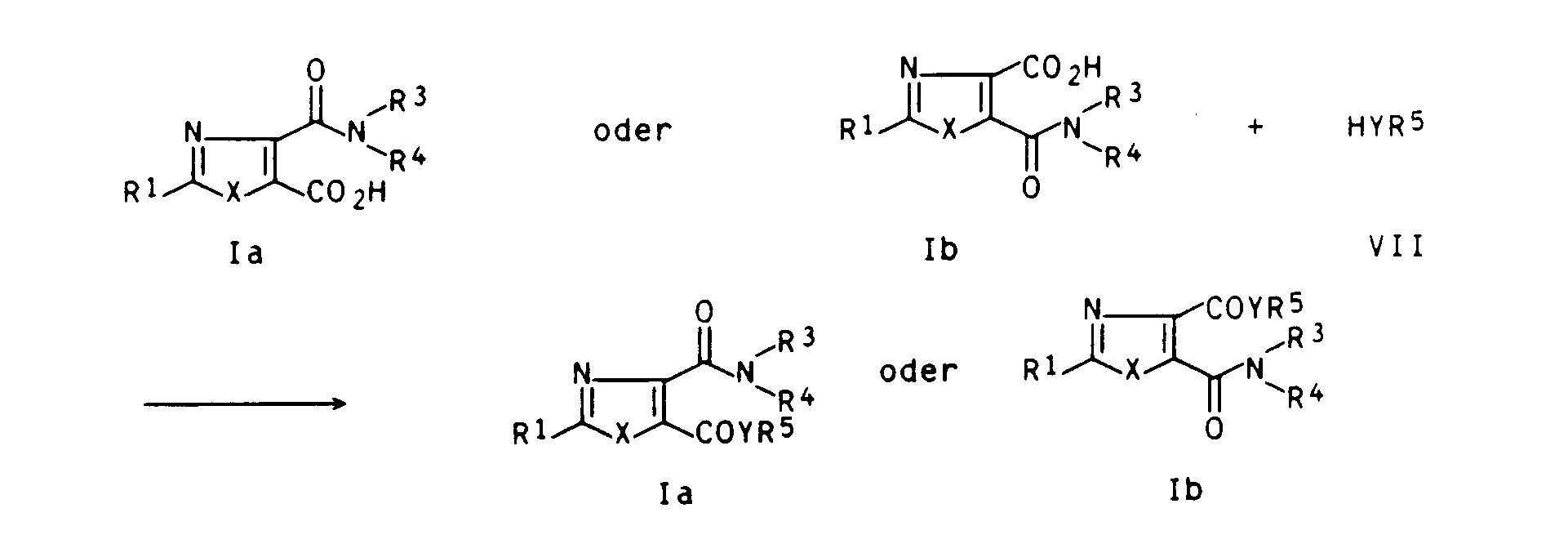
- Zweckmäßigerweise verwendet man für diese Umsetzungen Lösungsmittel wie Halogenkohlenwasserstoffe, z.B. Tetrachlorethan, Methylenchlorid, Chloroform, Dichlorethan, Chlorbenzol und 1,2-Dichlorbenzol; Ether z.B. Diethylether, Methyl-tert.-butylether, Dimethoxiethan, Diethylenglykoldimethylether, Tetrahydrofuran und Dioxan; Aromaten z.B. Benzol, Toluol oder Xylol; oder entsprechende Gemische.
- Als wasserentziehende Mittel kommen Dicyclohexylcarbodiimid oder Propanphosphonsäureanhydrid in Betracht.
- Die molaren Verhältnisse, in denen die benötigten Ausgangsverbindungen miteinander umgesetzt werden, betragen im allgemeinen 0,5:1 bis 2:1 für das Verhältnis von Carbonsäure IVa zu Alkohol oder Thiol und 1:1 bis 1:3 für das Verhältnis von Carbonsäure IVa zu wasserentziehendem Mittel.
- Die Konzentration der Edukte im Lösungsmittel beträgt im allgemeinen 0,1 bis 5 mol/I, bevorzugt 0,2 bis 2 mol/I.
- Besonders bevorzugt arbeitet man in Ethern wie Diethylether, Tetrahydrofuran oder Dioxan; mit Propanphosphonsäureanhydrid als wasserentziehendem Mittel bei 20 bis 60 ° C.
-
- 6. Verfahren zur Herstellung der Verbindungen la und Ib, in der R2 eine 4,5-Dihydro-oxazol-2-yl-gruppe bedeutet


- Als Lösungsmittel verwendet man zweckmäßigerweise Halogenkohlenwasserstoffe wie Chlorbenzol und 1,2-Dichlorbenzol, Ether, z.B. Methyl-tert.-butylether, 1,2-Dimethoxyethan, Diethylenglykol-dimethylether, Tetrahydrofuran und Dioxan; Alkohole wie Methanol, Ethanol, Propanol oder Ethylenglykol, dipolare aprotische Lösungsmittel, z.B. Acetonitril, Dimethylformamid, Dimethylacetamid, Dimethylsulfoxid, N-Methylpyrrolidon, 1,3-Dimethyltetrahydro-2(1 H)-pyrimidinon und 1,3-Dimethylimidazolin-2-on oder Aromaten, z.B. Benzol, Toluol und Xylol. Die Konzentration der Edukte im Lösungsmittel beträgt im allgemeinen 0,1 bis 5,0 mol/I, bevorzugt 0,2 bis 2,0 mol/I.
- Die Umsetzung ist im allgemeinen nach 14 Stunden beendet; die Carbonsäureamide la und Ib werden dann gegebenenfalls durch Zugabe von Wasser ausgefällt, abgesaugt oder mit einem organischen Lösungsmittel extrahiert und mit üblichen Standardmethoden wie Umkristallisation oder Chromatographie gereinigt.
- Man erhält die Verbindungen der Formel Vla, in denen R1 einen Alkohol oder Thiolrest -ZR8 bedeutet, in an sich bekannter Weise (Helv. Chim. Acta, 37, 2059 (1954)) durch Umsetzung eines 2-Halogen-thiazol-4-carbonsäureamids Vla (DE 22 41 035) in einem inerten organischen Lösungsmittel in Gegenwart einer Base mit einem Alkohol oder Thiol.

- R1 in Formel Vla' bedeutet C1-C4-Alkoxy, C1-C4-Alkylthio, die bis zu dreimal mit Halogen substituiert sein können, insbesondere Methoxy, Ethoxy, 1-Methyl-ethoxy, 1,1-Dimethylethoxy, Trifluormethoxy, Methylthio, Ethylthio, Difluormethylthio; oder Phenoxy oder Phenylthio, die bis zu dreimal durch C1-C4-Alkyl, C1-C4-Halogenalkyl, C1-C4-Alkylthio, C1-C4-Halogenalkylthio, Halogen, Cyano oder Nitro substituiert sein können, insbesondere 2,4-Dichlorphenoxy, 2,4-Difluorphenoxy, 2,4,6-Trifluorphenoxy, p-Trifluormethylphenoxy, 2-Chlor-4-Trifluorphenoxy, 3-Cyanophenoxy, 4-Cyano-2-methoxyphenoxy, 4-Nitrophenoxy, 2-Fluorthiophenyl, 4-Trifluormethylthiophenyl, 3-Cyanothiophenyl.
- Zweckmäßigerweise verwendet man für diese Umsetzungen Lösungsmittel wie Halogenkohlenwasserstoffe, z.B. Tetrachlorethan, Methylenchlorid, Chloroform, Dichlorethan, Chlorbenzol und 1,2-Dichlorbenzol; Ether, z.B. Diethylether, Methyl-tert.-butylether, Dimethoxiethan, Diethylenglykoldimethylether, Tetrahydrofuran und Dioxan; dipolare aprotische Lösungsmittel, z.B. Acetonitril, Dimethylformamid, Dimethylacetamid, Dimethylsulfoxid, N-Methylpyrrolidon, 1,3-Dimethyltetrahydro-2(1H)-pyrimidinon und 1,3-Dimethylimidazoli- din-2-on; Aromaten, z.B. Benzol, Toluol, Xylol, Pyridin und Chinolin; Ketone, z.B. Aceton, Methylethylketon; Alkohole, z.B. Methanol, Ethanol, iso-Propanol und tert.-Butanol oder entsprechende Gemische.
- Die Umsetzung kann bei Temperaturen von -100 ° C bis zur Rückflußtemperatur des jeweiligen Lösungsmittels bzw. -gemisches, vorzugsweise bei -60 ° C bis 150 ° C, durchgeführt werden.
- Als Basen dienen Hydride und Alkoxide von Alkali- und Erdalkalimetallkationen, insbesondere NaH, KH, CaH2, LiH und KO-t.-Bu. Mitunter ist es auch nützlich Kombinationen der oben angeführten Basen zu verwenden.
- Die molaren Verhältnisse, in denen die benötigten Ausgangsverbindungen miteinander umgesetzt werden, betragen im allgemeinen 3:1 bis 1:1 für das Verhältnis von Alkohol oder Thiol zu 2-Halogen-thiazol-4-carbonsäureamid Vla und 1:1 bis 1:3 für das Verhältnis von Alkohol oder Thiol zur wirksamen Base.
- Die Konzentration der Edukte im Lösungsmittel beträgt im allgemeinen 0,1 bis 5 mol/I, bevorzugt 0,2 bis 2 mol/I.
- Besonders bevorzugt arbeitet man in aprotisch dipolaren Solventien wie Acetonitril, Dimethylformamid, Dimethylsulfoxid, N-Methylpyrrolidon, 1,3-Dimethyltetrahydro-2(1 H)-pyrimidinon, 1,3-Dimethylimidazolidin-2- on oder Ethern wie 1,2-Dimethoxiethan, Diethylenglykoldimethylether, Tetrahydrofuran oder Dioxan bei Temperaturen zwischen 50 ° C und 150 ° C unter Verwendung von NaH oder KO-t.-Ba als Basen.
- Die für die Umsetzung benötigten 2-Halogen-thiazol-4-carbonsäureamide der Formel Illa können nach literaturbekannten Methoden aus den entsprechenden Carbonsäurehalogeniden durch Umsetzung mit Aminen gewonnen werden (DE-A 22 41 035).
- Die zum Einsatz kommenden Alkohole oder Thiole sind in vielen Fällen kommerziell erhältlich oder können in an sich bekannter Weise hergestellt werden.
- Desweiteren erhält man die Verbindungen der Formel Vlb in an sich bekannter Weise (Helv. Chim. Acta, 37, 2059 (1954)) durch Umsetzung eines 2-Halogen-thiazol-5-carbonsäureamids Illb in einem inerten organischen Lösungsmittel in Gegenwart einer Base mit einem Alkohol oder Thiol gemäß Schema 2:

- R1 in Formel Vlb' bedeutet C1-C4-Alkoxy, C1-C4-Alkylthio, die bis zu dreimal mit Halogen substituiert sein können; insbesondere Methoxy, Ethoxy, 1-Methyl-ethoxy, 1,1-Dimethylethoxy, Trifluormethoxy, Methylthio, Ethylthio, Difluormethylthio; oder Phenoxy oder Phenylthio, die bis zu dreimal durch C1-C4-Alkyl, C1-C4-Halogenalkyl, C1-C4-Alkylthio, C1-C4-Halogenalkylthio, Halogen, Cyano oder Nitro substituiert sein können; insbesondere 2,4-Dichlorphenoxy, 2,4-Difluorphenoxy, 2,4,6-Trifluorphenoxy, p-Trifluormethylphenoxy, 2-Chlor-4-Trifluorphenoxy, 3-Cyanophenoxy, 4-Cyano-2-methoxyphenoxy, 4-Nitrophenoxy, 2-Fluorthiophenyl, 4-Trifluormethylthiophenyl, 3-Cyanothiophenyl.
- Zweckmäßigerweise verwendet man für diese Umsetzungen Lösungsmittel wie Halogenkohlenwasserstoffe, z.B. Tetrachlorethan, Methylenchlorid, Chloroform, Dichlorethan, Chlorbenzol und 1,2-Dichlorbenzol; Ether, z.B. Diethylether, Methyl-tert.-butylether, Dimethoxiethan, Diethylenglykoldimethylether, Tetrahydrofuran und Dioxan; dipolare aprotische Lösungsmittel, z.B. Acetonitril, Dimethylformamid, Dimethylacetamid, Dimethylsulfoxid, N-Methylpyrrolidon, 1,3-Dimethyltetrahydro-2(1H)-pyrimidinon und 1,3-Dimethylimidazoli- din-2-on; Aromaten, z.B. Benzol, Toluol, Xylol, Pyridin und Chinolin; Ketone, z.B. Aceton, Methylethylketon; Alkohole, z.B. Methanol, Ethanol, iso-Propanol und tert.-Butanol oder entsprechende Gemische.
- Die Umsetzung kann bei Temperaturen von -100 ° C bis zur Rückflußtemperatur des jeweiligen Lösungsmittels bzw. -gemisches, vorzugsweise bei -60 ° C bis 150°C, durchgeführt werden.
- Als Basen dienen Hydride und Alkoxide von Alkali- und Erdalkalimetallkationen, insbesondere NaH, KH, CaH2, LiH und KO-t.-Bu. Mitunter ist es auch nützlich Kombinationen der oben angeführten Basen zu verwenden.
- Die molaren Verhältnisse, in denen die benötigten Ausgangsverbindungen miteinander umgesetzt werden, betragen im allgemeinen 3:1 bis 1:1 für das Verhältnis von Alkohol oder Thiol zu 2-Halogen-thiazol-4-carbonsäureamid Vlb und 1:1 bis 1:3 für das Verhältnis von Alkohol oder Thiol zur wirksamen Base.
- Die Konzentration der Edukte im Lösungsmittel berägt im allgemeinen 0,1 bis 5 mol/I, bevorzugt 0,2 bis 2 mol/I.
- Besonders bevorzugt arbeitet man in aprotisch dipolaren Solventien wie Acetonitril, Dimethylformamid, Dimethylsulfoxid, N-Methylpyrrolidon, 1,3-Dimethyltetrahydro-2(1 H)-pyrimidinon, 1,3-Dimethylimidazolidin-2- on oder Ethern wie 1,2-Dimethoxiethan, Diethylenglykoldimethylether, Tetrahydrofuran oder Dioxan bei Temperaturen zwischen 50 ° C und 150°C unter Verwendung von NaH oder KO-t.-Butylat als Basen.
- Die für die Umsetzung benötigten 2-Halogen-thiazol-4-carbonsäureamide der Formel Vlb können nach literaturbekannten Methoden aus den entsprechenden Carbonsäurehalogeniden durch Umsetzung mit Aminen gewonnen werden (US-A-4 001 421).
- Verbindungen der Formel IVb können gewonnen werden, indem man Dicarbonsäureester der Formel XI in an sich bekannter Weise mit Aminen umsetzt und die resultierenden Amide IXb gemäß Schema G verseift:
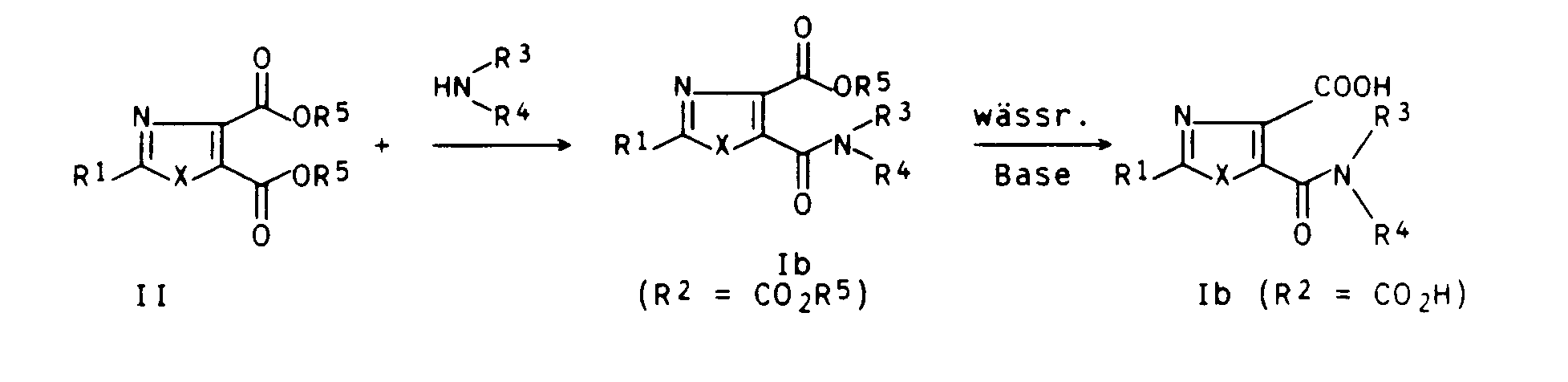
- Als Lösungsmittel verwendet man für diese Umsetzungen Ether, z.B. Diethylether, Methyl-tert.-butylether, Dimethoxyethan, Diethylenglykoldimethylether, Tetrahydrofuran und Dioxan; Aromaten, z.B. Benzol, Toluol, Xylol oder Mesitylen; Alkohole, z.B. Methanol, Ethanol, iso-Propanol und tert.-Butanol oder entsprechende Gemische.
- Die Umsetzung kann bei Temperaturen von -100 ° C bis zur Rückflußtemperatur des jeweiligen Lösungsmittels bzw. -gemisches, vorzugsweise bei -60 ° C bis 150°C, durchgeführt werden.
- Das molare Verhältnis, in dem Diester II und Amin eingesetzt werden, beträgt 1:1 bis 1:2, vorzugsweise 1:1 bis 1:1,2.
- Die Konzentration der Edukte im Lösungsmittel beträgt im allgemeinen 0,1 bis 5 mol/I, bevorzugt 0,2 bis 2,0 mol/I.
- Besonders bevorzugt arbeitet man in Alkoholen wie Ethanol in Gegenwart von einem Äquivalent Amin bei 50 bis 100°C. Die für die Umsetzung benötigten Diester XI, sind literaturbekannt oder können in Anlehnung an beschriebene Methoden hergestellt werden (Bull. Soc. Chim. Fr., 1969, 1762; J. Chem. Soc., 1953, 93).
- Neben den vorstehend geschilderten Verfahren 1-7 zur Herstellung der Verbindungen la, Ib und Ic gibt es weitere Synthesemöglichkeiten, die den folgenden Literaturstellen zu entnehmen sind:
- Beilstein, Hauptwerk sowie 1.-5. Erg.Werk, Band 27; R.W. Wiley, The Chemistry of Heterocyclic Compounds, Five- and Six-Membered Compounds with Nitrogen and Oxygen, Interscience Pubishers, New York, London (1962), Heterocyclic Chemistry, Vol. 6, Five-membered Rings with Two or More Oxygen, Sulfur or Nitrogen Atoms, Pergamon Press, 1984, J. March, Advanced Organic Chemistry, Third Adition, John Wiley and Sons, 1985, Houben-Weyl, Methoden der organischen Chemie, 4. Auflage, Thieme Verlag, Bände IV, VI, VII, VIII, X.
- Im Hinblick auf die bestimmungsgemäße Verwendung der Verbindungen la' und Ib' kommen als Substituenten bevorzugt folgende Reste in Betracht:
- X Sauerstoff oder Schwefel
- R1 Wasserstoff;
- Halogen wie Fluor, Chlor, Brom und lod, insbesondere Fluor und Chlor;
- C1 -C6 -Alkyl, wie Methyl, Ethyl, n-Propyl, iso-Propyl, n-Butyl, sek.-Butyl, iso-Butyl und tert.-Butyl, Pentyl, 1-Methylbutyl, 2-Methylbutyl, 3-Methylbutyl, 1,1-Dimethylpropyl, 1,2-Dimethylpropyl, 2,2-Dimethylpropyl, 1-Ethylpropyl, Hexyl, 1-Methylpentyl, 2-Methylpentyl, 3-Methylpentyl, 4-Methylpentyl, 1,1-Dimethyl, 1,2-Dimethylbutyl, 1,3-Dimethylbutyl, 2 2,2-Dimethylbutyl, 2,3-Dimethylbutyl, 3,3-Dimethylbutyl, 1-Ethylbutyl, 2-Ethylbutyl, 1,1,2-Trimethylpropyl, 1,2,2-Trimethylpropyl, 1-Ethyl-1-methylpropyl und 1-Ethyl-2-methylpropyl, insbesondere Methyl, Ethyl, Propyl und iso-Propyl, welches ein bis fünf Halogenatome, insbesondere Fluor- und/ oder Chloratome oder einen oder zwei der folgenden Reste tragen kann: Cycloalkyl wie Cyclopropyl, Cyclobutyl, Cyclopentyl und Cyclohexyl, insbesondere Cyclopropyl; Alkoxy wie Methoxy, Ethoxy, n-Propoxy, 2-Methylethoxy, n-Butoxy, 1-Methylpropoxy, 2-Methylpropoxy und 1,1-Dimethylethoxy, insbesondere Methoxy, Ethoxy, 1-Methylethoxy und 1,1-Dimethylethoxy; Halogenalkoxy wie Difluormethoxy, Trifluormethoxy, Chlordifluormethoxy, Dichlorfluormethoxy, 1-Fluorethoxy, 2-Fluorethoxy, 2,2-Difluorethoxy, 1,1,2,2-Tetrafluorethoxy, 2,2,2-Trifluorethoxy, 2-Chlor-1,1,2-trifluorethoxy und Pentafluorethoxy, insbesondere Trifluormethoxy und Pentafluorethoxy; Alkylthio wie Methylthio, Ethylthio, Propylthio, 1-Methylethylthio, Butylthio, 1-Methylpropylthio, 2-Methylpropylthio und 1,1-Dimethylethylthio, insbesondere Methylthio und Ethylthio; Halogenalkylthio wie Difluormethylthio, Trifluormethylthio, Chlordifluormethylthio, 1-Fluorethylthio, 2-Fluorethylthio, 2,2-Difluorethylthio, 2,2,2-Trifluorethylthio, 2-Chlor-2,2-difluorethylthio, 2,2-Dichlor-2-fluorethylthio, 2,2,2-Trichlorethylthio und Pentafluorethylthio, insbesondere Difluormethylthio und Pentafluorethylthio oder Cyano;
- Benzyl, welches ein bis drei der folgenden Reste tragen kann: Alkyl wie vorstehend genannt, insbesondere Methyl, Ethyl und iso-Propyl; Halogenalkyl wie vorstehend genannt, insbesondere Trifluormethyl und Chlordifluormethyl; Alkoxy wie vorstehend genannt, insbesondere Methoxy und Ethoxy; Halogenalkoxy wie vorstehend genannt, insbesondere Trifluormethoxy, Pentafluorethoxy und Trichlormethoxy; Alkylthio wie vorstehend genannt, insbesondere Methylthio und Ethylthio;
- Halogenalkylthio wie vorstehend genannt, insbesondere Difluormethylthio, Pentafluorethylthio und Trifluormethylthio; Halogen wie vorstehend genannt, insbesondere Fluor und Chlor; Cyano oder Nitro;
- Cycloalkyl wie Cyclopropyl, Cyclobutyl, Cyclopentyl, Cyclohexyl, Cycloheptyl und Cyclooctyl, insbesondere Cyclopropyl, Cyclopentyl und Cyclohexyl, welches ein bis drei der folgenden Reste tragen kann: Alkyl wie vorstehend genannt, insbesondere Methyl oder Halogen wie vorstehend genannt, insbesondere Chlor und Fluor;
- Alkenyl wie Ethenyl, 1-Propenyl, 2-Propenyl, 1-Methylethenyl, 1-Butenyl, 2-Butenyl, 3-Butenyl, 1-Methyl-1-propenyl, 1-Methyl-2-propenyl, 2-Methyl-1-propenyl, 2-Methyl-2-propenyl, 1-Pentenyl, 2-Pentenyl, 3-pentenyl, 4-Pentenyl, 1-Methyl-1-butenyl, 2-Methyl-1-butenyl, 3-Methyl-2-butenyl 1-Methyl-2-butenyl, 2-Methyl-2-butenyl, 1-Methyl-3-butenyl, 2-Methyl-3-butenyl, 3-Methyl-3-butenyl, 1,1-Dimethyl-2-propenyl, 1,1-Dimethyl-l-propenyl, 1,2-Dimethyl-2-propenyl, 1-Ethyl-1-propenyl, 1-Ethyl-2-propenyl, 1-Hexenyl, 2-Hexenyl, 3-Hexenyl, 4-Hexenyl, 5-Hexenyl, 1-Methyl-1-pentenyl, 2-Methyl-1-pentenyl, 3-Methyl-1-pentenyl, 4-Methyl-1-pentenyl, 1-Methyl-2-pentenyl, 2-Methyl-2-pentenyl, 3-Methyl-2-pentenyl, 4-Methyl-2-pentenyl, 1-Methyl-3-pentenyl, 2-Mehyl-3-pentenyl, 4-Methyl-2-pentenyl, 1-Methyl-3-pentenyl, 2-Methyl-3-pentenyl, 3-Methyl-3-pentenyl, 4-Methyl-3-pentenyl, 1-Methyl-4-pentenyl, 2-Methyl-4-pentenyl, 3-Methyl-4-pentenyl, 4-Methyl-4-pentenyl, 1,1-Dimethyl-2-butenyl, 1,1-Dimethyl-3-butenyl, 1,2-Dimethyl-1-butenyl, 1,2-Dimethyl-2-butenyl, 1,2-Dimethyl-3-butenyl, 1,3-Dimethyl-1-butenyl, 1,3-Dimethyl-2-butenyl, 1,3-Dimethyl-3-butenyl, 2,2-Dimethyl-3-butenyl, 2,3-Dimethyl-1-butenyl, 2,3-Dimethyl-2-butenyl, 2,3-Dimethyl-3-butenyl, 3,3-Dimethyl-1-butenyl, 1-Ethyl-1-butenyl, 1-Ethyl-2-butenyl, 1-Ethyl-3-butenyl, 2-Ethyl-1-butenyl, 2-Ethyl-2-butenyl, 2-Ethyl-3-butenyl, 1,1,2-Trimethyl-2-2-propenyl, 1-Ethyl-1-methyl-2-propenyl, 1-Ethyl-2-methyl-1-propenyl und 1-Ethyl-2-methyl-2-propenyl, insbesondere Allyl, welches ein bis drei der folgenden Reste tragen kann: Halogen wie oben genannt, insbesondere Fluor und Chlor;
- Alkoxy wie obengenannt, insbesondere Methoxy und Ethoxy, und/oder ein Phenyl, das seinerseits eine bis drei der folgenden Gruppen tragen kann: Alkyl wie vorstehend genannt, insbesondere Methyl, Ethyl und iso-Propyl; Halogenalkyl wie vorstehend genannt, insbesondere Trifluormethyl und Chlordifluormethyl; Alkoxy wie vorstehend genannt, insbesondere Methoxy und Ethoxy; Halogenalkoxy wie vorstehend genannt, insbesondere Trifluormethoxy, Pentafluorethoxy und Trichlormethoxy; Alkylthio wie vorstehend genannt, insbesondere Methylthio und Ethylthio; Halogenalkylthio wie vorstehend genannt, insbesondere Difluormethylthio, Pentafluorethylthio und Trifluormethylthio; Halogen wie vorstehend genannt, insbesondere Fluor und Chlor, Cyano oder Nitro;
- Alkinyl wie Ethinyl, 1-Propinyl, Propargyl, 1-Butinyl, 2-Butinyl, 3-Butinyl, 1-Methyl-2-propinyl, 1-Pentinyl, 2-Pentinyl, 3-Pentinyl, 4-Pentinyl, 1-Methyl-3-butinyl, 2-Methyl-3-butinyl, 1-Methyl-2- butinyl, 3-Methyl-1-butinyl, 1,1-Dimethyl-2-propinyl, 1-Ethyl-2-propinyl, 1-Hexinyl, 2-Hexinyl, 3-Hexinyl, 4-Alkinyl, 5-Hexinyl, 1-Methyl-2-pentinyl, 1-Methyl-3-pentinyl, 1-Methyl-4-pentinyl, 2-Methyl-3-pentinyl, 2-Methyl-4-pentinyl, 3-Methyl-pentinyl, 3-Methyl-4-pentinyl, 4-Methyl-1-pentinyl, 4-Methyl-2-pentinyl, 1,1-Dimethyl-2-butinyl, 1,1-Dimethyl-3-butinyl, 1,2-Dimethyl-3-butinyl, 2,2-Dimethyl-4-butinyl, 3,3-Dimethyl-1-butinyl, 1-Ethyl-2-butinyl, 1-Ethyl-3-butinyl, 2-Ethyl-3-butinyl und 1-Ethyl-1-methyl-2-propinyl, insbesondere Propargyl, welches ein bis drei der folgenden Reste tragen kann: Halogen wie oben genannt, insbesondere lod; Alkoxy wie oben genannt, insbesondere Methoxy und Ethoxy, und/oder ein Phenyl, das seinerseits eine bis drei der folgenden Gruppen tragen kann: Alkyl wie vorstehend genannt, insbesondere Methyl, Ethyl und iso-Propyl; Halogenalkyl wie vorstehend genannt, insbesondere Trifluormethyl und Chlordifluormethyl; Alkoxy wie vorstehend genannt, insbesondere Methoxy und Ethoxy; Halogenalkoxy wie vorstehend genannt, insbesondere Trifluormethoxy, Pentafluorethoxy und Trichlormethoxy; Alkylthio wie vorstehend genannt, insbesondere Methylthio und Ethylthio; Halogenalkylthio wie vorstehend genannt, insbesondere Difluormethylthio, Pentafluorethylthio und Trifluormethylthio; Halogen wie vorstehend genannt, insbesondere Fluor und Chlor, Cyano oder Nitro;
- C, -C4-Alkoxy wie obenstehend genannt, insbesondere Methoxy und Ethoxy; C1-C4-Halogenalkoxy wie obenstehend genannt, insbesondere Trifluormethoxy, Pentafluorethoxy und Trichlormethoxy;
- C, -C4-Alkylthio wie obenstehend genannt, insbesondere Methylthio und Ethylthio; C1-C4-Halogenalkylthio wie obenstehend genannt, insbesondere Difluormethylthio, Pentafluorethylthio und Trifluormethylthio;
- Phenoxy oder Phenylthio, wobei diese Reste ein bis drei der folgenden Gruppen tragen können: Alkyl wie vorstehend genannt, insbesondere Methyl, Ethyl und iso-Propyl; Halogenalkyl wie vorstehend genannt, insbesondere Trifluormethyl und Chlordifluormethyl; Alkoxy wie vorstehend genannt, insbesondere Methoxy und Ethoxy; Halogenalkoxy wie vorstehend genannt, insbesondere Trifluormethoxy, Pentafluorethoxy und Trichlormethoxy; Alkylthio wie vorstehend genannt, insbesondere Methylthio und Ethylthio; Halogenalkylthio wie vorstehend genannt, insbesondere Difluormethylthio, Pentafluorethylthio und Trifluormethylthio; Halogen wie vorstehend genannt, insbesondere Fluor und Chlor, Cyano oder Nitro;
- ein 5- bis 6-gliedriger heterocyclischer Rest enthaltend ein oder zwei Heteroatome, ausgewählt aus der Gruppe Sauerstoff, Schwefel und Stickstoff wie 2-Tetrahydrofuranyl, 3-Tetrahydrofuranyl, 4-Tetrahydropyranyl, 2-Tetrahydropyranyl, 3-Tetrahydropyranyl, 3-Furanyl, 2-Thienyl, 3-Thienyl, 2-Furanyl, 3-Tetrahydrothienyl, 2-Tetrahydropyranyl, 5-Isoxazolyl, 3-Isoxazolyl, 4-Isoxazolyl, 5-Isothiazolyl, 4-Isothiazolyl, 3-Isothiazolyl, 2-Oxazolyl, 4-Thiazolyl, 4-Oxazolyl, 2-Thiazolyl, 5-Oxazolyl, 5-Thiazolyl, 2-Imidazolyl, 4-Imidazolyl, 5-Imidazolyl, 3-Pyrrolyl, 2-Pyrrolyl, 3-Pyrazolyl, 4-Pyrazolyl, 5-Pyrazolyl, 4-Pyridyl, 3-Pyridyl und 2-Pyridyl, wobei dieser Ring ein oder zwei der folgenden Reste tragen kann: Alkyl wie oben genannt, insbesondere Methyl; Halogen wie oben genannt, insbesondere Fluor und Chlor; Alkoxy wie oben genannt, insbesondere Methoxy und Etoxy oder Alkoxycarbonyl wie Methoxycarbonyl und Ethoxycarbonyl, insbesondere Methoxycarbonyl;
- Phenyl, welches eine bis drei der folgenden Gruppen tragen kann: Alkyl wie bei R1 genannt, insbesondere Methyl, Ethyl und iso-Propyl; Halogenalkyl wie vorstehend genannt, insbesondere Trifluormethyl und Chlordifluormethyl; Alkoxy wie vorstehend genannt, insbesondere Methoxy und Ethoxy; Halogenalkoxy wie vorstehend genannt, insbesondere Trifluormethoxy, Pentafluorethoxy und Trichlormethoxy; Alkylthio wie vorstehend genannt, insbesondere Methylthio und Ethylthio; Halogenalkylthio wie vorstehend genannt, insbesondere Difluormethylthio, Pentafluorethylthio und Trifluormethylthio; Halogen wie vorstehend genannt, insbesondere Fluor und Chlor, Cyano oder Nitro;
- R2 Formyl, 4,5-Dihydroxazol-2-yl oder den Rest -COYRs und
- Y Sauerstoff oder Schwefel;
- R 5 Wasserstoff;
- Alkyl, wie unter R1 genannt, insbesondere Methyl, Ethyl, n-Propyl, iso-Propyl und n-Hexyl, welches ein bis fünf Halogenatome wie unter R1 genannt, insbesondere Fluor und Chlor oder Hydroxygruppen und/oder einen der folgenden Reste tragen kann: Alkoxy wie unter R1 genannt, insbesondere Methoxy und Ethoxy; Alkoxy-alkoxy wie Methoxy-ethoxy, Ethoxy-ethoxy, Propoxyethoxy, insbesondere Methoxy-ethoxy; Cyano; Trimethylsilyl; Alkylthio wie unter R1 genannt, insbesondere Methylthio und Ethylthio; Alkylamino wie Methylamino, Ethylamino, Propylamino, iso-Propylamino, insbesondere Methylamino und Ethylamino; Dialkylamino wie Dimethylamino, Diethylamino, Dipropylamino, Diisopropylamino, Methylethylamino, insbesondere Dimethylamino und Methylethylamino; Cycloalkylamino wie Cyclopropylamino, Cyclobutylamino, Cyclopentylamino, Cyclohexylamino und Cycloheptylamino, insbesondere Cyclopropylamino; Alkylsulfinyl wie Methylsulfinyl, Ethylsulfinyl, Propylsulfinyl, iso-Propylsulfinyl, insbesondere Methylsulfinyl und Ethylsulfinyl; Alkylsulfonyl wie Methylsulfonyl, Ethylsulfonyl, Propylsulfonyl, iso-Propylsulfonyl, insbesondere Methylsulfonyl und Ethylsulfonyl; Carboxyl; Alkoxycarbonyl wie unter R1 genannt, insbesondere Methoxycarbonyl; Dialkylaminocarbonyl wie Dimethylaminocarbonyl, Diethylaminocarbonyl, Dipropylaminocarbonyl, Diisopropylaminocarbonyl, Dicyclopropylaminocarbonyl, Methylethylaminocarbonyl, insbesondere Dimethylaminocarbonyl und Diethylaminocarbonyl; Dialkoxyphosphonyl wie Dimethoxyphosphonyl, Diethoxyphosphonyl, Dipropoxyphosphonyl, Diisopropoxyphosphonyl, insbesondere Dimethoxyphosphonyl und Diethoxyphosphonyl; Alkaniminoxy wie insbesondere 2-Propaniminoxy; Thienyl, Furanyl, Tetrahydrofuranyl, Phthalimido, Pyridyl, Benzyloxy; Benzoyl, wobei die cyclischen Reste ihrerseits eine bis drei der folgenden Gruppen tragen können: Alkyl wie unter R1 genannt, insbesondere Methyl und Ethyl; Alkoxy wie unter R1 genannt, insbesondere Methoxy und Ethoxy, oder Halogen wie unter R1 genannt, insbesondere Fluor und Chlor;
- Benzyl, das eine bis drei der folgenden Gruppen tragen kann: Alkyl wie unter R1 genannt, insbesondere Methyl und Ethyl; Alkoxy wie unter R1 genannt, insbesondere Methoxy und Ethoxy;
- Halogenalkyl wie unter R1 genannt, insbesondere Trifluormethyl; Halogen wie unter R1 genannt, insbesondere Fluor und Chlor, Nitro und Cyano;
- C3-Cg-Cycloalkyl wie unter R1 genannt, insbesondere Cyclopentyl und Cyclohexyl;
- Phenyl, das eine bis drei der folgenden Gruppen tragen kann: Alkyl wie unter R1 genannt, insbesondere Methyl und Ethyl; Alkoxy wie unter R1 genannt, insbesondere Methoxy und Ethoxy;
- Halogenalkyl wie unter R1 genannt, insbesondere Trifluormethyl; Halogenalkoxy wie unter R1 genannt, insbesondere Trifluormethoxy; Alkoxycarbonyl wie vorstehend genannt, insbesondere Methoxycarbonyl; Halogen wie unter R1 genannt, insbesondere Fluor, Chlor und Brom, Nitro und Cyano;
- C3-C6-Alkenyl wie unter R1 genannt, insbesondere Allyl und Methallyl, Cs-Cs-Cycloalkenyl wie 2-Cyclopentenyl und 2-Cyclohexenyl, insbesondere 2-Cyclohexenyl oder C3-C6-Alkinyl wie unter R1 genannt, insbesondere Propargyl, wobei diese Reste eine der folgenden Gruppen tragen können: Hydroxy; Alkoxy wie unter R1 genannt, insbesondere Methoxy und Ethoxy; Halogen wie unter R1 genannt, insbesondere lod, oder Phenyl, welches seinerseits eine bis drei der folgenden Gruppen tragen kann: Alkyl wie unter R1 genannt, insbesondere Methyl und Ethyl; Alkoxy wie unter R1 genannt, insbesondere Methoxy und Ethoxy; Halogenalkyl wie unter R1 genannt, insbesondere Trifluormethyl; Halogen wie unter R1 genannt, insbesondere Fluor und Chlor, Nitro oder Cyano;
- einen fünf- bis sechsgliedrigen heterocyclischen Rest enthaltend ein oder zwei Heteroatome, ausgewählt aus der Gruppe Sauerstoff, Schwefel und Stickstoff wie unter R1 genannt, insbesondere Tetrahydrofuranyl und Tetrahydropyranyl oder einen Benzotriazolrest;
- Phthalimido; Tetrahydrophthalimido; Succinimido; Maleinimido;
- ein Äquivalent eines Kations aus der Gruppe der Alkali- oder Erdalkalimetalle, Mangan, Kupfer, Eisen, Ammonium und substituiertes Ammonium
- oder einen Rest -N=CR6R7, wobei R6 und R7 unabhängig voneinander Wasserstoff, Alkyl wie unter R1 genannt, insbesondere Methyl, Ethyl und iso-Propyl; Cycloalkyl wie unter R1 genannt, insbesondere Cyclopropyl; Phenyl oder Furyl bedeuten oder zusammen eine Methylenkette der Formel -(CH2)m- mit m = 4 bis 7 Kettengliedern,
- R3 Wasserstoff,
- C1-C6-Alkyl, wie unter R1 genannt, insbesondere Methyl, Ethyl, iso-Propyl, das einen bis drei der folgenden Substituenten tragen kann: Hydroxy; Halogen wie unter R1 genannt, insbesondere Fluor und Chlor; Alkoxy wie unter R1 genannt, insbesondere Methoxy und Ethoxy; Alkylthio wie unter R1 genannt, insbesondere Methylthio und Ethylthio, oder Dialkylamino wie unter R5 genannt, insbesondere Dimethylamino;
- Cycloalkyl wie unter R1 genannt, insbesondere Cyclopropyl, Cyclobutyl, Cyclopentyl und Cyclohexyl, welches ein bis drei der folgenden Reste tragen kann: Alkyl wie unter R1 genannt, insbesondere Methyl, Ethyl und Isopropyl; Halogen wie unter R1 genannt, insbesondere Fluor und Chlor, oder Halogenalkyl wie unter R1 genannt, insbesondere Trifluormethyl;
- R 4 Hydroxy;
- Alkoxy wie unter R1 genannt, insbesondere Methoxy und Ethoxy;
- Alkyl wie unter R1 genannt, insbesondere Methyl, Ethyl, n-Propyl, iso-Propyl, n-Butyl, sek.-Butyl, iso-Butyl und tert.-Butyl; das eine bis drei der folgenden Gruppen tragen kann: Alkoxy wie unter R1 genannt, insbesondere Methoxy und Ethoxy; Halogenalkoxy wie unter R1 genannt, insbesondere Trifluormethoxy; Alkylthio wie unter R1 genannt, insbesondere Methylthio und Ethylthio;
- Halogenalkylthio wie unter R1 genannt, insbesondere Trifluormethylthio; Dialkylamino wie unter R1 genannt, insbesondere Dimethylamino und Diethylamino; Halogen wie unter R1 genannt, insbesondere Fluor und Chlor; Cycloalkyl wie unter R1 genannt, insbesondere Cyclopropyl, Cyclopentyl und Cyclohexyl, oder Phenyl, welches seinerseits ein bis drei der folgenden Reste tragen kann: Halogen, wie bei R1 genannt, insbesondere Fluor und Chlor; Cyano; Nitro; Alkyl wie unter R1 genannt, insbesondere Methyl und Ethyl ; Halogenalkyl wie unter R1 genannt, insbesondere Trifluormethyl; Alkoxy wie unter R1 genannt, insbesondere Methoxy und Ethoxy; Halogenalkoxy wie unter R1 genannt, insbesondere Trifluormethoxy; Alkylthio wie unter R1 genannt, insbesondere Methylthio und Ethylthio, oder Halogenalkylthio wie unter R1 genannt, insbesondere Trifluormethylthio;
- Cycloalkyl wie unter R1 genannt, insbesondere Cyclopropyl, Cyclobutyl, Cyclopentyl und CyclohexyL, das eine bis drei der folgenden Gruppen tragen kann: Alkyl wie unter R1 genannt, insbesondere Methyl, Ethyl und Isopropyl; Halogenalkyl wie unter R1 genannt, insbesondere Trifluormethyl; Alkoxy wie unter R1 genannt, insbesondere Methoxy und Ethoxy; Halogenalkoxy wie unter R1 genannt, insbesondere Trifluormethoxy; Halogen wie unter R1 genannt, insbesondere Fluor und Chlor, Nitro oder Cyano;
- Alkenyl oder C3-C6-Alkinyl wie unter R1 genannt, insbesondere Allyl, Methallyl, Propargyl und 1,1-Dimethyl2-2-propinyl, das ein- bis dreimal durch Halogen wie unter R1 genannt, insbesondere Fluor und Chlor, und/oder einmal durch Phenyl substituiert sein kann, wobei der Phenylrest seinerseits eine bis drei der folgenden Gruppen tragen kann: Alkyl wie unter R1 genannt, insbesondere Methyl und Ethyl: Halogenalkyl wie unter R1 genannt, insbesondere Trifluormethyl;
- Alkoxy wie unter R1 genannt, insbesondere Methoxy und Ethoxy; Halogenalkoxy wie unter R1 genannt, insbesondere Trifluormethoxy; Alkylthio wie unter R1 genannt, insbesondere Methylthio und Ethylthio; Halogenalkylthio wie unter R1 genannt, insbesondere Trifluormethylthio; Halogen wie unter R1 genannt, insbesondere Fluor und Chlor, Cyano oder Nitro;
- ein 5- bis 6-gliedriger heterocyclischer Rest enthaltend ein oder zwei Heteroatome, ausgewählt aus der Gruppe Sauerstoff, Schwefel oder Stickstoff wie unter R1 genannt, welcher ein bis drei der folgenden Gruppen tragen kann: Alkyl wie unter R1 genannt, insbesondere Methyl, Ethyl und iso-Propyl, oder Halogen wie unter R1 genannt, insbesondere Fluor und Chlor;
- Phenyl, das eine bis vier der folgenden Gruppen tragen kann: Alkyl wie unter R1 genannt, insbesondere Methyl, Ethyl und Isopropyl; Halogenalkyl wie unter R1 genannt, insbesondere Trifluormethyl; Alkoxy wie unter R1 genannt, insbesondere Methoxy und Ethoxy; Halogenalkoxy wie unter R1 genannt, insbesondere Trifluormethoxy; Alkylthio wie unter R1 genannt, insbesondere Methylthio und Ethylthio; Halogenalkylthio wie unter R1 genannt, insbesondere Trifluormethylthio; Halogen wie unter R1 genannt, insbesondere Fluor und Chlor; Nitro; Cyano; Formyl; Alkanoyl wie Acetyl, Propionyl, Butyryl, insbesondere Acetyl; Halogenalkanoyl, wie Trifluoracetyl, Trichloracetyl, Pentafluorpropionyl, insbesondere Trifluoracetyl, oder Alkoxycarbonyl wie unter R1 genannt, insbesondere Methoxycarbonyl;
- Naphthyl, das ein- bis dreimal durch Alkyl wie unter R1 genannt, insbesondere Methyl und Ethyl, oder Halogen wie unter R1 genannt, insbesondere Fluor und Chlor substituiert sein kann, oder
- R3 und R4 gemeinsam einen Rest der Struktur -(CH2)n-Yp-(CH2)q-, wobei n und q 1, 2 oder 3, p 0 oder 1 und Y Sauerstoff, Schwefel oder N-Methyl wie -(CH2)3-, -(CH2)4-, -(CH2)5-, -(CH2)6-, -CH2-O-CH2-, -CH2-CH2-O-CH2-CH2-, -CH2-S-CH2-, -CH2-CH2-S-CH2-CH2-, -CH2-CH2-N(CH3)-CH2-CH2-, insbesondere -(CH2)5- und -CH2-CH2-O-CH2-CH2-, oder den Rest der Formel -(CH2)3-CO- bilden können; sowie deren umweltverträglichen Salze.
- Insbesondere bevorzugt sind Verbindungen la' und Ib', in denen R3 Wasserstoff bedeutet sowie solche, in denen die Substituenten folgende Bedeutung haben:
- R1 Wasserstoff; Methyl, Ethyl, Propyl, 1-Methylethyl, Butyl, 1-Methylpropyl, 2-Methylpropyl und 1,1-Dimethylethyl; Methoxy, Ethoxy, Propyloxy, 1-Methylethoxy, Butyloxy, 1-Methylpropyloxy, 2-Methylpropyloxy und 1,1-Dimethylethoxy; Difluormethoxy und Trifluormethoxy; Methylthio, Ethylthio, Propylthio, 1-Methylethylthio, Butylthio, 1-Methylpropylthio, 2-Methylpropylthio und 1,1-Dimethylethylthio; Difluormethylthio und Trifluormethylthio;
- R2 einen Rest -COYR5;


- R4 Methyl, Ethyl, Propyl, 1-Methylethyl, Butyl, 1-Methylpropyl, 2-Methylpropyl und 1,1-Dimethylethyl; Cyclopropyl, Cyclopentyl, Cyclohexyl und Cycloheptyl; oder gemeinsam eine 4- bis 7-gliedrige Alkylenkette wie -CH2CH2CH2CH2-, -CH2CH2CH2CH2CH2-, CH2CH2CH2CH2CH2CH2- und -CH2 CH2 CH2 CH2 CH2 CH2 CH2-;
- Beispiele für sehr aktive Verbindungen der Formeln la und Ib sind in den nachstehenden Tabellen aufgeführt:


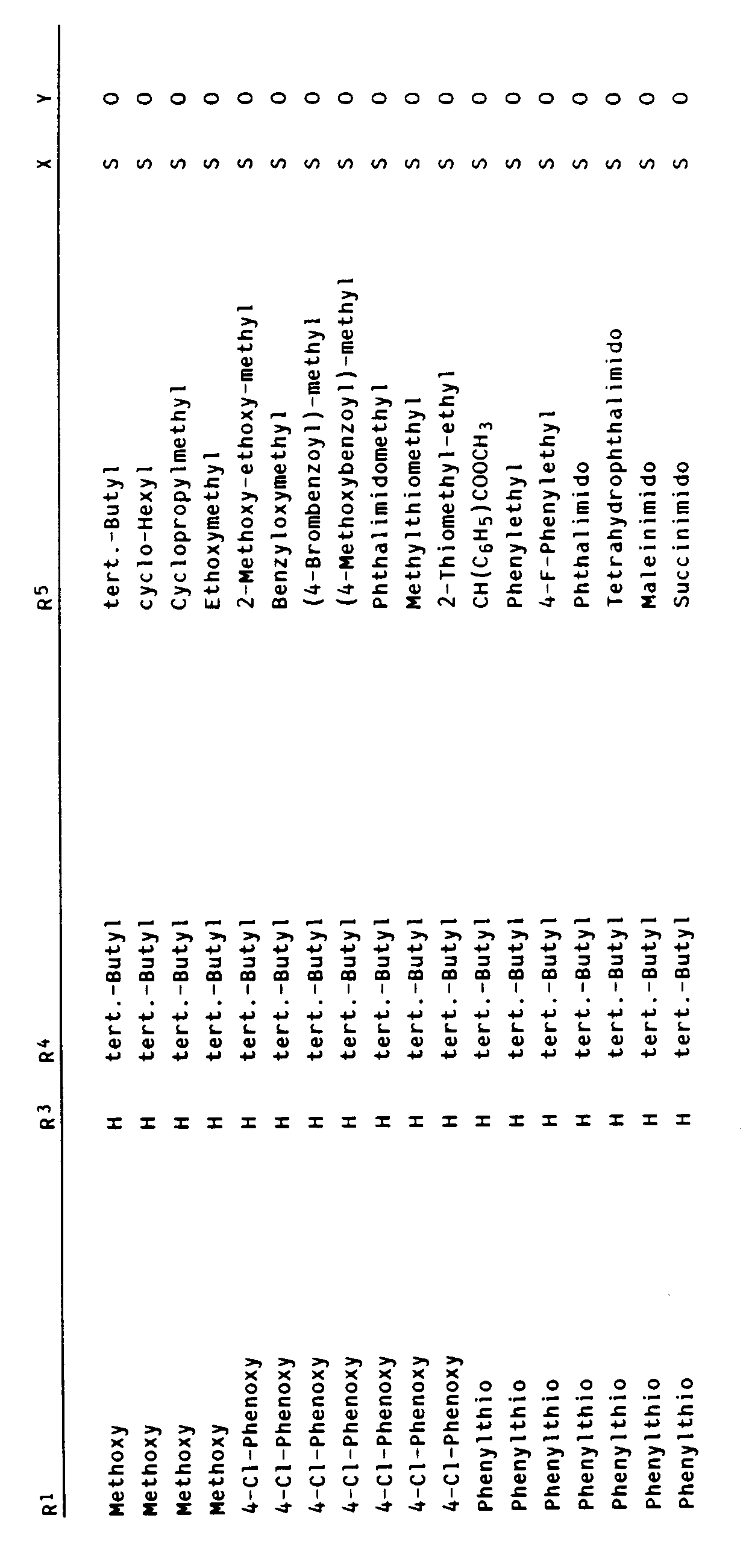
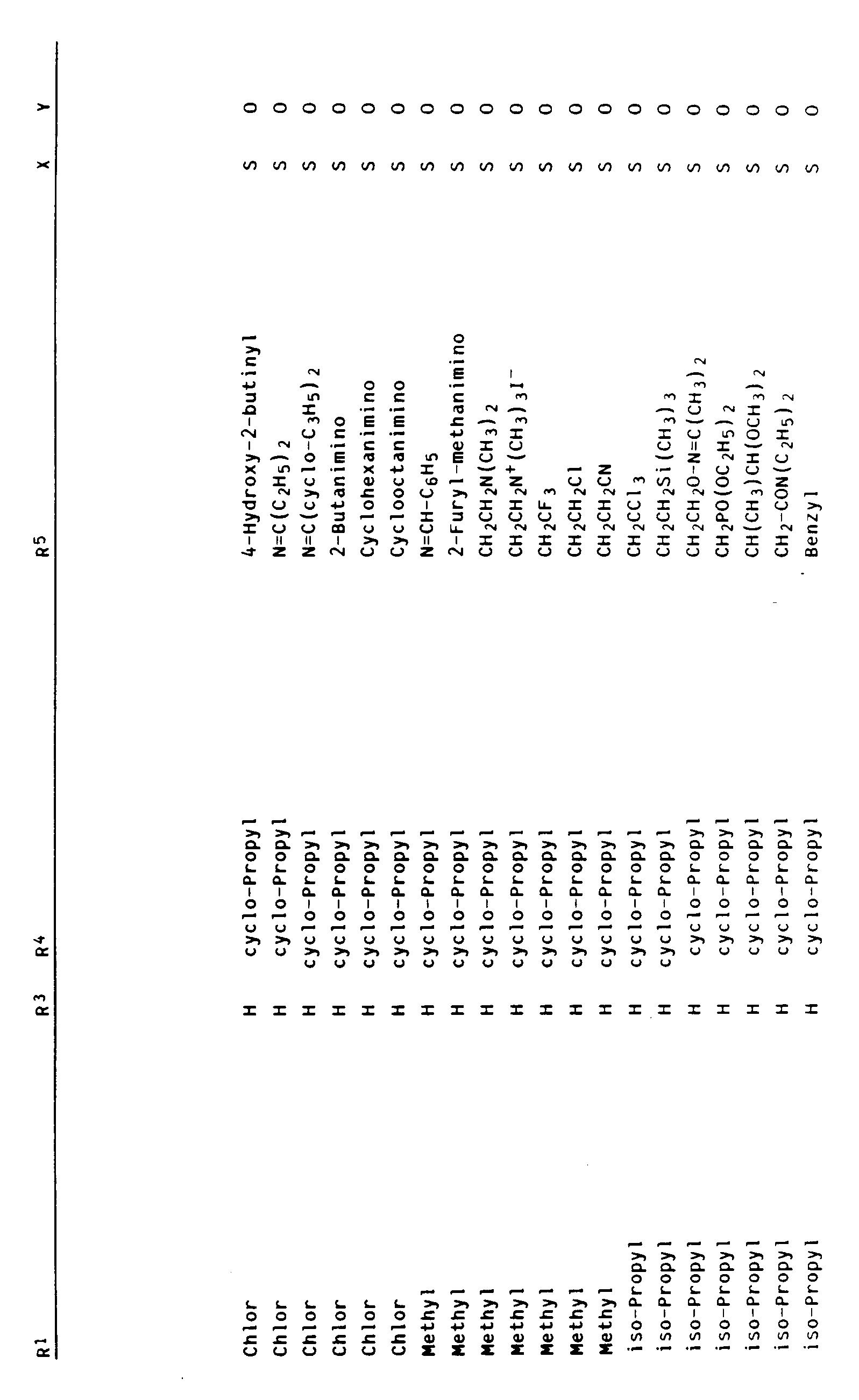
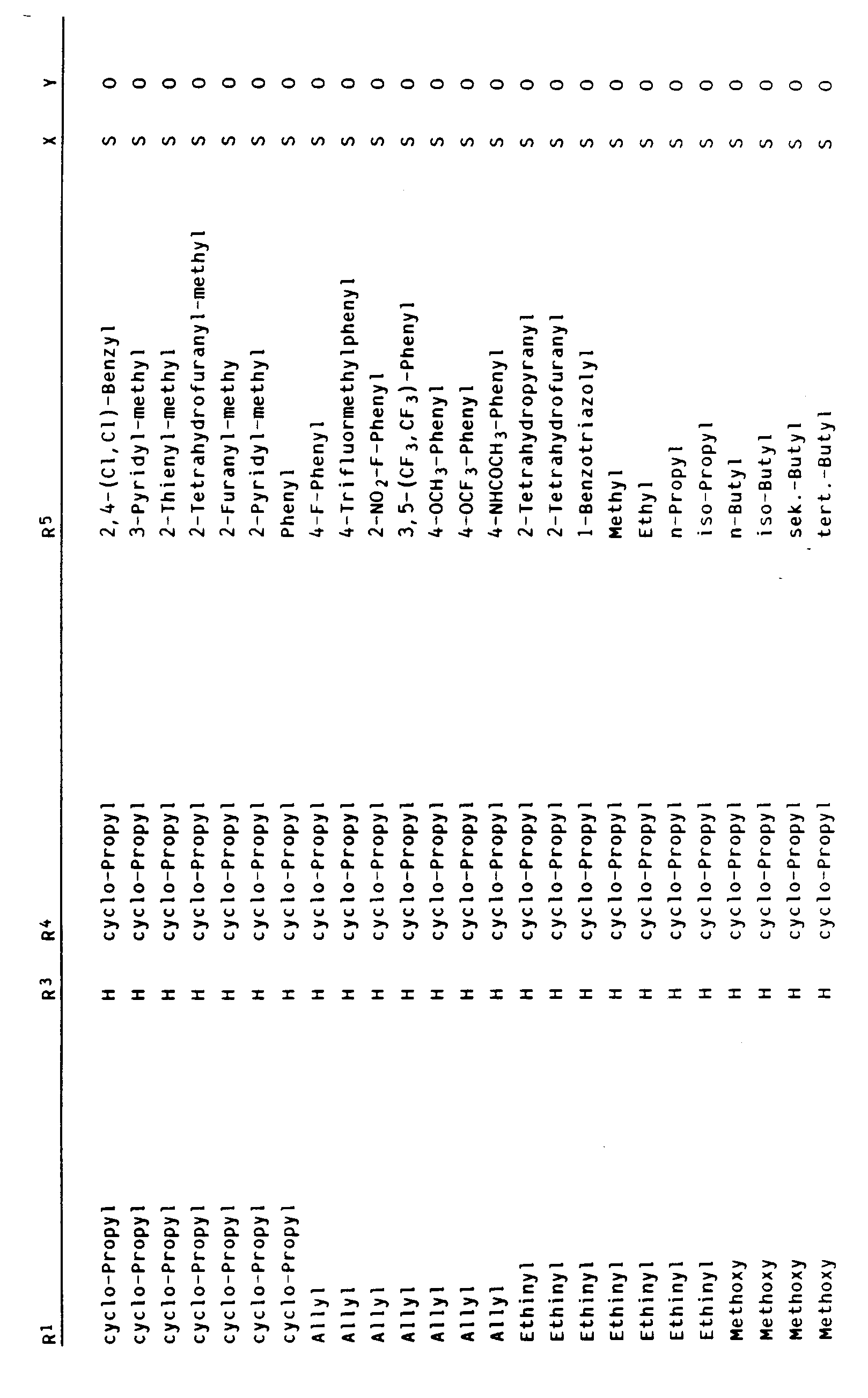


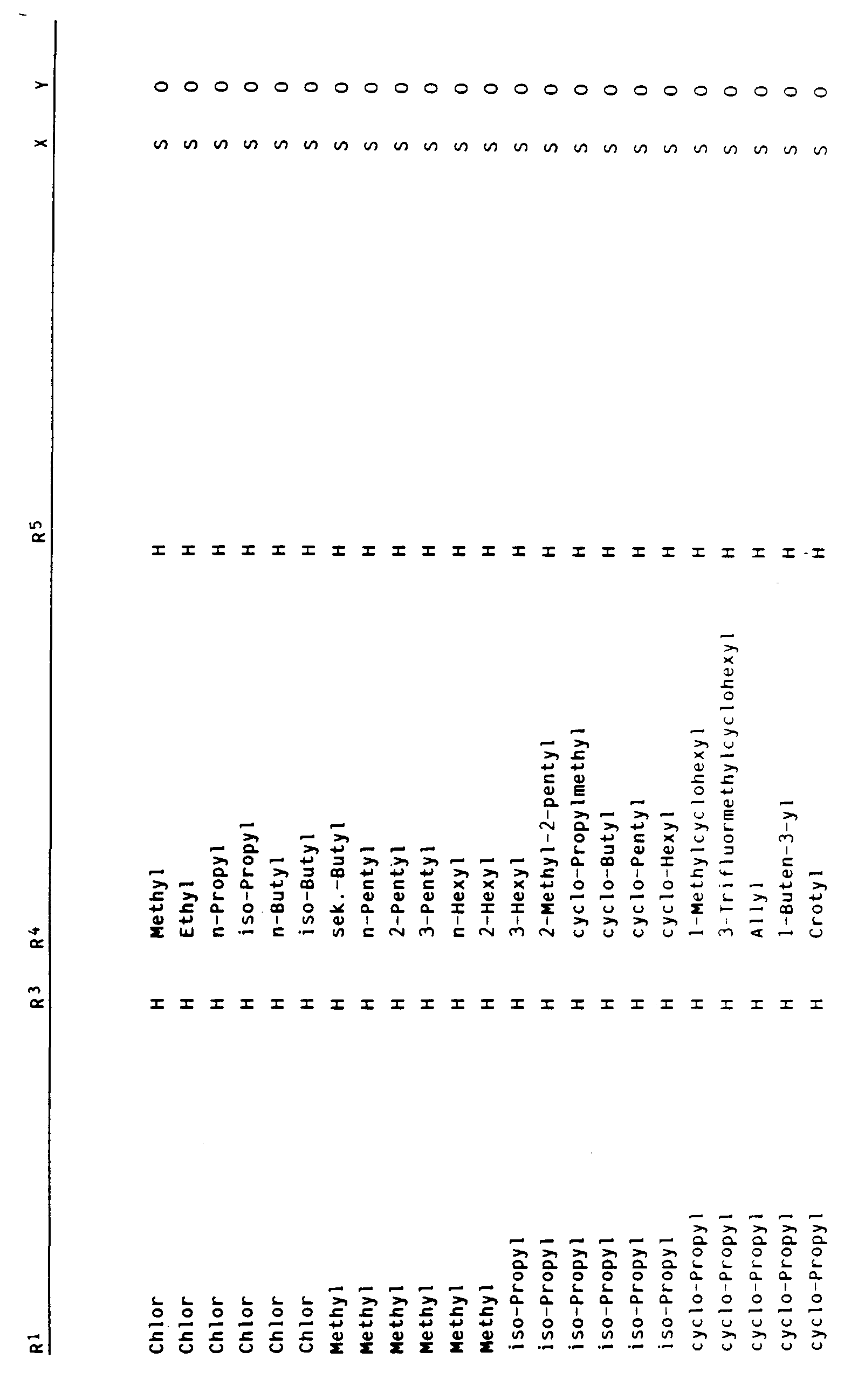


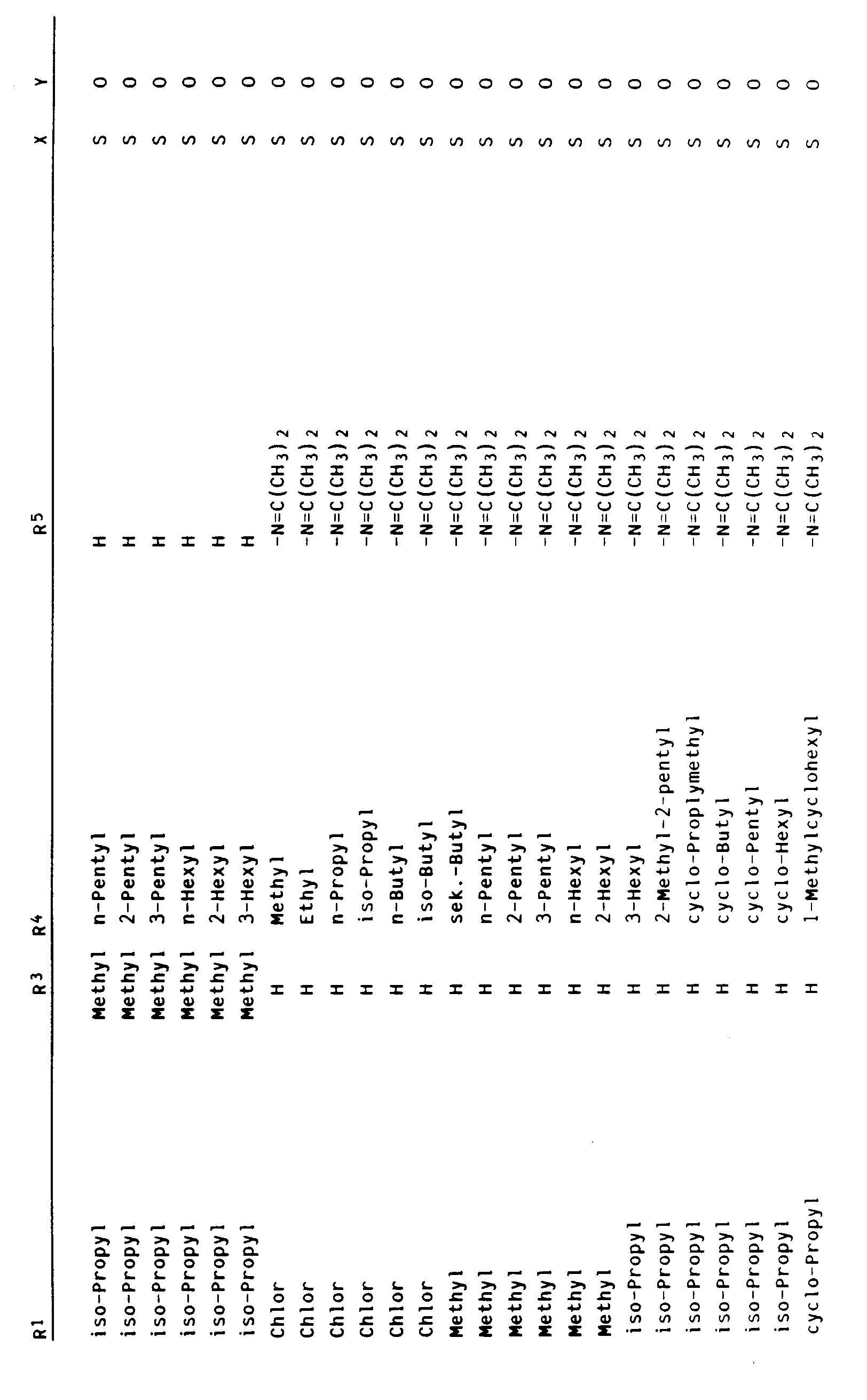


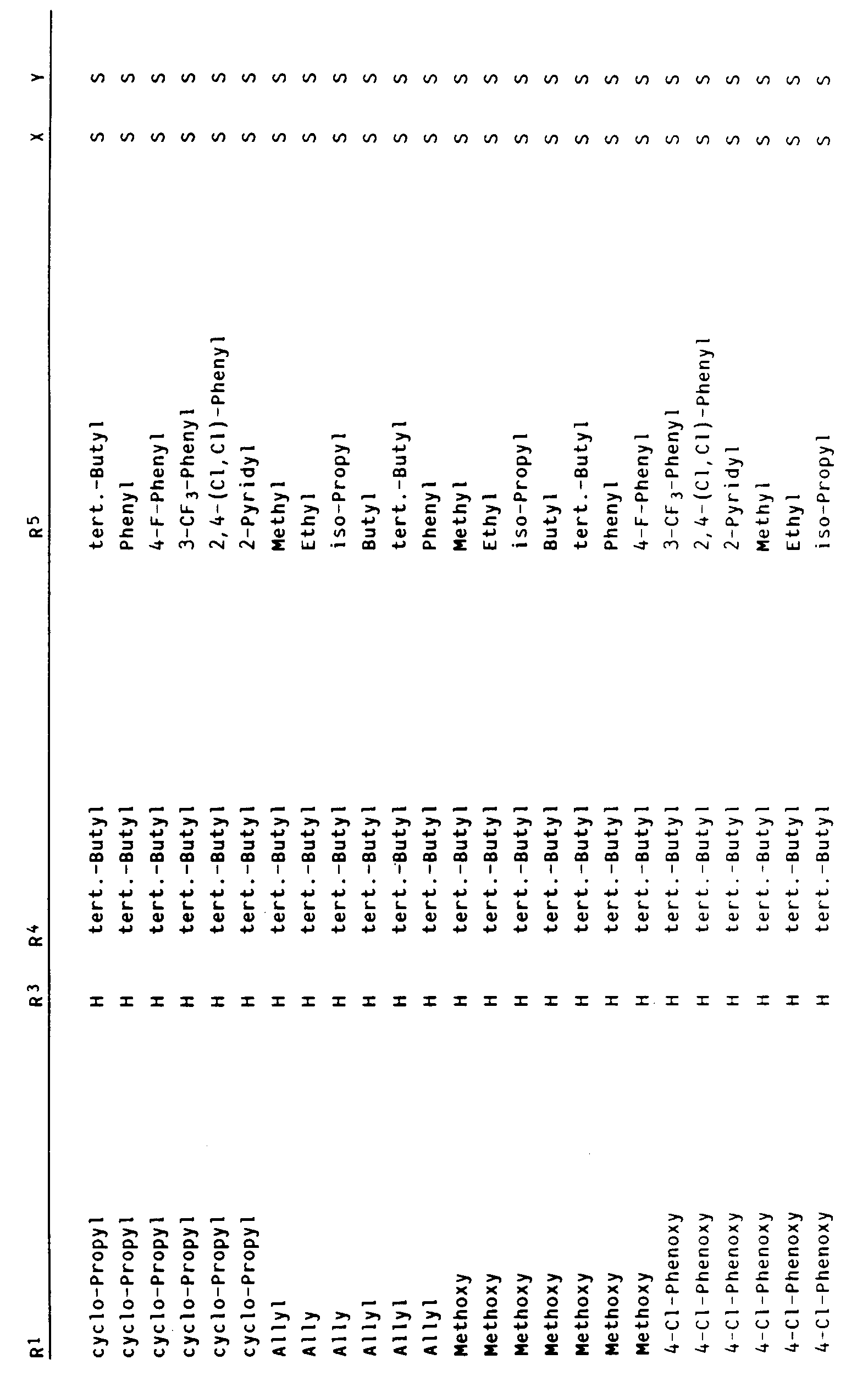


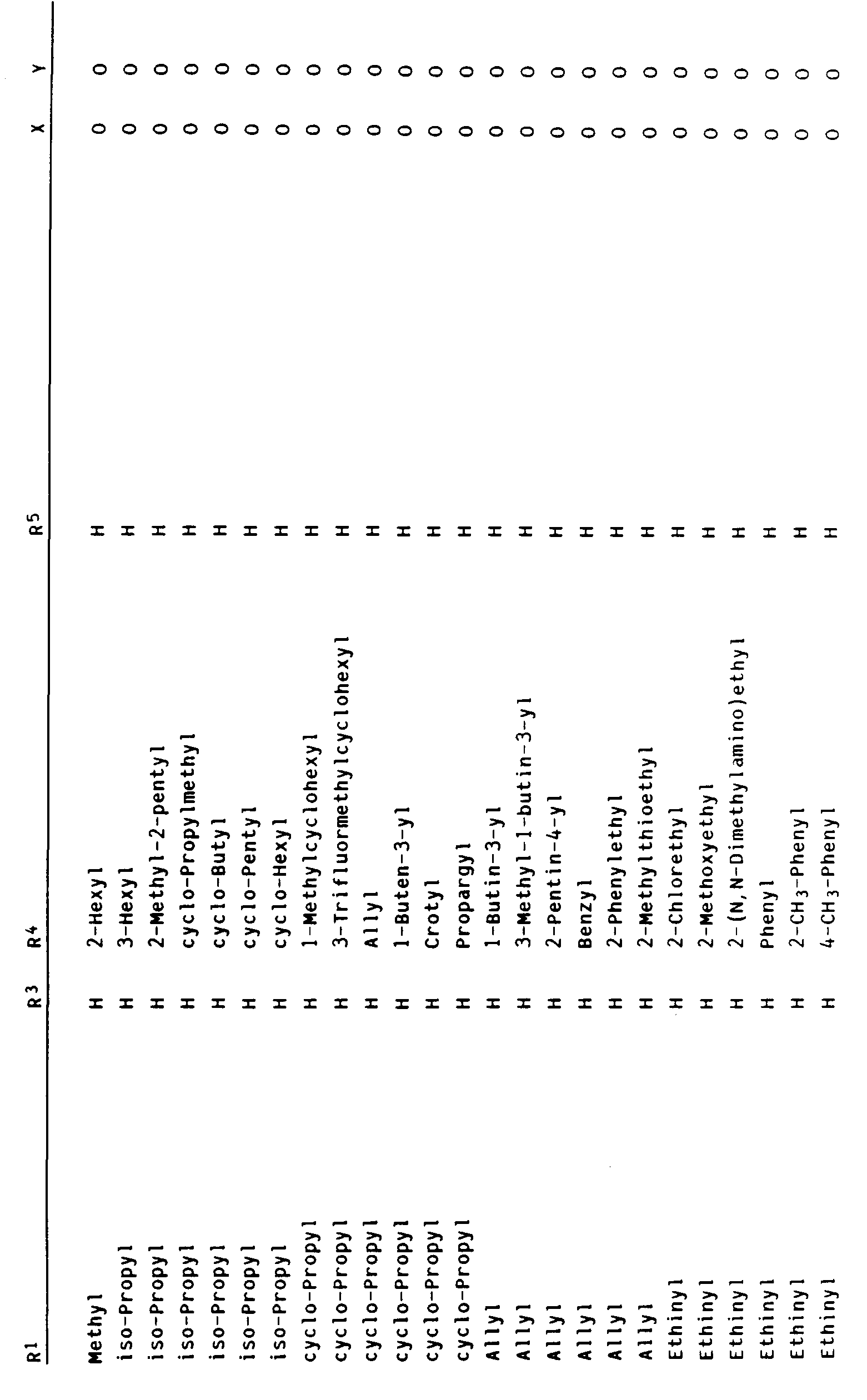


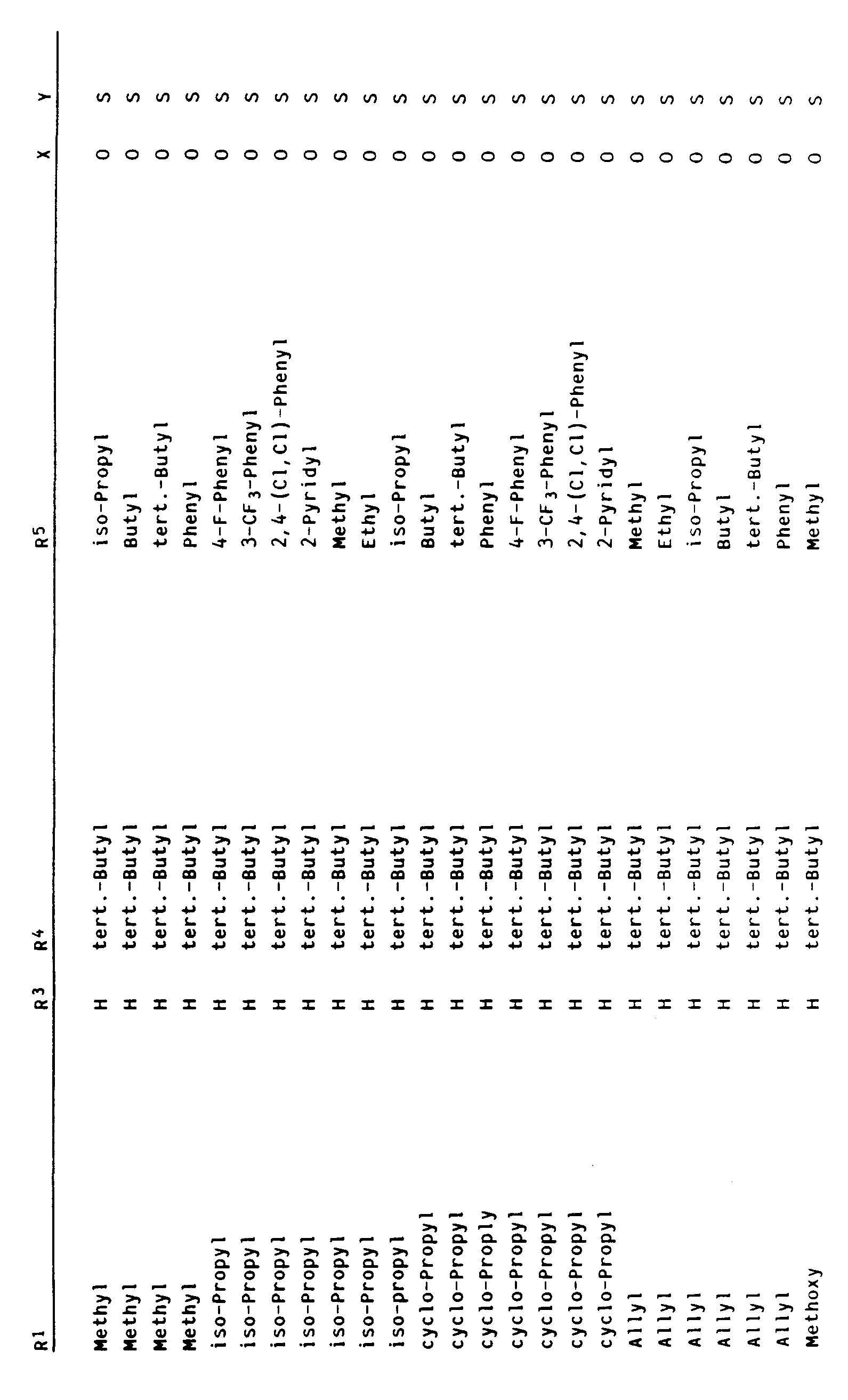


- Die Oxazol- bzw. Thiazolcarbonsäureamide la' und Ib' bzw. die sie enthaltenden herbiziden Mittel können beispielsweise in Form von direkt versprühbaren Lösungen, Pulvern, Suspensionen, auch hochprozentigen wäßrigen, öligen oder sonstigen Suspensionen oder Dispersionen, Emulsionen, Öldispersionen, Pasten, Stäubemitteln, Streumitteln oder Granulaten durch Versprühen, Vernebeln, Verstäuben, Verstreuen oder Gießen angewendet werden. Die Anwendungsformen richten sich nach den Verwendungszwecken; sie sollten in jedem Fall möglichst die feinste Verteilung der erfindungsgemäßen Wirkstoffe gewährleisten.
- Die Verbindungen la' und Ib' eignen sich allgemein zur Herstellung von direkt versprühbaren Lösungen, Emulsionen, Pasten oder Öldispersionen. Als inerte Zusatzstoffe kommen Mineralölfraktionen von mittlerem bis hohem Siedepunkt, wie Kerosin oder Dieselöl, ferner Kohlenteeröle sowie Öle pflanzlichen oder tierischen Ursprungs, aliphatische, cyclische und aromatische Kohlenwasserstoffe, z.B. Toluol, Xylol, Paraffin, Tetrahydronaphthalin, alkylierte Naphthaline oder deren Derivate, Methanol, Ethanol, Propanol, Butanol, Cyclohexanol, Cyclohexanon, Chlorbenzol, Isophoron oder stark polare Lösungsmittel, wie N,N-Dimethylformamid, Dimethylsulfoxid, N-Methylpyrrolidon oder Wasser in Betracht.
- Wäßrige Anwendungsformen können aus Emulsionskonzentraten, Dispersionen, Pasten, netzbaren Pulvern oder wasserdispergierbaren Granulaten durch Zusatz von Wasser bereitet werden. Zur Herstellung von Emulsionen, Pasten oder Öldispersionen können die Substrate als solche oder in einem Öl oder Lösungsmittel gelöst, mittels Netz-, Haft-, Dispergier- oder Emulgiermittel in Wasser homogenisiert werden. Es können aber auch aus wirksamer Substanz, Netz-, Haft-, Dispergier- oder Emulgiermittel und eventuell Lösungsmittel oder Öl bestehende Konzentrate hergestellt werden, die zur Verdünnung mit Wasser geeignet sind.
- Als oberflächenaktive Stoffe kommen die Alkali-, Erdalkali-, Ammoniumsalze von aromatischen Sulfonsäuren, z.B. Lignin-, Phenol-, Naphthalin-und Dibutylnaphthalinsulfonsäure, sowie von Fettsäuren, Alkyl- und Alkylarylsulfonaten, Alkyl-, Laurylether- und Fettalkoholsulfaten, sowie Salze sulfatierter Hexa-, Hepta- und Octadecanolen, sowie von Fettalkoholglykolether, Kondensationsprodukte von sulfoniertem Naphthalin und seiner Derivate mit Formaldehyd, Kondensationsprodukte des Naphthalins bzw. der Naphthalinsulfonsäuren mit Phenol und Formaldehyd, Polyoxyethylenoctylphenolether, ethoxyliertes Isooctyl-, Octyl- oder Nonylphenol, Alkylphenol-, Tributylphenylpolyglykolether, Alkylarylpolyetheralkohole, Isotridecylalkohol, Fettalkoholethylenoxid-Kondensate, ethoxyliertes Rizinusöl, Polyoxyethylenalkylether oder Polyoxypropylen, Laurylalkoholpolyglykoletheracetat, Sorbitester, Lignin-Sulfitablaugen oder Methylcellulose in Betracht.
- Pulver-, Streu- und Stäubemittel können durch Mischen oder gemeinsames Vermahlen der wirksamen Substanzen mit einem festen Trägerstoff hergestellt werden.
- Granulate, z.B. Umhüllungs-, Imprägnierungs- und Homogengranulate können durch Bindung der Wirkstoffe an feste Trägerstoffe hergestellt werden. Feste Trägerstoffe sind Mineralerden wie Silicagel, Kieselsäuren, Kieselgele, Silikate, Talkum, Kaolin, Kalkstein, Kalk, Kreide, Bolus, Löß, Ton, Dolomit, Diatomeenerde, Calcium- und Magnesiumsulfat, Magnesiumoxid, gemahlene Kunststoffe, Düngemittel, wie Ammoniumsulfat, Ammoniumphosphat, Ammoniumnitrat, Harnstoffe und pflanzliche Produkte, wie Getreidemehl, Baumrinden-, Holz- und Nußschalenmehl, Cellulosepulver oder andere feste Trägerstoffe.
- Die Formulierungen enthalten zwischen 0,1 und 95 Gew.%, vorzugsweise zwischen 0,5 und 90 Gew.%, Wirkstoff. Die Wirkstoffe werden dabei in einer Reinheit von 90 % bis 100 %, vorzugsweise 95 % bis 100 % (nach NMR-Spektrum) eingesetzt.
- Die erfindungsgemäßen Verbindungen la und Ib können beispielsweise wie folgt formuliert werden:
- I. Man vermischt 90 Gewichtsteile der Verbindung Nr. 1.003 mit 10 Gewichtsteilen N-Methyl-a-pyrrolidon und erhält eine Lösung, die zur Anwendung in Form kleinster Tropfen geeignet ist.
- 11. 20 Gewichtsteile der Verbindung Nr. 1.010 werden in einer Mischung gelöst, die aus 80 Gewichtsteilen Xylol, 10 Gewichtsteilen des Anlagerungsproduktes von 8 bis 10 Mol Ethylenoxid an 1 Mol Ölsäure-N-monoethanolamid, 5 Gewichtsteilen Calciumsalz der Dodecylbenzolsulfonsäure und 5 Gewichtsteilen des Anlagerungsproduktes von 40 Mol Ethylenoxid an 1 Mol Ricinusöl besteht. Durch Ausgießen und feines Verteilen der Lösung in 100 000 Gewichtsteilen Wasser erhält man eine wäßrige Dispersion, die 0,02 Gew.% des Wirkstoffs enthält.
- 111. 20 Gewichtsteile der Verbindung Nr. 1.004 werden in einer Mischung gelöst, die aus 40 Gewichtsteilen Cyclohexanon, 30 Gewichtsteilen Isobutanol, 20 Gewichtsteilen des Anlagerungsproduktes von 7 Mol Ethylenoxid an 1 Mol Isooctylphenol und 10 Gewichtsteilen des Anlagerungsproduktes von 40 Mol Ethylenoxid an 1 Mol Ricinusöl besteht. Durch Eingießen und feines Verteilen der Lösung in 100 000 Gewichtsteilen Wasser erhält man eine wäßrige Dispersion, die 0,02 Gew.% des Wirkstoffs enthält.
- IV. 20 Gewichtsteile des Wirkstoffs Nr. 1.011 werden in einer Mischung gelöst, die aus 25 Gewichtsteilen Cyclohexanon, 65 Gewichtsteilen einer Mineralölfraktion vom Siedepunkt 210 bis 280 °C und 10 Gewichtsteilen des Anlagerungsproduktes von 40 Mol Ethylenoxid an 1 Mol Ricinusöl besteht. Durch Eingießen und feines Verteilen der Lösung in 100 000 Gewichtsteilen Wasser erhält man eine wäßrige Dispersion, die 0,02 Gew.% des Wirkstoffs enthält.
- V. 20 Gewichtsteile des Wirkstoffs Nr. 1.011 werden mit 3 Gewichtsteilen des Natriumsalzes der Diisobutylnaphthalin-a-sulfonsäure, 17 Gewichtsteilen des Natriumsalzes einer Ligninsulfonsäure aus einer Sulfit-Ablauge und 60 Gewichtsteilen pulverförmigem Kieselsäuregel gut vermischt und in einer Hammermühle vermahlen. Durch feines Verteilen der Mischung in 20 000 Gewichtsteilen Wasser erhält man eine Spritzbrühe, die 0,1 Gew.% des Wirkstoffs enthält.
- Vl. 3 Gewichtsteile des Wirkstoffs Nr. 1.003 werden mit 97 Gewichtsteilen feinteiligem Kaolin vermischt. Man erhält auf diese Weise ein Stäubemittel, das 3 Gew.% des Wirkstoffs enthält.
- VII. 30 Gewichtsteile des Wirkstoffs Nr. 1.004 werden mit einer Mischung aus 92 Gewichtsteilen pulverförmigem Kieselsäuregel und 8 Gewichtsteilen Paraffinöl, das auf die Oberfläche dieses Kieselsäuregels gesprüht wurde, innig vermischt. Man erhält auf diese Weise eine Aufbereitung des Wirkstoffs mit guter Haftfähigkeit.
- VIII. 20 Gewichtsteile des Wirkstoffs Nr. 1.010 werden mit 2 Gewichtsteilen Calciumsalz der Dodecylbenzolsulfonsäure, 8 Gewichtsteilen Fettalkohol-polyglykolether, 2 Gewichtsteilen Natriumsalz eines Phenol-Harnstoff-Formaldehyd-Kondensates und 68 Gewichtsteilen eines paraffinischen Mineralöls innig vermischt. Man erhält eine stabile ölige Dispersion.
- Die Applikation der herbiziden Mittel bzw. der Wirkstoffe kann im Vorauflauf- oder im Nachauflaufverfahren erfolgen. Sind die Wirkstoffe für gewisse Kulturpflanzen weniger verträglich, so können Ausbringungstechniken angewandt werden, bei welchen die herbiziden Mittel mit Hilfe der Spritzgeräte so gespritzt werden, daß die Blätter der empfindlichen Kulturpflanzen nach Möglichkeit nicht getroffen werden, während die Wirkstoffe auf die Blätter darunter wachsender unerwünschter Pflanzen oder die unbedeckte Bodenfläche gelangen (post-directed, lay-by).
- Die Aufwandmengen an Wirkstoff betragen je nach Bekämpfungsziel, Jahreszeit, Zielpflanzen und Wachstumsstadium 0,001 bis 5, vorzugsweise 0,01 bis 2 kg/ha aktive Substanz (a.S.).
- In Anbetracht der Vielseitigkeit der Applikationsmethoden können die erfindungsgemäßen Verbindungen bzw. sie enthaltende Mittel in einer großen Zahl von Kulturpflanzen zur Beseitigung unerwünschter Pflanzen eingesetzt werden.
- Zur Verbreiterung des Wirkungsspektrums und zur Erzielung synergistischer Effekte können die Oxazol- bzw. Thiazolcarbonsäureamide la und Ib mit zahlreichen Vertretern anderer herbizider oder wachstumsregulierender Wirkstoffgruppen gemischt und gemeinsam ausgebracht werden. Beispielsweise kommen als Mischungspartner Diazine, 4H-3,1-Benzoxazinderivate, Benzothiadiazinone, 2,6-Dinitroaniline, N-Phenylcarbamate, Thiolcarbamate, Halogencarbonsäuren, Triazine, Amide, Harnstoffe, Diphenylether, Triazinone, Uracile, Benzofuranderivate, Cyclohexan-1,3-dionderivate, Chinolincarbonsäurederivate, Aryloxy- , Heteroaryloxyphenoxypropionsäuren sowie deren Salze, Ester und Amide und andere in Betracht.
- Außerdem kann es von Nutzen sein, die Verbindungen la und Ib allein oder in Kombination mit anderen Herbiziden auch noch mit weiteren Pflanzenschutzmitteln gemischt gemeinsam auszubringen, beispielsweise mit Mitteln zur Bekämpfung von Schädlingen oder phytopathogenen Pilzen bzw. Bakterien. Von Interesse ist ferner die Mischbarkeit mit Mineralsalzlösungen, welche zur Behebung von Ernährungs-und Spurenelementmängeln eingesetzt werden. Es können auch nichtphytotoxische Öle und Ölkonzentrate zugesetzt werden.
- Die in den nachstehenden Synthesebeispielen wiedergegebenen Vorschriften wurden unter entsprechender Abwandlung der Ausgangsverbindungen zur Gewinnung weiterer Verbindungen benutzt. Die so erhaltenen Verbindungen sind in den nachstehenden Tabellen mit physikalischen Angaben aufgeführt.
- Zu 33,8 g (0,15 mol) 2-Methyl-oxazol-4, 5-dicarbonsäureester in 300 ml Ethanol tropfte man bei -10°C unter N2 innerhalb von 4 h eine Lösung von 6,0 g (0,15 mol) Natriumhydroxid in 150 ml Wasser und rührte 2 h bei -10 ° C nach. Man engte die Lösung ein, nahm den Rückstand in 300 ml Wasser auf, stellte mit Salzsäure auf pH = 8 bis 9 ein und extrahierte zweimal mit je 300 ml Diethylether. Anschließend säuerte man mit konz. HCI auf pH = 2 an und extrahierte die wäßrige Phase viermal mit je 250 ml Dichlormethan. Die vereinigten organischen Phasen wurden über Magnesiumsulfat getrocknet und das Solvens im Vakuum abgezogen. Man erhielt 26,4 g (88 %) 4(5)-Ethoxycarbonyl-2-methyl-oxazol-5-(4)-carbonsäure als weißen Feststoff (Isomerenverhältnis: 3:1 ('H-NMR, HPLC). Zu isomerenreiner 4-Ethoxycarbonyl-2-methyl-oxazol-5-carbonsäure gelangte man durch fraktionierte Kristallisation aus Cyclohexan/ Ethylacetat 2:1 oder Säulenchromatographie an Kieselgel (Lösungsmittel: Toluol, THF, Eisessig (7:3:1). 1 H-NMR (250 MHz, D6-DMSO); Hauptisomer: 0 = 1,28 (t; 3H), 2,52 (s; 3H), 4,30 (q; 2H), 14,00 (bs; 1 H).
- Eine Lösung von 7,00 g (25 mmol) 2-Methylthio-thiazol-4,5-dicarbonsäurediethylester in 100 ml Ethanol/Wasser (2:1) wurde bei Raumtemperatur innerhalb von einer Stunde mit einer Lösung von 1,10 g (27,5 mmol) Natriumhydroxid in 10 ml Wasser versetzt. Man rührte eine Stunde nach, entfernte dann das Lösungsmittelgemisch im Vakuum, nahm den Rückstand mit 100 ml Wasser auf, extrahierte einmal mit 50 ml Diethylether und säuerte die wäßrige Phase mit konzentrierter Salzsäure an. Das ausgefallene Produkt wurde abgesaugt und getrocknet.
- Ausbeute: 4,50 g (73 %). Schmelzpunkt: 104 ° C.
- Die in der folgenden Tabelle genannten Carbonsäuren wurden gemäß dem vorstehenden Beispiel erhalten:

- Eine Lösung von 9,2 g (0,03 mol) 2-Chlor-thiazol-4,5-dicarbonsäure-diethylester in 30 ml Ethanol wurde bei 0 ° C tropfenweise mit einer Lösung von 2,1 g (0,03 mol) Natrium-methylthiolat in 10 ml Ethanol versetzt. Man ließ das Gemisch auf 25 ° C erwärmen und rührte zwei Stunden nach. Danach entfernte man das Lösungsmittel bei vermindertem Druck, nahm den Rückstand in 100 ml Diethylether auf und wusch nacheinander mit je 50 ml 5 %iger Natronlauge und Wasser. Man trocknete über Natriumsulfat, engte ein und behielt 7,2 g (87 %) Produkt als farbloses Öl zurück.
- 1H-NMR (CDCl3, 250 MHz, TMS als interner Standard): 1,35 (t, J=7,0 Hz, 3H), 1,45 (t, J=7,0 Hz; 3H), 2,75 (s, 3H), 4,30 (q, J = 7,0 Hz; 2H), 4,50 (q, J = 7,0 Hz; 2H).
-

- Eine Lösung von 12,00 g (46 mmol) 2-Brom-thiazol-4-carbonsäure-tert.-butylamid in 150 ml Methanol wurde bei 25 ° C mit 8,90 g einer 30 %igen Lösung (49 mmol) von Natriummethanolat in Methanol versetzt. Man hielt das Gemisch vier Stunden unter Rückfluß auf Siedetemperatur, engte dann die klare Lösung ein, nahm den Rückstand in 300 ml Diethylether auf, filtrierte und entfernte das Lösungsmittel bei vermindertem Druck. Man erhielt 9,60 g (98 %) Produkt als gelbes Öl.
- 1H-NMR (CDCl3, 250 MHz, TMS als interner Standard): 1,45 (s; 9H), 4,10 (s; 3H), 7,00 (s, breit, 1H), 7,48 (s; 1 H).
- Zu einer Lösung von 31,0 g (0,20 mol) 2-Isopropyl-oxazol-4-carbonsäure in 200 ml Toluol und 2 ml Dimethylformamid tropfte man bei Raumtemperatur 47,6 g (0,40 mol) Thionylchlorid und rührte 1 h bei 80 ° C. Man zog die Solventien im Vakuum ab, löste den Rückstand in 300 ml Dichlormethan und tropfte bei 0 bis 10 ° C 24,0 g (0,42 mol) Cyclopropylamin in 20 ml Dichlormethan zu. Man rührte 12 h bei Raumtemperatur, gab 150 ml Wasser zu, trennte die Phasen, wusch die organische Phase einmal mit gesättigter Natriumhydrogencarbonatlösung, trocknete über Magnesiumsulfat und zog das Solvens im Vakuum ab. Man erhielt 37,2 g (96 %) 2-Isopropyl-oxazol-4-carbonsäure-cyclopropylamid.
- 1H-NMR (CDCl3, 250 MHz): A = 0,62 (m; 2H), 0,88 (m; 2H), 1,34 (d; 6H), 2,86 (m; 1H), 3,09 (m; 1H), 6,93 (bs; 1 H; NH), 8,09 (s; 1 H).
- Die in der folgenden Tabelle genannten Amide wurden gemäß den vorstehenden Beispielen oder analog der zitierten Literatur erhalten:


- Zu einer Lösung von 10,4 g (0,054 mol) 2-Isopropyl-oxazol-4-carbonsäure-cyclopropylamid in 250 ml Tetrahydrofuran tropfte man unter Stickstoffatmosphäre bei -70 ° C 0,12 mol n-Butyllithium (80,0 ml einer 1,5 molaren Lösung in Hexan) und rührte 30 min bei dieser Temperatur. Anschließend goß man das Reaktionsgemisch auf 500 g festes C02 und ließ über Nacht stehen. Man engte ein, nahm den Rückstand in 200 ml Wasser und 30 ml 2H NaOH auf, extrahierte zweimal mit je 100 ml Diethylether, säuerte die wäßrige Phase mit konz. Salzsäure auf pH 2 an und extrahierte dreimal mit je 200 ml Ethylacetat. Man trocknete über Magnesiumsulfat und zog das Solvens im Vakuum ab.
- Man erhielt 10,4 g (81 %) 4-Cyclopropylaminocarbonyl-2-isopropyl-oxazol-5-carbonsäure als weißes Pulver vom Smp. 109 bis 112 ° C.
- (Wirkstoffbeispiel 3.007).
- Zu einer Lösung von 8,00 g (37 mmol) 2-Methoxy-thiazol-4-carbonsäure-tert.-butylamid in 150 ml Tetrahydrofuran tropfte man bei -70 ° C 65 ml einer 1,5 m Lösung (97 mmol) von n-Butyllithium in n-Hexan und rührte 30 Minuten bei dieser Temperatur. Anschließend goß man das Reaktionsgemisch auf 500 g festes Kohlendioxid und ließ innerhalb von 14 Stunden auf Raumtemperatur erwärmen. Man entfernte das Lösungsmittel im Vakuum, nahm den Rückstand in einer Mischung aus 150 ml Wasser und 16 ml 2 m Natronlauge auf, filtrierte, säuerte das Filtrat mit konzentrierter Salzsäure an und saugte die ausgefallene Carbonsäure ab.
- Man erhielt 7,80 g (82 %) 4-tert.-Butylaminocarbonyl-2-methoxythiazol-5-carbonsäure als weißes Pulver vom Fp.: 120 bis 122 ° C.
- (Wirkstoffbeispiel 1.003).
- Zu einer Lösung von 5,4 g (25,2 mmol) 2-Methoxy-thiazol-4-carbonsäure-tert.-butylamid in 150 ml Tetrahydrofuran tropfte man unter Stickstoffatmosphäre bei -70 ° C 56 mmol n-Butyllithium (37,3 ml einer 1,5 molaren Lösung in Hexan) und rührte 30 min bei dieser Temperatur. Anschließend goß man das Reaktionsgemisch auf 500 g festes C02 und ließ über Nacht stehen. Man engte ein, nahm den Rückstand in 150 ml Wasser und 10 ml 2N NaOH auf, extrahierte zweimal mit je 50 ml Diethylether, säuerte die wäßrige Phase mit konz. Salzsäure auf pH 2 an und extrahierte dreimal mit je 100 ml Ethylacetat. Man trocknete über Magnesiumsulfat und zog das Solvens im Vakuum ab.
- Man erhielt 3,9 g (60 %) 5-tert.-Butylaminocarbonyl-2-methoxy-thiazol-4-carbonsäure als weißes Pulver vom Smp. 105 bis 110 ° C.
- (Wirkstoffbeispiel 2.001)
- Zu 12,2 g (61,3 mmol) 4-Ethoxycarbonyl-2-methyl-oxazol-5-carbonsäure tropfte man bei 0 ° C 40 ml Thionylchlorid und 1 ml Dimethylformamid und erhitzte 1 h unter Rückfluß. Man zog das überschüssige Thionylchlorid im Vakuum ab und destillierte den Rückstand im Ölpumpenvakuum.
- Man erhielt 10,9 g (82 %) 4-Ethoxycarbonyl-2-methyl-oxazol-5-carbonsäurechlorid als gelbes Öl vom Sdp. 103 bis 105°C/0,1 Torr. 1H-NMR (250 MHz, CDCl3): 0 = 1,42 (t; 3H), 2,66 (s; 3H), 4,66 (q; 2H).
- Zu 10,9 g (50,3 mmol) 4-Ethoxycarbonyl-2-methyl-oxazol-5-carbonsäurechlorid in 150 ml Dichlormethan tropfte man bei 0 ° C eine Lösung von 11,0 g (150 mmol) tert.-Butylamin in 20 ml Dichlormethan und rührte 12 h bei Raumtemperatur. Man nahm das Reaktionsgemisch in 200 ml Wasser auf, trennte die Phasen, wusch die organische Phase einmal mit gesättigter Natriumhydrogencarbonatlösung sowie gesättigter Natriumchloridlösung, trocknete über Magnesiumsulfat und zog das Solvens im Vakuum am Rotationsverdampfer ab.
- Man erhielt 11,9 g (93 %) 4-Ethoxycarbonyl-2-methyl-oxazol-5-carbonsäure-tert.-butylamid als weißen Feststoff vom Smp. 152 bis 155 ° C.
- (Wirkstoffbeispiel 4.001).
- Zu 7,4 g (29,1 mmol) 4-Ethoxycarbonyl-2-methyl-oxazol-5-carbonsäure-tert.-butylamid in 150 ml Ethanol und 50 ml THF tropfte man bei 0 ° C unter N2 eine Lösung von 1,2 g (30,0 mmol) Natriumhydroxid in 50 ml Wasser. Man rührte 2 h bei 20 °C, zog die Solventien am Rotationsverdampfer im Vakuum ab, nahm den Rückstand in 300 ml Wasser auf, stellte auf pH = 9 ein und extrahierte die wäßrige Phase dreimal mit je 100 ml Diethylether. Anschließend säuerte man mit 6N HCI auf pH = 2 an und extrahierte viermal mit je 150 ml Dichlormethan. Die organische Phase wurde über Natriumsulfat getrocknet und das Solvens im Vakuum abgezogen.
- Man erhielt 6,1 g (93 %) 5-tert.-Butylaminocarbonyl-2-methyl-oxazol-4-carbonsäure als weißen Feststoff vom Smp. 186 bis 188 ° C.
- (Wirkstoffbeispiel 4.002).
- 3,40 g (13,7 mmol) 4-Ethoxycarbonyl-2-methylthio-thiazol-5-carbonsäure wurden in 50 ml Thionylchlorid gelöst und bis zur Beendigung der Gasentwicklung zum Rückfluß erhitzt. Man entfernte überschüssiges Thionylchlorid im Vakuum und behielt 3,55 g (98 %) Säurechlorid als farbloses Öl zurück.
- 1H-NMR (CDCl3, 250 MHz, TMS als interner Standard): 1,50 (t, J=7,0 Hz; 3H), 2,75 (s; 3H), 4,60 (q, J = 7,0 Hz; 2H). b) 4-Ethoxycarbonyl-2-methylthio-thiazol-5-carbonsäure-tert.-butylamid
- 3,50 g (13,2 mmol) 4-Ethoxycarbonyl-2-methylthio-thiazol-5-carbonsäurechlorid wurden in 20 ml Dichlormethan gelöst und bei 0 ° C zu einer Lösung von 3,20 g (44 mmol) tert.-Butylamin in 50 ml Dichlormethan getropft. Man ließ das Gemisch auf Raumtemperatur erwärmen, rührte 14 Stunden nach und gab dann 100 ml 10 %ige Salzsäure zu. Die organische Phase wurde abgetrennt, mit 50 ml Wasser gewaschen und über Natriumsulfat getrocknet. Man entfernte das Lösungsmittel im Vakuum und behielt 4,00 g (100 %) Produkt als gelben Kristallbrei zurück.
- 1H-NMR (CDCl3, 250 MHz, TMS als interner Standard): 1,45 (t, J=7,0 Hz; 3H), 1,45 (s; 9H), 2,75 (s; 3H), 4,50 (q, J = 7,0 Hz; 2H), 9,90 (s, breit; 1 H).
- (Wirkstoffbeispiel 2.007)
- 4,00 g (13,2 mmol) 4-Ethoxycarbonyl-2-methylthio-thiazol-5-carbonsäure-tert.-butylamid wurden in 50 ml Wasser/Ethanol (2:1) gelöst, mit 0,82 g (14,6 mmol) Kaliumhydroxid in 10 ml Wasser versetzt und zwei Stunden zum Rückfluß erhitzt. Anschließend entfernte man das Lösungsmittelgemisch im Vakuum, nahm den Rückstand mit 50 ml Wasser auf und säuerte mit konzentrierter Salzsäure an. Das ausgefallene Produkt wurde abgesaugt und getrocknet.
- Ausbeute: 3,40 g (94 %); Schmelzpunkt: 100 ° C. (Wirkstoffbeispiel 2.005).
- Zu einer Lösung von 3,1 g (12,0 mmol) 4-tert.-Butylaminocarbonyl-2-methoxy-thiazol-5-carbonsäure und 1,2 g (16,4 mmol) Acetonoxim in 100 ml Dichlormethan tropfte man bei Raumtemperatur 4,4 g (43,6 mmol) 4-Methylmorpholin sowie 1,5 g (12,3 mmol) 4-Dimethylaminopyridin und rührte 5 min. Anschließend fügte man 10,1 g einer 50 %igen Lösung von Propanphosphonsäureanhydrid in Dichlormethan (= 15,9 mmol) zu und erhitzte 7 h unter Rückfluß. Man engte ein, nahm den Rückstand in 100 ml Ethylacetat auf, extrahierte zweimal mit gesättigter Nariumhydrogencarbonatlösung sowie je einmal mit 5 %iger Zitronensäurelösung, gesättigter Natriumcarbonatlösung und gesättigter Natriumchloridlösung. Die organische Phase wurde über Magnesiumsulfat getrocknet und das Solvens im Vakuum abgezogen.
- Man erhielt 3,1 g (82 %) 4-tert.-Butylaminocarbonyl-2-methoxy-thiazol-5-carbonsäure-acetonoximester als weißes Pulver vom Smp. 128 bis 131 ° C.
- Zu einer Lösung von 3,80 g (16,8 mmol) 5-tert.-Butylamino-carbonyl-2-methyl-oxazol-4-carbonsäure und 1,23 g (16,8 mmol) Acetonoxim in 40 ml Tetrahydrofuran tropfte man bei Raumtemperatur 3,46 9 (16,8 mmol) Dicyclohexylcarbodiimid in 20 ml Tetrahydrofuran. Man rührte 14 h, saugte den ausgefallenen Niederschlag ab, zog das Solvens im Vakuum ab und chromatographierte den Rückstand an Kieselgel (Lösungsmittel: Cyclohexan:Ethylacetat (1:1)). Man erhielt 2,7 g (57 %) 5-tert.-Butylaminocarbonyl-2-methyl-oxazol-4-carbonsäure-acetonoximester als weißen Feststoff vom Smp. 107 bis 111 ° C.
- (Wirkstoffbeispiel 4.003).
- Die in den folgenden Tabellen aufgeführten Wirkstoffe wurden analog zu den voranstehenden Verbindungen hergestellt.


- Die herbizide Wirkung der Oxazol- bzw. Thiazolcarbonsäureamide der Formeln la' und Ib' ließ sich durch Gewächshausversuche zeigen: Als Kulturgefäße dienten Plastikblumentöpfe mit lehmigem Sand mit etwa 3,0 % Humus als Substrat. Die Samen der Testpflanzen wurden nach Arten getrennt eingesät.
- Bei Vorauflaufbehandlung wurden die in Wasser suspendierten oder emulgierten Wirkstoffe direkt nach Einsaat mittels fein verteilender Düsen aufgebracht. Die Gefäße wurden leicht beregnet, um Keimung und Wachstum zu fördern und anschließend mit durchsichtigen Plastikhauben abgedeckt, bis die Pflanzen angewachsen waren. Diese Abdeckung bewirkt ein gleichmäßiges Keimen der Testpflanzen, sofern dies nicht durch die Wirkstoffe beeinträchtigt wurde.
- Zum Zwecke der Nachauflaufbehandlung wurden die Testpflanzen je nach Wuchsform erst bei einer Wuchshöhe von 3 bis 15 cm mit den in Wasser suspendierten oder emulgierten Wirkstoffen behandelt. Die Aufwandmenge für die Nachauflaufbehandlung betrug 1,0 kg/ha a.S.
- Die Pflanzen wurden artenspezifisch bei Temperaturen von 10-25 ° C bzw. 20-35 ° C gehalten. Die Versuchsperiode erstreckte sich über 2 bis 4 Wochen. Während dieser Zeit wurden die Pflanzen gepflegt und ihre Reaktion auf die einzelnen Behandlungen wurde ausgewertet.
- Bewertet wurde nach einer Skala von 0 bis 100. Dabei bedeutet 100 kein Aufgang der Pflanzen bzw. völlige Zerstörung zumindest der oberirdischen Teile und 0 keine Schädigung oder normaler Wachstumsverlauf.
- Die in den Gewächshausversuchen verwendeten Pflanzen setzten sich aus folgenden Arten zusammen:

- Mit 1,0 kg/ha a.S. im Nachauflaufverfahren eingesetzt, lassen sich mit den Beispielen 1.001, 1.003, 1.004, 1.009, 1.010, 1.011, 3,002, 3,005 und 3,024 breitblättrige unerwünschte Pflanzen sehr gut bekämpfen. Verbindungen 1.001, 1.003 und 1.009 zeigen gleichzeitig Kulturpflanzenverträglichkeit an Weizen. Verbindung 3.005 wird sehr gut von der Kulturpflanze Mais toleriert.
Claims (11)

R3 und R4 gemeinsam einen Rest der Struktur -(CH2)n-Yp-(CH2)q-, wobei n und q 1, 2 oder 3, p O oder 1 und Y Sauerstoff, Schwefel oder N-Methyl bedeuten oder den Rest der Formel (CH2)3-CO- bilden, sowie deren umweltverträgliche Salze, ausgenommen Verbindungen der Formel la, in der R1 für unsubstituiertes Ethyl steht, wenn gleichzeitig X = Schwefel, R2 = COOH, R3 Wasserstoff und R4 eine C1-C4-Dialkylamino-C1-C3-alkylgruppe bedeuten.


R3 und R4 gemeinsam einen Rest der Struktur -(CH2)n-Yp-(CH2)q-, wobei n und q 1, 2 oder 3, p 0 oder 1 und Y Sauerstoff, Schwefel oder N-Methyl bedeuten oder den Rest der Formel -(CH2)3-CO- bilden, behandelt.
Applications Claiming Priority (2)
| Application Number | Priority Date | Filing Date | Title |
|---|---|---|---|
| DE3932052 | 1989-09-26 | ||
| DE3932052A DE3932052A1 (de) | 1989-09-26 | 1989-09-26 | Oxazol- bzw. thiazolcarbonsaeureamide |
Publications (3)
| Publication Number | Publication Date |
|---|---|
| EP0419944A2 EP0419944A2 (de) | 1991-04-03 |
| EP0419944A3 EP0419944A3 (en) | 1991-07-17 |
| EP0419944B1 true EP0419944B1 (de) | 1995-03-15 |
Family
ID=6390195
Family Applications (1)
| Application Number | Title | Priority Date | Filing Date |
|---|---|---|---|
| EP90117567A Expired - Lifetime EP0419944B1 (de) | 1989-09-26 | 1990-09-12 | Oxazol- bzw. Thiazolcarbonsäureamide |
Country Status (8)
| Country | Link |
|---|---|
| EP (1) | EP0419944B1 (de) |
| JP (1) | JPH03145478A (de) |
| KR (1) | KR910006254A (de) |
| BR (1) | BR9004803A (de) |
| CA (1) | CA2026131A1 (de) |
| DE (2) | DE3932052A1 (de) |
| HU (1) | HU207058B (de) |
| IL (1) | IL95775A0 (de) |
Cited By (2)
| Publication number | Priority date | Publication date | Assignee | Title |
|---|---|---|---|---|
| US6936629B2 (en) | 2001-12-21 | 2005-08-30 | Virochem Pharma Inc. | Compounds and methods for the treatment or prevention of flavivirus infections |
| AU2005299112B2 (en) * | 2004-10-21 | 2011-10-27 | Merck Patent Gmbh | Heterocyclic carbonyl compounds |
Families Citing this family (22)
| Publication number | Priority date | Publication date | Assignee | Title |
|---|---|---|---|---|
| DE69409377T2 (de) * | 1993-05-27 | 1998-07-23 | Shell Int Research | Herbizide thiazole-derivate |
| JPH0812653A (ja) * | 1994-04-26 | 1996-01-16 | Nissan Chem Ind Ltd | カルボン酸オキシムエステル誘導体および農園芸用殺菌剤 |
| FR2757856B1 (fr) * | 1996-12-27 | 2000-06-02 | American Cyanamid Co | Compose, procede pour sa preparation, composition herbicide le contenant, et son utilisation |
| WO2004056746A1 (en) | 2002-12-23 | 2004-07-08 | 4Sc Ag | Cycloalkene dicarboxylic acid compounds as anti-inflammatory, immunomodulatory and anti-proliferatory agents |
| US7365094B2 (en) | 2002-12-23 | 2008-04-29 | 4Sc Ag | Compounds as anti-inflammatory, immunomodulatory and anti-proliferatory agents |
| DK1578741T3 (da) * | 2002-12-23 | 2011-09-26 | 4Sc Ag | Aromatiske forbindelser som anti-inflammatoriske, immunmodulatoriske og anti-proliferative midler |
| JP4869072B2 (ja) * | 2003-11-14 | 2012-02-01 | バーテックス ファーマシューティカルズ インコーポレイテッド | Atp結合カセットトランスポーターのモジュレーターとして有用なチアゾールおよびオキサゾール |
| KR101394245B1 (ko) | 2005-12-30 | 2014-05-14 | 에스케이바이오팜 주식회사 | 아이속사졸 유도체 및 이의 용도 |
| BRPI0710479A2 (pt) | 2006-01-18 | 2012-08-14 | Hoffmann La Roche | composto, processo para sua preparaÇço, composiÇço farmacÊutica, uso de um composto e mÉtodo de tratamento de doenÇa ou desosrdem metabàlica. |
| CN101835377B (zh) | 2007-08-27 | 2014-12-10 | 巴斯夫欧洲公司 | 用于防治无脊椎动物害虫的吡唑化合物 |
| KR101364869B1 (ko) | 2008-09-24 | 2014-02-21 | 바스프 에스이 | 무척추 해충을 방제하기 위한 피라졸 화합물 |
| ES2461618T3 (es) | 2009-07-06 | 2014-05-20 | Basf Se | Compuestos de piridacina para el control de plagas de invertebrados |
| EP2451804B1 (de) | 2009-07-06 | 2014-04-30 | Basf Se | Pyridazinverbindungen zur bekämpfung von wirbellosen schädlingen |
| JP2013500246A (ja) | 2009-07-24 | 2013-01-07 | ビーエーエスエフ ソシエタス・ヨーロピア | 無脊椎動物系害虫防除用ピリジン誘導体化合物 |
| MX2014014323A (es) | 2012-05-25 | 2015-02-12 | Janssen R & D Ireland | Nucleosidos de espirooxetano de uracilo. |
| BR112015014457A2 (pt) | 2012-12-21 | 2017-11-21 | Alios Biopharma Inc | composto ou sal farmaceuticamente aceitável do mesmo e composição farmacêutica e respectivos usos e processos para melhorar ou tratar infecção de hcv, para inibir a atividade da ns5b polimerase do vírus da hepatite c e a replicação de vírus da hepatite c |
| CN112159417B (zh) * | 2018-05-08 | 2023-06-13 | 湘潭大学 | 一种噻吩并噻唑及衍生物及其合成方法 |
| TWI883391B (zh) | 2020-02-18 | 2025-05-11 | 美商基利科學股份有限公司 | 抗病毒化合物 |
| TWI775313B (zh) | 2020-02-18 | 2022-08-21 | 美商基利科學股份有限公司 | 抗病毒化合物 |
| KR20250133471A (ko) | 2020-02-18 | 2025-09-05 | 길리애드 사이언시즈, 인코포레이티드 | 항바이러스 화합물 |
| CA3216162A1 (en) | 2021-04-16 | 2022-10-20 | Gilead Sciences, Inc. | Methods of preparing carbanucleosides using amides |
| AU2022328698B2 (en) | 2021-08-18 | 2025-02-20 | Gilead Sciences, Inc. | Phospholipid compounds and methods of making and using the same |
Family Cites Families (4)
| Publication number | Priority date | Publication date | Assignee | Title |
|---|---|---|---|---|
| FR1516777A (fr) * | 1966-08-02 | 1968-02-05 | Innothera Lab Sa | Dérivés du thiazole ainsi que de la thiazolo [4,5-d] pyridazine et leur préparation |
| CA962269A (en) * | 1971-05-05 | 1975-02-04 | Uniroyal Ltd. | Thiazoles, and their use as insecticides |
| BE791087A (fr) * | 1971-11-15 | 1973-03-01 | Lepetit Spa | Oxazoles 2,4,5-trisubstitues et leur preparation |
| US3842172A (en) * | 1972-10-06 | 1974-10-15 | Uniroyal Inc | Pharmaceutical compositions containing a 4-substituted-2-(3-pyridyl)thiazole and methods of using same |
-
1989
- 1989-09-26 DE DE3932052A patent/DE3932052A1/de not_active Withdrawn
-
1990
- 1990-09-12 EP EP90117567A patent/EP0419944B1/de not_active Expired - Lifetime
- 1990-09-12 DE DE59008702T patent/DE59008702D1/de not_active Expired - Lifetime
- 1990-09-25 IL IL95775A patent/IL95775A0/xx unknown
- 1990-09-25 BR BR909004803A patent/BR9004803A/pt not_active Application Discontinuation
- 1990-09-25 CA CA002026131A patent/CA2026131A1/en not_active Abandoned
- 1990-09-25 HU HU906212A patent/HU207058B/hu not_active IP Right Cessation
- 1990-09-26 KR KR1019900015253A patent/KR910006254A/ko not_active Withdrawn
- 1990-09-26 JP JP2254369A patent/JPH03145478A/ja active Pending
Cited By (2)
| Publication number | Priority date | Publication date | Assignee | Title |
|---|---|---|---|---|
| US6936629B2 (en) | 2001-12-21 | 2005-08-30 | Virochem Pharma Inc. | Compounds and methods for the treatment or prevention of flavivirus infections |
| AU2005299112B2 (en) * | 2004-10-21 | 2011-10-27 | Merck Patent Gmbh | Heterocyclic carbonyl compounds |
Also Published As
| Publication number | Publication date |
|---|---|
| CA2026131A1 (en) | 1991-03-27 |
| HU906212D0 (en) | 1991-03-28 |
| IL95775A0 (en) | 1991-06-30 |
| DE59008702D1 (de) | 1995-04-20 |
| HU207058B (en) | 1993-03-01 |
| DE3932052A1 (de) | 1991-04-04 |
| JPH03145478A (ja) | 1991-06-20 |
| KR910006254A (ko) | 1991-04-29 |
| EP0419944A3 (en) | 1991-07-17 |
| HUT56084A (en) | 1991-07-29 |
| EP0419944A2 (de) | 1991-04-03 |
| BR9004803A (pt) | 1991-09-10 |
Similar Documents
| Publication | Publication Date | Title |
|---|---|---|
| EP0419944B1 (de) | Oxazol- bzw. Thiazolcarbonsäureamide | |
| EP0418667B1 (de) | Carbonsäureamide | |
| EP0337263B1 (de) | Isoxazol(Isothiazol)-5-carbonsäure-amide | |
| EP0467206B1 (de) | Dicarbonsäureimide, Verfahren zu ihrer Herstellung und ihre Verwendung als Herbizide | |
| EP0544152B1 (de) | Herbizide Chinolin-3-carbonsäureamide | |
| EP0640597B1 (de) | Acylamino-substituierte Isoxazol- bzw. Isothiazolderivate, Verfahren zu deren Herstellung und ihre Verwendung | |
| EP0544151B1 (de) | Hydroxypyridoncarbonsäureamide, deren Herstellung und Verwendung als Herbizide | |
| EP0423523A2 (de) | CarbonsÀ¤ureamide, Verfahren zu ihrer Herstellung und ihre Verwendung als Herbizide | |
| EP0663399B1 (de) | Pyridin-2,3-dicarbonsäureimide, Verfahren zu ihrer Herstellung und ihre Verwendung zur Bekämpfung unerwünschten Pflanzenwuchses | |
| EP0422456B1 (de) | Pyridinderivate und ihre Verwendung zur Bekämpfung unerwünschten Pflanzenwuchses | |
| EP0463444B1 (de) | Dicarbonsäureimide als Herbizide | |
| US5244867A (en) | Oxazole- and thiazolecarboxamides | |
| EP0353667B1 (de) | Bithienylderivate, Verfahren zu ihrer Herstellung und sie enthaltende Mittel | |
| EP0135838B1 (de) | 3-Phenyl-4-methoxycarbonylpyrazole, Verfahren zu ihrer Herstellung und ihre Verwendung zur Bekämpfung unerwünschten Pflanzenwuchses | |
| EP0503410B1 (de) | Isoxazol- und Isothiazol-5-carbonsäureamide | |
| EP0456069A1 (de) | Cyclohexenonoximether, Verfahren und Zwischenprodukte zu ihrer Herstellung und ihre Verwendung als Herbizide | |
| EP0456089B1 (de) | Cyclohexenonoximether, Verfahren zu ihrer Herstellung und ihre Verwendung als Herbizid | |
| EP0419917A1 (de) | Pyrazol-3-carbonsäureamide | |
| EP0344660B1 (de) | Thiophenverbindungen | |
| US5284821A (en) | Oxazole- and thiazolecarboxamides | |
| EP0661282B1 (de) | Pyridin-2,3-dicarbonsäureimide, Verfahren zu ihrer Herstellung und ihre Verwendung zur Bekämpfung unerwünschten Pflanzenwuchses | |
| US5256633A (en) | Oxazole-and thiazolecarboxyamides as herbicides | |
| EP0400427B1 (de) | Herbizide 5-(N-3,4,5,6-tetrahydrophthalimido)-zimtsäureester, Verfahren zur Herstellung und ihre Verwendung | |
| DE3931627A1 (de) | Carbonsaeureamide | |
| EP0599892B1 (de) | Cyclohexenonoximether |
Legal Events
| Date | Code | Title | Description |
|---|---|---|---|
| PUAI | Public reference made under article 153(3) epc to a published international application that has entered the european phase |
Free format text: ORIGINAL CODE: 0009012 |
|
| 17P | Request for examination filed |
Effective date: 19901227 |
|
| AK | Designated contracting states |
Kind code of ref document: A2 Designated state(s): BE CH DE ES FR GB IT LI NL |
|
| PUAL | Search report despatched |
Free format text: ORIGINAL CODE: 0009013 |
|
| AK | Designated contracting states |
Kind code of ref document: A3 Designated state(s): BE CH DE ES FR GB IT LI NL |
|
| 17Q | First examination report despatched |
Effective date: 19930708 |
|
| GRAA | (expected) grant |
Free format text: ORIGINAL CODE: 0009210 |
|
| AK | Designated contracting states |
Kind code of ref document: B1 Designated state(s): BE CH DE ES FR GB IT LI NL |
|
| PG25 | Lapsed in a contracting state [announced via postgrant information from national office to epo] |
Ref country code: IT Free format text: LAPSE BECAUSE OF FAILURE TO SUBMIT A TRANSLATION OF THE DESCRIPTION OR TO PAY THE FEE WITHIN THE PRESCRIBED TIME-LIMIT;WARNING: LAPSES OF ITALIAN PATENTS WITH EFFECTIVE DATE BEFORE 2007 MAY HAVE OCCURRED AT ANY TIME BEFORE 2007. THE CORRECT EFFECTIVE DATE MAY BE DIFFERENT FROM THE ONE RECORDED. Effective date: 19950315 Ref country code: NL Free format text: LAPSE BECAUSE OF NON-PAYMENT OF DUE FEES Effective date: 19950315 Ref country code: ES Free format text: THE PATENT HAS BEEN ANNULLED BY A DECISION OF A NATIONAL AUTHORITY Effective date: 19950315 Ref country code: BE Effective date: 19950315 |
|
| REF | Corresponds to: |
Ref document number: 59008702 Country of ref document: DE Date of ref document: 19950420 |
|
| GBT | Gb: translation of ep patent filed (gb section 77(6)(a)/1977) |
Effective date: 19950410 |
|
| ET | Fr: translation filed | ||
| NLV1 | Nl: lapsed or annulled due to failure to fulfill the requirements of art. 29p and 29m of the patents act | ||
| PLBE | No opposition filed within time limit |
Free format text: ORIGINAL CODE: 0009261 |
|
| STAA | Information on the status of an ep patent application or granted ep patent |
Free format text: STATUS: NO OPPOSITION FILED WITHIN TIME LIMIT |
|
| 26N | No opposition filed | ||
| PGFP | Annual fee paid to national office [announced via postgrant information from national office to epo] |
Ref country code: FR Payment date: 20000811 Year of fee payment: 11 |
|
| PGFP | Annual fee paid to national office [announced via postgrant information from national office to epo] |
Ref country code: CH Payment date: 20000901 Year of fee payment: 11 Ref country code: GB Payment date: 20000901 Year of fee payment: 11 |
|
| PGFP | Annual fee paid to national office [announced via postgrant information from national office to epo] |
Ref country code: DE Payment date: 20000918 Year of fee payment: 11 |
|
| PG25 | Lapsed in a contracting state [announced via postgrant information from national office to epo] |
Ref country code: GB Free format text: LAPSE BECAUSE OF NON-PAYMENT OF DUE FEES Effective date: 20010912 |
|
| PG25 | Lapsed in a contracting state [announced via postgrant information from national office to epo] |
Ref country code: DE Free format text: LAPSE BECAUSE OF THE APPLICANT RENOUNCES Effective date: 20010915 |
|
| PG25 | Lapsed in a contracting state [announced via postgrant information from national office to epo] |
Ref country code: CH Free format text: LAPSE BECAUSE OF NON-PAYMENT OF DUE FEES Effective date: 20010930 Ref country code: LI Free format text: LAPSE BECAUSE OF NON-PAYMENT OF DUE FEES Effective date: 20010930 |
|
| GBPC | Gb: european patent ceased through non-payment of renewal fee |
Effective date: 20010912 |
|
| REG | Reference to a national code |
Ref country code: CH Ref legal event code: PL |
|
| PG25 | Lapsed in a contracting state [announced via postgrant information from national office to epo] |
Ref country code: FR Free format text: LAPSE BECAUSE OF NON-PAYMENT OF DUE FEES Effective date: 20020531 |
|
| REG | Reference to a national code |
Ref country code: FR Ref legal event code: ST |