EP0456182A2 - Oxyde supraconducteur et procédé pour sa fabrication - Google Patents
Oxyde supraconducteur et procédé pour sa fabrication Download PDFInfo
- Publication number
- EP0456182A2 EP0456182A2 EP91107394A EP91107394A EP0456182A2 EP 0456182 A2 EP0456182 A2 EP 0456182A2 EP 91107394 A EP91107394 A EP 91107394A EP 91107394 A EP91107394 A EP 91107394A EP 0456182 A2 EP0456182 A2 EP 0456182A2
- Authority
- EP
- European Patent Office
- Prior art keywords
- oxide
- powder
- oxide superconductor
- superconducting material
- base material
- Prior art date
- Legal status (The legal status is an assumption and is not a legal conclusion. Google has not performed a legal analysis and makes no representation as to the accuracy of the status listed.)
- Granted
Links
Images

Classifications
-
- C—CHEMISTRY; METALLURGY
- C04—CEMENTS; CONCRETE; ARTIFICIAL STONE; CERAMICS; REFRACTORIES
- C04B—LIME, MAGNESIA; SLAG; CEMENTS; COMPOSITIONS THEREOF, e.g. MORTARS, CONCRETE OR LIKE BUILDING MATERIALS; ARTIFICIAL STONE; CERAMICS; REFRACTORIES; TREATMENT OF NATURAL STONE
- C04B35/00—Shaped ceramic products characterised by their composition; Ceramics compositions; Processing powders of inorganic compounds preparatory to the manufacturing of ceramic products
- C04B35/01—Shaped ceramic products characterised by their composition; Ceramics compositions; Processing powders of inorganic compounds preparatory to the manufacturing of ceramic products based on oxide ceramics
- C04B35/45—Shaped ceramic products characterised by their composition; Ceramics compositions; Processing powders of inorganic compounds preparatory to the manufacturing of ceramic products based on oxide ceramics based on copper oxide or solid solutions thereof with other oxides
- C04B35/4512—Shaped ceramic products characterised by their composition; Ceramics compositions; Processing powders of inorganic compounds preparatory to the manufacturing of ceramic products based on oxide ceramics based on copper oxide or solid solutions thereof with other oxides containing thallium oxide
-
- C—CHEMISTRY; METALLURGY
- C04—CEMENTS; CONCRETE; ARTIFICIAL STONE; CERAMICS; REFRACTORIES
- C04B—LIME, MAGNESIA; SLAG; CEMENTS; COMPOSITIONS THEREOF, e.g. MORTARS, CONCRETE OR LIKE BUILDING MATERIALS; ARTIFICIAL STONE; CERAMICS; REFRACTORIES; TREATMENT OF NATURAL STONE
- C04B35/00—Shaped ceramic products characterised by their composition; Ceramics compositions; Processing powders of inorganic compounds preparatory to the manufacturing of ceramic products
- C04B35/01—Shaped ceramic products characterised by their composition; Ceramics compositions; Processing powders of inorganic compounds preparatory to the manufacturing of ceramic products based on oxide ceramics
- C04B35/45—Shaped ceramic products characterised by their composition; Ceramics compositions; Processing powders of inorganic compounds preparatory to the manufacturing of ceramic products based on oxide ceramics based on copper oxide or solid solutions thereof with other oxides
- C04B35/4504—Shaped ceramic products characterised by their composition; Ceramics compositions; Processing powders of inorganic compounds preparatory to the manufacturing of ceramic products based on oxide ceramics based on copper oxide or solid solutions thereof with other oxides containing rare earth oxides
-
- C—CHEMISTRY; METALLURGY
- C04—CEMENTS; CONCRETE; ARTIFICIAL STONE; CERAMICS; REFRACTORIES
- C04B—LIME, MAGNESIA; SLAG; CEMENTS; COMPOSITIONS THEREOF, e.g. MORTARS, CONCRETE OR LIKE BUILDING MATERIALS; ARTIFICIAL STONE; CERAMICS; REFRACTORIES; TREATMENT OF NATURAL STONE
- C04B35/00—Shaped ceramic products characterised by their composition; Ceramics compositions; Processing powders of inorganic compounds preparatory to the manufacturing of ceramic products
- C04B35/01—Shaped ceramic products characterised by their composition; Ceramics compositions; Processing powders of inorganic compounds preparatory to the manufacturing of ceramic products based on oxide ceramics
- C04B35/45—Shaped ceramic products characterised by their composition; Ceramics compositions; Processing powders of inorganic compounds preparatory to the manufacturing of ceramic products based on oxide ceramics based on copper oxide or solid solutions thereof with other oxides
- C04B35/4504—Shaped ceramic products characterised by their composition; Ceramics compositions; Processing powders of inorganic compounds preparatory to the manufacturing of ceramic products based on oxide ceramics based on copper oxide or solid solutions thereof with other oxides containing rare earth oxides
- C04B35/4508—Type 1-2-3
-
- C—CHEMISTRY; METALLURGY
- C04—CEMENTS; CONCRETE; ARTIFICIAL STONE; CERAMICS; REFRACTORIES
- C04B—LIME, MAGNESIA; SLAG; CEMENTS; COMPOSITIONS THEREOF, e.g. MORTARS, CONCRETE OR LIKE BUILDING MATERIALS; ARTIFICIAL STONE; CERAMICS; REFRACTORIES; TREATMENT OF NATURAL STONE
- C04B35/00—Shaped ceramic products characterised by their composition; Ceramics compositions; Processing powders of inorganic compounds preparatory to the manufacturing of ceramic products
- C04B35/622—Forming processes; Processing powders of inorganic compounds preparatory to the manufacturing of ceramic products
- C04B35/653—Processes involving a melting step
-
- H—ELECTRICITY
- H10—SEMICONDUCTOR DEVICES; ELECTRIC SOLID-STATE DEVICES NOT OTHERWISE PROVIDED FOR
- H10N—ELECTRIC SOLID-STATE DEVICES NOT OTHERWISE PROVIDED FOR
- H10N60/00—Superconducting devices
- H10N60/80—Constructional details
- H10N60/85—Superconducting active materials
- H10N60/855—Ceramic superconductors
- H10N60/857—Ceramic superconductors comprising copper oxide
-
- Y—GENERAL TAGGING OF NEW TECHNOLOGICAL DEVELOPMENTS; GENERAL TAGGING OF CROSS-SECTIONAL TECHNOLOGIES SPANNING OVER SEVERAL SECTIONS OF THE IPC; TECHNICAL SUBJECTS COVERED BY FORMER USPC CROSS-REFERENCE ART COLLECTIONS [XRACs] AND DIGESTS
- Y10—TECHNICAL SUBJECTS COVERED BY FORMER USPC
- Y10S—TECHNICAL SUBJECTS COVERED BY FORMER USPC CROSS-REFERENCE ART COLLECTIONS [XRACs] AND DIGESTS
- Y10S428/00—Stock material or miscellaneous articles
- Y10S428/922—Static electricity metal bleed-off metallic stock
- Y10S428/9265—Special properties
- Y10S428/93—Electric superconducting
-
- Y—GENERAL TAGGING OF NEW TECHNOLOGICAL DEVELOPMENTS; GENERAL TAGGING OF CROSS-SECTIONAL TECHNOLOGIES SPANNING OVER SEVERAL SECTIONS OF THE IPC; TECHNICAL SUBJECTS COVERED BY FORMER USPC CROSS-REFERENCE ART COLLECTIONS [XRACs] AND DIGESTS
- Y10—TECHNICAL SUBJECTS COVERED BY FORMER USPC
- Y10S—TECHNICAL SUBJECTS COVERED BY FORMER USPC CROSS-REFERENCE ART COLLECTIONS [XRACs] AND DIGESTS
- Y10S505/00—Superconductor technology: apparatus, material, process
- Y10S505/725—Process of making or treating high tc, above 30 k, superconducting shaped material, article, or device
- Y10S505/729—Growing single crystal, e.g. epitaxy, bulk
-
- Y—GENERAL TAGGING OF NEW TECHNOLOGICAL DEVELOPMENTS; GENERAL TAGGING OF CROSS-SECTIONAL TECHNOLOGIES SPANNING OVER SEVERAL SECTIONS OF THE IPC; TECHNICAL SUBJECTS COVERED BY FORMER USPC CROSS-REFERENCE ART COLLECTIONS [XRACs] AND DIGESTS
- Y10—TECHNICAL SUBJECTS COVERED BY FORMER USPC
- Y10S—TECHNICAL SUBJECTS COVERED BY FORMER USPC CROSS-REFERENCE ART COLLECTIONS [XRACs] AND DIGESTS
- Y10S505/00—Superconductor technology: apparatus, material, process
- Y10S505/775—High tc, above 30 k, superconducting material
- Y10S505/785—Composition containing superconducting material and diverse nonsuperconducting material
Definitions
- the present invention relates to an oxide superconductor including barium (Ba) at least, and to a process for producing it.
- the oxide superconductor prepared by the present invention has a high critical current density, and is an extremely useful material for a superconducting wire, a superconducting tape and other applications.
- La-Ba-Cu-O oxide exhibited a sharply dropped electric resistance at around 30 K. Since the discovery, the research and development on oxide superconductors have been carried out very actively. At present, Y-Ba-Cu-O oxide is known as a high temperature superconductor which has high critical temperature of around 90 K, and it is investigated for many applications.
- the superconductor When making a superconducting magnet, it is required to make the superconductor into a wire or a tape. Accordingly, the superconductor has been first filled in a sheath comprising copper (Cu), silver (Ag) or the like. Then, the sheath filled with the superconductor is swaged and rolled, and thereafter it is heat treated.
- Cu copper
- Ag silver
- Jc critical current density
- an oxide powder is first heated at a high temperature, and thereafter the molten oxide is cooled rapidly so as to decompose the compositions. Then, precipitation phases to be the pinning centers and superconductor phases having no grain boundaries are generated by re-heating and slow cooling.
- the production process it is hard to control precisely the conditions during the rapid cooling, and it is also hard to control precisely the amount, grain size, distribution and the like of the precipitates produced by melting and decomposing.
- the product must be treated further under a grading temperature condition in order to obtain an oriented structure.
- the production process results in an increasing man-hour requirement.
- a thermal treatment is required at a temperature of the melting point of silver (i.e., 960 °C) or less.
- a temperature of the melting point of silver i.e., 960 °C
- the grain boundaries are generated when it is heated and sintered at around 960 °C, and no high "Jc" value can be obtained accordingly.
- the heating and sintering temperature can be raised to 1000 °C securely.
- oxygen does not permeate through the copper sheath, and since copper takes oxygens from the oxides disposed in the copper sheath, there occurs an oxygen insufficiency in the copper sheath. Therefore, the copper or copper alloy sheath has not been used recently, and the expensive silver sheath is inevitably used at present. Thus, a degree of freedom is very limited in the selection of an oxide superconductor.
- the present invention has been developed in view of the circumstances described above. It is therefore an object of the present invention to improve the "Jc" value of an oxide superconductor and to make the "Jc” value controllable precisely. It is another object of the present invention to increase the degree of freedom in the selection of the raw materials for an oxide superconductor and to make even the copper sheath applicable to the raw materials.
- An oxide superconductor comprises: a base material phase including an oxide superconducting material, the oxide superconducting material including barium (Ba) at least and being free from grain boundaries; and precipitation phases contained in an amount of 1 to 50% by volume in the base material phase and dotted therein in a manner like islands, the precipitation phases being oxides of a metal selected from the group consisting of silicon (Si), aluminum (Al), zirconium (Zr), magnesium (Mg), titanium (Ti), strontium (Sr), tungsten (W), cobalt (Co) and vanadium (V), and being products of decomposition reaction of the base material phase.
- the oxide superconducting material constituting the base material phase includes barium (Ba) element at least.
- the oxide superconducting material may be an oxide superconducting material expressed in a composition formula, LnBa2Cu3O 7-x in which "Ln” stands for yttrium (Y) and lanthanides elements, an oxide superconducting material expressed in a composition formula, YBa2Cu4O 10-x , an oxide superconducting material expressed in a composition formula, Tl x Ba2Ca y Cu z O w (1 ⁇ x ⁇ 2, 0 ⁇ y ⁇ 3, and 1 ⁇ z ⁇ 4), an oxide superconducting material expressed in a composition formula, BaPb 1-x Bi x O3 (0 ⁇ x ⁇ 0.35) or the like.
- the YBa2Cu3O 7-x has a high critical temperature and is less toxic, it is especially preferred to use the YBa2Cu3O 7-x .
- the base material phase is free from grain boundaries, and contains the precipitation phases dotted therein in a manner like islands.
- the precipitation phases includes oxides of at least one metal which is selected from the group consisting of silicon (Si), aluminum (Al), zirconium (Zr), magnesium (Mg), titanium (Ti), strontium (Sr), tungsten (W), cobalt (Co) and vanadium (V), and it also includes products of decomposition reaction of the base material phase. Since the precipitation phases work as the pinning centers, and since no grain boundary is present in the base material phase, it is possible to obtain an oxide superconductor having a high "Jc" value. Further, the precipitation phases are present in the amount of 1 to 50% by volume with respect to the entire base material phase.
- the precipitation phases When the precipitation phases are present in an amount of less than 1% by volume, the pinning force decreases and a high "Jc" value cannot be obtained. When the precipitation phases are present in an amount of more than 50% by volume, the base material phase diminishes relatively and the superconductive characteristic comes to deteriorate. Furthermore, it is preferred to micro-fine and produce a large number of the precipitation phases whose grain sizes fall in a range of 0.01 to 100 micrometers approximately.
- An optimum process for producing the oxide superconductor having the structure described above i.e., a production process according to the present invention, comprises the steps of:
- the base material powder a powder of an oxide superconducting material constituting the above-described base material phase is used.
- an additive powder including at least one of a metallic oxide powder, the metallic oxide including at least one of the metal, and a compound powder is mixed with the base material powder.
- the metal is at least one selected from the group consisting of silicon (Si), aluminum (Al), zirconium (Zr), magnesium (Mg), titanium (Ti), strontium (Sr), tungsten (W), cobalt (Co) and vanadium (V).
- the compound powder is the one which is oxidized to oxides of the metal selected from the group consisting of silicon (Si), aluminum (Al), zirconium (Zr), magnesium (Mg), titaniun (Ti), strontium (Sr), tungsten (W), cobalt (Co) and vanadium (V).
- the compound powder oxidized to the oxides means a powder of simple substances of the metals, carbides of the metals, nitrides of the metals, hydroxides of the metals or the like.
- the compound powder may be a composite compound, such as ZrSiO4, SrTiO3 or the like, including the metals selected from the group described above.
- the average particle diameters of the powders are not limited particularly.
- the base material powder has an average particle diameter falling in a range of 0.1 to 100 micrometers, and that it has an average diameter at around 10 micrometers approximately.
- the additive powder it is preferred that the additive powder has an average particle diameter falling in a range of 0.1 to 100 micrometers, and that it has an average diameter at around 1 micrometer approximately.
- these powders are mixed uniformly.
- a mixing method it is possible to use any known mixing method such as mixing with a ball mill or the like.
- the additive powder is compounded in the amount of 1 to 50% by mole with respect to the base material powder.
- the compounded amount is less than 1% by mole, the precipitation phases are produced in a lesser amount. Accordingly, the "Jc" value does not improve.
- the compounded amount is more than 50% by mole, the base material phase diminishes relatively. Accordingly, the superconductive characteristic comes to deteriorate.
- the mixed powder is molded into a predetermined shape.
- a molding method it is also possible to use any known molding method.
- the sintering step the molded body is heated and sintered at the partially melting temperature or more at which at least part of the mixed powder melts.
- the inventors of the present invention heated a mixed powder which was an oxide superconducting material with the above-described additive powder added, the inventors found that the mixed powder exhibited a decreased melting point compared with that of the simple substance of the oxide superconductor.
- the inventors After investigating the mixed powder treated at around the melting point in detail, the inventors discovered that the grain boundaries disappeared in the base material phase, and that the micro-fined precipitation phases were generated in a large number when the mixed powder was treated at the partially melting temperature or more at which at least part of the mixed powder melts. In this way, the inventors have completed the present invention.
- the partially melting temperature means a temperature at which part of the mixed powder melts, at which part of the base material powder decomposes and produces decomposition products resulting from the reaction of part of the decomposed base material powder and the additive powder, and at which the grain boundaries disappear in the base material phase.
- the partially melting temperature depends on a speed of a temperature increment, a composition of the mixed powder or the like, but it falls in a comparatively limited range around a temperature immediately before the melting point.
- the sintering is carried out at a temperature lower than the partially melting temperature, the grain boundaries remain. Accordingly, no improvement on the "Jc" value can be expected.
- the sintering is carried out at a temperature higher than the partially melting temperature, almost all of the mixed powder melts.
- the heating and sintering are carried out in a range of from the partially melting temperature to the melting point of the mixed powder, and it is further preferred that the heating and sintering are carried out at the partially melting temperature, though the partially melting temperature falls in a very limited range.
- a wire or the like including an oxide superconductor can be produced with ease. Since the melting point of the mixed powder decreases compared with that of the simple substance of the oxide superconductor, the degree of freedom increases in the selection of the raw materials when producing a wire or a tape with a silver sheath.
- the production process according to the present invention offers a unique and advantageous effect.
- the production process of an oxide superconductor member according to the present invention comprises the steps of:
- the oxide superconductor member is either a wire or a tape.
- the metallic oxide powder is compounded into the base material powder. Contrary to the above-described aspect of the production process according to the present invention, no compound powder which is oxidized to the metallic oxide is employed herein.
- the mixed powder is filled in the copper sheath, and the copper sheath is drawn or rolled into a wire or a tape.
- the copper sheath is treated at a partially melting temperature or more, preferably at a partially melting temperature, in a manner similar to the above-described aspect of the production process according to the present invention.
- the mixed powder melts and decomposes partially in the copper sheath, thereby forming an oxide superconductor.
- the oxide superconductor comprises a base material phase being free from grain boundaries and precipitation phases dotted in the base material phase in a manner like islands.
- the metallic oxide powder since the metallic oxide powder is mixed with the base material powder, and since the mixed powder is used, the metallic oxide powder supplies oxygen to the base material powder (i. e., the oxide superconducting material) and the copper sheath during the heat treatment step. Therefore, the oxygen is inhibited from being insufficient in the copper sheath, and accordingly a high quality oxide superconductor can be produced stably.
- the molded body made of the mixed powder including the base material powder and the additive powder is sintered at the partially melting temperature or more. At least parts of the base material powder and the additive powder melt and liquefies, the base material decomposes in the liquid phase, products of the decomposition reaction precipitate, and accordingly the grain boundaries disappear from the base material phase. Since these reactions are carried out in the liquid phase which is formed by the partial melting at least, the diffusion speeds of the constituents are so high that the reactions are carried out uniformly as a whole.
- the oxide superconductor member thus obtained exhibits a high "Jc" value.
- the amounts, grain sizes, distributions and the like of the precipitation phases can be controlled precisely as one desires by varying the average particle diameters and addition amounts of the powders, the conditions during the heat treatment or the like, and accordingly the oxide superconductor can be produced to have stable performances.
- the heat treatment is carried out under a temperature gradient condition, an oriented structure can be obtained simultaneously. As a result, the "Jc" value is improved further.
- the metallic oxide is employed as the additive powder, oxygen can be self-supplied within a sheath. Accordingly, a less expensive copper sheath can be employed as one of the raw materials. As a result, it is possible to reduce the production cost of the oxide superconductor member.
- the degree of freedom is increased in the selection of the raw materials for the oxide superconducting material, even when a silver sheath is employed.
- a silicon carbide (SiC) powder having an average particle diameter of 0.3 micrometers was added in amounts of 0 to 60% by mole with respect to a YBa2Cu3O7 powder having an average particle diameter of 10 micrometers.
- the powders were mixed with a wet type ball mill employing ethanol for 24 hours, and dried thereafter. Thus, a plurality of mixed powders was obtained.
- the mixed powders were weighed out in an amount of 80 mg, and their melting points were measured by the differential thermal analysis (hereinafter referred to as "DTA") under the following conditions. Namely, a flow of a mixture gas including oxygen and nitrogen was 200 ml/min., and a speed of temperature increment was 1 °C/min. Further, the DTA was carried out while varying the flow of oxygen gas in three stages, i.e., at oxygen partial pressures of 1/13 atm, 1/5 atm and 1 atm. Figure 4 illustrates how the melting points varied.
- the melting point of the mixed powder decreased by 10 to 40 °C as the SiC addition amount increased. Further, the smaller the oxygen partial pressure was set, the lower the melting point decreased. However, the influenre of the SiC addition amount was equal in the three oxygen partial pressures. For instance, under the oxygen partial pressure of 1 atm, the melting point decreased from about 1050 °C to a little bit over 980 °C when the SiC powder was added in an amount of 40% by mole.
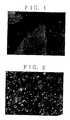
- FIG. 1 is an optical micrograph (magnification x 300) showing a crystalline structure of the thus obtained oxide superconductor.
- the oxide superconductor of the First Preferred Embodiment comprised base material phases (whitish portions in the micrograph) being free from the grain boundaries, and precipitation phases (blackish portions in the micrograph) dotted in a manner like islands in the seas of the base material phases.
- the precipitation phases were contained in an amount of 40% by volume with respect to the base material phase.
- the oxide superconductor of the First Preferred Embodiment was subjected to the electron probe microanalysis (EPMA) and the powder X-ray diffraction analysis.
- EPMA electron probe microanalysis
- Y2BaCuO5, YBa2SiO4 and CuO were present in the precipitation phases
- Y2BaCuO5 was surrounded by YBa2SiO4 and CuO
- the grain sizes of the precipitation phases were 0.5 to 10 micrometers.
- the base material phases were YBa2Cu3O7.
- a critical temperature "Tc” and "Jc” values of the oxide superconductor were measured by the four-probe method of the resistivity measurement.
- the "Jc” values were the ones at a magnetic flux density of 0 T (tesla) and a temperature of 77 K and at a magnetic flux density of 1 T and a temperature of 77 K, respectively.
- the results of the measurement are set forth in Table 1.
- An oxide superconductor of Comparative Example No. 1 was produced in the same manner as the First Preferred Embodiment other than that the sintering was carried out at 950 °C for 10 hours.
- the thus obtained oxide superconductor of Comparative Example No. 1 was subjected to the measurement in order to examine the "Tc" and "Jc" values similarly. The results of the measurement are also set forth in Table 1.
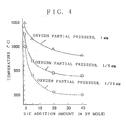
- Figure 2 is an optical micrograph (magnification x 300) showing a crystalline structure of the thus obtained oxide superconductor of Comparative Example No. 1.
- FIG. 2 is an optical micrograph (magnification x 300) showing a crystalline structure of the thus obtained oxide superconductor of Comparative Example No. 2. As can be seen from Figure 3, in the oxide superconductor of Comparative Example No. 2, the state of the crystalline structure looked like that of Comparative Example No. 1 substantially.
- An oxide superconductor of Comparative Example No. 3 was produced in the same manner as the First Preferred Embodiment other than that no SiC powder was used and a simple powder including YBa2Cu3O7 only was used, and that the simple powder was sintered at 950 °C for 10 hours.
- the thus obtained oxide superconductor of Comparative Example No. 3 was subjected to the measurement in order to examine the "Tc" and "Jc" values similarly. The results of the measurement are also set forth in Table 1.
- the base material phases were free from the grain boundaries and the precipitation phases were distributed uniformly.
- the base material phases had the grain boundaries remaining therein and the crystalline structure was similar to that of Comparative Example No. 2. Therefore, the high "Jc" values of the First Preferred Embodiment is believed to result from the fact that there were no grain boundaries in the base material phases and that there existed uniform precipitation phases.
- a mixed powder identical to that of the First Preferred Embodiment was employed, and molded into a tape-shaped molded body having a length of 30 mm, a width of 5 mm and a thickness of 1 nm.
- a heat treatment was carried out under the following conditions: i.e., under a temperature gradient of 5 °C/cm and at a specimen transferring speed of 0.01 mm/sec., until the temperature of the molded body became 850 °C. Thereafter, the temperature of the molded body was decreased to room temperature at a speed of 100 ° C/hour.
- the above-described processing was carried out in an atmosphere in which oxygen was flowed at a flow of 1500 ml/min.
- the base material phases were oriented in a longitudinal direction, and the precipitation phases including Y2BaCuo5, Ba2SiO4 and CuO are dispersed uniformly in the base material phases in an amount of 40% by volume.
- the thus obtained oxide superconductor exhibited a "Tc" value of 90 K and a "Jc" value of 17000 A/cm2 at 0 T and 77 K.
- the "Jc" value was higher than that of the First Preferred Embodiment.
- An oxide superconductor of a Third Preferred Embodiment was obtained in the same manner as the First Preferred Embodiment other than the following conditions: i.e., A mixed powder was employed in which an Al2O3 powder having an average particle diameter of 0.4 micrometers was added in an addition amount of 20% by mole instead of the SiC powder, and the pellets were sintered at 970 °C for 5 hours under an oxygen flow of 1500 ml/min.
- the thus obtained oxide superconductor of the Third Preferred Embodiment had the base material phases being free from the grain boundaries and the precipitation phases formed in an amount of 30% by volume, and it exhibited a "Tc" value of 88 K and a "Jc” value of 5000 A/cm2 at 0 T and 77 K.
- An oxide superconductor of a fourth Preferred Embodiment was obtained in the same manner as the First Preferred Embodiment other than the following conditions: i.e., A mixed powder was employed in which a ZrO2 powder having an average particle diameter of 0.3 micrometers was added in an addition amount of 15% by mole instead of the SiC powder, and the pellets were sintered at 1010 °C for 5 hours under an oxygen flow of 1500 ml/min.
- the thus obtained oxide superconductor of the Fourth Preferred Embodiment had the base material phases being free from the grain boundaries and the precipitation phases formed in an amount of 20% by volume, and it exhibited a "Tc" value of 90 K and a "Jc” value of 6000 A/cm2 at 0 T and 77 K.
- a mixed powder was filled in a sheath made of copper.
- the mixed powder included an SiO2 powder in an amount of 30% by mole instead of the SiC powder used in the First Preferred Embodiment, and the sheath had an outer diameter of 6 mm, an inner diameter of 4 mm and a length of 30 mm.
- the sheath filled with the mixed powder was pressed by rolling in order to obtain a tape having a thickness of 0.1 mm and a width of 7 mm.
- the tape was treated thermally at 980 °C for 2 hours in order to obtain a tape-shaped oxide superconductor member of the Fifth Preferred Embodiment.
- the thus obtained tape-shaped oxide superconductor member exhibited a favorable superconductive characteristic. Namely, it exhibited a "Tc" value of 90 K and a "Jc" value of 1000 A/cm2 at 0 T and 77 K.
- the favorable superconductive characteristic is believed to result from the fact that the SiO2 supplied oxygen to the base material powder in the copper sheath during the heat treatment, and that there existed a sufficient amount of oxygen enough to maintain the super conductive characteristic even when the copper sheath took away some of the oxygen. Therefore, it is possible to use a copper sheath, and accordingly to produce an oxide superconductor member which effects an advantage in view of the production cost.
- the oxide superconductor comprises a base material phase including an oxide superconducting material, the oxide superconducting material including barium (Ba) at least and being free from grain boundaries, and precipitation phases contained in an amount of 1 to 50% by volume in the base material phase and dotted therein in a manner like islands, the precipitation phases being oxides of a metal selected from the group consisting of silicon (Si), aluminum (Al), zirconium (Zr), magnesium (Mg), titanium (Ti), strontium (Sr), tungsten (W), cobalt (Co) and vanadium (V), and being products of decomposition reaction of the base material phase.
- a metal selected from the group consisting of silicon (Si), aluminum (Al), zirconium (Zr), magnesium (Mg), titanium (Ti), strontium (Sr), tungsten (W), cobalt (Co) and vanadium (V), and being products of decomposition reaction of the base material phase.
- the constituent materials are treated thermally at a partially melting temperature in order to give the above-described novel structure to the oxide superconductor.
- the precipitation phases are dotted in a manner like islands in a sea of the base material phase being free from the grain boundaries, and the precipitation phases work as the pinning centers. Therefore, the oxide superconductor exhibits a high "Jc" value.
Landscapes
- Engineering & Computer Science (AREA)
- Chemical & Material Sciences (AREA)
- Ceramic Engineering (AREA)
- Manufacturing & Machinery (AREA)
- Materials Engineering (AREA)
- Structural Engineering (AREA)
- Organic Chemistry (AREA)
- Inorganic Chemistry (AREA)
- Compositions Of Oxide Ceramics (AREA)
- Inorganic Compounds Of Heavy Metals (AREA)
- Superconductor Devices And Manufacturing Methods Thereof (AREA)
- Superconductors And Manufacturing Methods Therefor (AREA)
Applications Claiming Priority (2)
| Application Number | Priority Date | Filing Date | Title |
|---|---|---|---|
| JP2118363A JP2821794B2 (ja) | 1990-05-08 | 1990-05-08 | 酸化物超電導体およびその製造方法 |
| JP118363/90 | 1990-05-08 |
Publications (3)
| Publication Number | Publication Date |
|---|---|
| EP0456182A2 true EP0456182A2 (fr) | 1991-11-13 |
| EP0456182A3 EP0456182A3 (en) | 1992-03-11 |
| EP0456182B1 EP0456182B1 (fr) | 1996-01-31 |
Family
ID=14734852
Family Applications (1)
| Application Number | Title | Priority Date | Filing Date |
|---|---|---|---|
| EP91107394A Expired - Lifetime EP0456182B1 (fr) | 1990-05-08 | 1991-05-07 | Oxyde supraconducteur et procédé pour sa fabrication |
Country Status (4)
| Country | Link |
|---|---|
| US (1) | US5284822A (fr) |
| EP (1) | EP0456182B1 (fr) |
| JP (1) | JP2821794B2 (fr) |
| DE (1) | DE69116723T2 (fr) |
Cited By (1)
| Publication number | Priority date | Publication date | Assignee | Title |
|---|---|---|---|---|
| EP0583749A1 (fr) * | 1992-08-14 | 1994-02-23 | Daimler-Benz Aktiengesellschaft | Inductance non-linéaire et procédé de fabrication du noyau de l'inductance |
Families Citing this family (7)
| Publication number | Priority date | Publication date | Assignee | Title |
|---|---|---|---|---|
| USH2066H1 (en) * | 1995-05-26 | 2003-06-03 | The United States Of America As Represented By The Secretary Of The Navy | Superconductor and noble metal composite films |
| US5897945A (en) * | 1996-02-26 | 1999-04-27 | President And Fellows Of Harvard College | Metal oxide nanorods |
| US5958842A (en) * | 1996-02-28 | 1999-09-28 | The Regents Of The Uniersity Of California | Melt processing of Bi--2212 superconductors using alumina |
| US6209190B1 (en) * | 1996-05-03 | 2001-04-03 | The Korea Institute Of Machinery & Materials | Production of MgO dispersed Bi-2223 superconductor |
| US6617284B1 (en) * | 1998-07-06 | 2003-09-09 | Anatoly Rokhvarger | Superconductor composite material |
| US6830776B1 (en) * | 2002-02-08 | 2004-12-14 | The United States Of America As Represented By The Secretary Of The Air Force | Method of manufacturing a high temperature superconductor |
| CN101230877A (zh) * | 2007-01-24 | 2008-07-30 | 富准精密工业(深圳)有限公司 | 转动体及其制造方法 |
Family Cites Families (7)
| Publication number | Priority date | Publication date | Assignee | Title |
|---|---|---|---|---|
| US3932315A (en) * | 1974-09-24 | 1976-01-13 | E. I. Du Pont De Nemours & Company | Superconductive barium-lead-bismuth oxides |
| JPS63239111A (ja) * | 1987-03-27 | 1988-10-05 | Semiconductor Energy Lab Co Ltd | 超電導材料の作製方法 |
| EP0525827B1 (fr) * | 1987-03-31 | 1995-06-07 | Sumitomo Electric Industries Limited | Procédé de fabrication d'un fil supraconducteur |
| JP2707499B2 (ja) * | 1987-11-26 | 1998-01-28 | 住友電気工業株式会社 | 酸化物超電導体の製造方法 |
| JPH02153803A (ja) * | 1988-06-06 | 1990-06-13 | Nippon Steel Corp | 酸化物超電導バルク材料およびその製造方法 |
| GB8824630D0 (en) * | 1988-10-20 | 1988-11-23 | Evetts J E | Improvements in & relating to super-conducting composite conductors |
| EP0406456A1 (fr) * | 1989-07-03 | 1991-01-09 | Siemens Aktiengesellschaft | Procédé de fabrication d'un dispositif supraconducteur à haute température |
-
1990
- 1990-05-08 JP JP2118363A patent/JP2821794B2/ja not_active Expired - Fee Related
-
1991
- 1991-05-07 DE DE69116723T patent/DE69116723T2/de not_active Expired - Fee Related
- 1991-05-07 EP EP91107394A patent/EP0456182B1/fr not_active Expired - Lifetime
- 1991-05-07 US US07/695,813 patent/US5284822A/en not_active Expired - Fee Related
Cited By (1)
| Publication number | Priority date | Publication date | Assignee | Title |
|---|---|---|---|---|
| EP0583749A1 (fr) * | 1992-08-14 | 1994-02-23 | Daimler-Benz Aktiengesellschaft | Inductance non-linéaire et procédé de fabrication du noyau de l'inductance |
Also Published As
| Publication number | Publication date |
|---|---|
| DE69116723T2 (de) | 1996-06-27 |
| EP0456182A3 (en) | 1992-03-11 |
| US5284822A (en) | 1994-02-08 |
| JPH0416549A (ja) | 1992-01-21 |
| DE69116723D1 (de) | 1996-03-14 |
| JP2821794B2 (ja) | 1998-11-05 |
| EP0456182B1 (fr) | 1996-01-31 |
Similar Documents
| Publication | Publication Date | Title |
|---|---|---|
| AU696752B2 (en) | Improved processing of oxide superconductors | |
| US20020173428A1 (en) | Processing of magnesium-boride superconductors | |
| EP0356969B1 (fr) | Procédé pour la production d'un supraconducteur en oxide | |
| US5100866A (en) | Process for producing compound oxide high temperature superconducting material Tly Cul-y O3-z where RE=Y or La | |
| US5639714A (en) | Method of producing oxide superconductor | |
| CA2173273C (fr) | Procede de fusion pour l'obtention d'un materiau supraconducteur | |
| EP0456116B1 (fr) | Oxyde supraconducteur et procédé pour sa fabrication | |
| EP0456182B1 (fr) | Oxyde supraconducteur et procédé pour sa fabrication | |
| US20040116301A1 (en) | Superconducting borides and wires made thereof | |
| WO1993017969A1 (fr) | Supraconducteurs presentant des matrices continues de metal elementaire et de ceramique | |
| EP0800494B1 (fr) | PRODUCTION A BASSE TEMPERATURE (TEMPERATURE T INFERIEURE A 950 oC) DE SUPRACONDUCTEURS D'YBCO A TEXTURATION EN FUSION | |
| US5648322A (en) | Tl-based superconductive material, a superconductive body, and a method of forming such a superconductive material or body | |
| US5958842A (en) | Melt processing of Bi--2212 superconductors using alumina | |
| US20090048114A1 (en) | Alloy superconductor and methods of making the same | |
| EP0308326A1 (fr) | Procédé de production d'un supraconducteur oblong | |
| US5674814A (en) | Synthesis of increased-density bismuth-based superconductors with cold isostatic pressing and heat treating | |
| EP0869563B1 (fr) | Supraconducteur, amenée de courant et procédé de fabrication du supraconducteur | |
| US5736489A (en) | Method of producing melt-processed polycrystalline YBa2 Cu3 O.sub. | |
| Dou et al. | Diffusion grown superconducting thick films of Bi-(Pb)-Sr-Ca-Cu-O with zero resistance at 103 K | |
| US5244874A (en) | Process for producing an elongated superconductor | |
| EP0555971A1 (fr) | Procédé pour fabriquer des supraconducteurs ayant une densité de courant critique élevée | |
| EP0436723A1 (fr) | Supraconducteur a oxyde et procede de production d'un tel supraconducteur | |
| Samanta | Processing and Superconducting Properties of YBa2Cu3O7-X+ Ag2O Microcomposite for Fabrication of High Tc, Flexible Wire | |
| JPH07108772B2 (ja) | 高温超伝導物質の製造方法 | |
| Lee | Fabrication of superconducting wire using organometallic precursors and infiltration |
Legal Events
| Date | Code | Title | Description |
|---|---|---|---|
| PUAI | Public reference made under article 153(3) epc to a published international application that has entered the european phase |
Free format text: ORIGINAL CODE: 0009012 |
|
| 17P | Request for examination filed |
Effective date: 19910607 |
|
| AK | Designated contracting states |
Kind code of ref document: A2 Designated state(s): DE FR GB |
|
| PUAL | Search report despatched |
Free format text: ORIGINAL CODE: 0009013 |
|
| AK | Designated contracting states |
Kind code of ref document: A3 Designated state(s): DE FR GB |
|
| 17Q | First examination report despatched |
Effective date: 19941018 |
|
| GRAA | (expected) grant |
Free format text: ORIGINAL CODE: 0009210 |
|
| AK | Designated contracting states |
Kind code of ref document: B1 Designated state(s): DE FR GB |
|
| ET | Fr: translation filed | ||
| REF | Corresponds to: |
Ref document number: 69116723 Country of ref document: DE Date of ref document: 19960314 |
|
| PLBE | No opposition filed within time limit |
Free format text: ORIGINAL CODE: 0009261 |
|
| STAA | Information on the status of an ep patent application or granted ep patent |
Free format text: STATUS: NO OPPOSITION FILED WITHIN TIME LIMIT |
|
| 26N | No opposition filed | ||
| K2C3 | Correction of patent specification (complete document) published |
Effective date: 19960131 |
|
| REG | Reference to a national code |
Ref country code: GB Ref legal event code: IF02 |
|
| PGFP | Annual fee paid to national office [announced via postgrant information from national office to epo] |
Ref country code: GB Payment date: 20040505 Year of fee payment: 14 |
|
| PGFP | Annual fee paid to national office [announced via postgrant information from national office to epo] |
Ref country code: FR Payment date: 20040510 Year of fee payment: 14 |
|
| PGFP | Annual fee paid to national office [announced via postgrant information from national office to epo] |
Ref country code: DE Payment date: 20040520 Year of fee payment: 14 |
|
| PG25 | Lapsed in a contracting state [announced via postgrant information from national office to epo] |
Ref country code: GB Free format text: LAPSE BECAUSE OF NON-PAYMENT OF DUE FEES Effective date: 20050507 |
|
| PG25 | Lapsed in a contracting state [announced via postgrant information from national office to epo] |
Ref country code: DE Free format text: LAPSE BECAUSE OF NON-PAYMENT OF DUE FEES Effective date: 20051201 |
|
| GBPC | Gb: european patent ceased through non-payment of renewal fee |
Effective date: 20050507 |
|
| PG25 | Lapsed in a contracting state [announced via postgrant information from national office to epo] |
Ref country code: FR Free format text: LAPSE BECAUSE OF NON-PAYMENT OF DUE FEES Effective date: 20060131 |
|
| REG | Reference to a national code |
Ref country code: FR Ref legal event code: ST Effective date: 20060131 |