EP0456413B1 - Kalziumkarbonatpigment für wärmeempfindliches Aufzeichnungspapier, Verfahren zu dessen Herstellung, Mischung zur Beschichtung von wärmeempfindlichem Aufzeichnungspapier und wärmeempfindliches Aufzeichnungspapier - Google Patents
Kalziumkarbonatpigment für wärmeempfindliches Aufzeichnungspapier, Verfahren zu dessen Herstellung, Mischung zur Beschichtung von wärmeempfindlichem Aufzeichnungspapier und wärmeempfindliches Aufzeichnungspapier Download PDFInfo
- Publication number
- EP0456413B1 EP0456413B1 EP19910303976 EP91303976A EP0456413B1 EP 0456413 B1 EP0456413 B1 EP 0456413B1 EP 19910303976 EP19910303976 EP 19910303976 EP 91303976 A EP91303976 A EP 91303976A EP 0456413 B1 EP0456413 B1 EP 0456413B1
- Authority
- EP
- European Patent Office
- Prior art keywords
- heat
- calcium carbonate
- sensitive recording
- recording paper
- pigment
- Prior art date
- Legal status (The legal status is an assumption and is not a legal conclusion. Google has not performed a legal analysis and makes no representation as to the accuracy of the status listed.)
- Expired - Lifetime
Links
- VTYYLEPIZMXCLO-UHFFFAOYSA-L Calcium carbonate Chemical compound [Ca+2].[O-]C([O-])=O VTYYLEPIZMXCLO-UHFFFAOYSA-L 0.000 title claims description 295
- 229910000019 calcium carbonate Inorganic materials 0.000 title claims description 127
- 239000000049 pigment Substances 0.000 title claims description 89
- 239000008199 coating composition Substances 0.000 title claims description 42
- 238000004519 manufacturing process Methods 0.000 title claims description 4
- 239000010410 layer Substances 0.000 claims description 47
- 239000007787 solid Substances 0.000 claims description 45
- 239000000203 mixture Substances 0.000 claims description 34
- 238000000034 method Methods 0.000 claims description 27
- 239000003795 chemical substances by application Substances 0.000 claims description 26
- 238000010521 absorption reaction Methods 0.000 claims description 21
- 239000011230 binding agent Substances 0.000 claims description 19
- 239000000758 substrate Substances 0.000 claims description 18
- 239000011247 coating layer Substances 0.000 claims description 13
- 238000001035 drying Methods 0.000 claims description 13
- 230000035945 sensitivity Effects 0.000 claims description 12
- 239000007900 aqueous suspension Substances 0.000 claims description 11
- 239000000981 basic dye Substances 0.000 claims description 11
- 239000000975 dye Substances 0.000 claims description 11
- 229910052783 alkali metal Inorganic materials 0.000 claims description 10
- 150000001340 alkali metals Chemical class 0.000 claims description 10
- BVKZGUZCCUSVTD-UHFFFAOYSA-L Carbonate Chemical compound [O-]C([O-])=O BVKZGUZCCUSVTD-UHFFFAOYSA-L 0.000 claims description 6
- XLYOFNOQVPJJNP-UHFFFAOYSA-M hydroxide Chemical compound [OH-] XLYOFNOQVPJJNP-UHFFFAOYSA-M 0.000 claims description 6
- 238000003756 stirring Methods 0.000 claims description 6
- BVKZGUZCCUSVTD-UHFFFAOYSA-M Bicarbonate Chemical compound OC([O-])=O BVKZGUZCCUSVTD-UHFFFAOYSA-M 0.000 claims description 5
- 229910052784 alkaline earth metal Inorganic materials 0.000 claims description 4
- 150000001342 alkaline earth metals Chemical class 0.000 claims description 4
- ANBBXQWFNXMHLD-UHFFFAOYSA-N aluminum;sodium;oxygen(2-) Chemical compound [O-2].[O-2].[Na+].[Al+3] ANBBXQWFNXMHLD-UHFFFAOYSA-N 0.000 claims description 4
- 229910001388 sodium aluminate Inorganic materials 0.000 claims description 4
- HDYRYUINDGQKMC-UHFFFAOYSA-M acetyloxyaluminum;dihydrate Chemical compound O.O.CC(=O)O[Al] HDYRYUINDGQKMC-UHFFFAOYSA-M 0.000 claims description 3
- 229940009827 aluminum acetate Drugs 0.000 claims description 3
- ZBCBWPMODOFKDW-UHFFFAOYSA-N diethanolamine Chemical compound OCCNCCO ZBCBWPMODOFKDW-UHFFFAOYSA-N 0.000 claims description 3
- 150000001242 acetic acid derivatives Chemical class 0.000 claims description 2
- 235000010216 calcium carbonate Nutrition 0.000 description 129
- 239000000123 paper Substances 0.000 description 82
- 239000003921 oil Substances 0.000 description 19
- 235000019198 oils Nutrition 0.000 description 19
- 230000000052 comparative effect Effects 0.000 description 17
- 230000000694 effects Effects 0.000 description 16
- 239000002245 particle Substances 0.000 description 13
- 239000007864 aqueous solution Substances 0.000 description 11
- 238000009472 formulation Methods 0.000 description 9
- 239000011248 coating agent Substances 0.000 description 8
- 238000000576 coating method Methods 0.000 description 8
- 235000014113 dietary fatty acids Nutrition 0.000 description 7
- 239000006185 dispersion Substances 0.000 description 7
- 239000000194 fatty acid Substances 0.000 description 7
- 229930195729 fatty acid Natural products 0.000 description 7
- 239000004372 Polyvinyl alcohol Substances 0.000 description 6
- 239000002250 absorbent Substances 0.000 description 6
- -1 aliphatic amine acetic acid salts Chemical class 0.000 description 6
- 150000004665 fatty acids Chemical class 0.000 description 6
- 229920002451 polyvinyl alcohol Polymers 0.000 description 6
- 239000002270 dispersing agent Substances 0.000 description 5
- 230000001976 improved effect Effects 0.000 description 5
- 238000011160 research Methods 0.000 description 5
- VYPSYNLAJGMNEJ-UHFFFAOYSA-N Silicium dioxide Chemical compound O=[Si]=O VYPSYNLAJGMNEJ-UHFFFAOYSA-N 0.000 description 4
- 238000003490 calendering Methods 0.000 description 4
- 239000000463 material Substances 0.000 description 4
- 230000000704 physical effect Effects 0.000 description 4
- 239000000725 suspension Substances 0.000 description 4
- XLYOFNOQVPJJNP-UHFFFAOYSA-N water Substances O XLYOFNOQVPJJNP-UHFFFAOYSA-N 0.000 description 4
- 239000005995 Aluminium silicate Substances 0.000 description 3
- UHOVQNZJYSORNB-UHFFFAOYSA-N Benzene Chemical compound C1=CC=CC=C1 UHOVQNZJYSORNB-UHFFFAOYSA-N 0.000 description 3
- 239000002253 acid Substances 0.000 description 3
- 235000012211 aluminium silicate Nutrition 0.000 description 3
- IISBACLAFKSPIT-UHFFFAOYSA-N bisphenol A Chemical compound C=1C=C(O)C=CC=1C(C)(C)C1=CC=C(O)C=C1 IISBACLAFKSPIT-UHFFFAOYSA-N 0.000 description 3
- HQABUPZFAYXKJW-UHFFFAOYSA-N butan-1-amine Chemical compound CCCCN HQABUPZFAYXKJW-UHFFFAOYSA-N 0.000 description 3
- 238000004040 coloring Methods 0.000 description 3
- 230000003247 decreasing effect Effects 0.000 description 3
- 239000000945 filler Substances 0.000 description 3
- 150000004679 hydroxides Chemical class 0.000 description 3
- 239000000976 ink Substances 0.000 description 3
- NLYAJNPCOHFWQQ-UHFFFAOYSA-N kaolin Chemical compound O.O.O=[Al]O[Si](=O)O[Si](=O)O[Al]=O NLYAJNPCOHFWQQ-UHFFFAOYSA-N 0.000 description 3
- 150000002989 phenols Chemical class 0.000 description 3
- 239000000047 product Substances 0.000 description 3
- 238000004062 sedimentation Methods 0.000 description 3
- 239000007858 starting material Substances 0.000 description 3
- 238000004381 surface treatment Methods 0.000 description 3
- 238000012360 testing method Methods 0.000 description 3
- 238000012546 transfer Methods 0.000 description 3
- FJKROLUGYXJWQN-UHFFFAOYSA-N 4-hydroxybenzoic acid Chemical compound OC(=O)C1=CC=C(O)C=C1 FJKROLUGYXJWQN-UHFFFAOYSA-N 0.000 description 2
- IJGRMHOSHXDMSA-UHFFFAOYSA-N Atomic nitrogen Chemical compound N#N IJGRMHOSHXDMSA-UHFFFAOYSA-N 0.000 description 2
- 239000002518 antifoaming agent Substances 0.000 description 2
- WPYMKLBDIGXBTP-UHFFFAOYSA-N benzoic acid Chemical compound OC(=O)C1=CC=CC=C1 WPYMKLBDIGXBTP-UHFFFAOYSA-N 0.000 description 2
- 150000004649 carbonic acid derivatives Chemical class 0.000 description 2
- 239000010419 fine particle Substances 0.000 description 2
- 230000005484 gravity Effects 0.000 description 2
- 238000010438 heat treatment Methods 0.000 description 2
- HSEMFIZWXHQJAE-UHFFFAOYSA-N hexadecanamide Chemical compound CCCCCCCCCCCCCCCC(N)=O HSEMFIZWXHQJAE-UHFFFAOYSA-N 0.000 description 2
- 229920000126 latex Polymers 0.000 description 2
- 229910052751 metal Inorganic materials 0.000 description 2
- 239000002184 metal Substances 0.000 description 2
- LYRFLYHAGKPMFH-UHFFFAOYSA-N octadecanamide Chemical compound CCCCCCCCCCCCCCCCCC(N)=O LYRFLYHAGKPMFH-UHFFFAOYSA-N 0.000 description 2
- FATBGEAMYMYZAF-KTKRTIGZSA-N oleamide Chemical compound CCCCCCCC\C=C/CCCCCCCC(N)=O FATBGEAMYMYZAF-KTKRTIGZSA-N 0.000 description 2
- 239000000843 powder Substances 0.000 description 2
- 239000003755 preservative agent Substances 0.000 description 2
- 239000000377 silicon dioxide Substances 0.000 description 2
- 239000011973 solid acid Substances 0.000 description 2
- 229920003048 styrene butadiene rubber Polymers 0.000 description 2
- 229920003002 synthetic resin Polymers 0.000 description 2
- 239000000057 synthetic resin Substances 0.000 description 2
- 238000005303 weighing Methods 0.000 description 2
- LIZLYZVAYZQVPG-UHFFFAOYSA-N (3-bromo-2-fluorophenyl)methanol Chemical compound OCC1=CC=CC(Br)=C1F LIZLYZVAYZQVPG-UHFFFAOYSA-N 0.000 description 1
- RDYWHMBYTHVOKZ-UHFFFAOYSA-N 18-hydroxyoctadecanamide Chemical compound NC(=O)CCCCCCCCCCCCCCCCCO RDYWHMBYTHVOKZ-UHFFFAOYSA-N 0.000 description 1
- UPHOPMSGKZNELG-UHFFFAOYSA-N 2-hydroxynaphthalene-1-carboxylic acid Chemical compound C1=CC=C2C(C(=O)O)=C(O)C=CC2=C1 UPHOPMSGKZNELG-UHFFFAOYSA-N 0.000 description 1
- JCYPECIVGRXBMO-UHFFFAOYSA-N 4-(dimethylamino)azobenzene Chemical compound C1=CC(N(C)C)=CC=C1N=NC1=CC=CC=C1 JCYPECIVGRXBMO-UHFFFAOYSA-N 0.000 description 1
- 229940090248 4-hydroxybenzoic acid Drugs 0.000 description 1
- KDVYCTOWXSLNNI-UHFFFAOYSA-N 4-t-Butylbenzoic acid Chemical compound CC(C)(C)C1=CC=C(C(O)=O)C=C1 KDVYCTOWXSLNNI-UHFFFAOYSA-N 0.000 description 1
- QHPQWRBYOIRBIT-UHFFFAOYSA-N 4-tert-butylphenol Chemical compound CC(C)(C)C1=CC=C(O)C=C1 QHPQWRBYOIRBIT-UHFFFAOYSA-N 0.000 description 1
- KGYNGVVNFRUOOZ-UHFFFAOYSA-N 5-chloro-2-hydroxy-n-phenylbenzamide Chemical compound OC1=CC=C(Cl)C=C1C(=O)NC1=CC=CC=C1 KGYNGVVNFRUOOZ-UHFFFAOYSA-N 0.000 description 1
- XAICWTLLSRXZPB-UHFFFAOYSA-N 5-tert-butyl-2-hydroxybenzoic acid Chemical compound CC(C)(C)C1=CC=C(O)C(C(O)=O)=C1 XAICWTLLSRXZPB-UHFFFAOYSA-N 0.000 description 1
- 244000215068 Acacia senegal Species 0.000 description 1
- QTBSBXVTEAMEQO-UHFFFAOYSA-M Acetate Chemical compound CC([O-])=O QTBSBXVTEAMEQO-UHFFFAOYSA-M 0.000 description 1
- 239000005711 Benzoic acid Substances 0.000 description 1
- MOZDKDIOPSPTBH-UHFFFAOYSA-N Benzyl parahydroxybenzoate Chemical compound C1=CC(O)=CC=C1C(=O)OCC1=CC=CC=C1 MOZDKDIOPSPTBH-UHFFFAOYSA-N 0.000 description 1
- OYPRJOBELJOOCE-UHFFFAOYSA-N Calcium Chemical compound [Ca] OYPRJOBELJOOCE-UHFFFAOYSA-N 0.000 description 1
- 229920002134 Carboxymethyl cellulose Polymers 0.000 description 1
- IPAJDLMMTVZVPP-UHFFFAOYSA-N Crystal violet lactone Chemical compound C1=CC(N(C)C)=CC=C1C1(C=2C=CC(=CC=2)N(C)C)C2=CC=C(N(C)C)C=C2C(=O)O1 IPAJDLMMTVZVPP-UHFFFAOYSA-N 0.000 description 1
- MDNWOSOZYLHTCG-UHFFFAOYSA-N Dichlorophen Chemical compound OC1=CC=C(Cl)C=C1CC1=CC(Cl)=CC=C1O MDNWOSOZYLHTCG-UHFFFAOYSA-N 0.000 description 1
- RPWFJAMTCNSJKK-UHFFFAOYSA-N Dodecyl gallate Chemical compound CCCCCCCCCCCCOC(=O)C1=CC(O)=C(O)C(O)=C1 RPWFJAMTCNSJKK-UHFFFAOYSA-N 0.000 description 1
- 108010010803 Gelatin Proteins 0.000 description 1
- 229920000084 Gum arabic Polymers 0.000 description 1
- 229920000663 Hydroxyethyl cellulose Polymers 0.000 description 1
- 239000004354 Hydroxyethyl cellulose Substances 0.000 description 1
- DGAQECJNVWCQMB-PUAWFVPOSA-M Ilexoside XXIX Chemical compound C[C@@H]1CC[C@@]2(CC[C@@]3(C(=CC[C@H]4[C@]3(CC[C@@H]5[C@@]4(CC[C@@H](C5(C)C)OS(=O)(=O)[O-])C)C)[C@@H]2[C@]1(C)O)C)C(=O)O[C@H]6[C@@H]([C@H]([C@@H]([C@H](O6)CO)O)O)O.[Na+] DGAQECJNVWCQMB-PUAWFVPOSA-M 0.000 description 1
- CMHMMKSPYOOVGI-UHFFFAOYSA-N Isopropylparaben Chemical compound CC(C)OC(=O)C1=CC=C(O)C=C1 CMHMMKSPYOOVGI-UHFFFAOYSA-N 0.000 description 1
- FYYHWMGAXLPEAU-UHFFFAOYSA-N Magnesium Chemical compound [Mg] FYYHWMGAXLPEAU-UHFFFAOYSA-N 0.000 description 1
- OKKJLVBELUTLKV-UHFFFAOYSA-N Methanol Chemical group OC OKKJLVBELUTLKV-UHFFFAOYSA-N 0.000 description 1
- 241000282320 Panthera leo Species 0.000 description 1
- KWYUFKZDYYNOTN-UHFFFAOYSA-M Potassium hydroxide Chemical class [OH-].[K+] KWYUFKZDYYNOTN-UHFFFAOYSA-M 0.000 description 1
- 229920002125 Sokalan® Polymers 0.000 description 1
- 229920002472 Starch Polymers 0.000 description 1
- 229910000831 Steel Inorganic materials 0.000 description 1
- 239000002174 Styrene-butadiene Substances 0.000 description 1
- 229920001807 Urea-formaldehyde Polymers 0.000 description 1
- 229920002433 Vinyl chloride-vinyl acetate copolymer Polymers 0.000 description 1
- 238000002441 X-ray diffraction Methods 0.000 description 1
- HCHKCACWOHOZIP-UHFFFAOYSA-N Zinc Chemical compound [Zn] HCHKCACWOHOZIP-UHFFFAOYSA-N 0.000 description 1
- ZKURGBYDCVNWKH-UHFFFAOYSA-N [3,7-bis(dimethylamino)phenothiazin-10-yl]-phenylmethanone Chemical compound C12=CC=C(N(C)C)C=C2SC2=CC(N(C)C)=CC=C2N1C(=O)C1=CC=CC=C1 ZKURGBYDCVNWKH-UHFFFAOYSA-N 0.000 description 1
- 239000006096 absorbing agent Substances 0.000 description 1
- 239000000205 acacia gum Substances 0.000 description 1
- 235000010489 acacia gum Nutrition 0.000 description 1
- 150000007513 acids Chemical class 0.000 description 1
- 229920006243 acrylic copolymer Polymers 0.000 description 1
- 239000000654 additive Substances 0.000 description 1
- 238000013019 agitation Methods 0.000 description 1
- WNROFYMDJYEPJX-UHFFFAOYSA-K aluminium hydroxide Chemical compound [OH-].[OH-].[OH-].[Al+3] WNROFYMDJYEPJX-UHFFFAOYSA-K 0.000 description 1
- 150000001412 amines Chemical class 0.000 description 1
- 239000012752 auxiliary agent Substances 0.000 description 1
- 239000002585 base Substances 0.000 description 1
- 235000010233 benzoic acid Nutrition 0.000 description 1
- 230000005540 biological transmission Effects 0.000 description 1
- 238000007664 blowing Methods 0.000 description 1
- MTAZNLWOLGHBHU-UHFFFAOYSA-N butadiene-styrene rubber Chemical compound C=CC=C.C=CC1=CC=CC=C1 MTAZNLWOLGHBHU-UHFFFAOYSA-N 0.000 description 1
- 229910052791 calcium Inorganic materials 0.000 description 1
- 239000011575 calcium Substances 0.000 description 1
- 239000001768 carboxy methyl cellulose Substances 0.000 description 1
- 235000010948 carboxy methyl cellulose Nutrition 0.000 description 1
- 239000008112 carboxymethyl-cellulose Substances 0.000 description 1
- 239000005018 casein Substances 0.000 description 1
- BECPQYXYKAMYBN-UHFFFAOYSA-N casein, tech. Chemical compound NCCCCC(C(O)=O)N=C(O)C(CC(O)=O)N=C(O)C(CCC(O)=N)N=C(O)C(CC(C)C)N=C(O)C(CCC(O)=O)N=C(O)C(CC(O)=O)N=C(O)C(CCC(O)=O)N=C(O)C(C(C)O)N=C(O)C(CCC(O)=N)N=C(O)C(CCC(O)=N)N=C(O)C(CCC(O)=N)N=C(O)C(CCC(O)=O)N=C(O)C(CCC(O)=O)N=C(O)C(COP(O)(O)=O)N=C(O)C(CCC(O)=N)N=C(O)C(N)CC1=CC=CC=C1 BECPQYXYKAMYBN-UHFFFAOYSA-N 0.000 description 1
- 235000021240 caseins Nutrition 0.000 description 1
- 239000003054 catalyst Substances 0.000 description 1
- 239000001913 cellulose Substances 0.000 description 1
- 235000010980 cellulose Nutrition 0.000 description 1
- 229920002678 cellulose Polymers 0.000 description 1
- 239000013078 crystal Substances 0.000 description 1
- CZZYITDELCSZES-UHFFFAOYSA-N diphenylmethane Chemical compound C=1C=CC=CC=1CC1=CC=CC=C1 CZZYITDELCSZES-UHFFFAOYSA-N 0.000 description 1
- 235000010386 dodecyl gallate Nutrition 0.000 description 1
- 229920001971 elastomer Polymers 0.000 description 1
- 238000005516 engineering process Methods 0.000 description 1
- 239000005038 ethylene vinyl acetate Substances 0.000 description 1
- 230000001747 exhibiting effect Effects 0.000 description 1
- FWQHNLCNFPYBCA-UHFFFAOYSA-N fluoran Chemical compound C12=CC=CC=C2OC2=CC=CC=C2C11OC(=O)C2=CC=CC=C21 FWQHNLCNFPYBCA-UHFFFAOYSA-N 0.000 description 1
- 239000007850 fluorescent dye Substances 0.000 description 1
- 239000007789 gas Substances 0.000 description 1
- 239000008273 gelatin Substances 0.000 description 1
- 229920000159 gelatin Polymers 0.000 description 1
- 235000019322 gelatine Nutrition 0.000 description 1
- 235000011852 gelatine desserts Nutrition 0.000 description 1
- 235000019447 hydroxyethyl cellulose Nutrition 0.000 description 1
- 230000001771 impaired effect Effects 0.000 description 1
- 238000010348 incorporation Methods 0.000 description 1
- 238000011835 investigation Methods 0.000 description 1
- 150000002605 large molecules Chemical class 0.000 description 1
- 239000004816 latex Substances 0.000 description 1
- 235000021388 linseed oil Nutrition 0.000 description 1
- 239000000944 linseed oil Substances 0.000 description 1
- 230000007774 longterm Effects 0.000 description 1
- 229910052749 magnesium Inorganic materials 0.000 description 1
- 239000011777 magnesium Substances 0.000 description 1
- 230000014759 maintenance of location Effects 0.000 description 1
- QSHDDOUJBYECFT-UHFFFAOYSA-N mercury Chemical compound [Hg] QSHDDOUJBYECFT-UHFFFAOYSA-N 0.000 description 1
- 229910052753 mercury Inorganic materials 0.000 description 1
- 150000002739 metals Chemical class 0.000 description 1
- 229920000609 methyl cellulose Polymers 0.000 description 1
- 239000004292 methyl p-hydroxybenzoate Substances 0.000 description 1
- 235000010270 methyl p-hydroxybenzoate Nutrition 0.000 description 1
- JCYPECIVGRXBMO-FOCLMDBBSA-N methyl yellow Chemical compound C1=CC(N(C)C)=CC=C1\N=N\C1=CC=CC=C1 JCYPECIVGRXBMO-FOCLMDBBSA-N 0.000 description 1
- 239000001923 methylcellulose Substances 0.000 description 1
- 235000010981 methylcellulose Nutrition 0.000 description 1
- LXCFILQKKLGQFO-UHFFFAOYSA-N methylparaben Chemical compound COC(=O)C1=CC=C(O)C=C1 LXCFILQKKLGQFO-UHFFFAOYSA-N 0.000 description 1
- 229910052757 nitrogen Inorganic materials 0.000 description 1
- BRNPAEUKZMBRLQ-UHFFFAOYSA-N octadecyl 3,4,5-trihydroxybenzoate Chemical compound CCCCCCCCCCCCCCCCCCOC(=O)C1=CC(O)=C(O)C(O)=C1 BRNPAEUKZMBRLQ-UHFFFAOYSA-N 0.000 description 1
- IOQPZZOEVPZRBK-UHFFFAOYSA-N octan-1-amine Chemical compound CCCCCCCCN IOQPZZOEVPZRBK-UHFFFAOYSA-N 0.000 description 1
- 229920001568 phenolic resin Polymers 0.000 description 1
- 239000005011 phenolic resin Substances 0.000 description 1
- 229920003023 plastic Polymers 0.000 description 1
- 239000004033 plastic Substances 0.000 description 1
- 229920001490 poly(butyl methacrylate) polymer Polymers 0.000 description 1
- 229920001200 poly(ethylene-vinyl acetate) Polymers 0.000 description 1
- 229920000058 polyacrylate Polymers 0.000 description 1
- 239000004584 polyacrylic acid Substances 0.000 description 1
- 229920002635 polyurethane Polymers 0.000 description 1
- 239000004814 polyurethane Substances 0.000 description 1
- 229920002689 polyvinyl acetate Polymers 0.000 description 1
- 239000011118 polyvinyl acetate Substances 0.000 description 1
- 235000019422 polyvinyl alcohol Nutrition 0.000 description 1
- 238000002459 porosimetry Methods 0.000 description 1
- 235000011118 potassium hydroxide Nutrition 0.000 description 1
- 229940088417 precipitated calcium carbonate Drugs 0.000 description 1
- 239000011164 primary particle Substances 0.000 description 1
- 238000007639 printing Methods 0.000 description 1
- 238000010298 pulverizing process Methods 0.000 description 1
- 230000000717 retained effect Effects 0.000 description 1
- 239000005060 rubber Substances 0.000 description 1
- WKEDVNSFRWHDNR-UHFFFAOYSA-N salicylanilide Chemical compound OC1=CC=CC=C1C(=O)NC1=CC=CC=C1 WKEDVNSFRWHDNR-UHFFFAOYSA-N 0.000 description 1
- 229950000975 salicylanilide Drugs 0.000 description 1
- 150000003839 salts Chemical class 0.000 description 1
- 239000003566 sealing material Substances 0.000 description 1
- 239000013049 sediment Substances 0.000 description 1
- 229910052708 sodium Inorganic materials 0.000 description 1
- 239000011734 sodium Substances 0.000 description 1
- 235000011121 sodium hydroxide Nutrition 0.000 description 1
- 239000012265 solid product Substances 0.000 description 1
- 239000000243 solution Substances 0.000 description 1
- 238000001179 sorption measurement Methods 0.000 description 1
- 239000008107 starch Substances 0.000 description 1
- 235000019698 starch Nutrition 0.000 description 1
- 239000010959 steel Substances 0.000 description 1
- 238000003860 storage Methods 0.000 description 1
- 239000011115 styrene butadiene Substances 0.000 description 1
- 239000000126 substance Substances 0.000 description 1
- 239000004094 surface-active agent Substances 0.000 description 1
- 239000000454 talc Substances 0.000 description 1
- 229910052623 talc Inorganic materials 0.000 description 1
- 235000012222 talc Nutrition 0.000 description 1
- 239000001016 thiazine dye Substances 0.000 description 1
- 239000001003 triarylmethane dye Substances 0.000 description 1
- 239000011800 void material Substances 0.000 description 1
- 239000011701 zinc Substances 0.000 description 1
- 229910052725 zinc Inorganic materials 0.000 description 1
Classifications
-
- B—PERFORMING OPERATIONS; TRANSPORTING
- B41—PRINTING; LINING MACHINES; TYPEWRITERS; STAMPS
- B41M—PRINTING, DUPLICATING, MARKING, OR COPYING PROCESSES; COLOUR PRINTING
- B41M5/00—Duplicating or marking methods; Sheet materials for use therein
- B41M5/26—Thermography ; Marking by high energetic means, e.g. laser otherwise than by burning, and characterised by the material used
- B41M5/40—Thermography ; Marking by high energetic means, e.g. laser otherwise than by burning, and characterised by the material used characterised by the base backcoat, intermediate, or covering layers, e.g. for thermal transfer dye-donor or dye-receiver sheets; Heat, radiation filtering or absorbing means or layers; combined with other image registration layers or compositions; Special originals for reproduction by thermography
- B41M5/42—Intermediate, backcoat, or covering layers
-
- B—PERFORMING OPERATIONS; TRANSPORTING
- B41—PRINTING; LINING MACHINES; TYPEWRITERS; STAMPS
- B41M—PRINTING, DUPLICATING, MARKING, OR COPYING PROCESSES; COLOUR PRINTING
- B41M5/00—Duplicating or marking methods; Sheet materials for use therein
- B41M5/26—Thermography ; Marking by high energetic means, e.g. laser otherwise than by burning, and characterised by the material used
- B41M5/30—Thermography ; Marking by high energetic means, e.g. laser otherwise than by burning, and characterised by the material used using chemical colour formers
- B41M5/337—Additives; Binders
- B41M5/3377—Inorganic compounds, e.g. metal salts of organic acids
-
- B—PERFORMING OPERATIONS; TRANSPORTING
- B41—PRINTING; LINING MACHINES; TYPEWRITERS; STAMPS
- B41M—PRINTING, DUPLICATING, MARKING, OR COPYING PROCESSES; COLOUR PRINTING
- B41M2205/00—Printing methods or features related to printing methods; Location or type of the layers
- B41M2205/04—Direct thermal recording [DTR]
-
- B—PERFORMING OPERATIONS; TRANSPORTING
- B41—PRINTING; LINING MACHINES; TYPEWRITERS; STAMPS
- B41M—PRINTING, DUPLICATING, MARKING, OR COPYING PROCESSES; COLOUR PRINTING
- B41M2205/00—Printing methods or features related to printing methods; Location or type of the layers
- B41M2205/38—Intermediate layers; Layers between substrate and imaging layer
-
- B—PERFORMING OPERATIONS; TRANSPORTING
- B41—PRINTING; LINING MACHINES; TYPEWRITERS; STAMPS
- B41M—PRINTING, DUPLICATING, MARKING, OR COPYING PROCESSES; COLOUR PRINTING
- B41M5/00—Duplicating or marking methods; Sheet materials for use therein
- B41M5/26—Thermography ; Marking by high energetic means, e.g. laser otherwise than by burning, and characterised by the material used
- B41M5/30—Thermography ; Marking by high energetic means, e.g. laser otherwise than by burning, and characterised by the material used using chemical colour formers
- B41M5/323—Organic colour formers, e.g. leuco dyes
-
- B—PERFORMING OPERATIONS; TRANSPORTING
- B41—PRINTING; LINING MACHINES; TYPEWRITERS; STAMPS
- B41M—PRINTING, DUPLICATING, MARKING, OR COPYING PROCESSES; COLOUR PRINTING
- B41M5/00—Duplicating or marking methods; Sheet materials for use therein
- B41M5/26—Thermography ; Marking by high energetic means, e.g. laser otherwise than by burning, and characterised by the material used
- B41M5/30—Thermography ; Marking by high energetic means, e.g. laser otherwise than by burning, and characterised by the material used using chemical colour formers
- B41M5/323—Organic colour formers, e.g. leuco dyes
- B41M5/327—Organic colour formers, e.g. leuco dyes with a lactone or lactam ring
- B41M5/3275—Fluoran compounds
-
- B—PERFORMING OPERATIONS; TRANSPORTING
- B41—PRINTING; LINING MACHINES; TYPEWRITERS; STAMPS
- B41M—PRINTING, DUPLICATING, MARKING, OR COPYING PROCESSES; COLOUR PRINTING
- B41M5/00—Duplicating or marking methods; Sheet materials for use therein
- B41M5/26—Thermography ; Marking by high energetic means, e.g. laser otherwise than by burning, and characterised by the material used
- B41M5/30—Thermography ; Marking by high energetic means, e.g. laser otherwise than by burning, and characterised by the material used using chemical colour formers
- B41M5/333—Colour developing components therefor, e.g. acidic compounds
- B41M5/3333—Non-macromolecular compounds
- B41M5/3335—Compounds containing phenolic or carboxylic acid groups or metal salts thereof
-
- B—PERFORMING OPERATIONS; TRANSPORTING
- B41—PRINTING; LINING MACHINES; TYPEWRITERS; STAMPS
- B41M—PRINTING, DUPLICATING, MARKING, OR COPYING PROCESSES; COLOUR PRINTING
- B41M5/00—Duplicating or marking methods; Sheet materials for use therein
- B41M5/26—Thermography ; Marking by high energetic means, e.g. laser otherwise than by burning, and characterised by the material used
- B41M5/40—Thermography ; Marking by high energetic means, e.g. laser otherwise than by burning, and characterised by the material used characterised by the base backcoat, intermediate, or covering layers, e.g. for thermal transfer dye-donor or dye-receiver sheets; Heat, radiation filtering or absorbing means or layers; combined with other image registration layers or compositions; Special originals for reproduction by thermography
- B41M5/42—Intermediate, backcoat, or covering layers
- B41M5/426—Intermediate, backcoat, or covering layers characterised by inorganic compounds, e.g. metals, metal salts, metal complexes
-
- B—PERFORMING OPERATIONS; TRANSPORTING
- B41—PRINTING; LINING MACHINES; TYPEWRITERS; STAMPS
- B41M—PRINTING, DUPLICATING, MARKING, OR COPYING PROCESSES; COLOUR PRINTING
- B41M5/00—Duplicating or marking methods; Sheet materials for use therein
- B41M5/26—Thermography ; Marking by high energetic means, e.g. laser otherwise than by burning, and characterised by the material used
- B41M5/40—Thermography ; Marking by high energetic means, e.g. laser otherwise than by burning, and characterised by the material used characterised by the base backcoat, intermediate, or covering layers, e.g. for thermal transfer dye-donor or dye-receiver sheets; Heat, radiation filtering or absorbing means or layers; combined with other image registration layers or compositions; Special originals for reproduction by thermography
- B41M5/42—Intermediate, backcoat, or covering layers
- B41M5/44—Intermediate, backcoat, or covering layers characterised by the macromolecular compounds
Definitions
- the present invention relates to an anti-fogging and surface-treated calcium carbonate pigment for the coating layer of heat-sensitive recording paper, a process for preparing the same, a coating composition comprising the calcium carbonate for heat-sensitive recording paper, and heat-sensitive recording paper coated with the composition.
- Calcium carbonates include light calcium carbonate and heavy calcium carbonate which are up to 10 m2/g in BET specific surface area, and fine calcium carbonate in excess of 10 m2/g in BET specific surface area. Calcium carbonate is widely used as a pigment for papers, coating compositions, inks, etc. and also as a filler for rubbers, plastics, papers, sealing materials, etc.
- calcium carbonate is increasingly used also as a pigment for the coating layer of information recording papers such as heat-sensitive recording paper, ink-jet recording paper, etc.
- Calcium carbonate is incorporated into coating compositions for heat-sensitive recording paper generally in order to improve the whiteness, non-transparency, surface-smoothness, writablity and like properties of heat-sensitive recording paper as in the case of usual papers. Yet the main object of incorporation of the calcium carbonate is to give the following effects. When heat-sensitive recording paper is heated by the thermal head of a heat-sensitive facsimile system or heat-sensitive printer to develop a color for recording, a higher fatty acid amide or like chromogenic sensitivity adjusting agent, crystal violet lactone or like dye, etc.
- residual matter adheres to the thermal head as residual matter (hereinafter referred to as "residue") to obscure the recorded characters or to reduce the runnablity, i.e., the ability of recording paper to smoothly pass, so that calcium carbonate is incorporated in the coating composition for such paper to inhibit or prevent the adhesion of the residue (hereinafter referred to as “effect to remove residue”) and also to achieve heat transfer with enhanced efficiency from the thermal head to the surface of heat-sensitive recording paper.
- residual matter i.e., the ability of recording paper to smoothly pass
- Heat-sensitive recording paper is a recording material comprising a chromogenic material, a color developer, a pigment and other components, and is required to have:
- Such known calcium carbonates include, for example, bodies of intertwined needle- to pillar-like calcium carbonate particles as disclosed in Japanese Examined Patent Publication No.8048/1988 and highly oil- and water-absorbent calcium carbonate as described in Japanese Unexamined Patent Publication No.230424/1989. These calcium carbonates are excellent in the effect to remove residue, but are not always fully satisfactory in anti-fogging property, ability to form images with high resistance to weather, especially to light, heat transfer efficiency, etc.
- the present invention also provides a process for preparing the foregoing calcium carbonate pigment for heat-sensitive recording paper, the process comprising the steps of (i) adding a calcium carbonate surface-treating agent to an aqueous suspension of calcium carbonate having a BET specific surface area of 17 to 55 m2/g, preferably 19 to 55 m2/g, the surface-treating agent being at least one member selected from the group consisting of hydroxide of alkaline earth metal, hydroxide of alkali metal, carbonate of alkali metal, bicarbonate of alkali metal, sodium aluminate, aluminum acetate and C4 ⁇ 14 aliphatic amine acetate; and (ii) stirring the mixture.
- the invention further provides a coating composition for heat-sensitive recording paper characterized in that the composition contains the above calcium carbonate pigment for heat-sensitive recording paper.
- the BET specific surface area was determined by the low-temperature nitrogen adsorption method (see “Particle Size Determination Techniques,” edited by the Research Association of Powder Technology, Nikkan Kogyo Press, 1st edition, 1975, pp. 299-305).
- the surface acidity of solid was determined by an amine titrimetric determination method (see Kozo Tabe and Tsuneichi Takeshita, "Acid-base Catalyst,” Sangyo Tosho, 1st edition, 1966, pp.164-167).
- the method comprises titrating a calcium carbonate pigment as a solid acid in benzene with p-dimethylamino-azobenzene (dimethyl yellow) as an indicator using normal butyl amine.
- the oil absorption was determined by the Ogura method (see Junzo Matsumoto and Masateru Ogura, "Pigments, Coloring Materials and Inks," Kyoritsu Shuppan Co., Ltd., 4th print, 1950, pp. 66-67, with use of boiled linseed oil according to JIS K 5421).
- Table 1 below shows the physical properties of the calcium carbonate pigment of the invention for heat-sensitive recording paper in comparison with those of known calcium carbonates.
- the known calcium carbonates (i) to (iv) listed in Table 1 are as follows.
- Table 1 shows that the surface-treated calcium carbonate pigment of the invention has a surface acidity of solid of as low as 33 to 38 »mol/g compared with the known calcium carbonate (i) having a BET specific surface area of about 25 to 55 m2/g, and retains high oil absorption which is another important property of calcium carbonate pigment for heat-sensitive recording paper.
- the surface-treating method of the invention shows a particular significance when employed to treat calcium carbonates having a BET specific surface area of 17 to 55 m2/g, preferably 19 to 55 m2/g.
- the method of the invention reduces the surface acidity of solid of calcium carbonate to the specific range of 33 to 38 »mol/g in the specific relation represented by the above-defined equation (Z) with substantially no decrease in the BET specific surface area or in the oil absorption.
- the calcium carbonate pigments less than 17 m2/g in BET specific surface area have an inherently low surface acidity of solid like the starting calcium carbonate and are virtually free of fogging problem, but tend to have a low effect to remove residue because of generally low oil absorption.
- the treatment of calcium carbonate pigments more than 55 m2/g in BET specific surface area requires an increased amount of a surface-treating agent which is needed in order to diminish the high surface acidity of solid of the starting calcium carbonate to 38 »mol/g as specified above according to the equation (Z), so that the obtained calcium carbonate tends to have a decreased oil absorption. Therefore such calcium carbonates are undesirable.
- the calcium carbonate pigment of the invention is usually prepared by the following process.
- Useful starting calcium carbonates having a BET specific surface area of 17 to 55 m2/g include a variety of known calcium carbonates. Among them, it is desirable to use those as disclosed in Japanese Unexamined Patent Publication No.230424/1989 and Japanese Examined Patent Publications No.31530/1982 and No.30815/1982.
- More desirable among these starting calcium carbonate pigments are the calcium carbonate pigment as disclosed in Japanese Unexamined Patent Publication No.230424/1989 which is 25 to 55 m2/g in BET specific surface area, between 5 and 110 in the ratio of BET specific surface area (m2/g)/mean particle size (»m), at least 120 ml/100 g in oil absorption as determined by the Ogura method and at least 1.8 g/g in water absorption, and the calcium carbonate pigment which is 17 to 55 m2/g, preferably 19 to 55 m2/g, in BET specific surface area, among the bodies of intertwined needle-like calcium carbonate particles as disclosed in Japanese Examined Patent Publication No.31530/1982, the particles being formed of bodies of needle-like primary particles of calcium carbonate three-dimensionally intertwined irregularly and having mean dimensions of 0.5 to 10 »m in length (L) and 0.05 to 0.2 »m in width (W) as observed under an electron microscope, an aspect ratio (L/W) of from 10 to
- the oil absorption of calcium carbonate pigment contributes to the effect to remove residue. From the viewpoint of the effect to remove residue, it is suitable in the invention to use starting calcium carbonate pigments of preferably 90 to 220 ml/100 g, more preferably 93 to 220 ml/ 100 g, in oil absorption. It is preferable that the starting calcium carbonate pigments are those having a bulk of 6.5 to 15 ml/g, preferably 7 to 15 ml/g.
- typical hydroxides of alkaline earth metals are hydroxides of magnesium, calcium or like metals
- preferable hydroxides, carbonates or bicarbonates of alkali metals are sodium or potassium hydroxides, carbonates or bicarbonates
- preferred C4 ⁇ 14 aliphatic amine acetic acid salts are butyl amine, octyl amine and lauryl amine acetic acid salts.
- the amount of the calcium carbonate surface-treating agent which is added to the aqueous suspension of calcium carbonate of 17 to 55 m2/g in BET specific surface area is in the range of 0.1 to 5 parts by weight, preferably 0.2 to 4 parts by weight, per 100 parts by weight of the calcium carbonate.
- the amount is less than 0.1 part by weight, the surface acidity of solid can not be suppressed as contemplated and the heat-sensitive paper incorporating the treated carbonate is not imparted an improved anti-fogging property.
- the amount is more than 5 parts by weight, the obtained heat-sensitive paper has an improved anti-fogging property but tends to have an impaired effect to remove residue due to reduced oil absorption. Therefore the amount of surface-treating agent outside the above range is undesirable.
- the concentration of solids in the aqueous suspension of starting calcium carbonate is not specifically limited, but is usually in the range of 5 to 30% by weight, preferably 7 to 25% by weight.
- the mixture is stirred for surface treatment preferably at a temperature of 15 to 35°C.
- the aqueous suspension of starting calcium carbonate is stirred by stirring means which can stir uniformly the whole suspension, such as a propeller-type stirrer, high-speed impeller dispersing means, an oar-type stirrer, turbine-type stirrer, a stirrer of the type capable of blowing air or like gas, etc.
- the stirring time is not specifically limited, but is preferably in the range of about 10 to about 30 minutes.
- the calcium carbonate pigment of the invention having the BET specific surface area and the surface acidity of solid related to each other as represented by the equation (Z) is prepared by surface-treating the starting calcium carbonate of the above-specified BET specific surface area under the above conditions. As compared with the starting calcium carbonate, the obtained calcium carbonate is slightly reduced or increased, but not substantially reduced to an unacceptable degree, in oil absorption, and has suppressed surface acidity of solid in the range of 33 to 38 »mol/g.
- the calcium carbonate pigment obtained by the above surface treatment may be used in the form of a paste which is obtained by dewatering the suspension resulting from the surface treatment by a filter press or like dewatering means, or in the form of a powder prepared in the conventional manner by drying the paste, pulverizing the solid and classifying the particles.
- the present invention also relates to coating compositions for heat-sensitive recording paper which comprise about 5 to about 90% by weight of the above-obtained calcium carbonate pigment based on the total solids. Given below are examples of coating compositions of the invention.
- This composition comprises 5 to 60 wt. % of the calcium carbonate pigment of the invention as admixed with a known colorless to pale-colored basic dye, a color developer such as phenolic compound for causing the dye to produce a color when heated, a chromogenic sensitivity adjusting agent, a binder, etc.
- the heat-sensitive recording papers obtained with use of the composition are comparable to those incorporating the conventional calcium carbonate in the effect to remove residue and are superior to the latter in color density, anti-fogging property, resistance to light, etc.
- the components of the coating composition for heat-sensitive recording paper other than the above calcium carbonate pigment i.e. the basic dye, color developer, chromogenic sensitivity adjusting agent, binder, and the like can be a wide variety of those conventionally used for heat-sensitive paper. Typical examples of these components are as follows.
- Triarylmethane dyes such as 3,3-bis(p-dimethylaminophenyl)-6-dimethylaminophthalide, fluoran dyes such as 3-diethylamino-6-methyl-7-anilinofluoran, spiropyran dyes such as 3-methyl-spiro-dinaphthopyran, diphenylmethane dyes such as N-halophenyl-leucoauramine, thiazine dyes such as benzoylleucomethyleneblue, etc.
- fluoran dyes such as 3-diethylamino-6-methyl-7-anilinofluoran
- spiropyran dyes such as 3-methyl-spiro-dinaphthopyran
- diphenylmethane dyes such as N-halophenyl-leucoauramine
- thiazine dyes such as benzoylleucomethyleneblue, etc.
- Phenolic compounds such as 4-tert-butylphenol, 4-hydroxydiphenoxide, 4,4′-isopropylidenediphenol (bisphenol A), 2,2′-methylenebis(4-chlorophenol) and novolak-type phenolic resins, aromatic carboxylic acids or derivatives thereof such as benzoic acid, p-tert-butyl-benzoic acid, p-hydroxybenzoic acid, methyl p-hydroxybenzoate, isopropyl p-hydroxybenzoate, benzyl p-hydroxybenzoate, lauryl gallate, stearyl gallate, salicylanilide, 5-chlorosalicylanilide, 5-tert-butylsalicylic acid, hydroxynaphthoic acid and zinc or like metal salts of these acids or derivatives thereof.
- aromatic carboxylic acids or derivatives thereof such as benzoic acid, p-tert-butyl-benzoic acid, p-hydroxybenzoic acid, methyl
- Higher fatty acid amides such as palmitic acid amide, stearic acid amide, oleic acid amide, hydroxystearic acid amide, methylolated fatty acid amide, ethylenebis fatty acid amide and methylenebis fatty acid amide.
- Water-soluble high-molecular-weight compounds such as polyvinyl alcohol, methyl cellulose, carboxymethyl cellulose, hydroxyethyl cellulose, hydroxpropyl cellulose, starch, casein, gelatin and gum arabic.
- auxiliary agents for use in known coating compositions for heat-sensitive paper can be further incorporated into the composition of the invention.
- additives are release agents, defoaming agents, ultravio1et absorbers, fluorescent dyes, coloring dyes, preservatives, etc.
- another pigment can be added in an amount of up to 20% by weight, based on the total amount of the composition.
- useful other pigments are aluminum hydroxide, silica, calcined kaolin, kaolin, talc, urea resin, etc.
- the composition comprises the following proportions (solid contents) of components based on the total solids.
- Basic dye 3 to 10 wt.% (preferably 5 to 10 wt.%)
- Color developer 15 to 50 wt.% (preferably 20 to 40 wt.%)
- Chromogenic sensitivity adjusting agent 6 6 to 30 wt.% (preferably 10 to 30 wt.%)
- Binder 16 to 22 wt.% (preferably 16 to 20 wt.%)
- Calcium carbonate pigment of the invention 5 to 60 wt.% (preferably 10 to 55 wt.%)
- the coating composition of the invention can be prepared in a known manner, for example, by the following method.
- the basic dye, color developer and chromogenic sensitivity adjusting agent are each separately milled in an aqueous solution of binder.
- each component is added to the binder solution usually to a solids concentration of 15 to 30 wt. %, and the mill is operated for 2 days to obtain fine particles of 1 to 5 »m in size.
- the calcium carbonate pigment of the invention when required together with other pigments, is dispersed in an aqueous solution of binder in the usual manner using a dispersant to prepare a pigment dispersion containing 20 to 30 wt. % of solids.
- the pigment dispersion and the aqueous suspensions of finely divided components are mixed together in the conventional manner, giving a coating composition for forming a heat-sensitive recording layer of heat-sensitive paper according to the invention.
- the composition is in the form of a dispersion containing 15 to 30 wt. % of solids.
- the composition is applied to a substrate and dried in the usual manner, and the coated substrate is calendered when required to give heat-sensitive paper.
- the coating composition of the invention is applied usually in an amount of 3 to 15 g/m2, preferably 5 to 10 g/m2, calculated as dry weight, although the amount is variable, for example, with the properties of the heat-sensitive paper to be obtained.
- the present invention provides a heat-sensitive recording paper which is characterized in that it comprises a substrate and a heat-sensitive recording layer formed thereon by applying the above coating composition and drying the resulting coating.
- a heat-sensitive recording paper which is characterized in that it comprises a substrate and a heat-sensitive recording layer formed thereon by applying the above coating composition and drying the resulting coating.
- useful substrates are various papers, synthetic resin sheets or films and the like which are conventionally used in the art.
- the binder to be used for the coating composition for forming the intermediate layer can be any of the binders already mentioned in item (1) for the heat-sensitive recording layer. Also useful are latices of styrene-butadiene copolymer, polyvinyl acetate, polyurethane, polyacrylic acid, polyacrylate, vinyl chloride-vinyl acetate copolymer, polybutyl methacrylate, ethylene-vinyl acetate copolymer, styrene-butadiene-acrylic copolymer and the like.
- the coating composition may have further incorporated therein other pigments (such as calcined kaolin, silica, etc.), dispersants, surfactants, defoaming agents, coloring dyes, preservatives, etc.
- a binder is used preferably in an amount of, calculated as solids, 5 to 40 parts by weight, preferably 10 to 35 parts by weight, per 100 parts by weight of the calcium carbonate pigment of the invention.
- the amount of another pigment to be added when required is up to 40 parts by weight, preferably 10 to 40 parts by weight, per 100 parts by weight of the combined amount of the calcium carbonate pigment of the invention and the binder calculated as solids.
- the coating composition for the intermediate layer can be prepared by uniformly dispersing the calcium carbonate pigment of the invention and another pigment when so required in an aqueous solution of binder in the usual manner using a dispersant or the like to obtain a pigment dispersion containing 25 to 35 wt. % of solids.
- the composition can be applied to a substrate by various methods, for example, by a coater such as steel blade, air knife, roll, flexographic press, Mayer bar or the like.
- the amount of the composition to be applied although widely variable, is generally 1 to 15 g/m2, preferably 3 to 10 g/m2, calculated as dry weight.
- the coating, when dried, is preferably calendered.
- a heat-sensitive recording layer is formed by applying the coating composition for forming a heat-sensitive recording layer as stated above in item (1) in the conventional manner to the intermediate layer thus formed, and drying the coating layer, whereby a heat-sensitive recording paper is obtained which is excellent in effect to remove residue, anti-fogging property, color density, resistance to light and other properties.
- the present invention further provides a heat-sensitive recording paper comprising a substrate, the above intermediate layer formed thereon and the heat-sensitive recording layer formed over the intermediate layer from the coating composition for a heat-sensitive recording layer which composition contains the calcium carbonate pigment of the invention as described above in item (1).
- a heat-sensitive recording layer which composition contains the calcium carbonate pigment of the invention as described above in item (1).
- useful substrates are paper, synthetic resin film and the like which are conventionally used in the art.
- the heat-sensitive recording layer can be any of those heretofore known other than those described above in item (1), such as one containing a colorless to pale-colored basic dye, color developer, chromogenic sensitivity adjusting agent, binder and the like as exemplified in item (1), and various other layers.
- Calcium carbonate has some characteristics of solid acid as its surface properties, and the surface acidity of solid thereof is considered to be associated with the anti-fogging property of heat-sensitive recording paper. While the surface of particulate calcium carbonate is relatively low in surface acidity of solid, calcium carbonates of greater BET specific surface area tend to have a higher surface acidity of solid.
- the calcium carbonate pigment of greater BET specific surface area has a larger surface area in contact with a basic dye acting as a chromogenic material, resulting in reduction of anti-fogging property.
- Calcium carbonate pigments for heat-sensitive paper are also required to have a high oil absorption which is another important property of such pigment.
- the calcium carbonate pigment of the invention is endowed with a surface acidity of solid in the specific range, and thereby a heat-sensitive recording paper improved in anti-fogging property, color density and effect to remove residue is obtained.
- the calcium carbonate of the invention used also provides a heat-sensitive recording paper with higher resistance to light. However, the effect is unpredictable from the relation with the surface acidity of solid, and the reason for this improvement remains unclear.
- the calcium carbonate of the invention used for heat-sensitive paper can enhance the whiteness and non-transparency of the paper.
- the calcium carbonate pigments of the invention also have the following advantages.
- Calcium carbonate pigments for heat-sensitive recording paper of the invention were prepared in the same manner as in Example 1 with the exception of using the conditions listed in Table 2.
- Table 2 also shows the conditions employed in Example 1.
- Example 2 the calcium carbonates used as starting materials in Examples 1 and 2 were prepared by a process disclosed in Japanese Examined Patent Publication No. 31530/1982, and those used in Examples 3 to 7 were produced by a process set forth in Japanese Unexamined Patent Publication No. 230424/1989.
- Comparative calcium carbonate pigments were prepared in the same manner as in Example 1 with the exception of employing the conditions as described below in Table 3.
- the calcium carbonates used as starting materials in Comparative Examples 1 and 2 were produced by a process disclosed in Japanese Examined Patent Publication No. 31530/1982, and those used in Comparative Examples 3 to 5 were obtained by a process described in Japanese Unexamined Patent Publication No. 230424/1989.
- Table 4 below shows the physical properties of the calcium carbonate pigments obtained in Examples 1 to 7 and Comparative Examples 1 to 5.
- Coating compositions for forming the heat-sensitive recording layer of heat-sensitive recording paper were prepared by the following procedure using the calcium carbonate pigments of the invention (those obtained in Examples 1, 3 and 7). The compositions were used for preparing heat-sensitive recording papers.
- Formulation A 3-Diethylamino-6-methyl-7-anilinofluoran (product of Yamamoto Kagaku Gosei Co., Ltd., trademark "ONE DYE BLACK”) 100 parts 5% Aqueous solution of polyvinyl alcohol 500 parts
- Formulation B Bisphenol A 100 parts 5%
- Formulation C Fatty acid amide (trademark "ARMID HT-P", product of Lion ARMER Co., Ltd., m.p. 98°C, mixture of 22% palmitic acid amide, 75% stearic acid amide and 3% of oleic acid amide) 100 parts 5% Aqueous solution of polyvinyl alcohol 500 parts
- the calcium carbonate pigment of the invention was made into a pigment dispersion containing 25% of solids using an impeller-type agitator.
- Formulation D Calcium carbonate pigment 100 parts 5% Aqueous solution of polycarboxylic acid dispersant 20 parts 5% Aqueous solution of polyvinyl alcohol 300 parts Water 40 parts
- the coating composition thus prepared was applied to one surface of wood-free paper, weighing 50 g/m2, in the usual manner in an amount of 6 g/m2 on dry basis. After drying the coating at room temperature, the coated paper was calendered to obtain heat-sensitive paper.
- Table 5 showing the characteristics of the paper thus obtained indicates that the paper retains substantially the same degree of whiteness before and after the heating of the paper and is excellent in anti-fogging property. Further, the paper is outstanding in resistance to light and has high effect to remove residue.
- Comparative coating compositions for forming a heat-sensitive recording layer were prepared in the same manner as in Example I except that the comparative calcium carbonate pigments obtained in Comparative Examples 1 to 5 were used.
- the compositions were used for preparing heat-sensitive recording paper.
- Table 5 shows the characteristics of the paper obtained.
- Table 5 also shows the results obtained using known calcium carbonate (i) (which is disclosed in Japanese Unexamined Patent Publication No. 230424/1989).
- the physical properties of the known calcium carbonate (i) used are as follows.
- Calcium carbonate pigments of the invention (those obtained in Examples 1, 3 and 7) were used for forming the intermediate layer of heat-sensitive paper. More specifically, the calcium carbonate pigment was uniformly dispersed according to the following formulation to obtain a coating composition for forming the intermediate layer.
- Calcium carbonate pigment 100 parts 5% Aqueous solution of polycarboxylic acid dispersant 20 parts 5% Aqueous solution of polyvinyl alcohol 300 parts Styrene-butadiene latex (brand name "SN-307", product of Sumitomo Naugatuck Co., Ltd., solids content 48%) 20 parts Water 40 parts Using a coating rod, the coating composition was applied to one surface of wood-free paper, weighing 50 g/m2, in the usual manner in an amount of 7 g/m2 on dry basis. After drying the coating, the coated paper was falendered to obtain pigment-coated paper.
- Table 5 showing the characteristics of the heat-sensitive recording paper thus prepared indicates that the paper retained substantially the same whiteness before and after the heating of the paper, and was outstanding in anti-fogging property and resistance to light. Further, the paper had sufficiently high effect to remove residue.
- Comparative coating compositions for forming an intermediate layer were prepared in the same manner as in Example II except that the comparative calcium carbonates obtained in Comparative Examples 1 to 5 were used. Comparative heat-sensitive paper having an intermediate layer was obtained in the same manner as in Example II using each of the comparative coating compositions. The characteristics of the heat-sensitive recording paper thus obtained were shown in Table 5, which also shows the result achieved using known calcium carbonate (i) similarly.
- the calcium carbonate pigment of the present invention is excellent not only in anti-fogging property but in resistance to light in comparison with known calcium carbonate pigments.
Landscapes
- Chemical & Material Sciences (AREA)
- Physics & Mathematics (AREA)
- Optics & Photonics (AREA)
- Inorganic Chemistry (AREA)
- Chemical Kinetics & Catalysis (AREA)
- General Chemical & Material Sciences (AREA)
- Paper (AREA)
- Heat Sensitive Colour Forming Recording (AREA)
- Pigments, Carbon Blacks, Or Wood Stains (AREA)
- Compounds Of Alkaline-Earth Elements, Aluminum Or Rare-Earth Metals (AREA)
- Compositions Of Macromolecular Compounds (AREA)
Claims (16)
- Calciumcarbonatpigment für wärmeempfindliches Aufzeichnungspapier, wobei das Pigment eine spezifische Oberfläche gemäß BET von 17 bis 55 m²/g, eine Ölabsorption von 90 bis 220 ml/100 g, ermittelt nach dem Ogura-Verfahren, und eine Oberflächenacidität des Festkörpers, wiedergegeben durch die Gleichung (Z):
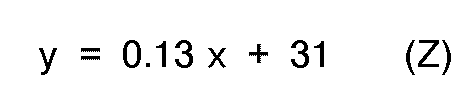
besitzt, in der x eine spezifische Oberfläche gemäß BET (m²/g) und y eine Oberflächenacidität des Feststoffs (»mol/g) ist. - Calciumcarbonatpigment gemäß Anspruch 1, das eine spezifische Oberfläche gemäß BET von 19 bis 55 m²/g besitzt.
- Verfahren zur Herstellung des Calciumcarbonatpigments gemäß Anspruch 1 für wärmeempfindliches Aufzeichnungspapier, welches die Schritte umfaßt:(i) Zugabe eines Calciumcarbonat-Oberflächenbehandlungsmittels zu einer wäßrigen Suspension eines Calciumcarbonats mit einer spezifischen Oberfläche gemäß BET von 17 bis 55 m²/g, wobei das Oberflächenbehandlungsmittel mindestens ein Mitglied, ausgewählt aus der Gruppe, bestehend aus einem Hydroxid eines Erdalkalimetalls, einem Hydroxid eines Alkalimetalls, einem Carbonat eines Alkalimetalls, einem Bicarbonat eines Alkalimetalls, Natriumaluminat, Aluminiumacetat und einem Essigsäuresalz eines C₄₋₁₄- aliphatischen Amins, ist und(ii) Rühren der Mischung.
- Verfahren gemäß Anspruch 3, worin das Calciumcarbonat eine spezifische Oberfläche gemäß BET von 19 bis 55 m²/g besitzt.
- Verfahren gemäß Anspruch 3, worin das Oberflächenbehandlungsmittel in einer Menge von 0.1 bis 5 Gew.-Teilen, pro 100 Gew.-Teile Calciumcarbonat, verwendet wird.
- Verfahren gemäß Anspruch 3, worin das Oberflächenbehandlungsmittel in einer Menge von 0.2 bis 4 Gew.-Teilen, pro 100 Gew. -Teile Calciumcarbonat, verwendet wird.
- Beschichtungszusammensetzung zur Herstellung einer wärmeempfindlichen Aufzeichnungsschicht eines wärmeempfindlichen Aufzeichnungspapiers, dadurch gekennzeichnet, daß die Zusammensetzung 5 bis 60 Gew.-% des Calciumcarbonatpigments gemäß Anspruch 1 enthält, bezogen auf die gesamten Feststoffe.
- Beschichtungezusammensetzung gemäß Anspruch 7, welche, berechnet als Feststoffe, umfaßt:
3 bis 10 Gew.-% eines Basisfarbstoffs, 15 bis 50 Gew.-% eines Farbentwicklers, 6 bis 30 Gew.-% eines chromogenen Empfindlichkeitseinstellungsmittels, 16 bis 22 Gew.-% eines Bindemittels und 5 bis 60 Gew.-% des Calciumcarbonatpigments gemäß Anspruch 1, bezogen auf die gesamten Feststoffe. - Beschichtungezusammensetzung gemäß Anspruch 7, welche, berechnet als Feststoffe, umfaßt:
5 bis 10 Gew.-% eines Basisfarbstoffs, 20 bis 40 Gew.-% eines Farbentwicklers, 10 bis 30 Gew.-% eines chromogenen Empfindlichkeitseinstellungsmittels, 16 bis 20 Gew.-% eines Bindemittels und 10 bis 55 Gew.-% des Calciumcarbonatpigments gemäß Anspruch 1, bezogen auf die gesamten Feststoffe. - Beschichtungszusammensetzung zur Herstellung einer Zwischenschicht zwischen einer wärmeempfindlichen Aufzeichnungsschicht eines wärmeempfindlichen Aufzeichnungspapiers und dessen Träger, dadurch gekennzeichnet, daß die Zusammensetzung ein Bindemittel in einer Menge von 5 bis 40 Gew.-Teilen, pro 100 Gew.-Teile des Calciumcarbonatpigments gemäß Anspruch 1, berechnet als Feststoffe, enthält.
- Wärmeempfindliches Aufzeichnungspapier, welches einen Träger und eine auf diesem gebildete wärmeempfindliche Aufzeichnungsschicht umfaßt und welche das Calciumcarbonatpigment gemäß Anspruch 1, ein chromogenes Empfindlichkeitseinstellungsmittel, einen farblosen bis schwach gefärbten Basisfarbstoff, einen Farbentwickler, der den Farbstoff veranlaßt, beim Erwärmen eine Farbe zu erzeugen, und ein Bindemittel enthält.
- Wärmeempfindliches Aufzeichnungspapier gemäß Anspruch 11, dadurch gekennzeichnet, daß es erhalten wird durch Aufbringen der Beschichtungszusammensetzung gemäß Anspruch 8 auf den Träger und Trocknen der Überzugsschicht.
- Wärmeempfindliches Aufzeichnungspapier gemäß Anspruch 11, dadurch gekennzeichnet, daß es erhalten wird durch Aufbringen der Beschichtungszusammensetzung gemäß Anspruch 9 auf den Träger und Trocknen der Überzugsschicht.
- Wärmeempfindliches Aufzeichnungspapier, welches umfaßt:(i) einen Träger, (ii) eine auf diesem gebildete Zwischenschicht, die das Calciumcarbonatpigment gemäß Anspruch 1 enthält, und (iii) eine auf der Zwischenschicht gebildete wärmeempfindliche Aufzeichnungsschicht, welche das Calciumcarbonatpigment gemäß Anspruch 1, ein chromogenes Empfindlichkeitseinstellungsmittel, einen farblosen bis schwach gefärbten Basisfarbstoff, einen Farbentwickler, der den Farbstoff veranlaßt, beim Erwärmen eine Farbe zu erzeugen, und ein Bindemittel enthält.
- Wärmeempfindliches Aufzeichnungspapier gemäß Anspruch 14, welches umfaßt:(a) einen Träger, (b) eine Zwischenschicht, gebildet durch Aufbringen der Beschichtungszusammensetzung gemäß Anspruch 10 auf den Träger, um eine Zwischenschicht zu bilden, und Trocknen der Überzugsschicht, und (c) eine wärmeempfindliche Aufzeichnungsschicht, gebildet durch Aufbringen der Beschichtungszusammensetzung gemäß Anspruch 8, um eine wärmeempfindliche Aufzeichnungsschicht auf der Zwischenschicht zu bilden, und Trocknen der Überzugsschicht.
- Wärmeempfindliches Aufzeichnungspapier gemäß Anspruch 14, welches umfaßt:(a) einen Träger, (b) eine Zwischenschicht, gebildet durch Aufbringen der Beschichtungszusammensetzung gemäß Anspruch 10 auf den Träger, um eine Zwischenschicht zu bilden, und Trocknen der Überzugsschicht, und (c) eine wärmeempfindliche Aufzeichnungsschicht, gebildet durch Aufbringen der Beschichtungszusammensetzung gemäß Anspruch 9, um eine wärmeempfindliche Aufzeichnungsschicht auf der Zwischenschicht zu bilden, und Trocknen der Überzugsschicht.
Applications Claiming Priority (2)
| Application Number | Priority Date | Filing Date | Title |
|---|---|---|---|
| JP122517/90 | 1990-05-11 | ||
| JP2122517A JPH0699150B2 (ja) | 1990-05-11 | 1990-05-11 | 感熱紙用炭酸カルシウム顔料、その製造法、感熱紙用塗被組成物及び感熱紙 |
Publications (3)
| Publication Number | Publication Date |
|---|---|
| EP0456413A2 EP0456413A2 (de) | 1991-11-13 |
| EP0456413A3 EP0456413A3 (en) | 1992-09-16 |
| EP0456413B1 true EP0456413B1 (de) | 1995-06-28 |
Family
ID=14837813
Family Applications (1)
| Application Number | Title | Priority Date | Filing Date |
|---|---|---|---|
| EP19910303976 Expired - Lifetime EP0456413B1 (de) | 1990-05-11 | 1991-05-02 | Kalziumkarbonatpigment für wärmeempfindliches Aufzeichnungspapier, Verfahren zu dessen Herstellung, Mischung zur Beschichtung von wärmeempfindlichem Aufzeichnungspapier und wärmeempfindliches Aufzeichnungspapier |
Country Status (3)
| Country | Link |
|---|---|
| EP (1) | EP0456413B1 (de) |
| JP (1) | JPH0699150B2 (de) |
| DE (1) | DE69110760T2 (de) |
Families Citing this family (4)
| Publication number | Priority date | Publication date | Assignee | Title |
|---|---|---|---|---|
| US5711799A (en) * | 1996-03-13 | 1998-01-27 | Ecc International Inc. | Acid tolerant calcium carbonate composition and uses therefor |
| JP3482323B2 (ja) * | 1997-06-03 | 2003-12-22 | サンスター株式会社 | 口腔用組成物 |
| JP5408562B2 (ja) * | 2006-11-30 | 2014-02-05 | 奥多摩工業株式会社 | 軽質炭酸カルシウム、その製造方法およびそれを用いた印刷用紙 |
| CA2737097C (en) * | 2008-09-18 | 2017-06-27 | Rheinkalk Gmbh | Manufacture of a material on the basis of calcium- and/or magnesium carbonate having a reduced decrepitation tendency |
Family Cites Families (3)
| Publication number | Priority date | Publication date | Assignee | Title |
|---|---|---|---|---|
| US2198223A (en) * | 1938-08-10 | 1940-04-23 | Pittsburgh Plate Glass Co | Preparation of calcium carbonate |
| GB684016A (en) * | 1950-04-03 | 1952-12-10 | Schweizerhall Saeurefab | Process for the preparation of neutral, inorganic oxide pigments |
| JPH01230424A (ja) * | 1988-03-09 | 1989-09-13 | Shiraishi Chuo Kenkyusho:Kk | 炭酸カルシウム、炭酸カルシウム顔料、その製造法、情報記録紙用塗被組成物及び情報記録紙 |
-
1990
- 1990-05-11 JP JP2122517A patent/JPH0699150B2/ja not_active Expired - Lifetime
-
1991
- 1991-05-02 DE DE1991610760 patent/DE69110760T2/de not_active Expired - Lifetime
- 1991-05-02 EP EP19910303976 patent/EP0456413B1/de not_active Expired - Lifetime
Also Published As
| Publication number | Publication date |
|---|---|
| EP0456413A2 (de) | 1991-11-13 |
| JPH0699150B2 (ja) | 1994-12-07 |
| DE69110760T2 (de) | 1995-12-21 |
| DE69110760D1 (de) | 1995-08-03 |
| JPH0421518A (ja) | 1992-01-24 |
| EP0456413A3 (en) | 1992-09-16 |
Similar Documents
| Publication | Publication Date | Title |
|---|---|---|
| US5007964A (en) | Calcium carbonate, calcium carbonate pigment, process for preparing same, coating composition for information recording paper and information recording paper | |
| EP0405417B1 (de) | Registriermittel und Verfahren zum Registrieren damit | |
| EP0461558B1 (de) | Tintenstrahldruckmittel und dessen Verwendungsverfahren | |
| EP0436230A1 (de) | Tintenstrahlaufzeichnungsmittel und -verfahren | |
| GB2145074A (en) | Calcium carbonate | |
| EP0264827B1 (de) | Wärmeempfindliches Aufzeichnungsmaterial | |
| GB2085178A (en) | Heat-sensitive recording material | |
| US4812438A (en) | Heat-sensitive recording material | |
| EP1400368B1 (de) | Wärmeempfindliches aufzeichnungsmaterial | |
| US4855278A (en) | Heat-sensitive recording material | |
| US4647951A (en) | Heat-sensitive recording material | |
| DE60222210T2 (de) | Wärmeempfindliches Aufzeichnungsmaterial | |
| US4426424A (en) | Heat-sensitive recording materials | |
| US4511909A (en) | Heat-sensitive recording materials | |
| EP0456413A2 (de) | Kalziumkarbonatpigment für wärmeempfindliches Aufzeichnungspapier, Verfahren zu dessen Herstellung, Mischung zur Beschichtung von wärmeempfindlichem Aufzeichnungspapier und wärmeempfindliches Aufzeichnungspapier | |
| DE69023818T2 (de) | Wärmeempfindliches Aufzeichnungsmaterial. | |
| EP0462770B1 (de) | Wärmeempfindliches Aufzeichnungsmaterial | |
| US5296441A (en) | Thermal printing medium and method for preparing the same | |
| US4833121A (en) | Heat-sensitive recording material | |
| GB2115943A (en) | Heat-sensitive recording sheets containing fluoran dyes | |
| JP5693005B2 (ja) | 表面処理炭酸カルシウム及びインクジェット印刷記録媒体 | |
| JP2938917B2 (ja) | インクジェット記録媒体 | |
| EP0399785A1 (de) | Wärmeempfindliches Aufzeichnungsmaterial | |
| JPH0117479B2 (de) | ||
| JPH05270136A (ja) | 感熱記録体 |
Legal Events
| Date | Code | Title | Description |
|---|---|---|---|
| PUAI | Public reference made under article 153(3) epc to a published international application that has entered the european phase |
Free format text: ORIGINAL CODE: 0009012 |
|
| AK | Designated contracting states |
Kind code of ref document: A2 Designated state(s): DE FR GB |
|
| PUAL | Search report despatched |
Free format text: ORIGINAL CODE: 0009013 |
|
| AK | Designated contracting states |
Kind code of ref document: A3 Designated state(s): DE FR GB |
|
| 17P | Request for examination filed |
Effective date: 19930202 |
|
| 17Q | First examination report despatched |
Effective date: 19940407 |
|
| GRAA | (expected) grant |
Free format text: ORIGINAL CODE: 0009210 |
|
| AK | Designated contracting states |
Kind code of ref document: B1 Designated state(s): DE FR GB |
|
| REF | Corresponds to: |
Ref document number: 69110760 Country of ref document: DE Date of ref document: 19950803 |
|
| ET | Fr: translation filed | ||
| PLBE | No opposition filed within time limit |
Free format text: ORIGINAL CODE: 0009261 |
|
| STAA | Information on the status of an ep patent application or granted ep patent |
Free format text: STATUS: NO OPPOSITION FILED WITHIN TIME LIMIT |
|
| 26N | No opposition filed | ||
| REG | Reference to a national code |
Ref country code: GB Ref legal event code: IF02 |
|
| PGFP | Annual fee paid to national office [announced via postgrant information from national office to epo] |
Ref country code: FR Payment date: 20100519 Year of fee payment: 20 |
|
| PGFP | Annual fee paid to national office [announced via postgrant information from national office to epo] |
Ref country code: DE Payment date: 20100512 Year of fee payment: 20 |
|
| PGFP | Annual fee paid to national office [announced via postgrant information from national office to epo] |
Ref country code: GB Payment date: 20100407 Year of fee payment: 20 |
|
| REG | Reference to a national code |
Ref country code: DE Ref legal event code: R071 Ref document number: 69110760 Country of ref document: DE |
|
| REG | Reference to a national code |
Ref country code: GB Ref legal event code: PE20 Expiry date: 20110501 |
|
| PG25 | Lapsed in a contracting state [announced via postgrant information from national office to epo] |
Ref country code: GB Free format text: LAPSE BECAUSE OF EXPIRATION OF PROTECTION Effective date: 20110501 |
|
| PG25 | Lapsed in a contracting state [announced via postgrant information from national office to epo] |
Ref country code: DE Free format text: LAPSE BECAUSE OF EXPIRATION OF PROTECTION Effective date: 20110502 |