EP0456467B1 - Reinigung und Desinfektion von Kontaktlinsen mittels Kombinationen von polymeren quaternären Ammoniumverbindungen und Enzymen - Google Patents
Reinigung und Desinfektion von Kontaktlinsen mittels Kombinationen von polymeren quaternären Ammoniumverbindungen und Enzymen Download PDFInfo
- Publication number
- EP0456467B1 EP0456467B1 EP91304114A EP91304114A EP0456467B1 EP 0456467 B1 EP0456467 B1 EP 0456467B1 EP 91304114 A EP91304114 A EP 91304114A EP 91304114 A EP91304114 A EP 91304114A EP 0456467 B1 EP0456467 B1 EP 0456467B1
- Authority
- EP
- European Patent Office
- Prior art keywords
- enzyme
- solution
- polymeric
- antimicrobial agent
- composition
- Prior art date
- Legal status (The legal status is an assumption and is not a legal conclusion. Google has not performed a legal analysis and makes no representation as to the accuracy of the status listed.)
- Expired - Lifetime
Links
Images




Classifications
-
- C—CHEMISTRY; METALLURGY
- C11—ANIMAL OR VEGETABLE OILS, FATS, FATTY SUBSTANCES OR WAXES; FATTY ACIDS THEREFROM; DETERGENTS; CANDLES
- C11D—DETERGENT COMPOSITIONS; USE OF SINGLE SUBSTANCES AS DETERGENTS; SOAP OR SOAP-MAKING; RESIN SOAPS; RECOVERY OF GLYCEROL
- C11D3/00—Other compounding ingredients of detergent compositions covered in group C11D1/00
- C11D3/48—Medical, disinfecting agents, disinfecting, antibacterial, germicidal or antimicrobial compositions
-
- A—HUMAN NECESSITIES
- A61—MEDICAL OR VETERINARY SCIENCE; HYGIENE
- A61L—METHODS OR APPARATUS FOR STERILISING MATERIALS OR OBJECTS IN GENERAL; DISINFECTION, STERILISATION OR DEODORISATION OF AIR; CHEMICAL ASPECTS OF BANDAGES, DRESSINGS, ABSORBENT PADS OR SURGICAL ARTICLES; MATERIALS FOR BANDAGES, DRESSINGS, ABSORBENT PADS OR SURGICAL ARTICLES
- A61L12/00—Methods or apparatus for disinfecting or sterilising contact lenses; Accessories therefor
- A61L12/08—Methods or apparatus for disinfecting or sterilising contact lenses; Accessories therefor using chemical substances
- A61L12/14—Organic compounds not covered by groups A61L12/10 or A61L12/12
- A61L12/141—Biguanides, e.g. chlorhexidine
- A61L12/142—Polymeric biguanides
-
- A—HUMAN NECESSITIES
- A61—MEDICAL OR VETERINARY SCIENCE; HYGIENE
- A61L—METHODS OR APPARATUS FOR STERILISING MATERIALS OR OBJECTS IN GENERAL; DISINFECTION, STERILISATION OR DEODORISATION OF AIR; CHEMICAL ASPECTS OF BANDAGES, DRESSINGS, ABSORBENT PADS OR SURGICAL ARTICLES; MATERIALS FOR BANDAGES, DRESSINGS, ABSORBENT PADS OR SURGICAL ARTICLES
- A61L12/00—Methods or apparatus for disinfecting or sterilising contact lenses; Accessories therefor
- A61L12/08—Methods or apparatus for disinfecting or sterilising contact lenses; Accessories therefor using chemical substances
- A61L12/14—Organic compounds not covered by groups A61L12/10 or A61L12/12
- A61L12/143—Quaternary ammonium compounds
- A61L12/145—Polymeric quaternary ammonium compounds
-
- C—CHEMISTRY; METALLURGY
- C11—ANIMAL OR VEGETABLE OILS, FATS, FATTY SUBSTANCES OR WAXES; FATTY ACIDS THEREFROM; DETERGENTS; CANDLES
- C11D—DETERGENT COMPOSITIONS; USE OF SINGLE SUBSTANCES AS DETERGENTS; SOAP OR SOAP-MAKING; RESIN SOAPS; RECOVERY OF GLYCEROL
- C11D3/00—Other compounding ingredients of detergent compositions covered in group C11D1/00
- C11D3/0005—Other compounding ingredients characterised by their effect
- C11D3/0078—Compositions for cleaning contact lenses, spectacles or lenses
-
- C—CHEMISTRY; METALLURGY
- C11—ANIMAL OR VEGETABLE OILS, FATS, FATTY SUBSTANCES OR WAXES; FATTY ACIDS THEREFROM; DETERGENTS; CANDLES
- C11D—DETERGENT COMPOSITIONS; USE OF SINGLE SUBSTANCES AS DETERGENTS; SOAP OR SOAP-MAKING; RESIN SOAPS; RECOVERY OF GLYCEROL
- C11D3/00—Other compounding ingredients of detergent compositions covered in group C11D1/00
- C11D3/16—Organic compounds
- C11D3/20—Organic compounds containing oxygen
- C11D3/2075—Carboxylic acids-salts thereof
- C11D3/2086—Hydroxy carboxylic acids-salts thereof
-
- C—CHEMISTRY; METALLURGY
- C11—ANIMAL OR VEGETABLE OILS, FATS, FATTY SUBSTANCES OR WAXES; FATTY ACIDS THEREFROM; DETERGENTS; CANDLES
- C11D—DETERGENT COMPOSITIONS; USE OF SINGLE SUBSTANCES AS DETERGENTS; SOAP OR SOAP-MAKING; RESIN SOAPS; RECOVERY OF GLYCEROL
- C11D3/00—Other compounding ingredients of detergent compositions covered in group C11D1/00
- C11D3/16—Organic compounds
- C11D3/37—Polymers
- C11D3/3703—Macromolecular compounds obtained otherwise than by reactions only involving carbon-to-carbon unsaturated bonds
- C11D3/3723—Polyamines or polyalkyleneimines
-
- C—CHEMISTRY; METALLURGY
- C11—ANIMAL OR VEGETABLE OILS, FATS, FATTY SUBSTANCES OR WAXES; FATTY ACIDS THEREFROM; DETERGENTS; CANDLES
- C11D—DETERGENT COMPOSITIONS; USE OF SINGLE SUBSTANCES AS DETERGENTS; SOAP OR SOAP-MAKING; RESIN SOAPS; RECOVERY OF GLYCEROL
- C11D3/00—Other compounding ingredients of detergent compositions covered in group C11D1/00
- C11D3/16—Organic compounds
- C11D3/38—Products with no well-defined composition, e.g. natural products
- C11D3/386—Preparations containing enzymes, e.g. protease or amylase
- C11D3/38618—Protease or amylase in liquid compositions only
Definitions
- the present invention relates to the field of contact lens cleaning and disinfecting.
- this invention relates to methods and compositions for the simultaneous cleaning and disinfecting of human-worn contact lenses.
- EP A 0 384 666 which is a state of the art document pursuant to Article 54(3)-(4) EPC discloses a method and composition for simultaneously cleaning and disinfecting contact lenses with proteolytic enzymes and antimicrobial agents wherein the lenses are contacted with an aqueous system containing the enzyme and an antimicrobial agent selected from quaternary ammonium salts used in ophthalmic applications and biguanides and wherein the osmotic value of the system is maintained at a level which does not substantially inhibit the activity of the antimicrobial agent.
- the system can include a chelating agent such as ethylenediaminetetraacetic acid.
- the present invention is directed to an improved method for cleaning and disinfecting contact lenses at the same Time. More particularly, this invention involves the combined use of enzymes to clean and a very low concentration of a polymeric antimicrobial agent to disinfect.
- the present invention is based on the finding that these antimicrobial agents can be effectively utilized in combination with enzymes to clean and disinfect contact lenses under certain conditions. This finding is surprising, both in view of prior art attempts which indicate that there is mutual inhibition, possibly by binding between the enzyme and the antimicrobial agent, and in light of other, earlier observations that large excesses of one or both of the enzyme and antimicrobial agent were required to achieve both cleaning and disinfecting.
- the present invention is based in part on the finding that the use of certain formulation criteria can eliminate or reduce the above-cited binding problem. More particularly, it has been found that this binding can be substantially eliminated by using certain "complexing agents" (defined hereunder) to prevent binding between the enzyme and antimicrobial agent, thereby maintaining the activity of each.
- the problem can be further overcome by maintaining the tonicity of the solution containing the antimicrobial agent at an isotonic or hypotonic level to maximize antimicrobial activity and by controlling both the enzyme and antimicrobial agent concentrations. This approach allows a very low concentration of the antimicrobial agent to be utilized, while still achieving both disinfecting and cleaning of the lenses.
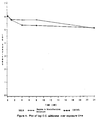
- FIG. 1 through 6 is a graphic illustration of log 10 reduction of a microorganism over exposure time in the disinfecting solution control ("diamond” points) and in the combination enzymatic cleaner and disinfecting solution ("+" points).
- the enzymes which may be utilized in the compositions of the present invention include all enzymes which: (1) are useful in removing deposits from contact lenses; (2) cause, at most, only minor ocular irritation in the event a small amount of enzyme contacts the eye as a result of inadequate rinsing of a contact lens; (3) are chemically stable and effective in the presence of the polymeric antimicrobial agents described below; and (4) do not adversely affect the physical or chemical properties of the lens being treated.
- enzymes which satisfy the foregoing requirements are referred to as being "ophthalmically acceptable.”
- enzymes may be utilized in the present invention. Since it is conventional in this art to categorize enzymes according to their activities, it can be further stated that the enzymes useful in the present invention include those having proteolytic, lipolytic, mucolytic, and/or amylolytic activity. Enzymes having proteolytic activity are particularly important, since protein deposits on contact lenses are a common problem. Reference is made to the above-cited U.S. Patents Nos. 3,910,296 and Re. 32,672 for a detailed listing of enzymes which are generally recognized as being useful for cleaning contact lenses.
- the enzymes utilized in the present invention will most frequently be enzymes having proteolytic, lipolytic, and/or amylolytic activity since deposits of proteins, lipids and mucopolysaccharides are formed on most, if not all, human-worn contact lenses.
- suitable proteolytic enzymes include: pancreatin, subtilisin, papain, ficin, and bromelin.
- suitable lipolytic enzymes include: Lipase K-3000 and Lipase AP6 (available from Amano Corp., Troy, VA), and pancreatic lipase.
- amylolytic enzymes include: ⁇ -amylase, ⁇ -amylase, aminoglucosidase (glucoamylase), fungal amylase, and pullalanase.
- ⁇ -amylase ⁇ -amylase
- aminoglucosidase glucoamylase
- fungal amylase fungal amylase
- pullalanase ase that is commercially available from various sources, including Novo Industries (Bagsvaerd, Denmark), Sigma (St. Louis, MO), and Boehringer Mannheim (Indianapolis, IN).
- a stabilizing agent such as acetylcysteine.
- the methods of the present invention will typically involve the use of an amount of one or more enzymes effective to remove substantially or to reduce significantly deposits of proteins, lipids, mucopolysaccharides and other materials on the lenses.
- an amount is referred to as "an amount effective to clean the lens.”
- the amount of enzyme or enzymes utilized in particular embodiments of the present invention may vary, depending on various factors, such as the type of enzyme(s) utilized, the proposed duration of exposure of lenses to enzyme, the nature of the lens care regimen (e.g., the frequency of lens disinfection and cleaning), the type of lens being treated, and the use of adjunctive cleaning agents (e.g., surfactants).
- proteolytic activity unit is defined as the amount of enzyme activity present to generate one microgram ( ⁇ g) of tyrosine per minute ( ⁇ g Tyr/min), as determined by the casein-digestion, colorimetric assay described below.
- casein substrate (0.65% casein w/v) is equilibrated for 10 minutes (min) ⁇ 5 seconds (s).
- a 1.0 ml portion of enzyme solution (0.2 mg/ml) is then added to the casein substrate and the mixture vortexed, then incubated for 10 min ⁇ 5 s.
- 5.0 ml of 14% trichloroacetic acid is added and the resultant mixture immediately vortexed.
- the mixture is incubated for at least another 30 min, then vortexed and centrifuged for 15-20 min (approx. 2000 rpm). The supernatant of the centrifuged sample is filtered into a serum filter sampler and a 2.0 ml aliquot removed.
- Enzymes having lipolytic, amylolytic, and/or mucolytic activity will typically be utilized in amounts of less than or equal to about 5 United States Pharmacopeia (USP) units per ml of solution.
- USP United States Pharmacopeia
- polymeric antimicrobial agent refers to any nitrogen-containing polymer or co-polymer which has antimicrobial activity.
- Suitable antimicrobial agents include, but are not limited to: polymeric quaternary ammonium compounds, such as disclosed in U.S. Patents Nos. 3,931,319 (Green, et al.), 4,026,945 (Green, et al.) and 4,615,882 (Stockel, et al.); and polymeric biguanides, such as disclosed in U.S. Patent No. 4,537,746 (Ogunbiyi, et al.) and European Patent Application 0 180 309 (Ogunbiyi). Particularly preferred are:
- antimicrobial agents are utilized in the methods of the present invention in an amount effective to eliminate substantially or to reduce significantly the number of viable microorganisms found on contact lenses, in accordance with the requirements of governmental regulatory agencies, such as the United States Food and Drug Administration (e.g., 1985 Guidelines). For purposes of the present specification, that amount is referred to as being "an amount effective to disinfect” or "an antimicrobial effective amount.”
- the amount of antimicrobial agent employed will vary, depending on factors such as the type of lens care regimen in which the method is being utilized. For example, the use of an efficacious daily cleaner in the lens care regimen may substantially reduce the amount of material deposited on the lenses, including microorganisms, and thereby lessen the amount of antimicrobial agent required to disinfect the lenses.
- the type of lens being treated may also be a factor.
- a concentration in the range of 0.000001% to 0.01% by weight of one or more of the above-described antimicrobial agents will be employed.
- the most preferred concentration of the polymeric quaternary ammonium compounds of Formula (I) is about 0.001% by weight, whereas the most preferred concentration of the polymeric biguanides of Formula (II) is about 0.00005% by weight.
- the above-described antimicrobial agents can be effectively utilized in combination with one or more enzymes to clean and disinfect contact lenses at the same time, provided that certain conditions are maintained. More specifically, it has been found that certain low molecular weight compounds having at least one carboxy functional group can be utilized to reduce substantially binding between the positively charged antimicrobial agents and the negatively charged sites of the enzymes. Although Applicants do not wish to be bound to a particular theory, it is believed that the complexing agent substantially reduces binding between enzyme and antimicrobial agent by binding with the antimicrobial agent, thereby effectively blocking the positively charged sites on the antimicrobial agent from binding or complexing with the negatively charged sites on the enzyme.
- a very low concentration of the antimicrobial agent can be utilized because the enzyme is effectively prevented from disrupting the disinfecting activity of the antimicrobial agent.
- these low molecular weight compounds having at least one carboxy functional group are referred to as "complexing agents.”
- the complexing agents significantly improve the performance of the antimicrobial agents without adversely affecting the performance of the enzymes contained in the same solutions. By keeping the ionic strength of the solution at an isotonic or hypotonic level and by limiting the enzyme concentration, the activity of the antimicrobial agent is further enhanced.
- the complexing agents which may be utilized include, but are not limited to: ethylenediamine-tetraacetic acid, citric acid, acetic acid and their pharmaceutically acceptable salts.
- the amount of complexing agent utilized will depend on several factors, including the particular type of agent selected and the relative concentrations of enzyme and antimicrobial agent utilized. The concentration will typically range from about 0.03% to about 0.7% by weight/volume, with 0.05% to 0.6% preferred.
- the ionic strength or tonicity of the cleaning and disinfecting solution of the present invention has also been found to be an important factor. More specifically, it has been found that polymeric ammonium compounds, and particularly those of Formula (I), above, lose antimicrobial activity as the tonicity of the solution is increased. A preferred tonicity in the range of 150 to 300 milliOsmoles per kilogram (mOs/kg) is therefore utilized, with a range of 210 to 240 mOs/kg being more preferred and a tonicity of 220 mOs/kg being most preferred.
- the tonicity of the solution may be affected by various components of the solution, but it is generally a function of the sodium chloride concentration.
- the enzyme tablet should be added after the lens and the antimicrobial agent have been placed together in solution; but if the enzyme is formed as a tablet having a delayed release coating, the enzyme tablet may be added to the solution at any point in the sequence of addition, provided that the actual release of enzyme into solution occurs after the lens and the antimicrobial agent have been combined in the solution.
- the antimicrobial activity of the enzyme and antimicrobial agent combination has surprisingly been found to become even more effective than the antimicrobial agent alone when lenses are treated for extended periods of approximately one hour to overnight, with four to eight hours preferred. Since, for the sake of convenience, contact lenses are typically soaked overnight in order to be cleaned with enzymes or disinfected with chemical agents, this finding has practical significance.
- the contact lens cleaning and disinfecting system of the present invention may be provided in various physical forms.
- the two main components, antimicrobial agent and enzyme can be formulated separately, or a single dosage form may be used (see Example 2).
- the antimicrobial agent is generally provided in solution form, although it could also be provided in solid form.
- the enzyme cleaner can be provided in either solid or liquid form, but for packaging and dosage purposes, effervescent compositions in tablet form are desirable. Dosage forms which provide for delayed release of the enzyme in solution are particularly preferred.
- the two components may be formed in layers with the enzyme component being formed as a core tablet and the antimicrobial agent being formed as an outer layer around said enzyme core, with a seal and/or a delayed release coating interposed between the enzyme core and the antimicrobial agent outer layer.
- the delayed release coating can be composed of any of several polymeric materials, including cellulose ethers, vinyls, glycols, and acrylics.
- the delayed release coating may additionally include plasticizers such as propylene glycol, polyethylene glycol, glycerin, mineral oil, vegetable oil, or other known plasticizers.
- the seal coating may be composed of any of several polymeric materials, including cellulose ethers, vinyls, glycols, and acrylics, or the coating could be composed of synthetic or natural gums, gelatin, shellac, salts (e.g., sodium chloride), saccharide alcohols (e.g., mannitol or sorbitol), or other commonly used seal coating materials.
- the following formulation represents a preferred disinfecting solution: Ingredient (w/v)% Polyquad® 0.001 + 10% excess Sodium chloride 0.48 Disodium edetate 0.05 Citric acid monohydrate 0.021 Sodium citrate dihydrate 0.56 Purified Water q.s.
- composition represents a preferred enzymatic cleaner tablet: Ingredient mg/50 mg Tablet Pancreatin (6X) 1.38 Citric Acid 5.95 Sodium Bicarbonate 13.135 Povidone (K 29-32) 0.415 Polyethylene Glycol (3350) 0.75 Compressible Sugar QS Alcohol QS
- This tablet may also be formulated with a seal coating and/or a delayed release coating to provide for a delay in dissolution of up to about 2 hours.
- pancreatin, polyethylene glycol, and lactose in the amounts indicated above, are mixed in a blender for 5 min, citric acid is added and the composite mixed for another 5 min, at which time sodium bicarbonate is added and the composite mixed for another 20 min.
- the resultant granulation is then compressed using a rotary tablet press fitted with suitable tooling into tablets of appropriate size and having a hardness of 5 to 10 Strong-Cobb units.
- the tablets are then sequentially coated with a seal coat (2.5% tablet weight gain), a delayed release coat (17.5% tablet weight gain), and a disinfectant coat (3.6% tablet weight gain).
- Each of the coating solutions is similarly prepared by mixing the ingredients until a homogenous mixture is obtained.
- Each of the coating solutions is applied by rotating the tablets and spraying the coating solution onto the tablets. After each coating solution is applied, the tablets are allowed to dry before the next coating solution is applied.
- the disinfecting effectiveness of the present invention was evaluated by determining the rate and extent of kill for six logarithmic challenge innoculae.
- the invention was tested against six microorganisms: Staphylococcus epidermidis , Pseudomonas aeruginosa , Serratia marcescens , Candida albicans , Aspergillus fumigatus and Herpes simplex .
- a 0.1 ml volume of inoculum was first added to a 10 ml volume of the disinfecting solution of Example 1, followed by the addition of one 50 mg tablet of the enzymatic cleaner of Example 1.
- a similarly inoculated 10 ml volume of the disinfecting solution of Example 1 was used as a control.
- the average D-values (see Table VII, below) for the enzymatic cleaner and disinfecting solution combination and the disinfecting solution control were less than or equal to 0.5 h for S. epidermidis and P. aeruginosa, less than or equal to 2.5 h for S. marcescens, less than or equal to 3.9 hr for C. albicans , and less than or equal to 3.4 h for A. fumigatus.
- the average D-values for the enzymatic cleaner and disinfecting solution combination were less than a quarter of the average D-values of the disinfecting solution control for Herpes simplex.
- D-values Of greater statistical significance than the average D-values were the differences in log reduction over time between the enzymatic cleaner an disinfecting solution combination and the disinfecting solution control. Comparison of actual log reduction, using a single, specified time for kill of microorganisms, is a more accurate determination of antimicrobial activity than comparison of D-values, since D-values are calculated from the initial log reduction and do not therefore take into consideration any subsequent reduction.
- Example 1 Approximately 10 ml of the disinfecting solution of Example 1 is placed in an appropriate container. A contact lens to be cleaned is first cleaned with a daily cleaner, such as a surfactant-containing formulation, rinsed with saline, then added to the disinfective solution. This is followed by the addition of one 50 mg tablet of the enzymatic cleaner of Example 1, which will easily dissolve in the disinfecting solution (about 3 min). The lens is allowed to soak in the resultant solution for a period sufficient to clean and disinfect the lens, typically four to eight hours, or overnight. The lens is then taken out and rinsed with saline to remove the soaking solution.
- a daily cleaner such as a surfactant-containing formulation
- Example 2 The procedure described above may be used with the formulation of Example 2, with a few modifications.
- a saline solution or other suitable diluent e.g. distilled water
- the tablet of Example 2 containing both the antimicrobial agent and enzyme is dissolved in the saline or other diluent, and the lens to be treated is soaked in the resulting solution.
- the lens may be added to the solution either prior to or concurrently with the addition of the tablet.
Landscapes
- Chemical & Material Sciences (AREA)
- Chemical Kinetics & Catalysis (AREA)
- Life Sciences & Earth Sciences (AREA)
- Organic Chemistry (AREA)
- Health & Medical Sciences (AREA)
- Engineering & Computer Science (AREA)
- Oil, Petroleum & Natural Gas (AREA)
- Wood Science & Technology (AREA)
- Epidemiology (AREA)
- General Chemical & Material Sciences (AREA)
- Animal Behavior & Ethology (AREA)
- General Health & Medical Sciences (AREA)
- Public Health (AREA)
- Veterinary Medicine (AREA)
- Emergency Medicine (AREA)
- Detergent Compositions (AREA)
- Apparatus For Disinfection Or Sterilisation (AREA)
- Eyeglasses (AREA)
- Agricultural Chemicals And Associated Chemicals (AREA)
Claims (32)
- Mittel zur Reinigung und Desinfektion von Kontaktlinsen, enthaltend:eine erste Komponente, umfassend eine Menge eines zur Desinfektion der Linsen wirksamen polymeren antimikrobiellen Mittels, wobei das polymere antimikrobielle Mittel ein Stickstoff enthaltendes Polymeres oder Copolymeres umfaßt, und eine Menge eines Komplexbildners, die ausreichend ist, eine Konzentration von etwa 0,03 bis etwa 0,7 Gew./Vol.-% zu ergeben, wenn das Mittel in einer Lösung aufgelöst ist, wobei der Komplexbildner aus Citronensäure, Ethylendiamintetraessigsäure, Essigsäure und pharmazeutisch annehmbaren Salzen davon ausgewählt ist; undeine zweite Komponente, umfassend eine Menge eines ophthalmologisch annehmbaren Enzyms, die ausreichend ist, eine Konzentration von etwa 26 proteolytischen Aktivitätseinheiten pro ml Lösung oder weniger zu ergeben, wenn das Mittel in einer Lösung aufgelöst ist (wobei eine "proteolytische Aktivitätseinheit" als die Menge der vorhandenen Enzymaktivität zur Erzeugung von einem Mikrogramm (µg) Tyrosin pro Minute (µg Tyr/min), bestimmt durch einen kolorimetrischen Casein-Digestionsassay, definiert ist);
wobei die genannte erste Komponente und die genannte zweite Komponente vor dem Gebrauch voneinander getrennt gehalten werden. - Mittel nach Anspruch 1, dadurch gekennzeichnet, daß das polymere antimikrobielle Mittel aus polymeren quaternären Ammoniumverbindungen, polymeren Biguaniden und pharmazeutisch annehmbaren Salzen davon ausgewählt ist.
- Mittel nach Anspruch 2, dadurch gekennzeichnet, daß das polymere antimikrobielle Mittel ausausgewählt ist.a) polymeren quaternären Ammoniumverbindungen mit einem zahlenmittleren Molekulargewicht im Bereich von etwa 2000 bis etwa 30.000, wobei die polymeren quaternären Ammoniumverbindungen die Formel:haben, worin: R1, R2 = OH, N(CH3)2 oder N+(CH2CH2OH)3; X für ein pharmazeutisch annehmbares Anion steht; und m = 0, 1 oder 2; und
 b) polymeren Biguaniden der Formel:und pharmazeutisch annehmbaren Salzen davon mit einem zahlenmittleren Molekulargewicht im Bereich von etwa 500 bis etwa 120.000
- Mittel nach Anspruch 3, dadurch gekennzeichnet, daß die Konzentration des polymeren antimikrobiellen Mittels, wenn das Mittel in Lösungsform vorliegt, im Bereich von etwa 0,000001 bis etwa 0,01 Gew./Vol.-% liegt.
- Mittel nach Anspruch 1, dadurch gekennzeichnet, daß das polymere antimikrobielle Mittelist.α-4-[1-Tris(2-hydroxyethyl)ammonium-2-butenyl]poly[1-dimethylammonium-2-butenyl]-ω-tris(2-hydroxyethyl) - ammoniumchlorid (allgemein als Polyquaternium-1 bekannt)
- Mittel nach Anspruch 5, dadurch gekennzeichnet, daß die Konzentration von Polyquaternium-1 ausreichend ist, um eine Konzentration von etwa 0,001 Gew./Vol.-% zu ergeben, wenn das Mittel in Lösungsform vorliegt.
- Mittel nach einem der Ansprüche 1 bis 4, dadurch gekennzeichnet, daß das polymere antimikrobielle Mittel ein Gemisch aus polymeren quaternären Ammoniumverbindungen der Formel (I) umfaßt.
- Mittel nach einem der Ansprüche 1 bis 7, dadurch gekennzeichnet, daß das Enzym aus Pancreatin, Papain und Subtilisin ausgewählt ist.
- Mittel nach einem der Ansprüche 5, 6 und 8, dadurch gekennzeichnet, daß das polymere antimikrobielle Mittel Polyquaternium-1 ist und daß das Enzym Pancreatin ist.
- Mittel nach einem der Ansprüche 1 bis 4 und 8, dadurch gekennzeichnet, daß das polymere antimikrobielle Mittel ein Biguanidpolymeres der Formel (II), wie in Anspruch 3 definiert, oder ein pharmazeutisch annehmbares Salz davon mit einem zahlenmittleren Molekulargewicht im Bereich von etwa 500 bis 2.500 ist.
- Mittel nach Anspruch 10, dadurch gekennzeichnet, daß die Konzentration des genannten Biguanidpolymeren II ausreichend ist, um eine Konzentration von etwa 0,00005 Gew./Vol.-%, wenn das Mittel in Lösungsform vorliegt, zu ergeben.
- Mittel nach einem der Ansprüche 1 bis 11, dadurch gekennzeichnet, daß die Ionenstärke des Mittels, wenn es in Lösungsform vorliegt, auf einem isotonischen oder hypotonischen Niveau gehalten wird.
- Mittel nach Anspruch 12, dadurch gekennzeichnet, daß die Ionenstärke des Mittels, wenn es in Lösungsform vorliegt, im Bereich von etwa 150 bis etwa 300 mOsm/kg liegt.
- Mittel nach einem der Ansprüche 1 bis 13, dadurch gekennzeichnet, daß die Konzentration des genannten Enzyms, wenn das Mittel in Lösungsform vorliegt, etwa 13 "proteolytischen Aktivitätseinheiten" (wie in Anspruch 1 definiert) pro ml Lösung gleich ist oder kleiner ist.
- Mittel nach einem der Ansprüche 1 bis 14, dadurch gekennzeichnet, daß die genannte zweite Komponente weiterhin ein ophthalmologisch annehmbares Enzym mit einer lipolytischen, mucolytischen oder amylolytischen Aktivität umfaßt.
- Mittel nach einem der Ansprüche 1 bis 15, dadurch gekennzeichnet, daß die zweite Komponente als Tablette formuliert ist.
- Mittel nach Anspruch 16, dadurch gekennzeichnet, daß die Tablette einen Enzymkern und einen Außenüberzug umfaßt, um die Freisetzung des Enzymkerns zu verzögern, wenn die genannte Enzymtablette zu der genannten ersten Komponente gegeben wird.
- Verfahren zur gleichzeitigen Reinigung und Desinfektion von Kontaktlinsen, umfassend die Stufen:Eintauchen der Kontaktlinsen in eine wäßrige Lösung, die eine wirksame Menge eines polymeren antimikrobiellen Mittels zur Desinfektion der Kontaktlinsen, wobei das genannte polymere antimikrobielle Mittel ein Stickstoff enthaltendes Polymeres oder Copolymeres umfaßt, und etwa 0,03 bis 0,7 Gew./Vol.-% eines Komplexbildners, wobei der Komplexbildner aus Citronensäure, Ethylendiamintetraessigsäure, Essigsäure und pharmazeutisch annehmbaren Salzen davon ausgewählt ist, enthält;Freisetzen in die genannte wäßrige Lösung einer Menge eines ophthalmologisch annehmbaren Enzyms, die ausreichend ist, um eine Konzentration von etwa 26 "proteolytischen Aktivitätseinheiten" (wie in Anspruch 1 definiert) oder weniger zu ergeben, undAufrechterhalten des Eintauchens der Kontaktlinsen in die genannte wäßrige Lösung über einen genügenden Zeitraum zur Reinigung und Desinfektion der Linsen.
- Verfahren nach Anspruch 18, dadurch gekennzeichnet, daß das polymere antimikrobielle Mittel aus polymeren quaternären Ammoniumverbindungen, polymeren Biguaniden und pharmazeutisch annehmbaren Salzen davon ausgewählt ist.
- Verfahren nach Anspruch 19, dadurch gekennzeichnet, daß das polymere antimikrobielle Mittel ausausgewählt ist.a) polymeren quaternären Ammoniumverbindungen mit einem zahlenmittleren Molekulargewicht im Bereich von etwa 2000 bis etwa 30.000, wobei die polymeren quaternären Ammoniumverbindungen die Formel:haben, worin: R1, R2 = OH, N(CH3)2 oder N+(CH2CH2OH)3; X für ein pharmazeutisch annehmbares Anion steht; und m = 0, 1 oder 2; und
 b) polymeren Biguaniden der Formel:und pharmazeutisch annehmbaren Salzen davon mit einem zahlenmittleren Molekulargewicht im Bereich von etwa 500 bis etwa 120.000
- Verfahren nach Anspruch 20, dadurch gekennzeichnet, daß die Konzentration des polymeren antimikrobiellen Mittels, wenn das Mittel in Lösungsform vorliegt, im Bereich von etwa 0,000001 bis etwa 0,01 Gew./Vol.-% liegt.
- Verfahren nach Anspruch 18, dadurch gekennzeichnet, daß das polymere antimikrobielle Mittelist.α-4-[1-Tris(2-hydroxyethyl)ammonium-2-butenyl]poly[1-dimethylammonium-2-butenyl]-ω-tris(2-hydroxyethyl)-ammoniumchlorid (allgemein als Polyquaternium-1 bekannt)
- Verfahren nach Anspruch 18, dadurch gekennzeichnet, daß das polymere antimikrobielle Mittel ein Biguanidpolymeres der Formel (II), wie in Anspruch 3 definiert, oder ein pharmazeutisch annehmbares Salz davon mit einem zahlenmittleren Molekulargewicht im Bereich von etwa 500 bis 2.500 ist.
- Verfahren zur gleichzeitigen Reinigung und Desinfektion von Kontaktlinsen nach Anspruch 18, dadurch gekennzeichnet, daß das antimikrobielle Mittelist und daß das Enzym aus Pancreatin und Subtilisin ausgewählt ist.a) etwa 0,001 Gew.-% des in Anspruch 5 definierten Polymeren; oderb) etwa 0,00005 Gew.-% des in Anspruch 10 definierten Polymeren
- Verfahren nach einem der Ansprüche 18 bis 24, dadurch gekennzeichnet, daß die Konzentration des genannten Enzyms, wenn das Mittel in Lösungsform vorliegt, etwa 13 "proteolytischen Aktivitätseinheiten" (wie in Anspruch 1 definiert) pro ml Lösung gleich ist oder kleiner ist.
- Verfahren nach einem der Ansprüche 18 bis 25, dadurch gekennzeichnet, daß die Ionenstärke des wäßrigen Systems auf einem isotonischen oder hypotonischen Niveau gehalten wird.
- Verfahren nach Anspruch 26, dadurch gekennzeichnet, daß die Ionenstärke des wäßrigen Systems im Bereich von etwa 150 bis etwa 300 mOsm/kg liegt.
- Verfahren nach Anspruch 24, dadurch gekennzeichnet, daß das proteolytische Enzym in einem enzymatischen Reinigungsmittel enthalten ist und daß das enzymatische Reinigungsmittel als Tablette formuliert ist, die ungefähr 1,38 mg Pancreatin (6X), 5,95 mg Citronensäure, 13,135 mg Natriumbicarbonat, 0,415 mg Povidon, 0,75 mg Polyethylenglykol (3350) und eine ausreichende Menge von komprimierbarem Zucker, daß ein Gesamtgewicht von 50 mg erhalten wird, enthält.
- Verfahren nach Anspruch 18, dadurch gekennzeichnet, daß die Linsen über Nacht in dem wäßrigen System eingeweicht wird.
- Verfahren nach Anspruch 18, dadurch gekennzeichnet, daß die Linsen in dem wäßrigen System vier bis acht Stunden eingeweicht werden.
- Verfahren nach einem der Ansprüche 18 bis 30, dadurch gekennzeichnet, daß das proteolytische Enzym von einem Überzug zur verzögerten Freisetzung umgeben ist, um die Freisetzung des Enzyms in dem wäßrigen System bis zu zwei Stunden zu verzögern.
- Verfahren zur gleichzeitigen Reinigung und Desinfektion von Kontaktlinsen nach Anspruch 18, umfassend:Einbringung von 10 ml einer Desinfektionslösung in einen Behälter, wobei die Desinfektionslösung 0,001 + 10% Überschuß Gew./Vol.-% Polyquaternium-1 (wie in Anspruch 5 definiert), 0,48 Gew./Vol.-% Natriumchlorid, 0,05 Gew./Vol.-% Dinatriumedetat, 0,021 Gew./Vol.-% Citronensäuremonohydrat, 0,56 Gew./Vol.-% Natriumcitratdihydrat und eine ausreichende Menge von gereinigtem Wasser, um ein Endvolumen von 10 ml zu erhalten, enthält;Einbringen der Linsen in die genannte Desinfektionslösung;Auflösen einer 50 mg-Tablette eines enzymatischen Reinigers in der genannten Desinfektionslösung, um eine Desinfektions/Enzymlösung zu bilden, wobei die genannte Tablette 1,38 mg Pancreatin (6X), 5,95 mg Citronensäure, 13,135 mg Natriumbicarbonat, 0,415 mg Povidon, 0,75 mg Polyethylenglykol (3350) und eine ausreichende Menge von komprimierbarem Zucker, daß ein Gesamtgewicht von 50 mg erhalten wird, enthält; undEinweichen der Linsen in der Desinfektions/Enzymlösung über einen ausreichenden Zeitraum zur Reinigung und Desinfektion der Linsen.
Applications Claiming Priority (4)
| Application Number | Priority Date | Filing Date | Title |
|---|---|---|---|
| US52121890A | 1990-05-09 | 1990-05-09 | |
| US521218 | 1990-05-09 | ||
| US68919591A | 1991-04-25 | 1991-04-25 | |
| US689195 | 1991-04-25 |
Publications (3)
| Publication Number | Publication Date |
|---|---|
| EP0456467A2 EP0456467A2 (de) | 1991-11-13 |
| EP0456467A3 EP0456467A3 (en) | 1993-01-20 |
| EP0456467B1 true EP0456467B1 (de) | 1999-04-21 |
Family
ID=27060408
Family Applications (1)
| Application Number | Title | Priority Date | Filing Date |
|---|---|---|---|
| EP91304114A Expired - Lifetime EP0456467B1 (de) | 1990-05-09 | 1991-05-08 | Reinigung und Desinfektion von Kontaktlinsen mittels Kombinationen von polymeren quaternären Ammoniumverbindungen und Enzymen |
Country Status (8)
| Country | Link |
|---|---|
| EP (1) | EP0456467B1 (de) |
| AT (1) | ATE179079T1 (de) |
| AU (1) | AU646455C (de) |
| CA (1) | CA2041871C (de) |
| DE (1) | DE69131145T2 (de) |
| DK (1) | DK0456467T3 (de) |
| ES (1) | ES2129400T3 (de) |
| GR (1) | GR3030028T3 (de) |
Cited By (3)
| Publication number | Priority date | Publication date | Assignee | Title |
|---|---|---|---|---|
| US9052529B2 (en) | 2006-02-10 | 2015-06-09 | Johnson & Johnson Vision Care, Inc. | Comfortable ophthalmic device and methods of its production |
| WO2016057789A1 (en) * | 2014-10-10 | 2016-04-14 | Rochal Industries, Llc | Compositions and kits for treating pruritus and methods of using the same |
| US9395559B2 (en) | 2005-02-14 | 2016-07-19 | Johnson & Johnson Vision Care, Inc. | Comfortable ophthalmic device and methods of its production |
Families Citing this family (30)
| Publication number | Priority date | Publication date | Assignee | Title |
|---|---|---|---|---|
| GB2252421A (en) * | 1990-12-31 | 1992-08-05 | Tchelva Ramanathan | Cleaning soft contact lenses |
| US5356555A (en) * | 1992-09-14 | 1994-10-18 | Allergan, Inc. | Non-oxidative method and composition for simultaneously cleaning and disinfecting contact lenses using a protease with a disinfectant |
| TW243455B (de) * | 1993-02-09 | 1995-03-21 | Ciba Geigy | |
| IL109705A (en) * | 1993-06-17 | 1998-07-15 | Allergan Inc | Enzyme compositions and methods for contact lens cleaning |
| US5783532A (en) * | 1993-06-17 | 1998-07-21 | Allergan | Enzyme compositions and methods for contact lens cleaning |
| US5370744B1 (en) * | 1993-08-27 | 1999-11-09 | Alcon Lab Inc | Process for cleaning and disinfecting contact lenses |
| US5723421A (en) * | 1995-06-07 | 1998-03-03 | Alcon Laboratories, Inc. | Stable liquid enzyme compositions and methods of use in contact lens cleaning and disinfecting systems |
| US5604190A (en) * | 1995-06-07 | 1997-02-18 | Alcon Laboratories, Inc. | Stable liquid enzyme compositions and methods of use in contact lens cleaning and disinfecting systems |
| US5576278A (en) * | 1995-06-07 | 1996-11-19 | Alcon Laboratories, Inc. | Stable liquid enzyme compositions and methods of use |
| US6184189B1 (en) | 1995-06-07 | 2001-02-06 | Alcon Laboratories, Inc. | Liquid enzyme compositions and methods of use in contact lens cleaning and disinfecting systems |
| JP3697294B2 (ja) * | 1995-08-02 | 2005-09-21 | 株式会社トーメー | コンタクトレンズの洗浄消毒方法 |
| US5605661A (en) * | 1995-08-18 | 1997-02-25 | Alcon Laboratories, Inc. | Methods of using liquid enzyme compositions containing mixed polyols |
| US5672213A (en) * | 1995-08-18 | 1997-09-30 | Alcon Laboratories, Inc. | Liquid enzyme compositions containing aromatic acid derivatives |
| US5718895A (en) * | 1995-11-16 | 1998-02-17 | Alcon Laboratories, Inc. | Enzymes with low isoelectric points for use in contact lens cleaning |
| WO1997029788A1 (en) * | 1996-02-14 | 1997-08-21 | Vision Pharmaceuticals L.P. | Compositions and methods for enzyme deactivation |
| JP2000505486A (ja) * | 1996-02-14 | 2000-05-09 | アルコン ラボラトリーズ,インコーポレイテッド | ポリマー第4級アンモニウム化合物と、眼科用抗微生物剤としてのその使用 |
| GB9606868D0 (en) * | 1996-04-01 | 1996-06-05 | Waverley Pharma Ltd | Disinfectant solutions |
| ES2197342T3 (es) * | 1996-05-13 | 2004-01-01 | BAUSCH & LOMB INCORPORATED | Composicion y metodo para inhibir la deposicion de proteina sobre lentes de contacto. |
| US6096138A (en) | 1997-04-30 | 2000-08-01 | Bausch & Lomb Incorporated | Method for inhibiting the deposition of protein on contact lens |
| US6358897B1 (en) | 1996-06-07 | 2002-03-19 | Alcon Laboratories, Inc. | Alkyl trypsin compositions and methods of use in contact lens cleaning and disinfecting systems |
| US6228323B1 (en) | 1996-12-13 | 2001-05-08 | Alcon Laboratories, Inc. | Multi-purpose compositions containing an alkyl-trypsin and methods of use in contact lens cleaning and disinfecting |
| AU721951B2 (en) * | 1996-12-13 | 2000-07-20 | Alcon Laboratories, Inc. | Multi-purpose compositions and methods of use in contact lens cleaning and disinfecting systems |
| US6214596B1 (en) | 1996-12-18 | 2001-04-10 | Alcon Laboratories, Inc. | Liquid enzyme compositions and methods of use in contact lens cleaning and disinfecting systems |
| NL1005658C2 (nl) * | 1997-03-27 | 1998-09-29 | Jon Holding B V | Vloeistof voor het bewaren van contactlenzen en werkwijze voor het reinigen en spoelen van een contactlens. |
| WO2006012712A2 (en) * | 2004-08-02 | 2006-02-09 | Vermeiren Carolus D J | All in one effervescent tablet in combination with a special filter system for the hygienic treatment of contact lenses |
| JP2009509702A (ja) | 2005-10-05 | 2009-03-12 | エスセーアー・ハイジーン・プロダクツ・アーベー | 活性剤を含む薄膜を備えた吸収性物品 |
| AT507062B1 (de) * | 2008-11-07 | 2010-02-15 | Arcana Pool Systems Gmbh | Verwendung von polymeren quaternärer ammoniumverbindungen |
| PL2503883T3 (pl) | 2009-11-24 | 2016-09-30 | Kompozycja dezynfekująca | |
| RU2019122013A (ru) | 2017-01-20 | 2021-02-20 | Альберт ШТУРМ | Средство для очистки контактных линз |
| US12226464B2 (en) | 2017-04-10 | 2025-02-18 | Curemark, Llc | Compositions for treating addiction |
Family Cites Families (3)
| Publication number | Priority date | Publication date | Assignee | Title |
|---|---|---|---|---|
| US4361548A (en) * | 1980-11-28 | 1982-11-30 | Bausch & Lomb Incorporated | Contact lens disinfecting and preserving solution (polymeric) |
| GB8812109D0 (en) * | 1988-05-23 | 1988-06-29 | Ifejika C | Method for daily cleaning & protein deposit removal for contact lenses |
| CA2009118C (en) * | 1989-02-21 | 1996-02-27 | Mary F. Mowrey-Mckee | Method and composition for cleaning and disinfecting contact lenses |
-
1991
- 1991-05-06 CA CA002041871A patent/CA2041871C/en not_active Expired - Fee Related
- 1991-05-08 DK DK91304114T patent/DK0456467T3/da active
- 1991-05-08 DE DE69131145T patent/DE69131145T2/de not_active Expired - Fee Related
- 1991-05-08 ES ES91304114T patent/ES2129400T3/es not_active Expired - Lifetime
- 1991-05-08 EP EP91304114A patent/EP0456467B1/de not_active Expired - Lifetime
- 1991-05-08 AU AU76432/91A patent/AU646455C/en not_active Ceased
- 1991-05-08 AT AT91304114T patent/ATE179079T1/de not_active IP Right Cessation
-
1999
- 1999-04-22 GR GR990400925T patent/GR3030028T3/el unknown
Non-Patent Citations (4)
| Title |
|---|
| Alcon commercial products descrition OPTI-SOFT nad OPTI-ZYME (revised 1986 print). * |
| CTFA Cosmetic Ingredient Dictionary, published by The Cosmetic Toiletry and Fragance Association, Inc., Washington D.C., p. 245 * |
| GRAU et al.: "Cleaning Efficacy of Three Disinfection/Enzymatic Cleaning Regimens", PRIMARY EVIDENCE, Allergan Optical Report 001, June 1988, pp. 1-4 * |
| Publication (Sept 1986) relating to Bausch & Lomb ReNu Multi-Action Disinfecting Solution * |
Cited By (7)
| Publication number | Priority date | Publication date | Assignee | Title |
|---|---|---|---|---|
| US9395559B2 (en) | 2005-02-14 | 2016-07-19 | Johnson & Johnson Vision Care, Inc. | Comfortable ophthalmic device and methods of its production |
| US10267952B2 (en) | 2005-02-14 | 2019-04-23 | Johnson & Johnson Vision Care, Inc. | Comfortable ophthalmic device and methods of its production |
| US11150383B2 (en) | 2005-02-14 | 2021-10-19 | Johnson & Johnson Vision Care, Inc. | Comfortable ophthalmic device and methods of its production |
| US11953651B2 (en) | 2005-02-14 | 2024-04-09 | Johnson & Johnson Vision Care, Inc. | Comfortable ophthalmic device and methods of its production |
| US12461280B2 (en) | 2005-02-14 | 2025-11-04 | Johnson & Johnson Vision Care, Inc. | Comfortable ophthalmic device and methods of its production |
| US9052529B2 (en) | 2006-02-10 | 2015-06-09 | Johnson & Johnson Vision Care, Inc. | Comfortable ophthalmic device and methods of its production |
| WO2016057789A1 (en) * | 2014-10-10 | 2016-04-14 | Rochal Industries, Llc | Compositions and kits for treating pruritus and methods of using the same |
Also Published As
| Publication number | Publication date |
|---|---|
| EP0456467A2 (de) | 1991-11-13 |
| GR3030028T3 (en) | 1999-07-30 |
| CA2041871C (en) | 2000-07-11 |
| AU7643291A (en) | 1991-11-14 |
| EP0456467A3 (en) | 1993-01-20 |
| HK1011295A1 (en) | 1999-07-09 |
| AU646455B2 (en) | 1994-02-24 |
| AU646455C (en) | 2001-10-25 |
| DE69131145T2 (de) | 1999-08-19 |
| DE69131145D1 (de) | 1999-05-27 |
| ATE179079T1 (de) | 1999-05-15 |
| DK0456467T3 (da) | 1999-05-31 |
| ES2129400T3 (es) | 1999-06-16 |
| CA2041871A1 (en) | 1991-11-10 |
Similar Documents
| Publication | Publication Date | Title |
|---|---|---|
| EP0456467B1 (de) | Reinigung und Desinfektion von Kontaktlinsen mittels Kombinationen von polymeren quaternären Ammoniumverbindungen und Enzymen | |
| US5356555A (en) | Non-oxidative method and composition for simultaneously cleaning and disinfecting contact lenses using a protease with a disinfectant | |
| EP0772669B1 (de) | Salzlösung zur behandlung von kontaktlinsen | |
| US5723421A (en) | Stable liquid enzyme compositions and methods of use in contact lens cleaning and disinfecting systems | |
| US5718895A (en) | Enzymes with low isoelectric points for use in contact lens cleaning | |
| WO1994004028A1 (en) | Preservative system for ophthalmic and contact lens solutions and method for cleaning, disinfecting and storing contact lenses | |
| US6139646A (en) | Alkyl trypsin compositions and methods of use in contact lens cleaning and disinfecting systems | |
| AU706542B2 (en) | Stable liquid enzyme compositions and methods of use | |
| US5604190A (en) | Stable liquid enzyme compositions and methods of use in contact lens cleaning and disinfecting systems | |
| US6069120A (en) | Liquid enzyme compositions containing mixed polyols and methods of use | |
| CA2470003A1 (en) | Composition for treating contact lenses in the eye | |
| US6214596B1 (en) | Liquid enzyme compositions and methods of use in contact lens cleaning and disinfecting systems | |
| US6184189B1 (en) | Liquid enzyme compositions and methods of use in contact lens cleaning and disinfecting systems | |
| EP0140669A1 (de) | Mikrobenenzymatischer Kontaktlinsenreiniger und Verfahren zur Anwendung | |
| JP3243759B2 (ja) | コンタクトレンズを洗浄及び殺菌するための抗菌剤/酵素水性溶液形成用組成物 | |
| HK1011295B (en) | Contact lens cleaning and disinfecting with combinations of polymeric quaternary ammonium compounds and enzymes | |
| WO2000012663A1 (en) | Liquid enzyme compositions for cleaning and disinfecting contact lenses | |
| HK1020986A (en) | Stable liquid enzyme compositions and methods of use in contact lens cleaning and disinfecting systems | |
| HK1014029B (en) | Stable liquid enzyme compositions and methods of use in contact lens cleaning and disinfecting systems |
Legal Events
| Date | Code | Title | Description |
|---|---|---|---|
| PUAI | Public reference made under article 153(3) epc to a published international application that has entered the european phase |
Free format text: ORIGINAL CODE: 0009012 |
|
| AK | Designated contracting states |
Kind code of ref document: A2 Designated state(s): AT BE CH DE DK ES FR GB GR IT LI LU NL SE |
|
| PUAL | Search report despatched |
Free format text: ORIGINAL CODE: 0009013 |
|
| AK | Designated contracting states |
Kind code of ref document: A3 Designated state(s): AT BE CH DE DK ES FR GB GR IT LI LU NL SE |
|
| 17P | Request for examination filed |
Effective date: 19930716 |
|
| 17Q | First examination report despatched |
Effective date: 19960418 |
|
| GRAG | Despatch of communication of intention to grant |
Free format text: ORIGINAL CODE: EPIDOS AGRA |
|
| GRAG | Despatch of communication of intention to grant |
Free format text: ORIGINAL CODE: EPIDOS AGRA |
|
| GRAH | Despatch of communication of intention to grant a patent |
Free format text: ORIGINAL CODE: EPIDOS IGRA |
|
| GRAH | Despatch of communication of intention to grant a patent |
Free format text: ORIGINAL CODE: EPIDOS IGRA |
|
| GRAA | (expected) grant |
Free format text: ORIGINAL CODE: 0009210 |
|
| AK | Designated contracting states |
Kind code of ref document: B1 Designated state(s): AT BE CH DE DK ES FR GB GR IT LI LU NL SE |
|
| REF | Corresponds to: |
Ref document number: 179079 Country of ref document: AT Date of ref document: 19990515 Kind code of ref document: T |
|
| REG | Reference to a national code |
Ref country code: CH Ref legal event code: NV Representative=s name: MOINAS SAVOYE & CRONIN Ref country code: CH Ref legal event code: EP |
|
| ET | Fr: translation filed | ||
| REF | Corresponds to: |
Ref document number: 69131145 Country of ref document: DE Date of ref document: 19990527 |
|
| REG | Reference to a national code |
Ref country code: DK Ref legal event code: T3 |
|
| REG | Reference to a national code |
Ref country code: ES Ref legal event code: FG2A Ref document number: 2129400 Country of ref document: ES Kind code of ref document: T3 |
|
| PLBQ | Unpublished change to opponent data |
Free format text: ORIGINAL CODE: EPIDOS OPPO |
|
| PLBI | Opposition filed |
Free format text: ORIGINAL CODE: 0009260 |
|
| 26 | Opposition filed |
Opponent name: BAUSCH & LOMB INC. Effective date: 20000113 |
|
| PLBL | Opposition procedure terminated |
Free format text: ORIGINAL CODE: EPIDOS OPPC |
|
| NLR1 | Nl: opposition has been filed with the epo |
Opponent name: BAUSCH & LOMB INC. |
|
| PLBM | Termination of opposition procedure: date of legal effect published |
Free format text: ORIGINAL CODE: 0009276 |
|
| STAA | Information on the status of an ep patent application or granted ep patent |
Free format text: STATUS: OPPOSITION PROCEDURE CLOSED |
|
| 27C | Opposition proceedings terminated |
Effective date: 20000401 |
|
| NLR2 | Nl: decision of opposition | ||
| REG | Reference to a national code |
Ref country code: GB Ref legal event code: IF02 |
|
| PGFP | Annual fee paid to national office [announced via postgrant information from national office to epo] |
Ref country code: FR Payment date: 20020417 Year of fee payment: 12 |
|
| PGFP | Annual fee paid to national office [announced via postgrant information from national office to epo] |
Ref country code: SE Payment date: 20020418 Year of fee payment: 12 Ref country code: NL Payment date: 20020418 Year of fee payment: 12 Ref country code: AT Payment date: 20020418 Year of fee payment: 12 |
|
| PGFP | Annual fee paid to national office [announced via postgrant information from national office to epo] |
Ref country code: DK Payment date: 20020419 Year of fee payment: 12 Ref country code: CH Payment date: 20020419 Year of fee payment: 12 |
|
| PGFP | Annual fee paid to national office [announced via postgrant information from national office to epo] |
Ref country code: GR Payment date: 20020426 Year of fee payment: 12 |
|
| PGFP | Annual fee paid to national office [announced via postgrant information from national office to epo] |
Ref country code: GB Payment date: 20020501 Year of fee payment: 12 |
|
| PGFP | Annual fee paid to national office [announced via postgrant information from national office to epo] |
Ref country code: LU Payment date: 20020508 Year of fee payment: 12 |
|
| PGFP | Annual fee paid to national office [announced via postgrant information from national office to epo] |
Ref country code: DE Payment date: 20020520 Year of fee payment: 12 |
|
| PGFP | Annual fee paid to national office [announced via postgrant information from national office to epo] |
Ref country code: BE Payment date: 20020527 Year of fee payment: 12 |
|
| PGFP | Annual fee paid to national office [announced via postgrant information from national office to epo] |
Ref country code: ES Payment date: 20020606 Year of fee payment: 12 |
|
| PG25 | Lapsed in a contracting state [announced via postgrant information from national office to epo] |
Ref country code: LU Free format text: LAPSE BECAUSE OF NON-PAYMENT OF DUE FEES Effective date: 20030508 Ref country code: GB Free format text: LAPSE BECAUSE OF NON-PAYMENT OF DUE FEES Effective date: 20030508 Ref country code: AT Free format text: LAPSE BECAUSE OF NON-PAYMENT OF DUE FEES Effective date: 20030508 |
|
| PG25 | Lapsed in a contracting state [announced via postgrant information from national office to epo] |
Ref country code: SE Free format text: LAPSE BECAUSE OF NON-PAYMENT OF DUE FEES Effective date: 20030509 Ref country code: ES Free format text: LAPSE BECAUSE OF NON-PAYMENT OF DUE FEES Effective date: 20030509 |
|
| PG25 | Lapsed in a contracting state [announced via postgrant information from national office to epo] |
Ref country code: LI Free format text: LAPSE BECAUSE OF NON-PAYMENT OF DUE FEES Effective date: 20030531 Ref country code: CH Free format text: LAPSE BECAUSE OF NON-PAYMENT OF DUE FEES Effective date: 20030531 Ref country code: BE Free format text: LAPSE BECAUSE OF NON-PAYMENT OF DUE FEES Effective date: 20030531 |
|
| BERE | Be: lapsed |
Owner name: *ALCON LABORATORIES INC. Effective date: 20030531 |
|
| PG25 | Lapsed in a contracting state [announced via postgrant information from national office to epo] |
Ref country code: NL Free format text: LAPSE BECAUSE OF NON-PAYMENT OF DUE FEES Effective date: 20031201 Ref country code: DK Free format text: LAPSE BECAUSE OF NON-PAYMENT OF DUE FEES Effective date: 20031201 |
|
| PG25 | Lapsed in a contracting state [announced via postgrant information from national office to epo] |
Ref country code: DE Free format text: LAPSE BECAUSE OF NON-PAYMENT OF DUE FEES Effective date: 20031202 |
|
| PG25 | Lapsed in a contracting state [announced via postgrant information from national office to epo] |
Ref country code: GR Free format text: LAPSE BECAUSE OF NON-PAYMENT OF DUE FEES Effective date: 20031203 |
|
| GBPC | Gb: european patent ceased through non-payment of renewal fee |
Effective date: 20030508 |
|
| EUG | Se: european patent has lapsed | ||
| REG | Reference to a national code |
Ref country code: CH Ref legal event code: PL |
|
| PG25 | Lapsed in a contracting state [announced via postgrant information from national office to epo] |
Ref country code: FR Free format text: LAPSE BECAUSE OF NON-PAYMENT OF DUE FEES Effective date: 20040130 |
|
| NLV4 | Nl: lapsed or anulled due to non-payment of the annual fee |
Effective date: 20031201 |
|
| REG | Reference to a national code |
Ref country code: DK Ref legal event code: EBP |
|
| REG | Reference to a national code |
Ref country code: FR Ref legal event code: ST |
|
| REG | Reference to a national code |
Ref country code: ES Ref legal event code: FD2A Effective date: 20030509 |
|
| PG25 | Lapsed in a contracting state [announced via postgrant information from national office to epo] |
Ref country code: IT Free format text: LAPSE BECAUSE OF NON-PAYMENT OF DUE FEES;WARNING: LAPSES OF ITALIAN PATENTS WITH EFFECTIVE DATE BEFORE 2007 MAY HAVE OCCURRED AT ANY TIME BEFORE 2007. THE CORRECT EFFECTIVE DATE MAY BE DIFFERENT FROM THE ONE RECORDED. Effective date: 20050508 |